Home Blog Page 2404

Brick-and-mortar retailers call for VAT on global online sellers

BW FILE PHOTO

By Justine Irish D. Tabile, Reporter

THE retail industry said international online sellers should be taxed equally compared with physical stores in the Philippines, noting that the industry is disadvantaged when online sellers’ transactions go untaxed.

Philippine Retailers Association President Roberto S. Claudio said one bill he had hoped that President Ferdinand R. Marcos, Jr. would highlight during his third State of the Nation Address was for a measure that would impose value-added tax (VAT) on online transactions. 

“I wish that the proposed bill to impose VAT on all online transactions of foreign merchants in marketplaces would have been prioritized to earn more revenue for the government,” Mr. Claudio told BusinessWorld via Viber.

Mr. Claudio said that a tennis racquet sold by his sporting goods business is charged 12% VAT, while an online merchant from China selling the same tennis racquet is subject only to 1% withholding tax.

“Can you not see the unlevel playing field that the government has created with store retailers and Chinese online retailers?,” he said. 

“Online transactions are running in the billions now. Imagine how much the government is losing in terms of tax revenue,” he added.

On July 15, the Bureau of Internal Revenue (BIR) started collecting a withholding tax on online platforms and sellers through Revenue Memorandum Circular 79-2024.

The BIR granted an extension for online sellers to comply with Revenue Regulations (RR) 16-2023, which imposed a withholding tax of 1% on half of the gross remittances by e-marketplace operators to sellers and merchants.

The regulations cover marketplaces for online shopping, food delivery, lodging accommodation booking services, and other online marketplaces.

Despite the RR’s purpose of leveling the playing field between brick-and-mortar stores and online marketplaces, Mr. Claudio said that it is still not enough.

“It’s completely unfair to local retailers. Our contention is that online Chinese retailers must be subjected to the same conditions imposed on local retailers, such as in the areas of taxation, duties, intellectual property, consumer protection, and product standards,” he added.

Separately, Philippine Chamber of Commerce and Industry President Enunina V. Mangio said that most of the transactions done through e-commerce platforms are not monitored as thoroughly as those of brick-and-mortar retailers.

“All our offline retailers pay their taxes, but those selling online who adopt the same pricing for the same products are not monitored to see whether they are paying taxes or not,” she said.

“So what we want is for the government to charge e-commerce sellers the right taxes, or whatever it is that is being paid by offline retailers,” she added.

She said that the imposition of a 1% withholding tax is a welcome move, signaling that online transactions will now be monitored.

A report by Google, Temasek Holdings and Bain & Co. projected the Philippine digital economy’s growth at between $80 billion and $150 billion in gross merchandise value by 2030.

Around $60 billion of the total is expected to come from e-commerce, with transport and food generating $5 billion, online travel $5 billion, and online media $10 billion.

Damage to agriculture from typhoon, monsoon estimated at P203 million

PAGASA.DOST.GOV.PH

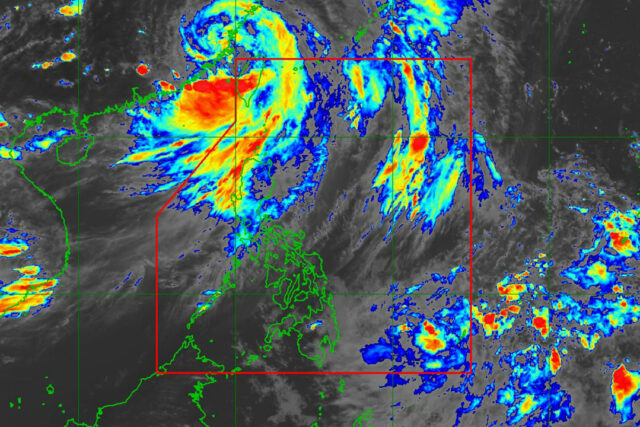
AGRICULTURAL damage due to the combined effects of the southwest monsoon enhanced by Typhoon Carina (international name: Gaemi) was initially estimated at P203.38 million, according to the Department of Agriculture (DA).

In a bulletin on Thursday, the DA said that the damage was reckoned at 2,574 metric tons (MT) of crops across 10,688 hectares of farmland.

The DA said that about 61.7% or 6,595 hectares of affected crops were judged to have a chance of recovery, with 38.6% or 4,093 hectares no longer recoverable.

It added that about 9,198 farmers and fisherfolk were affected by the weather events.

The majority of damage was to the rice crop, which made up 97.2% of the total. Lost volume was estimated at 2,299 MT valued at P191.53 million, with the damage spanning 10,442 hectares.

“Most of the damage and losses to rice are in the newly planted, vegetative, and reproductive stages,” the DA said.

The DA valued corn losses at P3.27 million, with volume estimated at 56 MT.

Damage to high-value crops was tallied at 219 MT valued at P8.5 million. Livestock damage totaled 2,323 head valued at P80,900.

The DA said that its regional offices were ready to distribute 72,174 bags of rice seed, 39,546 bags of corn seed, and 1,966 kilograms of vegetable seed.

It added that farmers can borrow up to P25,000 from the Agricultural Credit Policy Council, payable in three years.

The government weather service, known as PAGASA (Philippine Atmospheric, Geophysical and Astronomical Services Administration), said Typhoon Carina left the Philippine area of responsibility early Thursday.

It caused serious flooding in Metro Manila and neighboring areas, prompting the declaration of State of Calamity.

The Department of Trade and Industry has implemented a freeze on basic commodities such as rice, corn, bread, fresh vegetables, root crops, pork, beef, poultry, eggs, milk, coffee, sugar, cooking oil, salt, laundry soap, detergent, firewood, charcoal, candles, and medicine. — Adrian H. Halili

PHL pork, chicken imports seen rising — USDA

PHILSTAR FILE PHOTO

PORK AND CHICKEN imports by the Philippines are expected to increase this year as producers seek alternative markets in the face of falling China demand, the US Department of Agriculture (USDA) said.

In a report, the USDA said that major meat exporters like the European Union, Brazil, and the US will seek to sell more to the Philippines, Japan, and South Korea.

“However, these markets will only partially offset lower China demand,” the USDA added.

Philippine pork imports are expected to rise to 500,000 metric tons (MT) this year, against the 448,000 MT estimated by the USDA last year.

In the five months to May, imports of pork rose 10.6% to 253,548 MT, according to the Philippines’ Bureau of Animal Industry.

The USDA said Philippine hog production is expected to be flat after a 1.05 million MT (MMT) performance in 2023.

This would result in a shortfall in meeting demand of about 1.59 MMT this year. Demand is projected to grow 2% from last year.

On the other hand, shipments of chicken meat are forecast at 465,000 MT in 2024, against the 438,000 MT shipped in 2023.

Domestic chicken production was expected to rise 3% to 1.54 MMT this year, the USDA said, resulting in a shortfall with chicken consumption estimated at 1.99 MMT.

According to the Meat Importers and Traders Association, Executive Order (EO) No. 62, which extended low import tariffs, could stabilize meat import costs even with high international prices.

EO 62, signed by President Ferdinand R. Marcos, Jr., extended low tariffs on pork and mechanically deboned chicken meat until 2028.

The tariff for pork was kept at 15% for shipments within the minimum access volume and 25% for those exceeding the quota. On the other hand, the rate for mechanically deboned chicken was retained at 5%. — Adrian H. Halili

IP law needs to evolve with advances in tech, trade agreements — IPOPHL

THE Intellectual Property Office of the Philippines (IPOPHL) said that the Intellectual Property (IP) Code of the Philippines needs to be responsive to developments in technology while complying with international commitments.

IPOPHL Director General Rowel S. Barba said at the Trademark Conference on Wednesday that the law is 27 years old, making it ripe for updating to address emerging challenges.

“It needs to be amended to respond to technological advances, which have created new challenges in protecting and enforcing IP rights, (and) to increase penalties to deter counterfeiting and piracy, particularly those acts that endanger life and health,” the IPOPHL said.

It added that amendments to the IP law should help the Philippines comply with international agreements like the protection of sound marks under the Regional Comprehensive Economic Partnership (RCEP) agreement.

IPOPHL said that among the provisions that require immediate amendment is the limited enforcement function of the agency in addressing IP rights violations.

It said amendments must also transform its enforcement office into a bureau.

The IPOPHL also cited the need to remove the P200,000 threshold for claims in filing complaints and cases as it limits micro, small and medium enterprises’ access to IPOPHL services.

Meanwhile, the IPOPHL sees the expansion of the coverage of registrable marks under the IP Code as a way to help the Philippines comply with its RCEP commitments and spur creativity.

Another required amendment sought by IPOPHL is the removal of the prohibition against the parallel filing of patents, utility model applications, and provisional patent applications.

It cited the need to transfer the mandate of the National Library of the Philippines to administer copyright deposits and registrations to the IPOPHL.

According to the IPOPHL, the bills pending in Congress seeking to amend the IP Code include Senate Bill No. 2326, House Bill (HB) No. 3838, HB 2672, and HB 799. — Justine Irish D. Tabile

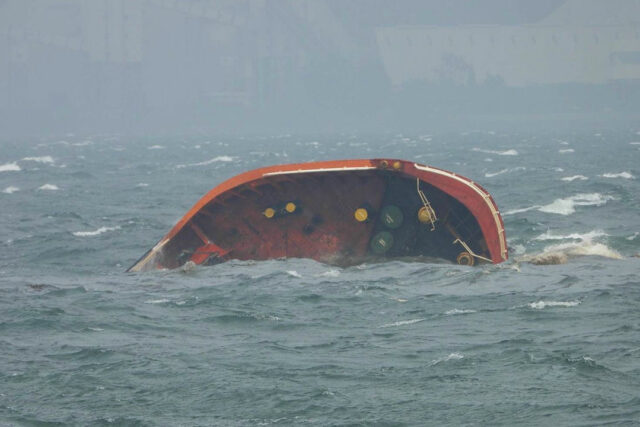
Philippine oil tanker causes oil spill after capsizing off waters of Bataan

THE SUNKEN MT Terra Nova off Bataan. — PHILIPPINE COAST GUARD FACEBOOK PAGE

A MARINE tanker carrying industrial fuel sank in rough seas off the Philippines on Thursday, causing a large oil spill, authorities said.

A search was under way for a missing crew member of the MT Terra Nova, which was carrying 1,494 metric tons of industrial fuel when it capsized off the coastal town of Limay, Bataan province in the country’s north, Transportation Secretary Jaime J. Bautista told a situation briefing with President Ferdinand R. Marcos, Jr. in Manila.

Sixteen crew members were rescued.

“There is already an oil spill,” he said. “Right now, we cannot dispatch our resources because of strong winds and high waves.

Philippine Coast Guard spokesman Armando A. Balilo told a separate briefing a 97-meter coast guard vessel had been deployed to search for the missing sailor and combat the oil spill.

Smaller vessels were waiting for the weather to clear before they could sail.

An aerial survey by the coast guard showed an oil slick spreading roughly two nautical miles and being driven by strong waves.

“We are racing against time. We will do our best to contain the fuel,” Mr. Balilo said.

He added that the waters where the ship sank is close to Manila, and there is a “big danger” the spill could reach the capital.

“That’s part of the contingencies that we are preparing for,” Mr. Balilo said.

At the situation briefing, Mr. Marcos ordered the Environment department to assess the damage. The agency’s chief was on her way to Limay town.

Mr. Marcos told the Environment and Science and Technology departments and the Philippine Coast Guard to assess the environmental impact of the spill.

An investigation was under way whether the sinking was related to Super Typhoon Carina (International name: Gaemi), which on Wednesday flooded swathes of the capital Manila and surrounding towns.

At least 21 people have died from the super typhoon and monsoon rains, according to police. Authorities said the toll could go up.

LSEG’s Eikon data showed Terra Nova has a deadweight tonnage of 1,415 tons and was headed to the central province of Iloilo.

The oil tanker MT Princess Empress was carrying about 800,000 liters of industrial fuel when it capsized on Feb. 28 last year and eventually sank, causing an oil spill that took three months to clean up and hit tourist towns. — NPA with Reuters

Analysts urge China not to manipulate talks with Manila on sea dispute

BRP SIERRA MADRE, a marooned transport ship which Philippine Marines live in as a military outpost, sits on the disputed Second Thomas Shoal, part of the Spratly Islands in the South China Sea. — REUTERS

By John Victor D. Ordoñez, Reporter

CHINA should avoid a domineering stance in negotiations with the Philippines to ease sea tensions, security analysts said on Thursday, after Beijing told Manila not to complicate the situation.

“It shows the behavior of China as domineering and manipulative in the two-way process of resolving the South China Sea conundrum,” Chester B. Cabalza, founding president of Manila-based International Development and Security Cooperation, said in a Facebook Messenger chat.

“Beijing should learn to listen to Manila and set an equal footing to gain mutual respect and trust,” he added.

The Chinese Embassy in Manila did not immediately reply to a Viber message seeking comment.

At a news briefing in Beijing late Tuesday, Chinese Foreign Ministry spokesperson Mao Ning said the Philippines should not “backpedal” or do something that would complicate the sea dispute, after both countries reached an arrangement on resupply missions to a handful of Filipino soldiers stationed at Second Thomas Shoal.

Ms. Ning said the “provisional arrangement” agreed upon during the July 2 bilateral talks in Manila was an “active effort China made to keep the situation under control.”

China has said it would only allow Philippine resupply missions to the shoal, where Filipino soldiers live on a grounded ship, if it is informed in advance.

The Department of Foreign Affairs said Manila had never agreed to prior notification during talks with Chinese officials.

“It takes two to tango,” Rommel C. Banlaoi, chairman of the Philippine Institute for Peace, Violence and Terrorism Research, said in a Viber message.

“Both parties should avoid hostile and offensive unilateral actions to truly deescalate bilateral tensions and should exert best efforts to coordinate their activities without compromising their respective national positions,” he added.

Manila and Beijing need consent from each other before they can publicize the details of their arrangement on resupply missions, Philippine National Security Adviser Eduardo M. Año told a news briefing on Wednesday.

China claims more than 80% of the South China Sea, overlapping with the exclusive economic zones of Vietnam, Malaysia, Brunei, Indonesia and the Philippines.

A United Nations-backed tribunal in 2016 voided China’s claim over the waterway for being illegal. Beijing has ignored the ruling.

Chinese Coast Guard (CCG) forces with bladed weapons on June 17 boarded Philippine rubber boats and looted several rifles stored in gun cases, actions that Manila’s military chief Romeo S. Brawner, Jr. said only “pirates” do.

A Filipino Navy sailor lost a thumb during the encounter.

US Secretary of State Antony John Blinken and Defense Secretary Lloyd J. Austin III are set to meet with Philippine Foreign Affairs Secretary Enrique A. Manalo and Defense Secretary Gilberto Eduardo C. Teodoro, Jr. in Manila on July 30 to discuss maritime and security issues.

Meanwhile, the Philippine Coast Guard (PCG) said it had spotted a Shucha II-class China Coast Guard vessel near Capones Island in Zambales province, a day after the ship sailed around a South China Sea feature that is rich in oil and gas. 

The vessel was traveling at a speed of nine knots and was about 62 nautical miles west of Capones, PCG spokesman Jay Tristan Tarriela said in an X post.

“On July 23, it moved to the northeast of Recto Bank and stayed there for more than a day before proceeding towards its current location,” he added.

The vessel passed through Philippine waters amid rough seas along Luzon’s western seaboard brought by Super Typhoon Carina.

It left Scarborough Shoal on July 21 and headed toward El Nido, Palawan, where it joined a Zhaotim-class CCG vessel, Mr. Tarriela said. — with Kyle Aristophere T. Atienza

Death toll from Carina hits 21

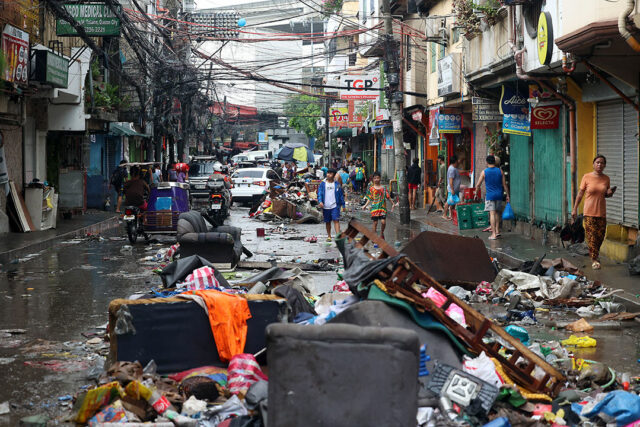
RESIDENTS of Tatalon village in Quezon City try to salvage their belongings as they clear their homes of rubbish and mud after Metro Manila was inundated by rains from Super Typhoon Carina and the southwest monsoon. — PHILIPPINE STAR/MIGUEL DE GUZMAN

SEVEN people died in the capital region mostly from drowning, five in Batangas province, three each in Cavite and Rizal provinces, one in Bulacan and two in Angeles City in Pampanga, police spokesperson Jean S. Fajardo told a news briefing, citing the local disaster agency.

Two of the deaths were a mother and her five-year-old daughter, who were buried in a landslide in Bulacan province, she said.

The disaster agency said more than 1 million people from about 245,000 families had been affected by Carina, which together with the southwest monsoon inundated Metro Manila and some northern provinces.

Almost 52,000 people from 12,199 families were staying in evacuation centers, it said.

Carina left the Philippine area of responsibility at 10 a.m. on Thursday, according to the state weather bureau.

“The opening of the new school year on July 29 may be at risk with thousands of schools severely affected and some being used as evacuation centers,” the United Nations Children’s Fund said in a statement.

Children are among those who suffer the most in any emergency, it said, noting that the Philippines had the highest number of children displaced in the past six years from weather-related events at 9.7 million.

The center of Carina, which had maximum sustained winds of 140 kilometers per hour (kph) and gustiness of up to 215 kph, was estimated at 515 kilometers north-northwest of Itbayat, Batanes province, it added.

President Ferdinand R. Marcos, Jr. visited several evacuation centers in Metro Manila, including those in Valenzuela City, which was submerged in floodwaters after La Mesa dam overflowed on Wednesday.

In his visit to the city’s command center, the President cited miscommunication between dam operators and local government units regarding water release.

“Communication has become our weak spot,” he said. “When you open the dams — if they would spill — the downstream communities need to be informed.”

A social media photo showed a passenger bus submerged in Quezon City as the Marikina River, which spans 16 bridges, reached as high as 20 meters.

Its water level rose to 21.5 meters during the onslaught of Typhoon Ondoy in 2009 that killed more than 700 people, and to 22 meters during Ulysses in 2022 killed about 100 people.

Also on Thursday, the office of Vice President Sara Duterte-Carpio in a statement said she left the Philippines on Wednesday for “a personal trip with her family.”

“The timing of the trip coinciding with Typhoon Carina is unfortunate,” it said. Reports earlier said Ms. Duterte-Carpio had flown to Germany. — Kyle Aristophere T. Atienza

BTr to file claim for school damage

PHILIPPINE STAR/WALTER BOLLOZOS

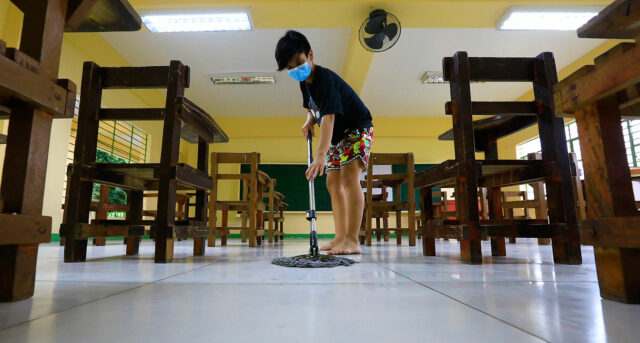
THE BUREAU of the Treasury (BTr) on Thursday said it would file an insurance claim under the National Indemnity Insurance Program to support public schools affected by Super Typhoon Carina.

The cost of the damage in 45 public schools in eight regions had reached at least P308.5 million it said in a statement.

The BTr is working with the Department of Education (DepEd) and Government Service Insurance System (GSIS) for the insurance claim. Once a payout is confirmed, the DepEd may use the funds to rehabilitate the schools, the Treasury bureau said.

The national insurance program provides cover for government assets against fire, lightning, typhoons, floods, earthquakes and volcanic eruptions. It started on Jan. 1 and is insured by the GSIS. — Beatriz Marie D. Cruz

No power for Meralco clients

BW FILE PHOTO

MANILA Electric Co. (Meralco) on Thursday said about 210,000 customers still had no electricity after it cut power to some flooded areas for safety.

Affected clients were mainly in Metro Manila and parts of Bulacan, Rizal, Cavite, Laguna, Batangas and Quezon provinces, according to the power distributor.

The number had gone down from more than 660,000 customers on Wednesday who experienced brownouts.

“The outages are predominantly due to heavy flooding across our service areas,” Meralco Vice President and head of Corporate Communications Joe R. Zaldarriaga told a news briefing. “Fallen trees and foreign objects obstructing power lines also caused power disruptions in several areas.”

In a report, the Energy department said no generation plant had been affected by the floods caused by Super Typhoon Carina. — Sheldeen Joy Talavera

DFA resumes passport interviews

DFA.GOV.PH

THE DEPARTMENT of Foreign Affairs (DFA) on Thursday said it would accommodate those with postponed passport renewal and application appointments at its Metro Manila, Central Luzon and Calabarzon offices starting Friday up to Aug. 26 after Super Typhoon Carina.

The presidential palace on Wednesday suspended work in all government offices in the three regions due to flooding caused by the typhoon and monsoon rains.

Metro Manila, which is composed of 16 cities and one municipality and home to at least 13 million people, was placed under a state of calamity. — John Victor D. Ordoñez

Carpio silence on SONA slammed

VICE-PRESIDENT Sara Duterte-Carpio — OFFICE OF THE VICE PRESIDENT

A CONGRESSMAN on Thursday questioned Vice President Sara Duterte-Carpio’s silence on President Ferdinand R. Marcos, Jr.’s State of the Nation Address (SONA) before Congress on Monday.

In a statement, Majority Leader and Zamboanga City Rep. Manuel Jose M. Dalipe said her decision not to support the presidential pronouncements including the ban on Philippine Offshore Gaming Operators (POGO) and the sea dispute with China undermined efforts to present a united front.

“While everyone was cheering the President for his decisive actions on the West Philippine Sea and POGO, Vice-President Duterte’s lack of response is indeed troubling,” he said.

“Her silence not only undermines the collective efforts of our government but also casts doubt on her commitment to the nation’s best interests,” he added.

The office of Ms. Duterte-Carpio, who was out of the country with her family, did not immediately reply to an e-mail seeking comment.

In a separate statement, Albay Rep. Edcel C. Lagman, Sr. berated Ms. Duterte-Carpio for leaving the country amid Super Typhoon Carina’s onslaught, citing her “lack of empathy.” — Kenneth Christiane L. Basilio

Lack of mobility plan scored

Motorists are stuck in traffic along ESDA in Cubao, Quezon City, Nov. 7, 2023. — PHILIPPINE STAR/MIGUEL DE GUZMAN

PRESIDENT Ferdinand R. Marcos, Jr. failed to say how he plans to solve traffic congestion in Metro Manila and offer a comprehensive transport plan in his State of the Nation Address (SONA) to Congress on Monday, according to a mobility advocate.

“A part of us was hoping that the President would reiterate the need for a comprehensive transport plan,” AltMobility PH Director Ira F. Cruz told BusinessWorld in a Viber message. “Past SONAs and the 2025 budget of the Department of Transportation, much of which has been allocated for airports and seaports, did not leave much room for optimism.”

He said the group was “not surprised” that the President chose to ignore the day-to-day mobility needs of ordinary Filipinos. — Chloe Mari A. Hufana