Home Blog Page 2404

Enstack to take super app to Thailand in 2025

ENSTACK.COM

By Beatriz Marie D. Cruz, Reporter

ENSTACK, a Philippine super app for small and medium enterprises (SMEs), plans to take its platform to Thailand by the second quarter of 2025, according to its top official.

“Next year, Enstack is looking to broaden its reach and make our platform accessible to more sellers across new regions, with Thailand as our next country,” Macy Castillo, co-founder and chief executive officer at Enstack, told BusinessWorld in a Viber message.

Enstack is looking to expand in other regions where SMEs face challenges similar to the Philippines, amid the increasing need for digital tools for smaller firms.

“While we’re initially focused on Southeast Asia, we’re also evaluating markets where our platform can bring unique value to local entrepreneurs and support diverse business models effectively,” Ms. Castillo said.

“Specifically, we’re looking for regions that face challenges similar to those in the Philippines, especially where businesses need quick setup solutions, instant payments, integrated shipping options and other essential tools for seamless operations.”

Enstack has an all-in-one mobile app that helps SMEs manage their business on their smartphones. It allows SMEs to track their inventory, payments and shipping, among other things.

Since its launch in February last year, Enstack has on-boarded almost 200,000 merchants and as many as 40 partners.

To support a wider range of SMEs, Enstack has been working on partnerships to cater to other industries and business types on its platform, Ms. Castillo said.

It is also refining the app interface to ensure seamless order tracking, inventory updates and customer messaging.

Enstack recently partnered with Canva to provide users with free design tools to help SMEs without design experience or resources.

Under the new feature, business owners can download a curated selection of Canva templates and design assets through the Enstack app. The designs were specifically created by the Enstack team to fit businesses’ needs.

Business owners can personalize ready-made designs for their posts, stories or web store banners for different platforms such as Instagram, Facebook and TikTok.

“Each template is crafted to drive maximum impact, helping sellers create visuals that truly resonate with customers,” Ms. Castillo said. “They’re also ready to go for Enstack Web Stores, so sellers won’t need to worry about adjustments or resizing; all they have to do is edit their content and upload it on the Enstack app.”

Enstack expects to integrate additional Canva features in its app by the first quarter of next year.

Bridge offers unique view of Rome’s Trevi Fountain during conservation work

COMMONS.WIKIMEDIA.ORG

ROME — Tourists and locals will be able to see Rome’s Trevi Fountain from a new angle by walking across a footbridge erected while it undergoes maintenance work.

The metal bridge, which will give visitors a closer look at the fountain’s intricate facade, will be up for about two months while work is in progress.

“(We) wanted to give everybody the opportunity to admire the fountain and to do this from a unique perspective,” Rome Mayor Roberto Gualtieri told Reuters at the opening of the bridge on Saturday.

“Normally you would never be able to see what you can see from the walkway… so it’s actually a unique opportunity.”

Restoration of the fountain — a Baroque masterpiece completed in 1762 — is expected to be completed by the end of the year.

The work includes removing dirt, pollution, iron oxide, and lime scale, Anna Maria Cerioni, head of restoration works for Rome’s art and cultural heritage, told Reuters.

A similar walkway was used in 2014 during much longer restoration works.

Only 130 people will be allowed on the bridge at any one time, as authorities look for ways to limit access to one of the city’s busiest monuments.

Mr. Gualtieri said Rome was for now not considering charging for admission but was looking at ways to make visits to the fountain “an experience that will not be ruined by overcrowding.” — Reuters

Maya Bank issues over 50,000 credit cards in partnership with Landers

MAYA BANK has issued over 50,000 credit cards in partnership with membership shopping mart Landers Superstore as of Nov. 11, or just three months after the product’s launch.

“Our entry into credit cards with the Landers Cashback Everywhere is a major milestone for Maya. We continue to launch new products to become a deeper part of our customers’ daily lives — from routine purchases to helping them meet larger financial goals,” Maya Group President and Maya Bank Co-Founder Shailesh Baidwan said in a statement on Tuesday.

Maya Bank said 61% of the credit cardholders reside outside Metro Manila. It added that 42% of their card users do not have another credit card.

The high credit card issuance was driven by the rewards and technology the card offers, Maya Bank said.

“The early success of the Landers Cashback Everywhere card shows we’re breaking barriers for the unhappily banked. “By embracing a high-tech approach, we’re reshaping what credit means — making it fast, rewarding, and accessible to all,” Maya Bank President Angelo S. Madrid said.

The application and approval process for the card is done fully online via Maya app. Applicants only need a Landers membership and a Maya account.

Cardholders get 5% cashback at Landers Superstore, 2% on dining, and 1% on all other purchases.

The card also includes features like card verification value or CVV for security, real-time spending limits, and digital management of credit lines.

Maya Bank is one of the six licensed digital banks in the country. It previously said it expects to breakeven by this year and be profitable by 2025.

The digital bank is owned by Voyager Innovations, Inc. PLDT Inc. is Voyager’s main shareholder. Hastings Holdings, Inc., a unit of PLDT Beneficial Trust Fund subsidiary MediaQuest Holdings, Inc., has a majority stake in BusinessWorld through the Philippine Star Group, which it controls. — A.M.C. Sy

PAL income falls to P789.79M on lower passenger revenue

BW FILE PHOTO

PAL Holdings, Inc. saw its third-quarter attributable net income drop to P789.79 million from P4.28 billion in the same period last year due to lower passenger revenue.

In a stock exchange disclosure on Tuesday, PAL Holdings, the listed operator of Philippine Airlines, said it generated a revenue of P41.53 billion, 11.9% lower than the P47.13 billion combined revenues in the same period last year.

“The latest net income report reflects our ongoing focus on investments to ensure higher-level products and services for our customers – building up our fleet, upgrading our cabins, rolling out digital innovations, and refining a high-performance culture for our teams,” PAL President and Chief Operating Officer Stanley K. Ng said.

Broken down, passenger revenue fell to P35.82 billion for the third quarter, 14.4% lower than last year’s P41.84 billion.

Cargo revenues also dropped by 28.9% to P2.45 billion from P3.45 billion previously, while revenues from ancillary services also went down to P3.35 billion, 1.2% lower than the P3.39 billion in the comparable period a year ago.

“As market conditions normalize, we are continuing to see a moderation in growth and a more challenging business environment where rising costs exert greater pressure on the economics of airline operations,” Mr. Ng said.

For the nine months to September, PAL Holdings’ attributable net income went down by 55.4% to P6.76 billion from P15.16 billion in the same period last year.

For the January to September period, PAL Holdings’ gross revenue plunged to P132.45 billion, lower by 1.6% from P134.58 billion, the company’s financial statement showed.

Broken down, passenger revenue dropped by 3.9% to P115.66 billion from P120.08 billion, while cargo revenues went down to P6.47 billion, marking a decrease of 13.3% from P7.47 billion. Ancillary revenues, meanwhile, increased by 17% to P10.24 billion from P8.75 billion previously.

Gross expense for the nine-month period climbed to P120.09 billion, increasing by 9.5% from P109.70 billion in the same period last year.

For the nine months to September, Philippine Airlines carried 11.7 million passengers, the company said.

Its year-to-date capital expenditures increased to $263 million or P15 billion, which includes pre-delivery payments for the company’s aircraft order and maintenance requirements of its aircraft and engines and enhancements.

At the local bourse on Tuesday, shares in the company closed six centavos, or 1.13% lower, at P5.24 apiece. — Ashley Erika O. Jose

The labor, civil, and criminal implications of employee theft

FREEPIK

Employee theft is a serious matter that carries significant consequences under Philippine law. Among these implications are labor, civil, and criminal aspects, all of which an employer must carefully consider.

Various types of theft occur in the workplace, including outright theft of the employer’s money, falsifying payments to vendors and pocketing the budget, and stealing office supplies, materials, or products.

When an employee steals from their employer, the worst response is the immediate termination of the employer-employee relationship. Conversely, ignoring the incident and pretending that everything is fine can negatively impact the workplace culture. Before long, other employees may assume that stealing from the employer is acceptable, leading to widespread dishonesty.

LABOR IMPLICATIONS
While not indispensable, companies typically include theft as a punishable offense in their internal Employees’ Handbook or similar policies, prescribing corresponding penalties. Under Philippine labor law, employers have the prerogative to establish company policies and rules of conduct. Unless shown to be grossly oppressive or contrary to law, these policies are generally valid and binding. The Supreme Court has consistently upheld the dismissal of employees for violating company rules, emphasizing the importance of reasonable company policies.

The rules of conduct and discipline must be fair and reasonable based on the circumstances of each case. Before disciplining an employee for violating disciplinary rules, the employer must prove that the rules are work-related, made known to the employee, and that the imposed penalties are reasonable. It is crucial to inform employees of any company policy, provide them with a copy, and request their acknowledgment. Periodic reminders and training can also reinforce these policies.

Even without an express policy on theft, an employee can still be penalized under Article 297 of the Labor Code. Theft can be classified as serious misconduct, willful disobedience of the lawful orders of the employer in connection with work, fraud, willful breach of trust, or commission of a crime. In some cases, theft may also constitute gross and habitual neglect of duties.

However, having just cause for termination is not enough. The employer must also observe procedural due process, which requires issuing two notices.

The first is a notice to explain, containing the specific causes or grounds for termination, and giving the employee an opportunity to submit a written explanation within a reasonable period. After determining that termination of employment is justified, the employer must serve a written notice of termination indicating that: 1.) all circumstances involving the charge against the employee have been considered; and, 2.) grounds have been established to justify the termination of employment.

CIVIL IMPLICATIONS
To recover the stolen items or their value, the employer may deduct the corresponding amount from the employee’s final pay, provided that the employee has given a written authorization for any deductions.

If there is no final pay to deduct from, employers can file a civil case to recover the stolen assets or their monetary value. Under Article 2176 of the Civil Code, an employer can claim damages resulting from the theft, including restitution of the stolen amount and compensation for consequential damages.

Civil liability can also be included in a criminal case. The rule is that every person who is criminally liable is also civilly liable. In civil cases, the employer must establish the employee’s liability by a preponderance of evidence, meaning the evidence must show it is more likely than not that the employee committed the theft. However, in criminal cases, the prosecution must prove the employee’s guilt beyond a reasonable doubt.

CRIMINAL IMPLICATIONS
An employer may file different criminal cases against the employee depending on the specific circumstances. The most common case against a thieving employee is Qualified Theft, which is punishable by two degrees higher than simple theft. Qualified Theft involves grave abuse of confidence by an employee or person entrusted with the care of the property. Employers generally place significant trust in their personnel to responsibly manage company property. Consequently, the law regards this breach of trust with heightened severity, resulting in more stringent penalties when an employee perpetrates theft against their employer.

Before filing a Complaint-Affidavit with the Prosecutor’s Office, the employer must ensure that all documentation and evidence against the former employee is sufficient. This is crucial, considering the quantum of evidence required before an information is filed in court has recently been raised to “prima facie evidence with reasonable certainty of conviction.”

Employee theft has far-reaching implications under Philippine law, affecting labor relations, civil and criminal liabilities, among others. Employers must ensure they have robust policies, observe due process in disciplinary actions, and pursue appropriate legal remedies to protect their interests. Understanding these legal frameworks helps in effectively managing and mitigating the risks associated with employee theft. n

The views and opinions expressed in this article are those of the author. This article is for general informational and educational purposes only and not offered as and does not constitute legal advice or legal opinion.


Martin Luigi G. Samson is a senior associate of the Angara Abello Concepcion Regala & Cruz Law Offices (ACCRALAW), Davao Branch.

(6382) 224-0996

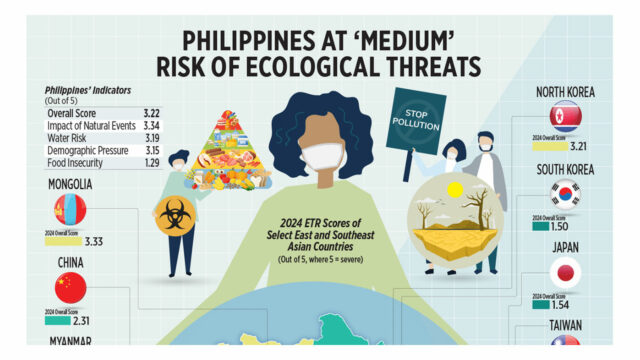
Philippines at ‘medium’ risk of ecological threats

The Philippines got an overall score of 3.22 out of 5 in the 2024 edition of the Ecological Threat Report (ETR) by think tank Institute for Economics & Peace. This put the country at a “medium” risk of natural disasters, food and water insecurity, and rapid population growth.

Philippines at ‘medium’ risk of ecological threats

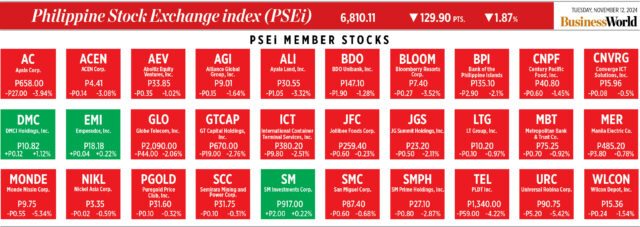
How PSEi member stocks performed — November 12, 2024

Here’s a quick glance at how PSEi stocks fared on Tuesday, November 12, 2024.


Philippines says it’s under pressure from China to cede claims in South China Sea

DEFENSE SECRETARY GILBERTO ‘GIBO’ C. TEODORO, JR. — GIBO.PH

By John Victor D. Ordoñez, Reporter

CANBERRA — China is putting ever-greater pressure on the Philippines to cede its sovereign rights in the South China Sea, Defense Secretary Gilberto Eduardo Gerardo “Gibo” C. Teodoro, Jr. said on Tuesday after a meeting with his Australian counterpart in Canberra.

“What we see is an increasing demand by Beijing for us to concede our sovereign rights in the area,” he said, adding that the Philippines is a “victim of Chinese aggression.”

China and the Philippines have sparred repeatedly this year over disputed areas of the South China Sea, including the Scarborough Shoal, one of Asia’s most contested features.

Mr. Teodoro’s meeting with his Australian counterpart Richard Marles, their fifth since August 2023, reflects growing security ties between the countries, both of which have expressed concern about Chinese activity in areas of the South China Sea claimed by the Philippines and other Southeast Asian nations.

The two nations signed a strategic partnership in September 2023 and held their first joint sea and air patrols in the South China Sea several months later. The Philippines also joined war games in Australia this year for the first time.

China claims almost the entire South China Sea, a conduit for more than $3 trillion of annual ship-borne commerce, including parts claimed by the Philippines, Vietnam, Indonesia, Malaysia and Brunei. The Permanent Court of Arbitration in 2016 said China’s claims had no legal basis, a ruling Beijing rejects.

Mr. Teodoro said China’s claims and behavior are contrary to international law, and defense deals with partners such as Australia are an important way to deter Chinese incursions.

“Although they (China) claim to act under the aegis of international law, everybody knows that what they’re doing is contrary to the tenets of international law,” he said. “The biggest evidence of this is that nobody has actually supported their actions or activities.”

In addition to closer ties with countries including Australia and the US, the Philippines also plans to spend at least $33 billion on new weapons including advanced fighter jets and mid-range missiles.

Mr. Marles said Australia wants to work more closely with the Philippine defense industry and would send an engineering assessment team to the country early next year.

Meanwhile, the Philippine and US Coast Guards held simulation exercises on maritime law enforcement, border security and illegal fishing as part of their efforts to ensure peace and stability in the region, the US Embassy in Manila said.

In a statement, the embassy said both coast guards held a technical workshop on maritime law in Bataan in northern Philippines on Nov. 5 to 7 that also had participants from maritime law enforcement agencies from Indonesia, Malaysia, Thailand and Vietnam.

It said 30 delegates engaged in scenario-based simulation exercises that aimed to improve maritime law enforcement.

At the workshop, Philippine Coast Guard (PCG) Deputy Director Captain Noriel P. Ramos said the venue was used to “discuss and collaborate on maritime law enforcement efforts for regional stability to ensure a free and open Indo-Pacific.”

This comes amid worsening tensions between the Philippines and China as Beijing continues to block resupply missions at Second Thomas Shoal, where Manila has a handful of soldiers stationed at a World War II-era ship that it grounded in 1999 to bolster its sea claim.

The PCG has borne the brunt of Chinese intrusions into the Philippines’ exclusive economic zone in the South China Sea, which Beijing claims almost in its entirety.

Manila and Beijing have repeatedly clashed in the waterway, accusing each other of aggressive behavior involving their ships and of damaging the marine environment.

PCG Commandant Admiral Ronnie Gil L. Gavan last week said the PCG is set to receive 49 new ships by 2028, 40 of which are funded by a French loan worth P25.8 billion and five from Japan, to boost patrols in the waterway.

US Embassy Deputy Director Luke Bruns said at the workshop that the exercises and exchange of expertise aimed to boost Washington’s “maritime cooperation among Southeast Asian partners.”

The Chinese Foreign Ministry late Sunday published territories and baselines around Scarborough Shoal, asserting its maritime claims.

China has controlled Scarborough, which falls within the Philippines’ exclusive economic zone but is also claimed by several other countries, since 2012 after maintaining constant coast guard presence there, according to the Asia Maritime Transparency Initiative.

Meanwhile, the Philippines’ National Maritime Council on Tuesday opposed the baselines, saying it was a continuation of China’s “illegal seizure” of the shoal in 2012.

“The straight baselines established by China around the shoal are without any legal basis or effect,” it said in a statement. “The Philippines strongly objects to the use of these baselines by China and resolutely maintains its right to declare the correct baselines around Bajo de Masinloc (Scarborough Shoal).”

Philippine President Ferdinand R. Marcos, Jr. has signed into law a measure that defines Philippine territories within its exclusive economic zone amid China’s growing assertiveness in the South China Sea.

The President has also vowed to upgrade the assets of the PCG. China has opposed the law, saying it illegally includes parts of Chinese territories in the waterway.

The Philippine Senate has also passed a bill that seeks to set up sea lanes at the Balintang Channel, Celebes and Sulu Seas, among other waterways, to assert Philippine sovereignty.

“The Philippine Maritime Zones Act is a legitimate exercise of the country’s right to determine and declare its maritime zones, consistent with international law,” the country’s maritime council said, citing the 1982 United Nations Convention on the Law of the Sea.

“The Philippines reiterates that it has always had sovereignty and jurisdiction over Bajo de Masinloc and that its maritime zones are consistent with international law and do not impinge on the sovereignty or jurisdiction of other states,” it added.


Marcos: Philippine-US economic ties won’t change under Trump

PRESIDENT FERDINAND R. MARCOS, JR. — PHILIPPINE STAR/RYAN BALDEMOR

By Kyle Aristophere T. Atienza, Reporter

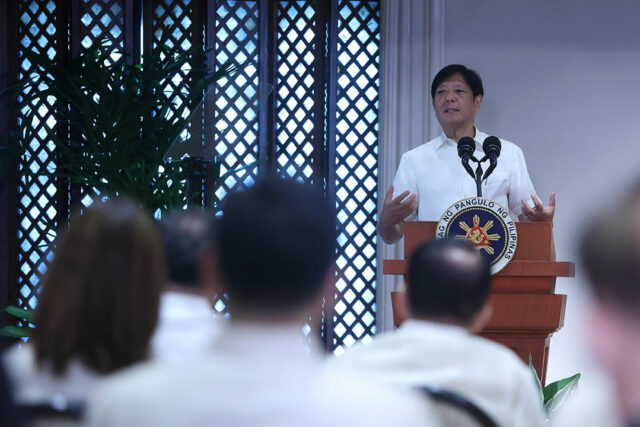
PRESIDENT Ferdinand R. Marcos, Jr. on Monday night said Philippine-US economic ties under a Donald J. Trump presidency would not change given their strong defense bond.

“I don’t think it will change,” he told reporters on the sidelines of a cruise industry event in Parañaque City. “They are our oldest treaty partner; that doesn’t change. So, I will have to see if there is a major change, but I don’t think so.”

Mr. Marcos earlier congratulated Mr. Trump on his win in the US presidential election, hoping for “unshakeable” Philippine-US ties.

He said he looked forward to working with Mr. Trump on a wide range of issues that “will yield mutual benefits to two nations with deep ties, shared beliefs, common vision, and a long history of working together.”

The US is the Philippines’ major security partner, with a 1951 Mutual Defense treaty compelling both nations to defend each other in case of an armed attack.

The US government under President Joseph R. Biden had reiterated that the treaty covers any attacks on Philippine vessels, personnel and other assets in the South China Sea and anywhere in the Pacific.

Last year, Manila gave Washington access to four more military bases under their 2015 Enhanced Defense Cooperation Agreement.

Finance Secretary Ralph G. Recto on Monday said Manila hopes it could improve ties with the US on the economic front under a Trump presidency since the two nations are security allies.

Last month, he flagged a potential “setback on multilateralism” particularly in trade, which he said has been a driver of global growth.

Mr. Trump wants to impose a 60% tariff on all Chinese goods and a 10% universal tariff.

“While the Philippine-US ties are highly likely to remain stable, the economic landscape will be shaped by global dynamics, including the US position on China,” John Paolo R. Rivera, a senior research fellow at the Philippine Institute for Development Studies, said in a Facebook Messenger chat. “This may present both opportunities and challenges for the Philippines.”

On trade, decoupling trends targeting China could deepen Philippine-US economic engagement, he said, citing the Philippines’ competitive advantage in the electronics, semiconductors and outsourcing sectors.

“Stronger military cooperation can increase economic support. However, any escalation in security ties would need careful management to balance economic dependencies and regional stability.”

Meanwhile, Defense Secretary Gilberto Eduardo Gerardo “Gibo” C. Teodoro, Jr. on Tuesday said the Philippines has no expectations about what President-elect Trump would do regarding territorial disputes in the South China Sea. He issued the remarks during a visit to Canberra, the Australian capital.

Tropical Storm Usagi enters Philippines as Toraji leaves

PAGASA.DOST.GOV.PH

TROPICAL Storm Usagi, locally named Ofel, has entered the Philippine Area of Responsibility (PAR) and was set to make landfall over Northern or Central Luzon, the state weather bureau said on Tuesday.

“Regardless of the position of the landfall point, it must be emphasized that hazards on land and coastal waters may still be experienced in areas outside the landfall point or forecast confidence cone,” the Philippine Atmospheric, Geophysical and Astronomical Services Administration (PAGASA) said in a 5 p.m. bulletin.

Usagi was last seen 780 kilometers east of Virac, Catanduanes province, and it was moving west-northwestward at 30 kilometers per hour (kph). It was packing maximum sustained winds of 95 kph near the center and gustiness of up to 115 kph.

The weather bureau said Usagi had intensified into a severe tropical storm as it headed toward northern Philippines.

This comes after the area was battered by Typhoon Toraji (Nika), which left the Philippines at 2 p.m.

PAGASA said Usagi was expected to make landfall over the east coasts of Cagayan or Isabela province by Thursday (Nov. 14).

“Areas in Northern Luzon are at risk of heavy rainfall, severe wind and possibly, storm surge inundation from Ofel, which may cause considerable impacts,” it added.

It said provinces in Central and Southern Luzon might also be affected if the tropical cyclone further intensifies.

Separately, PAGASA was still monitoring Tropical Storm Man-Yi, which was last seen 2,515 kilometers east of Virac, Catanduanes province, and was traveling westward at 30 kph.

Man-Yi was packing maximum sustained winds of 75 kph near the center and gusts of up to 90 kph. Once it enters the PAR it will be named Pepito. —  Adrian H. Halili

MMDA, Comelec to share assets for 2025 polls

PHILIPPINE STAR/EDD GUMBAN

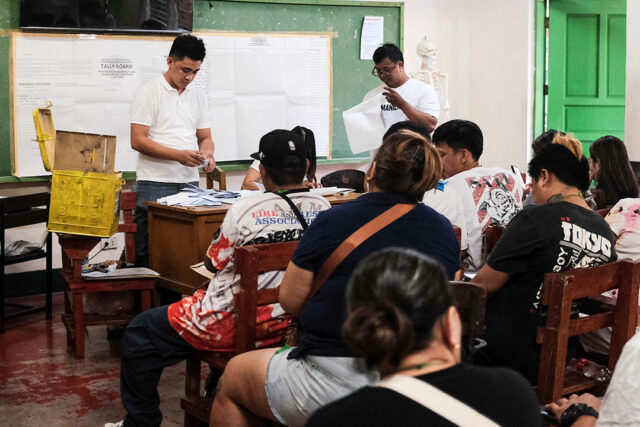
THE Metropolitan Manila Development Authority (MMDA) and the Commission on Elections (Comelec) on Tuesday signed a memorandum of agreement (MoA) to coordinate efforts and share resources for the upcoming 2025 midterm polls.

The agreement will give Comelec access to MMDA’s Command Center, equipment and personnel to support election-related operations.

“MMDA assets including our command center, body cams, radios, deployable cameras, and Mobile Command Center, will be made available and placed at Comelec’s disposal during the election period to ensure a clean, honest, and transparent election,” MMDA Chairman Romando S. Artes said in a news briefing in mixed English and Filipino.

“Also, aside from the deployment of our trained personnel for traffic assistance, MMDA will assign necessary manpower to assist election officers of the National Capital Region and Comelec Main Office in carrying out the teardown and removal of unlawful election materials,” he added.

The MoA will also cover assistance to Comelec’s final testing and sealing, international observation, and mock elections among other election-related activities.

It has over 330 close-circuit televisions (CCTVs) in its command center.

The Comelec will assign a computer station at the Command Center to ensure proper use of facilities and to coordinate technical support, equipment, transportation, and storage devices at docking stations.

The MMDA will also supply Comelec with manpower and logistical support to help election officers remove illegal election materials.

Both agency officials called on candidates and the public to follow the regulations and be responsible for displaying election materials.

“We hope there is a responsible way for them to put up campaign materials that is consistent with, and pursuant to, our guidelines, first of all. Secondly, we want to ensure it does not disrupt traffic or inconvenience pedestrians,” Mr. Garcia said in Filipino.

The Philippines will hold midterm elections on May 12 next year, where Filipinos will elect their congressmen, mayors, vice mayors and members of city councils. Twelve of the 24-member Senate will also be replaced.

The period of filing for candidacy ended on Oct. 8, which saw 184 people seeking a seat at the Senate, and 190 party-list groups seeking congressional seats. — Chloe Mari A. Hufana

Gov’t shifts anti-drug strategy 

PHILIPPINE STAR/MICHAEL VARCAS

THE MARCOS government will focus on the supply side in its anti-drugs campaign, with an eye on big-time players, according to the Department of Interior and Local Government (DILG).

The Philippines for the longest time has been focused on the consumption side, arresting users on streets and during buy-bust operations, said Interior Secretary Juanito Victor “Jonvic” C. Remulla, Jr. at a Palace briefing on Tuesday.

“This time, we are going heavy on the supply side chasing after the big guns, the big suppliers, the main men involved in the importation of drugs,” he added.

“The personalities have been identified; I am not at liberty to discuss it.”

Mr. Remulla, Justice Secretary Jesus Crispin C. Remulla, Philippine Drug Enforcement Agency Chief Moro V. Lazo, and police chief Rommel Francisco D. Marbil met with Mr. Marcos on Monday to discuss “a new strategy towards fighting the war on drugs,” according to the DILG chief.

He said the Muntinlupa City Jail remains the number one source of drug trade in the country.

Authorities are “taking proactive steps” to transfer high-value detainees from the jail to a “maximum security facility somewhere in the Philippines.”

“I think the operations will be set pretty soon and we should see a marked difference in the war against drugs here in the Philippines.” — Kyle Aristophere T. Atienza

ADVERTISEMENT
ADVERTISEMENT