Home Blog Page 2387

On the path to PHL’s sustainable future

BusinessWorld, The Freeman hold forum on enhancing the country’s SDG investments

By Bjorn Biel M. Beltran, Special Features and Content Assistant Editor

As the years pass, the pressure for sustainability becomes ever more pressing. The climate crisis, resource scarcity, and social inequality are all complicated issues that demand immediate and innovative solutions, and as a result the need for sustainable development has become an imperative.

As such, BusinessWorld and The Freeman, two leading news and media platforms of the PhilSTAR Media Group, conceived the “Investing for Sustainable Development from Cebu and Beyond” forum, to serve as a clarion call for transformative action, and encourage stakeholders to redefine what progress means in this increasingly complex world.

Held on Oct. 18, at the NUSTAR Ballroom, NUSTAR Resort & Casino, the forum was a one-of-a-kind gathering of leaders, policy makers, corporate executives, and advocates united by a shared vision: to accelerate the Philippines’ progress toward the United Nations Sustainable Development Goals (SDGs).

Presented in partnership with Robinsons Land Corp. (RLC), the event highlighted the role Cebu might play in pursuit of this goal, as it continues to become a bustling economic hub and a model for sustainable practices for the Philippines. It invited key players from various industries to discuss not only the ‘why’ but, more importantly, the ‘how’ of sustainable investment — a focus critical for regions like Cebu, which are rich in resources yet vulnerable to ecological strain.

In his keynote address “Reviewing the Philippines’ Progress in Achieving SDGs,” Edwine Carrie, deputy resident representative of the United Nations Development Programme Philippines, provided an analysis of the nation’s journey toward achieving its sustainable goals, balancing optimism with a sobering look at the gaps that persist globally.

Acknowledging that the world is “severely off-track” in achieving the 2030 SDG targets, he noted that progress worldwide is estimated to be over 30 years behind schedule. This reality, he explained, is exacerbated by climate-related challenges, especially in vulnerable regions like the Asia-Pacific.

“Climate has been a thorn on the side for many Asia-Pacific countries, because of the recurrence of natural disasters. Climate inaction is threatening to derail the progress of the SDGs in the region,” he said.

Despite these challenges, Mr. Carrie pointed out that the Philippines has made notable strides in some SDG areas, particularly those aligned with poverty reduction and social inclusion, facilitated by the country’s resilient economic foundations. Moreover, the Philippines has integrated SDG indicators into its Philippine Development Plan, demonstrating a commitment to monitoring and advancing these goals.

Complementing this, Maria Veronica Magsino, deputy director-general for finance and administration at the Philippine Economic Zone Authority (PEZA), delved into the investment climate, highlighting progress in policies and the creation of support structures to attract responsible investments that align with sustainable development.

In her keynote titled “Assessing the Philippine Investment Climate for SDGs,” Ms. Magsino emphasized that creating a sustainable investment environment in the Philippines requires more than just tax breaks or incentives. “It requires collective strategic effort,” she said, alluding to the necessity for government agencies, private sector partners, and the international community to work in concert towards accelerating these goals.

Ms. Magsino also echoed Mr. Carrie in identifying climate change as a central concern for the Philippines, particularly given the country’s high vulnerability to natural disasters.

She argued that the Philippines could gain significant benefits from initiatives focused on climate adaptation and resilience, which not only address immediate environmental concerns but also create sustainable economic opportunities. In line with this, she stressed that innovation and development “need not come at the expense of the environment.”

Looking ahead, Ms. Magsino expressed optimism about the growth of sustainable investments in the Philippines, underscoring PEZA’s commitment to positioning the country as an attractive destination for businesses that align with the SDGs.

“Together with partners like the SEC, the DTI, and others, we are laying the groundwork for a more responsible and more sustainably managed business environment,” she said. “PEZA is optimistic at the growth of sustainable investments in the Philippines. Cebu, in particular, has the potential to be a hub for sustainable innovation.”

Opportunities and challenges

Panel 1: “Unlocking Doors to a Sustained Nation: Investment Opportunity Areas Supporting SDGs”

To discuss “Unlocking Doors to a Sustained Nation: Investment Opportunity Areas Supporting SDGs,” Vera Alejandria, AVP for Sustainability and CSR at Cebu Landmasters, Inc., emphasized the role private companies like theirs could play to further the SDGs.

Cebu Landmasters, in particular, she said was committed to pushing forward Sustainable Development Goals 9 and 11, to create more sustainable infrastructure and cities. She also expressed optimism for the impact of discussions about SDGs, saying, “Hopefully, through these forums, we will also bring out opportunities for more sustainable investments to accelerate our progress on the SDGs.”

Jay Yuvallos, president of the Cebu Chamber of Commerce and Industry, added that constant discourse in the business community is needed for any meaningful change to happen. He pointed out, “A challenge is people refusing to take responsibility. If plastic waste remains in the rivers and oceans, it’s no one’s responsibility. But once we have that conversation, then we can start doing something.”

Mr. Yuvallos added that these sorts of conversations also highlight the need for strong leadership to guide smaller businesses toward sustainable practices. “We need leadership to achieve anything in this world.”

Speaking on the government’s side, Evelyn Nacario-Castro, assistant regional director for Region VII at the National Economic and Development Authority, outlined strategic paths that businesses in Central Visayas could pursue to contribute to the SDGs.

Advocating for inclusive growth, she stated, “We hope that all of us enablers, government and private sector, can bring that rising tide that will lift all boats, so those who have the least will not be left behind. Not just survive, but thrive.”

In a subsequent fireside chat, Barun Jolly, president and general manager of Robinsons Hotels and Resorts (RHR), discussed “Planting the Seeds of Sustainable Tourism for a Greener Future.”

Acknowledging that tourism as an industry is inherently carbon-intensive because of its reliance on air travel, Mr. Jolly noted some cost-effective initiatives, such as tree planting, replacing single-use plastic bottles, and waste segregation, that could help the industry lower their carbon footprint.

“I won’t lie, greener initiatives are more expensive. A few years ago, if you asked me what the biggest challenge was, it was changing mindsets. But now we’re past that. Now we need to think about the costs, incentives, and returns,” he said.

The next panel on “Better Facilitation Towards Expanded Sustainable Investments” featured discussions on how to drive inclusive growth and attract sustainable investments to keep the country’s economic momentum going.
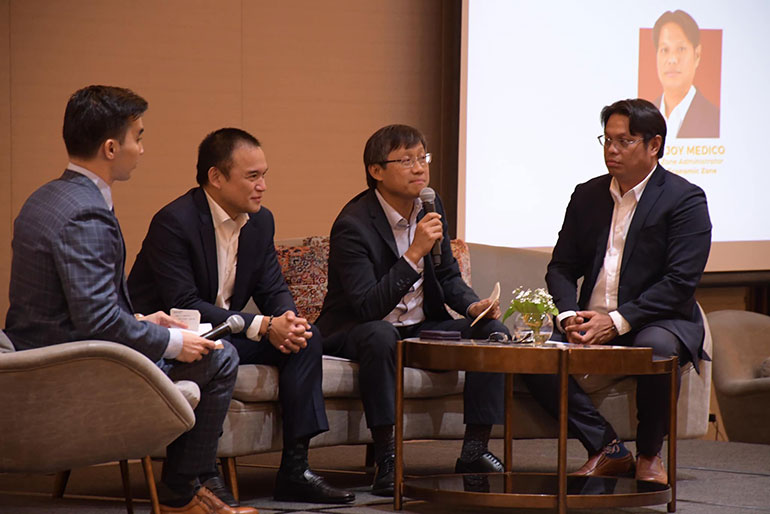
Panel 2: “Better Facilitation Towards Expanded Sustainable Investments”

Roderick Danao, chairman and senior partner at PwC Philippines, stressed the need for inclusive economic growth, critiquing the current model as disproportionately benefiting the wealthy. “When we talk about growing 5%-6%, we’re only talking about the rich getting richer,” he said.

Mr. Danao also noted that manufacturing investments could be a game-changer, suggesting the nation should make a transition from a consumer-led to an industry-led economy for more inclusive growth.

Engr. April Joy Medico, deputy zone administrator at the Mactan Economic Zone, offered his insights on sustainability from the perspective of PEZA. “We want to build more ecozones that are not just sustainable but inclusive,” Mr. Medico said, highlighting PEZA’s standardized processes across all economic zones, which provide coherence and reliability to investors nationwide.

Luis “Louie” Cruz, senior vice-president and group head of commercial banking at Bank of the Philippine Islands (BPI), said that he sees a lot of opportunity in places like Cebu to become a hub for sustainable development. “We’re very excited with Cebu. We have a huge team in Cebu because we really want to support this region moving forward,” he said.

Mr. Cruz said that BPI, for their part, is ready to fund any manufacturing initiatives, with access to capital markets if necessary. However, he emphasized that the country must create an environment attractive to investors to make this vision viable.

Alongside RLC as co-presentor, the “Investing for Sustainable Development from Cebu and Beyond” forum was made possible by sponsors Prime Integrated Waste Solutions, Shang Properties, Inc., Aboitiz InfraCapital Economic Estates, Primeworld Landholdings, Inc., Cebu Landmasters, Inc. and Cebu-Cordova Link Expressway Corp.; with official venue partner NUSTAR Resort and Casino.

The event was also supported by partners Cebu Chamber of Commerce and Industry, Asian Consulting Group, the American Chamber of Commerce of the Philippines, the British Chamber of Commerce of the Philippines, Bank Marketing Association of the Philippines, Management Association of the Philippines, Philippine Chamber of Commerce and Industry, the Philippine Franchise Association, the Philippine Retailers Association, and media partner The Philippine STAR.

PHSW 2024 highlights investments, innovation trends

From L-R: DICT-ICT Industry Development Bureau (IIDB) Assistant Director Jhino Ilano; DoST-Philippine Council for Industry, Energy, and Emerging Technology Research and Development (PCIEERD) Executive Director Enrico Paringit; SCALE NCR President Christina Ibañez; Ideaspace | QBO Innovation Executive Director Jay Farardo; and DTI-Bureau of Policy Research and Innovation (BPRI) Division Chief Karl Pacolor during the Philippine Startup Week 2024 Press Conference at the Blue Leaf Events Pavilion, Taguig

By Jomarc Angelo M. Corpuz, Special Features and Content Writer

The Innovative Startup Act (ISA) Steering Committee, led by the Department of Science and Technology (DoST), Department of Trade and Industry, and Department of Information and Communications Technology, recently held the 6th Philippine Startup Week 2024 (PHSW24) from Nov. 11-15 at the Blue Leaf Events Pavilion in Taguig City.

The five-day conference featured a series of activities nationwide including several conferences, a hackathon, a demo day, and the second edition of the KMC Startup Awards.

Among the events was a press briefing on Nov. 11 paneled by DoST-Philippine Council for Industry, Energy, and Emerging Technology Research and Development (PCIEERD) Executive Director Dr. Enrico C. Paringit, Department of Information and Communications Technology Industry Development Bureau Jhino Llano, Innovation and Collaboration Division Chief Karl Pacolor, Ideaspace Executive Director Jay Fajardo, and SCALE NCR President Maria Cristina Ibañez.

During the session, the panel discussed the government’s ongoing efforts to support the Philippine startup ecosystem, noticeable trends in the local startup landscape, and the investments needed from investors to help Filipino startup companies further grow.

“In terms of how much, I think relatively we really need as much of the resources we can get in terms of being able to fund the startups that we have here… So as much as possible, we want to unlock the capital coming from local people, but also from international investments,” said Mr. Pacolor.

Mr. Paringit echoed the sentiment and highlighted that substantial investments in funding are necessary to ensure effective programs and interventions for startups.

“I would say we are looking at something like P5 billion, that’s just the minimum. I may have to adjust it to be more aggressive. It’s nice to have these kinds of figures as a goal just for us to see if we are doing the right kinds of programs, putting up interventions,” Mr. Paringit said.

Meanwhile, Mr. Fajardo revealed that fintech, artificial intelligence (AI) and sustainable practices are emerging as prominent trends in the local startup scene.

“So far, what we’ve seen in our sphere, is a lot of fintech startups have emerged in our ecosystems… However, in the last 12-15 months, we’ve seen that these verticals diversify and include sustainable practices, and of course, AI startups,” he said.

Ideaspace Ventures Demo Day

Organized on the second day of the Philippine Startup Week, Ideaspace Ventures Cohort 12’s Demo Day showcased the latest batch of startups in its flagship accelerator program. The startup arm of the MVP Group added five startups to its portfolio on Nov. 12 and for the first time since its launch made immediate investments in the selected startups.

Included in the Cohort 12 startups are Collo, a property management app; Flying Tigers Express, an aerial logistics service provider; and Itemcount, a tool aimed at helping businesses with inventory management.

Also part of the group are Remotify, a platform designed to revolutionize remote work management on a global scale; and SwiftClaims, which focuses on streamlining the processing of claims for the Philippine Health Insurance Corp. (PhilHealth) and other health insurance providers.

The event also featured a fireside chat between National Development Company’s (NDC) Chairman of Investment Committee Alewijn Ong and Ideaspace Ventures Deputy Director and Head of Investments Ben Alderson.

The session discussed topics ranging from the establishment and principles of the NDC’s venture fund, the challenges in the Philippines’ startup ecosystem, and their collaborations with other government agencies and venture capital firms.

“We would like to let the world at large know that the NCD can actually not just provide funding but we can also invest in these companies. It’s a very strong message that the government is telling,” Mr. Ong explained.

At the end of the event, he also announced that the NDC, through its startup venture fund, along with investment firm Kaya Founders will be investing $300,000 in SwiftClaims, one of the startups on the demo day.

iThink Hackathon

The sixth edition of ISLA Camp’s (ICP Hub Philippines) iThink Hackathon also concluded on Nov. 15 at Tier One HQ, as a flagship event of the Philippine Startup Week 2024.

Co-presented by Tier One Entertainment, in partnership with Devcon Philippines and Filipino Web Development Peers, the 10-day hackathon offered aspiring developers and entrepreneurs a structured environment to ideate, build, and pitch projects that address real-world issues.

The hackathon is also a platform where teams showcased their projects to a panel of industry experts, potential investors, and partners seeking the next wave of Filipino-led innovations.

Earlier this month, the ICP Hub Philippines also awarded P50,000 in total prizes to the winners of the concluded Regional Assembly on Information Technology Education 2024 iThink Hackathon, a 30-day hackathon aimed to create digital solutions that address key issues related to the United Nations Sustainable Development Goals (SDGs).

Additionally, ISLA Camp, in partnership with the Philippine Society of Information Technology Educators (PSITE) Region 3, awarded five laptops to IT students from the region, honoring their hard work and dedication to their studies.

Remotify wins GrowthCon PH’s inaugural pitch competition

Remotify Founder and Chief Executive Officer Maria Sucgang

By Mhicole A. Moral, Special Features and Content Writer

An outsourcing startup wins the inaugural pitch competition of the annual GrowthCon PH earlier this November.

Remotify, an outsourcing firm specializing in remote hiring for small and medium enterprises, won the startup pitch competition, receiving P600,000 in exclusive article features on subscription-based business platform The Business Manual, the host of GrowthCon PH.

Maria Sucgang, founder and chief executive officer of Remotify, described how the company addresses challenges in talent acquisition, retention, and regulatory compliance. Its streamlined onboarding process, enabling job matching in as little as 10 minutes, proved successful, generating $1.2 million in gross merchandise value and $214,000 in gross profit in 2023.

In GrowthCon PH’s first startup pitch competition, nine finalists showcased their innovative ideas to a panel of venture capitalists and angel investors. The event allowed budding companies, whether operational or conceptual, to gain exposure and receive constructive feedback.

GrowthCon PH, on its second iteration this year, was held last Nov. 7 at the Ascott Hotel in Bonifacio Global City, providing essential skills, access to industry leaders, and networking opportunities to foster business growth.

With over 200 attendees, the event empowered Filipino entrepreneurs with practical solutions to navigate the competitive business landscape amid ongoing economic challenges.

“GrowthCon PH 2024 is a dream come true for entrepreneurs,” said RJ Ledesma, editor-in-chief of The Business Manual. “Nowhere else can entrepreneurs and aspiring entrepreneurs come together to share learnings, explore opportunities, and network with the leaders of successful Philippine startups. It’s like standing on the shoulders of giants.”

This year’s conference featured four dedicated sessions designed to tackle pressing business topics. Industry leaders shared their expertise on key areas essential for today’s entrepreneurs, including digital innovation, sustainable growth, and securing the right investment partners.

Notable speakers included representatives from Kaya, Foxmont, Ideaspace, Gobi, Manila Angel Investors Network, and National Development Company. Additional insights came from startups and businesses such as Peddlr, Avocadoria, Parlon, DMark, Humble Sustainability, SolX, Mylo, Luxe Beauty and Wellness, Baken, 1Export, Mtek, Kindred, Betterteam, and Go Rocky.

“At The Business Manual, we’ve created a platform for business enthusiasts to educate, inform, and inspire,” said Mr. Ledesma. “GrowthCon is the realization of that mission as a business summit for entrepreneurs.”

Companies can make customers ambassadors of sustainability, hospitality expert says

Barun Jolly, senior vice-president of Robinsons Land Corp.

By Patricia B. Mirasol, Multimedia Producer

Companies that communicate their sustainability efforts enable their customers to become ambassadors of sustainability, according to a hospitality expert.

Small changes in everyday operations can have a big impact in the environment, said Barun Jolly, senior vice-president of Robinsons Land Corp. and business unit general manager of Robinsons Hotels and Resorts (RHR).

A towel, as he pointed out in an interview on Oct. 18, takes eight liters of water to wash.

“Be it in water, be it in linen, we are telling the guest what the impact is and how they can be part of it,” he told BusinessWorld at the sidelines of the publication’s forum with The Freeman. “In our linen reuse program, for example, we don’t want to not change the linen and not let the guest be aware about it.”

The point of the linen reuse information cards in every room, he added, is to give the customer the choice of whether or not they need new towels or sheets, thus allowing them to take part in the advocacy.

RHR focuses on the Sustainable Development Goals (SDGs) on good health and well-being (3), affordable and clean energy (7), sustainable cities and communities (11), responsible consumption and production (12), climate action (13), life below water (14), and life on land (15).

Climate change is an area where the Philippines is regressing, according to Edwine Carrie, deputy resident representative of United Nations Development Programme Philippines, in said forum.

“Although the Philippines is in an upward trajectory, climate change is the main challenge,” he said at the event. “It could impact its ambition to be upper income in the region.”

The impacts of climate change reduce a country’s ability to advance SDGs, noted the 2024 Asia-Pacific SDG Partnership Report.

RHR’s sustainability efforts for 2024, Mr. Jolly also said, include an Earth Hour activity that resulted in a 0.39 reduction in greenhouse gas emission, as well as a water bottling plant in five of its hotels that decreased single-use plastic bottle use by 8.1 tons per year.

The organization is also looking into variable frequency drives — a motor controller that drives an electric motor by varying the frequency and voltage of its power supply — as an energy-saving tool.

Air-conditioning and heating carry the biggest impact in a hotel’s energy consumption, Mr. Jolly said.

“If a ballroom only has 100 people, [the technology] will adjust the cooling temperature so you’re not overcooling the area,” he said. “That can reduce 20%-30% of consumption.”

The initiatives extend to its workforce through the company’s internal sustainability awards, Mr. Jolly added.

“We hope our efforts inspire people… to be more attuned to green and sustainable energy,” he said.

Enderun Colleges students top EDUtech Sustainability Challenge in Singapore

Victoria Castro, Janis Tan, and Maria Angelica Candava, BSBA Sustainability Management students, along with Director of Academics and Sustainability Management Program Head Mhyles D.G. Oliva, celebrating their win from the EDUtech Sustain­ability Challenge at Marina Bay Sands

Students from Enderun Colleges emerged as the champion in the Planet Protectors Higher Education League at the EDUtech Planet Protectors Sustainability Challenge, making them the only Filipinos to reach the top three finalists.

Singapore Polytechnic took 2nd Runner-up, followed by the Institute of Technical Education (Singapore) as 1st Runner-up.

Enderun’s groundbreaking project, Rubbish Reborn, was led by BSBA Sustainability Management students Maria Angelica Candava, Victoria Castro, and Janis Tan, under the mentorship of Mhyles D.G. Oliva, director of academics and head of the Sustainability Management Program. The initiative focused on innovative waste management solutions designed to close the loop and support the school’s commitment to achieving zero waste.

Presented at the event held on Nov. 6-7 in Singapore, this achievement not only showcased their innovative approach but also positioned Enderun Colleges at the forefront of sustainability efforts in education.

The team shared 2022 United Nations Development Programme (UNDP) data showing a steady rise in the country’s solid waste. Enderun’s campus alone contributes around 10,000 kilograms of paper, plastic, and food waste each year, prompting a key question: Where does all this waste go?

In their sustainability classes, the team gained critical insights into the adverse impacts of the linear economy model, in which finite resources are extracted, transformed into products, and ultimately discarded in landfills. This realization proved to be a pivotal moment.

“This linear approach rapidly depletes natural resources, pollutes ecosystems, and neglects the essential need for long-term sustainability,” Ms. Candava explained.

It was compelling to ask: “What will happen when these resources are entirely depleted?” The answer, they realized, lies in a shift toward a circular economy — a system designed to reduce waste, reuse products, and restore nature.

Inspired by the growing need for sustainable practices, the team set out to develop an innovative solution that could transform Enderun’s waste management practices and contribute to a more sustainable future.

The team’s groundbreaking project, Rubbish Reborn, revolves around two key models for waste management, focusing on the segregation of paper, plastic, and food waste on campus. The aim is to not only reduce waste but also reuse it in a way that supports the school’s commitment to achieving a zero-waste goal by 2027. In effect, Enderun’s waste will ultimately return to campus in a new, reusable form through sustainable partnerships.

The first model under the project involves the recycling of paper and plastic products used on campus. “These items often end up in landfills, but we’ve found a way to give them new life,” said Ms. Castro. Partnering with Green Trident, a waste collection and sorting partner, the team is now able to connect with recycling companies like Papel ni Juan and Poly al Pro boards. These partnerships allow them to turn paper and plastic waste into eco-friendly products, such as 100% recycled paper for office use and eco-boards for building campus furniture.

“This process enables us to not only reduce waste but also create valuable resources that can be used on campus again,” Ms. Castro added. “It’s a prime example of the circular economy in action.”

The second model targets food waste, a significant contributor to landfill volume. Through their innovative research on Black Soldier Flies (BSF), the team has developed a process to bioconvert food waste into valuable byproducts. BSF larvae are used to convert food scraps into organic feedstock, which is then donated to local farmers in exchange for organic produce for Enderun’s cafeteria.

“The idea behind this is twofold: reduce food waste going to landfills and create a sustainable, mutually beneficial relationship with local farmers,” explained Ms. Tan. “We’re not just dealing with waste; we’re transforming it into something productive that supports our local community.”

By 2027, Enderun Colleges aims to reintegrate nearly 100% of the waste produced on campus into the circular economy. The team is already seeing promising results, with projections showing a 60% reduction in waste going to landfills, a 50% reduction in dependence on natural resources, and a 40% cost reduction in waste management expenses — cutting annual costs from P864,000 to just P500,000.

“Even with the costs of our BSF setup (P5,000) and Green Trident pickups (P504,000 annually), sustainability doesn’t have to be expensive,” said Ms. Tan. “In fact, these investments in sustainability not only save money but also open the door to more sustainable projects in the future.”

The Rubbish Reborn project represents more than just a waste management solution — it’s a testament to the power of innovation, collaboration, and forward-thinking leadership. Through their project, Misses Candava, Castro, and Tan are not only contributing to Enderun’s sustainability goals but are also setting a powerful example for other institutions to follow.

“This experience taught me the challenges of presenting at a convention,” Ms. Castro shared. “Manning our booth prepared me for the finalist keynote stage and helped me build confidence in front of an audience. Engaging with convention attendees highlighted the extensive behind-the-scenes work required to make our project successful, from logistics to execution.”

“Our sustainable waste management plan for Enderun was ready to launch, and unveiling it on an international stage was a strategic choice and a profound experience,” Ms. Oliva shared. “The event’s timing, our team’s synergy, and the sustainability themes in our project were meant to be. I had complete confidence in my team’s dedication; they not only met our vision but exceeded it with meticulous research and a dynamic presentation. We’re excited to bring this vision to life on campus, and I couldn’t be prouder of my incredible sustainability management team!”

NNIC working to clear way for new terminal with hotel demolition in 2025

PHILIPPINE STAR/MIGUEL DE GUZMAN

SAN MIGUEL-LED New NAIA Infra Corp. (NNIC) plans to resolve all issues to demolish the abandoned Philippine Village Hotel beside the Ninoy Aquino International Airport (NAIA) by next year to make way for a new terminal, a company official said.

“The Philippine Village Hotel, we want to start the demolition and construction by early next year, although there are many problems surrounding this plan,” NNIC General-Manager Angelito A. Alvarez told reporters on Friday last week.

Mr. Alvarez said that the NNIC is now coordinating with the local government of Pasay City, together with the Transportation department and the Manila International Airport Authority to have the building demolished.

“I think the local government saw the merit of our request. From the looks of it, in the next few days they will issue a permit,” he added.

Mr. Alvarez said the demolition of the Philippine Village Hotel faces many legal issues.

“We have a plan for this new terminal. We need this to decongest (our airport) because our airport capacity is only 35 million, but by the end of the year, it is projected that we will hit about 50 million,” he added.

NNIC Chairman Ramon S. Ang said the new terminal will add 36 passenger boarding bridges and accommodate 22 million passengers annually. He added that construction might take at least three to four years to complete.

The NNIC is also working on the renovation and upgrade of Terminal 4, which started on Nov. 6.

The new upgraded terminal, which has a budget of more or less P200 million, will reopen in February 2025.

With the ongoing upgrade of Terminal 4, all airlines operating there, such as AirSWIFT, Sunlight Air, and the regional brand of budget carrier Cebu Pacific, Cebgo, transferred to Terminal 2, where the domestic flights of Philippine Airlines are currently operating.

The new NAIA operator said that it is still ironing out its planned terminal reassignments to ensure minimal impact on operations.

The new terminal reassignment is expected to be implemented by the first quarter of 2025, Mr. Alvarez said.

“This terminal reassignment would only be the first phase. The first thing to do is to renovate Terminal 4. Once finished, we will relocate AirAsia from Terminal 2 to Terminal 4,” he said, adding that the terminal reassignments would be in a gradual manner.

To recall, NNIC said it plans to designate Terminal 1 for Philippine Airlines, Terminal 2 for domestic flights, Terminal 3 for all foreign airlines including Cebu Pacific and AirAsia Philippines’ international flights, and Terminal 4 for AirAsia Philippines’ domestic operations. — Ashley Erika O. Jose

ACEN unit plans to expand Palauig solar farm

ACENRENEWABLES.COM

ACEN Corp.’s subsidiary Giga Ace 8, Inc. plans to expand its solar farm in Palauig, Zambales to 420 megawatts-peak (MWp) from 346 MWp for P26 billion.

In a document submitted to the Department of Environment and Natural Resources, Giga Ace 8 proposed increasing the capacity and land area of its solar farm under its existing environmental compliance certificate (ECC).

Giga Ace 8, a special purpose vehicle for developing renewable energy projects in the Philippines, plans to expand the land area to 369.83 hectares from 275 hectares.

The project will include a battery energy storage system (BESS).

“The Giga Ace 8 Solar Power Project aims to achieve sustainable development and supply electricity to the Luzon grid to address the expected lack of supply and increasing demand for power,” the company said.

The integration of the BESS with the solar power plant will have an output of up to 200 MW, which is planned to be from 9 a.m. to 9 p.m. or until BESS is fully discharged.

“During solar hours, the plant’s output will primarily come from solar generation. Any excess solar generation will be stored in the BESS, while any energy deficit during the period will be supplied by the BESS,” the company said.

The company said it chose the project site in Barangay Bulawen and Salaza for its accessibility and high solar irradiance potential.

“The existing and the proposed expansion areas do not encroach on any protected areas and historical cultural properties,” Giga Ace 8 said.

The proponent is currently in the feasibility, permitting, and licensing, and detailed engineering phase for the proposed additional area.

Construction of the components under the existing ECC is ongoing and is slated for completion by the first quarter of 2026.

The target for commercial operation is the second quarter of 2026.

Construction for the additional area is scheduled from the first quarter of 2026 to the third quarter of 2030, with commercial operation expected by the fourth quarter of 2030. — Sheldeen Joy Talavera

How Kindred aims to bridge the healthcare gap for rural women

BW FILE PHOTO

By Beatriz Marie D. Cruz, Reporter

FEMALE-CENTERED healthcare technology (femtech) solutions provider Kindred plans to open three hybrid clinics outside Metro Manila to expand healthcare access for women in rural areas, its founder said.

“We’re still building our new solutions, new physical clinics… Right now, we’re constructing in three provinces, and even outside Luzon,” Maria Jessica J. de Mesa-Lim, founder and chief executive officer of Kindred, told BusinessWorld on the sidelines of an event on Nov. 7.

Kindred, offering online and in-clinic female health services, has two hybrid clinics in Taguig City and Quezon City.

In its rural expansion, Kindred aims to “hyperlocalize” its hybrid clinics to meet the needs of women in underserved areas, Ms. Lim said.

“It’s easier to have a template and replicate a one-size-fits-all strategy,” she said.

“But in healthcare, you’re dealing with people’s lives and health, so as much as possible, if we can customize per geographical area or category, it will be a big step toward positive change.”

Opening a women’s clinic in the province offers lower costs and minimal competition, but lack of awareness will be a challenge for femtech, Ms. Lim said.

“The hard part is more women are not aware that they actually need it… It’s harder to do a lot of awareness and education in areas where they didn’t have a lot of access to that education, so there’s much more work that needs to be done in increasing awareness there rather than here in Metro Manila.”

Women’s access to healthcare remains underfunded and under-researched due to a lack of funding and existing social stigmas.

Many women also fear being judged or do not know the options to protect themselves from sexually transmitted diseases or unwanted pregnancies, among others, she added.

The Philippines lags behind its Southeast Asian peers in women’s healthcare access, ranking 93rd out of 143 countries in the 2022 Global Women’s Health Index.

The index measures healthcare access in preventive care, emotional health, health and safety opinions, basic needs, and individual health.

Vista Land Q3 income rises to P2.64B; Villar optimistic on provincial demand

VISTAESTATES.VISTALAND.COM.PH

VILLAR-LED Vista Land & Lifescapes, Inc. recorded a 9.5% increase in its third-quarter (Q3) net income to P2.64 billion from P2.41 billion a year ago on higher revenue.

Revenue climbed by 2.4% to P8.87 billion from P8.67 billion last year, Vista Land said in a regulatory filing.

For the first nine months, Vista Land grew its net income by 10% to P9.08 billion from P8.22 billion in 2023.

The property developer saw a 7% increase in consolidated revenue to P29.1 billion. Vista Land launched P32.6 billion worth of new projects nationwide during the period.

“We are now reaping the fruits of our various Vista Estate projects across the country, which is one of the factors in the sustained growth in our reservation sales which amounted to P58.4 billion as the end of period,” Vista Land Chairman Manuel B. Villar, Jr. said in a separate e-mailed statement over the weekend.

Real estate revenue rose by 12% to P13.6 billion while rental income increased by 5.1% to P12.4 billion.

“We remain optimistic with the industry especially in the provincial areas where demand continues to rise,” Mr. Villar said.

Vista Land said it is not affected by the recent government ban on Internet Gaming Licensees, formerly known as Philippine Offshore Gaming Operators (POGOs).

“Our presence in 147 cities and municipalities across the country became apparent when we saw softening demand in Metro Manila due to the effect of the POGO ban,” Mr. Villar said.

Meanwhile, Vista Land President Manuel Paolo A. Villar said the company is reinforcing its position in the residential and commercial sectors.

“We have also seen steady growth in our 1.6 million square meters gross floor area of commercial portfolio which includes 42 malls, 59 commercial centers and seven office buildings as foot traffic returns to pre pandemic levels and we anticipate that we will see more in the coming holiday season,” he said.

Vista Land’s capital expenditures totaled P21.2 billion, equivalent to 71% of the P30 billion budget this year.

Of the amount, 70% was allocated to project construction, 28% to land development, and 2% to land acquisition.

The property developer said it has 2,969 hectares of landbank, allowing for growth in provincial areas and Metro Manila.

Vista Land subsidiary VLL International, Inc. previously issued $350 million in senior guaranteed notes due 2029 under a $2-billion medium-term note program, which will be used for refinancing, working capital, investment and other general corporate purposes.

“We are done with the 2029 dollar notes issuance. What we will be looking at next year is a liability management exercise for our dollar notes maturing in 2027,” Mr. Villar said.

Vista Land shares were last traded on Nov. 15 at P1.66 apiece. — Revin Mikhael D. Ochave

The Dragon Lady

JOSIE NATORI, née Almeda Cruz, once had her eyes set on the stage, to be a successful concert pianist. Fate took her to a different field, which led to her becoming one of New York’s most successful bankers. Even that was not enough, and Ms. Natori, in the 1970s, decided to clothe the world’s wealthy during their most private moments through her line of luxury loungewear.

At a show at the Grand Hyatt’s Garden Pavilion on Nov. 14, Ms. Natori “relaunched” twice: her Fall/Winter 2024 line had been launched in New York back in February (the show merely signaled the items’ availability in stores), but more importantly, the show is a reimagining of her 1984 “Natori State of Mind” campaign.

In the Philippines, Natori is carried in Rustan’s department stores.

The show was held in a lavish set done up in red, with a dragon as the backdrop. It opened with a performance, dancers clothed in Natori sarongs. What we saw on the runway included luxurious batik-like patterns with jewel tones, dragons on pajama sets, prints of peonies on white silk, and rich red caftans.

A second part, this time opened by a dance with lamps, showed more abstract Impressionist prints on pastel pinks, on items like shirtdresses and soft suits. A black skirt and sweater set with prints of blue hydrangeas evoked midnight, and for this line, blues were everywhere, looking like shadows: especially enviable was a black pajama set with a robe of black with white embroidery.

Giant opaque fans opened the third part of the show, showing pieces embroidered in white and gold. The motif was seen on a mantilla, a bomber jacket, a belted wrap dress, and a rich velvet lounge suit. We saw sequined pieces, even presented as a corset, a shift; the metallic theme was carried over to a kaftan embroidered with a gold dragon, as well as another dragon-themed piece, this time a kimono and slip set. I don’t know how she does it, but the cling of the silk suggested a life that inspires deep envy.

The show ended with a dance with gossamer fans (like moth wings), and an invitation for the audience to shop, with racks brought out on the runway. The easy audience took the invitation, with women flocking onstage and Ms. Natori herself recommending pieces.

“It’s very much exotic,” she said in an interview, expressing that the scrolls (what she calls the luxurious batik-like patterns) and the dragons, were a part of the brand identity. “That’s iconic to Natori.” We noted her renewed energy, her slim figure in a sleek silver suit. “What do you mean? I’m 77.”

“I keep working. I work 24/7.”

Aside from it being a dragon year in the Chinese Zodiac, Ms. Natori spoke about her use of dragons (a previous collection showed them off in bone white). “It says very strongly of strength. When you think about Natori, you think dragons. Maybe it’s the Dragon Lady. I don’t know. But it’s the idea of strength, and power, and spirit.”

In some superstitions, her age, 77, would be doubly lucky. She’s not slowing down, either way: “There’s an expression: ‘I’ll die with my boots on’.” — Joseph L. Garcia

CLI to push Metro Manila entry despite oversupply — COO

CEBULANDMASTERS.COM

PROPERTY DEVELOPER Cebu Landmasters, Inc. (CLI) is still pushing through with its planned entry into the Luzon market despite the oversupply of condominium units in Metro Manila, a company official said.

“We’re definitely still on with our Luzon expansion. This includes one horizontal development in the Cavite area and potentially a condo development in Metro Manila,” CLI Chief Operating Officer (COO) Jose Franco B. Soberano said in a virtual briefing last week.

“If we do acquire land, we’re looking at launching in 2026. We are expecting this Metro Manila oversupply to correct,” he added.

Last month, Leechiu Property Consultants said there is an oversupply of condominium units in Metro Manila worth 29 months, equivalent to 67,600 units across 510 buildings, due to high interest rates and the change in homebuyers’ preferences.

Quezon City and Ortigas (plus fringe areas) have the most unsold condominium units at 18,000 and 13,500, respectively.

Despite the oversupply, Mr. Soberano said that CLI is banking on demand from the middle class for the planned Luzon developments.

“Our market is just too strong, and we will see that shining through with our emerging middle class and people entering the workforce,” he said.

“For condo development, we’re really looking at good value-for-money sites. When it comes to housing, we are very confident. We are looking at more than 20 hectares or 2,000 units,” he added.

CLI is expecting to launch two additional projects for the remainder of 2024. These include the two-tower upper mid-market project The North Grove at Pristina Town in Cebu with over 1,000 units, and the first three towers in the 14.3-hectare Manresa Town township in Cagayan de Oro.

For the first nine months, CLI recorded a 7% increase in its net income to P2.3 billion, led by the core business and recurring income streams.

Revenue climbed by 9.2% to P14.1 billion as property sales grew by 8.7% to P13.8 billion on strong demand across residential, mid-market, and economic housing segments, along with commercial lot sales.

CLI stocks were last traded on Nov. 15 at P2.82 per share. — Revin Mikhael D. Ochave

An Indian giant

TITAN NEO WATCH

BY OWNING a Titan timepiece, what you’re looking at is just one of the products that the Tata Group produces, a veritable giant that casts a long shadow across India.

Kuruvilla Markose, chief executive officer – International Business, for Titan Company Limited,  discussed the hold that Tata has over India, in an interview with BusinessWorld on Nov. 8. “Sometimes, we call it a software to salt-kind of group,” he said. Through various subsidiaries, Tata owns India’s largest software company, sells industrial chemicals, but also tea (among other food products), and cosmetics. Through Tata Motors, it owns the Jaguar and Land Rover brands. Another unit, the one under which Titan belongs to, has interests in jewelry, watches, and eyewear. The Tata Group was founded by Jamsetji Tata in 1868.

“Fundamentally, one common thread that runs across us, the Tata Group is known for its professional practices, and also for consumer trust,” said Mr. Markose. “If you ask any consumer in India what Tata stands for, they’ll state that it stands for trust.”

Titan is the world’s fifth largest watch manufacturer, behind rivals in East Asia and Switzerland. Still, No. 5 is a big number: Mr. Markose said that they’ll end the year with 20 million watches manufactured and sold. “The reason why we are No. 5 is because we serve the Indian market. India today is now the world’s most populous country. It’s a huge market. It’s continuing to grow and from a per capita income perspective, and from an economy growth perspective, it’s the fastest-growing economy in the world.” In their home base, they have a 50% market share, and the watches are made across India.

The name does not come from the primordial giants of Greek myth. Titan’s name comes from the giants of Tata, as well as the Tamil government, operating as a private-public partnership since 1984. “Back in the ’80s, India was a regulated economy. Watches in India were a reserved sector. It was reserved for either the small-scale sector… or you had to be a government company. Only then can you enter and start the watch business,” he explained.

“We are not a high-end luxury brand. We are a brand for the people,” said Mr. Markose when asked about celebrities who wear their watches, within India and out. So who wears their watches? “Everybody.”

That’s not an exaggeration: their clientele ranges from first-jobbers to wealthy Emirati. The watches are present in 25 countries, including the Gulf nations, South Asia, Southeast Asia, Australia, and New Zealand, and are available online in the US and Europe.

The reason is in their pricing. In the Philippines, they’ve been distributed for about 10 years by Newtrends International Corp. (NIC), and are available at Watch Republic Shops, SM and Robinsons stores, and other department stores. There, they cost about P2,995, and a little bit higher. But they have another line that also ranges from 2,000 to 3,000 — dollars, that is. That’s the Nebula line, made completely of solid gold.

The company continues to make analog watches in an increasingly smart world, but then, Mr. Markose says, “Any watch is an expression of your personality. For men, there aren’t too many accessories that you have, and not all men are comfortable wearing jewelry.

“Using the watch to tell other people about you: just like your clothes, your hairstyle… is a wonderful way of letting other people know what you are like as a person,” he said. While smart watches can do things no analog watch can do (such as tracking your heart rate), “I’ll use a smart for functionality… but when I’m at work, or when I’m going to a party, I don’t want to wear a smart watch. I want to wear something nicer and more aligned to my personality… I don’t need to see my e-mail all the time,” he said.

That said, they’re introducing their own line of smart watches to the Philippines in about a month.

As mentioned earlier, their main rivals in the watch business are in East Asia and Switzerland. Aside from belonging to a giant like Tata, Titan has the whole of India backing up their rise across the charts. That’s not hyperbole: Mr. Markose talks about postwar manufacturing capabilities in Asia. “In the ’60s and ’70s, the Japanese sort of became a force to reckon with globally,” he said, talking about their cars, and their appliances, and their other goods. Korea followed, then China. “I believe that in the next 15 years, it’s going to be the time for Indian brands and Indian businesses.”

When watches were first invented, they were only in the hands of a few, ensuring that what they offered — the gift of knowing time, and thus, the movement of the world — were in their hands alone. That made timepieces a status symbol. With prices at P2,995, Titan’s watches are accessible to almost everyone.

“Feeling good is an important aspect of our existence as people. We all want to feel good about our jobs, our families, what we do. How we live. In a lot of ways, that expression of how you feel and the confidence that you get is in your appearance. That’s what we’ve tried to do, by giving people timepieces that make them feel good,” said Mr. Markose. — Joseph L. Garcia

ADVERTISEMENT
ADVERTISEMENT