Home Blog Page 2378

Philippines calls for $1.3-T COP29 climate finance goal

PHILIPPINE STAR/KRIZ JOHN ROSALES/PPA POOL

THE Department of Finance (DoF) said it is pushing for an initial climate finance target of $1.3 trillion from wealthy nations to fund developing nations’ climate mitigation projects.

“In the wake of Typhoon Pepito — the sixth typhoon to strike the Philippines in less than a month — the DoF has been pushing for an initial climate finance target of $1.3 trillion annually from developed countries….,” it said in a statement on Monday.

This will finance climate, adaptation and mitigation projects, while addressing losses and damage in developing nations.

Arab countries, including Saudi Arabia, are advocating supporting an annual funding target of $1.1 trillion, with $441 billion coming directly from developed nations in the form of grants.

India, African nations, and small island states have also called for raising over $1 trillion per year, though they differ on the share that should be contributed by wealthy countries.

The wealthy countries expected to provide these funds have not set a specific target, but both the US and the EU agree that it should exceed the previous $100-billion goal.

“That is why here at COP29, the Philippines is aggressively pushing for bold action and sustained, increased financing once and for all for countries that are perpetually on the frontlines of catastrophic typhoons,” Finance Undersecretary Maria Luwalhati C. Dorotan Tiuseco said during the High-Level Ministerial Dialogue on Climate Finance.

The DoF said it remains determined to utilize all available resources and implement tools across fiscal and financial sectors to strengthen disaster resilience, reduce economic impacts, and ensure financial protections for those affected by climate-induced disasters.

The Finance department is leading negotiations for scaled-up climate finance flows to vulnerable nations during the 29th Conference of the Parties to the United Nations Framework Convention on Climate Change (COP29) in Baku, Azerbaijan. — Aubrey Rose A. Inosante

PEZA registers 3 new locators in Cebu, Makati, Batangas economic zones

THREE new economic zone enterprises investing a combined P98 million registered with the Philippine Economic Zone Authority (PEZA) last week, the regulator said.

In a statement on Monday, PEZA said that the new registered business enterprises are involved in sustainable energy, advanced manufacturing, and information technology (IT) services.

“PEZA is committed to creating an enabling environment for investments that not only drive economic growth but also prioritize sustainability and innovation,” PEZA Director General Tereso O. Panga said.

“These registrations represent PEZA’s ongoing commitment to making the Philippines a competitive and sustainable investment destination,” he added.

Tsuneishi Green Energy Philippines, Inc. invested P61.06 million in a roof-mounted solar facility at West Cebu Industrial Park in Balamban, Cebu.

“The company will generate clean, sustainable power for the industrial zone, advancing the region’s green energy goals,” PEZA said.

“By backing renewable energy projects like Tsuneishi’s solar facility, PEZA is advancing clean energy solutions, reducing carbon footprints, and promoting sustainability, in line with its strategy to foster a green economy and attract eco-friendly investments,” it added.

Tractebel Red, Inc. will invest P24.37 million in an export knowledge and computer-enabled services project in Makati City.

“This investment promotes the Philippines as a hub for IT and tech-enabled services, contributing to job creation and innovation in the tech sector,” PEZA said.

“Tractebel Red’s registration reflects the growing interest in the Philippines from British companies, further boosting the country’s appeal as an investment destination in the global tech and IT services market,” it added.

Wenshan Electronics Philippines Corp. which will manufacture high-tech chip power inductors at the Light Industry and Science Park II in Santo Tomas, Batangas.

“This investment further strengthens the Philippines’ competitive position in electronics manufacturing, enhancing its capacity to support high-value production for the global market,” PEZA said.

It added that Wenshan’s facility and Tesla’s recent entry into the Philippines will help position the country as a key player in electric vehicles and the tech supply chain.

“This synergy boosts industry collaboration and attracts further foreign investments, advancing the Philippines’ role in sustainable tech innovation,” it said. — Justine Irish D. Tabile

DSWD crisis funds topped up by P5B

PHILIPPINE STAR/KRIZ JOHN ROSALES

THE Department of Budget and Management (DBM) has approved the release of P5 billion to top up a Department of Social Welfare and Development (DSWD) crisis fund.

In a statement on Monday, the DBM said it released the Special Allotment Release Order and its corresponding Notice of Cash Allocation amounting to P5 billion for the Assistance to Individuals in Crisis Situations (AICS) program.

The AICS program offers support, including medical, burial, transportation, education, and food assistance, as well as financial aid for other urgent needs of individuals and families facing crises.

“We cannot deny the severe impact of the climate crisis here in the Philippines. Typhoons Nika, Ofel, Pepito, and many more are on their way,”  DBM Secretary Amenah F. Pangandaman said.

“Through this, we are sustaining support for vulnerable and marginalized communities. We are bridging the resource gap required for extensive disaster recovery and sustained support throughout the nation,” Ms. Pangandaman said.

The DBM said the additional funds are authorized by the special provisions in the 2024 General Appropriations Act concerning the use of unprogrammed appropriations.

These provisions allow the use of funds for essential infrastructure and social programs, including financial aid for indigent citizens, subject to the availability of new or excess revenue, it said. — Aubrey Rose A. Inosante

Vegetable prices to remain high after typhoons

PHILSTAR FILE PHOTO

THE Department of Agriculture (DA) said on Monday that prices of lowland vegetables are expected to remain elevated due to the consecutive typhoons that traversed key farming areas this month.

“The price of vegetables remains elevated, especially for lowland vegetables, because the (vegetable growing) areas have been affected by typhoons,” Agriculture Assistant Secretary and Spokesperson Arnel V. de Mesa told reporters at a briefing.

The Philippines has logged six typhoons entering its Area of Responsibility in November, according to the government weather service, known as PAGASA.

The latest storm to hit the country was Super Tyhoon Man-Yi (Philippine name: Pepito).

“After typhoons, vegetable prices immediately increase about 10% to 15%; right now they are consistently high,” he added.

According to DA price monitors in Metro Manila market as of Nov. 15, the price of bitter gourd (ampalaya) was as high as P200 per kilo, string beans (sitaw) P160 per kilo, Chinese cabbage P140, squash P80, eggplant P220, and tomatoes P230.

A month earlier, bitter gourd prices topped out at P140 per kilo, string beans P100, Chinese cabbage P120, squash P70, eggplant P130, and tomatoes P170.

Mr. De Mesa said that among the affected lowland vegetable growing areas were Nueva Vizcaya, Cagayan, Central Luzon, and Quezon, Laguna, and Batangas provinces.

“Region 3 and the Southern Tagalog have been hit hard by the typhoons. So most likely the prices for vegetables will remain high,” he added.

According to a DA bulletin, the initial agricultural damage inflicted by typhoons Toraji (Nika) and Usagi (Ofel) was estimated at P248.47 million on lost volume of 8,504 metric tons.

The most affected commodity group was high-value crops, with lost volume at 5,946 MT, valued at P97.72 million. — Adrian H. Halili

Rice traders capturing benefits of low tariffs — FFF

PHILIPPINE STAR/WALTER BOLLOZOS

By Adrian H. Halili, Reporter

IMPORTERS are cornering much of the value from the lowering of rice tariffs, with prices not falling as much as they should have, a farmers’ federation said.

“Right now, the benefit from the lower tariffs is being captured mostly by importers, wholesalers and retailers,” Federation of Free Farmers (FFF) National Manager Raul Q. Montemayor said via Viber. “So one could argue that putting the tariff back to 35% will not lead to higher prices but will only lessen traders’ profits.”

The lowered tariffs are subject to review every four months.

The government lowered rice import tariffs via executive order in June to 15% from 35% until 2028, touting it as an inflation-containment measure. The intention had been to pass on the tariff savings to consumers, thereby dampening growth in the Consumer Price Index, of which food makes up the largest component.

The arrival of rice shipments charged the lower tariff coincides with the softening of global rice markets, raising the prospect of even lower prices by the start of 2025.

“Rice prices could remain lower with… world rice prices hovering around 2.5-year lows,” Rizal Commercial Banking Corp. Chief Economist Michael L. Ricafort said via Viber.

Former Agriculture Secretary William D. Dar said  rice prices could fall to between P45 and P50 per kilo “if the imports arrive on time.

Roehlano M. Briones, a senior research fellow with the Philippine Institute for Development Studies, said via Viber that he sees rice prices posting further declines until next year, citing the decline in world prices.”

Executive Order No. 62 took effect on July 5, The first four-month review has yet to be scheduled.

In a report, Fitch Solutions’ unit BMI said international rice prices are expected to decline in 2025 due to the easing of India’s ban on white rice exports.

In September India’s Directorate of Foreign Trade announced the lifting of the export ban on non-basmati white rice, citing ample inventory levels.

Last month, the Indian government also removed the minimum export price, which had been set at $490 per metric ton (MT).

BMI forecast global rice prices next year to decline to $14.2 per hundredweight (cwt) on average. Its previous forecast had been $14.85 per cwt.

The Department of Agriculture (DA) said that global rice prices have dropped to below $500 per MT from the $630 per MT reported in January.

The DA said that rice prices will remain stable with retailers expected to cut prices to P42 per kilogram.

According to its price monitors, well-milled rice in Metro Manila markets as of Nov. 15 fetched P42 to P53 per kilo, against P45 to P54 a year earlier.

Regular-milled sold for between P40 and P50 per kilo, against the P33-P50 per kilo price range registered a year prior.

“Well-milled rice around P42 per kilo will provide a happy balance between our goal of ensuring our farmers get a decent return for their hard work and consumers have access to affordably priced food, especially rice,” Agriculture Secretary Francisco P. Tiu Laurel, Jr. said in a statement on Monday.

Last week, the DA said that Metro Manila retailers committed to limit their profits on regular and well milled rice to between P3 and P5 per kilo.

Agriculture Assistant Secretary and Spokesperson Arnel V. de Mesa said in a briefing that imports are expected to make up for the anticipated drop in domestic rice production.

Malaking bagay ’yung pagbaba ng taripa at ’yung patuloy ng pagbaba ng presyo sa international market (The drop in tariffs and the continued drop in prices in the international market are a big deal),” Mr. De Mesa added.

“(Lower prices will) likely be sustained especially if the price continues to decrease in the international market,” he said.

The DA is projecting palay (unmilled rice) production to decline to 19.41 million metric tons (MMT), down 3.24% from a year earlier, due to losses caused by El Niño-induced dry conditions and the typhoons that hit the country towards the end of the year.

“The projected supply gap will have to be addressed by imports,” he added.

The Philippines is projected to import 5.1 MMT next year, according to the US Department of Agriculture.

According to the Bureau of Plant Industry, rice imports amounted to 3.9 MMT as of Nov. 7.

Italian chocolatier Venchi sees PHL sustaining two store openings a year

ID.VENCHI.COM

By Justine Irish D. Tabile, Reporter

ITALY’s Venchi Chocogelateria opened in Central Square in Bonifacio High Street on Tuesday, with its officials estimating that the Philippine market can sustain two store openings a year.

“The next is Podium in Ortigas, which is going to open in the second week of December… For next year, I think the team is already looking into a few options,” Venchi Asia-Pacific Chief Executive Officer Marco Galimberti told BusinessWorld in an interview on Monday.

“But we take it cautiously. We want to get only the top and right locations, and we need to be careful where and when we open. And we also need to get the business stable. So … two openings a year, I think, will be a good pace,” he added.

Venchi currently operates in Japan, Taiwan, China, Hong Kong, Macau, Singapore, Malaysia, Indonesia, and Australia.

The brand’s expansion was pursued in partnership with SSI Group, Inc.

“I think if you aim to be a global brand, (the Philippines) is a market that you need to address. It’s a market that has grown (as reflected in) the growth of SSI,” Mr. Galimberti said, noting the expansion of other international brands in the Philippines.

“The country is growing, so it’s just about the right time. The brand has grown outside of the Philippines, so there is a strong following of Filipinos living in Singapore and traveling to Singapore and Hong Kong,” he added.

SSI President and Chief Executive Officer Anton T. Huang said Venchi is currently positioned for the upper middle class segment.

“That is very aligned with the customer base that we, in the Rustans or SSI group, have catered to for the past 70 odd years. And that is the customer base we know best,” he added.

Nevertheless, Mr. Galimberti said Venchi products will tend to be 10-15% cheaper in the Philippines to make them more accessible.

“We have two-tier price segmentation in Asia. It depends a lot on what your P&L (profit and loss) and margin allow you to do,” he said.

“In some countries, salaries are very high and the cost of capital is very high, so sometimes you are obliged a little bit to stay on the high end. In some countries, they actually, because the costs are more flexible, allow you to be more competitive,” he added.

Mr. Huang said Venchi is expected to capture a large slice of the Philippine market.

“I think it will do very, very well,” he said.

“There’s a large market for the brand here. There’s an opportunity to even expand the target market that we cater to. And I believe that being here in BGC is really the right first location for us,” he added.

SSI is partners with other food and beverage brands such as Shake Shack, SaladStop!, and HeyBo.

The brand will not carry its entire product line in the Central Square branch, though it will offer 12 flavors of freshly-made gelato to choose from, and will add local flavors at some point.

3 transmission lines in Luzon knocked out by Typhoon Pepito

PHILSTAR FILE PHOTO

THE National Grid Corp. of the Philippines (NGCP) said on Monday that three transmission lines on Luzon were put out of operation by Typhoon Pepito, though two have since been restored and the third now partly operational.

In an advisory, the NGCP said the Cabanatuan-Bulualto (San Miguel, Bulacan) 69-kiloVolt (kV) line and the Santiago-Cauayan 69-kV line have been restored, while the Cabanatuan-San Luis (Pampanga) 69-kV line was partially energized.

“NGCP has mobilized its line crews and is currently conducting patrols. Simultaneous restoration activities are also being conducted in areas already accessible,” the grid operator said.

Separately, Energy Secretary Raphael P.M. Lotilla called on the distribution utilities, electric cooperatives, the National Electrification Administration, and the NGCP for “a proactive and resilient approach to energy restoration.”

Mr. Lotilla cited the importance of continuously evaluating the wind resistance of distribution and transmission lines and determining the structural integrity of power lines and other energy assets.

“Identifying the specific weaknesses in the network allow for targeted reinforcements to be made where they are needed most,” Mr. Lotilla said.

“The goal is to strengthen the power lines in high-risk areas, ensuring that these lines can better withstand the impact of future storms, thus minimizing disruptions and reducing the risks posed by extreme weather events,” he added. — Sheldeen Joy Talavera

BIR issues revised roadmap for digital transformation

PHILIPPINE STAR/EDD GUMBAN

THE Bureau of Internal Revenue (BIR) said on Monday that it revised its digitalization roadmap for 2025-2028, which now consists of 27 digital transformation projects.

The Digital Transformation (DX) roadmap outlines plans for integrating new technologies and addressing future challenges, the BIR said in a revenue memorandum dated Nov. 5.

“As a result, the BIR recognized the need to establish a more comprehensive roadmap for its digital transformation efforts. This initiative aligns closely with the Ease of Paying Taxes (EoPT) Act,” the bureau said.

The BIR said the new DX Roadmap for 2025-2028 is structured around four pillars and eight core programs designed to improve revenue collection, strengthen governance and elevate the taxpayer experience.

The first pillar focuses on equipping employees with the necessary training and a restructuring of the organization, while the second pillar centers on upgrading the bureau’s information technology infrastructure to improve the digital experience for taxpayers and support data-driven decision making.

The third pillar aims to build a strong data governance and management framework while the fourth prioritizes improving digital services by enhancing current eServices and launching a single sign-on Integrated Taxpayer Portal. — Aubrey Rose A. Inosante

A closer look at VAT on digital services

In October, the Philippines joined the growing list of countries like Indonesia, Malaysia, Thailand, Singapore, and Japan, in imposing a consumption tax on digital services with the signing of Republic Act (RA) No. 12023. According to the Department of Finance, the new law ensures equitable tax treatment for all digital businesses providing services in the Philippines, leveling the playing field for all digital service providers. At the same time, it aims to boost much-needed tax collections to aid national development.

RA No. 12023 explicitly includes digital services consumed in the Philippines within the scope of Philippine taxation. Under its provisions, the supply of digital services, whether rendered by a resident or non-resident digital service provider (DSP), is considered among the transactions specifically subject to 12% value-added tax (VAT).

Let’s take a closer look at the provisions of RA No. 12023 and possible areas of concern in its implementation.

DEFINITION OF DIGITAL SERVICES
RA No. 12023 classified supply of digital services as a sale or exchange of service subject to 12% VAT. The term “digital service” is defined as any service that is supplied over the internet or other electronic network with the use of information technology and where the supply of the service is essentially automated. As provided under the law, digital services include: (1) online search engines; (2) online marketplaces or e-marketplaces; (3) cloud services; (4) online media and advertising; (5) online platforms; or (6) digital goods.

Based on the above definition, a service can be classified as a “digital service” if it meets two conditions: first, it must be supplied over the internet using information technology (IT), and second, it must be essentially automated. If either of these conditions is not met, the service cannot be considered a “digital service” and will instead fall under the traditional definition of services for VAT purposes.

Digital services may include cloud and IT infrastructure like data storage and web hosting, e-commerce platforms and payment processing, targeted digital marketing and analytics, e-learning platforms and professional networking, artificial intelligence, and interactive media, among others. On the other hand, examples of digital goods classified under digital services are digital content purchases (downloads of e-books, music, videos, games, etc.), subscription-based content (e.g., news, music, streaming media, online gaming), digital art, and virtual assets, among others, as provided under the proposed revenue regulation of the BIR.

On the other hand, I am of the view that services performed outside the Philippines that are not essentially automated and require human interventions, although delivered through the internet and accessed in the Philippines, such as rendition of management consultancy services and technical services like advisory, provisions of designs and studies, and after-sales services like systems maintenance, etc., should not be classified as a digital service.

It is important to note that RA No. 12023 did not amend the general coverage of 12% VAT on the sale or exchange of services, which is still defined as the performance of all kinds of services in the Philippines for others for a fee, remuneration, or consideration. When the law expanded this coverage to include supply of digital services, a different section provided that digital services delivered by non-resident DSPs will be considered performed or rendered in the Philippines if consumed in the Philippines. Another section of the law also provided that the DSP, whether resident or non-resident, is responsible for assessing, collecting, and remitting the VAT on the digital services consumed in the Philippines, subject to the provisions on withholding VAT.

Therefore, digital services will be subject to 12% VAT if consumed in the Philippines. In contrast, services, other than digital services, will only be subject to 12% VAT if they are performed in the Philippines.

Going back to our examples of management consultancy and technical services, performed principally with human interventions but delivered through the internet, the same may not be subject to 12% VAT if the services are performed outside the Philippines, as it is still covered by the previous rules on VAT prior to RA No. 12023. However, it is important to consider the provisions of the controversial twin circulars on cross-border services issued by the Bureau of Internal Revenue (BIR) earlier this year (Revenue Memorandum Circulars No. 05-2024 and 38-2024).

REGISTRATION REQUIREMENTS FOR DSPs
A resident DSP must register with the BIR following the usual policies and procedures under relevant tax laws and regulations applicable to Philippine taxpayers.

On the other hand, a non-resident DSP or those with no physical presence in the Philippines are required to register with the BIR to remit the 12% VAT on the supply of digital services. RA No. 12023 reiterated the existing rules on VAT registration, in which a non-resident DSP will be required to register for VAT if the gross sales for the past 12 months exceed P3 million, or if there are reasonable grounds to believe that the gross sales for the next 12 months will exceed P3 million.

In relation to the above-required registration of non-resident DSP, the BIR is to establish a simplified automated registration system for such taxpayers.

In view of the foregoing, questions regarding the registration requirements for non-resident DSPs may include whether a non-resident DSP who does not meet the VAT threshold will be required to register with the BIR and whether they will be subject to percentage tax under Section 116 of the Tax Code on persons exempt from VAT. Section 116 of the Tax Code imposes 3% percentage tax on persons whose sales do not exceed the VAT threshold and who are not VAT-registered. If the above non-resident DSPs are subject to percentage tax, how will the percentage tax be remitted to the BIR?

RA No. 12023 mentioned the withholding of percentage taxes imposed, which may be required by the Secretary of Finance upon recommendation by the Commissioner of Internal Revenue; however, there are no express provisions for the imposition of a 3% percentage tax on the supply of digital services by non-resident DSPs who will not meet the VAT threshold.

Another possible concern is whether only the gross sales for digital services consumed in the Philippines should be considered in determining the P3-million VAT threshold. The rules provide that sales specifically considered VAT exempt under Section 109 of the Tax Code should not be considered in determining the VAT threshold. However, supply of digital services by the non-resident DSPs consumed in other countries does not squarely fall under the enumerated VAT exempt transactions. Considering this, does it mean that the sales by the non-resident DSPs for digital services consumed outside the Philippines should also be considered in determining the gross sales on which the VAT threshold will be applied, or should they be excluded considering that digital services consumed outside the Philippines are not covered by our VAT laws?

REMITTANCE OF 12% VAT ON DIGITAL SERVICES
A resident VAT-registered DSP supplying digital services to consumers, regardless of whether the latter are engaged or not engaged in business, is liable for remitting the 12% VAT by following the usual policies and procedures in filing VAT returns.

On the other hand, for digital services supplied by a non-resident DSP, the 12% VAT can either be remitted directly by the non-resident DSP or withheld and remitted by the Philippine buyer-consumer in what the law described as a reverse charge mechanism. As such, the non-resident DSP must determine whether its customer is engaged in business by obtaining supporting documents and other evidence from its customers.

If the consumer is not engaged in business, the non-resident DSP is directly liable for filing a VAT return and remitting the 12% VAT on the digital services consumed in the Philippines. For this purpose, including receiving notices and record-keeping, the non-resident DSP may appoint a third-party service provider, such as a law firm or an accounting firm.

If the customer is engaged in business, including the government or any of its political subdivisions, instrumentalities, agencies, and GOCCs, such customers are to withhold and remit the 12% VAT due on their purchase of digital services consumed in the Philippines by filing a monthly withholding VAT return.

Issues arise in cases where the customer is engaged in business but is non-VAT registered. Will they be required to withhold the VAT on the digital services? Considering that the 12% VAT is tax imposed on the non-resident DSP but passed on only to the customer, non-VAT registered suppliers may still be required to withhold and remit the 12% VAT.

Furthermore, if a VAT-registered non-resident DSP is classified as an e-marketplace, it is to remit the VAT on transactions of non-resident sellers or merchants that go through its platform, provided it controls key aspects of the supply and sets any of the terms and conditions in supplying the goods or involved in the ordering or delivery of goods.

INVOICING REQUIREMENTS FOR NON-RESIDENT DSPs
A resident VAT-registered DSP must comply with existing rules on the issuance of invoices.

For non-resident DSPs, there will be a new compliance requirement — the issuance of a digital sales or commercial invoice for every sale, barter, or exchange of digital services made, with the following information: (1) date of the transaction, (2) transaction reference number, (3) identification of the consumer (including Tax Identification Number); (4) brief description of the transaction; and (5) the total amount with the indication that such amount includes VAT.

The above requirement applies whether the customer of the non-resident DSP is engaged in business or not. Take note that based on the above provisions, the total amount of sales, including VAT, should be indicated in the invoice even though the customer of the non-resident DSP is engaged in business and liability for remittance of VAT is actually shifted on to such customers, as previously discussed.

Also, note that VAT paid by the above customers can be claimed as input VAT credit or as part of cost/expense, as the case may be, depending on whether the customer is VAT-registered or not. For those claiming input VAT, what will then be the primary support for claiming input VAT credit? Will this be the digital invoice issued by the non-resident DSP; hence, failure by the non-resident DSP to issue a digital invoice or issuance of a digital invoice with incomplete information will result in disallowance of the claimed input VAT credit? I wish to highlight that the existing VAT regulations provide that the withholding tax remittance return filed by the resident payor on behalf of the non-resident evidencing remittance of VAT due will be sufficient proof of claiming input VAT credit for VAT withheld on services rendered by non-residents.

RA No. 12023 became effective on Oct. 18. Nonetheless, the transitory provision of the law provides that non-resident DSPs be immediately subject to VAT after 120 days from the effectivity of the implementing rules and regulations. Accordingly, the BIR has until 90 days from the effectivity of the law (or until Jan. 16, 2025) to issue the implementing revenue regulations.

We can’t stop the wave of digitalization because it brings so many economic benefits, making it an essential part of our modern world. As such, new legislation is important in order for our tax laws to catch up with the ever-evolving transactions they regulate. The passage of RA No. 12023 marks a new upgrade in our tax laws, and we hope that it is an update that we need for a more equitable and efficient tax system.

Let’s Talk Tax is a weekly newspaper column of P&A Grant Thornton that aims to keep the public informed of various developments in taxation. This article is not intended to be a substitute for competent professional advice.


John Paulo D. Garcia is a senior manager from the Tax Advisory & Compliance division of P&A Grant Thornton, the Philippine member firm of Grant Thornton International Ltd.

pagrantthornton@ph.gt.com

Peso gains amid cautious signals from Fed

BW FILE PHOTO

By Aaron Michael C. Sy, Reporter

THE PHILIPPINE peso appreciated against the dollar on Monday amid cautious signals from US Federal Reserve officials on their next policy meeting.

It closed at P58.68 a dollar, strengthening by 5.2 centavos from its P58.732 finish on Friday, according to Bankers Association of the Philippines data posted on its website.

The peso opened at P58.67 against the dollar. Its intraday best was at P58.65, while its worst showing was at P58.777 against the greenback.

Dollars exchanged fell to $1.05 billion from $1.36 billion on Friday.

The peso moved sideways against the dollar amid some cautious trading as the market assessed the Fed’s next policy move, a trader said by phone.

Fed Chairman Jerome H. Powell last week said the US central bank did not need to rush to lower interest rates as inflation was on the path to reaching their 2% target.

The peso was also supported by comments from other Fed officials on the US central bank’s next move, Michael L. Ricafort, chief economist at Rizal Commercial Banking Corp., said in a Viber message.

Boston Fed President Susan Collins said she did not see a big urgency to lower rates, but did not rule out another rate cut at the Fed’s next meeting on Dec. 17-18, Reuters reported.

Speaking to CNBC, Chicago Fed President Austan Goolsbee acknowledged that one important indicator of inflation, the Personal Consumption Expenditures price index, which is stripped of food and energy costs, remains “too high” at an estimated 2.8% for October.

And if officials disagree on where they see the “neutral” stopping point, “it does make sense to start slowing at some point how rapidly you are getting there just to figure out… are we at neutral, are we getting close?”

But he also reiterated his broad expectation that inflation would continue to fall toward the Fed’s 2% target. In an interview with Bloomberg TV later on Friday, he signaled that the Fed would end up cutting rates by a quarter of a percentage point next month and by another full percentage point over the course of next year, as Fed policy makers projected in September.

The trader expects the peso to move between P58.60 and P58.90 a dollar on Tuesday, while Mr. Ricafort sees it ranging from P58.60 to P58.80.

Bargain-hunting, earnings lift PSEi above 6,700

REUTERS

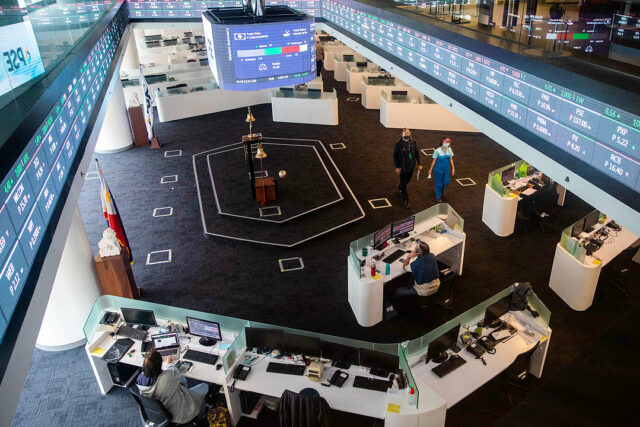
PHILIPPINE STOCKS climbed to the 6,700 level on Monday as investors digested recent corporate earnings and hunted for bargains after the market’s four-week decline.

The benchmark Philippine Stock Exchange index (PSEi) rose 1.26% or 84.70 points to 6,761.35. The broader all-share index added 0.71% or 26.90 points to 3,799.70.

“The local market rose this Monday as investors continued to hunt for bargains,” Japhet Louis O. Tantiangco, a senior research analyst at Philstocks Financial, Inc., said in a Viber message. “This comes as the market has already been on a four-week decline.”

“Also helping the market is the appreciation for sound third-quarter and nine-month corporate results,” he added.

The PSEi traded as low as 6,693.39 before climbing to the 6,700 level at market close.

“Philippine shares continued to rebound after the sell-off last week as investors prepare for a fresh round of economic data,” Luis A. Limlingan, head of sales at Regina Capital Development Corp., said in a Viber message.

“The key economic event in the US this week is the release of the Philadelphia Fed Manufacturing Index on Thursday, accompanied by several speaking engagements from Federal Reserve officials,” he added.

“On the local front, Goldman Sachs released its most recent market outlook for 2025, placing the Philippines at an overweight rating, a further catalyst for investors to be buying into the market,” Mr. Limlingan added.

The market’s sectoral indices were mixed. Holding firms increased by 3.58% or 200.39 points to 5,788.65, while property gained 1.67% or 42.55 points to 2,578.05. The financial index gained 0.36% or 8.12 points to 2,230.50.

On the other hand, mining and oil dropped 1.68% or 130.67 points to 7,633.75, while services lost 0.13% or 2.75 points to 2,075.86. The industrial index shed 0.03% or 3.14 points to 9,376.83.

Value turnover fell to P5.78 billion covering 695.71 million shares from P6.77 billion covering 447.1 million stocks on Friday.

Advancers beat decliners 97 to 94, while 62 stocks were unchanged. Net foreign selling expanded to P1.27 billion from P868.17 million on Friday. — Revin Mikhael D. Ochave

Cone, Gilas face youth-laden NZ at FIBA Asia Cup Qualifiers

TIM CONE and Gilas Pilipinas — PBA

GILAS Pilipinas will be up against a New Zealand rival parading a mix of experience and youth under the new system of debuting coach Judd Flavell in Thursday’s FIBA Asia Cup Qualifiers (ACQ) matchup at the MOA Arena.

Mr. Flavell, who succeeded Pero Cameron at the helm last month, called back Corey Webster, Izayah Le’afa, former Converge import Tom Vodanovich, Tyrell Harrison, Sam Mennenga and Flynn Cameron from the NZ crew in the FIBA Olympic Qualifying Tournament (OQT) in Greece and 2023 FIBA World Cup campaigners Taylor Britt, Hyrum Harris and Walter Brown for his core.

Mr. Flavell added Kaia Isaac, 21, and 17-year-old Oscar Goodman, fresh from his All Star 5 showing at the recent FIBA U17 World Cup, to his pool.

“This is an exciting group, a young group playing at a high level for their Australian clubs. Look at Tyrell, Sam Mennenga, Sam Waardenburg, Flynn, Izayah, Max Darling, Hyrum — all in the early to mid-20s and all playing vital roles at very good clubs in a very good league that is gaining worldwide attention,” Mr. Flavell said on the Basketball New Zealand website.

“Add that experience of Corey, Tom and Taylor — and the chance to integrate the energy and excitement of the younger players in Walter, Kaia and Oscar and I think we have a fantastic blend in this group and for these two testing games.”

Mr. Flavell, a member of the legendary NZ team that placed fourth in the 2002 FIBA World Championship who shifted to coaching and won four NBL titles, will have his baptism of fire on the road against Tim Cone and the Nationals.

Their system’s going to change a little bit,” Mr. Cone said. “They’re bringing over a little different personnel than they have from the past years and they’re a little different from the World Cup that the team that came over here in 2023 so they might be a little bit more difficult to prepare for.”

While NZ and Mr. Flavell are on their first rodeo, it would be the third window for Mr. Cone and his Justin Brownlee-led group after the opening window of the ACQ last February and the FIBA OQT last July in Latvia.

“They’ll know us a little bit better because they’ve seen us in the OQT. They’ve seen us in some of our windows already. In that regard, they’re going to have a little bit of an advantage. (But) we have had that continuity over this year, and that might bode us well, too.”

Mr. Cone and Co. are out to snap the Philippines’ four-game losing streak against the Tall Blacks, which started in the 2016 OQT that was played in the same venue. — Olmin Leyba

ADVERTISEMENT
ADVERTISEMENT