Home Blog Page 2365

Retail, F&B face cautious optimism for second half

PHILIPPINE STAR/MIGUEL DE GUZMAN

By Revin Mikhael D. Ochave, Reporter

CONSUMER-RELATED companies, such as those in retail and food and beverage (F&B) sectors, are expected to perform well in the second half of the year with higher consumer spending anticipated during the holiday season, though potential risks remain, according to market analysts.

“We are cautiously optimistic for the second half as the Bangko Sentral ng Pilipinas’ (BSP) Consumer Expectations Survey still shows some pessimism on economic conditions moving forward. This is somewhat tempered on forecasts that are leaning towards easing inflationary pressures in the following months,” AP Securities, Inc. Research Analyst Jose Antonio B. Cipres told BusinessWorld in a Viber message.

“Alongside this, the P35 wage hike which took effect last July would increase spending power and should also translate to revenues primarily to companies exposed to the F&B industry,” he added.

According to Mr. Cipres, the revenue growth for retail and F&B companies last year was driven by price increases, but noted that their margins were tempered due to higher costs.

“This year however, we are slowly starting to see all-around volume driven revenue growth and better margins on a quarter-on-quarter basis,” he said.

The BSP’s recent Consumer Expectations Survey showed that Filipino consumers are a bit more optimistic for the next 12 months, with the index growing to 13.5% from 13.4% previously.

BusinessWorld poll of 15 analysts forecasted a median estimate of 3.7% for the country’s inflation rate in August, within the 3.2-4% forecast of the BSP. August inflation data will be released on Sept. 5.

If realized, August inflation would also be slower than the 4.4% in July and the 5.3% print in the same month a year ago.

Stephen Gabriel Y. Oliveros, research associate at China Bank Securities Corp., said in an e-mail interview that consumer-oriented companies could perform beyond expectations on the back of stronger spending and easing interest rates.

“An acceleration in growth remains a possibility in the second half given the seasonal uptick from the holiday season, and prospects of a recovery in consumer purchasing power amid easing price pressures and policy rate cuts,” he said.

“We think growth trajectories of consumer-oriented firms in the second semester will largely mirror the pace of revenue expansion we’ve seen during the first semester as first half performance generally trended within respective company guidance,” he added.

The BSP’s Monetary Board on Aug. 15 reduced its policy rate by 25 basis points (bps) to 6.25% from a near 17-year high of 6.5%, marking its first easing move in nearly four years.

BSP Governor Eli M. Remolona, Jr. has said they could cut rates by another 25 bps within the year.

Unicapital Head of Research Wendy B. Estacio-Cruz said in a separate interview that retail and F&B companies are expected to have a modest growth this year.

“We came from high levels for last year. For this year, I think it is slightly up from last year but not as much as the growth from last year,” she said.

“There will be an influx of consumer spending over the next couple of months, especially the ‘ber’ months. There’s a slight or modest growth from last year,” she added.

Mr. Cipres said that listed retailers Puregold Price Club, Inc., San Miguel Food and Beverage, Inc., Universal Robina Corp., and Robinsons Retail Holdings, Inc. will benefit from increased consumer spending during the holiday season.

“These are poised to take advantage of consumer demand during the holidays through increased sales for groceries, supermarkets, and department stores,” he said.

He added that Jollibee Foods Corp. and Alliance Global Group, Inc. (AGI), which operates McDonalds’ Philippines through Golden Arches Development Corp. (GADC), will also benefit from increased number of gatherings.

“JFC would benefit from the parties and gatherings that typically occur during holidays. While AGI would benefit given their stake in GADC; lackluster performance from their other segments would temper this,” he said.

Unicapital’s Ms. Cruz said that listed operators SM Prime Holdings, Inc. and Robinsons Land Corp. will see a surge in performance during the holiday season.

She added that listed banks will also benefit from increased consumer spending amid expected rate cuts.

“We’re also expecting banks to benefit from the lowering interest rates. There will be a lot of consumer and retail spending. There will be a lot of mortgage as well as automotive loans,” she said.

For his part, China bank Securities’ Mr. Oliveros said that listed companies Century Pacific Food, Inc. (CNPF) and Monde Nissin Corp. will see a surge this holiday season.

“CNPF’s diversified product portfolio allows the company to remain the top-of-mind producer of accessible and value-for-money goods. The company also has new legs for growth as they continue to scale their emerging businesses like milk, pet food, and alternative meat,” he said.

“Monde Nissin is expected to continue benefitting from stable demand across its core categories (noodles, baked goods), complemented by their efforts to boost brand awareness. Meanwhile, more favorable economic conditions in the United Kingdom could also aid the demand recovery for its alternative meat business,” he added.

Mr. Oliveros also said that listed telecommunication companies Globe Telecom, Inc., PLDT Inc., and Converge Information and Communications Technology Solutions, Inc. will also benefit during the holiday season.  

“We like telcos given expectations of steady demand for data services, alongside accelerating earnings contributions from non-telco services. Note these factors helped support earnings growth across major listed telco players over the past few quarters,” he said.

Meanwhile, SM Prime Executive Committee Chairman Hans T. Sy said in a separate ambush interview that the company has a positive outlook for its retail and mall businesses.

“Shopping and retail are always going to always be there. We’re very positive still. It depends on how you’re going to be able to sell, whether online or on the physical side,” he said.

“What we need to do is to adapt. Instead of expecting people to go to your place to shop, you have to make it experiential for them, make it interesting for them. A place to see or a place to be seen. That’s now the evolution of shopping,” he added.

inDrive PHL targets to grow driver network to 16,000 by yearend

INDRIVE

INDRIVE, a global ride-hailing app operated by RL Soft Corp., plans to double its partner-drivers in the Philippines to 16,000 by the end of the year, signaling aggressive expansion that could intensify competition in the local ride-hailing market.

“We’re working hard together with our partners to enlarge our driver base because we understand that it’s not only for business development for us but also providing opportunities of income for drivers,” inDrive Marketing Director for Asia-Pacific (APAC) Natalia Makarenko said during a briefing on Tuesday. 

The company reported a 96% increase in its active driver base, reaching 8,000 drivers, since resuming operations in the Philippines nearly three months ago.

“We’re still having a 0% commission to our driver-partners. And we don’t have precise plans that we can announce about the timings of introduction of the commission,” Ms. Makarenko said.

Further, once the company decides to collect commissions from its drivers, it will be up to 10% of their earnings, she said.

“We will be looking closely and closely at the situation of business growth and development. Of course, we have an open feedback communication with our drivers’ partners,” Ms. Makarenko said.

Mobility and urban services platform inDrive operates in 750 cities in 46 countries. In the Philippines, inDrive currently operates in six cities namely, Metro Manila, Bacolod, Baguio, Iloilo, Butuan, and Cagayan de Oro. 

The company is planning to expand its operation in three key areas within this year, Ms. Makarenko said, adding that inDrive is eyeing to operate in Cebu, Davao, and Pampanga.

“Well, we are undergoing the review of our expansion plans until the end of the year and, of course, we are thinking about 2025 and further on. The Philippines is one of the key markets for us in APAC. We will have to prepare thoroughly for the business expansion,” she said.

Ms. Makarenko said inDrive is also planning to further expand its operations in more cities by 2025.

“For this year, we are thinking about launching two to three more cities and for the next year probably the number of cities will expand as well,” she said.

To recall, the company initially secured the approval of the Land Transportation Franchising and Regulatory Board to offer its services in the Philippines in December 2023 but was suspended a month after due to alleged fare haggling violations. — Ashley Erika O. Jose

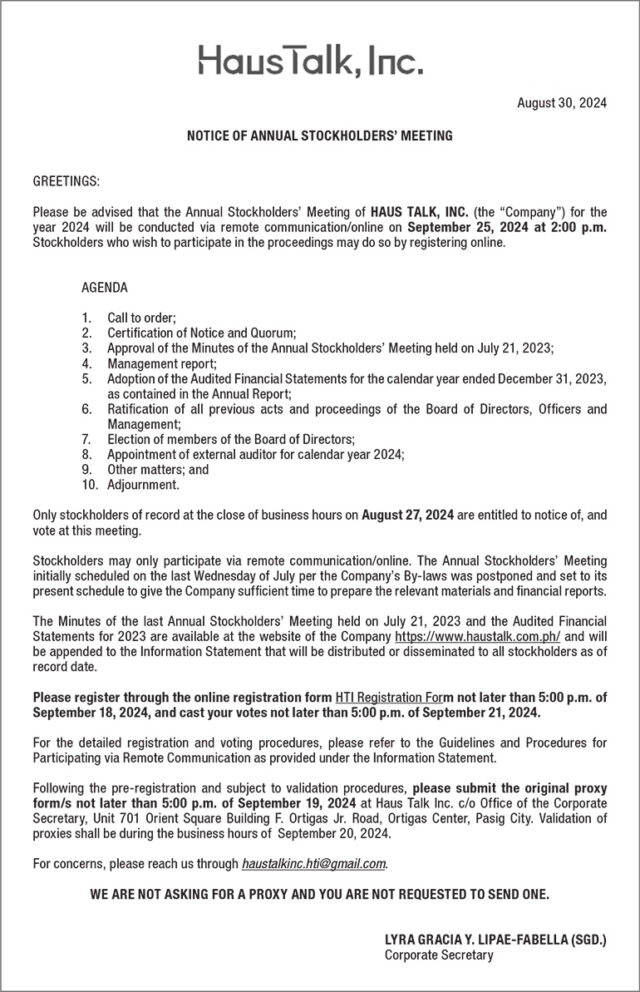
Haus Talk, Inc. to hold Annual Stockholders’ Meeting on Sept. 25 via remote communication


Spotlight is BusinessWorld’s sponsored section that allows advertisers to amplify their brand and connect with BusinessWorld’s audience by publishing their stories on the BusinessWorld Web site. For more information, send an email to online@bworldonline.com.

Join us on Viber at https://bit.ly/3hv6bLA to get more updates and subscribe to BusinessWorld’s titles and get exclusive content through www.bworld-x.com.

Haul of ancient Roman coins discovered in Sicily

REGIONE.SICILIA.IT

ROME — A rare haul of 27 silver Roman coins dated between 94 and 74 BC has been discovered on the remote island of Pantelleria, the Sicily region said on Monday.

The discovery was made during a cleaning and restoration project by a team led by archaeologist Thomas Schaefer from the University of Tuebingen in Germany.

It was found in the Acropolis, part of the Archaeological Park of Selinunte, Cave di Cusa, and Pantelleria, which is one of the largest such sites in the Mediterranean and includes the remains of an ancient Greek colony founded in the 7th century BC.

The discovery was on the same site where 107 Roman silver coins had been unearthed in 2010 and not far from where the three famous imperial statue heads of Caesar, Agrippina and Titus had been found a few years earlier.

The coins would have been minted in Rome and date back to the Republican age, the same period as the first find.

“This discovery … offers valuable information for the reconstruction of the events, trade contacts and political relations that marked the Mediterranean in the Republican age,” said Francesco Paolo Scarpinato, a regional councilor for cultural heritage.

Some coins appeared in the loose soil after recent heavy rains while the others were found under a rock during the excavations and have already been cleaned and inventoried.

The archaeologist Mr. Schaefer speculated that the treasure was hidden during a pirates’ attack and never retrieved. — Reuters

Gov’t makes full award of reissued 20-year bonds

BW FILE PHOTO

THE GOVERNMENT made a full award of the reissued 20-year Treasury bonds (T-bonds) it offered on Tuesday amid strong demand and as the average rate fetched was largely in line with secondary market levels on expectations that headline inflation eased anew in August.

The Bureau of the Treasury (BTr) raised P30 billion as planned via the reissued 20-year bonds it auctioned off on Tuesday as total bids reached P49.435 billion, well above the amount on offer.

This brought the outstanding volume for the series to P121.1 billion, the Treasury said in a statement.

The bonds, which have a remaining life of three years and one day, were awarded at an average rate of 6.025%. Accepted yields ranged from 5.975% to 6.05%.

The average rate of the reissued papers went up by 1.6 basis points (bps) from the 6.009% fetched for the series’ last award on July 30. Still, this was 260 bps lower than the 8.625% coupon for the issue.

This was likewise 2 bps above the 6.005% seen for the same bond series and 0.8 bp higher than the 6.017% quoted for the three-year bond — the tenor closest to the remaining life of the papers — at the secondary market before Tuesday’s auction, based on PHP Bloomberg Valuation Service (BVAL) Reference Rates data provided by the BTr.

The government made a full award of its T-bond offer as rates fetched were largely in line with market expectations, a trader said in a text message.

“This bond looks attractive, especially at above 6%, since the longer securities are just a few basis points higher,” the trader said.

“The Treasury bond average auction yield at 6.025% is almost the same as the comparable three-year PHP BVAL yield of 6.02% as of Sept. 3… ahead of the latest headline inflation data that is expected to ease back to within the Bangko Sentral ng Pilipinas’ (BSP) target range of 2-4%,” Rizal Commercial Banking Corp. Chief Economist Michael L. Ricafort said in a Viber message.

Slowing inflation would give the BSP confidence to cut benchmark interest rates further, which could match potential easing moves by the US Federal Reserve in the coming months, Mr. Ricafort added.

Philippine headline inflation likely eased last month and returned within the central bank’s 2-4% annual target amid lower prices of rice and fuel, analysts said.

A BusinessWorld poll of 15 analysts yielded a median estimate of 3.7% for the August consumer price index (CPI), within the BSP’s 3.2-4% forecast.

If realized, the August CPI would be slower than the nine-month high of 4.4% seen in July and the 5.3% print in the same month a year ago.

The Philippine Statistics Authority will release August inflation data on Thursday (Sept. 5).

With inflation likely on a downtrend, analysts expect that the central bank will be able to continue its easing cycle.

The BSP last month cut benchmark interest rates for the first time in almost four years amid an improving inflation and economic outlook, with its governor signaling at least one more reduction before the end of the year.

The Monetary Board on Aug. 15 reduced its policy rate by 25 bps to 6.25%.

BSP Governor Eli M. Remolona, Jr. said they could cut rates by another 25 bps within the year. The Monetary Board’s last two policy-setting meetings this year are on Oct. 17 and Dec. 19.

Meanwhile, markets widely expect a rate cut at the US central bank’s Sept. 17-18 meeting following Fed Chair Jerome H. Powell’s dovish speech at the Jackson Hole Symposium last month.

Mr. Powell last month endorsed an imminent start to interest rate cuts, saying further cooling in the job market would be unwelcome and expressing confidence that inflation is within reach of the US central bank’s 2% target.

“The time has come for policy to adjust,” Mr. Powell said in a highly anticipated speech to the Kansas City Fed’s annual economic conference in Jackson Hole, Wyoming. “The direction of travel is clear, and the timing and pace of rate cuts will depend on incoming data, the evolving outlook, and the balance of risks.”

Futures are 100% priced for a cut of 25 bps this month, and imply a 33% probability of 50 bps, Reuters reported. They also have 100 bps of cuts priced in by December, and 120 bps for 2025.

Crucial for the Fed will be the payrolls report on Friday, where analysts look for a rise of 165,000 in jobs and a dip in the unemployment rate to 4.2%.

The BTr wants to raise P195 billion from the domestic market this month, or P80 billion through Treasury bills and P115 billion via T-bonds.

The government borrows from local and foreign sources to help fund its budget deficit, which is capped at P1.48 trillion or 5.6% of gross domestic product for this year. — A.M.C. Sy with Reuters

SC junks ERC’s plea against San Miguel-Meralco deal

PHILSTAR FILE PHOTO

THE SUPREME COURT (SC) has denied with finality the motion for reconsideration filed by the Energy Regulatory Commission (ERC), upholding its decision on the power contracts between San Miguel Corp.’s (SMC) subsidiaries and Manila Electric Co. (Meralco).

In a regulatory filing on Tuesday, SMC said that it had received a copy of the resolution from the SC’s First Division denying the motion for reconsideration filed by the energy regulator regarding the high court’s decision dated Aug. 3.

“Considering that there is no substantial argument to warrant a modification of this Court’s resolution, the Court further resolved to deny reconsideration with finality,” the high court said.

The SC likewise denied the temporary restraining order and writ of preliminary injunction sought by the office of the solicitor general (OSG), which serves as the ERC’s counsel, for “lack of merit.”

“No further pleadings, motions, letters, or other communications shall be entertained herein,” the SC said.

The ruling stemmed from the joint motions filed by South Premiere Power Corp. (SPPC) and San Miguel Energy Corp., now Sual Power, Inc. (SPI), with Meralco in 2022, requesting price adjustments in relation to their 2019 power supply agreements (PSAs).

The companies sought a temporary increase in the contract price under the PSAs for a period of six months to recover incremental fuel costs arising from “a change in circumstances.”

The regulator denied the petition, stating that it had no basis, as the PSA is a fixed-rate contract.

SPPC and SPI brought the matter to the Court of Appeals, where the appellate court reversed the ruling of the ERC, in a decision dated June 27, 2023, for “grave abuse of discretion.”

Sought for comment, ERC Chairperson and Chief Executive Officer Monalisa C. Dimalanta said, “We are consulting with OSG if there are still legal remedies available to the ERC.”

Meralco’s controlling stakeholder, Beacon Electric Asset Holdings, Inc., is partly owned by PLDT Inc.

Hastings Holdings, Inc., a unit of PLDT Beneficial Trust Fund subsidiary MediaQuest Holdings, Inc., has an interest in BusinessWorld through the Philippine Star Group, which it controls. — Sheldeen Joy Talavera

Food banking to alleviate hunger: Kenny Rogers Roasters and Starbucks

STARBUCKS.PH

(Part 4)

Before we describe in greater detail the activities of the Philippine Food Bank Foundation as a possible template for other private citizens to replicate in regions outside the leading urban centers in the Philippines, let us report on what the United Nations World Food Programme (WFP) recently launched as the first in-country innovation competition in search of local solutions to address food insecurity in  the Philippines.

Food banking may connote to the ordinary citizens a formal organization that is beyond their capacity to establish and operate.  That is why the WFP is promoting this initiative called the Preparedness and Response Excellence in the Philippine (PREP) Program — supported by USAID, the Australian’s Government Department of Foreign Affairs and others — which is inviting local innovators to propose low- and high-tech solutions that will help combat food insecurity, especially in disaster-prone areas of the archipelago. Innovators may apply to one or both of two priority areas: enhancing emergency preparedness to build resilience or increasing efficiency and effectiveness in humanitarian response. 

All types of entities, including government at all levels, local organizations, foundations, academia, and private individuals are encouraged to apply. The innovation proposal must target at least one of the following provinces: Maguindanao del Sur, Maguindanao del Norte, Surigao del Norte, Dinagat Islands, Albay, Catanduanes, Cagayan, and Isabela. This program marks the commitment of WFP to help pilot and scale up existing innovative approaches to end hunger in the Philippines, in close partnership and support of the government, donors, and partners.  Once again this is the application of the principle of subsidiarity through which individuals are enabled to contribute their efforts to address a social problem.

An international example of an individual effort to contribute to alleviating hunger is what was reported by AFP about a Palestinian food blogger, Hamada Shaquora. To satisfy his craving for comfort food on a war-rations diet, he taught himself to cook, using food aid packages and whatever fresh vegetable he could scrounge up. His cuisine includes beef tacos “Gaza style,” pizza wraps, and a deep-fried “golden sandwich” which he films then offers up to the tent camp’s hungry children. Barefoot children toting empty pots and bowls run through the ruins of Khan Yunis to his tent, where the war chef cooks up pea stew in huge pots over an open fire. This example illustrates what can be done by an individual to fight hunger. In the Philippines, there are examples of housewives who pool their resources together and cook nutritious dishes in their homes that they distribute to poor communities near their residences.

On the institutional level, let me cite the case of Kenny Rogers Roasters, the famous restaurant chain. It launched the Farm Advocacy Program (FAP) three years ago. FAP is a farm-to-table program in which every purchase of a select Kenny Roasters menu item supports local farmers. In 2024, the fundraising menu item is the Chimichurri Roast, the ingredients of which are sourced locally. Sales of the popular roasted item supported an NGO called Urban Farmers PH, a group that promotes the use of idle public spaces for farming. The P300,000 raised was used by Urban Farmers PH to support the Taguig Integrated School and Barrio Obrero Elementary School to provide essential resources to make plant beds, seedling nurseries, and provide technical training in urban planning.

Something similar is being implemented in Pasig by one of the leading seed companies, Harbest, in training street sweepers to plant high-value vegetables and fruits in empty public plots.  Harbest also is providing residents of condominiums with the technology and tools to plant the same high-value vegetables along the walls of their residences through hydroponics.

Let me now briefly described the Philippine Foodbank Foundation, Inc., an NGO put together by some members of the Philippine business community and civil society. One can read on its website that this SEC-registered foundation aims, through strategic partnerships, to secure surplus food products from various sources and redistribute them to marginalized communities with the help of grassroots movements. Its main goals are  hunger relief  (distributing surplus food to religious orphanages, schools, parishes, and other charitable institutions in communities in need); food waste reduction (through collaborating with food businesses to minimize excess food and waste added to landfills); increase learning abilities or reduce learning poverty (by providing nourishment, especially for children during the first two years of their lives in order to prevent brain damage or stunting); and community empowerment (by providing nutrition education and supporting local initiatives to attain zero hunger).

At the heart of the mission of the Philippine Food Bank Foundation is the belief that no one should go hungry. Through an innovative food rescue and logistics program, the Foundation strives to provide nourishment and hope to those in need while simultaneously addressing the pressing issue of food waste. In fact, there is an ongoing process of working with the officials of the Department of Environment and Natural Resources (DENR) to find ways and means for food banks to obtain carbon credits for their contribution to a cleaner environment by reducing food waste that is thrown into landfills.

One of the largest initiatives of a multinational corporation to address hunger in the Philippines, in partnership with the Philippine Food Bank Foundation (PFBF), is that of Starbucks. In March 2022, Starbucks partnered with PFBF and Grab Philippines to launch its FoodShare food donation program. Under this program, Starbucks donates rescuable food items to select beneficiaries, first in the National Capital Region and subsequently in Cebu, Iloilo, Davao, Cagayan de Oro, Southern Luzon, and Central Luzon. Participating stores are connected to Grab drivers who pick up their food donations and deliver them to local non-profit organizations who have been targeted as beneficiaries by PFBF.

To cite a few examples from the over 100 institutional beneficiaries of PFBF, Starbucks interviewed Marko Lim, a Volunteer Project Leader who was in charge of receiving food donations for the National Children’s Hospital (NCH) that provides quality care to children ages zero to 19. According to Mr. Lim, the hospital has been the frontrunner in the care of pediatric patients in different stages of life with different types of diseases. When asked about their experience with FoodShare, Mr. Lim mentioned that the NCH receives delicious snacks for the children, parents and frontliners in the facility weekly.  He said that the problem of hunger persists, but with the help of determined socially responsible and action-oriented companies like Starbucks Philippines, they are able to be part of the solution.

Another institutional beneficiary of the FoodShare program is the Oasis of Joy for Young Girls, a child-caring home and welfare agency that provides alternative parental care and fostering in a wholesome environment to neglected, surrendered, orphaned, abandoned, and foundling female children from ages three to 12. Currently, the home is caring for 16 children with four religious nuns who manage and organize the daily activities with the help of two house mothers. Food is donated to this institution regularly through the FoodShare program. According to Sr. Liezel D. Cantara, Finance Officer of Oasis: “The delicious bread that Starbucks shares with us on a daily basis is very helpful. It does not only help the children but goes a long way to help feed our communities, staff and mothers as well.”

More than 200 Starbucks stores — and counting — are involved as more regions in the Visayas and Mindanao are getting involved. Through the example of Starbucks (and more recently Subway), the Philippine Food Bank Foundation hopes to involve many more restaurant chains — both local and foreign — to participate in this very worthy cause that simultaneously addresses the problems of hunger, the quality of education, and climate change.


Bernardo M. Villegas has a Ph.D. in Economics from Harvard, is professor emeritus at the University of Asia and the Pacific, and a visiting professor at the IESE Business School in Barcelona, Spain. He was a member of the 1986 Constitutional Commission.

bernardo.villegas@uap.asia

British actor Ian McKellen feared he would die in London stage fall

IAN MCKELLEN in a scene from Player Kings. — PLAYERKINGSTHEPLAY.CO.UK

LONDON — British actor Ian McKellen said on Monday he feared he would die when he lost his footing and fell off a London stage mid-performance in June.

Mr. McKellen, 85, was starring in Player Kings, combining William Shakespeare’s Henry IV, Parts One and Two, in the capital’s West End theater district, when he tripped during a fight scene.

The actor, who is best known for playing Gandalf in the film versions of Lord of the Rings and The Hobbit and was also Magneto in the X-Men movies, was taken to hospital. He did not return to the role for the rest of the tour.

“I am absolutely physically recovered,” Mr. McKellen told BBC Radio. “It is emotionally that I’ve got some residue that I’ve got to deal with. I said to myself as I slid off the stage … ‘this is the end,’ these were the words in my mind.

“Apparently, I shouted out, ‘My neck is broken, I am dying.’ I don’t remember saying that. So, there was a lot going on in my head as the body responded to the fall.”

Mr. McKellen broke his wrist and chipped a vertebrae in the fall but said he was saved from more serious injury by the padding of the suit he was wearing to play the overweight character John Falstaff.

In a separate interview with BBC television, Mr. McKellen, whose stage career stretches back to 1961, said he had no plans to retire from acting and did not want anyone else to play Gandalf in the next installment of the Lord of the Rings franchise, due in 2026.

McKellen’s latest film, The Critic, based on the novel Curtain Call by Anthony Quinn, in which he plays powerful theater critic Jimmy Erskine in 1930s London, is out in cinemas later this month. — Reuters

BDO adds new categories to sustainable financing framework

BW FILE PHOTO

BDO UNIBANK, Inc. has expanded its sustainable financing framework (SFF) to fund more environmental, social, and governance-themed projects, it said on Tuesday.

The lender has included gender financing and 19 additional eligible categories under green, blue, orange and social financing in its sustainable financing framework, the Sy-led bank said in a statement.

“The expanded SFF will allow BDO to finance more projects with high economic, environmental and social benefits through its bond issuances, contributing to ecological sustainability, ocean, health, community development and women’s empowerment,” it said.

The projects that can be financed under the expanded framework will be aligned with international and local bond principles, guidelines and taxonomies, as well as the United Nations Sustainable Development Goals, BDO said.

The bank also received an updated Second Party Opinion (SPO) from Morningstar Sustainalytics affirming its expanded sustainable finance framework.

“The SPO aligns with the 2021 Sustainability Bond Guidelines and Green Bond Principles. It is also in line with the 2023 Social Bond and Loan Principles, and Green and Social Loan Principles, as well as the 2018 ASEAN Sustainability, Social and Green Bond Standards,” BDO said.

In July, the bank raised P55.7 billion from its third issuance of peso-denominated ASEAN Sustainability Bonds, well above the initial target of P5 billion.

The one-and-a-half-year notes carry a coupon rate of 6.325% per annum.

The net proceeds of the issuance will be used to finance and/or refinance eligible assets as defined in the bank’s sustainable finance framework and to diversify its funding sources, BDO earlier said.

“The bank’s previous ASEAN Sustainability Bond issuances have both set records as the largest issuance for any Philippine financial institution or company at P52.7 billion in 2022, and at P63.3 billion in January 2024,” the listed lender added.

BDO saw its net profit rise by 11.98% year on year to P20.94 billion in the second quarter amid continued growth in its core businesses and higher fee income.

Its shares closed unchanged at P152.80 apiece on Tuesday. — A.M.C. Sy

Mercato Centrale renews lease with RLC at Bridgetowne Estates

MERCATO CENTRALE has renewed its partnership with Robinsons Land Corp. (RLC) for the operation of an outdoor food market at the Bridgetowne Destination Estates in Quezon City.

Following the renewed partnership, Mercato Centrale announced new collaborations with Okane Kitchen and Fly Ace Corp. to expand its offerings at the outdoor food market, the company said in an e-mailed statement sent on Tuesday.

 “The strong and steady foot traffic at Bridgetowne makes it the perfect venue for launching new food concepts by our small food business entrepreneurs,” Mercato Centrale said.

 Okane Kitchen specializes in new food concepts and back-end kitchen operations for small and medium enterprises (SMEs), while Fly Ace is one of the country’s leading food and beverage companies and the exclusive distributor of Franzia Wines.

 Launched in 2011, Mercato Centrale offers a platform to support the growth of SMEs. It also offers customers with a wide range of food options from gourmet dishes to street food.

Bridgetowne is a mixed-use township and business park development located on the border of Pasig and Quezon City. — Revin Mikhael D. Ochave

What it means to be stewards of our marine resources

PHILIPPINE STAR/MIGUEL DE GUZMAN

As an archipelago situated at the apex of the Coral Triangle, the Philippines is in a uniquely strategic position to optimize its location, which harbors some of the most diverse and extensive coral reef systems. Our nation enjoys a wealth of marine biodiversity that is the envy of many, that protects our coastlines from erosion and storm waves, and that gives us food security and ensures the livelihood of coastal communities.

Unfortunately, many things threaten to destroy the precious marine ecosystem.

Foremost, climate change — directly attributable to human activities over centuries — raises sea temperatures and leads to coral bleaching. This weakens the reefs and reduces their ability to recover.

Overfishing and destructive fishing practices, specifically the use of blast and cyanide fishing, also do harm. And then, given the incursions of another country into what has been established as ours, artificial islands are being built to assert its erroneous claim. This leads to the destruction of natural coastal habitats, including coral reefs, mangroves, and seagrass beds. Such activities also result in coral reef degradation. These illegal methods destroy habitats and reduce fish populations, threatening marine biodiversity and the livelihoods of coastal communities. These projects disrupt marine ecosystems by altering sedimentation patterns and increasing water pollution.

The loss of natural barriers also increases the vulnerability of coastal communities to storm surges and erosion.

In response to these threats, the government has enacted laws and policies to not only protect but also maximize our marine resources. Three pieces of legislation specifically address these concerns. According to Lea Avila, OIC Chief of the Coastal and Marine Ecosystems Management Section, Biodiversity Management Bureau of the Department of Environment and Natural Resources during a recently held forum on marine protection held by The Stratbase ADR Institute, in partnership with the Australian Embassy, it is through the integration of policy, management and enforcement, science, and partnerships that we can conserve and protect our coastal and marine environment.

The Philippine Fisheries Code of 1998, for instance, protects coastal and marine environments by regulating fishing practices, establishing marine protected areas, and involving local communities in resource management. Local policies and ordinances have established more than 1,000 locally managed Marine Protected Areas (MPAs) or Marine Sanctuaries as a result of this law.

The Coral Triangle National Plan of Action expands and effectively manages MPAs and enforces regulations to prevent overfishing and protect fish stocks. The National Integrated Protected Areas System Act of 1992 designates various protected areas, such as national parks and wildlife sanctuaries, and established Protected Area Management Boards to oversee these regions. It also emphasizes community involvement, ensuring that local stakeholders benefit from and participate in conservation efforts.

These laws are not new. They have been in force for years, showing the keen awareness of the government of the need to protect the marine ecosystem. And yet the threats remain. Indeed, conservation alone is not enough. The Philippines must also look beyond protection and find ways to maximize the resources in its waters.

In the same forum, Dr. Mary Kristerie Baleva, a non-resident fellow of the Stratbase ADR Institute and former director of the ASEAN Center for Biodiversity, said that the contribution of ocean-based industries to the national GDP remains below 5% despite the vast array of aquatic resources that the country possesses. Fisherfolk continue to be one of the poorest sectors in society. In 2021, poverty incidence among this sector was at 30.6%.

These indicate that the country’s marine resources are not being fully utilized to improve economic outcomes for its people.

A solution that appears promising is the development of a blue economy, one that emphasizes the sustainable use of ocean resources for economic growth, improved livelihoods, and the preservation of the marine environment.

Toward this objective, the government has emphasized the development of the country’s blue economy. Central to this initiative is Senate Bill 2450 or the proposed “Blue Economy Act,” which is considered a priority legislation of the administration. The Blue Economy Framework will serve as the country’s roadmap towards a diversified and sustainable ocean economy aimed at providing long-term economic and social benefits while building resilience to climate change.

A July 2024 survey by the Social Weather Stations showed that three in five Filipinos believe government efforts in protecting Filipino fishermen and protecting the marine resources in the West Philippine Sea are sufficient. But while there is substantial support for current measures, the government has to intensify its efforts to address ongoing challenges and enhance the protection of these critical national assets. Strengthening these efforts will ensure that the needs and concerns of the Filipino people are effectively met, and that the nation’s maritime sovereignty and ecological wealth are secured for future generations.

Defending our seas goes far beyond securing our territorial waters or safeguarding the rights of our fisherfolk against expansionist threats. It is a profound commitment to our role as stewards of these vast and vital resources. We are entrusted with the responsibility to care for, preserve, and protect the marine ecosystem — not just for our own benefit, but for the health of our planet and the prosperity of succeeding generations.


Victor Andres “Dindo” C. Manhit is the president of the Stratbase ADR Institute.

Shanghai Museum welcomes feline visitors to peruse Egyptian cat imagery at ‘Meow Night’

SHANGHAIMUSEUM.NET

SHANGHAI — Shanghai Museum has pulled in crowds this summer for an exhibition of ancient Egyptian relics including cat statues and other feline imagery, and which on Saturday nights allows up to 200 visitors to bring along their own four-legged friends.

Inspired ancient Egyptians’ worship of Bastet, the goddess of protection — often depicted as a cat — the museum has given cats the chance to interact with part of the exhibition called The Secrets of Saqqara.

“Egyptian archaeological teams discovered a cat temple in Saqqara and unearthed many cat mummies and cat statues. So when we were planning the event, we had cats as a theme, and then came the idea for ‘Meow Night,’” said Shanghai Museum Deputy Director Li Feng.

The Top of the Pyramids: Ancient Egyptian Civilization Exhibition began on July 19 and runs until Aug. 17, 2025, with “Meow Night” planned for at least 10 Saturdays. It has held six so far with tickets, including 200 bring-a-cat tickets, selling out each time.

Visitors bring their cats in carriers or pet strollers and can take them out only at designated areas, such as for a photo opportunity next to a statue of Bastet.

The cats are checked on entry to ensure up-to-date vaccinations and for signs of illness or stress. There are veterinarians onsite and rest areas for cats in case the stimulation from their night at the museum gets a bit much.

“It’s very special that you can bring a cat with you,” said visitor Qiu Jiakai who was attending “Meow Night” with one-year-old puss An Mao.

“I listened to the narrator’s introduction saying … many of today’s pet cats are related to the cats domesticated in ancient Egypt. So I thought I would have to bring my cat here to see its ancestors and the cat goddess,” she said. — Reuters