Home Blog Page 2350

Didal makes triumphant comeback at Red Bull Buenos Aires Conquest

MARGIELYN “MARGIE” DIDAL — REDBULL

FILIPINO skater and Red Bull athlete Margielyn “Margie” Didal has made a triumphant return to the international skateboarding scene, skating her way to first place for women’s division at the Red Bull Buenos Aires Conquest. Ms. Didal makes her return to the podium following her journey to recovery from an ankle injury.

Last Nov. 9, a crowd of 2,000 people gathered at the University of Buenos Aires Law School to witness the Red Bull Buenos Aires Conquest. The competition brought together 24 of the world’s best skaters, including skaters from South Africa, the Netherlands, France, Mexico, Colombia, Peru, Chile, Uruguay, Brazil, Argentina, and the Philippines.

Ms. Didal won first place in the women’s division of the competition, besting some of the top women skaters in the world including Argentina’s Aldana Bertran and Brazil’s Leticia Bufoni, in the qualifying round, and Argentinian Camila Cáceres in the semifinals. It was down to Ms. Didal and Dutch skateboarder Roos Zwetsloot for the finals, with the Filipino athlete ultimately taking home the trophy.

Brazilian skater Gabryel Aguilar reclaimed his spot as the men’s division champion after winning the title the previous year. He competed against Mexican athlete Brayan Coria in the final round, after Aguilar defeated Argentina’s Axel Mansilla and Uruguay’s Emilio Dufour in the qualifying round. Mr. Aguilar was up against Mr. Dufour again in the semifinals, which the Brazilian skater won.

The fourth edition of the global skating competition featured riskier tricks and showcased the culture and history of the host city, coursing through iconic local skateboarding obstacles.

During the competition, the skaters battled in a 1v1 elimination format and had three minutes to showcase their skills on the course. Winners were decided by a judging panel consisting of key figures in the skating scene including Argentina’s Diego Bucchieri and Enrique Rosso, USA’s Anthony Claravall, and Brazil’s Biano Bianchin and Larissa Carollo.

Buenos Aires was the final stop in the global competition, after stops in Paris, Lisbon, and Rio de Janeiro with iconic backdrops in each stop. The competition served as a celebration of skate culture, allowing skaters from across the world to demonstrate their skill and style on a global platform.

SMB and Meralco host separate foes at East Asia Super League

Games on Wednesday
(PhilSports Arena)
6:10 p.m. – San Miguel Beer vs Taoyuan Pauian Pilots
8:10 p.m. – Meralco vs Busan KCC Egis

PBA CHAMPS San Miguel Beer and Meralco aim to bounce back as they host separate rivals in the East Asia Super League’s “Clash of Champions Manila” double-header on Wednesday at the PhilSports Arena.

The Beermen (0-1), the reigning PBA Commissioner’s Cup titlist, seek this objective against P. League+’s Taoyuan Pauian Pilots (1-0) in their Group A duel at 6:10 p.m.

The PBA Philippine Cup kingpin Bolts (1-1), for their part, target the pull-around versus Korea’s Busan KCC Egis (0-1) at 8:10 p.m. over in Group B.

The Bolts have mixed results in their first two assignments in the continental league, beating expansion team Macau Black Bears in the Oct. 2 opener at home before yielding to the Ryukyu Golden Kings in Okinawa, 74-77, two weeks later.

With beloved import Allen Durham retiring after their last road assignment, the Bolts signed up 6-foot-9 Akil Mitchell.

Mr. Mitchell is expected to make his Meralco debut and join forces with fellow reinforcement DJ Kennedy, ace guard Chris Newsome, naturalized player Ange Kouame and Chris Banchero in the home gig.

Meanwhile, the Beermen return to EASL play after losing to Korea’s Suwon KT Sonicboom, 81-87, in Match Day 1.

June Mar Fajardo, riding high on his record-extending 11th Best Player of the Conference, and Marcio Lassiter, fresh from soaring to No. 1 in PBA’s all-time three-pointers made, and imports EJ Anosike and Quincy Miller are determined to bring SMB to victory this time around. — Olmin Leyba

Converge FiberXers acquire Gilas Pilipinas guard Jordan Heading

CONVERGE boosted its roster ahead of the PBA Season 49 Commissioner’s Cup by acquiring the rights to former Gilas Pilipinas sniper Jordan Heading in a trade with Terrafirma.

In return, the FiberXers gave up guard Aljun Melecio, big man Keith Zaldivar plus their first-round pick in the 51st season to the rebuilding Dyip.

Fil-Australian Mr. Heading is set for his debut in Asia’s first play for play league three years after getting picked No. 1 by the Dyip in the special Gilas draft.

The sweet-shooting national team guard, however, didn’t see action for the Dyip and instead took his services to the Taichung Wagor Suns in the T1 League in Taiwan, the Nagasaki Velca in the Japan B.League and the West Adelaide Bearcats in Australia’s NBL1.

Mr. Heading also suited up for the Strong Group Athletics under coach Charles Tiu, making this a reunion with the latter who serves as Converge assistant.

The 6-foot-2 Mr. Heading had previously expressed interest to finally strut his stuff in the PBA when he watched Game 1 of the Governors’ Cup finals between eventual back-to-back champion TNT and Ginebra in Antipolo.

“I think it’s a great league. I’d really like to play here,” he said then.

The FiberXers look to sustain the momentum from their stellar play in the last Governors’ Cup, where they pushed San Miguel Beer to the limit before bowing out of the quarterfinals in five. — Olmin Leyba

Roster changes

To argue that the Knicks are in Win Now mode would be to understate the obvious. Having been buoyed by their immediate past deep playoff run, they made significant — perhaps even shocking — roster changes in the offseason. First, they gave up a whopping five first round draft picks and reserves Bojan Bogdanovic, Shake Milton, and Mamadi Diakite for erstwhile Nets starter Mikal Bridges. Next, they acquired four-time All-Star Karl Anthony-Towns by sending starters Donte DiVincenzo and Julius Randle to the Timberwolves. The objective was clear: Reach the National Basketball Association Finals and contend for the championship.

To be sure, the key to the Knicks’ subscription to an all-in stance was their capacity to bring back vital cogs that underpinned their close call in the 2024 Eastern Conference semifinals. They succeeded in inking foundational piece Jalen Brunson and starter OG Anunoby to four- and five-year extensions, respectively, on relative bargains, triggering their boldness. Even as they courted with the unknown by bidding goodbye to DiVincenzo and post presence Isaiah Hartenstein, they believed their new look enabled them to get closer to their ultimate goal.

Three weeks into the 2024-25 season, it appears that the Knicks are still in the adjustment stage. They have more losses than wins through nine games, with their roller-coaster ride so far reflecting their inability to claim a semblance of consistency. Most telling has been their porous coverage, middling at best and in stark contrast to the defense-first predilections of head coach Tom Thibodeau. Needless to say, the difference has been Towns — both ways. On one hand, his contributions on offense (24.9 points per game on .533/.537/.875 shooting splits) cannot be denied. On the other, he continues to be a sieve in the post; opponents have shot an eye-popping 91.4% against him in the restricted area.

There’s something to be said about the small sample size, of course. It’s still too early to take the Knicks to task for not simply leaning on what worked instead of treading uncharted territory; nine-tenths of their current campaign remains in front of them. That said, Towns is a known commodity that Thibodeau got to see up close when he coached the Timberwolves for two and a half seasons. If nothing else, he should have known what he was getting: a rare big man with a gift for making baskets on any part of the court, and also a lack of inclination for preventing them.

Perhaps the Knicks figured they reached the ceiling with their previous roster, which would have featured more of the equally confounding Randle following surgery to his right shoulder in April. Whatever the case, there can be no turning back now. They’ve made their bed; they get to lie in it.


Anthony L. Cuaycong has been writing Courtside since BusinessWorld introduced a Sports section in 1994. He is a consultant on strategic planning, operations and human resources management, corporate communications, and business development.

‘Blinders on’ but be prepared: In 2016, Fed took note of Trump’s plans

Fed Chairman Jerome Powell — FEDERAL RESERVE

WASHINGTON — Within weeks of Donald Trump’s 2016 election, U.S. Federal Reserve policy makers began mulling the impact of expected tax cuts and tariffs on the economy, penciling in rough estimates of what was to come, with some among them concluding higher interest rates may be needed to keep inflation in check.

That included Jerome Powell, then a Fed governor and now the central bank’s chair with chief responsibility for setting the course of monetary policy through the first 16 months of Trump’s next term. The Republican former president defeated Democratic Vice-President Kamala Harris in last Tuesday’s election and will be sworn into office in January 2025.

Transcripts of the Fed’s Dec. 13-14, 2016, meeting, before Trump had taken office, show Powell then said that because of the “expansionary fiscal stance” anticipated under the incoming administration “somewhat tighter policy is likely to be needed.”

The Fed at that meeting raised its policy rate for the first time since the previous December, an increase that had been telegraphed beginning well before Mr. Trump’s victory over Democrat Hillary Clinton. But, for a variety of reasons, policy makers upped the expected pace of rate increases for 2017, and went on to deliver three rate hikes over the next 12 months instead of the two that had been expected prior to Mr. Trump’s election.

The Fed is now facing a similarly uncertain moment and potential tension with a second Trump administration as central bankers assess how far and fast they can cut interest rates while keeping inflation in check.

The economic measures Mr. Trump promised during the recent campaign echo what he pledged in 2016 — including more tax cuts, tariffs, and stricter immigration policy. Now, though, they will land in an economy in a very different situation, arguably one with inflation risks still percolating.

Minneapolis Fed President Neel Kashkari, in television interviews Saturday and Sunday, noted the potential for mass deportations to disrupt some businesses. Meanwhile, rising tariffs, if they trigger a “tit for tat” response from other nations, could become “more concerning,” he said, with the potential to lead to steadily rising prices.

“We will have to wait and see what gets implemented,” Mr. Kashkari said. “Right now we are just all guessing.”

‘BLINDERS ON’
Inflation was a central issue in Mr. Trump’s campaign against Ms. Harris, but he now faces the tricky task of delivering on a set of expansionary promises in an economy that is running close to or perhaps above capacity without reigniting the rising prices he railed against.

Economic activity in 2016 was hampered by slack in labor markets and the wider economy, with the Fed hoping too-low inflation could be jolted higher. Now the economy is coming through a period of labor shortage, output is above estimates of potential, and the Fed is on guard against any sign price pressures are again building.

Though Mr. Powell at a press conference last Thursday said Trump’s election would have no “near-term” influence on monetary policy, if 2016 is a guide then initial staff estimates of how tariffs, tax cuts, and the loss of some foreign-born workers could influence the outlook are likely to be presented when the Fed next meets on Dec. 17-18.

While reluctant to comment on the substance of Mr. Trump’s plans, central bankers may have already begun rethinking how fast and how far they can cut interest rates in the coming year. That could put them on an early collision course with the new administration if the “Trump 2.0” policies are seen as raising inflation risks the Fed has been fighting for more than two years to vanquish.

For now, Bank of America analysts wrote, the Fed would take a “blinders on” approach and continue interest rate cuts meant to make policy less restrictive in acknowledgement of the sharp drop in inflation since 2022.

But those blinders may fall off fast. Fed staff by the December 2016 meeting had already ginned up estimates of what different tariff and tax cut proposals could mean, and noted the higher interest rates they might require.

PACE AND DESTINATION
At December’s meeting policy makers will update their economic projections, showing if they still think rates can fall as far as they’d expected at September’s meeting. Then the median estimate saw the benchmark rate dropping to 2.9% sometime in 2026. After a quarter-percentage-point cut at last Thursday’s meeting, the rate is now in a range of 4.5% to 4.75%.

While Mr. Powell said the baseline outlook remained for monetary policy to gradually approach a “neutral” stance, he noted the “pace and destination” remained to be determined.

Mr. Powell’s comments at the press conference steered away from any direct discussion of the election or Mr. Trump, who elevated Mr. Powell to Fed chair but later branded him an “enemy” for pursuing monetary policy Mr. Trump considered too tight and disruptive to his own economic plans.

But the Fed chair, whose current term lasts until May 2026, also offered a coda of sorts on the era that is closing and a prologue for what’s ahead.

He noted a powerful paradox that may have proved decisive in the just-concluded presidential vote. After weathering a once-in-a-century pandemic, the economy was actually in great shape, Mr. Powell said, but people’s perceptions hadn’t caught up.

The challenge now is to keep things on track.

“It is actually remarkable how well the US economy has been performing, with strong growth, a strong labor market, inflation coming down,” Mr. Powell said.

“We also know that people are still feeling the effects of high prices… It stays with you, because the price level doesn’t come back down. What it takes is years of real wage gains for people to feel better… We’re well on the road to creating that…What needs to happen is happening and for the most part has happened, but it will be some time before people regain their confidence and feel that.” — Reuters


Vatican unveils AI services for St. Peter’s Basilica ahead of Jubilee

SAINT PETER’S BASILICA is silhouetted in this photo taken at the Vatican, Dec. 16, 2023. — REUTERS

VATICAN CITY — The Vatican launched on Monday new artificial intelligence (AI)-enabled services for St. Peter’s Basilica, allowing virtual access to its Renaissance-era architectural treasures for all and enhanced tours for visitors.

The new experiences were unveiled in time for the Catholic Church’s Holy Year or Jubilee celebrations in 2025, which come around every quarter of a century.

“St. Peter’s is like a starry sky on a summer night: you remain enchanted by its splendor,” said St. Peter’s archpriest Cardinal Mauro Gambetti, enthusing that the new tools would act like a telescope or spaceship for better viewing.

Working with tech firm Microsoft and Iconem, a company that specializes in digitalization of heritage sites, the Vatican launched a new interactive website, a digital replica of the basilica and two AI-enabled exhibitions.

Some 40,000-50,000 people visit the Basilica daily.

A 3D model of St. Peter’s was built scanning the basilica using drones, cameras and lasers. AI algorithms pieced together, elaborated and completed the data.

Drones flew at night for 4 weeks, taking over 400,000 photographs and collecting the equivalent of a 6-kilometer high column of DVDs in data. Data from the digital twin will also be instrumental in preservation and restoration work.

“We are taking St. Peter’s not just to the world but to a new generation of people, in a language that is more accessible for the times we live in,” Microsoft President Brad Smith told reporters.

Pope Francis has acknowledged that AI can broaden access to knowledge but has repeatedly warned that it must only be used in an ethical way, to benefit humanity.

“The correct and constructive use of (AI’s) potential, which is certainly useful but can be ambivalent, depends on us,” he said on Monday when the project was presented to him. — Reuters

Japan’s political lynchpin Tamaki aims to unleash Yellen-inspired economic boom

Visitors wearing Disney character hats wait to enter Tokyo Disneyland in Urayasu, east of Tokyo, Japan July 1, 2020. — REUTERS

TOKYO — Yuichiro Tamaki, the leader of a small opposition party now able to wield outsized political influence, had long puzzled over how best to revive a moribund deflation-entrapped Japanese economy.

A former finance ministry bureaucrat, his early career was steeped in fiscal conservatism but even so, he became convinced that the easy “Abenomics” fiscal and monetary stimulus policies favoured by Japan’s leaders for around a decade did not go far enough.

His lightbulb moment came upon reading a 2016 speech by then Federal Reserve Chair Janet Yellen on running a “high-pressure” economy — one where demand outstrips supply in a tight labor market to spur growth and dispel entrenched economic gloom.

“I felt like something that had been hazy in my head had been cleared,” Mr. Tamaki said in a 2021 blog post praising Yellen’s proposals.

Mr. Tamaki, 55, now advocates for aggressive tax relief and welfare spending. As leader of the Democratic Party for the People (DPP), he could well have opportunities to put his theories to the test.

An Oct. 27 election left the ruling Liberal Democratic Party (LDP) and its coalition partner Komeito leading a fragile minority. Prime Minister Shigeru Ishiba’s administration has been seeking cooperation with the DPP, especially over economic measures and Mr. Tamaki has said he may support coalition policies where they can find common ground.

But while some economists say Mr. Tamaki’s plans could boost a still fragile economy, others are wary they could swell Japan’s mountain of debt, unsettle investors and complicate the central bank’s efforts to wean the country off decades of massive monetary stimulus.

UNORTHODOX APPROACH
Hailing from a small, rural town in western Japan, Mr. Tamaki studied law at the University of Tokyo before embarking on a 13-year stint as a career bureaucrat in 1993 just after the bursting of the country’s real estate and stock bubble.

Despite having climbed the ladder to land a job in LDP Prime Minister Junichiro Koizumi’s cabinet office, Mr. Tamaki decided to join the opposition and run for office in the 2005 election.

He lost, spent four years in political wilderness, but then returned to clinch a seat in 2009 when the opposition ousted the LDP for only the second time in Japan’s post-war era.

Asked why he rejected fiscal conservatism, Mr. Tamaki told a press conference on Friday he had seen first-hand how those policies had failed to avert a near 30-year slide in real wages.

Mr. Tamaki is not the first to argue for fiscal largesse to revive Japan’s economy — which some predicted half a century ago might overtake the United States to become the world’s biggest but last year slipped below Germany into fourth place.

Abenomics, named after late premier Shinzo Abe who led the LDP back to power in 2012, increased money supply, boosted government spending and sought corporate governance reform. But it didn’t get the job done, Mr. Tamaki says, as demand was stifled through successive hikes in the consumption tax.

Mr. Tamaki’s vision, such as raising the basic tax-free income allowance, temporarily halving the country’s consumption tax and lowering the gasoline tax, has won significant support among younger voters.

He has also said the Bank of Japan should pause its efforts to raise interest rates for at least six months.

While his rise to prominence was blemished this week by revelations of an extra-marital affair, his party has swung behind him with support.

WHO PAYS?
As the ruling coalition discusses the DPP’s policy proposals, the finance ministry, in apparent protest, has estimated Mr. Tamaki’s proposed income tax threshold hike could trigger a drop in tax revenue of more than 7 trillion yen ($46 billion).

But Mr. Tamaki has been unfazed, pointing out that inflation in Japan remains low compared to other developed economies and that it has room to spend given bumper tax revenues in recent years.

Takuya Hoshino, chief economist at Dai-ichi Life Research Institute, said Tamaki’s policies could be effective in boosting long-stagnant consumption.

But other economists say his policies risk stoking inflation and expanding public debt, which already stands at more than twice the size of Japan’s economy.

The policies are “short-sighted” and could unnerve bond market investors at a time when the central bank is trying to run down its holdings of government bonds bought via its emergency quantitative easing programme, said Norihiro Yamaguchi, senior economist at Oxford Economics in Tokyo.

“This is like a huge fiscal burden and in the end, someone has to pay,” he said. — Reuters

South Korea’s Yoon practices golf to prepare for future Trump meets

South Korean President Yoon Suk-yeol. — REUTERS

SEOUL — South Korean President Yoon Suk Yeol recently began practicing golf, for the first time in eight years, in preparation for future meetings with US President-elect Donald Trump, Yoon’s office confirmed on Tuesday.

South Korean media said Mr. Yoon visited a golf course on Saturday for a sport his office said he had last played in 2016.

“A lot of people close to President Trump… (told me) President Yoon and Trump will have good chemistry,” Mr. Yoon told a press conference on Thursday, after congratulating Mr. Trump by telephone on his win.

Former Trump administration officials and influential Republicans had offered to help build ties with the incoming president, he added.

Analysts said Mr. Yoon may seek to find a way to capitalize on a personal friendship with Mr. Trump to advance Seoul’s interests as Trump’s “America First” foreign policy plans and his unpredictable style play out in his second term.

South Korean companies rely heavily on trade with the United States, and during Mr. Trump’s first term, the countries clashed over cost-sharing for the roughly 28,500 US troops stationed in South Korea as a legacy of the 1950-1953 Korean War.

Officials in Seoul have been working to prepare for significant economic change, while Mr. Yoon called on Sunday for government and industry talks to prepare for Mr. Trump’s return.

The similar personalities and outsider approaches of Mr. Trump and Mr. Yoon may help them get along, said Ramon Pacheco Pardo, a specialist in Korean affairs at King’s College London.

“I also think that Yoon is generally well-liked by policy makers in the United States, which will help him, whoever advises Trump on foreign policy,” he added.

Bruce Klingner, of the Heritage Foundation in Washington, agreed that the two could develop a strong relationship but warned it might not be sufficient to spare South Korea from negative impacts.

“While many leaders will seek to replicate the friendship that Shinzo Abe had with Mr. Trump, there is no evidence that personal relationship resulted in any tangible, demonstrative benefits for Japan,” the former Central Intelligence Agency analyst added, referring to the assassinated former Japanese prime minister.

Tokyo was treated the same as Seoul in contentious talks on military cost-sharing, he added. — Reuters

Pag-IBIG Fund reports Q3 growth in savings and shelter financing, highlights accomplishments in PIA Kapihan

Pag-IBIG Fund, in coordination with the Presidential Communications Office (PCO), participated in the Philippine Information Agency’s (PIA) Kapihan sa Bagong Pilipinas on Nov. 12, 2024.

The regional townhall, which was held simultaneously across 16 regions, became the venue for Pag-IBIG Fund to report its performance for the first three quarters of the year, reflecting its commitment to the delivery of its mandates for the benefit of the Filipino workers.

Following a historic milestone last August when Pag-IBIG Fund surpassed the P1-trillion mark in total assets, the organization continues its strong growth. As of the third quarter, Pag-IBIG Fund continues to grow with more than 16.37 million active members, who have collectively saved P98.72 billion — P49.27 billion collected from the mandatory Regular Savings program and P48.86 billion collected under the Fund’s voluntary MP2 savings.

From January to September 2024, Pag-IBIG Fund was able to assist more than 2.5 million members in need of immediate short-term cash financing, approving Multi-Purpose Loan applications of more than two million borrowers amounting to a total of P49.72 billion, a 16% increase in both the number of borrowers and the total loan amount compared to the same period last year. Almost 461,000 victims affected by various calamities this year were also assisted with the release of P5.92 billion in Pag-IBIG Calamity Loan. Applications for Pag-IBIG Fund’s Short-Term Loans do not have processing fees. Loan proceeds are also not deducted with advanced payments or interests, allowing it to be one of the most affordable cash loans in the market.

Aside from the calamity loan, Pag-IBIG Fund also approved the implementation of a one-month moratorium for housing loan payments of affected borrowers residing and working in areas declared under a state of calamity due to Typhoon Kristine. The one-month housing loan payment moratorium allows the calamity victims to prioritize finances to help them recover from the effects of the typhoon. Eligible members may apply for the availment of the moratorium program until Dec. 31, 2024, either through the Virtual Pag-IBIG or at the nearest Pag-IBIG branch.

In terms of shelter financing, Pag-IBIG Fund has released P88.17 billion to 61,597 housing loan borrowers who needed funds to purchase or improve their homes. The Pag-IBIG Housing Loan allows borrowers to access financing of up to P6 million at interest rates as low as 3% for socialized and low-cost housing.

Pag-IBIG Fund has also remained active in the promotion of the government’s flagship program, the Pambansang Pabahay para sa Pamilyang Pilipino Housing (4PH) Program. As of September 2024, Pag-IBIG Fund has already released P20.17 billion for the development of various 4PH projects nationwide, which is set to benefit 17,791 low-income borrowers.

Pag-IBIG Fund CEO Marilene C. Acosta said, “Our accomplishments this year underscore our dedication to serving the financial needs of Filipinos across the country. Participating in the PIA’s Kapihan sa Bagong Pilipinas serves as a good opportunity for us to directly engage with our members and inform them how Pag-IBIG Fund is working towards a stronger financial institution. After all, our members are the true owners of the Fund. It is just proper that they know how their savings are used and how effectively managing Pag-IBIG’s finances will result to their benefit through dividends and returns on their savings.”

Pag-IBIG Fund’s participation in the Kapihan sa Bagong Pilipinas is part of its commitment to transparency and stakeholder engagement, aiming to keep members and partners informed on the impact of its operations to the workers, employers, and businesses in each region.


Spotlight is BusinessWorld’s sponsored section that allows advertisers to amplify their brand and connect with BusinessWorld’s audience by publishing their stories on the BusinessWorld Web site. For more information, send an email to online@bworldonline.com.

Join us on Viber at https://bit.ly/3hv6bLA to get more updates and subscribe to BusinessWorld’s titles and get exclusive content through www.bworld-x.com.

Nearly 37,00 families affected by Typhoon Nika – NDRRMC

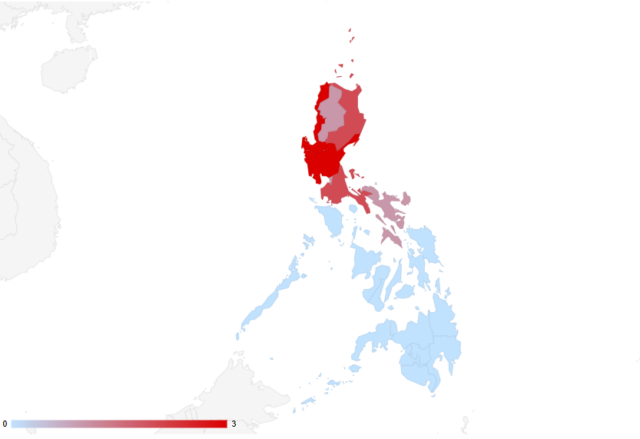
Provinces affected by Typhoon Nika | Source: NDRRMC

As Typhoon Nika (international name: Toraji) exits the Philippine Area of Responsibility, it has left about 37,000 families affected, the National Disaster Risk Reduction and Management Council (NDRRMC) reported on Tuesday. 

In the latest situational report released by NDRRMC, a total of 36,788 families or 153,643 persons were affected by the impacts of Typhoon Nika. 

It has affected several regions, including Region I, II, III, V, and the Cordillera Administrative Region (CAR).  

Region V has the highest number of affected families, with 32,796, primarily in Daet, Camarines Norte, Camarines Sur, Naga, and Catanduanes. 

In Aurora, where the eye of Typhoon Nika made landfall, a total of 1,843 families were affected across 59 barangays.  

Meanwhile, A total of 4,593 families, or 14,971 persons, were sheltered in 246 evacuation centers, while 723 families, or 2,099 persons, were served outside of evacuation centers. 

As of Monday, a total of P47,480 worth of assistance were provided to the affected families, according to NDRRMC.  

The NDRRMC also reported that there is nearly P2.5 billion worth of standby funds and stockpiles from the Department of Social Welfare and Development and the Office of Civil Defense. 

No casualties have been reported, and the cost of damage to properties has yet to be released.Edg Adrian A. Eva

Philippines says it’s under pressure from China to cede claims in South China Sea

DEFENSE SECRETARY GILBERTO C. TEODORO, JR. — DND

 – China is putting ever-greater pressure on the Philippines to cede its sovereign rights in the South China Sea, Secretary of National Defense Gilberto Teodoro said on Tuesday after a meeting with his Australian counterpart in Canberra.

“What we see is an increasing demand by Beijing for us to concede our sovereign rights in the area,” he said, adding that the Philippines was a “victim of Chinese aggression”.

China and the Philippines have sparred repeatedly this year over disputed areas of the South China Sea, including the Scarborough Shoal, one of Asia’s most contested features.

Teodoro’s meeting with his Australian counterpart Richard Marles, their fifth since August 2023, reflects growing security ties between the countries, both of whom have expressed concern about Chinese activity in areas of the South China Sea claimed by the Philippines and other Southeast Asian nations.

The two nations signed a strategic partnership in September 2023 and held their first joint sea and air patrols in the South China Sea several months later. The Philippines also joined war games in Australia this year for the first time.

China claims almost the entire South China Sea, a conduit for more than $3 trillion of annual ship-borne commerce, including parts claimed by the Philippines, Vietnam, Indonesia, Malaysia and Brunei. The Permanent Court of Arbitration in 2016 said China’s claims had no legal basis, a ruling Beijing rejects.

Teodoro said China’s claims and behavior were contrary to international law and defense deals with partners such as Australia were an important way to deter Chinese incursions.

“Although they (China) claim to act under the aegis of international law, everybody knows that what they’re doing is contrary to the tenets of international law,” he said.

“The biggest evidence of this is that nobody has actually supported their actions or activities.”

In addition to closer ties with countries including Australia and the United States, the Philippines also plans to spend at least $33 billion on new weapons including advanced fighter jets and mid-range missiles.

Mr. Marles said Australia wanted to work more closely with the Philippine defense industry and would send an engineering assessment team to the country early next year. – Reuters

What does the US election outcome mean for the Philippines and Asia?

The 2024 U.S. presidential election is capturing attention worldwide as Vice President Kamala Harris and former President Donald Trump face off in a closely contested race to the White House. With the U.S. wielding the world’s largest economy and military, this election’s outcome will undoubtedly have far-reaching global implications. But what’s at stake specifically for the Philippines and the broader Asia and Indo-Pacific region?

In this B-Side episode, I will be speaking to Josue Raphael Cortez, a diplomacy instructor at the De La Salle-College of Saint Benilde’s School of Diplomacy and Governance.

Interview by Edg Adrian Eva
Editing by Jayson Mariñas