Home Blog Page 2313

S&P 500, Nasdaq post record highs as tech-related shares gain

REUTERS

NEW YORK – The Nasdaq and S&P 500 scored record closing highs on Monday, boosted by tech-related shares following the market’s strong November gains, as investors awaited this week’s economic data including the key monthly jobs report on Friday.

The Dow finished lower on the day. Both the Dow and S&P 500 recorded on Friday their biggest monthly percentage gains in a year.

The technology, communication services and consumer discretionary sectors rose about 1% each on Monday, while the rest of the S&P 500 sectors were lower. Tesla shares advanced 3.5%, with Stifel raising its price target on the stock.

“We’re seeing a market that’s in a seasonably strong period just creep higher,” said Rick Meckler, partner at Cherry Lane Investments, a family investment office in New Vernon, New Jersey.

“It’s a tough time for people to bail out, but by the same token, I don’t see an explosive finish to the year. There’s just too much uncertainty to where we’re headed. … No one is quite sure what the plan is economically with the new administration.”

Former U.S. President Donald Trump recaptured the White House in last month’s election and his Republican Party swept both houses of Congress, boosting stocks in November.

The Dow Jones Industrial Average fell 128.65 points, or 0.29%, to 44,782.00. The S&P 500  rose 14.77 points, or 0.24%, to 6,047.15 and the Nasdaq Composite climbed 185.78 points, or 0.97%, to 19,403.95.

Strategists have cited Trump’s potential plans for tax cuts and deregulation as a positive for stocks, but tariffs would be negative.

Investors also digested comments from Federal Reserve Governor Christopher Waller that he was inclined to cut the benchmark interest rate at the Dec. 17-18 meeting as monetary policy remained restrictive.

Investors have been expecting a quarter-point rate cut in December, but recent inflation data has raised worries that progress may have stalled.

The Fed began reducing rates in September by a half a point, following that with a quarter-point cut in November.

Earlier on Monday, the Institute for Supply Management reported improved U.S. manufacturing activity in November.

Aside from Friday’s hotly anticipated employment report, investors this week also will see private sector job growth data, the ISM’s services report and the Labor Department’s weekly jobless claims.

Super Micro Computer surged 28.7% after the artificial intelligence server maker began searching for a new finance chief based on recommendations by a special committee formed to review its accounting practices.

Declining issues outnumbered advancers by a 1.08-to-1 ratio on the NYSE. There were 406 new highs and 64 new lows on the NYSE.

On the Nasdaq, 2,332 stocks rose and 2,060 fell as advancing issues outnumbered decliners by a 1.13-to-1 ratio.

Volume on U.S. exchanges totaled 13.64 billion shares, compared with the 14.74 billion full-session average over the last 20 trading days. — Reuters

Forest Lake brings together Undas and Christmas with ‘Undasko 2024’

Memorial park developer Forest Lake recently presented “UNDASKO,” its way of celebrating Undas (All Saints’ and All Souls’ Days) and Pasko (Christmas), in one joyous and heartwarming event. Forest Lake showed that Filipinos may celebrate the shared values of two cherished Filipino holidays and further deepen family bonds in the process.

Forest Lake featured simultaneous Christmas tree lighting rites across all Forest Lake parks, not only creating stunning light displays in Forest Lake’s vast memorial parks but also serving as a beautiful tribute to departed loved ones.

UNDASKO also gave Forest Lake the perfect time to extend its “gifts of gratitude” to lot owners. These came in the form of exclusive promotions and discounts, complimentary services, and branded merchandise. Forest Lake likewise underscored how its unique provisions, such as its Total Memorial Care services, make it easier for families to plan for the future with peace and dignity. In addition, Forest Lake took the opportunity to promote its exclusive deals on memorial lots; its Libing Anywhere interment services; the Libre Burol for families availing of interment services; and QRonicle, the digital storytelling platform for loved ones.


Spotlight is BusinessWorld’s sponsored section that allows advertisers to amplify their brand and connect with BusinessWorld’s audience by publishing their stories on the BusinessWorld Web site. For more information, send an email to online@bworldonline.com.

Join us on Viber at https://bit.ly/3hv6bLA to get more updates and subscribe to BusinessWorld’s titles and get exclusive content through www.bworld-x.com.

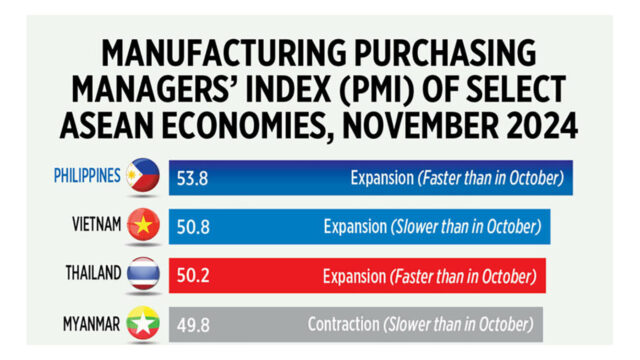
Manufacturing Purchasing Managers’ Index (PMI) of select ASEAN economies, November 2024

PHILIPPINE MANUFACTURING ACTIVITY jumped to a 30-month high in November, as firms anticipate stronger demand in the coming months, a survey by S&P Global showed on Monday.” Read the full story.

DBCC tweaks GDP growth targets

Crowds look for affordable Christmas lanterns and decorations at the Dapitan market in Quezon City, Nov. 30. The government now expects the economy to grow by 6-6.5% this year. -- PHILIPPINE STAR/MIGUEL DE GUZMAN

THE Development Budget Coordination Committee (DBCC) on Monday trimmed the economic growth target for this year to a range of 6-6.5% but widened the target band to 6-8% for 2025 until 2028, due to “evolving domestic and global uncertainties.”

Budget Secretary Amenah F. Pangandaman, who chairs the DBCC, said Philippine gross domestic product (GDP) is now projected to grow by 6-6.5% this year, narrower than the previous 6-7% goal.

“Despite domestic challenges, we are optimistic that we can still attain our growth target for the year of 6% to 6.5%. In particular, we expect the Philippine economy to bounce back during the last quarter, given the anticipated increase in holiday spending, continued disaster recovery efforts, low inflation, and a robust labor market,” she said at a briefing after a DBCC meeting on Monday afternoon.

The DBCC’s review of the macroeconomic assumptions came after the Philippine economy expanded by a weaker-than-expected 5.2% in the third quarter, which was the slowest since the 4.3% logged in the second quarter of 2023.

In the first nine months, GDP growth averaged 5.8%. To meet the lower end of the government’s revised 6-6.5% target band, the economy would need to grow by 6.5% in the fourth quarter.

Finance Secretary Ralph G. Recto said the Philippine economy can still “realistically” grow by 6% for the full year.

“The growth assumptions for 2025 to 2028 have been given a wider band of 6% to 8%, reflecting the anticipated impact of structural reforms and evolving domestic and global uncertainties,” Ms. Pangandaman said.

To achieve the targets, she said the government is committed to “accelerating infrastructure investments, enhancing the ease of doing business, and boosting national competitiveness.”

The DBCC chair said they expect the recently signed Republic Act No. 12066 or Corporate Recovery and Tax Incentives for Enterprises to Maximize Opportunities for Reinvigorating the Economy (CREATE MORE) Act to spur faster growth and attract more foreign investments.

FISCAL program

“We have maintained our medium-term fiscal targets for 2025 to 2028. This means that we remain determined to reduce the country’s deficit in a more gradual and realistic manner, while also bolstering long-term investments that create more jobs, increase incomes, and decrease poverty incidence,” Ms. Pangandaman said.

The DBCC said it raised the deficit ceiling for 2024 to -5.7% of GDP from -5.6% previously. It kept the deficit ceiling at -5.3% of GDP for 2025, -4.7% for 2026, -4.1% for 2027 and -3.7% for 2028.

For this year, the DBCC raised the revenue outlook to P4.383 trillion in 2024 from P4.27 trillion previously. Revenue targets were kept at P4.644 trillion for 2025, P5.063 trillion for 2026, P5.627 trillion for 2027, and P6.249 trillion for 2028.

“On average, revenue collections are expected to remain at 16.5% of GDP from 2025 to 2028, reaching P6.250 trillion (17% of GDP) by the end of the administration. This means that over the medium term, the government will be collecting a billion more in revenues a day annually,” Ms. Pangandaman said.

She said this will be supported by new measures such as the value-added tax (VAT) on digital services and tax administration reforms centered on digitalization.

At the same time, Ms. Pangandaman said government spending will remain one of the major contributors to growth.

This year’s expenditure program was raised to P5.907 trillion from P5.754 trillion previously.

DBCC expects expenditures to remain at an average of about 21% of the GDP from 2024 until 2028.

The 2025 spending target was maintained to P6.182 trillion; 2026 was set at P6.54 trillion, 2027 to P7.027 trillion, and for 2028 to P7.621 trillion.

“Our fiscal discipline and fluid debt management have recently earned our country a regional on credit rating outlook, found stable to positive from the S&P Global and a series of high rating affirmations from different global credit rating agencies,” Ms. Pangandaman said.

REVISIONS

During its meeting, the DBCC also tweaked the macroeconomic assumptions for inflation, crude oil, foreign exchange rate and exports growth.

Inflation is now projected to average 3.1-3.3% this year, a narrower band from the previous assumption of 3-4%. For 2025 to 2028, inflation assumption is kept at 2-4%.

The assumption for Dubai crude oil prices was trimmed to $78-$81 per barrel this year, from $70-$85 per barrel previously. Crude oil price assumptions were cut to $60-$80 per barrel from $65-$85 per barrel for 2025 to 2028, “with the anticipated improvements in global oil production over the medium term,” the DBCC said.

The DBCC now sees the Philippine peso averaging P57-P57.50 against the US dollar this year, “given sustained remittance growth, recovery in travel services, and growing outsourcing revenues.”

The peso is expected to “broadly stabilize” at P56-P58 per dollar in 2025, and P55-P58 per dollar for 2026 to 2028.

On external trade assumptions, the DBCC lowered the goods export growth to 4% this year from 5% previously, “in line with the observed slowdown in export revenues in recent months as well as the revision in the outlook for the domestic semiconductor industry.”

For 2025 to 2028, exports growth was maintained at 6%.

DBCC kept its assumptions for imports growth at 2% this year, 5% for 2025 and 8% for 2026-2028. — A.R.A.Inosante

Factory activity expands in Nov.

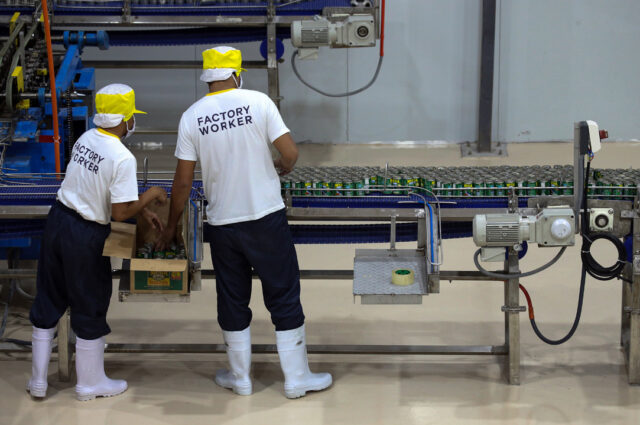
Workers are at an assembly line in a canned goods manufacturing facility. — PHILIPPINE STAR/KJ ROSALES

By Aubrey Rose A. Inosante, Reporter

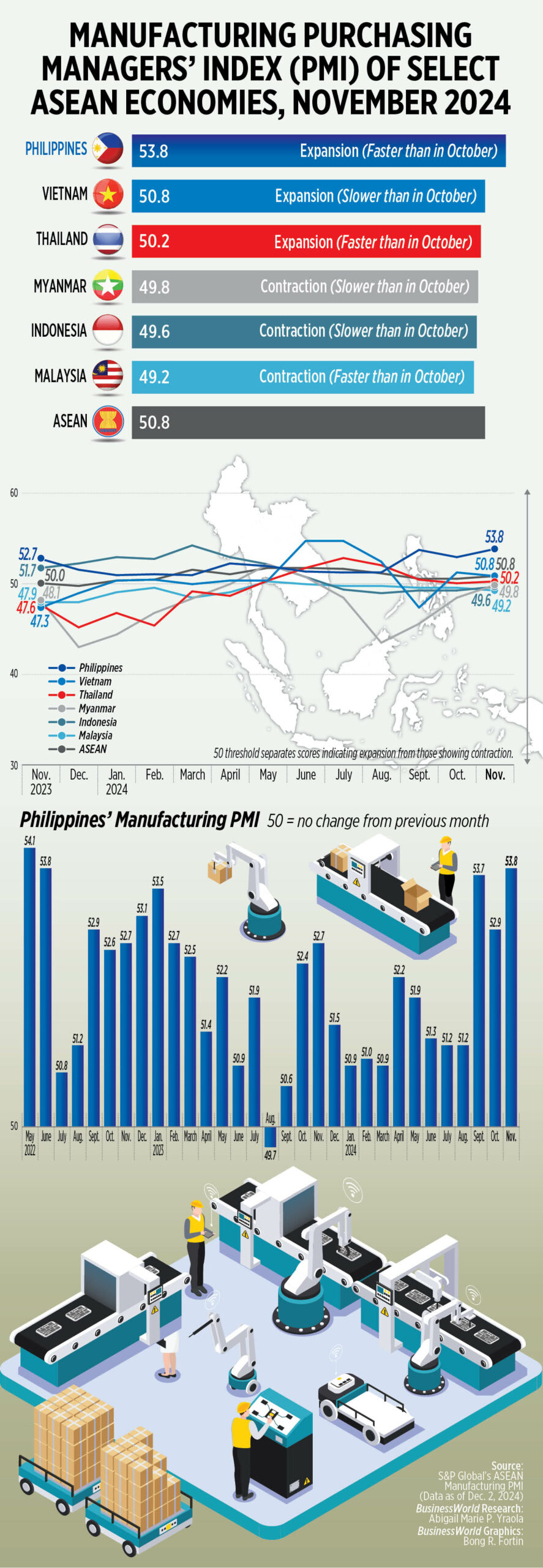
PHILIPPINE MANUFACTURING ACTIVITY jumped to a 30-month high in November, as firms anticipate stronger demand in the coming months, a survey by S&P Global showed on Monday.

The S&P Global Philippines Manufacturing Purchasing Managers’ Index (PMI) rose to 53.8 in November from 52.9 in October. This was the strongest improvement in operating conditions since the 54.1 reading in May 2022.

It also marked the 15th straight consecutive monthly improvement in manufacturing activity in the Philippines.

A PMI reading above 50 means improved operating conditions from the previous month, while a reading below 50 shows deterioration.

“November saw the Filipino manufacturing sector ramping up production in anticipation of greater sales in the coming months,” Maryam Baluch, economist at S&P Global Market Intelligence, said in a report.

“Hiring, purchasing activity and post-production inventories were also raised in preparation. New sales recorded further growth, as demand conditions continued to improve.”

The Philippines posted the highest PMI reading among six Association of Southeast Asian Nation (ASEAN) member countries, followed by Vietnam (50.8) and Thailand (50.2).

Myanmar (49.8), Indonesia (49.6) and Malaysia (49.2) all saw a contraction in PMI in November.

“Last month’s headline improvement was led by a big bounce in the Philippines’ gauge to 53.8 from 52.9, with the archipelago’s stellar outperformance in this survey continuing to mask a lot of the softness across the broader region,” Pantheon Macroeconomics Chief Emerging Asia Economist Miguel Chanco said in an e-mailed statement.

The average PMI among the six Southeast Asian economies stood at 50.8.

“Manufacturers eagerly anticipated a sales boost in the months ahead, prompting a notable ramp-up in production during the latest survey period, with growth accelerating from October,” S&P said.

It noted that the increased production went to supporting the growth of new sales, as demand conditions rose for a 15th straight month.

“While the pace of increase moderated to a three-month low, it remained solid and historically strong. The uptick in output was also attributed by companies to inventory building,” S&P said.

S&P said the inventory of finished goods increased for the first time in four months, with the pace of accumulation the fastest in two years.

Manufacturers also ramped up hiring in November.

“Companies expanded their capacity further as job creation was recorded for a third straight month. The pace of increase was just shy of October’s recent peak,” it said.

S&P said purchasing activity increased in November, but this did not result in a rise in pre-production inventories since companies used the inputs for current production.

“Some supply-side challenges acted as headwinds, as adverse weather conditions resulting from the recent typhoons hitting the country and rising inflationary pressures make a difficult environment for manufacturers,” Ms. Baluch said.

S&P noted the November data showed signs that supply chains are still “strained.” It noted that typhoons led to port congestion and flooding “with average lead times lengthening rapidly and to the most significant degree in over three years.”

In November, S&P said that inflationary pressures “intensified” as rising costs of supplies and raw materials led to a faster increase in expenses — the strongest since February 2023.

Charges for Filipino manufactured goods went up in November, as output charge inflation reaching a 21-month high.

“Nonetheless, firms remained optimistic about future output, with hopes that improved demand trends and the upcoming election year will provide a boost to the sector,” Mr. Baluch said.

S&P noted that manufacturers’ sentiment in November was the highest since early 2023.

Rizal Commercial Banking Corp. Chief Economist Michael L. Ricafort said factory activity rose as firms made preparations for the Christmas holiday season.

Mr. Ricafort said further rate cuts and a “benign inflation rate” would be beneficial for the economy, including manufacturing, though with some lag effects.

The Monetary Board could deliver another rate cut either at its December policy review or the meeting after, Bangko Sentral ng Pilipinas (BSP) Governor Eli M. Remolona, Jr. said earlier.

Since starting its easing cycle in August, the BSP has cut rates by 50 basis points, bringing the benchmark rate to 6%.

AMRO cuts Philippine growth outlook amid slowing consumption

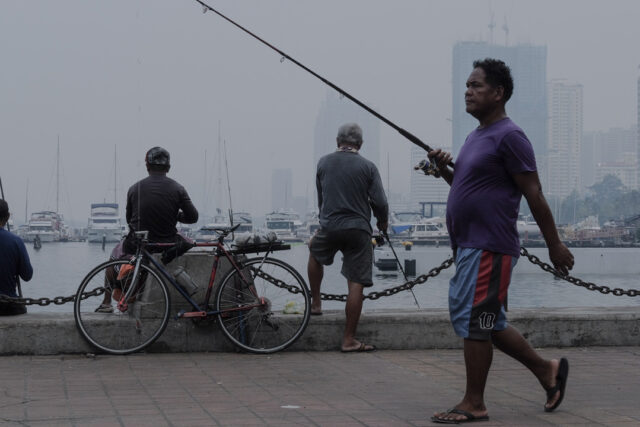
Smog covered parts of Metro Manila on Aug. 19. The growth outlook for the Philippines is clouded by external risks. -- PHILIPPINE STAR/RYAN BALDEMOR

By Luisa Maria Jacinta C. Jocson Reporter

PHILIPPINE ECONOMIC GROWTH may fall short of the government’s target this year amid a slower-than-expected rise in consumption and investment, the ASEAN+3 Macroeconomic Research Office (AMRO) said.

In its latest Annual Consultation Report, AMRO cut its gross domestic product (GDP) growth projection for the Philippines to 5.8% this year from its 6.1% estimate in October.

This would fall below the government’s revised 6-6.5% growth target for 2024.

AMRO said household spending and private investment were weaker than expected this year due to elevated inflation and high interest rates.

“Household consumption, underpinned by a strong labor market and robust remittances, continued to expand, but at a slower pace due to the lagged impact of high inflation.”

“Private investment is gradually rebounding but has yet to reach pre-pandemic levels, partly due to weak investment sentiment amid high interest rates,” it added.

Latest data from the Philippine Statistics Authority (PSA) showed that Philippine GDP growth averaged 5.8% in the first nine months of the year.

For 2025, AMRO retained its growth forecast of 6.3% for 2025.

“The pickup in growth is driven by higher government spending as well as an upturn in external demand and strengthening domestic demand,” it said.

The think tank also expects domestic demand to improve moving forward, which would support growth.

“Private consumption is anticipated to grow faster in the rest of the year, supported by strong labor market conditions, lower inflation and robust overseas remittances.”

“With the start of the monetary policy easing cycle, private investment sentiments are expected to improve,” it added.

However, AMRO said the growth outlook faces “heightened geopolitical risks” that may increase the likelihood of supply disruptions and further global economic fragmentation.

The Philippine economy’s growth momentum could also be “derailed by a sharp slowdown in major trading partners in the near term,” it added.

“Over the long term, the country’s potential growth could be constrained by insufficient infrastructure investment, vulnerabilities to climate change, and prolonged scarring effects caused by the coronavirus disease 2019 (COVID-19) pandemic.”

Consumption growth may still be hampered by elevated inflation, it added.

“Philippine growth prospects, particularly private consumption, are clouded by the risk of high food inflation… Higher costs of basic needs would further reduce households’ ability to afford discretionary items and hence constrain household consumption.”

However, AMRO projects headline inflation to average 3.2% this year and the next.

“Inflation is expected to stay broadly within the target range in the second half of 2024 through 2025, benefiting from the continued easing of global commodity prices and government measures,” it said.

The Bangko Sentral ng Pilipinas (BSP) expects inflation to average 3.1% this year and 3.2% in 2025.

“While upside risks such as wage increases and local food supply shocks remain, the decline in headline inflation is expected to continue in the second half of 2024 due to lower commodity prices of fuel and food, and tariff cuts on imported rice,” AMRO said.

“Meanwhile, inflationary pressure will likely remain moderate due to a positive output gap and second-round effects, following increases in minimum wages and persistently high inflation expectations.”

With inflation expected to remain within target, AMRO said that there is room for the BSP to continue its rate-cutting cycle.

“As inflation will continue to ease within the target band, there is room to adopt a less restrictive monetary policy stance if current growth trends continue,” it said.

“However, if supply-side risks emerge, a whole-of-government approach should be taken to address inflationary pressures.”

Since August, the central bank has lowered borrowing costs by 50 basis points (bps), bringing the key rate to 6%.

The Monetary Board is set to have its last policy review for the year on Dec. 19.

“As year-to-date inflation has returned to the upper half of the target range, the BSP has room to gradually adjust the policy rate to a moderately restrictive stance,” AMRO said.

“This will lend some support to private investment and allow the BSP to rebuild space for renewed policy rate hikes if inflationary risks were to reemerge.”

Meanwhile, AMRO said that the Philippine government’s fiscal consolidation efforts can still be enhanced.

“The current fiscal-monetary policy mix is appropriate and can be adjusted further to support economic growth while rebuilding policy buffers.”

AMRO expects the fiscal stance from this year to 2025 to be “neutral.”

It projects the fiscal deficit settling at 5.7% of GDP this year and 5.6% of GDP in 2025, driven by “robust revenue collection despite higher expenditure.”

“Moving forward, the fiscal balance is expected to gradually decline to 4.2% of GDP by 2028,” it added.

The latest data from the Treasury showed the budget deficit narrowed to P963.9 billion in the January-October period.

The government has set a deficit ceiling of P1.52 trillion this year, equivalent to 5.7% of economic output. It expects to lower the budget gap to 3.7% of GDP by 2028.

RISING DEBT

Meanwhile, AMRO expects the National Government’s (NG) outstanding debt to rise slightly before easing further.

“Public debt is projected to increase slightly from 60.1% of GDP in 2023 to 60.7% in 2024, due to the government’s sustained funding needs and higher debt servicing costs.”

“However, it is expected to gradually decrease to 57.6% of GDP in 2028, on account of improved fiscal positions and robust economic growth.”

The NG’s debt-to-GDP ratio stood at 61.3% at the end of September, still above the 60% threshold deemed by multilateral lenders as manageable for developing economies.

The government seeks to bring the ratio down to 60.6% by the end of 2024, and below 60% by 2028.

“While the need for strategic adjustments in medium-term fiscal policy to support the economy is recognized, fiscal consolidation should be accelerated when conditions allow,” AMRO said.

“The government is likely to continue its medium-term fiscal consolidation plan at a slower pace to better support economic growth. However, it would be prudent to quicken the pace of fiscal consolidation if conditions allow, as restoring fiscal space remains critical to build greater resilience to external shocks amid elevated uncertainty.”

AMRO recommended efforts to expedite revenue mobilization and increase efficiency, as well as long-term fiscal reforms for fiscal sustainability.

“Overall financial stability remains sound; at the same time, a more active use of macroprudential toolkits could be considered to mitigate the financial stability risks,” it said.

“Some signs of vulnerabilities have emerged in certain areas, such as the household and property sectors, which warrant close monitoring. Meanwhile, the authorities should strengthen the institutional framework to safeguard financial stability and deepen the bond and repo markets.”

Lola Amour: The Album Concert premieres on Spotify, YouTube

LOLA AMOUR at the press launch of their album concert film (In the photo: trumpet player Tim Cruz, drummer Raffy Perez, keyboardist David Yuhico, guitarist Zoe Gonzales, vocalist Pio Dumayas, bassist Manu Dumayas, trumpet player Angelo Mesina, saxophonist Jeff Abueg).

A DOCUMENTARY film on Filipino band Lola Amour’s latest album concert is now available online, perfect for fans who want to relive the experience or casual listeners who want to see what all the fuss is about.

Lola Amour: The Album Concert, which was filmed live at Circuit Makati’s open concert grounds back in April, is meant to be a sort of “early Christmas present,” according to the band.

Directed by Jed Regala of First Light Studios, the concert film captures the band’s performance and includes exclusive behind-the-scenes moments like candid rehearsal footage and interviews with fans and musical directors leading up to the big event.

“For the concert film, our main product is the live show. We already have full sets online, like the ‘Fallen’ single launch and the PETA Theater live. Every few years we do something like this, and it’s good practice for us to see where we’re going, to see the progression to remind us that we’re still improving,” said Pio Dumayas, Lola Amour’s lead singer and rhythm guitarist, at the press launch of the concert film.

“Of course, we’re also inspired by the fans that we can’t reach. We have lots of fans that wanted to see us live but couldn’t, so this is for them,” he added.

For lead guitarist Zoe Gonzales, the film allowed the members to properly see the crowd. “It’s like proof that it actually happened because when we performed it, it felt so surreal. It was great to see the crowd’s reactions, just very genuine,” he said.

It was also their last concert with ex-bassist Raymond King, whose departure from the band was effective after the live show ended. Their current bassist, Manu Dumayas, explained that the adjustment has been smooth.

“Raymond and I have really different playing styles. There was a point where there was a kind of transitional period, not just in terms of turnover of roles in the band, but actual sound. Seven months have passed and I think we’re where we want to be. We’re all on the same page on the new sound that we want,” he told the press.

The album concert also featured guests like the band’s former keyboardist Martin Kim (who is now based in South Korea), the Filipino hip-hop group PLAYERTWO, and macho dancer internet personality Dante Gulapa.

WHAT’S NEXT

Having just released the concert film online, Lola Amour is gearing up to drop new music in the coming months.

“We went to Malaysia late in July to participate in a songwriting camp organized by Warner Philippines and Warner Australia,” Mr. Dumayas said. “We got along with some of the producers there and came back to Malaysia to finish an album with them. We wrote an album in nine working days.”

Before that is released, fans can look forward to a song that will come out on Jan. 31, 2025, — a collaboration they did with Australian singer-songwriter Oliver Cronin, titled “Maria.”

Lola Amour drummer Raffy Perez said that the technical aspects of their live shows have only just started improving. “Tame Impala, an artist I really love, is really heavy on light usage in concerts. So in a way, we’re kind of in-spired to do the same wherein the synchronized LEDs are like a light show that goes well with each song’s vibe and energy. That’s what I’m excited about,” he told BusinessWorld.

For keyboardist David Yuhico, their songwriting will continue to evolve. “Now we’re like, let’s keep it simple. Let’s do what we’re good at and let people shine in certain areas. Let’s make it whole, not just everyone trying to fill the sound up because they can,” he explained.

Fans can expect Lola Amour to make a name for itself internationally, according to frontman Mr. Dumayas.

“So far, we’ve performed in Singapore and Macau. We love playing here, but we want to look for opportunities to get out in the world more,” he said.

The band members also told BusinessWorld of many other goals — performing in bigger venues like arenas once they have more hit songs, releasing a concert film in cinemas or on platforms like Netflix, and even looking for a Guinness World Record to break during their next live show.

“Everything we do is for the fans. It’s all for them,” Mr. Dumayas said.

Lola Amour: The Album Concert is now available on Spotify and YouTube. — Brontë H. Lacsamana

Megaworld invests P5B in 35th township in CdO

FROM LEFT TO RIGHT: Lourdes T. Gutierrez-Alfonso, president, Megaworld Corp.; Kevin L. Tan, president and chief executive officer, Alliance Global, Inc.; and Monica T. Salomon, president, Global-Estate Resorts, Inc.

MEGAWORLD CORP. is expanding its portfolio to 35 townships as it starts the development of The Upper Central integrated lifestyle community in Cagayan de Oro City.

The 117-hectare township is being developed by Megaworld’s subsidiary Global-Estate Resorts, Inc. (GERI).

“With GERI as the primary developer of The Upper Central, it is allocating an initial P5 billion to develop the entire integrated lifestyle community in the next ten years,” Megaworld said in a stock exchange disclosure on Monday.

The Upper Central is located along J.R. Borja Road in Barangays Gusa and Indahag, overlooking Downtown Cagayan de Oro. The township is 10 to 15 minutes away from the city’s downtown area and less than an hour away from Lagu-indingan International Airport.

“The Upper Central will be a milestone development as it is our 35th township launched on our 35th year in the Philippine real estate industry. As we develop this new township, our vision as a developer remains: to help uplift the lives of the community and also to help propel the local economy through the jobs that we create. We hope to impart this lasting impact to Kagay-anons and the rest of the people of Mindanao,” Megaworld President Lourdes T. Gutierrez-Alfonso said.

Highlighted by views of Macajalar Bay and the Malasag Mountain Range, the township will have residential villages, a pedestrianized commercial and shophouse district, mixed-use developments, and its own town center.

The township will feature a central park, landscaped open spaces, viewing decks, mountain and bike trails, and an adventure park, with sloping terrain reaching up to 245 meters above sea level.

About 40% of the township will be allocated for roads, as well as green and open spaces.

“We are envisioning building a whole new lifestyle district in this higher part of Cagayan de Oro,” GERI President Monica T. Salomon said.

Philippine Statistics Authority data this year showed that Cagayan de Oro is the second richest city outside of Metro Manila in terms of per capita gross domestic product.

UK-based Oxford Economics placed Cagayan de Oro as the third city in the Philippines with the largest urban economy, only behind Manila and Cebu.

“Ever since, we have already set our eyes on Cagayan de Oro City because this is the gateway to many parts of Northern Mindanao. For the past years, our group has been carefully evaluating the concept of development that we want to put in this bustling city. Now is the perfect time to take part in the booming real estate industry of this side of Mindanao,” Megaworld Executive Director Kevin Andrew L. Tan said.

Meanwhile, MREIT, Inc., the real estate investment trust (REIT) arm of Megaworld, is eyeing expansion into Cebu, Bacolod, and Pampanga over the next three years.

“As opportunities arise, the company may choose to diversify into other high-growth geographic areas like Cebu, Bacolod, and Pampanga, as well as other growth areas in the country where the sponsor’s (Megaworld Corp.) townships are located,” MREIT said in a separate regulatory filing on Monday.

According to the company, its diversification plans also include investments in other types of real estate assets such as retail, hospitality, industrial, logistics, warehouse, and other sectors that meet its criteria for “Grade-A, centrally located, stably occupied, and income-generating” properties.

“Properties to be acquired will primarily be Megaworld assets but may also include assets owned by third parties. Acquisitions will be funded either through debt, equity, or a combination of both,” MREIT said.

The company previously said that it aims to have one million square meters of gross leasable area across its portfolio by 2030.

In October, MREIT secured approval from the Securities and Exchange Commission to acquire six office properties from Megaworld.

Valued at P13.15 billion, the properties include Two West Campus, Ten West Campus, and One Le Grand in McKinley West; One Fintech and Two Fintech in Iloilo Business Park; and Davao Finance Center in Davao Park District.

Under the deal, MREIT will issue 926.16 million shares to Megaworld in exchange for the six properties.

On Monday, Megaworld shares rose by 0.49% to P2.05 each, while GERI stocks last traded at 58 centavos on Nov. 27. MREIT shares declined by 1.89% to P13.48 each. — Revin Mikhael D. Ochave

A teenage otaku’s experience at the Ramon Magsaysay Awards

THE AUTHOR’S SON, Cid (right), with Studio Ghibli’s Yoda Kenichi stands in front of a poster of Studio Ghibli’s head and Ramon Magsaysay Awardee Hayao Miyaki. — BETH SANCHEZ LACSON

By Beth Sanchez Lacson,

THE STUDIO GHIBLI bling they wore in honor of the occasion (clockwise from top): a hand-painted bag of a sleeping Howl from Howl’s Moving Castle, a faded plastic Totoro watch, a No Face pin, and a pair of crocheted red mask earrings from Princess Mononoke. — BETH SANCHEZ LACSON

THE HISTORIC Art Deco building that is the Metropolitan Theater in Ermita, Manila was filling up with dignitaries from across Asia in formal regalia and their proud national attire.

This was our first time to attend the Ramon Magsaysay Awards, the 66th this year, considered as Asia’s equivalent of the Nobel Peace Prize.

On the sidelines, my son, Cid, a 16-year-old otaku (animé or manga fan) sat quietly in giddy anticipation, wearing a faded plastic Totoro watch and a No Face pin. For the occasion, I donned a pair of crocheted red mask earrings from Princess Mononoke and carried a hand-painted bag of a sleeping Howl from Howl’s Moving Castle. With our paraphernalia, we waited with bated breath for Studio Ghibli’s Hayao Miyaki to make a rare public appearance.

RAMON MAGSAYSAY AWARDS

The Ramon Magsaysay Award — named after the 7th President of the Philippines who perished in a plane crash in 1957 — was created to give recognition to the ideals he espoused and the courageous service that he rendered for the Filipino people.

President Magsaysay embodied greatness of spirit and believed that his fellow humans were entitled to live in freedom and happiness. Injustice incurred his wrath and he worked tirelessly to build a nation that thrived with honor and peace.

The reason for our being at the awards ceremony was that among the 2024 Awardees was animator and filmmaker Miyazaki Hayao of Japan who co-founded Studio Ghibli in 1983.

When the Ramon Magsaysay Foundation posted an announcement on social media calling for questions for Mr. Miyazaki, my son didn’t need to be asked twice. Incidentally, they were holding an art exhibit in his school inspired by Studio Ghibli films and he took great pains to send those photos and videos along with his questions to the foundation.

I fail to recall how long I have been a fan of Studio Ghibli films but my obsession with everything Studio Ghibli seemed to rub off on my son.

Studio Ghibli has produced many memorable animated feature films including the 1988 classic, My Neighbor Totoro. Mr. Miyazaki’s works are primarily aimed at children, one of the most challenging audiences. What is unique about his films is that they don’t oversimplify plots. He tackles complicated issues head on — whether these are about climate change, the pain of loss and grief, the role of women in society, and the discovery of self — because he has complete faith in the youth and their ability to comprehend such issues.

Princess Mononoke and Nausicaä of the Valley of the Wind teach children about protecting the environment and how human actions can greatly affect nature and the creatures on planet Earth.

Grave of the Fireflies and Howl’s Moving Castle are snapshots of the harrowing consequences of war. Castle in the Sky and The Wind Rises depict the potential for technology as a tool of progress or destruction. Kiki’s Delivery Service is a story of self-discovery and acceptance. Howl’s Moving Castle and Whisper of the Heart both tackle the innocence of love. And My Neighbor Totoro, Spirited Away, Ponyo, and Arrietty focus on purity, curiosity, and the unknown.

“Besides the mesmerizing animation and high quality that Studio Ghibli films have, I was mainly focusing on and appreciating the stories that they were trying to tell,” Cid said.

THE ACKNOWLEDGMENT

The words of the Ramon Magsaysay Foundation resonate: “In electing Miyazaki Hayao to receive the 2024 Ramon Magsaysay Award, the board of trustees hails a gifted and exemplary artist who has demonstrated, in his work and outlook a lifelong commitment to the use of art, especially animation, to illuminate the human condition, especially lauding his devotion to children as torchbearers of the imagination.”

As the parade started, we craned our necks to see if he was there — his signature white hair and beard and thick, black rimmed glasses. But he was nowhere in sight.

There was a spark of wishful thinking on my part, that maybe, he would make a surprise appearance that night. I didn’t want it to be all for naught for us.

Finally, his name was called but somebody else stood up.

“My name is Yoda Kenichi, Vice-President for Events and Exhibitions for Studio Ghibli. It is my honor to represent our co-founder Miyazaki Hayao, at the 66th Ramon Magsaysay Awards. Please allow me to read a letter that Miyazaki-san has written for this occasion.”

(Letter from Hayao Miyazaki)

“I first heard of the Ramon Magsaysay Award when I was a child.
“I think it was in the school playground, and my teacher told me that such an award had been created.
“The name made an impression, so it has remained in my mind ever since.
“Being honored with this award made me think of the Philippines once again.
“In 2016, the former Emperor and Empress visited Manila, which was the setting of urban warfare during World War II, to pay their respects to thousands who have lost their lives.
“The Japanese did a lot of terrible things back then.
“They killed many civilians.
“The Japanese people must not forget this.
“It will always remain.
“With such history, I solemnly accept the Ramon Magsaysay Award from the Philippines.”

(End of Letter)

The tears came unbidden before I realized what was happening.

My son was looking at me in a funny way, wondering what was wrong. This acknowledgment and profound humility were the reasons why I thought he was chosen as an awardee — to become a bridge to a broader under-standing of peace in modern times, through sensible and sensitive storytelling, even if a lot of the past seemed forgotten.

At least he has not forgotten.

And for my son who has learned to love all that is Studio Ghibli, this moment will always be part of a core memory.

First Gen lowers 2025 capex to P35 billion

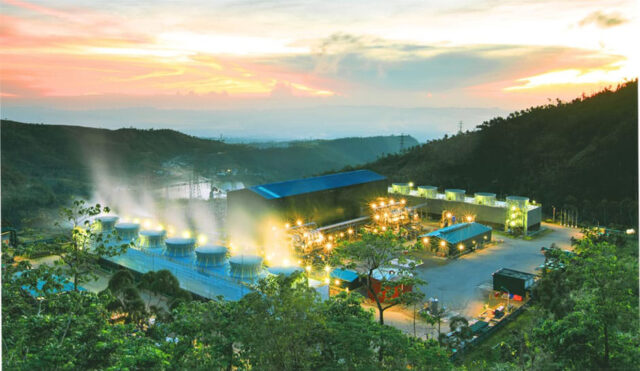
FIRSTGEN.COM.PH

By Sheldeen Joy Talavera, Reporter

LOPEZ-LED First Gen Corp. is allocating a lower capital expenditure (capex) budget for next year as it will be focusing on geothermal activities, its president said.

“Next year, we will have a relatively smaller capex program. Maybe roughly around…P35 billion,” First Gen President and Chief Operating Officer Francis Giles B. Puno told BusinessWorld last week.

Mr. Puno said that around 90% of the budget will be allocated for geothermal activities, particularly drilling new wells.

“The prioritization is those drilling programs and the completion of the power plants… 83 megawatts (MW) will be operational by next year,” he said.

For 2024, First Gen has allocated $1.27 billion or approximately P74.4 billion.

Of the total, $560 million was for the hydro platform, which included the acquisition cost of the Casecnan Hydroelectric Power Plant; $670 million was allotted to its renewable energy subsidiary Energy Development Corp. (EDC) for its renewable energy portfolio; and the remainder was allocated for natural gas projects and the LNG Terminal Project.

Mr. Puno said that the company has already “completed the capex program in gas, as well as in hydro,” which explains the lower 2025 budget.

“The capex for geothermal is ongoing. So, what we’re doing is completing all the capex programs for geothermal,” he said.

For 2025, First Gen is targeting to drill approximately 16 new wells.

“We’re spending a lot on our well-drilling program. But the other issue we’re facing is that the power plants above ground are already old. So, we’re also trying to figure out how to make sure that we’re maximizing the steam capability of our concessions — matched with the right technology,” Mr. Puno said.

He said that the company has set a P60-billion capex program, of which P30 billion is for drilling wells while another P30 billion is for building more geothermal plants, as well as battery energy storage facilities.

“Many of our investments were originally fossil fuel, particularly in gas. We never invested in coal. But over the last many years, our priority really has been in geothermal,” Mr. Puno said.

“When you look at our balance sheet, for the longest time, our gas assets were probably the bigger portion of our investments, but today, our biggest investment actually is in EDC,” he added.

First Gen has a total of 3,668 MW of installed capacity coming from its portfolio of plants that run on geothermal, wind, hydro, solar energy, and natural gas.

At the local bourse on Monday, shares in the company climbed by 1.3% to close at P17.20 each.

My life in public service

I am deeply humbled and greatly honored by this recognition for my work, both in the public and private sectors, by the most prestigious business and management organization in the country. Thank you very much, MAP.

Allow me to briefly share my life in public service, both in the public and private sectors, and its contribution to nation building as I thank individuals and institutions that played essential roles for my being here today as the 48th MAP Management Person of the Year, which happens to be my birth year 1948. These individuals and institutions have shaped my values and principles on good governance, providing guidance and support along the way.

Allow me first to dedicate this award to my father, engineer Atanacio Singson, and my mother, Dra. Andrea Lazo Singson, for teaching me the values of simplicity, integrity, and honesty, daily prayers, and hard work. My father was a DPWH (Department of Public Works and Highways) District Engineer in Ilocos Sur who stood by his values and had to refuse a request of an influential member of the Commission on Appointments of Congress who also happened to be his cousin. And because of this conflict, he decided to resign and work with National Power Corp. (NPC) as a Lead Structural Engineer for NPC’s huge infrastructure projects, like the Ambuklao and Binga dams. My father worked hard, stood by his principles, and showed us how to live a simple life.

I would like to thank the Responsible Parenthood Council, headed by the late Horacio Boy Morales, and the Development Academy of the Philippines (DAP), headed by Dr. Onofre D. Corpuz and Executive Director Boy Mo-rales, for introducing me to grass roots community development work which I found more fulfilling as a fresh graduate from UP College of Engineering in 1971, instead of joining the corporate world. Upon the recommendation of my then immediate boss, Atty. Milton Mendoza, I was appointed as the first Resident Manager of DAP Tagaytay Training Center when it was officially inaugurated by then President Ferdinand Marcos in 1974. There I learned to deal with high-ranking government officials attending the 13-week live-in Career Executive Development Program and other live-in management programs and made sure that participants were kept happy, busy, and com-fortable with our spartan accommodations.

In DAP Tagaytay, I met Jose “Ping” de Jesus, a person who would have a profound influence in all of my work in the public sector. As DAP Senior VP, Ping de Jesus, known as JPJ, was running the organization and manage-ment development program while I was running the training center facilities.

GOAL WAS TO RETIRE AT AN EARLY AGE OF 40
My goal in life then was to retire at an early age of 40, so I left DAP and decided to become an OFW in the Middle East as part of the CDCP/Ultra Overseas Team so that I could earn in US dollars. Indeed, I was able to retire be-fore 40 with my dollar savings. I did retire at 38, constructed our retirement home in Baguio. But that was not going to go my way. The Lord had different plans.

Here again for some “divine” intervention, Sec. Ping de Jesus asked me to rejoin government while enjoying my short-lived early retirement in Baguio. I did eventually join, sometime late 1986, Sec. Ping de Jesus and another mentor, Usec. Chito Sobrepeña, in the Office of the Cabinet Secretary of President Corazon C. Aquino. My assignment at the Office of the President, included supporting the Office of Special Concerns with Cabinet Secretary de Jesus and Usec. Sobrepeña in preparing for the official trips of President Cory to ensure that government services reached the furthest and poorest municipalities of the country. President Cory, on record, traveled to 54 prov-inces, from Batanes to Tawi-Tawi. This assignment meant traveling as an advance party to the provinces under very stressful and challenging circumstances, including sleeping on school tables or hospitals since we were deep into places without accommodations — I am referring to places then, like Tawi-Tawi, Basilan, GenSan, and Batanes. Some of them were being visited by a sitting Philippine President for the first time.

I was also assigned as Executive Director of the Coordinating Council of the Philippine Assistance Program (CCPAP), a joint program with the US government, which was tasked to implement the creation of special economic and development zones and key infra projects — Calabarzon, Pavia/Iloilo, Gensan Sea Port, among others — and the promotion of BOT/PPP (Build-Operate-Transfer/Public-Private-Partnership) projects.

Allow me to thank the late President Cory for my appointment to BCDA (Bases Conversion and Development Authority) as the Vice-Chair and its First EVP in 1992 when RA 7227 was passed creating the BCDA Act. We made significant progress in generating employment and economic growth through conversion projects of former US military base lands. Among the major projects which stand out today include Heritage Memorial Park as our first BCDA fund-raising project, the privatization of Camp John Hay and Poro Point, the privatization and re-development of Clark Air Base into what is now known as Clark Special Economic Zone and the Clark International Airport.

With the leadership of SBMA (Subic Bay Metropolitan Authority) Chair Dick Gordon and as a Board Member of SBMA, we were able to privatize several assets turned over by the US military in Subic.

But to me, our biggest contribution to our economic development was the privatization and development of Fort Bonifacio and the Villamor Air Base. I personally got involved, from negotiating and clearing informal settlers, in what was known as Imelda Park, which was around the American battle monument, where most of the past army generals and chiefs of staff lived, and the nearby Palar Villages. In all these resettlement activities, we made sure that the relocation was done with fairness, compassion, and providing a reasonable and acceptable relocation for all affected families, be it a general or just a master sergeant living in the Palar areas along C5. This led to the development of Kalayaan Military Village, Villamor Housing, Centennial Village, and Diego Silang Housing, among others.

‘REAL ESTATE DEAL OF THE CENTURY’
The privatization of 214 hectares of Fort Bonifacio, known as the “real estate deal of the century,” with the winning group led by the Metro Pacific Consortium raised for government P30.4 billion. I believe the government received the biggest check payment of P19.6 billion as a down payment for that successful bidding of Bonifacio Global City (BGC). Thank you to the professional management team of BCDA and the BCDA Board who embraced good governance in all of our privatization undertakings.

From BCDA, in 1996, I joined the BCDA joint venture company with the Metro Pacific Consortium, the Fort Bonifacio Development Corp. (FBDC) as Senior VP in charge of infrastructure development of BGC, together with Mr. Charlie Rufino. At FBDC, I got directly involved with the help of our US-based urban planners and consultants, in the implementation of the upscale urban development of BGC — using for the first time in the country — floor area ratios, GIS (Geographic Information System) for all underground utilities, deed of restrictions handbook for all the lot buyers and owners which has created long-term value to BGC properties up to today.

In July 1998, President Erap Estrada appointed me back as Chair and President of BCDA to pursue more privatization and PPP projects using former military base lands and assets. I was told that President Erap wanted me back at BCDA because of the transparent and successful biddings of Fort Bonifacio military lands. From there, we continued to do more conversion projects to complete the master plans of all the base lands transferred to BCDA.

Another individual that I would like to thank is a former colleague in the Office of the Cabinet Secretary, Usec. Chito Sobrepeña, who invited me to join the community where I still belong, Ang Ligaya ng Panginoon (LNP), a family-based covenant community. After regularly attending the breakfast meetings of the Brotherhood of Christian Businessmen and Professionals (BCBP), “sabi siguro ni Chito, may pag-asa pa ito si Mr. Singson” (I guess Chito said, there is hope yet for Mr. Singson). After going through formation programs as a member of LNP, I eventually became a District Coordinator of LNP.

Fast forward [a few years], while attending an LNP Coordinators Retreat sometime in May 2010, I clearly remember the first day of our retreat. I got a call from a member of the selection committee of incoming President Noynoy Aquino (P-Noy), asking if I would be open to being considered as Secretary of DPWH. I told the caller — I believe it was Cesar Buenaventura — that I was in a retreat and I said I will pray about it. His immediate answer was, “I know our prayers will be answered.” [In a] coincidence, the theme of our retreat, led by Fr. Herb Sneider of the Loyola School of Theology, was on heroic leadership and becoming radical disciples for our Lord. With proper discernment and prayers, the community leadership with Senior Head Coordinator Mr. Tony Panajon and Spanky Meer, they gave their full support that I should be open to taking on the job of DPWH Secretary as a mis-sion field to being a radical disciple for love of God and service to fellowmen.

And again for some reason, the Bible reflection on the day P-Noy interviewed me for the first time was the reading from Matthew: “enter the narrow gate for the road to life is narrow and difficult.” At that point, what was much clearer than the message of “entering the narrow gate and following the narrow road” was the clear message for me to accept the government position. Of course, I had to consult and inform my wife, Binggay, and my family of this major decision. My daughter Nikka’s response was “are you crazy?” to accept.

VALUE OF LOVE FOR GOD AND SERVICE TO FELLOWMEN
So, my acceptance of the most challenging job in public service was based on the value of love for God and service to fellowmen. I knew my life in DPWH would be challenging, [with] long working days, a very huge pay cut coming from Maynilad as President. I even had to sell my Alabang Golf membership to augment my government salary. Knowing that DPWH was always in the [list of the] top three most corrupt government agencies prior to 2010 was my biggest challenge. Allow me to thank my brothers and sisters and the leadership of LNP for their guidance, and especially their prayers, during my full six challenging years with DPWH.

After Malacañang announced that I was the incoming DPWH Secretary, I asked a good friend, Ms. Yolly Villanueva Ong, to do a survey for me to know what the general public expected from the DPWH. The survey results showed that people simply expected that government funds and resources be used for the right projects, at the right cost and right quality. So, I made it very clear in our first DPWH ManCom meeting that we had to change the culture of DPWH and, with the help of some members of the DPWH ManCom, draw up our good governance and anti-corruption measures.

We developed our management mantra and strategic objectives of the 3Rs — Right projects, Right cost, and Right quality. Eventually, P-Noy added the 2 Rs — Right on time and by the Right people. Part of changing the cul-ture of DPWH was offering early retirement to about 25% of the employees and replacing them with young, qualified, registered civil engineers below 30 years old. We hired about 1,500 nationwide, and offered them a career in DPWH with regular plantilla positions and the salary equivalent of $600/month, instead of them going abroad as contractual personnel.

This award is not just a recognition of my efforts, but a testament to the commitment of the late P-Noy to his Daang Matuwid (Straight Path) way of governance in serving the country. Let me quote, P-Noy said — “no wangwang (sirens), no entitlements; kung walang corrupt, walang mahirap (if there are no corrupt people, there will be no poor people); kayo ang boss ko (you are my boss).” I had P-Noy’s full support in the transformation of the DPWH to become the lead infrastructure arm of the government. The Philippines got its highest rating ever in the 2014 Transparency International rating in the corruption perception index.

With the help of DBM (Department of Budget and Management) Secretary Butch Abad and the full support of other department secretaries, we were able to implement our infrastructure convergence program, developing infrastructure, roads and bridges, using national road standards to major tourism destinations of our country as prioritized by the late DoT (Department of Tourism) Secretary Mon Jimenez. For tourism convergence, we were able to complete 2,500 kms of tourism roads worth P84 billion.

Thanks to DepEd (Department of Education) Secretary Bro. Armin Luistro, who entrusted to DPWH the construction of the school buildings, and where we instituted for the first time PPP for school buildings to be able to wipe out the DepEd classrooms backlog; to Secretary Mar Roxas and Secretary Jun Abaya for national road standards leading to airports and seaports; and to Secretary Cesar Purisima and NEDA (National Economic and Devel-opment Authority) Secretary Arsi Balisacan for supporting our PPP projects, like CALAX, the NLEX Connector, the NAIA Expressway, the Cebu Cordova Bridge, and the Skyway, among others. We also started other convergence programs on flood control projects, too many to mention, based on river basin master plans and integrated water resources management (IWRM) principles and introducing the use of bio-engineering solutions. In the process, because of competitive public bidding, we were able to save the government several billion pesos. Thank you to Cabinet Secretary Rene Almendras who was very much in the thick of the transformation.

With the guidance of the Institute for Solidarity in Asia (ISA), we adopted in DPWH their performance governance system scorecard to ensure that we were moving in the right direction and that our achievements were measurable. And with the full support of the whole DPWH family, we were able to measure up to ICD standards and were awarded the highest gold trailblazer award. Thank you to Dr. Jess Estanislao and Rex Drilon for helping us and believing that we could change the culture of DPWH. And of course, thank you to the professionals and career personnel, especially the cadet engineers of DPWH, who believed that we could indeed change the culture and public perception of DPWH by supporting our good governance and anti-corruption program.

PUBLIC SERVICE OPERATING UNDER A PRIVATE ENTITY
In most of my assignments in the private sector, I have to thank Metro Pacific Investments Corp. (MPIC) Chair Manuel V. Pangilinan, for my appointments as presidents of Maynilad Water Services, Light Rail Manila Corp., Meralco MGen Power, Metro Pacific Water Investments, and, until recently, Metro Pacific Tollways Corp. In all these assignments, I made sure that we focused on the public service aspect of our plans and programs and our contribution to nation building. I emphasized that we are in public service operating under a private entity. We made sure that we addressed the needs and pain points of our customers and communities that we served. I was lucky to have very professional business unit heads and key officers, like NLEX President engineer Luigi Bautista, who is also the National President of Familia, a family-based church organization, who took care of the spiritual needs of North Luzon Expressway employees.

At my age of 76, I have been blessed with good health and able to live a balanced life — spiritually, mentally, physically, and in my social life. I still have my daily exercises, play golf on weekends whenever possible, go seri-ous ballroom dancing, and I will continue my advocacy for good governance and anti-corruption measures, particularly in addressing the country’s water crisis.

I wish and hope that some of my experiences and principles in good governance and anti-corruption measures based on hard work, political will, transparency, accountability, and citizens/stakeholders participation will in-spire our NextGen and Gen Z future leaders for a better future for all Filipinos.

In closing, I want to express my heartfelt gratitude to the MAP Board of Governors and the MAP members for this prestigious award which I also share with my sweetheart of over 54 years, Binggay Nepomuceno Singson, our daughter Nikka and husband attorney Jorge Abes with our apo (grandson) Rafa, our sons Patrick, Gilbert, and Edu, their spouses and our apos, and my close friends, some of whom are present here today, for helping me in my journey dedicated to a life of public service, for love of God and service to fellowmen. To God be the glory.


Rogelio “Babes” L. Singson is president and CEO of Metro Pacific Tollways Corp. Send feedback to map@map.org.ph and rlsingson@mptc.com.ph


T-bill rates mostly higher before inflation report

BW FILE PHOTO

THE GOVERNMENT made a full award of the Treasury bills (T-bills) it offered on Monday even as rates mostly climbed due to bets that Philippine headline inflation quickened further in November.

The Bureau of the Treasury (BTr) raised P15 billion as planned from the T-bills it auctioned off on Monday as total bids reached P57.8 billion, almost four times as much as the amount on offer and higher than the P51.665 billion in tenders seen the previous week.

Broken down, the Treasury borrowed the programmed P5 billion through the 91-day T-bills as tenders for the tenor reached P21.75 billion. The three-month paper was quoted at an average rate of 5.63%, down by 1.7 basis points (bps) from 5.647% seen last week, with accepted bids having yields ranging from 5.62% to 5.64%.

The government likewise made a full P5-billion award of the 182-day securities, with bids reaching P16.11 billion. The average rate of the six-month T-bill stood at 5.905%, up by 2.3 bps from the 5.882% fetched last week, with accepted rates at 5.85% to 5.925%

Lastly, the Treasury raised P5 billion as planned via the 364-day debt papers as demand for the tenor totaled P19.94 billion. The average rate of the one-year debt increased by 3.2 bps to 5.937% from 5.905% quoted last week, with the tenders accepted carrying yields ranging from 5.92% to 5.948%.

At the secondary market before the auction, the 91-, 182-, and 364-day T-bills were quoted at 5.6445%, 5.9236%, and 6.0048%, respectively, based on PHP Bloomberg Valuation Service (BVAL) Reference Rates data provided by the Treasury.

The government fully awarded the T-bills placed on the auction block on Monday as the offer was 3.9 times oversubscribed and the average rates fetched for the tenors were “all lower than the prevailing secondary market rates,” the Treasury bureau said in a statement.

“The awarded T-bill rates today tracked the latest short-term secondary BVAL rates, despite moving in mixed directions from last week’s auction,” a trader said in an e-mail.

T-bill yields mostly rose week on week amid market expectations that inflation picked up last month, Rizal Commercial Banking Corp. Chief Economist Michael L. Ricafort said in a Viber message.

Headline inflation may have picked up in November as prices of key food items rose due to the impact of several typhoons, analysts said.

A BusinessWorld poll of 15 analysts conducted last week yielded a median estimate of 2.5% for the November consumer price index (CPI), within the central bank’s 2.2% to 3% forecast for the month.

If realized, the November print would be slightly faster than the 2.3% clip in October but slower than 4.1% in the same month a year ago.

This would also mark the 12th straight month that headline inflation was within the Bangko Sentral ng Pilipinas’ (BSP) 2-4% annual target.

The BSP expects inflation to average 3.1% this year. In the first 10 months, headline inflation averaged 3.3%.

The Philippine Statistics Authority will release November CPI data on Dec. 5. (Thursday).

“The higher yields for the relatively longer 182- and 364-day bills reflected investors’ appetite for these issuances as they opted to secure yields with a longer holding period. This was due to potential market noise from the lingering uncertainty ahead of the incoming Trump administration,” the trader added.

US President-elect Donald J. Trump will take office on Jan. 20, 2025.

Uncertainties around US policies may slow global economic growth modestly in 2025, according to major brokerages, Reuters reported. They expect Mr. Trump’s proposed tariffs to fuel volatility across global mar-kets, spurring inflationary pressures and, in turn, limiting the scope for major central banks to ease monetary policy.

World economies and equity markets have had a robust year, with global growth expected to average 3.1% this year, a Reuters poll published in October showed.

The BTr plans to raise P75 billion from the domestic debt market this month, or P60 billion via T-bills and P15 billion through Treasury bonds.

The government borrows from local and foreign sources to help fund its budget deficit, which is capped at P1.48 trillion or 5.6% of gross domestic product this year. — AMCS with Reuters

ADVERTISEMENT
ADVERTISEMENT