Home Blog Page 2308

2027 SAP migration deadline may cause panic among PHL legacy customers

TRUSTPAIR.COM

THE 2027 DEADLINE to migrate to the latest version of Systems, Applications & Products in Data Processing’s (SAP) enterprise resource planning (ERP) software could cause panic among its customers in the Philippines, a global information and communication (ICT) solutions company said last week.

“SAP is actually transforming into a cloud company,” Simone Pigason, senior vice-president for customer success at delaware Philippines, said in a media briefing. “It is ending its 50+ years old version and then migrating into a cloud version.”

“To be fair with them, they have already maintained the software for more than 50 years,” she said. “They have to also develop their products already.”

SAP is a software producer for business management processes that has established the global standard for ERP software.

ERP software helps businesses streamline their processes, including finance, human resources, manufacturing, supply chain, sales, and procurement, through an integrated system.

In February 2020, SAP announced its maintenance commitment for the S/4HANA business suite until the end of 2040. S/4HANA is the next generation of SAP ERP that supports artificial intelligence (AI) and machine learning. By committing to the latest version, the mainstream maintenance for SAP Business Suite 7 core applications ends in 2027.

According to Ms. Pigason, only about 20% of current SAP customers in the Philippines have migrated to the new version.

“There’s going to be a tidal wave, a panic attack in the industry. Legacy customers of SAP have to migrate simultaneously,” she said.

Ms. Pigason added that delaware Philippines plans to leverage this for the next three years.

“We have our hands full right now because of the market and there’s just a compelling event that drives us there.”

delaware Philippines targets a 10% revenue growth in 2025 from its 35% projected growth this year.

“My main problem is not sales, there’s a market for me,” Ms. Pigason said. “My problem is how are we going to deliver? We only have so many people to implement SAP.” — Almira Louise S. Martinez

What do you bring to the table?

FREEPIK

THE eponymous phrase comes from the practice of “potluck” at social gatherings. This approach to hosting parties allows the guests to bring something for the party. Usually, the item is specified so that guests don’t bring identical stuff. The custom of not burdening a host with preparing food for a large group, after already providing the venue, expects that all party attendees bring a dish for all to eat. Also, the quantity may be dictated by the contributor’s number of attendees.

The guest who brings nothing to the table is considered rude, partaking of dishes brought by others and not contributing any of his own. This behavior invites scorn over someone who did not bring anything but sits anyway at the table heedless of the dagger looks around. (Should he just step out for a smoke while the food-bringers eat?)

What one brings to the table has become a corporate expression.

The expression “bring to the table” is defined in Lois Beckwith’s Dictionary of Corporate Bullshit. It refers to “the people who are important to an organization because of what they bring to the table in the form of skills, knowledge, contribution to a revenue-generating center, and connections.”

Bringing in a high-level and expensive talent into an organization for his rain-making skills (ability to bring in a shower on a parched desert) sets expectations on both sides. It is then a race between patience by the recruiters and the overhead cost of the new talent. Unfortunately, the high overhead from salaries and premium benefits needs to be front-loaded. Will the expected contribution follow suit?

This race between patience and windfall is stacked against the former. After two months when the euphoria of the top draft pick dies down, people around the table clear their throats and ask for a timetable.

In pre-historic times Homo sapiens (or more precisely, Homo erectus — referring to his walk rather than a particular part of his body) was a hunter-gatherer expected to hunt for his lunch, bringing back enough for the family at home. Companies may follow this hunter-gatherer model in recruiting key executives. One’s Guaranteed Annual Cash Compensation (salary is too primitive a word when including bonuses and variable pay) has to be justified by revenue one has brought in.

How different is this concept of hunting for one’s meal from the entrepreneurial model where absence of business automatically means no salary? Companies are embracing this no-free-lunch model with passion. If someone does not bring in business, should he even sit at the table or be banished from the feast?

Bringing something to the table is a simplistic concept with many implications. If a rain maker (or door opener) brings in more than his share of business, does he have license to ask how much the others are bringing to the table? This view can be disruptive. In terms of corporate culture, this approach causes anxiety and stress. Team spirit is replaced by “survival of the fittest.”

In the old days when basketball only tracked points made, the other aspects of the game were largely ignored. More metrics now note contributions to team play like assists, steals, blocks, charges taken, playing minutes, defense, and number of touches. Is there a way to measure what a good finance and accounting person brings to the table? Assuming corporate contribution is not limited to revenues, what about timely reports, research, and enhancing customer relationships? What about the support staff that improves cost efficiency, credit ratings, and brand enhancement.
Focusing just on table contribution can warp perception of who enhances the company’s real value. It focuses on individual (and selfish) play rather than teamwork. There is then a credit-grabbing culture that is espoused. A reward system based solely on bringing in business ignores the follow-through activities of nurturing the customer and building enduring relationships.

Imagine a basketball team which rewards only points made. Five players will just keep trying to shoot the ball without looking to pass and defend. Instead of asking what anybody brings to the table, it is better to check how big the table has become with everybody’s efforts and what kind of meal is being served.

An enjoyable conversation around the table is a contribution that is offered by the leader — who after all provided the table.


Tony Samson is chairman and CEO of TOUCH xda

ar.samson@yahoo.com

Davao construction company bags another port expansion contract

BW FILE PHOTO

A DAVAO-BASED company has secured the contract for the expansion of the Masbate port, the Philippine Ports Authority (PPA) said.

In a notice of award posted on its website, the PPA announced that Khan Kon Chi Construction Development Corp. won the P161.74-million contract.

The same company secured the contract for the P839.18-million Currimao Port expansion project.

The company will have 450 days to complete the Masbate port expansion, the PPA said, noting that at least eight companies submitted proposals for the project.

Aside from Khan Kon Chi Construction, the companies that submitted bids for the project include Grace Construction Corp., SB Construction Corp., Sunwest, Inc., MAC Builders Corp., the joint venture of JFAP Construction and NBCDC Corp., Luzviminda Engineering, and Frey-Fil Corp.

Last week, the port regulator also awarded the contract to restore another port in Masbate, the Esperanza Port, to a Bataan-based construction company, Jejor’s Construction Corp. and NBCDC Corp.

The PPA is working with private companies for the rehabilitation and expansion of its ports.

Over the next four years, the PPA is allocating approximately P16 billion to fund its projects, including 14 flagship projects slated for completion within this period. — Ashley Erika O. Jose

World wine production set for new 60-year low on weather woes, OIV says

FREEPIK

PARIS — World wine output is on course to hit another 60-year low in 2024 as vineyards in both the northern and southern hemispheres endured adverse weather as they did last year, the International Organization of Vine and Wine (OIV) said on Friday.

In its first global projections for 2024, the OIV pegged world wine output, excluding juices and musts, at between 227 million and 235 million hectoliters (mhl), with a mid-range estimate of 231 mhl.

The mid-range figure was 2% lower than last year’s output and the smallest since 1961, the OIV said. A hectoliter is the equivalent of 133 standard wine bottles.

“Globally, 2024 appears to be a re-run of 2023,” the OIV said in a note.

“As with 2023, extreme or atypical meteorological events are the key influence on global production, with early frosts, heavy rainfall, and prolonged drought dramatically impacting vineyard productivity.”

In the European Union (EU), home to the world’s three largest wine-producing countries — France, Italy and Spain — output was estimated at 139 mhl, down 3% from last year and the lowest level this century, according to the OIV.

France led the decline in the EU, with its production expected to fall by around a quarter, after weather setbacks ranging from torrential rain, limited sunshine, and hail.

An expected recovery in Italy from last year’s weak level should let the country reclaim the position of biggest wine producer from France, the OIV said.

In the United States, the world’s fourth-largest producer, 2024 output was forecast to be down 3% from last year though marginally above the five-year average, the body said.

In the southern hemisphere, overall output was estimated down 2% year on year at 46 mhl and the lowest in two decades, with declines in Australia, China, and South Africa offsetting a rebound in Argentina, the OIV said.

The declining production trend globally underscored the sector’s vulnerability to climate change, though in the short term the reduced supply may help balance a market faced with decreasing consumption and high inventories, it added. — Reuters

Pacific Cross Philippines appoints new president

PACIFIC CROSS Philippines, which operates nonlife firm Pacific Cross Insurance, Inc. and health maintenance organization Pacific Cross Health Care, Inc., has appointed Robert D. Wyld as its new president and chief executive officer (CEO), the companies said on Wednesday.

“I am deeply honored to lead Pacific Cross Philippines as we embark on this exciting new chapter. With the incredible team here, I look forward to building on the company’s strong foundation, driving growth, and ensuring we continue to provide world-class insurance solutions that adapt to our clients’ ever-evolving needs,” Mr. Wyld said in a statement.

Mr. Wyld, who is currently the CEO of Pacific Cross Vietnam, has over four decades of experience in the insurance industry, both in Asian and European markets.

“Throughout his career, Robert has demonstrated leadership by consistently driving growth and achieving remarkable results across diverse roles in the insurance industry. With a proven ability to transform businesses, he has led organizations to expand their market presence, exceed revenue targets, and establish strong industry partnerships,” Pacific Cross Philippines said.

“His leadership philosophy centers on building dynamic teams, fostering innovation, and delivering exceptional customer value — qualities that align perfectly with Pacific Cross Philippines’ vision for the future,” it added.

Mr. Wyld was also previously chief distribution officer for Asia at Pacific Cross International, where he helped the company reach record-high revenue growths for two consecutive years.

“As Pacific Cross Philippines moves forward under Robert’s leadership, the company remains steadfast in its commitment to offering dependable health and travel insurance solutions tailored to the needs of individuals, families, and businesses in the Philippines and beyond,” the company said.

Pacific Cross Insurance booked a net income of P12.31 million in 2023, data from the Insurance Commission (IC) showed. Premiums earned stood at P2.68 billion, with net premiums written at P2.72 billion and gross premiums written at P2.79 billion.

Meanwhile, Pacific Cross Healthcare posted a net loss of P41.93 million as of end-September, based on the latest IC data. — AMCS

Sizzling valuations are no bar for Asia data center deals as AI growth beckons

TRUSTPAIR.COM

SINGAPORE/HONG KONG/SYDNEY — Global investors are queueing up to invest in data center operators in Asia-Pacific either by buying stakes directly or via public offerings, unfazed by their rich valuations that are driven by demand for artificial intelligence (AI)-based services.

Many industry executives say the regional data centers will continue to command high valuations due to the nascent nature of the industry and its growth outlook. Some, though, say a lack of robust infrastructure could cast a cloud on their outlook.

Data centers house computer servers and equipment that companies use to process and store data.

A valuation benchmark for the sector was set in September when a consortium led by alternative asset manager Blackstone agreed to buy Australian data center group AirTrunk for an implied enterprise value of over A$24 billion ($15.58 billion), or over 20 times the target’s forward core earnings.

The process to sell a minority stake in Indonesian data center NeutraDC, for example, has attracted interest from Singapore Telecommunications (Singtel) and BDx Data Centers, among others, two sources with direct knowledge of the matter said.

A sale of roughly 20% to 30% stake in the data center arm of Indonesian state-owned communication company Telkom, which kicked off in October, could value the business at more than $1 billion, sources have said.

Brokerage BRI Danareksa Sekuritas’ analyst Niko Margaronis said NeutraDC could be valued at more than 20 times core earnings helped by factors including a capacity expansion plan to reach 500 megawatts (MW) by 2028 to 2030, from around 60 MW by end-2024.

Telkom group spokesperson Ahmad Reza told Reuters the sale process is “underway and progressing well.” He declined to comment on details including valuations, stake sale size and parties interested.

BDx, an Asia-Pacific data center operator backed by US-headquartered I Square Capital, declined to comment. Singtel did not respond to requests seeking comment.

In another example, Australia’s HMC Capital said on Nov. 21 that strong interest from investors had led the company to upsize the initial public offering (IPO) of its data centers business DigiCo REIT by A$100 million to A$2.75 billion.

The listing, Australia’s largest this year and scheduled to debut on the local bourse on Dec. 12, translates into a valuation of 26 times forward earnings, according to DigiCo’s IPO prospectus.

The new valuation benchmark for data center deals compares with average market-wide multiple of around 16 times core earnings in the broader private infrastructure deals globally, according to asset intelligence and data company Realfin.

“Valuations of data center assets are reflective of the rapid growth currently being experienced by the sector, driven by large orders from hyperscale customers,” said Manjit Balgir, Bank of America’s Asia telecom and digital infrastructure head.

EXECUTION RISKS REMAIN
The AirTrunk deal has propelled Asia-Pacific to the top of the M&A league table in the global data center market this year, with deal value totaling $17.03 billion, more than half of the global transactions, LSEG data showed.

The high valuations for the sector in Asia are partly linked to the nascent nature of the business in the region, and to data center operators adding more capacity as countries and companies respond to booming demand for AI.

“If someone comes and gives you a one-gigawatt contract, you’re probably doubling or more than doubling the capacity,” said KKR’s Director Projesh Banerjea, referring to the still-nascent state of the data center market in Asia.

KKR bought a 20% stake in the Asian data center of Singtel for S$1.1 billion ($818.64 million) last year and partnered Singtel to invest S$1.75 billion in ST Telemedia Global Data centers in June. Earnings multiples for the deal were not disclosed.

The sustainability of the valuation premium in the coming years, however, will be tested by execution risks in markets where power capacity and infrastructure are inadequate, some investors said.

Reliability on the actual delivery of data centers will become a lot more critical for tenants, said Gilles Chow, CPP Investments’ managing director and head of real estate for North Asia.

“Ultimately we see Asia-Pacific data center markets remaining a positive growth story in the medium term but anticipate that growth in the sector may cool a little as capacity comes online,” said Charlie Wilson, Asia M&A and private equity head at law firm Sidley Austin. Reuters

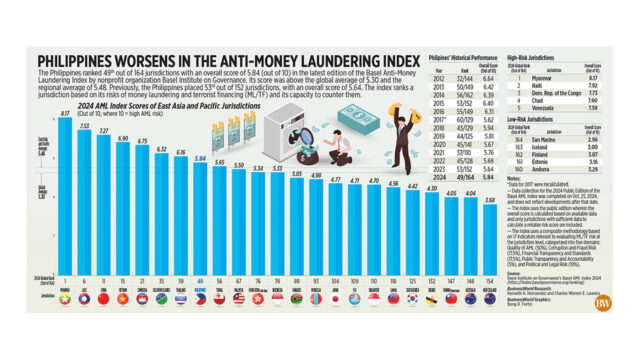
Philippines worsens in the Anti-Money Laundering Index

THE PHILIPPINES’ SCORE in a global anti-money laundering index worsened as its ranking declined to the 49th place out of 164 countries. Read the full story.

Philippines worsens in the Anti-Money Laundering Index

How PSEi member stocks performed — December 4, 2024

Here’s a quick glance at how PSEi stocks fared on Wednesday, December 4, 2024.


VP Sara faces second impeachment rap

AT LEAST 75 representatives from various organizations and progressive groups hand over to House Secretary-General Reginald S. Velasco the second impeachment complaint against Vice-President Sara Z. Duterte-Carpio at the House of Representatives in Quezon City on Wednesday. — PHILIPPINE STAR/MIGUEL DE GUZMAN

By Kenneth Christiane L. Basilio, Reporter

ANOTHER complaint seeking the ouster of Philippine Vice-President (VP) Sara Z. Duterte-Carpio was filed at the House of Representatives on Wednesday, triggered by what progressive group leaders describe as her gross abuse of power while in office.

This is the second impeachment charge against the embattled vice-president within the week. Critics of Ms. Duterte said her failure to account for public fund spending has paved the way for moves seeking her removal from office.

A total of 75 complainants are seeking Ms. Duterte’s impeachment, including political leaders, student representatives, human rights advocates, and sectoral groups, citing betrayal of public trust due to her alleged “gross abuse of discretionary powers” over her secret fund use in 2022 and 2023.

The complaint was endorsed by Party-list Reps. Raoul Danniel A. Manuel, France L. Castro, and Arlene D. Brosas, members of a House minority bloc.

The Office of the Vice-President did not immediately respond to an e-mail seeking comment on the impeachment complaint’s allegations.

“We accuse Vice-President Sara Duterte of betraying public trust,” Teodoro A. Casiño, chairman of political group Bayan Muna and among Wednesday’s complainants, said in a media briefing before the filing in Filipino.

“By misusing P612.5 million in confidential funds from the Office of the Vice-President and the Department of Education. This was used for improper purposes in improper ways,” he added, noting Ms. Duterte also covered up the misuse of public funds through “fake receipts, fabricated acknowledgment receipts, and false documents submitted to the Commission on Audit.”

Mr. Casiño also cited the Vice-President’s refusal to recognize Congress’ authority to investigate fund use as well as efforts to prevent the chamber from performing its oversight functions.

Impeachment complaints against Ms. Duterte have been submitted at the House despite President Ferdinand R. Marcos, Jr. discouraging it. While some congressmen from the majority have said they would toe the president’s line, civil groups and minority lawmakers remain adamant for her removal.

The filing of impeachment complaints against Ms. Duterte comes against the backdrop of a widening political rift between two of the country’s most influential clans. The falling out of the Dutertes and Marcoses has resulted in the collapse of what was once a formidable electoral alliance that delivered them landslide wins in the 2022 elections.

The first impeachment complaint, filed on Monday, cited 24 grounds containing allegations of graft and corruption, bribery, and betrayal of public trust among other crimes.

Under the 1987 Constitution, grounds for impeachment include treason, bribery, graft and corruption, high crimes or betrayal of public trust.

Impeachment counsel Neri J. Colmenares explained the second complaint only cited betrayal of public trust to allow them to focus on one issue and establish “solid” evidence.

“Right from the start, we said that the evidence needs to be solid. So, we cited the most catch-all ground, which is the betrayal of public trust, and we’ll focus on the most blatant issue, which is Ms. Duterte’s use of confidential funds,” he told reporters in Filipino after the complaint’s filing.

Aside from Ms. Duterte’s alleged misuse of secret funds, Wednesday’s complainants accused her of undermining the auditing process, making her unfit for office. They also claimed that her “willful refusal” to attend congressional investigations also constituted a betrayal of public trust.

The vice-president has been the subject of a House investigation on her spending of P612.5 million worth of confidential and intelligence funds in 2023 since she broke away from the Marcos administration in June, when she resigned from the Cabinet.

Ms. Duterte denies any wrongdoing stemming from the probe, alleging it is politically charged and could be laying the groundwork for her ouster.

Mr. Colmenares said they fielded a “simple” article for Ms. Duterte’s impeachment so Congress could easily deliberate their accusations. “I hope there will be a decision and, of course, a conviction by January 2025 so that the accountability mechanism for public officials can be seen by the people.”

Midterm elections are scheduled for next year, casting doubts on the viability of the complaint as an impeachment process could drag out and take months.

“The impeachment complaint should be expedited because we know, and we’re not blind, that the elections are approaching,” said Mr. Colmenares.

Political analysts said that the upcoming elections could affect how lawmakers would proceed with Ms. Duterte’s impeachment complaint.

“The combination of the upcoming elections and the holding of the impeachment proceedings will be an opportune time to assess [lawmakers’] political alignment,” Dennis C. Coronacion, chairman of the University of Sto. Tomas’ Political Science department, said in a Facebook Messenger chat.

Lawmakers are likely on the fence on the impeachment complaint against Ms. Duterte, citing the need to carefully consider whether they’d gain or lose votes from their stance on the matter, Anthony Lawrence A. Borja, an associate political science professor at the De La Salle University, said in a Facebook chat.

The House will first hear the complaint, requiring one-third of its members, or at least 102 congressmen, to agree with the impeachment rap before the case is elevated to the Senate for trial. The chamber is headed by Speaker Ferdinand Martin G. Romualdez, a cousin of the president.

The embattled Dutertes have a few allies in the Senate, whose members include former President Rodrigo R. Duterte’s ex-police chief and former chief presidential aide. At least 16 senators need to find Ms. Duterte guilty of the alleged violations to be convicted.

Chinese vessel engaged in ‘aggressive’ actions against PHL vessel, PCG says

PCG/BW FILE PHOTO

THE Philippine Coast Guard (PCG) on Thursday said a Chinese Coast Guard (CCG) ship had fired water cannons at a fisheries bureau vessel conducting a resupply mission for Filipino fishermen in the vicinity of Scarborough Shoal.

The incident comes days after the reported harassment of Filipino fishermen by a People’s Liberation Army (PLA) Navy helicopter in a different South China Sea feature.

In a joint statement, the PCG and the Bureau of Fisheries and Aquatic Resources (BFAR) said CCG vessel 3302 fired a water cannon at the BRP Datu Pagbuaya, “aiming directly at the vessel’s navigational antennas” while it was located 16 nautical miles south of Scarborough Shoal.

The Chinese vessel intentionally sideswiped the 30-meter BFAR ship BRP Datu Pagbuaya on its starboard side and launched a second water cannon attack shortly after, the Philippine side added.

The PCG said CCG vessels 5303, 3302, 3104, and 3304 and two PLA Navy ships with bow numbers 500 and 571 were involved in “aggressive” actions against Philippine vessels during the resupply mission.

The BRP Teresa Magbanua, the PCG’s largest and most modern vessel, and other Philippine ships faced “blocking, shadowing, and dangerous maneuvers” from PLA Navy vessel 500 and CCG 503.

“Additionally, BRP Cabra was subjected to reckless maneuvers by CCG 3104 at a distance of 300 yards,” it added.

A 2016 arbitral ruling that invalidated China’s expansive claims in the South China Sea said Scarborough Shoal, which Beijing has effectively controlled since 2012, is a traditional fishing ground for Filipino, Chinese, and Vietnamese fishermen.

Citing the CCG, the Chinese embassy in Manila accused the Philippine side of attempting “to intrude into the territorial waters of Huangyan island.” Huangyan is the Chinese name for Scarborough.

It said four Philippine vessels also “dangerously approached the normal law enforcement patrol ships” of the CCG.

“China has exercised control over them in accordance with the law.”

In a statement, the Philippines’ National Maritime Council reiterated that Scarborough, which it calls Bajo de Masinloc, is an “integral part of the Philippine national territory.”

Manila has an “indisputable sovereignty over it and its territorial sea,” it added.

“These maritime zones are in accordance with United Nations Convention on the Law of the Sea (UNCLOS), the 2016 Arbitral Award, and the Philippine Maritime Zones Act,” the council said.

“Hence, the Philippines is well within its rights to conduct routine maritime activities in the area, including maritime patrols and humanitarian activities that support the economic activities of Filipino fishers.”

On Monday, the PCG said it had deployed two vessels to Rozul Reef in response to fishermen’s report that they were harassed by a Chinese Navy helicopter.

The deployment “aims to provide evidence of the active presence of Filipino fishermen in the West Philippine Sea,” its spokesman for the West Philippine Sea Jay Tristan Tarriela said in a statement.

The maritime council said the aggressive posture of the Chinese vessels on Wednesday “highlights a continuing pattern of aggression, coercion and intimidation within Philippine waters.”

“These actions against our vessels are clear violations of international law and an affront to the mutual respect that is expected between countries.” 

The United States condemned on Wednesday China’s “unlawful use of water cannons and dangerous maneuvers” in the South China Sea, its top envoy to Manila said on Wednesday.

China’s actions disrupted Philippine maritime operations and put lives at risk, Ambassador MaryKay Carlson said on social media platform X, adding that the US stands with likeminded allies in support of a free and open Pacific. — Kyle Aristophere T. Atienza with Reuters

EU reaffirms support for 2016 ruling amid SCS tensions

PHILIPPINE COAST GUARD PHOTO

THE EUROPEAN UNION (EU) is keen on bolstering ties with the Philippines in diplomatic efforts on a free and open waters in the Indo-Pacific region as it reaffirmed commitment to international law amid the Manila’s maritime dispute with Beijing, according to the European External Action Service (EEAS).

“What concerns us in Europe is we are very much committed to international law and specifically in this case the United Nations Convention on the Law of the Sea (UNCLOS),” EEAS Managing Director for the Asia and the Pacific Niclas Kvarnström told a news briefing in Makati City.

“The best way to handle these situations is through diplomacy and so when you see aggressive behavior, and in our case, we stand fully behind UNCLOS and the ruling in 2016.”

China claims almost the entire South China Sea (SCS), a conduit for more than $3 trillion of annual ship-borne commerce. The Permanent Court of Arbitration in 2016 said China’s claims had no legal basis, a ruling Beijing rejects.

The EU is also looking at collaborating with the Southeast Asian nation on maritime routes awareness projects, cybersecurity, and digitalization.

Mr. Kvarnström said Manila has been working with the EU in its Critical Maritime Routes Indo-Pacific project, which installs devices on civilian or coast guard ships to boost maritime coordination and communication in the region.

“We feel that it’s one thing to have overlapping claims, but for us the central thing is to follow UNCLOS and international law,” he said.

“And when that isn’t being done or when tensions are being heightened, we will speak out, and that has been the case, we have done that against Chinese moves on several locations.”

China’s claims overlap with the exclusive economic zones of Vietnam, Malaysia, Brunei, Indonesia and the Philippines.

Manila and Beijing have repeatedly clashed in the waterway, accusing each other of aggressive behavior involving their ships and of damaging the marine environment.

US Ambassador to the Philippines MaryKay L. Carlson on Wednesday condemned China for firing water cannons at Philippine Coast Guard ships in Scarborough Shoal.

“The People’s Republic of China’s unlawful use of water cannons and dangerous maneuvers disrupted a Philippine maritime operation on Dec. 4, putting lives at risk,” she said in an X post.

“We condemn these actions and stand with our likeminded friends, partners, allies in support of a free and open Indo-Pacific.”

China has controlled Scarborough, which falls within the Philippines’ exclusive economic zone but is also claimed by several other countries, since 2012 after maintaining constant coast guard presence there, according to the Asia Maritime Transparency Initiative.

“Any escalations, here you are talking about the Philippines, which of course has a Mutual Defense treaty… the two largest militaries (China and US) in the world, goes without saying that that’s dangerous to have escalation so we would not like to see that,” Mr. Kvarnström said. — John Victor D. Ordoñez

Move to militarize South Korea sends a ‘troubling’ signal to democracies — analysts

STOCK PHOTO | Image by Vitamin from Pixabay

By Kyle Aristophere T. Atienza, Reporter

THE BID to impose a military regime in South Korea and other authoritarian trends in some of the world’s flagship democracies send a troubling signal to the Philippines and other nations with weak check-and-balance systems, analysts said.

Amid growing discontent in his leadership, South Korean President Yoon Suk Yeol late on Tuesday announced on national television that he had declared martial law, citing communist threats within their parliament.

Despite reported police harassment, it took only a few hours for South Korea’s National Assembly to strike a majority vote against the martial rule, forcing Mr. Yoon to lift the order on Wednesday morning.

Cleve V. Arguelles, chief executive officer and president of Philippine think tank WR Numero, said South Korea, often hailed as a success story of democratization, has significant symbolic weight in the global order.

“When a democratically elected president imposes martial law without clear and justifiable reasons, it sends a troubling signal to the global community,” he said in a Viber message.

“Such actions erode trust in the principles of democracy and risk normalizing authoritarian measures, even in stable democracies.”

The failed attempt to declare martial law in South Korea, a 76-year-old democracy, comes just as the world braces for the US presidency of Donald J. Trump, a Republican politician who has capitalized on populist sentiments and who himself has accused opponents of being communists.

The last time South Korea was placed under martial rule was in 1980, when student and labor unions launched a massive uprising.

That was eight years after the Philippines itself was placed under Martial Law, with the late former President Ferdinand E. Marcos, Sr.  also citing a “communist threat.”

His Proclamation No. 1081, dated two days earlier, abolished Congress and allowed him to consolidate power by extending his tenure beyond the two presidential terms allowed by the 1935 Constitution.

Mr. Yoon, in his declaration of a state of emergency, accused South Korea’s main opposition party of anti-state activities and of sympathizing with North Korea.

Mr. Arguelles said when a nation like South Korea succumbs to actions that undermine its democratic framework, “the ripple effects are far-reaching.”

“It diminishes the credibility of democratic governance and provides a precedent that other leaders across the world might exploit,” he explained. “Moreover, the instability or democratic backsliding of one country affects others.”

Democracies are interconnected, he added, noting that the decline of one weakens the standing of democratic governance worldwide.

“For countries like the Philippines, where democracy already faces significant challenges, such developments could embolden leaders to consider similar undemocratic measures, further deepening regional democratic stagnation.”

The Philippines has been considered as Southeast Asia’s oldest democracy after the ouster of the Marcos patriarch, which resulted in a freedom constitution that restored checks and balances in the government.

The country, however, suffered a major democratic backsliding, especially under Rodrigo R. Duterte who, during his six-year term, undermined the people power uprising that deposed Mr. Marcos.

His administration had been marked by arrests of critics and activists, emboldened by his anti-communist remarks that domestic and international experts said had far-reaching consequences.

Last year, the Philippines remained a “flawed democracy” as it inched down a spot to 53rd out of 167 countries in a democracy index by the London-based Economist Intelligence Unit (EIU).

In the same index, South Korea was tagged as a “full democracy,” seeing a two-point increase in ranking to secure the 22nd spot.

Maria Ela L. Atienza, a political scientist at the University of the Philippines, said the Philippines is more vulnerable to democratic backsliding because its Congress has failed to become genuinely independent from the Executive branch.

“Any leader can try to abuse power and test the limits of current political processes. But in the case of South Korea, we see the strength of parliament to immediately negate that declaration,” she added in a Viber message.

CHECKS AND BALANCES
And it does not help that many ordinary Filipinos are not fully aware of the check-and-balance system in the government.

“In the case of South Korea too, it helps that they have dedicated and committed legislators from both opposition and administration camps who know their constitutional mandate,” Ms. Atienza said.

The opposition Democratic Party on Wednesday said it will launch impeachment proceedings against Mr. Yoon if he doesn’t resign immediately.

Meanwhile, the leader of Mr. Yoon’s People’s Power Party, Han Dong-hoon, has apologized to the public and called for the dismissal of their defense minister.

“The minister of defense, who recommended this martial law, should be immediately dismissed, and all those responsible must be held strictly accountable,” he said in a statement to reporters, based on a report from CNN.

Hours after the martial law declaration, a majority — 190 out of 300 members — of South Korea’s National Assembly generated a unanimous veto vote.

Under the South Korean law, the president “shall comply” with parliament’s decision.

“The recent series of events in South Korea could be considered as proof that authoritarian tendencies can survive and even thrive within a supposedly liberal democratic system,” said Anthony Lawrence Borja, a political science professor at De La Salle University in Manila.

“However, if there are strong and legitimate representative institutions in place, authoritarians could only go so far as disrupt without wholesale destruction,” he added in a Facebook Messenger chat.

Mr. Borja said strength and legitimacy of the Philippines’ representative institutions gravitates “around the shared ideal among ordinary citizens that they should all serve the public good by serving or being aligned with the chief executive.”

“I don’t think ordinary Filipino citizens have the same sense of institutional checks and balances as their East Asian counterparts in Japan, Taiwan, and South Korea.,” he added.

“Could we even distinguish between representatives and leaders or are we on a slippery slope that equates voting to a free license for the victors?”

Hansley A. Juliano, a political science lecturer at the Ateneo de Manila University, said democracy is easily toppled or overruled by strongman personalities.

“It takes generations for societies to become immunized again from charismatic and authoritarian leaders, and the fragility of democratic institutions is difficult to sell to societies which are precarious,” he said via Messenger chat.

WEAK OPPOSITION
And it does not help that the Philippines, currently, has a weak political opposition.

“They have been suffering the age and credibility issue that South Korean politicians, at least at the moment, do not have.”

The liberal opposition Democratic Party holds a majority in the 300-seat National Assembly.

In the Philippines, which has a bicameral Congress, the opposition holds about 5% of the 308-member House of Representatives. Meanwhile, there is only one opposition member in the Senate.

“Major lesson here is that we should not be repeating authoritarian and populist episodes,” said Ms. Atienza.

Closure, she noted, is an important step to ensuring that the Philippines will never go back to its authoritarian past.

“File strong cases backed up by empirical evidence and convict and punish accordingly erring politicians.”

In the face of democratic backsliding, the Philippines struggles to defeat corruption, ranking 115th out of 180 countries in the 2023 Corruption Perceptions Index.

For one, Vice-President Sara Z. Duterte- Carpio, who has been capitalizing on anti-communist sentiments, is now facing two impeachment complaints grounded in accusations of graft and corruption and betrayal of public trust, among others.

“This is an opportunity for us to ask what opposition actually means for the ordinary citizen instead of simply echoing the lines being drawn by claimants,” Mr. Borja said.

Ms. Atienza said stronger civic and voter education are “important tools” in preserving the country’s democratic gains.

Mr. Borja and Mr. Juliano said international efforts to advance the concept of democracy should be suited in domestic contexts.

“An imperial approach to the defense of liberal democracy around the world might cause its very demise.”

“We honestly need more Global South voices that the Philippines is likely to listen to or sympathize with,” Mr. Juliano said.

In the 2023 democracy index, which noted lower scores in Asia, only Taiwan, Japan, and South Korea were tagged as “full democracies” among East and Southeast Asian countries.

Aside from the Philippines, Malaysia, Timor-Leste, Indonesia, Mongolia, Thailand, Singapore were labelled “flawed” democracies, while Cambodia, Vietnam, China, Laos, North Korea, and Myanmar were tagged as “authoritarian.”

Like South Korea, the Philippines is largely aligned to the West, with European and American entities largely supporting domestic push for human rights, civil society engagement, electoral reforms, and media freedom through programs and policies.

And like the US, Europe also struggles with democratic backsliding inside its backyard as seen in the rise of far-right parties.

A September report by the International Bar Association said seven EU members such as Croatia, the Czech Republic, Finland, Hungary, Italy, the Netherlands and Slovakia now have far-right parties within government.

It particularly noted the rise of Germany’s Alternative für Deutschland, which won almost a third of the vote in the eastern state of Thuringia in September, in a move “marking the first time a far-right party has won in a state parliament election in the country since the Second World War.”

For countries that already face significant democratic challenges, backsliding in advance democracies “could embolden leaders to consider similar undemocratic measures, further deepening regional democratic stagnation,” Mr. Arguelles said.


ADVERTISEMENT
ADVERTISEMENT