Home Blog Page 2296

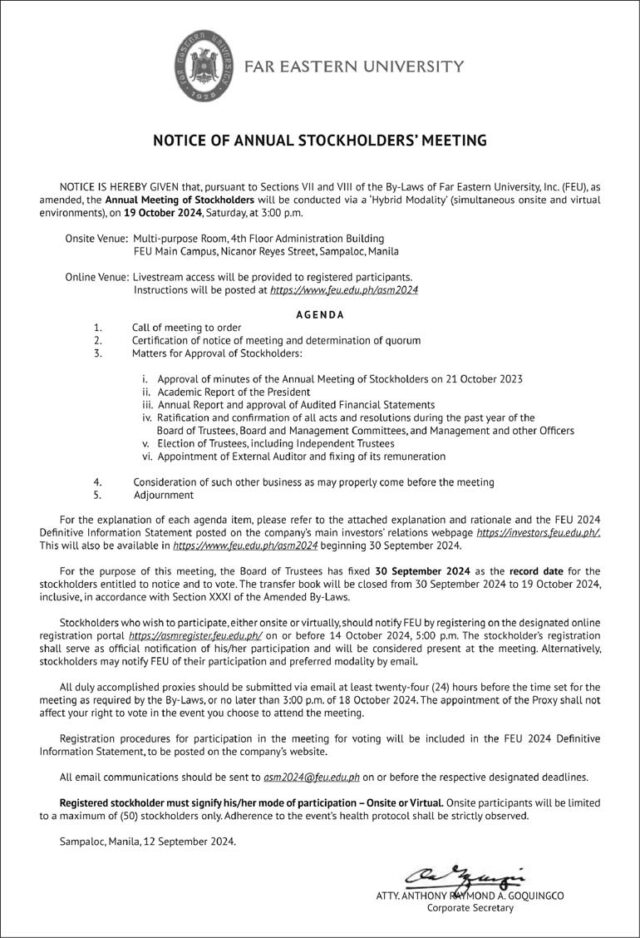
Far Eastern University, Inc. to hold Annual Stockholders’ Meeting on Oct. 19


Spotlight is BusinessWorld’s sponsored section that allows advertisers to amplify their brand and connect with BusinessWorld’s audience by publishing their stories on the BusinessWorld Web site. For more information, send an email to online@bworldonline.com.

Join us on Viber at https://bit.ly/3hv6bLA to get more updates and subscribe to BusinessWorld’s titles and get exclusive content through www.bworld-x.com.

Auction house Christie’s opens at the Henderson in Hong Kong

PRESS.CHRISTIES.COM

CHRISTIE’S opened its new headquarters in Hong Kong, capping off a series of real estate expansions by auction houses in the financial hub.

The company occupies the 6th to 9th floors of The Henderson — a skyscraper in the Central district developed by Henderson Land Development Co. and designed by Zaha Hadid Architects — for a total of 50,000 square feet (4,645 square meters).

“We have always been very ambitious with Hong Kong,” Christie’s Chief Executive Officer Guillaume Cerutti said in an interview. The new space would allow the firm to have control over the timing of its auctions, unlike before when sales were held at the Convention and Exhibition Center. For instance, its November sales often clashed with the Thanksgiving holiday period, he said.

Hong Kong remains Asia’s art hub, even as a Chinese economic downturn means that collectors have become more selective in their spending. Christie’s global auction sales for the first half of this year declined 22% from 2023.

“Even in this moment where there are some challenges in the macro environments, politically and economically in the world, we’ve seen the Asian market keeping its share of 20, 25 or more percent of our turnover,” said Mr. Cerutti. While these collectors previously bought Asian art, they are now “crucial” to sales in other categories such as impressionist works, modern art, and watches, he said.

Christie’s expansion comes after Sotheby’s opened a new 24,000-square-foot space located at Central’s Landmark Chater, while Phillips opened an office at the West Kowloon Cultural District last year.

The expansion by auction houses brings some relief to Hong Kong’s troubled real estate market. Commercial vacancies are at a record high, and retail and office rents have plunged. Leasing rates at The Henderson, whose other tenants include financial firms Carlyle Group, Inc. and Coller Capital Ltd., have been highly watched as a proxy for the property market.

At Christie’s, some of the pieces that will be auctioned at its inaugural sales at the new location have set the art world buzzing. These includes Vincent Van Gogh’s Les canots amarrés, which is expected to sell for between $30 million and $50 million, and Claude Monet’s Nymphéas, estimated at between $25 million and $35 million. — Bloomberg

PFA honors the best in Philippine franchising in FEA 2024

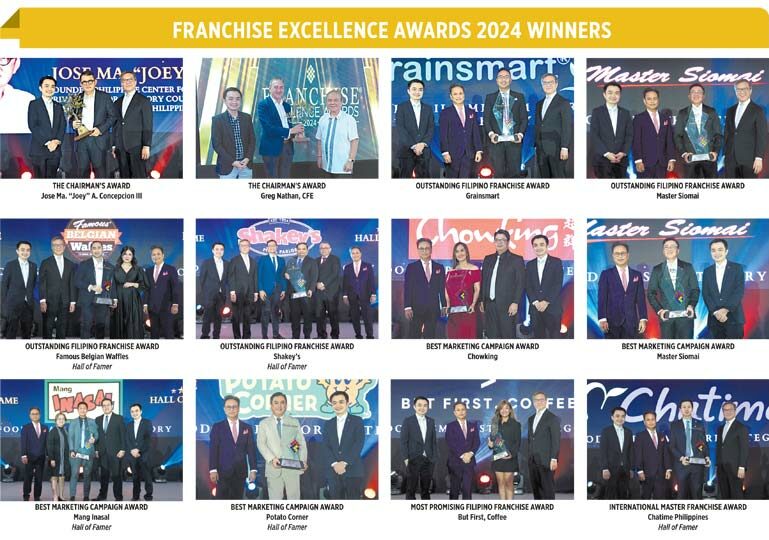
Winners of this year’s Franchise Excellence Awards gather for a group photo.

The Philippine Franchise Association (PFA) recently hosted the prestigious Franchise Excellence Awards (FEA) 2024 Awards Night at the SMX Convention Center-Manila, gathering the country’s leading franchise brands to honor their exceptional contributions to the Philippine franchising industry. The event was graced by Department of Trade and Industry Secretary Ma. Cristina Aldeguer-Roque, who served as the guest of honor.

Now on its 25th year, FEA is the only awards for the franchising sector in the country. Its winners have become benchmarks for success in the industry many of which have conquered international markets. Through these awards, PFA aims to strengthen a culture of excellence, showcasing businesses that have demonstrated innovation, resilience, and adaptability while maintaining good ethical business practices.

DTI Secretary Ma. Cristina Aldeguer-Roque was guest of honor in the FEA 2024 Awards Night.

This year’s theme, “Ensuring Success Through Excellence and Sustainability,” underscores the importance of pursuing industry leadership while embracing a sustainability mindset. The awards emphasize the role of franchises in creating sustainable business models that drive long-term success for both franchisors and franchisees.

“FEA serves as a reminder that excellence is the driving force that propels the franchising industry forward,” said PFA President Joseph C. Tanbuntiong in his speech. “And in this crucial time in our history when environmental and social upheavals are becoming more frequent, excellence can only be impactful if it is driven by a sustainability mindset.”

Winners of the FEA 2024 were selected for their outstanding achievements in growth, operational excellence, and positive impact on community. Their success stories reflect the dynamic nature of franchising in the Philippines and its role in driving inclusive economic growth.

Aside from the franchisor and franchisee winners, FEA 2024 also bestowed the Chairman’s Award to two individuals who have contributed to the growth and development of the Philippine franchising sector. These were Go Negosyo Founder Jose Ma. “Joey” A. Concepcion III and international franchising guru Greg Nathan who have facilitated several Certified Franchise Executive (CFE) programs for PFA.

The franchisor award categories up for grabs were: Outstanding Filipino Franchise Award, International Master Franchise Award, Most Promising Filipino Franchise Award, Best Marketing Campaign Award, Innovative Excellence Award, and Sustainability Award.

The Outstanding Filipino Franchise Award honors Filipino franchises that have become benchmarks in national market penetration through excellent franchise operations and good corporate governance. The International Master Franchise Award, meanwhile, recognizes international franchises, which have become benchmarks in franchise operations, particularly in the sustained growth in sales, expansion and employment.

The Most Promising Filipino Franchise Award is granted to a homegrown franchise under the micro, small, and medium enterprises (MSMEs) category that are seen with the potential to become a major player in the Philippine franchising sector.

The Best Marketing Campaign Award franchise celebrates companies with a successful and effective marketing program that contributed significantly to the growth of their companies and, overall, to the advancement of the franchising sector.

The Innovative Excellence Award recognizes franchise brands that have exhibited remarkable agility, successfully pivoting or implementing innovative strategies. The award also acknowledges the resilience of franchisors that have navigated challenges effectively to sustain their business.

Lastly, the Sustainability Award highlights outstanding sustainable developmental programs and initiatives instituted by PFA member companies that impact positively on their primary and secondary stakeholders.

The FEA franchisor awardees for this year were 7-Eleven; But First, Coffee; Chatime; Chowking; Dr. Carl Balita Review Center; Famous Belgian Waffles; Grainsmart; Greenwich; Health Screen Laboratory and Diagnostic Center; Mang Inasal; Master Siomai; Potato Corner; Shakey’s; and Toby’s Sports.

FEA 2024 also recognized franchisees who were exceptional in the way they managed their stores towards growth and profitability. The lone international franchisee award went to William Xu, Potato Corner franchisee in Myanmar. The regional franchisee awardees were: Enrico “Cholo” Francisco of Max’s Restaurant (NCR); Cecilia Pua Phee of Max’s Restaurant (North Luzon); Pablo Olivarez II of Yellow Cab (South Luzon); and Anniebeth Gapido of Dr. Carl Balita Review Center (South Luzon) and Abdullah Guinda, Dr. Carl Balita Review Center Cotabato (Mindanao). Among the regional awardees, Mr. Francisco was voted National Franchisee Awardee.

Those who have won a category award a second time were inducted into the Hall of Fame. These awardees are Famous Belgian Waffles, Mang Inasal, Potato Corner and Shakey’s. For the franchisees, the Hall of Fame welcomed Ms. Phee of Max’s Restaurant and Ms. Gapido of Dr. Carl Balita Review Center.

FEA 2024 was made possible with the support of PWC-Philippines.

Max’s Group franchisees triumph at the Franchise Excellence Awards

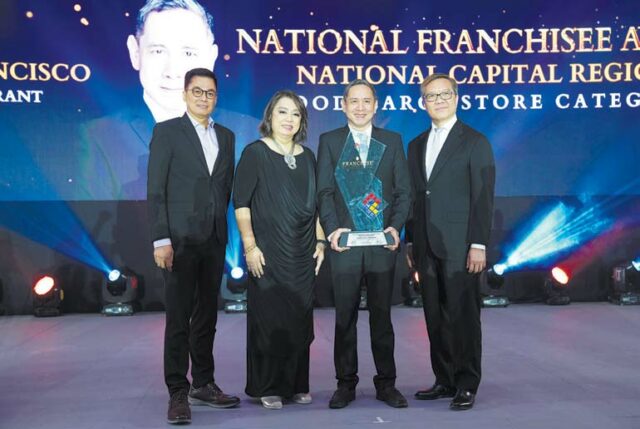
Enrico D. Francisco, franchisee of Max’s Shell Don Antonio, was recognized with the National Franchisee Award.

Franchisees of Max’s Group, Inc. (MGI), the largest casual dining restaurant chain in the Philippines, recently celebrated their success at the Franchise Excellence Awards on Sept. 2, 2024, held at the SMX Convention Center. Organized by the Philippine Franchise Association, the event honors franchise brands that exemplify excellence in business growth and contribute significantly to the franchising sector.

Enrico D. Francisco, franchisee of Max’s Shell Don Antonio, won the Regional Franchisee Award for the National Capital Region in the Food — Large Store Category and was also recognized with the National Franchisee Award. Ma. Cecilia Pua Phee, franchisee of Max’s La Union, received the Regional Franchisee Award for North Luzon and was inducted into the 2024 Hall of Fame, having previously won in 2009.

Ma. Cecilia Pua Phee, franchisee of Max’s La Union, received the Regional Franchisee Award for North Luzon and was inducted into the 2024 Hall of Fame.

Additionally, Pablo Olivarez II, franchisee of Yellow Cab — Olivarez Plaza Los Baños, also secured a Regional Franchisee Award for South Luzon. These accolades highlight the franchisees’ commitment to service and operational excellence. “We take pride in our consistent efforts and dedication, which lead to achieving our strategic goals,” stated Mr. Olivarez.

Pablo Olivarez II, franchisee of Yellow Cab — Olivarez Plaza Los Baños, secured a Regional Franchisee Award for South Luzon.

The awards reflect years of collaboration and mutual progress. “As business partners of MGI, we are united in meeting our customers’ needs, and we are grateful for the support that fuels our continuous growth,” Ms. Pua Phee remarked. Mr. Francisco added, “Our partnership is built on trust and confidence, which are key to our achievements.”

MGI remains dedicated to understanding the evolving needs of its franchisees, providing support and guidance to foster growth and success in franchise operations.


Spotlight is BusinessWorld’s sponsored section that allows advertisers to amplify their brand and connect with BusinessWorld’s audience by publishing their stories on the BusinessWorld Web site. For more information, send an email to online@bworldonline.com.

Join us on Viber at https://bit.ly/3hv6bLA to get more updates and subscribe to BusinessWorld’s titles and get exclusive content through www.bworld-x.com.

Zobel matriarch Doña Beatriz, 88

DOÑA BEATRIZ ZOBEL DE AYALA — JAIME AUGUSTO ZOBEL DE AYALA VIA FB/PHILSTAR.COM ARTWORK

DOÑA Beatriz Zobel de Ayala, the matriarch of the Zobel de Ayala family, passed away at the age of 88 on Monday, Sept. 23.

“We confirm the passing of Doña Beatriz Zobel de Ayala, the wife of Ayala Corp. Chairman Emeritus Jaime Zobel de Ayala,” the conglomerate said in a statement on Tuesday.

“The family requests privacy during this most difficult time,” it added.

Ayala Corp. did not provide additional details about the passing of Ms. Zobel.

Born on Feb. 29, 1936, in Madrid, Spain, Ms. Zobel was the mother of Ayala Corp. Chairman Jaime Augusto, as well as Fernando, Bea Jr., Patsy, Cristina, Monica, and Sofia.

A memorial service for Ms. Zobel will be held on the morning of Sept. 27 at the Santuario de San Antonio Parish, Forbes Park, Makati City.

In lieu of flowers, Ayala Corp. said that the Ayala family requests donations in Doña Bea’s memory to her favored causes, including the Friends of Elsie Gaches and the Tuloy Foundation. — Revin Mikhael D. Ochave

Actor Meryl Streep shows solidarity at UN with Afghan women, girls

MERYL STREEP — COMMONS.WIKIMEDIA.ORG

UNITED NATIONS — A female cat has more freedom in Afghanistan than a woman does, Hollywood actor Meryl Streep said at the United Nations (UN) on Monday in a bid to get world leaders to focus on the plight of Afghan women and girls.

“The way that … this society has been upended is a cautionary tale for the rest of the world,” Ms. Streep told an event on the sidelines of the UN General Assembly to encourage the inclusion of women in the future of Afghanistan.

The Taliban seized power in August 2021 when US-led forces withdrew after 20 years of war. The UN has sought a unified global approach to dealing with the Taliban, who have cracked down on women’s rights.

Most girls have been barred from high school and women from universities by the Taliban. The group has closed beauty salons and curtailed travel for women without a male guardian.

“Today in Kabul a female cat has more freedoms than a woman. A cat may go sit on her front stoop and feel the sun on her face. She may chase a squirrel into the park. A squirrel has more rights than a girl in Afghanistan today, because the public parks have been closed to women and girls,” Ms. Streep said.

“A bird may sing in Kabul, but a girl may not and a woman may not in public. This is extraordinary,” she said.

The Taliban say they respect rights in line with their interpretation of Islamic law. The group formally codified a long set of rules governing morality last month that were based on a decree by the Taliban’s supreme spiritual leader in 2022 and will be enforced by the morality ministry.

“Without educated women, without women in employment, including in leadership roles, and without recognizing the rights and freedoms of one-half of its population, Afghanistan will never take its rightful place on the global stage,” UN Secretary-General Antonio Guterres told the event. — Reuters

Sustainable mining is not an oxymoron: Upholding SDGs

JCOMP-FREEPIK

(Part 3)

It is clear from what we have written so far that sustainability goes much further than just protecting the physical environment from human abuse.

As we have seen, the Semirara Mining and Power Co. (SMPC), in order to demonstrate that sustainable mining is not an oxymoron, tries to align its corporate goals to the 17 Sustainable Development Goals (SDGs) of the United Nations (UN). So far we have described the corporate strategies and programs that are aligned with the first nine SDGs of the UN. We shall now complete the list so that in its small and humble way, SMPC can serve as a role model for other mining companies in the Philippines, one that is trying to make its operations compatible with sustainability.

I am proud of the fact that I am an Independent Director of the parent company of SMPC, DMCI Holdings, Inc., a publicly listed Philippine corporation. As an Independent Director, I am not beholden to protect only the interest of the shareholders.  Under Philippine laws, I have to protect all the stakeholders of the corporation, especially the rank-and-file workers, the management, the suppliers, the immediate community in which the enterprise is located and the nation at large. I am glad to report that the interests of these stakeholders have not been given short shrift by SMPC, as the initial listing of the SDGs have shown.

Let me now proceed to the eight remaining SDGs.    

The 10th SDG has to do with reducing inequalities. From the macroeconomic point of view, we already saw how the community in which SMPC operates has already attained what the Administration of President Ferdinand Marcos, Jr. is still striving for, i.e., to reduce to a single digit the level of the nation’s poverty incidence. Already, the host community of SMPC, as of 2021, had a poverty incidence of 8% (the National Economic and Development Authority or NEDA targets 9% for the whole nation by 2028). SMPC is now focusing on upskilling, reskilling, and retooling out-of-school youth to help them to be employed or to be small-scale entrepreneurs. Women and marginalized groups are especially targeted in social development projects.

For SDG No. 11 (Sustainable Cities and Communities), SMPC has non-stop mine rehabilitation and restoration programs, rural electrification, construction and maintenance of road networks (especially farm to market roads) and livelihood infrastructure such as a commissary, a food court, and a wet market.

For SDG No. 12 (Responsible Consumption and Production), there are programs for water resource management, the reduction or management of emissions, wastes, and affluents.  There are programs in educating the community in the efficient use of energy, responsible sourcing and green criteria for suppliers, and bottom ash repurposing.

Directly related to mitigating climate change or protecting the physical environment are carbon offsets through afforestation and reforestation; biodiversity offsets through marine and terrestrial conservation programs, capacity building towards a carbon transition roadmap, and emergency response and disaster resilience programs.

SDG No. 13 directly targets the climate change issue. SMPC is one of the pioneers in obtaining carbon credits through afforestation and reforestation. It obtains biodiversity offsets through marine and terrestrial conservation programs. It has appropriated P1.5 billion for climate-related investments. It is undertaking capacity-building initiatives towards a carbon transition roadmap. It has established an emergency response and disaster resilience program. It has partnered with the LGU of Caluya for a mangrove enrichment program.

Last April, SMPC celebrated Earth Day by planting 1,500 mangrove seedlings in Barangay Semirara, Caluya. This activity was supported by over 150 participants who included SMPC employees, Philippine Coast Guard personnel, and residents of the barangay. Mangroves support food security and livelihood since they serve as a valuable nursery habitat for fish and crustaceans. By stabilizing shorelines, these coastal forests also provide protection from a plethora of disasters such as storm surges, tsunamis, and rising sea levels. Furthermore, mangrove forests can sequester an estimated three to five times more carbon per hectare than tropical forests, thus playing a key role in climate change mitigation.

As regards SDG No. 14 (Life Below Water), a world-class initiative of SMPC is the Semirara Marine Hatchery Laboratory (SMHL).  A flagship program to protect marine biodiversity, the SMHL is the only private facility in the Philippines that has spawned and propagated eight species of the giant clams, which are considered keystone species to the coral reef ecosystem. Reseeded giant clams promote diversity where they live as they attract corals, fishes, and small marine biota. These giant clams also clean their environment when they sip seawater for food and then release the clean, clear water back to the sea.

SDG No. 15 is Life on Land. One of those who accompanied me to visit Semirara island was a history professor from my university, the University of Asia and the Pacific, whose hobby is bird watching. He literally went wild when we visited SMPC’s Semirara Avian Biodiversity Conservation Center which maintains and operates a wildlife breeding aviary. It also serves as a rescue center that rehabilitates juvenile birds found fallen from their nests, injured adult birds, and other wildlife affected by storms or found before vegetation clearing during mine expansion projects. To date, this facility has released 66 captive-bred birds at the rehabilitation of the South Parian Mine.  Among the birds protected were 34 endangered, 18 vulnerable. 18 near threatened species, totaling some 70 birds. My friend said that to a true-blue birdwatching afficionado, seeing birds in captivity, no matter how exotic, does not count. Thus, he spent time on his own going around the island with his bird watching equipment. He attested that he saw many beautiful birds in the wild in the Semirara forests. He happily reported that he even saw a “lifer,” the word used by birdwatchers when they see a new bird species for the first time in their lives.

In our very visit to the island, we saw in action the reality of SDG No. 16. Both the CEO and the COO of SMPC spent practically the whole day meeting with the various members of the community in dialogues, consultations, and issue resolutions.  They involved as many of the stakeholders of the company as possible in obtaining views about a serious problem that was facing the mining operations: the seepage of sea water into the coal mines. We saw that through constant dialogue, the SDG of peace, justice, and strong institutions was very much in the minds of the owners and management.

We learned that there was absolutely no case of child or forced labor. At all levels, values formation is conducted and there are very clear guidelines on whistleblowing and community grievances.

There was strong evidence of SDG Goal No. 17 being addressed, i.e., Partnerships for the Goals, as there were very many examples of public-private partnerships for sustainable development and social development programs.

We had the opportunity to meet some of the barangay officials who confirmed that the channels of communication between the LGU and the company were always open as there were regular coordination meetings with local government units on the barangay development plans.

We learned from all our conversations with the various stakeholders of SMPC we talked to that all the positive aspects of mining we witnessed could be primarily attributed to the late Victor Consunji, one of the children of former Secretary of Public Works and Highways and founder of the DMCI group of companies, David Consunji. Having inherited from his father the outstanding qualities of leadership and concern for the common good, Victor spearheaded the conversion of the island of Semirara into a model of sustainable mining and a progressive community with one of the lowest poverty incidences in the Philippine archipelago.


Bernardo M. Villegas has a Ph.D. in Economics from Harvard, is professor emeritus at the University of Asia and the Pacific, and a visiting professor at the IESE Business School in Barcelona, Spain. He was a member of the 1986 Constitutional Commission.

bernardo.villegas@uap.asia

KKR, GIC hire banks to sell stakes in $3.2-B Metro Pacific Health, sources say

SINGAPORE — KKR & Co. and Singaporean sovereign wealth fund GIC have appointed Bank of America, Jefferies, and UBS to sell their majority stake in the Philippines’ Metro Pacific Health Corp. in a deal that could value the company at $3.2 billion, three people with knowledge of the matter said.

A sale process could start as early as the fourth quarter of this year, or the first quarter of 2025, one of the people said.

Global investment firm KKR and GIC together hold 80% stake in Metro Pacific Health, the Philippines’ largest private healthcare group, the source said.

The Philippines’ infrastructure group Metro Pacific Investments Corp. owns the remaining 20% stake in Metro Pacific Health, according to the former company’s website.

Bank of America, UBS, GIC, and KKR declined to comment. Jefferies, Metro Pacific Health, and Metro Pacific Investments Corp. did not respond to immediate requests for comment.

Founded in 2007, Metro Pacific Health runs 24 hospitals including Makati Medical Center and Davao Doctors Hospital, according to its website.

It also has 31 outpatient care centers, six cancer care centers, two allied health colleges and a centralized laboratory, its website showed.

KKR and GIC first invested in Metro Pacific Health in 2019 for a total of $680 million, according to statements at that time. — Reuters

Researchers uncover remains of Ice Age mastodons in Peru

COMMONS.WIKIMEDIA.ORG

LIMA — The fossilized remains of three mastodons from the Ice Age have been uncovered in the Peruvian Andes, raising questions as to how the behemoths arrived in the area.

Excavations starting in 2019 uncovered the behemoths, believed to be between 11,000 and 12,000 years old, in the valley of the town of Chambara, about 300 km east of Lima.

One of the specimens is nearly complete, and could be the best preserved mastodon in all of Peru, said paleontologist Ivan Meza.

“If the skull is found — and everything indicates that the tusks are there — that would have scientific importance at a national and global scale,” Mr. Meza said.

Mastodons were similar to the also-extinct mammoth, but had flatter heads and straighter tusks.

Scientists now hope to find more fossils in the area, which could shed light on how and when the mastodons arrived.

“We’re talking about a small area of less than one hectare,” Mr. Meza said. “To date we’ve discovered three specimens, with the possibility of there being more, and from other types of animals.”

The mastodons likely migrated from North America down to South America in search of food and water as climate conditions changed, experts believe.

“Over time, the Andes mountain range rose and the sea water receded,” said researcher Oscar Diaz. “This area dried up and left lagoons across the Mantaro Valley,” he added, which would have provided a source of water.

Peru is a rich source of prehistoric remains. In April, a team of paleontologists unveiled the fossilized skull of a river dolphin, the largest found to date, which had swam through the Peruvian Amazon some 16 million years ago. — Reuters

Bolder maritime security forged by Manila and Seoul for the Indo-Pacific region

FREEPIK

In the latest round of the conference hosted by the Stratbase ADRi Institute, “Enhancing Indo-Pacific Security: Philippines-South Korea Cooperation Strategies” on Sept. 20, experts from the diplomatic and defense circles converged to critique the current security architecture in the expanded dynamic region. They aimed to expound on strategies in the geometry of relationships of distressed powers tossed by geopolitics and global defense postures of major and middle powers in the Indo-Pacific region.

While the hegemonic rivalry of “Chimerica” (China and the USA) manifested a chain of reaction in the community of competing neighbors in the region, rooted by the defining “lips and teeth” relations in the Korean Peninsula, Japan’s pacific activism in the Senkaku islands, the “tit for tat” dramaturgy in the South China Sea, and India’s effort to check China in Pakistan — these threat perceptions go beyond Russia’s protracted warfare in Ukraine and the “eye for an eye, tooth for a tooth” in Israel’s conflict with Gaza.

The changing regional alliance system challenges the hub-and-spoke model of constant territorial enlargement coursed through mini-lateral and multilateral approaches in building strategic trust among democratic states. This is where the nexus of calculated interests and collective deterrence are needed in the Indo-Pacific region, fueled by a common threat to elevate freedom of navigation at its highest standard contextualized in the process of maritime rules-based order.

The transformative balance of economic cooperation to maritime security paves the way for stronger bilateral relations between the Philippines and South Korea as the two democratic nations celebrate their 75 years of diplomatic ties. On March 11, the Philippine Senate recognized the enduring friendship and cooperation of Manila and Seoul. In the esteemed commendation formalized by the Senate Resolution No. 946, the Philippines commemorated Manila’s active role in the inter-Korean peace process and reconciliation efforts.

During the Korean War in 1950s, 7,440 Filipino soldiers served in the Republic of Korea to secure the battered peninsula. Seoul is reciprocating Manila’s benevolence by playing a key role in the ongoing modernization of the Philippines’ Armed Forces and becoming one of the country’s largest development partners. The two countries inked a free trade agreement on Sept. 7, 2023 for immediate ratification in South Korea.

Seoul geared up a trilateral pact with Tokyo and Washington on Aug. 18, 2023 in pursuit of the Camp David principles. For its part, Manila has replicated the same mini-lateral template to propel its existing three-sided defense and trade cooperation with Japan and the US which was announced on April 11. This was meant to fortify America’s commitment to a free and open Indo-Pacific region that is connected, prosperous, secure, inclusive, and resilient. But these trilateral pacts will have to evolve into a Northeast Asian quadrilateral arrangement for Japan-Philippines-South Korea-US cooperation amid unpredictability in the upcoming US elections.

South Korea stands as a quasi-island and a product of the Cold War still threatened by North Korea’s massive stock of nuclear weapons and ballistic missiles. Nonetheless, the support it gives to the Philippines to make concrete a grounded self-reliance defense posture, to develop a maiden industrial base in support of maintenance and operations of its procured expensive defense weapon systems and re-engineered military materiel, would grow enough to sustain our two countries’ strategic partnership and defense economics.

Given Manila’s burden of sharing due to its own inherent vulnerabilities in the West Philippine Sea, joint military training and maritime exercises for interoperability are endorsed to unburden like-minded nations on its own external defense. Seoul can offer its stencil for advanced research and development, intelligence gathering and information sharing, and capability building in the dawn of artificial intelligence to the Philippines, aside from South Korea’s advantages in blue ocean economy and coast guard diplomacy.

The rise of new technologies, such as autonomous vehicles and cyber warfare, will certainly create new challenges for maritime security and law enforcement in the region. The physical realities of geography in the Indo-Pacific region can generate acceptable strategic trust to solve specific problems despite constancy of dialogue and diplomacy. This is where the Philippines and South Korea are seen as capacity builders to deter proxy wars and conflicts in the tense region.

By elevating Seoul as Manila’s newest strategic partner, there will be a push for strategic intent to craft a defense deal, similar to Japan’s Reciprocal Access Agreement (that needs to be ratified yet in Tokyo), or perhaps France’s prerogative to sign a Visiting Forces Agreement to join its western allies, in the same league of Canberra and Washington that enjoy military agreements with the Philippines. Recently, Hanoi forged a Defense Cooperation Agreement with Manila to secure a stronger voice for rule-based norms in Southeast Asia.

Through the proposed establishment of Indo-Pacific mini-lateral cooperation, Manila and Seoul can become solution providers to unravel small regional risks and insecurities with greater impact on global security. At the same time, they can strengthen successful regional trilateral cooperation to further develop the mini-lateral mechanisms as exemplified in the intensified Indonesia-Malaysia-Philippines tri-border patrols of the Sulu-Sulawesi Seas. As no conflict can be isolated for itself, there should be goal congruence and dynamic equilibrium for like-minded nations in preserving the new arsenal of democratic values. We need this to increase the appreciation of maritime rules-based order amid changing leaderships in the Indo-Pacific region.


Dr. Chester B. Cabalza is a non-resident fellow of the Stratbase ADRi. He is the founding president of the International Development and Security Cooperation (IDSC) and teaches in the graduate school at the University of the Philippines, Diliman (UPD).

SEC: PERA administrators must hold gov’t securities equivalent to 1% of total assets

THE Securities and Exchange Commission (SEC) said that registered personal equity and retirement account (PERA) administrators should hold government securities equivalent to 1% of the book value of their total assets.

The SEC issued Memorandum Circular (MC) No. 14 on Sept. 19, which provided guidelines for the accreditation of market participants offering PERA investment products, pursuant to Republic Act No. 9505, or the PERA Act of 2008, and its implementing rules and regulations (IRR).

“In accordance with the PERA IRR, the SEC guidelines also require registered PERA administrators to hold government securities equivalent to 1% of the book value of the total volume of PERA assets administered or such other amount as the SEC may impose, earmarked in favor of the commission,” the SEC said in an e-mailed statement on Tuesday.

“This will serve as security for the faithful performance of its duties. The amount shall be in addition to and shall be treated separately from the capital, surplus, and undivided profits of the administrator,” it added.

PERA refers to a voluntary saving program that supplements retirement benefits from the state-led Social Security System and Government Service Insurance System. Some of the PERA investment products include a unit investment trust fund and mutual fund.

According to the commission, those eligible to apply as PERA administrators include securities brokers, investment houses, and investment company advisers or fund managers.

On the other hand, investment company advisers or fund managers may register as investment managers.

“Other entities or individuals as may be determined by the commission as having the qualifications to be accredited as administrator or investment manager may also apply,” the SEC said.

To become eligible as a PERA administrator, the applicant must have a net worth of at least P100 million at all times, as well as the technical expertise and personnel to administer all types of PERA investment products.

“The applicant must also submit proof that it has sufficient personnel who have undergone the requisite training prescribed or approved by the commission to educate PERA contributors on the nature of a PERA and the requirements, risks, and benefits of the investment product, among others,” the SEC said.

Meanwhile, those applying as PERA investment managers must have written supervision and control procedures for the conduct of the investment management functions, with proof of at least five years’ experience in professional investment management.

The SEC temporarily reduced the security deposit amount to 0.0% of the book value of the total volume of PERA assets administered to encourage applications as PERA administrators.

Interested applicants must file an application for the issuance of a Qualification Certificate with the SEC Markets and Securities Regulation department. — Revin Mikhael D. Ochave

Treasury fully awards reissued 20-year bonds at lower yields

BW FILE PHOTO

THE GOVERNMENT made a full award of the reissued Treasury bonds (T-bonds) it auctioned off on Tuesday at a lower average rate ahead of a cut in banks’ reserve requirement ratios (RRR) and amid expectations of further monetary policy easing at home and abroad.

The Bureau of the Treasury (BTr) raised P25 billion as planned via the reissued 20-year bonds on Tuesday as total bids reached P44.147 billion, or almost twice the amount on offer.

This brought the outstanding volume for the series to P127.7 billion, the Treasury said in a statement.

The bonds, which have a remaining life of 19 years and eight months, were awarded at an average rate of 5.861%. Accepted yields ranged from 5.75% to 5.899%.

The average rate of the reissued papers fell by 33.7 basis points (bps) from the 6.198% fetched for the bonds when they were last awarded on Aug. 28. This was also 101.4 bps lower than the 6.875% coupon rate for the issue.

However, the average rate was 3.3 bps above the 5.828% quoted for the same bond series and 11.6 bps higher than the 5.745% fetched for the 20-year bond at the secondary market before Tuesday’s auction, based on PHP Bloomberg Valuation Service Reference Rates data provided by the BTr.

The government fully awarded its T-bond offer as the issue’s average rate was lower compared with the level fetched for previous award after the Bangko Sentral ng Pilipinas (BSP) announced that it would cut banks’ reserve ratios in October, Rizal Commercial Banking Corp. Chief Economist Michael L. Ricafort said in a Viber message.

The RRR cut will free up almost P400 billion in liquidity, which banks can lend and put in instruments like government debt, he said.

A trader noted that the average rate fetched for the reissued 20-year bond was close to the 5.583% fetched for the one-year Treasury bill at Monday’s auction despite being a longer tenor.

The BSP on Friday said it will reduce the RRR for universal and commercial banks and nonbank financial institutions with quasi-banking functions by 250 bps to 7% effective on Oct. 25.

It will also cut the RRR for digital banks by 200 bps to 4%, while the ratio for thrift lenders will be reduced by 100 bps to 1%. Rural and cooperative banks’ RRR will likewise go down by 100 bps to 0%.

Mr. Ricafort added that signals of further BSP rate cuts also caused T-bond rates to go down.

Finance Secretary Ralph G. Recto, who sits on the central bank’s Monetary Board, said on Tuesday the monetary authority can afford to slash interest rates further and match the size of the US Federal Reserve’s rate cut, Reuters reported.

“The Fed reduced by 50 basis points. I think we can also do half a percent,” Mr. Recto a told a media briefing.

Inflation would likely ease to 2.5% in September, he said, the slowest in nearly four years, after rising at an annual pace of 3.3% the previous month. Mr. Recto said that could settle at 3.4% this year, within the central bank’s 2% to 4% target range.

Slowing inflation allowed the central bank to cut its benchmark borrowing rate by 25 bps to 6.25% in August, its first rate cut since November 2020, ahead of major central banks, including the Fed.

The Fed started cutting rates on Sept. 18 with a larger-than-usual half-percentage-point reduction, which will likely be followed by a 25-bp cut in both November and December, according to a Reuters poll.

BSP Governor Eli M. Remolona, Jr. had earlier flagged there was room for one more interest rate cut this year. The BSP’s next meeting is on Oct. 17.

Tuesday’s T-bond auction was the last for the month. The government raised the planned P115 billion from long-term papers in September as it made full awards at all its auctions and even made a tap facility award of reissued 10-year bonds worth P5 billion on Sept. 17 amid strong demand.

The BTr has yet to release its domestic borrowing plan for the fourth quarter. — A.M.C. Sy with Reuters