Home Blog Page 2235

AI robots are coming, and they’ll be made in Asia

FREEPIK

OVER the past year, I’ve noticed an overwhelming theme emerge when Asian tech leaders look at what comes next for artificial intelligence (AI). There has been a marked desire to move beyond chatbots and software, and into the physical realm.

We’ll start to see much more AI-enabled hardware and robotics — and it will be coming from Asia.

The experience I’ve had tuning in to many executive chats and tech conferences could best be summed by Nvidia Corp. Chief Executive Officer Jensen Huang’s proclamation in Taipei in June. “The next wave of AI is physical AI,” he said. “The era of robotics has arrived.”

Historically, a lot of coverage of robot-human interactions in Asia have been filled with futuristic techno-orientalist tropes that often fail to reflect the reality. But there are factors that make the region uniquely primed to propel this next leap forward in integrating AI into the physical world. While the US is the leader in AI advances — and the software and internet revolution emanated from Silicon Valley — Asian tech giants have traditionally been very good at the hardware side of things.

Citigroup, Inc. projects that there would be 1.3 billion AI robots globally by 2035 and 4 billion by 2050, doing everything from household chores to delivering parcels. A lot of the progress will come from China, which accounts for 78% of all robotics patents over the last two decades, the Citi analysts said. Japan and South Korea make up 7% and 5%, respectively, while the US contributes just 3%. This dominance in Asian robotics remained just as strong when the sheer quantity of patents was weighed through a quality-assessment measure.

Moreover, robotics is an extremely expensive and difficult process. But advancing in this sector has emerged as part of China’s top-down priorities for its tech ecosystem, meaning government subsidies in research and development, and other support give it an edge.

There are other societal factors that suggest an embrace of AI robotics makes sense. Researchers have found Japan is poised to be a global leader in deploying technologies that adopt automation, as it confronts an aging population and shrinking workforce. AI-driven software coupled with hardware are being developed and implemented across all types of work, including white and blue collar, agriculture and services. While many US industries have been gripped by fears of robots taking away livelihoods, in Asia, there has been a tendency to welcome automation due to a people shortage.

This is already playing out, although on a small scale, in several creative ways. A Shenzhen startup is using an AI robot to help cook meals. A tool unveiled by Japan’s Fujitsu Ltd. in October teaches Noh, a performance art dating back to the 14th century that is under pressure as there are fewer people who know the techniques to carry on the tradition. Not to mention the countless industrial robots.

While the region may currently be behind the US when it comes to AI now, Asian tech firms have shown great success in finding practical, market applications for technology developed elsewhere. Japanese tech entrepreneurs, especially, have been very good at this. Sony Group Corp. perfected the consumer radio after taking transistor technology invented in the US. (Sony also unveiled the first consumer robot to the mass market in 1999: the beloved Aibo dog.)

There’s been a tendency to overhype the role and value of robots in Asian societies, especially in Western reporting, when the reality is much more nuanced. I’ve yet to meet a real person in Japan who ties Shinto animism beliefs into the embrace of robots. And mounting research suggests that eldercare robotic experiments have not been worth the cost and end up causing more work for caregivers (and that perhaps better immigration policies to address labor crunches would be a more worthwhile solution). Several high-profile robotic ventures launched in recent years have been curtailed.

But AI could serve as a catalyst, especially as investors and company leaders increasingly search for practical and real-world applications for the technology that go beyond just engaging chatbots. Softbank Group Corp. Founder Masayoshi Son said in Tokyo last month that he is “passionate about AI robotics,” stating that like his favorite cartoon, Astro Boy, “you can’t just have the muscle, you have to have intelligence.”

I remain skeptical that we will see the rise of AI robots in the new year, but I have no doubt they’re coming, and that they will likely be coming from Asia.

BLOOMBERG OPINION

BAP inks partnerships with administrators of its Treasury Certification Program

THE BANKERS Association of the Philippines (BAP) has announced the two administrators of its Treasury Certification Program (TCP) for the coming year.

The BAP renewed its partnership with the Ateneo Graduate School of Business Center for Continuing Education through the Ateneo-BAP Institute of Banking (ABIB) for the TCP, it said in a statement on Thursday.

It also inked a new partnership with the Asian Institute of Management (AIM)-School of Executive Education and Lifelong Learning (SEELL).

“The BAP initiative to enhance and revamp the TCP aims to upskill and reskill bankers and develop a new generation of highly analytical, technical, and ethical financial market professionals,” BAP Open Market Committee (OMC) Chairman Paul Raymond A. Favila said.

“The objective of the program redesign is to elevate the TCP to global best practices and international standards while ensuring the quality, professionalism, and integrity of treasury professionals in the interbank market,” he added.

Starting next year, bank treasury personnel may obtain their BAP Certified Treasury Professional (CTP) licenses from ABIB or AIM-SEELL.

Both institutions will be offering a refreshed and updated version of the BAP TCP.

“Successful passers of the BAP TCP are accorded with a CTP certification by the BAP,” it said.

“A special team of banking industry experts worked closely with the BAP OMC to update the TCP curriculum that will enhance the baseline knowledge and developmental needs of financial markets and bank treasury professionals,” BAP OMC TCP and Treasury Education Subcommittee Chairman Felipe Martin F. Timbol said.

The CTP is a license that authorizes a dealer to trade with their counterpart traders in the interbank market. It is a BAP-registered trademark with the Intellectual Property Office of the Philippines. — A.M.C. Sy

Brazilian judge orders Adele song removed over plagiarism claim

Adele’s latest album, 30, was the biggest selling album of 2021

RIO DE JANEIRO — A judge in Rio de Janeiro has ordered the global removal of a 2015 song by British singer Adele due to a plagiarism claim by a Brazilian musician, which Universal Music is fighting on appeal.

The ruling, made public on Monday, came in a case filed this year by Toninho Geraes, whose compositions were made famous by some of Brazil’s most acclaimed samba singers.

Mr. Geraes accused Adele of copying his song “Mulheres,” a national hit since the 1990s. His lawyers uploaded to YouTube a comparison of that song and Adele’s “Million Years Ago.”

“The ruling shows that the Brazilian justice system is strong and that injuries to Brazilian artists won’t be ignored,” said Fredimio Biasotto Trotta, a lawyer for Mr. Geraes.

The decision orders Sony Music Entertainment and Universal Music to immediately cease “using, reproducing, editing, distributing, or commercializing” the song by any means on streaming or sharing platforms, without Mr. Geraes’ consent. It set a fine of 50,000 reais ($8,080.94) if the companies fail to comply with the order.

The Berne Convention, an international treaty, orders other signatory countries, including the US, to comply with legal decisions regarding copyright, Mr. Trotta said.

Mr. Geraes’ lawyers are now notifying streaming services, such as Spotify and Deezer, to withdraw the song in Brazil and globally. On Wednesday morning, the song was still widely available.

Universal appealed the decision on Tuesday, arguing there was no plagiarism, only an “accidental melodic similarity” due to the use of “musical clichés.”

Both Adele and Mr. Geraes have contracts with Universal, but the Brazilian musician has been trying to terminate his contract with the company due to his plagiarism claim, his lawyer said.

“I felt very disrespected,” Mr. Geraes told Reuters. He is asking the courts for compensation of more than $150,000.

Lawyers representing Universal Music declined to comment, and Sony Music did not immediately reply to a request for comment.

Mr. Geraes learned of the similarities between the two songs after a friend, who is also a composer, heard Adele’s “Million Years Ago” at a party in 2021. — Reuters

Figaro Coffee stockholders OK corporate name change

FIGARO.PH

FIGARO COFFEE Group, Inc. (FCG) has secured stockholders’ approval for its planned corporate name change as part of expanding the company’s brand identity.

The stockholders greenlit the company’s plan to change its name to Figaro Culinary Group, Inc. during the annual stockholders’ meeting on Dec. 18, FCG said in a regulatory filing on Thursday.

There will be no change in the company’s stock symbol. The corporate name change was approved by the FCG board on Oct. 10.

“The proposed new name will outline the company’s commitment to quality and innovation as it expands its offerings to include a wide range of culinary products and experiences,” FCG said.

“The board has determined that it is in the best interest of the company to change its corporate name to better reflect its strategic vision and broaden its brand identity,” it added.

FCG saw a 17% increase in its net income for the first quarter of the fiscal year ending June to P103.49 million last year, led by higher volume from its new stores.

Net revenue rose by 6% to P1.39 billion, while system-wide sales rose by 4.2% to P1.49 billion, led by the opening of 11 new stores.

As of the end of September, FCG has 214 stores within its network. Its brands include Angel’s Pizza, Figaro Coffee, Tien Ma’s, Café Portofino, and Koobideh Kebabs.

FCG shares rose by 1.18%, or one centavo, to 86 centavos apiece on Thursday. — Revin Mikhael D. Ochave

Making the most out of yearend parties

It’s the season for Christmas parties and yearend celebrations. In our case, we are taking the opportunity to recognize people for their excellent performance for the year, including the Employee of the Year Award. Last year, however, the occasion was marred by conflict between some employees. I will not discuss the embarrassing details here. How do we prevent a party from turning into a nightmare? — Pink Ranger.

You refused to describe the nature of the “conflict.” Let me guess. Does it have anything to do with awards being given to the wrong people? Is your system for deciding awards subjective? Could there possibly have been a lack of advance information about the awards, causing some people to be surprised by the results?

How about the quality of the awards being given? How did the awardees feel about non-awardees teasing them for receiving a lapida (tombstone) as a token? Could the cause have been the excessive consumption of alcoholic drinks at the party?

Whatever it is, you have to be transparent about your policies and processes to head off any issues that may arise. Another option is to move the annual recognition program to another time, such as the company’s anniversary celebration.

If that’s not possible, you must establish certain basic rules to avoid any disruptions. As long as there are rules, chances are that the participants will be understanding.

Rational thinking requires management willpower, rather than simply taking a come-what-may stance. In other words, come up with the best possible rules to remind people of potential consequences, whether or not they’re covered by the company’s code of conduct.

DECORUM
At times, even professionals may succumb to temptations in the mistaken belief that yearend celebrations sponsored by the company are an excuse to shed certain inhibitions. Others may use the excuse of a change in regular programming to justify any wrongful actions.

Here are some party rules you can outline in an office circular in advance of the celebration:

One, party theme. Some examples include cowboy or pajama party. Ensure that the employees are not forced to spend much on costumes. Have a contest for best costume and give prizes for the top three of various categories like male and female or age divisions.

Conduct a survey to choose the theme acceptable to all. This heads off conflict in case some employees do not like the theme.

Two, limit alcoholic drinks to two bottles per employee. Your experience may vary with the employee population and budget. Consider issuing drink stubs to enforce the limits. Also, regulate the sale of alcoholic drinks with the help of the venue owner. Be on guard for anyone who may smuggle in alcoholic drinks or drugs. Allowing people to drink over the limit may lead to unacceptable behavior punishable under the code of conduct.

Three, allow active mingling. Any type of party is always an opportunity for everyone to circulate freely even with those outside their departments. This can be done after the meal is served. It might be the best time for the chief executive officer (CEO) or the senior management team to interact.

Encourage people to build their networks with staff outside their immediate circles, which could be the first step in advancing up the company ranks.

Fourth, remind everyone to avoid sensitive subjects. These include religion, race, or politics. Green jokes bordering on sexual harassment might be risky. Advise people not to talk negatively about bosses or management.

Five, manage the time. Regardless of the venue — the cafeteria or a hotel, for instance — it’s best to inform all that the party is limited only to three hours maximum. Advise people to come on time and avoid making “dramatic entrances” that disturbs the program.

Six, discourage the posting of party pictures on social media. Even if posting with permission, chances are, some people may object or claiming no permission was given.

Seven, advise everyone to act appropriately. Regardless of marital status, it’s best for male employees (even the boss) not to flirt with female or younger colleagues. A Christmas party, any yearend celebration, or anything for that matter is no place for hooking up or public displays of affection, even if both parties are unmarried.

In conclusion, anticipate all possible issues. If you’re in human resources, understand going into the event the relationships between people and their respective bosses. Anticipate worst-case scenarios to forestall all possible issues that may arise during the yearend celebrations.


Bring Rey Elbo’s “Kaizen Blitz Problem-Solving Workshop” to your management team. Learn how to solve problems without spending much money. Contact him on Facebook, LinkedIn, X, or e-mail elbonomics@gmail.com or via https://reyelbo.com

The General Appropriations Act and priority spending

BW FILE PHOTO

The recent proposed budget has been criticized by certain sectors for allocating more spending for public works than education. The criticism is, however, unwarranted and simply wrong. Nevertheless, while it is the position here that the government does have the prerogative to apportion funds on areas it deems more important, public works isn’t it.

Indeed, Art. XIV.5 of the Constitution does provide: “The State shall assign the highest budgetary priority to education and ensure that teaching will attract and retain its rightful share of the best available talents through adequate remuneration and other means of job satisfaction and fulfillment.”

The reasoning behind this said provision, as cited by the Supreme Court in Guingona vs. Carague (1991), is narrated pithily:

“In explaining his proposed amendment, Mr. Ople stated that all the great and sincere piety professed by every President and every Congress of the Philippines since the end of World War II for the economic welfare of the public schoolteachers always ended up in failure and this failure, he stated, had caused mass defection of the best and brightest teachers to other careers, including menial jobs in overseas employment and concerted actions by them to project their grievances, mainly over low pay and abject working conditions.

“He pointed to the high expectations generated by the February Revolution, especially keen among public schoolteachers, which at present exacerbate these long frustrated hopes.

“Mr. Ople stated that despite the sincerity of all administrations that tried vainly to respond to the needs of the teachers, the increase for public schoolteachers had to be multiplied many times by the number of government employees in general and their equitable claims to any pay standardization such that the pay rate of teachers is hopelessly pegged to the rate of government workers in general. This, he stated, foredoomed the prospect of a significant pay increase for teachers.

“Mr. Ople pointed out that the recognition by the Constitution of the highest priority for public schoolteachers, and by implication, for all teachers, would ensure that the President and Congress would be strongly urged by a constitutional mandate to grant to them such a level of remuneration and other incentives that would make teaching competitive again and attractive to the best available talents in the nation.”

Nevertheless, the Supreme Court did then point out that:

“While it is true that under Section 5(5), Article XIV of the Constitution Congress is mandated to ‘assign the highest budgetary priority to education’ in order to ‘insure that teaching will attract and retain its rightful share of the best available talents through adequate remuneration and other means of job satisfaction and fulfillment,’ it does not thereby follow that the hands of Congress are so hamstrung as to deprive it the power to respond to the imperatives of the national interest and for the attainment of other state policies or objectives.”

Indeed, otherwise could not have been the intent. In the Constitutional Commission records itself (VOL. IV, Aug. 30, 1986; R.C.C. NO. 70) the following exchange is instructive:

“MR. GUINGONA: May I restate briefly what I said yesterday. This is more an expression of an objective and it is, in effect, a mandate to the State, as our distinguished chairman has said, to give top priority to education. This means that in the allocation of the budget, they should give more percentage to education vis-a-vis the other services or operation.

MR. RODRIGO: Is it a mere statement of objective or is this a commitment? The way I read it, it is a commitment of the State.

MR. GUINGONA: It is more a statement of objective, but it is a mandate to the State to give top priority and to seek sources of revenue in order to be able to comply with the mandate.”

Mandate is not a commitment or obligation but an “authority” (see Cambridge Dictionary), thus giving the implication that exercise of such is within the discretion and judgment of the one authorized.

Thus, as stated here previously, the Philippine defense budget pegs Philippine defense spending rising from P204 billion in 2023 to P238 billion in 2024. It is projected to expand by another 6.4% in 2025. Yet, compare that with United States’ defense spending being at 3.38% of its GDP. Singapore’s defense budget is around 2.5% of its GDP, followed by South Korea at 2%, and Japan is increasing its defense budget to 1.6% (from its formerly flat spending of around 1% for the past couple of years). Philippine GDP currently being P26.55 trillion, this means that the country’s defense spending share to GDP is only at 0.896% (see “The existential importance of Philippine defense spending,” Rocio Salle Gatdula, Manila Times, September 2024).

Read the foregoing alongside another study, “The Implications of Defense Expenditure on Philippine Economic Growth” (Julia Rocio S. Gatdula, University of Asia and the Pacific), which examined the relationship between Philippine defense spending and economic growth, and found that for every 1% increase in defense expenditure there results an estimated increase of 0.12% in GDP.

The findings cogently suggest that “it may be more imperative for the Philippines to allow the Defense department greater flexibility in terms of budget allocation due to its possible multi-dimensional effect, particularly the geopolitical, economic, social, and cultural dimensions of the Philippines. This, coincidentally, is similarly indicated in the aims pointed out in the National Security Policy (NPS) of 2023 to 2028 and the Philippine Development Plan (PDP) of 2023 to 2028. Investing in the defense sector should be seen more and more not merely as a purely national security matter but also as a positive catalyst in sustaining or facilitating the country’s economic growth.” (“Philippine defense spending and its impact on economic growth,” BusinessWorld, September 2023).

And though the Constitution does allow priority spending for education, nevertheless, Article II.IV declares that: “The prime duty of the Government is to serve and protect the people. The Government may call upon the people to defend the State and, in the fulfillment thereof, all citizens may be required, under conditions provided by law, to render personal, military or civil service.” So clearly more must be done.

Rather then that the government continue with previous administrations’ humongously misguided policy of trying to give everyone a college education, the country will be far better off spending more for its immediate survival.


Jemy Gatdula is a lawyer specializing in international economic law and the law of armed conflict, as well as constitutional philosophy and jurisprudence.

https://www.facebook.com/jigatdula/

Twitter  @jemygatdula

PNB Holdings launches second phase of cloud implementation program

PNB Holdings Corp. (PHC), the real estate subsidiary of Philippine National Bank (PNB), has launched the second phase of its cloud adoption program in partnership with delaware Philippines to help streamline its operations.

“By adopting GROW with SAP, we’re embracing a system designed to address our unique real estate challenges while ensuring accuracy and operational efficiency. With delaware’s expertise, we are confident that this initiative will bring lasting value to our business and stakeholders,” PHC Chief Operation Officer Joselito R. Consunji said in a statement on Thursday.

PHC’s backend and frontend systems will adopt cloud solutions as part of the second phase of the program to improve operational efficiency.

Phase one involved the automation and standardization of PHC’s processes related to financials, procurement, property maintenance, and project systems.

The second phase titled Project Cosmos began this month, with the first track to start in January 2025 and the second track to follow in April.

“Our partnership with delaware underscores our shared goal of achieving operational excellence. GROW with SAP equips us with the tools to simplify processes, improve decision-making, and achieve sustainable growth,” PHC Chief Financial Officer Maryknoll B. Zamora said.

“This collaboration highlights our dedication to helping businesses like PHC navigate their digital transformation journey efficiently. We’re proud to support PHC as they adopt GROW with SAP to optimize their operations and prepare for future challenges,” delaware Philippines Partner and Managing Director Rosette Carrao added.

PHC is expected to have more accurate data, enhanced workflows, and improved decision-making as a result of the program.

“As the preferred SAP implementation partner, delaware is committed to ensuring PHC’s success. We’re excited to see how this technology will empower PHC to meet its strategic objectives and remain competitive in the real estate market,” delaware Philippines Senior Vice President for Customer Success Simone Pigason said.

PNB’s net income grew by 25.79% year on year to P4.74 billion in the third quarter amid higher revenues. This brought its nine-month net profit to P14.95 billion, up by 10.59% from the same period a year ago.

Its shares went up by 20 centavos or 0.77% to end at P26.20 each on Thursday. — A.M.C. Sy

How PSEi member stocks performed — December 19, 2024

Here’s a quick glance at how PSEi stocks fared on Thursday, December 19, 2024.


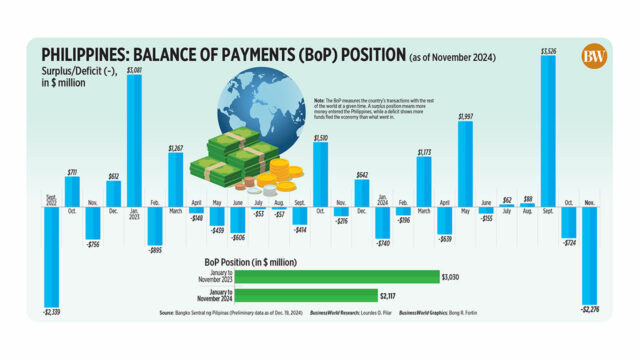
Philippines: Balance of Payments (BoP) Position

THE COUNTRY’S balance of payments (BoP) deficit widened in November as the government made more repayments on foreign debt, the Bangko Sentral ng Pilipinas (BSP) said on Thursday. Read the full story.

Philippines: Balance of Payments (BoP) Position

PHL stocks stumble as Fed delivers hawkish cut

REUTERS

PHILIPPINE SHARES sank to the 6,300 level on Thursday to hit an over five-month low amid a global sell-off after the US Federal Reserve signaled fewer rate cuts ahead due to inflation concerns.

The Philippine Stock Exchange index (PSEi) dropped by 1.13% or 73.48 points to close at 6,395.60, while the broader all shares index fell by 0.76% or 28.25 points to 3,671.75.

Thursday’s finish was the PSEi’s worst close in more than five months or since it ended at 6,358.96 on July 2.

This was also lower than its end-2023 finish of 6,450.04.

“The local market took cues from Wall Street’s drop, driven by the Federal Reserve’s trimmed projections on its rate cuts next year,” Philstocks Financial, Inc. Senior Research Analyst Japhet Louis O. Tantiangco said in a Viber message.

“Philippine shares continued to drop following the Federal Reserve’s rate cut decision… Meanwhile, US equities fell on Wednesday, recording lows as the Fed hinted on a slower pace of cuts by 2025, pushing Treasury yields higher while dragging stocks,” Regina Capital Development Corp. Head of Sales Luis A. Limlingan said in a Viber message.

The US central bank cut interest rates on Wednesday, as expected, but Federal Reserve Chair Jerome H. Powell said more reductions in borrowing costs now hinge on further progress in lowering stubbornly high inflation, remarks that showed policy makers are starting to reckon with the prospects for sweeping economic changes under a Trump administration.

Mr. Powell’s explicit — and repeated — references to the need for caution from here on jolted Wall Street, sending stocks sharply lower, bond yields higher and leading investors to dial back estimates of how far borrowing costs are likely to fall over the coming year.

Rates will fall again once inflation shows it is making more progress, “with the extent and timing of additional adjustments to the target range” depending on “incoming data, the evolving outlook, and the balance of risks,” the Fed said in new language that sets up a likely pause to the rate cuts beginning at the Jan. 28-29 meeting.

US central bankers now project they will make just two-quarter-percentage-point rate reductions by the end of 2025.

All sectoral indices closed lower on Thursday. Mining and oil retreated by 2.36% or 175.72 points to 7,248.76; property sank by 1.68% or 39.77 points to 2,323.83; industrials went down by 1.36% or 122.35 points to 8,838.82; holding firms declined by 1.35% or 75.20 points to 5,496.44; services slumped by 0.69% or 14.43 points to 2,052.48; and financials dropped by 0.32% or 7.01 points to 2,178.36.

Value turnover went up to P6.03 billion on Thursday with 595.34 million shares traded from  the P5.96 billion with 1.39 billion issues exchanged on Wednesday.

Decliners outnumbered advancers, 126 versus 72, while 41 names were unchanged.

Net foreign selling rose to P997.59 million on Thursday from P487.26 million on Wednesday. — R.M.D. Ochave with Reuters

Marcos to remold 2025 budget to ‘same shape’ with line-item vetoes

PRESIDENT FERDINAND R. MARCOS, JR. — REVOLI S. CORTEZ/PPA POOL

By Kyle Aristophere T. Atienza, Reporter

PHILIPPINE President Ferdinand R. Marcos, Jr. said on Thursday he seeks to remold the proposed 2025 national budget to the “same shape” submitted by the Executive branch in July.

He made the statement after meeting his economic managers on Wednesday afternoon to review the Congress-approved budget for next year.

“Well, we had to have a look because a lot were changed from the budget request of the different departments and we have to put it back in the same shape that we had first requested,” he told reports in mixed English and Filipino on the sidelines of an event in Pasay City.

The Presidential Palace on Wednesday announced the postponement of the budget signing set for Dec. 20, amid backlash that has forced the President to push for the restoration of cuts from the Department of Education’s (DepEd) budget.

Mr. Marcos earlier justified the bicameral conference committee’s (bicam) move to remove the state subsidy for the Philippine Health Insurance Corporation (PhilHealth), arguing it has enough reserves.

The President, speaking to reporters on Thursday, said he’s “unfortunately” only “left now with the veto power.”

“Now it’s up to us on how we regain control of the spending program,” he said.

Executive Secretary Lucas P. Bersamin on Wednesday said while the new date for the budget signing remains unclear, “we can now confirm that certain items and provisions of the national budget will be vetoed.”

“We are going through item by item, line by line, to see what [the] priority is and what is not. And that is what we will come up with,” Mr. Marcos said.

“But I want to be very, very sure that the budget for 2025 is directed at the important projects that we have prioritized, number one. And secondly, that there [are] stronger safeguards on spending for the different projects,” he added.

DepEd, in particular, was denied its proposed P10-billion funding for its computerization program for 2025 due to its failure to spend previous budgets for the similar program as early as 2022.

It reported an obligation rate of 41.9% as of August, ranking 11th among government agencies in terms of budget utilization. Still, the rate is higher than that of the House of Representatives (HoR), which had the lowest obligation rate of 8.8% but has nonetheless, received a P16.35-billion increase in the bicam version.

The President said they may also “assess” items included in the budget via “insertion.”

“We are starting to see some project proposals that do not have the appropriate program of work, [no] appropriate documentation, and it’s not clear where the money will go,” he said. “So we will clarify that.”

The Department of Public Works and Highways’ (DPWH) allocation in the Congress-approved budget rose by P288 billion to P1.1-trillion funding. And as the agency responsible for most of the government’s flagship infrastructure projects became a net gainer, while agencies responsible for key social services faced massive cuts.

In the bicam-version of the spending plan, the budget of the Department of Social Welfare and Development declined by P95 billion to P217.3-billion funding, while the Health department’s budget fell by P25.7 billion to P247 billion.

Public finance expert Zyza Nadine M. Suzara, however, said line-item vetoes will not restore budget cuts, raising the need to reconvene the bicam to “reshape” the budget.

“It seems like the President does know his constitutional mandate. The ratified version of the 2025 budget can only be reshaped by reconvening the Bicam and restoring the budget for what the country truly needs,” Ms. Suzara said in an X message.

“That means the President has to call Congress to a special session to ‘reshape the budget.’ Imposing line-item veto will not necessarily restore the funds that agencies lost. Taxpayers deserve more than the crumbs thrown to us by the Bicam.”

She added a line-item veto would be “useless” as it cannot “significantly change the budget,” noting the move was just a “way to minimize the backlash.”

“Without a line item in the budget for the PhilHealth subsidy, the funds cannot be restored even assuming that the President vetoes the astronomical increases in the DPWH, AKAP (Ayuda sa Kapos ang Kita Program) and HoR budgets,” she explained.

Mr. Marcos said the country does not have a considerable amount of savings, “so we need to be careful about where we spend it.”

The P6.352-trillion national budget is equivalent to 22.1% of the country’s gross domestic product, and 10.1% higher than the P5.768-trillion budget this year.

Mr. Marcos said he hopes to sign the spending plan for 2025 by the year end. If the budget is not approved within the year, the Philippine government will operate under the 2024 Generation Appropriations Act.

Philippine VP Duterte slapped with third impeachment rap

VICE-PRESIDENT SARA DUTERTE-CARPIO FACEBOOK PAGE PHOTO

ANOTHER impeachment complaint seeking the removal of Philippine Vice-President (VP) Sara Z. Duterte-Carpio was filed at the House of Representatives on Thursday, containing allegations she committed plunder, bribery, and betrayed the public’s trust.

The impeachment rap, filed by 12 complainants composed of clergymen, members of a religious sect and a lawyers’ group, alleged the embattled vice-president breached the Constitution, betrayed public trust, committed plunder, bribery, corruption, and other high crimes.

The Philippine Charter stated that grounds for impeachment include “culpable violation of the Constitution, treason, bribery, graft and corruption, other high crimes, or betrayal of public trust.”

Camarines Sur Rep. Gabriel H. Bordado, Jr. and Party-list Rep. Lex Anthony Cris A. Colada endorsed the impeachment complaint, which called for Ms. Duterte’s removal from office for her failure to account for the alleged “anomalous disbursements” of more than P600 million worth of secret funds in 2022 and 2023.

The Office of the Vice-President (OVP) did not immediately respond to an e-mail seeking comment about the most recent impeachment complaint.

In a Viber message to reporters, the OVP said “the matter was already relayed to the Vice President.”

Two impeachment complaints were filed earlier by civil society groups and activists, which similarly zeroed in on Ms. Duterte’s alleged misuse of confidential and intelligence funds (CIF).

“What makes this different is that the complainants now believe that it is no longer just the constitutional and legal obligation of the members of the House of Representatives to impeach and for the Senate to remove from office the sitting vice president of the Republic of the Philippines,” Armando Virgil D. Ligutan, the complainants’ counsel, told reporters before the ouster rap’s filing. 

“That obligation now becomes a moral one,” he added.

In a separate statement on Thursday, the Office of the Secretary-General in the chamber confirmed receipt of the third complaint.

“The House of Representatives reaffirms its steadfast dedication to upholding the principles of transparency, accountability, and the rule of law,” it said.

“The impeachment complaint will undergo due deliberation in strict compliance with the Constitution and established legislative processes.”

The filing of the third impeachment complaint comes just before the Philippine Congress goes on recess for its Christmas break, which would start on Dec. 21 until Jan. 12.

Ouster complaints against Ms. Duterte face an uphill battle as lawmakers question whether there is enough time to deliberate with the country’s midterm elections just five months away.

The Constitution requires the House to first hear the complaints, requiring one-third of its members or at least 103 congressmen to find it with merit before the case is elevated to the Senate for trial. At least 16 senators need to find Ms. Duterte culpable of the alleged violations to be convicted.

All 318 seats in the House will be voted on by Filipinos in May, while 12 spots in the influential 24-seat Senate are up for grabs.

Thursday’s complainants alleged that Ms. Duterte’s use of secret funds “were not properly done” as her office used fictitious individuals to receive the government funds, according to Mr. Ligutan.

“We have instances of the same individuals receiving money from the public, but these individuals used different signatures,” he said, referring to the House good government panel’s findings that fictitious identities were used by recipients of CIF from Ms. Duterte’s office.

Ms. Duterte’s failure to also submit documentary evidence on her use of CIF “evidenced inexcusable negligence on the vice-president’s part to ensure that the Filipino people’s money was properly spent,” a copy of the filed impeachment complaint provided to reporters stated.

“If this Honorable House of Representatives allows the Vice-President to get away with what she did, what is stopping other less ethical public officials from misappropriating millions and millions of hard-earned public money by the mere flimsy excuse that disposition be confidential,” the complaint further read. — Kenneth Christiane L. Basilio

ADVERTISEMENT
ADVERTISEMENT