Home Blog Page 2210

Property valuation data-sharing deal enlists local governments

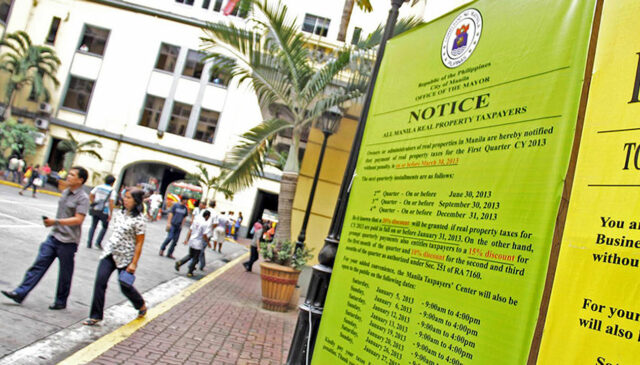
GOVERNMENT agencies and local government units (LGUs) signed on Wednesday a data sharing agreement to streamline real property valuation data and improve tax compliance, the Department of Finance (DoF) said.

“A data-sharing agreement was signed on the sidelines of the (Bureau of Local Government Finance) anniversary celebration to develop the Real Property Information System and all other digitalization systems under the Local Governance Reform Project (LGRP),” the DoF said in a statement.

“The agreement enables more collaboration to build a robust and comprehensive database system, enhancing the ease of doing business and strengthening data-sharing with the Bureau of Internal Revenue to improve tax administration.”

The BLGF, which serves as the DoF’s oversight agency for fiscal transparency and revenue collection, is overseeing the LGRP.

This seeks to harmonize policies and digitalize local fiscal management, especially in real property valuation and appraisal.

This is in support of Republic Act No. 12001 or the Real Property Valuation and Assessment Reform Act, which seeks to establish uniformity in taxing real property.

During the event, the BLGF also launched key projects to improve its operations: LGRP Manuals; Electronic Official Receipts and e-Ledgers; the turnover of information technology equipment; and the enhanced academic curriculum in real estate management.

Locally generated revenue by LGUs outside the National Capital Region have nearly doubled from 2019, the DoF said.

In a speech, Finance Secretary Ralph G. Recto said the BLGF aims to speedily carry out projects to improve transparency, digitalization, and the enhancement of the capabilities of LGU treasurers and assessors. — Beatriz Marie D. Cruz

Pioneering fiber cement plant in Pampanga gets green lane status

SHERAEU.COM

THE Department of Trade and Industry (DTI) said on Thursday that it granted a green lane certification to Thailand’s SHERA Public Co. Ltd.’s fiber cement plant in Mabalacat, Pampanga.

“The project was granted a green lane certificate during a meeting held on Oct. 9 (Wednesday), on the sidelines of the 44th and 45th Association of Southeast Asian Nations (ASEAN) Summits and Related Summits,” the DTI said.

The company, through its subsidiary SHERA Building Solution (Philippines) Corp., will install and operate a fiber cement building materials manufacturing plant inside the 250-hectare TECO Industrial Park.

“This manufacturing facility… is set to be the sole manufacturer of fiber cement boards in the country, substantially reducing the country’s dependence on imports,” the DTI said.

According to the DTI, the facility will house cutting-edge technologies, including systems powered by artificial intelligence and the internet of things to optimize the production processes, enhance efficiency, and minimize environmental impact.

“Their product selection includes fiber cement building materials that can be used in ceilings, wall cladding, wall partitions and decorative walling, decking, siding, and fencing for residential, commercial, and industrial buildings,” the DTI said.

In August, SHERA announced that the plant is 60% complete and is on track to start operations in the first quarter of 2025.

As part of its plan to expand outside Thailand, SHERA made a P2-billion investment in the Philippines, which included the construction of a 5-hectare facility in Mabalacat.

The plant, which has the capacity to produce 240,000 tons of fiber cement, is the company’s first production hub outside Thailand.

As of September, the Board of Investments said it endorsed P4.3 trillion worth of investments to the One Stop Action Center for Strategic Investments. The endorsements cover 158 projects. — Justine Irish D. Tabile

NFA to discontinue palay re-bagging; cost savings to boost procurement

PHILIPPINE STAR/KRIZ JOHN ROSALES

THE National Food Authority (NFA) said on Thursday that it will no longer re-bag palay (unmilled rice) starting from the wet-season harvest to save on costs.

“The NFA has signed an order where farmers selling palay use their own sacks,” acting Administrator Larry R. Lacson told reporters at a briefing.

He added that the NFA will conduct a pilot test during the wet season harvest, in which 20% of palay procured from domestic farmers will no longer be re-bagged in NFA-branded sacks. This is equivalent to about 1.3 million bags.

“The NFA will no longer spend money on transferring the palay to new sacks; At the same time it will reduce handling costs,” Mr. Lacson said.

The NFA had previously required farmers to re-bag their harvest when selling to the NFA. Farmers have said that delayed the turnover of palay.

The NFA is required to procure domestically grown rice and hold it in reserve in the event of shortages or calamities.

The NFA is expected to save about P27.4 million from the suspension of palay repacking from October to December.

He added that if the test is successful, the NFA will roll out the measure next year, which could save the about P215.5 million.

He said that the savings realized from re-bagging could also be used in procuring more palay.

“This is an amount the NFA could use to buy an additional 7,700 metric tons of palay at an average price of P28 a kilogram,” Mr. Lacson said.

The NFA has just adopted a new pricing scheme for palay, offering between P23 and P25 per kilo.

The NFA is targeting a palay inventory of 435,000 MT before the end of the year.

Meanwhile, the NFA said that it has partnered with the Philippine National Oil Co. on a rooftop solar panels project for the NFA central office.

Mr. Lacson said that the solar project will eventually be replicated at other NFA sites.

According to their Memorandum of Agreement, the NFA will lease a 100-kilowatt rooftop solar photovoltaic system. The entire NFA network will eventually host solar capacity of 5 megawatts.

“We will not only save on our power costs from this solar rooftop project, we are also contributing to the reduction of carbon emissions and in safeguarding the environment,” he said. — Adrian H. Halili

TNT, Gin Kings gunning for 2-nil edge in Governors’ Cup semis

BARANGAY GINEBRA GIN KINGS — PBA.PH

Games on Friday
(Smart Araneta Coliseum)
5 p.m. – TNT vs Rain or Shine  (Semifinals Game 2)*
7:30 p.m. – Ginebra vs San Miguel (Semifinals Game 2)*
*TNT and Ginebra lead best-of-seven series, 1-0

IF DRAWING first blood against a tough opponent was hard, making it two in a row is doubly tougher.

That’s why defending champion TNT and Barangay Ginebra aren’t resting easy as they head to Game 2 of their respective PBA Governors’ Cup semi final assignments on Friday at the Smart Araneta Coliseum.

The Tropang Giga seek a 2-nil edge after their opening 90-81 verdict and create more distance from Rain or Shine in the race-to-four affair at 5 p.m. while the Gin Kings shoot for a followup to their 122-105 Game 1 romp versus San Miguel Beer (SMB) at 7:30 p.m.

TNT import Rondae Hollis Jefferson (RHJ) said it’s imperative that the troops maintain the same mindset against Aaron Fuller and the ROS young guns that lifted them to success in Wednesday’s curtain raiser.

“Do it as a team, do it together, have your brothers’ back out there every play, every possession. I think we’ll be good,” said RHJ, who went an assist short of a triple double in leading this first strike by the Tropang Giga.

Coach Chot Reyes tasked the Tropang Giga to keep their defensive shape against ROS offensive weapons.

“For us to win, we have to limit their production. And as Rondae (Hollis Jeferson) said, just everyone pitching in” said Mr. Reyes. “It really starts with that defensive mentality.”

Elasto Painters counterpart Yeng Guiao isn’t in panic mode, though, as he feels his charges are ready for a long battle.

Gin Kings mentor Tim Cone admitted the biggest concern is how to keep Justin Brownlee and Co. driven after gaining payback on SMB for its 49-point beating back in the elims.

“Now the question is: Can we continue to motivate ourselves into Game 2 because we did it (revenge) and we got to feel good about ourselves. But can we turn around and follow it up because you know them (SMB), they’re going to come back and use all that talent and experience that they have to play a really good game on Game 2,” said Mr. Cone.

“It’s just the way the series is. It often times pingpongs back and forth because it’s hard to sustain that motivation game after game after game against a really good team like them,” he added. — Olmin Leyba

Letran vs LPU kickstarts second round of NCAA 100

COLEGIO DE SAN JUAN DE LETRAN KNIGHTS — NCAA

Games on Friday
(Filoil EcoOil Arena)
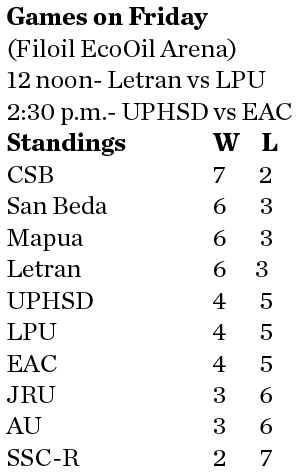
12 noon- Letran vs LPU
2:30 p.m.- UPHSD vs EAC

FOR THREE GAMES NOW, Colegio de San Juan de Letran’s Kevin Santos had found a way to flip the switch that has transformed him from a seldom used, second string big man to a juggernaut inside.

During that scintillating span, the 6-6 Mr. Santos averaged around 15 points 13 rebounds and three blocks a game that helped propel the Letran Knights not just straight into Final Four contention, but also in a championship race.

Mr. Santos hopes to sustain his fiery form when Letran tackles an unpredictable Lyceum of the Philippines University (LPU) in Friday’s start of the second round of NCAA Season 100 double-round elimination at the Filoil EcoOil Arena.

With Mr. Santos as their defensive anchor and a dangerous inside scoring threat, Letran has jumped into a three-way tie for No. 2 with defending champion San Beda University and Mapua University on 6-3 records, or just a game behind league leader College of St. Benilde (7-2).

“I told him (Mr. Santos) to just be patient and his time will come if he follows what we are trying and need to do,” said Letran coach Allen Ricardo. “So far, he’s been doing it.”

Coincidentally, it will be the second game between Letran and LPU in less than a week after the former edged the latter, 78-66, in that first-round encounter.

Interestingly, it was Mr, Santos’ 17-point, 11-rebound and three-block effort that helped the Letran Knights seal the deal.

LPU is in desperate need of a win as it is currently in a logjam at No. 5 with University of Perpetual Help and Emilio Aguinaldo College (EAC) on 4-5 marks.

The UPHSD Altas and the EAC Generals face off at 2:30 p.m. to likewise stay afloat in the Final Four race. — Joey Villar

Francisco Lindor hits grand slam, New York Mets eliminate Phillies in NLDS

NEW YORK — The amazin’ ride continues for the New York Mets.

Francisco Lindor hit the go-ahead grand slam in the sixth inning Wednesday for the Mets, who beat the Philadelphia Phillies 4-1 to win their National League Division Series (NLDS) three games to one.

The Mets, who were 11 games under .500 in early June, didn’t clinch the NL’s sixth seed until splitting a makeup doubleheader with the Atlanta Braves on Sept. 30 — the day after the regular season was scheduled to end. New York will face either the Los Angeles Dodgers or San Diego Padres in the NL Championship Series (NLCS) beginning Sunday on the road in a best-of-seven series.

The season-ending loss represents the latest October disappointment for the NL East-winning Phillies, who reached the World Series as the No. 6 seed in 2022 but lost in the NLCS last year before being eliminated in their first playoff series this year.

Lindor’s grand slam came after five frustrating innings for the Mets, who left the bases loaded in the first and second against left-hander Ranger Suarez and also failed to score against Suarez and right-hander Jeff Hoffman (1-2) after putting two on with no outs in the fifth.

The Mets again loaded the bases with no outs in the sixth against Hoffman, who exited after Francisco Alvarez’s grounder forced J.D. Martinez at home. But Lindor homered beyond the right-center-field fence on the fourth pitch from closer Carlos Estevez for the second postseason grand slam in team history.

Starling Marte, on third base, did a joyful jig/dance as he jogged toward home. Lindor showed no emotion rounding the bases as the crowd of 44,103 roared and shook Citi Field.

It was just the latest dramatic moment in a potentially franchise-altering nine-day stretch for the Mets. Lindor hit the go-ahead two-run ninth-inning homer in the 8-7 win over the Braves that clinched a playoff berth in the doubleheader opener on Sept. 30.

Three days later, New York was two outs away from being eliminated by the Milwaukee Brewers in Game 3 of an NL wild-card series when Pete Alonso hit the go-ahead three-run homer in a 4-2 win.

David Peterson (1-0), the Mets’ third pitcher on Wednesday, earned the win with 2 1/3 scoreless innings. Edwin Diaz notched the save by working around a pair of walks in the ninth.

New York starter Jose Quintana gave up an unearned run over five-plus innings, allowing two hits and two walks with six strikeouts.

The Phillies scored their lone run in the fourth, when Bryce Harper raced home from third on a fielding error by third baseman Mark Vientos.

Suarez tossed 4 1/3 scoreless innings despite allowing five hits and four walks. He struck out eight. — Reuters

Former UConn stars in focus as Lynx, Liberty begin WNBA Finals

THE TOP TWO SEEDS entering this year’s WNBA playoffs are still standing. Now, they’ll go head-to-head for the league title.

Game 1 of the best-of-five WNBA Finals tips off Thursday, when the top-seeded New York Liberty host the second-seeded Minnesota Lynx.

Both teams are powered by former UConn stars who helped the US Olympic team win a gold medal at this summer’s Paris Games. Breanna Stewart leads the Liberty, while fellow forward Napheesa Collier steers the Lynx.

Stewart and Collier were teammates on the 2015-16 Huskies team that went 38-0 and won the school’s fourth straight national title.

And the two aren’t just friends off the court — they’re also business partners. Stewart and Collier together founded “Unrivaled” — a 3×3 basketball league that will launch in 2025.

But first, the former teammates and longtime friends will clash for the league crown.

“We’ve definitely built a bond – or kind of rekindled it since college,” Stewart said of her relationship with Collier. “I’m happy to see all the success that she’s had on and off the court and know that it’s going to be a battle.”

Collier, this season’s WNBA Defensive Player of the Year and runner-up for league MVP honors, has averaged 27.1 points, 9.6 rebounds and 3.9 assists per game across Minnesota’s first seven playoff games. Stewart has posted 20.0 points, 8.2 rebounds and 3.5 assists per game in six playoff contests for New York.

This is the second time the Lynx and Liberty are meeting this season with a championship at stake. Minnesota beat New York 94-89 on June 25 to win the WNBA’s Commissioner’s Cup — the league’s in-season tournament with a cash prize for players. Collier racked up 21 points, six rebounds, three assists and three steals to win championship game MVP.

Overall, the Liberty went 1-3 against the Lynx in the regular season, with those three losses coming by an average margin of 10.3 points.

New York enters the Finals on a tear, having won 11 of its last 14 games. The Liberty swept the Atlanta Dream 2-0 in the first round before dispatching the two-time reigning champion Las Vegas Aces 3-1 in the semifinals.

Guard Sabrina Ionescu led New York with 22 points and seven rebounds in the Liberty’s series-clinching, 76-62 win at Las Vegas last Sunday.

Minnesota reached the Finals for the seventh time in franchise history by beating the visiting Connecticut Sun 88-77 in a decisive semifinal Game 5 on Tuesday. Collier scored a game-high 27 points and collected 11 rebounds, while becoming the first player in WNBA history to post three straight outings of at least 25 points and 10 rebounds in the playoffs.

Courtney Williams added 24 points for the Lynx.

“From the very beginning, we felt how special this team could be. Coach (Cheryl Reeve) said she felt it from the second day of training camp, and I felt it really early on too,” Collier said.

“We understand how special and unique of an opportunity that we have and how rare it is. I definitely don’t think we’re taking it for granted.”

Minnesota is searching for its fifth Finals crown, while New York is looking for its first in its sixth appearance. Should the Lynx win, it would be a record fifth championship for Reeve. — Reuters

Giancarlo Stanton’s homer gives New York Yankees 2-1 advantage on Kansas City Royals

KANSAS CITY, Mo. — Giancarlo Stanton hit a long go-ahead home run in the eighth inning on Wednesday night, leading the New York Yankees to a 3-2 victory against the Kansas City Royals in Game 3 of the American League Division Series.

“I just wanted to hit the ball hard,” said Stanton. “You go up and try to hit a homer but you have to put yourself on time. If you get your bat through the zone on time, you give yourself a good shot.”

The Yankees lead the best-of-five set two games to one, and they can advance to the AL Championship Series with a victory in Game 4 on Thursday in Kansas City.

Stanton finished 3-for-5, driving in another run with a double and adding a stolen base. His 12th career postseason homer, a 417-foot shot to left field against left-hander Kris Bubic, came off his bat at 112.9 mph, according to MLB Statcast data. Bubic (0-1) had not allowed a run in three previous appearances during this year’s postseason.

New York’s bullpen, with Luke Weaver getting the final five outs for his second postseason save, kept the Royals scoreless after the fifth inning. Tommy Kahnle (1-0) got the victory with 1 1/3 perfect innings in relief after following starter Clarke Schmidt and Clay Holmes to the mound.

Kansas City’s best late scoring opportunity came in the eighth when Weaver allowed a one-out single to Bobby Witt Jr. and a two-out single to Salvador Perez. Yuli Gurriel flied out to end the inning.

Royals pitchers issued nine walks, and have allowed 22 walks in the series. Yankees batters managed four hits, collectively going 0-for-6 with runners in scoring position. AL MVP favorite Aaron Judge went 0-for-4 with a walk and a strikeout, and he is 1-for-11 with five K’s in the series. — Reuters

Starting 5

Everybody knows LeBron James is pushing 40, so amazement is what comes to mind when Starting 5 gives viewers an even closer look at his life behind the curtains. The just-released Netflix series — backstopped by his company Uninterrupted, Peyton Manning’s Omaha Productions, and Barack and Michelle Obama’s Higher Ground Productions — deftly delves into his love of hoops and, perhaps more importantly, his family throughout the 2023-24 season of the National Basketball Association. And the result is nothing short of stunning; for all his time in the spotlight since he was dubbed The Chosen One as a high school wunderkind, there is evidently still a lot to be learned about him, and what makes him tick.

Considering the timing, Starting 5’s arrival provides both casual observers and longtime habitues of the pro hoops scene with a fitting preamble to the upcoming season from James’ vantage point. It will be his 22nd, tying a league record, but he continues to blaze trails even among opponents a generation removed from his. In fact, his son Bronny is a teammate, and while the worth and worthiness — or lack thereof — of the latter to don the fabled Lakers jersey can be subject to debate, the gravity of the development remains clear to all and sundry.

True, Starting 5 likewise shines the spotlight on Jimmy Butler, Anthony Edwards, Domantas Sabonis, and Jason Tatum, and their exposure enhances appreciation of and for the proceedings. The similarities, and contrasts, between them are equally revealing and stark, and they come out all the better for their willingness to open their hearts and minds — and homes — to otherwise-invasive recording equipment for posterity. Regardless of personality and makeup, it’s not easy to shun whatever privacy is left to them for the benefit of fans and critics alike.

Bottom line, however, Starting 5 works because James is completely invested in the outcome. No doubt, the others proved to be just as immersed in the experience because, well, if the series is good for the best of the best, then it must be good for them, too. In any case, it manages to distinguish itself from such sports documentaries as Break Point, Full Swing, and even Hard Knocks because the protagonists are all in and caught raw. The slick production values notwithstanding, there can be no denying the concerted effort to make it revelatory first and foremost. Highly recommended.


Anthony L. Cuaycong has been writing Courtside since BusinessWorld introduced a Sports section in 1994. He is a consultant on strategic planning, operations and human resources management, corporate communications, and business development.

Investors bracing for risks from potentially contested US election

ELEMENT5 DIGITAL-UNSPLASH

NEW YORK — A tight US presidential race is leading some investors to brace for an unclear or contested election result that could trip up this year’s booming stock market rally.

With less than a month before the election, polls and prediction markets show Democrat Kamala Harris and Republican Donald Trump in a virtual dead heat. Ms. Harris led Mr. Trump by a marginal 46% to 43% in a Reuters/Ipsos poll released on Tuesday, a tighter race than the same poll showed a couple weeks earlier.

Given Trump’s efforts to overturn his loss to President Joseph R. Biden in 2020, investors expect any close outcome might also be contested this year. The balance of power in Congress is also at stake, with a number of potentially close contests that could ratchet up uncertainty.

“This is going to be a very close election. It just stands to reason that the likelihood of some type of dispute occurring is higher than it is on average,” said Walter Todd, chief investment officer at Greenwood Capital. He expects stocks to sell off if the result is in doubt for more than a few days.

“Markets do not like uncertainty, and they certainly would not like the fact that we don’t know who the president of the United States is a day or two after the election,” Mr. Todd said.

For now, political uncertainty appears to be doing little to dampen enthusiasm for stocks, as strong US economic growth has helped the S&P 500 power to fresh highs. The benchmark index is up 21% so far this year and on track for a second straight year of double-digit gains.

That’s not to say the election isn’t on investors’ radar. The CBOE Volatility Index, which measures options demand for protection against stock swings within a 30-day period, has risen about 6 points from its September lows and now stands at 20.9 — a level typically associated with moderate to higher expectation for market turbulence. Some of the index’s rise is attributable to the looming election, investors say.

Options markets also reflect increased concerns about tail risk — a market shock due to an unlikely but highly impactful event. The Nations TailDex Index, a measure of such risk, recently hit its highest level in a month.

Michael Purves, chief executive officer of Tallbacken Capital Advisors, believes investors are too focused on the days before and immediately after the vote, when a contested election could roil markets in the weeks after Nov. 5.

“It’s really not so much about the outcome as it is about the potential risk of the morning after, of the election not being considered valid by a large part of the population,” he said. “That to me is a real risk … a litigated outcome, where the stock market probably sells off.”

Recent precedents for challenged elections are few.

Markets were largely unperturbed by Mr. Trump’s attempt to overturn the results of the 2020 election. US stocks rallied in the week’s remaining trading days after election day, even though Mr. Biden wasn’t officially declared the winner until that weekend.

But investors might be less sanguine this time around, especially if a challenge to a close result by either party gains traction with fellow lawmakers and election officials in swing states.

Trump and his allies for months have been signaling that they would challenge a defeat, claiming repeatedly that they are worried that large numbers of non-citizens will vote, though independent and state reviews show this practice is vanishingly rare.

Stocks notched sharp declines in late 2000, when the race between George W. Bush and Al Gore was undecided for more than a month after a challenge from Gore’s campaign based on disputed results in Florida, the clearest example of a contested election in recent US history.

From election day of 2000 until Gore conceded in mid-December, the S&P 500 slumped 5%, when sentiment was also weighed down by unease about technology shares and the broader economy. The index slid 7.6% for the November/December period overall in 2000.

Such volatility could cloud the outlook for what has tended to be a strong time for equities in election years. The S&P 500 has gained an average of 3.3% in the last two months of presidential election years since 1952, rising 78% of the time, according to Keith Lerner, co-chief investment officer at Truist Advisory Services.

Mr. Purves, of Tallbacken Capital, advises investors to hedge potential election-related volatility through puts contracts, which gain in value when stocks fall.

Kurt Reiman, head of fixed-income Americas and co-lead of the ElectionWatch at UBS Wealth Management, remains broadly positive on stocks, but he said investors should consider popular havens such as utility stocks and gold to buffer portfolios against a close or contested vote.

Stephanie Aliaga, global market strategist at JPMorgan Asset Management, said whatever volatility a potentially contested election causes would likely be mitigated once the uncertainty subsides.

“Elections create uncertainty, but election results ultimately diminish and reduce that uncertainty,” she said. “At the end of the day you do end up with this almost post-election boost or rally because the uncertainty is cleared.” — Reuters


One in eight girls and women raped or sexually assaulted before age 18, UNICEF says

MIKA BAUMEISTER-UNSPLASH

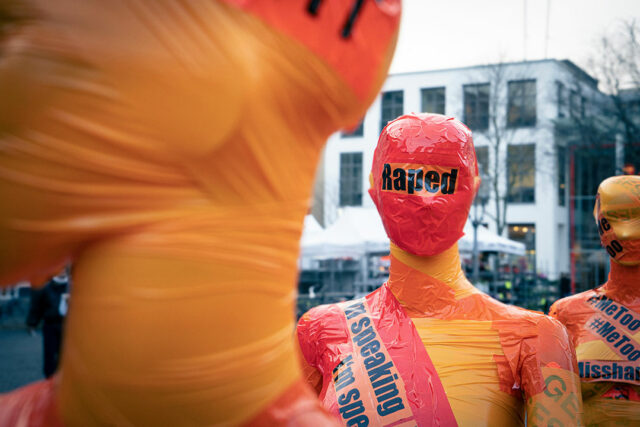
UNITED NATIONS — More than 370 million girls and women alive today, or one in every eight worldwide, experienced rape or sexual assault before the age of 18, the United Nations (UN) children’s agency said on Wednesday.

The number rises to 650 million, or one in five, when taking into account “non-contact” forms of sexual violence, such as online or verbal abuse, United Nations Children’s Fund (UNICEF) reported, in what it called the first global survey of the problem.

The report said that while girls and women were worst affected, 240 to 310 million boys and men, or around 1 in 11, have experienced rape or sexual assault during childhood.

“The scale of this human rights violation is overwhelming, and it’s been hard to fully grasp because of stigma, challenges in measurement, and limited investment in data collection,” UNICEF said in releasing the report.

It comes ahead of an inaugural Global Ministerial Conference on Ending Violence Against Children in Colombia next month.

UNICEF said its findings highlight the urgent need for intensified global action, including by strengthening laws and helping children recognize and report sexual violence.

UNICEF said sexual violence cuts across geographical, cultural, and economic boundaries, but Sub-Saharan Africa has the highest number of victims, with 79 million girls and women, or 22% affected. Eastern and South-Eastern Asia follow with 75 million, or 8%.

In its data for women and girls, UNICEF estimated 73 million, or 9%, were affected in Central and Southern Asia; 68 million, or 14%, in Europe and Northern America; 45 million, or 18%, in Latin America and the Caribbean, and 29 million, or 15%, in Northern Africa and Western Asia; Oceania, with six million, had the highest number affected by percentage, at 34%.

Risks were higher, rising to 1 in 4, in “fragile settings,” including those with weak institutions, UN peacekeeping forces, or large numbers of refugees, the report found.

UNICEF Executive Director Catherine Russell called sexual violence against children “a stain on our moral conscience.”

“It inflicts deep and lasting trauma, often by someone the child knows and trusts, in places where they should feel safe.”

UNICEF said most childhood sexual violence occurs during adolescence, especially between ages 14 and 17, and those who suffer it face higher risks of sexually transmitted diseases, substance abuse and mental health issues.

“(T)he impact is further compounded when children delay disclosing their experiences… or keep the abuse secret altogether,” UNICEF said.

It said increased investment in data collection was needed to capture the full scale the problem, given persistent data gaps, particularly on boys’ experiences.

UNICEF said it based its estimates of girls’ and women’s experiences on nationally representative surveys conducted between 2010 and 2022 in 120 countries and areas. It said estimates for boys and men were derived from a broader range of data sources and applied some indirect methods. — Reuters

Floods in South Asia expose gaps in regional climate cooperation

SAIKIRAN KESARI-UNSPLASH

DHAKA — As more extreme rainfall hits South Asia leading to floods that do not recognize national borders, regional countries must work together more to combat the mutual threat, experts said.

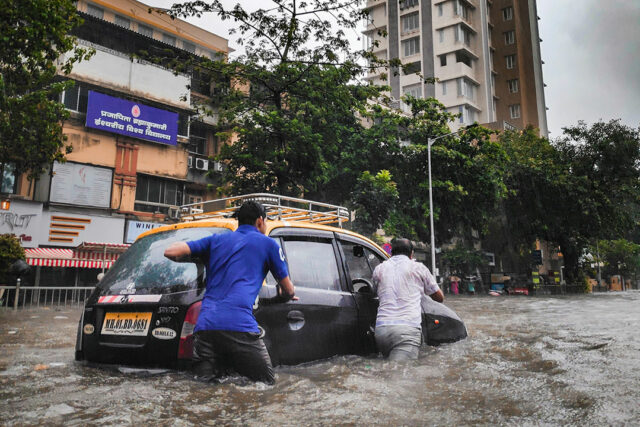
Heavy rains led to flash floods and landslides that killed some 200 people in Nepal last month in two days of incessant rains caused by low-pressure in the Bay of Bengal and neighboring parts of India. In August, a flash flood killed at least 71 near the border of India and Bangladesh.

Some 80% of major South Asian cities are at risk of flooding that could cost the region $215 billion a year by 2030, a 2021 report published by the World Bank said.

But despite larger and more frequent cross-border disasters, a trust deficit between South Asian countries has meant they have struggled to work together, and have instead often resorted to mutual recrimination.

India is Nepal’s biggest trading partner, but the two also have a number of border disputes. Similarly, Bangladesh and India have strong economic ties, but are in dispute over water sharing and the killing of people crossing the border illegally.

“No country in the region trusts others when it comes to riparian management, thanks to the political differences,” said Harsh Vasani, a professor of international studies at FLAME University in India.

A Bangladesh government adviser said the August flood was caused by India releasing water from a dam upstream without warning into a river flowing into Bangladesh.

India’s Ministry of External Affairs said live data had been shared with Bangladesh about the rising waters, but had stopped due to a power cut caused by the floods. It said the area had seen the “heaviest rains of this year” and in any case most of the water came from catchments downstream from the dam.

“Floods on the common rivers between India and Bangladesh are a shared problem inflicting sufferings to people on both sides, and requires close mutual cooperation towards resolving them,” the ministry said in a statement.

EARLY WARNINGS
Climate change is likely to trigger more frequent and more extreme weather events, such as the August flood, said Shaikh Rokon, head of Riverine People, a Bangladesh non-profit promoting stewardship of rivers and inshore wetlands.

“But climate change should not be made into a scapegoat for explaining away preparedness gaps within and between countries,” Mr. Rokon said.

The United Nations’ 2015 Sendai Framework for Disaster Risk Reduction says countries should provide early warnings and help communities make preparations before floods hit.

Forecasts and timely messaging have brought the death toll from monsoon floods to near zero in vulnerable communities in South Asia, said Dharam Raj Uprety from the Britain-based development organization Practical Action, which has implemented flood resilience projects in Bangladesh and Nepal.

But while monsoon floods can be predicted 10 to 12 days ahead, flash floods caused by rain give much less warning and that means alerting communities is a much bigger challenge, said Sardar Uday Raihan, executive engineer at the Flood Forecasting and Warning Centre in Bangladesh.

Bangladesh and India set up a joint river commission in 1972 to foster cooperation on flood warnings for the 54 rivers that cross their border. India and Nepal have a similar commission.

But it would help if there were real time data sharing on water released from dams and upstream water levels, Mr. Raihan said.

REGIONAL COOPERATION
Joint action is a rarity, said Sumit Vij, a professor at Wageningen University in the Netherlands. It makes little sense for each country to have its own strategy to adapt to the same floods, he said.

“Though we often stress on locally led adaptation, we actually need countries and areas over the same river basin or climatic region to align their adaptation efforts and share resources to deal with disasters,” Mr. Vij said.

One rare example of cooperation has been over the Koshi and Karnali rivers that flow from Nepal to India.

The project, implemented by Practical Action and other organizations, upgraded weather stations and set up a system to send mobile telephone alerts of rising waters.

While it was carried out mainly on the Nepalese side of the border, the project also benefited Indians living near the frontier who could also receive the flood warnings.

At present, Bangladesh and India have agreements on only a few of the rivers that pass between them. The two countries should formulate a single comprehensive agreement on all their 54 transboundary rivers instead of pursuing lengthy negotiations for each river separately, Vij said.

“We, South Asian nations, need to work together,” he said. — Thomson Reuters Foundation