Home Blog Page 2202

High-rise condominiums to address PHL housing crisis, urban planners say
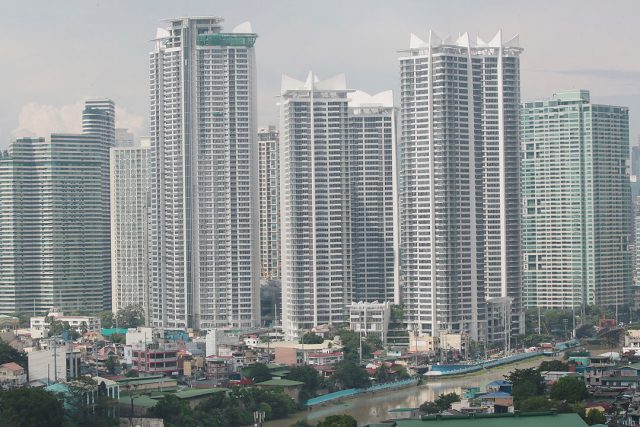
A VIEW of buildings in Makati City. — PHILIPPINE STAR/MICHAEL VARCAS

By Beatriz Marie D. Cruz, Reporter

VERTICAL HOUSING helps ensure more affordable housing options for the urban poor, while offsetting high land costs, according to urban planners.

“From a larger urban perspective, vertical housing makes the provision of urban services more cost-effective,” Joel L. Luna, principal at Joel Luna Planning and Design, said in an e-mail.

“Bringing more people together in a compact land area reduces the per capita cost of providing utilities, infrastructure, roads and other services compared with a sprawling development,” he added.

At a recent Senate hearing, Senator Cynthia A. Villar questioned the Department of Human Settlements and Urban Development’s plan to set up more medium-rise condominiums, saying these are only for the middle class.

“Why are you prioritizing the 3.2 million housing [units] for the middle class when your mandate is to help the poor and the homeless?” she told the Nov. 12 hearing, citing the need for more affordable housing options for the poor.

The Pambansang Pabahay Para sa Pilipino Housing Program, a flagship project of the Marcos administration, seeks to build 3.2 million housing units by 2028.

The program will focus on building in-city, high-density/vertical housing units using idle state lands and backed by government financial institutions.

Felino A. Palafox, Jr., president of Palafox Architecture Group, Inc., said vertical housing in urban areas would give the poor access to basic needs such as work and transportation.

“The urban poor should live close to their places of work, the schooling of their children, and public transit,” he said via telephone.

He added that vertical housing is more environment-friendly than horizontal housing units.

“When you have a large single-family home in the middle of the city, you’ll have a higher carbon footprint because you’re arrogating to yourself prime urban land resources,” he said.

Compared with traditional housing models, medium- and high-rise buildings also help maximize land space and reduce piping costs, according to urban planner and landscape architect Paulo G. Alcazaren.

“The key is the cost of land. If the land is expensive, then building up is the only way to recover the cost,” he said in an e-mail.

Vertical housing is also seen as the more practical choice in urban areas, where limited space and high demand drive up land prices and construction costs, according to Mr. Luna.

“In urban centers where high demand and scarcity of space drives unit land prices to levels that far exceed the unit cost of construction, building vertically would be the practical way to create new supply of space,” he said.

“At the fringes of urban centers (peri-urban, suburban or rural areas) where land is more abundant and where land values remain lower than the cost of building vertically, horizontal development is more economically practical,” he added.

However, Mr. Luna cited the need for a “multi-dimensional” approach to solving the country’s housing problem, noting that it is an issue of poverty.

“Why are they (urban poor) migrating to cities? Where did they come from and what circumstances made them leave their place of origin?” he asked.

Addressing issues on livelihood and employment, rural poverty and land ownership, among others, are as equally important as the housing crisis.

“The type of building is just one facet of a very complex issue,” Mr. Luna said.

To ensure affordable vertical housing options, the government should allocate more state land in urban areas to public housing, and push for subsidies or tax incentives, Mr. Luna said.

Building more vertical housing units would also help lower costs, Mr. Alcazaren said. “It’s economies of scale. If we need to build six million units, then the projection for costs goes down.”

Self-help housing, which allows beneficiaries to participate in construction, provides skill training and employment opportunities, Mr. Luna said. Housing developers should also allow livelihood opportunities in the area such as small businesses, childcare services and community farming.

Developers can use more locally available materials, build more energy- and water-efficient buildings through renewable sources of power and rainwater harvesting, Mr. Luna said.
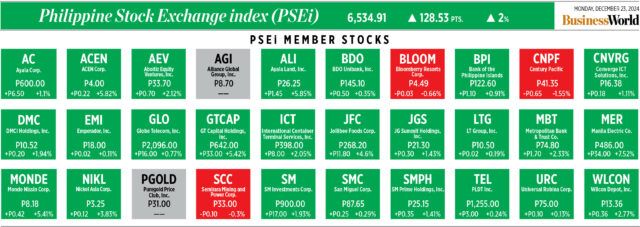
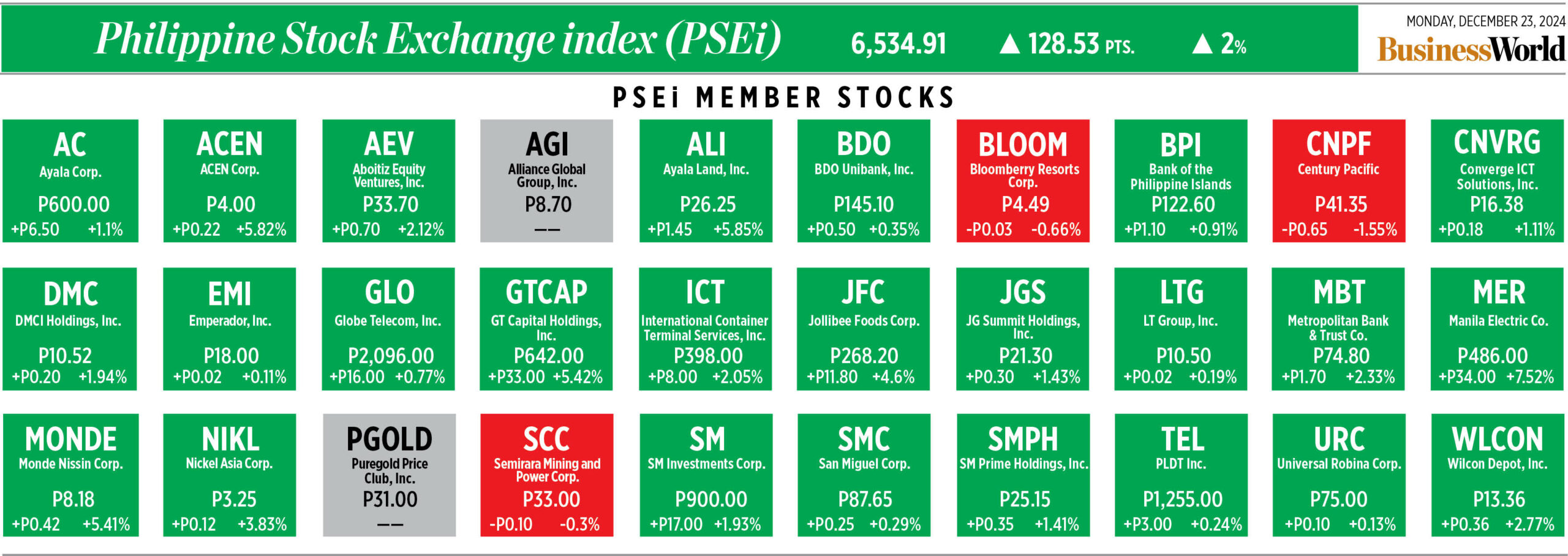
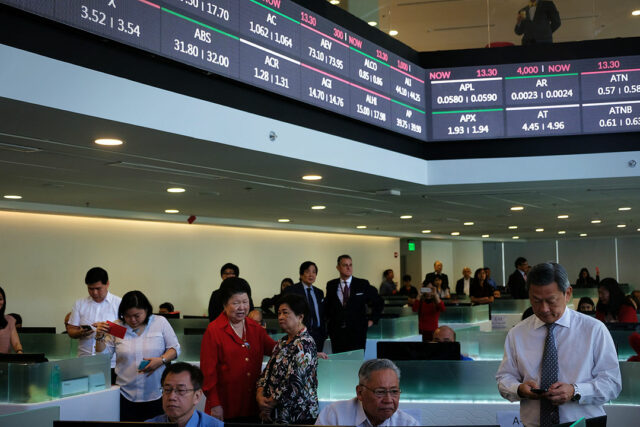
How PSEi member stocks performed — December 23, 2024

Here’s a quick glance at how PSEi stocks fared on Monday, December 23, 2024.


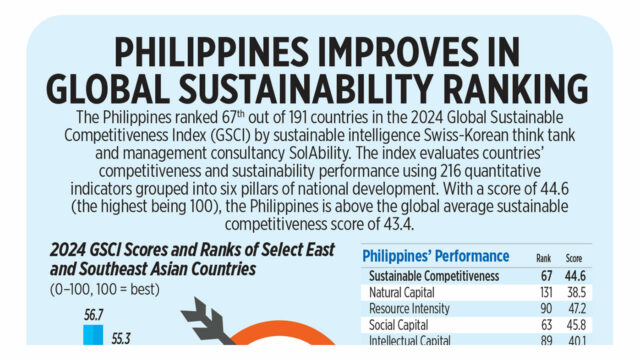
Philippines improves in Global Sustainability Ranking

The Philippines ranked 67th out of 191 countries in the 2024 Global Sustainable Competitiveness Index (GSCI) by sustainable intelligence Swiss-Korean think tank and management consultancy SolAbility. The index evaluates countries’ competitiveness and sustainability performance using 216 quantitative indicators grouped into six pillars of national development. With a score of 44.6 (the highest being 100), the Philippines is above the global average sustainable competitiveness score of 43.4.

Philippines improves in Global Sustainability Ranking

PSEi surges to 6,500 level on BSP rate cut signal

BW FILE PHOTO

THE MARKET SURGED to the 6,500 level on Monday after the Bangko Sentral ng Pilipinas (BSP) governor signaled that he is open to a rate cut in their first policy meeting for next year.

The Philippine Stock Exchange index (PSEi) rose by 2% or 128.53 points to close at 6,534.91 on Monday, while the broader all shares index went up by 1.39% or 51.40 points to 3,727.23.

“The local market rallied on the back of hints from the Bangko Sentral ng Pilipinas of a possible policy rate cut in their first meeting for 2025,” Philstocks Financial, Inc. Senior Research Analyst Japhet Louis O. Tantiangco said in a Viber message. “The recent rebound of the local currency against the US dollar also gave the market a boost.”

On Friday, BSP Governor Eli M. Remolona, Jr. told Bloomberg that the Monetary Board is open to delivering another rate cut at their first meeting of 2025.

Mr. Remolona said the BSP remains in an easing cycle and is “neither more dovish nor less dovish.”

The Monetary Board, at its final review for the year on Thursday, cut benchmark interest rates by 25 basis points (bps) for a third straight meeting to bring the policy rate to 5.75% from 6%.

The Philippine central bank has reduced borrowing costs by 75 bps thus far since the start of its easing cycle in August.

The BSP chief’s comments also boosted the peso. On Monday, the local unit closed at P58.45 per dollar, appreciating by 36 centavos from its P58.81 finish on Friday, Bankers Association of the Philippines data showed. This was its best finish in over a week or since Dec. 12’s P58.24.

“The local market benefited from positive spillovers from Wall Street’s rise last Friday driven by the US November personal consumption expenditures price index, which rose slower than expected,” Mr. Tantiangco added.

“Philippine shares finally bounced back… as investors prepare for the last trading week of the year,” Regina Capital Development Corp. Head of Sales Luis A. Limlingan said in a Viber message. “It will be a relatively quiet and shortened trading week, with the November budget balance set for release on Dec. 27. The Philippine equities market will be closed on Dec. 24 and 25 in observance of Christmas Eve and Christmas Day, respectively.”

All sectoral indices closed higher on Monday. Industrials went up by 2.97% or 264.21 points to 9,150.78; property climbed by 2.31% or 53.48 points to 2,368.11; mining and oil rose by 2.23% or 164.46 points to 7,526.29; holding firms increased by 1.78% or 98.59 points to 5,633.93; financials added 1.07% or 23.27 points to end at 2,179.86; and services jumped by 1.02% or 21.20 points to 2,095.10.

Value turnover dropped to P4.2 billion on Monday with 713.21 million shares traded from the P6.95 billion with 488.17 million issues exchanged on Friday.

Advancers beat decliners, 110 versus 72, while 53 names were unchanged.

Net foreign buying stood at P255.38 million on Monday versus the P777.85 million in net selling recorded on Friday. — Revin Mikhael D. Ochave

No reenacted budget in 2025 — Palace

PHILIPPINE STAR/RYAN BALDEMOR

By Kyle Aristophere T. Atienza, Reporter

MALACAÑANG on Monday assured that the Philippine government will not operate under a reenacted budget next year.

Presidential Communications Secretary Cesar B. Chavez made the remark following two meetings in which President Ferdinand R. Marcos, Jr. and his Cabinet officials reviewed items under the Congress-approved budget for 2025.

“In the past two meetings that I attended with them, there was never discussion on that (reenacted budget),” he said in a Viber message to reporters.

Mr. Chavez said Mr. Marcos recently met with secretaries of Budget, Finance, National Economic and Development Authority, and Public Works to review the proposed national budget for 2025 for the second time.

“The printed copy of the spending measure was only received late Friday afternoon,” he said.

“President Marcos, Jr. hopes to act on the measure before the year ends.”

The proposed P6.352-trillion national budget, which was ratified by both houses of Congress on Dec. 11, is equivalent to 22.1% of the country’s gross domestic product (GDP), and 10.1% higher than the P5.768-trillion budget this year.

The Presidential Palace on Dec. 18 announced the postponement of the budget signing set for Dec. 20, amid backlash that has forced Mr. Marcos to push for the restoration of cuts from the Department of Education’s (DepEd) budget.

Mr. Marcos has justified the bicameral conference committee’s (bicam) move to remove the state subsidy for the Philippine Health Insurance Corporation (PhilHealth), citing its reserves.

The National Government operated under a reenacted budget in 2019 — the first in eight years — after lawmakers failed to pass the spending plan on time in December 2018.

At that time, the Department of Budget and Management (DBM) issued guidelines telling agencies that they may not spend more than the amount specified in the proposed budget for projects and operations in the first quarter of 2019.

The guidelines also said government agencies can only spend on their workers’ salaries based on the 2018 level until the spending plan is passed, barring any pay hike.

The rules also barred agencies from implementing new projects, saying that only the maintenance and other operating expenses (MOOE) and capital outlay for ongoing foreign-assisted and locally funded projects can be funded under the reenacted budget.

The DBM had warned lawmakers at that time that a reenacted budget could have a GDP growth impact of -1.1 to -2.3% in 2019.

Ser Percival K. Peña-Reyes, director of the Ateneo de Manila University Center for Economic Research and Development, said a reenacted budget next year could lead to “uneven growth because of structural imbalances.”

“There are going to be some negative short-term effects from reenacting a budget, particularly the delay of on-going infrastructure and other social programs,” said Leonardo A. Lanzona, who also teaches economics at the Ateneo.

“This will mean that the government will have to reduce much of its expenditures that can impact on economic growth, perhaps bringing down the growth by at least a third of what is expected,” he added in a Messenger chat.

The Philippine economy in the third quarter grew at the weakest pace in more than a year at 5.2%, due largely to weather disturbances’ impacts on government spending and farm output.

The government earlier this month narrowed its economic growth target for 2024 to 6 to-6.5% from a top end of 7% previously and is targeting a 6-8% GDP target for the whole of 2025.

“The long-term costs of continuing what is obviously a politicized budget are going to be much greater than the short-term costs, and the chance of recovering is even much lower,” Mr. Lanzona said. “Hence, there is no alternative but to swallow the short-term costs and to fix the budget by securing the appropriate priorities into the future.”

“We cannot definitely create a firewall between the political structure and the economic system,” he added. “This episode of economic inefficiency is a result of a political structure where the unfit and the worst people are placed in positions of power.”

CRITICAL SECTORS
In a statement on Monday, the Philippine Economic Society urged the Marcos leadership to restore funding for critical sectors and implement strategic subsidies for the state health insurer, as Cabinet officials identify items to be vetoed in the proposed national budget.

It said the P83-billion budget cut in the proposed budget of the Department of Social Welfare and Development (DSWD) “weakens safety nets for the most vulnerable, including conditional cash transfers, disaster relief, and feeding programs for children.”

“Cuts to school and daycare feeding initiatives will exacerbate hunger and malnutrition,” it added, “impacting children’s health, learning outcomes, and future productivity.”

The government should ensure transparency and targeted social transfers for the needy by eliminating “politicization and discretion” in the management of social transfer funds, it said, citing the DSWD’s Ayuda sa Kapos Ang Kita (AKAP) Program, which is allegedly weaponized by lawmakers.

The group said the National Government should continue to subsidize PhilHealth to fully implement the Universal Health Care (UHC) Act of 2019 and “eliminate reliance on politicized guarantee letters.”

“The P74.47-billion reduction in PhilHealth subsidies jeopardizes the promise of UHC,” it said. “Without strategic subsidies, vulnerable groups, including indigents, persons with disabilities, and senior citizens risk exclusion from healthcare access.”

It also warned that the P11.6-billion cut in DepEd’s budget endangers efforts to address the learning crisis.

“Cuts to teachers training, infrastructure, and upskilling programs will worsen disparities in access to quality education, leaving many children and workers unprepared for the demands of the modern economy,” it added.

It also said the reduction worth P20 billion in the Department of Agriculture’s budget undermines food security and rural livelihoods.

“Lack of funding for irrigation, mechanization, climate-resilient production systems and farmer support programs threatens productivity and raises food prices, disproportionately affecting the poor,” it flagged.

It asked the Marcos administration to invest more in climate-smart agriculture programs.

ERC to complete fourth rate reset for grid operator by next month

BW FILE PHOTO

By Kenneth Christiane L. Basilio, Reporter

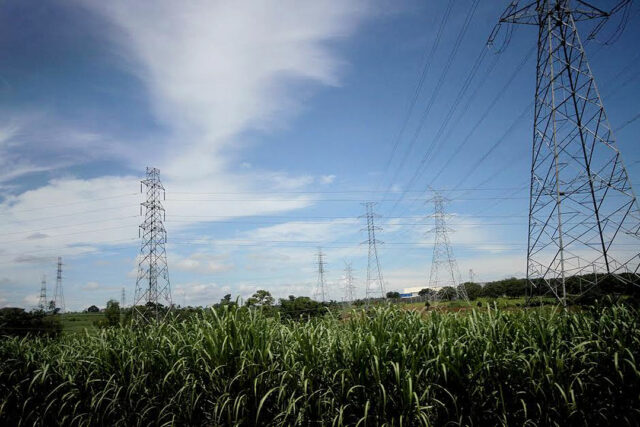
THE Energy Regulatory Commission (ERC) is set to complete the National Grid Corporation of the Philippines’ (NGCP) transmission rate adjustment next month, the regulatory body’s chief told lawmakers at the House of Representatives on Monday.

“We are at the tail end of the reset for the fourth regulatory period, we have completed all the evaluation,” ERC Chairperson Monalisa C. Dimalanta said during a House legislative franchises hearing.

“We are completing the evaluation… and we expect to issue the final determination by January 2025.”

The ERC conducts a rate reset process for power companies to help ensure that rates are fair for both consumers and power utilities by looking into the proposed project costs and projected expenditures over a five-year regulatory period.

The NGCPs’ fourth regulatory period covers the years 2016 to 2022, which the ERC previously described as “unique because it covers a past period.”

Ms. Dimalanta said there is a possibility that the ERC en banc would increase NGCP’s allowable revenue for the January final determination. “Because of changes… there is now a potential increase in the allowable revenue of NGCP.”

“This is now subject to the final evaluation of the commission,” she added.

The energy regulatory body capped the NGCP’s allowable revenue for the fourth regulatory period to P310.96 billion, 43.84% lower than the P552 billion it requested, according to a draft of the grid operator’s final rate adjustment determination sent by Ms. Dimalanta to BusinessWorld.

The ERC also slashed the NGCP’s requested capital expenditures by 15.89% to about P180 billion from the requested P214.66 billion.

“We hope that due process will be followed, and that prevailing regulatory frameworks, existing laws, all of which have been complied with by the NGCP, would be recognized [for the fourth regulatory period’s final determination],” NGCP Assistant Vice-President and Head of Public Relations Leonor Felipa Cynthia P. Alabanza told reporters after the House hearing.

Meanwhile, the ERC is set to release the NGCP’s fifth regulatory period rates by the second half of 2025, Ms. Dimalanta told BusinessWorld after the House hearing.

“We might be able to do that in the second half of next year. Although I think the proceedings for the fifth regulatory period are almost done,” she said.

NGCP’s fifth regulatory period will cover the years 2023 to 2027.

Also on Monday, lawmakers launched a motu proprio investigation into NGCP’s congressional franchise, citing alleged delays over the grid operator’s infrastructure projects.

Of the 37 transmission projects investigated by the ERC, 34 have faced “unjustified delays,” Ms. Dimalanta told lawmakers.

Ms. Alabanza in response said that NGCP remains “on time for its system impact studies.”

Embassy to continue repatriating Filipinos in Lebanon amid ceasefire with Israel

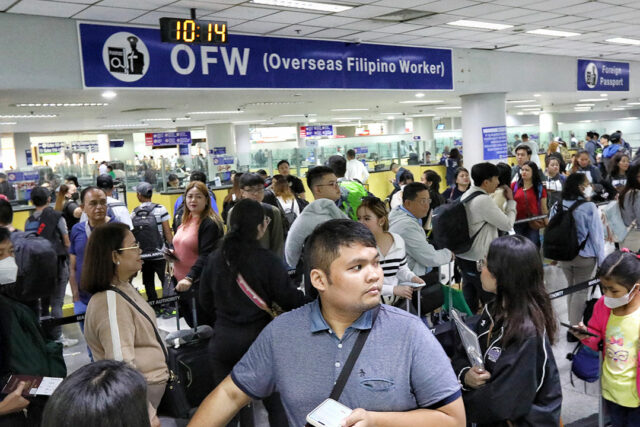
Overseas Filipino workers (OFWs) are seen at the Ninoy Aquino International Airport Terminal 3. — PHILIPPINE STAR/WALTER BOLLOZOS

THE PHILIPPINE Embassy in Lebanon on Monday gave assurance to overseas Filipino workers still in war-torn Beirut that it is accepting and processing voluntary repatriation applications amid the country’s 60-day ceasefire with Israel and Iran-backed militant group Hezbollah.

The Department of Foreign Affairs (DFA) earlier placed Lebanon under Alert Level 3 and Crisis Alert Level 3, which suspends the return of contract workers to the West Asian country.

“The Philippine Embassy constantly reminds Filipinos in Lebanon to maintain their vigilance and preparedness through various means: ensuring important documents are ready and up to date…” the embassy said in a statement.

It also urged Filipinos in Lebanon to keep an eye on international news and to stay in touch with the Migrant Workers Office in Beirut.

On Dec. 18, 28 Filipinos were repatriated from Lebanon after the ceasefire was declared.

Lebanon and Israel had agreed to a 60-day ceasefire amid Syria’s political transition after the fall of the Al-Assad government.

More than 3,000 people have died in Lebanon since late September, Reuters reported. Israeli airstrikes and widespread detonation of homes destroyed more than 40,000 housing units in the country’s border, it said, citing Lebanon’s state news agency.

“The Embassy continues to monitor the situation across Lebanon and provides updated advisories to Filipino nationals,” the Philippine embassy said.

“The voluntary repatriation program remains open to Filipino nationals who wish to return to the Philippines.” — John Victor D. Ordoñez

GCTA proposal ‘problematic and unfair,’ Veloso lawyer says

MARY JANE F. VELOSO — PHILSTAR FILE PHOTO

THE Department of Justice’s (DoJ) proposal to apply the Good Conduct Time Allowance (GCTA) rule is “problematic and unfair” to Filipina drug convict Mary Jane F. Veloso, who was incarcerated in Indonesia for almost 15 years, as it requires another six years before she qualifies for the benefit of GCTA and possible parole, her lawyer said.

Edre U. Olalia, one of Ms. Veloso’s legal counsels, said the application of GCTA is unfair to her who has been on death row since 2010 because this requires serving the minimum sentence of reclusion perpetua of 20 years.

“Absolute pardon is within the sole power and prerogative of the [Philippine] President especially if this is based, as in the case of [Veloso], on humanitarian and not legal grounds,” he said in a Viber chat to reporters on Monday.

The lawyer noted the only “condition” requested by Indonesian authorities when they turned over the former domestic helper was for her conviction not to be questioned anymore, and for the Philippines should respect the Indonesian legal and judicial system and process.

“The legal jurisdiction over drug trafficking case remains with Indonesia but the physical custody is passed on to the [Philippine government] under a bilateral transfer of sentenced prisoner agreement,” Mr. Olalia clarified.

The hearing for the criminal cases for qualified human trafficking, illegal recruitment and estafa, filed in the Regional Trial Court of Sto. Domino, Nueva Ecija in May 2015 against Ms. Veloso’s recruiters, who allegedly planted heroin in her suitcase, will be on Feb. 19, 2025, the lawyer said.

“The taking of her testimony originally via deposition in Indonesia jail has been delayed for years because of legal challenges by the accused but which is now settled and superseded by her impending testimony in person in open court,” he added.

A legal expert earlier told BusinessWorld Ms. Veloso was a victim of human trafficking, which should have exempted her from criminal liability under international conventions.

The expert noted this issue was never raised during her trial in Indonesia, leading to her prosecution for drug trafficking when she should have been exempted from criminal liability.

Ms. Veloso was convicted in 2010 for drug trafficking in Indonesia after being caught with heroin in her luggage. However, evidence and testimonies that emerged later suggested that Ms. Veloso was a victim of human trafficking, exploited by a syndicate that used her as an unwitting drug courier.

She received a last-minute reprieve from execution in 2015 after the late former President Benigno Simeon C. Aquino III appealed to the Indonesian government, arguing she could be a vital witness in prosecuting drug syndicates.

She arrived in Manila last Dec. 18 and has since been detained at the Correctional Institute for Women in Mandaluyong City. — Chloe Mari A. Hufana

PHL’s FTA with South Korea to take effect on Dec. 31

REUTERS

SOUTH Korea’s free trade agreement with the Philippines will take effect on Dec. 31, its embassy in Manila said on Monday.

This comes after the Philippine Trade department said it would take effect on Jan. 1 next year after both countries ratified the pact, which is expected to boost exports of Philippine bananas and processed pineapples to is East Asian neighbor, earlier this year.

“The Free Trade Agreement (FTA) will officially come into effect on December 31, 2024,” the embassy said in a statement.

“Moreover, Korean companies will contribute to the Philippines’ economic development by creating quality jobs through expanded investments in advanced manufacturing, including automobiles, electronics, and energy.”

It added that the agreement is expected to also boost economic ties in sectors such as industry, agriculture, infrastructure, and energy.

The Philippine Senate ratified the trade pact in September, while South Korea’s National Assembly did so in November.

Under the deal, the Philippines secured the elimination of 1,531 tariff lines on agricultural goods, of which 1,417 would be removed after the FTA enters into force.

It will also remove 9,909 tariff lines of industrial goods, 9,747 of which would be removed after the deal enters into force.

South Korean automakers are expected to benefit from the FTA, which will remove the 5% import duties on Korean-made automobiles. Tariffs on Korean electric and hybrid vehicles would also be eliminated within five years.

“With a comprehensive scope covering 97% of imports, the FTA will significantly enhance market access for Philippine products like bananas and pineapples in the Korean market,” the embassy said. — John Victor D. Ordoñez

Meralco ready to address power issues over holidays

BW FILE PHOTO

POWER DISTRIBUTOR Manila Electric Co. (Meralco) said on Monday that it is ready to respond to any possible electricity service concern that may arise during the holiday break.

“Meralco crews and personnel will remain on standby 24/7 even on Christmas Day, to keep the lights on for its 8 million customers and help ensure a bright and accident-free celebration,” the power distributor said in a statement.

While Meralco business centers are closed on Christmas Eve (Dec. 24), and Christmas Day (Dec. 25), customers can still report power outages and other concerns to Meralco through its official social media accounts.

Customers may also send a text message with their concerns to Meralco’s official contact number and hotline.

“We are reminding our customers to do their part in ensuring a bright and merry holiday season by practicing electrical safety,” Meralco Vice-President and Head of Corporate Communications Joe R. Zaldarriaga said.

“Rest assured, contingency measures are in place and our crews are on standby ready to respond to any concern on our electricity service,” he added. — Sheldeen Joy Talavera

Seniors may now avail medical discounts without booklets

JCOMP-FREEPIK

HEALTH SECRETARY Teodoro J. Herbosa on Monday signed an administrative order (AO) removing the purchase booklet requirement for senior citizens’ medical discount.

The order is in line with the Expanded Senior Citizens Act of 2010, the Department of Health (DoH) said in a statement.

Before AO No. 2024-0017, which deletes the requirement for seniors to present a purchase booklet to drugstores, senior citizens were required to present valid identification and a doctor’s prescription to avail themselves of medical discounts.

Albay Rep. Jose Maria Clemente S. Salceda lauded DoH for heeding the House’s call to remove the purchase booklet requirement for availing of senior citizen medicine discounts.

Citing a previous committee hearing, Mr. Salceda said the booklet requirement often causes senior citizens to be denied essential medicines.

“Senior citizens often forget these documents, or lose them,” he said in a statement as he welcomed DoH’s latest AO.

He said the 20% medicine discount, along with the VAT (value-added tax)-free treatment for a significant number of medicines, has been a “lifesaver” for many senior citizens.

“The January to March 2024 hearings of the House on senior and persons with disabilities discounts remains one of its most productive undertakings ever. We obtained at least P112 billion in benefits for these sectors, without even changing any laws yet. The removal of the booklet requirement is one of its major accomplishments,” he said. — Kyle Aristophere T. Atienza

Benefits for seniors in jail pushed

PHILIPPINE STAR/EDD GUMBAN

A CONGRESSMAN on Monday urged government agencies to ensure that elderly prisoners still receive senior citizens’ benefits despite being incarcerated.

“Our laws on senior citizens’ welfare do not distinguish nor discriminate against elderly PDLs (Persons Deprived of Liberty). But because elderly PDLs are out of sight, it would not be surprising that they are out of mind when it comes to aid programs and benefits,” Party-list Rep. Rodolfo M. Ordanes said in a statement.

“I specifically appeal to Social Welfare Secretary Rexlon T. Gatchalian and Justice Secretary Jesus Crispin C. Remulla to please issue the necessary directives to include all senior citizens in the indigent seniors’ pension program,” he added.

He was addressing the Social Welfare and Development, and Justice departments and the Correction, and Jail Management bureaus.

The Philippines has one of the most congested prison systems in the world, ranking third globally for jail and prison overcrowding, according to the United Nations in 2023.

There were about 3,000 elderly inmates above 65 years old incarcerated in the country’s penal system, Bureau of Corrections Director-General Gregorio Pio P. Catapang, Jr. said in 2022. — Kenneth Christiane L. Basilio