PLDT INC.’s attributable net income slipped by 7.12% to P30.01 billion in 2025, as higher expenses and flat core earnings weighed on results, while the company also said it plans to pursue a real estate investment trust (REIT) listing for its data center business after shelving earlier plans to sell a minority stake.
“The first half of the year was tough, but we regained momentum in the second half, with our third quarter gains carrying us through to the end of 2025. Our core business has remained stable, especially considering the challenges in the wider economy. We likewise saw our disciplined and focused investments strengthen our free cash flow,” PLDT Chairman Manuel V. Pangilinan said in a statement on Thursday.
PLDT Chief Financial Officer and Chief Risk Management Officer Danny Y. Yu said heightened competition in the telecommunications sector also contributed to the weaker income performance.
Telco core income — which excludes the impact of asset sales and losses from Maya Innovations Holdings — declined by 3% to P33.93 billion from P35.14 billion in 2024.
Gross revenue in 2025 rose 1% to P218.39 billion from P216.83 billion the previous year.
Service revenue accounted for P212.19 billion, while non-service revenue reached P6.20 billion.
Total expenses increased 1% to P168.04 billion from P166.30 billion in 2024.
For 2026, the company set capital expenditure (capex) guidance in the mid‑P50‑billion range, Mr. Yu said. This is slightly below the about P60 billion spent in 2025.
Meanwhile, Maya Group recorded its first full-year profit in 2025, posting P1.7 billion in net income on improved execution and cost management supported by platform ownership.
Mr. Pangilinan earlier said Maya is targeting an initial public offering (IPO) in the second half of the year, with plans to list first in the United States and then on the Philippine Stock Exchange.
The IPO is intended to raise fresh capital while giving existing investors room to exit, and allowing PLDT to retain its stake. PLDT and First Pacific Co. Ltd. jointly own 39% of Maya.
DATA CENTER REIT PLDT now plans to pursue a REIT listing for its data center subsidiary VITRO, Inc., Mr. Yu said.
The move comes after negotiations with potential investors failed to advance because they preferred majority control rather than the minority stake PLDT was willing to sell.
“We are selling idle properties (to help cut down debts). We are also seriously considering REIT listing IPO for data centers,” Mr. Yu said. Consolidated net debt as of end‑December 2025 was P284.7 billion. Net debt‑to‑EBITDA (earnings before interest, taxation, depreciation, and amortization) stood at 2.56x, while gross debt reached P296.9 billion.
“Most of them want the majority, all of them. None of them agree with the minority stake… So, our only choice right now is REIT,” Mr. Yu added.
“We’re really taking a look at the new SEC rules that classify new real estate investment trust in relation to data centers. It is for us to understand the rules on how to properly engage in such an option,” ePLDT Inc. President and Chief Executive Officer Victor S. Genuino said on the sidelines of PLDT’s briefing.
He said REIT rules applicable to real estate could allow VITRO to list nine of its mature data centers.
“We have to make a decision whether that’s a path that we want to take. It’s clear for us that if we want to take this route of monetizing our asset, selling it to an interested third party for a majority is not going to happen. So we want to keep control of our assets because we think this is going to be a catalyst for growth,” Mr. Genuino said.
Last year, PLDT inaugurated VITRO Sta. Rosa, its 11th data center. The five‑hectare facility in Laguna is described as the country’s largest data center campus, with capacity of up to 50 megawatts (MW). Across all sites, VITRO has nearly 100 MW of combined capacity.
At the local bourse on Thursday, PLDT shares closed P20, or 1.42%, higher at P1,425 each.
Hastings Holdings, Inc., a unit of the PLDT Beneficial Trust Fund subsidiary MediaQuest Holdings, Inc., holds a majority stake in BusinessWorld through the Philippine Star Group, which it controls. — Ashley Erika O. Jose
Global growth is projected to slow to 2.6% this year as trade activity weakens and tariff effects intensify, according to the World Bank. Several supportive factors that buoyed growth in previous years are fading, and trade growth is expected to soften as firms scale back inventory accumulation.
At the same time, the World Economic Forum (WEF) describes uncertainty as the “defining theme” of the global risks outlook in 2026. Based on its Global Risks Perception Survey, 50% of respondents expect a turbulent or stormy global outlook over the next two years. That share rises to 57% over the next decade. Only 1% foresee a calm outlook across both time horizons.
Fragile economy
The World Bank cautions that global growth could falter if trade tensions worsen or if financial market sentiment deteriorates. Asset price corrections, fiscal concerns and unexpected inflation spikes could further dampen activity.
Geoeconomic confrontation, according to the WEF, ranks as the top risk most likely to trigger a material global crisis in 2026, selected by 18% of respondents. State-based armed conflict follows at 14%.
Economic downturn rises eight positions to rank 11th. Inflation also climbs eight places to 21st. Asset bubble burst moves up seven positions to 18th.
The survey also finds that 68% of respondents expect a multipolar or fragmented global order over the next 10 years, where major and middle powers contest regional rules. Only 6% anticipate a return to a unipolar, rules-based order.
Mounting debt concerns and potential asset bubbles could also usher in volatility, especially if paired with rising geopolitical rivalry. Such pressures, according to the WEF, could heighten volatility for businesses and governments.
Workforce and technological challenges
Think tank The Conference Board’s C-Suite Outlook for 2026 finds that global leaders worry most about workforce challenges and regulation.
Among specific risks identified are cyberattacks (46.5%), supply chain disruptions (41.6%), and finding qualified workers (37.2%).
In terms of technological risks, the WEF reports that misinformation and disinformation rank second on the two-year outlook. Cyber insecurity ranks sixth.
Adverse outcomes of artificial intelligence show the largest increase in long-term ranking, as it may affect labor markets, societies and global security over the next decade. The risk moves from 30th place in the two-year outlook to fifth place over a 10-year horizon.
Environmental risks and social polarization
While environmental risks decline in ranking over the next two years, they remain dominant over a 10-year horizon. Extreme weather events rank as the top long-term risk. Half of the top 10 risks over the next decade are environmental in nature.
The WEF links continued extreme weather and climate change to strains on aging infrastructure, supply chains, and electrical grids.
Meanwhile, inequality ranks as the most interconnected global risk for the second consecutive year. The report warns that narratives pitting “streets versus elites” deepen disillusionment with governance systems. Hence, the convergence of economic stress and political rivalry places added pressure on public trust and institutional stability.
PHL progress and vulnerability
The Organisation for Economic Co-operation and Development (OECD) notes that the Philippines has posted strong growth and rapid poverty reduction over the past 15 years, supported by macroeconomic stability and social protection.
However, demographic tailwinds are fading and climate risks are intensifying, making long-term income goals more challenging. In fact, the Philippine Institute for Development Studies notes that the country narrowly missed the upper-middle-income country threshold in 2024.
Externally, the country runs a persistent trade deficit as imports outpace exports. Services exports, particularly in information technology and business process management, cushion the gap. Risks include possible tariff escalation in the United States, supply-chain realignments under regional trade agreements and geopolitical tensions.
Beyond macroeconomic indicators, the OECD says sustaining high and broad-based growth will require structural reforms to foster competition, deepen trade and investment openness, improve governance and strengthen incentives for formal job creation, alongside climate mitigation and adaptation policies. — Mhicole A. Moral
NICKEL ASIA CORP. (NAC) reported an attributable net income of P6.25 billion for 2025, more than four times the P1.52 billion recorded a year earlier, supported by higher ore export prices.
In a statement on Thursday, the listed miner said revenues from saprolite and limonite ore climbed 39% to P27.25 billion from P19.56 billion in 2024.
NAC’s operating mines sold a combined 18.56 million wet metric tons (WMT) of nickel ore in 2025, up 9% from 17.02 million WMT the previous year.
The company said its weighted average ore price increased 28% to $25.66 per WMT from $20.04 per WMT a year earlier.
Saprolite and limonite ore exports rose 13% to 10.93 million WMT from 9.64 million WMT previously. Average export prices for both ore types increased 32% to $36.14 per WMT, compared with $27.34 per WMT in 2024.
At a briefing on Thursday, NAC said costs and expenses rose 18% to P18.32 billion from P15.52 billion a year earlier.
The company said it is targeting 20 million WMT in ore production this year.
Meanwhile, NAC said its renewable energy arm, Emerging Power, Inc. (EPI), through its subsidiary Jobin SQM, Inc. (JSI), is operating at a capacity of 172 megawatts (MW), with power generation up 1% to 226,897 megawatt-hours in 2025.
JSI’s earnings before interest, taxes, depreciation, and amortization declined 16% to P788 million from P939 million, attributed to lower wholesale electricity spot market prices.
Phase 1 of the San Isidro, Leyte Solar project achieved energization in October and is targeting commercial operations in the second quarter of 2026, NAC said. The project is operated by Greenlight Renewables Holdings, Inc. (GRHI), EPI’s joint venture with Shell Overseas Investments B.V.
The San Isidro solar project is expected to add 120 megawatt-peak (MWp), of which 72 MWp will be attributable to EPI. Construction of Phase 2, also with a capacity of 120 MWp, is ongoing, with testing and commissioning expected in the second quarter.
NAC said Phase 1 of the Botolan solar project in Zambales, also under GRHI, received a notice to proceed in October, with testing and commissioning scheduled for the fourth quarter of 2026.
Separately, EPI is developing a 145‑MWp solar facility in Cawag, Subic. The company said testing and commissioning for Phase 1 has been moved to the first half of 2027, while Phase 2 is scheduled to begin construction in the first quarter of this year.
Pre-development activities are also under way for the 50‑MWp Nazareno solar project in Bataan, with construction targeted to start in the third quarter of the year.
“EPI is transitioning from volume-driven to value-focused expansion. This is in response to the changing market dynamics and to optimize its pipeline of solar power projects,” NAC said.
The company added that EPI is expanding its development strategy to include run-of-river hydro projects, as well as hybrid diesel, solar, and battery systems suited for island grid operations.
In a separate disclosure, NAC said it has established three wholly owned subsidiaries. One will provide corporate support services, another will serve as a holding entity for geothermal investments, and the third will hold international investments.
On Thursday, NAC shares closed at P5.64, up 18 centavos or 3.3%. — Vonn Andrei E. Villamiel
The Philippine Health Insurance Corp. (PhilHealth) says it reaches full population coverage in 2025 as it celebrates its 31st year, with 106.24 million beneficiaries enrolled in the National Health Insurance Program (NHIP).
The state insurer reports paying more than P300.45 billion in benefits nationwide in 2025, nearly double the P165.34 billion it released in 2024.
In the first half of 2025 alone, PhilHealth processes 9.4 million claims with a 96.8% efficiency rate and an average turnaround time of 25 days, according to data from the Department of Information and Communications Technology-PhilHealth Transparency Portal. The figures place the agency above its 95% efficiency target and within its benchmark of completing claims processing in less than 30 days.
Providing access since inception
PhilHealth traces its roots to reforms that began decades before its creation.
In 1969, lawmakers enact Republic Act 6111, also known as the Philippine Medical Care Act. The law takes effect in 1971 and places the national medical care program under the Philippine Medical Care Commission. The program ran for nearly 25 years and laid the groundwork for broader health insurance reform.
In 1995, the Congress passed Republic Act 7875, or the National Health Insurance Act. The measure created PhilHealth and has set the goal of providing social health insurance coverage to all Filipinos.
By October 1997, the state insurer assumes administration of the Medicare program for government employees from the Government Service Insurance System. It has took over private sector Medicare accounts from the Social Security System in April 1998 and then absorbed the program for overseas workers from the Overseas Workers Welfare Administration in March 2005.
Under its charter, PhilHealth administers the NHIP, formulates policies, sets standards for quality and utilization, manages the National Health Insurance Fund and accredits healthcare providers. It operates as a tax-exempt government corporation attached to the Department of Health for policy coordination and guidance.
The agency also maintains affiliations with the International Social Security Association, the ASEAN Social Security Association and the Philippine Social Security Association.
Billions of benefits delivered
For the first semester of 2025, PhilHealth collects P100.51 billion in premium contributions. Direct contributors from the private sector, government and informal economy account for nearly all collections.
The agency pays P68.72 billion in benefit expenses as claims during the same period. Total processed claims reach P139.31 billion, covering 9,396,020 claims with an average value of P14,826.50 each.
The benefits-to-revenue ratio stands at 68.4%, which PhilHealth cites as a measure of benefit delivery relative to collections.
At the same time, the state insurer reports P152.57 billion in total healthcare investments and P4.39 billion in operating expenses. It posts an operating margin of negative 47%, which it attributes to higher benefit payouts tied to expanded coverage.
Across the country, PhilHealth accredits 13,646 facilities and works with 58,700 healthcare professionals. Of these, 1,902 institutions hold full accreditation, including 799 government-owned and 1,103 private hospitals. Another 11,744 facilities operate under public and private ownership. The network includes 2,156 hospitals and 54,805 accredited health professionals, most of whom are physicians.
This year, the National Budget allocates nearly P130 billion to PhilHealth, including P60 billion restored by order of the Supreme Court. The broader health sector receives P448.125 billion to support the Universal Health Care Act, with P1 billion earmarked for the Zero Balance Billing Program to cover in-patient services in basic accommodations in local government hospitals.
Push for primary care
Recently, PhilHealth has started rolling out RISE30 as a corporate strategy that sets internal improvement targets every 30 days. The program focuses on streamlining administrative processes and upgrading systems to improve service delivery.
At the same time, PhilHealth advances the Yaman ng Kalusugan Program, or YAKAP, a primary care initiative that connects members to designated providers for preventive and continuous care. Under the program, members receive free consultations, laboratory tests, medicines and cancer screening.
The program registers 31,789,799 members and covers 90% of municipalities nationwide. It also accredits 3,476 providers to deliver primary care services.
YAKAP benefits now expanded to dental checkups and procedures. The package covers routine consultations, fluoride treatments, cleaning sessions, sealants and emergency dental interventions.
Members receive P600 annually for preventive dental checkups and P200 per tooth for sealant applications. The package also allows two dental fillings and one cleaning per year. PhilHealth says 129 accredited dental clinics currently provide these services.
The agency also introduces the Guaranteed and Accessible Medications for Outpatient Treatment program, or GAMOT, in YAKAP clinics, offering 21 essential medicines for outpatient care. These medicines include amoxicillin, co-amoxiclav, cotrimoxazole, nitrofurantoin, ciprofloxacin, clarithromycin, oral rehydration salts, prednisone, salbutamol, fluticasone with salmeterol, paracetamol, gliclazide, metformin, simvastatin, enalapril, metoprolol, amlodipine, hydrochlorothiazide, losartan, aspirin and chlorphenamine.
PhilHealth President and Chief Executive Officer Edwin M. Mercado said members may obtain these medicines from their chosen YAKAP clinics as the agency upgrades benefits under YAKAP and Gamot.
“We are striving to improve and deliver quality services through coordinating with YAKAP providers, giving Filipinos, who depend on PhilHealth, peace of mind and comfort,” Mr. Mercado said in a statement.
The state insurer also expands benefits for middle-income direct contributors, including those who pay premiums through salaries or business income. The move follows the directive of President Ferdinand R. Marcos, Jr. to provide upgraded hospital accommodations and improved benefits for direct contributors.
In addition, the agency coordinates with the Overseas Workers Welfare Administration to strengthen health service access for overseas Filipino workers.
“Ito ang aming mandato: Sa Bagong Pilipinas, mayroon tayong Mabilis, Patas at Mapagkakatiwalaang PhilHealth (This is our mandate: In the New Philippines, we have a PhilHealth that is fast, fair, and trustworthy),” Mr. Mercado said. — Mhicole A. Moral
ROBINSONS Retail Holdings, Inc. (RRHI) reported an attributable net income of P5.7 billion for 2025, reflecting the absence of the one‑off merger‑related gain that had lifted its 2024 results to P10.3 billion.
Full-year 2025 net sales rose 5.65% to P210.42 billion from P199.17 billion a year earlier.
“Our performance in 2025 reflects the continued strength of our core businesses and our ability to remain agile in a dynamic retail landscape,” Robinsons Retail President and Chief Executive Officer Stanley C. Co said in a statement on Thursday.
“In 2026, we remain focused on expanding our footprint, elevating customer experience across our formats, and investing in strategic initiatives that reinforce our differentiation and support sustainable growth,” he added.
For the fourth quarter, RRHI’s attributable net income increased 5.25% to P2.6 billion from P2.5 billion in the same period in 2024.
Fourth-quarter net sales reached P61.2 billion, up 7.7% from P56.8 billion, driven by blended same-store sales growth (SSSG) of 3.6% and incremental revenue from new stores.
Operating income for the quarter grew 12.9% to P3.8 billion, outpacing sales growth on the back of supplier support, an improved category mix, higher private-label share, and cost management. Full-year 2025 operating income rose 7.4% to P10.5 billion.
RRHI’s core net earnings reached P2.5 billion in the fourth quarter of 2025, up 9.9% from P2.3 billion a year earlier. For the full year, core net earnings rose 6% to P6.7 billion from P6.4 billion, supported by steady sales expansion and improved operating leverage.
The company said its fourth-quarter and full-year results include a one‑month contribution from motorcycle retailer Premiumbikes Corp., which was consolidated into RRHI’s financial statements starting Dec. 1, 2025.
In July last year, RRHI — through its subsidiary Robinsons Supermarket Corp. — signed a share purchase agreement to acquire 100% of Premiumbikes from Lance Y. Gokongwei, president and chief executive officer of JG Summit Holdings, Inc.
The transaction covered 20.15 million shares at P7.27 per share, equivalent to 1.0x Premiumbikes’ audited book value for 2024.
As of end‑2025, RRHI operated 2,763 stores, consisting of 799 food stores, 1,173 drugstores, 51 department stores, 234 DIY stores, and 506 specialty stores (including 216 Premiumbikes outlets), in addition to 2,154 franchised The Generics Pharmacy stores.
RRHI shares inched up 0.27% to P37.60 apiece on Thursday. — Alexandria Grace C. Magno
Warning Against the Sale and Purchase of Counterfeit BLUE-POINT Goods
Snap-On Incorporated is an American corporation listed with the New York Stock Exchange. It designs, manufactures and markets high-end tools and equipment for professional use in the transportation industry, including automotive, marine, aviation and railroad.
Snap-On is the true owner of the trademark BLUE-POINT which is used in connection with automotive equipment, automotive workshop tools, and power tools, among others.
From investigations recently conducted, it was confirmed that counterfeit versions of its BLUE-POINT products are being sold in the Philippines. These counterfeit BLUE-POINT products are sold to unsuspecting Filipino consumers by resellers and distributors who are not authorized by Snap-On.
These counterfeits are made of components that do not meet the high-quality standards of genuine BLUE-POINT products. Because of the poor quality of these counterfeit products, they are bound to malfunction and cause damage and injuries to consumers. Please be advised that Snap-On will not be responsible for any injuries or damages that may arise from the use of counterfeit BLUE-POINT products. We therefore urge the public to always source BLUE-POINT tools and equipment from authorized distributors and authorized resellers in the Philippines.
For the official list of authorized distributors and resellers, please direct your inquiry to Snap-On at https://snapon.com.sg/contact/.
Termination of Reseller Authorization
As of 01 January 2026, Menold Marketing Corporation, with address at 1849-1851 Dian cor. Ampere St., Palanan, Makati City, is no longer an authorized reseller of BLUE-POINT products in the Philippines. Snap-On has conducted recent investigations and confirmed that Menold Marketing Corporation is selling counterfeit BLUE-POINT products.
Any sale, distribution, marketing, or promotion of BLUE-POINT products by the said entity is unauthorized and is being done without the permission or authority of Snap-On.
Purchases made through unauthorized sellers may result in the acquisition of counterfeit, tampered, or improperly handled products and will not be covered by Snap-On’s official warranties, support, or after-sales service.
We appreciate your cooperation in protecting the integrity of our BLUE-POINT brand and ensuring consumer safety.
SNAP-ON INCORPORATED
Spotlight is BusinessWorld’s sponsored section that allows advertisers to amplify their brand and connect with BusinessWorld’s audience by publishing their stories on the BusinessWorld Web site. For more information, send an email to online@bworldonline.com.
Join us on Viber at https://bit.ly/3hv6bLA to get more updates and subscribe to BusinessWorld’s titles and get exclusive content through www.bworld-x.com.
In 2025, Robinsons Land Corp. (RLC) marked a defining milestone — its 45th year in Philippine real estate — by setting its sights firmly on what comes next. True to its philosophy of “Building Better Lives,” the company completed a diverse lineup of developments, cementing its position as a leading force in Philippine property.
From next-generation office towers and first-in-city malls to ultra-luxury hospitality and logistics facilities built for the future, 2025 underscored what Robinsons Land does best: build where it matters, build to last, and build with purpose.
“As a company, we don’t measure success only by scale,” said Mybelle V. Aragon-GoBio, president and CEO of RLC. “We measure it by relevance, how our developments respond to real needs, uplift local economies, and continue to create value long after opening day.”
RAISING THE BAR IN HOSPITALITY
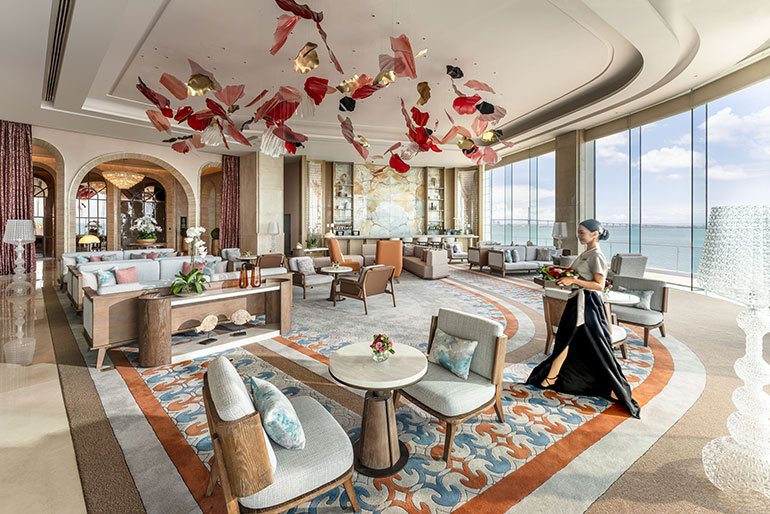
NUSTAR Hotel Cebu
NUSTAR Hotel Cebu stands as the five-star pinnacle of RLC’s hospitality, offering a world-class escape that feels both grand and intimate.
At the pinnacle of RLC’s diverse hospitality offerings is NUSTAR Hotel Cebu, a five-star property within the NUSTAR Resort & Casino complex on Cebu’s Kawit Island. Designed for the ultra-luxury traveler, the hotel features oversized rooms with panoramic sea views, private butler service, deep soaking tubs, and exclusive access to a Private Club Lounge. It is also officially part of the Michelin Guide’s curated list of recommended hotels, having earned recognition in the 2025 Michelin Guide for its excellence in design, service, and exceptional guest experience.
Integrated seamlessly with NUSTAR’s wider entertainment ecosystem — casino, curated dining, mall, and pool villas — the hotel positions Cebu as a serious contender in the global luxury travel circuit.
“NUSTAR Hotel Cebu reflects Robinsons Hotels & Resorts’ pride as the Philippines’ first and only five‑star Filipino hospitality brand. It captures the ambition of global luxury while honoring the signature warmth and world‑class service Filipinos are known for,” said Aragon-GoBio.
REDEFINING BUSINESS DISTRICTS
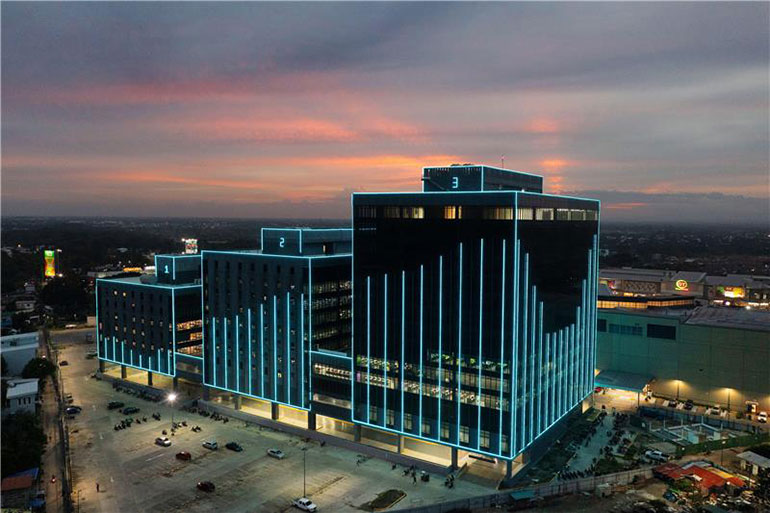
Cybergate Iloilo Tower 3
Cybergate Iloilo Tower 3: A BPO-grade, sustainable office that is redefining workspaces in Western Visayas
Standing as the newest and tallest structure within the 10-hectare destination estate in Iloilo by Robinsons Land, Cybergate Iloilo Tower 3 signals Iloilo’s steady rise as a regional business hub. The estate, which also includes a lifestyle mall, has grown into a destination that brings together work, convenience, and everyday experiences. Purpose-built for modern enterprises, the tower offers sustainable, BPO-grade office spaces framed by sweeping countryside views.
Already recognized as the first LEED-certified office development in Western Visayas (with Towers 1 and 2 certified and Tower 3 pursuing LEED certification), the project integrates VRF air-conditioning systems, LED lighting, and a sewage treatment plant, marrying efficiency with environmental responsibility. Its aluminum-accented façade and interiors, inspired by the Dinagyang Festival, lend the tower a distinctly local soul.
Strategically positioned as the closest BPO-grade complex to Iloilo International Airport, the development has also garnered industry recognition, including Best BPO Office Development at the 2024 PropertyGuru Philippines Awards.
“Cybergate Iloilo shows how world-class workspaces can thrive outside Metro Manila,” said Aragon-GoBio.
GBF Center 2
GBF Center 2 delivers future-ready, sustainable workspaces in Bridgetowne.
RLC’s Bridgetowne Destination Estate is home to GBF Center 2, the largest LEED v4 Gold-certified office tower in the Philippines, which includes touchless access (facial recognition systems) with seamless integration into the destination-oriented allocation system (DOAS) elevators. This ensures optimal vertical transport utilization that reduces energy consumption and maintenance expense. On health and safety, high-efficiency air filtration systems, 100% backup power that boasts of N+1 redundancy, and multiple telco facilities have been deployed in the building. Its prime location along the C5 corridor ensures superior access to Ortigas, Pasig, Quezon City, and Taguig.
The 30-storey, PEZA-accredited Grade A building boasts expansive 2,800-square-meter floor plates designed for IT-BPM firms and multinational tenants. Together with GBF Center 1, the development clinched multiple honors at the 2025 PropertyGuru Philippines Awards, including Best Green Commercial Development, Best Office Architectural Design, and Best Office Interior Design.
RETAIL THAT BUILDS COMMUNITIES
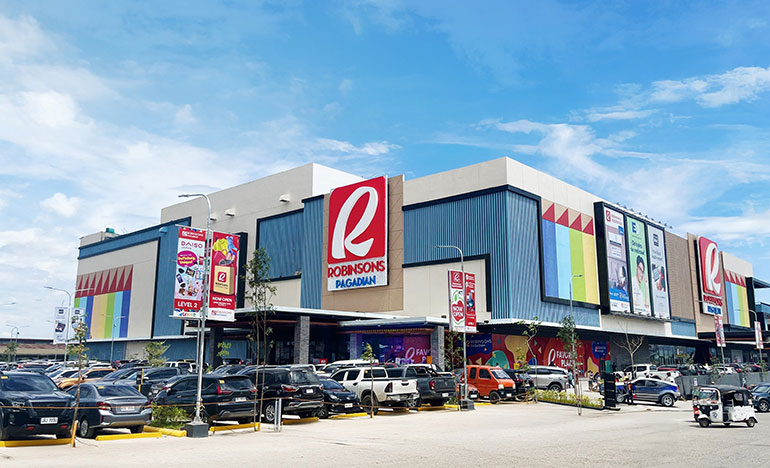
Robinsons Pagadian
Located in the capital of Zamboanga del Sur, Robinsons Pagadian redefines retail, community gathering and family entertainment — bringing local and international brands closer to Pagadianons.
Marking RLC’s 56th mall nationwide and its 8th in Mindanao, Robinsons Pagadian made an immediate impact, posting record-breaking foot traffic on opening day and bringing modern retail to the heart of the Zamboanga Peninsula.
The mall introduced first-in-city brands and attractions including Movieworld cinemas equipped with laser projection and Dolby 7.1 sound. Its design draws inspiration from the vibrant vinta boats of Zamboanga, grounding the mall firmly in local culture.
Strategically located across City Hall and major civic landmarks, Robinsons Pagadian reinforces RLC’s long-held belief in going where others do not dare — and succeeding.
“We’ve always believed that growth shouldn’t be exclusive to already-saturated cities,” Aragon-GoBio said. “Robinsons Pagadian is proof that there are still underserved markets, and those are the areas we wish to focus on.”
Robinsons Caloocan (The Plaza Bagong Silang)
Designed as a community mall and a civic hub, The Plaza at Bagong Silang gives North Caloocan residents convenient access to essential services, retail, and dining options.
As RLC’s 57th mall, The Plaza Bagong Silang stands out for purpose. Developed through a public-private partnership with the Caloocan City government, the mall functions as an integrated civic hub, housing a health center, multi-purpose hall, and basketball court, a first for Robinsons Malls.
Launched at 100% occupancy, the development serves one of Metro Manila’s densest districts with a thoughtfully curated mix of essential retail and dining options, reinforcing RLC’s role as both developer and community partner.
POWERING THE FUTURE OF LOGISTICS
RLX Taytay 2
RLX Taytay 2 — shaping smarter, more sustainable logistics in the East
RLC’s logistics arm, RLX, also had a strong showing in 2025, one of which was the completion of RLX Taytay 2, its 14th warehouse facility. Spanning four hectares with a 27,000-square-meter covered area, the Grade A development features high ceilings, reinforced flooring, energy-efficient lighting, and advanced fire protection systems.
Built to support the evolving needs of 3PL, eCommerce, and FMCG sectors, the facility also contributes to local job creation, underscoring the company’s commitment to inclusive growth. RLX Taytay sets a new benchmark in efficient and sustainable warehousing and is poised to transform the logistics landscape in Taytay and beyond.
RLX Calamba 2E
Strategically located near the SLEX Canlubang Toll Plaza, RLX Calamba 2E forms part of the fast-growing RLX Calamba 2 compound. Designed for modern, scalable logistics operations, the warehouse offers seamless access to major transport routes and is engineered for efficient storage, distribution, and fulfillment.
“RLX logistics facilities reflects our commitment to strengthening the country’s supply chain backbone. By building facilities that enable faster, smarter, and more resilient logistics operations, we empower businesses to scale with confidence and position whole regions for sustained economic growth,” said Aragon-GoBio.
STABILITY YOU CAN INVEST IN
Beyond brick and mortar, Robinsons Land’s strong fundamentals were reflected in its market performance. RLC’s stock performed notably well in 2025, the best among its peers, with momentum continuing into 2026 — underscoring investor confidence in the company’s stability and long-term value.
With a diversified portfolio spanning offices, residences, malls, hotels, and logistics facilities, RLC remains a stable and lucrative investment, one that continues to appreciate as its developments mature and communities grow around them.
In every sense, 2025 was not just a productive year for Robinsons Land, it was a defining one. And with projects completed and under way, the outlook for 2026 looks even more promising.
Spotlight is BusinessWorld’s sponsored section that allows advertisers to amplify their brand and connect with BusinessWorld’s audience by publishing their stories on the BusinessWorld Web site. For more information, send an email to online@bworldonline.com.
Join us on Viber at https://bit.ly/3hv6bLA to get more updates and subscribe to BusinessWorld’s titles and get exclusive content through www.bworld-x.com.
CHINA BANKING CORP.’s (Chinabank) net profit climbed by 13% year on year to a record P28 billion in 2025, driven by sustained growth in its loan book and its core businesses.
This translated to a return on equity of 15.6% and a return on assets of 1.6%, it said in a disclosure to the stock exchange on Thursday.
Its financial statement was unavailable as of press time.
The bank’s net interest income climbed by 12% to P105.2 billion last year amid strong loan demand across various business segments.
It said its core lending business served as a “primary engine” for its growth in 2025.
“Meanwhile, sustained deposits growth and a more favorable deposit mix helped temper the increase in interest expense,” Chinabank added.
Net interest margin stood at 4.6% at the end of 2025.
“Fee-based income also improved, partly attributed to the sustained growth in transactional fees, trust fees, and bancassurance commissions,” the bank said.
As a result, its total operating income rose by 16% to P75.7 billion.
Meanwhile, Chinabank’s operating expenses grew by 12% to P34.4 trillion amid higher manpower costs, taxes, and IT spending.
Its cost-to-income ratio stood at 45%, which it noted is still “healthy… despite higher spending on technology and initiatives aimed at driving revenue growth.”
The bank’s gross loans expanded by 13% year on year to P1.1 trillion on strong credit demand from both corporates and consumers.
“During the year, Chinabank demonstrated greater prudence while maintaining asset quality. Although the nonperforming loans (NPL) ratio kept steady at 1.6%, the bank more than doubled its safety net, setting aside P7 billion in credit provisions,” it said.
“This proactive move resulted in an NPL coverage ratio of 109%, well above the industry average.”
On the funding side, deposits grew by 9% to P1.4 trillion, 48% of which were low cost current account, savings account or CASA deposits.
Chinabank’s total assets rose by 8% to hit P1.8 trillion at end-2025.
Total capital went up by 13% to P191.3 billion.
“This strength is reflected in a common equity Tier 1 ratio of 15.2% and a total capital adequacy ratio of 16.1%, providing a significant buffer to support the bank’s long-term strategic objectives,” the bank said.
Its book value per share also improved by 13% to P71.04.
Chinabank’s shares closed unchanged at P69 each on Thursday. — Aaron Michael C. Sy
BUSINESSMAN-TURNED-POLITICIAN Leandro L. Leviste is in talks with a foreign investor regarding his remaining shares in SP New Energy Corp. (SPNEC), the company’s chairman said.
“Lean (Mr. Leviste) is talking to a foreign investor to unload his shares,” SPNEC Chairman Manuel V. Pangilinan told reporters on the sidelines of an event on Wednesday.
“This particular foreign investor is quite keen to invest in SPNEC. Actually, we introduced this foreign investor to Lean. So, I think he’s fairly serious about selling,” he added.
Mr. Pangilinan, who is also chairman of Manila Electric Co. (Meralco) and its subsidiary, Meralco PowerGen Corp. (MGEN), said the group does not need to increase its stake in SPNEC as it is already the majority shareholder.
At present, SPNEC is 57.33% owned by MGEN Renewable Energy, Inc. (MGEN Renewables), a subsidiary of MGEN. Meanwhile, 16.3% is held by Solar Philippines Power Project Holdings, Inc., which was founded by Mr. Leviste.
Last month, Mr. Leviste resigned from the SPNEC board for “personal reasons.”
The Batangas congressman also stepped down from his post at MTerra Solar and was replaced by MGEN President and Chief Executive Officer Emmanuel V. Rubio as part of a reorganization, as the P200-billion integrated solar and battery project moves toward initial grid integration.
MTerra Solar comprises a 3,500-megawatt-peak solar power plant and a 4,500-megawatt-hour energy storage system spanning Nueva Ecija and Bulacan.
The company said it has completed initial grid synchronization and energization, allowing the facility to export 85 megawatts (MW) to the grid by the end of the month.
The Meralco group took over development of MTerra Solar in 2023 after acquiring a controlling stake in SPNEC from Solar Philippines.
SPNEC is seeking approval from the Securities and Exchange Commission to change its corporate name to MGEN Renewable Energy Holdings, Inc.
Separately, analysts have said the proposed name change could align the company’s branding with MGEN’s renewable energy portfolio and potentially support plans to list the group’s renewable energy assets.
Mr. Pangilinan earlier said there might be a re-initial public offering (IPO) for SPNEC by 2027 to raise additional funds.
“Perhaps in 2027, we will re-IPO to raise a bit of money for SPNEC and MGreen (MGEN Renewables),” he said.
Meralco’s controlling shareholder, Beacon Electric Asset Holdings, Inc., is partly owned by PLDT Inc. Hastings Holdings, Inc., a unit of PLDT Beneficial Trust Fund subsidiary MediaQuest Holdings, Inc., has an interest in BusinessWorld through the Philippine Star Group, which it controls. — Sheldeen Joy Talavera
GCash and Manulife Investments Philippines partner to advance financial inclusion by expanding Filipinos’ access to global real estate and other diversified income investments via GFunds. From left to right: Zedric Matubis, Head of Wealth Sales at Manulife Investments Philippines; Aira Gaspar, President and CEO of Manulife Investments Philippines; Winsley Bangit, Group Head of New Businesses at Mynt, the parent company of GCash; and Darvin Sy Su, Head of Wealth Management at GCash
The partnership introduces the first-ever REIT funds on GCash, alongside other income-paying investments starting at just PHP 1,000.
Finance super app GCash, together with Manulife Investment Management and Trust Corporation (Manulife Investments Philippines), is expanding Filipinos’ access to the global property market by introducing Real Estate Investment Trust (REIT) funds and other income-paying unit investment trust funds (UITFs) within the GCash app.
GCash users may access four income-paying UITFs on GFunds from Manulife Investments Philippines, including the first REIT funds to come to the e-wallet. These include the Manulife Asia Pacific REIT Fund and the Manulife Global REIT Feeder Fund, which comprise investments in Asia and global properties. In addition, the newly added Manulife Global Preferred Income Fund and Manulife Asia Dynamic Bond Feeder Fund aim to help Filipinos access additional income through other diversified investments with attractive yield advantage.
Through the partnership, Filipinos have an opportunity to earn from global property rentals — including hotels, condominiums, and office buildings — without the high capital requirements associated with property ownership. Professional management by Manulife Investments Philippines simplifies the experience, covering asset selection to optimization, making investing in global real estate a guided and more accessible experience for Filipinos, starting at just PHP 1,000.00.
Among the country’s largest fund managers, Manulife Investments Philippines had PHP 205 billion assets under management (AUM) and a net income of PHP 372 million as of end of 2024. Meanwhile, Manulife Investment Management, the global wealth and asset management segment of Manulife, had over US$1.6 trillion of assets under management and administration (AUMA) globally as of December 2024.
“Our partnership with Manulife Investments Philippines is about providing Filipinos with access to simplified world-class tools to help them in their long-term financial security. We’re making it easier for Filipinos to explore investment opportunities that haven’t always been within reach. Now, Filipinos can easily invest in REIT funds and UITFs backed by the strategic perspective and proven credibility of Manulife,” said Winsley Bangit, Group Head of New Businesses at Mynt, the parent company of GCash.
“Partnering with GCash, a major player in the financial space, is aligned with our mission to provide innovative and affordable wealth solutions to more Filipinos so they can achieve their long-term financial aspirations, even in volatile times. Through GCash, our UITFs are now more accessible to a broader set of investors who are looking to diversify and grow their wealth portfolio,” said Aira Gaspar, President and Chief Executive Officer, Manulife Investments Philippines.
Filipinos can now invest in global real estate and other diversified assets from Manulife Investments Philippines through GFunds on GCash, starting at just P1,000.
Combining local expertise with global resources, Manulife Investments Philippines offers a diverse range of differentiated UITFs, including income-paying UITFs that aim to provide recurring income streams and potential capital appreciation by tapping into a broad range of asset classes.
Manulife Investments Philippines’ UITFs give access to local and global investment opportunities for different goals, needs, and risk profiles across various life stages. Whether investors are seeking income, growth, or portfolio diversification, its investment solutions are designed to help investors pursue competitive returns and sustainable cash flow for better income. The company provides investment products designed to give investors competitive returns and cash flow.
For more information on GCash and its financial and investment solutions, visit www.gcash.com. To know more about Manulife Investments Philippines and its suite of investment solutions, visit www.manulifeim.com.ph.
Spotlight is BusinessWorld’s sponsored section that allows advertisers to amplify their brand and connect with BusinessWorld’s audience by publishing their stories on the BusinessWorld Web site. For more information, send an email to online@bworldonline.com.
Join us on Viber at https://bit.ly/3hv6bLA to get more updates and subscribe to BusinessWorld’s titles and get exclusive content through www.bworld-x.com.
(L-R): SMP executives Guy Henderson, Roslyn Pineda, and Stephanie Ortiz; John Paulo Nase of SB19; Paolo Benjamin of Ben&Ben; and SMP executives Nasra Artan, Dan Nelson, and Anthony Wan. — BRONTË H. LACSAMANA
SONY MUSIC Publishing (SMP) has launched a new flagship office in Manila, beginning a strategic expansion focused on developing and promoting Filipino songwriters.
In line with this, Stephanie Ortiz has been appointed general manager of SMP Philippines. Meanwhile, Sony Music Entertainment Philippines’ General Manager Roslyn Pineda has been promoted to president for SMP Asia, which is based in Hong Kong.
“Many songwriters have told us that they don’t know about music publishing yet and that they don’t know how to maximize their compositions. Education is a priority for us,” Ms. Ortiz told the press at the launch on Feb. 24.
She added that, with the help of music industry allies such as the Filipino Society of Composers, Authors and Publishers (FILSCAP), SMP Philippines’ goal will be to expand music publishing education, for songwriters to “know their rights and learn how to earn money.”
Ms. Ortiz also noted that they will focus on building a community that will connect Filipino songwriters and producers with each other before bringing them to the global stage. “It starts in the homebase first. That’s our target. From there, we can work closely with our global counterparts,” she said.
For Guy Henderson, president of SMP International, music now coming from anywhere in the world means there’s a huge opportunity for growth for Philippine music.
“These days, kids in the Western world jump up and down in a stadium to artists who sing 75% of their lyrics in another language,” he said. “The Philippines is one of those countries that benefits from that.”
He also explained that, in terms of putting songwriters first especially in an AI (artificial intelligence) environment, SMP is committed to working with them so that their songs are taken care of and protected.
“It’s a combination of allowing them to use their creativity and protecting them by lobbying for stronger laws,” Mr. Henderson said.
FILIPINO SONGWRITERS Among the homegrown artists who have recently made a name regionally and internationally are P-pop group SB19 and OPM band Ben&Ben. SMP Philippines marked its launch by inviting each of their chief songwriters to a panel where they discussed their creative processes.
“Before writing a song, we first establish what the message is. If the elements put in the composition make the song better, that’s evolution,” said John Paulo Nase, better known as Pablo, SB19’s leader and songwriter, at the talk. “For me, if you can listen to it after five years, it’s a great song.”
Some of SB19’s biggest hits from five years back include “Mapa,” “Alab,” and “Bazinga.” Their latest song, released last week, is “VISA,” which has been gaining attention for its socially relevant lyrics about systemic barriers for Filipinos seeking stability abroad.
Meanwhile, Ben&Ben, known for hits like “Kathang Isip,” “Leaves,” and “Sa Susunod Na Habang Buhay,” recently released the track “Duyan.” Singer-songwriter Paolo Benjamin explained that making music is about “understanding the purpose of the song.”
“Ultimately, it becomes the compass. There are songs that are meant to provoke, and there are also songs that are meant to be a safe space. It begins with what the song is,” he said.
Ben&Ben and SB19 also collaborated on a track in 2021, “Kapangyarihan,” which has been used in protests in recent years. On the topic of how tracks grow and transform as they are listened to by many, both songwriters expressed their gratitude.
“It’s the highest honor a composer can have, to be told that your songs have helped them in some way,” said SB19’s Mr. Nase. “I’m always deeply honored.”
For Ben&Ben’s Mr. Benjamin, it remains “the biggest mystery of life” how that happens. “When you try and chase it, it doesn’t happen. When you don’t try, it also doesn’t happen usually, but sometimes it just does,” he said.
Roslyn Pineda, now president of SMP Asia, reaffirmed Sony Music’s thrust to provide access to global markets.
“It’s always been a challenge for songwriters all over — save for the US, UK, a bit of Latin America, and K-pop — to break into the global markets. There’s not a huge presence of publishing in the Philippines compared to other Asian markets, but there’s really a need for education and additional resources,” she explained.
“Music is becoming more global. Genres like P-pop that are popular in Asia are becoming more global.” — Brontë H. Lacsamana
Our economic managers and trade officials may well succeed in attracting sizeable foreign investments as we chair ASEAN in 2026. But without structural reform — in infrastructure, institutions, and policy frameworks — such efforts address the periphery, not the core. The more fundamental question remains: how do we motivate risk-averse investors when growth dynamics, weighed down by corruption and patronage politics, remain fragile? When even macroeconomic policy appears to be reaching its limits?
Accommodative monetary policy is pushing on a string. Weak business and household confidence blunt its impact, while banks, acting procyclically, tighten credit standards and weaken the transmission channel. The recent policy rate cut, instead of inspiring confidence, underscored economic fragility. As we noted in GlobalSource, the reduction “reflects both accommodation and caution” — a wake-up call to Malacañang and Congress to do more than rely on the central bank.
Expansionary fiscal policy can lift growth only if infrastructure funds are protected from plunder and truly directed toward productive investment. Of the P243 billion in unprogrammed appropriations, only P93 billion was vetoed. Some of the vetoed items could have funded P35.7 billion in counterpart financing for foreign-assisted projects. Where, then, do the remaining items go? Without discipline, fiscal consolidation becomes rhetoric and debt sustainability drifts further away.
This is why EDSA at 40 matters.
Had even a fraction of EDSA’s moral and political intent been institutionalized, the Philippines could have traveled a very different economic path.
The 1986 EDSA People Power Revolution was not merely a political transition; it was a reset of public expectations. It was a collective rejection of impunity, cronyism, and entitlement. It sought to restore rule of law, accountability, and the primacy of institutions over personalities. Had those aspirations been translated into sustained structural reform, growth would not have depended on episodic booms or remittance-driven consumption. It could have been broad-based, productivity-driven, and institutionally anchored.
If Congress had faithfully implemented the 1987 Constitution’s prohibition on political dynasties, political competition would have deepened. Governance could have shifted from patronage to programs, from transactional politics to policy-based accountability. Political capital would have been earned through performance rather than inherited through lineage. That single reform alone could have altered the country’s incentive structure — encouraging long-term policymaking instead of short electoral cycles.
If constitutional accountability institutions — the Office of the Ombudsman, the Sandiganbayan, and the Commission on Audit — had been strengthened not only in mandate but in operational independence, the deterrent effect on corruption could have compounded over time. Faster resolution of cases, higher conviction credibility, and visible enforcement would have lowered the risk premium attached to the Philippines. Obviously, investors prize good governance. But citizens do more.
If the civil service had been fully professionalized, shielded from patronage appointments and reinforced by meritocratic promotion, the regulatory environment would have matured earlier. The result could have been policy continuity that is less vulnerable to political turnover. We only have to set our sight to such countries as Singapore and Hong Kong which demonstrate that strong bureaucracies are not luxuries; they are growth infrastructure.
Why, even within constitutional economic restrictions, consistent enforcement of competition law, anti-monopoly provisions, and independent regulation could have fostered a genuinely level playing field. Capital does not merely seek openness; it seeks predictability and fairness. A rules-based economy reduces uncertainty, and invites more investments, more effectively than any tax incentive package. Other territories offer similar incentives but more even playing field.
In other words, the Philippines did not lack potential. It lacked sustained institutionalization of EDSA’s moral impulse.
Had governance credibility strengthened over the decades, fiscal multipliers would have been larger, infrastructure spending more efficient, and monetary easing more effective. Confidence — arguably the most powerful economic variable — would have been endogenous, not episodic. Growth could have compounded not only through capital accumulation, but through higher institutional trust.
We often measure lost opportunity in terms of foregone GDP percentage points. But the deeper loss is compounding credibility. Four decades is enough time for institutions to mature, for corruption norms to shift, for political culture to evolve.
That this transformation remains incomplete is precisely why the promise of EDSA still feels aspirational rather than fully realized.
The lesson is not nostalgic. It is structural: when moral reform is only commemorated but not embedded, economic reform could only remain fragile.
Remember the recent warning from Fitch Ratings?
It has warned that the Philippines is among the most vulnerable to climate-related risks, something that most of us already know but very few care about. Yet some of our politicians without shame plundered public money away from flood control projects for years, depriving many of the exposed communities of climate defense and escalating fiscal and economic costs. Resources meant to flood-proof communities reportedly financed private excess instead. Climate vulnerability thus becomes both an environmental and governance crisis.
Against this backdrop, Moody’s Ratings projects growth of 5.5% in 2026 and 5.6% in 2027 — figures hedged by concerns over debt servicing costs, revenue needs, and restrained public spending. These are not breakout numbers; they suggest muddling through. Especially when growth was stronger in 2024 and slowed markedly thereafter, “rebound” feels optimistic.
Moody’s expects resilient consumption and recovering public investment. Yet it acknowledges risks and time lags. It also overlooks the reality that weak monetary transmission and procyclical banking behavior can blunt policy support, while fiscal consolidation remains gradual at best.
It is comforting to say the Philippines has nowhere to go but up. But numbers alone do not constitute progress. Without moral integrity in policy design and implementation, reforms lose credibility before they bear fruit.
Chairing ASEAN in 2026 offers symbolic leadership. But institutional reform is substantive leadership. Without the latter, the former risks becoming ceremonial.
Looking back, 40 years after the 1986 EDSA People Power Revolution, the challenge is not remembrance. It is completion.
Now, we need the Trillion Peso March to deliver that message.
As Lipa Archbishop Gilbert Garcera, also president of the Catholic Bishops’ Conference of the Philippines (CBCP) warned, the deeper danger is moral fatigue. And moral fatigue is not abstract. It seeps into institutions, into regulatory discretion, into budget processes, into the uneven enforcement of law. When accountability weakens, risk premia rise. When impunity persists, capital hesitates. When public trust erodes, even the best-designed policies operate below capacity.
We can celebrate improving forecasts from Moody’s Ratings or note cautions from Fitch Ratings. But ratings agencies cannot manufacture credibility. Central banks cannot print integrity. Fiscal expansion cannot compensate indefinitely for governance leakages.
The tragedy is not that EDSA failed. It is that it was not fully finished. Even after 40 years.
Unless we keep our feet firmly on the ground — anchored in reform, rule of law, and moral responsibility — economic projections will remain arithmetic without architecture. Growth without integrity is fragile. Numbers without institutional reform are merely numbers.
The real unfinished business of EDSA is not memory. It is governance.
Diwa C. Guinigundo is the former deputy governor for the Monetary and Economics Sector, the Bangko Sentral ng Pilipinas (BSP). He served the BSP for 41 years. In 2001-2003, he was alternate executive director at the International Monetary Fund in Washington, DC. He is the senior pastor of the Fullness of Christ International Ministries in Mandaluyong.