Home Blog Page 2078

German film The Investigation aims to educate young viewers on Auschwitz horrors

Die Ermittlung (2024) — IMDB

BERLIN — Against a darkened TV sound stage, a woman testifies before judges on a bare black platform about how her boss at the Auschwitz Nazi death camp, Boger, killed a newly arrived boy.

“The boy stood there with his apple. Boger went to the child and picked him up by the feet and dashed his head against the barracks wall,” the woman recalls as the camera pans across Boger, sitting behind her, his face impassive.

“Since then, I have never wanted a child of my own.”

Her testimony is one of several by defendants and witnesses re-enacted in The Investigation, a new film by German director RP Kahl based on a play of the same name that dramatizes the trials of 22 Auschwitz personnel in Frankfurt from 1963-65.

Testimonies at those trials give just a small glimpse of the suffering experienced by the estimated 1.3 million people sent to Auschwitz in Nazi-occupied Poland as part of Adolf Hitler’s “Final Solution” to annihilate European Jews.

“What particularly intrigued me about the play was its ability to depict Auschwitz without the need for total immersion in its unimaginable reality,” Kahl told Reuters in Berlin.

Kahl said he had opted for a more contemporary cinematic style to appeal to younger viewers: “We filmed in a television studio with multiple cameras to create an immersive visual experience. We aimed to avoid creating a historical drama.”

With an eye to the 80th anniversary of Auschwitz’s liberation by Soviet troops on Jan. 27, Mr. Kahl said he hoped his movie would make it easier for a new generation to engage with the Holocaust as the number of survivors dwindles.

The Investigation is also a reminder of the importance of maintaining a liberal, democratic society, and the constant vigilance needed to prevent a recurrence of atrocities like Auschwitz, he said.

“The film conveys the message that we all have a role to play in shaping our society and preventing such horrors from recurring,” said the director.

Six months after its debut in Germany, the four-hour film will be shown to Israelis in Tel Aviv on Monday, the 80th anniversary, while its international premiere is set for Jan. 31 at the Rotterdam festival in the Netherlands. — Reuters


Smaller rate cuts to boost PHL banks’ margins, Fitch says

Buildings are seen from Mandaluyong City, Aug. 17, 2024. — PHILIPPINE STAR/MIGUEL DE GUZMAN

HIGHER-FOR-LONGER interest rates could benefit large Philippine banks as this would support their margins, Fitch Ratings said.

“We believe Philippine and Singapore banks will be key beneficiaries if rates are higher than we expected,” the credit rater said in a commentary dated Jan. 26. “Our rated banks in these markets have good funding profiles and are in liquid banking systems that can capitalize on yields staying buoyant while keeping deposit rates lean. This should position them to enjoy modestly higher net interest margins (NIM) than in our base case, under this scenario.”

Fitch said borrowing costs are expected to begin easing in most large economies in Southeast Asia this year.

“But we believe banks in some regional systems would benefit if the decline in rates is shallower than we expect,” it said. “Banks’ capacity to cut deposit rates and manage wholesale funding costs will be key in determining outcomes. This capacity tends, in turn, to reflect the strength of their deposit franchise and the diversity of their funding mix.”

Fitch flagged risks such as US President Donald J. Trump’s higher import tariffs and other protectionist policies, which could stoke inflation pressures and impact the US Federal Reserve’s rate-cutting cycle.

“This increases the risk that policy rate cutting cycles in Southeast Asia could be shallower than we had anticipated. There have already been some signs in Indonesia and Vietnam of local-currency liquidity tightening, raising wholesale funding costs for banks, which we believe is linked to official intervention in foreign-currency markets and associated sterilization efforts.”

Markets are on a wait-and-see mode on the US central bank’s next steps following Mr. Trump’s inauguration last week. Fed policy makers are largely expected to keep rates steady in their Jan. 28-29 meeting, marking the first pause in the rate-cutting cycle that began in September, Reuters reported.

Data since the Fed’s December meeting has kept intact the core view among Fed officials that inflation will continue to move steadily, if slowly, towards 2%, with a low unemployment rate and continued hiring and economic growth.

“Nevertheless, low rates of inflation in the region mean that policy makers have some headroom to accommodate weaker currencies without breaching inflation targets, supporting their rate-setting autonomy,” Fitch said.

The Bangko Sentral ng Pilipinas (BSP) began its easing cycle in August last year, slashing benchmark interest rates by a total of 75 basis points (bps) to bring its policy rate to 5.75%. Fitch expects the policy rate to be at 4.75% at end-2025 under its base case, which would mean 100 bps in reductions this year.

While less rate cuts from the BSP this year could support the margins of big banks in the Philippines, smaller lenders may not see the same windfall, the debt watcher said.

“However, smaller Philippine banks may benefit less than their larger peers, as their weaker competitive advantage in chasing deposits and lending opportunities tends to constrain their NIM,” Fitch said.

Latest data from the BSP showed the banking system’s net profit rose by 6.4% year on year to P290 billion in the first nine months of 2024, driven by a 14% jump in net interest income.

Of this, universal and commercial banks’ net income went up by 7% to P271.73 billion in the nine-month period.

“Banks in many regional markets have tended to preserve NIMs by shifting lending towards higher-yielding segments. However, this may affect their risk profiles unless loss-absorption buffers are also adjusted. We expect such dynamics to play out again in 2025 where NIMs come under pressure,” Fitch added.

The credit rater also noted that the impact of policy changes on Southeast Asian banks’ asset quality would likely be limited.

“Banks’ credit costs would be more vulnerable if there were external shocks to economic growth. Upside surprises to rates could aggravate existing asset-quality risks in vulnerable pockets of some banking systems, such as micro and small and medium-sized enterprise lending in Thailand. However, regional authorities could also deploy relief to cushion debt strains, as the Thai government has done recently,” Fitch said.

“The region’s bank capitalization levels are mostly ample, so the impact of higher-than-expected bond yields on valuations of securities is unlikely to be a significant rating consideration.” — Luisa Maria Jacinta C. Jocson with Reuters

Healthcare, banking firms to boost office demand in Manila — CBRE

UNSPLASH

THE METRO Manila office market is expected to see new entrants from the healthcare and banking sectors this year, according to real estate services and investment firm CBRE.

“In this kind of market where we’re coming off a slow year, it’s encouraging that we’re seeing new entrants into the market,” CBRE Philippines Country Head Jie C. Espinosa said during a briefing last week.

He said industries seeking office space this year include healthcare, banking, financial services, and insurance.

“They want to enter and be in spaces that are predictable, less risky for them, and where they can readily start their operations,” Mr. Espinosa noted, adding that these firms aim to start within four to six months.

New entrants in the office market would help offset spaces vacated by companies from the information technology-business process management (IT-BPM) sector and the departure of Philippine offshore gaming operators (POGOs), he added.

Around 32% of vacated spaces in Metro Manila’s office market were from the IT-BPM sector, while 31% came from POGOs, CBRE Philippines Research Head Samantha Laureola told reporters.

“Starting from the third quarter onwards, we already saw a slight deceleration in the market,” Mr. Espinosa said.

“The one thing we did not anticipate was that the IT-BPM sector would also experience a bit of a slowdown. Due to the US elections, many decisions were delayed or put off.”

The Metro Manila market ended 2024 with about 1.78 million square meters (sq.m.) of available office space, according to CBRE. Of this, 51% or 903,500 sq.m. were vacated spaces, and 49% or 880,100 sq.m. were unleased.

This translated to a full-year vacancy rate of 19.9% for the Metro Manila office market in 2024, according to CBRE.

“Most of the vacated spaces were not necessarily just from the POGO sector but also from the IT-BPM sector. They’re not leaving; they’re simply downsizing in certain locations,” Mr. Espinosa said.

“But overall, the IT-BPM sector, although there was growth, that growth was mostly flat. It did not offset the decrease in take-up by the POGOs.”

In 2024, the average take-up of office space decreased to about 1,300 sq.m. from 1,400 sq.m. a year ago, mainly due to companies’ increased preference for flexible setups, such as work-from-home.

“Companies, even traditional space takers, are realizing that there’s not much need for space anymore. Instead of having workstations or offices, they provide more collaborative spaces, meeting areas, and amenities,” CBRE Senior Director Bryan Michael David told BusinessWorld.

To ensure more office space transactions, the Philippines must bolster the skillset of its workforce to attract more demand from foreign players, Mr. David said.

“If we prepare for that, maybe we can actually capture a bit of their market share later on, which will probably improve or increase demand here in the Philippines,” he added. — Beatriz Marie D. Cruz

Ranger Raptor 3.0L V6 now permanent in Ford lineup

FORD Philippines announced that it is permanently adding the Ford Ranger Raptor 3.0L V6 to its vehicle portfolio amid growing demand from Filipino customers.

Initially sold in a limited quantity of 300 units at its launch at the Philippine International Motor Show in October, the new Raptor variant has become one of Ford Philippines’ best-selling models.

“Due to the overwhelming demand from our customers, we are excited to announce that the Ranger Raptor 3.0L V6 will now be a permanent addition to our performance vehicle portfolio,” said Pedro Simoes, managing director at Ford Philippines, in a statement on Monday.

“The Raptor 3.0L V6 is a personal favorite, and I can’t wait for more customers to experience its exceptional power and unmatched versatility,” he added.

The Raptor variant is available at P2.74 million and in colors Arctic White, Absolute Black, Blue Lightning, Conquer Grey, and Code Orange.

Since its launch, the Ranger Raptor 3.0L V6 has drawn customers to Ford dealerships and test drive events, the company said.

“The enhanced availability of the Ranger Raptor 3.0L for Filipino customers further expands the Raptor brand in the country, complementing the Ranger Raptor 2.0L Bi-Turbo Diesel Engine,” said Mr. Simoes.

“Pickup enthusiasts now have the option to choose which Raptor pickup truck suits their needs and lifestyles,” he added.

Ford Motor Co. Phils., Inc. is the country’s third-top car manufacturer in terms of total vehicle sales in 2024, according to a joint report by the Chamber of Automotive Manufacturers of the Philippines, Inc. and the Truck Manufacturers Association.

Last year, Ford Motor Co. sold 27,997 units, representing a 10.6% decline from 2023 and a 5.99% market share. — Justine Irish D. Tabile

Trade non-growth and budget expansion

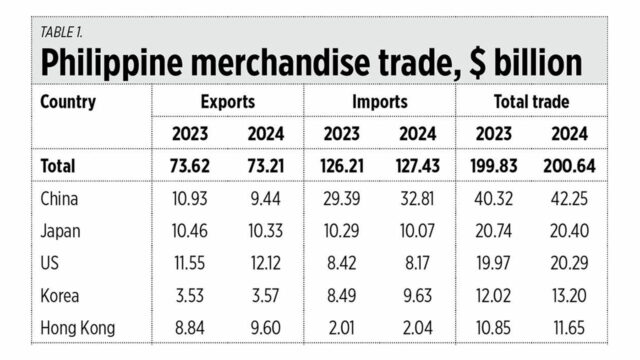
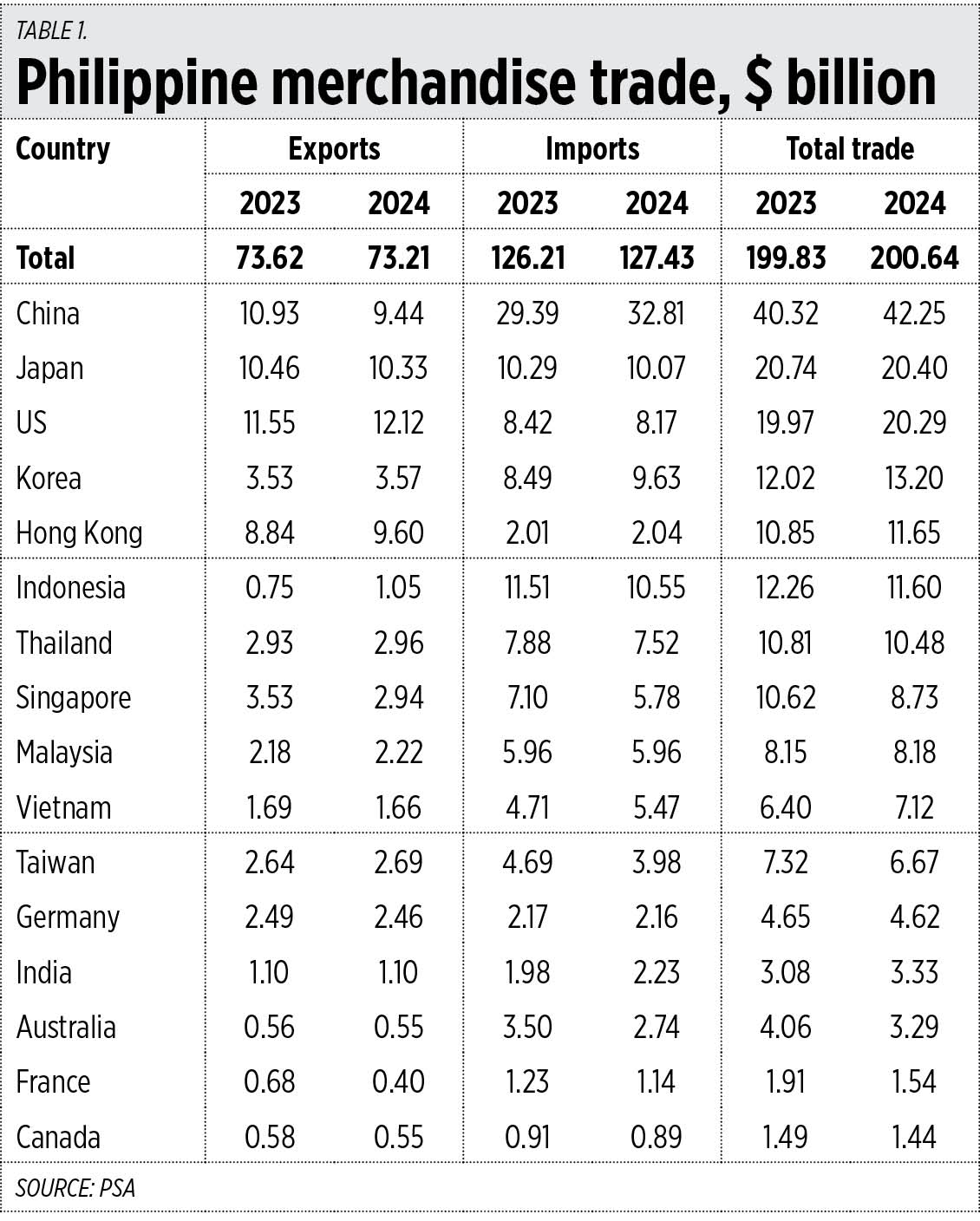
Last Friday the Philippine Statistics Authority (PSA) released the December — and hence, full year 2024 — merchandise (or goods) trade data. It showed that exports were flat at $73 billion for both 2023 and 2024, as imports marginally increased by $1 billion.

But what significantly changed was the further rise in China’s share of our imports, from 23.3% in 2023 to 25.7% in the 2024 total imports. The total trade (exports plus imports) with China in 2024 at $42 billion is larger than those of Japan plus the US combined at $41 billion, and is slightly lower than trade with our five ASEAN neighbors with a combined total trade of $46 billion (see Table 1).

This has a big implication on our foreign policy. If so much of our imports — our clothes, shoes, buses, trucks, gadgets, other consumer and capital goods — comes from China, why is there so much noise against China? It does not make sense. We should focus on trade and commerce, tourism and investment, and economics over war mongering with countries around the world, especially our Asian neighbors.

It is a good thing that Donald Trump is back in the White House. Trump has a record of having started no new US wars from 2017-2020. It is likely that this will be repeated in 2025-2028. Now war mongering versus China, the Ukraine war, and the Middle East war has significantly simmered down. I think the deep state operatives that promote the US’ endless wars abroad are scared that Trump will fire them soon, or that their agencies will suffer budget cuts.

OPPOSITION TO GAA
The General Appropriations Act (GAA) 2025 is now being implemented but the political opposition against it continues, mainly over the defunding of Philippine Health Insurance Corp. (PHIC or PhilHealth) whose subsidy this year is zero.

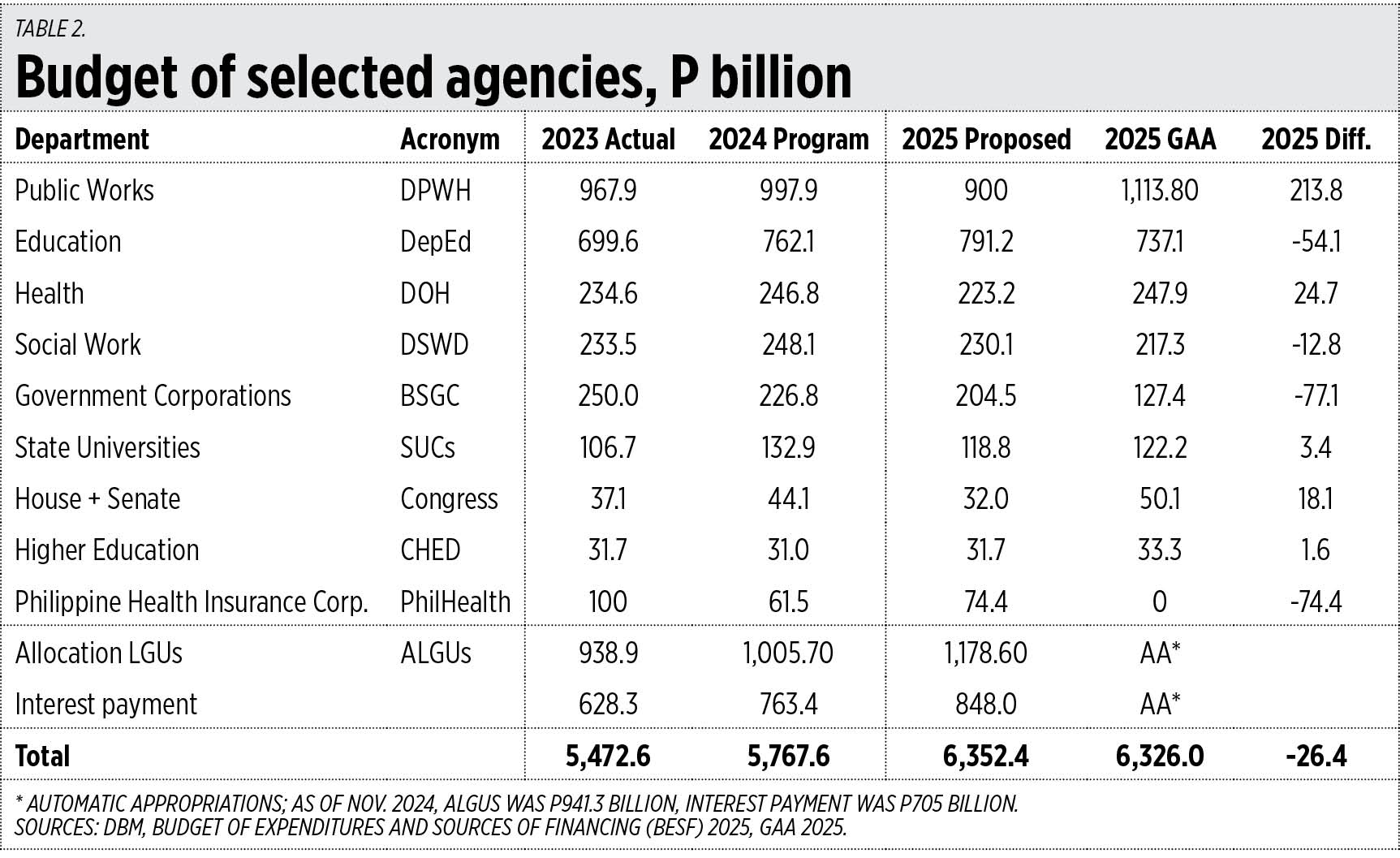
I will compare the proposed versus the approved budget for 2025. While there is a small decline in the overall budget, there are huge increases in the budgets of the departments of Public Works and Highways (DPWH) and Health (DoH), and Congress. And there are big declines in the budgets of the departments of Education (DepEd) and Social Welfare and Development (DSWD), in Budgetary Support for Government Corporations (BSGC), and, of course, zero for PhilHealth (see Table 2).

I believe that the fact that PhilHealth and the DoH are getting funding from smokers, vapers, and drinkers is problematic. The health establishment says that tobacco and alcohol are bad and hence, people should avoid these. Then, ironically, the same health establishment is happy when billions of pesos are collected from taxing more smokers and drinkers of legal products. The political opposition to GAA 2025, health advocates, and activists, are angry that PhilHealth gets zero this year from the taxes paid by smokers and drinkers.

To remove the irony of health being funded by unhealthy products, the earmarking of the proceeds from the tobacco tax to health agencies should be removed. The DoH and PhilHealth should get nothing from tobacco tax revenues, which should instead go to the general fund. That way, when revenues further decline due to there being fewer smokers and drinkers because of the high taxes — or due to greater illicit trade and smuggling — they will not be sad because they do not rely on it anyway.

With more public-private partnerships (PPP) in roads, airports, seaports and other infrastructure, there is little justification for the DPWH to have so large a budget. The priority should have been reducing the public debt stock, reducing interest rates or the cost of borrowing, and reducing public interest payments, from the projected P848 billion this year to below P500 billion or less. Interest payments from January-November 2024 were P705 billion, or equivalent to P2.1 billion/day. To be clear, that was interest payment alone.

And since there is no more virus crisis nor economic crisis, the budgets of the DSWD, state universities, and the Commission on Higher Education should further decline. The focus should be on fiscal responsibility, the aim should be for a balanced budget if not a budget surplus in years where there is no crisis in order to compensate for high budget deficits during years of economic crisis years.


Bienvenido S. Oplas, Jr. is the president of Bienvenido S. Oplas, Jr. Research Consultancy Services, and Minimal Government Thinkers. He is an international fellow of the Tholos Foundation.

minimalgovernment@gmail.com

Borgen creator says fiction challenged by Trump’s Greenland gambit

Borgen (2010) — IMDB

COPENHAGEN — The creator of the Danish political TV drama Borgen, Adam Price, says US President Donald Trump’s wish to control Greenland has created an “absurd” reality that has made it more challenging to write political fiction.

Trump’s refusal to rule out using military or economic power to take control of Greenland, a semi-autonomous territory of Denmark, has caught many by surprise, including Price.

“When reality becomes absurd, like I think it has become in recent weeks when we are talking about the current situation with Greenland and Trump and Trump’s demands, what are we to write?” Price said in an interview this week with Reuters.

“Because if I had pitched this as a new season of Borgen, I think most people would say, like five or 10 years ago, that I was completely out of my mind and had lost my sense of reality,” he said.

Price, 57, said he was concerned that what previously had been considered politically extreme or bizarre would increasingly be considered “normal” under Trump’s presidency.

In fact, Price did anticipate the current international focus on Greenland in the latest season of his fictional series from 2022, in which the vast Arctic island makes a significant discovery of oil and becomes the center of a power struggle between Denmark, Russia, China, and the United States.

As in that last season of Borgen, Trump’s remarks have thrust Greenland into the global spotlight, reigniting a public debate about independence and the island’s complicated relationship with Denmark, its former colonial power.

Borgen, which in Danish means “fortress” — a direct reference to the informal name for Denmark’s parliament — was first aired in 2010 and tells a fictional story of Denmark’s first female prime minister and her rise to power.

Price said one idea for a potential new season of Borgen could be to “make the EU sexy” in a dramatic way, as many viewers may find the European Union difficult to grasp.

“When you deal with politics that maybe on the surface seem more cold and not as emotional, you need to find topics that are really explosive when it comes to emotions,” he said. — Reuters

Monetary Board orders closure of rural lender

BW FILE PHOTO

THE BANGKO SENTRAL ng Pilipinas has ordered the closure of Emerald Rural Bank, Inc.

The central bank’s policy-setting Monetary Board, in Resolution No. 77. A dated Jan. 23, decided to prohibit the bank from doing business in the Philippines, pursuant to Section 30 of Republic Act No. 7653 or the New Central Bank Act, according to a circular letter posted on the regulator’s website.

Section 30 of the New Central Bank Act is focused on proceedings regarding receivership and liquidation.

“The Philippine Deposit Insurance Corp. (PDIC) has been designated as receiver with a directive to proceed with the takeover and liquidation of the aforementioned rural bank,” it added.

In a separate bulletin, the PDIC said it took over the bank and its assets, records and affairs on Jan. 24.

“The PDIC charter provides in Section 13, that a bank placed under liquidation shall in no case be reopened and permitted to resume banking business,” it said.

“Furthermore, Section 12 expressly provides that banks closed by the Monetary Board shall no longer be rehabilitated.”

The powers, functions and duties of directors, officers and stockholders of the bank have also been terminated upon its placement under liquidation, the PDIC said.

“Accordingly, the directors, officers, and stockholders shall be barred from interfering in any way with the assets, records and affairs of the bank,” it added.

“Therefore, anyone in possession of any asset and/or records of the closed Emerald Rural Bank, Inc. is advised not to allow or honor any transaction affecting the same without the consent of the receiver and to immediately turnover the said assets and/or records to the designated deputy receiver.” — Luisa Maria Jacinta C. Jocson

More telco, aviation firms to tap coworking spaces — IWG

WORK.IWGPLC.COM

MULTINATIONAL office solutions firm International Working Group Plc (IWG) anticipates that more companies from the telecommunications and aviation sectors will tap coworking spaces for office flexibility.

“With the GDP (gross domestic product) growth rate in the Philippines being as high as it is, and with the many game-changing legislation that has been passed, the question is now, why not the Philippines? The Philippines is really the choice we see to a higher and higher degree,” IWG Country Manager for the Philippines Lars Wittig said during a recent briefing.

The country’s GDP growth averaged 5.8% in the first nine months of 2024.

Mr. Wittig said more companies from sectors such as aviation and telecommunications are expected to utilize coworking spaces, as Republic Act No. 11659, or the Public Service Act, allows full foreign ownership in these sectors.

The creation of green lanes, which seeks to expedite the permit and licensing processes, is also favorable for coworking space providers, according to Mr. Wittig.

“We see that it’s approaching 1,000 companies, investors in the Philippines that are now on the so-called registered green lane… and many of those are our customers or are becoming our customers,” he told reporters.

He also anticipates that more start-ups and government offices will adopt coworking spaces to better meet their needs.

“If you are a start-up in the Philippines…, your primary resource is yourself, your time, idea, and skills, and you don’t want to tie your money up in real estate or office investment. You want it all to be focused on getting your first customer,” Mr. Wittig said in an interview with BusinessWorld.

Around 20% of IWG’s customers come from the start-up sector, Mr. Wittig said.

Government demand for office spaces was the highest in seven years, accounting for 11% or 122,000 square meters of total demand in 2024, according to Leechiu Property Consultants.

“Hopefully, I will soon be able to welcome many of these critical government offices that also want to not only be flexible with multiple locations for the sake of their employees and productivity, but also for the sake of the population they’re servicing,” Mr. Wittig added.

IWG earlier stated that it plans to have at least 50 open sites nationwide by the end of 2025, with each location having an average of 200 to 250 seats.

It is set to launch at least 17 new sites in locations such as Makati, Pampanga, Cavite, and Batangas this quarter. — Beatriz Marie D. Cruz

Skip the hype, here’s how AI ‘agents’ can really help

FREEPIK

SO-CALLED agents are meant to be the next big thing in artificial intelligence (AI) this year. If the breathless headlines about them are to be believed, you might think your job is on the line. It’s not (for now at least) — but some back-office occupations probably are.

Last week, OpenAI announced its first agent-like tool called Operator, which carries out online tasks like navigating to a website and clicking on buttons, according to the company. But the idea is not unique. Alphabet, Inc.’s Google, Anthropic, and Salesforce, Inc. have all launched platforms for agents, or AI systems that can act autonomously. Imagine, for instance, a customer service bot that doesn’t just generate information, but can also book an appointment or lodge a complaint. Mark Zuckerberg has said they’ll replace mid-level software engineers this year, and earlier this month, Axios reported that a tech firm was preparing to release software that could autonomously handle complex tasks at a “PhD level.” The hype around AI agents and their capabilities has reached fever pitch.

Yet while Silicon Valley dreams big, a small startup in London called REKKI offers a more realistic preview of how agents could transform business. It sells access to a bot dubbed Claire, which processes orders for restaurant suppliers. Using large-language models from vendors such as OpenAI and Anthropic, the software can convert midnight voicemails from chefs into standardized data for a food seller’s enterprise-resource planning (ERP) systems.

The result is that one wine supplier canceled plans to hire six seasonal workers during the 2024 Christmas rush, according to Orat Benyamini, REKKI’s co-founder and chief operations officer, while other companies have cut their order processing teams from 15 people to just three or four. “We’re seeing more and more suppliers being able to transition headcount, or not hiring,” she says. Naming the agents makes it easier for suppliers to conceptualize their return on investment. “You can compare it to the cost of a salary of a person,” Benyamini adds. 

The startup has a second agent called Aileen, designed to support the restaurant tendering process, scanning a spreadsheet of, say, 800 necessary ingredients and matching that data to a catalogue. And a forthcoming third bot will help suppliers boost their sales, scanning the menus of prospective customers and advising on what ingredients could be upsold to the restaurant.

Businesses don’t have to wait for PhD-level agents, or even the next big breakthrough from OpenAI. “It’s now about conventional software engineering, evaluation, and iterating,” says Raza Habib, the chief executive officer of San Francisco-based AI startup Humanloop.

It’s also safer to keep tasks narrow, when large language models have been known to make mistakes. Combine their access to customer data with the ability to take action and you get more risk, and not just for making errors.

One of the earliest uses of AI agents has been to send personally crafted sales e-mails. Downtown San Francisco is currently filled with billboards urging businesses to hire an “AI sales representative.” But they’ve had mixed results, according to Habib: “I get so many of these (sales) messages now that I’m not sure if they’re human-sent or not.”

The reality of where AI agents are headed is that they won’t be blank-slate geniuses that can handle lots of tasks. Instead, they’ll be highly specialized at repetitive chores, particularly where the risk of a mistake won’t kill the business.

“A lot being sold about AI and ‘agentic’ in particular is a fantasy,” says Matt Calkins, the CEO of enterprise software firm Appian Corp., a company that has spent years automating processes for major banks. “AI shouldn’t be making big decisions. It should be doing discrete tasks for which it is suited, as part of a team pointed toward a greater goal.”

Sometimes the most powerful technology isn’t the most ostentatious, but the kind that quietly gets the job done. (“Secret agents,” anyone?) Companies that wait for super-intelligent AI tools promised by OpenAI might miss a more immediate opportunity focused on more focused automation. You don’t need PhD agents to process orders and handle routine documents — but for now, handing such assignments over to software is more likely to help the bottom line.

BLOOMBERG OPINION

PHINMA Corp. plans socialized housing in Bacolod, Davao

PHINMA

PHINMA Corp. plans to launch two socialized housing projects in Bacolod and Davao this year, its chairman said on Monday.

“Our first (socialized housing) project will be in Davao, then Bacolod,” PHINMA Corp. Chairman and Chief Executive Officer Ramon R. del Rosario, Jr. told reporters on the sidelines of the Financial Executives Institute of the Philippines 2025 Inaugural Meeting in Makati City.

The company is also eyeing a socialized housing project in Iloilo.

“The idea there is to put some of the basic necessities that families need, such as a daycare center, skills upgrading facilities, and even employment opportunities,” Mr. Del Rosario said.

“The way we are organizing it is we’re calling it community housing so that it’s not just physical homes, it’s building communities,” he added.

PHINMA is looking at an initial 200 units to test its entry into the community housing segment, with each unit priced from P750,000 to P800,000.

Mr. Del Rosario said PHINMA is also looking at possible locations in Luzon.

“We really want to make sure we know what we’re doing and that we can do it at scale and at a reasonable cost, and hopefully generate reasonable profits as well,” he said.

PHINMA shares were last traded on Jan. 24 at P18.20 apiece. — Revin Mikhael D. Ochave

Snap Fitness PHL relaunches, welcomes fitness enthusiasts and aspiring franchisees

WHEN the new year begins, many Filipinos set health and fitness goals, but hitting the gym can feel intimidating. Snap Fitness Philippines aims to change that with the reopening of its Cubao Spark Place branch on Wednesday, providing a welcoming space for fitness enthusiasts and offering franchising opportunities.

Vanessa Orendain, Chief Executive Officer of Snap Fitness, told BusinessWorld that the newly reopened branch operates 24/7, ensuring accessibility for all and a pressure-free workout environment.

“Schedule and availability don’t matter — just find the time and get moving. You don’t need a full 30-minute workout; even 15 minutes makes a difference,” Ms. Orendain said.

Just like Snap Fitness’ tagline, it is important to work out “for the feeling,” rather than just for aesthetic results, she added.

The relaunched Snap Fitness in Cubao features state-of-the-art gym equipment from Matrix Fitness and a partnership with a payment gateway provider, offering members more convenient payment options.

Ms. Orendain also told BusinessWorld that Snap Fitness has staff and trainers, some of whom hold degrees in sports science.

Snap Fitness Philippines is also opening franchising opportunities for aspiring business owners and investors as the country’s fitness industry continues to grow.

According to data from Statista, the gym and training market in the Philippines is projected to grow at a compound annual growth rate of 1.7% from 2025 to 2029, with revenue expected to reach $19.2 million in 2025.

By investing in Snap Fitness, business owners can reduce the challenges of entering the industry, as essential systems — such as equipment from its partners, financing solutions, real estate assistance, and operational support — are already in place, Ms. Orendain said.

“So, taking all of these together… I think we have the winning formula to succeed here,” Ms. Orendain said, highlighting the brand’s proven success with over 1,000 clubs in more than 20 countries.

Apart from its relaunching in Cubao, Ms. Orendain said that the construction of a branch in the Makai Central District has already started, with further plans to expand In Luzon, Visayas, and Mindanao.

For membership rates and franchising details, visit their social media pages. — Edg Adrian Eva

IC lifts stop order against HMO

BW FILE PHOTO

THE INSURANCE COMMISSION (IC) has lifted the cease-and-desist order it issued against Forticare Health Systems International, Inc. (FHSII), allowing the firm to exit conservatorship after nearly six months.

The cease-and-desist order was lifted effective Jan. 17, releasing the company from conservatorship, the IC said in a notice dated Jan. 20.

“The issued order of this Commission is without prejudice to other findings/actions it may take upon the completion of the Company’s 2024 Audited Financial Statement verification/examination,” it added.

The IC issued the stop order versus the health maintenance organization (HMO) and placed it under conservatorship on July 31, 2024, due to its inability to comply with the regulator’s minimum capitalization and financial capacity requirements, prohibiting it from conducting business.

Latest available IC data showed that FHSII booked a net income of P4.81 million and had assets worth P134.79 million at end-September 2024.

Its liabilities stood at P11.80 million in the period, while it recorded revenues worth P47.499 million and expenses worth P42.69 million.

Meanwhile, the HMO industry posted a combined net income of P800.86 million at end-September 2024, improving from the P2.15-billion net loss booked in the same period a year prior. — A.M.C. Sy

ADVERTISEMENT
ADVERTISEMENT