Home Blog Page 206

Inflation quickens to 13-month high
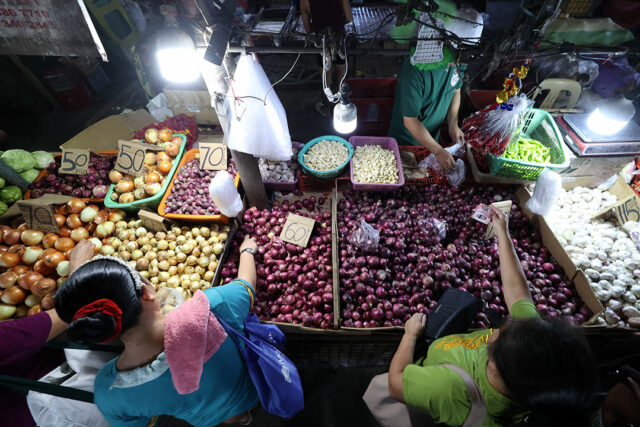
Consumers buy produce at the Commonwealth Market in Quezon City on March 5, 2026. — PHILIPPINE STAR/MIGUEL DE GUZMAN

By Katherine K. Chan, Reporter

PHILIPPINE INFLATION accelerated to a 13-month high in February as rising costs for rice, fuel, electricity and other utilities added pressure on household budgets, the Philippine Statistics Authority said on Thursday.

The consumer price index (CPI) picked up to 2.4% from 2% in January and 2.1% in February 2025. It was the fastest since January 2025, when inflation hit 2.9%.

February inflation fell within the Bangko Sentral ng Pilipinas’ (BSP) 2.3%-3.1% forecast and matched the 2.4% median estimate in a BusinessWorld poll of 17 analysts.
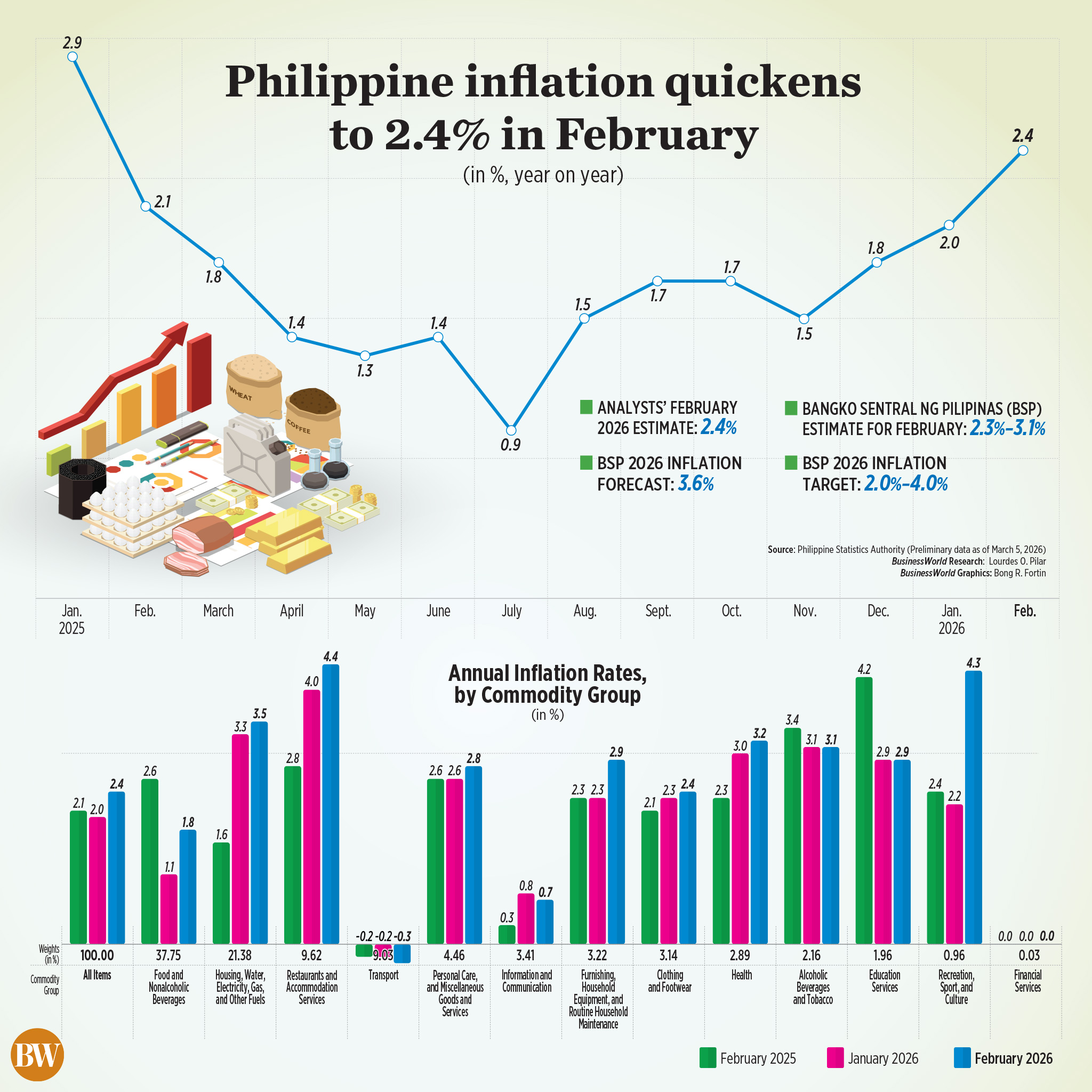
February also marked the second straight month that inflation stayed within the central bank’s 2%-4% target, bringing the two-month average inflation rate to 2.2%.

“Overall price conditions remain stable,” Economy Secretary Arsenio M. Balisacan said in a statement. “However, we are mindful of recent geopolitical developments, which we are closely monitoring, along with domestic supply conditions of key commodities.”

The peso’s purchasing power remained at P0.76 from January, meaning P100 from 2018 could only buy P76 worth of goods and services now.

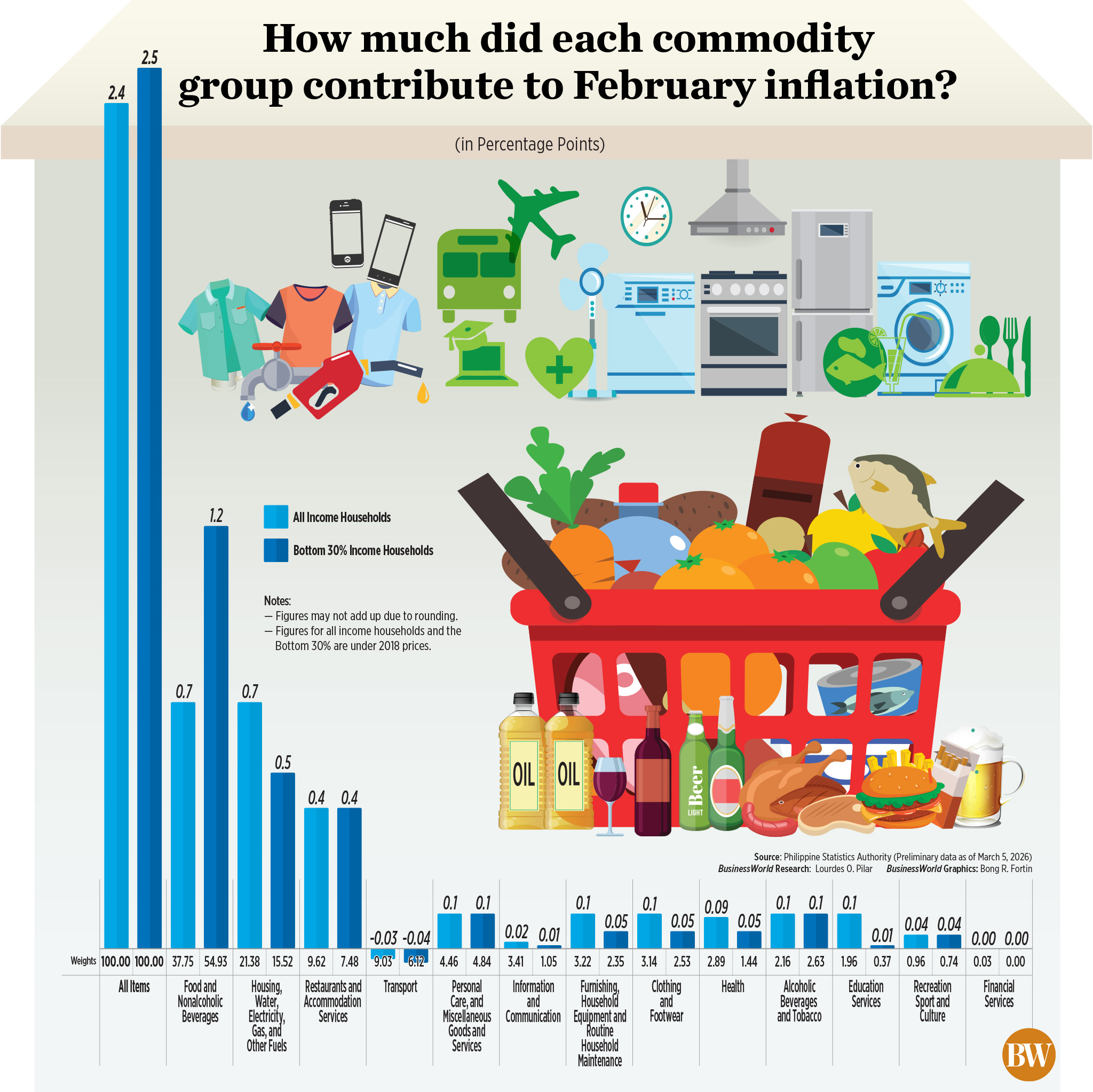
National Statistician Claire Dennis S. Mapa said faster price increases in food and nonalcoholic beverages, housing and utilities and restaurants and accommodation services pushed inflation higher last month.

Inflation for food and nonalcoholic beverages accelerated to 1.8% from 1.1% in January, driven by faster price increases for vegetables, fish and seafood, as well as a slower decline in cereals and cereal products.

Inflation for restaurants and accommodation services also quickened to 4.4% from 4% a month earlier. Prices for restaurants, cafés and similar establishments rose 4.5% from 4.1% pace in January.

Core inflation, which strips out volatile food and fuel prices, edged up to 2.9% in February from 2.8% in January and 2.4% a year earlier. This was the fastest  since June 2024.

ENERGY COSTS
Inflation for housing, water, electricity, gas and other fuels, which accounted for almost 30% of the headline CPI, rose to 3.5% in February from 3.3% a month earlier.

Fuel prices have been rising steadily in recent weeks, with diesel and kerosene marking 10 consecutive weekly increases and gasoline climbing for eight straight weeks.

In February alone, pump price adjustments led to a net increase of P3.20 a liter for gasoline, P4.40 for diesel and P3.50 for kerosene.

Liquefied petroleum gas (LPG) prices also increased after oil companies implemented a P1.50- to P1.55-per-kilo hike, bringing the price of a standard 11-kilo household tank to P836.50 to P1,137.05.

Rising tensions in the Middle East have raised concerns about possible disruptions in global oil supply, which could further push up energy costs for net oil importers such as the Philippines.

The Department of Economy, Planning and Development said authorities are monitoring domestic fuel price movements and could intervene if global oil prices rise sharply.

“Further, the government will implement measures to reduce fuel consumption, first by government offices, and we encourage the private sector to do the same,” Mr. Balisacan said.

These measures include the use of shuttle buses, encouraging carpooling and adopting flexible work arrangements such as work-from-home or compressed workweeks.

Electricity costs also rose after Manila Electric Co. increased its rate by 22.26 centavos per kilowatt-hour (kWh) in February to P13.1734 per kWh from January. Electricity inflation climbed to 6.7% from 6.5%.

Rental inflation also edged higher to 3% from 2.9%, while inflation for water supply rose to 4% from 3.5%.

Rice prices, a key driver of Philippine inflation, showed signs of firming in February.

Rice inflation remained negative at -3.4%, but this was a slower decline than -8.5% in January, indicating a gradual rebound in prices.

Regular milled rice prices fell 2.5% year on year to an average of P46.01 per kilo but rose 5.14% compared with January levels.

Mr. Mapa said rice inflation could move closer to zero — or even turn positive — if month-on-month price increases persist in March.

Meanwhile, inflation for the bottom 30% of income households accelerated to 2.5% in February from 1.6% in January and 1.5% a year earlier, the fastest in more than a year.
INFLATION OUTLOOK
The BSP said inflation expectations remain well anchored despite the February uptick, although authorities are assessing the potential impact of Middle East tensions on the domestic economy.

“The BSP will ensure that policy settings remain in line with its pursuit of price stability conducive to sustainable growth and employment,” it said in a statement.

Jonathan L. Ravelas, a senior adviser at Reyes Tacandong & Co., said the latest data point to rising risks, particularly from global oil markets.

“While inflation remains manageable, the third straight monthly uptick tells us upside risks are building — especially if global oil supply disruptions persist,” he said via Viber.

Chinabank Research said inflation might average around 3.6% this year, near the upper end of the BSP’s target, though the outlook could worsen if geopolitical tensions persist.

Morningstar DBRS also warned that net oil-importing economies such as the Philippines remain vulnerable to rising energy costs and potential supply disruptions stemming from the war in the Middle East.

The Bangko Sentral ng Pilipinas (BSP) should hold interest rates steady, rather than cut or raise, amid rising global oil price pressures from the Middle East war, according to the Institute for Risk and Strategic Studies, Inc. (Salceda Research).

In a report released on Wednesday, the think tank said further rate adjustments might be unwise amid uncertainties over crude prices stemming from disruptions linked to the war between Israel and Iran.

“The appropriate response is a pause, not a hike — the inflation is supply-driven and rate hikes would not reduce oil prices,” Salceda Research said. “The BSP should communicate clearly that the easing cycle is on hold, not reversed, to avoid market overreaction.”

The Strait of Hormuz, a critical oil transit point, has become a flashpoint after Israeli and US military strikes on Iran. Roughly one-fifth of the world’s oil supply passes through the strait, and any disruption could push global oil prices higher, squeezing import-dependent economies such as the Philippines.

Salceda Research estimated that sustained crude prices above $80 per barrel for more than a month could push Philippine inflation toward 4%, near the upper limit of the central bank’s target band. “Second-round consumer price index effects will push inflation toward the 4% upper target boundary within two quarters,” it added.

At its first policy review of 2026, the BSP cut the key interest rate by 25 basis points (bps) to 4.25%, the sixth consecutive reduction and a total easing of 225 bps since August 2024.

BSP Governor Eli M. Remolona, Jr. has noted that easing alone might not stimulate an economy constrained by weak sentiment and lingering governance issues.

Salceda Research also cautioned that the Philippine peso could come under renewed pressure, potentially testing P59.50 to P65 a dollar.

The peso briefly recovered to around P57 a dollar last month after record lows in January but has remained above P58 amid geopolitical uncertainty.

“The BSP should allow the peso to depreciate within the P59.50-P61 band… intervening [only] to prevent disorderly overshooting beyond P62,” the think tank said.

Rapid moves past P62 could front-load inflation and trigger capital outflows, it said. “Graduated, transparent intervention is preferable to defending a fixed level.

PHL plans diesel stockpile amid Middle East war

A gas attendant is at work at a gasoline station in Manila in this file photo. — PHILIPPINE STAR/NOEL PABALATE

By Sheldeen Joy Talavera, Reporter

THE PHILIPPINE government plans to procure at least a million barrels of diesel to secure domestic fuel supply as tensions in the Middle East threaten global oil trade and China moves to curb refined fuel exports.

The Department of Energy (DoE) is studying a proposal to direct state-run Philippine National Oil Co. (PNOC) to buy the diesel for a strategic stockpile that could cover about five days of domestic consumption, Oil Industry Management Bureau Director Rino E. Abad told reporters on Thursday.

The planned purchase is equivalent to roughly 200,000 barrels a day, or about 33 million liters of diesel consumption daily in the Philippines.

Mr. Abad said the volume could be increased to as much as 3 million barrels, which would be enough to cover up to 15 days of supply, especially after reports that China is asking refiners to halt new export contracts for refined fuel.

“That’s a game changer,” he said, noting that about 30% of the Philippines’ diesel imports come from China. “Hopefully, South Korea will not follow because about 40% of our imports come from South Korea,” he added in mixed English and Filipino.

China has asked companies to stop signing new contracts to export refined fuel and attempt to cancel shipments already committed, according to a Reuters report, citing industry sources.

Mr. Abad said PNOC could buy diesel from nearby suppliers such as South Korea, Japan, Singapore, Malaysia and Indonesia if Chinese shipments are disrupted.

The fuel purchased by PNOC would still be sold to domestic oil companies to ensure continued supply in the local market, he said.

“At best, PNOC may sell the fuel at cost,” Mr. Abad said. “It will simply recover the procurement expenses and distribute the supply to domestic oil companies.”

Global oil supply chains have come under pressure after the closure of the Strait of Hormuz, a critical chokepoint through which roughly a fifth of the world’s oil and liquefied natural gas shipments pass.

The disruption stems from escalating hostilities involving Iran, the US and Israel.

As a net oil importer, the Philippines is particularly vulnerable to fluctuations in global oil supply and prices.

About 98% of the country’s crude oil imports come from the Middle East, according to DoE data, with the remainder obtained from nearby producers such as Brunei and Malaysia.

Fuel retailers have implemented several rounds of price increases this year as global oil prices climbed.

On Monday, oil companies raised gasoline prices by P1.90 a liter, diesel by P1.20 and kerosene by P1.50.

The adjustments marked the 10th consecutive weekly increase for diesel and kerosene prices and the eighth straight week for gasoline.

Since January, gasoline prices have increased by P6.70 a liter, diesel by P9.40 a liter and kerosene by P7.70 a liter.

STAGGERED INCREASES
Energy Secretary Sharon S. Garin said some oil firms have agreed to implement potential increases in pump prices on a staggered basis next week to cushion the impact on consumers.

Oil companies assured the DoE during a meeting on Wednesday that existing fuel inventories remain adequate and that additional shipments previously ordered were on the way, Ms. Garin told DZMM radio.

“We also talked about staggering the increases and the discounts. They seem amenable,” she said.

Tanya Samillano, president of the Independent Philippine Petroleum Companies Association, said oil companies briefed the DoE on their plans for price adjustments and inventory levels.

“We discussed how we plan to implement our price adjustments this coming week and updated the department on our inventories,” she said in a Viber message.

Leo P. Bellas, president of Jetti Petroleum, Inc., said many independent fuel retailers had agreed to stagger price increases if global oil costs continue to climb.

“Almost all nonmajor players agreed to implement the potential increase on a staggered basis,” he told BusinessWorld.

Brigitte Carmel C. Lim, senior vice-president and chief operating officer of Cebu-based Top Line Business Development Corp., said the company supports the DoE’s call for measures that could soften the impact of rising oil prices.

“We will continue to monitor global price movements and regulatory advisories,” she said in a Viber message.

Ms. Garin said the government would determine the scale and timing of fuel price adjustments after assessing global market movements over a full five-day trading cycle.

“We will determine by the weekend because we need five days of simulation to estimate the increase,” she said.

Economists said even staggered fuel price increases could weigh on household spending.

Foundation for Economic Freedom President Calixto V. Chikiamco said spreading out price increases might reduce the shock to consumers but would still erode purchasing power.

“Staggering the increases is slightly better than a one-time price shock,” he said via Viber. “But the total increase is still large and will cut deeply into disposable income.”

IBON Foundation Executive Director Jose Enrique “Sonny” A. Africa said gradual adjustments might soften the immediate impact but would not reduce the overall burden on households.

“The increase is paced but households will still eventually pay the same higher prices,” he told BusinessWorld.

Compressed workweek could strain Philippine manufacturing, BPOs

REUTERS

By Beatriz Marie D. Cruz, Reporter

THE PHILIPPINE government’s proposal to adopt a four-day workweek to conserve energy amid Middle East tensions could affect delivery schedules in sectors such as manufacturing and business process outsourcing (BPO), industry groups warned.

Elizabeth H. Lee, executive director of the Federation of Philippine Industries (FPI), said the impact would vary across industries.

“The impact may differ significantly for manufacturing, where continuous production requirements are a central consideration,” she said in a statement.

“Possible effects on supply chain stability, delivery timelines and competitiveness relative to regional peers should be thoughtfully assessed,” she added.

President Ferdinand R. Marcos, Jr. is weighing the proposal, Presidential Communications Undersecretary Clarissa A. Castro said on Wednesday. Senator Sherwin T. Gatchalian earlier suggested the plan to conserve energy amid risks to oil supply and rising costs from the US-Iran war.

Ms. Lee noted that production-driven sectors rely on coordinated logistics and continuous output cycles.

“Any adjustments in work structures would need to be carefully designed to avoid unintended disruptions in output, delivery schedules and supply chain flows,” she added.

By contrast, service-oriented and knowledge-based industries might more easily adopt a four-day week through hybrid or flexible arrangements, she said.

Donald Patrick L. Lim, president of the Management Association of the Philippines, said industries operating on global schedules — including BPOs, manufacturing, logistics, and export sectors — could face operational disruptions.

“Compressing the workweek could affect productivity and client commitments,” he told BusinessWorld via Viber.

He urged industry-specific flexibility in policy design, suggesting that energy efficiency improvements might be a more sustainable response to geopolitical volatility.

Experts also emphasized the role of remote and hybrid work, digitalization, public transport improvements, and energy-saving technologies in cushioning businesses from external shocks.

“Ultimately, strengthening productivity and energy efficiency will help Philippine businesses and workers weather external shocks more effectively,” Mr. Lim said.

Under a Civil Service Commission memo, government employees may adopt flexible arrangements. Private sector workers can telecommute under the Telecommuting Act.

Jose Sonny G. Matula, a labor lawyer and president of the Federation of Free Workers, cautioned that compressed four-day schedules could result in longer, 10-hour workdays, causing fatigue.

“Worker safety and stamina must remain the primary consideration when designing alternative work schedules,” he said via Viber.

The Philippine Chamber of Commerce and Industry (PCCI) said the government should consult stakeholders before implementing a four-day workweek program.

“We are not against the implementation of flexible work arrangements but there should be proper consultation with various stakeholders and supported with data to ensure that industries with specific operational requirements will not be adversely affected,” PCCI President Ferdinand A. Ferrer said in a statement.

Ms. Lee added that no Southeast Asian country has implemented a nationwide four-day workweek. She recommended pilot programs and data-driven assessments before considering wider adoption.

S&P: Philippines to outpace most Asian peers in next 3 years

PHILIPPINE STAR/ MICHAEL VARCAS

THE PHILIPPINES is expected to remain one of Southeast Asia’s fastest-growing economies over the next three years despite a slowdown in 2025 triggered by a corruption scandal, according to S&P Global Market Intelligence.

“Based on our data, the country is projected to remain one of the fastest economies in the region, second only to Vietnam,” Rodeza Mones, sector editor for news and research at S&P Global Market Intelligence, told an investment forum on Thursday.

The Philippines’ real gross domestic product (GDP) grew 4.76% in 2025, down from 5.64% in 2024. S&P now projects growth will accelerate to 5.66% in 2026, 5.84% in 2027, and 5.78% in 2028, though these estimates are lower than its prior 6.5% projections for 2027 and 2028.

GDP in dollar terms ended 2025 at $452.18 billion, with S&P expecting expansion to $477.78 billion in 2026, $505.7 billion in 2027 and $534.9 billion in 2028.

The projections do not account for uncertainties stemming from the Middle East war, Ms. Mones noted.

She said the projections show economic growth in the country is expected to be below 6%, far from the most recent high of 7.68% in 2022.

“The forecast comes as the country faces the economic fallout of a sweeping investigation into the alleged misuse of billions in state-funded flood control projects,” she said.

She noted that the graft scandal slowed infrastructure spending, weighed on investments and constrained growth by the end of 2025.

“Economists say that the outlook for economic growth in the Philippines hinges in large part on how the graft investigation will play out,” Ms. Mones said.

S&P also highlighted structural risks, including artificial intelligence (AI) disruption to the business process outsourcing sector, strained public finances and recurrent climate-related disasters such as floods, landslides and earthquakes.

“The Philippines should accelerate the implementation of structural and governance reforms and reduce infrastructure gaps to boost investments and increase fiscal multipliers,” she added, citing the International Monetary Fund.

REGIONAL CONTEXT
Across Southeast Asia, growth is expected to slow from 2025 highs. Singapore’s real GDP rose 4.96% in 2025 to $464.19 billion, driven by AI-related electronics demand. S&P projects GDP of $482.71 billion (3.99%) in 2026, $498.79 billion (3.33%) in 2027 and $516.4 billion (3.53%) in 2028.

Vietnam’s economy expanded 8.02% in 2025, with GDP reaching $464.71 billion, supported by trade growth, foreign direct investment and stable inflation.

S&P forecasts $495.43 billion (6.61%) in 2026, $526.35 billion (6.24%) in 2027 and $558.4 billion (6.09%) in 2028.

Thailand, by contrast, remains sluggish, with GDP growth near 2% in recent years. S&P projects it will dip to 1.6% in 2026 before recovering to 2.1% in 2027 and 2.4% in 2028.

“Southeast Asia’s second-largest economy has been crippled by prolonged political instability, weak domestic consumption and high household debt,” Ms. Mones said.

“Its industrial competitiveness has also declined owing to structural weakness in manufacturing, while tourism as a key source of income for the country has faced tough competition from other countries in the region,” she added. — Justine Irish D. Tabile

ACEN eyes P16-B battery storage for its largest solar farm in PHL

SANMAR SOLAR is one of the largest operating solar farms in the Philippines. It is built over a vast 500-hectare unutilized, lahar-covered land in Zambales. — ACENRENEWABLES.COM

RENEWABLE ENERGY developer ACEN Corp. plans to construct a 2,000-megawatt-hour battery energy storage system (BESS) to provide a stable power supply from its largest solar farm in the Philippines.

SanMar Solar, Inc., a subsidiary of ACEN, aims to integrate the BESS into the 585-megawatt (MW) SanMar Solar project in Zambales, according to the company’s filing with the Department of Environment and Natural Resources.

The energy storage system is projected to cost P15.88 billion and will be built on the southern section of the 10-hectare solar plant.

“The construction and installation of the BESS will be undertaken within the area already covered by the approved ECC (environmental compliance certificate), and no additional land or expansion beyond the existing ECC coverage will be required,” the company said.

A BESS stores energy generated from a power facility and can supply electricity to the grid during periods of insufficient supply or peak demand.

SanMar said the proposed project will also deliver ancillary services to the grid operator to support the reliable operation of the transmission system.

“Without availability of ancillary services, the stability of the transmission capacity and the quality, reliability, and security of the power grid may be compromised,” the company said.

Currently, around 385 MW of the solar plant is operational, while 200 MW is under construction and is expected to be completed by the third quarter of 2027.

The BESS project is scheduled for commercial operation by the first quarter of 2028 to harness capacity from the solar farm and supply it to the grid.

A public scoping activity for the project is scheduled on March 16. This early stage of the environmental impact assessment process allows the project proponent to present an overview of the development and gather issues and concerns from stakeholders.

The SanMar Solar expansion is part of ACEN’s 7.1-gigawatt renewable energy portfolio.

Beyond the Philippines, ACEN also has operations in Australia, Vietnam, India, and Lao PDR, along with strategic investments in Indonesia and other markets. — Sheldeen Joy Talavera

Disney Adventure gets Iron Man’s blessing

HOLLYWOOD STAR Robert Downey, Jr. attends the christening ceremony for the Disney Adventure at a special event on board the ship in Singapore, March 4. In photo (from left): Captain Mickey Mouse, Disney Experiences Chairman Josh D’Amaro, Mr. Downey, Disney Signature Experiences President Joe Schott and Captain Minnie Mouse. — DISNEY CRUISE LINE HANDOUT

RDJ raves about Disney Adventure as he christens the cruise ship

SINGAPORE — Iron Man star Robert Downey, Jr. (RDJ) on Wednesday officially christened Disney Cruise Line’s (DCL) newest ship, the Disney Adventure, in Singapore.

In a special event aboard the Disney Adventure, Mr. Downey appeared on stage amid a cloud of smoke as a 23-piece orchestra performed music from the Disney film that shot him to superstardom.

“Never let it be said, I don’t know how to make an entrance,” he quipped amid wild cheers from the audience.

Mr. Downey, who will return to the Marvel Cinematic Universe as Doctor Doom in the upcoming Avengers: Doomsday, said it was an honor to be named the “godparent” of the Disney Adventure, describing it as a “majestic vessel.”

“I’ve had the privilege of getting to know the team at Walt Disney Imagineering, and I can tell you Adventure is the perfect name for what they’ve created,” he said.

“There’s an entire amusement park up there. It’s bananas. I recommend the Ironcycle (roller) coaster by the way. I got a good feeling about that one,” he added, referring to the DCL’s first-ever roller coaster at sea.

Mr. Downey was joined on stage by Disney Experiences Chairman Josh D’Amaro and Disney Signature Experiences President Joe Schott for the ceremonial christening.

Mr. D’Amaro said the Disney Adventure was the newest and biggest cruise ship in the DCL fleet and required a “big blessing.”

In response, Mr. Downey replied: “I have three words for you… I’m your guy.”

“I christen thee, Disney Adventure. May God bless this ship and all who sail upon it,” Mr. Downey said, as the orchestra performed “When You Wish Upon A Star” and confetti rained on the guests.

Mr. D’Amaro, who is also the incoming chief executive officer of The Walt Disney Co., said the cruise ships are ambassadors for the “(Disney) brand that carry joy, wonder and enchantment to destinations around the world.”

“As our first ship to homeport in Asia, the Disney Adventure represents a new chapter for Disney Cruise Line and will introduce Disney to audiences who may be experiencing our magic for the very first time. It offers fans across this region an opportunity to immerse themselves in unforgettable ways and create memories that are uniquely Disney,” Mr. D’Amaro said.

The christening ceremony also featured performances from Filipino singer Jed Madela and Australian-Korean singer Dami Im. They performed a medley of classic songs from Disney, Pixar, and Marvel films.

To end the ceremony, a parade of Disney characters, such as Donald and Daisy Duck, Goofy, Spider-Man, and Disney Princesses, entered the theater as the orchestra played “Let’s Set Sail.”

The Disney Adventure is the first DCL ship to sail in Southeast Asia. It will embark on its maiden voyage on March 10. — Cathy Rose A. Garcia

View related videos and photos online:

https://tinyurl.com/2th73h3v
https://tinyurl.com/4bxubakj
https://tinyurl.com/3a2sjxfj

PCC clears DoubleDragon’s acquisition of MerryMart shares

MERRYMART.COM.PH

THE Philippine Competition Commission (PCC) has approved DoubleDragon Corp.’s (DD) proposed acquisition of shares in MerryMart Consumer Corp., issuing its decision ahead of the Phase 1 review deadline.

In a statement on Thursday, the PCC said the DoubleDragon-MerryMart transaction is unlikely to substantially lessen competition, as strong rivals in upstream and downstream markets constrain input and customer foreclosure.

DoubleDragon develops real estate across retail, offices, industrial spaces, and hospitality, with subsidiaries CityMall operating malls nationwide and CentralHub managing warehouse complexes in the Philippines.

MerryMart runs a growing chain of supermarkets and convenience stores focused on consumer goods throughout the country.

“With this clearance, the PCC affirms its commitment to safeguarding competitive markets while ensuring that mergers and acquisitions proceed in ways that allow businesses to pursue growth opportunities that benefit consumers and the broader economy,” the commission said.

The PCC’s Mergers and Acquisitions Office reviewed how the deal might affect competition in leasing commercial spaces and warehouses to grocery and convenience stores in areas served by DoubleDragon’s CityMall and CentralHub.

It also examined upstream markets, such as space and warehouse supply, and downstream markets for those retailers.

“Consultations were conducted with key industry stakeholders, which include major retail chain competitors, customers, and relevant government agencies,” it noted.

In April last year, DoubleDragon announced plans to acquire a 35% stake in listed consumer and wholesale retailer MerryMart under a P1.28-billion deal.

Under the transaction, DD will buy 2.66 billion MerryMart common shares at 48 centavos per share from Injap Investments, Inc. The price was based on the 30-day volume-weighted average price (VWAP) of MerryMart shares. Half of the transaction will be paid using DD shares, while the remaining half will be settled in cash worth P637.97 million.

In April 2021, DD amended its articles of incorporation to change its primary purpose from a real estate developer to an investment holding company.

DD said in an earlier statement that the acquisition would also support its target of reaching P500 billion in revenue by 2035.

On Thursday, DoubleDragon shares rose 1.89% to close at P9.17, up P0.17. — Alexandria Grace C. Magno

Ena Mori presents two sides of an emotional journey

FOR Filipino-Japanese artist Ena Mori, it’s possible to use different styles and voices to express one’s emotional vulnerability. This is reflected in how her latest EP, Ore, provides a rough contrast to her previous one, rOe, released last year.

“It’s a cyclical album, but ultimately, I separated it into two because of the different voices I was using. The way I approached writing Ore was sterner and more direct than the previous record,” Ms. Mori said in a press interview on March 4.

Produced with Tim Marquez, mixed by Sam Marquez, and mastered by Emil Dela Rosa, the new EP emphasizes abrasive, disjointed soundscapes over fluid softness.

Even the titles of the two EPs hint at this key difference: rOe, referring to Ms. Mori’s favorite sushi condiment of fish roe, connotes a nice roundness that brings some comfort and conveys a delicateness. Meanwhile, Ore, referring to the natural resource collected in the form of rocks deep in the earth, evokes the opposite texture.

“I was looking for some wordplay that would make sense by changing the spelling,” said Ms. Mori. “I landed on ‘ore’ because I was playing the board game Settlers of Catan, and the natural crystallized gems are the total opposite of how delicate and pure the fish egg is. It’s a rock that’s been there for centuries that has changed shape, a modal opposite but still connected through the spelling.”

Compared to DON’T BLAME THE WILD ONE!, her album from 2022 which served her “urge to just shout” during the pandemic, the two EPs are more of an “internal analysis.”

“I’ve been reflecting on my past experiences and making sense of what I feel,” Ms. Mori said. “It’s more introspective.”

While emotionally unrestrained and dance-oriented, the genre of avant-pop that she occupies can still be played in the club or enjoyed in live shows. The EP’s focus track, “19 Underground,” is a good example, written from the perspective of a 19-year-old trying to navigate their artistic and personal awakening.

“I think my maturity shows in how I don’t have to use pretty words to say something, or pretty sounds to make a record,” explained Ms. Mori, when asked about what is different in her songwriting this time around. “You can use noises, which we experience all the time, from honking in the street to feedback from a mic. We categorize it as noise because it hurts your ears, but there’s something so natural about that. It’s about not being afraid of that.”

She also shared how her vantage point as a Filipino-Japanese artist allows her to be comfortable in her deeply personal cultural identity, with all its bumps and hurdles, without worrying about how it would be received. The intertwined chaotic power and haunting resonance in tracks like “Funny” and “La Loba” are examples of finding ease in this unease.

“I’m just trying my best to make music true to myself rather than being conscious of how I will be accepted in some sounds, countries, or particular scenes,” Ms. Mori said, noting that she’s comfortable using Japanese and English lyrics simultaneously.

“Whenever I feel something fits the lyrics, I’ll choose that. It’s not about hitting a market. At the end of the day, I believe that whatever you write will resonate with a lot of people from different countries,” she added. “Music really is universal. The language or genre doesn’t matter because it’s about feeling.”

Ena Mori has several upcoming shows including her Backyard Live performance, to be released online on March 13, and her appearance at the SYNCHRONICITY music festival in Tokyo, Japan, in April. In May, she will be at the Circus Music Festival in Parklinks, Pasig City.

“Live shows are challenging because making a record is completely different from live shows. It takes a lot of discipline because the technicalities, like in dual setups where I play a lot of instruments, can get hard,” Ms. Mori said, on her preparation for all these shows.

“It’s a discipline that I’m working on so that I have more room to be present onstage, especially because I’m a maximalist of sound. I end up playing so many things, and I’m excited to convey that live!”

Ena Mori’s two EPs, rOe and Ore, are available on all digital music streaming platforms. — Brontë H. Lacsamana

Equinix eyes expansion of PHL data centers to meet rising demand

EQUINIX.COM

GLOBAL DIGITAL infrastructure firm Equinix, Inc. said it is ready to expand the capacity of its existing data centers in the Philippines to capture growing demand, noting that the country is strategically positioned to become a data center hub in Asia.

“What we are doing at the current time is continually assessing. What I can say is right now, we have every capability to support our customers’ current expansion needs in our existing data centers,” Equinix Vice-President for Growth and Emerging Markets in Asia-Pacific Max Parry said in a briefing on Thursday.

Equinix launched its Philippine operations in 2025 with the opening of three data centers in Cavite and Makati. The facilities were acquired a year earlier from Total Information Management Corp. (TIM), marking the company’s entry into the country’s fast-growing data infrastructure market.

The Philippines, Mr. Parry said, completes Equinix’s regional expansion following its operations in Malaysia and Indonesia, filling a missing piece in its Southeast Asia growth strategy.

Equinix’s facilities in the Philippines have about 35,000 square feet of colocation space, with a combined capacity of 1,000 data cabinets.

“It is a lot of optimism that we announced our investment into the Philippines last year. I think across Southeast Asia as a whole, the Philippines has a very strong and unique (role). We see the demand from global customers wanting to access the Philippine market,” he said.

Mr. Parry identified the diverse information technology-business process outsourcing (IT-BPO) industry as a catalyst for data center growth, alongside rising demand from the network, telecommunications, and banking sectors.

“The other thing which is very notable around our business here in the Philippines is the diversity of banking and financial services customers that call Equinix Philippines home. So, we have a lot for those banking customers,” he said.

Equinix’s data centers provide high-speed interconnection services, giving enterprises direct access to cloud platforms, artificial intelligence providers, and major network ecosystems through secure private links. Globally, the company operates more than 260 data centers across 70 markets.

“I think the Philippines is very strategically placed to do that. It’s a strategic location between the economies of Asia and the US market. I think that positions the Philippines well to occupy that data center hub position,” he said, adding that ongoing subsea connectivity projects in the Philippines would also drive growth.

The Department of Information and Communications Technology (DICT) projects that the country’s data center capacity could reach 1.5 gigawatts (GW) by 2028, up from nearly 200 megawatts (MW) at present.

To achieve this target, the Philippines must also capitalize on the growth of its digital economy, which is expected to reach $36 billion in gross merchandise value (GMV) in 2025, according to a November report by Google, Temasek Holdings, and Bain & Company. The report projects the country’s overall digital economy could reach $70 billion to $140 billion in GMV by 2030, slightly lower than last year’s forecast of $80 billion to $150 billion.

“I think you’ve got the local strength in industry to be able to attract data center operators like us through the strength of the local market. Vibrant financial ecosystem, lots of foreign direct investment coming into manufacturing, one of the world’s leading IT BPO sectors. And as I said, increasingly, international organizations are looking towards the digital growth in the Philippines and wanting to be a part of it,” Mr. Parry said. — Ashley Erika O. Jose

Songs for Selina and the unspoken truths in the music industry

WITH its harrowing yet grounded portrayal of the music industry’s grim realities, Songs for Selina is set to open new conversations about the struggles of Filipino musicians who aspire to make it big.

The film follows Selina (played by Mica Javier) and Maya (Rachel Coates) as musical soulmates whose bond is fractured by the unforgiving and cutthroat nature of the industry they once dreamed of conquering together.

A theme of the film is the importance of independent storytelling in a commercially driven industry, according to one of the film’s executive producers, acclaimed Filipino R&B musician Jay R, who is also the chief songwriter of the movie’s original songs. At a virtual press conference on March 5, he explained that the film draws from real experiences.

“The message is for artists to be original because that’s the route we took for this movie. We didn’t license any songs. We created everything from scratch,” he said.

Aside from Ms. Javier and Ms. Coates, the cast boasts a strong ensemble of actors with film, theater, and music backgrounds. It includes Rachel Alejandro, Audie Gemora, Nicole Laurel, Leanne Mamonong, Gian Magdangal, and Jay R himself.

Another thing that sets the film apart is that the songs are diegetic, which means the music is part of the story, as if written and performed by the characters themselves. Jay R shared that the songwriting process for it was challenging compared to writing songs for himself.

“The songs have to hold up weight to be good enough to listen to on the radio. At the same time, it’s telling the story of what’s happening in the movie,” he explained. The original motion picture soundtrack, now on streaming platforms, mainly features solos and duet performances by the two lead stars.

For Ms. Javier, although Songs for Selina was shot back in 2019, the film remains very relevant in the US and the Philippines today. “It’s about the struggles of artists that are trying to make it in the industry and how those paths can be completely different,” she said.

“I think with TikTok, Instagram, and YouTube shorts, the internet is giving everyone access to what goes on behind-the-scenes. This increases exposure and awareness of issues like ghostwriting or creators’ works not getting properly monetized or paperwork problems,” she added. “It does happen in the industry. This movie doubles down on those facts.”

Ahead of the Philippine theatrical release on March 18, the film had been picked up by Amazon Prime US and Tubi for its North American release last year.

Ms. Javier explained that the film has become “a proof of concept that Filipino creatives, from behind the scenes to in front of the camera, can compete on a global level.”

Songs for Selina is also a way for Filipino talents to “put their best foot forward,” according to Ms. Alejandro, who plays a supporting role as a music industry bigwig.

“Filipino singing talent is one of the best, if not the best, in the world. I feel like it’s perfect that this film focuses on music and it’s a story about music. That’s who we are as Filipinos,” she said. “We’re putting our best foot forward in the world, showing what we do that’s so special and extraordinary.”

Songs For Selina, directed by Dean Rosen, is produced by Homeworkz Entertainment and distributed in the Philippines by Black Cap Pictures. — Brontë H. Lacsamana

Pacific Online acquires Belle treasury shares in P280-M transaction

THE 400-HECTARE Tagaytay Midlands Golf Club — BELLECORP.COM

PACIFIC ONLINE Systems Corp. (LOTO), a gaming and technology firm, has purchased 200 million treasury shares of Belle Corp., a developer of leisure, residential, and casino properties, at P1.40 per share in a P280-million transaction.

The deal follows Belle’s board approval of the sale and slightly increases the listed firm’s public float.

“Pacific Online shall provide the other details of its acquisition of part of Belle’s treasury shares through its filing of the requisite Material Related Party Transactions disclosure as this transaction is valued at more than 10% of the Company’s total consolidated assets based on its latest audited financial statements,” the company said in a disclosure on Thursday.

Belle Corp. said on Wednesday that its board approved the sale of up to 200 million treasury shares to raise fresh capital, which will be partly used for forthcoming projects.

“The sale of treasury shares will be done through the facilities of the Philippine Stock Exchange based, at the minimum, at prevailing market prices at the time of the sale,” the company added.

If fully subscribed, the transaction would increase Belle’s public float by roughly 1.12%, from 44.59%.

Belle, a portfolio investment of SM Investments Corp., develops club, golf, and residential facilities at Tagaytay Highlands and Tagaytay Midlands in Tagaytay City. Its subsidiary Premium Leisure Corp. oversees operations at the luxury casino resort City of Dreams Manila.

At the local bourse on Thursday, Belle rose 0.71% to P1.41, or up P0.01, while Pacific Online gained 0.6% to P1.69, also up P0.01. — Alexandria Grace C. Magno

Philippine banks’ profit growth may slow on narrowing margins

Peoples walk past automated teller machines in Makati City, June 23, 2016. — REUTERS

PHILIPPINE BANKS’ profit growth could slow down this year as the interest rate environment normalizes and with geopolitical risks adding more uncertainty to already gloomy economic prospects.

“Universal banks should continue to post positive earnings in 2026 but at a more moderate pace as loan growth cools and interest margins compress with potential policy easing,” Philippine Institute for Development Studies Senior Research Fellow John Paolo R. Rivera added in a Viber message.

“Increasing global volatility due to geopolitical tensions or US policy shifts can affect Philippine banks indirectly via capital flows, forex (foreign exchange) volatility, and investor sentiment.”

Latest Bangko Sentral ng Pilipinas (BSP) data showed that the banking sector’s net income rose by 3.648% to P405.606 billion in 2025 from P391.33 billion in 2024.

Mr. Rivera said this growth was mainly supported by higher net interest earnings, lower loan loss provisions amid stable asset quality, and fee income from banks’ transactional and wealth management services.

The biggest gainers were those with strong retail and payments franchises, diversified fee streams, and controlled cost bases, he added, as these names are already experienced in balancing their consumer and corporate loan portfolios.

The country’s three largest private banks in asset terms, namely, BDO Unibank, Inc., Metropolitan Bank & Trust Co. (Metrobank), and Bank of the Philippine Islands (BPI), posted record profits in 2025 despite increasing competition in the industry, First Metro Investment Corp. Head of Research Cristina S. Ulang said in a Viber message.

BDO’s attributable net income climbed by 6.28% year on year to P87.17 billion in 2025, while Metrobank’s profit rose by 3.29% to P49.72 billion, and BPI’s earnings increased by 7.4% to P66.62 billion.

CONSUMER PUSH
Banks will likely continue to expand their consumer lending business this year as the segment remains largely untapped, April Lynn C. Lee-Tan, chief equity strategist at COL Financial Group, Inc., said in a Viber message.

She said there could be an increase in the industry’s nonperforming loans (NPL) as they grow their retail segments as these sectors are naturally riskier but offer better margins.

“Consumer expansion is likely to remain a focus, especially in mortgages and auto loans, but lenders will be more cautious and selective given credit risk considerations. Aggressive consumer targeting may continue in niches where credit scoring and digital engagement reduce risk, but broad-based rate wars are less likely,” Mr. Rivera added.

“Improvement in asset quality seen in 2025 with NPL ratios near multi-year lows should broadly persist, but pressures could emerge if growth remains soft and certain segments (micro, small, and medium enterprises and unsecured credit) slow or reprice. Prudent risk management and early intervention frameworks will be key to keeping NPLs contained through 2026.”

Ms. Ulang likewise said that asset quality will likely remain stable this year as lenders stay cautious due to lingering domestic and external risks.

Ms. Tan said credit and profitability risks could stem from escalating geopolitical concerns as the conflict in the Middle East could drive up oil prices and the US dollar.

“That would lead to higher inflation and hurt consumers. The peso could also weaken as investors turn risk averse and shift to safe-haven assets like gold, the US dollar and US bonds,” she said.

“A stronger US dollar can put pressure on the Philippine peso and increase hedging costs, while risk-off episodes can dampen investment and corporate borrowing,” Mr. Rivera added. “But the sector’s strong capital base, predominantly domestic funding, and relatively low direct foreign risk exposure mean that Philippine banks are generally well-positioned to absorb external shocks, even if volatility continues.”

Last month, the Monetary Board delivered a widely expected 25-basis-point (bp) cut for the sixth consecutive meeting, bringing the policy rate to 4.25% to support domestic demand as the country deals with the economic fallout from a corruption scandal that has affected consumer and investor confidence.It has now lowered benchmark borrowing costs by a total of 225 bps since it began its easing cycle in August 2024.

BSP Governor Eli M. Remolona, Jr. has said that they are open to supporting growth through monetary policy as long as easing does not cause inflation.

However, he said that they are now less certain about the policy path ahead despite a manageable inflation outlook, adding that rate cuts may not be enough to boost the economy amid lingering governance concerns.

Analysts have said that oil supply disruptions due to the widening conflict in the Middle East could stoke domestic inflation anew and give the BSP less space for further rate cuts. — Aaron Michael C. Sy

ADVERTISEMENT
ADVERTISEMENT