Home Blog Page 2025

Ozzy Osbourne and Black Sabbath to reunite for first time in 20 years

BIRMINGHAM, England — The original lineup of heavy metal legends Black Sabbath, including Ozzy Osbourne, will play together for the first time in 20 years at a one-off concert on July 5 in Birmingham, England, organizers said on Wednesday.

The gig will feature guitarist Tony Iommi, bassist Geezer Butler, and drummer Bill Ward — who along with charismatic frontman Mr. Osbourne pioneered heavy metal music in the early 1970s with hits such as “War Pigs,” “Paranoid,” and “Iron Man.”

Since their last performance together in 2005, Black Sabbath has played in partial reunions but never in their original lineup.

Osbourne’s wife, music manager and TV personality Sharon, said that while other bandmembers might continue to make records and perform, Black Sabbath’s gig at the birthplace of the band will certainly be the 76-year-old’s final performance.

“For Ozzy right now, it’s definitely: ‘I love you and good night’,” she told Reuters.

Mr. Osbourne has produced new music in recent years including a Grammy-winning album but the singer has made fewer public appearances since revealing in 2020 that he had been diagnosed with Parkinson’s disease.

Profits from the show, called Back to the Beginning, will be donated to charities including Cure Parkinson’s, organizers said.

Black Sabbath will top a lineup of rock and heavy metal icons including Metallica, Slayer, Pantera, Alice in Chains, Lamb Of God, and Anthrax at the Villa Park event.

Mr. Osbourne, who left the band in 1979 due to drug and alcohol problems and went on to pursue a highly successful solo career, paid tribute to his hometown in a statement.

“It’s … time for me to give back to the place where I was born,” Osbourne said. “How blessed am I to do it with the help of people whom I love. Birmingham is the true home of metal.”

Sharon said her husband was doing well and was excited about the gig. “It’s stimulated him. He’s very, very excited and very thankful that he can do it.”

Tickets will go on sale on Feb. 14. — Reuters

Body language for job applicants

Iwas interviewed by the head of marketing for a medium-sized bank for a marketing manager position. This 50-something man was robotic and appeared not interested in my answers. There were no follow-up questions, and yet he maintained eye contact with me all the time, which made me edgy. What was he doing? — Cross Road.

​Are you single? If you’re a female applicant with a pleasing personality, is it possible that your interviewer was mesmerized by your beauty or other things that could ripen into something unethical or immoral in the future should you get that job? 

It’s difficult to give you an answer given the lack of information. But we can always speculate with the age-old question: “If a tree falls in the forest, and no one is around to hear it, does it make a sound?”

The answer is still loud and clear. A falling tree creates vibration and stress in the air creating a sound regardless of anyone hearing it. It doesn’t matter if one is present or not. The tree will fall just the same.

In your interview with the marketing head, it doesn’t matter if he hears or understands your answers to his questions. What’s important to him is the value of his screening process. He wanted to evaluate your ability to do the job.

Take the case of the Mona Lisa. Why is it admired by so many people? We know it’s beautiful but are confounded by her enigmatic smile.

MICROCOSM
Almost all job interviewers are focused on the form and substance of an applicant’s answers to questions. The applicant’s appearance (or form) matters only during the first few minutes of the interview process. After that, they pay great attention to any substantive answers.

While you’re prepared to tackle tough questions during the interview, your interviewer is more interested in your answers, even your silences, and possibly the number of pauses you took.

I would imagine your interviewer is interested in understanding your body language, which in the words of Richard Bolles in What Color is Your Parachute? (2014) is based on the principle that “microcosm reveals macrocosm.”

The best interviewers believe that what job applicants show in a small universe reveals how they would act in a big universe. Interviewers “assume that each applicant’s behaviors reveal how would you act in a larger ‘universe’ like the job you’re aspiring for.

Bolles says when employers scrutinize your microcosm or past behavioral employment record, they believe it can reveal your macrocosm or likely behavior in the future. Bolles cites the following examples of microcosm:

One is appearance and personal habits. Do you look freshly bathed during the interview? Are you freshly shaven? How clean are your fingernails? For female applicants, do you have manicured fingernails that don’t stick out too much? Are you wearing daring clothes attract a lot of attention?

Are you wearing freshly laundered clothes and pants? Do you smell of garlic or stale tobacco? Is your breath bad? Do you wear cologne or perfume so strong that it could make people sick 15 feet away?

Two, nervous mannerisms. Is your handshake limp? Do you continually avoid eye contact even when the interviewer invites it? Do you slouch or fidget?

Three, self-confidence. Do you speak too slowly or too softly? Or are you so loud that you can be heard two rooms away? Do you give only a one-word replies to more than 50% of the questions? On the other hand, do you constantly interrupt the interviewer to project a strong personality?

Four, basic courtesy. Were you courteous to the security guard and the receptionist? Did you excessively criticize past employers? Did you forget to thank the interviewer on your way out of the office?

Five, personal values. Did you show signs of laziness or lack of motivation? Did you complain or blame other people, even government officials? Did you make any untruthful statements in your resume or give off evidence of lying during the interview? Did you criticize their office facilities or other things that didn’t impress you?

Some of these are not important to employers who are in dire need of filling a key managerial post. But you can be certain employers will follow the basic requirements to ensure that they hire the best person while looking for fruitful work relations.


For free management advice, chat with Rey Elbo on Facebook, LinkedIn, X (Twitter) or e-mail elbonomics@gmail.com or via https://reyelbo.com. Anonymity is guaranteed.

Address toxic resilience now

The concept of Filipino resilience is deeply ingrained in the nation’s identity, often celebrated as a virtue that enables individuals and communities to endure and recover from various adversities. In a recent conversation with Dr. Horacio “Junbo” Borromeo, the respected coordinator of AIM MBM class of 1980, he however pointed to the negative aspects of this trait.

As an example, Mr. Borromeo cited how Filipino flood victims are admired in the media for laughing while walking through waist-deep muddy waters. Instead, shouldn’t they be asking what government ineptitude and corruption contributed to the floods? While resilience enables Filipinos to navigate hardships, it can also lead to complacency regarding systemic issues such as corruption and governance failures.

Resilience is the ability to adapt, recover and thrive in the face of adversity, stress or change. Resilient individuals can manage stress effectively and maintain emotional stability during difficult time. Communities that foster resilience tend to recover more quickly from disasters, economic downturns or social crises.

Research indicates that Filipino resilience is often a product of necessity rather than choice. A study published in the Journal of Pacific Rim Psychology assessed the psychometric properties of the demographic and psychological variables influencing national resilience. The findings suggest that while Filipinos possess a robust capacity to withstand challenges, this resilience is deeply intertwined with cultural values and social expectations.

From a cultural perspective, Filipino resilience is encapsulated in the phrase bahala na (come what may) and the cultural trait of pagiging matatag (being strong). Sikolohiyang Pilipino (Filipino psychology) pioneered by Virgilio Enriquez examines indigenous concepts like pakikisama (harmony), bayanihan (community spirit) and tiyaga (perseverance). These traits contribute to resilience and highlight the communal nature of the Filipino coping mechanism. “Bahala na” is a fatalistic outlook that can both empower individuals to face uncertainty, but it discourages proactive problem-solving.

Another study highlighted in Girl Power Talk emphasizes that Filipinos are resilient because circumstances demand it, not necessarily because they choose to be. This perspective suggests that resilience has become a pervasive burden, where the ability to cope is romanticized, potentially overshadowing the need for comprehensive change.

Scholars like Randy David have critiqued the Filipino tendency to “move on” from political scandals and crises without holding leaders accountable. He suggests that while resilience is often celebrated, it also leads to a form of fatalism where individuals accept their circumstances rather than challenge systemic issues. Filipinos are also on constant search for charismatic leaders who promise redemption from oppression and inequality. But what the country needs are strong institutions that transcend personalities.

Critics therefore believe that resilience mask systemic failures with the people adapting to recurring problems instead of demanding better disaster preparedness or government accountability. This has now been termed “toxic resilience” and it leads to normalization of suffering and a lack of collective action to address root causes. People forget and move on, exhibiting short memory which engenders cycles of corruption, inefficiency and injustice to persist. The valorization of endurance can hinder critical examination and accountability.

Resilience is a powerful asset that helps navigate life’s inevitable challenges. However, it should be balanced with self-awareness, emotional intelligence, and the ability to recognize when to either step away from harmful situations or seek the changes that lead to better long-term solutions.

Resilience must be complemented by a proactive stance against systemic issues through critical thinking, leading to a more accountable and transparent society. And the starting point is education and awareness. Implementing educational programs that emphasize ethical behavior, civil responsibility and the importance of accountability can cultivate a more vigilant citizenry. Tailored education measures can help nurture young people’s intolerance for corrupt ad unethical behavior.

Institutions must be strengthened, especially those responsible for enforcing laws and regulations. Government transactions and decision-making processes should be made transparent. And society must collectively condemn and stigmatize corrupt behavior. Public discourse and society and community initiatives are necessary so that Filipinos can move beyond toxic resilience and aim for a more just and equitable society.

And if you believe the thesis that resilience must be combined with a more proactive and vigilant mindset, we can start by choosing leaders who have the heart, character, wisdom, competence and integrity to address these issues. Let us no longer vote into office those tainted with graft and who use their powers more for self-interest like preserving a family dynasty. Let us be more circumspect in looking at the qualifications and background of our set of leaders. We must shift away from toxic resilience through active citizenship.

The views expressed herein are his own and do not necessarily reflect the opinion of his office as well as FINEX.


Benel Dela Paz Lagua was previously EVP and chief development officer at the Development Bank of the Philippines.  He is an active FINEX member and an advocate of risk-based lending for SMEs. Today, he is independent director in progressive banks and in some NGOs.

The Imaginal Life

JARED RICE-UNSPLASH

“If ever there was a time and a place to reconnect with Imagination, that place is here, and that time is now. Humanity stands at a crossroads, one direction leading to worse destruction, the other to the endless possible.”

— Dr. Stephen Aizenstat, The Imagination Matrix

Discussing the importance of imagination, Rose Marie Yenko, clinical psychologist, OD Consultant and Chair Emeritus of the Carl Jung Center Circle, shared with me this impromptu response.

“Fruits of imagination abound in our world. One can think of Steve Jobs and his early creations — the candy-colored computers and their beautiful keyboard icon designs. The small and sleek iPod. And the invention of the mind-blowing iPhone then. One can think of Hanunuo Mangyan’s ambahan, and this lyrical seven syllable poetry written on bamboo tubes and placed along nature trails for one’s beloved serenade.

“One can think of pop-up books that awe children… One can think of a simple hymn, ‘Amazing Grace,’ that moves one to weep. One can think of a major city transformation, like Iloilo City that was moved by a concerted collective, purposive, and intentional commitment to a vision that was started. In another country, Dubai has shown us what imagination can create — a flourishing of a lifestyle and an economy that is limited only by what can be imagined,” Ms. Yenko explained.

“My imagination has always set me free. It has made me create scenarios that have propelled me into action. The images in my head have sustained visions of what is possible and have tended dreams one small step at a time until they become realities. My country home design came from a home featured in a ’90s magazine, heightened in imagination by magazine clippings and photos. And now my country home has become a reality, with a particular look and feel as desired.”

Ms. Yenko recalled a wonderful trip to Istanbul that was prompted by watching an old movie featuring a heist of the Topkapi Palace.

The importance of imagination is the focus of the work of the esteemed educator, psychotherapist Dr. Stephen Aizenstat. He is an author, a consultant to leaders and movers, and the Founding President of Pacifica Graduate Institute, Santa Barbara, California, an institute that is well-known for its graduate programs in the field of Depth Psychology, Mythology, and the Humanities. He is a specialist in working with images and imagination. His work on images builds on the pioneering work on dreams by Carl Jung. He works with Hollywood film writers.

Dr. Aizenstat’s major book, Dream Tending, gives the individual who dreams an attitude and a way of working with images in his dreams. This book has impacted thousands of students and individuals. The evolution of his work has progressed to images and imagination.

Another one of his major books, The Imagination Matrix: How to Access the Greatest Power You Have for Creativity, Connection, and Purpose, is the focus of his lecture-workshop on Tuesday, Feb. 10.

“An Imaginal Life: the Masterclass” (a face-to-face session) is ideal for leaders and influential individuals who want to transform society, the community, and institutions that need to adapt to a new world. It will encourage the shift of one’s “rational consciousness to another pathway of generative solutions.”

It will present actual cases, with engaging discussions and an experiential activity to appreciate the nature and power of imagination and deepen understanding and skills for using imaginal intelligence.

“This trailblazing pathway has been carved by the imagination-based curriculum that Harvard Business School instituted in 2011, the creativity incubators embedded in many corporations, the image-centered psychological treatment programs, the application of imaginal thinking applications of the infusion of imagination in business and other endeavors,” Ms. Yenko said.

“There is a global emphasis on growing our imaginal capacities to pull human evolution into its abundant future on a collective and individual level.

“The Imagination Matrix is a discipline, one of cultivation of the imagination. It is a guide, a template to heighten one’s imagination strengths and resources,” she said.

Key topics and activities during the lecture-workshop include: 1.) Inner preparation: activating the curious mind, and one’s archetypal allies; 2.) The Imagination Matrix: Presentation of its Four Grids and the Principle Confluence with an experiential activity to immerse oneself in the Matrix; and, 3.) Reflections on applying the Matrix to one’s organization.

This event is meaningful to many of us who dream big and have active imaginations. It is significant to those who wish to learn to deepen their understanding of others and the world and enrich their inner and professional lives.

“An Imaginal Life: the Masterclass” with Stephen Aizenstat, Ph.D. will be held on Feb. 10, 1-4:30 p.m., at the function room of the Park Terraces Condominium, West St. corner Arnaiz Ave., Makati. For details visit https//jung circlecenter.com, or contact Rose (rosemarie_yenko@yahoo.com) or Oliver (0922-887-8757).


Maria Victoria Rufino is an artist, writer and businesswoman. She is president and executive producer of Maverick Productions.

mavrufino@gmail.com

Radius opens DDoS scrubbing center in Hong Kong

RADIUS Telecoms, Inc., a wholly owned subsidiary of Manila Electric Co. (Meralco), has launched a specialized facility to strengthen its cybersecurity measures against growing threats in Hong Kong.

In a media release on Thursday, Radius announced the opening of its new distributed denial of service (DDoS) scrubbing center at its international point-of-presence in Hong Kong.

This new initiative is designed to bolster security for its business-to-business (B2B) direct internet access service, ensuring enhanced protection against increasing cyberattacks.

“This new investment enables us to block DDoS attacks in real-time, which also helps optimize latency in our traffic routing. The availability of scrubbing centers within our network guarantees the high reliability of our internet service and protects our low-latency commitment to our enterprise customers,” said Radius Officer-in-Charge and Chief Operating Officer Alfredo B. Solis in a statement.

Radius is a local telecom company and subsidiary of utility giant Meralco. It provides connectivity and security solutions to top corporations in the Philippines, utilizing a full pure fiber network that spans business districts in Metro Manila and economic zones in Central Luzon, Clark, and Cebu.

Meralco’s controlling stakeholder, Beacon Electric Asset Holdings, Inc., is partly owned by PLDT, Inc. Hastings Holdings, Inc., a unit of PLDT Beneficial Trust Fund subsidiary MediaQuest Holdings, Inc., has an interest in BusinessWorld through the Philippine Star Group, which it controls. — Ashley Erika O. Jose

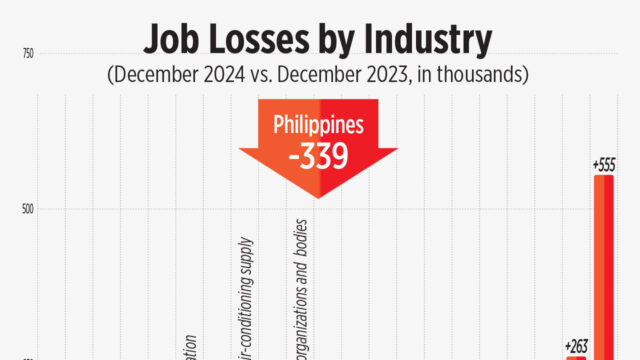
Job Losses by Industry (December 2024 vs December 2023)

PHILIPPINE UNEMPLOYMENT eased to 3.1% in December amid a surge in hiring in the transport and storage sector, bringing the full-year average to a record-low of 3.8%, according to the statistics agency. Read the full story.

Untitled

Film September 5 offers new perspective on Olympic tragedy

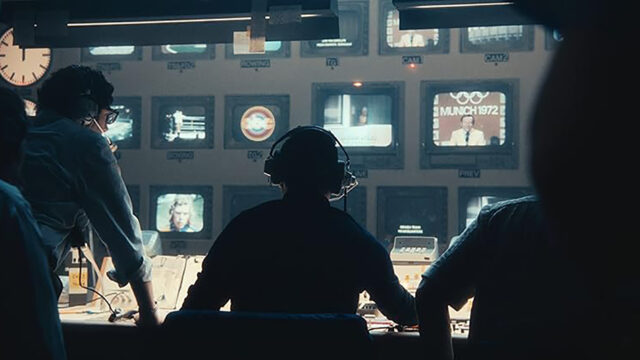
A scene from September 5.

LONDON — Drama thriller September 5 takes a new approach to tell the true story of the 1972 Munich Olympic massacre.

Directed by Swiss filmmaker Tim Fehlbaum and boasting an accomplished ensemble cast including Peter Sarsgaard, John Magaro, Ben Chaplin, and Leonie Benesch, the film follows the ABC Sports broadcasting team as they pivot from Olympics programming to covering the developing news story.

On Sept. 5, 1972, members of the Israeli Olympic team were taken hostage at the poorly secured athletes’ village by Palestinian gunmen from the Black September group.

Within 24 hours, 11 Israelis, five Palestinians, and a German policeman were dead after a stand-off and subsequent rescue effort erupted into gunfire.

For the first time ever, the coverage of the attack, and the Games which continued as the events unfolded, played out live on television, watched by millions of people. One rescue attempt had to be called off when police officers realized it was being shown live and watched by the attackers.

“We’re living in this hyper-sensationalized media atmosphere, and this was kind of the beginning of it. These were people who were just doing their job, not realizing that they were changing the way we consume news forever,” said Magaro, who plays Geoffrey Mason, the real-life head of the ABC Munich control room, at the film’s London premiere on Tuesday.

September 5 is almost entirely set in the ABC control room, with outside events playing on its multiple monitors. The film team wove in real footage and assembled still functioning studio equipment of the day to ensure an authentic look.

“Some of these scenes in the Olympic Village we recreated, also out of respect, because we didn’t want to show anyone who lost their life on that day, and then we mixed all of this together,” said Mr. Fehlbaum.

“Tim was absolutely passionate about it being as accurate as possible because it was a true story. Everything worked. They built the studio on ABC’s original blueprints,” said Mr. Chaplin.

The movie also depicts the moral dilemmas the team faced as the crisis deepened.

“All the questions like, what do we show, is there such a thing as a neutral standpoint, is it helpful to watch potential violence live, the film raises all of these questions,” Benesch said.

“The questions they had to ask themselves are still very relevant for any journalist and also for all of us,” said screenwriter Mortiz Binder. “Most of us have a smartphone, have social media, so all these ethical questions are questions for everybody.”

September 5 is produced by Hollywood star Sean Penn and its writers Binder, Fehlbaum, and Alex David are up for a best original screenplay Oscar at next month’s Academy Awards. — Reuters

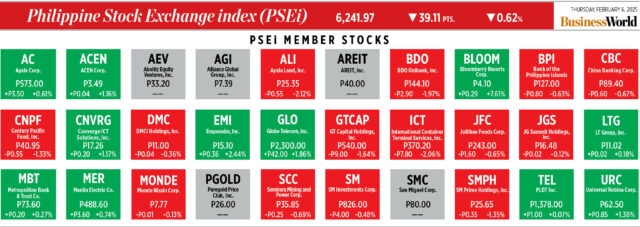
How PSEi member stocks performed — February 6, 2025

Here’s a quick glance at how PSEi stocks fared on Thursday, February 6, 2025.


Low onion inventories trigger import order for 4,000 MT

PHILIPPINE STAR/MIGUEL DE GUZMAN

THE Department of Agriculture (DA) said it approved imports of 4,000 metric tons (MT) worth of onions to ensure stable prices with stocks running low.

In a statement, Agriculture Secretary Francisco P. Tiu Laurel, Jr. said that the DA will permit shipments of 3,000 MT of red onions and 1,000 MT of white onions for delivery within two weeks.

He added that the imports will plug the supply gap until the domestic harvest comes in.

“We will not risk a potential shortage that traders could exploit to drive up prices, as we saw in the past. We do not want a repeat of the 2022 crisis,” Mr. Laurel said.

In 2022, onion prices surged to as much as of P700 per kilo due to a shortage of domestic supply and delayed imports.

Last year, the DA allowed white onion imports totaling 17,000 MT, after delaying imports until August due to a bumper harvest.

The DA has said that the inventory of red onions from last year was expected to last until February, when the harvest starts.

According to Bureau of Plant Industry (BPI), the red onion inventory was 2,325.86 MT, with white onion stocks at 70,161 MT as of Jan. 31.

Monthly consumption of red onions was estimated at 17,000 MT and white onions 4,000 MT, the BPI said.

“While we were assured during our consultative meetings that there is still ample supply of onions, the BPI recommended minimal imports to prevent major price spikes,” BPI Director Gerald Glenn F. Panganiban said.

“Also, due to the typhoons that hit late last year and prevalence of pests and disease, these imports are meant to be a buffer for possible supply gaps. This move is a preemptive measure,” Mr. Panganiban added.

He said that the agency is projecting the onion harvest to reach 33,000 MT by March.

In 2024, onion production rose 4.7% to 264,322 MT, according to the Philippine Statistics Authority. — Adrian H. Halili

Meat traders push to distribute MAV quotas

PHILIPPINE STAR/ EDD GUMBAN

MEAT IMPORTERS are calling on the Department of Agriculture (DA) to allocate the pork and poultry quotas for the minimum access volume (MAV), which should have been released during the first week of January.

The Meat Importers and Traders Association (MITA) said in a letter to the DA: “the quotas for the MAV year 2025 have not been distributed. This is the second time this has happened.”

The group added that since the start of the quota year on Feb. 1, the Systematic Distribution Process (SDP) has not been conducted.

“The SDP had been scheduled, rescheduled and then canceled until further notice,” it added in its letter to Agriculture Secretary Francisco P. Tiu Laurel, Jr.

It said that the delay in SDP may disrupt the meat trade as happened last year, when MAV allocations were also delayed.

“Importers are concerned about a repeat of last year, and orders will be put on hold, delayed or canceled,” MITA added.

Last year, the DA also postponed the distribution of MAV allocations.

“MITA strongly urges DA to allow MAV Secretariat (MAVSEC) to proceed with the distribution of the Beginning Year Pool,” it said.

“In the meantime, MAVSEC should be instructed to issue Provisional MAVICs (MAV import clearances) to ensure continuity of trade,” MITA added.

MAV grants trading partners guaranteed market access, subject to volume quotas. The MAV system is a feature of the World Trade Organization’s trading system.

The Philippines has committed to admit imports of 54,210 metric tons (MT) of pork and 23,500 MT of  chicken. — Adrian H. Halili

Seizures of counterfeit goods hit P41 billion in 2024 led by apparel, shoes, bags

NBI EXEC. OFFICER Intellectual Property Rights Division Rodolfo Ignacio serves a subpoena to Chinese seller of Jiangsu Huihong Machinery Manufacturing Co., Ltd. who is allegedly exhibiting and selling counterfeit auto parts at a car show in Pasay City on July 6, 2024. — PHILIPPINE STAR/ EDD GUMBAN

THE National Committee on Intellectual Property Rights (NCIPR) seized P40.99 billion worth of counterfeit products in 2024, the Intellectual Property Office of the Philippines (IPOPHL) said.

“It is increasing year by year, and I would like to attribute it to the efforts of law enforcement agencies,” IPOPHL Deputy Director General Nathaniel S. Arevalo told reporters on the sidelines of the Japan External Trade Organization (JETRO) Seminar on Thursday.

“It’s an all-time high, (involving) our usual items like apparel, shoes, bags, food supplements, and toys. But most of them are apparel and shoes,” he added.

According to IPOPHL, the estimated value is 52% higher than the P26.99 billion worth of counterfeit products seized in 2023.

“Last year’s haul from the Bureau of Customs (BoC) accounted for the lion’s share, totaling P34.70 billion,” it added.

Two of the biggest operations of the BoC were a raid in Binondo which yielded P11 billion worth of counterfeit luxury goods, and an operation at a Divisoria mall, which resulted in the confiscation of counterfeits valued at P7 billion.

“BoC’s haul was followed by seizures by the National Bureau of Investigation and Philippine National Police estimated at P3.42 billion and P2.83 billion, respectively,” IPOPHL said.

“Meanwhile, the Food and Drug Administration seized P30.20 million worth of counterfeit drugs and health-related products,” it added.

Mr. Arevalo said the agency is looking to further educate the public on IP issues and will seek amendments to the Intellectual Property Code.

“(We will continue) educating the public about the dangers of counterfeiting because it is not just an issue of fake goods, but also the dangers to public safety of counterfeit health supplements, medicines, and devices,” he said.

He said the proposed IP Code amendments would give the agency “more teeth in the fight against piracy and counterfeiting.”

On Monday, the IPOPHL, together with other members of the NCIPR, attended the JETRO Seminar for law enforcement agencies.

“This event is meant to enhance the competence and skills of the law enforcement agencies as far as the identification of the fake products,” he said.

“That’s why the brand owners from Japan are here, because they are the experts,” he added. — Justine Irish D. Tabile

Full budget transparency seen taking time

BW FILE PHOTO

THE PHILIPPINES is working on initiatives like procurement reform to achieve budget transparency, but it will take time to mainstream these initiatives, Budget Secretary Amenah F. Pangandaman said.

Ms. Pangandaman, who also chairs the Philippine Open Government Partnership (OGP) Steering Committee, said: “It’s a long way to go before we can actually mainstream this across all National Government agencies.”

OGP is a global initiative to make governments more transparent, accountable, and responsive to citizens. It is staging its regional convention in Manila this week.

The Philippines amended a decades-old procurement law via the New Government Procurement Act, which sets up an online marketplace where agencies can directly procure supplies and equipment from vetted suppliers.

“We have a medium like this for us to be able to push forward our commitment to open government,” she said.

In the Philippines, six local government units including South Cotabato, Baguio City, Quezon City, Tagbilaran City, Borongan City and the Municipality of Larena, Siquijor actively participate in the OGP Local Program.

South Cotabato Governor Reynaldo S. Tamayo, Jr.  said two pilot OGP projects are open contracting and open monitoring.

“In open contracting, we involve civil society organizations in the bidding process. They are part of the Bids and Awards Committee. They observe the process of bidding online,” Mr. Tamayo said.

He also noted that the province created a Monitoring Committee, of 11 members, with a chairman and half of the committee belonging to civil society organizations.

“They are the ones who scrutinize, and monitor the project, and if the contractor has a 15 negative slippage or above, they cannot bid for another project for a year. They will be banned in our province,” Mr. Tamayo said.

President Ferdinand R. Marcos, Jr., who was attending the OGP event, said that the country can only truly participate in governance if they have access to information.

“This access is made possible by government transparency, digitalization, and the institutionalization of the Freedom of Information (FoI) through legislation, which is a constitutionally recognized principle,” Mr. Marcos said.

He also said that the FoI is one of the many ways that the Philippines has been keeping its commitments to OGP.

Hosted by the Philippine Open Government Partnership chaired by the DBM, the 2025 OGP Asia and the Pacific Regional is taking place between Feb. 5 and 7. — Aubrey Rose A. Inosante

ADVERTISEMENT
ADVERTISEMENT