Home Blog Page 196

Performers take a new stage at the Manila Improv Festival


BACK TO DELIVER more entertainment and laughter this year is Asia’s biggest festival for improvisational theater and comedy — the Manila Improv Festival (MIF).

Now that improv comedy is breaking through to the mainstream with the success of SPIT Manila and other groups’ short-form videos online, the festival aims to make improvisation more accessible to a wider, more diverse audience. For its seventh year, it will feature over 70 improv acts from all over the world, performing from March 25 to 29 at The Proscenium Theater in Rockwell, Makati.

Improvisational theater, or improv, is a form of theater where scenes and stories are created spontaneously and, on the spot, inspired by audience suggestions.

“Manila Improv Fest was initiated by SPIT in 2012 and from then on, we’ve been celebrating it every two years,” festival director Irvinne Redor said during the launch on March 4 at The Proscenium Theater.

“We’re very excited to bring it to a very nice venue here at Rockwell,” he said, noting that this will be the first time it will be home to improvisational comedy.

Mr. Redor added that the festival aims to be “a global meeting point for improvisers that also provides a platform to showcase Filipino talent in the performing arts.”

With the theme of “Rise to the Moment,” the audience can expect improv groups from the Philippines and over 20 other countries. SPIT Manila, together with dance group Galaw.Co Dance Theater, and Drum Circle PH, will open the festival at the Proscenium Main Stage, while Filipino improv groups Housekeeping Improv, Noted with Thanks, Isprikitik Improv, and Buwan ng Wika Improv will perform at The Proscenium Black Box Theater and other pocket locations.

Notable international improv groups performing at the MIF 2026 include Oshow (Japan), Landry and Summers (US), Formosa Improv Group (Taiwan), Beijing Improv (China), Improv Lore (India), The Joy Riders (Australia), Imfrog (South Korea), and Les Musicables (Singapore).

“For most improvisers, the art form is so close to their heart — almost like home,” said MIF artistic director Karl Echaluse.

“That’s why we’re so excited to host again this year’s Manila Improv Festival as we get to experience our home as well as bring together our improviser friends from all over the world and share our art here to Filipino audiences,” he explained.

The festival will also feature over 30 improv workshops in several locations in Makati, to be facilitated by local and international improvisers spanning a wide range of improv-related topics.

For Mr. Redor, it was vital that they present the Manila Improv Festival to showcase the vibrant range of improv talent out there, especially since they were unable to hold the event last year.

“Last year, there was a boom in the theater industry and there were so many shows, so we weren’t able to secure a venue,” he shared. “We tried to make sure this would happen in the first quarter of 2026.”

This year’s Manila Improv Festival is produced by Sanghimig Performing Arts and Travel Consultancy in association with SPIT Manila. Show tickets and limited workshop passes are currently on sale at manilaimprovfestival.com/tickets. — Brontë H. Lacsamana


ACEN income plunges 60% as output fails to offset soft spot prices

BW FILE PHOTO

ACEN CORP.’S consolidated net income plunged by 60% in 2025 as lower power prices in the spot market and operational headwinds offset a double-digit increase in renewable energy output.

The Ayala-led energy company reported that its consolidated net income declined to P3.8 billion from P9.36 billion the previous year, while statutory revenues dropped 14% to P32 billion.

“Profitability was weighed down by softer spot prices in the Philippines and Australia, weaker solar irradiation in key geographies, and loss of generation from offline wind assets in Northern Luzon, most of which have since resumed operations,” the company said in a statement on Monday.

Despite the financial contraction, the firm delivered 7,009 gigawatt-hours (GWh) in attributable renewable energy output, a 24% increase driven primarily by new operating assets in Australia and Lao PDR.

International renewable output surged 34% to 5,143 GWh, whereas power production in the Philippines remained relatively flat, increasing by only 2% to 1,866 GWh following repairs to wind turbines in Ilocos Norte.

The company’s bottom line was specifically impacted by a 28% decline in spot prices to P3.6 per kilowatt-hour, which translated to a 7% drop in attributable revenues to P36 billion.

ACEN President and Chief Executive Officer Eric T. Francia said that the macro and sectoral headwinds reflect “the complexities of today’s energy landscape and the long-term energy transition.”

“Despite these headwinds, our core business and long-term outlook remain resilient. As we look ahead, we will continue to prioritize increasing our contracted capacity and accelerating investments in energy storage, while ensuring steady, continued progress on our pipeline projects,” he added.

Group Chief Finance Officer and Chief Strategy Officer Jonathan Back added that the focus for 2026 will remain on “precise execution — operational efficiency, balance sheet strength, and project delivery” to navigate market uncertainties.

In a separate move to bolster its portfolio, ACEN’s board approved additional funding of P1.35 billion for its solar project in Palauig, Zambales.

The project is slated for expansion to increase its capacity to 420 megawatts (MW), contributing to the company’s total attributable renewable energy capacity of 7.1 gigawatts.

At the local bourse on Monday, shares in the company dropped 4.31% to P2.44 apiece. — Sheldeen Joy Talavera

The Trust Economy Flywheel: A governance imperative

FREEPIK/WAYHOMESTUDIO

The boardroom case for International Women’s Day’s theme ‘Give to Gain’

If the name International Women’s Day (IWD) almost made you click away — good. You are exactly who needs to read this.

Not because of optics. And not merely because the World Economic Forum’s “Global Gender Gap Report 2025” puts the timeline to closing the gender gap at 123 years globally — longer still for South Asia — a figure that should unsettle any strategist in the room. But because the framework Josiah Go and I have been developing around the Trust Economy Flywheel reframes this conversation entirely. What presents itself as a gender issue is, at its core, a governance one.

IWD 2026’s global theme, “Give to Gain,” says it plainly. Strip away the ceremony and what remains is a compounding strategic advantage that most organizations are forfeiting right now.

TRUST ECONOMY FLYWHEEL AND COMPETENCIES
The Trust Economy Flywheel is a framework for rebuilding moral leadership and brand integrity, rooted in the Filipino cultural interplay of loob (inner integrity) and labas (outward expression). It begins where most strategies refuse to start: inside.

Loob rests on three disciplines: humility or stewardship — being self-aware that you hold trust on behalf of others, not for yourself; cultural literacy — understanding values like hiya, delicadeza, and utang na loob (shame, propriety, and debt of gratitude) — not as liabilities but as moral compasses; and empathy, not sympathy that observes, but presence that participates and listens without assumption.

Transparency is the bridge — making intentions and reasoning visible as decisions are made, building trust into systems rather than personalities. It connects inner integrity to outer credibility.

Labas is where trust becomes visible: through authenticity (coherence between message and messenger), consistency (reliability in the ordinary, not just in crisis), and accountability (the courage to repair rather than spin). Trust is proven in how we repair when we fall short.

Here is the IWD connection that rarely gets said plainly: women have been practicing this flywheel for generations — in households, communities, and organizations — often without the title or budget to match. Stewardship. Cultural navigation. Empathetic leadership. Showing up when it is not rewarded. These are not soft skills. These are the precise competencies the Trust Economy demands.

McKinsey’s “Diversity Matters Even More” (2023) found companies in the top quartile for board-gender diversity are 27% more likely to outperform financially, and that the business case has more than doubled over the past decade. The IFC found female-led SMEs in Southeast Asia are twice as likely to adopt digital tools when given access to capital and training (IFC, 2023). The flywheel spins faster with the people who already know how to build trust from the inside out.

PINOY CULTURE AS FLYWHEEL’S MORAL ENGINE
The idea of Kapwa, formalized by psychologist Virgilio Enriquez in Sikolohiyang Pilipino (1994), describes the self as inherently shared with others. Your success and mine are the same variable. It gives the Trust Economy Flywheel its moral engine: when you lead from loob with genuine regard for the other, trust is not manufactured. It is recognized.

The haligi ng tahanan (pillar of the home) was historically a woman not because men were absent, but because women were doing the invisible architecture of community trust. Harvard sociologist Robert Putnam confirms this at scale: high social capital communities consistently outperform on economic and social metrics. Scale that to a company, or a country, and the math gets compelling fast.

GOOD INTENTIONS ARE THE FLOOR, NOT CEILING
Here is the uncomfortable truth decades of data have been quietly telling us: we have known about women’s contributions to performance, innovation, and trust-building for a very long time. The business case is not new. And yet the needle moves with frustrating slowness. Why? Because we have been relying too heavily on goodwill.

In a MAP Insights piece I published in January, I argued that inclusion stalls not because leaders do not care, but because systems are not designed to consistently translate commitment into results. Good intentions, such as mentoring, sponsoring, and modeling inclusive behavior, matter. But they are fragile, fading under economic pressure or leadership transition. A culture built on goodwill is only ever one reorganization away from regression.

Power in organizations shows up in allocation: who controls large budgets, who is placed in roles with significant operational exposure, who is trusted with turnaround assignments, and who is given room to recover when things go wrong. Representation at the top is not the same as access to where enterprise-defining decisions are made. That gap, i.e., between visible inclusion and structural power, is where the needle stops.

Good intentions opened the conversation. Governance is what closes the gap.

THE GIVE TO GAIN THESIS, PLAINLY
The UN Women’s Gender Snapshot 2025 projects that investing in women could add $4 trillion to the global economy by 2030 — and $342 trillion cumulatively by 2050. The World Bank is equally stark: closing the gender gap in labor force participation alone could deliver a 20% increase in GDP per capita on average. These are not distant projections. They are the cost of what we are forfeiting right now.

Kapwa, the Filipino understanding that your flourishing and mine are inseparable, is the moral foundation of the Trust Economy. The flywheel only reaches full velocity when those who have been practicing loob-driven leadership all along are given the platform, authority, and resources to lead at scale.

That requires a deliberate choice: give access, give credit, and embed both in governance. When diversity is designed into how decisions are made and not just who sits at the table — the loob deepens, transparency becomes structural, and labas stops being performance and starts being proof. That is when the Trust Economy Flywheel stops being a framework on a slide and becomes the engine of your organization. When the flywheel turns that way, “Give to Gain” stops being a theme and becomes a strategy you can measure.


Carolina “Chiqui” Escareal-Go is a member of the Management Association of the Philippines Ease of Doing Business Committee. She is the CEO of Mansmith and Fielders (www.mansmith.net). She is also a marketing anthropologist and consumer behavior strategist. She is a fellow of the Institute of Corporate Directors, and former chair of the Women’s Business Council Philippines. She will open the Mansmith Market Masters Conference on March 17 at SMX Aura Taguig City with the topic: “The Filipino Trust Economy.”

map@map.org.ph

chiqui.mansmith@gmail.com

Manulife Philippines bets on diversified investments to sustain profits

BW FILE PHOTO

MANUFACTURERS Life Insurance Co. (Phils.), Inc. (Manulife Philippines) is leaning on investment diversification to support profitability this year after a decline in premium income last year, as global market volatility intensifies amid the Middle East war.

Premiums fell 9.27% to P14.39 billion in 2025 from 2024, according to Insurance Commission data. Net income also slipped 10.32% to P1.97 billion.

“Before the recent crisis, we were trending quite well,” Manulife Philippines President and Chief Executive Officer Rahul Hora told a forum on Monday, citing a resilient Philippine economy.

He said the insurer is prioritizing profitability after restructuring its portfolio last year, exiting unprofitable products and shifting focus from group life to individual life insurance.

“We are dropping out of those lines of business because of profitability issues and there are other lines of business where we are focusing more on,” Mr. Hora said.

The insurer is also adjusting its investment strategy to mitigate risks from surging global oil prices and potential inflationary pressures that could dampen demand for life insurance.

“If there is an increase in prices, there is a possibility that it will impact [demand for life insurance],” Mr. Hora said. “Our responsibility is to make people understand how to prioritize their financial spending.”

The company plans to launch policies and funds emphasizing long-term savings and diversified investments.

Mr. Hora stressed the importance of avoiding concentration in any single geography or asset class, given the unpredictability of economic conditions.

“We are in an environment where surprises are always around the corner,” he said. Predicting which region or asset class will deliver strong returns is increasingly becoming difficult, he added.

Diversification helps ensure customers are not overly exposed to any single risk, Mr. Hora said. — AMCS

Entertainment News (03/10/26)


Spotify awards Filipino podcasts

PODCASTING in the Philippines is entering a new phase defined by sustained audience growth, fan communities, and creator-owned brands built for the long term. This year, The KoolPals and Dear MOR received Spotify’s Creator Milestone Award, a global recognition program honoring their journey and performance. Evaluated quarterly, the global award recognizes the shows that build consistent, returning audiences over time. Other podcasts recognized by the program include Diary of a CEO with Steven Bartlett and Critical Role.


Sponge Cola, Gigi De Lana collaborate on single

OPM BAND Sponge Cola and artist Gigi De Lana have released their first collaborative single, “Naghihilom.” Alongside the track is an official music video. It is about healing and the quiet, complicated aftermath of heartbreak. The track is anchored by Sponge Cola’s signature alternative rock sensibility, unfolding through textured instrumentation and a slow-burning arrangement, with Gigi De Lana’s restrained yet deeply felt vocal performance. It is out now on all digital music streaming platforms.


IKEA Philippines donates soft toy sales

BABY Panchi or Punch, a macaque living in Japan’s Ichikawa Zoo, captured the world’s hearts after being rejected by his mother at birth and forming an emotional bond with an orangutan soft toy, IKEA’s Djungelskog. To pay homage to this, IKEA Philippines has launched Project Panchi Akap Pabalik, where up to P1 million from soft toy sales this April and May will be donated to support key social and environmental causes. For every soft toy purchased during the campaign period, P50 will go toward IKEA’s initiatives in partnership with the Better World organization.


The Ransom Collective drops first release in 4 years

OPM band The Ransom Collective has returned with a new single, “Tongue Tied,” their first official release after a four-year hiatus. The bossa nova-infused indie pop track aims to be “a gentle reopening of a well-worn photo album: familiar, warm, and unexpectedly alive.” According to the band, the song draws inspiration from the simple but profound feeling of becoming “tongue-tied” in the presence of someone new. It is out now on all digital music streaming platforms.


Radha performs live at Quezon Club

THIS March, the Quezon Club at Solaire Resort North is bringing 1990s Original Pilipino Music icon Radha Cuadrado back into the spotlight. Known as the powerhouse vocalist of the R&B and hip‑hop group Kulay, Radha will be performing nostalgic favorites such as “Burn,” “Vibestation,” and “Chapter What?!”. The shows, set for March 18, 20, 25, and 27, will run from 7:45 to 8:45 p.m. Tables can be reserved at quezonclub.com, or via 8888-8888 and snrestaurantevents@solaireresort.com.


James Reid releases music video about traffic

FILIPINO celebrity James Reid has dropped a new music video for his latest single, “Traffic,” released under Careless Philippines and Sony Music Entertainment. Caught in the gridlock of Metro Manila, the video finds Reid driving around, visibly stressed and tired, yet holding on to the thought that the moment, like traffic itself, will soon pass. The music video was helmed by Jonathan Tal Placido of Philippine-based production house Toothless, with creative direction by Issa Pressman. It marks the singer’s first official 2026 single.


Visa, RCBC offer ticket presale for Laufey concert

VISA and RCBC are bringing two-time Grammy-winning artist Laufey closer to her fans in the Philippines through an exclusive concert ticket presale for RCBC Visa credit cardholders for her upcoming A Matter of Time Tour. RCBC Visa credit cardholders can access selected ticketing platforms until March 10, 10 a.m. Laufey will perform in Manila for two nights on May 26 to 27 as part of her Asia Pacific tour, where Visa serves as the Official Payment Partner.


Shakira, Beéle collaborate on new single

GRAMMY award-winning artist Shakira and rising Colombian star Beéle have released their new track “ALGO TÚ.” Produced by A.C., Flambo, Shakira, and Beéle, the track is out now via Sony Music Latin/5020 Records. Their range of styles blend on the track, delivering a Latin and Afro-fusion song with a nod to autochthonous instruments such as the Colombian gaita (pan flute), evoking the city of Barranquilla where both Shakira and Beéle were born. It is out now on all digital music streaming platforms.


Anko reveals Easter event lineup

AUSTRALIAN home and lifestyle brand Anko is hosting free in-store activities and dropping an affordable Easter collection. Every weekend from 2 to 5 p.m., Anko Club parents can treat their kids to Easter coloring sessions across all Anko stores. Little artists who post their work on social media will receive an exclusive Easter goodie bag. Digital copies of the coloring sheets are also available for free download from Anko’s website. Anko will also have a face painting activity at the Glorietta Activity Center on April 4 and 5.


Lags returns with new single

AFTER taking a year-long hiatus from releasing music, singer-songwriter Lags has marked his return with the new single “Pansamantala.” Currently managed by GLXY Talent Management and signed under Universal Records, he expresses the painful reality of loving someone who ultimately chooses their past over the present in an acoustic ballad. It is out now on all digital music streaming platforms.


A1 announces return to Manila in October

BRITISH-Norwegian pop band A1 is set to perform for their Filipino fans once again, in Cebu on Oct. 16 at the Waterfront Cebu City Hotel & Casino, and in Manila on Oct. 17 at the New Frontier Theater in Quezon City. Following their successful Valentine’s tour in the same cities in February 2025, the group, consisting of Paul Marazzi, Christian Ingebrigtsen, Mark Read, and Ben Adams, will return to deliver the soulful harmonies of “Like a Rose,” “Everytime,” and “Heaven by Your Side.” With more than five visits to the Philippines under their belt, A1 has evolved from international idols into honorary locals. Tickets for both shows officially go on sale on March 13, 12 p.m., via SM Tickets & TicketNet.


Harry Styles releases new album

THE fourth studio album of British pop star Harry Styles, KISS ALL THE TIME. DISCO, OCCASIONALLY. is out now on all digital music streaming platforms. It marks his first music release since 2022’s record breaking album, Harry’s House, which was named Album of the Year at the 2023 Grammy Awards. The new 12-track album was written by Mr. Styles and executive produced by Kid Harpoon via Erskine/Columbia Records.

AC Logistics, GMI open Davao cold storage facility

ACLOGISTICS.COM.PH

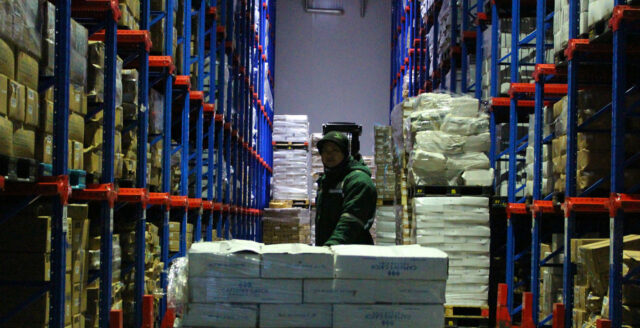
AC LOGISTICS Holdings Corp. and Glacier Megafridge, Inc. (GMI) have opened a new cold storage facility in Panabo City, Davao del Norte, as part of a strategic push to expand their logistics footprint in Mindanao.

The facility, which is located within the Anflo Industrial Estate, is managed by GMAC Logitech Refrigeration Corp. (GMAC), a joint venture between the two companies, AC Logistics said in a statement on Monday.

With a capacity of 11,798 pallet positions, the property is considered among the largest and most advanced cold storage facilities in the region.

The venture aims to modernize logistics operations for a wide range of industries, including food processing, agriculture, aquaculture, retail, and manufacturing.

The companies said that the facility is designed to serve “micro, small, medium, and large enterprises” to “broaden cold chain capacity, extend network coverage and enhance service delivery nationwide.”

AC Logistics President and Chief Executive Officer (CEO) Erry Hardianto highlighted the facility’s role in addressing systemic agricultural issues.

“Post harvest loss continues to be a pressing supply chain challenge in the Philippines,” he said.

“Through our cold storage technology and end-to-end logistics solutions, we are helping minimize spoilage and preserve the value of what our farmers and producers work so hard to harvest.”

For his part, GMI CEO Arturo C. Yan noted that the facility would “help position the Philippines as a regional trade hub.”

GMI, which was founded in 2005, utilizes Japanese refrigeration technology across its 12 facilities nationwide, maintaining a total capacity of 75,000 pallet positions. 

The expansion follows AC Logistics’ acquisition of an 84% stake in GMI, which was announced in January.

AC Logistics is a subsidiary of the Ayala group, a conglomerate with interests in banking, telecommunications, real estate, and renewable energy.

On Monday, shares in Ayala Corp. fell by 6.88% or P37, closing at P501 apiece. — Beatriz Marie D. Cruz

Lesson of the Iran war: There is no substitute for fossil fuels

The continued bombing of Iran by the US and Israel has adversely affected oil and gas prices. There is no problem when it comes to the oil and gas supply; the problem is in their delivery and export from the Middle East to Asia, Europe, and the rest of the world.

It is often argued by the climate establishment that the world’s oil, gas, and coal prices should become more expensive via the imposition of carbon, excise, and other related taxes since then people and countries will be forced to use more solar, wind, and other sources of renewable power.

Now that hydrocarbon prices are high, businesses and energy companies are supposed to run towards more investments in and use of more solar and wind power, but this is not happening. Companies instead turn to coal to keep the lights and air conditioning on.

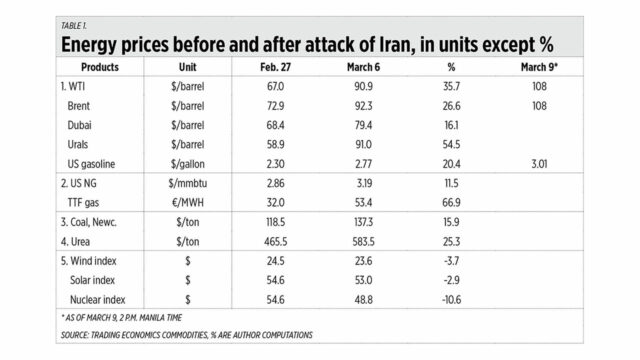
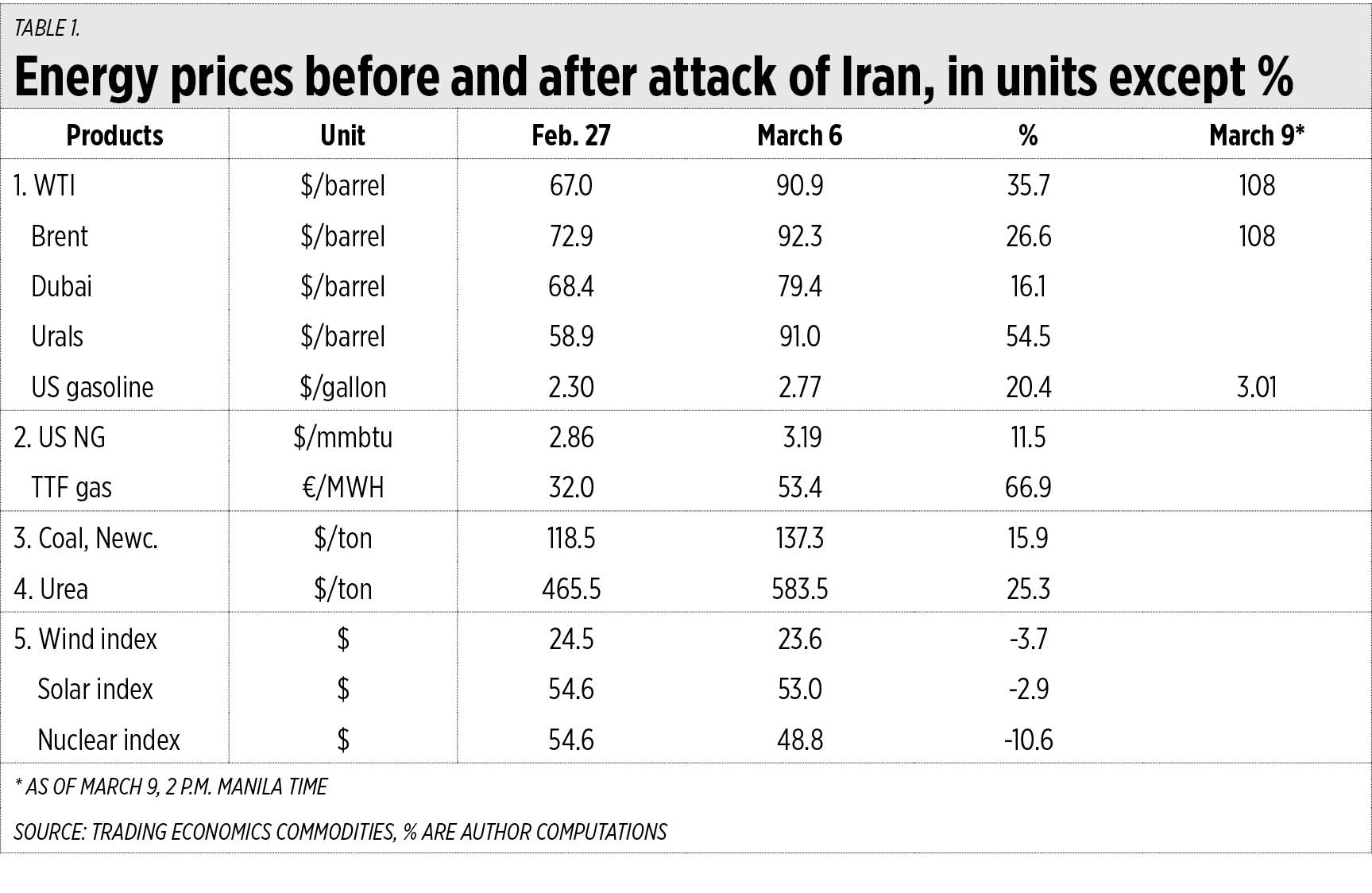
From Feb. 27, or day before the bombing of Iran, to March 6 or after seven days of war, crude oil (WTI, Brent, Dubai, Urals) prices have gone up from 16% to 54%. Natural gas prices have a wider range of increases, with US natural gas increasing by 12% while Europe’s TTF gas increased by 67%.

Meanwhile, solar-wind energy indices declined by 3-4% — they did not increase as expected. Even the nuclear index declined by 11%. It was the price of coal that experienced an increase of 16% (see Table 1).

Which shows an inconvenient truth for the climate establishment — the substitute for fossil fuels/hydrocarbons are also fossil fuels/hydrocarbons. If not hydrocarbons from the Middle East, then hydrocarbons from Russia, Australia, or Indonesia, etc. It is delusional to think that solar/wind can substitute for fossil fuels.

Even if people use fully electric vehicles like those of BYD or Tesla, they still using oil-based products in the car paint, the dashboard, ceiling and interiors, the leather seats, the electrical wiring insulation, the synthetic rubber tires, polymers and carbon fiber, etc., even the road asphalt! These are among the thousands of oil byproducts.

We should expand exploration and development for our domestic oil and gas supply. We should have more offshore oil-gas development instead of irrational and expensive offshore wind.

I checked the movement of crude oil trade in 2024, and it showed the following:

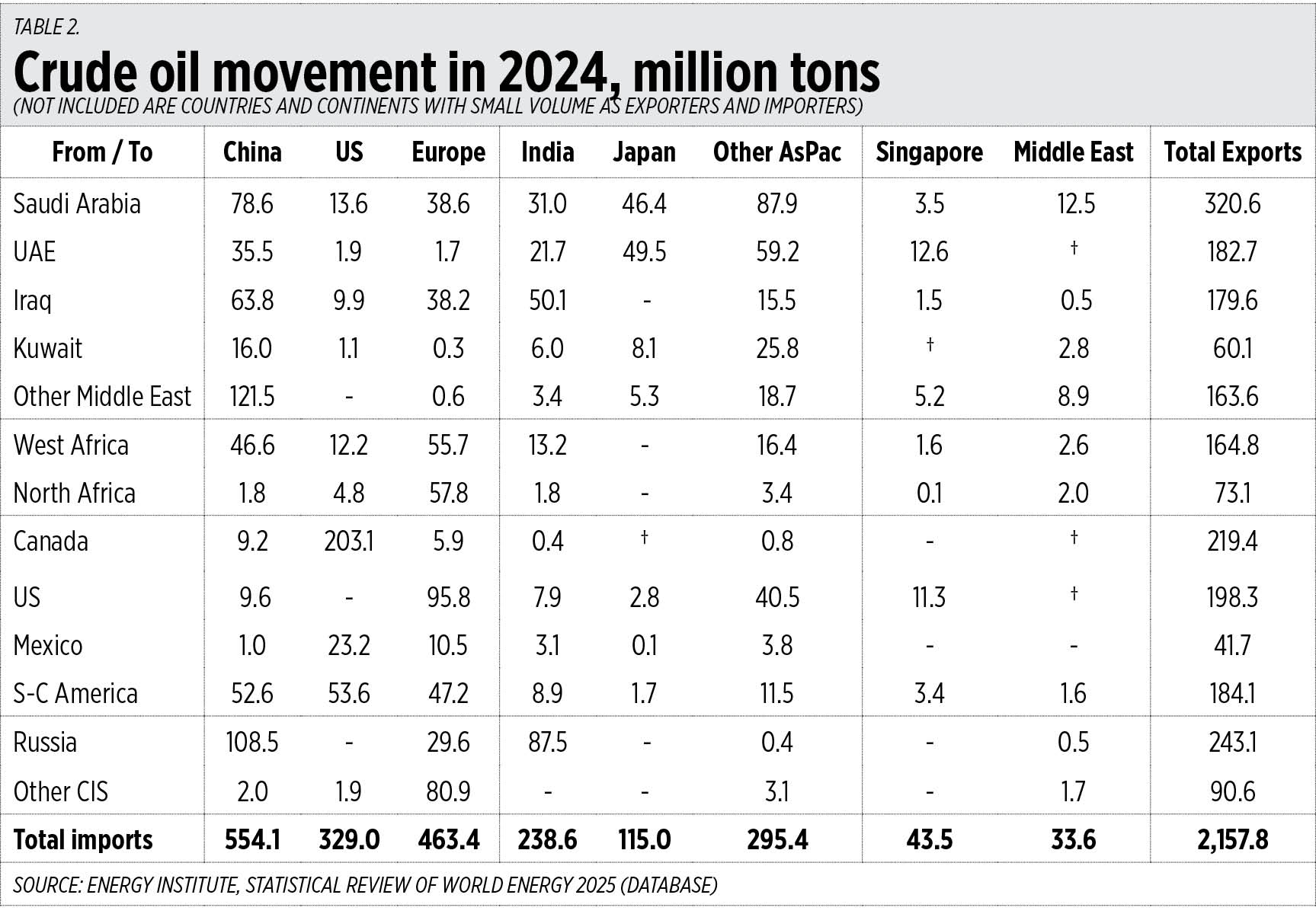
1. The largest exporters of crude oil are Saudi Arabia, Russia, Canada, the US, the United Arab Emirates, and Iraq. Iran has no official record because of the long-standing sanctions against it, but it kept exporting crude via illicit trade.

2. The largest importers of crude oil are China, Europe, the US, India, Japan, and other Asia-Pacific nations (Taiwan, Korea, Australia, etc.).

3. The US is the largest producer of crude oil, but its oil is mostly what is called light/sweet. They still need to import heavy/sour oil for their refinery production.

4. China’s main source of crude imports is Russia, followed by Saudi Arabia, Iraq, the UAE and other nations from the Middle East (see Table 2).

So, it seems that the biggest loser in the continuing war, aside from Iran, is China since 57% of its total crude oil imports in 2024 came from the Middle East, and now the delivery is choked. The US, especially under Trump, has an implicit goal of disallowing China from becoming at par with it in the level of industrialization and political-economic influence on global affairs.

PEPIF 2026
The Philippine Electric Power Industry Forum (PEPIF) 2026 will be held on March 12 at John Hay Convention Center in Baguio City. This is a big annual conference organized by the Independent Electricity Market Operator of the Philippines (IEMOP).

Keynote and plenary speeches will be held in the morning, then a panel discussion is scheduled for the afternoon which is focused on the theme, “The Energy Trilemma in the Philippines: Pathways to Security, Sustainability and Equity.” The panel speakers will be Energy Undersecretary Mylene Capongcol, Energy Director Luningning Baltazar, Energy Regulatory Commission Director Sharon Montaner, Philippines Independent Power Producers Association Chairman Roman Miguel de Jesus, Ateneo Economics Professor Fernando Aldaba, and the National Grid Corp. of the Philippines’ Redi Allan Remoroza.

I will be moderating this panel of articulate speakers, industry players, and regulators. I hope to bring out the best ideas from each of them.


Bienvenido S. Oplas, Jr. is the president of Bienvenido S. Oplas, Jr. Research Consultancy Services, and Minimal Government Thinkers. He is an internationa fellow of the Tholos Foundation.

minimalgovernment@gmail.com

PHL bank bonds may underperform

FREEPIK

CREDITSIGHTS kept its “market underperform” recommendation on most Philippine bank dollar bonds, citing weaker growth expectations after last year’s flood control graft scandal and continued asset-quality pressures.

The research firm kept underperform ratings on BDO Unibank, Inc. (BDO) and Bank of the Philippine Islands (BPI) from a relative value standpoint. It also assigned underperformance to Security Bank Corp., Rizal Commercial Banking Corp. (RCBC) and Philippine National Bank (PNB) due to a combination of weaker fundamentals and tight relative-value spreads. Metropolitan Bank & Trust Co. retains a market perform rating, CreditSights said in a report dated March 9.

CreditSights expects BDO, BPI and Metrobank dollar bonds to trade largely flat against the State Bank of India’s dollar issuance, citing India’s stronger economic momentum and healthier asset quality.

The report also notes that Philippine banks’ loan profitability might face less pressure from policy rate cuts this year.

Security Bank’s dollar bonds are expected to trade at a 20-30 basis points discount relative to BDO, reflecting thinner capital and higher credit costs from its rapid retail growth.

RCBC’s dollar bonds are expected to face a similar spread, as aggressive expansion into higher-yielding but riskier retail and small and medium enterprise segments has weighed on profitability.

CreditSights highlighted RCBC as having the weakest earnings performance among its covered banks.

“Management said risk-weighted asset growth will be more targeted and recalibrated going forward to keep the common equity Tier 1 ratio above 13% (at 13.6% as of the fourth quarter of 2025), but we see some execution risk as aggressive lending at RCBC has typically outpaced internal capital accumulation, leading to a decline in capital ratios over time,” it said.

PNB’s dollar bonds are expected to trade flat to Security Bank’s, maintaining underperformance due to tight spreads across the Philippine bank dollar senior debt complex.

While the bank improved profitability and asset quality last year, its retail expansion introduces potential asset quality risks.

CreditSights said it continues to favor the large first-tier Philippine banks from a credit perspective but remains cautious on second-tier lenders.

Risks arise from rapid growth in higher-risk lending, thin reserve coverage (72-86%) and capital buffers that are strained by brisk risk-weighted asset expansion outpacing internal capital accumulation, it added. — AMCS

Belgian museum, US mining company at odds over colonial-era Congo archive

THE Royal Museum for Central Africa in Flemish Brabant, Belgium. — JMH2O/ COMMONS.WIKIMEDIA.ORG

DAKAR — A US mining company backed by billionaires Jeff Bezos and Bill Gates is in a tangle with Belgium’s AfricaMuseum over who should digitize antique maps of what is now the Democratic Republic of Congo (DRC) in the museum’s archive.

Mining startup KoBold Metals said it had offered to support the DRC in digitizing the colonial-era archive, stored on museum shelves stretching some 500 meters and containing millions of documents that record how Congo’s mineral wealth was mapped and exploited.

“We scan, we digitize the documents, and make them accessible to the public immediately,” Benjamin Katabuka, director general for KoBold Metals in DRC, told Reuters.

“This country needs more investment in exploration, and we need the data to be available to the public to make that happen.”

The Belgian museum, backed by Belgian authorities, has refused, saying it already has a separate project with the DRC to digitize the data, backed by the European Union.

“We cannot delegate the management of collections to private companies; it would go against all scientific and institutional ethics,” museum director Bart Ouvry told Reuters.

KoBold received permits last year to search for lithium and other minerals in DRC and struck agreements with Kinshasa to digitize data, including records held in Belgium, it said.

Mr. Katabuka said the request for access to the archive was made by the DRC government. “KoBold is coming to support the project, technically and financially,” he said.

KoBold pointed to a 2022 Belgian law that created a framework for returning colonial-era collections to African states. However, archives are excluded.

Mr. Ouvry said the museum is working with Congo’s National Geological Service to digitize and share the geological archives in a project expected to take up to five years. Data would be available in both countries “in accordance with Belgian and European law,” he said.

Congo’s ministry of mines did not respond to requests for comment.

ARCHIVE INCLUDES HANDWRITTEN, FRAGILE DOCUMENTS
Located just outside Brussels in Tervuren, the museum’s extensive archive includes material that is handwritten, fragile, and still not fully inventoried, the head of the museum’s earth sciences department told Reuters.

Belgium’s King Leopold II seized Congo in 1885 for his personal enrichment — the territory was plundered and the population subjected to extreme brutality. The King ran it as his fiefdom until 1908, when it became a Belgian colony.

Mr. Ouvry said the archives are accessible; copies can be provided on request, and private companies must supply a letter of support from the DRC government to view geological maps.

A Belgian government spokesperson for foreign affairs said the geological archives are a public asset. “Belgium cannot, under any circumstances, grant exclusive access to a foreign company or private entity with which it does not have a contractual relationship,” spokesperson Florinda Baleci said.

Global competition for critical minerals is increasing and DRC is rich in deposits of lithium, copper, cobalt, and coltan. The country’s ministry of mines estimates that 90% of potential remains untapped.

KoBold is one of several US companies expanding in Congo as Washington deepens a strategic partnership with Kinshasa to secure supplies and reduce reliance on China for materials needed for batteries, electronics, and defense. — Reuters

ATRAM sustainability fund outperforms PSEi since 2021 launch

PHILIPPINE STAR/EDD GUMBAN

THE ATRAM Sustainable Development and Growth Fund (SDGF) has outperformed the local stock market benchmark since its inception in 2021, recording double-digit returns despite prolonged market volatility and a global downturn in sustainability-themed investments.

Since its mid-2021 launch, the SDGF has posted a 23.1% return, while the Philippine Stock Exchange index (PSEi) saw an 8.6% decline over the same period.

By the end of 2025, a year in which the PSEi dropped 7.3%, the fund delivered a steady 3.0% return, surpassing the benchmark by 10.3%.

“So, it started in 2021, and the portfolio’s performance has been very robust since the start. If I’m not mistaken, we’re up about 23.1% since the launch of the fund, versus an about 9% decline in the PSEi,” Jose Mari Lacson, ATR Asset Management, Inc. (ATRAM) head of macroeconomics and impact investing, told BusinessWorld in a phone interview on Friday last week.

The fund, the Philippines’ first domestic sustainability-themed equity fund, integrates United Nations Sustainable Development Goals (SDGs) into its selection process.

Mr. Lacson noted that this approach allows the fund to maintain performance during market turbulence by evaluating more than just traditional financial figures.

“We do not just measure returns but also sustainability-related data such as Greenhouse Gas (GHG) emissions and waste generation. On returns and these SDG-based metrics, the fund’s portfolio has performed better than the market and our proxy-benchmark,” he said.

The SDGF currently ranks among the top five Philippine unit investment trust funds (UITFs) and is noted as one of the best-performing funds on the GCash platform. A key driver of this performance is the fund’s active engagement with invested companies, where ATRAM provides feedback on sustainability strengths and weaknesses.

“We give them feedback on their scores so that they know that they can make changes in terms of their sustainability strategy if they need to,” he said.

The fund’s top portfolio sectors include banks, property, and consumer food.

Mr. Lacson attributed the heavy weighting in banking to regulatory shifts driven by the Bangko Sentral ng Pilipinas (BSP), which mandates that banks integrate environmental and social risks into their operations.

“So, banks actually are our top sector in the portfolio, and this is because the sustainable finance framework of the BSP has encouraged — not just encouraged — but pushed banks to disclose more and start monitoring their impacts on these SDGs,” Mr. Lacson said.

The property sector has also seen increased representation in the portfolio as companies move toward renewable energy to meet net-zero targets.

“What the property companies have done to help contribute to net zero — they’ve set some targets — is increasing their switch to renewables or renewable energy. And that’s the reason why they’ve actually increased their contribution to our portfolio, because it has started to make an impact,” he added.

As of early 2026, ATRAM Group managed approximately P498 billion in assets. Mr. Lacson said that the fund caters to a growing segment of investors looking to align personal values with financial goals.

“It’s not all about profit,” he said. “Profit plays a huge role, but to be sustainable for the long term, you have to consider the other set of data that’s coming out on sustainability. We believe investors are out there that have such values and they can align their values with how they invest through this fund.” — Alexandria Grace C. Magno

Bastardizing the Constitution

FREEPIK

By Rico V. Domingo

YOU DO NOT NEED a lawyer to grasp the command. Article II, Section 26 of the 1987 Constitution orders the State to guarantee equal access to opportunities for public service and to prohibit political dynasties as defined by law. The framers wrote it as a duty, not a suggestion. Congress received the assignment on day one. Congress refused to finish it.

Thirty-eight years later, the damage sits in plain sight. Dynastic politics did not pause while lawmakers delayed. It expanded, adapted, and hardened into the operating system of elections. A recent report by the Philippine Center for Investigative Journalism (PCIJ) shows that at least 18 “obese dynasties” hold between five and 19 elective posts each in a single election cycle. Separate data shows that roughly eight in 10 district representatives belong to political families. These figures describe consolidation. The same surnames occupy Congress, provincial capitols, and city halls at the same time. The ballot begins to resemble inheritance rather than competition.

Then comes the twist that should alarm anyone who still takes constitutional language seriously. Congress now claims progress through a substitute anti-political dynasty bill approved at the committee level. The headline sells movement. The text sells retreat: the measure does not prohibit dynasties. It regulates them.

And once regulation enters the conversation, lax enforcement follows close behind. A regulatory bill narrows a constitutional ban into technical guardrails. It does not break dynastic control. It manages it. Relatives stay eligible in many configurations. Families can rotate posts across districts, shift to allied local positions, or time their runs to fill gaps. The structure survives because the law treats dynastic power as a fact to be administered rather than a problem to be eliminated.

At this point, a larger question arises. What carries the greater disgrace, decades of inaction or deliberate action designed to weaken the Constitution while pretending to comply with it? For 38 years, Congress ignored a direct constitutional command. Now lawmakers appear ready to replace that silence with a law crafted in ways that preserve the very dynasties the Constitution sought to dismantle. In that choice lies the deeper insult.

The backlash in the House shows lawmakers recognizing the problem themselves. Several legislators withdrew support after reviewing what they described as a weak substitute bill. Their objection rests on a simple constitutional point. Article II, Section 26 does not say “regulate.” It says “prohibit.”

The politics behind the draft deepens the distrust. The substitute version traces back to bills filed by Speaker Bojie Dy and Majority Leader Sandro Marcos. The symbolism is difficult to miss. Dy rose from the Dy political clan of Isabela, a family that has held key provincial positions across decades. Marcos belongs to the country’s most entrenched political dynasty. When dynastic leadership authors the anti-dynasty script, the public has reason to read the fine print with suspicion.

Members of the Makabayan bloc refused to participate in the exercise and withdrew support for the substitute bill. Their position rests on the same constitutional line. An enabling law that merely regulates dynasties mocks a mandate to prohibit them. Nearly four decades of congressional inaction have already violated the Constitution through neglect. Passing a diluted measure would deepen that violation by disguising noncompliance as reform. The substitute bill, they argue, carries the fingerprints of dynasties themselves, drafted in ways that protect entrenched families rather than the electorate.

The Senate debate reveals the same disease in another form. Once lawmakers choose regulation over prohibition, the fight shifts from power to definitions. And definitions breed loopholes. Senators now debate whether extramarital partners or mistresses should count in determining dynastic links. The discussion illustrates the trap. Once legislation revolves around technical classifications of family relationships, the law becomes a maze instead of a clear rule. Each refinement opens another path for evasion.

That is the core weakness of the current proposals circulating in both chambers. The drafts contain multiple gaps. Whether intentional or accidental, those gaps create room for maneuvering. Political families possess the resources, lawyers, and networks needed to navigate technical restrictions. Regulation invites circumvention.

Observers already warn about the next stage of dilution. The measure may weaken further during bicameral negotiations between the House and Senate. Others expect a familiar legislative tactic. The bill could stall indefinitely while dynastic interests protect their ground.

This outcome should surprise no one. The deeper problem lies in the institutional design created in 1987. The framers recognized the threat posed by dynastic politics and inserted a prohibition against it into the Constitution. Yet they delegated the task of defining and enforcing the prohibition to Congress itself. Lawmakers who benefit from dynastic structures, therefore, acquired the authority to regulate them.

Four decades later, the consequences stand in full view. Dynasties shape legislative priorities. They influence local economies. They control candidate selection. In many provinces, elections resemble internal family arrangements rather than democratic contests.

The lesson is straightforward. Regulation does not dismantle dynasties. Regulation accepts their permanence and rearranges technical boundaries around them. Prohibition addresses the constitutional command.

Stronger anti-dynasty proposals exist in Congress. These measures aim to implement the Constitution without dilution and to open political space for leaders outside entrenched family networks. Yet political reality keeps them stalled inside the legislative mill.

Passing a genuine Anti-Political Dynasty Law demands political courage. Corruption flourishes where political power concentrates. Dynastic concentration creates exactly that environment. Breaking the cycle requires dismantling the structure itself. Dislodging dynasties strikes at the root of the problem. Once eradicated, electoral competition expands. Oversight strengthens. Public office returns to the principle envisioned by the Constitution.

A weak law filled with exemptions would achieve the opposite. It would legitimize dynasties under a legal framework while claiming reform. Congress has already violated the Constitution through decades of delay. Passing a paper tiger that pretends to comply would go further. It would signal that even a constitutional command can be negotiated down to a loophole.

The Constitution spoke with clarity in 1987: Prohibit political dynasties. The instruction remains unfulfilled. Each attempt to dilute that mandate does not merely delay reform; it undermines it. It bastardizes the Constitution itself.


Atty. Rico V. Domingo is the founding chair of the Movement Against Disinformation or MAD, a former president of the Philippine Bar Association, and lead convenor of ULAP or the Ugnayan ng mga Lumalaban sa Airport Privatization.

Global bond sell-off deepens as oil price jump stokes stagflation fear

REUTERS/DADO RUVIC/ILLUSTRATION

GLOBAL BOND MARKETS tumbled in Asian trading on Monday as an oil price shock prompted investors to price in higher inflation and a deteriorating economic growth outlook.

Yields on benchmark 10-year US Treasuries rose more than seven basis points — the most since January — with pressure rippling through other sovereign debt markets.

Australia’s policy-sensitive three-year yield climbed to its highest level since 2011, while German bund futures slid to an almost 15-year low.

Treasuries later pared some losses, and the Bloomberg Dollar Spot Index trimmed gains after the Financial Times reported that Group of Seven finance ministers would discuss a possible joint release of oil reserves with the International Energy Agency.

Still, the broader bond rout reflects anxiety about the global economy after crude oil surged toward $120 a barrel, up almost 80% since the Iran war began and disrupted shipments from the Middle East.

Sustained price increases could force central banks to keep policy tight to curb inflation even as growth slows, leaving the world grappling with stagflation.

Inflation fears have led traders to scale back expectations for the Federal Reserve’s next quarter-point rate cut to September.

At the end of February, before the war erupted, traders had fully priced in a move by July. Some bond options traders are now betting the Fed may not cut rates at all this year.

“A weeklong halt in Hormuz shipping is driving a fast‑escalating energy shock, lifting oil and gas prices, boosting the US dollar and global yields and challenging 2026 consensus trades as stagflation risks rise,” Oversea-Chinese Banking Corp. strategists including Sim Moh Siong wrote in a note.

The economic toll would be significant. A 10% rise in energy costs that persists for a year would lift global inflation by about 0.4 percentage point (ppt) and shave up to 0.2 ppt off growth, according to the International Monetary Fund.

Bloomberg Intelligence says demand destruction tends to set in when crude hits $133, highlighting the risks if prices continue to climb.

SUPPLY STRAIN
Investors are bracing for a prolonged conflict, suggesting the oil spike may not be short-lived.

Iran’s selection of the late Ayatollah Ali Khamenei’s son as the next supreme leader signals continuity in Tehran’s stance and little shift in its approach to the war.

Meanwhile, output cuts in Kuwait and the United Arab Emirates highlight the growing supply strain after the closure of Hormuz.

In the US, recent data have added to concerns about a potential stagflationary mix. Employers unexpectedly cut jobs in February and the unemployment rate rose, pointing to cracks in the labor market just as price pressures intensify.

“Oil is arguably the single-most important input into global inflation,” said Tim Murray, a capital market strategist in the Multi-Asset Division at T. Rowe Price.

With most Asian economies significant net oil importers, that creates a “relative headwind for the region in a risk-off environment,” he added.

Bonds fell across Asia, with benchmark yields climbing by double-digit figures in Australia, New Zealand and South Korea. Indonesian and Japanese debt markets also slumped, with the 10-year yen government yields surging by 11.5 basis points, while European bond futures retreated.

Chinese government bonds declined as well, with 30-year bond futures posting their biggest drop of the year. The asset had initially outperformed global peers after the Iran war began, but confidence in its resilience is being eroded by fears of imported inflation as oil prices push higher. — Bloomberg News

ADVERTISEMENT
ADVERTISEMENT