Home Blog Page 1958

US exempts security funds from aid freeze — but little for humanitarian programs
TYLER GARDON-UNSPLASH

WASHINGTON — The Trump administration released $5.3 billion in previously frozen foreign aid, mostly for security and counternarcotics programs, according to a list of exemptions reviewed by Reuters that included only limited humanitarian relief.

President Donald Trump ordered a 90-day pause on foreign aid shortly after taking office on Jan. 20, halting funding for everything from programs that fight starvation and deadly diseases to providing shelters for millions of displaced people across the globe.

The freeze sparked a scramble by US officials and humanitarian organizations for exemptions to keep programs going. Secretary of State Marco Rubio, who has said all foreign assistance must align with Mr. Trump’s “America First” priorities, issued waivers in late January on military aid to Israel and Egypt, the top US allies in the Middle East, and for life-saving humanitarian aid, including food. The waivers meant those funds should have been allowed to be spent.

Current and former US officials and aid organizations, however, say few humanitarian aid waivers have been approved.

Reuters obtained a list of 243 further exceptions approved as of February 13 totaling $5.3 billion. The list provides the most comprehensive accounting of exempted funds since Mr. Trump ordered the aid freeze and reflects the White House’s desire to cut aid for programs it doesn’t consider vital to US national security.

The list identifies programs that will be funded and the US government office managing them.

The vast majority of released funds — more than $4.1 billion — were for programs administered by the US State Department’s Bureau of Political-Military affairs, which oversees arms sales and military assistance to other countries and groups. Other exemptions were in line with Mr. Trump’s immigration crackdown and efforts to halt the flow of illicit narcotics into the US, including the deadly opioid fentanyl.

More than half of the programs that will be allowed to go forward are run by the State Department’s Bureau of International Narcotics and Law Enforcement Affairs, or INL, and are aimed at helping fight drug trafficking and illicit migration to the US, according to the list.

Those exemptions were worth $293 million and included funds for databases to track migrants, identify possible terrorists and share biometric information.

A State Department spokesperson did not respond to a request for comment.

Reuters could not determine if some exemptions had been granted but were not on the list.

Mr. Trump has long railed against foreign aid, which has averaged less than 2% of total federal spending for the past 20 years, according to the nonpartisan Committee for a Responsible Federal Budget. Mr. Trump has described the US “foreign aid industry” as “in many cases antithetical to American values.”

Billionaire Elon Musk’s Department of Government Efficiency has led an effort to gut the United States Agency for International Development (USAID), the main delivery mechanism for American foreign assistance and a critical tool of US “soft power” for winning influence abroad.

In contrast to security-related programs, USAID programs received less than $100 million in exemptions, according to the list. That compares to roughly $40 billion in USAID programs administered annually before the freeze.

Exempted USAID programs included $78 million for non-food humanitarian assistance in Gaza, which has been devastated by war. A separate $56 million was released for the International Committee of the Red Cross related to the ceasefire deal between Israel and Hamas, the list showed.

The list did not include specific exemptions for some of the world’s worst humanitarian crises, including Sudan, Syria, Ukraine, Myanmar and Afghanistan, which means funds for those places appeared to remain stopped.

Security exemptions included $870 million for programs in Taiwan, $336 million for modernizing Philippine security forces and more than $21.5 million for body armor and armored vehicles for Ukraine’s national police and border guards, the list showed.

The biggest non-security exemption was $500 million in funding for PEPFAR, the flagship US program fighting HIV/AIDS, which mainly funds healthcare services in Africa and is credited with saving millions of lives. That compares with PEPFAR’s annual budget in 2024 of $6.5 billion. PEPFAR is administered by the State Department’s global health bureau.

‘DYSFUNCTIONAL’
A current USAID employee, speaking on condition of anonymity, described the process for requesting exemptions as “very dysfunctional” and said the agency’s remaining staff have sought clarity on what criteria are being used. Mr. Rubio has said the Trump administration reached out to USAID missions overseas to identify and designate programs that will be exempted.

J. Brian Atwood, USAID’s administrator from 1993 to 1999, said reducing foreign aid to a narrow set of exemptions was shortsighted. “When people are starving or feeling desperate, they are going to become a security problem eventually,” he said. “They’ll migrate or become an immigration problem, or they will be more inclined to move to terrorism.”

The foreign aid that was paused by Mr. Trump had previously been approved by Congress, which controls the federal budget under the US Constitution. As a candidate and as President, Mr. Trump has said he opposes foreign aid for “countries that hate us” and would prefer to instead spend the money at home.

The exemptions in the list were granted before a federal judge last week ordered the Trump administration to restore funding for foreign aid contracts and awards that were in place before Jan. 20. Reuters was unable to establish what exemptions, if any, had been granted since Feb. 13.

Many of the unfrozen programs reflect Mr. Trump’s focus on drug trafficking, including funds supporting fentanyl interdiction operations by Mexican security units and efforts to combat transnational criminal organizations. Mr. Trump’s aid freeze has thrown a wrench into those efforts, however.

Reuters reported last week that the pause halted anti-narcotics programs funded by the INL Bureau in Mexico that for years had been working to curb the flow of the synthetic opioid into the United States.

More than $64 million was released to support Haitian police and a UN-approved international security force that is helping Haiti’s government fight escalating gang violence that has displaced more than one million people.

The money covers supplies of small arms, ammunition, drones, night vision goggles, vehicles and other support for the force, according to the list. The force is led by Kenya and includes personnel from Jamaica, Belize, the Bahamas, Guatemala and El Salvador.

The Bureau of International Security and Nonproliferation, focused on preventing the spread of nuclear weapons and other weapons of mass destruction, received 17 exemptions worth more than $30.4 million, the list showed.

Also released was $397 million for a US-backed program in nuclear-armed Pakistan that a congressional aide said monitored Islamabad’s use of US-made F-16 fighter jets to ensure they are employed for counterterrorism operations and not against rival India.

Some of the released funds were for small expenditures — including $604 for Mr. Musk’s Starlink satellite internet system to run biometrics registration programs in the Darien Gap, a treacherous 60-mile route linking South and Central America used by US-bound illegal migrants. — Reuters
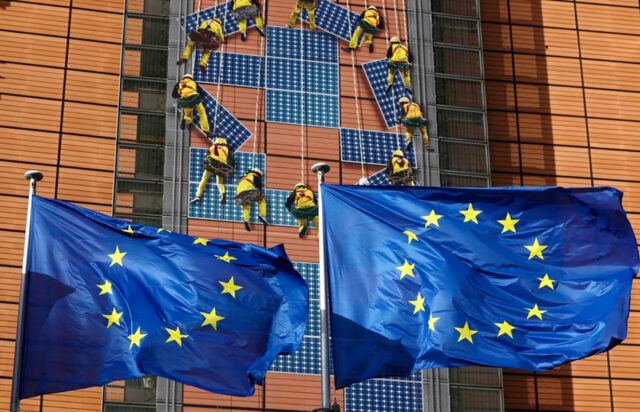
EU to pare back sustainability rules for companies, draft shows

REUTERS

BRUSSELS/LONDON — The European Commission plans to cut back the number of companies facing European Union (EU) sustainability reporting requirements, as part of its drive to cut red tape for businesses, a draft document seen by Reuters showed.

Brussels plans to publish next week an “omnibus” proposal to simplify green rules for businesses, aiming to make local industries more competitive and respond to US President Donald Trump’s promise to scrap regulations.

The European Union is also facing competing calls from member countries including Germany and France demanding the green reporting rules are weakened — and others, including Spain, which have argued the rules are key to upholding the EU’s values on the environment and human rights.

A partial draft of the upcoming proposals, seen by Reuters on Saturday, showed the Commission is planning changes to the EU’s corporate sustainability reporting directive, which requires companies to disclose information about their environmental and social sustainability.

Under the draft proposal, which could still change before it is published, only companies with more than 1,000 employees and a net turnover exceeding 450 million euros ($471 million) would be subject to the rules’ obligations.

Currently, the rules apply to firms with more than 250 employees and a 40-million-euro turnover. The EU would also cancel its plans to adopt sector-specific reporting standards by next June, the draft said.

The document also detailed plans to delay the EU’s due diligence law — known as the CSDDD — which aims to ensure companies find and fix human rights and environmental issues in their supply chains, by imposing due diligence requirements upon large companies.

The draft proposal would require companies to only undertake in-depth assessments of their direct business partners, and subsidiaries, leaving out other subcontractors and suppliers in their supply chains. — Reuters

[B-SIDE Podcast] Unleashing Pandora’s Box: DeepSeek, LLMs, and the AI race

Follow us on Spotify BusinessWorld B-Side

DeepSeek is a Chinese AI company that develops large language models, which is a type of AI program that can recognize and generate text, among other tasks. Its new AI model, R1, is said to rival the capabilities of leading AI models, while reportedly costing less to develop.

In this episode, BusinessWorld talks about LLMs, DeepSeek, and the AI arms race with Satnam Narang, a senior staff research engineer at Tenable Inc., a cybersecurity company.

Follow us on Spotify BusinessWorld B-Side

Interview by Patricia Mirasol
Audio editing by Jayson Mariñas

Philippines exits global watchdog’s dirty money ‘gray list’

The Central Business District in Makati City, the Philippines. — VEEJAY VILLAFRANCA/BLOOMBERG

The Philippines has been taken off a global watchdog’s dirty-money list, a move that could spur remittances and foreign investments in one of Asia’s fastest-growing economies.

The Paris-based Financial Action Task Force said on Friday that the Southeast Asian country is no longer on the list of nations under increased monitoring after a government push to step up efforts to counter money laundering and terrorist financing.

Bloomberg News reported earlier this month that the FATF was poised to make the move.

The removal from the so-called gray list should make it easier and cheaper for Filipinos working overseas to send money home — a key driver of domestic consumption — and may boost investments in a country where monthly inflows dropped 20% from a year ago in November.

The Philippines was the only country removed from the list, and the potential boost comes at a time of global uncertainty arising from US policies under President Donald Trump and Manila’s mounting tensions with Beijing in the South China Sea. Separately, Laos and Nepal were added to the FATF’s gray list.

A study by the International Monetary Fund found that gray-listings result in a “large and statistically significant reduction in capital inflows.”

The Philippines landed on the gray list in June 2021 after the FATF cited shortcomings in the nation’s efforts to fight illicit financial flows. The rise of offshore gaming operators across the country drew particular scrutiny.

The Philippines’ Anti-Money Laundering Council said that since its inclusion in the gray list the country has implemented key regulatory and operational reforms to mitigate dirty-money risks.

“These reforms have led to a marked improvement in the development and application of financial intelligence, enhanced financial investigative capabilities among law enforcement agencies, and a significant increase in money laundering investigations and prosecutions,” the council said in an emailed response to a query ahead of the FATF decision. — Bloomberg

Pope Francis in critical condition after health deteriorates, Vatican says

POPE FRANCIS smells a rose that was given to him by a faithful during the weekly general audience inside the Paul VI Audience Hall at the Vatican, Feb. 12, 2025. — REUTERS

VATICAN CITY — The Vatican said on Saturday that Pope Francis’ health had deteriorated over the past 24 hours and for the first time described his condition as “critical”, reporting he had needed supplemental oxygen and blood transfusions.

The pope was admitted to Rome’s Gemelli hospital on February 14 after experiencing difficulty breathing for several days, and was subsequently diagnosed with pneumonia in both lungs.

In a statement on Saturday evening, the Vatican said the 88-year-old Francis had suffered a “prolonged asthma-like respiratory crisis” during the morning that had required the administration of “high-flow oxygen”.

“The Holy Father’s condition remains critical,” the statement said. “The Pope is not out of danger.”

It added: “The Holy Father remains alert and has spent the day in a chair, though he is suffering more than yesterday. At the moment, the prognosis remains guarded.”

Besides the additional oxygen, the Vatican said he had also needed blood transfusions because tests showed he had a low platelet count, which is associated with anaemia.

A US-based doctor said the Gemelli team was probably using the transfusions to raise the pope’s levels of both red blood cells and platelets, which are small cell fragments in the blood that help form clots and stop or prevent bleeding.

Dr. Andrea Vicini, a Jesuit priest and professor at Boston College, stressed he only knew of the pope’s case through the Vatican’s public statements. “It seems it is under control, but his body is showing signs of difficulty to overcome (the) situation,” he said.

OUT OF SIGHT
The Vatican announced earlier on Saturday that the pope would not appear in public on Sunday to lead prayer with pilgrims, the second consecutive week he will have missed the event.

It is believed to be the first time he has missed two consecutive Angelus prayers for health reasons. After undergoing intestinal surgery in 2021, he led the Angelus just one week later, and skipped one public Sunday prayer in 2023 following another operation.

Double pneumonia is a serious infection that can inflame and scar both lungs, making it difficult to breathe. The Vatican has described the pope’s infection as “complex,” saying it is being caused by two or more micro-organisms.

In a briefing on Friday, two of his doctors said the pope was highly vulnerable due to his age and frailty.

Dr. Sergio Alfieri, a senior member of the Gemelli staff, said there was a risk the lung infection could spread to his bloodstream and develop into sepsis, which “could be very difficult to overcome”.

Francis, who has been pope since 2013, has suffered bouts of ill health in the past two years. He is particularly prone to lung infections because he developed pleurisy as a young adult and had part of one lung removed. — Reuters

Philippine central bank cuts reserve requirements further

BANGKO SENTRAL NG PILIPINAS

MANILA – The Philippine central bank on Friday said it was reducing the reserve requirement ratio (RRR) for banks by 200 basis points from late March.

The reduction will bring the reserve requirement for universal and commercial banks down to 5% and will take effect in the week of March 28, the Bangko Sentral ng Pilipinas said in a statement.

The reserve requirements for digital and thrift banks will fall by 150 bps and 100 bps, respectively, on the same date.

The announcement comes after the BSP last week unexpectedly kept interest rates steady at a policy review. At the time, Governor Eli Remolona said the BSP would likely further trim the reserve requirements for banks but the timing was uncertain.

The BSP last cut RRRs in September by 250 basis to 7%.

“The BSP reiterates its long-run goal of enabling banks to channel their funds more effectively toward productive loans and investments. Reducing RRRs will lessen frictions that hinder financial intermediation,” the central bank said. – Reuters

Bridging financial gaps: Global Dominion’s support for women entrepreneurs

By Sarah Tabing

Women entrepreneurs fuel innovation, create jobs, and drive economic growth. At Global Dominion, we empower women-led SMEs and MSMEs by providing accessible financing solutions to help them expand, invest, and sustain their businesses.

In the Philippines, women-led businesses continue to rise, demonstrating resilience, creativity, and leadership across industries such as retail, services, manufacturing, and logistics. Despite challenges like limited access to capital and resources, they thrive and make significant contributions to both local and national economies.

According to a 2024 article by the Philippine Commission on Women, more than half of women-owned MSMEs perceive access to finance as a significant challenge, compared to only one-third of men-owned MSMEs.

Additionally, a 2024 report by the Philippine Business Coalition for Women Empowerment (PBCWE) highlights that women now comprise 40% of executive leadership teams in publicly listed companies in the Philippines, with the number of female CEOs gradually increasing. These findings underscore the critical role of women entrepreneurs in the country’s economic landscape and the ongoing efforts to promote gender equality in business leadership.

At Global Dominion, we are committed to supporting these businesses through customized financing solutions that meet their evolving needs. Our loan products—such as Sangla OR/CR (Car and Truck), Second-Hand Car and Truck Financing, Brand-New Car Financing, Real Estate Mortgage, Real Estate Financing, and Doctors’ Loan—offer flexible options to help businesses secure capital, scale operations, and invest in their future.

As of 2024, about 25% of Global Dominion’s financed portfolio consists of women-led businesses, reinforcing our commitment to empowering female entrepreneurs and promoting inclusive economic growth. By bridging financial gaps and providing tailored solutions, we help businesses overcome barriers and achieve long-term success.

At Global Dominion, we remain steadfast in our mission to support women in business by offering financial tools, resources, and opportunities to help them thrive. As more women explore financing options, we stand ready to turn their business aspirations into reality.


Spotlight is BusinessWorld’s sponsored section that allows advertisers to amplify their brand and connect with BusinessWorld’s audience by publishing their stories on the BusinessWorld Web site. For more information, send an email to online@bworldonline.com.

Join us on Viber at https://bit.ly/3hv6bLA to get more updates and subscribe to BusinessWorld’s titles and get exclusive content through www.bworld-x.com.

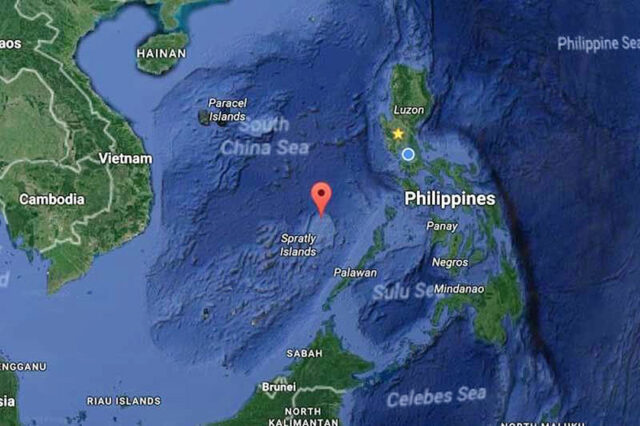
China military drove away Philippine aircraft near Spratly Islands

PHOTO FROM GOOGLE MAP
BEIJING, Feb 21 (Reuters) – China’s military said it warned and drove away three Philippine aircraft that “illegally intruded” into the airspace near the Spratly Islands on Thursday.
There was no immediate comment from the Philippine embassy in Beijing on the Chinese military’s statement issued on Friday.
China’s Southern Theatre Command accused the Philippine side of attempting to “peddle its illegal claims” through provocation, and warned that the “clumsy manoeuvre is doomed to failure”.
China claims sovereignty over almost the entire South China Sea, a vital waterway for more than $3 trillion of annual ship-borne commerce, putting it at odds with Brunei, Indonesia, Malaysia, the Philippines, and Vietnam.
A 2016 arbitration ruling invalidated China’s expansive claim but Beijing does not recognize the decision.
On Thursday, the Philippines said its coast guard and fisheries bureau had jointly carried out a maritime domain awareness flight over the Kalayaan Islands, the Philippine name for Spratly Islands.
The mission was to assert the Philippines’ sovereignty, sovereign rights, and maritime jurisdiction in the West Philippine Sea, it said. More than 50 Chinese maritime militia vessels and a Chinese coast guard ship were spotted during the exercise.
It was not immediately clear if that mission, which deployed two aircraft, was the one Chinese military said it responded to.
The latest confrontation comes after Philippine coast guard accused the Chinese navy of performing dangerous flight maneuvers earlier this week when it flew close to a government aircraft patrolling the contested Scarborough Shoal in the South China Sea.
Beijing disputed that account. – Reuters

South Korea seeks exemption from Trump tariffs

STOCK PHOTO | Image by Russian Aluminium Association from Pixabay

 – South Korean officials have requested an exemption from U.S. reciprocal, steel and aluminum tariffs during their visit this week to Washington, the industry ministry said in a statement on Friday.

Deputy Minister Park Jong-won, who led the first major South Korean government delegation to visit Washington since U.S. President Donald Trump announced sweeping tariffs, argued that almost all tariffs between the two countries have already been eliminated under their free trade agreement.

As a major global exporter and top trading partner with the United States, South Korea has viewed Trump’s measures with increasing concern.

Mr. Park highlighted investments in the United States by South Korean companies and proposed holding high-level meetings with the Trump administration to discuss further cooperation, the ministry said.

He also met with members of Congress and pressed them to maintain incentives for South Korean companies to operate in the United States.

“In the future, the government will continue to consult at a high level on U.S. trade and trade measures, and will respond to minimize damage to Korean companies through close communication with the industry,” the ministry’s statement said.

South Korea’s Acting President Choi Sang-mok said last week the country had invested more than any other in the United States in the past two years and that should allow it to negotiate with the Trump administration on tariffs.

On Friday, Mr. Choi ordered authorities to reach out to the U.S. more actively to seek cooperation and monitor response measures being taken by others, such as the European Union, Japan and China.

Japan has asked Washington to exclude it from steel and aluminum tariffs, while China has responded to U.S. measures with retaliatory tariffs. The EU said this week it was ready to discuss trade deals and lower tariffs.

“Given their substantial role in supporting US economic objectives, we think Korea and Japan are in a strong position to seek tariff exemptions,” Standard Chartered economists said in note, citing more than 20,000 U.S. jobs South Korea contributed in 2023, more than any other country.

Seoul’s responses to the Trump administration’s moves have been complicated by a political crisis sparked when President Yoon Suk Yeol briefly imposed martial law in December.

South Korea’s industry minister on Friday met with the acting U.S. ambassador in Seoul and said policies affecting trade and investment between the two countries should remain consistent and stable.

A delegation representing 20 South Korean companies also travelled to the U.S. this week to meet policymakers.

Mr. Choi, who took over after both Mr. Yoon and the prime minister were impeached, has yet to speak directly with Mr. Trump. – Reuters

Trump pulls US out of key global climate assessment, sources say

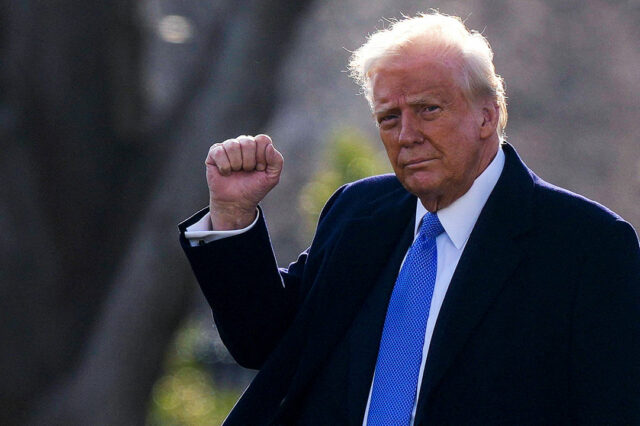
US PRESIDENT Donald Trump gestures as he walks to board Marine One, during his departure for Palm Beach, Florida from the South Lawn of the White House in Washington, US on Feb. 7, 2025. — REUTERS

 – The Trump administration has halted the participation of U.S. scientists in key U.N. climate change assessments, two sources familiar with the situation told Reuters, part of its broader withdrawal from climate change mitigation efforts and multilateral cooperation.

The stop-work order affects staff members of the U.S. Global Change Research Program and the National Oceanic and Atmospheric Administration who engage with a key working group of the Intergovernmental Panel on Climate Change.

It means the U.S. will not attend a major IPCC plenary meeting in Hangzhou, China, next week, to plan the seventh global climate assessment, said one of the sources.

The White House declined to comment and the State Department did not respond to a request for comment.

“The power of the IPCC is that governments, businesses and global institutions can operate with shared conclusions. The U.S. being completely removed from that process is concerning,” said Delta Merner of the Union of Concerned Scientists.

While American scientists will be in attendance and continue to work on climate research used by the IPCC, the absence of the U.S. in the IPCC process will be felt.

The Hangzhou meeting from 24-28 February is expected to make a few key decisions that will shape the outcomes of the next climate assessment, including around the role of carbon removal and capture technology.

China’s foreign ministry said on Thursday it was unaware of the withdrawal of U.S. participants.

The U.S. is a co-chair along with Malaysia of a working group on climate mitigation, or ways to reduce greenhouse gas emissions.

The U.S. had also pledged around $1.5 million to support the IPCC, though that money had not yet been appropriated by Congress.

Withdrawal of the U.S. from the IPCC does not come as a surprise to climate scientists, given President Donald Trump’s moves to withdraw the U.S. again from the Paris climate agreement, claw back U.S. global climate finance and sever international partnerships on climate.

“This would align with Trump’s signals around climate action,” said Kathryn Bowen, a professor at Melbourne University and a lead author on the IPCC’s sixth assessment report published last year.

She said the loss of federal support comes at a time of reduced funding for climate science globally.

“Unfortunately there has been a slow reduction of funding support for authors in the IPCC process in the last few years,” Bowen said. “High-income countries are looked upon as important sources of funding for colleagues from the Global South.” – Reuters

Deepfakes can ruin lives and livelihoods – would owning the ‘rights’ to our own faces and voices help?

STOCK PHOTO | Image by stokpic from Pixabay

by Graeme Austin, Chair of Private Law, Te Herenga Waka — Victoria University of Wellington, and Jane C Ginsburg, Professor of Literary and Artistic Property Law, Columbia University


Not that long ago, the term “deepfake” wasn’t in most people’s vocabularies. Now, it is not only commonplace, but is also the focus of intense legal scrutiny around the world.

Known in legal documents as “digital replicas”, deepfakes are created by artificial intelligence (AI) to simulate the visual and vocal appearance of real people, living or dead.

Unregulated, they can do a lot of damage, including financial fraud (already a problem in New Zealand), political disinformation, fake news, and the creation and dissemination of AI-generated pornography and child sexual abuse material.

STOCK IMAGE | Image by 愚木混株 Cdd20 from Pixabay

For professional performers and entertainers, the proliferation and increasing sophistication of deepfake technology could demolish their ability to control and derive income from their images and voices.

And deepfakes might soon take away jobs: why employ a professional actor when a digital replica will do?

One possible solution to this involves giving individuals the ability to enforce intellectual property (IP) rights to their own image and voice. The United States is currently debating such a move, and New Zealand lawmakers should be watching closely.

Remedies already being discussed in New Zealand include extending prohibitions in the Harmful Digital Communications Act to cover digital replicas that do not depict a victim’s actual body.

Using (or amending) the Crimes Act, the Fair Trading Act and the Electoral Act would also be helpful.

At the same time, there will be political pressure to ensure regulation does not stymie investment in AI technologies – a concern raised in a 2024 cabinet paper.

Legislation introduced to the US Congress last year – the Nurture Originals, Foster Art, and Keep Entertainment Safe Bill – proposes a new federal intellectual property right that individual victims can use against creators and disseminators of deepfakes.

Known informally as the “No Fakes Bill”, the legislation has bipartisan and industry support, including from leading entertainment worker unions. The US Copyright Office examined the current state of US law and concluded that enforceable rights were “urgently needed”.

From the New Zealand perspective, the No Fakes Bill contains both helpful ideas and possible pitfalls. As we discuss in a forthcoming paper, its innovations include expanding IP protections to “everyday” individuals – not just celebrities.

All individuals would have the right to seek damages and injunctions against unlicensed digital replicas, whether they’re in video games, pornographic videos, TikTok posts or remakes of movies and television shows.

But these protections may prove illusory because the threshold for protection is so high. The digital replica must be “readily identifiable as the voice or visual likeness of an individual”, but it’s not clear how identifiable the individual victim of a deepfake needs to be.

Well known New Zealand actors such as Anna Paquin and Cliff Curtis would certainly qualify. But would a New Zealand version of the bill protect an everyday person, “readily identifiable” only to family, friends and workmates?

Under the US bill, the new IP rights can be licensed. The bill does not ban deepfakes altogether, but gives individuals more control over the use of their likenesses. An actor could, for example, license an advertising company to make a digital replica to appear in a television commercial.

Licenses must be in writing and signed, and the permitted uses must be specified. For living individuals, this can last only ten years.

So far, so good. But New Zealand policy analysts should look carefully at the scope of any licensing provisions. The proposed IP right is “licensable in whole or in part”. Depending on courts’ interpretation of “in whole”, individuals could unknowingly sign away all uses of their images and voice.

The No Fakes Bill is also silent on the reputational interests of individuals who license others to use their digital replicas.

Suppose a performing artist licensed their digital replica for use in AI-generated musical performances. They should not, for example, have to put up with being depicted singing a white supremacist anthem, or other unsanctioned uses that would impugn their dignity and standing.

On the other side of the ledger, the No Fakes Bill contains freedom of expression safeguards for good faith commentary, criticism, scholarship, satire and parody.

The bill also protects internet service providers (ISPs) from liability if they quickly remove “all instances” of infringing material once notified about it.

This is useful language that might be adopted in any New Zealand legislation. Also, the parody and satire defense would be an advance on New Zealand’s copyright law, which currently contains no equivalent exception.

But the US bill contains no measures empowering victims to require ISPs to block local subscribers’ access to online locations that peddle in deepfakes. Known as “site-blocking orders”, these injunctions are available in at least 50 countries, including Australia. But New Zealand and the US remain holdouts.

For individual victims of deepfakes circulating on foreign websites that are accessible in New Zealand, site-blocking orders could offer the only practical relief.

The No Fakes Bill is by no means a perfect or comprehensive solution to the deepfakes problem. Many different weapons will be needed in the legal and policy armory – including obligations to disclose when digital replicas are used.

Even so, creating an IP right could be a useful addition to a suite of measures aimed at reducing the economic, reputational and emotional harms deepfakes can inflict. – Reuters

Block’s profit misses estimate as holiday spending, bitcoin gains fall short

KANCHANARA-UNSPLASH

Block’s fourth-quarter profit fell short of estimates as spending growth during the holiday season and gains from a post-election surge in bitcoin lagged expectations, sending the payment firm’s shares down 8% in extended trading on Thursday.

While a robust labor market and steady wage growth have supported consumer spending – bolstered further by holiday travel and retail splurges – uncertainty surrounding trade policy under a new administration and the Federal Reserve’s rate cuts has kept sentiment in check.

Block’s results come on the same day that retail giant Walmart WMT.N fueled concerns over consumer spending with a sales and profit forecast for the current year that fell short of Wall Street estimates.

Block CEO Jack Dorsey, however, emphasized the payments company’s attempts to streamline operations and said investing in artificial intelligence tools was a top priority.

“Our number one initiative on our strategic roadmap … is to invest heavily in building applied AI tools to remove the toil of mechanical tasks,” he said.

The company reported a profit of 71 cents per share, excluding one-time costs. Analysts had expected a figure of 87 cents per share, according to estimates compiled by LSEG.

Its transaction-based revenue was $1.68 billion, compared with the expectations of $1.70 billion. Bitcoin revenue of $2.43 billion also missed estimates of $2.62 billion.

Block facilitates bitcoin purchases on its platform by acquiring the cryptocurrency through private broker dealers and reselling it at a small premium.

Founded in 2009 as Square before rebranding in 2021, the company is expanding into crypto mining while also deepening its presence in the buy now, pay later market. – Reuters

ADVERTISEMENT
ADVERTISEMENT