Home Blog Page 1940

Fed seen poised to cut interest rates this month

REUTERS

CHICAGO/PALO ALTO, California — Federal Reserve officials appear on track to cut interest rates this month after data showed the US labor market remained strong but continued to cool in November, even as debate emerged over a possible pause to rate cuts in the new year.

US employers added 227,000 jobs last month, a rebound from a hurricane-impacted slowdown in October, but the unemployment rate ticked up to 4.2%, the Labor Department’s monthly employment report showed on Friday.

Over the last half-year average monthly job gains are below 150,000, short of what some policymakers feel is needed to provide enough work to match a growing population, but nothing like the collapse Fed policymakers worried could happen when they began cutting interest rates a few months ago.

A number of Fed policymakers speaking on Friday said they saw rates continuing to come down, while injecting a note of caution on the pace.

San Francisco Fed President Mary Daly said the fresh figures show the labor market is in a good position. And while she indicated no discomfort with another rate cut this month, she said that once the policy rate is closer to where it will settle, she would take “a more thoughtful and cautious approach” on further rate cuts. Ms. Daly has previously said she views 3% as where short-term borrowing costs may need to end up.

Chicago Fed President Austan Goolsbee also said he expects that by next year “rates are going to be a fair bit lower than where they are today,” with the Fed feeling its way to a stopping point for rate cuts.

Beth Hammack, in her first major policy speech since taking the helm of the Cleveland Fed in August, said she too feels rates need to come down over time, but that given still-elevated inflation and a healthy labor market, “we are at or near the point where it makes sense to slow the pace of rate reductions.”

Traders after the jobs data put the probability of a rate cut at the Fed’s Dec. 17-18 policy meeting at 85%, up from less than 70% before the release of the report, and added to bets that short-term borrowing costs will drop another 75 basis points next year — a slower pace than Fed officials anticipated in a September set of economic projections.

Those projections will be updated at the December meeting.

A quarter-percentage-point reduction this month would bring the Fed’s policy rate to the 4.25%-4.5% range, a full percentage point below where it was in September when the central bank began its easing cycle.

“It’s not exactly a wonderful economy, but it’s also an economy that doesn’t seem to be decelerating as sharply as everyone expected a few months ago,” TD Securities analyst Gennadiy Goldberg said, citing the average payroll growth of about 150,000 jobs in recent months. “The Fed can safely deliver another rate cut in December and then maybe communicate a possible pause coming as soon as the January meeting.”

Fed Governor Christopher Waller at the start of last week said he was “leaning towards” a rate cut but would reserve final judgment to review the latest jobs numbers as well as inflation data due next week.

‘PROCEED CAUTIOUSLY’
On Wednesday, Fed Chair Jerome Powell repeated his prior comments that the central bank could be careful in managing the endgame of its roughly three-year fight against inflation.

Powell’s caution may come more into play next year, with many analysts expecting the Fed to pause the easing after delivering a cut on Dec. 18.

At least one of the Fed chief’s colleagues may prefer a nearer-term breather.

“I continue to see greater risks to the price-stability side of our mandate, especially when the labor market continues to be near full employment,” Fed Governor Michelle Bowman told the Missouri Bankers Association Executive Management Conference. “I would prefer that we proceed cautiously and gradually in lowering the policy rate, as inflation remains elevated.” — Reuters


Coconut output likely flat next year amid aging trees

MICHAEL LOUIE-UNSPLASH

By Adrian H. Halili, Reporter

PHILIPPINE COCONUT production gowth is likely to be flat next year given low yields from the country’s aging trees, an industry player said.

“We estimate coconut production to stay at the levels similar to previous years as efforts to improve productivity will take time to bear fruit,” Romeo I. Chan, Axelum Resources Corp. chairman and chief executive officer, said in an e-mailed reply to questions.

Philippine coconut output has steadily decreased in recent years as most of the country’s fruit-bearing trees are now too old. Coconut and its by-products remain the country’s top agricultural export.

The volume of coconut production hit 14.89 million metric tons (MT) in 2023, slightly lower than 14.93 million MT a year earlier, according to data from the Philippine Statistics Authority.

“At present, the most evident challenges are the low productivity of coconut trees and inadequate infrastructure support,” Mr. Chan said. “Senile trees, weather disturbances and climate change have led to declining harvest yields over the years.”

Last year, President Ferdinand R. Marcos, Jr. ordered the Philippine Coconut Authority (PCA) to draft a plan to rehabilitate the coconut industry, including planting 100 million coconut trees by 2028.

Among the agency’s rehabilitation plan seeks to address the advanced age of the nut-bearing trees. The agency is seeking to replant about 8.5 million coconut trees this year.

Under the Philippine Coconut Industry Development Plan 2024-2034, the replanting project is expected to increase coconut output by 4.7 billion nuts annually worth P33.1 billion by 2034.

In 2025, the PCA aims to replant 15.3 million trees, followed by 25.4 million yearly between 2026 and 2028.

Mr. Chan said the government’s replanting goal could be reached if the state and private sector work together.

“In addition, the absence or lack of development in coconut regions has increasingly contributed to it being one of the most marginalized sectors, with coconut farmers considered among the poorest in the country,” he added.

Mr. Chan said the struggling industry could be boosted with the appropriate use of the coco levy fund.

In 2021, Republic Act No. 11524 or the Coconut Farmers and Industry Trust Fund Act signed by then President Rodrigo R. Duterte mandated the creation of a fund that places coconut levy assets to a trust fund that will finance the rehabilitation and modernization of the industry.

“The proper utilization of the coco levy fund will be critical to help modernize the coconut industry, reinforce capabilities of smallholder farms and uplift coconut farming communities,” he said.

The law also calls on the Bureau of the Treasury to transfer P10 billion to the trust fund, another P10 billion in the second year, P15 billion in the third year, another P15 billion in the fourth year and P25 billion in the fifth year.

Axelum is a Philippine Stock Exchange-listed manufacturer and exporter of coconut products.

Megawide PCS showcases innovative construction solutions at Philconstruct 2024 

Megawide Construction Corporation (“Megawide” or the “Company”), through its Precast and Construction Solutions (“Megawide PCS” or the “Unit”) unit, made another strong impression at the Philconstruct 2024 Expo, held at the World Trade Center and SMX Convention Center from Nov. 7 to 10, 2024.

“Our participation in Philconstruct 2024 represents our mission to provide First-World construction solutions that elevate industry standards,” said Markus Hennig, Executive Vice-President for Precast and Construction Solutions. “With these innovations, we aim to address the growing demand for faster, safer, and more sustainable construction practices in the country.”

The event, attended by delegates and exhibitors, is the largest construction trade show in the Philippines and brings together industry leaders, market innovators, and key stakeholders to showcase new technologies and state-of-the-art solutions that help shape the future of construction.

The Megawide PCS Team – represented by the Unit’s Commercial and Sales team and leads of Precast, Formworks, Ready-Mixed Concrete, and Construction Equipment, Logistics and Services (CELS) – joined the four-day event for the third consecutive time and highlighted its proprietary brand of precast technology that redefines efficiency, durability, and sustainability in construction.

Specifically, the PCS booth offered product brochures and technical talks from officers on site and even invited attendees to explore and learn about the solutions they offer, emphasizing on the Company’s long-term commitment to driving engineering excellence and innovation in Philippine construction. Over 800 attendees signed up at the booth from day one to day four.

It was also an opportunity for the Megawide PCS team to share insights on the company’s expanding portfolio of large-scale infrastructure projects, including the Paranaque Integrated Terminal Exchange (PITX), Mactan-Cebu International Airport (MCIA), Malolos-Clark Railway Project (MCRP) and the Metro Manila Subway Project (MMSP) Contract Package 104 as well as supply contracts for portions of the Skyway and MRT-7 projects.


Spotlight is BusinessWorld’s sponsored section that allows advertisers to amplify their brand and connect with BusinessWorld’s audience by publishing their stories on the BusinessWorld Web site. For more information, send an email to online@bworldonline.com.

Join us on Viber at https://bit.ly/3hv6bLA to get more updates and subscribe to BusinessWorld’s titles and get exclusive content through www.bworld-x.com.

Reverse psychology marketing

PATAGONIA.COM

Can you imagine an ad for an expensive jacket, boldly telling its target buyers, “Don’t Buy This Jacket”?  Beside the handsome blue sports jacket are the admonitions: Reduce — don’t buy what you don’t need; Repair — we help you repair your old jacket; Re-use – sell or pass on your old gear; Recycle — we take back your old jackets.

Patagonia, a leading American outdoor clothing brand, launched a campaign on Black Friday in the run-up before the Christmas 2011 shopping rush, urging consumers not to buy their jacket.   Despite their “efforts” not to sell, sales increased by approximately 30% in the nine months following the ad. What gives?

The Knowledge Hub (KH of the Circle Economy group) made a business case study of this marketing phenomenon. “With this ad, the company aspired to raise consumer awareness regarding the consequences of over-consumption, especially in the textile industry… each piece of Patagonia clothing — despite being made from recycled materials — emits far more greenhouse gas (GHG) than it weighs, in addition to increased use of freshwater for production purposes.”

People were made aware that Patagonia was admittedly contributory to the environment issues but was zealously improving its products to lessen environmental damage. “Don’t buy this jacket!” Consume (buy) only what you need. This counter-intuitive move within the context of a business environment brought the company increased revenues, but only because the company is indeed acting upon its mission of being a sustainable company. Patagonia has shown its success of adherence to sustainability principles through growth levels in their top line, margins, and market share, the case study concluded.

But some observers say Patagonia used clever reverse psychology marketing to achieve its revenue goals while keeping its image of being a fierce advocate for environmental sustainability. Wizard of Ads, a marketing and advertising company that offers services to help businesses strategize, calls the Patagonia ad a “breakthrough” in bold, effective marketing.  Advertising has three primary objectives: to inform, to persuade, and to remind. That, the Patagonia ad effectively did!

“By telling you NOT to buy the jacket, Patagonia is making your resistance work in their favor. You see the ad, and now you sort of want the jacket, just due to reactance. Plus, the unexpected headline really grabs attention and ensures the ad breaks through the clutter. Even better, Patagonia gets the added bonus of demonstrating their commitment to sustainable, eco-friendly business practices.” (wizardofads.org)

It’s called “reactance.” When someone tries to tell you what to think or do — that automatic resistance you feel is called reactance by psychologists (Ibid.). “An Empirical Study on Reverse Psychology Applied in Advertising Messages,” by the Asian Journal of Empirical Research (archive.aessweb.com) showed that this technique has been applied by marketers in advertising in which a negative message or tagline (e.g., “don’t buy the product”) is used to motivate consumers to make a purchase.

“Psychological reactance theory advocates that reactance occurs when people react to restore a freedom when it is eliminated or threatened to be eliminated. The expected response to an advertising message of not doing something is to do it.

“Results suggested that the application of reverse psychology in advertising enables marketers to create awareness and raise interest of consumers. It is also interesting to find out that 40.8% of subjects were uncomfortable with the messages but showed interest in them,” the study concluded.

Doctors and healthcare professionals warn that, “While it can be seen as a way of managing another person’s behavior, reverse psychology can also be used as a form of manipulation. The idea behind reverse psychology is that by pushing for the opposite of what you want, the other person will choose to engage in the behavior that you desire. The person who is the subject of this tactic generally doesn’t realize what is happening and may not be fully aware of the other person’s true motives (verywellmind.com, April 4, 2023).

Manipulation cannot be justified because it is untrue and insincere and violates the other person. “Yet even if you didn’t know it at the time, there’s a chance that you’ve used reverse psychology to try to get someone to do something at some point in your life. The most ordinary example is that of parents using reverse psychology to get their kids to do what they want them to do. A parent might tell their child not to pick up their toys in their room in the hope that the child will actually do the opposite (Ibid.).

Yes, reverse psychology is often used on children due to their high tendency to respond with reactance, a desire to restore threatened freedom of action. It is a negative emotional reaction to being persuaded and thus choosing the option which is being advocated against. This may work especially well on a person who is resistant by nature, while direct requests work best for people who are compliant (Psychology Today. Retrieved 2018-09-22).

Marketing and sales strategies often utilize reverse psychology to encourage people to buy goods and services. “Marketers’ understanding of consumer behavior has provided particularly valuable insights into voter behavior which is an important strand in the success of political marketing. As a theory, it has come a long way and holds a key position in the coming times” (“Political Marketing: an emerging theory,” Suman Si). Of course, political leaders obviously use marketing strategies “to inform, to persuade, and to remind” the public of their platforms and directions, and the “packaging” of their personas. In her book, The Political Marketing Game (2011), author Jennifer Lees-Marshment talks of “what works in political marketing, drawing on 100 interviews with practitioners.  It also shows that authenticity, values and vision are as much a part of winning strategy as market-savvy pragmatism.”

Is the self-induced, deafening political noise distracting the country from the Sisyphean task of catching up to regional economic development, a market-savvy strategy by opposing political leaders now preparing for the critical mid-term elections in 2025? Perhaps also laying the groundwork for the presidential elections in 2028?

“The feud between the Marcos administration and the Dutertes has been making headlines, deteriorating further after Vice-President Sara Duterte disclosed that she had asked someone to kill President Marcos, First Lady Liza Marcos, and Speaker Martin Romualdez if an alleged plot to assassinate her is carried out. Law enforcement agencies have launched probes to determine the Vice-President’s possible legal liability” (The Philippine Star, Nov. 29, 2024).

Tensions rose after former president Rodrigo Duterte called on the military to “correct” what he labeled a “fractured government,” a comment that the Justice department said was “bordering on sedition” (Ibid.). Star columnist Boo Chanco described how “the House quad comm hearings have taken the nature of a Netflix miniseries. The revelations were not shocking in the sense that they did not surprise us. We suspected as much all the while but we are now getting confirmation from some of the key people involved. Good thing the UniTeam broke up or all these would have remained secrets” (The Philippine Star, Oct. 18, 2024).

Sara Duterte seems masochistic and suicidal with her open cursing of President Ferdinand Marcos, Jr., and revealing how she has contacted hired killers to get him and his family if she were assassinated for fighting him. But her stance to the Filipino people seems to be — this is what I am, take me as I am. (So much like her father, Rodrigo Duterte.)  Maybe she is employing reverse psychology on the electorate — she wants to run for President after Marcos Jr.’s six year, no-reelection term. “Don’t vote for me” means “Vote for me,” for impressionable voters who elected her father the way he was, in 2016.

“Let us not impeach Sara Duterte,” Marcos Jr. surprisingly declared, in the face of two impeachments vs. VP Sara filed in House (Rappler, Nov. 29, 2024).

Was Marcos Jr. using reverse psychology to strongly suggest that Sara should be impeached?

Like, “Do not buy this jacket.”


Amelia H. C. Ylagan is a doctor of Business Administration from the University of the Philippines.

ahcylagan@yahoo.com

2 Jetour SUVs to be raffled off at Newport World Resorts

The Jetour T2 (left) and Dashing — PHOTO BY KAP MACEDA AGUILA

THE MARRIOTT Grand Ballroom at Newport World Resorts in Pasay City will be the venue of “The Grand Countdown to 2025,” a New Year’s Eve party that will feature the performance of celebrities Angeline Quinto, Jed Madela, Bamboo, and Bini.

Jetour Auto Philippines, Inc. (JAPI), the official event partner of Newport World Resorts for this event, will cap the countdown to 2025 with a grand raffle of two brand-new Jetour vehicles for two lucky audience members. Up for grabs is a Dashing compact crossover and a T2 4×4 SUV.

The Jetour Dashing is one of the pioneering vehicles when the brand began its operations in the Philippines in March 2023, and remains one of JAPI’s best-selling models. It features an ultra-modern design, high-tech features, luxurious interior amenities, and powerful yet efficient 1.5-liter turbocharged gasoline engine. The vehicle has been a favorite choice of young, passionate, and upwardly mobile individuals who maintain active lifestyles for themselves and their families.

Meanwhile, the T2 has been earning raves as a solid SUV that’s “ready to play, and play hard in any urban and outdoor setting.” The T2’s 2.0-liter Kunpeng TGDI gasoline-powered engine mated to the Magna 7DCT third-generation wet dual-clutch transmission with intelligent execution system generates up to 254hp and 390Nm. Managing the four-wheel-drive system is the XWD Intelligent 4WD. The Jetour T2 is available in Beyond, Terrain, and Terminator variants.

As part of JAPI’s ongoing partnership with Newport World Resorts, the latest Jetour models are also currently on display at strategic locations of the Newport World Resorts complex. Visitors and guests of Newport World Resorts now have the chance to get an up-close look at Jetour models.

RL Commercial REIT focusing on CBDs to expand portfolio

BUILDINGS at the Makati central business district are seen in this file photo. — PHILIPPINE STAR/ MIGUEL DE GUZMAN

GOKONGWEI-LED RL Commercial REIT, Inc. (RCR) said it is focusing on central business districts (CBDs), emerging business districts, and key locations nationwide as potential areas to expand its property portfolio.

“RCR’s principal investment strategy is to invest on a long-term basis in a diversified portfolio of income-producing real estate assets located in major CBDs, key locations, and urban areas across the country,” the company said in a stock exchange disclosure on Friday.

“The potential property should be located in a CBD, emerging business district, or in key locations across the Philippines, typically with high-growth potential and in proximity to various modes of public transport and major roads for enhanced accessibility to tenants,” it added.

RCR is the real estate investment trust (REIT) unit of Robinsons Land Corp. (RLC).

As of end-September, RCR’s portfolio consists of 29 commercial properties, of which six are located in the Bonifacio Global City, Makati, and Ortigas CBDs.

The remaining 23 assets are situated in 15 locations across the country.

RCR said the average occupancy of its leases is at 96% as of end-September, with “manageable lease expiries until 2027.”

Some of the properties under RCR’s portfolio include the 45-storey Robinsons Equitable Tower in Pasig City, the 37-storey Robinsons Summit Center in Makati City, the 28-storey Giga Tower in Quezon City, and the 20-storey Cyber Sigma building in Taguig City.

RLC previously infused 13 commercial assets worth P33.9 billion into RCR as part of expanding the latter’s portfolio. The Securities and Exchange Commission approved the transaction on Sept. 19.

The deal brought RCR’s gross leasable area to 828,000 square meters.

For the first nine months, RCR saw a 32% increase in net income to P4.27 billion as revenue climbed by 42% to P5.84 billion due to its asset infusion and steady occupancy rates.

On Dec. 6, RCR shares dropped by 0.51% or three centavos to P5.90 apiece, while RLC stocks rose by 0.73% or 10 centavos to P13.78 each. — Revin Mikhael D. Ochave

Style (12/09/24)


BOSS launches holiday campaign

BOSS has introduced its #BeYourOwnBOSS campaign for the 2024 holiday season, featuring stylish evening wear and seasonal gift ideas. The campaign features global icons Gisele Bündchen, David Beckham, Burna Boy, and Lee Jong-suk. The BOSS Holiday Menswear Collection offers versatile essentials for any occasion, from casual to professional. This includes a breathable virgin wool slim-fit sweater, plush velvet tuxedo trousers with silk-blend trims, and crystal-embellished stretch-wool tuxedo trousers. A cotton-silk blend dress shirt with bib adornments completes the formal look. Meanwhile, the BOSS Womenswear Collection offers a range of refined looks, including a halter-strap satin dress with a crystal-trimmed waterfall back, a signature shoulder bag with gemstone details, and a slim-fitting stretch-wool tuxedo jacket with embellished peak lapels. The 2024 collection is available at BOSS stores worldwide, on boss.com, and through select wholesale partners.


Midea released vintage breakfast set for the holiday

MIDEA, a home appliance brand has introduced its Vintage Breakfast Set, a collection of kitchen essentials perfect for the holiday season. The set includes a 12-cup coffee maker, a toaster, and an electric kettle, all featuring a retro-inspired design. Packaged in a festive holiday-themed gift box, the set combines functionality and style, making it a practical addition to any kitchen. To learn more about the Midea Vintage Breakfast Set, visit www.midea.com/ph and follow their social media pages.


Banana Republic announces end of season sale

FASHION BRAND Banana Republic is set to kick off its End of Season Sale, offering discounts of up to 50% on all items. The sale will run from Dec. 26 to Jan. 23, 2025, and will be available at Rustan’s Makati and online at bananarepublic.com.ph. Apart from the sale, Banana Republic is gearing up to expand its presence in the Philippines with the opening of a new store in Central Square Mall, Bonifacio Global City, Taguig. This new store promises an elevated shopping experience for customers. The brand will also host a pop-up store at Central Square Mall from Jan. 6 to Feb. 9, 2025. The pop-up will showcase Banana Republic’s latest collections and allow shoppers to immerse themselves in the brand’s offerings.


Dove unveils new underarm night skin deodorant

GLOBAL BEAUTY brand Dove has launched the Night Repair Deo Serum, part of the Dove Radiant + Care Deodorant line. Designed for nighttime use, the product features a blend of niacinamide and hyaluronic acid to nourish and repair underarm skin during sleep. The serum, available in dry and roll-on formats, contains 3% niacinamide, the highest concentration in a Dove deodorant, aimed at enhancing skin radiance. Hyaluronic acid adds moisture to support skin barrier repair, promoting healthier underarms by morning.

Gov’t debt yields inch down on data

YIELDS on government securities (GS) traded on the secondary market were mixed last week as the market was cautious ahead of the release of key US and domestic data that could affect the direction of monetary policy moving forward.

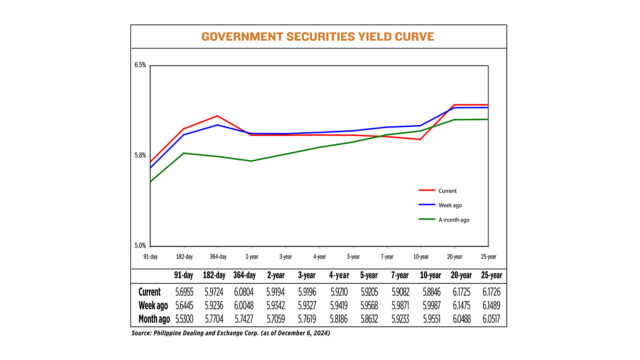
GS yields, which move opposite to prices, inched down by an average of 0.49 basis point (bp) last week, based on data from PHP Bloomberg Valuation Service Reference Rates as of Dec. 6 published on the Philippine Dealing System’s website.

At the short end of the curve, the rates of the 91-, 182-, and 364-day Treasury bills (T-bills) went up by 5.10 bps (to 5.6955%), 4.88 bps (to 5.9724%), and 7.56 bps (to 6.0804%), respectively.

Meanwhile, at the belly, yields on the two-, three-, four-, five-, and seven-year Treasury bonds (T-bonds) decreased by 1.48 bps (5.9194%), 1.31 bps (5.9196%), 2.09 bps (5.9210%), 3.63 bps (5.9205%), 7.89 bps (5.9082%), respectively.

At the long end of the curve, the rate of the 10-year debt paper declined by 11.41 bps to 5.8846%, while the 20- and 25-year T-bonds saw their yields increase by 2.50 bps (to 6.1725%) and 2.37 bps (6.1726%), respectively.

GS volume traded reached P35.18 billion, lower than the P48.25 billion recorded a week prior.

“The local bond market was broadly moving sideways during the week as market participants remained cautious ahead of key Philippine and US economic releases, which are expected to influence the policy decisions of the BSP (Bangko Sentral ng Pilipinas) and the Federal Reserve respectively later this month,” the first bond trader said in an e-mail.

“The downturn [last] week was likely due to improved sentiment ahead of the BSP’s MB (Monetary Board) meeting this month mirroring the easing sentiment in US yields, with similar sentiment on the US Fed meeting this month as well,” the second bond trader said in a Viber message.

Philippine headline inflation picked up to 2.5% year on year in November from 2.3% in October, the government reported last week.

Still, this was slower than 4.1% in the same month a year ago and was within the BSP’s 2.2%-3% forecast for the month.

The November print also matched the median estimate in a BusinessWorld poll of 15 analysts.

For the first 11 months, the consumer price index (CPI) averaged 3.2%, a tad higher than BSP’s 3.1% full-year baseline forecast but well within its 2-4% annual target.

“As domestic inflation for November came within market expectations and remains at the lower end of the BSP’s target range, this has solidified views that local inflation appears to be manageable, pushing both medium- and long-term yields [last] week. However, short-term yields are slightly moving higher as expectations that the BSP might hold policy rates unchanged in its December meeting,” the first trader said.

The second bond trader said the CPI result was within expectations and thus was mostly taken as a “non-event.”

“If anything, the print just reaffirmed the view that the BSP has some leeway to cut rates this month,” the trader added.

The BSP’s policy-setting Monetary Board will hold its last review for the year on Dec. 19, a day after the Federal Open Market Committee’s Dec. 17-18 meeting.

The Philippine central bank has cut benchmark borrowing costs by a total of 50 bps since kicking off its easing cycle in August, bringing its policy rate to 6%.

BSP Governor Eli M. Remolona, Jr. has said that the central could either cut or pause at this month’s meeting.

Meanwhile, Fed officials appear on track to cut interest rates this month after data showed the US labor market remained strong but continued to cool in November, even as debate emerged over a possible pause to rate cuts in the new year, Reuters reported.

US employers added 227,000 jobs last month, a rebound from a hurricane-impacted slowdown in October, but the unemployment rate ticked up to 4.2%, the Labor department’s monthly employment report showed on Friday.

For this week, GS yields may rise on expectations of faster US consumer inflation in November, the first bond trader said. US CPI data will be released on Dec. 11 (Wednesday).

The trader added that the market could react to the US nonfarm payrolls (NFP) data released on Friday.

“We could see some slight momentum carry over into [this] week, depending on the release of the US NFP, which could influence the Fed’s decision the following week,” the second trader likewise said.

“Locally, we’ll be looking at the results of the BTr’s (Bureau of the Treasury) last bond auction for the year, but traders will likely be wary of the first-quarter auction schedule that could come out before Christmas and see the BTr revert to more frequent auctions with higher offer amounts,” the second trader added.

On Tuesday, the Treasury will offer P15 billion in reissued 10-year T-bonds with a remaining life of nine years and one month. This would be the last T-bond auction for 2024. — Kenneth H. Hernandez with Reuters

DA seeks to boost palay yield in Iloilo province

BW FILE PHOTO

THE Department of Agriculture (DA) on Sunday said it would allocate P82.5 million more to boost rice production in farms in Iloilo province.

In a statement, the agency said the extra budget would fund 16,500 hectares more allotted for hybrid rice production in the province.

The agency said this would increase the farm area planted with unmilled rice by “more than 50%.”

“Weather permitting, the additional hectarage that will be planted with hybrid varieties should increase our rice harvest during this dry season,” Dennis R. Arpia, executive director for Region VI, said.

He added that attaining five metric tons (MT) per hectare on hybrid seeds would suffice despite the potential yield of 10 MT per hectare for the seed variety, citing the unpredictable weather in Western Visayas.

The average yield of palay in Iloilo was 3.4 MT per hectare in 2023, below the national average yield of 4.2 MT per hectare.

“If rains come during the flowering stage, they could significantly impact yields,” Mr.  Arpia said.

Iloilo is among the country’s top rice-producing provinces, producing 1.07 million MT last year or 5.33% of the total 20.06 million MT output in 2023.

The DA said the potential yield for rice in the province could be improved with higher-yield varieties, better irrigation, proper nutrition and recommended cultural management practices.

The department said some areas in Western Visayas have begun planting palay for the incoming dry season, while farmers have been delayed in their harvest due to El Niño. — Adrian H. Halili

Listed banks rise in Q3

By Lourdes O. Pilar, Researcher

LISTED BANKS rose in the third quarter propelled by higher loan growth thanks to cheaper borrowing costs that boosted net interest income.

The Philippine Stock Exchange index (PSEi) gained 13.4% on a quarter-on-quarter basis in the third quarter of 2024, a reversal from the 7.1% drop in the second quarter. Year on year, PSEi climbed by 15.1%.

Meanwhile, the financials subindex, which included the banks, inched up by 19.4% quarter on quarter at the end of the July-September period, a turnaround from the 5.4% decline recorded in the second quarter.

The subindex, however, rose by 23.4% annually.

Out of 15 banks covered in the third quarter of this year, 13 banks’ stock performance rose.

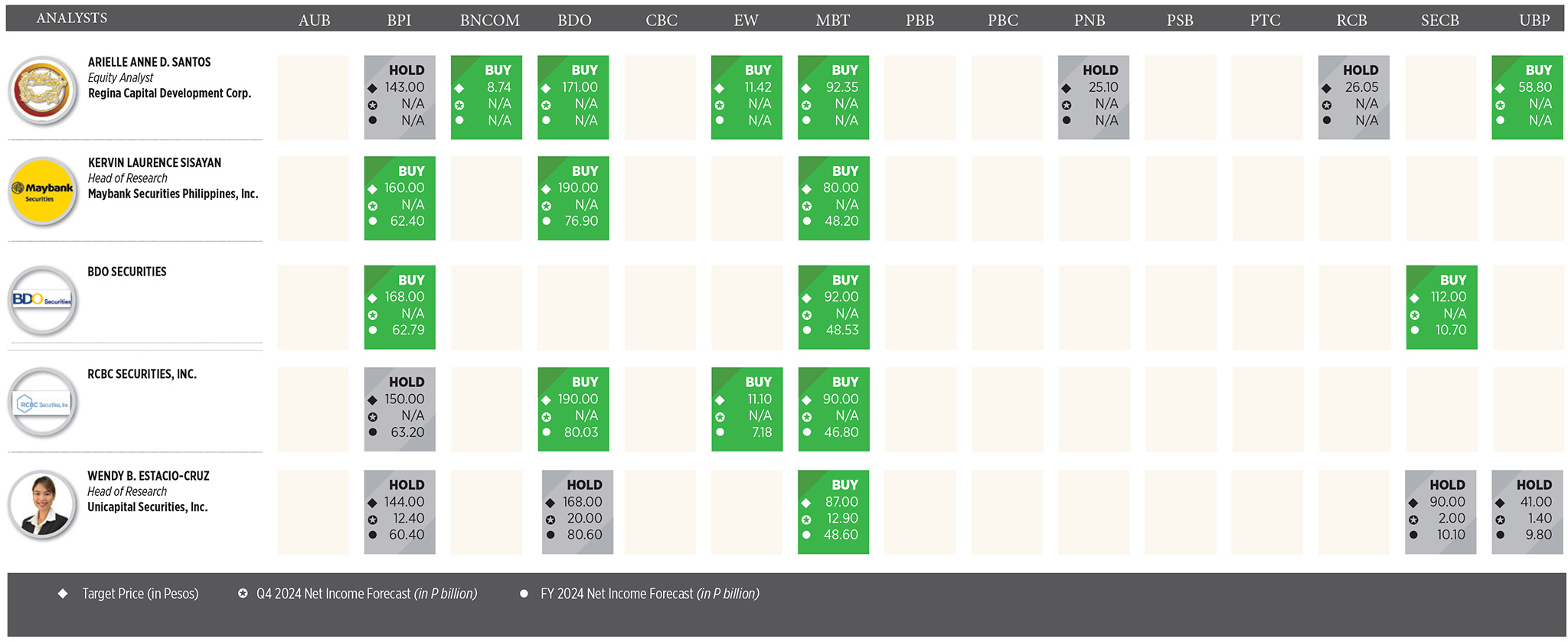
Quarter-on-quarter top performers were Security Bank Corp. (SECB, 52.5%), Bank of Commerce (31%), China Banking Corp. (27.5%), Philippine National Bank (27.3%), and BDO Unibank, Inc. (BDO, 23.2%).

Philippine Trust Co. and Philippine Business Bank performed poorly as their stock prices in the third quarter declined by 3.2% and 5.6%, respectively.

Aggregate net income of universal and commercial banks went up by 51.9% to P271.73 billion as of end-September from P178.91 billion last year, data from the Bangko Sentral ng Pilipinas (BSP) showed.

Gross total loan portfolio of these big lenders rose by 14% to P13.81 trillion as of end-September from P12.11 trillion a year ago.

The big banks’ gross nonperforming loans (NPLs) ratio, however, edged up to 3.18% in September from 3.09% in September the previous year.

The big banks’ net interest margin (NIM) — a ratio that measures banks’ efficiency in investing their funds by dividing annualized net interest income to average earning asset — grew to 4.06% in the third quarter from 3.83% recorded in the same period in 2023.

“Most of the banks under our coverage posted double-digit growth in the bottom line, attributable to high net interest margins and lower provisions for losses amid benign asset quality,” Wendy B. Estacio-Cruz, Unicapital Securities head of Research, said in an email.

Ms. Estacio-Cruz said that Union Bank of the Philippines and Bank of the Philippines (BPI) posted high net income growth in third quarter alone with 77% and 28% year-on-year growth, respectively.

UBP’s bottom line was driven by high top line growth and managed operating expenses and for BPI, high trading income contributed to the growth.

BDO Securities Corp. First Vice-President and Head of Research Abigail L. Chiw said that most banks reported stronger loan growth, stable lending margins, and improving asset quality, which contributed to record high incomes.

“The big banks continue to do well, as they registered above-average industry loan growth given their extensive branch network and expanding digital presence, strong asset quality with low NPL ratios and solid profitability with robust double-digit return on return on equities (RoEs),” said Ms. Chiw.

“During the third quarter, majority of banks booked trading gains which helped push noninterest income higher. This was the result of lower interest rates in the period. On the other hand, majority of banks continue to enjoy high net interest income margin as majority continue to grow consumer loan book which is high yielding in terms of assets,” said Kervin Laurence Sisayan, Maybank Securities Philippines, Inc. head of Research.

Mr. Sisayan also said that SECB stood out given the very strong loan growth year on year. Meanwhile, BDO and Metropolitan Bank & Trust Co. (MBT) continued to show high NPL coverage and stable NPL ratio, implying sustained asset quality.

RCBC Securities, Inc. said that the main factor for the performance of listed banks during the third quarter was the double-digit loan growth under the consumer segment, as business confidence improved along with the BSP’s rate cut.

“BDO and MBT stood out because both managed to improve their asset quality while increasing topline and beating industry loan growth. Their ability to make it happen provides them a shield from inflationary risks or flexibility to deal with slower interest rate cuts,” RCBC Securities said.

BANK STOCK PICKS
In choosing bank stocks, analysts said that traders and investors should continue to monitor market conditions that may affect loan demand and asset quality of banks.

“Uncertainties with regard to the potential impact of protectionist policies from US president-elect Donald J. Trump may temporarily weigh on credit appetite and temper loan growth for banks,” said Ms. Chiw.

Ms. Chiw also added that the risks of reaccelerating inflation and interest rates remaining high and restrictive could also have knock-on effects to the ability of borrowers to repay their debts.

“Traders should watch potential rate changes, loan demand stability, and credit quality trends. Digital transformation will also be pivotal in enhancing banks’ competitiveness and profitability,” said Arielle Anne D. Santos, an equity analyst at Regina Capital Development Corp.

Investors should keep an eye on the movement on NIMs given that they saw more policy rate cuts, Maybank’s Mr. Sisayan said.

“Eventually when we see a more pronounced decline in interest rates as inflation continues to ease, then we could also start looking more closely at an acceleration on loan growth,” Mr. Sisayan said.

Ms. Estacio-Cruz said that they are cautiously optimistic about the banking sector and believe that operating income is likely to peak in mid-2024.

“We anticipate a 20-bps decline in NIMs for the banks within our coverage, given the ease of interest rates. However, we expect that strong asset quality and improved loan growth will help to partially offset the effects of these rate cuts next year, thereby supporting the sector’s RoE,” Ms. Estacio-Cruz added.

“Year-to-date, the financials index remains the most outperforming index and rose 28% compared to the PSEi’s gain of 3%. Nevertheless, we advise a selective approach, particularly considering banks with substantial discounts,” said Ms. Estacio-Cruz.

RATE CUTS
This year, the BSP has delivered a total of 50 basis points (bps) worth of rate cuts in increments of 25-bp reductions at its August and October meetings.

BSP has signaled a possible interest rate cut in December, following the slower-than-expected economic growth in the third quarter and the within-target inflation print in October. Further rate cuts could be expected in 2025, BSP said.

“Rate cuts are expected to compress banks’ net interest margins, which may weigh on short-term profitability. However, they could also stimulate loan demand, potentially benefiting banks with diversified loan portfolios like BDO and BPI,” said Ms. Santos.

She added that lower rates might support asset quality by easing debt burdens, a factor investor may view positively.

“Overall, rate cuts could have a mixed impact on bank stocks, balancing margin pressure with potential gains from loan growth and improved asset quality,” said Ms. Santos.

For BDO Securities, the negative impact of rate cuts to margins can be offset by the positive impact of the reserve requirement ratio (RRR) reductions, such that banks are largely expecting NIMs to remain stable.

“Lower interest rates or borrowing costs are also seen to potentially lift consumer and business sentiment, which in turn, could translate to better investment spending and faster loan growth, which are positive for bank earnings,” Ms. Chiw said.

“We believe that there is room to cut another 25 bps in the last month of the year. So, for the 25-bps cut, this could lead to lower interest rates and lower asset yields,” Mr. Sisayan said.

Meanwhile, Ms. Estacio-Cruz expects net interest margins stable for this year as banks manage to lower cost of funds while keeping asset yields steady.

Addressing barriers to shingles prevention

FREEPIK

One out of three adults aged 50 years or older is at risk of contracting shingles (herpes zoster). After an individual recovers from chickenpox (which they usually caught as a child), the varicella-zoster virus which causes chickenpox continues to live in some of their nerve cells. People get shingles when the varicella-zoster virus reactivates in their bodies after they have already had chickenpox.

Shingles usually develops on just one side of the body or face, and in a small area. The most common place for shingles to occur is in a band around one side of the waistline. Common symptoms include fluid-filled blisters; burning, shooting pain; tingling, itching, or numbness of the skin; and chills, fever, headache, or upset stomach.

For some people, the symptoms of shingles are mild, such as itching. For others, shingles can cause intense pain that can be felt from the gentlest touch or breeze.

If you notice blisters on your face, see your doctor right away because this is an urgent problem, warns the US National Institute on Aging (NIA). Blisters near or in the eye can cause lasting eye damage and blindness. Hearing loss, a brief paralysis of the face, or, very rarely, inflammation of the brain (encephalitis) can also occur.

Most cases of shingles can be diagnosed by a doctor from a visual examination. Although there is no cure for shingles, early treatment with antiviral medications can help the blisters clear up faster and limit severe pain.

Most cases of shingles last three to five weeks. After the shingles rash goes away, some people may be left with ongoing pain called postherpetic neuralgia (PHN). The pain is felt in the area where the rash occurred. The older a person is when they get shingles, the greater their chances of developing PHN.

The PHN pain can cause depression, anxiety, sleeplessness, and weight loss. Some people with PHN find it hard to go about their daily activities, such as dressing, cooking, and eating. Consult your doctor if you are experiencing PHN or have any of these symptoms. Usually, PHN will lessen over time.

Shingles vaccination is the only way to protect yourself against this painful disease, according to the US Centers for Disease Control and Prevention (CDC). Vaccination is over 90% effective at preventing shingles and PHN in adults 50 years and older with healthy immune systems.

The CDC recommends two doses of recombinant zoster vaccine to prevent shingles and related complications in adults 50 years and older. The CDC also recommends the recombinant zoster vaccine for adults 19 years and older who have weakened immune systems because of disease or therapy.

Doctors from various specialties across the country, particularly geriatricians and dermatologists, see many cases of shingles with PHN as the most common complication, revealed a paper by Panaligan et al.

The paper was published in the August 2023 issue of the international monthly peer-reviewed medical journal Human Vaccines & Immunotherapeutics. It presented the insights and recommendations of two multispecialty advisory boards participated in by specialists in adult infectious diseases, dermatology, geriatrics, obstetrics-gynecology, pulmonology, endocrinology, neurology, hematology, medical oncology, rheumatology, transplant surgery, and nephrology.

The specialists noted that shingles imposes a heavy socioeconomic burden on patients in terms of the high cost of antiviral treatment and distress due to pain. Moreover, antiviral medicines do not prevent shingles complications such as PHN. Shingles may also complicate the treatment of ongoing conditions, they added.

The specialists agreed that the introduction of the recombinant zoster vaccine, which has received regulatory approval from the Philippine Food and Drug Administration, could help in the prevention of shingles.

To address low disease awareness, the specialists recommended stepping up education on the burden of shingles and benefits of vaccination through patient advocacy groups, social media, and the dissemination of infographics. They underscored the importance of educating local healthcare professionals (HCPs) on shingles vaccination guidelines, efficacy, and vaccinology principles to improve confidence in making strong recommendations for shingles vaccination.

Capacity building and increased support for shingles immunization infrastructure is also crucial for enabling HCPs to start vaccination in their practice. With an improved infrastructure, shingles vaccination could be offered at primary care facilities and dermatology centers.

Among others, the specialists suggested forming a collaborative, multispecialty special interest group to address barriers to shingles vaccination in the country.


Teodoro B. Padilla is the executive director of Pharmaceutical and Healthcare Association of the Philippines which represents the biopharmaceutical medicines and vaccines industry in the country. Its members are in the forefront of research and development efforts for COVID-19 and other diseases that affect Filipinos.

URC shares drop on gloomy outlook despite increased production

URC.COM.PH

UNIVERSAL ROBINA Corp. (URC) shares dropped last week as challenges outweighed the opening of a new flour mill in Quezon.

URC was the seventh most actively traded stock last week with 14.26 million shares worth P1.11 billion changing hands from Dec. 2-6, data from the Philippine Stock Exchange showed.

Shares of the Gokongwei-led food and beverage company closed at P76.15 apiece, 3.6% lower than the P78.95 close on Nov. 29.

For the year, the stock’s price fell 35.6% from a P118.2 close on the last trading day of 2023.

Analysts attributed the weaker week-on-week close to the lingering effects of its earnings report released on Nov. 12 and higher inflation in November.

“In our view, the recent decline in the stock price [last] week appears to be a continuation of the negative sentiment following last month’s dismal earnings. This spillover effect suggests that investors’ confidence remains fragile as concerns over its near-term prospects persist,” Jemimah Ryla R. Alfonso, equity analyst at Unicapital Securities, Inc., said in an e-mail.

For the third quarter, URC posted a net attributable income of P1.42 billion, falling 53.7% from P3.07 billion in the same period last year.

The company’s revenues likewise dropped 1.81% to P38.14 billion in the third quarter.

“It is hard to say how long the negative effects from its earnings report will last,” Mercantile Securities Corp. Head Trader Jeff Radley C. See said in a Viber message.

“The latest inflation data may have also added to the decline in investors’ sentiment [last] week,” Ms. Alfonso added.

Inflation quickened to 2.5% in November, as typhoons increased prices, the Philippine Statistics Authority (PSA) said on Dec. 5.

Meanwhile, the Department of Agriculture (DA) said on Dec. 1 that the opening of URC’s flour milling factory in Quezon province is seen to improve production.

Spanning 10 hectares, the plant is expected to increase URC’s flour capacity to 3,500 metric tons per day.

The DA said that the plant is expected to “play a key role in ensuring a stable and affordable supply of products.”

“While the recent capacity expansion may be viewed as a positive news for the firm, it appears that it did not provide enough padding for the continued gloomy outlook for URC [last] week. Investors remain focused on the broader challenges that the company is facing including the negative price mix, struggling feed volumes, and the drop in sugar profits,” Ms. Alfonso said.

“Our consolidated net income forecast for URC stands at P2.4B, with an expected topline growth of 6% to P168.4B,” she added.

Mr. See saw resistance at P88 and support at P70.

Ms. Alfonso pegged her support between P73-75.8 and resistance between P80.25-86.25.

“Chart-wise, URC remains in a bearish trend. A shift in bias would require the stock to recover and sustain levels above P86 in the short term,” Ms. Alfonso concluded.   Karis Kasarinlan Paolo D. Mendoza