Home Blog Page 1926

Actor Gene Hackman and wife found dead at home

Gene Hackman in a scene from the 2003 film Runaway Jury.

GENE HACKMAN, the intense character actor who won two Oscars in a more than 60-year career, has died alongside his wife, pianist Betsy Arakawa, and their dog at home, the sheriff’s office in Santa Fe, New Mexico, said on Thursday.

The county sheriff’s office said deputies had found the 95-year-old actor and Ms. Arakawa, 64, deceased on Thursday afternoon at around 1:45 p.m.

“Foul play is not suspected as a factor in those deaths at this time, however exact cause of death has not been determined. This is an active and ongoing investigation by the Santa Fe County Sheriff’s Office,” it said.

Mr. Hackman, a former Marine known for his raspy voice, appeared in more than 80 films, as well as on television and the stage during a lengthy career that started in the early 1960s.

He earned his first Oscar nomination for his breakout role as the brother of bank robber Clyde Barrow in 1967’s Bonnie and Clyde. He was also nominated for best supporting actor in 1971 for I Never Sang for My Father.

It was his turn as Popeye Doyle, the rumpled New York detective chasing international drug dealers in director William Friedkin’s thriller The French Connection, that assured his stardom and a best actor Academy Award.

He also won a best supporting actor Oscar in 1993 as a mean sheriff in the Clint Eastwood western Unforgiven, and was nominated for an Academy Award for his turn as an FBI agent in the 1988 historical drama Mississippi Burning.

Mr. Hackman could come across on the screen as menacing or friendly, working with a face that he described to the New York Times in 1989 as that of “your everyday mine worker.”

A method actor, he drew from his personal experience to flesh out a role. His characters were sometimes raw and violent and ranged from a small-town basketball coach in the 1986 sports film Hoosiers to Superman’s archrival Lex Luthor.

He retired in his 70s, saying the parts he was offered were too grandfatherly. His last substantial role was in the 2004 comedy Welcome to Mooseport.

Living outside Santa Fe, New Mexico, Mr. Hackman was married twice and had three children — Christopher, Elizabeth Jean and Leslie Anne, with his late ex-wife, Faye Maltese, who died in 2017. He married Ms. Arakawa in 1991. — Reuters

PXP Energy cuts net loss to P30.9M in 2024 on higher sales, cost reductions

PXPENERGY.COM.PH

PANGILINAN-LED PXP Energy Corp. narrowed its attributable net loss to P30.9 million for 2024 from P97 million a year earlier, driven by higher petroleum sales volume, reduced overhead costs, and lower net interest expenses.

The company’s core net loss stood at P33.3 million during the period, lower than the P42.5 million recorded in 2023, PXP said in a statement on Thursday.

The reduction was attributed to “higher volume lifted, a reduction in overhead, and lower net interest expense.”

Petroleum revenues rose by 6% to P67 million, driven by higher output sold at 498,126 barrels of oil. This was partially offset by a slight decline in the average crude oil price to $79.97 per barrel from $80.50 per barrel previously. The crude was sourced through Service Contract (SC) 14C-1 Galoc. 

SC 14C-1 is a block containing the producing Galoc Oil Field, situated offshore Northwest Palawan. The oil field has yielded approximately 24.2 million barrels since production began in October 2008, according to PXP.

Costs and expenses declined by 10.5% to P91.8 million, primarily due to significant reductions in both production costs and recurring overhead, which fell to P37.5 million and P54.4 million, respectively.

Amid ongoing geopolitical tensions, PXP and Forum Energy Limited reiterated their commitment to SC 72 and SC 75 despite the extended force majeure on both blocks.

The company holds a 50% operating interest in SC 75, located in Northwest Palawan. Forum Energy, through its wholly owned subsidiary Forum (GSEC 101) Limited, has a 70% operating interest in SC 72 Recto Bank, offshore West Palawan. 

PXP Chairman Manuel V. Pangilinan said the company remains unable to proceed due to the moratorium.

“We can’t do anything when the moratorium is there because we don’t own the asset. It’s owned by the government. Service contracts [are] given to us by the government as [a] concessionaire,” Mr. Pangilinan told reporters on Monday. 

He added that the company could initiate discussions with China National Offshore Oil Corp. (CNOOC), China’s state-owned oil producer, to explore possible action.

“Probably, there has to be some, I guess, some conversation between the Chinese government first. But what we might be able to do is we’ll talk to CNOOC, our counterpart, because it’s an enterprise-to-enterprise [arrangement] as [the] private sector,” he said.

PXP and CNOOC previously held talks on a potential joint oil and gas development in the South China Sea.

Meanwhile, PXP and its joint venture partners are anticipating the imminent awarding of two pre-determined areas (PDAs) offered by the government for petroleum exploration. 

A joint venture comprising PXP, The Philodrill Corp., Sunda Energy Plc (United Kingdom), and operator Triangle Energy (Global) Limited (Australia) has submitted bid documents for petroleum exploration in two PDAs located in the Sulu Sea Basin.

“The company is also actively assessing the feasibility of SC 40’s Dalingding prospect, located onshore in northern Cebu, and will continue to evaluate other oil and gas projects within the Philippines.”

SC 40, also known as the North Cebu Block, is situated in the Visayan Basin, which the Department of Energy considers among the “most prospective in the country,” second only to the producing Northwest Palawan Basin. — Sheldeen Joy Talavera

No, celebrities are not the problem

PHILIPPINE STAR/EDD GUMBAN

RECENT pre-election surveys indicate a significant shift in the Philippine political landscape, with media celebrities poised to secure a substantial number of Senate seats in the upcoming May 2025 elections. According to data from the Philippine Center for Investigative Journalism (PCIJ), if current trends persist, 11 out of the 24 Senate seats could be occupied by popular figures from the news, entertainment, and sports sectors.

Notably, incumbents such as actors Robin Padilla and Jinggoy Estrada, along with broadcaster and YouTuber Raffy Tulfo, are expected to retain their positions. News broadcasters Erwin and Ben Tulfo (Raffy Tulfo’s brothers) and former Senate President (and former TV comedian) Vicente Sotto III are leading in recent Pulse Asia surveys, with over 50% of respondents expressing support for their candidacies.

This trend underscores a growing voter preference for candidates with a strong media presence and public recognition, challenging traditional notions of political qualifications. Yet, instead of reckoning with this reality, Filipino liberals continue to react with frustration, repeating the same tired complaint: Why do we keep electing actors and artists into the Senate?

This reaction isn’t just condescending — it’s politically shortsighted. The assumption that actors are inherently unqualified ignores both the nature of electoral politics and the reality that voters aren’t looking for policy technicians; they’re looking for leaders who resonate with them. By refusing to adapt to this political psyche, Filipino liberals widen the gap between their brand of politics and the mass electorate, leaving a vacuum that conservatives and populists readily exploit.

It’s time to rethink this outdated, elitist view. The problem isn’t that actors enter politics — it’s that Filipino liberals refuse to understand why they win.

POLITICS IS ABOUT POWER
There’s a common misconception that senators should be policy experts. In truth, legislative work is a collective effort, involving legal teams, think tanks, and technical advisors. What matters in electoral politics isn’t whether a candidate can draft a bill from scratch but whether they have the influence and political capital to push policies forward.

This is why actors and media personalities make effective politicians: they already understand how to communicate, how to command public attention, and how to shape narratives. These are essential political skills — arguably more crucial in a democracy than technical expertise.

This isn’t a uniquely Filipino phenomenon either. Around the world, actors have transitioned into politics and left significant legacies.

In the US, Ronald Reagan evolved from an actor to the Governor of California before becoming one of the most impactful US presidents. Arnold Schwarzenegger similarly leveraged his fame to win California’s governorship, where he championed bipartisan policies on climate change and infrastructure. In the UK, Oscar-winning actress Glenda Jackson became a Labor MP, advocating fiercely for social justice and public housing. Meanwhile, Volodymyr Zelenskyy, once a comedian portraying a fictional president, now leads Ukraine through one of the most consequential wars of the 21st century.

None of these figures were dismissed outright for their backgrounds in entertainment. They were instead evaluated on their ability to mobilize public support and navigate power structures. Filipino liberals, in contrast, still cling to a narrow definition of “qualification” that isolates them from the realities of electoral politics.

HOW CONSERVATIVES EXPLOIT THIS LIBERAL BLIND SPOT
This elitist attitude does more than alienate voters — it also plays right into the hands of conservative populists. By positioning themselves as the defenders of “serious” politics, liberals reinforce the idea that they are disconnected from ordinary Filipinos, while populists and right-wing figures brand themselves as the true representatives of the people.

UP Diliman research conducted by Dave Centeno on parasocial relationships — where audiences develop one-sided emotions and bonds with celebrities — suggests that these figures resonate with voters because they feel personally connected to them. A study on Philippine political campaigns found that celebrities bring an added level of emotional engagement that traditional politicians struggle to replicate.

This is exactly how figures like Donald Trump weaponized mass appeal against political elites in the US. His critics mocked his reality TV background, but that same media savvy made him an unstoppable force in modern politics. The more traditional politicians dismissed him, the more he gained credibility as an anti-elite figure.

In the Philippines, conservatives and populists use a similar strategy. Every time a liberal intellectual scoffs at an actor running for Senate, it feeds the narrative that the opposition is a club for the privileged few — disconnected from the masses and allergic to popular culture.

STOP COMPLAINING AND START ADAPTING
If Filipino liberals want to remain relevant, they need to stop looking down on the electorate and start learning how to engage with them. Instead of dismissing celebrity candidates outright, they should be asking: What makes these figures resonate with voters? How can we harness the same emotional and cultural power in our own political messaging?

Filipino liberals need to abandon the lazy complaint that actors shouldn’t be in politics. Electoral politics is about power, influence, and decision-making — not just drafting bills. The real question isn’t whether actors should run, but why liberal candidates fail to match their appeal.

If liberals continue to operate within an intellectual bubble, they will keep losing elections and ceding ground to populists. The challenge isn’t to shame voters into rejecting celebrities — it’s to meet them where they are, understand what moves them, and build a political movement that embraces both competence and charisma.


Jam Magdaleno is a political communications expert and the head of the Information & Communications unit at the Foundation for Economic Freedom, a Philippine-based policy think tank.

Chinabank posts record 2024 net income

BW FILE PHOTO

CHINA Banking Corp.’s (Chinabank) net income rose 12.7% to a record P24.8 billion last year, amid sustained core business growth.

Its common equity tier 1 ratio was 15.3%, while total capital adequacy ratio was 16.2%, the Philippine lender said in a statement on Thursday.

The publicly listed lender did not provide financial figures for the fourth quarter.

“Our ongoing business transformation as well as solid fundamentals will allow us to sustain our growth in the coming years,” Chinabank President and Chief Executive Officer Romeo D. Uyan, Jr. said.

The bank’s full-year performance translated to a return on equity of 15.6% and return on assets of 1.6%, according to its financial statement.

Net interest income rose 18.7% year on year to P63.54 billion due to asset base expansion. Net interest margin stood at 4.5%. Revenue increased 21.1% to P65.49 billion.

Operating expenses went up 20.43% to P30.07 billion amid continued investments in manpower and technology, and volume-related taxes. Its cost-to-income ratio was 47%.

Gross loans rose 18.55% to P916.23 billion from a year earlier as demand from all segments increased.

“Taking a more proactive stance against portfolio risks despite the easing of its nonperforming loan (NPL) ratio to 1.6%, the bank also increased its credit provisions to P3.3 billion,” Chinabank said. “The resulting NPL coverage was higher at 139%.”

Total deposits rose 12.2% to P1.33 trillion from 2023, while assets expanded 11.4% to P1.65 trillion. Total capital went up 12.2% to P168.5 billion.

The lender’s liquidity coverage ratio fell to 110.67% from 127.02%.

“With ample liquidity and a solid capital structure, we can confidently support our institutional and retail customers and advance our growth strategies, while ensuring financial stability through market volatilities and economic challenges,” Chinabank Chief Finance Officer Patrick D. Cheng said in the statement.

The bank doubled its stock price last year due to its strong performance and investor confidence, it said. Book value per share rose 12% to P62.61.

Chinabank shares fell five centavos to close at P86.50 each. — Aaron Michael C. Sy

Buffy the Vampire Slayer’s Michelle Trachtenberg, 39

MICHELLE TRACHTENBERG, an American actor known for her roles in the television series Buffy the Vampire Slayer and Gossip Girl, died on Wednesday, according to her public relations team.

“It is with great sadness to confirm that Michelle Trachtenberg has passed away. The family requests privacy for their loss. There are no further details at this time,” the statement said.

The cause of Ms. Trachtenberg’s death is not known.

The actor was born on Oct. 11, 1985, in New York City to Jewish immigrant parents.

As a child, Ms. Trachtenberg got her start in Hollywood when she was three years old in commercials and her television debut was in the Nickelodeon series The Adventures of Pete & Pete in 1994.

At 10 years of age, she landed her first title role in the 1996 movie Harriet the Spy.

She had roles in several Nickelodeon productions leading up to her being cast in the cult classic EuroTrip in 2004 when she was in her early twenties.

Then came the roles she is best known for, including the character Dawn Summers in the WB supernatural drama Buffy the Vampire Slayer in 2000 and as Georgina Sparks on the CW television series Gossip Girl in 2007.

Some of her other roles include television films Killing Kennedy, Sister Cities, and the science fiction film The Scribbler.

Ms. Trachtenberg also appeared in music videos from emo-rock band Fall Out Boy for their song “This Ain’t a Scene, It’s an Arms Race,” and the Joaquin Phoenix-directed music video for “Tired of Being Sorry” by Ringside. — Reuters

Higher costs cut Philex Mining’s 2024 profit to P810M, down 20%

PHILEXMINING.COM.PH

PANGILINAN-LED Philex Mining Corp. saw its attributable net income decline by 20% to P810 million in 2024 from P1.02 billion a year earlier, as higher costs outpaced revenue growth.

Core net income also dropped 22% to P746 million from P963 million, the company said in a disclosure.

While revenues grew 6% to P8.18 billion from P7.73 billion, operating costs and expenses climbed 9% to P7.3 billion, driven by higher production costs, increased depletion and depreciation, and rising administrative expenses.

Philex reported that depletion, amortization, and depreciation expenses surged to P904.6 million from P698.4 million in 2023.

Production costs increased to P5.61 billion from P5.21 billion, while excise taxes and royalties edged up to P523.98 million from P522.5 million. General and administrative expenses also rose to P260.39 million from P242.42 million.

Despite these cost pressures, the company said higher global gold and copper prices helped offset some of the impact. Gold prices reached $2,419 per ounce in the fourth quarter, while copper peaked at $4.57 per pound before settling at an average of $4.32 per pound for the year.

Philex also noted that its total tonnage milled in 2024 was slightly lower at 6.81 million tons, compared with 6.85 million tons in 2023.

Meanwhile, the company reported progress on its Silangan Project in Surigao del Norte, saying that the underground main access decline has reached the Santa Barbara 1 ore body. Key processing equipment, including a SAG mill and atmospheric leach feed thickener, has been delivered and is ready for installation.

“In 2025, we will navigate the challenges of operating an old yet viable mine like Padcal and commissioning a new mine like Silangan,” Philex Mining President and Chief Executive Officer Eulalio B. Austin, Jr. said.

Philex Mining shares closed 1.99% lower at P4.93 apiece on Thursday. — Kyle Aristophere T. Atienza

A growing appetite: 5 lessons to learn before jumping into the restaurant business

FACEBOOK.COM/MAMALOUS

There’s something about the restaurant biz that calls out to Filipinos. In my many conversations with entrepreneurs, restaurateurs and aspiring entrepreneurs and restaurateurs, their passion for food always rises to the forefront. It’s a testament to how rich Filipino food culture is, that so many of us want to put up a restaurant or food business based on their special secret recipe or their lola’s iconic dish.

With such a deep and strong food culture, the food service industry in the Philippines is booming. Our appetite for new cuisine is bottomless, and the industry is expected to grow at a compound annual growth rate of 13% between 2022 to 2027.

Evidence of this growth is all around us. It seems that there is no end to the new restaurants opening almost every week. But before we all quit our day jobs to pursue that passion of starting our own cafe or launching “The Potato Corner of X,” just how hard is it to succeed in the highly competitive restaurant business? And is there a recipe for success?

Recently, I spoke to restaurateur David Sison, the co-founder of Mama Lou’s and president of the Restaurant Owners of the Philippines. He has such a wealth of experience in establishing restaurants — and, more importantly, succeeding with each. With Mama Lou’s he grew a humble Italian pizza parlor into a restaurant chain with 29 locations and five more on the way this year. Expanding beyond Italian cuisine, he is now venturing into Filipino, halal-certified, Cantonese, and even brewery concepts. His businesses include Famu, Nonna’s, Fatima Halal, Braubass, and more. David’s journey offers invaluable business lessons for aspiring restaurateurs.

LESSON 1: FAILURE IS A STEPPING STONE TO SUCCESS
David wasn’t always in the restaurant business. Before finding success with Mama Lou’s, he dabbled in various businesses, from an internet café to buy-and-sell ventures. These early entrepreneurial efforts, however, ended in failure.

Despite these setbacks, David remained committed to learning and improving. When he saw the potential in Mama Lou’s, he took a different approach, crafting a solid business plan and securing investors rather than simply borrowing money. His early failures taught him that business success requires not just passion but also proper financial planning and operational discipline.

LESSON 2: FINDING THE RIGHT BUSINESS OPPORTUNITY
David attributes much of Mama Lou’s success to identifying the right market gaps. At the time of its expansion, there were few Italian restaurant brands offering authentic, high-quality ingredients at scale.

“I saw that there were not a lot of Italian restaurants that had scale. Many were focused on what was readily available rather than sourcing the best possible ingredients,” David explained. By emphasizing authentic flavors and consistent quality, Mama Lou’s carved out a strong niche in the competitive restaurant industry.

LESSON 3: THE IMPORTANCE OF PROFESSIONALIZING A BUSINESS
In the early years of Mama Lou’s, David recognized a critical challenge: inconsistency. The restaurant’s success relied heavily on the chef, leading to fluctuations in food quality. To address this, he applied what he learned from his Master’s in Entrepreneurship at De La Salle University — building standardized systems and processes.

“The pandemic really taught us to professionalize the business, to focus on the foundation, and to build systems,” David shared. This approach enabled the company to scale efficiently, ensuring that quality and customer experience remained consistent across multiple locations.

LESSON 4: PEOPLE ARE THE HEART OF THE BUSINESS
While food quality is crucial, David believes the real secret to restaurant success is people — both customers and employees. “Business is really all about life. It’s all about how you make people feel,” David said, citing renowned restaurateur Danny Meyer.

Mama Lou’s built its reputation not just on great food but on a warm, hospitable dining experience. David ensures that his team is composed of individuals who embody kindness, empathy, and optimism. To institutionalize this, he developed a hiring framework based on five “gifts of hospitality”: eye contact, genuine smiles, enthusiasm, welcoming hand gestures, and confident posture.

“When you scale so fast, you tend to compromise. You may get managers who can hit numbers, but if they don’t align with your values, your customer service suffers,” David emphasized. He learned that hiring the right people from the start is crucial to maintaining the company’s culture as it grows.

LESSON 5: STRATEGIC PLANNING IS NON-NEGOTIABLE
David admits that his natural inclination is to juggle multiple projects at once, sometimes leading to burnout for himself and his team. He learned the hard way that execution without a clear plan leads to failure.

“The lack of planning leads to stress. You cannot execute well if you don’t have a plan,” David noted. Before expanding, he conducted thorough market research, and it is this level of preparation that made Mama Lou’s expansion a calculated, strategic move rather than a leap into the unknown.

David Sison’s journey is a masterclass for Filipinos who want to get into the restaurant business. Entrepreneurs can learn much from David’s story: start with a strong foundation, invest in systems, and above all, prioritize people.


RJ Ledesma (www.rjledesma.com) is a Hall of Fame Awardee for Best Male Host at the Aliw Awards, a multi-awarded serial entrepreneur, motivational speaker, and business mentor, podcaster, an Honorary Consul, and editor-in-chief of The Business Manual. Mr. Ledesma can be found on LinkedIn, Facebook and Instagram. The RJ Ledesma Podcast is available on Facebook, Spotify, Google and Apple Podcasts.

ledesma.rj@gmail.com

Mastercard Strive signs up 15 service providers

Mastercard Strive signs up 15 service providers
MASTERCARD’s partnership with Boost Capital has onboarded 15 service providers that it said would bolster access to digital financial services for more than 10,000 micro and small enterprises (MSE) in the Philippines .

“Small business owners can focus on growing their businesses rather than waiting in line at a bank to fill out an application,” Boost co-founder Gordon Peters said in a statement on Thursday. “Instead, they just chat with the bank through Messenger or Viber. It’s a huge time saver for women entrepreneurs, and a huge expansion in the customer base for the banks.”

The program under Mastercard Strive onboarded five times more partners than its initial goal. Companies include Asialink, Paymongo, UNO Digital Bank, RAFI Microfinance and Cantilan Bank, which together serve more than 25 million clients nationwide.

“Boost’s white-labeled tech lets financial service providers expand their customer reach even further, so they can now onboard small businesses anytime and anywhere by using Facebook Messenger and Viber for bank applications and payment processing,” Mastercard said in the statement.

Mastercard Strive, which is a portfolio of philanthropic programs, supports the digitalization of small businesses globally. The Mastercard Strive program in the Philippines is delivered by Caribou.

“We launched this program because micro and small businesses, especially those led by women, are a vital part of the Philippine economy,” Mr. Peters said. “Boost’s tech can address the barriers they face in accessing financial services.”

He said they expect 15 partner-companies to launch in less than four months Boost’s chat-based onboarding for loans, savings accounts and payment processing for small business customers. “Between them, these financial service providers serve more than 25 million clients already, so we’re optimistic we’ll impact far more than the 10,000 small businesses we initially set out to serve.”

He added that demand was strong for Boost’s chat-based technology because banks and payment systems in the Philippines want to serve MSEs, especially women-led businesses.

Boost co-founder Lucinda Revell said Mastercard allowed them to enhance their artificial intelligence (AI) technology, which now includes advanced dialect recognition and expanded document validation capabilities. — Aaron Michael C. Sy

Stuff to Do (02/28/25)


Attend a mini book fair, exhibit at Fundacion Sansó

ART books and Filipiniana titles will be showcased at “One for the Books,” a mini book fair on March 1 at Fundacion Sansó. It also serves as the official end of Dibujo: Sketches by Juan Luna and Juvenal Sanso, an exhibition in collaboration with Rising Sunday Foundation under ICArE (Initiative for the Continuation of Artist’s Estate). There will be rare books from the Ayala Museum, the Fundacion Sansó Museum Shop, Vibal Publishing, Tahanan Books, Federico Magat, and more. Special guests will be giving talks in the afternoon: Esperanza Gatbonton at 1 p.m., and Czar Kristoff JP at 2 p.m. Admission is free. Fundacion Sansó is located at 32 V. Cruz, San Juan City.


Go to The Itchyworms concert at Newport

FILIPINO BAND The Itchyworms are set to stage the concert, Good Time Show, at the Newport Performing Arts Theater in Pasay City on March 1, 8 p.m. Presented by Aexponent Media Productions, the special concert will benefit the Philippine Science High School community. The concert’s title refers to the band’s iconic, generation-defining album, Noontime Show, which catapulted them to mainstream success. It will feature intricate musical arrangements by the Manila String Machine on select tracks and a special guest performance from The CompanY. Tickets are available via TicketWorld, with prices ranging from P1,800 to P7,000.


Attend Denise Weldon’s exhibit walkthrough

TO END Arts Month and to kick off Women’s Month, “Witness of the Quiet: A Photographer’s Talk & Meditative Experience” will be held at the Yuchengco Museum in Makati on March 2, 3 p.m. The event blends visual storytelling and mindfulness, with renowned photographer Denise Weldon guiding guests to explore the beauty of stillness through the photographs in her exhibit, Witness of the Quiet. This will be followed by an intimate meditation circle. The walkthrough and experience will take place at the Photography Gallery on the 4th floor of the Yuchengco Museum, with a fee of P500. Participants are invited to come in comfortable clothing, with a yoga mat or towel and a journal. Register via https://bit.ly/PTMEDW500.


View the Lenten season exhibit at Ali Mall

THE new exhibition, Mater Dolorosa, will be opening on March 2 at the MacArthur Activity Area on the ground floor of Ali Mall in Cubao, Quezon City. As a kickoff to the Lenten season, the exhibit showcases religious statues that reflect themes of sorrow, strength, and compassion. It runs until March 13.


Watch a cinematic reimagining of Nosferatu

A BRAND new take on Nosferatu is now on the big screen, helmed by director Robert Eggers. Starring Bill Skarsgård, Lily-Rose Depp, and Nicholas Hoult, the folk legend comes alive in rural Europe, with the goal to project the mythic terror that the vampire character is known to embody. “The folk vampire is not a suave dinner-coat-wearing seducer, nor a sparkling, brooding hero. The folk vampire embodies disease, death, and sex in a base, brutal, and unforgiving way. This is the vampire I wanted to exhume for a modern audience,” Mr. Eggers said in a statement. Nosferatu is screening nationwide in Philippine cinemas.


Listen to Plume’s new single about unexpected love

ALTG RECORDS artist Plume has released a new single, “Kidlat,” about the beauty of falling in love unexpectedly. “It is a reflection on how love can surprise you when you least expect it — when you think you’re done with the idea of romance, only to find your heart opening again,” the Baguio-based singer said of his new track. It was recently featured in GMA Network’s series Mga Batang Riles and is now streaming on all digital music platforms worldwide.


See Maris Racal, Anthony Jennings’ movie on Netflix

SOSYAL CLIMBERS is the first Netflix Original with ABS-CBN. Now available on the platform, it stars Maris Racal and Anthony Jennings as a financially struggling couple who are mistaken for new residents of a posh neighborhood and play into the charade to fool the upper class and have a taste of luxury. The two test their skill, charm, and love for each other as their scheme goes too far.

NLEX Corp. taps China Road for NLEX–C5 Northlink project

NLEX.COM.PH

NLEX CORP. has partnered with China Road and Bridge Corp. (CRBC) for the construction of the new NLEX–C5 Northlink segment, the Metro Pacific Tollways Corp. (MPTC) unit said on Thursday.

In a media release, NLEX said it had signed a contract with CRBC for the NLEX–C5 Northlink Segment 8.2 Section 1A project, which has an overall cost of P2.2 billion.

The elevated road will extend the NLEX Mindanao toll plaza to Quirino Highway in Novaliches via an expressway crossing the Tullahan River in Quezon City.

“The Metro Pacific Group actively contributes to driving infrastructure development across the Philippines, focusing on supporting nation-building through an extensive tollway network,” MPTC President and Chief Operating Officer Arrey A. Perez said.

“NLEX–C5 Northlink Segment 8.2 Section 1A will offer 24/7 access for all vehicle classes, facilitating smoother and more efficient travel across the east and west routes of North Metro Manila.”

The entire NLEX–C5 Northlink project spans 11.3 kilometers and is expected to ease daily traffic congestion along parts of Mindanao Avenue and Quirino Highway by providing a direct route for motorists.

MPTC is the tollway unit of Metro Pacific Investments Corp. (MPIC), one of the three key Philippine subsidiaries of Hong Kong-based First Pacific Co. Ltd., alongside Philex Mining Corp. and PLDT Inc.

Hastings Holdings, Inc., a unit of PLDT Beneficial Trust Fund subsidiary MediaQuest Holdings, Inc., holds a majority stake in BusinessWorld through the Philippine Star Group, which it controls. — Ashley Erika O. Jose

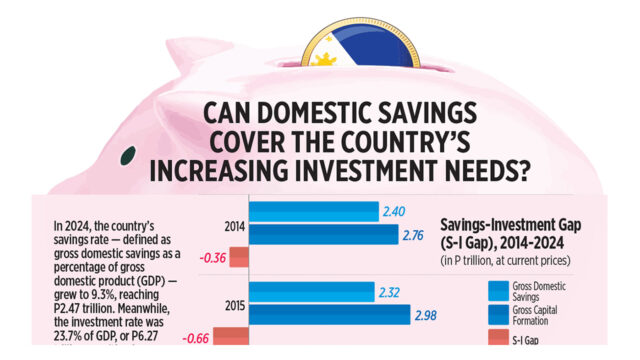
Can domestic savings cover the country’s increasing investment needs?

In 2024, the country’s savings rate — defined as gross domestic savings as a percentage of gross domestic product (GDP) — grew to 9.3%, reaching P2.47 trillion. Meanwhile, the investment rate was 23.7% of GDP, or P6.27 trillion, resulting in a P3.8-trillion gap. The savings-investment gap (S-I) gap — the difference between gross domestic savings and gross capital formation — shows a country’s ability to finance its overall investment needs. An S-I deficit occurs when a country’s investment expenditures exceed its savings, forcing borrowing to fund the gap.

Can domestic savings cover the country’s increasing investment needs?

EV-killer cobalt has backfired, Wile E. Coyote-style

MICHAEL FOUSERT-UNSPLASH

LISTENING to the various “yes, but” theoretical challenges raised to the energy transition over the years has at times felt like watching Road Runner cartoons.

Time and again, portentous and alarming arguments have been dragged out — like the cartoons’ antagonist Wile E. Coyote, hauling along an Acme Rocket-Sled to catch his feathered prey — only to backfire spectacularly, leaving the proponents frazzled. Meanwhile the energy transition, undaunted, has sped onward.

The latest EV-killer to run into the canyon has been cobalt. The Democratic Republic of Congo, which produces about three-quarters of the bluish-silver metal used in lithium-ion batteries, has suspended output for four months to help mop up a glut that’s caused prices to slump to their lowest levels in decades.

It wasn’t meant to be this way. At pretty much any point over the past decade, wise heads were warning that a looming shortage might stop the rise of electric vehicles in its tracks.

“A Cobalt Crisis Could Put the Brakes on Electric Car Sales,” Wired magazine warned in 2020. Prices might surge north of $600,000 a metric ton, an International Monetary Fund study cautioned the following year, about 30 times the current price. There simply isn’t enough cobalt in global mine reserves, and we may be better off reinventing the internal combustion engine instead of switching to electric cars, according to a 2021 report for the Geological Survey of Finland.

How did all those predictions turn out so wrong? If you’d paid attention to the history of commodities, you’d have known the answer long ago.

Permanent shortages of raw materials are almost unheard of in human history. That’s a consequence of the laws of supply and demand: When demand for a material runs too far ahead of supply, prices rise. Consumers respond by using less, while producers rush to get more of it to market. The result is a price slump and, typically, a return to equilibrium.

That’s precisely what we’ve seen in the cobalt market over the past decade. The metal helps pack extra energy into a lithium-ion battery, so seemed critical in the early years of EVs when manufacturers were struggling to develop vehicles which could travel for more than a few hundred kilometers on a charge.

The shortage of global supplies was a concern from the outset, though. By the middle of the 2010s, cell-makers were working to shift from the NMC 111 chemistry — which used equal quantities of nickel, manganese, and cobalt — to NMC 811 and NMC 955, which were respectively 10% and 5% cobalt.

Miners, meanwhile, were finding far more of it than anyone expected. In Indonesia, weathered nickel-rich rock contains just the right proportion of cobalt for an NMC battery. Now a country whose production was negligible has become the world’s second-largest producer. In Congo, hunger for another energy-transition metal — copper — caused cobalt output to more than double in five years, thanks to the way local ores contain a mixture of the two elements.

The coup de grâce came from China’s lithium-ion battery giants Contemporary Amperex Technology Co. and BYD Co. Rather than scrimping on your use of cobalt with NMC 811 and NMC 955 batteries, why not give up on it altogether? The rival lithium-iron-phosphate or LFP cathode chemistry, long overlooked as a technology more suited to golf carts than performance cars, has improved by leaps and bounds — driven by the necessity of innovation in the face of cobalt’s tight market.

These days, LFP batteries have energy densities that match the best NMC cathodes from the early 2020s, cost about half as much, and are installed in nearly 50% of Chinese EVs. Premium overseas carmakers are joining the club: Audi AG, BMW AG, Mercedes-Benz Group AG, and Tesla, Inc. are all now selling or developing LFP-based models.

The result of all this is a bust, even as EVs boom. “Cobalt is far less important than imagined,” a spokesman for China’s CMOC Group Ltd., the biggest miner of the metal, told Bloomberg News last year. “EV batteries will never return to the era that relies on cobalt.”

Demand for cobalt sulfate, the compound used in batteries, has already nearly topped out. Having doubled to about 160,000 metric tons a year since 2019, it will tick up to just over 180,000 tons by 2027, where it will plateau for the foreseeable future, according to forecasts out to 2035 by BloombergNEF. That’s in marked contrast to other battery metals such as lithium, nickel, and manganese, which are expected to experience ongoing growth.

Cobalt won’t go away entirely — but in future it will increasingly occupy a niche position at the most performance-oriented end of the EV market. There’s a rich irony in this. For years, people have warned that this one metal would kill off electric cars and keep the world hooked on gasoline. To the extent that cobalt still has a future now, it’s because that prediction turned out to be spectacularly wrong.

BLOOMBERG OPINION