Home Blog Page 189

Rate cuts, US tariffs, corruption mess steer markets in Q3

BW FILE PHOTO

By Isa Jane D. Acabal

POLICY EASING by the Bangko Sentral ng Pilipinas (BSP), tariffs imposed by the United States, and the ongoing flood control corruption scandal shaped the country’s financial markets in the third quarter, analysts said.

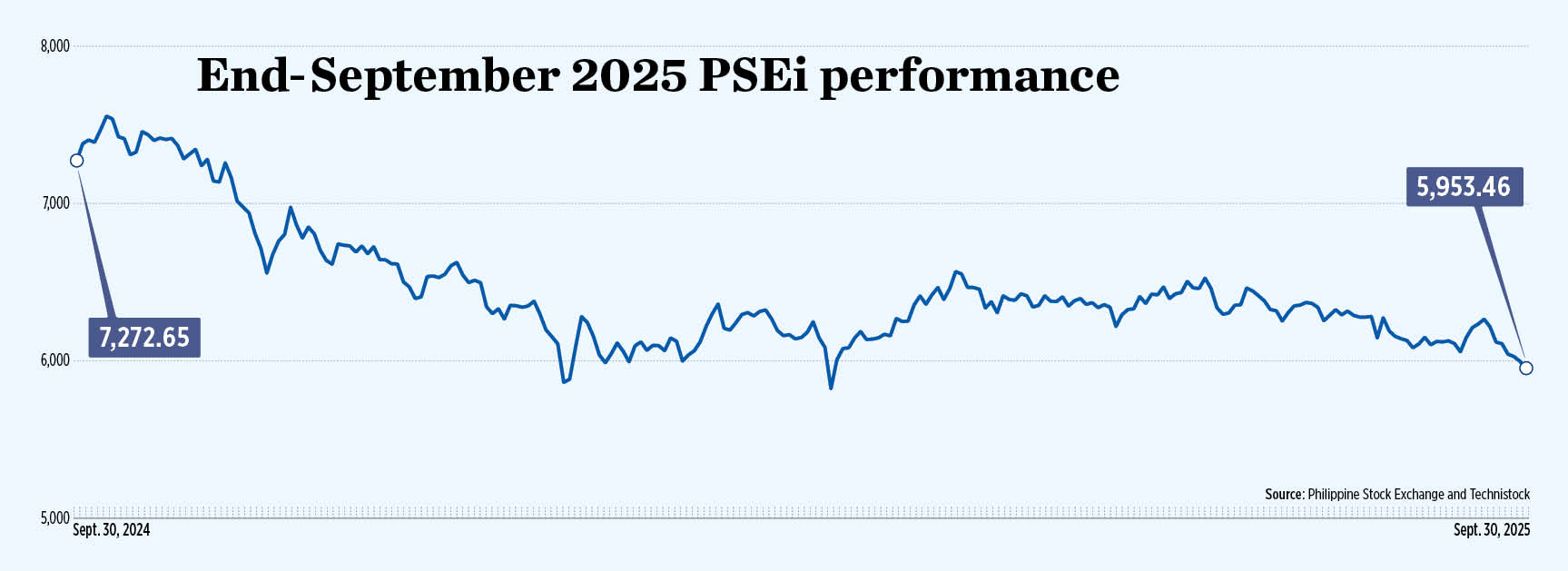
The Philippine Stock Exchange index (PSEi), the country’s barometer for the stock market, closed at 5,953.46 in the third quarter, down by 18.1% from 7,272.65 in the same quarter last year.

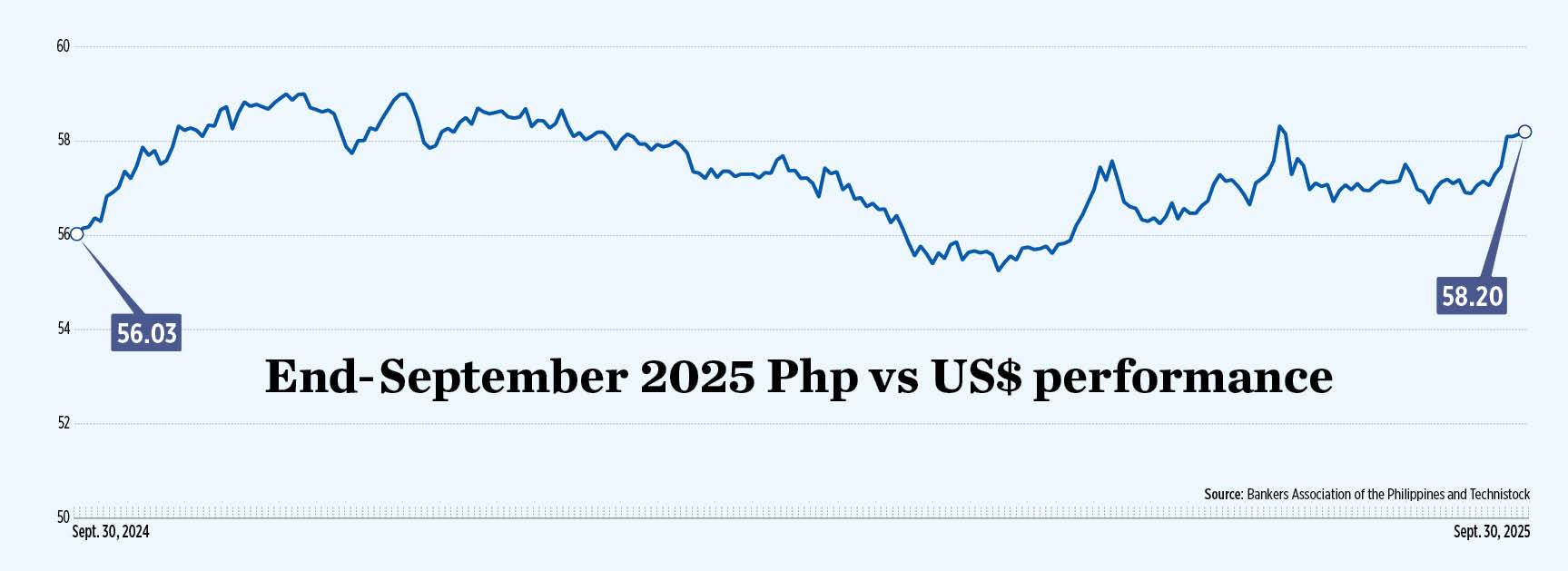
On the other hand, the peso appreciated by 3.9% to P58.20 against the dollar as of end-September from P56.03 a year ago, according to data from the Bankers Association of the Philippines.

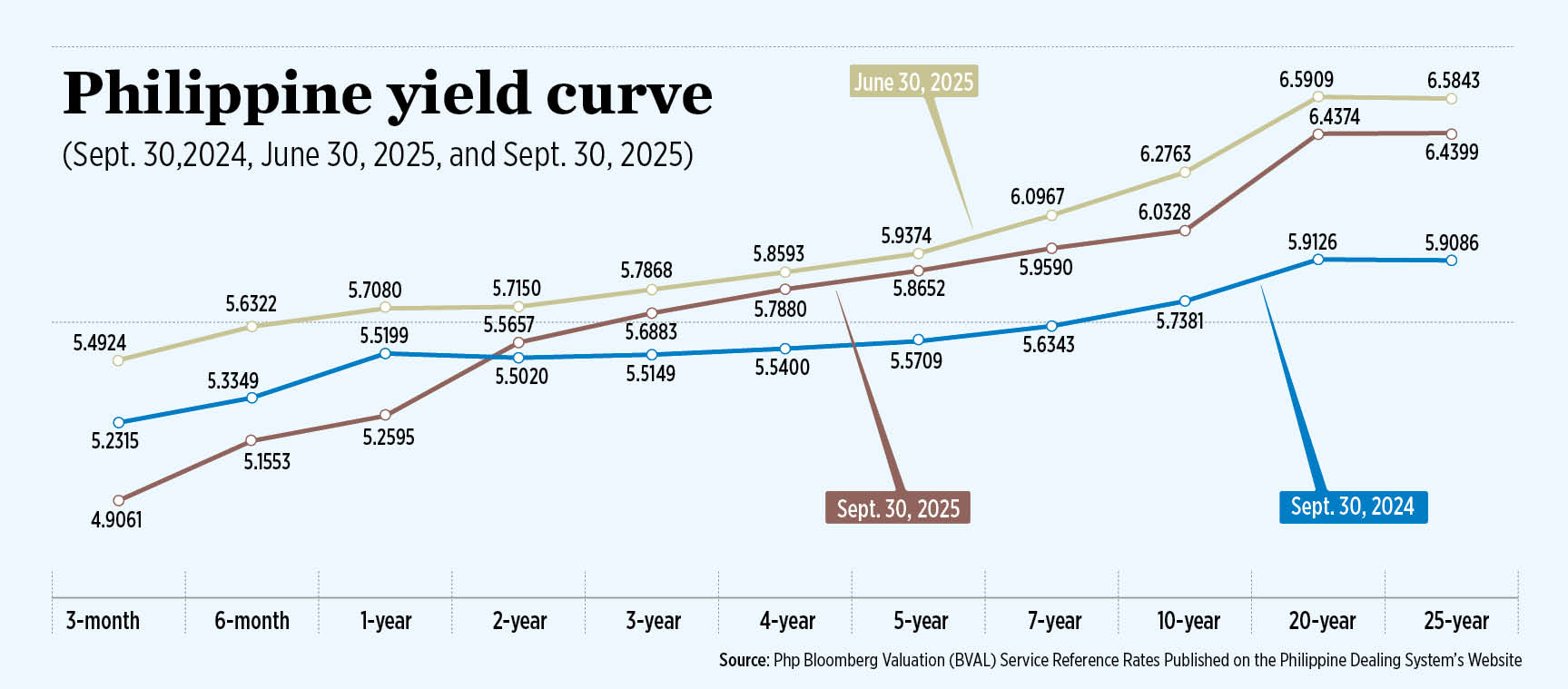
Yields on government securities rose by an average of 2.59 basis points (bps) year on year, based on the PHP Bloomberg Valuation (BVAL) Service Reference Rates published on the Philippine Dealing System’s website as of Sept. 30.

The BSP’s shift to a more dovish stance reflected in its consecutive rate cuts influenced the performance of domestic markets during the period, according to analysts.

Just last week, the central bank slashed again its policy rate by another 25 bps, bringing the key rate to over three-year low of 4.5%. It also signaled that the easing cycle nears its end.

It has so far trimmed borrowing costs by two full percentage points since it began its easing cycle in August last year.

“Reduced borrowing costs incentivized capital formation and supported investment momentum and economic activity, despite external headwinds and domestic governance concerns,” the central bank said in an e-mailed reply to questions.

According to the BSP, the present interest rate environment helped in credit expansion and in maintaining stability in the domestic financial markets.

“What we saw from this easing cycle was a ‘A Tale of Two Cities’ in Q3 — the local stock market was tepid while the bond market received much interest,” Marco Antonio C. Agonia, an economist from the University of Asia and the Pacific, said in an e-mail.

Mr. Agonia said the response in local equities was muted because market players anticipated the rate cuts, contrary to the local secondary market where “participants scrambled to lock in yields within the easing cycle.”

For economist Reinielle Matt M. Erece of Oikonomia Advisory and Research, Inc., the markets’ reaction to the key rate reduction was anticipated, with bond yields already factoring in the move, leading to their decline.

However, he said equity markets continued to move sideways due to investors’ concern about corruption, global trade tensions, and weaker currency.

Sharing the same sentiment, Nicholas Antonio T. Mapa, chief economist of Metropolitan Bank & Trust Co., said in an e-mail that the BSP’s policy easing would help support moderating growth momentum amid uncertainty.

“Almost everyone was expecting BSP to retain their dovish stance given target consistent inflation and expectations for growth momentum to stay challenged,” he said.

Despite the rate cuts, Mr. Mapa said investors remain cautious given persistent concerns about the economic and geopolitical outlook for the Philippines.

In the third quarter, the Philippine economy grew 4%, a sharp slowdown from the 5.5% growth in the second quarter and the 5.2% logged in the same period in 2024.

Government spending increased by 5.8% in the third quarter, slowing down from 8.7% in the previous quarter, but faster than the 5% growth recorded in the same period last year.

This followed after the delays and controversies surrounding flood-control infrastructure projects.

“The ongoing infrastructure spending controversy exerted downward pressure on investor sentiment and domestic market performance,” according to the BSP.

On the same note, Mr. Agonia said the ongoing flood control scandal soured investors’ mood in the stock market.

“While trade uncertainties weighed on investors’ minds in the first half of the year, governance issues became the defining brush stroke for the Q3 picture,” he said, adding that a definite action is needed to regain investors’ optimism.

He noted that the US Fed’s September rate cut boosted the PSEi, but gains were short-lived as new revelations about the flood-control scandal emerged.

US TARIFFS
The 19% US tariff imposed on most Philippine goods, effective Aug. 7, also affected markets during the period.

“The heightened uncertainty over the implementation of US tariffs weighed on domestic investor sentiment during the quarter,” the BSP said.

Based on the central bank’s Business Expectations Survey, business sentiment became less optimistic in the third quarter amid global headwinds from higher US tariffs, geopolitical tensions, and weaker external demand.

For Mr. Agonia, the tariff announcement alleviated some of the uncertainty that had weighed market players in the previous quarters concerning the implementation of US tariffs.

“Markets seemed to react positively to the definite and comparatively lenient tariff stance given to the Philippines,” Mr. Agonia said.

Meanwhile, for Pantheon Macroeconomics Chief Emerging Asia Economist Miguel Chanco, the confirmation of the US tariff midway through the quarter “was neither here nor there in terms of market impact” primarily because exports are a minor factor for the country’s economic growth.

“For the most part, the Philippines is one of the ‘winners’ in the global tariff setup so far, even though its rate ended up being slightly higher than the one first proposed in Liberation Day,” he said.

For Mr. Mapa, the ongoing US tariffs weighed on the country’s overall growth, a key concern for investors.

However, “although traders and exporters remain wary over developments on the global trade front, concern appears to be shifting to domestic growth concerns more than to US tariff policy,” Mr. Mapa added.

Mr. Agonia said other challenges for financial markets in the third quarter included the “ghost month,” bad weather, and slight peso depreciation.

Meanwhile, supportive factors included “benign domestic inflation, within-expectations Q2 gross domestic product (GDP) growth, and good Q2 corporate earnings,” he added.

KEY FACTORS TO MONITOR
Heading into the fourth quarter, Mr. Chanco sees further rate cut expectations as markets continue to face pressure based on domestic factors.

“As things stand, our base case is that the Board will cut again in December and in early-2026 by a total of 50 bps (two more 25-bps cuts),” he said.

Mr. Agonia said the country’s financial markets could see cautious gains, supported by the seasonal holiday boost and catch-up government spending.

On the same note, Rizal Commercial Banking Corp. Chief Economist Michael L. Ricafort said markets expect a seasonal rise in remittances and peso conversions to fund the Christmas spending in the latter part of the fourth quarter, a pattern observed for decades.

He also anticipates further rate cuts by the US Fed and the BSP in the coming months, amid benign inflation, to remain an offsetting positive factor for the economy.

FIXED-INCOME MARKET
BSP: The bond market is expected to be supported by the low-interest rate environment, easing global monetary conditions, and robust demand from domestic investors.

Agonia: Relatively low inflation and a more dovish BSP should see the bond market flourishing into Q4 and onwards. Volatility in the US markets may encourage investors to flock to the Philippine bond market.

Erece: Expectations of continuous rate cuts can drive market rates downwards. Furthermore, concerns about economic slowdowns may also drive demand for debt securities over equities to lock in consistent profit through interest rates.

EQUITIES
BSP: Ongoing concerns over public spending on flood control projects weigh down market sentiment. However, slower global trade and the sustained strength of the US dollar are likely to influence foreign investment into equities.

Ricafort: Further improvement in ESG (environmental, social, and governance) compliance by the government and some listed companies may be needed for the PSEi to break out higher from the familiar range of 6,000-7,000 seen for more than 13 years already, particularly the government’s anti-corruption measures and further elevating governance standards.

Agonia: Local equities may continue to be lukewarm, especially as analysts scale down their Q3 GDP growth forecasts. Despite this, some factors guarding the downside may include benign inflation, healthy employment figures, potentially strong Q3 corporate earnings, and some holiday remittance relief for the peso-dollar rate.

Erece: A potential year of loss can be anticipated given disappointing economic growth, persistent external headwinds, and weak public sector credibility.

FOREIGN EXCHANGE MARKET
BSP: Concerns over US fiscal sustainability, US trade policy measures and risks to the US Fed’s stability and independence could weaken the US dollar and support the peso. However, ongoing geopolitical tensions, notably in the Middle East, may prompt safe-haven demand for the dollar and put depreciation pressure on the peso. Domestically, the peso could find support from steady macroeconomic fundamentals and resilient FX inflows from BPO revenues, tourism, and Overseas Filipino Workers’ remittances.

Ricafort: Still relatively benign local inflation data tends to fundamentally support the peso exchange rate with more purchasing power for the local currency.

Agonia: The holiday remittance wave may also provide relief for the peso-dollar rate towards the P57-P57.5 range. However, a potential BSP rate cut in December and a larger Q4 trade deficit could add to some depreciation pressure moving forward.

Erece: The recent corruption scandals can drive confidence on the country down. Thus, inducing capital outflows and less demand for the peso. These events can cause the peso to depreciate. Despite a dovish Fed, if investor sentiment overwhelms the foreign exchange effects of monetary policy, the Peso may continue to depreciate. However, I think the BSP will prevent the currency from reaching P60 levels through their own interventions.


Disney’s Zootopia 2 set to join $1-billion box office club

WALT DISNEY Animation Studios’ Zootopia 2 is on track to surpass $1 billion at the global box office, the company said on Friday, as the sequel continues its strong run in international markets.

The film, which revisits the bustling animal metropolis of Zootopia, features returning characters Judy Hopps, a rabbit police officer voiced by Ginnifer Goodwin, and her fox partner Nick Wilde, voiced by Jason Bateman.

The duo embarks on a new adventure that blends humor and social themes, echoing the formula that made the original a hit.

Zootopia 2 opened strongly over the US Thanksgiving weekend, giving Hollywood a boost at the start of the critical holiday season.

The film’s runaway success has been fueled by an extraordinary reception in China, where Zootopia 2 dominated the box office during its opening weekend, accounting for roughly 95% of all ticket sales nationwide.

The original Zootopia also became China’s most popular foreign animated film when it was released in 2016.

The performance offers welcome relief for theater operators hoping for packed cinemas through Christmas, traditionally the second-busiest moviegoing period of the year. Global box office receipts have yet to return to the pre-pandemic levels seen in 2019. — Reuters

DA ‘command center’ to consolidate crop, weather, produce, livestock inventory data

DA.GOV.PH

THE Department of Agriculture (DA) said it is consolidating its data in a single “command center” platform which will compile crop, weather, produce and livestock inventory, among others.

According to the DA, the command center will allow the department to anticipate shortages, prevent oversupply, and improve regional coordination.

The DA said it is also exploring artificial intelligence (AI) tools that can process the data to generate actionable insights.

“We will use AI to ask the questions and then help us solve problems or situations,” Agriculture Secretary Francisco Tiu Laurel, Jr. was quoted as saying in a statement.

Mr. Tiu Laurel said the AI service may be called Government Artificial Intelligence for Agriculture or GAIA.

The DA said the AI tool is expected to help the agency simulate crop scenarios, optimize planting schedules, detect disease risk early, and monitor farmgate price distortions. — Vonn Andrei E. Villamiel

First Gen powers Cagayan hospital with renewable energy

CUMC.COM.PH

FIRST GEN CORP. has partnered with Divine Mercy Wellness and Medical Center in Tuguegarao City, Cagayan to supply the hospital with renewable energy from its Tongonan Geothermal Power Plant in Leyte.

The agreement covers the electricity needs of the 100-bed facility, supporting its shift to cleaner power, First Gen said in a statement over the weekend.

“Geothermal power provides a clean, reliable and consistent energy source — qualities that are vital for hospitals,” said Carlo Vega, First Gen’s chief customer engagement officer.

Divine Mercy, part of the Mount Grace Hospital network under the UNILAB Group, employs more than 200 medical specialists providing 24/7 radiology, pathology, laboratory and other services.

“Our partnership with First Gen reinforces our commitment to environmental stewardship while ensuring the provision of high-quality healthcare,” said Divine Mercy President Godofredo Cruz.

The deal was facilitated through the government’s green energy option program, which lets qualified consumers with at least 100 kilowatts in average peak demand select their preferred electricity supplier.

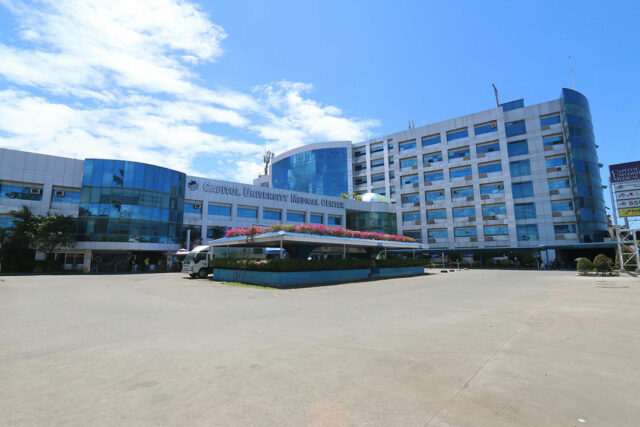
First Gen has partnered with Capitol University Medical Center in Mindanao, supplying its 200-bed hospital, including specialty care units like the Kidney Institute.

The company operates over 1,700 megawatts (MW) of renewable capacity across 22 geothermal, wind, solar and hydropower facilities, part of its total installed capacity of 3,696 MW across various energy sources. — Sheldeen Joy Talavera

Peso to move sideways before key data releases

BW FILE PHOTO

THE PESO could trade sideways against the dollar this week as players await the release of Philippine and US economic data.

On Friday, the local unit closed at P59.065 per dollar, declining by 7.5 centavos from its P58.99 finish on Thursday, data from the Bankers Association of the Philippines showed.

Week on week, the peso dropped by 13 centavos from its P58.935 close on Dec. 5.

“The dollar-peso closed higher after Remolona tempered the market’s hawkish view due to weak growth expectations,” a trader said in a phone interview.

BSP Governor Eli M. Remolona, Jr. said on Friday that the central bank has room for one last 25-basis-point (bp) cut next year as the inflation outlook remains benign and with the economy’s recovery likely to take longer than expected.

He said gross domestic product (GDP) growth could slow further to 3.8% this quarter from the over four-year low of 4% in the July-September period. This would bring the full-year average below 5% versus the government’s 5.5-6.5% goal.

The BSP chief said that they expect the economy to recover by the second half of 2026, with growth seen moving closer to the government’s 6-7% target only by 2027.

On Thursday, Mr. Remolona signaled that their current easing cycle is nearing its end after the Monetary Board lowered benchmark rates by 25 bps for a fifth meeting in a row to bring the policy rate to 4.5%, as expected by 17 out of 18 analysts in a BusinessWorld poll.

The Philippine central bank has now delivered 200 bps in reductions since starting its easing cycle in August 2024.

For this week, the trader said the peso could move depending on the Philippine remittances and US nonfarm payrolls data to be released in the coming days.

The trader expects the peso to move between P58.80 and P59.20 per dollar, while Rizal Commercial Banking Corp. Chief Economist Michael L. Ricafort said he sees it ranging from P58.70 to P59.20.

A host of delayed employment, inflation and other data in the coming week will give a long-anticipated view of the US economy that could help guide markets into year-end, Reuters reported.

The upcoming data are especially critical because investors and the Federal Reserve have been navigating with little certainty since a 43-day federal government shutdown postponed key reports.

The US jobs report for November is due on Tuesday, while the monthly consumer price index, which is closely watched for inflation trends, is out on Thursday.

US payrolls are expected to have climbed by a tepid 35,000 in November, according to a Reuters poll. Fed Chair Jerome H. Powell on Wednesday said while payrolls have been averaging an increase of 40,000 per month since April, the Fed thinks those numbers are overstated and could instead be an average loss of 20,000 per month.

A divided Fed cut interest rates by a quarter percentage point on Wednesday for a third-straight meeting as it seeks to shore up a weakening labor market. But the central bank signaled borrowing costs are unlikely to drop further in the near term as it awaits more economic clarity. — AMCS with Reuters

Globe Business brings GDay 2025 closer to partners and communities

Jonathan Cristobal, Globe Business Marketing Head, opening the Ready, Set, G! Game Night

GDay 2025 was Globe Business’ grand gesture of gratitude, transforming business relationships to vibrant, lasting connections. Across the nation, the celebrations overflowed with laughter, shared stories, and memorable moments. Every moment reflected its belief that appreciation strengthens bonds and empowers communities.

Globe Business proudly wrapped up its 10th anniversary GDay celebration, reaching thousands over three months through impactful events and delightful surprises.

Ready, Set, G! Game Nights: Where collaboration meets fun

Business met leisure at the Ready, Set, G! Game Nights, turning traditional gatherings into lively, engaging experiences in Manila, Cebu, and Davao. Drawing over 600 attendees, each night was filled with friendly games, upbeat music, and lively exchanges that proved collaboration can indeed be fun.

Guests also enjoyed interactive booths that featured Globe Business’ latest digital solutions, showing how technology can make work simpler and more meaningful. These events forged lasting connections, moving beyond mere transactions to build genuine partnerships.

Globe Business Teams ready to deliver the GDay Donuts to their respective clients

The sweetest surprise: GDay Donuts return

The celebration’s sweetest gesture was the highly-anticipated return of GDay Donuts, a heartwarming collaboration with Dunkin’. This custom-branded surprise was delivered directly to the offices of over 2,300 companies nationwide. Each box included a QR code linking to exclusive Globe Business offers. It was a simple, heartfelt gesture that shared gratitude and brightened the workday of countless partners.

“Every event is a thank-you note written in experiences,” said KD Dizon, VP and Head of Globe Business. “We want our partners to feel that they are an essential part of something bigger — an ecosystem built on collaboration, innovation, and care that drives us all forward.”

GDay 2025 successfully highlights that Globe Business is a dedicated partner for both the success of its clients and the well-being of the community it supports. Ten years on, GDay continues to serve as a powerful reminder that when connections are made with heart, business transcends mere transactions and truly becomes a force for good.


Spotlight is BusinessWorld’s sponsored section that allows advertisers to amplify their brand and connect with BusinessWorld’s audience by publishing their stories on the BusinessWorld Web site. For more information, send an email to online@bworldonline.com.

Join us on Viber at https://bit.ly/3hv6bLA to get more updates and subscribe to BusinessWorld’s titles and get exclusive content through www.bworld-x.com.

Fit to a T

The Jetour T2’s slightly smaller sibling is priced at P1.898 million. — PHOTO BY MANNY N. DE LOS REYES

The Jetour T1 Lightning i-DM looks like a Bronco, feels like an X5

IF YOU’VE BEEN admiring the Land Rover swagger of the Jetour T2 but find its size a tad too big, Jetour just rolled out its slightly smaller alternative, the T1. The all-new Jetour T1 Lightning i-DM is a midsize five-seater plug-in hybrid electric vehicle (PHEV) that mimics the ruggedly handsome styling of its T2 SUV sibling.

From the front, the T1 exudes a Ford Bronco vibe, while the slab sides channel that Land Rover Defender stance. The T1 is shorter than the T2 by about three inches, with its width and height shorter by just under two inches. For reference, the T1 is shorter than a Toyota Fortuner by 3.8 inches. Surprisingly, the wheelbase of the T1 is longer than the T2’s by a miniscule 10mm, while its ground clearance is just under an inch lower.

Overall, the T1 looks like a T2 that’s been shrunk by 10%, with every side and the overall proportions very similar. The only visual differences are the missing rear quarter window in the T1 and the absence of the tailgate-mounted spare tire cover (which is actually a faux spare tire cover). But the T1 retains the T2’s bold and rugged exterior styling and very assertive road presence, highlighted by distinctive LED headlamps and taillamps.

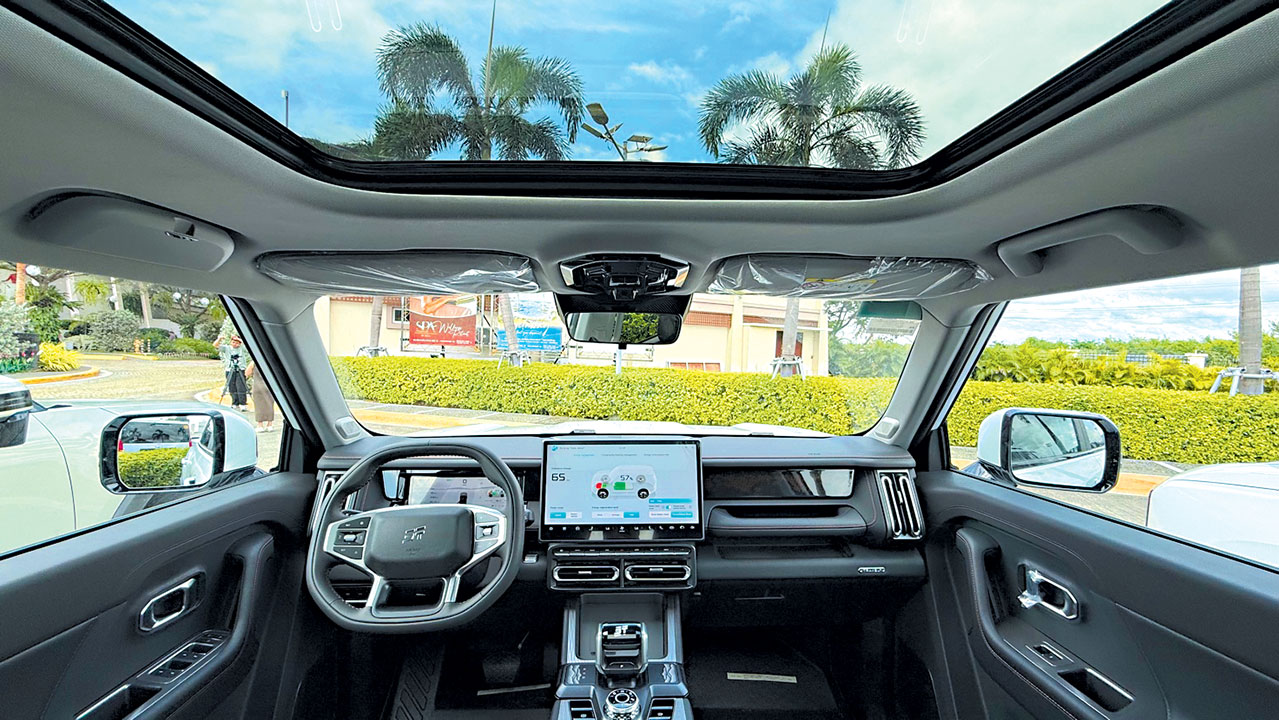
Inside, the similarities continue. You’ll find yourself in a very spacious and very premium interior with plush-feeling faux leather in black with red piping. The vastness comes from the vehicle’s boxy upright proportions, large windows, and panoramic sunroof, giving the cabin a very generous visual and physical airiness. There is a lot of head, leg, and elbow room and numerous storage compartments on the dash, console, door panels, and seatbacks.

The center console is a work of art, with beautiful detailing on the surfaces and a jewel-like quality to the artfully designed gearshift lever and drive mode knob. Polished metal trims on the AC vents, steering wheel, and inner door handles create a luxurious ambience — pleasant and soothing to the touch and to the eyes.

You’ll also find a wireless charger, multiple USB-A and USB-C charging ports, and a superb-sounding Sony audio system. Rear AC vents, a folding center armrest with cupholders, reclinable rear seatbacks, and more charging ports elevate the premium feel even for backseat passengers of this Jetour.

The T1 features a 10.25-inch instrument panel and a 15.6-inch infotainment screen. Passengers are shielded from sun and sound by a nine-layer sun-protection glass and five-layer soundproof glass. Unique features like Adaptive Ventilation, which adjusts based on body weight, and a 24-hour parked air-conditioning function are boons in our hot climate and redefine in-car comfort. The vehicle’s 26.7-kWh battery supports fast DC charging, reaching 30% to 80% capacity in just 30 minutes.

Our drive from the Jetour showroom in Quezon Avenue to Subic revealed the T1’s solid performance, seamless driving dynamics, and luxury car-like comfort firsthand. Truth be told, it feels like as BMW X3 or X5 from behind the wheel or even as a passenger. You could barely hear the engine or any wind/road noise. The muffled thump of the tires over any pavement imperfection sounds and feels exactly like when you’re inside a German luxury SUV.

The same applies to the suspension tuning and the balance between supple ride and confident handling — very German. The premium-car ride is also a testament to the solid chassis built using Jetour’s Ultra-Safe Cage Body Structure welded together via cutting-edge laser welding for maximum rigidity and occupant protection. The relatively tall 60-series 235/19 comfort-biased Giti tires also help soak up bumps better than lower-aspect- ratio rubber.

The “i-DM” in T1 Lightning i-DM stands for Intelligent Dual Motor. Its state-of-the-art hybrid powertrain combines a 1.5-liter gasoline engine generating 140hp and 215Nm of torque with a permanent magnet synchronous electric motor that adds 150kW of power and 310Nm of torque, all transmitted via Jetour’s Hybrid-Dedicated Gearbox.

With these output figures, acceleration is very strong. The T1 is very responsive, no matter what speed you’re in. Punch the throttle at 40kph, 60kph, or 80kph and the big SUV just propels forward effortlessly. Braking is strong and the steering is equally responsive, although I would wish for more braking and steering feel — perhaps the two dynamic aspects where Chinese automakers haven’t matched legacy brands yet.

The T1 offers a comprehensive suite of active and passive safety features, including a full array of air bags, ISOFIX anchors, and advanced driver assistance systems (ADAS): Corner Brake Control (CBC), traction control, hill assist, and stability control. The suite is further enhanced with lane departure warning, lane keeping assist, front collision warning with active braking, adaptive cruise control, blind spot monitoring, rear cross traffic alert, and a 540-degree panoramic image system for complete situational awareness.

The Jetour T1 Lightning i-DM has a retail price of P1.898 million. For that price, you get head-turning styling, a sumptuous interior, German SUV driving feel, and a truckload of comfort, tech, and safety features – for less than half the price of the best from the US, UK, and Germany.

The fascist performer

Methinks it’s wise to resist drawing similarities between fascists, say, Rodrigo Duterte with Donald Trump. Context matters: cultural, economic, and historical specifics make for useful markers of difference.

Sometimes, though, picking up fascist-to-fascist analogies is a useful urge.

Because while allowing ample space for difference feeds a capacity for nuance in cultural analysis — back to this below — detecting similarities feeds a capacity for big-picture description. Such as: both Trump and Duterte are contemptuous of their base. As fascists are wont.

The Donald thinks his rabid followers are idiots who will pay more for groceries and health care without connecting the cost-of-living upward spiral to his preferential options for the very wealthy. The Duts thinks his fans are stupid. Feeding them troll talking points justifying murder in the streets, or yowling for his “human rights” as he awaits trial at the International Criminal Court, the fans are no more to him than minions.

Similar, too, are their phenomenal skills at rabble rousing around their captivating personae. These captivating qualities are not ironically described here. The Donald and The Duts are truly compelling figures.

Think Hitler. Think Syria’s Bashar al-Assad. Think the Shah of Iran, Reza Pahlavi. Think, even, of Uganda’s Idi Amin. The longevity of a fascist regime hinges on a Satanic attractiveness. Think, therefore, of Mao Zedong. And then there’s Marcos Sr. of the Philippines, who actually worked mysticism (semi-secretly, that is, seductively) to produce fascination.

THEATER
They proliferate now, with various (uneven) states of fascist competence. Some have perfected the Strong Man figure. Here’s Turkey’s Reccep Tayyip Erdoğan, according to a journalist account:

“Government officials portray Erdoğan as a stern patriarch. His outbursts of anger, often accompanied by him throwing his iPad at one of his staff, are legendary. Grown men lower their voices in his presence. Their faces become solemn, almost stiff. They look down, obedient, nervous, mindful.”

In 1981, Alan Cowell wrote a piece which The New York Times titled “In Libya, Qaddafi Personality Cult is All-pervasive.” Cowell continues: “He’s a great actor. He loves to put on a show. He’s tall, good looking, and has a great deal of charm. He can look a bit fierce when he’s upset, and when he’s worked up he’s almost neo-Hitlerian.”

The fascist leader is a performer of substantial, typically remarkable flair. But unlike the theater actor, this performer does not aspire to speak truth to audiences.

On the contrary, the acting skills are parlayed to achieve a double outcome. Firstly, the target population must be mesmerized into unthinking enthusiasm for the Great Leader. Secondly, the performer-tyrant must conceal his/her scorn for the seduced followers.

It can only be scorn that drives the leaders’ will to reduce adherents into the abject state: a slavery of the mind.

CONTEMPT AND TYRANNY
MAGA and DDS’ slavish adulation fuels tyrannical action that progressively impoverishes these scorned throngs — physically and mentally — and ultimately disenfranchises them. They can elect only their idols; cannot vote to better their own lives. Their vote is effectively nullified.

The more abject they are, the more they empower tyrants.

And it does not seem to matter a whit that the performer/tyrant uses violence to terrorize their constituencies, or just charms them silly. Or promises financial gain. It does not even matter if the promises are unredeemed. The show, really, just goes on.

Right now, it only matters that the theater platforms are massively online, as much as a very local, grassroots reach succeeds. The character of contempt, or scorn — among the ugliest of human attitudes — is precisely the sine qua non of tyranny.

It assumes that there are humans who are born to be sold, bought, fooled, depleted, drained of capacity for independent thought, bled, consumed, tapped, used up. This derisory attitude towards the multitudes will not square with any protesting voice about all human beings as equal and possessed of rights, freedoms, and responsibilities.

And corruption, the bane of postcolonial and neocolonial states, is simply the immense, chillingly obvious face of contempt, writ large.

THE AUTHORS
Where corruption is normalized, such as in Trump’s USA and the Philippines under most of its presidents, the majority populations are necessarily thought of as idiot throngs — notwithstanding loud declarations from all leaders of love for the “common man” (an unfortunate coinage indeed). This is the stupid electorate who, in the warped minds of the Filipino neoliberal middle class, and American Democrats, foisted bad leaders on their respective republics.

Very few challenge the projection of stupidity on the masses. Very few look to the tyrants themselves as the authors of mass stupidity.

The questions begged are quite confronting. Is this contemptuous heart of national leadership the true reason for the failure of democratic institutions? Is this the foul core of governance that guarantees the failure of education, civic responsibility, the creation of common good?

And: Is this culture of political performance, that which enables tyrannical rule, inevitable wherever all forms of mass communication are the only real exercise of democratic guarantees of freedom?


Marian Pastor Roces is an independent curator and critic of institutions. Her body of work addresses the intersection of culture and politics.

Moderating loan growth, rate cuts drag listed big banks in Q3

By Lourdes O. Pilar, Researcher

SHARE PRICES of listed universal and commercial banks slipped at the close of the third quarter as loan growth moderated and policy rate cuts continued to squeeze lending margins.

However, analysts still expect a rebound in the last quarter of this year.

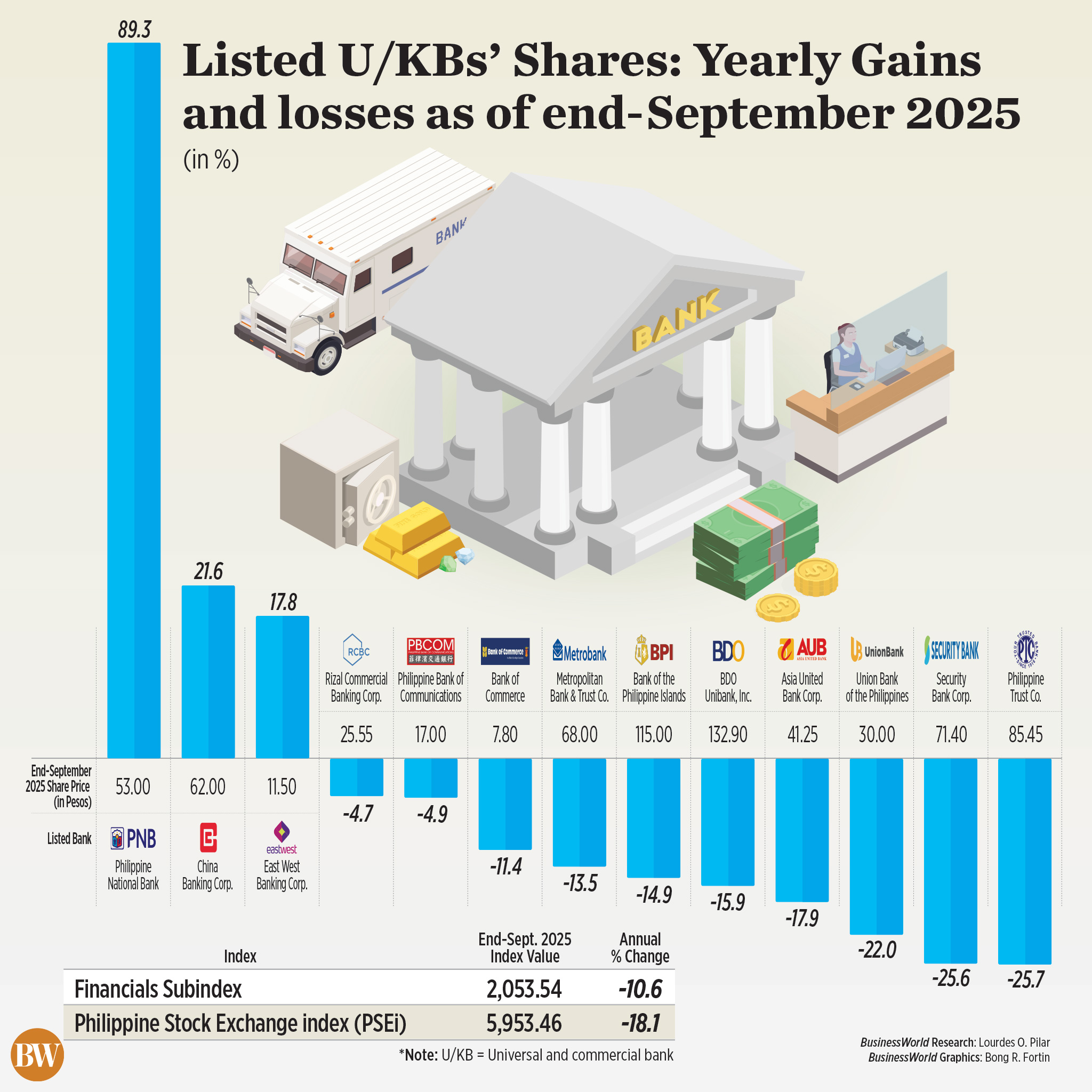
The Philippine Stock Exchange index (PSEi) fell by 18.1% year on year to 5,953.46 at the end of the third quarter, worse than the 6.5% decline in the second quarter.

The decline was reflected in the financials subindex which also declined by 10.6% during the period.

The third quarter saw 10 out of 13 largest banks’ stock prices contract annually as of end-September. Philippine Trust Co. led the decliners with 25.7% drop during the period, followed by Security Bank Corp. (-25.6%) and Union Bank of the Philippines (-22%).

On the other hand, three U/KBs saw their share prices grow in the third quarter. Philippine National Bank (PNB) grew the most with 89.3% surge. Other lenders which recorded growth were China Banking Corp. (21.6%), and East West Banking Corp. (17.8%).

“The decline in most listed banks was largely due to investor concerns over the impact of recent policy rate cuts on lending margin amid backdrop of moderating loan growth,” Ralph Jonathan B. Fausto, research associate in Chinabank Securities Corp., said in an e-mail.

Business loan appetite notably softened amid prevailing uncertainties while asset quality likewise came under scrutiny, with the continued expansion in high-yielding segments resulting in higher provisioning requirements which weighed on banks’ bottom-line performance, Mr. Fausto said.

The Monetary Board trimmed the key policy rate by 25 basis points (bps) to a three-year low of 4.75% in October, while inflation in the first nine months averaged at 1.7%, matching the central bank’s full-year forecast.

The Monetary Board slashed its key rate for a fifth straight meeting in December by another 25 bps, bringing the target reverse repurchase rate to an over three-year low of 4.5%.

The Bangko Sentral ng Pilipinas (BSP) also signaled that the current easing cycle, which started in August last year, approaches its end.

Aggregate net income of universal and commercial banks grew by 4.2% to P283.16 billion as of end-September from P271.73 billion the previous year, data from the BSP showed.

Gross total loan portfolio of these big lenders rose by 8.8% to P15.03 trillion as of end-September from P13.81 trillion last year.

Likewise, the big banks’ gross nonperforming loans (NPLs) ratio narrowed down to 3.02% in September from 3.18% a year ago.

The big bank’s net interest margin (NIM) — a ratio that measure banks’ efficiency in investing their fund by dividing annualized net interest income to average earning asset — improved to 4.2% in the third quarter from 4.06% recorded in the same period last year.

Provision for credit losses by these big banks reached P116.63 billion, up by 60.9% from P72.48 billion in September 2024.

Kervin Laurence Sisayan, head of research of Maybank Securities Philippines, said that most of the banks were more conservative in third quarter due to the ongoing slowdown in the economy.

“Note that we’ve seen gross domestic product (GDP) growth slower than expected mostly due to weaker gross capital formation. As a result, majority has increased credit costs to account for any potential weakness for example in the construction sector,” said Mr. Sisayan.

For the third quarter, the Philippine economy expanded by 4%, easing from the 5.5% of the previous quarter growth and 5.2% expansion in the last three months of 2024.

However, this was still below the 5.5%-6.5% growth target of the government.

“A decelerating economy as evidenced by the dismal 4% 3Q25 GDP outturn amid weather-related disruptions that weighed on consumption, and the corruption scandal that curtailed government spending and reduced investment activity,” Abigail Kathryn L. Chiw, first vice-president and head of research at BDO Securities Corp., said in an e-mail.

The Marcos administration faces increasing scrutiny over flood control projects, where billions of pesos in public funds were diverted through padded contracts and shell companies. The Department of Finance said that economic losses from corruption in flood control projects may have averaged P118.5 billion annually from 2023 to 2025.

At present, the Independent Commission for Infrastructure and Congress are conducting separate investigations to individuals involved in public works projects, including claims of budget manipulation and contractor collusion.

STANDOUTS
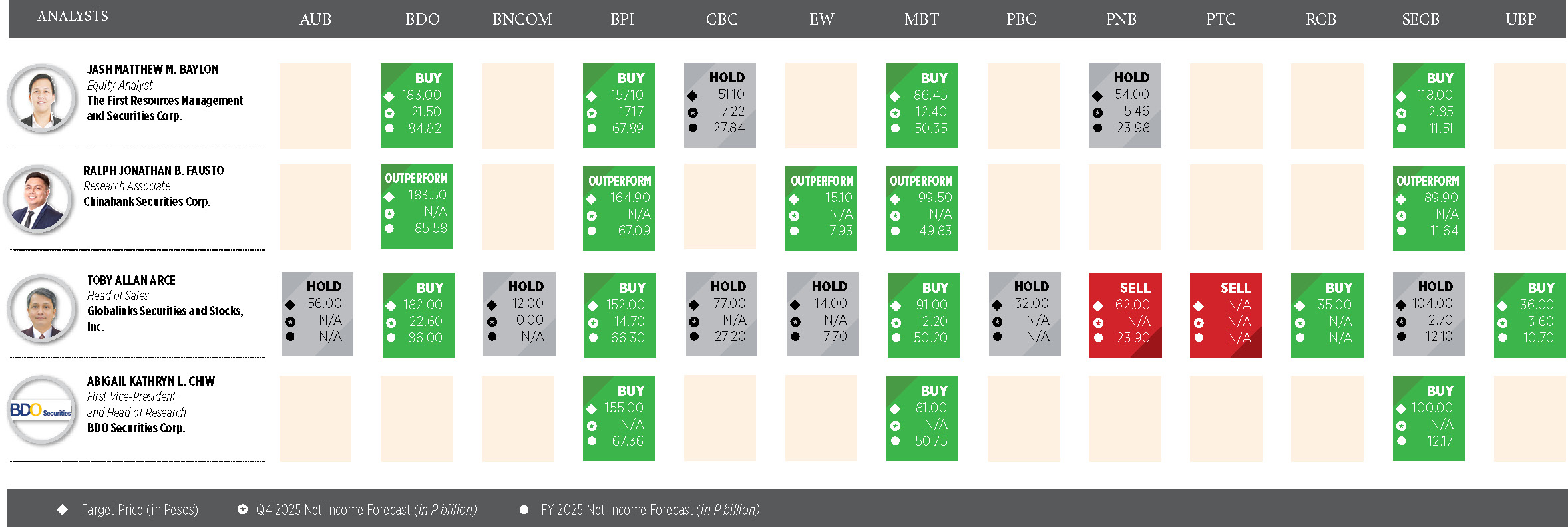
Investors should closely monitor the trajectory of interest rates, as the BSP easing cycle will impact NIM, Globalinks Securities and Stocks, Inc. Head of Sales Trading Toby Allan C. Arce said. Traders should consider near-term volatility due to potential adjustments in monetary policy expectations and global risk sentiment.

“Despite the broader sectoral weakness, BDO and BPI stood out due to their resilient loan growth and strong noninterest income performance. BDO’s diversified business lines and solid capital position helped it weather market volatility,” he said.

“These banks demonstrated operational agility and managed to sustain profitability despite external challenges,” Mr. Arce added.

Mr. Fausto said that BPI continue to deliver mid-teens return on equity (RoE) underpinned by its deliberate strategy to continue scaling its consumer loan portfolio alongside the revenue uplift and efficiency gains from tech investments. Meanwhile BDO also stood out during the quarter due to sustained double-digit growth in corporate lending.

“BDO is the bank that stood out the most given the stable and high-quality growth. What we like about BDO is the improvement in quarterly RoE, bringing it closer to mid-teens level. In addition, they continue to see above industry loan growth despite the economic slowdown,” said Mr. Sisayan.

Mr. Sisayan also said that in the near term, they might see overall weakness in profitability for banks as they increase provisions for bad loans.

“For short term we are currently looking for the local currency movement as the weaker peso could bring lower inflows and liquidity for the banks. The declining foreign direct investment (FDI) should also be watch as lower FDI   could translate to slower economic growth and loan growth impacting the banks performance,” Jash Matthew M. Baylon, equity analyst at The First Resources Management and Securities Corp., said in a Viber message.

BSP reported that net inflows of FDI into the Philippines slumped by 25.8% in September to $432 million from $830 million in the same month in 2024, amid a drop in net investments in debt instruments.

RATE CUTS
Mr. Sisayan said that lower policy rates would put downward pressure on asset yields or loans.

“However, we have yet to see the policy rate cuts have a significant impact to asset yields of banks in the past 12 months. In fact, the decline in NIMs has been quite minimal especially if we take into account the banks’ pivot towards lending more to the consumer segment,” said Mr. Sisayan.

He also added that the trend remains that policy cuts will negatively affect NIMs and profitability.

“In theory, lower rates should make funding cost cheaper and spur loan growth. But if most corporates are cautious to expand given the economic slowdown, this might not translate to higher demand for loans in the near term,” he added.

Luis A. Limlingan, head of sales at Regina Capital Development Corp., said that in the medium term, these developments are “beneficial” for banks as lower policy rates can encourage more borrowing.

“Cheaper loans make credit more accessible to clients, which helps support stronger loan demand. As loan growth picks up, banks are likely to see a corresponding boost in revenues. But in the near term, pressured margins are one of the key factors the market is already pricing in,” Mr. Limlingan said.

Ms. Chiw said that subdued inflation and easing interest rates are positive for consumption and supportive of growth.

“We believe these conditions are constructive for banks, as it encourages lending activity and fee income growth as transaction volumes increase. We also think NIM pressures from rate cuts could be mitigated by the rising mix of higher-margin consumer loans and cultivating lower-cost CASA deposits to support loan expansion,” she said.

Mr. Baylon thinks that the BSP’s monetary policy reduction has a balanced effect on the country’s financial sector, as rate cutting cycle at its December meeting could improve the spending in the country which may show a recovery on economic activity.

Mr. Arce said that while lower rates could compress NIMs and reduce interest income, they may also stimulate credit demand from consumers and businesses, supporting loan growth.

“The benign inflation outlook enhances purchasing power and reduces credit risk, improving banks’ asset quality. Overall, in the medium term, the sector is poised for steady but moderate growth, as profitability will hinge more on volume expansion and cost efficiency than margin gains,” Mr. Arce said.

OUTLOOK
Analysts expect a rebound for listed banks in the last quarter of this year.

Mr. Arce said that the fourth quarter of 2025 is expected to bring a modest rebound for the sector as lending activity gradually picks up and the holiday season boosts consumer spending.

“However, the sector’s overall growth may remain tempered by cautious corporate lending and lingering global uncertainties. BDO, BPI, and MBT are projected to lead the sector in terms of earnings momentum, while mid-tier banks like RCB and EW may post selective growth due to niche lending and digital strategies,” Mr. Arce said.

“We expect banks to perform in line with their current trajectory, as we do not see any significant developments that could affect profitability drastically through yearend. Loan growth is also likely to remain steady, with the current trend showing a slowdown despite the recent rate cut from the BSP,” Mr. Limlingan said.

Mr. Fausto expects listed banks to end fourth quarter of 2025 on a solid footing supported by healthy loan demand from corporates earmarking for expansion plans and working capital requirements for 2026.

“Consumer lending is also poised to remain strong, driven by increased credit card and personal loan utilization amid holiday-driven spending. Given that most bank stocks have declined year-to-date, current valuations appear more attractive which could potentially prompt investors to reconsider names with still durable growth prospects and support potential share price recovery over the medium term,” said Mr. Fausto.

Mr. Baylon also shared that the banking sector will show improve provisions as higher consumer spending and consumer capacity to pay off their loans which may benefit banking provision. 

“Moreover, the expectation of lower interest rates for the year end could boost loan demand for both retail and corporate which may offset the declining net interest margin. However, we still consider the revised GDP outlook for the full year 2025 which may bring a more cautious approach on its corporate loans segment,” Mr. Baylon added.

However, Ms. Chiw expects their covered banks of lower earnings growth.

“Overall, we expect our covered banks to deliver slower earnings growth of 5.4%-8.3% for this year from 6%-9.7% previously, on account of preemptive provisioning costs and moderating loan growth trends in recent months, which is reflective also of slackening GDP performance,” said Ms. Chiw.

“However, lower borrowing costs may result to a pickup in lending activity and a reduction of NPL stress, which in turn would allow banks to cut back on provisioning costs that could also lift earnings in the ensuing quarter,” she added.

Italy arrests 34 ‘tomb raiders’ suspected of looting archaeological sites

ROME — Italian authorities said on Friday they had arrested 34 “tomb raiders” suspected of looting treasures from archaeological sites in Sicily and the neighboring region of Calabria.

The looting of Italy’s rich artistic and archaeological heritage is a centuries-old problem, but the Carabinieri police art squad has had some success in recent years in recovering stolen artifacts.

In Sicily, nine people were placed in pre-trial detention and 14 under house arrest on charges including criminal conspiracy, theft of cultural property, trading in stolen goods, and counterfeiting, police and prosecutors said.

Officers seized around 10,000 archaeological artifacts, including 7,000 coins issued by various Greek city states that existed on Sicily in ancient times, the Catania prosecutors’ office said in a statement.

Police also seized hundreds of clay and terracotta vases, bronze rings, brooches, and arrowheads. The estimated total value of the recovered goods is €17 million ($20 million), prosecutors said.

The word tombaroli, or tomb raiders, is applied in Italy to criminals who loot any archaeological treasures, not only those found in ancient tombs or graves.

Authorities also discovered a clandestine lab in the eastern Sicilian province of Catania, which produced fake ancient coins, pottery and copper, and seized some looted coins in Germany, where they had been smuggled for resale.

AGRICULTURAL CODE WORDS
In Calabria, two people were put in pre-trial detention and nine under house arrest on similar charges. Prosecutors from the town of Catanzaro said the suspects had operated with the “implicit consent” of a local Ndrangheta mafia clan.

The suspects kept phone contacts to a minimum for fear of being wiretapped, and used agricultural code words in their conversations, such as “asparagus” or “fennel,” to disguise their illicit activities, prosecutors said.

In the suspects’ lingo, “chainsaw” stood for “metal detector,” they added.

Sicily is home to various ancient Roman and Greek archaeological sites, including the spectacular Valley of the Temples in Agrigento. Calabria also has a rich historical heritage.

“We are talking about territories as vast as the cultural heritage that lies under their ground,” General Antonio Petti, head of the Carabinieri art squad, told a press conference in Rome. — Reuters

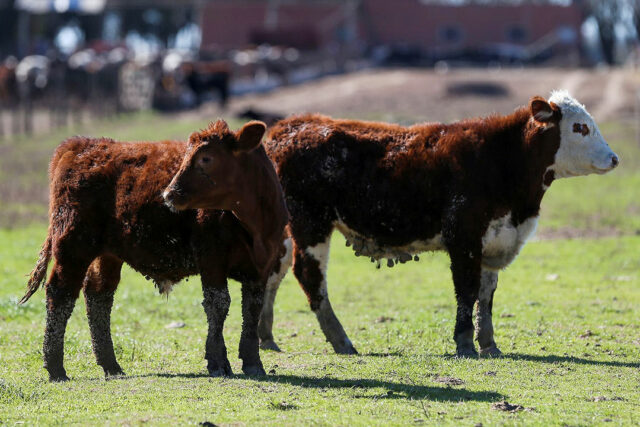
France boosts lumpy skin disease vaccinations as farmers protest cattle culls

REUTERS

PARIS — France will vaccinate one million head of cattle in coming weeks against lumpy skin disease, Agriculture Minister Annie Genevard said on Saturday, as farmers blocked highways and dumped manure near public buildings to protest against culls of herds.

Outbreaks of the highly contagious disease prompted authorities to order large-scale culls, sparking demonstrations by farmers who consider the measure excessive. A new outbreak was detected in the Haute-Garonne department, bordering Spain, Ms. Genevard confirmed.

Lumpy skin disease is a virus spread by insects that affects cattle and buffalo, causing blisters and reducing milk production.

While not harmful to humans, it often results in trade restrictions and severe economic losses. “We will vaccinate nearly one million animals in the coming weeks and protect farmers. I want to reiterate that the state will stand by affected farmers, their losses will be compensated as well as their operating losses,” Ms. Genevard told radio network ICI.

France calls the total culling of infected herds, alongside vaccination and movement restrictions necessary to contain the disease and allow cattle exports. If the disease continues to spread in livestock farms, it could kill “at the very least, 1.5 million cattle,” Ms. Genevard told Le Parisien daily in a previous interview.

Farmers stepped up protests on Saturday, blocking several toll entrances and exits on the A64 motorway in the southwestern department Hautes-Pyrenees, local authorities said.

Protesters have also dumped manure near government buildings in Tarbes, the department’s administrative capital, disrupting the work of officials implementing the vaccination campaign, they said.

The government, backed by the main FNSEA farming union, maintains that total culling of infected herds is necessary to prevent the disease from spreading and triggering export bans that would devastate the sector.

But the Coordination Rurale (CR), a rival union, opposes the systematic culling approach, calling instead for targeted measures and quarantine protocols. “There is no question of culling animals in the Pyrenees that are not sick and are healthy, simply because they belong to a herd from which a supposedly sick animal came,” said Leon Thierry, co-president of CR in the Pyrenees-Atlantiques.

Ms. Genevard said vaccination would be mandatory, and complete culling remains necessary in some cases because the disease can be asymptomatic and undetectable.

France detected 110 outbreaks across nine departments and culled about 3,000 animals, according to the agriculture ministry. It has paid nearly six million euros to farmers since the first outbreak on June 29. — Reuters

ICTSI shares climb on 25-year South Africa port terminal deal

ICTSI.COM

By Pierce Oel A. Montalvo, Researcher

SHARES of International Container Terminal Services, Inc. (ICTSI) climbed last week after it secured a 25-year concession to operate South Africa’s busiest state-owned port terminal, lifting trading activity and reinforcing investor confidence in its overseas expansion strategy.

ICTSI was the second-most actively traded stock, according to Philippine Stock Exchange (PSE) data, with 6.23 million shares worth P3.74 billion changing hands during the week. The stock rose 3.9% to P610, outperforming both the service sector’s 1.4% gain and the Philippine Stock Exchange index’s (PSEi) 1.5% rise.

The stock has surged 58% from its P386 close on the last trading day of 2024, far ahead of the service sector’s 20.7% increase and the PSEi’s 7.5% decline. Trading was paused on Monday due to the Feast of the Immaculate Conception holiday.

The rally came after South Africa’s Transnet SOC Ltd. signed a 25-year agreement on Thursday giving ICTSI the right to upgrade and operate the Durban Container Terminal Pier 2 (DCT2), the biggest facility in Transnet’s port system. DCT2 handles more than 70% of the Port of Durban’s throughput and about 46% of South Africa’s entire port activity.

The terminal includes 1,760 meters of quay length and 120 hectares of yard and support areas. Under the deal, ICTSI will expand DCT2’s handling capacity to 2.8 million twenty-foot equivalent units (TEUs), or 800,000 TEUs more than its volume now, through equipment and modernization works. Project rollout is expected to start in January 2026.

Michael Adrian O. Vergara, head of equities and global funds at Sun Life Investment Management and Trust Corp., said initial returns from the project might be modest but should improve steadily once operations stabilize.

“We take the view that return on invested capital (ROIC) is likely to be minimal at first, but will ramp up after the third year to low-teen ROIC,” he said in an e-mailed reply to questions. He noted that execution risks remain, including operational integration, timeline management and coordination with Transnet, labor groups and other local stakeholders.

Transnet has a history of disputes with labor unions, including the United National Transport Union (UNTU) and the South African Transport and Allied Workers Union.

“Transnet managed to sign a settlement agreement with UNTU that has specific clauses related to job security and nonretrenchment,” Mr. Vergara said. “ICTSI will have to deal with similar labor union initiatives as it scales up and tries to make DCT2 more efficient.”

Jash Matthew M. Baylon, an equity analyst at First Resources Management and Securities Corp., noted that while ICTSI’s involvement could improve port efficiency, political and regulatory risks loom.

“Sustained policy uncertainty and internal resistance to privatization reforms within the state-owned sector could complicate the long-term execution of the partnership,” he said.

Both analysts said global monetary easing, including synchronized 25-basis-point rate cuts by the US Federal Reserve and the Bangko Sentral ng Pilipinas (BSP), is likely to support market sentiment for ICTSI.

The BSP lowered its benchmark rate on Thursday to 4.5%, the lowest in three years, after cutting 200 basis points since it began easing in August 2024.

“Overall, there seems to be a consensus to stay overweight on ICTSI over other Philippine names due to its international business exposure, which has so far provided a buffer from concerns about the weakening peso and domestic sentiment,” Mr. Vergara said.

He added that further expansion at the Manila International Container Terminal beyond Berth 8 remains a growth driver, though possible negotiations for higher concession fees with the Philippine Ports Authority present a risk.

ICTSI’s net income attributable to equity holders rose 26.3% to $267.72 billion in the third quarter from a year earlier, pushing nine-month net income higher by 18.8% to $751.56 billion. Revenue rose 19.7% to $827.74 billion, bringing the nine-month revenue to $2.34 trillion, up 16.1%.

“We expect full-year 2025 earnings-per-share growth of about 22% year on year to $0.487 and more modest 12% growth to $0.545 in 2026,” Mr. Vergara said.

Mr. Baylon places the stock’s support level at P540-P550 and resistance at P650-P670.

Mr. Vergara sees support at P550. “Resistance is harder to gauge as the stock trades close to all-time highs,” he said, citing a Bloomberg consensus target price of P626.