Home Blog Page 1875

Trump defends tariffs before corporate America as stocks sell off
GAGE SKIDMORE-WIKIPEDIA

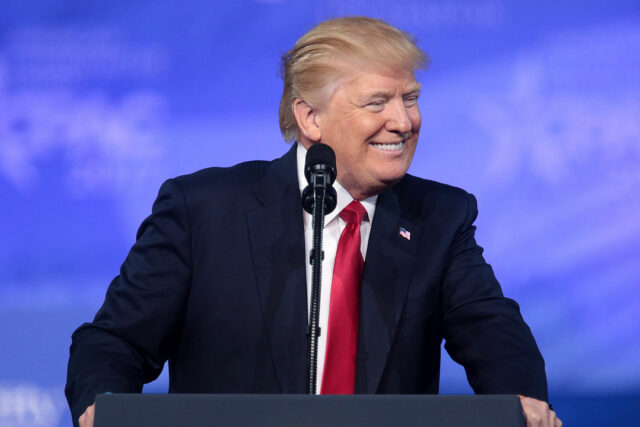
 – U.S. President Donald Trump defended his use of tariffs and said they could multiply as he met on Tuesday with the CEOs of America’s biggest companies, many of whom have watched their market value crater over recession and inflation fears.

The Republican president spoke to about 100 CEOs at a regular meeting of the Business Roundtable, which includes the heads of Apple, JPMorgan Chase and Walmart. The event followed a private Trump meeting with technology company executives at the White House on Monday.

U.S. stocks on Tuesday extended a selloff that has dragged the benchmark S&P 500 down 5.3% so far in 2025, with investors rattled over increased tariffs on imports and souring consumer sentiment.

Monday’s drop in the S&P 500 was its largest this year and followed an interview over the weekend in which Mr. Trump declined to rule out a recession resulting from his trade policies.

He clarified those comments on Tuesday, telling reporters, “I don’t see it at all,” regarding the possibility of a recession.

Speaking to business leaders and reporters before the roundtable, Trump defiantly maintained his stance, dismissed market volatility and vowed that investors would see gains for putting money to work now.

“The tariffs are going to be throwing off a lot of money for this country,” he said to CEOs. “It may go up higher.”

The executives in the room sat expressionless as Mr. Trump spoke during a brief part of the meeting that was open to the press. There was scattered chuckling when Mr. Trump said there were some people in the room he did not like.

Later, in a part of the meeting that was closed to reporters, Mr. Trump vowed to speed up approvals in environmental agencies and cut tax rates to 15% for companies making products in the U.S., according to a person familiar with the remarks.

Mr. Trump said markets may have been too high as of a few weeks ago, and described Chinese President Xi Jinping as not thrilled about the new tariffs, the person said.

Mr. Trump’s economic policies so far have centered on a blitz of tariff announcements. Some have taken effect and others have been delayed or are set to kick in later. He said they will correct unbalanced trade and stop the flow of illegal narcotics from abroad.

Mr. Trump started Tuesday by ramping up a burgeoning trade war with Canada, vowing to double tariffs set to take effect within hours on all imported steel and aluminum products from America’s northern neighbor to 50%. The White House later said the tariff would remain at 25% after Canadian officials agreed to talks.

Markets worry that tariffs could raise prices for businesses, boost inflation and undermine consumer confidence in a blow to economic growth. It has also raised investor speculation that Trump’s ambition will not be bound by the preferences of big business.

The White House has dismissed this thinking, which is shared by most economists, who view trade wars as a lose-lose proposition for the countries involved.

Mr. Trump’s aides say the tariff threats will force companies to invest more in the United States.


VOLATILE MARKETS

“Markets are going to go up and they’re going to go down, but you know what? We have to rebuild our country,” Trump told reporters before he met the business leaders.

For much of his political career, Mr. Trump has talked up the importance of the stock market. During his first 2017-2021 term in office he regularly pointed to rallying stock prices as proof of his success and in both his 2020 and 2024 campaigns warned that markets could tumble if he lost.

Mr. Trump had already imposed an additional 20% tariff on Chinese goods entering the United States, and 25% tariffs on imports from Canada and Mexico, although he suspended most of the duties on U.S. neighbors until April 2, when he plans to unveil a global regime of reciprocal tariffs on all trading partners.

Until recently, investors had been optimistic that Mr. Trump’s policies would stimulate growth, for instance through lower taxes. They also hoped he could ease inflationary pressures, for instance by loosening regulation on fossil fuel production.

But tax cuts need congressional approval and energy producers are unlikely to dramatically scale up production, which could cut their profit margins. Meanwhile, some economists see plans to increase deportations of undocumented immigrants increasing price pressures in the labor market. Cutting the federal workforce could raise unemployment.

“If we all are becoming a little more nationalistic … it’s going to have elevated inflation,” said BlackRock BLK.N CEO Larry Fink, a Business Roundtable member, at an industry conference on Monday.

Last week, the Business Roundtable warned that if they are long-lasting, the tariffs “run the risk of creating serious economic impact.” – Reuters

North Korea says South Korea jets’ accidental bombing shows armed conflict possible, KCNA says

 – North Korea said on Wednesday a recent accidental bombing of a civilian area by South Korean fighter jets in training shows a mishap could trigger a new armed conflict on the Korean peninsula, its state news agency reported.

Two South Korean jets mistakenly dropped eight air-to-surface bombs on a village near the military border with North Korea on Thursday, injuring 29 civilians in an accident the South’s military said was likely caused by pilot error.

The area was close to a regular training ground used by the allies near the border.

“We don’t need to explain how the situation would have unfolded if the bombs had dropped further north and crossed our border,” KCNA state news agency said.

“It is not at all an unreasonable imagination … that an accidental spark could engulf the Korean peninsula and the world in a new armed conflict in response to the malicious large joint military drills by the U.S. and South Korea,” KCNA said.

South Korean and U.S. militaries began annual Freedom Shield drills on Monday to run until March 20, but they suspended live-fire exercises following the bombing accident.

North Korea routinely denounces joint military drills by the allies, calling them a dress rehearsal for war against it.

South Korea rejects that accusation, saying the drills are defensive and aimed at maintaining readiness against possible North Korean aggression.

The U.S. Defense Department did not immediately have comment.

“This incident is an example of how the various war demonstrations by the U.S. and its followers targeting us are not for ‘peace and stability in South Korea’ as they claim but an extremely dangerous and unamusing acts that can breed an imminent crisis and the world’s first nuclear war,” KCNA said.

It warned of taking “merciless action” without notice if needed because of its enemies’ military activities. – Reuters

US to resume security support to Ukraine as Kyiv says it is ready to accept ceasefire proposal

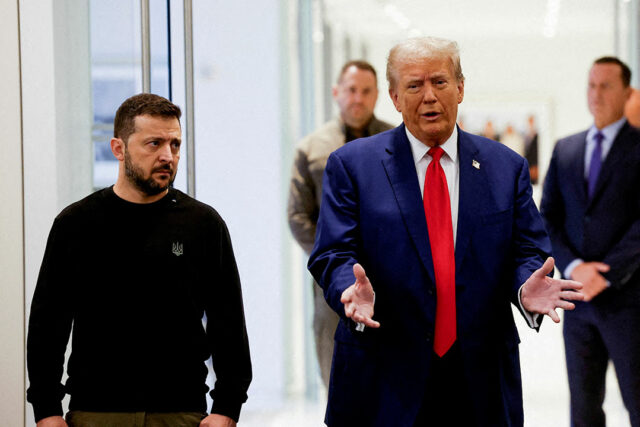
Donald Trump and Ukraine’s President Volodymyr Zelenskiy meet at Trump Tower in New York City, U.S., Sept. 27, 2024. — REUTERS

 – The United States agreed on Tuesday to resume military aid and intelligence sharing with Ukraine after talks where Kyiv said it would accept a U.S. proposal for a 30-day ceasefire in its conflict with Russiathe countries said in a joint statement.

U.S. Secretary of State Marco Rubio said the U.S. would now take the offer to Russia, and the ball is in Moscow’s court.

“Our hope is that the Russians will answer ‘yes’ as quickly as possible, so we can get to the second phase of this, which is real negotiations,” Rubio told reporters, referring to U.S. President Donald Trump, after more than eight hours of talks in Jeddah, Saudi Arabia.

The Kremlin launched a full-scale invasion of Ukraine three years ago, and Russia, which has been making advances, now holds around a fifth of Ukraine’s territory, including Crimea, which it annexed in 2014.

Mr. Rubio said Washington wanted a full agreement with both Russia and Ukraine “as soon as possible.”

“Every day that goes by, this war continues, people die, people are bombed, people are hurt on both sides of this conflict,” he said.

How Moscow would respond was far from certain.

Russian President Vladimir Putin has said he is open to discussing a peace deal, but he and his diplomats have repeatedly stated they are against a ceasefire and would seek a deal that safeguards Russia’s “long-term security.” Putin has ruled out territorial concessions and said Ukraine must withdraw fully from four Ukrainian regions claimed and partly controlled by Russia.

On Tuesday, Russia’s foreign ministry said only that it did not rule out contacts with U.S. representatives.

Ukrainian President Volodymyr Zelenskiy, who was in Saudi Arabia but did not participate in the talks, said the ceasefire was a “positive proposal,” that covers the frontline in the conflict, not just fighting by air and sea.


WILL RUSSIA AGREE?

The Ukrainian leader said the ceasefire would take effect as soon as Russia agreed.

“When the agreements come into force, during these 30 days of ‘silence,’ we will have time to prepare with our partners at the level of working documents all the aspects for reliable peace and long-term security,” Mr. Zelenskiy said.

Rubio said the plan would be delivered to the Russians through multiple channels. Mr. Trump’s national security adviser, Mike Waltz, was due to meet his Russian counterpart in the coming days and Mr. Trump’s special envoy Steve Witkoff plans to visit Moscow this week to meet Putin.

On Tuesday, Mr. Trump said he hoped for a swift ceasefire and thought he would talk to Putin this week. “I hope it’ll be over the next few days,” he told reporters at a White House event to promote his close adviser Elon Musk’s Tesla car company.

The U.S.-Ukraine agreement was a sharp turnaround from an acrimonious White House meeting on February 28 between the new Republican U.S. president, who has long been a Ukraine aid skeptic, and Mr. Zelenskiy.

In Tuesday’s joint statement, the two countries said they agreed to conclude as soon as possible a comprehensive agreement for developing Ukraine’s critical mineral resources, which had been in the works and was thrown into limbo by that meeting.

Following that encounter, the United States cut off intelligence sharing and weapons shipments to Ukraine, underlining Mr. Trump’s willingness to pressure a U.S. ally as he pivots to a more conciliatory approach to Moscow.

Trump said on Tuesday he would invite Mr. Zelenskiy back to the White House.

Ukrainian officials said late on Tuesday that both U.S. military assistance and intelligence sharing had resumed.


EUROPEAN PARTNERS

A top aide to Mr. Zelenskiy said options for security guarantees to Ukraine were discussed with U.S. officials. Security guarantees have been one of Kyiv’s key aims, and some European countries have expressed willingness to explore sending peacekeepers.

In the joint statement, Ukraine reiterated that European partners should be involved in the peace process. NATO Secretary General Mark Rutte will be at the White House on Thursday.

“It seems like the Americans and Ukrainians have taken an important step towards peace. And Europe stands ready to help reach a just and lasting peace,” Polish Prime Minister Donald Tusk said on X.

Mr. Waltz said the initial resumption of military assistance for Ukraine would involve equipment from U.S. stockpiles approved by former U.S. President Joe Biden and stopped by Mr. Trump.

As the diplomacy plays out, Ukraine’s battlefield positions have been under heavy pressure, particularly in Russia’s Kursk region where Moscow’s forces have launched a push to flush out Kyiv’s troops, which had been trying to hold a patch of land as a bargaining chip.

Ukraine overnight launched its biggest drone attack on Moscow and the surrounding region yet, showing Kyiv can also land major blows after a steady stream of Russian missile and drone attacks, one of which killed 14 people on Saturday.

The attack, in which 337 drones were downed over Russia, killed at least three employees of a meat warehouse and caused a short shutdown at Moscow’s four airports. – Reuters

Trump’s expanded metals tariffs to hit goods from horseshoes to bulldozer blades

STOCK PHOTO | Image by Foto-RaBe from Pixabay

 – U.S. President Donald Trump‘s bulked-up tariffs on steel and aluminum due to launch within hours will hit nearly $150 billion worth of derivative products made from the metals, ranging from nuts and bolts to bulldozer blades and threatening cost increases for industry and consumers alike.

The metals tariffs were set for an effective increase to 25% as prior exemptions, exclusions and quotas expire at 12:01 a.m. EDT (0401 GMT) on Wednesday, with hundreds of downstream products subjected to the duties for the first time.

Mr. Trump on Tuesday lashed out at Canada amid rising trade tensions with the U.S. ally, threatening 50% tariffs on Canadian steel and aluminum, but later backed off after Ontario Premier Doug Ford withdrew a 25% surcharge on the province’s electricity exports to the U.S.

A Reuters analysis of the products listed for new tariffs under Trump’s plan would subject a wide range of imported automotive and tractor parts, metal furniture, construction materials and machinery parts to the tariffs.

Mr. Trump’s action, first ordered last month to strengthen the Section 232 national security tariffs on steel and aluminum imposed during his first term, extends the duties to products as diverse as stainless steel sinks, gas ranges, air conditioner evaporator coils, horseshoes, aluminum fry pans and steel door hinges.

Total 2024 import value for the 289 product categories came to $147.3 billion with nearly two-thirds aluminum and one-third steel, according to Census Bureau data retrieved through the U.S. International Trade Commission’s Data Web system.

By contrast, Mr. Trump’s first two rounds of punitive tariffs on Chinese industrial goods in 2018 during his first term totaled only $50 billion in annual import value.

The tariffs will hit over $25 billion worth of imported aluminum components for cars, trucks, buses, tractors and specialty vehicles, and $15 billion worth of metal furniture and parts imports, the analysis showed.

Canada and Mexico, the two largest sources of the metals imports, would be the hardest hit. The two biggest U.S. trading partners also are battling separate, 25% duties on all products imposed in Trump’s drive to eradicate fentanyl trafficking. Those are largely paused for goods compliant with the U.S.-Mexico-Canada Agreement on trade’s rules of origin.

Steelmakers and aluminum producers have long argued that the proliferation of exemptions and quotas eroded the effectiveness of his first-term Section 232 tariffs imposed in 2018, which gave a temporary lift to U.S. steel and aluminum capacity use.

“These are not the steel and aluminum tariffs of the last time,” said Dan Ujczo, a trade lawyer specializing in U.S.-Canada trade matters. “These are the very products that consumers will feel on the shelves, in the construction industry in particular, and automotive.”

Mr. Ujczo, senior counsel at Thompson Hine in Columbus, Ohio, said some of the firm’s real estate clients are putting development projects on hold because they cannot accurately estimate materials costs over the next six to 12 months due to tariff uncertainty.

Mr. Trump’s goals in imposing the metals tariffs are to strengthen steel and aluminum production and bring more manufacturing and jobs to U.S. shores. They are part of an onslaught of tariff actions in his first weeks in office that will culminate in reciprocal tariffs on April 2 that aim to match other countries’ tariff rates and counteract their non-tariff trade barriers.


WEIGHING PRICE HIKES

But equipment manufacturers in Wisconsin say the new metals tariffs may simply raise costs because much of the supply base for small metal components has moved offshore. Several say they are weighing price hikes.

Mr. Husco, a Waukesha, Wisconsin-based maker of hydraulic components for automotive and construction equipment, buys steel domestically but will see cost increases across its supply chain, especially for smaller imported components like machined steel parts, said CEO Austin Ramirez.

The firm began moving some work out of China after Trump slapped tariffs on Chinese industrial goods in 2018, but this would be difficult for components with high labor content due to U.S. wage costs, he said.

“The more dominant impact will be higher cost on our inputs,” Mr. Ramirez said, adding that for many parts, even paying 25% tariffs would still be cheaper than trying to set up domestic production or trying to find U.S. suppliers, he said.

Farm equipment manufacturers would likely announce price hikes within a week or two, as the tariffs would likely boost domestic steel prices, said Kip Eideberg, head of government relations for the Association of Equipment Manufacturers.

Midwest hot-rolled steel futures prices HRCc1 have risen more than 21%, or $166 a ton, to $925 since Trump announced the tariff revisions.

“If it’s 8% more expensive to build tractors and combines in the U.S., some of that inevitably, unfortunately will be passed down to the customers,” Mr. Eideberg said.


METALS RESHORING

Whether Mr. Trump’s tariffs will bring metals work back or make some U.S. manufacturers less competitive with global peers is an open question.

But Alan Price, a lawyer who leads Wiley Rein’s trade practice in Washington, said they could help counteract policies such as Mexico’s IMMEX program, which allows foreign companies, including U.S. manufacturers, to import components duty-free into Mexico for assembly into finished products for export to the United States.

“Certainly, extending (tariffs) to these downstream products closes additional loopholes and reduces the attractiveness of shifting production outside the U.S.,” Mr. Price said, adding that the tariffs would also incentivize manufacturers to use more U.S.-produced steel and aluminum.

Unlike with the fentanyl-related tariffs, Mr. Trump has shown no sign of easing up ahead of the midnight deadline. He was expected to hear tariff concerns from top U.S. corporate CEOs on Tuesday afternoon.

The White House declined comment on potential cost increases from the tariffs, which it said were an extension of Mr. Trump’s first-term America First economic agenda to rebuild the U.S. industrial base, cut taxes and increase American energy production.

“In his second term, President Trump will again use tariffs to level the playing field for American workers and reignite America’s industrial might,” White House spokesperson Kush Desai said in a statement. – Reuters

How Filipina founders can get the business funding they need

She Secure is a program which provides funding and financial advisory support to women-owned and women-led enterprises in the Philippines. In this B-Side episode, Abigail de los Santos Tan, co-founder and managing partner of ARC SME Business Development Company, talks about how to program aims to address the funding barriers faced by female entrepreneurs.

Interview by Patricia Mirasol
Audio editing by Jayson Mariñas

Businesses sound alarm as Trump tariff chaos hits the economy

A “tariff” sign is displayed on a laptop screen and an American flag displayed on a phone screen are seen in this illustration photo taken in Krakow, Poland on Feb. 1, 2025. — JAKUB PORZYCKI/NURPHOTO VIA REUTERS CONNECT

LONDON/NEW YORK/WASHINGTON – With each day, evidence is mounting across the corporate world that the chaotic implementation of US President Donald Trump’s tariffs is translating into caution on Main Street.

The uncertainty brought by Trump’s threats of tariffs and his shape-shifting trade policies is starting to have a chilling effect across many industries, businesses warn, as consumers pull back on everything from basic goods to travel.

The president’s back-and-forth tariff moves against major trading partners have kept markets on edge, and prompted companies to warn they may have to raise prices, which could boost inflation and dent economic growth. The White House fired another salvo on Tuesday, when Trump said he would double the planned tariff on all steel and aluminium imports from Canada to 50%.

While Trump has said his policies could cause short-term pain, investor concerns about their economic fallout have intensified in the last two days. Those worries have translated into a market selloff that has wiped out nearly $5 trillion in market value from the S&P 500’s peak last month, when Wall Street was cheering much of Trump’s agenda.

“A market that was cruising has been disrupted by the White House,” said Patrick Kaser, portfolio manager at Brandywine Global. “The volatility is in part caused by the market’s uncertainty as to what the administration’s objectives are… why are we going after Canada, exactly?”

Even as markets have stumbled, CEOs have largely refrained from publicly criticizing Trump’s trade policies, instead citing “uncertainty” for ebbing confidence. Several of Trump’s economic advisers have alternated between downplaying the market’s concerns and stressing the need to reorient the economy toward domestic manufacturing, even if it causes near-term damage.

“The administration is saying this is a blip or whatever,” said Byron Callan, managing director at Capital Alpha Partners. “There’s maybe this willingness to just kind of punch through and try and prove markets are wrong. But that can carry a lot of risk … it’s the judgment of a small group of people against the judgment of millions of people.”

Speaking after the market close on Monday, Delta Air Lines CEO Ed Bastian warned that economic worries among consumers and businesses were hurting domestic travel, without referencing tariffs directly. He noted several sectors were showing softness, including autos, technology, media, and aerospace and defense.

Several other airlines warned of softness in U.S. spending on Tuesday, sending shares of those companies, along with cruise operators and entertainment giant Walt Disney Co lower. Shares of Apple, the world’s most valuable company, touched a five-month low.

“Economic uncertainty is a big deal,” American Airlines CEO Robert Isom said at a JPMorgan industry conference.

LATEST TARIFFS
The latest round of Trump tariffs – 25% levies on imported steel and aluminum – kick in on Wednesday. They will apply to millions of tons of steel and aluminum imports from Canada, Brazil, Mexico, South Korea and other countries that had been entering the U.S. duty-free under previous carve-outs.

Trump vowed the tariffs will be applied “without exceptions or exemptions” to try to aid the struggling U.S. industries. He said on Tuesday that his latest move against Canada was because the province of Ontario imposed a 25% surcharge on electricity it exports to the United States. Ontario froze that plan on Tuesday afternoon.

In a post on Truth Social, Trump also threatened to “substantially increase” tariffs on cars coming into the United States on April 2 “if other egregious, long time Tariffs are not likewise dropped by Canada.”

Ahead of these measures, a range of recent surveys of U.S. businesses and consumers has shown deteriorating sentiment, which, if sustained, could hamper investment and household spending.

The National Federation of Independent Business – a Washington lobby group whose members staunchly supported Trump in the 2024 election – reported small business sentiment weakened for a third straight month, erasing the bump from Trump’s election victory.

“The mere risk of severe policy changes reflected by this uncertainty is enough to have an impact on the economy, even in the absence of any actual policy changes,” said Rogier Quaedvlieg, ABN Amro’s senior U.S. economist.

SOUNDING THE ALARM
U.S. businesses broadly had greeted Trump’s election with optimism, fueled by pledges of deregulation and tax cuts. Instead, they have spent the early part of the year talking about tariffs, as more than 900 companies out of the largest 1,500 have discussed the topic since January 1, according to LSEG data.

At the same time, Republicans in Congress have yet to agree on a plan that would allow them to cut taxes and instead are focused this week on averting a government shutdown when funding expires at midnight on Friday.

Carsten Knobel, CEO of Germany’s Henkel HNKG.DE, which makes Sellotape and Schwarzkopf hair products, said on Tuesday that he sees a “reluctance” in the United States for both consumer and industrial segments, citing the White House’s policies.

“What’s the end game? What’s trying to literally be accomplished with these tariffs? It hasn’t been explained to us,” said Robert Pavlik, senior portfolio manager at Dakota Wealth. “How can you model out for projections when you don’t know what the goals are?” — Reuters

Running the business the analog way

Transitioning the business into the digital age was an uphill climb, Antonio J. Jose, whose parents founded Solidaridad Bookshop, shared.

Interview by Patricia Mirasol
Video editing by Arjale Queral

Globe leaders take on global connectivity discussions at MWC Barcelona 2025

Rebecca Eclipse, Globe’s Chief Transformation and Operations Officer, talks about how globe transformed its operations to deliver superior customer experience at MWC Barcelona.

Globe’s senior leaders actively shaped the global discourse on digital transformation at the Mobile World Congress (MWC) 2025 in Barcelona. Participating at various high-level discussions, the Globe executives were able to drive innovations through solutions that address challenges relevant to emerging markets like the Philippines.

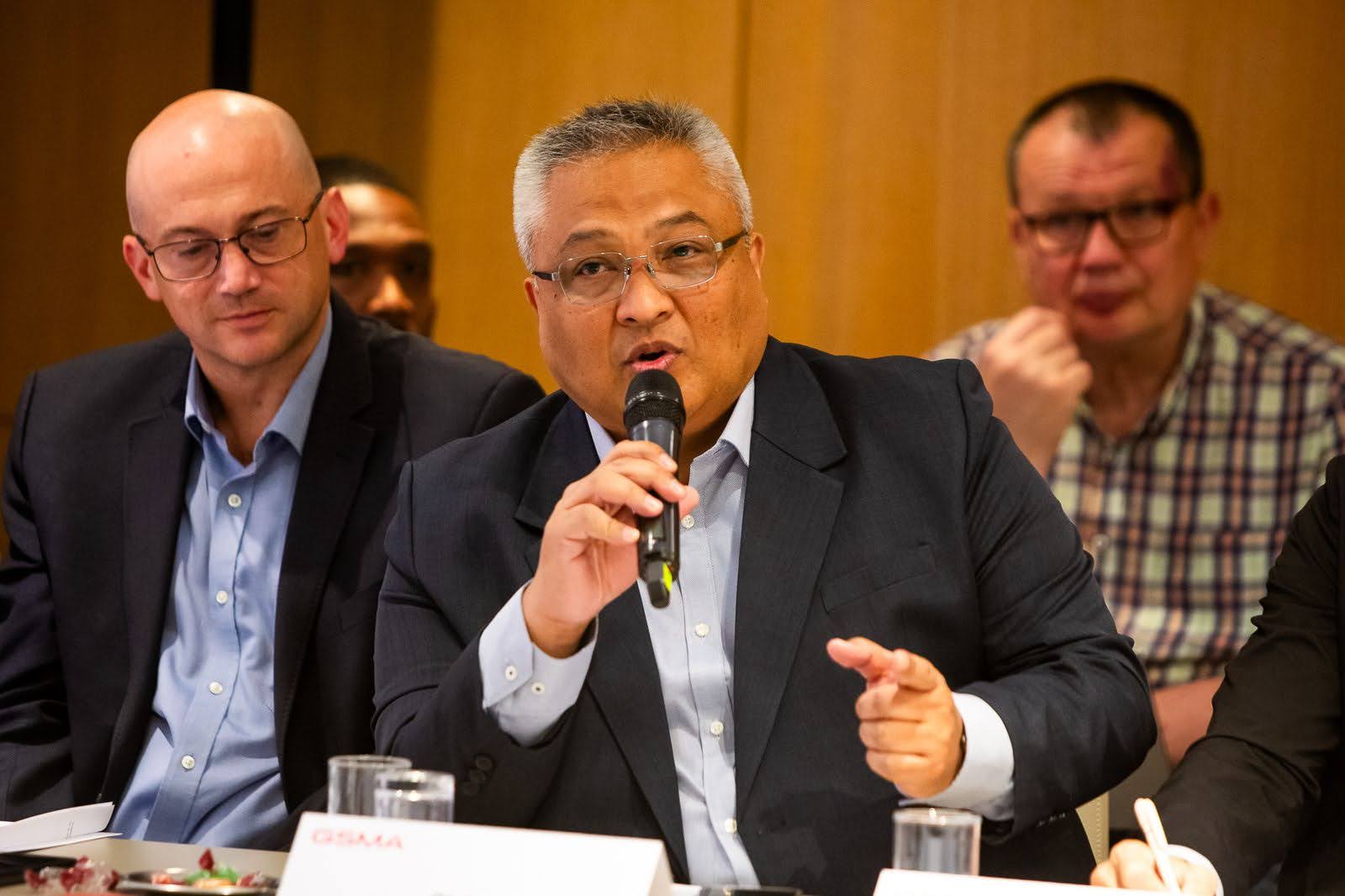
Held in Barcelona last week, MWC is the world’s premier ICT event, uniting the industry behind the advancement of business and society. Globe CEO Ernest Cu was joined by Deputy CEO Carl Cruz and other senior leaders on a hectic week of engagements with global telco leaders to tackle the most pressing concerns facing the industry today.

Ernest Cu, Globe President and CEO, signs an MoU with other Philippine telco operators on CAMARA APIs under GSMA’s Open Gateway initiative.

Cu represented Globe in signing a Memorandum of Understanding with other Philippine telco operators on the deployment of federated CAMARA APIs under GSMA’s Open Gateway initiative.

Through CAMARA APIs, Globe will be able to improve security measures against fraud. These standardized APIs will also make it easier for businesses to create and expand digital solutions across telco networks. The partnership will also help fintech, e-commerce, and other digital services grow by turning telecom networks into platforms that developers can easily use, ensuring wider reach and smoother integration.

“Globe remains dedicated to advancing digital innovation while prioritizing customer security. This partnership marks a major step in enhancing fraud prevention and identity verification in the Philippines. By leveraging GSMA Open Gateway and federating CAMARA APIs, we can create a safer and more seamless digital experience, empowering both businesses and consumers in today’s fast-evolving digital landscape,” Cu said.

Cu also participated in his first GSMA Board Meeting and spoke about Globe’s best practices in combatting digital scams and fraud.

Cruz, meanwhile, shared insightful perspectives on the impact of 5G-A×AI on the future of connectivity at the GTI Summit 2025 as a session speaker.

Carl Cruz, Globe’s Deputy CEO, at the MWC in Barcelona, leading a delegation of senior leaders in discussions on AI, cybersecurity and telco innovation.

The Summit revolves around the 5G-A×AI 100 Commercial Campaign that aims to engage 100+ partners, open 100+ APIs, and develop 100+ lighthouse projects, over the next three years.

“Globe is focused on strengthening connectivity, driving inclusive growth through initiatives like JuanSim ng Bayan, expanding 5G access, and making fiber internet more affordable. By working closely with industry partners and the government, we are building a future where every Filipino can fully participate in the digital economy and benefit from AI-driven innovation,” he said.

At the GSMA SEC CON 2025, Atty. Irish Salandanan-Almeida, Chief Privacy Officer and VP for Governance, Risk, and Compliance outlined the company’s proactive measures to address digital scams and fraud.

“Fraud has become more sophisticated, leveraging AI and multi-channel exploitation. We are taking a proactive stance by working closely with financial institutions, regulators, and law enforcement agencies to identify and prevent scams before they impact consumers,” she said.

Anton Bonifacio, Globe’s Chief Information Security Officer and Chief AI Officer, and Darius Delgado, Globe’s Chief Commercial Officer, also took part in multiple side events, including the Amdocs podcast.

Anton Bonifacio, Globe’s Chief Information Security Officer and Chief AI Officer, speaks at a roundtable discussion on Globe’s efforts against fraud at MWC Barcelona 2025.

Bonifacio talked about Globe’s proactive efforts to beat evolving scam methods. Globe was the first telco in the world to block all person-to-person SMS with clickable links– a security measure enforced in September 2022 amid a spate of scams targeting mobile users.

It has also forged data sharing agreements with major banks and other financial institutions to facilitate more efficient and effective fraud detection, investigation, response and prevention.

Globe is also at the initial stages of implementing AI-driven cybersecurity solutions and strategies to combat increasingly sophisticated cyber threats.

“At Globe, we are relentless in our fight against fraud and cyber threats, leveraging a multi-layered approach that combines technology, intelligence sharing, and proactive security measures. With AI-driven solutions complementing our defenses, we remain committed to building a safer digital ecosystem for our customers,” said Bonifacio.

Rebecca Eclipse, Globe’s Chief Transformation and Operations Officer, delivered a talk on “Transforming Operating Model Towards Becoming the Most Reliable Service Provider,” sharing insights on Globe’s journey towards delivering superior customer experience. She highlighted Globe’s shift towards a more agile and customer-focused approach by simplifying processes, reducing inefficiencies, and fostering cross-functional collaboration.

“We cannot adopt a single, one-size-fits-all strategy nationwide. It is imperative to know our customers and the landscape in each territory to provide them the right experience.  We started transforming our operating model and ourselves. We brought more of our people on the ground, all united towards delivering better network experience, improving NPS, and with it, increasing revenues,” said Eclipse.

In pilot areas, Globe’s streamlined approach resulted in faster site deployment and improved network coverage. This transformation has strengthened customer trust, thus contributing to improved revenues, and underscoring further Globe’s commitment to innovation and exceptional service delivery.

Globe also participated in the GSMA MOU Signing Ceremony, strengthening collaboration with global industry players to promote AI and cybersecurity.

On the other hand, Delgado shared the telco’s commitment to digital inclusion, network expansion, and strategic partnerships, ensuring that its services remain relevant, accessible, and impactful.

“We are deeply invested in delivering meaningful experiences that go beyond connectivity. By leveraging AI-driven personalization, optimizing operational efficiency, and unlocking new growth opportunities, we ensure that our services remain relevant and impactful for Filipinos. Our commitment is to empower individuals, businesses, and communities through innovation and a seamless digital experience,” he said.

Globe’s active presence at the MWC 2025 underscores its leadership in the Philippine telecom sector and its pivotal role in fostering digital inclusion whilst supporting the country’s digital transformation.

To learn more about Globe, visit https://www.globe.com.ph/.


Spotlight is BusinessWorld’s sponsored section that allows advertisers to amplify their brand and connect with BusinessWorld’s audience by publishing their stories on the BusinessWorld Web site. For more information, send an email to online@bworldonline.com.

Join us on Viber at https://bit.ly/3hv6bLA to get more updates and subscribe to BusinessWorld’s titles and get exclusive content through www.bworld-x.com.

BSP: April rate cut still ‘on the table’

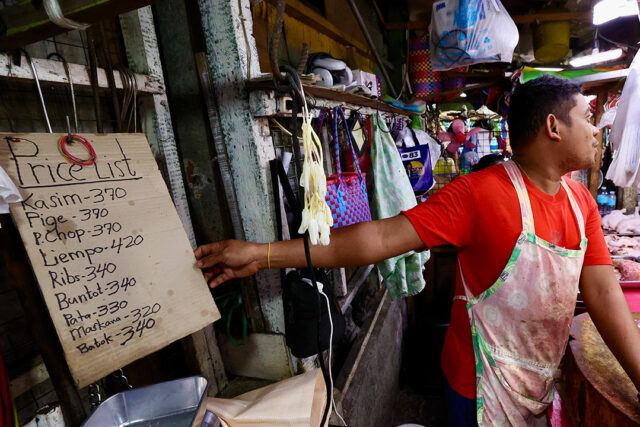
A vendor points to the prices of pork at a stall inside a market in Balintawak, Quezon City, March 11, 2025. — PHILIPPINE STAR/ MIGUEL DE GUZMAN

By Luisa Maria Jacinta C. Jocson, Reporter

THE Bangko Sentral ng Pilipinas (BSP) could resume its easing cycle as early as its next meeting on April 10, its top official said.

BSP Governor Eli M. Remolona, Jr. said a rate cut is still “on the table” at the Monetary Board’s meeting next month, signaling “a few more” rate cuts for the rest of the year.

“Let me say that we see ourselves still on the easing cycle. We are expecting to cut a few more times this year. But how much, we haven’t determined,” he said at a forum.

Mr. Remolona also confirmed that the Monetary Board’s next meeting would be moved to April 10 from April 3.

“When we think we’re on track, more or less on track, we stay with baby steps, which means 25 basis points (bps) at a time,” he said.

The central bank unexpectedly kept rates steady at its February policy review, opting to keep the benchmark at 5.75%.

This after it delivered three straight 25-bp cuts at each of its meetings in August, October and December.

“If things look much worse than we thought — that’s what we call a hard landing — it can be up to 50 bps of a cut, even more, but as long as we’re more or less on track, it will be 25 bps at a time,” Mr. Remolona said.

However, a hard landing or a recession scenario is “highly unlikely,” he added.

The Philippine economy grew by a slower-than-expected 5.2% in the fourth quarter, bringing 2024 growth to 5.6%. The full-year growth was well below the 6-6.5% target.

This year, the government is targeting 6-8% growth.

Mr. Remolona said the central bank considers several scenarios in its policy decisions.

“There’s the baseline scenario, which is kind of saying we’ll cut by this many times the rest of the year. Then we have a hawkish scenario, which means fewer cuts. And then there’s the dovish scenario, which means more cuts than the baseline,” he said.

“We compare those three scenarios and how we see inflation evolving, how we see growth evolving. It’s a balancing act between inflation and growth and so we have to weigh the different factors.”

The BSP chief also noted they are still reworking the current models to account for risks.

At their February meeting, Mr. Remolona said “global trade uncertainties” were the primary reason behind the policy hold.

“There are still a lot of numbers to look at. Of course, we’re recalibrating our models to take account of uncertainty,” he said.

Headline inflation sharply eased to 2.1% in February from 2.9% in January and 3.4% a year ago.

The February print was also below the 2.2%-3% forecast from the central bank.

“We did miss the inflation number on the low side, lower than the bottom of our range. If we’re going to miss it, that’s the way to miss it, right? So, we’re happy about that miss,” Mr. Remolona said.

“Then we’ll look at all the other numbers, and then we’ll decide on April 10 whether to ease further or not to ease.”

FURTHER RRR CUTS?
Mr. Remolona also cited the possibility of another reserve requirement ratio (RRR) cut, possibly within the year.

Asked if the BSP could slash reserve requirements again before the year ends, he said this was “possible.”

“For me, 5% is still high. But I’m just one vote. We’re seven on the Monetary Board. But it can’t be sudden because we need to control the liquidity that’s coming out,” he added.

The RRR of universal and commercial banks and nonbank financial institutions with quasi-banking functions will be reduced by 200 bps to 5% from 7% later this month.

Digital banks’ RRR will also be cut by 150 bps to 2.5%, while the ratio for thrift lenders will be lowered by 100 bps to 0%.

Rural and cooperative banks’ RRR has been zero since October, the last time the BSP cut reserve requirements.

Big banks’ RRR can be brought down to zero eventually, Mr. Remolona said. “It can be zero. In the US, the RRR is zero.”

The BSP chief said there is a “subtle difference” between the policy rate and reserve requirement. Reducing either one stimulates the economy, he said.

“But the policy rate, there’s a kind of cycle, you don’t want to lower it and then raise it the next time. You want to just keep going in baby steps.”

“The reserve requirement, you can just stop. You lower it, that’s it, and then there’s no kind of cycle that you have to worry about. The markets are disrupted when you change the cycle, especially with the policy rate.”

EYE ON PESO
Meanwhile, Mr. Remolona said they are closely monitoring the movements of the peso.

“We always worry about the exchange rate. But not for the reasons other people worry about the exchange rate. We worry about the exchange rate because if it moves too much, especially when it weakens, it can be inflationary.”

The peso closed at P57.225 per dollar on Tuesday, strengthening by 18.5 centavos from its P57.41 finish on Monday.

The peso had been under pressure late last year, falling to the record-low P59-per-dollar level thrice.

“We monitor the exchange rate. But not because we want the peso to stay low or to stay high. We monitor it because of the possible inflation consequences,” he added.

Mr. Remolona also clarified how the central bank manages its gold reserves.

“Gold as an asset, it’s a very poor investment. The return is negative because it has custody fees. Our gold is in the Bank of England, we pay there so they can store our gold. That’s where the market is,” he said in mixed English and Filipino.

“But it’s very volatile. So, by itself, it’s a very poor investment. It’s risky and the average return is negative.”

Latest BSP data showed the value of the central bank’s gold holdings went up by 2.5% to $12.5 billion at end-February from $11.75 billion a month ago. It likewise jumped by 16.6% from $10.34 billion in the same period in 2024.

“But if you hold it as a part of a large portfolio, and our portfolio is mainly dollar assets, it’s a good hedge… especially when there are geopolitical (uncertainties),” he said.

Mr. Remolona said the central bank sold gold reserves as prices of the precious metal increased, so the gold in the BSP’s reserves breached the “ideal ratio of between 8% and 10%.”

Most of the BSP’s gold reserves are in the Bank of England, with a small amount kept by the New York Federal Reserve.

Banks’ nonperforming loan ratio up in January

BW FILE PHOTO

PHILIPPINE BANKS’ asset quality worsened as the industry’s gross nonperforming loan (NPL) ratio rose in January, according to data from the Bangko Sentral ng Pilipinas (BSP).

Preliminary data from the central bank showed the bad loan ratio rose to 3.38% in January from 3.27% in December. This was the highest in two months or since the 3.54% in November.

However, this was lower than 3.44% in the same month in 2024.

Data from the central bank showed the amount of soured loans went up by 2.5% to P512.83 billion in January from P500.43 billion a month earlier.

Year on year, bad loans rose by 11.3% from P460.76 billion.

Loans are considered nonperforming once they remain unpaid for at least 90 days after the due date. These are deemed as risk assets since borrowers are unlikely to pay.

The total loan portfolio of the banking system stood at P15.18 trillion as of end-January, down by 1% from P15.32 trillion at end-December. Year on year, it jumped by 13.4% from P13.38 trillion a year ago. 

Past due loans increased by 4.6% month on month to P633.07 billion from P605.22 billion. It likewise climbed by 10.8% from P571.56 billion a year earlier.

This brought the past due ratio to 4.17%, higher than 3.95% in December but lower than 4.27% a year ago.

Meanwhile, restructured loans inched up by 0.3% to P311.22 billion in January from P310.44 billion in December. It rose by 3.1% from P302 billion in January 2024. 

Restructured loans accounted for 2.05% of the industry’s total loan portfolio, a tad above the 2.03% in the month prior but lower than 2.26% in January 2024.

Banks’ loan loss reserves amounted to P488.48 billion, up by 1.6% from P480.64 billion in December and by 5.7% from P462.12 billion a year ago.

This brought the January loan loss reserve ratio to 3.22% from 3.14% in December and 3.45% in the same month in 2024.

Lenders’ NPL coverage ratio, which gauges the allowance for potential losses due to bad loans, slipped to 95.25% in January from 96.04% in December and 100.29% in 2023.

Rizal Commercial Banking Corp. Chief Economist Michael L. Ricafort said the uptick in the NPL ratio reflects the continued growth in bank loans.

Latest data from the BSP showed bank lending jumped by 12.8% to P13.02 trillion in January, its fastest pace in over two years.

“The higher NPL in January may be reflective of higher loan demand during the holiday season up until the start of 2025 but I don’t think this is a cause for concern on liquidity,” Reinielle Matt M. Erece, economist at Oikonomia Advisory and Research, Inc., said.

“Slow economic growth that we saw in the last quarter may also be a cause of struggle in the repayment of these loans due to slow earnings growth,” he added.

The central bank’s rate-cutting cycle in the latter half of the year also bolstered demand for loans, Mr. Ricafort said.

The BSP began its easing cycle in August last year and slashed borrowing costs for three straight meetings, reducing the key rate by a total of 75 basis points (bps) by end-2024.

“The slight monthly pickup on NPL ratio may have to do with the seasonal slowdown in sales, earnings, and other business activities upon crossing the new year from the Christmas holiday season that is considered one of highest in sales for many businesses,” he added.

For the coming months, Mr. Ricafort said the recent cut in banks’ reserve requirement ratio (RRR) could infuse liquidity into the financial system and boost banks’ loans and investments.

Effective March 28, the BSP will cut the RRR of universal and commercial banks and nonbank financial institutions with quasi-banking functions by 200 bps to 5% from 7%.

It will also reduce the RRR for digital banks by 150 bps to 2.5%, while the ratio for thrift lenders will be lowered by 100 bps to 0%.

Rural and cooperative banks’ RRR has been zero since October, the last time the BSP cut the reserve requirements.

“We expect NPLs to improve in the remaining months of the year as interest rates go down and as faster economic growth supports higher incomes for consumers and businesses alike, helping them meet their obligations,” Mr. Erece added. — Luisa Maria Jacinta C. Jocson

Meralco hikes rates for households this March

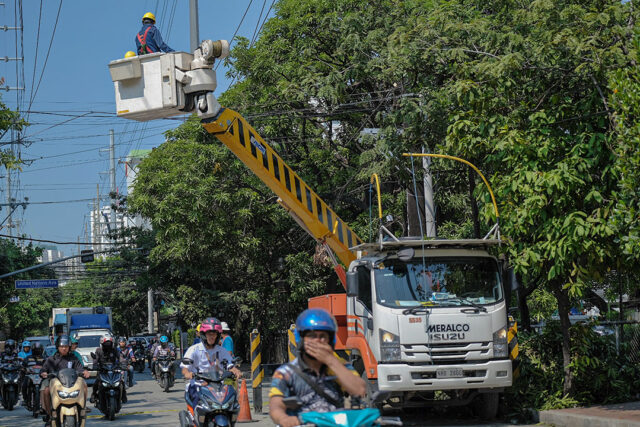
LINEMEN are at work along a street in Ermita, Manila. — PHILIPPINE STAR/RYAN BALDEMOR

TYPICAL HOUSEHOLDS in areas served by Manila Electric Co. (Meralco) can expect higher electricity bills this month as the power distributor is set to hike rates by P0.2639 per kilowatt-hour (kWh) due to higher transmission charge and feed-in tariff allowance (FIT-All).

The upward adjustment pushed the overall rate to P12.2901 per kWh in March from P12.0262 per kWh in February, the company said in a statement on Tuesday.

Households consuming 200 kWh will see their monthly electricity bills go up by around P53. Those consuming 300 kWh, 400 kWh, and 500 kWh will have to pay an additional P79, P106, and P132, respectively.

Meralco attributed the rate increase to the conclusion of the one-time refund on regulatory reset fee, equivalent to P0.2264 per kWh for its customers. The refund was implemented last month as ordered by the Energy Regulatory Commission (ERC).

Also contributing to higher rates was the P0.1294 per kWh increase in transmission charge due to higher ancillary service charges incurred by the National Grid Corp. of the Philippines. The transmission charge for March also covered the second of three monthly collections for the recovery of costs of reserve market suppliers.

The ERC directed the recovery of the remaining 70% of the reserve market settlement fees incurred in March last year. This will be reflected in customers’ bills until April.

Adding to the upward adjustment was the implementation of the new FIT-All rate of P0.1189 per kWh, which was higher than the previous rate of P0.0838 per kWh.

The FIT-All is a uniform charge billed to all on-grid electricity consumers to support the development and promotion of renewable energy.

Other charges, which included taxes, increased by P0.0416 per kWh.

“Such increases were mitigated by the lower generation charge for February supply month that impacted the March billings of Meralco customers. The reduction is almost 17 centavos per kWh in generation charge,” Joe R. Zaldarriaga, Meralco vice-president and head of corporate communications, said in Filipino during a briefing.

The generation charge fell by P0.1686 per kWh to P7.0517 from P7.2203 per kWh last month due to lower costs from Meralco’s supply sources.

The peso appreciation against the US dollar pushed down the charges from independent power producers (IPP) and power supply agreements (PSA) to P1.0143 per kWh and P0.2934 per kWh, respectively. Around 98% of IPP costs and 61% of PSA costs were dollar-denominated.

The peso closed at P57.995 on Feb. 28, strengthening by 37 centavos from its P58.365 finish on Jan. 31.

Charges in the Wholesale Electricity Spot Market (WESM), the trading floor of electricity, decreased by P0.2247 per kWh due to the improved supply situation in Luzon.

IPPs, PSAs, and WESM accounted for 31%, 47%, and 22% respectively of the company’s total energy requirement for the period.

“Pass-through charges for generation and transmission are paid by Meralco to the power suppliers and the grid operator, respectively; while taxes, universal charges, and FIT-All are all remitted to the government,” Meralco said.

The company’s distribution charge has not moved at P0.0360 per kWh since August 2022.

Lawrence S. Fernandez, Meralco vice-president and head of utility economics, said prices at the spot market might shoot up after the declaration of a yellow alert over the Luzon grid last week. 

“Let’s see what will happen for the rest of the month. Demand has moderated a bit after that one time of yellow alert. So, we’ll have to see what the situation will be for the rest of the month,” he said.

Meanwhile, Mr. Zaldarriaga said Meralco’s energy requirements are fully covered by its suppliers as the summer season approaches.

“We entered into an emergency power supply agreement to cover our requirements, especially during peak load come the summer months. Although it has not been officially declared, we already feel the impact of the temperature levels on our demand,” he said.

“So, as long as there will be no unplanned and forced outages from the plants and as long as transmission will be able to supply the load coming from the power plants, we don’t see any problems come the summer months,” he added.

Meralco’s controlling stakeholder, Beacon Electric Asset Holdings, Inc., is partly owned by PLDT Inc. Hastings Holdings, Inc., a unit of PLDT Beneficial Trust Fund subsidiary MediaQuest Holdings, Inc., has an interest in BusinessWorld through the Philippine Star Group, which it controls. — Sheldeen Joy Talavera

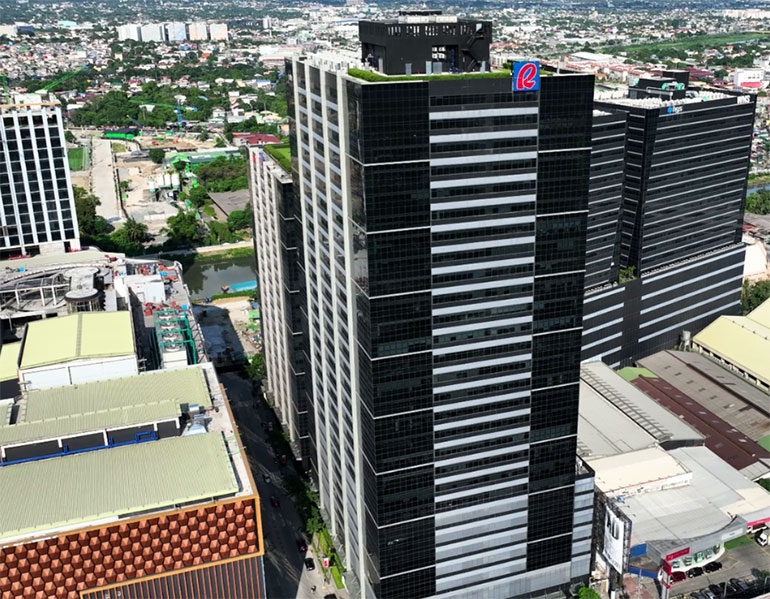
Scaling new heights in real estate investments

RCR continues to create value for shareholders through a massive infusion and steady occupancy of assets.

When RL Commercial REIT, Inc. (RCR) entered the market in September 2021, the real estate sector was grappling with the aftermath of COVID-19. The pandemic shook investor confidence, and demand for office spaces declined. Yet, RCR defied expectations.

Incorporated in 1988 as Robinsons Realty and Management Corporation, the company was renamed as RL Commercial REIT, Inc. before going public in 2021. RCR’s public offering raised approximately P23.5 billion, the largest REIT initial public offering (IPO) in the Philippines by far.

At the time of its listing, RCR’s portfolio includes 14 prime office assets. These include the 1. Tera and 2. Exxa-Zeta Towers in Quezon City, 3. Robinsons Equitable Tower, 4. Robinsons Cyberscape Alpha, and 5. Robinsons Cyberscape Beta in Pasig City, 6. Robinsons Cybergate Center 2 and 7. Robinsons Cybergate Center 3 in Mandaluyong City, 8. Robinsons Summit Center in Makati City, and 9. Cyber Sigma in Taguig City. The other office properties were 10. Robinsons Luisita BTS 1 in Tarlac City, 11. Robinsons Cybergate Naga in Naga City, 12. Robinsons Galleria Cebu and 13. Robinsons Cybergate Cebu in Cebu City, and 14. Robinsons Cybergate Delta 1 in Davao City.

Since then, it has significantly expanded its size and reach. In 2022, it added two properties in less than 18 months (ahead of its commitment per REIT Plan), followed by a major infusion in 2024 when it infused 13 additional properties.

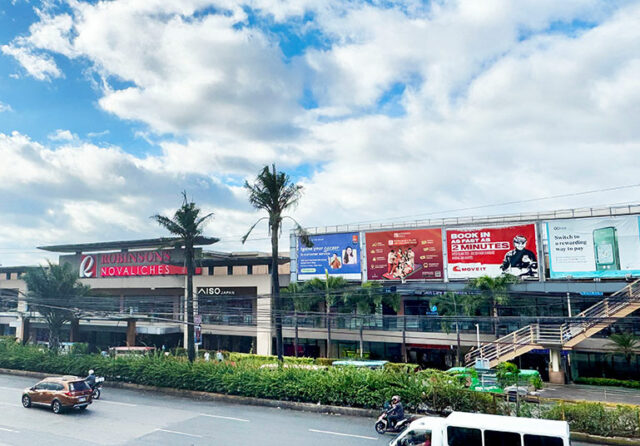
RCR diversified beyond office spaces. Initially focused on office spaces, the company’s portfolio now includes 17 office properties and 12 malls across 18 key locations in the Philippines. This expansion brought its total assets to 29, with a strong occupancy rate of 96% as of December 2024.

Stability and sustainability

The growth trajectory of RCR hinges on an Investment Criteria. In determining future investment to expand RCR’s portfolio, the asset to be acquired or infused has to be yield-accretive, has three-year profitability history, has stable occupancy, has to be in a key location and accessible at the same time, has to have a healthy tenant mix (for offices, BPOs are key while for malls, retail affiliates and strong and expanding retail concepts are important), and to extent available, PEZA Registration is an advantage. Such factors ensure that any new asset infusion strengthens the company’s financial standing and enhances value for the shareholders.

RCR executed a landmark asset infusion in 2024. The 13 multi-asset infusion valued at P33.92 billion has been the largest single infusion done by any Philippine REIT company so far. The injection of the mall assets positioned RCR to become a multi-asset class REIT not only limited to offices. The variable rent structure of the malls signifies a potential upside to its current revenue. The malls are considered to be one of the stable real estate classes backed by high consumer spending.

RCR’s strengths also include stable occupancy rates. Both office segment and mall segment had steady occupancy rate of 96% as of December 2024. RCR’s tenant mix is primarily BPO for office segment and Retail Affiliates for its mall segment.

Strong investment option

RCR continues to establish itself as a stable and lucrative investment vehicle with consistently high dividend yields, a growing asset portfolio, and a track record of share price appreciation.

Investing in RCR gives opportunities for those looking for better returns than conventional money market instruments. Typically, a money market investment offers a return of around 6% per year. In contrast, RCR provides dividend yield of approximately 6.67% to 7.10%, making it a more profitable alternative. Dividend yield assumes a share price of P6.00 and following the total dividends per share declared by RCR for CY2024 totaling to P0.4001 without special cash dividends and P0.4261 including the P0.0260 special cash dividends. For instance, an investor who places P100,000 in a money market fund might earn P6,000 annually. Investing the same amount in RCR yields approximately P6,670 to P7,100 in dividends. RCR’s share price has also shown upward momentum, increasing from P5.85 (as of Dec. 27, 2024) to P6.20 (as of Feb. 28, 2025).

If one is an investor of RCR since it went public in 2021, the change in share price, as well as the total dividend earnings to date, results in an overall investment growth of more than 15% — a significantly higher return compared to traditional fixed-income instruments.

Ensuring consistent dividend yields and long-term growth for investors, RCR combines rental revenue, asset appreciation, and sustainability for a winning investment strategy.

Continued growth

In just three years, the company has doubled its total gross leasable area (GLA) from approximately 425,000 square meters (sq.m.) to approximately 828,000 sq.m. This expansion ensures continued profitability for investors, aligning with RCR’s strategy to increase revenue-generating assets.

RCR’s market capitalization is around P97 billion as of Feb. 28, 2025, higher than the P64-billion market capitalization when it listed last Sept. 14, 2021.

RCR is continuously to be on the lookout for potential assets for acquisition. RCR’s Sponsor, RLC alone, currently has more than 1.3 million sq.m. of mall GLA, more than 250 thousand sq.m. office GLA, almost 300 thousand sq.m. of logistics and industrial facilities GLA, and approximately 4 thousand hotel room keys remaining for infusion. Aside from these, RCR is also on the watch for assets from third parties.


Spotlight is BusinessWorld’s sponsored section that allows advertisers to amplify their brand and connect with BusinessWorld’s audience by publishing their stories on the BusinessWorld Web site. For more information, send an email to online@bworldonline.com.

Join us on Viber at https://bit.ly/3hv6bLA to get more updates and subscribe to BusinessWorld’s titles and get exclusive content through www.bworld-x.com.

ADVERTISEMENT
ADVERTISEMENT