Home Blog Page 1834

Uy’s air navigation control proposal ‘rejected’ — PPP Center

COMCLARK Chief Executive Officer Dennis Anthony H. Uy — CONVERGEICT.COM

By Ashley Erika O. Jose, Reporter

THE Department of Transportation (DoTr) has rejected ComClark Network and Technology Corp.’s P29.82-billion unsolicited proposal to manage the country’s air navigation, traffic, and control system, according to the Public-Private Partnership (PPP) Center.

“The DoTr has decided to reject and return the unsolicited proposal. The DoTr will soon be sending the proponent the rejection letter, which will contain the grounds for rejection,” PPP Center Deputy Executive Director Jeffrey I. Manalo told reporters on the sidelines of a press briefing on Wednesday.

The Dennis Anthony H. Uy-led proponent may resubmit its unsolicited proposal upon addressing the grounds for rejection, Mr. Manalo said.

In October, Civil Aviation Authority of the Philippines (CAAP) Director-General Manuel Antonio L. Tamayo said that CAAP — as the implementing agency — was evaluating the proposal of ComClark.

Information from the PPP Center’s website indicates that ComClark’s proposal encompasses the construction, modernization, and operation of air navigation service facilities, including air traffic services and communications, navigation, surveillance, and traffic management systems. The company plans to execute the project with an international partner.

The proposal aims to modernize air traffic safety while also enhancing operational efficiency and reliability.

“By addressing critical shortcomings and leveraging innovative strategies, this initiative aims to instill a robust framework that ensures the utmost safety and effectiveness in air traffic management operations nationwide,” the PPP Center said.

To recall, PPP Center Executive Director Ma. Cynthia C. Hernandez said previously that the Air Traffic Services-Air Navigation Services project was also being evaluated as a solicited project.

The project involves the financing, design, construction, operations, and maintenance of air traffic services and air navigation services of the country’s airspace and international airspace managed by the Philippines, she said.

The Transportation department has said that, while there is an unsolicited proposal for managing and controlling the air traffic control system, it has also tapped the World Bank and the International Finance Corp. to conduct a study on the management of the country’s air traffic control.

The DoTr said that allowing a private company or creating a separate entity to manage and control the country’s air traffic control system will relieve CAAP of its conflicting roles.

ComClark is the controlling shareholder of Converge ICT Solutions, Inc., a listed telecommunications company. Converge has not received any information from the DoTr or PPP Center pertaining to the project, according to its communications team on Wednesday.

BusinessWorld also reached out to CAAP’s Mr. Tamayo for comment via text message and Viber. CAAP is an attached agency of the DoTr and is responsible for regulating and overseeing civil aviation in the country.

ChatGenie launches AI-powered multi-agent framework for BPOs

PHILSTAR FILE PHOTO

CUSTOMER engagement platform Chat-Genie has launched an artificial intelligence (AI)-powered multi-agent framework to help speed up tasks in traditional business process outsourcing (BPO) roles.

ChatGenie’s multi-agent framework deploys AI agents, which will take charge of customer interactions, enabling human workers to focus on handling more complex tasks such as resolving intricate customer issues, building client relationships, and driving customer success initiatives.

The AI agent will help automate repetitive office work such as query identification, issue classification, message filtering, and response refinement.

To run the framework, ChatGenie integrates advanced AI technologies such as Open-AI’s GPT-4o and Meta’s Llama 3.1.

Radge Falcis, cofounder and chief executive officer at ChatGenie, said the multi-agent platform shows that AI and human talent can coexist in a mutually beneficial way.

“Our technology is accelerating the redundancy of traditional customer service roles, but this isn’t about job losses,” Mr. Falcis in a statement.

“It’s about elevating agents to focus on their intellectual edge — tackling complex scenarios that require critical thinking and human empathy. In this way, we help businesses operate more efficiently while enabling employees to grow in their careers,” he added.

The framework includes agents for specific purposes, such as Guard AI, Classification AI, and Refinement AI, to ensure 90% to 95% accuracy in its responses.

The AI chatbots can also understand Filipino, English, and regional dialects.

The ChatGenie platform also integrates with popular messaging applications like Facebook Messenger, Instagram, and Meta’s Business Messaging services.

“Powered by large language models (LLMs), AI agents are systems that can perform complex tasks, make autonomous decisions, reason, adapt to unknown variables, understand language, and plan, making them highly versatile for various applications,” ChatGenie said.

The IT and Business Process Association of the Philippines (IBPAP) earlier said that 67% of firms saw enhanced productivity and operational efficiency after integrating AI into their operations. However, AI implementation resulted in job cuts among 8% of its members.

Despite this, IBPAP President and CEO Jack Madrid said AI is not expected to result in massive job losses in the industry if organizations continue to upskill their employees. — Beatriz Marie D. Cruz

Does Bitcoin at $100,000 signal a last laugh for HODLers?

PIXABAY

WHAT is there to say with Bitcoin at $100,000 for those of us who thought $10,000 looked nuts. After 15 years of cryptocurrency boom-and-bust cycles, rags-to-riches (and back to rags) stories, scams and bankruptcies, a carnival mood is back and hushing us naysayers.

Politicians are joining the party: Donald Trump is appointing pro-crypto officials, eyeing a Bitcoin reserve, and even hawking his own coin. So are punters, who are trying their hand and losing their shirts in the risky meme coin market. Like the 18th century carnival of Rome attended by the poet Goethe — where all mad and foolish behavior save knifing and brawling was allowed — it’s the mystified tourists who are in the minority.

Right now, it’s Anthony Scaramucci of all people whose analysis makes the most sense: Bitcoin’s new milestone shows it’s gained wider acceptance as a tradable asset and portfolio investment, offering both big gains and gut-wrenching drawdowns (the last peak-to-trough fall after COVID-19 was around 76%). The flipside of having no intrinsic value and a decentralized architecture with a huge energy footprint means that nobody’s using Bitcoin to buy their groceries, though: Only 7% of US consumers hold Bitcoin, according to Deutsche Bank AG research, and a survey published last month by the UK Financial Conduct Authority found only 16% of people who owned cryptocurrencies used them for payments. Skeptics focus on the lack of real-world adoption — yet it’s speculators banking on so-called digital gold who’ve come out richer.

Another point in favor of HODLers* going into 2025 is betting on the power of the incoming US president — somewhat ironically for a movement originally forged by libertarian cypher-punks. Almost $10 billion has flowed into Bitcoin exchange-traded funds since Trump’s Nov. 5 win, which makes sense given the likely gains to be had from regulatory forbearance. Gary Gensler’s departure from the Securities and Exchange Commission likely means more breathing space for tokens that have labored under the “unregistered securities” label, making US-based Coinbase Global, Inc. an obvious beneficiary of onshore trading flows and products — its shares have doubled this year. A friendlier regulatory atmosphere means we should expect more financial institutions to join in, even in risk-averse Europe.

Still, even pro-crypto folks know there are limits to this trade. We’re far from Friedrich Hayek’s vision of the “de-nationalization of money,” in which the state would ideally cede monopoly control of currency to the competitive private sector. Trump’s recent call to BRICs to accept dollar dominance shows he’s far from a crypto purist. A Bitcoin strategic reserve, with all the risk involved for US taxpayers, is probably (let’s hope) a bridge too far.

And while digital gold is a handy moniker that allows optimists to imagine another tenfold rise for Bitcoin — taking its market capitalization to $20 trillion, or on par with gold — its price has recently been correlated with tech stocks on the Nasdaq index, suggesting real-world macroeconomic conditions need to remain healthy to maintain that speculative luster. For now, they are: Monetary policy is loosening and tech stocks like Nvidia Corp. and Palantir Technologies, Inc. are rocketing (and have outperformed Bitcoin this year). But if the twin engines of the US economy and stock market sputter — perhaps due to tariffs or inflation — it may undermine Bitcoin’s attractiveness.

There are other, longer-term questions posed by this rally. The first is just how dangerous the gamblification of finance could yet be in a world of 24/7 trading apps, legalized sports betting, and instant payments — something crypto fans tend to dismiss. Like two sides of the same coin, crypto rallies expose punters to a proliferation of scams and get-rich-quick schemes. The urge to make money fast and replicate the seemingly out-of-reach gains of the early adopters can lead to horror shows like the Hawk Tuah memecoin or the baffling rise of Peanut the Squirrel’s token (market cap: $1.2 billion.) There will need to be re-regulation ahead, and maybe a total rethink of how the lines between investing and gambling are policed.

The second is whether there is already a glimpse of a future financial system beyond the speculation. Complex systems take time to emerge — something crypto doubters might also miss. Maybe new experiments, such as First Abu Dhabi Bank PJSC and Libre Capital’s announcement this week of a stablecoin lending pilot backed by tokenized money-market funds, are the budding indicators of where this Wild West of digital trading might end up.

The hope is that this carnival is close to maturity; but the history of financial manias, especially those with political encouragement, suggests a few more accidents are on the way.

BLOOMBERG OPINION

*HODL — “hold on for dear life”

Tea meditation

ORIENTO-UNSPLASH

The tea ritual: such a precise repetition of the same gestures and the same tastes; accession to simple, authentic and refined sensations, a license given to all, at little cost, to become aristocrats of taste, because tea is the beverage of the wealthy and the poor; the tea ritual, therefore, has the extraordinary virtue of introducing into our lives an aperture of serene harmony.” — Muriel Barbery, The Elegance of the Hedgehog

IN MANY of the world’s tea-drinking cultures, tea is transformed into a ritual that gives a taste of the sacred to what should be mundane. In the Philippines, Rachel Ngan Dueñas does the same by holding tea meditation classes.

We caught up with Ms. Dueñas at an event with Moda Interni (see related story: https://tinyurl.com/3bbn9yw3), where her artwork (especially one shown at an exhibit at the Carrousel du Louvre in Paris, Come to Life) was shown with the furniture showroom’s Italian offerings.

We didn’t come for her art, however: Ms. Dueñas achieved her certification as a tea sommelier from the International Tea Masters Association in the Philippines in 2018. In 2020, at the height of the pandemic, she began holding tea meditation classes through her Instagram page, @kindness.in.a.cup.

“I’m Chinese. We grew up drinking tea and everything,” she told BusinessWorld in an interview on Nov. 28. While tea has always been a part of her life, it was a stint in her life in the corporate world selling tea to hotels that opened her eyes to the many varieties and possibilities. She recalled having to taste 15 teas in a week. “It opened my brain beyond Chinese tea,” she said.

Encouraged by her husband to pursue tea (after an otherwise unsatisfying life in the corporate world), she told us what discouraged her from doing so at first. “There’s something I’ve always wanted to be, but I never felt qualified,” she said. “The sommelier in my brain has always been a white (British) man,” she said with laughter. Her husband told her, “Then change that.”

“My insecurity worked to the best of my ability. I’m not British, but I’m going to overcompensate and study very hard,” she said. “My job is to be there to help articulate the taste of people; whether they like something or not… you draw from a memory and you understand why; it teaches you so much as a human being, and these little tastes (are) clues to yourself, and who you are.”

She tells us what is there to love about tea: “It brings you a sense of calm. It brings you a chance to slow down. It is the cheapest way to say: ‘I’m going to take care of you.’”

She walked us through what happens at a tea meditation class, inspired by the discipline in the Japanese tea ceremony. She talked about engaging the five senses: but more than that, about how the five senses’ preferability differ from person to person. Of the five senses, two are considered favorable by a person, two are unfavorable; the last sense is considered neutral. From observing me, she said that my own favorable senses must be sight and smell (basing it on my clothes and my perfume).

“When you use tea meditation, and you brew your tea and everything, you have to engage your five senses. When you do it slowly and mindfully… the best way to do it is to focus on that moment,” she said.

“Me, as a facilitator, I watch your body (language), and it helps to have someone to guide you. When I’m able to help your body… to a more relaxed state… it teaches your body. Instead of heightening your stress level, it actually lowers [it],” she said; pointing out that I had a propensity for clenching my jaw and holding my breath (which tea meditation should fix).

“Through your cup of tea, it will teach you how to slow down and be more compassionate to yourself. That’s what tea meditation is — I teach you how to be friends with yourself, in a very gentle way,” she said.

Of course, there are other ways to meditate (yoga, anyone?), but: “I don’t like to teach meditation for you to aim for your brain to be quiet… I feel like you should engage what you like, what you enjoy, and that can bring you tranquility, even if it’s multisensorial,” she said. “Meditation should not be difficult. It should not make you bad that you can’t do it.”

Tea meditation has led to much more. Her client list kept growing, until she was invited to hold a class at The Farm at San Benito. One of the people there happened to be involved with Paris Fashion Week and then brought her to Paris to help de-stress the fashion workers there. One thing led to another, and that’s how her painting came to be at the Carrousel du Louvre.

“Everybody was born with a God-given talent, and it is our mission to share that to the world,” she said about how tea has taken her to several places. “The moment you share that with the world, the world offers you opportunities, more than you can possibly dream of,” she said.

“Your talent has now become an act of service.”

Contact Ms. Dueñas at https://www.instagram.com/kindness.in.a.cup/.Joseph L. Garcia

Central bank launches second phase of SME credit risk database project

BW FILE PHOTO

THE BANGKO SENTRAL ng Pilipinas (BSP) has launched the second phase of its credit risk database project, which aims to improve financial inclusion by helping boost lending to small and medium enterprises (SME).

“We already have seen many SME success stories. Each of them inspires us to keep pushing forward with the work we have already started as we end phase one and as we move to phase two of the CRD project,” BSP Governor Eli M. Remolona, Jr. said on Wednesday.

The CRD project was launched in 2020 in partnership with the Japan International Cooperation Agency (JICA). Last year, the BSP introduced the CRD scoring model.

A total of 33 financial institutions in the country have provided data for the project.

“In just four years, we’ve built a large database of SME data and developed a credit scoring tool. This tool is already helping participating financial institutions better assess credit risk, complementing their own methods,” BSP Deputy Governor Bernadette Romulo-Puyat said.

“It’s a step forward in making credit more accessible to SMEs. We are now transitioning this tool into a web-based service, which will make it even easier to use.”

Philippine banks continued to fall short of the mandated lending quota for small businesses at end-September, only extending 4.55% of their total loan portfolio. This was well below the 10% requirement under the Magna Carta for MSMEs.

Under the law, 8% of these loans must go to micro and small enterprises, while 2% must go to medium-sized businesses.

JICA Chief Representative in the Philippines Takema Sakamoto said the second phase of the CRD project will need to ensure sustainability.

“First, in particular, we have to maintain the robustness of the database through creating a secure environment and convenient data provision mechanism for our partner financial institutions,” he said.

He also noted the need to maintain the accuracy of the scoring model through regular, internal and third-party validation as well as the continuous development of institutional capacities.

“However, we are still in the middle or just in the beginning. We still need to do more to promote risk-based lending rather than just relying on conventional, collateral-based lending to enhance financial inclusion of SMEs,” Mr. Sakamoto added.

He also called for the establishment of a permanent body that will “operate and maintain the CRD services in the Philippines.”

“We believe that the principles of confidentiality, open or public access, transparency, and fairness are the foundations of a functional and sustainable CRD-operating entities.” — Luisa Maria Jacinta C. Jocson

Terra Solar seeks ERC nod for connection facility

PHILSTAR FILE PHOTO

SOLAR DEVELOPER Terra Solar Philippines, Inc. (TSPI) is seeking approval from the Energy Regulatory Commission (ERC) to establish a transmission facility for its P200-billion solar power and battery energy storage project.

TSPI aims to develop, own, and/or operate dedicated point-to-point limited transmission facilities to connect its power project to the Luzon grid, according to its filing with the ERC.

“Connecting the Terra Solar Project to the Luzon grid via bus-in connection along the Nagsaag-San Jose 500-kilovolt (kV) Transmission Line is an essential requisite to the plant’s commercial operations scheduled in the first quarter of 2026,” the company said.

The company is constructing a 3,500-megawatt-peak (MWp) solar power plant and a 4,500-megawatt-hour (MWh) battery energy storage facility in Central Luzon.

Now known as MTerra Solar, the project is targeted to be completed by 2027 and is expected to provide clean energy to more than two million households.

“After a thorough review of the available options, TSPI determined that the bus-in connection along the Nagsaag-San Jose 500-kV Transmission Line is the most cost-effective and technically viable option for the immediate interconnection of the Terra Solar Project,” the company said.

Once completed, the operation, service, and maintenance of the said facilities are proposed to be undertaken by the National Grid Corp. of the Philippines, consistent with the decision of the commission on similar applications, it said.

MGen Renewable Energy, Inc., the renewable energy arm of Meralco PowerGen Corp. (MGen), holds a controlling stake in SP New Energy Corp. MGen is a subsidiary of power distributor Manila Electric Co. (Meralco).

Last month, the companies officially broke ground for the MTerra Solar Project, marking the full swing of its construction.

TSPI tapped state-owned firms China Energy Engineering Group Co., Ltd. and Power Construction Corp. of China Ltd. for the construction of the project.

The company also inked a contract with Meralco Industrial Engineering Services Corp. to design and construct critical infrastructure that will connect the solar plant to the Luzon grid.

The total contract price amounts to P7.8 billion, while about $116.9 million (approximately P6.8 billion) was allocated for offshore equipment.

The MTerra Solar project is set to deliver electricity under a 20-year, 850-MW mid-merit power supply agreement to Meralco.

Meralco’s controlling stakeholder, Beacon Electric Asset Holdings, Inc., is partly owned by PLDT Inc.

Hastings Holdings, Inc., a unit of PLDT Beneficial Trust Fund subsidiary MediaQuest Holdings, Inc., has an interest in BusinessWorld through the Philippine Star Group, which it controls. — Sheldeen Joy Talavera

Organizations seen shifting to unified security platforms for data protection

A SHIFT from multiple cybersecurity tools to a unified data security platform is expected to happen among organizations next year to enhance visibility and control of artificial intelligence (AI)-driven threats, according to a cybersecurity company.

“We honestly believe organizations will start to move more and more to a single platform in order to address the types of sophisticated threats,” Steven Sherman, Palo Alto Networks regional vice-president for ASEAN, said in a media briefing last week.

Mr. Sherman said cyberattacks have become more sophisticated and faster over time.

“In the past, we would see an attack that would take an x time frame — say days or weeks — that became reduced to hours, which then became minutes,” he said.

“Organizations are being attacked quicker now at a greater scale, with a higher level of sophistication.”

Palo Alto said a unified platform will help organizations build better resilience against such cyber threats by providing end-to-end visibility and context, spanning code repositories, cloud workloads, networks, and security operations centers.

“The convergence of all security layers onto a unified platform will optimize resources, improve overall efficiency, and enable organizations to build more resilient, adaptive defenses against evolving threats,” it said.

“Ultimately, this creates a more holistic security architecture with fewer dashboards,” it added.

In the Philippines, 174 cybersecurity incidents have occurred in November, according to the Philippine National Computer Emergency Response Team (CERT-PH).

The latest report revealed 83 cases of data breaches (leaks/exfiltration), which was the most common incident last month. Malware followed with 55 cases, together with 19 cases of compromised system-web application cybersecurity management system issues.

Compromised systems-web application (framework), phishing, technical assistance, compromised server, compromised network/infrastructure, and ransomware issues are also included in the incidents handled by CERT-PH.

CERT-PH added that government and emergency services ranked first in the critical infrastructures that saw the highest rate of incidents last month at 100 cases or 57.5%. The academe, telecommunications, healthcare, private institutions, military, finance, and banking sectors also reported cybersecurity threats. — Almira Louise S. Martinez

The case for lying to kids about Santa — from a philosopher

FREEPIK

I have a vivid memory of the moment I realized Santa didn’t exist. I was around six years old, it was the height of summer, and I was sitting on the step outside our back door, thinking about God. The existence of God, back then, was something that annoyed me: it meant that every Sunday, we had to go to church.

Then I realized: there isn’t actually any evidence God exists. I only think God exists, because this is something people have told me.

I remember bounding up, excited, ready to share with my family this wonderful news. No longer would we be forced to endure the drudgery of weekly Sunday schools and sermons. But then I remember checking myself and thinking, “oh no.” If God doesn’t exist, by the same logic, “Santa must be made up as well.”

Perhaps this was the moment I became a philosopher (though I should say that as an adult, I no longer think that the analogy between God and Santa really holds). Certainly it gave me a slightly ridiculous sense of my intellectual superiority to those around me — not least the other kids in my class who hadn’t seen through this hoax.

But now the tables have turned. Now I am a parent of young children, and I am the one enforcing hegemonic myths about Santa.

We all do it, of course. Our culture expects parents, basically, to lie to our children that their presents were left by a jolly fat man who flies in a sleigh pulled by reindeer through the sky. And so of course one might ask, is this OK? We all surely want our children to grow up to be honest people. Shouldn’t we set a good example, as far as possible, by telling them the truth?

To which I would say: well, no. We shouldn’t be honest about Santa — at least not at first. It is morally OK, to the point of being actively morally good, for parents to participate in the grand Santa lie.

WHY KIDS NEED SANTA
When you think back to your first experiences of Christmas, do you really think they would have been improved if your parents had been honest about Santa? Without that sweet embellishment, there would be no ritual of writing to him, of leaving out sherry and mince pies, of waiting desperately to see if “he’s been” on Christmas morning.

Without the Santa myth, what would Christmas for the average child even be? An arbitrary date when they are finally allowed to play with presents their parents maybe bought months in advance. What would be the point?

This also bears on the question of to what extent one ought to be honest with one’s children in general. What, after all, would being “fully honest” really mean?

If I felt compelled to tell my children everything, I would pull no punches in relating the wretched state of the world, of existence, of my still-deepening resignation that nothing positive can be done about it. I would inflict the full brunt of my money worries, my health concerns, my (mostly irrational) worries about them.

And this would leave them, what? Emotionally healthier than the children of parents who gifted them a moderately sugar-coated sense of the world? Think of Nietzsche’s argument in his early essay “On Truth and Lies in a Non-Moral Sense,” to the effect that we need to be at least somewhat deluded about reality in order to be able to bear it.

As we’re growing up, we probably do on some level need to believe that the world is good and just: the sort of place where a jolly man runs a workshop staffed by elves, rewarding the nice children and (lightly) punishing the naughty.

If not, would youngsters really find it in themselves to fight for a better world?

WHEN THE LYING SHOULD END
And when our children do finally see through the myth? This is surely good for their moral development as well. It was very positive for me to realize that I had seen through my parents’ lies. I didn’t feel angry at them — and research suggests only a minority of children do, in this situation. Instead, I was left with a healthy suspicion for the received wisdom being ventriloquized by my parents.

This I guess is the extent to which I think lying about Santa is justified. Parents should surely maintain the myth while their children remain small, but answer honestly when confronted directly. When a child finally asks, at the age of six or seven, “is Santa real?” — that’s when they no longer need the noble lie.

Ultimately in raising children, our concern should always be with how we are shaping them. If we want to raise critical citizens, with a powerful sense that the world can be improved — and with a healthy suspicion of those in charge — the Santa myth is surely one mechanism through which this might possibly be achieved.

THE CONVERSATION VIA REUTERS CONNECT


Tom Whyman is a lecturer in Philosophy at the University of Liverpool.

‘Butter’ holidays

BUTTER BUTLER’S Butter Financier

THERE’S nothing like a morning that starts off with a cup of coffee and bread with butter. We’re lining up some of our new butter discoveries, perfect for adding creaminess to your holiday celebrations.

BUTTER BUTLER OPENS IN MANILA
Butter Butler, a Japanese sweetshop from Tokyo, opened this month at the R2 Level of Rockwell, Powerplant Mall. The shop is known for its various butter-centric treats.

“We are thrilled to bring the unique and indulgent world of Butter Butler to the Philippines,” said Bryan Tiu, president and chief executive officer of iFoods Group, Inc. in a statement. “Our goal is to elevate the dessert experience by making butter the star of the show, and we believe we’ve achieved that with our delectable offerings.”

A Manila-only release is the Butter Croffle, with the crispy, buttery exterior of a croissant and the soft, fluffy interior of a waffle. However, those familiar with the Japanese offerings might look for their other treats (and they’re mostly all here). These include the Butter Financier, featuring a rich, moist texture and a golden-brown crust. It’s made with a special blend of two kinds of European fermented butter and a touch of French sun-dried Guérande salt. The Butter Galette uses the same European fermented butter and French sun-dried Guérande salt for a crispy, chewy texture. Other ingredients they use include maple syrup straight from Canada.

“The Butter Butler is not just a dessert, but a celebration of butter. It is a perfect omiyage, the Japanese tradition of travelers bringing gifts and souvenirs back from their destination to friends, family, and colleagues. One bite and the rich sweetness will fill your mouth. The butter, usually a supporting role in sweets, is the star here, providing a rich, savory texture and flavor that supports the deliciousness of the dessert,” Mr. Tiu added in a statement.

Follow Butter Butler PH (Facebook), @butterbutlerph (Instagram), and butterbutler.ph for updates.

INTRODUCING BÜT BÜTTER BÜTTEST
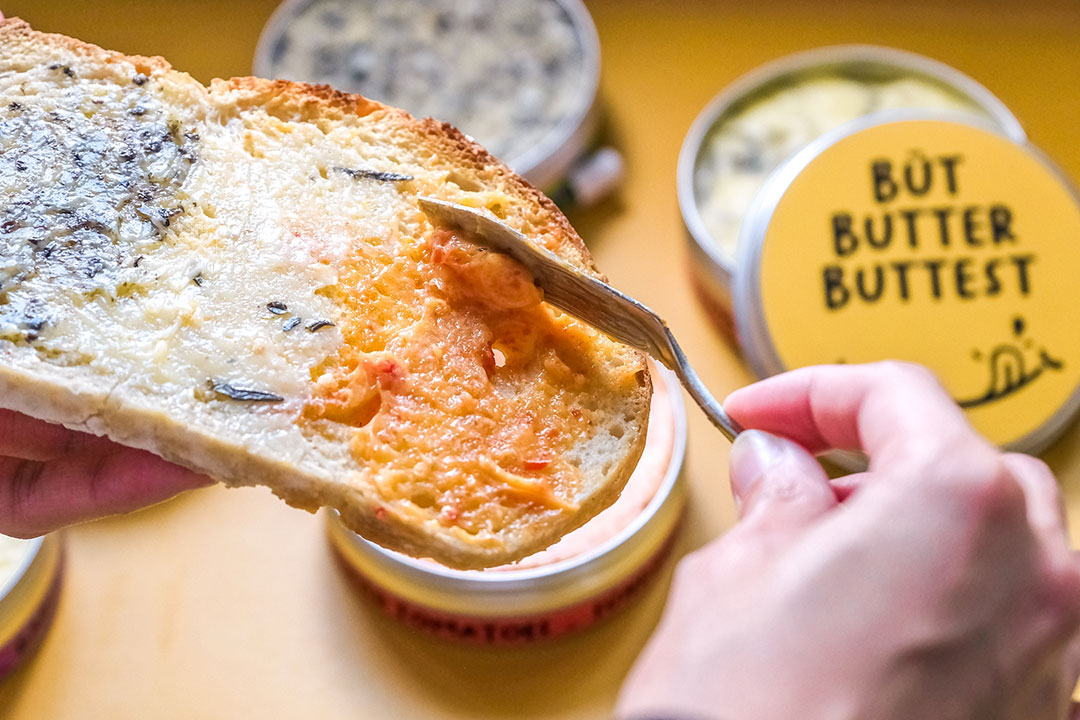
Büt Bütter Büttest is a home-based business in Quezon City offering six different flavored butters. Each can of butter is made from pure French butter. Fan favorites include Burnt Butter with Garlic and Shallots, and Sweet Cinnamon. Other flavors include Garlic and Shallots, Lemon and Herb, Sundried Tomato, and Roasted Seaweed.

The Just The Bütter gift set starts at P630. Check out their pages https://www.facebook.com/butbutter.buttest and https://instagram.com/butbutter.buttest, and message them to place orders.

Skyro, Paynamics partner to expand flexible payment options

STOCK PHOTO | Image by David Dvořáček from Unsplash

FINTECH COMPANY Skyro and e-payment firm Paynamics Technologies, Inc. have partnered to expand and offer more flexible payment options for underserved Filipinos and small businesses.

“This partnership is another milestone for us, for Filipinos, and also for the businesses, including the small and medium enterprises (SMEs),” Skyro Head of POS (Point of Sale) Business Lowen Medina said during the contract signing on Wednesday.

“We don’t need to stop in making sure that we provide better, accessible, affordable, and definitely flexible financial services in the Philippines.”

Under the partnership, Skyro’s buy now, pay later (BNPL) scheme can now be used across 4,000 merchant-partners under Paynamics.

“This partnership actually highlights the mission of Paynamics in elevating Filipino businesses and the lives of Filipino people by making financial products such as the BNPL more accessible and convenient,” Mylene Chua-Magleo, Paynamics co-founder and chief executive officer, said.

“Together with Skyro, we bring stronger cash flow to businesses while offering flexible payment options to customers and flexible payment terms that fosters a more inclusive and digitally empowered economy,” she added.

Skyro aims to offer “humane” loan terms and interest rates. Its loan products have an approval rate of up to 80% with down payments as low as 20%. — Luisa Maria Jacinta C. Jocson

Regulator OKs NGCP’s P2.6-B Tarlac substation project

PHILSTAR FILE PHOTO

THE Energy Regulatory Commission (ERC) has approved the National Grid Corp. of the Philippines’ (NGCP) P2.59-billion Capas 230-kilovolt (kV) substation project.

The regulator said that the load growth in Capas, Tarlac is expected to reach “unprecedented levels,” according to a document posted on its website.

This is due to the anticipated connection of Shin Clark Power Corp., the distribution utility for New Clark City (NCC), along with Tarlac 1 Electric Cooperative, Inc. (Tarelco 1), Tarelco II, and Tarlac Electric, Inc.

“The proposed Capas 230-kV substation project aims to manage this growth and facilitate NCC’s connection to the Luzon grid,” the ERC said.

The regulator said that the substation project is “subject to optimization during the reset process for the subsequent regulatory period.”

“[This is] following the procedures stated in the Rules in Setting the Transmission Wheeling Rates and other relevant issuances of the Commission,” it added.

The NGCP earlier said that it had allocated more than P600 billion as a capital expenditure budget for over 100 transmission projects in the pipeline.

These grid projects form part of the Transmission Development Plan 2024-2050, which are “ready for implementation,” according to the company. — Sheldeen Joy Talavera

AI safety is hard to steer with science in flux, US official says

WANGXINA-FREEPIK

NEW YORK — Policy makers aiming to recommend safeguards for artificial intelligence (AI) are facing a formidable challenge: science that is still evolving.

AI developers themselves are grappling with how to prevent abuse of novel systems, offering no easy fix for government authorities to embrace, Elizabeth Kelly, director of the US Artificial Intelligence Safety Institute, said on Tuesday.

Cybersecurity is an area of concern according to Kelly, speaking at the Reuters NEXT conference in New York. Ways to bypass guard rails that AI labs established for security and other topics, called “jailbreaks,” can be easy, she said.

“It is difficult for policy makers to say these are best practices we recommend in terms of safeguards, when we don’t actually know which ones work and which ones don’t,” Ms. Kelly said.

Technology experts are hashing out how to vet and protect AI across different dimensions. Another area regards synthetic content. Tampering with digital watermarks, which flag to consumers when images are AI-generated, remains too easy for authorities to devise guidance for industry, she said.

The US AI Safety Institute, created under the Biden administration, is addressing such concerns via academic, industry, and civil society partnerships that inform its tech evaluations, Ms. Kelly said. She said AI safety is a “fundamentally bipartisan issue,” when asked what will happen to the body after Donald Trump takes office in January.

The institute’s first director, Ms. Kelly recently presided over the inaugural gathering of AI safety institutes from around the world, which took place last month in San Francisco.

Asked about the outcome of these meetings, Ms. Kelly said the 10 country members were working toward interoperable safety tests with the help of more technical, hoodie-wearing experts than in a typical diplomatic meeting.

“It was very much getting the nerds in the room,” she said. Reuters