Home Blog Page 18

BSP, SEC discuss possible transfer of online lender oversight

UNSPLASH

THE BANGKO Sentral ng Pilipinas (BSP) and the Securities and Exchange Commission (SEC) are in talks on regulating online lending platforms, including a possible transfer of oversight to the central bank.

The discussions include how oversight of online lending platforms (OLPs) could be shared or shifted, as the BSP also supervises credit-granting companies under its mandate, BSP General Counsel Roberto L. Figueroa told reporters on the sidelines of an event on Tuesday.

“Both parties are talking to each other and see how we can move forward on this. Because you’ve heard the Commissioner himself saying, they have no problem giving these entities to us. I think as far as the BSP is concerned, we’re not against that move. It’s just that we want to be sure that we’re ready when we take over,” he said.

SEC Commissioner Rogelio V. Quevedo said in a speech on Tuesday that the regulator has submitted a position paper proposing to transfer oversight of OLPs to the BSP, citing challenges in addressing fraud in the sector.

“Financing and lending companies are one of the serious headaches of the SEC. So, we are trying to establish a secure, interoperable, and trustworthy credit ecosystem. I have always maintained that since this is heavy, it should properly belong to the BSP. But the law leaves it with a joint regulatory ecosystem of the SEC and the BSP,” he said.

Mr. Quevedo said the SEC submitted the position paper this year, although the BSP and legislators have indicated a preference for a joint regulatory approach.

“SEC’s expertise is financial regulation like insider trading. We supervise the PSE. Particularly, securities trading. Aside from this, we are regulating companies with P1-million capitalization. We have to dedicate about 80 people for this. But it is not enough. Because there are almost 6,000 [OLPs]. If we lift the moratorium, it will be 10,000.”

Mr. Figueroa said the BSP and the SEC still need to determine whether any transfer of oversight would require legislation or could be implemented through regulatory issuances.

“But we are okay with either route. The BSP is willing because we do recognize the importance of these lending and financing companies and their potential impact on the economy,” he said.

Separately, Mr. Quevedo said the SEC is considering stricter governance rules following complaints from foreign fund managers related to potential exposure to flood control projects.

“Under the regulatory power of the SEC, we are contemplating on a definition of corporations vested with public interest. Because now, the listed companies are being monitored so we will come up with a definition,” he said.

“We will require them to have independent directors of corporations vested with public interest. Because now, it’s just a requirement of independent directors. But now 20% of the board must be independent directors of listed companies. And that is probably one of the reasons why they are being delisted. So, we are proposing that corporations vested with public interest must also have independent directors. Maybe at least 10% because in listed companies, 20%. But there must be at least one independent director of corporations vested with public interest.” — Aaron Michael C. Sy

Netong’s eyes partnerships to cushion rising costs

NETONG’S FB PAGE

ILOILO CITY — Netong’s Original Special La Paz Batchoy is seeking partnerships with hotels and private companies to sustain operations as rising ingredient costs squeeze margins, its owner said.

“It’s expensive now, and you cannot just have a price increase,” third-generation owner John Patrick Guillergan told reporters.

Mr. Guillergan said the Iloilo-based brand, known for its warm noodle soups, is exploring tie-ups with hotels and corporate clients, while continuing to work closely with the local government.

He said the strategy could help stabilize demand and offset higher input costs without passing the full burden to customers.

Founded in 1948 by his grandfather Leonito, Netong’s has built its reputation on affordable servings of La Paz batchoy using ingredients bought from local public markets. The brand said its supply setup allows it to maintain operations even during supply disruptions.

“The only advantage is that when we run out of soup, we have a backup because our ingredients are here in the market; that’s our traditional practice,” Mr. Guillergan said, adding that the dish’s broth remains its key differentiator.

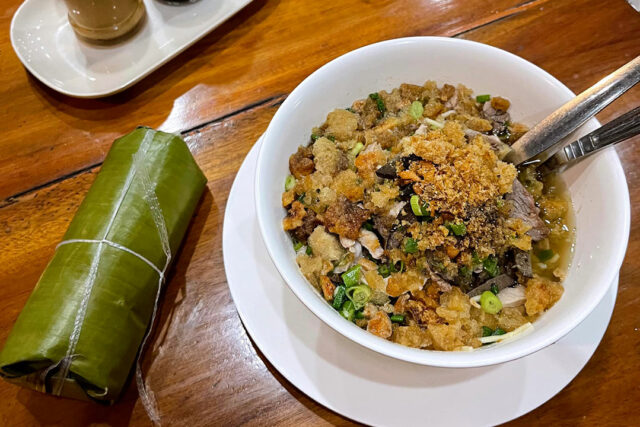
Each bowl, priced from P115 to P155, includes egg noodles, pork, beef and innards, topped with pork cracklings, spring onions and toasted garlic. Customers may also opt for thin wheat or glass noodles and add bone marrow.

Despite rising costs, the company has yet to decide on price increases.

“We are actually talking about the price because you also need to consider that the salary of our customers has yet to increase,” Mr. Guillergan said. “We also cannot reduce the serving and quality because it might trigger bashers on social media.”

Data from the local statistics office showed the average retail price of fresh beef rose to P376.34 per kilo in the second phase of March, slightly higher than earlier periods. The Department of Agriculture has also warned that pork prices could climb sharply if geopolitical tensions from the Iran war worsen.

The company said it has no immediate plans to expand outside Iloilo, citing high capital requirements and uncertain market conditions.

“It’s hard to open a business right now because there are a lot of expenses,” Mr. Guillergan said. “You have to shell out a lot of money.”

Instead, Netong’s plans to open another kiosk within Iloilo to reach more customers, while continuing to join trade fairs such as World Food Bazaar and Arte Fino in Manila.

The company previously operated five outlets but closed three during the coronavirus pandemic. It maintains branches including one at the redeveloped La Paz Public Market. — Almira Louise S. Martinez

Private consent in the adoption of a surrendered child is insufficient

STOCK PHOTO | Image by Jcomp from Freepik

State certification remains mandatory

The State has made the adoption process more expeditious. However, the procedures and requirements provided by law must still be complied with, as the best interests and welfare of the child are at stake.

Republic Act (RA) No. 9523, which amended RA 8552, RA 8043, and Presidential Decree No. 603, authorizes the Department of Social Welfare and Development (DSWD) to declare a child legally available for adoption through administrative proceedings, upon issuance of the corresponding Certification. The DSWD can make this declaration if: a.) the fact of abandonment or neglect of the child is proven through the submission of requisite documents; or, b.) the child has been voluntarily committed by his or her parent or legal guardian, who knowingly and willingly surrender parental authority to the DSWD, or to any duly accredited child-placement or child-caring agency or institution.

RA 11642, otherwise known as the Domestic Administrative Adoption and Alternative Child Care Act, repealed RA 9523 and streamlined domestic adoption, making it more accessible by converting it from a judicial process into an administrative one under the National Authority for Child Care (NACC), which is now the agency that issues the Certification.

In other words, even if a biological parent or legal guardian of a surrendered child expressly and voluntarily relinquishes parental authority and consents to the adoption, such consent cannot supplant the requirement of securing the State’s approval through the Certification declaring the child legally available for adoption.

This was emphasized by the Supreme Court in the case of Robiso v. Ibay (G.R. No. 241893, Nov. 3, 2025). In this case, the adopter filed a Petition for Adoption of the minor child whose biological mother freely and knowingly relinquished her parental authority to the adopter. No familial relationship existed between the adopter and the child sought to be adopted. To prove her voluntary surrender, the biological mother executed an Affidavit of Consent to Adoption and Grant of Custody of Child.

The Regional Trial Court (RTC) dismissed the petition for failure to attach a DSWD Certification declaring the surrendered child legally available for adoption, as mandated by RA 9523. The adopter fervently contended that the Certification was unnecessary since the child was not: a.) abandoned; b.) neglected; or, c.) voluntarily committed to the DSWD, or to a duly accredited child-placement or child-caring agency or institution.

The Supreme Court affirmed the ruling of the RTC. The doctrinal clarification of the Supreme Court, speaking through Associate Justice Japar B. Dimaampao, centers on its treatment of a surrendered child. While RA 9523 extends its application to surrendered children, the law itself does not explicitly contemplate the same as a stand-alone term. In fact, the Supreme Court in Robiso acknowledged that it is the Implementing Rules and Regulations of RA 9523 that “defines a surrendered child alongside a voluntarily committed child.”

The Supreme Court clarified that a child is deemed voluntarily committed not only when surrendered to the DSWD or a child-placement agency, but also to an individual. It was recognized by the Supreme Court that “when a parent — often a mother acting under difficult circumstances, as in this case — entrusts her child to another’s care, the child is legally considered voluntarily committed.” In this instance, despite the Affidavit of Consent to Adoption and Grant of Custody of Child evidencing the consent of the biological mother, Robiso affirms that a DSWD Certification remains indispensable.

In fine, Robiso is a discernible manifestation of the Supreme Court placing utmost consideration on the best interests and material welfare of a child, balanced against its caution in addressing the dangers surrounding adoption. As profoundly stated by the Supreme Court, “justice demands equal vigilance in protecting children, who are often the most vulnerable and may become susceptible to exploitation if legal safeguards are disregarded.”

Demonstrably, the Certification requirement in adoption laws cannot be superseded by the consent of the biological parent or legal guardian. Private arrangements between the biological parent or legal guardian of the surrendered child and the potential adopter cannot override the final administrative declaration of the State in adoption proceedings. Formal State acquiescence remains decisive.

All told, while Philippine adoption laws may appear rigid and unnecessarily exhaustive, especially when there is genuine urgency to adopt, such protections are deliberately uncompromising. The ultimate objective is, and shall be, without exception, the assured long-term protection of a child’s best interests and welfare.

The views and opinions expressed in this article are those of the author. This article is for general informational and educational purposes only and not offered as and does not constitute legal advice or legal opinion.


Kimberly Belle Diet is an associate of the Litigation and Dispute Resolution department of the Angara Abello Concepcion Regala & Cruz Law Offices (ACCRALAW).

(632) 8830-8000

kdiet@accralaw.com

Britney Spears enters rehab after arrest on suspicion of driving under the influence

Britney Spears — FACEBOOK.COM/BRITNEYSPEARS

LOS ANGELES — Britney Spears voluntarily checked into rehab on Sunday following her March arrest on suspicion of driving under the influence, a representative for Ms. Spears confirmed to Reuters on Monday.

The California Highway Patrol said the pop singer was arrested in Ventura County after officers stopped her black BMW following a report that it had been traveling erratically at high speed.

The highway patrol said in a statement that Spears, the sole occupant of the vehicle, “showed signs of impairment” due to what officers suspected was the influence of a combination of alcohol and drugs. It added she underwent a series of field sobriety tests.

Ms. Spears was booked into the Ventura County Main Jail and is due for a court appearance on May 4.

Ms. Spears, who became one of the biggest pop stars in the world in the late 1990s while still a teenager, has struggled for years with intense media speculation into her personal life, use of drink and drugs, and questions over her mental state.

In 2007, she was charged with one count of a hit-and-run causing property damage and one count of driving without a valid license, both misdemeanors. The first charge was later dropped and the other dismissed.

After she had a public breakdown that year, she was hospitalized for undisclosed mental health issues and her father granted a conservatorship.

Ms. Spears regained control of her personal life and her money in 2021 when a judge ended the conservatorship that had become a cause celebre for fans and that had governed her personal life and $60-million estate since 2008. — Reuters

Financial system’s resources up 9.16% at end-February

The main office of the Bangko Sentral ng Pilipinas in Manila. — BW FILE PHOTO

THE TOTAL RESOURCES of the Philippine financial system grew by 9.16% as of February, preliminary data from the Bangko Sentral ng Pilipinas (BSP) showed.

Resources held by banks and nonbank financial institutions increased to P36.784 trillion at end-February from P33.696 trillion a year prior. This was also up by 1.25% from the P36.33 trillion at end-January.

These include funds and assets such as deposits, capital, and bonds or debt securities.

Broken down, resources held by banks increased by 9.98% year on year to P30.56 trillion at end-February from P27.78 trillion previously.

Universal and commercial banks’ resources went up by 9.17% to P28.344 trillion at end-February from P25.963 trillion last year.

Thrift banks’ resources surged by 26.25% year on year to P1.469 trillion from P1.16 trillion, while those held by rural and cooperative banks climbed by 7.19% to P565 billion from P527.1 billion.

Digital banks’ resources also jumped by 41.07% to P179.3 billion from P127.1 billion, BSP data showed.

On the other hand, resources of nonbank financial institutions rose by 5.25% to P6.226 billion as of September 2025 from P5.916 billion at end-February 2025.

Nonbanks include investment houses, finance companies, security dealers, pawnshops, and lending companies.

Institutions such as nonstock savings and loan associations, credit card companies, private insurance firms, the Social Security System, and the Government Service Insurance System are also considered nonbank financial firms.

The expansion in the Philippines’ financial resources reflected continued growth in bank lending, deposit growth, and asset accumulation as domestic demand remained resilient, Philippine Institute for Development Studies Senior Research Fellow John Paolo R. Rivera said in a Viber message.

However, this growth may moderate for the rest of the year as faster inflation, elevated borrowing costs, and geopolitical uncertainty could dampen credit demand and risk appetite, he said.

“The outlook is one of continued but more measured growth, with the financial system remaining broadly stable.” — A.M.C. Sy

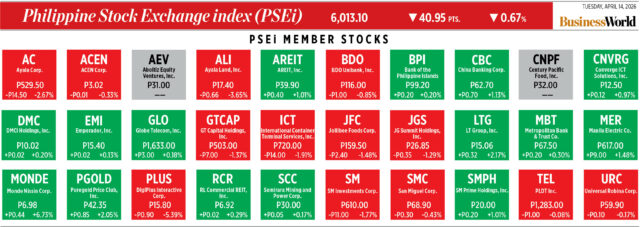
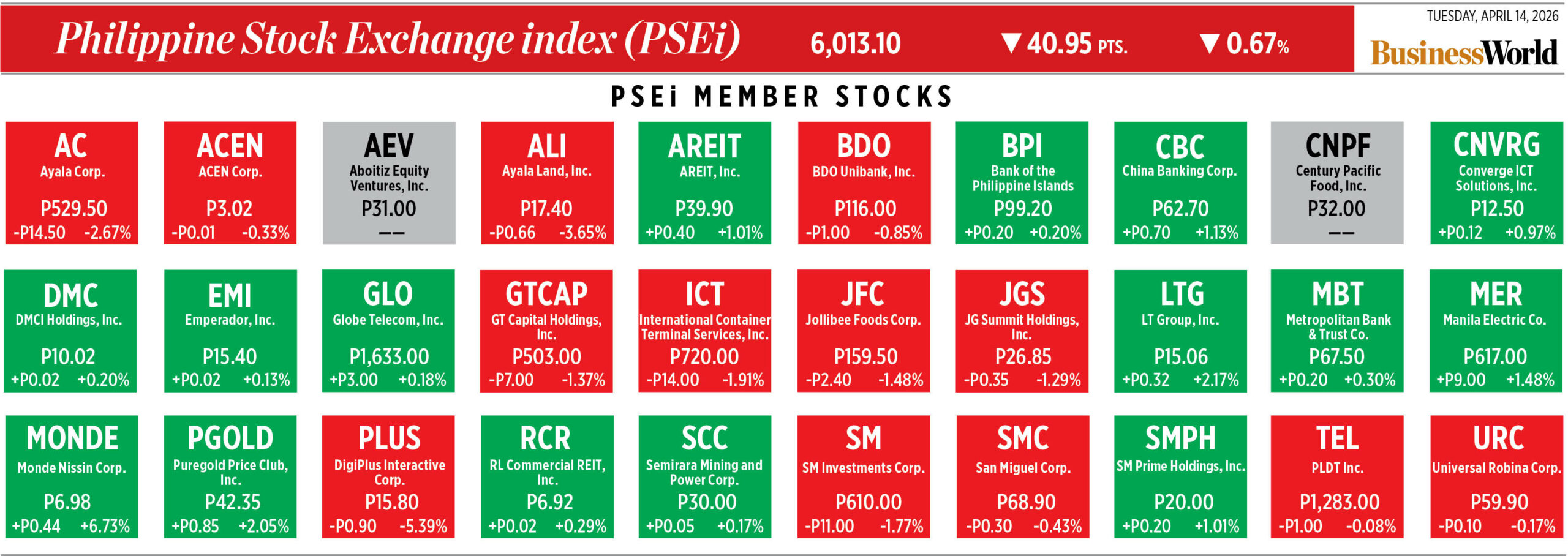
How PSEi member stocks performed — April 14, 2026

Here’s a quick glance at how PSEi stocks fared on Tuesday, April 14, 2026.


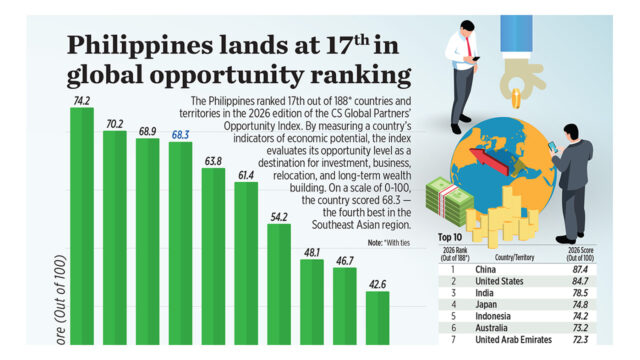
Philippines lands at 17th in global opportunity ranking

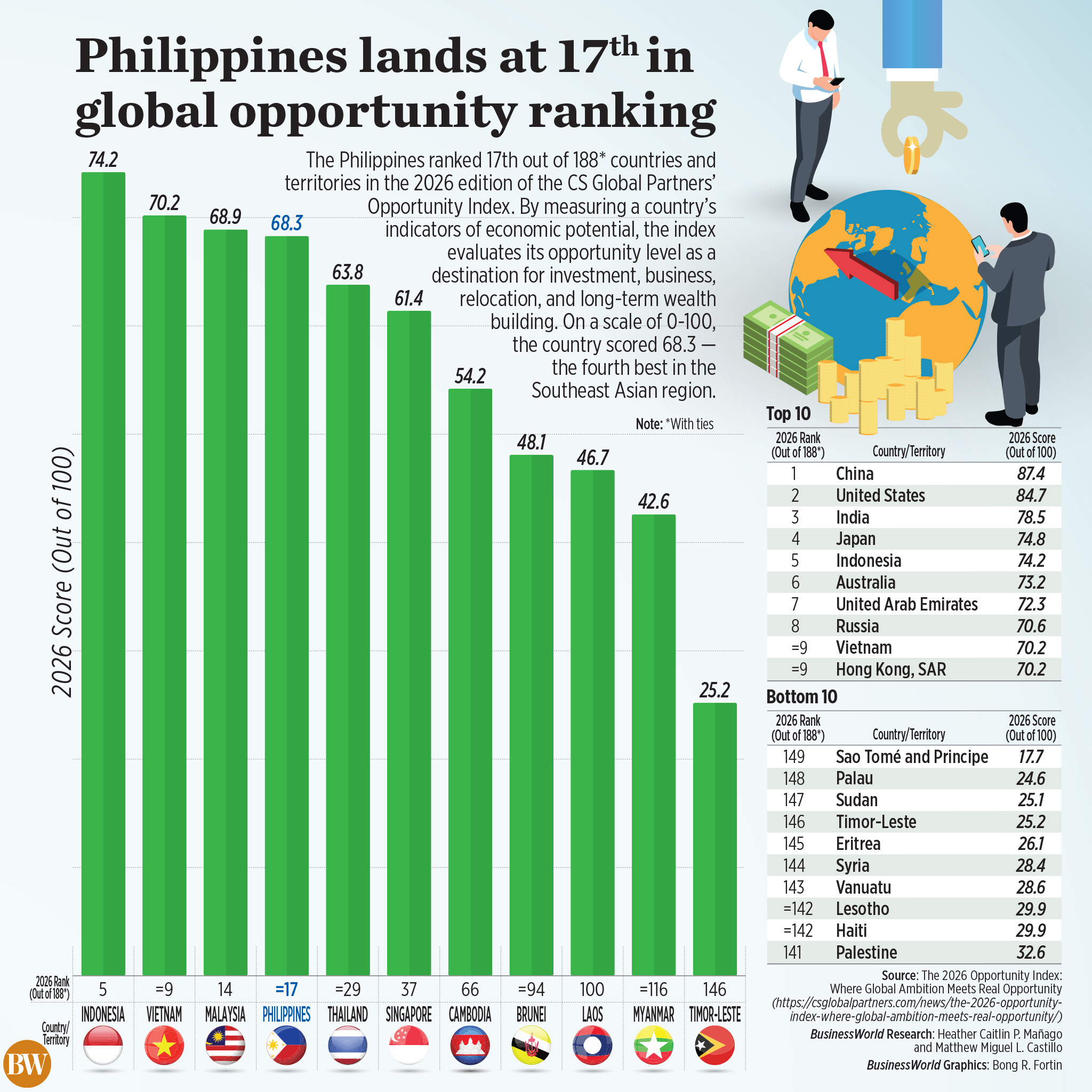
The Philippines ranked 17th out of 188* countries and territories in the 2026 edition of the CS Global PartnersOpportunity Index. By measuring a country’s indicators of economic potential, the index evaluates its opportunity level as a destination for investment, business, relocation, and long‑term wealth building. On a scale of 0-100, the country scored 68.3 — the fourth best in the Southeast Asian region.

Sanofi, PhilCare ink partnership to promote preventive workplace health

PhilCare President and CEO Jaeger L. Tanco. — PHILCARE

Biopharma company Sanofi Philippines and PhilCare, a health maintenance organization (HMO), signed a partnership on Tuesday to promote workplace vaccination and a proactive health approach for the local workforce.

The agreement is aligned with the upcoming celebration of World Day for Safety and Health at Work on April 28 and World Immunization Week from April 24 to 30.

The partnership underscores the importance of taking preventive measures for safer and healthier working environments in workplaces and communities.

With the Philippine labor force participation rate at 63.8%, or people aged 15 years and above, translating to 52.09 million as of February, according to the Philippine Statistics Authority.

Diseases that could have been prevented by vaccines, such as influenza, are a common factor that disrupt workforce productivity and economic growth, the partnership statement said.

“As the country’s workforce continues to grow, maintaining employee health is important to sustaining productivity and economic growth,” Vanessa Yabut-Gomez, head of vaccines for Sanofi Philippines said in a statement.

“Immunization is one of the most viable ways to support the health of Filipino employees.”

The flu season in the Philippines typically peaks from June to November. Despite this seasonality, experts note that year-round protection remains important for working adults.

Unvaccinated adults, especially those managing underlying conditions, face severe impacts from the flu.

The World Health Organization emphasizes the critical role of vaccines in controlling disease outbreaks.

However, adult immunization remains overlooked due to significant barriers, including high costs, limited access to vaccines, and a general lack of awareness.

Through the partnership between Sanofi Philippines and PhilCare, these barriers are being addressed by expanding access for corporate members and strengthening vaccination awareness.

For PhilCare, the partnership reinforces the company’s commitment to delivering comprehensive healthcare services to Filipinos across the country.

“By integrating critical vaccination options, such as the flu shot, into our broad range of healthcare offerings, we aim to address the gaps in adult preventive care,” Jaeger L. Tanco, president and chief executive officer (CEO) of PhilCare said in a statement. — Edg Adrian A. Eva

Unsolicited Iloilo International Airport bid rejected

PATRICKROQUE01-WIKIPEDIA

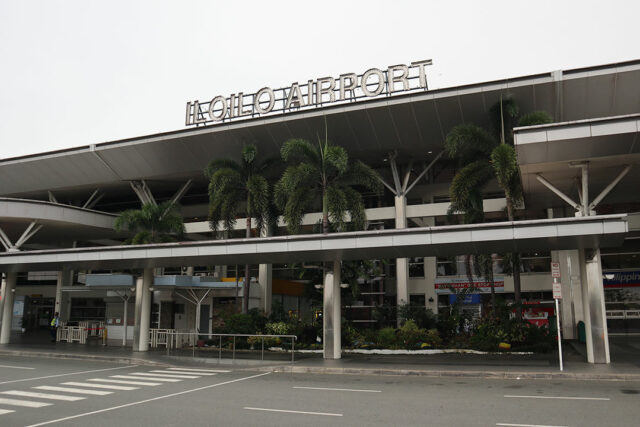
THE P21‑billion unsolicited proposal of Prime Asset Ventures, Inc. (PAVI) to upgrade and operate Iloilo International Airport has been rejected due to deficiencies in documentation, the Civil Aviation Authority of the Philippines (CAAP) said.

CAAP Deputy Director-General Danjun G. Lucas told BusinessWorld that PAVI, controlled by the Villars, “can always refile but the Department of Transportation (DoTr) is seriously considering solicited mode.”

CAAP said the group’s proposal lacked an endorsement to the Department of Economy, Planning, and Development (DEPDev). DEPDev approval is needed for projects of over P15 billion.

The DoTr and CAAP were designated the implementing agencies for the project.

The rehabilitation, expansion, operation, and maintenance of the Iloilo International Airport was structured as an operate‑and‑transfer scheme.

PAVI was named the original proponent for the project, which covers the expansion and renovation of the passenger terminal building.

The company also holds original proponent status for the Puerto Princesa International Airport rehabilitation, operation, and maintenance project which had an estimated project cost of P11.63 billion, according to Public-Private Partnership Center (PPP Center).

“We have already proven that  PPPs work better for public infrastructure, which generate revenue and (hold the potential to) improve through private sector involvement,” Nigel Paul C. Villarete, senior adviser on public-private partnerships at the technical advisory group Libra Konsult, said via Viber.

Solicited PPP projects are government-initiated, with competitive tenders issued after the government generally sets the project’s terms of reference and overall coverage. In contrast, unsolicited PPPs are private sector-led proposals.

The Iloilo International Airport is considered to have strong revenue potential, making it attractive for further development via PPP, Mr. Villarete said.

Rene S. Santiago, an international consultant on transport development and former president of the Transportation Science Society of the Philippines, said the government should just go ahead and pursue its plan for the Iloilo International Airport.

“In theory, competitive bidding attracts more participants. In the Philippines, I have doubts when it comes to airports, especially domestic ones,” Mr. Santiago said.

Libra Konsult’s Mr. Villarete said the solicited mode gives the government greater flexibility in defining project terms and coverage, being responsible for preparing the technical and financial studies for procurement.

“Between solicited and unsolicited modes, I would strongly suggest doing it through solicited mode… (unsolicited) is easier to do since the government won’t go through the steps of bid preparation and the bidding itself, but it binds the government to the party that submitted the proposal,” he said. 

Last year, the DoTr said it is hoping to privatize at least 15 airports by 2026 as the government seeks to make regional airports more economically viable. — Ashley Erika O. Jose

NFA to offer as much as P30 to buy palay in some areas

PHILIPPINE STAR/EDD GUMBAN

THE National Food Authority (NFA) said it increased its buying price for dry palay (unmilled rice) to as much as P30 per kilo in selected areas, from the previous P21, citing the need to support rice farmers.

In a document shared with reporters, the NFA said the higher procurement price of P30 per kilo will be implemented this week in Bulacan, Nueva Ecija, Sorsogon, Capiz, Aklan, Bohol, and Negros Oriental.

The grains agency said it will also buy dry palay at P30 per kilo in most parts of Southern and Central Mindanao and the Bangsamoro Autonomous Region in Muslim Mindanao.

In other provinces and regions, the NFA said buying prices will range from P25 to P29 per kilo.

The NFA earlier signaled an increase in buying prices during the dry-season harvest to match the higher prices offered by private traders.

“Right now, traders are buying at very high prices, so we cannot keep up,” NFA Administrator Larry R. Lacson earlier told reporters.

The Philippine Statistics Authority, citing preliminary data, said the national average farmgate price of dry palay rose 28% year on year in March to P23.91 per kilo, the highest level since the P24.68 recorded in July 2024.

The highest farmgate price for dry palay in March was reported in Northern Mindanao at P26.99 per kilo, up 41.8% from a year earlier.

The Bangsamoro Autonomous Region in Muslim Mindanao recorded the lowest average price at P19.42 per kilo, down 10.4% year on year, making it the only region to post a decline during the period.

In Central Luzon, the country’s top rice-producing region, the average farmgate price of dry palay was P24.42 per kilo, up 33.1% from a year earlier.

Cagayan Valley, another key producer, reported an average farmgate price of P24.22 per kilo for dry palay, 34.6% higher than a year earlier. — Vonn Andrei E. Villamiel

Pork, corn MAV could rise instead of lowering tariffs

REUTERS

THE Department of Agriculture (DA) said it is studying the possibility of increasing the minimum access volume (MAV) for pork and corn, after President Ferdinand R. Marcos, Jr. ordered his officials to find ways to keep food affordable.

Agriculture Secretary Francisco P. Tiu Laurel, Jr. said the DA is considering a “MAV Plus” scheme for pork and corn as an alternative to lowering tariff rates.

“The DA’s suggestion is to use MAV Plus. The minimum access volume will simply be increased so that it will not affect farmers,” he told reporters on the sidelines of the DA’s P20 rice program launch in Makati City on Tuesday.

The MAV scheme is a feature of the international trade regime in which participating countries allow limited volumes of agricultural commodities at a favorable tariff rate. Volumes exceeding the quota are charged a higher rate.

For pork, shipments within the MAV are subject to a 15% tariff, while volumes beyond the quota are charged the regular 25% rate. Corn imports within the MAV are levied a 5% tariff, while shipments outside the quota are charged 15%.

If approved, the proposed MAV Plus scheme would expand the current quotas of 55,000 metric tons (MT) for pork and 216,900 MT for corn.

Mr. Laurel said the department is still studying the appropriate additional MAV volume for the commodities.

“We will follow the recommendation of the industry so we can find common ground. If supply proves insufficient, we can adjust accordingly,” he said.

Mr. Laurel said the proposed MAV Plus could be implemented within three weeks, once a consensus with industry participants is reached.

The DA said it is not yet considering an increase in the MAV for chicken, which is currently at around 24,000 MT, citing opposition from poultry producers and prevailing market conditions.

“There is currently overproduction, and chicken prices remain low. While MAV Plus could be considered in the future, we will not trigger it unless necessary,” Mr. Laurel said.

Agriculture groups have expressed opposition to proposals to reduce duties on pork, corn, and chicken, arguing that imports are already cheap and do not require further tariff relief.

Rosendo O. So, chairperson of the Samahang Industriya ng Agrikultura, said pork, for instance, is already cheap due to lower production and fuel costs in the source countries.

“For pork from Brazil… export prices are only around $1.60 to $2.50 per kilo. That’s how low they are. Their fuel prices are also lower,” he said at a briefing.

Elias Jose M. Inciong, chairman of the United Broiler Raisers Association, said there is also no reason to reduce tariffs on chicken as farmgate prices remain depressed.

“We do not see any reason to reduce tariffs further because chicken prices are currently low. Liveweight price is at around P82 per kilo against the industry’s breakeven range of P100 to P110, so producers are incurring losses,” he said. — Vonn Andrei E. Villamiel

Impact of fertilizer crisis seen reflected in food prices by Q3

PHILIPPINE STAR/RYAN BALDEMOR

FOOD PRICES are expected to reflect the impact of the fertilizer crisis as early as the third quarter, via increased costs of the input for growers of crops for human or animal consumption, a private-sector executive said. 

“We were calculating maybe by the third or fourth quarter, you will see the full impact of the fertilizer spike on food pricing and protein pricing,” Jose Rene D. Almendras, private sector representative to the Legislative-Executive Development Advisory Council, told the Money Talks with Cathy Yang program on One News on Tuesday.

He said it will take a few months before the rise in fertilizer prices shows up in food prices.

“The price of the urea, which was at about P400, is now going towards P800, and the farmer that buys that fertilizer will now charge more for his produce, which eventually will be used for feed. So that’s going to take a few months.

Fighting around the Persian Gulf has disrupted the supply of fertilizer, affecting farm production costs, IBON Foundation Executive Director Jose Enrique A. Africa said.

“The US attack on Iran is causing a systemic price shock on food systems not just through oil prices but also through fertilizer, and these are being transmitted through the country’s overly import-dependent energy and agricultural systems,” he said via Viber.

Fertilizer production is energy-intensive as it relies mainly on natural gas as feedstock. The Middle East is a key producer of fertilizer.

“The pass-through of price shocks will be aggravated if marginal rural producers stop producing, and cause localized supply gaps to aggregate to regional and national shortfalls,” Mr. Africa added.

Danilo V. Fausto, president of the Philippine Chamber of Agriculture and Food, Inc., said shipping and logistics costs also will drive up food prices, which will likely manifest in the coming months.

“Replenishment of inventories by food manufacturers will result in increased prices due to high cost of raw materials,” he said via Viber.

Boat fares and ship cargo rates have been allowed to rise as much as 30%, the Maritime Industry Authority said in March. 

Mr. Fausto also cited the need to provide targeted support for farmers in light of the upcoming planting season this May. — Beatriz Marie D. Cruz