(L-R): SMP executives Guy Henderson, Roslyn Pineda, and Stephanie Ortiz; John Paulo Nase of SB19; Paolo Benjamin of Ben&Ben; and SMP executives Nasra Artan, Dan Nelson, and Anthony Wan. — BRONTË H. LACSAMANA
SONY MUSIC Publishing (SMP) has launched a new flagship office in Manila, beginning a strategic expansion focused on developing and promoting Filipino songwriters.
In line with this, Stephanie Ortiz has been appointed general manager of SMP Philippines. Meanwhile, Sony Music Entertainment Philippines’ General Manager Roslyn Pineda has been promoted to president for SMP Asia, which is based in Hong Kong.
“Many songwriters have told us that they don’t know about music publishing yet and that they don’t know how to maximize their compositions. Education is a priority for us,” Ms. Ortiz told the press at the launch on Feb. 24.
She added that, with the help of music industry allies such as the Filipino Society of Composers, Authors and Publishers (FILSCAP), SMP Philippines’ goal will be to expand music publishing education, for songwriters to “know their rights and learn how to earn money.”
Ms. Ortiz also noted that they will focus on building a community that will connect Filipino songwriters and producers with each other before bringing them to the global stage. “It starts in the homebase first. That’s our target. From there, we can work closely with our global counterparts,” she said.
For Guy Henderson, president of SMP International, music now coming from anywhere in the world means there’s a huge opportunity for growth for Philippine music.
“These days, kids in the Western world jump up and down in a stadium to artists who sing 75% of their lyrics in another language,” he said. “The Philippines is one of those countries that benefits from that.”
He also explained that, in terms of putting songwriters first especially in an AI (artificial intelligence) environment, SMP is committed to working with them so that their songs are taken care of and protected.
“It’s a combination of allowing them to use their creativity and protecting them by lobbying for stronger laws,” Mr. Henderson said.
FILIPINO SONGWRITERS Among the homegrown artists who have recently made a name regionally and internationally are P-pop group SB19 and OPM band Ben&Ben. SMP Philippines marked its launch by inviting each of their chief songwriters to a panel where they discussed their creative processes.
“Before writing a song, we first establish what the message is. If the elements put in the composition make the song better, that’s evolution,” said John Paulo Nase, better known as Pablo, SB19’s leader and songwriter, at the talk. “For me, if you can listen to it after five years, it’s a great song.”
Some of SB19’s biggest hits from five years back include “Mapa,” “Alab,” and “Bazinga.” Their latest song, released last week, is “VISA,” which has been gaining attention for its socially relevant lyrics about systemic barriers for Filipinos seeking stability abroad.
Meanwhile, Ben&Ben, known for hits like “Kathang Isip,” “Leaves,” and “Sa Susunod Na Habang Buhay,” recently released the track “Duyan.” Singer-songwriter Paolo Benjamin explained that making music is about “understanding the purpose of the song.”
“Ultimately, it becomes the compass. There are songs that are meant to provoke, and there are also songs that are meant to be a safe space. It begins with what the song is,” he said.
Ben&Ben and SB19 also collaborated on a track in 2021, “Kapangyarihan,” which has been used in protests in recent years. On the topic of how tracks grow and transform as they are listened to by many, both songwriters expressed their gratitude.
“It’s the highest honor a composer can have, to be told that your songs have helped them in some way,” said SB19’s Mr. Nase. “I’m always deeply honored.”
For Ben&Ben’s Mr. Benjamin, it remains “the biggest mystery of life” how that happens. “When you try and chase it, it doesn’t happen. When you don’t try, it also doesn’t happen usually, but sometimes it just does,” he said.
Roslyn Pineda, now president of SMP Asia, reaffirmed Sony Music’s thrust to provide access to global markets.
“It’s always been a challenge for songwriters all over — save for the US, UK, a bit of Latin America, and K-pop — to break into the global markets. There’s not a huge presence of publishing in the Philippines compared to other Asian markets, but there’s really a need for education and additional resources,” she explained.
“Music is becoming more global. Genres like P-pop that are popular in Asia are becoming more global.” — Brontë H. Lacsamana
Our economic managers and trade officials may well succeed in attracting sizeable foreign investments as we chair ASEAN in 2026. But without structural reform — in infrastructure, institutions, and policy frameworks — such efforts address the periphery, not the core. The more fundamental question remains: how do we motivate risk-averse investors when growth dynamics, weighed down by corruption and patronage politics, remain fragile? When even macroeconomic policy appears to be reaching its limits?
Accommodative monetary policy is pushing on a string. Weak business and household confidence blunt its impact, while banks, acting procyclically, tighten credit standards and weaken the transmission channel. The recent policy rate cut, instead of inspiring confidence, underscored economic fragility. As we noted in GlobalSource, the reduction “reflects both accommodation and caution” — a wake-up call to Malacañang and Congress to do more than rely on the central bank.
Expansionary fiscal policy can lift growth only if infrastructure funds are protected from plunder and truly directed toward productive investment. Of the P243 billion in unprogrammed appropriations, only P93 billion was vetoed. Some of the vetoed items could have funded P35.7 billion in counterpart financing for foreign-assisted projects. Where, then, do the remaining items go? Without discipline, fiscal consolidation becomes rhetoric and debt sustainability drifts further away.
This is why EDSA at 40 matters.
Had even a fraction of EDSA’s moral and political intent been institutionalized, the Philippines could have traveled a very different economic path.
The 1986 EDSA People Power Revolution was not merely a political transition; it was a reset of public expectations. It was a collective rejection of impunity, cronyism, and entitlement. It sought to restore rule of law, accountability, and the primacy of institutions over personalities. Had those aspirations been translated into sustained structural reform, growth would not have depended on episodic booms or remittance-driven consumption. It could have been broad-based, productivity-driven, and institutionally anchored.
If Congress had faithfully implemented the 1987 Constitution’s prohibition on political dynasties, political competition would have deepened. Governance could have shifted from patronage to programs, from transactional politics to policy-based accountability. Political capital would have been earned through performance rather than inherited through lineage. That single reform alone could have altered the country’s incentive structure — encouraging long-term policymaking instead of short electoral cycles.
If constitutional accountability institutions — the Office of the Ombudsman, the Sandiganbayan, and the Commission on Audit — had been strengthened not only in mandate but in operational independence, the deterrent effect on corruption could have compounded over time. Faster resolution of cases, higher conviction credibility, and visible enforcement would have lowered the risk premium attached to the Philippines. Obviously, investors prize good governance. But citizens do more.
If the civil service had been fully professionalized, shielded from patronage appointments and reinforced by meritocratic promotion, the regulatory environment would have matured earlier. The result could have been policy continuity that is less vulnerable to political turnover. We only have to set our sight to such countries as Singapore and Hong Kong which demonstrate that strong bureaucracies are not luxuries; they are growth infrastructure.
Why, even within constitutional economic restrictions, consistent enforcement of competition law, anti-monopoly provisions, and independent regulation could have fostered a genuinely level playing field. Capital does not merely seek openness; it seeks predictability and fairness. A rules-based economy reduces uncertainty, and invites more investments, more effectively than any tax incentive package. Other territories offer similar incentives but more even playing field.
In other words, the Philippines did not lack potential. It lacked sustained institutionalization of EDSA’s moral impulse.
Had governance credibility strengthened over the decades, fiscal multipliers would have been larger, infrastructure spending more efficient, and monetary easing more effective. Confidence — arguably the most powerful economic variable — would have been endogenous, not episodic. Growth could have compounded not only through capital accumulation, but through higher institutional trust.
We often measure lost opportunity in terms of foregone GDP percentage points. But the deeper loss is compounding credibility. Four decades is enough time for institutions to mature, for corruption norms to shift, for political culture to evolve.
That this transformation remains incomplete is precisely why the promise of EDSA still feels aspirational rather than fully realized.
The lesson is not nostalgic. It is structural: when moral reform is only commemorated but not embedded, economic reform could only remain fragile.
Remember the recent warning from Fitch Ratings?
It has warned that the Philippines is among the most vulnerable to climate-related risks, something that most of us already know but very few care about. Yet some of our politicians without shame plundered public money away from flood control projects for years, depriving many of the exposed communities of climate defense and escalating fiscal and economic costs. Resources meant to flood-proof communities reportedly financed private excess instead. Climate vulnerability thus becomes both an environmental and governance crisis.
Against this backdrop, Moody’s Ratings projects growth of 5.5% in 2026 and 5.6% in 2027 — figures hedged by concerns over debt servicing costs, revenue needs, and restrained public spending. These are not breakout numbers; they suggest muddling through. Especially when growth was stronger in 2024 and slowed markedly thereafter, “rebound” feels optimistic.
Moody’s expects resilient consumption and recovering public investment. Yet it acknowledges risks and time lags. It also overlooks the reality that weak monetary transmission and procyclical banking behavior can blunt policy support, while fiscal consolidation remains gradual at best.
It is comforting to say the Philippines has nowhere to go but up. But numbers alone do not constitute progress. Without moral integrity in policy design and implementation, reforms lose credibility before they bear fruit.
Chairing ASEAN in 2026 offers symbolic leadership. But institutional reform is substantive leadership. Without the latter, the former risks becoming ceremonial.
Looking back, 40 years after the 1986 EDSA People Power Revolution, the challenge is not remembrance. It is completion.
Now, we need the Trillion Peso March to deliver that message.
As Lipa Archbishop Gilbert Garcera, also president of the Catholic Bishops’ Conference of the Philippines (CBCP) warned, the deeper danger is moral fatigue. And moral fatigue is not abstract. It seeps into institutions, into regulatory discretion, into budget processes, into the uneven enforcement of law. When accountability weakens, risk premia rise. When impunity persists, capital hesitates. When public trust erodes, even the best-designed policies operate below capacity.
We can celebrate improving forecasts from Moody’s Ratings or note cautions from Fitch Ratings. But ratings agencies cannot manufacture credibility. Central banks cannot print integrity. Fiscal expansion cannot compensate indefinitely for governance leakages.
The tragedy is not that EDSA failed. It is that it was not fully finished. Even after 40 years.
Unless we keep our feet firmly on the ground — anchored in reform, rule of law, and moral responsibility — economic projections will remain arithmetic without architecture. Growth without integrity is fragile. Numbers without institutional reform are merely numbers.
The real unfinished business of EDSA is not memory. It is governance.
Diwa C. Guinigundo is the former deputy governor for the Monetary and Economics Sector, the Bangko Sentral ng Pilipinas (BSP). He served the BSP for 41 years. In 2001-2003, he was alternate executive director at the International Monetary Fund in Washington, DC. He is the senior pastor of the Fullness of Christ International Ministries in Mandaluyong.
LISTED property developer Megaworld Corp. reported an 11% increase in net income for 2025 to P24 billion, supported by sustained growth across its key business segments.
“Our full-year results highlight the growing strength of our diversified township portfolio and the steady expansion of our recurring income base,” Megaworld President and Chief Executive Officer Lourdes T. Gutierrez-Alfonso said in a statement on Thursday.
Total revenue rose 5.3% to about P86 billion from P81.7 billion in 2024, according to the company.
“With our leasing businesses continuing to gain momentum and a strong pipeline of residential launches ahead, we are entering 2026 with confidence as we see meaningful opportunities to scale further, expand in key growth markets, and build on the solid foundation we have established, especially on our pioneering township concept,” Ms. Gutierrez-Alfonso said.
Leasing revenue grew 11% to P22 billion, accounting for a significant portion of the company’s topline.
Megaworld Premier Offices’ leasing revenues increased 11% to P14.9 billion, supported by new assets, rental adjustments, renewals, and demand from business process outsourcing (BPO) firms and multinational companies across its townships, the company said.
In 2025, Megaworld recorded more than 330,000 square meters (sq.m.) of office transactions, of which roughly 180,000 sq.m. came from new leases, with the balance from renewals, it added.
Megaworld Lifestyle Malls’ leasing revenues rose 9% to P6.9 billion.
The company said average daily foot traffic reached 297,000, up 18% year on year and above pre-pandemic levels.
The company opened 64,000 sq.m. of new retail space in 2025, including 27,000 sq.m. in the fourth quarter, alongside tenant mix upgrades across food, fashion, home, and experiential retail categories.
Megaworld Hotels & Resorts posted a 9% increase in revenues to P5.6 billion, supported by higher room rates and the addition of new properties, including the Grand Westside Hotel, set to become the world’s largest Mövenpick hotel as Mövenpick Manila Bay Westside Hotel.
Real estate sales reached P51.8 billion, backed by steady demand in Metro Manila and expansion in provincial growth centers, the company said.
“Among the strong contributors during the year were projects in Uptown Bonifacio, McKinley West, Westside City, ArcoVia City, Northwin Global City, and Iloilo Business Park,” the company said.
For 2026, Megaworld plans to launch P65 billion worth of residential projects across Metro Manila and high-growth provincial locations to support its development pipeline and future revenue.
In January 2026, Megaworld launched its 37th township, The Sugartown, a 97‑hectare mixed-use development in Talisay City, Negros Occidental, marking its third development in the Negros Island Region.
“Megaworld continues to pursue its long-term leasing expansion strategy, targeting two million square meters of office gross leasable area (GLA) and one million square meters of retail GLA by 2030, bringing total leasing GLA to three million square meters,” the company said.
Megaworld shares rose 1.31% to P2.32 each. — Alexandria Grace C. Magno
THE SOCIAL Security System (SSS) expects its reserve fund to reach P2 trillion before the end of the current administration.
“My dream is to, before the end of the administration, reach P2 trillion… As you know, we came from the pandemic and the growth has been exponential, but I think the road to P2 trillion is getting nearer. We are on track to reach P2 trillion within the next three to four years,” SSS President and Chief Executive Officer Robert Joseph M. De Claro said in a press conference on Thursday.
Last year, the SSS’ reserve fund breached the trillion mark for the first time, ending at P1.065 trillion.
The state pension fund is also looking to increase the share of its investment income to total revenues as it targets higher premium contributions, driven by growth in its members and expanded offerings.
“With our programs, the intention is to have more members contributing more to the institution,” Mr. De Claro said.
The SSS recorded a net income of P142.97 billion in 2025, surging by 58.4% from P90.248 billion in 2024.
Finance Secretary Frederick D. Go said at the same event that the state pension fund was the most profitable government-owned or -controlled corporation last year.
It booked P460.761 billion in revenues last year, with P377.6 billion sourced from members’ contributions, which grew by 15.6% year on year, and the remaining P83.161 billion coming from investment income, up 571%.
Mr. De Claro said that following their positive financial performance last year, they are now looking at international investment opportunities for further growth.
“Because today, all of SSS’ investments are local. In our charter, it is allowed that we can invest up to 7.5% of the IRF (Investment Reserve Fund) in foreign investments. Maybe this will jumpstart our foreign investments, but with the objective of attracting also investors going to the Philippines,” he said.
“I think the life of the fund is also dependent — really, more than anything else — on the quality of the investments. So, the key is the quality of the investments of the fund which are being well taken care of,” Mr. Go said.
The SSS chief added that they hope to recoup the three years’ worth of fund life that was lost to the pension reform program announced in 2025 by this year, backed by the programs they plan to launch and expand.
“But again, the fund life is safe today at 25 years.”
The SSS in September implemented the first tranche of its three-year pension reform program, which will raise the pension for retirement and disability pensioners by 10% every September until 2027, while the pension for death or survivor pensioners will be increased by 5%.
When the reform program ends, pensions will have increased by approximately 33% for retirement/disability pensioners and 16% for death/survivor pensioners.
Mr. De Claro previously said the reform program will shorten the fund’s lifespan to 2049 from 2053 previously.
He added that the SSS has plans to increase contributions after the lifting of its moratorium once the reform program ends in 2027 until 2029.
“By 2029, the SSS will be 10 years old. So, it’s up to Congress probably to review at that point in time whether or not there could be increases in contribution. But as of today, we do not foresee an increase in contribution,” he said.
The pension fund on Thursday also announced that it plans to launch a micro loan program next quarter with an annual interest rate of 8% in partnership with banks.
Mr. De Claro said the SSS has already tapped five partner banks that will offer the micro loan through their respective mobile banking apps.
Mr. Go told reporters that the loanable amount for the program will range from P1,000 to P20,000.
The SSS will also launch more loan programs this year for micro, small, and medium enterprises and overseas Filipino workers. — Aaron Michael C. Sy
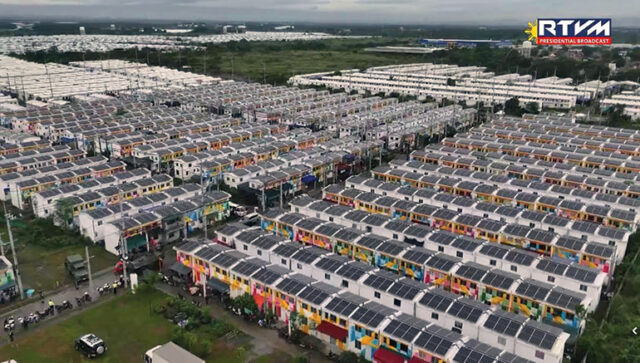
“Ningning” project inside the Pasinaya Homes Prime Central in Barangay Sabang, Naic — Photos from facebook.com/DHSUDgovph
Since its establishment in 2019, the Department of Human Settlements and Urban Development (DHSUD) has emerged as the Philippine government’s central agency for housing. Created through Republic Act No. 11201, the department consolidated key shelter agencies under a unified institutional framework, marking a strategic shift toward coherent, integrated, and people-centered housing governance.
Marking its 7th anniversary this year, the DHSUD has implemented sweeping reforms, launched ambitious housing programs, and introduced regulatory innovations that reshaped the country’s housing and urban development landscape.
As the Philippines continues to grapple with a housing backlog estimated at over 6.5 million units, the DHSUD’s evolving policy architecture reflects both urgency and transformation. From institutional consolidation and regulatory streamlining to the rollout of the flagship Pambansang Pabahay Para sa Pilipino (4PH) Program and its later expansion, the department’s milestones highlight a governance trajectory anchored on inclusivity, efficiency, and sustainability.
Institutional foundations and strategic mandate
The creation of the DHSUD in February 2019 signaled a long-overdue realignment of housing and urban development governance. By merging the Housing and Urban Development Coordinating Council (HUDCC) and the Housing and Land Use Regulatory Board (HLURB), the new department sought to harmonize policy direction, program implementation, and regulatory oversight.
This consolidation addressed long-standing issues of fragmented authority, overlapping mandates, and procedural inefficiencies that had constrained housing delivery and urban planning.
In its early years, the department focused on institutional capacity-building, regulatory restructuring, and stakeholder engagement. These foundational efforts laid groundwork for more expansive reforms under the Marcos administration, which elevated housing as a central pillar of national development through the launch of 4PH in 2022.
The program’s ambition to construct 6 million housing units by 2028 represented one of the most extensive public housing commitments in the Philippine history.
Human Settlements and Urban Development Secretary Jose Ramon P. Aliling (right) assumed office back in May 2025, succeeding Jose Rizalino Acuzar (left).
4PH Program
At its core, the DHSUD’s reform agenda lies in the 4PH program. Initially designed as a vertical housing initiative to maximize government land use in urban centers, the program aimed to deliver affordable condominium-style housing for low-income families, particularly informal settler households and minimum wage earners.
Early implementation faced structural and procedural challenges, including financing constraints, documentary backlogs, and difficulties within public-private partnerships.
Nevertheless, in 2024, the department had begun turning over completed housing units, signaling the transition from policy vision to tangible delivery.
By early 2026, the DHSUD achieved a major milestone with the turnover of its first horizontal housing units under the expanded framework of 4PH, benefiting over 400 families in Occidental Mindoro.
The recalibration of the 4PH Program into the Expanded Pambansang Pabahay para sa Pilipino Program (Expanded 4PH) in 2025 represented a critical policy inflection point. Recognizing the diverse housing needs across urban and rural contexts, the DHSUD broadened the program to include horizontal housing, rental accommodation, modular shelters, incremental housing, and community mortgage initiatives.
This policy expansion significantly widened program accessibility, encouraged private-sector participation, and enabled localized housing solutions tailored to community needs.
President Ferdinand R. Marcos, Jr., DHSUD Secretary Jose Ramon Aliling and NHA General Manager Joeben Tai led the inauguration and awarding of new house and lot units to beneficiaries in St. Barts Southville Heights in San Pablo City, Laguna last September.
Regulatory reforms and digital transformation
Parallel to program expansion, the DHSUD pursued an aggressive regulatory reform agenda. Upon assuming office in 2025, Secretary Jose Ramon P. Aliling introduced an 8-point strategic framework focused on transparency, efficiency, and institutional accountability.
Among the department’s most notable achievements was the resolution of over 3,800 backlog cases involving licenses to sell, development permits, and compliance certifications — an unprecedented feat that restored investor confidence and improved service delivery.
Central to this reform drive was the adoption of zero-tolerance policy against corruption, reinforced by internal audits, procedural standardization, and personnel accountability mechanisms.
These governance reforms were complemented by a comprehensive digitalization road map aimed at fully automating the DHSUD’s regulatory and licensing systems by 2028. The initiative seeks to minimize bureaucratic bottlenecks, enhance transaction transparency, and reduce opportunities for discretionary abuse.
To further streamline housing access, the DHSUD simplified application processes through Department Order No. 2025-021, allowing families to apply directly via developers, Pag-IBIG Fund, or the department itself. The reform substantially reduced processing times and democratized access to public housing opportunities, especially for low-income households.
Fiscal and policy innovations
The DHSUD’s reform agenda also extended into fiscal policy and interagency coordination. In partnership with the Department of Finance (DoF) and the Bureau of Internal Revenue (BIR), the department facilitated the issuance of Revenue Memorandum Order No. 048-2025, which standardized tax exemption procedures for socialized housing projects.
The reform significantly lowered development costs, incentivized private sector participation, and accelerated housing project approvals.
Another major breakthrough came with the issuance of Joint Memorandum Circular 2025-001, jointly crafted with the Department of Economy, Planning, and Development (DEPDev). The circular adjusted price ceilings for socialized housing, aligning cost parameters with market realities and construction inflation.
This policy shift enhanced financial viability for developers while safeguarding affordability for beneficiaries.
Community mortgage revival and tenure security
Among the most socially transformative initiatives of the DHSUD is the revitalization of the Community Mortgage Program (CMP), now enhanced under Expanded 4PH framework.
The revival of 34 CMP sites nationwide enabled approximately 5,000 families to acquire land collectively, empowering informal sector communities to secure tenure and invest incrementally in home improvements. This participatory housing model has been widely lauded for fostering community cohesion, financial inclusion, and grassroots empowerment.
Complementing CMP reforms was the distribution of Certificates of Award to families residing on land covered by longstanding presidential proclamations.
By formalizing tenure security, the DHSUD addressed decades-old tenure disputes and provided legal assurance to thousands of households, enhancing residential stability and socioeconomic mobility.
Rental housing and urban inclusivity
Recognizing the rising demand for flexible housing solutions in metropolitan areas, the DHSUD pioneered government-led rental housing initiatives.
A landmark partnership with the University of the Philippines launched the pilot rental housing project at UP Diliman, providing affordable accommodation for informal settler families and university employees.
The model is currently being replicated across regional campuses and local government units, marking a paradigm shift toward diversified housing tenure systems.
These rental housing projects underscore the DHSUD’s broader urban development strategy, emphasizing in-city relocation, transit-oriented development, and socio-spatial integration.
By prioritizing location efficiency and livelihood accessibility, the department aims to mitigate urban sprawl, reduce commuting burdens, and enhance quality of life for marginalized urban residents.
Disaster-responsive housing and Bayanihan Villages
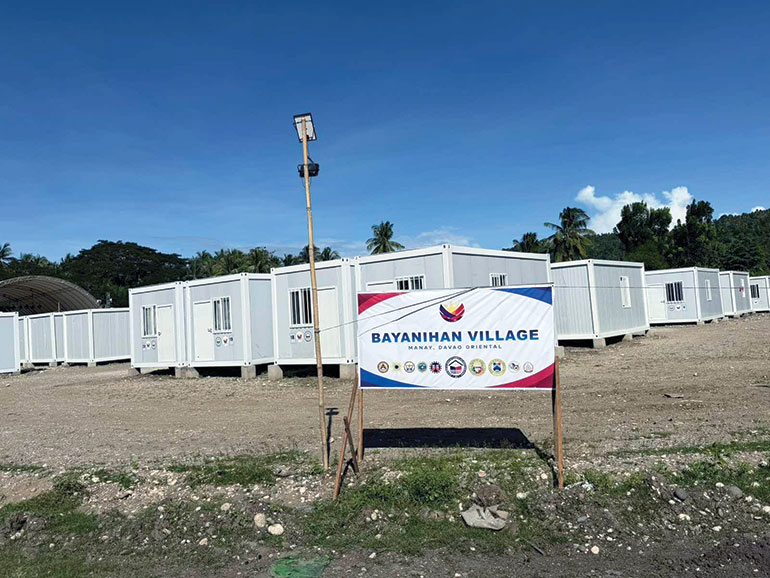
A Bayanihan Village was turned over to the Manay local government unit in Davao Oriental last December. It serves as a temporary refuge for calamity-stricken families.
In response to increasing climate vulnerability and disaster displacement, the DHSUD institutionalized modular shelter systems and launched the Bayanihan Villages initiative.
By 2025, the department had established 20 temporary housing sites across disaster-affected regions, including Cebu and Davao Oriental, offering rapid, dignified shelter solutions for displaced families.
The modular units not only address immediate housing needs but also serve as transitional settlements, supporting community recovery and rehabilitation.
Stakeholder engagement and public trust
The department’s first government-initiated National Housing Expo in 2025 symbolized renewed dynamism within the housing sector. Organized in collaboration with the Pag-IBIG Fund, the expo convened developers, financial institutions, local governments, and civil society groups, fostering multi-sectoral collaboration and public accountability.
The event also facilitated beneficiary enrollment, project matchmaking, and policy dialogue, reinforcing the DHSUD’s commitment to participatory governance.
Beyond institutional partnerships, the DHSUD has strengthened regulatory enforcement mechanisms to protect homebuyers from fraudulent practices, delayed turnovers, and contractual violation.
Enhanced complaint resolution systems and legal mediation frameworks have restored public trust in housing governance, particularly among first-time buyers and vulnerable consumers.
Seven years since its inception, the DHSUD stands at the forefront of transformative housing governance in the Philippines. Through ambitious programmatic expansion, decisive regulatory reforms, and inclusive policy innovations, the department is redefining public housing delivery and urban development planning.
While formidable challenges persist, ranging from financing sustainability and land acquisition constraints to climate resilience and urban density management, the department’s institutional trajectory underscores a resolute commitment to dignified living for all Filipinos.
As the DHSUD enters its next phase, its legacy will be measured not merely in housing units delivered, but in communities strengthened, livelihoods secured, and futures built. — Krystal Anjela H. Gamboa
DEXTER SOL ANSELL (right) and Peter Claffey in A Knight of the Seven Kingdoms (2026)
1 of 3
DEXTER SOL ANSELL (right) and Peter Claffey in A Knight of the Seven Kingdoms (2026)
By Brontë H. Lacsamana, Reporter
TV Review A Knight of the Seven Kingdoms HBO Max
WHILE avid readers of George R.R. Martin’s A Song of Ice and Fire novels wait for the final two installments of the series (which formed the basis for HBO’s hit medieval fantasy show — the haphazard final three seasons of which fans choose to forget these days), a new spinoff show set in the same universe has come out.
The good news is that the spinoff, A Knight of the Seven Kingdoms, succeeds in what many others don’t. Clocking in at just six episodes of 30 minutes each, it manages to enliven GRRM’s universe thanks to its clever storytelling and refreshing perspective.
Adapted from The Hedge Knight, the first novella in the author’s Tales of Dunk and Egg series, it follows Dunk, or Ser Duncan the Tall (played by Peter Claffey), the titular wannabe hedge knight, wandering the land. On the way to a tourney, he meets Egg (played by Dexter Sol Ansell), a young boy determined to be his squire, later revealed to be the runaway prince Aegon Targaryen.
The opening scene alone signals how different this adaptation is compared to the self-important warring family dramas that have come before. The famous opening theme begins, only to be abruptly cut off by the disgusting sound of Ser Dunk having a poo under a tree. Set a hundred years before Game of Thrones and a hundred years after the other ongoing spinoff series House of the Dragons, this show has a lighter, more comedic tone, with a running theme being the lies and pretense that go into mythmaking, be it that of a knight, a prince, or the complex history of a family or the entire seven (or is it nine?) kingdoms.
A Knight of the Seven Kingdoms needs no refresher for the intricate web of generations of incestuous dynasties nor a recap of political vortices among dozens and dozens of characters with incomprehensible names. It’s simply about a man who wants to be a knight, and a prince who wants to be a squire, and the adventures they go on as they navigate a world with bits of magic and royal intrigue. It seems showrunner Ira Parker knew exactly what to do to bring out the charm of GRRM’s Dunk and Egg novellas in a way that would solve the audience fatigue for the sprawling world of Westeros.
What this spinoff series gets right is its ability to let each character shine sparingly in service of the story being told. Daniel Ings as the indulgent Lyonel Baratheon and Shaun Thomas as the amiable Raymun Fossoway make for memorable friends for Ser Dunk as he stumbles around trying to become a full-fledged tourney knight. Some of the best lines in the show are delivered by Ings’ impassioned scenes, as Lyonel tries to pull Dunk into his hedonistic world. Rowan Robinson as Fossoway prostitute Red and Tanzyn Crawford as the Dornish puppeteer Tanselle are also scene stealers, adding character to a medieval fantasy world that feels very lived in.
Ironically, compared to the spinoff show that’s all about the Targaryens in their heyday, A Knight of the Seven Kingdoms presents the most interesting Targaryen family dynamics put to screen so far, even without the dragons. There’s Princes Baelor (played with a resolute charm by Bertie Carvel) and Maekar (played with an amusing, perpetual scowl by Sam Spruell), two brothers seemingly doomed to bring their house to ruin in spite of all their efforts. Egg’s older brothers, the drunkard Daeron (Henry Ashton) and the cruel Aerion (Finn Bennett), also make an impression. But truly, what seems to serve the sense of tragedy that looms around these characters best is the sparing glimpses of how they struggle to carry the burden of their family name. (Of course, by the time Game of Thrones comes around, almost all Targaryens have been wiped out.)
But make no mistake: Dunk and Egg’s endearing chemistry is at the heart of the show. Claffey’s huge stature does him favors embodying the physicality of Dunk, sure, but he really does capture the essence of the firm yet kind knight that tries to overcome his limited intellectual capabilities and the traumas he’s endured all his life. Meanwhile, Ansell breathes life into Egg’s naivete and spunk, as he learns to live among people who see him as an equal, coming from a sheltered existence in a ruling house that is starting to waver.
Without spoiling anything, what sets A Knight of the Seven Kingdoms apart is how self-aware it is of the tall tales that the world of Westeros is built on. Those who haven’t watched any of the other shows or read the books will be able to follow this and appreciate its heart and its wit — except, of course, if bloodshed isn’t your cup of tea, because this is still a medieval fantasy and the penultimate episode (and best of the season!) has lots of it, for good reason. Otherwise, it’s a refreshing, boots-on-the-ground take on a familiar universe filled with action, revelry, and philosophical conundrums, all told with humor.
In the meantime, fans of the novels who continue to ceaselessly wait for GRRM to actually finish the main series, will have something to enjoy. The world-building remains subtle and the stories of these characters feel fleshed out in their limited screentime, which makes it a topnotch experience for anyone who has avidly kept up with the lore for years. It even keeps you itching for more, with season two still a year away, slated for 2027.
Overall, it’s a fascinating look at a Westeros still reeling from the embattled past when dragons used to exist, but also on its way to a bleaker world that is the stage for Game of Thrones. Of all adaptations so far, it’s the most faithful, and also the most tightly written and edited, making for a refreshing experience which proves that fantasy doesn’t always have to be so complicated.
THERE IS a category of organizational investment that rarely generates enthusiasm in the boardroom. It does not carry the promise of artificial intelligence (AI), the urgency of cybersecurity, or the narrative appeal of digital transformation. It does not make for compelling slides. And yet, without it, virtually every ambitious technology initiative an organization pursues will underperform, produce unreliable outputs, or fall short of its promises.
That investment is data governance. And the case for taking it seriously at the board level has never been stronger.
WHEN THE CUSTOMER KNOWS MORE THAN THE COMPANY Consider a scenario that will feel familiar to many. A customer updates their address with one business unit of a financial institution. Months later, a statement from a different unit of the same institution arrives at the old address. A card renewal follows it there. From the customer’s vantage point, this is baffling; they are dealing with one company, the same name, the same logo.
From the institution’s internal perspective, however, these are separate business lines with separate systems, separate data repositories, and no shared mechanism for propagating a simple change. The customer knows something the company does not: that they have moved.
What this reveals is that the organization has no reliable single view of its customer. Data updates are siloed, and the various parts of the enterprise are operating on different versions of the same reality. For a board that has approved investments in customer experience, digital channels, and personalization, this is precisely the kind of gap those investments were meant to close, and precisely what data governance is meant to prevent.
THE 360° VIEW IS A DATA GOVERNANCE PROBLEM Many organizations today aspire to what practitioners call a “360° view” of their customers. The idea is intuitive. Aggregate all available data about a customer, including transaction history, service interactions, product holdings, preferences, and risk profile, into a single coherent picture that enables better decisions, better service, and better outcomes. It is an aspiration that boards readily endorse, and the business case is well understood.
What is less often discussed in the boardroom is the operational reality of achieving it, and how frequently organizations discover they are further from it than they assumed.
A bank may have a customer who holds a savings account, a credit card, and a home loan, three products potentially managed across three different systems with three different teams. When that customer calls to report a change in income, the information may be updated in one system but not the others. The loan officer reviewing a restructuring request may be working from a different picture of the customer than the one the credit card team holds.
In healthcare, the gap can be even more consequential. A pharmaceutical company that manufactures medicines, runs patient support programs, and engages directly with physicians may be touching the same patient through multiple channels. Yet, each of these functions often operates with its own data infrastructure. The patient enrolled in a chronic disease management program may be invisible to the pharmacovigilance team tracking adverse events. A physician who is both a prescriber and a program participant may appear in multiple databases with no common identifier linking them. The organization’s ability to understand outcomes, adjust programs, or respond to safety signals depends entirely on whether these data streams can be connected, and that connection requires governance, not just technology.
Energy companies offer a version of this problem that extends beyond customers entirely. A power distributor managing transmission infrastructure generates data from sensor readings, maintenance logs, outage records, and real-time telemetry across its grid assets. These streams are typically produced by different systems, managed by different teams, and stored in different formats. When a transformer fails, the data needed to understand why, including its maintenance history, prior anomaly readings, and load patterns, may sit across multiple systems with no straightforward way to bring it together. Predictive maintenance depends entirely on the ability to integrate and trust these streams; a model trained on incomplete or misaligned data will produce predictions that engineers cannot rely on, and in infrastructure management, that carries consequences well beyond inconvenience. The governance challenge here is not always about knowing the customer. Sometimes, it is about knowing the grid.
In each of these cases, the ambition is real, and the investments are substantial; what is consistently underestimated is the governance layer that makes the data trustworthy enough to actually use: common identifiers, shared standards, defined ownership, and the organizational discipline to maintain all of it over time. Without that, the 360° view remains an aspiration rather than a capability.
BEYOND ‘GARBAGE IN, GARBAGE OUT’ The computing maxim “Garbage In, Garbage Out” has been around for decades, and it remains directionally correct. Feed a model bad data, and it will produce bad outputs. But for a board seeking to exercise meaningful oversight, the phrase is too blunt an instrument. It tells you that data quality matters without telling you what to ask, what to monitor, or what governance actually entails.
A more useful framing is to think of data quality as having several distinct dimensions, each with different risks if neglected.
Accuracy refers to whether data reflects reality. Is the address on file the customer’s actual address? Completeness asks whether critical fields are populated. Are there customers in the system with no risk classification, no contact information, no transaction history? Consistency concerns whether the same entity is represented the same way across systems. Does the customer appearing on three different platforms share a common identifier, or are they three separate records that no one has reconciled? Timeliness captures whether data is current enough for the decisions it informs. Is the credit score driving a lending decision based on information from last month, or last year?
Each dimension has a corresponding governance mechanism: data standards, validation rules, master data management, refresh cycles, and ownership accountability. Each failure mode also carries a corresponding business consequence: mispriced risk, failed compliance checks, poor customer service, and increasingly, AI models that produce confident predictions from flawed inputs.
This last point deserves emphasis. AI amplifies data failures at scale. A human analyst reviewing a spreadsheet might notice an anomaly; a credit officer with experience might sense that something is off. An AI model trained on and fed by compromised data will process it at volume without hesitation, embedding the error into thousands of decisions before anyone identifies the pattern. The same scale that makes AI valuable is what makes bad data so consequential.
WHAT DATA GOVERNANCE INVESTMENT ACTUALLY MEANS Boards that approve data governance investments are sometimes presented with proposals for data platforms, cloud migration, or master data management systems, all of which are necessary, but which represent only the technical layer of a much broader requirement. The platforms matter, but the governance challenge is as much organizational as it is architectural.
Effective data governance requires investment across at least three areas.
The first is institutional, defining who owns which data, who is accountable for its quality, and who has authority to establish and enforce standards. This sounds straightforward, but is often contentious in practice. Business units that have long managed their own data with their own definitions resist centralized standards. Functions that have built workflows around local data conventions resist harmonization. Without clear ownership and accountability, governance frameworks tend to become committees without authority.
The second is technical, encompassing the systems, tools, and architecture needed to implement governance at scale. This includes data catalogues that document what data exists and where, lineage tools that trace how data moves and transforms, quality monitoring systems that flag anomalies, and integration layers that allow data to flow across business units without being corrupted in transit.
The third, and perhaps most underestimated, is cultural. Data governance fails not because organizations lack policies, but because those policies are not followed, not enforced, and not embedded in day-to-day workflows. People enter incomplete records because they are measured on speed, not accuracy. Systems are integrated hastily because project timelines do not allow for proper data mapping. Exceptions are granted because enforcing standards is inconvenient. Boards should ask not only whether governance frameworks exist, but whether the organization’s culture treats data as an asset that requires active stewardship.
WHAT BOARDS SHOULD ASK Asking whether a data governance policy exists is a reasonable starting point, but it tells a board relatively little. More revealing is whether accountability is real, whether standards are enforced, and whether quality is actually being measured. Boards should expect management to be able to answer several basic questions. What is the organization’s data quality posture across its most material data assets, those that drive credit decisions, risk models, regulatory reporting, and customer interactions? Where are the known gaps, and what is being done to close them? How are data quality issues identified and escalated? Who is accountable when a data failure produces a material business or compliance consequence?
Equally important, boards should look for the connection between data governance investments and the strategic ambitions they have approved. If the board has endorsed an AI strategy, it should expect management to explain how data infrastructure supports that strategy, not in aspirational terms, but in concrete ones: what data is available, how trustworthy it is, and what gaps remain between the current state and what the strategy requires.
The address that was never updated is a small thing in isolation. But as a signal, it points to an organization that has not yet treated data as a governed asset, and that has not yet connected data quality to the customer experiences and analytical capabilities it is trying to build. In a world where AI is being embedded into consequential decisions at scale, the cost of that gap is rising. Boards that understand this, and ask accordingly, will be better positioned to distinguish organizations that are genuinely AI-ready from those that are merely AI-aspiring.
Dr. Erika Fille T. Legara, FICD is a physicist, educator, and data science and AI practitioner working across government, academia, and industry. She is the inaugural managing director and chief AI and data officer of the Philippine Center for AI Research, and an associate professor and Aboitiz chair in Data Science at the Asian Institute of Management. She serves on corporate boards, is a fellow of the Institute of Corporate Directors, an IAPP Certified AI Governance Professional, and a co-founder of CorteX Innovations, Corp., a technology company.
THE PESO dropped anew against the dollar on Thursday as markets turned cautious while waiting for news on the United States’ talks with Iran.
The local unit weakened by 9.8 centavos to close at P57.608 against the greenback from its P57.51 finish on Wednesday, data from the Bankers Association of the Philippines showed.
The peso opened Thursday’s trading session slightly weaker at P57.555 per dollar. Its worst showing for the day was at P57.64, while its intraday high was at P57.47 versus the greenback.
Dollars traded went down to $1.415 billion from $1.768 billion on Wednesday.
“The dollar-peso closed higher but traded mostly sideways due to lack of catalysts. It was a relatively quiet market today amid risk-off sentiment ahead of talks between the Iran and US tonight,” a trader said in a phone interview.
The dollar was generally stronger on Thursday as players await clarity on new tariff rates after the US Supreme Court ruled the previous levies as unconstitutional, Rizal Commercial Banking Corp. Chief Economist Michael L. Ricafort said in a Viber message.
For Friday, the trader sees the peso moving between P57.40 and P57.70 per dollar, while Mr. Ricafort expects it to range from P57.50 to P57.70.
Iran and the US hold the latest round of talks in Geneva on Thursday aimed at resolving their longstanding nuclear dispute and averting new US strikes on Iran following a large-scale military buildup, Reuters reported.
The two countries renewed negotiations this month, seeking to break a decades-long impasse over Tehran’s nuclear program, which Washington, other Western states and Israel believe is aimed at building nuclear arms. Tehran denies this.
US Special Envoy Steve Witkoff and US President Donald J. Trump’s son-in-law, Jared Kushner, will attend the indirect talks with Iran’s Foreign Minister Abbas Araqchi, a US official told Reuters. The meeting follows discussions in Geneva last week and will again be mediated by Oman’s Foreign Minister Badr Albusaidi.
Mr. Trump briefly laid out his case for a possible attack on Iran in his State of the Union speech on Tuesday, stressing that while he preferred a diplomatic solution, he would not allow Tehran to obtain a nuclear weapon.
He has deployed fighter jets, aircraft carrier strike groups as well as destroyers and cruisers in the region, hoping to pressure Iran into concessions. — Aaron Michael C. Sy with Reuters
SM PRIME Holdings, Inc. said foot traffic is expected to remain resilient this year, after its mall unit SM Supermalls averaged 115 million monthly visits in 2025, totaling 1.4 billion for the year.
Foot traffic reached 153 million in December, with daily averages of 5.5 million on weekends and 4.6 million on weekdays, the company said in a statement on Thursday.
It said figures held steady despite economic headwinds and weather disruptions.
“With our customer as our North Star, we are evolving all for them, transforming their most loved SM Supermalls not just to respond to needs, but to proactively anticipate them,” SM Supermalls President Steven T. Tan said.
In 2025, SM opened MOA Sky and ScreenX — both firsts in the Philippines — and launched SM Active Hub.
Other additions included expanded Book Nook reading spaces, sustainability initiatives, and community events. New brands entered the Philippine market through SM, including Chatterbox Café, Christy Ng, Funko, JD, Läderach, Mak’s Noodle, Oysho, and Vivaia.
SM said it plans to open one flagship mall per year through 2030, alongside network-wide redevelopments.
Foot traffic is projected to remain resilient this year, the company added.
Looking to 2026, upcoming attractions include Southeast Asia’s first adidas Football Park and adidas Football Specialty Store, plus Pop Mart’s first permanent Philippine store at SM Megamall, both launched in late December.
“This year, we are bringing in new concepts that reflect how customers live, so every SM mall continues to feel personal, meaningful, and worth returning to,” Mr. Tan said.
For this year, the company said it expects strong foot traffic and sales, noting last year’s respectable fourth-quarter performance despite inflation.
SM Prime reported P48.8 billion in net income for 2025, up 7% from P45.6 billion a year earlier, supported by revenues from its commercial properties and lower expenses.
Consolidated revenues reached P141.1 billion, slightly higher than P140.4 billion recorded in 2024. Revenue from commercial properties, which include rental establishments, increased 6% to P98.6 billion from P92.6 billion.
At a briefing on Feb. 16, the company announced plans to open four malls outside Metro Manila in 2026: SM Zamboanga, SM General Trias, SM Tagum, and SM Santa Rosa.
“Three of the four (malls) are about 60,000-70,000 square meters (sq.m.) gross floor area (GFA) and then SM Santa Rosa is about 130,000 GFA,” SM Supermalls Executive Vice-President for Marketing Joaquin L. San Agustin said.
The company said that, based on size and contribution to GFA and gross leasable area (GLA), it expects an increase of about 3%-4% in its current GFA at yearend.
At the local bourse on Thursday, SM Prime shares rose 2.33% to P22 apiece. — Alexandria Grace C. Magno
THE Marrakech Global Framework for Action Against Child Labour Global has released a “Roadmap to 2030” to help sustainable development goals (SDGs) signatories ultimately eradicate child labor, after the international community failed to meet a 2025 deadline for doing so.
The framework, adopted during a conference between Feb. 11 and 13, aims to address the “intolerable situation” for the 138 million children who remain in child labor, including 54 million performing hazardous work.
Julius H. Cainglet, vice-president of the Federation of Free Workers, told BusinessWorld that the new framework builds upon the 2022 Durban Call to Action.
Mr. Cainglet, a trade unionist from the Philippines and conference delegate, said via teleconference: “It’s clear that we made a step forward decisions meant to complement and give more flesh to the previous Durban Declaration.”
Delegates agreed that “gradual change is no longer enough” to ensure a sustained reduction. Mr. Cainglet said discussions highlighted emerging challenges, including the online exploitation of children, as well as the effects of climate change and recurring economic crises on vulnerable households.
In the Philippines, the Department of Labor and Employment (DoLE) reported that though child labor numbers are declining, the scale of the problem remains significant.
Merriam Leilani M. Reynoso, director of the Bureau of Workers with Special Concerns, saidthe Philippine Statistics Authority reported that in 2024, an estimated 861,000 children aged 5 to 17 were working, with 509,000 — or 59.1% — classified as child laborers.
Ms. Reynoso told BusinessWorld via messenger chat that while the numbers have declined from 828,000 in 2022 and 678,000 in 2023, they remain particularly concentrated in agriculture.
“The agriculture sector continued to account for the largest share of child laborers at 64.4%,” she said, followed by services at 29% and industry at 6.6%.
To address the problem, the government has tasked the National Council Against Child Labor (NCACL) to oversee the Philippine Program Against Child Labor.
“The NCACL is tasked to coordinate and oversee the implementation of the Philippine Program Against Child Labor by all concerned agencies and organizations for the protection of the rights of the vulnerable, especially the children, strengthen related institutional mechanisms, and establish further measures to contribute to the prevention, reduction, and elimination of any form of child labor,” Ms. Reynoso explained.
Mr. Cainglet said the root cause of child labor is household poverty and argued that ensuring a living wage for adult workers is the most effective intervention.
“If a parent receives a living wage, the child no longer needs to work,” he said.
According to a December 2025 estimate by the IBON Foundation, a family of five in Metro Manila requires daily income of P1,251 — or about P27,201 per month — to live decently.
By comparison, the current minimum wage in the National Capital Region stands at P695 per day. Minimum wage rates are set by the National Wages and Productivity Commission.
At the household level, Ms. Reynoso pointed to the Child Labor Prevention and Elimination Program, which adopts what she described as a “strategic and holistic” approach to assisting child laborers and their families.
In 2025, DoLE’s Integrated Livelihood Program provided assistance to 9,951 parents of child laborers. According to Ms. Reynoso, this included providing raw materials and tools for various small businesses, such as “rice retailing, snack vending, tailoring, fishing tools… hog raising… and the provision of fishing boats” to ensure alternative income for families.
The Marrakech Framework also introduces a stronger focus on psychosocial support and mental health services for child labor survivors. Mr. Cainglet said this is a critical addition for children who “would rather work than play” and miss out on normal stages of development.
However, he noted persistent policy gaps at the national level, citing inconsistencies between labor laws and the K-12 education system.
“You’re already 18 years old, yet you’re still in Grade 11 or Grade 12. But a 15-year-old is allowed to work,” he said, arguing that the legal minimum working age should align with the completion of basic education.
The Marrakech Framework concludes with a commitment to universal ratification of ILO Convention 138 and a roadmap to monitor progress via the Child Labour Observatory, with the goal of reaching zero child labor by 2030. — Erika Mae P. Sinaking
DISNEY has announced that Academy Award-winning actor Robert Downey, Jr. will be the “godparent” for the Disney Adventure, the newest and largest ship in the Disney Cruise Line fleet. Disney Adventure will have its maiden voyage out of its home port in Singapore in early March.
A ship godparent is usually a civilian who blesses the vessel with wishes for safe and successful voyages — think of those old movie reels where an actress or prince cracks a bottle of champagne on the ship’s bow before it goes on its first trip.
“It’s impossible to describe the majesty of the Adventure, and to be its godparent is an honor. As the largest ship in the Disney fleet, a gargantuan blessing must be bestowed… I’ll do my darndest,” Mr. Downey said in a statement.
“Our new ship continues Disney Cruise Line’s tradition of bringing great stories to life at sea, and we are honored that Robert Downey, Jr., who has guided audiences through unforgettable Marvel stories, is the official godparent for the Disney Adventure,” said Josh D’Amaro, chairman of Disney Experiences and incoming chief executive officer of The Walt Disney Co., in the same statement.
While he has had a long and colorful career, Mr. Downey is arguably best known for his portrayal of Tony Stark/Iron Man, a character who was the cornerstone of the Marvel Cinematic Universe (MCU), the highest-grossing film franchise of all time. The MCU is a massive superhero franchise produced by Marvel Studios,
a subsidiary of The Walt Disney Co. since 2009. Mr. Downey, who played the character for over a decade, was named an official Disney Legend in 2019. While no longer playing Ironman, Mr. Downey is returning to the MCU as Doctor Doom in Marvel Studios’ Avengers: Doomsday, which is scheduled for release this year on Dec. 18.
The Disney Adventure has seven Disney-themed areas, including several Marvel experiences. At Marvel Landing on the top decks, one will find Tony Stark’s Ironcycle Test Run, the first roller coaster on a Disney Cruise Line ship and the longest of its kind at sea. In the open-air Disney Imagination Garden area, the Avengers Assemble! live stage production will feature stunts and special effects during a battle between Marvel Superheroes and Villains. And inside Disney’s Oceaneer Club, the Marvel WEB Workshop invites young recruits to try out new Super Hero suit prototypes and conduct training simulations using top-secret Avengers technology.
The new ship offers signature Disney entertainment and hospitality: character encounters; Broadway-style shows; themed stateroom and concierge accommodations; and more than 20 dining and lounge venues featuring world-class international and Asian-inspired cuisines and beverages.
The maritime tradition of appointing a godparent to bless a new ship is a centuries-old custom believed to bring good fortune before a maiden voyage. A video revealing Robert Downey, Jr. as the Disney Adventure’s godparent can be viewed and reshared on YouTube <https://tinyurl.com/b8v6fmu6> and Instagram <https://tinyurl.com/59kzpa3m>.
THERE’S BEEN a lot of bad weather this year, both actual and economic. Tariffs are coming and going, random Substack posts are making software-company investors panic, and the US is rattling a saber in the Gulf. But none of this is spoiling the springtime vibe in Europe’s credit markets.
Take this week. After a few days of President Donald Trump making the world even more confused about his tariffs and his goals in Iran, the continent’s unflustered corporate-debt buyers were back in business. On Tuesday, 14 different investment-grade and junk-rated companies borrowed money in Europe, illustrating that the market is open to a wide variety of credits with different risks and maturities.
US tech “hyperscalers” — firms such as Alphabet, Inc. who are spending wildly on building data centers — have continued to gatecrash the euro, sterling, and Swiss franc corporate bond markets to become an outsized presence.
That dynamic is here to stay, according to Bloomberg Intelligence (BI) credit strategists. Last year, a record €143 billion ($169 billion) of investment-grade euro corporate bonds were issued as “reverse Yankees” — market lingo for US borrowers issuing in euros. That was a quarter of all the supply in the common currency, and BI expects that share to rise in 2026.
Other profound changes are at play, too. Whereas US corporate borrowers would once have swapped the proceeds from their foreign bond sales back into dollars, they’ve started holding onto the debt in European currencies. Ostensibly this is to fund local operations, but there’s an element of hedging exposure to the greenback at a time of huge policy uncertainty at the White House.
The European Central Bank has been slow to react. But it’s now taking the opportunity to widen the appeal of holding euros for international investors by offering access to euro funding to central banks around the world. This can be tapped in times of stress, and it promotes global use of the single currency.
Much of the US share of European borrowing comes, of course, from big banks and multinationals with extensive overseas operations. That has helped drive the supply of new corporate and financial bonds denominated in euros as much as 15% higher at the start of this year than in the same period in 2025.
Investment-grade corporate debt is doubly attractive because it has become less volatile than apparently “risk free” government bonds. Persistent overborrowing by countries takes the shine off their debt when comparing it with corporate borrowers with healthier balance sheets (even if their credit ratings are usually lower than a sovereign issuer’s). Credit investing also offers plenty of diversification in terms of different industries and risk profiles.
Even marquee junk-rated US corporates such as Ford Motor Co. are freely borrowing in euros, although American issuers make up much less of the euro high-yield debt market than they did a decade ago.
It helps that yields on euro-denominated corporate debt are on average about 170 basis points lower than for comparable US bonds, making this a cheaper way for American companies to borrow. In exchange, euro investors get access to tech giants with better credit ratings. And the yields are still attractive when you consider this is increasingly single-A and double-A debt, often with longer maturities.
Euro credit markets also look less exposed to the impact of artificial intelligence on legacy software companies. While such businesses account for a large part of lending by US private-capital funds, European junk-rated companies tend to do more boring stuff such as telecoms and manufacturing.
Yields have risen somewhat for European- and UK-listed software providers with outstanding corporate bonds, but after an initial jolt the damage has been relatively contained.
More broadly, euro credit markets are becoming globally important as a conduit for raising plentiful, relatively cheap money for international corporates. Some of this may ebb over time if US interest rates drop and the cost of American corporate debt follows. And yet the depth of Europe’s debt capital markets is undoubtedly improving — something that the continent has been desperate to achieve. Call it de-dollarization if you will. It’s more likely just progress.