Home Blog Page 1728

Three in four Southeast Asian e-commerce sellers require additional support in their AI adoption, Lazada report reveals
Lazada, a leading e-commerce platform in Southeast Asia, published its research report on online sellers, Bridging the AI Gap: Online Seller Perceptions and Adoption Trends in SEA. Developed in collaboration with Kantar, the report surveyed 1,214 eCommerce sellers across Indonesia, Malaysia, the Philippines, Singapore, Thailand, and Vietnam to examine AI adoption trends, challenges, and opportunities — shedding light on sellers’ readiness to integrate AI into their operations.

Knowledge, perception and implementation gap evident among online sellers

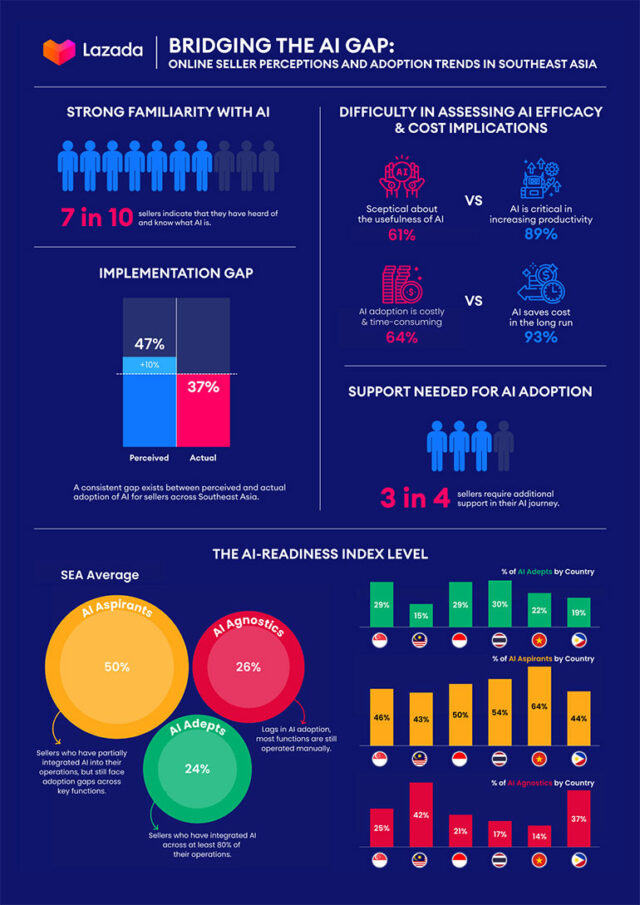
The research reveals that online sellers in Southeast Asia show strong familiarity of AI, with nearly seven in 10 sellers (68%) indicating that they are aware of AI. Sellers believe they have integrated AI into 47% of their business operations, even though actual adoption stands only at 37%, highlighting a clear gap between perceived and actual AI adoption.

Online sellers face a dilemma in terms of assessing AI efficacy and its cost implications. While 89% acknowledge AI’s role in boosting productivity, almost two-third (61%) remain sceptical about its overall usefulness. Furthermore, although nearly all sellers (93%) agree that AI can drive long-term cost savings, 64% cite costliness and time-consuming implementation as barriers to adoption.

The research also suggests an implementation gap, where sellers understand the importance of AI but struggle with effective deployment. Highlighting the challenge of transitioning from familiar, manual processes to AI-driven solutions, nearly all sellers (93%) agree that it is important to upskill the workforce to use AI so that they can be more productive, yet 3 out of 4 sellers (75%) also concede that their employees still prefer to use tools they are familiar with, rather than new AI solutions.

AI-readiness level varies across markets

Across the region, Indonesia and Vietnam lead with 42% AI adoption across business functions, while Singapore and Thailand follow closely at 39%. Based on the level of AI adoption across five core aspects of operations of a seller’s business, namely operations and logistics, product management, marketing and advertising, customer service, and workforce management, the report identifies three distinct seller archetypes — AI Adepts, AI Aspirants, and AI Agnostics1, based on the average score they attained in each aspect of operations to represent their readiness level to embrace AI:

  • AI Adepts: Sellers who have integrated AI across at least 80% of their operations, placing them at the forefront of adoption. In Southeast Asia, only 1 in 4 (24%) sellers belong to this category.
  • AI Aspirants: Sellers who have partially integrated AI into their operations, but still face adoption gaps across key functions. 50% of sellers in Southeast Asia belong to this category.
  • AI Agnostics: Comprising the remaining 26% of surveyed sellers in Southeast Asia, this group lags in AI adoption, with most business functions still handled manually.

Findings indicate that Thailand has the highest share of AI Adepts, with 30% of sellers in this category. Singapore (29%), Indonesia (29%), and Vietnam (22%) also demonstrate strong AI implementation despite knowledge gaps, while Malaysia (15%) and the Philippines (19%) face challenges related to internal buy-in and infrastructure limitations. With the majority of Southeast Asian sellers (76%) falling within the AI Aspirants and AI Agnostics categories, they are actively seeking more effective AI-powered solutions, with high demand for AI-powered tools (42%) and enhanced seller support (41%).

“The findings from our research reveal a fascinating gap in Southeast Asia’s eCommerce ecosystem. While most sellers understand AI’s transformative potential, many are still navigating the path from recognition to implementation,” said James Dong, Chief Executive Officer, Lazada Group. “As a leading eCommerce platform in Southeast Asia, we aim to bridge the knowledge and adoption gap by developing accessible AI solutions that address the unique challenges faced by sellers across different markets, ultimately making technology more accessible and driving sustainable business growth regardless of a seller’s size or technical expertise.”

Leveraging Lazada’s AI-driven solutions to transform business operations

To support sellers in their AI adoption journey, Lazada is launching the Online Sellers Artificial Intelligence Readiness Playbook, designed to provide strategic guidance based on sellers’ AI maturity levels. The research reveals that sellers are already leveraging key AI-driven solutions on Lazada’s platform to enhance their efficiency, validating Lazada’s continuous investments into cutting-edge AI innovations and advanced tools that streamline e-commerce operations and drive competitiveness.

With 67% of sellers expressing strong satisfaction in existing Lazada AI features2, Lazada is also releasing new Generative AI (GenAI) features that are designed to empower sellers and enhance their product listings, streamline operations, and boost customer conversions such as:

  1. AI Smart Product Optimisation: Powered by GenAI, this tool helps sellers identify improvements they can make to their product titles, descriptions, or even photos. It enables automated virtual try-ons, background modifications, and model adjustments, allowing sellers to produce professional product imagery quickly within minutes.
  2. AI-Powered Translations: This feature automatically translates product content into multiple local languages, enabling sellers to expand their reach across diverse markets efficiently and accurately.
  3. Lazzie Seller: A dedicated AI assistant within the Alibaba Seller Centre (ASC), providing instant responses to frequently asked questions, quick navigation to key features, store risk assessments, and business advice to boost seller efficiency and growth.

To find out more, download the Online Sellers Artificial Intelligence Readiness Playbook to understand how these solutions can offer a structured framework for sellers to integrate AI into their workflows to drive growth, efficiency, and innovation in an ever-evolving eCommerce landscape.


Spotlight is BusinessWorld’s sponsored section that allows advertisers to amplify their brand and connect with BusinessWorld’s audience by publishing their stories on the BusinessWorld Web site. For more information, send an email to online@bworldonline.com.

Join us on Viber at https://bit.ly/3hv6bLA to get more updates and subscribe to BusinessWorld’s titles and get exclusive content through www.bworld-x.com.

Odelon Simpao turns every bride’s fantasy into reality with his latest collection

Odelon Simpao

Filipino fashion designer draws inspiration from the beauty of the waling-waling flower for his newest bridal couture line

For more than a decade, Odelon Simpao has been the go-to designer for many celebrities. He has dressed stars for the red carpet, crafted dashing suits for men, and created awe-inspiring pieces for the Philippines’ representatives in international pageants. This time, he is focusing his efforts on producing a collection centered around the most important dress a woman will wear in her lifetime — her wedding gown.

Although this isn’t Odelon’s first foray into bridal wear, his upcoming collection marks a significant chapter in his design career — setting the tone for what his fashion house is about to present this year.

An ode to the waling-waling

For his latest bridal couture line, Odelon drew inspiration from the waling-waling flower, a symbol of beauty and elegance in Filipino culture. His goal was to incorporate elements of Filipino heritage in the collection while maintaining modern and sophisticated forms.

Over three months, he meticulously worked with French lace, tulle, and Swarovski crystals, among other luxurious materials. The result is a collection that is romantic, ultra-feminine, and glamorous. Comprising nine exquisite pieces, the collection showcases various forms and techniques. There is a poetic quality in the way Odelon adorned each piece with intricate floral embroideries, 3D floral appliqués, and thousands of crystals. The designs highlight timeless silhouettes, from voluminous ball gowns to sleek column dresses with detachable trains — each a testament to Odelon’s mastery in celebrating and enhancing a woman’s figure.

“The collection features different silhouettes because it’s all about the woman’s body. I want to accentuate her form and curves,” Odelon explains. “The silhouettes aren’t avant-garde or experimental. They are classic and timeless — designed not to overshadow the bride’s beauty, but to elevate her innate charm.”

To mark the launch of his bridal couture line, Odelon collaborated with photographer Charvin Valdez Torne for a stunning campaign shoot, with Dave Sandoval styling the setup. The campaign puts his gowns in the spotlight, offering a glimpse of what happily ever after could look like in an Odelon Simpao wedding dress.

His muses are visions in white, each wearing a piece from his bridal couture collection. The campaign’s elegant setup features dreamy drapes as the perfect backdrop for Odelon’s designs, while the warm glow of a crystal chandelier highlights the charm of his exquisite embellishments.

“Brides want to see their most beautiful selves on their special day,” Odelon muses. “They have their own fantasy they want to fulfill.”

Learning from the masters

Odelon’s journey in the fashion industry wasn’t easy. Growing up in Cagayan de Oro, he initially pursued a nursing degree in college. During that time, he used his passion for design as a means to support himself — creating accessories and blouses to sell to his friends. Eventually, he became involved with Cagayan’s fashion community, which led him to meet renowned Filipino designer Frederick Peralta.

With nothing but passion and determination, Odelon left Cagayan de Oro and moved to Manila to pursue a career in fashion. Under Frederick’s guidance, he learned the ins and outs of the industry and honed his design skills. He spent hours observing how Frederick worked with clients and brought his creative visions to life. Soon, he became an apprentice, assisting with wedding dresses — applying appliqués, manipulating fabrics, and mastering intricate beadwork. In addition to Frederick, Odelon also trained under esteemed designer Jojie Lloren.

“I’m very fortunate that I was able to work and learn from the best,” Odelon says.

During his apprenticeship, he successfully broke into the local fashion scene. One of his first ventures was working with a men’s apparel brand specializing in formal wear. For two years, he served as the brand’s designer and head of creatives, reimagining barongs and suits with a contemporary flair. It was during this time that Odelon discovered his signature style — designing menswear.

In the 2010s, he participated in Philippine Fashion Week, where he showcased his modern take on men’s fashion. His collections included “Abstract Illusion,” which merged tailoring with digital prints, and an all-black ensemble of sleek men’s suits.

“During that time, nobody was doing menswear full-time. Designers would include one or two men’s pieces in their collections, but no one was dedicating an entire collection to it,” he recalls. “That was a niche market.”

Eventually, Odelon expanded his repertoire to include womenswear. In 2014, he presented a modern take on power dressing using prints at a fashion show in Canada. In 2016, his spring-summer collection played with linear forms.

One of his biggest career milestones was designing for television and film. Odelon worked with actress Marian Rivera, crafting outfits for her movie and TV roles, most notably in Marimar. To this day, many of Odelon’s creations continue to grace TV screens and the international stage as his celebrity clientele grows.

To learn more about Odelon Simpao Weddings, visit @odelonsimpaocouture on Instagram or email odelonsimpao@gmail.com.


Spotlight is BusinessWorld’s sponsored section that allows advertisers to amplify their brand and connect with BusinessWorld’s audience by publishing their stories on the BusinessWorld Web site. For more information, send an email to online@bworldonline.com.

Join us on Viber at https://bit.ly/3hv6bLA to get more updates and subscribe to BusinessWorld’s titles and get exclusive content through www.bworld-x.com.

Australia turns down China’s offer to ‘join hands’ to fight US tariffs

STOCK PHOTO | Image by Rebecca Lintz from Pixabay

SYDNEY – Australia on Thursday declined Beijing’s proposal to work together to counter U.S. tariffs, saying instead it would continue to diversify its trade and lower its reliance on China, its largest trading partner.

“We are not going to be holding hands with China in respect of any contest that is going on in the world,” Deputy Prime Minister Richard Marles told Sky News, referring to the Chinese ambassador’s proposal for countries to “join hands” on trade.

“We are not doing that. What we are doing is pursuing Australia’s national interests and diversifying our trade around the world.”

He said Australia would build its economic resilience by strengthening trade ties with the European Union, Indonesia, India, Britain and the Middle East.

In an opinion column in The Age newspaper, China’s ambassador to Australia Xiao Qian urged Canberra to collaborate with Beijing to defend the multilateral global trading system.

“Under the new circumstances, China stands ready to join hands with Australia and the international community to jointly respond to the changes of the world,” Mr. Xiao said.

U.S. President Donald Trump, in a stunning reversal, on Wednesday said he would temporarily lower hefty duties on dozens of countries but continue to target China, raising the tariff to 125% from 104%, further escalating a trade war between the world’s two largest economies.

That could pose a risk to Australia, which ships almost a third of its goods to China. Exports to the United States are less than 5% of Australia’s total goods exports.

Australia’s central bank has warned the ongoing uncertainty over tariffs and other trade restrictions between the U.S. and other major economies could have a chilling effect on business investment and household spending decisions in the country.

Mr. Trump has imposed a unilateral 10% tariff on Australia, the low end of his reciprocal tariffs for all imports into the United States.

Prime Minister Anthony Albanese has said that while the duty on Australia, a key U.S. security ally in the Indo-Pacific, has “no basis in logic”, his government would not retaliate. — Reuters

OpenAI countersues Elon Musk, claims harassment

SAN FRANCISCO – OpenAI countersued Elon Musk on Wednesday, citing a pattern of harassment by Mr. Musk and asking a federal judge to stop Mr. Musk from any “further unlawful and unfair action” against OpenAI in a court case over the future structure of the firm that helped launch the AI revolution.

Mr. Musk and OpenAI CEO Sam Altman cofounded OpenAI in 2015, but Mr. Musk left before the company became a technology star.

Recently Mr. Musk, who went on to create his own AI firm, xAI, in 2023, has tried to prevent the ChatGPT maker from transitioning to a for-profit model, culminating in the current court case. In order for OpenAI to secure the entire $40 billion of its current fundraising round, the company must complete its transition by the end of the year.

“Through press attacks, malicious campaigns broadcast to Musk’s more than 200 million followers on the social media platform he controls, a pretextual demand for corporate records, harassing legal claims, and a sham bid for OpenAI’s assets, Musk has tried every tool available to harm OpenAI,” the company wrote in a filing in Mr. Musk’s existing lawsuit against OpenAI in U.S. District Court for the Northern District of California.

OpenAI asked the judge to stop Mr. Musk from any further attacks, as well as be “held responsible for the damage he has already caused.”

The two parties are set to begin a jury trial in spring next year.

In response, Mr. Musk’s legal team referred to a $97.4 billion unsolicited takeover bid earlier this year from a Musk-led consortium, which OpenAI rejected.

“Had OpenAI’s Board genuinely considered the bid as they were obligated to do they would have seen how serious it was. It’s telling that having to pay fair market value for OpenAI’s assets allegedly ‘interferes’ with their business plans,” Mr. Musk’s lawyer Marc Toberoff said in a statement provided to Reuters.

In a post on X, the social media platform which Mr. Musk owns, OpenAI said: “Elon’s nonstop actions against us are just bad-faith tactics to slow down OpenAI and seize control of the leading AI innovations for his personal benefit.”

Mr. Musk’s xAI last month acquired X in a deal that values the social media company at $33 billion and allows the value of his artificial intelligence firm to be shared with co-investors in X.

Last year, Mr. Musk, who is also the CEO of electric carmaker Tesla, sued OpenAI and Mr. Altman, accusing OpenAI of straying from its founding mission – to develop AI for the good of humanity, not corporate profit. Mr. Musk did not respond to a request for comment on the OpenAI filing.

OpenAI and Mr. Altman have denied the allegations, while Mr. Altman alleges that Mr. Musk has been trying to slow down a competitor.

At stake in the lawsuit is the ChatGPT maker’s transition to a for-profit model, which the startup says is crucial to raising more capital and competing well in the expensive AI race. — Reuters

South Korea trade envoy says Trump’s tariff pause leaves room for negotiations

REUTERS

SEOUL – South Korea’s top trade envoy Cheong In-kyo said on Thursday that U.S. President Donald Trump’s tariff reprieve had provided room for negotiations, as the country seeks to reduce tariffs through talks.

Cheong met U.S. Trade Representative Jamieson Greer about lowering tariff rates slapped on the country and delivered concerns about U.S. tariffs, the trade ministry said on Thursday.

He flew to Washington to negotiate with U.S. officials after Mr. Trump announced a 25% tariff on its key Asian ally among a new set of sweeping tariffs.

In a stunning reversal on Wednesday, Mr. Trump said he would temporarily lower the hefty duties he had just imposed on dozens of countries while further ramping up pressure on China.

Mr. Trump’s 90-day pause on some tariffs means a new South Korean president set to be elected in early June is likely to face a daunting task to negotiate with its leading security ally over tariffs that pose a risk to the export-reliant economy.

Cheong found the reprieve “positive”, but swift consultations with Washington were still needed to minimize the impact, considering South Korea’s exports to China, and any balloon effect, he told reporters.

South Korean Finance Minister Choi Sang-mok also assessed that the tariff shock had been reduced to some extent for the time being, following news of the pause.

Nonetheless, Trump left a base tariff of 10% in place for all countries, in addition to 25% duties on cars, auto parts, steel, and aluminum products which are among South Korea’s key export items.

Trump spoke to South Korean interim leader Han Duck-soo late on Tuesday to discuss shipbuilding and potential energy deals in what Trump labelled a “great call”, as South Korea seeks to negotiate with Washington over tariffs.

Cheong, the trade envoy, said the Trump-Han dialogue had created favorable momentum for further negotiations, the ministry said in a statement. — Reuters

Trump signs executive order seeking to revitalize US shipbuilding

STOCK PHOTO | Image by Mateusz Dietrich from Pixabay

WASHINGTON – U.S. President Donald Trump signed an executive order on Wednesday aimed at reviving U.S. shipbuilding and reducing China’s grip on the global shipping industry, vowing to boost funding for the effort in coming years.

Republican and Democratic U.S. lawmakers for years have warned about China’s growing dominance on the seas and diminishing U.S. naval readiness.

Senators Mark Kelly, a Democrat, and Todd Young, a Republican, welcomed the executive order and said they would reintroduce their bipartisan legislation to provide the congressional authorizations needed to revitalize the industry.

The order directs the U.S. Trade Representative to move ahead with a proposal that included levying million-dollar U.S. port docking fees on any ship that is part of a fleet that includes Chinese-built or Chinese-flagged vessels. Allies will be pushed to act similarly.

USTR’s recommended port fees had sparked sharp criticism from commodities exporters, trade groups and U.S. ship operators, who warned of supply chain disruptions, job losses in port cities and inflation. The order must be finalized by an April 17 deadline.

U.S. Trade Representative Jamieson Greer on Wednesday said USTR should have a final decision on remedies by middle of the month and repeated his comments from Tuesday, saying that not all of the measures outlined by the agency’s original proposal would be implemented.

“This could have been a miscommunication issue, some people thought that all of those measures would be imposed,” Mr. Greer said. But after feedback and public comments, “now we consider which of those measures is most appropriate.”

The order also requires USTR to consider proposing tariffs on ship-to-shore cranes manufactured, assembled, or made using components of Chinese origin, or manufactured anywhere in the world by a company owned, controlled, or substantially influenced by a Chinese citizen, as well as tariffs on other cargo handling equipment.

The executive order further requires the Department of Homeland Security to enforce collection of Harbor Maintenance Fees and other charges, and to prevent cargo carriers from circumventing those fees by routing goods to ports in Mexico and Canada and then sending cargo into the United States via land borders.

Trump, speaking in the Oval Office, said the United States would be spending “a lot of money on shipbuilding” to restore American capacity in the sector.

“We’re way, way, way behind,” he told reporters. “We used to build a ship a day, and now we don’t do a ship a year, practically, and we have the capacity to do it.”

The order said recent data showed the United States built less than 1% of commercial ships globally, while China built about half, an increase from just 5% in 1999, according to the Center for Strategic and International Studies.

Mr. Trump’s order called for creation of a Maritime Security Trust Fund to provide reliable funding for programs aimed at shoring up U.S. maritime capacity, including consideration of potential new or existing tariff revenue, fines, fees, or tax revenue.

It also calls for incentives to encourage private investment in construction of commercial components, and improvements to shipyards, repair facilities and dry docks.

The U.S. shipbuilding industry, which peaked in the 1970s, has struggled due to high costs and a complex regulatory structure, which has enabled rivals including China to grow rapidly. — Reuters

Republican-led US House votes to limit judges’ power to block Trump’s agenda

By United_States_Capitol_-_west_front.jpg: Architect of the Capitolderivative work: O.J. - United_States_Capitol_-_west_front.jpg, Public Domain, https://commons.wikimedia.org/w/index.php?curid=17800708

Republican-led U.S. House of Representatives voted on Wednesday to curtail the ability of judges to issue nationwide injunctions blocking government policies after key parts of President Donald Trump’s agenda have been stymied by such court rulings.

The House voted 219-213 along largely party lines in favor of the No Rogue Rulings Act, a bill that top Republican lawmakers have called a priority after numerous judges ruled against Trump’s executive orders and policies used to implement his immigration crackdown and government downsizing initiatives.

The bill now goes to the Senate, where it faces long odds of securing the 60 votes needed to become law. Republicans have only a 53-47 majority in the Senate, where similar legislation to limit nationwide injunctions is pending.

Such nationwide orders from judges have risen over the last two decades in response to challenges to policies issued by Republican and Democratic administrations, prompting calls in both parties over the years for reform.

Yet the latest bill was introduced only after judges in some of the 170-plus lawsuits challenging Trump’s flurry of executive orders and initiatives began issuing a wave of rulings blocking policies they deemed unlawful or unconstitutional.

“Since President Trump has returned to office, left-leaning activists have cooperated with ideological judges whom they have sought out to take their cases and weaponized nationwide injunctions to stall dozens of lawful executive actions and initiatives,” U.S. Representative Darrell Issa, the bill’s lead Republican sponsor, said on the floor on Tuesday.

Under his bill, judges would have to limit the scope of their rulings to the specific parties before them, though they could still issue nationwide orders in class action lawsuits.

Cases by two or more states would be heard by randomly assigned three-judge panels, whose rulings could be appealed directly to the U.S. Supreme Court.

Republican Speaker Mike Johnson has touted it as an alternative to calls by some of Trump’s allies in the chamber to impeach judges who block the Republican president’s agenda.

“No one single activist judge should be able to issue a nationwide injunction to stop a president’s policies,” Mr. Johnson told Fox News host Sean Hannity on Monday night ahead of the vote. “That’s not the way the framers intended this to work, and we’re going to put them back in check.”

Democrats lambasted the bill as an effort to change the rules to ensure judges could not fully block anything unlawful Mr. Trump does while in office, after many of former President Joe Biden’s own initiatives were blocked by courts.

“The whole idea of suddenly blocking nationwide injunctions because Donald Trump is losing every single day in court defeats the whole concept of the rule of law,” Representative Jamie Raskin, the top Democrat on the House Judiciary Committee, said at a committee hearing last week on the bill.

Mr. Raskin said had it been law, the bill would have prevented federal judges in Washington state, Massachusetts and Maryland from issuing the nationwide injunctions that have blocked Mr. Trump’s “blatantly unconstitutional” attempt to restrict automatic U.S. birthright citizenship as part of his immigration agenda.

The Trump administration has asked the U.S. Supreme Court to narrow those injunctions to cover just the plaintiffs that brought the cases, saying the justices “should declare that enough is enough before district courts’ burgeoning reliance on universal injunctions becomes further entrenched.”

The court, which has a 6-3 conservative majority, has yet to act on that request.

But it has handed Mr. Trump a series of recent victories, halting judges’ orders that required the administration rehire thousands of fired employees and reinstate millions of dollars in teacher training grants and blocked the administration from pursuing deportations of alleged Venezuelan gang members using a 1798 wartime law, though that decision imposed limits.

The Trump administration welcomed Wednesday’s action in Congress, which a U.S. Justice Department spokesperson said would “reinforce the separation of powers.”

“This Department of Justice has vigorously defended President Trump’s policies and will continue to do so whenever challenged in federal court by rogue judges who think they can control the president’s executive authority,” the spokesperson said. — Reuters

Converge launches upgraded FiberX: WiFi 6 and next-level entertainment

On the heels of a third consecutive Ookla® Speedtest Award™ for Fastest Fixed Network, Converge ICT Solutions, Inc. spearheads a seamlessly integrated digital home with its new and improved internet offering called Super FiberX.

Building upon the proven success of its flagship FiberX service, which has consistently dominated the market for its speed and value since its 2017 relaunch, Super FiberX introduces a powerful upgrade: seamless WiFi 6 connectivity and access to SkyTV, all powered by the innovative Converge Xperience Hub.

Optimized to meet the evolving connectivity needs of Filipinos, Super FiberX MAX at P1,599 combines fiber-fast internet speeds of up to 400 Mbps that, along with the Converge Xperience Hub, transforms every home into a high-performance digital playground for entertainment, work, and everyday digital needs. The Super FiberX Plans seamlessly integrate high-speed internet, live TV, and a multitude of streaming options, offering unparalleled value and convenience.

Play, Max, Ultra

As 2024’s Fastest Internet, Converge expands its already robust network solutions with the Super FiberX Plans, now featuring Wi-Fi 6 technology for faster, more reliable connectivity, even with multiple devices connected simultaneously, at no extra cost.

“The Converge Xperience Hub, equipped with SkyTV (offering access to up to 54 channels), paves the way for future plans to expand and elevate our residential offerings,” says Converge EVP & Chief Commercial Officer Benjamin B. Azada. “As a Google-certified Android TV box, it allows users to download popular apps like YouTube, Spotify, and Netflix, access games, and even utilize Google’s integrated assistant. Paired with a Blast TV subscription, it transforms regular TVs into Smart TVs, delivering an extensive entertainment lineup, from blockbuster movies and hit series to news and live sports.” 

He adds, “Best of all, these amazing entertainment features come without compromising internet performance, as Super FiberX Plans provide speeds of up to 200 Mbps to 800 Mbps, covering everything from browsing and gaming to 4K streaming and remote work.”

Starting at an unbeatable price of just P1,349, the Super FiberX PLAY plan delivers internet speeds of up to 200 Mbps providing accessible fiber-fast connectivity tailored to the everyday digital needs of Filipinos.

For smarter homes, a reliable, lightning-fast internet connection is essential. The high-tier Super FiberX ULTRA (up to 800 Mbps) offers the bandwidth needed to support multiple smart devices, from security cameras and smart speakers to other connected gadgets. Whether working, streaming, or staying connected, Super FiberX is the cornerstone for a seamlessly integrated digital home.

Upgraded to Wi-Fi 6 Technology

The Super FiberX Plans come with Wi-Fi 6 technology, delivering enhanced performance, wider coverage, and faster speeds, especially for households with multiple connected devices. The enhanced Super FiberX Plans are designed to be smarter and more energy-efficient with intelligent hibernation mechanisms that reduce network device power consumption by up to 41%. Furthermore, Wi-Fi 6’s Target Wake Time (TWT) also optimizes battery life by enabling connected devices to communicate more efficiently with the router.

Beyond sustainability, Converge has again redefined connectivity, combining high-speed internet with diverse entertainment options; ensuring Tatay meets his deadlines, Kuya stays competitive in ranked matches, while Nanay and Ate enjoy their favorite shows on live TV or via streaming, all at once and without compromise.

For more information on the Converge products and offerings, visit convergeict.com/fiberx. To become a Converge subscriber, visit gofiber.ph.


Spotlight is BusinessWorld’s sponsored section that allows advertisers to amplify their brand and connect with BusinessWorld’s audience by publishing their stories on the BusinessWorld Web site. For more information, send an email to online@bworldonline.com.

Join us on Viber at https://bit.ly/3hv6bLA to get more updates and subscribe to BusinessWorld’s titles and get exclusive content through www.bworld-x.com.

In stunning U-turn, Trump walks back some tariffs, triggering historic market rally

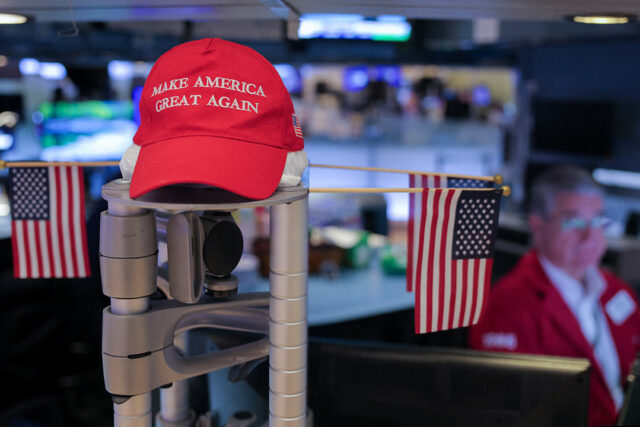
A “Make America Great Again” hat is seen on display on the trading floor at The New York Stock Exchange. — REUTERS

WASHINGTON – In a stunning reversal, US President Donald Trump said he would temporarily lower the hefty duties he had just imposed on dozens of countries while further ramping up pressure on China, sending global stocks rocketing higher.

Trump’s turnabout on Wednesday, which came less than 24 hours after steep new tariffs kicked in on most trading partners, followed the most intense episode of financial market volatility since the early days of the COVID-19 pandemic. The upheaval erased trillions of dollars from stock markets and led to an unsettling surge in US government bond yields that appeared to catch Trump’s attention.

“I thought that people were jumping a little bit out of line, they were getting yippy, you know,” Trump told reporters after the announcement, referring to a golf term.

Since returning to the White House in January, Trump has repeatedly threatened an array of punitive measures on trading partners, only to revoke some of them at the last minute. The on-again, off-again approach has baffled world leaders and spooked business executives, who say the uncertainty has made it difficult to forecast market conditions.

The day’s events cast into stark relief the uncertainty surrounding Trump’s policies and how he and his team create and implement them.

US Treasury Secretary Scott Bessent asserted that the pullback had been the plan all along to bring countries to the bargaining table. Trump, though, later indicated that the near-panic in markets that had unfolded since his April 2 announcements had factored in to his thinking.

Despite insisting for days that his policies would never change, he told reporters on Wednesday: “You have to be flexible.”

But he kept the pressure on China, the No. 2 provider of US imports. Trump said he would raise the tariff on Chinese imports to 125% from the 104% level that took effect at midnight, further escalating a high-stakes confrontation between the world’s two largest economies. The two countries have traded tit-for-tat tariff hikes repeatedly over the past week.

Trump’s reversal on the country-specific tariffs is not absolute. A 10% blanket duty on almost all US imports will remain in effect, the White House said. The announcement also does not appear to affect duties on autos, steel and aluminum that are already in place.

The 90-day freeze also does not apply to duties paid by Canada and Mexico, because their goods are still subject to 25% fentanyl-related tariffs if they do not comply with the US-Mexico-Canada trade agreement’s rules of origin. Those duties remain in place for the moment, with an indefinite exemption for USMCA-compliant goods.

“China is unlikely to change its strategy: stand firm, absorb pressure, and let Trump overplay his hand. Beijing believes Trump sees concessions as a weakness, so giving ground only invites more pressure,” said Daniel Russel, vice president of international security and diplomacy at the Asia Society Policy Institute.

“Other countries will welcome the 90-day stay of execution — if it lasts — but the whiplash from constant zigzags creates more of the uncertainty that businesses and governments hate,” Russel said.

US stock indexes shot higher on the news, with the benchmark S&P 500 .SPX index closing 9.5% higher. Bond yields came off earlier highs and the dollar rebounded against safe-haven currencies.

The relief spread through Asian markets as they opened on Thursday with Japan’s Nikkei index surging almost 9%.

Trump’s tariffs had sparked a days-long selloff that erased trillions of dollars from global stocks and pressured US Treasury bonds and the dollar, which form the backbone of the global financial system. Canada and Japan said they would step in to provide stability if needed – a task usually performed by the United States during times of economic crisis.

Analysts said the sudden spike in share prices might not undo all of the damage. Surveys have found slowing business investment and household spending due to worries about the impact of the tariffs, and a Reuters/Ipsos survey found that three out of four Americans expect prices to increase in the months ahead.

Goldman Sachs cut its probability of a recession back to 45% after Trump’s move, down from 65%, saying the tariffs left in place were still likely to result in a 15% increase in the overall tariff rate.

Treasury Secretary Bessent shrugged off questions about market turmoil and said the abrupt reversal rewarded countries that had heeded Trump’s advice to refrain from retaliation. He suggested Trump had used the tariffs to create maximum negotiating leverage. “This was his strategy all along,” Bessent told reporters. “And you might even say that he goaded China into a bad position.”

Bessent is the point person in the country-by-country negotiations that could address foreign aid and military cooperation as well as economic matters. Trump has spoken with leaders of Japan and South Korea, and a delegation from Vietnam met with US officials on Wednesday to discuss trade matters, the White House said.

Bessent declined to say how long negotiations with the more than 75 countries that have reached out might take.

Trump said a resolution with China was possible as well. But officials have said they will prioritize talks with other countries.

“China wants to make a deal,” Trump said. “They just don’t know how quite to go about it.”
Trump told reporters that he had been considering a pause for several days. On Monday, the White House denounced a report that the administration was considering such a move, calling it “fake news.”

Earlier on Wednesday, before the announcement, Trump tried to reassure investors, posting on his Truth Social account, “BE COOL! Everything is going to work out well. The USA will be bigger and better than ever before!”

Later, he added: “THIS IS A GREAT TIME TO BUY!!!” — Reuters

ADB cuts Philippine growth forecast

The Philippine economy is projected to grow by 6% this year, according to the Asian Development Bank. — PHILIPPINE STAR/RYAN BALDEMOR

By Luisa Maria Jacinta C. Jocson, Senior Reporter

THE ASIAN Development Bank (ADB) trimmed its gross domestic product (GDP) growth projection for the Philippines this year, though this still places it among the fastest-growing economies in Southeast Asia.

In its latest Asian Development Outlook (ADO), the multilateral lender lowered its growth forecast for the country to 6% this year from its 6.2% projection in December.

This would be faster than the 5.6% GDP growth in 2024. It would also hit the lower end of the Philippine government’s 6-8% growth target band for the year.

However, the ADB noted these forecasts do not yet consider US President Donald J. Trump’s “reciprocal” tariffs went into effect on April 9. (Related story “Trump’s reciprocal tariffs kick in, including 104% against China”). 

ADB Senior Economics Officer Teresa B. Mendoza said the slight downgrade accounted for the “lower-than-expected turnout in the (fourth) quarter of 2024 because we have seen household spending growth moderated more than we expected.”

“This was also actually as an effect of the lingering impacts of high inflation for most of the year, although it trended lower in the second half after the fourth quarter, and also the lagged impacts of tight monetary policy,” she said at a briefing on Wednesday.

Philippine economic growth this year will be driven by “strengthening domestic demand and sustained public investment,” according to the report.

“Sound macroeconomic fundamentals and structural reforms support a sustained positive outlook, with growth projected at 6% this year and 6.1% in 2026,” Ms. Mendoza said.

In Southeast Asia, the Philippines is projected to be the third-fastest-growing economy this year, just behind Vietnam (6.6%) and Cambodia (6.1%).

It is ahead of Indonesia (5%), Malaysia (4.9%), Timor-Leste (4%), Lao PDR (3.9%), Thailand (2.8%), Singapore (2.6%), Brunei Darussalam (2.5%) and Myanmar (1.1%).

The Philippines’ growth forecast is also above the ADB’s projection for developing Asia, which is expected to grow 4.9% this year and 4.7% in 2026. The region includes 46 Asia-Pacific countries, but excludes Japan, Australia and New Zealand.

This year, household spending in the Philippines will be boosted by strong employment and remittances, the multilateral lender said.

The country’s private investment and business indicators have also been positive, it added.

“Modest inflation is projected at 3% over the forecast period, and monetary easing will support growth,” Ms. Mendoza said.

The ADB sees headline inflation averaging 3% in 2025 and in 2026. This is below the Bangko Sentral ng Pilipinas’ (BSP) baseline inflation forecast of 3.5% this year and next.

“While there are upside risks to inflation, including potential increases in electricity rates and transport fares, inflation is projected to remain within the 2% to 4% target through 2026,” the report said.

This outlook will also pave the way for continued monetary policy easing, it added.

“In terms of the monetary policy, what we are expecting that the BSP continue is seeing its monetary policy, but a much more gradual pace,” Ms. Mendoza said.

The BSP began its rate-cutting cycle in August last year, lowering borrowing costs by a total of 75 basis points (bps) to 5.75% by end-2024.

The central bank delivered a pause at its first policy review this year in February amid global trade uncertainties.

Markets are widely expecting the Monetary Board to resume its easing cycle with a 25-bp cut at its meeting today (April 10.).

“Further reforms to enhance the investment climate bode well. Public infrastructure investment, with its high multipliers, will continue to support growth,” the ADB added.

It cited reforms such as the Corporate Recovery and Tax Incentives for Enterprises to Maximize Opportunities for Reinvigorating the Economy (CREATE MORE) Act.

Meanwhile, the ADB also noted that the National Government’s (NG) fiscal consolidation efforts are on track.

“Additional revenues and expenditure reforms are supporting fiscal consolidation,” it said.

Treasury data showed the NG’s budget deficit shrank by 0.38% or P5.7 billion to P1.506 trillion in 2024. However, it exceeded the P1.48-trillion deficit ceiling set by the Development Budget Coordination Committee.

This year, the NG’s deficit ceiling is capped at P1.54 trillion or 5.3% of GDP.

“Programs are also being undertaken to make spending more efficient. The new government procurement law enhances project implementation and procurement processes,” Ms. Mendoza added.

However, the multilateral lender sees the current account remaining in a deficit, “as imports rise to meet aggregate demand.”

“Capital-intensive imports for infrastructure projects will remain strong. Merchandise exports will likely be subdued, with prospects uneven for major external markets,” it added.

Latest data from the BSP showed the current account deficit widened by 41.4% to $17.5 billion in 2024. This marked the second-largest current account deficit on record.

RISKS TO GROWTH
Meanwhile, the ADB cited several downside risks to its  growth outlook.

“This includes increased uncertainty over the external environment, including significant shifts in trade and investment policies, and increased protectionism and its adverse impacts on investor sentiment,” Ms. Mendoza said.

“Heightened geopolitical tensions were also highlighted, and weather shocks could drive commodity prices higher.”

The ADO released on Wednesday did not tackle the potential impacts of the sweeping US tariffs. ADB Chief Economist Albert F. Park said they will follow the evolution of the trade policies and update the forecasts in their next ADO to be released in July.

“The situation is still unfolding as we know, so it’s very soon to tell. In July, we’ll have a better idea,” ADB Philippines Principal Country Specialist Cristina Lozano said.

“But I want to make a point that the Philippines faces these US tariffs and the potential global slowdown from a position of relative strength. The macroeconomic fundamentals are very strong,” she added.

Ms. Mendoza noted the Philippine economy is mostly driven by domestic demand, not exports.

“We’re still monitoring the impacts because there are spillover effects across various channels.”

However, the country’s services sector, a key growth driver, will likely remain unaffected by tariffs, Ms. Lozano said.

“It’s a buffer to the economy. We don’t know what’s gonna happen, but for the moment, the Philippine economy is protected because most of the exports of the Philippines are in the semiconductor sector.”

The US exempted some commodities such as semiconductors from the reciprocal tariffs.

Electronics manufacturing services and semiconductor manufacturing services account for almost half or 44.5% of Philippine export sales to the US.

Abdul Abiad, director of ADB’s Macroeconomic Research Division, said there are many different policy options that countries can explore to mitigate the impact of these tariffs.

“Negotiations are obviously another important component in terms of policy response, but really most important, especially considering how integration has benefited this region the most, actually, in the world.”

“Doubling down on open trade and investment is going to be key and is really something within the control of economies in the region, and that will take many forms.”

This could be done by diversifying export markets and strengthening current free trade agreements, among others.

“I would expect to see, especially if these tariffs from the US persist, that you’ll see this reconfiguration that will actually strengthen intra-regional integration,” Mr. Abiad added.

Ms. Lozano said these tariffs could also “reinforce the case for regional integration, especially in Asian economies.” She noted the Philippines can take advantage of its membership in the Regional Comprehensive Economic Partnership, as well as pursue free trade deals with the European Union and other countries.

“I think this renewed commitment to regional trade agreements will support positive changes, and will gain momentum, given the situation.”

Pavit Ramachandran, ADB country director for the Philippines, said there is a need to continue domestic reforms, particularly on ease of doing business, investment, climate, and logistics and infrastructure.

The government can also focus on “increasing the sophistication of the economy” as a strategy, he said.

“For the Philippines, given that 60% of their exports are electronics, and this is relatively concentrated in a few markets, I think diversification is something that is worth pursuing.”

Within Southeast Asia, the Philippines can also reinforce engagement, Mr. Ramachandran said.

“There’s also a chance to move up the value chain in services. There is an opportunity to look at moving up to more financial services, healthcare, areas around IT, even in the BPO sector, for example.”

“There is an opportunity to also streamline tariffs. I think we’re already seeing that discussion happening in terms of a negotiation strategy. So, I think that work that’s already started in the Philippines will need to continue,” he added.

Trade Secretary Ma. Cristina A. Roque earlier said they are open to lowering tariffs on US goods in response to the US imposition of a 17% reciprocal tariff on Philippine goods.

Banks’ NPL ratio steady at 3.38% in Feb.

STOCK PHOTO | Image by iiijaoyingiii from Pixabay

THE PHILIPPINE banking industry’s gross nonperforming loan (NPL) ratio remained steady in February, according to data from the Bangko Sentral ng Pilipinas (BSP).

Preliminary data from the central bank showed the bad loan ratio stood at 3.38% in February, the same as January. On the other hand, it was lower than 3.44% in the same month in 2024.

Loans are considered nonperforming once they remain unpaid for at least 90 days after the due date. These are deemed as risk assets since borrowers are unlikely to pay.

The amount of nonperforming loans inched up by 0.1% to P513.35 billion in February from P512.83 billion in January. Year on year, soured loans jumped by 10.1% from P466.11 billion.

The total loan portfolio of the banking system slipped to P15.173 trillion from P15.176 trillion a month ago. However, it climbed by 12.1% from P13.54 trillion a year earlier.

Past due loans stood at P637.81 billion in February, up by 0.7% month on month from P633.1 billion. It likewise increased by 9.2% from P584.23 billion in the same month in 2024.

This brought the past due ratio to 4.2%, higher than 4.17% in January but lower than 4.31% a year ago.

Restructured loans dipped to P311.11 billion in February from P311.22 billion a month prior. Year on year, it went up by 6.5% from P292.1 billion.

Restructured loans accounted for 2.05% of the industry’s total loan portfolio, steady from January and lower than 2.16% a year ago.

Banks’ loan loss reserves inched up by 0.2% to P489.55 billion in February from P488.48 billion in the previous month and increased by 5% from P466.39 billion a year earlier.

This brought the loan loss reserve ratio to 3.23% in February from 3.22% in January and 3.44% in 2024.

Lenders’ NPL coverage ratio, which gauges the allowance for potential losses due to bad loans, rose to 95.36% in February from 95.25% in January but dipped from 100.06% a year ago.

Rizal Commercial Banking Corp. Chief Economist Michael L. Ricafort said the steady NPL ratio was largely due to the faster growth in loans that broadened the base.

This would also “reflect a corresponding growth in NPLs in the numerator, thereby mathematically keeping the said NPL ratio steady,” he added.

Separate BSP data showed bank lending growth slowed to 12.2% in February from the 12.8% expansion in January, which was the fastest in two years.

Year on year, the growth in lending was faster than the 8.7% increase in February 2024.

“The steady NPL ratio also reflects better management of credit risks amid faster loan growth in recent months,” he added.

Mr. Ricafort said lower interest rates since late last year also eased the debt burden for borrowers.

The central bank began its easing cycle in August last year, slashing borrowing costs by a total of 75 basis points (bps) and bringing the rate to 5.75% by end-2024.

“Possible further Fed and local policy rate cuts in the coming months would also help improve the NPL ratio,” he said.

Despite keeping rates steady in February, the BSP is widely expected to resume easing at its policy-setting meeting today (April 10.)

A BusinessWorld poll conducted last week showed that all 17 analysts surveyed expect the Monetary Board to reduce the target reverse repurchase rate by 25 bps.

If realized, this would bring the benchmark rate to 5.5% from the current 5.75%.

On the other hand, Mr. Ricafort flagged risks such as the United States’ recent reciprocal tariffs, which could slow growth, investments and business activities.

This could “reduce sales, incomes, and ability to pay by some borrowers,” he added.

US President Donald J. Trump’s reciprocal tariffs on the country’s trading partners took effect on Wednesday (April 9), deepening the global trade war.

The Philippines was slapped with a tariff rate of 17%, though this was the second lowest in Southeast Asia, just after Singapore, which received the 10% baseline tariff.

“Employment data among the best in 20 years or since revised records started in 2005 would continue to support the continued growth in consumer loans and overall loans, while also leading to more incomes that support the ability to pay by some borrowers,” Mr. Ricafort said.

The latest data from the local statistics authority showed the jobless rate dropped to a two-month low of 3.8% in February. The underemployment rate likewise fell to a nine-month low of 10.1%. — Luisa Maria Jacinta C. Jocson

Hunger knocks on door as Philippine farmers vanish

JERRY M. ABAT and Rodel J. Macato till the land they inherited from their fathers on a sunny February morning in San Juan, La Union. — CHLOE MARI A. HUFANA

By Chloe Mari A. Hufana, Reporter

LA UNION — Jerry M. Abat, 60, has been planting rice since he could walk.

The farmer from the surf town of San Juan, La Union province in northern Philippines has spent most of his life under the sun, working with his back bent, feet soaked in muddy water, while goading a carabao to plow and harrow the rice paddy.

Now, he said, technology has taken over with advanced tractors and machinery, mostly donated by government bodies.

“Farming is really a difficult job,” Mr. Abat, who had spent some time with his crops before sitting down for an interview — the dirt under his short fingernails was still visible — told BusinessWorld.

“That’s why, if possible, I didn’t want my children to end up like me, wading through the mud.”

Mr. Abat has sent his four kids to college, thanks to his hard work as a farmer. His children, like many others from farming families, have sought employment overseas or in offices where work is easier and pays more.

Two of his children now work in the United Arab Emirates — one in the hospitality industry and another as a medical technologist. His eldest, however, helps with farming, making the patriarch feel a sense of pride and relief, knowing that at least one of his children is willing to carry on his legacy.

The average age of Filipino rice farmers is 56 and climbing, and analysts predict a critical shortage of farmers in the next decade as young people show less interest in agriculture, threatening food security.

The problem is compounded by increasing farm input costs. Fertilizers, pesticides, machinery and irrigation systems are becoming more expensive, eating away at farmers’ modest profits.

Mr. Abat, who inherited his farmland from his parents, said the average cost of production per hectare of rice increased from P65,000 in 2023 to P75,000 in 2024, but his income has been stagnant.

On top of this, the price of unmilled rice remains low, fluctuating between P20 and P22 per kilo, a stark contrast to high retail prices in urban markets. He laments the fact that middlemen and traders profit more than those who cultivate the land.

“When we sell unmilled rice, the price is low,” he said. “But when we buy rice in the market, the price is high.”

Inflation in the Philippines dropped to its lowest level in nearly five years in March, with the annual rate easing to 1.8% due to slower increases in food and transport costs, according to the Philippine Statistics Authority. This was down from 2.1% in February and 3.7% a year ago.

For the first quarter, average inflation stood at 2.2%, comfortably within the central bank’s 2-4% target range.

The government of President Ferdinand R. Marcos, Jr., declared a “food security emergency” on rice last month due to persistently high prices despite global price reductions and lower tariffs on rice imports last year.

The Philippines faced a surge in hunger rates in December 2024, with more than a quarter of Filipino families experiencing involuntary hunger — the worst since September 2020 at the height of the coronavirus disease 2019 (COVID-19) lockdowns, according to the Social Weather Stations.

PSA data showed agriculture and forestry lost the most workers year on year, shedding almost 950,000 jobs in February, mainly due to several typhoons that devastated farmlands.

Marie Annette Galvez-Dacul, executive director at the University of Asia and the Pacific Center for Food and Agribusiness, said fewer people work on farms given low wages and rural-urban migration.

“Many shift to off-farm jobs in cities, while mechanization, land conversion and climate risks make farming less viable,” she said in a Viber message.

The decline in Filipino farmers threatens food security and increases reliance on imports, she pointed out.  “To sustain agriculture, the country must attract young farmers, modernize farming and improve rural livelihoods.” 

Ms. Dacul also cited the need to secure farmlands, strengthen rural-urban connections and diversify the economy to keep the farming sector resilient amid the exodus of people to the cities.

“Investing in mechanization, smart farming and climate-resilient techniques, along with regenerative farming practices, vertical farming and stronger food supply chains will help ensure long-term sustainability,” she added.

The Philippine agriculture sector is struggling with slow growth, declining productivity and structural inefficiencies, according to a Philippine Institute for Development Studies (PIDS) report by economist Roehlano M. Briones published in December 2021.

Farm sizes have been shrinking, leaving little room for expansion.  The country’s arable land was estimated at 12.44 million hectares, according to the PIDS study, citing data from the Food and Agriculture Organization.

“Agriculture was the biggest employer of the economy in the mid-1990s but has since given way to services,” according to the study. “Its share in employment has been consistently declining.”

TURNING THE TIDE
The government should raise the productivity of farm workers to keep the sector competitive, Mr. Briones said.

“The correlation between average daily basic pay and level of education tends to be stronger in industry and services than agriculture,” he said in the study. “It may well be the case that the long-term movement of workers out of agriculture represents the better educated trying to realize higher returns on human capital investment.” 

The report recommended governance reforms, investments in research, improved credit access, mechanization, irrigation improvements, and trade liberalization. The state should also shift support from subsidies to long-term investments in public goods, Mr. Briones said.

Jayson H. Cainglet, executive director at the Samahang Industriya ng Agrikultura (SINAG), said the key to encouraging future generations to pursue careers in agriculture lies in guaranteeing fair and sustainable wages.

“You can only really attract young farmers if they can earn something,” he said by telephone. “You can’t romanticize farming by saying, ‘Oh, the country needs you for food security, for food self-sufficiency.’”

“That kind of idealism doesn’t put food on the table. Farmers are discouraged when they experience low farmgate prices after investing months of hard work without guaranteed returns,” he added.

The situation is compounded by the country’s increasing reliance on food imports, driving down the prices of local produce.

Mr. Cainglet noted that the Philippines, once a top rice exporter, is now the world’s biggest importer of the staple. As a result, local millers could no longer compete with the lower landed cost of imported rice, leaving Filipino farmers at a disadvantage, he said.

He urged the government to offer farmers low-interest loans since they are often at the mercy of their creditors. “But the real problem is that the government often says we don’t have enough funds. Still, we have to start somewhere,” he added.   

He said the state could help farmers by guaranteeing them a floor price. For example, if tomato and onion prices drop below P15, the government should step in to buy the produce or at least compensate them at some point.   

While technology is making farming less labor-intensive and more efficient, the real game-changer is proving that there is a rewarding future in agriculture, Mr. Cainglet said. Without this assurance, young people will shun the industry.

“That’s the only way to turn the tide,” he said. “There’s no shortcut or magic formula here.”

Mr. Cainglet recalled how the COVID-19 pandemic showed that there are only two essential professions — healthcare and agriculture. Despite the hard lessons of the pandemic, he lamented how quickly the world forgot how important the farm sector is. 

“The mindset really starts with the farmers themselves,” he said. “They should be the one encouraging their children or siblings to continue farming.”

Fifty-year-old Rodel J. Macato, who works on a farm adjacent to Mr. Abat’s, is proud of having toiled under the sun so he could send his kids to college. His eldest daughter now works as the village secretary, while his son is studying to become a marine engineer.

“We are the backbone of the country,” he told BusinessWorld in Filipino. “Once we’re gone, what happens to the country’s food supply?”

ADVERTISEMENT
ADVERTISEMENT