Home Blog Page 167

Cuba to release 51 prisoners in Vatican-brokered deal

A CHIMNEY is set up on the roof of the Sistine Chapel, ahead of the conclave, at the Vatican, May 2, 2025. — REUTERS

HAVANA — Cuba said on Thursday it will release 51 prisoners in the coming days under an agreement with the Vatican, at a time the Communist government has come under increasing pressure from the United States to reform its one-party rule.

The prisoner release follows two weeks after Foreign Minister Bruno Rodriguez met with Pope Leo in the Vatican and at a time when Cuba faces a severe economic crisis, one aggravated by US President Donald Trump’s imposition of a virtual oil blockade on the Caribbean island.

“In the spirit of goodwill and the close and fluid relations between the Cuban state and the Vatican, with which communication has historically been maintained regarding the review and release of prisoners, the Cuban government has decided to release 51 people sentenced to imprisonment in the coming days,” the Foreign Ministry said in a statement.

“All have served a significant portion of their sentences and have maintained good conduct in prison,” it said.

Cuba said it has granted pardons to 9,905 inmates since 2010 while granting early release to another 10,000 in the past three years.

In March 2025, it granted early release to 553 prisoners in another Vatican-brokered deal.

But human rights groups say the Communist government is holding hundreds of political prisoners, with estimates varying. It was unclear how many of the 51 prisoners subject to the latest release have been held on common crimes or charges related to public displays of dissent.

“This sovereign decision is a common practice in our criminal justice system and has characterized the humanitarian trajectory of the revolution, which this time coincides with the approach of the religious celebrations of Holy Week,” Cuba said.

The Cuban government has always rejected any suggestion it makes decisions under US pressure. The timing of Thursday’s announcement happens to coincide with the most intense pressure campaign applied by Washington in decades. On Jan. 3, the US captured Venezuelan President Nicolas Maduro, removing from power Cuba’s most important foreign benefactor.

Mr. Trump in recent weeks had made a series of threatening statements, saying either that Cuba was on the verge of collapse or eager to make a deal with the United States. On Monday he said Cuba may be subject to a “friendly takeover,” then added, “it may not be a friendly takeover.”

“Wouldn’t really matter because they’re really down to … as they say, fumes. They have no energy, they have no money,” Mr. Trump told reporters in Doral, Florida.

The Cuban government has denied that any official talks are underway with the United States, but has yet to explicitly deny press reports that US officials were in talks with Raul Guillermo Rodriguez Castro, the grandson of former Cuban President Raul Castro, who is 94 and still wields great influence. — Reuters

Both sides trade strikes and threats as the Iran war approaches the two-week mark

Iran’s new supreme leader, Mojtaba Khamenei, the second son of late Iran's Supreme Leader Ayatollah Ali Khamenei, attends a rally in Tehran, Iran, May 31, 2019. — via REUTERS/HAMID FOROOTAN

DUBAI/BEIRUT – The leaders of Iran, Israel and the United States all voiced defiance and vowed to fight on as the Middle East war approached the two-week mark on Friday, killing thousands of people, disrupting the lives of millions of others and shaking financial markets.

New Iranian Supreme Leader Mojtaba Khamenei issued his first comments, read out by a television presenter on Thursday, vowing to keep the Strait of Hormuz shut and calling on neighboring countries to close US bases on their territory or risk Iran targeting them.

“I assure everyone that we will not neglect avenging the blood of your martyrs,” said the hardline cleric, who is close to Iran’s top military force. It was not clear why he did not appear in person.

Israeli Prime Minister Benjamin Netanyahu held his first news conference since the US and Israeli airstrikes on Iran started on February 28, taking questions via video-link and issuing a veiled threat to kill Mr. Khamenei and defending the military assault.

“I will not detail the actions we are taking. We are creating the optimal conditions for toppling the regime but I won’t deny that I can’t tell you with all certainty that the people of Iran will topple the regime – a regime is toppled from the inside,” Mr. Netanyahu said.

“But we can definitely help and we are helping.”

The prospect that one of the most severe disruptions ever to global energy supplies could endure sent oil prices up about 9% to $100 a barrel on Thursday, helping drive down US stocks.

The S&P 500 notched up its biggest three-day percentage drop in a month, and shares in Asia were also under pressure on Friday.

In an effort to stabilize global energy markets, the US on Thursday issued a 30-day license for countries to buy Russian oil and petroleum products currently stranded at sea.

“The temporary increase in oil prices is a short-term and temporary disruption that will result in a massive benefit to our nation and economy in the long-term,” Mr. Bessent said in the statement, echoing earlier comments from President Donald Trump.

US POLITICAL FALLOUT

Mr. Trump, who has already declared that the US and Israel won the war, said the United States stood to make significant money from oil prices driven higher because of supply issues tied to the closure of the Strait of Hormuz, through which a fifth of global oil normally passes.

“The United States is the largest Oil Producer in the World, by far, so when oil prices go up, we make a lot of money.” Stopping Iran from having nuclear weapons was far more important, he said on social media.

Mr. Trump’s comments angered opposition Democrats, who accused the Republican president of caring too little about the war’s impact on average Americans and demanded more information about civilian casualties, particularly a strike that killed dozens of children at an Iranian girls’ school.

Trump’s administration has not provided a public assessment of the expected cost or duration of the war, which is unpopular with the American public, or a strategy for Iran after the fighting stops. The president and top aides have also given conflicting reasons for starting to fight.

The death toll has risen to more than 2,000 people, most in Iran. Almost 700 have died in Lebanon, where Israel has targeted central Beirut and ordered residents out of a swathe of the south in an offensive against the Iran-backed Hezbollah group.

Drones have been reported flying into Kuwait, Iraq, the United Arab Emirates, Bahrain and Oman, undermining US and Israeli claims to have knocked out much of Iran’s stock of long-range weapons.

In Iraq, US Central Command said it was carrying out rescue efforts after one of its refueling aircraft went down in an incident that involved another aircraft but was not the result of hostile or friendly fire. The Islamic Resistance in Iraq, ​an ​umbrella group of ⁠Iran-backed ​armed factions, claimed responsibility for downing the aircraft.

France’s President Emmanuel Macron said one soldier had died and several were wounded during an attack in northern Iraq, hours after an Italian base was also targeted in the area.

Two tankers were set ablaze in the Iraqi port of Basra earlier this week after being hit by suspected Iranian explosive-laden boats and other ships have been struck in the Gulf near the Strait of Hormuz.

IRAN SECURITY FORCES ‘EVERYWHERE’

Inside Iran, residents said security forces were increasing their presence to demonstrate continued control.

“Security forces are everywhere, more than before. People are afraid to come out, but supermarkets are open,” teacher Majan, 35, said by phone from Tehran.

Israel and the United States have called on Iranians to rise up and topple their clerical rulers.

Many Iranians want change and some openly celebrated the elder supreme leader’s death, after his forces had killed thousands of anti‑government protesters in January. But there has been no sign of organized dissent while the country is under attack.

Iran’s message is that its strategy now is to impose prolonged economic shock to force Mr. Trump to back off. A spokesperson for Iran’s military command said on Wednesday the world should prepare for oil prices of $200 a barrel.

US Energy Secretary Chris Wright said on Thursday he did not expect that to happen, but did not totally rule it out. “I would say unlikely, but we are focused on the military operation and solving a problem,” Wright told CNN. — Reuters

US allows countries to buy Russian oil stranded at sea for 30 days

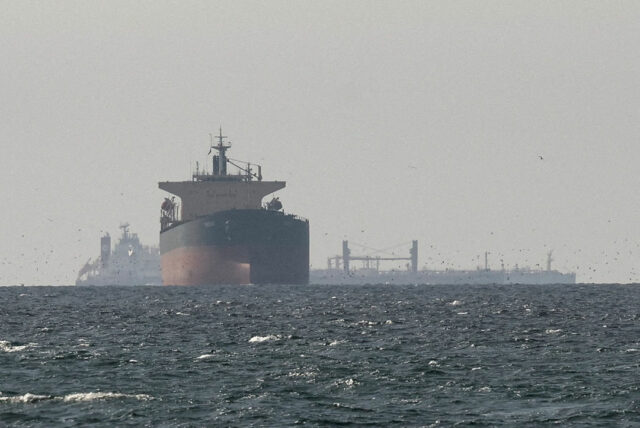
Tankers sail in the Gulf, near the Strait of Hormuz, as seen from northern Ras al-Khaimah, near the border with Oman’s Musandam governance, amid the US-Israeli conflict with Iran, in United Arab Emirates, March 11, 2026. — REUTERS

THE UNITED STATES issued a 30-day license for countries to buy Russian oil and petroleum products currently stranded at sea in what Treasury Secretary Scott Bessent said was a step to stabilize global energy markets roiled by the Iran war.

The announcement comes a day after the US Energy Department said that the US would be releasing 172 million barrels of oil from the strategic petroleum reserve in an effort to curb sky-rocketing oil prices in the wake of the war in Iran.

That release was part of a broader commitment by the 32-nation International Energy Agency to release 400 million barrels of oil. The agency said earlier on Thursday that he war in the Middle East was creating the biggest oil supply disruption in history.

Mr. Bessent, in a statement on X released hours after benchmark oil prices shot above $100 a barrel, said the measure was “narrowly tailored” and “short-term” and would not provide significant financial benefit to the Russian government.

“The temporary increase in oil prices is a short-term and temporary disruption that will result in a massive benefit to our nation and economy in the long-term,” Mr. Bessent said in the statement, echoing President Donald Trump.

Thursday’s license, which authorizes the delivery and sale of Russian crude oil and petroleum products loaded on vessels as of March 12, will remain valid through midnight Washington time on April 11, according to the text of the license posted on the Treasury Department’s website.

The US Treasury previously issued a 30‑day waiver on March 5 specifically for India, allowing New Delhi to buy Russian oil stuck at sea.

Among other measures to tame energy prices, Mr. Trump has already ordered the US International Development Finance Corporation to provide political risk insurance and financial guarantees for maritime trade in the Gulf and said the US Navy could escort ships in the region.

In another attempt to control prices, the Trump administration is considering temporarily waiving a shipping rule known as the Jones Act to ensure energy and agricultural products can move freely between ​US ports, the White House said. Waiving the rule would allow foreign ships to ​carry fuel between US ​ports, potentially lowering ⁠costs and speeding deliveries.

“The president is taking every action he can to lower prices … unsanctioned oil that’s at sea to get that into the market, continuing to push our own producers to drill and expand production as fast and as far as they can, providing regulatory relief, and you’re going to see more and more in the days to come,” White House Deputy Chief of Staff Stephen Miller told Fox News’ “Primetime” program on Thursday.

There were about 124 million barrels of Russian-origin oil on water across 30 different locations globally as of Thursday, Fox News reported, adding that the US license would provide around five to six days of supply when taking into account the daily loss of oil from the Strait.

Mr. Trump said earlier on Thursday the United States stood to make significant money from oil prices driven higher by the war, prompting criticism from some lawmakers who accused him of caring only about rich people.

US and Israeli strikes on Iran and the subsequent response by Tehran have widened regional tensions and paralyzed shipping through the Strait of Hormuz, disrupting vital Middle East oil and gas flows and sending energy prices higher.

Raising the stakes for the global economy, Iran’s Islamic Revolutionary Guard Corps says it will block oil shipments from the Gulf unless the US and Israeli attacks cease. — Reuters

Oil shock may prompt BSP rate hike

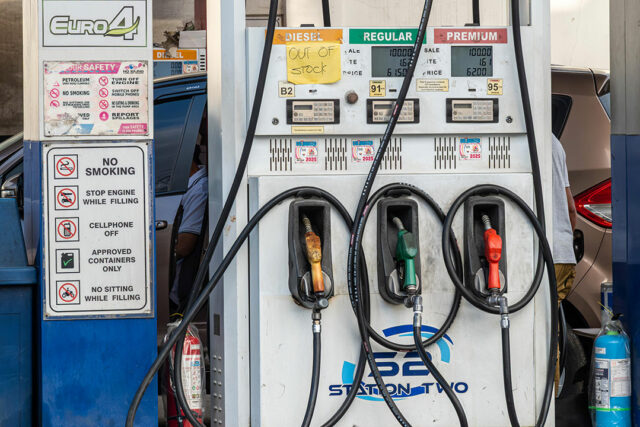
A GAS STATION is seen along Norzagaray Road in San Jose del Monte, Bulacan, March 8, 2026. — PHILIPPINE STAR/RYAN BALDEMOR

By Katherine K. Chan, Reporter

OIL PRICE SHOCKS may prompt the Bangko Sentral ng Pilipinas (BSP) to hike its policy rate as early as its next meeting in April amid the risk of inflation breaching the central bank’s target band in March, an economist said.

Security Bank Chief Economist Angelo B. Taningco sees the BSP reversing its policy path in April but ruled out an off-cycle move as the central bank has “room to wait.”

“In this episode of an oil shock, it is more broad-based. It also affects the other energy supplies, natural gas. And there are ripple effects coming from this because of the shipping disruption at the Strait of Hormuz, which I think will not be reopened anytime soon,” Mr. Taningco told Money Talks with Cathy Yang on One News on Thursday.

“So, in that regard, to basically manage inflation expectations, I think that a rate hike is warranted,” he added.

If realized, it would be the first time in over two years or since October 2023 that the central bank will tighten its monetary policy. 

The BSP has been on an easing path since August 2024, delivering a total of 225 basis points (bps) in cuts to bring the key interest rate to 4.25%.

BSP Governor Eli M. Remolona, Jr. has opened the door for a potential rate hike once oil price hits over $100 per barrel amid concerns that it could bring inflation above 4% or the upper end of their target band.

The Monetary Board’s next policy meeting is on April  23.

Local fuel retailers on Tuesday raised oil prices by double digits for the first round of their planned staggered hikes.

Gasoline prices were increased by P7 to P13 per liter, while diesel prices were up P17.50 to P24.25 per liter and kerosene by as much as P32 to P38.50 per liter.

This came after Brent crude oil price topped $100 per barrel on Monday for the first time in over three years as the ongoing Middle East war disrupted oil trade.

The United States and Israel’s attacks since late February triggered Iran to block off the Strait of Hormuz, fueling volatility in global oil markets due to concerns over major oil price spikes or shortages. The strait serves as a vital chokepoint where nearly a fifth of the world’s oil supply passes through.

Mr. Taningco said the Philippines is only experiencing price-driven shocks and not supply issues as “we still have in the world a glut of oil supply.”

“It’s just that chokepoint in the Middle East has really disrupted the flow of oil and other energy supplies, and therefore we have this price shock,” he added.

Still, Mr. Taningco said it is unlikely for oil prices to soar to $200 per barrel, adding that it has yet to reach the $140-per-barrel worst-case scenario anticipated by the market.

Meanwhile, ING Economics said insufficient buffers and wide current account deficit exposes the Philippines to more risks amid sharp oil price swings, citing the 17% climb in local gasoline prices.

“The Philippines is likely to feel higher oil prices sooner than most Asian counterparts, such as Thailand or Indonesia, given its modest fuel buffers, rapid domestic price pass‑through and a structurally wider current account deficit,” Deepali Bhargava, regional head of research for Asia-Pacific at ING, said in a commentary published late on Wednesday.

Inflation has been on an uptrend since December last year, accelerating to 2.4% in February as costlier oil, particularly fuel and liquefied petroleum gas, weighed on households’ pockets.

According to Ms. Bhargava, how quickly elevated energy costs will translate into higher prices in transport, electricity and food will determine the country’s inflation trajectory.

“In our scenario of sustained oil disruptions for a month, CPI (consumer price index) inflation for the Philippines is expected to inch closer to the upper end of 4% of the BSP’s target range,” she said.

Ms. Bhargava said this may warrant a prolonged pause by the BSP, ending its nearly two-year easing cycle.

Meanwhile, the ING analyst sees the Philippines hitting its growth target at 5.2% despite uncertainties from last year’s graft scandal and the Middle East war.

“We maintain our 2026 GDP forecast at 5.2%, with a meaningful upturn expected only in the second half of the year,” Ms. Bhargava said.

“We anticipate weak growth pressures to persist in the first half of 2026, at least, as ongoing investigations and unresolved political and oil price uncertainty continue to weigh on both business confidence and broader economic sentiment.”

Last year, Philippine gross domestic product (GDP) expanded by just 4.4%, the lowest since 2020, as the flood control corruption issue took a toll on investments, government spending and household consumption.

For Mr. Taningco, the ongoing oil crisis calls for long-term government reforms beyond short-term solutions such as subsidies or excise tax suspension to prevent a drag on growth.

“These short-term solutions in terms of fuel subsidy and even the suspension of the tax on fuel (have) to be time-bound and well-targeted. And that has to be, I think, communicated clearly,” he said.

“In addition, you have to push through with the other governance reforms that will help boost investor confidence and be able to at least temper the potential weakening of demand-side growth,” he added.

Such reforms could help the Philippine economy recover and potentially attain the low end of the government’s 5%-6% growth target for the year, Mr. Taningco said.

Rising fuel prices pinch Filipino households and businesses

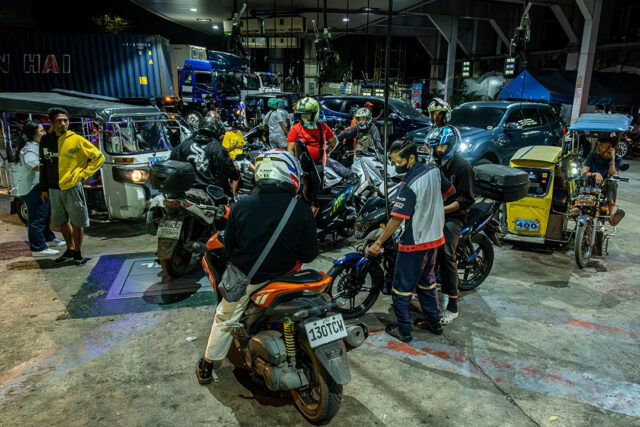
Motorists fill up their tanks at a gasoline station in Pasay City, March 9, 2026. — PHILIPPINE STAR/RYAN BALDEMOR

By Norman P. Aquino, Special Reports Editor and Ashley Erika O. Jose, Reporter

ON A HUMID Thursday afternoon in Las Piñas City near the Philippine capital, jeepney driver Michael I. Resuello, 48, watched the diesel pump at the RedStar Fuel station in Pilar Village tick past P70 per liter, up from P48 just weeks ago.

“The fuel is just too expensive,” he told BusinessWorld in Filipino, wiping sweat from his brow. Before the crisis, he said, he could fill a 35-liter tank for less than P1,700 for his Alabang-Baclaran route.

“Now, I have to gas up as often as four times a day because of my limited budget,” he said, as the pump stopped at P250 for 3.33 liters of diesel.

Daily earnings barely cover household expenses, and rising oil prices are forcing families and small businesses alike to rethink budgets. For millions of Filipinos, soaring energy costs are no longer a distant headline — they’re an immediate financial strain.

The Philippines imports nearly all of its crude from the Middle East. The US-Israel strikes on Iranian targets and Tehran’s retaliatory attacks have disrupted global oil flows, pushing Brent crude above $100 per barrel at the start of March, the highest since mid-2022.

On Thursday, Brent futures climbed 6.19% or $5.69 to $97.67 a barrel after Iranian explosive-laden boats hit two Iraqi fuel oil ​tankers in its waters, causing them to catch fire, Reuters reported, citing Iraqi security officials.

Analysts warn that continued instability near the Strait of Hormuz, a chokepoint for one-fifth of the world’s oil, could drive prices even higher, intensifying inflation and eroding household purchasing power.

Families are expected to feel the impact on daily commutes, electricity bills and food prices in the coming days.

Oil companies have agreed to stagger price increases, but diesel could balloon by as much as 62% to about P96.76 per liter in March, while gasoline prices could rise by 52% to about P88.79 per liter under a more severe scenario, according to the Department of Economy, Planning, and Development (DEPDev).

Mr. Resuello’s household is trimming discretionary spending to cover higher energy costs.

“People are cutting back where they can,” he said. “My grandkid and I need to cut back on eat-outs to Jollibee from now on. Everything costs more, even the basics.”

Inflationary pressures are compounded by the peso, which recently fell to a record low of P59.50 against the dollar.

The Iran war could trim 0.2-0.3 percentage point from Philippine economic growth this year, DEPDev Secretary Arsenio M. Balisacan said on Tuesday.

He added that inflation could quicken to as much as 5.1% this month and to 4.8% in April based on the agency’s baseline scenario, with full-year inflation settling at 4-4.2% — above the central bank’s target.

In a worst-case scenario where oil prices hit $140 this month and stay above $80 until September, DEPDev said inflation could hit as high as 7.5% in March and April, bringing the full-year print to as much as 4.8% and affecting consumer spending and corporate margins.

CORPORATE STRAIN
Philippine businesses are also bracing for impact. Shipping and logistics firms face steep bunker fuel costs, while manufacturers reliant on energy-intensive processes are weighing price adjustments. Retailers and food distributors are expected to pass higher energy costs to consumers, and utilities will have to contend with increased generation expenses.

Transport, industrial, and consumer goods sectors have been hit hard in financial markets. The Philippine Stock Exchange index (PSEi) recently dipped to near six-month lows, dragged down by shares of transport, manufacturing, and energy companies.

The slump reflects investor concerns over inflation, profit margins, and potential monetary tightening.

The Department of Energy said strategic stockpiles and inbound shipments could cover demand until at least April, even amid prolonged disruptions. President Ferdinand R. Marcos, Jr. on Wednesday said the government is exploring alternative suppliers while monitoring logistics to prevent shortages.

Lawmakers are debating excise tax relief for petroleum products. A lapsed provision previously allowed the government to suspend excise taxes when global oil exceeded $80 per barrel for three months. Finance officials estimate that suspending duties from May to December could cut revenues by roughly P136 billion.

The Bangko Sentral ng Pilipinas, which cut its benchmark interest rate last year to support growth, is monitoring inflation. Sustained oil shocks above $100 per barrel could prompt tighter monetary policy to safeguard price stability.

Overseas Filipino workers, particularly in the Middle East, are also affected. While remittance flows remain robust, heightened geopolitical tensions raise concerns about workplace safety, contract disruptions, and timely money transfers — key income sources for millions of families.

Businesses and households are recalibrating strategies for an energy-constrained environment. Companies are exploring efficiency measures, fuel hedging, and renewable energy alternatives.

Meanwhile, households are rethinking spending priorities and conserving energy wherever possible.

Mylene M. Villanueva, who runs a mom-and-pop store along a busy street in the same village, has had to contend with slower sales since Monday.

“Filipinos are spending less,” Ms. Villanueva, 52, said in an interview, sitting idly in her store that used to be full of customers.

Her daily sales have dropped to P15,000 from P30,000, she told BusinessWorld. “It feels like money has just disappeared.”

Economists caution that if tensions persist, inflationary pressures could last through much of 2026, potentially slowing economic growth.

“The war will likely push inflation upward and slightly dampen economic growth, as energy costs feed into transportation, logistics and food prices, reducing household purchasing power,” John Paolo R. Rivera, a senior research fellow at the Philippine Institute for Development Studies, said in a Viber message.

He said state measures such as temporary excise tax cuts, targeted fuel subsidies and staggered oil price increases could help soften the immediate shock from the crisis, but these must remain strategic to prevent fiscal strain.

“The oil shock may persist while geopolitical tensions continue, although such spikes are often volatile rather than permanent,” he added.

“You have to consider two things: how big the changes are and how often they happen,” Nigel Paul C. Villarete, a senior adviser on public-private partnerships at Libra Konsult, said in a Viber message.

Global oil prices are volatile, and small fluctuations occur frequently, while large swings are rarer. It is the larger shifts that require careful management, he pointed out.

FINANCIAL MARKETS
Rising oil prices have triggered sell-offs in the stock market. Investors are factoring in the impact on corporate earnings and consumer spending.

The PSEi plunged 4.97% or 314.19 points to 6,006.22 on March 9, its lowest close since Dec. 19, 2025. Heavy foreign selling was reported, while bond market yields climbed, reflecting caution amid global risk. The peso’s depreciation compounds the effect, making imported commodities costlier.

Energy-intensive industries including shipping, airlines, and petrochemicals are most exposed.

Some analysts see potential for structural shifts. Renewable energy adoption, energy-efficient transport and alternative fuels could gain traction as companies seek to reduce exposure to volatile oil prices.

“In addition to conserving oil and petroleum, the structural transition to renewable energy — solar, wind, geothermal and hydroelectric, among others — together with the growing use of electric and hybrid vehicles, will lessen dependence on imported oil,” Michael Ricafort, chief economist at Rizal Commercial Banking Corp., said in a Viber message.

Rising fuel prices are pushing more people to consider cycling in cities where it is practical. Companies are also expanding work-from-home schemes to help cut commuting costs.

“While the government should consider short-term relief for the transport industry and commuters, the country is overdue for more sustainable solutions,” Patricia Mariano, director and co-founder of AltMobility PH, said via Viber.

Ms. Mariano said the government could have invested more over the past four years in active transport and public transit, which could have eased the impact of fuel price swings on commuters.

For people like Mr. Resuello, the effects are immediate. Higher fuel prices mean rising daily costs and difficult choices. “We just have to keep moving,” he said. “Even if it costs more, the work must go on.”


House OKs bill scrapping travel tax on 2nd reading

Passengers are seen at the Ninoy Aquino International Airport Terminal 3 in Pasay City. — PHILIPPINE STAR/RYAN BALDEMOR

By Kenneth Christiane L. Basilio, Reporter

THE HOUSE of Representatives on Wednesday evening approved on second reading a proposal to scrap the travel tax, advancing the measure seeking to cut the levy seen as burdensome for Filipinos.

Lawmakers approved via voice vote House Bill (HB) No. 8464, which seeks to abolish the travel tax, a decades-old levy that was designed to curb overseas travel when the Philippines was seeking to conserve foreign exchange and promote domestic tourism.

“The continued imposition of travel tax oppresses travel demands, dampens tourism growth and discourages mobility,” Romblon Rep. and House Tourism Committee Chairman Eleandro Jesus F. Madrona said in his sponsorship speech. “This is a timely initiative that will not only reduce travel costs but will also stimulate tourism-dependent sectors.”

A travel tax of P1,620 is collected from economy air passengers and P2,700 from first class passengers flying overseas.

Exempt from travel tax are overseas Filipino workers, Filipino permanent residents overseas who stayed less than a year in the Philippines, and children aged two years and below.

Lawmakers have overwhelmingly backed the move to scrap the travel tax, saying the levy has outlived its purpose and now hampers travel for Filipinos, despite concerns from government agencies that rely on it as a steady source of funding.

“No travel tax shall be collected by any government agency or private entity,” according to a copy of the bill. “For flights scheduled on or after the date of effectivity, the collecting authority shall immediately refund any previously paid travel tax to the passenger.”

President Ferdinand R. Marcos, Jr. has declared proposals abolishing the travel levy as a priority of his administration.

Caloocan Rep. Edgar R. Erice raised doubts about the proposal, saying it could encourage Filipinos to travel abroad instead of locally.

In response, Mr. Madrona said: “This proposed measure would not have been included in the LEDAC (Legislative-Executive Development Advisory Council) list if our President had not thoroughly studied it, and our agencies have ensured it would benefit our economy.”

Removing the travel tax would benefit international travelers but cut funding for agencies that depend on it, such as those tasked with improving local tourism infrastructure, Michelle Guerrero Taylan, president of Global Tourism Business Association, said.

“It will be good news for (international travelers) because it means a big reduction in costs when they travel abroad,” she said in a phone call. “But we also have to recognize that the travel tax we pay benefits our local tourism, since it helps fund infrastructure projects.”

Under the law, 50% of the proceeds from travel tax collections go to the Tourism Infrastructure and Enterprise Zone Authority, while 40% go to the Commission on Higher Education for tourism-related education programs.

The remaining 10% goes to the National Commission for Culture and the Arts.

Mr. Madrona said the government has committed to fund programs affected by the cut, assuring that resources will come from the country’s gambling regulatory body and the national lotto commission.

For now, it is difficult to determine the proposal’s overall fiscal impact on government coffers, said Jonathan L. Ravelas, a senior adviser at Reyes Tacandong & Co.

“It’s a balancing act,” he said in a Viber message.

Ms. Taylan said the government should reduce the tax to around P300 to P500 instead of scrapping it entirely to preserve key funding while easing the burden on travelers.

“They should instead expand exemptions for persons with disabilities and students to make the system more equitable, not an outright abolition,” she said.

DIGITAL PAYMENTS BILL
Also late on Wednesday, the House approved on second reading HB No. 8468, which promotes digital payment systems for government transactions and provides incentives for merchants to adopt them.

“As government and private transactions increasingly move online, the bill seeks to establish clear standards that ensure faster, safer, and more transparent financial processes,” Manila Rep. Erwin C. Tieng said in a statement on Thursday. 

The bill requires all government agencies to adopt digital payments for disbursements and collections, either through in-house systems or by engaging with payment service providers.

For merchants, the bill orders local government units to encourage and incentivize merchants via reduced fees, as well as assist small and micro-merchants in becoming more capable of adopting digital payment systems. 

The push for the measure comes as the Philippines risks falling short of its 2028 digitalization target under the Philippine Development Plan, with BSP Governor Eli M. Remolona, Jr. noting the transition is progressing more slowly than expected.

In 2024, online payments accounted for a 57.4% share by volume and 59% by value of retail transactions, according to the BSP’s 2024 Status of Digital Payments in the Philippines report.

DoE chief Garin says pump prices unlikely to go down soon

A jeepney plies Taft Avenue in Manila. Jeepney drivers are seeking fare hikes amid soaring pump prices. — PHILIPPINE STAR/RYAN BALDEMOR

By Ashley Erika O. Jose and Sheldeen Joy Talavera, Reporters

FUEL PRICES are unlikely to go down anytime soon despite the recent decline in crude prices in the global market, the Energy chief said.

At the same time, a group of jeepney drivers is planning to seek a P5 provisional fare increase from the regulator next week as soaring pump prices put a strain on their daily operations.

“On our calculations, on average, it’s still not going down as we hoped, but at least the market has calmed down slightly. But this war is very erratic. We don’t know what’s going to happen. Nobody knows,” Energy Secretary Sharon S. Garin told One News’ The Big Story on Wednesday evening.

Ms. Garin said the Department of Energy (DoE) is monitoring fuel prices as adjustments will only be determined after Friday’s trading in the global market.

“Hopefully, something better will happen, and the prices will stay down and hopefully go down,” she said.

Oil prices dropped by more than 11% on Tuesday, the steepest decline of any session since 2022, Reuters reported.

As a net oil importer, the Philippines is particularly vulnerable to fluctuations in global oil supply and prices.

President Ferdinand R. Marcos, Jr. earlier said the Philippines is exploring alternative oil suppliers to ensure stable fuel supply.

“Actually, there are offers already… So, hopefully we lock in some already to make sure that we have deliveries by April,” Ms. Garin said.

This week, the Philippines had its largest single-week adjustment, as pump prices rose as much as P38.50 per liter.

“We are going to file a petition on Monday at the LTFRB (Land Transportation Franchising and Regulatory Board) for a P5 provisional fare increase,” Pinagkaisang Samahan ng mga Tsuper at Operators Nationwide (PISTON) President Mody T. Floranda told BusinessWorld on Thursday.

He said the provisional fare hike is intended to ease the strain of rising fuel costs on jeepney operators, adding that the P5 adjustment still falls short of covering losses from volatile fuel prices.

Earlier this week, other transport groups like Manibela have also said that they have requested a P2 fare hike, citing fuel price increases.

PISTON’s Mr. Floranda said that since last week, the estimated loss of income for drivers is around P1,000 per day, while the daily expenditure of drivers for fuel has doubled. 

“But the fare hike is only one option, there are other options that the government can explore. We highly favor the suspension of the excise tax. If the government considers that then maybe we will withdraw our petition,” Mr. Floranda said.

Transportation Acting Secretary Giovanni Z. Lopez said in a statement that there will be a fare increase for public utility vehicles (PUV), but did not give details.

“Hopefully, the LTFRB will finish the review of fare hike petitions. We have to treat this very carefully with abundance of caution,” he said.

John Paolo R. Rivera, a senior research fellow at the Philippine Institute for Development Studies, said the proposed P5 fare increase would disproportionately affect low- and middle-income households who allocate a larger share of income to transport.

“Higher commuting costs could force households to reduce spending on other goods and services, potentially slowing consumption in the short term,” Mr. Rivera said in a Viber message.

Targeted transport assistance may be needed to support operators’ viability while also prioritizing household welfare, he said.

“LTFRB already has a time-tested methodology on fare adjustments due to fuel price and other increases — they can dig into their past experience in coming up with the best decision that is fair to all,” Nigel Paul C. Villarete, a senior adviser on public-private partnerships at the technical advisory group Libra Konsult, said in a Viber message.

Rene S. Santiago, an international consultant on transport development and former president of the Transportation Science Society of the Philippines, said the proposed fare hikes are long overdue.

“Delays have weakened public transport, aside from the government losing elbow room to stagger fare increases with a jump in fuel prices. Fuel subsidy is a pittance and benefits only urban-based public transport,” Mr. Santiago said.

Meanwhile, Mr. Lopez said starting March 17, the government will begin disbursing a P5,000 fuel subsidy to PUV drivers in Metro Manila. He said the Department of Transportation (DoTr) has also asked toll operators to provide discounts to buses and trucks.

NLEX Corp. President and General Manager Luis S. Reñon told reporters on Wednesday that the company is in talks with DoTr to provide rebates to haulers and truckers.

Setting sail with Mickey and friends on the Disney Adventure

By Cathy Rose A. Garcia, Editor-in-Chief

(Part 1)

SINGAPORE — As a cruise skeptic, I never quite saw the appeal of spending days at sea on a floating resort surrounded by thousands of strangers. But as a Disney fan, I was curious about the Disney Adventure, Disney Cruise Line’s (DCL) first ship in Asia and the biggest one in its fleet.

After all, the Disney cruises are known for blending modern cruise travel with over 100 years of storytelling from Disney entertainment.

Another interesting thing about the Disney Adventure is that it has no port calls, so it starts and ends in Singapore.

Sarah M. Fox, DCL vice-president and regional general manager, told BusinessWorld in an interview on board the ship that the Disney Adventure is “both the journey and the destination” as their research showed most of their cruise guests enjoy their days at sea.

I wondered if Disney’s carefully crafted brand of “magic” could turn this cruise skeptic into a convert in just four days at sea?

The question stayed with me as I went on a preview cruise on the Disney Adventure from its homeport of Singapore last week. (Note: The ship set sail on its maiden voyage with paying customers on March 10.)

Seeing the massive ship docked at the Marina Bay Cruise Center, I could not help but be impressed. The ship can carry as many as 6,700 passengers, has a crew complement of 2,300 (including around 700 Filipinos), and over 2,000 cabins.

Boarding the ship, I could already feel excitement building as the crew (or cast members as they are called on DCL ships) welcomed us with warm smiles and loud cheers.

I could already see the Disney magic in the small details — the hidden Mickeys, the artwork from Disney classics, and the Disney songs played on a loop in the background. The nostalgia set in and suddenly I was a kid again who was obsessed with Cinderella and Beauty and the Beast.

Since the staterooms were not ready yet at the time of boarding, guests had a buffet lunch at the Enchanted Summer restaurant, which was inspired by Frozen. There were bronze busts of Anna and Elsa, a mural featuring Olaf, and other details that made one feel you were in Arendelle. (More on the cruise food later.)

As a first-time cruiser, I was extremely confused by the ship layout and kept going the wrong direction — going Alt when my stateroom was on Fwd. But I would soon find out that getting lost is probably a good way to explore the Disney Adventure.

THE APP
However, the best tip for a Disney cruise newbie is to download the Disney Cruise Line Navigator app even before their trip. All guests are encouraged to check in online to make the boarding process much quicker, and to have the QR code ready.

The app is also where you can find all the things to do on board the ship, as well as make reservations for character meet-and-greets, various other activities, and the evening shows at the Walt Disney Theater.

It also has an onboard chat feature so you can stay connected with your family and friends while on the ship.

Since Disney offers rotational dining for dinner, you can find out which restaurant you are assigned to every evening. Guests can have dinner at the Navigator’s Club, the Hollywood Spotlight Club, and Enchanted Summer at least once during their trip.

SAIL-AWAY PARTY
On my first day, I immediately got lost while looking for my stateroom. I took a wrong turn and ended up in the Imagination Garden — one of the seven themed areas on the ship.

Stepping inside felt like entering the pages of a Disney storybook. On one end is a magical castle and courtyard, with a topiary statue of Mickey Mouse as the Sorcerer’s Apprentice in the middle. At the other end is a stage, where the Disney gang appeared for the sail-away party called “Let’s Set Sail.” I couldn’t help but get caught up in the excitement at the party when Captain Mickey, Captain Minnie, Donald Duck, Daisy Duck, Goofy, and Pluto came on stage to celebrate the beginning of the cruise. It was a perfect way to start!

I nearly missed this show, so to make sure you don’t miss the sail-away party, check the app immediately for the schedule.

KEY TO THE WORLD
As a cruise newbie, it was a surprise that the key card (known as Key to the World card) is left in a sealed envelope outside the stateroom. Luggage is also usually left outside the room after the ship sails. A side note: For convenience, bring a lanyard for your Key to the World card, which is used for payments and all bookings.

The Disney Adventure offers several kinds of staterooms, with verandah staterooms having views of the ocean, the Imagination Garden, or Discovery Reef. The rooms’ decorations are based on Disney classic films — my room had a painting of a scene from The Lion King and a sketch of Mufasa and Simba.

Having a room overlooking the Imagination Garden means you can watch the shows on the Garden Stage from your verandah. My room had a verandah, but unfortunately, the view was of the side of the Castle Shop.

Our media group was later invited to take a tour of the more luxurious staterooms on the Concierge level. There are themed suites featuring design elements from films such as Aladdin, Frozen, and the Avengers. The biggest suites have a dining area, a bathtub, a walk-in closet, and even a private sundeck and jacuzzi. Concierge guests also enjoy perks such as exclusive access to a private lounge, sundeck, and a spa.

DISNEY FILMS COME TO LIFE
It was hard not to succumb to the Disney magic while on the Adventure.

At the Discovery Reef, it felt like diving into the world of The Little Mermaid and Finding Nemo thanks to the deep blue hues of the walls, Dory and Nemo figures, coral-like structures, and wavy benches.

Toy Story Place, located on the upper decks, features several pools, Woody and Jessie’s Wild Slides, and splash zones filled with favorite Toy Story characters.

Of course, I just had to grab a slice from Pizza Planet and a soft-serve ice cream from Wheezy’s Favorites — both places inspired by the Toy Story films.

Town Square can be considered the lobby area if the cruise ship were a hotel. There’s a small stage where I found kids watching a show with Princess Tiana from The Princess and the Frog. At another time, there was a show with Cinderella. There one will also find a bronze statue of Snow White standing next to the magical wishing well. Surrounding her are seven guest services desks, which are a nod to the seven dwarves.

SAN FRANSOKYO
My favorite themed area on the cruise ship would have to be San Fransokyo Street, which is straight out of Big Hero 6. The film is set in an alternate universe where San Francisco was rebuilt by Japanese immigrants.

The idea is you’re entering the street from the subway station, hence the detailed SFast map on the wall with stops like Castro-cho, Haightjuku, Ginza Square, and of course, the San Fransokyo Institute of Technology.

The attention to details is amazing. I spotted a news stand with copies of the San Fransokyo Tribune, snacks, and other trinkets, as well as a vending machine with snacks like Kapow chips and Wasabi Salt Chippu Chippu. There’s a pedestrian crossing sign that included Baymax, while the manhole cover had distinctly Japanese design.

There’s also a full-size recreation of one of San Fransokyo’s trolleys, as well as a bus stop and post box. Kids can also play games at the Big Hero 6 arcade, and experience the Hiro Training Zone.

The Baymax Cinemas feature new releases such as Zootopia 2 and The Fantastic Four: First Steps throughout the day. The cinema snack bar, called Alley Cat Café, is inspired by Aunt Cass’ bakery from the movie, and offers Japanese-style coffee, drinks, and popcorn.

If there’s one thing you shouldn’t forget to do, it’s to get a photo with Baymax. Make a booking for the Baymax meet-and-greet at Hiro’s garage lab. Take my word for it, Baymax is just as adorable there as on screen.

There are just so many things to see and do on the Disney Adventure, that this travel story needs a Part 2, which will include the ship’s other attractions, dining options, shows, shopping on board, and the friendly Filipino crew. Also find out if this cruise skeptic changed her mind about cruises, or has simply become a “Disney adult.”

To be continued.

IPOPHL to create toolkit promoting musicians’ IP rights

STOCK PHOTO | Image by Macrovector from Freepik

THE Intellectual Property Office of the Philippines (IPOPHL) is looking to develop a toolkit on copyright principles to help Filipino musicians protect their intellectual property (IP) rights.

In a statement released on Wednesday, the agency said it recently held consultations for the creation of its Toolkit for Filipino Musicians on Managing Copyright.

The toolkit will serve as a resource material on fundamental copyright principles on IP management.

During the consultations, participants noted that Filipino musicians have gaps in their knowledge on ownership and rights to their creative work.

IPOPHL said that many musicians make records without fully understanding their contracts with production companies. It noted how artists lack awareness on how songs earn income or how their rights are protected.

“Participants also raised how the knowledge gap extends even to established musicians, particularly in administration, royalty collections and the role of collective management organizations,” it said in the statement.

With this, the toolkit is expected to help cultivate a more enabling and future-ready IP ecosystem for the Philippine music industry, IPOPHL Acting Director General Nathaniel S. Arevalo was quoted as saying.

“By grounding policy support in the real experiences of our creators, we ensure that our interventions are responsive, inclusive, and aligned with how the industry actually works,” he noted.

The toolkit would help support the boom of the Philippine music industry in the age of streaming and digitalization, IPOPHL said.

The number of Filipino-made songs on Spotify grew by four times over the last five years, the streaming platform said in 2024.

IPOPHL also cited the rise of P-pop acts such as BINI and SB19, which further expanded the reach of Original Pilipino Music (OPM) globally.

“The boom is also driven by increasing access to legitimate avenues for digital streaming for both creators and consumers alike,” IPOPHL said.

The consultation was held in partnership with FlipMusic Productions, Inc., a local sound production house and record label.

FlipMusic Chief Executive Officer Jeli Mateo said the toolkit will be an “evolving document,” ensuring that artists will be supported at different stages in their careers.

It is also expected to help strengthen copyright awareness, promote responsible rights management, and support Filipino musicians’ careers, IPOPHL added.

The toolkit is a project under IPOPHL’s Copyright Plus Program 2.0, a series of initiatives seeking to raise awareness of copyright among under-resourced creators.

In 2024, the Philippines recorded 17.9% year-on-year growth in revenues from recorded music to $88.3 million (P5.1 billion), according to the International Federation of the Phonographic Industry’s (IFPI) Global Music Report 2025. — Beatriz Marie D. Cruz

Bounce

Timothée Chalamet in Marty Supreme (2025)

Movie Review
Marty Supreme
Directed by Josh Safdie

JOSH SAFDIE’S Marty Supreme takes its cue from its central character: brassy, loud, unrelentingly annoying, chronicling the life of one Marty Mauser, a nascent shoe salesman and up-and-coming ping-pong player. Marty, to put it mildly, likes to burn both ends of his candle: he hustles players at the local bar; hustles his rich friend Dion (Luke Manley) to finance production of orange ping-pong balls with his name printed on them; hustles his married friend Rachel (Odessa A’zion) for sex at the shoe store’s back room; hustles his Uncle Murray (Larry Sloman) for $700 to help finance a trip to the British Open in London — to be fair Uncle Murray’s hustling Marty too, trying to manipulate the young man into staying on as salesman while having an affair with Marty’s mother Rebecca (Fran Drescher).

Timothée Chalamet trades in his Kwisatch Haderach stillsuit for a long-sleeved blouse, unbuttoned to reveal the sweat-soaked undershirt, and glues a dead caterpillar to his upper lip the way I assume Guy Gardner likes to sport a bowl cut — to declare “fuck you!” at anyone who dares object to his grating personality. It’s perfect; like him or not as an actor, have to admit this role fits Chalamet’s less-than-charming persona to a T, down to the nipples standing defiantly erect through the thin cotton.

It’s a vibe, I suppose. Helps that Darius Khondji is the cinematographer, with his shadowed aesthetic developed from his time with Jean-Pierre Jeunet (Delicatessen, City of Lost Children, Alien Resurrection), through his time developing the look and feel of David Fincher’s signature features (Se7en, Panic Room), to his time applying richly textured layers to James Gray’s visual palette (The Immigrant, The Lost City of Z, Armageddon Time), to his time illuminating the Safdie brothers’ shaky-cam aesthetic (Uncut Gems, this film), lending them more gravitas and solemn beauty than they actually deserve. For this production, Khondji adds a sumptuous glow about Chalamet’s tousle-haired head, suggesting he’s more “Fast” Eddie Felson than Ratso Rizzo (we’re not totally fooled, but Khondji for a few moments at a time manages to leave us confused).

It also helps that the legendary Jack Fisk is the production designer — he grew up in 1950s Illinois, is adept at creating worlds set in the past (Badlands, Days of Heaven, The Thin Red Line, Killers of the Flower Moon), the relative present (The Straight Story, Carrie, Mulholland Drive), and the nightmarish subconscious (Eraserhead). Fisk’s work here is so immersive I can believe it helped settle and modulate Safdie’s usually frenetic camerawork, from the near-incomprehensible near-hysterical gibberish Adam Sandler spouted in Uncut Gems to the comparatively sedate rat-tat-tat delivery of 1930s screwball comedies (transposed here to early ’50s).

Does the film work? To a point. It wants to be The Hustler, to beat that film at its own game of taking up a relatively lightweight game (billiards) by employing a sport even lighter in weight (table tennis) to pronounce on matters as momentous (At what point does selling one’s honor, dignity, soul for the umpteenth time become too much? Who in this dog eat dog world does one care about, dig in one’s heels for, and why?), but lacks Robert Rossen’s lean elegant visual storytelling, lacks the dark Mephistophelean figure played by George C. Scott as counterweight. Marty stands alone in a world of fools and suckers and that I suspect is how Chalamet (who’s never been shy on the subject of his ego) likes it, and that’s likely why this film fails to touch its intended level.

This Marty isn’t even half as interesting as the real deal — Marty Reisman, on whom Chalamet’s character is loosely based, was a table tennis player from the age of nine, won his first city championship at the age of 13; he hustled for money and, yes, toured the world as the opening comedy act for the Harlem Globetrotters, often visiting Hong Kong, and (a detail omitted from the film) smuggled gold and Rolex watches out of Asia into the United States. He won the 1997 US National Hardbat Championship at the age of 67, and in 2008 demonstrated on the Late Show with David Letterman that he could split a cigarette with a ping pong ball. On archival video footage Reisman looks improbable, with limbs longer and lankier than Chalamet’s (you can believe he can cover a ping pong table with arms outstretched), his onscreen manner is far more charming and charismatic — if he ever approached me for financing production of thousands of orange ping pong balls with his name printed on them, I’d seriously consider his proposal.

This isn’t Safdie’s best work either — that would be Uncut Gems, co-directed with his brother Benny, in a milieu the brothers grew up in (the New York Diamond District), with real stakes (loan sharks, a gambling addiction, a crumbling marriage, millions in rings and gems and unsecured loans), with Adam Sandler sweating the kind of desperation Chalamet can only fantasize about. I am usually not a fan of the smash-n-grab handheld frenetically cut style the Safdies excel at but in this one case they may actually have a point, and so does the film — an icepick of a point, driven into your skull between your eyes.

And this isn’t even the ultimate table tennis saga — that would be Masaaki Yuasa’s Ping Pong: the Animation, with visuals that make the Safdies look like on quaaludes, and a narrative that goes into power dynamics, players’ psychology, the significance of the sport to various countries’ cultures (specifically Japan and China), the pitfalls and virtues of both victory and defeat. Would I consider Marty supreme? Wouldn’t call it bad, but would definitely rank it fourth.

RCBC prices bonds, starts offer

RIZAL COMMERCIAL BANKING CORP.

RIZAL COMMERCIAL BANKING Corp. (RCBC) has set the coupon rate for its three-year fixed-rate ASEAN Sustainability bonds at 6.08% as it started the public offer period on Thursday.

The three-year bonds will be offered until March 27, unless adjusted by the bank, with the settlement and listing on the Philippine Dealing and Exchange Corp. scheduled on April 8, RCBC said in a disclosure to the stock exchange.

The bank is selling the notes at a minimum investment amount of P100,000 with additional increments of P10,000 thereafter.

“The funds to be raised from the offer will be used to finance or refinance, in whole or in part, the eligible green and social categories as described in the bank’s Sustainable Finance Framework,” RCBC said.

The notes will make up the ninth drawdown under the bank’s P200-billion bond and commercial paper program, which in 2022 was expanded from the P100 billion initially approved in 2019.

The Securities and Exchange Commission approved the bank’s application for an Association of Southeast Asian Nations (ASEAN) label for the bond issuance on Feb. 23.

The bank mandated Standard Chartered Bank (SCB) and RCBC Capital Corp. as joint lead arrangers and bookrunners for the transaction, while the selling agents are SCB and RCBC.

RCBC last tapped the domestic market in July last year, raising P12.21 billion from an offering of ASEAN Sustainability Bonds, well above the minimum issue size of P3 billion amid strong demand. The notes have a tenor of two years and six months and carry a coupon rate of 6% per annum. This brought total issuances under its peso fundraising program to P99.01 billion.

Meanwhile, the bank also raised $350 million from an offering of five-year sustainability bonds in January 2025. The notes were priced at 5.375% per annum and were issued out of its $4-billion medium-term note program and under its Sustainable Finance Framework.

RCBC’s net income rose by 11% to P10.6 billion in 2025.

Its shares climbed by 20 centavos or 0.84% to close at P24.10 each on Thursday. — Aaron Michael C. Sy

Fueling the fire of female rage

By Brontë H. Lacsamana, Reporter

Movie Review
Sisa
Directed by Jun Robles Lana

SISA — an intentional reference to the iconic madwoman character from José Rizal’s Noli Me Tangere — is a female-led revenge thriller by acclaimed director Jun Robles Lana. Truly befitting Women’s Month, it is a searing story of how women can only rely on themselves for their emancipation.

This film is set towards the end of the Philippine-American War. It follows the titular character Sisa (played by film legend Hilda Koronel in her comeback role after a decade out of the spotlight), who seems to wander into a remote American concentration camp made up mostly of Filipino women. Here, we see in their struggles the tensions of benevolent assimilation, as those deemed savages must adapt to the ways of the colonizer, be it in their form of dress, their language, or their use of cutlery.

It is in this environment that the director brings us an enthralling feminist period piece, involving the worried Delia (played by Eugene Domingo), who tries to dissuade her teenage daughter Nena (Angellie Sanoy) from becoming too close to the white woman teaching the children English; the distraught Ofelia (Tanya Gomez), still in mourning after the capture of her husband, the village chief; and self-assured widow Leonor (Jennica Garcia), who is the paramour of the American garrison’s commander. Without spoiling how their arcs develop through the film, each plays their part to perfection.

This revenge thriller is anchored by Koronel’s stoic, mysterious Sisa, whose madness is weaponized as we discover her true motives. She’s probably the most engaging figure of subterfuge in Philippine cinema to date, as she is revealed to be a rebel leader spying on the American camp to gain intel for an imminent attack. In the process, she gets to know all the women in the village and their struggles, which ultimately affects the decisions she makes in the last act. Naming her after Rizal’s famous madwoman is a feminist move, subverting this symbol of a victim of foreign abuse and turning her into an icon that fights against it. Being played by Koronel guarantees the very picture of subtle discontent brewing beneath the beautiful, features (young in Lino Brocka’s Insiang, just as potent now that the actress is more advanced in age). Plus, Teresa Barrozo’s disconcerting score effectively matches her intense psyche, pushed not alongside dialogue but through the depth of Koronel’s gaze.

The other women fill out the textures of interpersonal strife in this bubble of assimilation. Most notable is Domingo’s Delia, who turns in a believably distraught performance as a woman who has lost most of her family to carnage. She starts out simply grumbling about her remaining child’s closeness with the Americans, until a shocking turn in the teenager’s fate pushes her from mildly comedic to harrowingly dramatic, past a point of no return. Garcia as the tragic Leonor, fully believing in the commander’s supposed love for her and for the Philippines, has the most engaging arc of the ensemble.

The cinematography has striking moments, and the pacing and build-up in the narrative are teeming with tension. Lana wears his references on his sleeve, evoking some of the dramatic framing of Ishmael Bernal’s Himala in moments where Sisa stands alone in the sparse landscape. Of course, because he has Koronel’s powerful screen presence at his disposal, the composition of some scenes call back to Brocka’s Insiang, with steady push-ins and pans.

While the Caucasian actors are a weak point in the ensemble, their one-note, almost cartoonish portrayals do kind of match the sense of artifice that veers this film towards saturated, moody landscapes over historical realism. As the aspect ratio widens from a dimly lit chamber scene to an open-air village confrontation, cinematographer Carlo Mendoza and editor Lawrence Ang helping Lana paint this seething rage against colonizing Americans.

However, what it achieves stylistically softens the blow of the film. Instead of being an incisive indictment of imperialism itself, the final act really draws out the theatrics of women scrambling to come together to fight back against oppressors. It’s riveting stuff, executed with a one-take scene that has become Lana’s signature, albeit with clichés here and there, and an ending that doesn’t go all the way. For all the build-up it took, the toned-down bloodshed and mayhem make a sour pairing with the frustrating politics that refuse to grant full revolutionary imagination to the oppressed women.

Akin to Jerrold Tarog’s recently concluded “Bayaniverse” trilogy (Heneral Luna, Goyo, and Quezon), Sisa espouses the rhetoric that we are our own worst enemies, which is understandable given the Philippines’ political milieu today, but a bit tired in historical films that seek to reappraise forgotten parts of our history. This film harkens back beautifully to local cinema classics, with phenomenal acting from its leads being the exact picture of Women’s Month girl power, but it says something about our nation’s view of emancipation that it almost always carries with it a wry note.

In terms of similarity in plot, Lana’s 2013 film Barber’s Tales, which also stars Domingo as a widow who takes her fate into her own hands, has a superior conclusion. It is telling that, over a decade since, the contrast in the depiction of Filipino guerrillas and their undeniable flaws reflects a disillusionment with the traditional notions of resistance.

What amused me most about the screening I was in was an American tourist couple who, for one reason or another, decided to watch this film. As we were all standing up and leaving, the guy chuckled nervously, he and his wife the only white people in a sea of brown, and asked us directly behind him, “so, uh, that’s not a true story, is it?”

We shook our heads no, but it was funny all the same that the film made them nervous. Perhaps it is wishful thinking on Jun Robles Lana’s part — if only it were true that we had a Sisa (or a few of them) to set ablaze the bleak conclusion to that phase of our history, and to wreck and burn the eventual full embrace of Americans that the Philippines pivoted to after the turn of the century. Perhaps I would not be writing this review in English at all, and that tourist couple wouldn’t be here in the first place.

Alas, that is still wishful thinking, and it makes sense that the film — as a revenge thriller or as an ideological study — didn’t have a fully satisfying conclusion. Sisa represents female rage, its place in an imperfect historical memory, and the perceived madness with which women adopt to be able to survive.

ADVERTISEMENT
ADVERTISEMENT