Home Blog Page 1641

Fed signals rates will be steady despite bets on looming cuts

FEDERALRESERVE.GOV

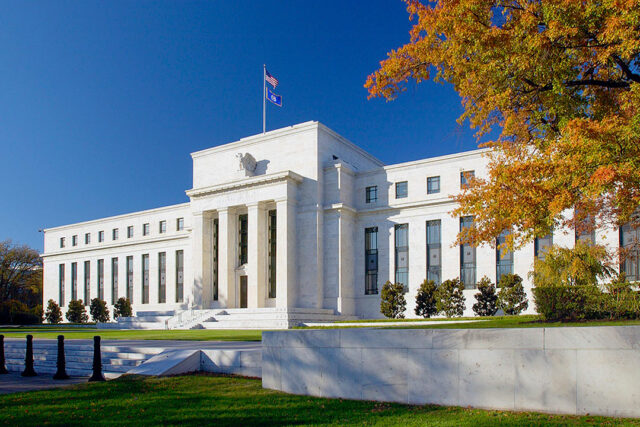
US FEDERAL RESERVE policymakers have signaled that short-term interest rates will remain unchanged as they wait for clearer signs that inflation is nearing the US central bank’s 2% goal or until there is a whiff of a deteriorating job market.

The data so far has presented neither of those scenarios to the Fed, and though economists say the real drag from President Donald J. Trump’s aggressive import tariffs lies ahead, there is a great amount of uncertainty over where the policies will end up and the degree and timing of their impact on prices and jobs.

“The cone of possibilities,” as Cleveland Fed President Beth Hammack put it recently, is quite large, and includes the possibility of persistently higher inflation coupled with a slowdown in economic activity that would require the central bank to pick which battle to fight.

That dilemma has not stopped traders from betting that by June a faltering economy will likely move the Fed to resume its rate cuts, ultimately lowering borrowing costs by a full percentage point by the end of this year. They added to those bets on Wednesday after data showed the US economy shrank last quarter and the Fed’s preferred measure of price inflation did not rise at all on a monthly basis in March.

But while economists say such a rate-cutting scenario is not out of the question, they are quick to note that inflation remains elevated, and is likely to worsen at least temporarily as retailers raise prices to cover higher costs from the sharp increase in import levies.

The Personal Consumption Expenditures Price Index excluding volatile food and energy prices, which Fed officials feel maps best to where inflation is headed, eased to 2.6% in March from 3% in February, the data showed.

Longer-term inflation expectations remain largely grounded, but a few Fed policymakers have taken note of a sharp rise in short-term inflation expectations that they worry could set the stage for a resurgence in price pressures.

“The Fed’s in a very tricky spot; you have inflation that is already above target, you have inflation expectations that are, sort of showing that, perhaps they’re becoming a little unhinged,” said Tom Porcelli, chief US economist at PGIM Fixed Income. “And we’re now waiting for the inflation to show up on the back of tariffs. I mean, the Fed is on hold.”

At the same time, Fed policymakers are keenly focused on the potential for tariffs to slow the economy and potentially trigger layoffs, a situation that in the absence of persistent inflation would move them to cut rates, perhaps sharply. That’s not evident so far.

‘PERIOD OF STAGNATION’
The US economy contracted by an annualized 0.3% last quarter in large part because US businesses rushed to buy imported goods ahead of Mr. Trump’s tariffs. The report also showed consumer spending down-shifted from a 4% growth pace last quarter to a still-decent 1.8%, and business investment soared.

The GDP report overall would allow the Fed to continue to characterize economic activity as “solid,” though only in the rear-view mirror, said Gregory Daco, chief economist at EY Parthenon.

“This shock is unlike anything we’ve seen before,” Mr. Daco said. “It’s a massive self-imposed supply shock resulting from policy uncertainty, market volatility, surging tariffs and monetary policy inertia.”

The front-loading of demand in the first quarter, he said, sets the stage for a drop-off in demand this quarter, “a far more troubling phase of the ongoing economic slowdown.”

Or as Pantheon Macro economists wrote, “A period of stagnation now likely lies ahead if the current set of tariffs is maintained, with recession the most likely outcome” if the sweeping import duties Mr. Trump announced on April 2 and then partially paused come into force in July. The Trump administration, which this week eased some tariffs on automakers, says trade talks are ongoing.

On Friday policymakers will get some of the first data on the current quarter, with the Labor Department’s closely watched monthly jobs report expected to show a slowdown in hiring but no change in the 4.2% unemployment rate.

The Fed is nearly universally expected to hold its benchmark overnight interest rate in the current 4.25%-4.5% range at the end of a two-day policy meeting next week.

Futures contracts that settle to the Fed’s policy rate continue to suggest that the rate cuts would resume in June, with a total of four quarter-percentage-point reductions likely. The US central bank cut rates three times last year, for a total of 100 basis points of easing. — Reuters

Eroding democracy without trying

PHILIPPINE STAR/EDD GUMBAN

If the April pre-election survey by Pulse Asia Research, Inc. is a good predictor of the May 12 election for senators, and the likelihood is quite high, we shall have a Philippine Senate very few of us could be proud of. Most of the potential winners are film idols and talk show hosts, while others performed poorly in their earlier tenure in the Senate. Others may not serve their full term because they are impleaded at The Hague for committing crimes against humanity.  With such a composition, we might have a shortage of laws that champion good governance, a strong economy, justice and rule of law, and some sense of decency in the land.

This is a sure-fire formula for increasing further our democratic deficit.

Thus, we might have to deal with the same legislative mill that allowed the violation of the Constitution and various laws that mandated the centrality of people through adequate funding of both public education and public health. It is the same institution that refused to clear the blue ribbon committee report that recommended filing plunder, graft and other criminal and administrative charges against key officials of the previous administration and Pharmally executives. Enormous public money was squandered during the 2020 pandemic by acquiring overpriced, used or soiled medical supplies based solely on a presidential directive that dispensed with public bidding. Many of them were also instrumental in allowing financial stability to be compromised when the Maharlika Investment Fund was established with funds sequestered from state banks and the Bangko Sentral ng Pilipinas.

True, when we examine other surveys on a more modest scale, the results are completely different. We are not at all surprised that in the recent mock elections at the UP College of Law, two former opposition senators came out first. That fiery former audit commissioner, several labor and mass leaders and former cause-oriented party-list representatives completed the magic 12. There was no space for traditional, dynastic and comical politicians.  This result mirrors those in other academic institutions.

Beyond the perverse influence of paid trolls and other false news purveyors, it is not difficult to explain why Filipinos are voting circus characters in Congress and the Executive agencies. Just the other day, both print and broadcast media reported on the hearing conducted by the Senate education committee. The Philippine Statistics Authority shared some data, shocking at the least, showing that in 2024 there were almost 19 million Filipino students who graduated from senior and junior high school who “cannot read and understand a simple story.” This means some 19 million Filipinos are not functionally literate. In fact, at the same Senate hearing, the PSA claimed there were in fact 24.8 million Filipinos, or one out of every four Filipinos, “who have problems understanding a simple story.”

We believe that this situation pre-dated 2024 or even earlier, and in a few years, we don’t think this would be mitigated in a big way. Therefore, these 19 million Filipino students who “cannot read and understand a simple story” will be among our millions of voters a few years from now.

How do we expect these young voters to wrap around the idea that bad budget practices in Congress deny them books and additional classrooms, and that many of them get sick because they lack nutrition? Money is a problem because some of their parents are jobless, while some are looking for more work or additional hours of work. Some of them are not equipped with the skills in demand by industry. The economy is not operating at its peak. The budget for infrastructure as well as digital innovation has been severely trimmed. The narrative gets longer; it’s no longer plain vanilla. Those millions of young voters will be lost.

It would even be a more complex story for our young voters to understand that traditional politicians have been mainly behind the continued inability of the Philippine economy to break through many of our structural problems that impede a more accelerated, more inclusive economic growth in the Philippines. And there is bad political governance, there is bad economic governance, and there is bad social governance. In many previous studies of these governance factors, corruption counts among the political factors, economic freedom among the economic factors and education and health among the social factors. Some of them are caused by these politicians, on others, voters don’t have any idea. 

One can always argue that it is to many politicians’ advantage to maintain the status quo. An informed, thinking electorate will tolerate neither corruption nor incompetence in public service. Such an electorate will demand track record, or experience in crafting laws, or executing them, not in staging shows, doing stunts no matter how awesome, or collecting commissions from pork barrel projects. A history of vote-buying or being part of vicious political dynasties would be anathema.

But then, there could be no other more difficult, more daunting challenge than producing an informed, thinking electorate in this country.

How does one teach creative thinking among our current Filipino students who scored among the weakest in creative thinking in the latest PISA (Programme for International Student Assessment) ranking of students worldwide? They ranked in the same score range as three other bottom dwellers — Albania, Uzbekistan and Morocco. The Philippines’ mean score stood at 14 out of 60 possible points, remotely lower than the OECD (Organization for Economic Cooperation and Development) average of 33. Based on comparative analysis, only around 3% of Filipino students can match the creative thinking abilities of an average student in Singapore!

It is one thing to read and write and do some math, but it is a completely different challenge to think correctly, and think well. Again, Filipino students failed to distinguish themselves in this thought process.

Why is this alarming?

PISA defines creative thinking as “the competence to engage productively in the generation, evaluation and improvement of ideas that can result in original and effective solutions, advances in knowledge and expressions of imagination.” This is all about nation-building, transforming the economy and strengthening the social fabric.

Four aspects were covered, all indicative of future capabilities: written expression, as in crafting public policy; visual expression, as in perceiving key problems of the Philippines; social problem solving, as in how corruption and plunder should be dealt with; and scientific problem solving, as in addressing floods and traffic in Metro Manila.

In 10, 20 or 30 years, these young students will not only grow into our electorate, but they will also constitute the ranks from where political and economic leadership will be recruited through election or appointment. From the givens, it looks like we would need signs and wonders to squeeze blood from stone.

Francis Fukuyama in Identity (2019) argued that the most unexpected big electoral surprises of 2016 were Britain’s vote to leave the European Union and the election of Donald Trump. In both cases, Fukuyama wrote, “voters were concerned with economic issues, particularly those in the working class who had been exposed to job loss and deindustrialization. But just as important was opposition to continued large-scale immigration.” What is at work, to Fukuyama, is the politics of resentment.

Could it be that many of our people who would choose to elect misfits in public office feel that they have no stake in our political and economic mainstream and therefore any candidate who is not their kind should merit no support? 

Accepting ayuda or election bribe money is just a bonus in voting traditional, dynastic and incompetent candidates. They couldn’t care less if the P2,000 that they would receive on the eve of the election is the cost of infrastructure that would never materialize, or public hospital or additional hospital beds that would never be delivered, or better training for teachers that would never happen. “Pera naman natin ’yan” (It’s our money anyway) is not entirely true; whatever we get reduces the nation’s public goods.

Undermining the capacity of the citizenry to choose and choose correctly weakens our ability to achieve prosperity and more inclusive growth. If nothing is done with this state of affairs, either by Congress by a long shot rationalizing our election laws and restoring the primacy of public health and education, or the Supreme Court paving the way for an anti-political dynasty, or declaring as unconstitutional and illegal any attempt by the National Government to defund PhilHealth and reduce the budget for education — then we erode democracy even without trying.


Diwa C. Guinigundo is the former deputy governor for the Monetary and Economics Sector, the Bangko Sentral ng Pilipinas (BSP). He served the BSP for 41 years. In 2001-2003, he was alternate executive director at the International Monetary Fund in Washington, DC. He is the senior pastor of the Fullness of Christ International Ministries in Mandaluyong.

PLDT unveils Fiber Netflix plan

THE FIBER Netflix plan, including free internet speed boosts and installation services, has been officially launched by PLDT Home.

PLDT executives gave a rundown of the new packages, which combine internet connectivity with a Netflix streaming subscription, at a press event in Makati City on April 30. There are three available variations: Plan 1599, Plan 2499, and Plan 3199.

Roy Victor “Viboy” E. Añonuevo, PLDT Home’s vice-president for fixed broadband products, said at the launch that the packages are convenient in that they allow Filipinos to pay what is usually two different bills in one go.

“It will make our lives easier. Imagine tracking both your Netflix subscription and Fiber plan both at once, and paying them in just one due date,” he explained.

“If you get a standard plan for each, and compare it to our Plan 1599, for example, you get to save more,” Mr. Añonuevo said.

For Patrick Tang, vice-president for acquisition marketing at PLDT Home, the partnership makes “relationships and connections more profound.”

“PLDT firmly believes that the best connections are what brings families, friends, and people together. What better way to do this than with Netflix? When we watch a series or movie that we love or go crazy about, we talk about it all day or all week,” he said.

The three newly launched plans include the Fiber Netflix Plan 1599 which has a Netflix Basic plan and 150Mbps (megabits per second)fiber connection, with 300Mbps speed boost for six months; Fiber Netflix Plan 2499 has a Netflix Standard plan and 500Mbps fiber connection, with 700Mbps speed boost for six months, as well as a Cignal subscription. Finally, Fiber Netflix Plan 3199 has a Netflix Standard plan and 700Mbps fiber connection, with 1Gbps (gigabit per second) speed boost for six months. This also includes a Cignal subscription and a StreamTV device.

All the plans come with free installation services.

Mr. Añonuevo pointed out that these are “updated from existing PLDT plans,” to cater to the busy lifestyle of Filipinos.

“Nowadays, it’s a matter of being able to watch your favorite movie or TV show anytime you want. You can easily pause it and do what you need to do then continue watching later on,” he said.

He added that people can expect more partnerships where PLDT will strengthen their foray into entertainment, like music and gaming.

“You can expect PLDT to address the entirety of the Filipino digital lifestyle,” Mr. Añonuevo said.

PLDT Home also launched a promo that offers new customers the chance to win a free trip to South Korea and access to the Squid Game: The Experience attraction in Seoul.

New subscribers of Fiber Netflix plans 1599, 2499, and 3199 can get a raffle entry only until May 15. The trip includes round-trip airfare, hotel accommodation, travel allowance and free access to Squid Game: The Experience, for five lucky winners and their plus-ones.

More information on PLDT Home’s Fiber Netflix plans can be found at pldthome.com/fiber-netflix.

Hastings Holdings, Inc., a unit of PLDT Beneficial Trust Fund subsidiary MediaQuest Holdings, Inc., has a majority stake in BusinessWorld through the Philippine Star Group, which it controls. — Brontë H. Lacsamana

Japan, China, South Korea, ASEAN to expand currency swap program, Nikkei says

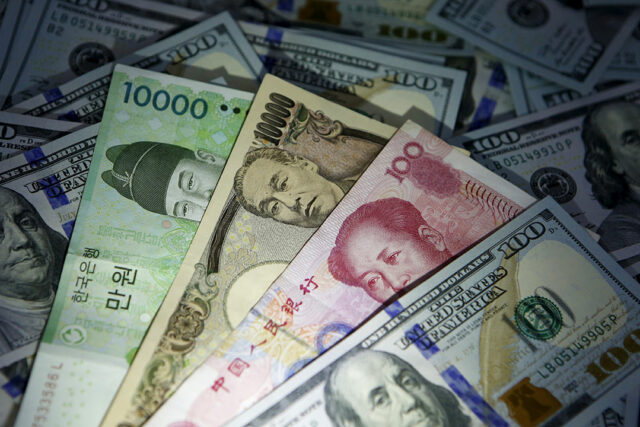
The South Korean won, Chinese yuan and Japanese yen notes are seen with US $100 notes in this picture illustration taken in Seoul, South Korea, Dec. 15, 2015. — REUTERS

TOKYO — Japan, China, South Korea and the Association of Southeast Asian Nations (ASEAN) countries are expected to expand their emergency currency swap program as early as this month to include infectious disease outbreaks and natural disasters, Nikkei Asia reported on Thursday.

A currency swap arrangement known as the Chiang Mai Initiative, created after the 1997-98 Asian financial crisis, exists to support regional financial stability by allowing members to tap currency swap lines to support currencies in need.

The expansion came as some countries faced foreign currency shortages during the COVID pandemic, Nikkei said.

The members of the initiative are likely to agree on the expansion when their representatives meet in Milan, Italy, on Sunday, Nikkei said, adding that the change would likely take effect in May.

The Chiang Mai Initiative pool amounts to $240 billion in foreign exchange reserves, with Japan and China each contributing $76.8 billion, South Korea providing $38.4 billion and the 10 ASEAN members a combined $48 billion. — Reuters

Pacific Online weighs expansion amid PIGO uncertainty

BW FILE PHOTO

LISTED online lottery operator Pacific Online Systems Corp. is rethinking its expansion plans into the online betting games business amid a proposed ban on Philippine inland gaming operators (PIGOs).

“We’re rethinking it if there’s that uncertainty,” Pacific Online Chairman Willy N. Ocier told reporters on Wednesday.

Malacañang said in March that it was still studying whether a ban on PIGOs was necessary. Talks of a potential PIGO ban surfaced due to concerns that it might cause the same issues as Philippine offshore gaming operators, including illegal activities and tax evasion.

Despite this, Mr. Ocier said that Pacific Online’s acquisition of a minority stake in electronic gaming platform software and service provider HHR Philippines, Inc. (HHRPI) is still ongoing.

“We’ll take it slow. It’s a minority interest. It’s ongoing,” he said.

“We wanted to get our feet wet, just to get a feel of it,” he added.

In January, Pacific Online signed an investment agreement to acquire a 37.5% stake in HHRPI for P150 million in a bid to expand its presence in the online gaming business.

HHRPI is a Philippine Amusement and Gaming Corp. (PAGCOR)-licensed software and professional service provider of electronic gaming platforms for land-based and online gaming operators. It is also a holder of a PAGCOR gaming license for online gaming under the brand “Buenas.”

Pacific Online shares were last traded on April 30, closing unchanged at P3.40 per share. — Revin Mikhael D. Ochave

The looming trade war: What US tariffs mean for the Philippines

ALIAKSEI LEPIK-UNSPLASH

THE LATEST World Economic Outlook from the IMF paints a sobering picture of the global economy. Growth projections have been revised downward, with global growth expected to drop to 2.8% in 2025, around half-a-percentage point decline. This is largely attributed to escalating trade tensions, including the sweeping tariffs introduced by President Donald Trump, which have brought effective tariff rates to levels not seen in over a century. It also creates inflation pressures for some countries, notably the US. Unless anchored by credible monetary policymaking by the Fed, the US runs the risk of having both low growth, even a recession, as well as high inflation. In a word — stagflation — a phenomenon familiar to those of us who were around in the 1970s, that had serious spillovers globally, triggering the Latin American and Philippine debt crisis.

But even if stagflation does not happen, the global uncertainty will exact a heavy toll all around. Even the US dollar and US treasuries have not been exempt. For the first time, it lost value in a crisis, as countries and people lost confidence in the US and the dollar as a safe haven.

The world remains in flux, but it seems less alarming than when Trump said he wanted Powell fired. Nonetheless, we need to wait and see what Donald has to say as the 90-day pause counts down.

The Philippines is not spared from this global turbulence, though its outlook is less worrisome in relative terms, compared with other emerging markets. Coming from a period of strong growth, most forecasts anticipate, at most, a one-percentage-point impact on projected growth, still over 5% in most cases, including the IMF and World Bank. Fitch Ratings has also just affirmed our stable BBB credit rating. This resilience is supported by our lower exposure to trade shocks, reliable earnings from overseas Filipino workers and business process outsourcing, a more favorable treatment under the Trump tariff regime including lower tariffs at 17% and global exemptions of all semiconductors and electronics, a manageable fiscal position, a crisis-tested financial system, adequate foreign exchange reserves and an independent — and if I may say, a most competent — central bank.

Inflation has also been trending downward to 2-3% from the high of 8% in 2023, allowing BSP to lower policy rates by 100 basis points to date. The governor has signaled more easing for the rest of the year as inflation is expected to be within our target range, and will help compensate for the deflationary effects of the trade war. Lower prices of oil, coal, fertilizers, some food imports — a side effect of lower global demand due to tariffs — will support this stance.

We do have to worry about a few things. First, the rules-based global trading system: The trade war challenges the principles that have underpinned international trade for decades. It undermines the predictability and stability that businesses rely on for cross-border transactions. The imposition of tariffs and retaliatory measures disrupts established norms and can lead to a fragmented global trading environment, with deleterious effects on investments and long-term growth and development, as Governor Remolona observed in a recent IMF panel.

Second, this global disorder, unless sorted out soon, primarily between the US and China, can evolve into a somos o no somos world.

As spheres of influence built around security, technology (especially AI) and trade are forcibly made exclusive, the cost of global disruption will be even more elevated and especially challenging for countries like the Philippines, who have deep and multifaceted economic ties with both the US and China.

The desire to contain China by US authorities enjoys bi-partisan support, so we may all be caught in a Thucydides Trap scenario over the medium to long term. Even if the tariffs are rolled back, we shouldn’t expect that things will revert to the pre-Trump status quo.

Allow me to conclude by sharing a few tentative suggestions on how we, as a country and people, might prepare ourselves to cope — and, I dare say, maybe even thrive — during these exciting times.

First, we should build financial resiliency by, for example, sustaining fiscal consolidation, upscaling systemic risk vigilance — including preparing and maintaining a ready crisis management playbook — and ensuring that our foreign exchange reserves remain ample. Second, we should enhance food and energy security. Third, we should strengthen our ties with ASEAN. This includes the aforementioned cooperation in the food and energy sectors where   our neighbors are exporters, as well as advancing financial cooperation (e.g., currency swap arrangements) and pursuing third-party trade negotiations.

Fourth, we should negotiate for compensatory concessions from the US, such as through friend-shoring initiatives or the establishment of a free trade agreement. (We need to remind ourselves what Dr. Kissinger said — It may be dangerous to be America’s enemy, but to be America’s friend is fatal.) Fifth, we should diversify our economic, financial and trade relationships with a broader set of countries and institutions.

Sixth, we should exploit our relative tariff advantage in the US market by attracting investors, especially those already operating in the Philippines, to consider future expansions here. Seventh, we should forge national cohesion, both politically and economically. In particular, economically via public-private collaboration, as we did during the COVID-19 crisis.


Romeo L. Bernardo is a member of the Philippine central bank’s Monetary Board (MB). The views expressed here, which he delivered in a speech before the Asia Society on April 30, do not necessarily reflect those of the MB or the Bangko Sentral ng Pilipinas.

globalsourcepartners.com

romeo.lopez.bernardo@gmail.com

King Charles says cancer diagnosis has shown him ‘the very best of humanity’

KING CHARLES — REUTERS

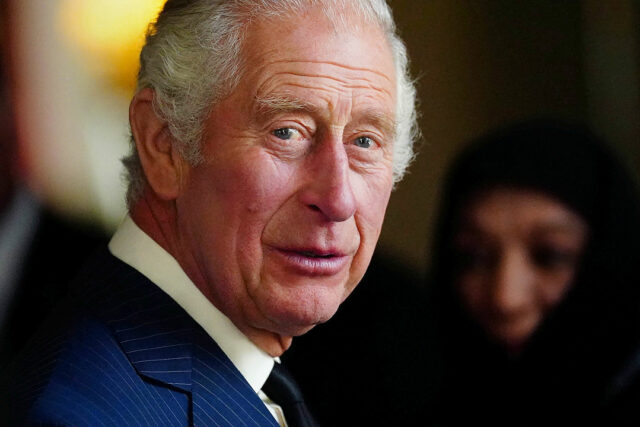
BRITAIN’S KING CHARLES on Wednesday said his cancer diagnosis had been an experience that showed him “the very best of humanity,” in a personal message celebrating the work of cancer support groups and charities.

Buckingham Palace said in February 2024 that Charles had been diagnosed with an unspecified form of cancer, detected in tests after a corrective procedure for an enlarged prostate.

He has been receiving treatment since and returned to public duties a year ago. Although updates on his condition have been rare, a Buckingham Palace source said in December that the treatment had been moving in a positive direction.

Charles used a message to attendees at a reception dedicated to the work of the cancer community to share his experiences of the disease.

“Each diagnosis, each new case, will be a daunting and at times frightening experience for those individuals and their loved ones,” he said in the message published by the palace.

“But as one among those statistics myself, I can vouch for the fact that it can also be an experience that brings into sharp focus the very best of humanity.”

Charles, 76, thanked charities for their work to raise funds for research, and reflected on the value of the human connection they offer patients in times of need.

“It has certainly given me an even deeper appreciation of the extraordinary work undertaken by the remarkable organizations and individuals gathered here this evening, many of whom I have known, visited and supported over the years,” Charles said.

“And it has reinforced what I have long observed during these visits — that the darkest moments of illness can be illuminated by the greatest compassion. — Reuters

Marriott, CG Hospitality to convert The Farm into Autograph Collection resort

THEFARMATSANBENITO.COM

MARRIOTT International, Inc. and CG Hospitality Global have signed an agreement to convert The Farm at San Benito into the first Autograph Collection resort in the Philippines, marking a jumpstart to taking the resort’s brand and services abroad.

The Autograph Collection, Marriott’s premium brand, includes over 100 upscale hotels worldwide, such as Grotta Giusti in Tuscany and Mauna Kea Beach Hotel in Hawaii.

The Farm at San Benito will be the first wellness-focused property in the collection, joining categories like “Beachside Getaways” and “Hidden Gems.”

“Autograph is a collection of boutique hotels that deliver immersive experiences,” said Rajeev Menon, president of Marriott’s Asia Pacific excluding China.

He added, “The partnership is twofold: first, The Farm will be accessible to our 230 million Bonvoy members. Second, we aim to explore ways to take it global.”

CG Corp. Global Chairman Binod Chaudhary, whose company CG Hospitality acquired the 52-hectare wellness retreat in 2018, said, “This will be a unique Filipino brand that will go global.” CG Corp. Global is a diversified conglomerate based in Nepal, with investments spanning multiple industries, including hospitality, retail, and manufacturing.

CG Hospitality operates over 193 hotels in 12 countries. “Marriott has the ability to take The Farm worldwide, under various formats,” Mr. Chaudhary noted.

The Farm introduced luxury wellness residences last year and entered a P12-billion partnership with Megaworld to develop a wellness township near the property.

Renovations for the relaunch, set for the third quarter of 2025, are underway. The resort currently has over 130 keys, excluding 80 villa keys. The exact number of additional keys has not been disclosed.

Both executives confirmed that the wellness offerings will remain integral to the brand. “The offerings of The Farm are sacrosanct,” Mr. Menon said.

The resort’s name will remain unchanged: “The Farm at San Benito, an Autograph Collection hotel,” Mr. Menon said. — Joseph L. Garcia

Can the White House ignore the Supreme Court? Americans will decide

SARAH PENNEY-UNSPLASH

By Noah Feldman

A PRESIDENT’S first 100 days are traditionally measured by how much he’s created and accomplished through legislation, leadership, and executive action. Donald Trump’s first 100 days demand to be evaluated in terms of how much he’s destroyed.

By that terrible standard of shock and awe, Trump’s destruction is historic — by far the worst first 100 days since Franklin Delano Roosevelt made it a thing in 1933. Trump has announced, reversed, and re-announced tariffs poised to tank the economy and the markets. He’s upended 80 years of US global leadership in international security and cooperation. He’s gutted agencies and departments devoted to health, education, science, the environment and other forms of lifesaving.

Yet as shocking and self-destructive as these actions are, they don’t represent the most serious danger Trump poses to the survival of the United States of America as a republic. That distinction must be reserved for Trump’s devastating, unrelenting attacks on the Constitution and the rule of law.

After 100 days of Trump’s war on the law itself, it’s time for what the military calls a battle damage assessment. We need to know how much harm has been done to understand how to defend against the onslaught and prepare for the epochal battles yet to come.

This war is definitively not over and we, the people, don’t have to lose it. But we do have to face facts analytically and calmly. We need to set aside our appropriate moral outrage to the extent possible. Only by doing so can we hope to strategize victory rather than prematurely mourn a defeat that is not inevitable.

In essence, the damage looks like this: Trump is trying to establish his authority over that of the courts and Congress. To get there, he’s using the tactic of a constant-yet-unsteady pattern of illegal actions. His main targets are a combination of vulnerable people who have a hard time fighting back and high-profile elites whom he hopes to subordinate and humiliate. When blocked by the courts, Trump repeats the same actions under supposedly different authority. He retaliates against anyone who objects. Because the courts are the main vector of resistance, Trump and Vice-President JD Vance have verbally attacked judges. Most recently, the FBI went so far as to arrest a Wisconsin judge for allegedly allowing a man sought by ICE to leave her courtroom through a side door.

Let’s start with Trump’s overall strategic objective, which is to make himself seem like he is — and thus actually become — the ultimate authority in the US, above Congress and the courts. His main tool is unilateral executive action.

The whole theory of executive orders (of which he’s signed nearly 140) is that the President is exercising either a power that the Constitution gives him or power specifically delegated to him by Congress. It was in that framework that former President Bill Clinton’s adviser Paul Begala offered his pithy near-haiku about executive orders: “Stroke of the pen. Law of the land. Kind of cool.”

What makes an executive order law is specifically that it is issued lawfully. If an order violates the law, it’s an arrogation of illegitimate power — a step toward autocracy in a system where Congress, not the president, possesses the power of legislation.

Trump’s executive orders have openly violated the Constitution and federal laws from the get-go. Take as exemplary the order purporting to end birthright citizenship, which is guaranteed by the plain meaning of the Fourteenth Amendment.

The order, issued on Trump’s first day in office, claims to “interpret” the Fourteenth Amendment as not extending “citizenship universally to everyone born within the United States.” But the Supreme Court, not the president, has the final word in interpreting the Constitution. The fact that Trump’s interpretation is obviously wrong (and intended to terrify children of immigrants) only dramatizes how bad this is.

There have been many more clearly unlawful orders, on topics from voting rights to deportations under the 1798 Alien Enemies Act to, God help us, low-flow showerheads. (The last of these included the astonishing statement that legal process was unnecessary “because I am ordering” the action.)

The good news in the battle damage assessment is that courts have been blocking the unlawful orders. Just Security’s Trump litigation tracker records 212 cases against the administration so far. In many of these, lower courts have paused unlawful action. Gradually, these cases are making their way to the Supreme Court.

These cases also reflect that Trump has taken a lot of unlawful actions without even bothering to issue an executive order explaining or justifying why. Firings of government employees have been one sort of unlawful action, ranging from commissioners of independent agencies who are protected by federal law from presidential removal except for cause, to rank-and-file civil service members whose protections come from different laws. Equally consequential have been unilateral cuts or freezes to government grants and contracts established by law.

In these cases, the courts have also been blocking those that are clearly unlawful. But Trump has responded with new firings and freezes, often claiming to be doing so under different legal authority than the courts have already barred.

The result is a flood-the-zone method of attack. When you’re subject to unlawful administrative action, you can be fairly sure that even when you win in court, your rights will continue to be violated.

When noncitizens are arrested and sent out of the country without an opportunity to speak to a lawyer (a practice that now appears to have extended even to some citizens), it creates terror among expansive communities of immigrants, who almost by definition are among the least powerful members of society.

When Trump is targeting powerful actors like big law firms or Ivy League universities (such as my own), the point of flooding the zone is to tell elites that he will go after anyone he doesn’t like — and that even if they win in court, he won’t stop making their lives extremely difficult in every way possible. This explains why so many rational people in powerful institutions have chosen to not take on the Trump administration directly: their victories might end up being Pyrrhic. Trump’s unrelenting approach to attacking even the powerful is therefore more than just score-settling. It is also a clever way to get past the illegality of his actions.

Going after the courts is a crucial part of this tactic. Trump’s overall goal is to warn the Supreme Court, which ultimately stands for the rule of law, that if it stands up to him, he will destroy the court itself. The justices aren’t vulnerable individually. But their institution is. That’s because, under the Constitution, the courts can only order the president to do what they say. They have no force of their own except their inherent legitimacy as exponents of the law. If the Supreme Court issues an order and Trump ignores it, all the court can do is declare him in contempt. Congress could impeach and remove the president — but after two impeachments in the first administration failed to yield a conviction, it’s uncertain at best whether that would happen.

Trump has been inching closer to directly violating a court order. Two judicial contempt investigations are currently in progress against administration officials for doing so. An overt Trump administration refusal to follow a court order could well trigger a constitutional crisis.

The Supreme Court would much prefer that the confrontation doesn’t happen, and that Trump at least give the impression that he is following the law — even if he does so imperfectly. But if the showdown must happen, the court will want it to be on the terms most favorable to the justices. They will want it to involve the undisputed rights of US citizens. They will want to be able to vote unanimously against Trump. That’s because they know that in a climactic confrontation, if Trump doesn’t back down, the rule of law itself will be broken.

The courts will need allies in such a battle. One perhaps unexpected form of alliance may come from the financial markets. Trump’s threats to fire Federal Reserve Chair Jerome Powell were threats against the rule of law and the Constitution as it is presently interpreted. It’s a good sign that Trump backed down, and not just for the markets. At the same time, it would be naïve to imagine that the markets would fully protect against a constitutional crisis. Markets function, albeit less efficiently, in countries where the law protects private property and transactions only selectively, and where autocrats can break the rules almost at will.

Republicans in Congress might be tempted to side with a unanimous Supreme Court against Trump if it looks like doing otherwise would harm the party in the midterm elections. For Trump to ignore an order from a court in which he appointed one-third of the justices and where  another third are also Republican appointees might be too much for some in the GOP to tolerate. Again, however, it would be a mistake to rely too confidently on that scenario.

That leaves the people. The rule of law exists in the US only because we have a Constitution that traces its legitimate authority back to popular sovereignty. We need to brace ourselves to back the Supreme Court in a potential fight with a president who thinks he can run roughshod over the law. If that day comes, there will have to be a million or more people on the streets of Washington, siding with the Constitution and with the body that has the ultimate responsibility to interpret and apply it. Trump’s 100 days have dramatically raised the possibility of such a confrontation taking place. The battle lines are being drawn.

BLOOMBERG OPINION

Pope Francis interview with Scorsese featured in new documentary

MAZUR-CATHOLICNEWS.ORG.UK

A NEW documentary from Oscar-winning director Martin Scorsese will feature a conversation with the late Pope Francis about an effort the pontiff championed to provide education through cinema, the film’s producers said on Wednesday.

Called “Aldeas – A New Story,” the documentary is “rooted in the pope’s belief in the sacred nature of creativity,” a statement from the filmmakers said.

They said the previously unseen conversation with Mr. Scorsese was the pope’s “final in-depth on-camera interview for cinema.” Francis died this month at age 88 and was buried on Saturday.

The documentary will showcase the work of Scholas Occurrentes, an educational movement founded by Pope Francis, and Aldeas, a project that supports the making of short films to promote cultural understanding.

Before he died, Francis called the documentary “an extremely poetic and very constructive project because it goes to the roots of what human life is, human sociability, human conflicts… the essence of a life’s journey,” the filmmakers said.

No release date was announced. — Reuters

CHR, DoLE roll out program for workers facing labor abuses

REUTERS

THE Commission on Human Rights (CHR) and the Department of Labor and Employment (DoLE) on Thursday rolled out an economic assistance program designed for workers impacted by labor rights violations.

The new Labor, Intervention, Financial, and Economic (LIFE) Assistance Program, launched as the country celebrates Labor Day, offers support to both workers and their families.

This includes livelihood aids, scholarships, internships, skills training under the Technical Education and Skills Development Authority, and referrals to relevant government services, the CHR said in a statement.

“CHR and DoLE affirm their joint commitment to ensure that Filipino workers and their families can live with dignity — free from fear and empowered to claim their rights,” it added.

The initiative specifically targets individuals who have faced threats, violence, or retaliation linked to labor organizing and rights advocacy. It is designed to meet their immediate economic needs and provide long-term recovery support.

The LIFE Assistance Program reflects broader government efforts to address international labor rights concerns and improve worker protection.

It builds on the Memorandum of Agreement and Data Sharing Agreement signed between CHR and DoLE in October 2023, which forms part of the Philippines’ response to observations made by the International Labour Organization’s High-Level Tripartite Mission.

Under the program, CHR is expected to submit a nationwide list of investigated labor-related cases for DoLE’s review.

Eligible beneficiaries will be identified based on this list and formally recognized during the ceremonial awarding on Labor Day.

The joint program also aligned with Executive Order No. 23, signed in 2023, which reinforces the state’s obligation to protect workers’ rights to organize. It also mandates coordinated responses among government agencies.

Labor rights protection has been identified as a key priority of the CHR’s sixth Commission en banc. It reiterated that economic security is integral to the full realization of human rights and expressed support for more responsive, rights-based interventions across government. — Chloe Mari A. Hufana

BoJ keeps rates unchanged, cuts growth forecasts on US tariffs hit

WIKIPEDIA.ORG

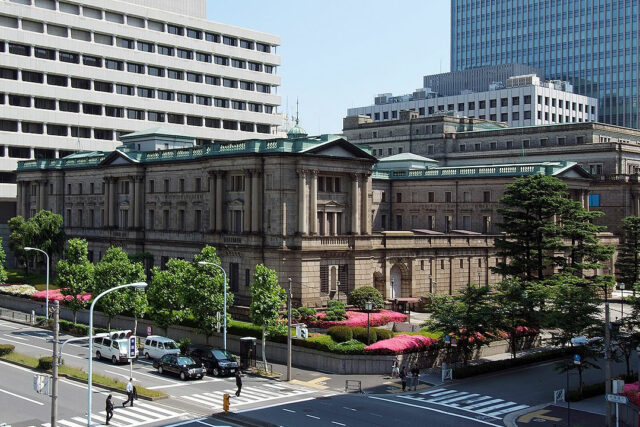
TOKYO — The Bank of Japan (BoJ) kept interest rates steady and sharply cut its growth forecasts on May 1, suggesting uncertainty surrounding US tariffs and the hit to exports could keep policy in a holding pattern for some time.

But the central bank projected inflation would stay roughly on course to hit its 2% target in coming years, a sign that risks from US tariffs could delay, but not derail, its rate hike plans.

As widely expected, the BoJ kept short-term interest rates steady at 0.5% by a unanimous vote.

Given growing headwinds from higher US tariffs, the board slashed its economic growth and inflation forecasts in a quarterly outlook report released after the meeting.

But it said underlying inflation would accelerate after a period of stagnation as a tight job market lifts wages, signaling that the hit from US tariffs was likely to be temporary.

“Japan’s economic growth is likely to moderate as trade and other policies in each jurisdiction slow overseas growth and weigh on corporate profits,” the BoJ said in a statement.

“Thereafter, Japan’s economy will see growth accelerate as overseas economies resume a moderate growth path,” it said.

Under fresh projections, the BoJ cut its economic growth forecast for the fiscal year ending March 2026 to 0.5% from 1.1% projected three months ago. It also slashed its growth forecast to a 0.7% expansion for the following fiscal year from 1% in January.

The BoJ now expects underlying consumer inflation to reach levels consistent with its 2% target around the latter half of fiscal 2026 and onward, the report said, pushing back the timing by around a year from the previous report in January.

“If our economic and price forecasts are realized, we will continue to raise our policy rate,” the BoJ said in a statement.

“Considering extremely high uncertainties over the future course of trade and other policies in each jurisdiction,” however, the BoJ will scrutinize economic price developments and guide policy without preconception, it added.

The BoJ expects core consumer inflation to hit 2.2% in fiscal 2025 and 1.7% in fiscal 2026, then accelerate to 1.9% in fiscal 2027.

“The BoJ appears to be maintaining a rate-hike stance. Given high uncertainty, however, it probably wants to leave itself a free hand on the timing,” said Totan Research chief economist Izuru Kato.

TARIFFS TO HIT GROWTH
Japanese government bond yields and the yen fell after the BoJ’s decision.

“Everything’s been reduced in terms of their forecasts and the market seems to be selling the yen at the moment,” said State Street Tokyo branch manager Bart Wakabayashi.

“The BoJ is taking a step back. They want to see how the data will change or which way it’s pointing once the policies are put in place.”

Rising trade tensions from US President Donald J. Trump’s sweeping tariffs have sent shockwaves through markets and led to a sharp downgrade in the International Monetary Fund’s global growth forecasts.

In the report, the BoJ said higher tariffs would weigh on Japan’s economy by slowing global trade and hurting business confidence through heightened uncertainty and market volatility.

Companies may also start focusing on cutting costs rather than raising wages, it said, but added steady rises in food costs could have second-round effects on underlying inflation.

After a period of slowdown, exports, output and capital expenditure are expected to resume an uptrend, the BoJ said, offering a cautiously optimistic view on the long-term outlook.

“Domestic wage growth in this year’s labor negotiations is expected to exceed 5%, which will support the case for additional interest rate hike,” said Daiwa Institute of Research economist Kanako Nakamura, projecting the next hike to come in the October-December quarter.

The BoJ raised its short-term interest rate to 0.5% in January in the belief the economy was on the cusp of sustainably achieving its 2% inflation target.

While BoJ Governor Kazuo Ueda has signaled the BoJ’s readiness to keep raising rates, Mr. Trump’s tariffs have complicated its decision on when and how far it can hike. — Reuters

ADVERTISEMENT
ADVERTISEMENT