Home Blog Page 1603

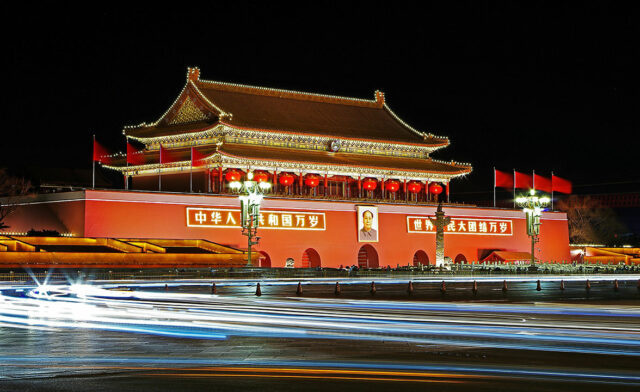
The impact of China’s trade sanctions on the Philippines
(Part 2)

In my previous column on Dec. 30, 2024 (https://tinyurl.com/2arr2vm5), I speculated on how and when China might wield trade as a weapon and eventually de-escalate. In this second installment, I examine the potential impact on the Philippine economy if China were to impose trade sanctions amid escalating maritime and national security disputes. I also explore strategies the Philippines can adopt to mitigate these effects.

Using 2023 trade data from Harvard’s Observatory of Economic Complexity, I outline three scenarios. The first considers a targeted sanction strategy in which China applies selective pressure, limiting Philippine exports that it can easily replace while ensuring its own industries remain unaffected. The second examines a more aggressive situation in which trade is reduced by 50%, perhaps triggered by heightened security tensions such as the deployment of US missiles in Philippine territory, an escalation similar to what happened with South Korea in 2017. The third and most extreme scenario envisions a 75% trade reduction, potentially occurring if the Philippines becomes entangled in a direct US-China conflict. These scenarios estimate potential losses in trade volume, job displacement, inflationary pressures and broader macroeconomic consequences.

ECONOMIC IMPACTS
China remains the Philippines’ largest trading partner, with bilateral trade reaching about $41 billion in 2023. Philippine exports to China amounted to $15.3 billion, with imports from China totaling $25 billion. This trade relationship covers a wide range of industries. Electronics and semiconductors dominate exports, accounting for 38% of total shipments, followed by nickel ore, refined copper and agricultural products. On the import side, China supplies the Philippines with electronic components, fertilizers, steel, chemicals and consumer goods — inputs that are vital to the country’s manufacturing and construction industries. Any disruption in these sectors would have cascading economic effects.

If China were to impose selective sanctions, focusing on curtailing imports of electronics, agricultural goods and low-value exports, the Philippine economy could face a $6-billion loss. The hardest-hit industries would include electronics manufacturing, agriculture and consumer goods, with about 250,000 jobs at risk. The strategy would allow China to exert significant economic pressure while minimizing harm to its own industries, avoiding disruptions to imports of raw materials like nickel and copper that remain essential to its production lines.

If trade restrictions escalated to a 50% reduction, the economic impact would be far more severe. In this scenario, Philippine trade losses could exceed $20 billion, affecting nearly 882,500 jobs. The repercussions would extend beyond the immediate loss of export markets, affecting supply chains, logistics, retail and financial services. The electronics sector, concentrated in industrial hubs such as Cavite, Laguna and Batangas, would see significant contractions, with job losses climbing to 145,000. A deeper cut of 75%, as might happen if the Philippines became involved in a US-China military confrontation, would push trade losses past $30 billion and displace over 1.3 million workers, leading to profound disruptions in key industries.

SECTORAL IMPACTS
The electronics sector would be one of the first to suffer. As the largest export category to China, accounting for 38% of total shipments, any disruption in demand would have immediate consequences for manufacturing firms in export processing zones. A reduction in trade would not only affect factory workers but also ripple across the entire supply chain, including logistics companies, component suppliers and supporting industries. The mining sector, while somewhat shielded under a targeted sanction strategy due to China’s ongoing need for nickel and copper, would still face significant setbacks under broader trade restrictions. If Chinese purchases of Philippine minerals fell by half, about 32,500 jobs would be lost, increasing to 49,000 in a 75% trade reduction scenario. The impact would be particularly severe in mining-dependent regions such as Caraga and Northern Mindanao, where entire communities rely on mineral exports.

Agriculture, which is often overlooked in trade discussions, would also suffer significant consequences. The banana industry, heavily reliant on Chinese markets, would be among the first to feel the strain. A 50% reduction in banana exports could cost 19,000 jobs, climbing to 28,000 if trade were cut by 75%. The loss of the Chinese market would create an oversupply, driving prices down and hurting small farmers and plantation workers in the Davao region. While alternative markets exist, they are unlikely to absorb the excess volume quickly enough to prevent severe financial losses. However, given that Davao is the political base of the Dutertes, China may choose to leave this sector untouched for political reasons.

Beyond goods exports, the tourism industry has already been affected by shifting trade and diplomatic tensions. In 2019, about 1.7 million Chinese tourists visited the Philippines, making them a key driver of the hospitality sector. By 2024, that number had dropped to just over 300,000, a sharp decline compared with neighboring countries that have rebounded more quickly.

BROADER MACROECONOMIC IMPACTS
The trade deficit would widen significantly under all scenarios. In the worst case, it could increase by as much as $8.75 billion, as reduced exports combined with ongoing import needs would put downward pressure on the peso. A weaker currency would, in turn, make imported goods more expensive, further exacerbating inflationary pressures. Inflation, already a major concern for Filipino households, could rise by 1.5% to 3.5% under a 50% trade reduction and by as much as 5.5% in the event of a 75% cut. The consequences would be particularly harsh for low- and middle-income households, for whom rising food and transportation costs constitute a major financial burden. The labor market, particularly in regions dependent on trade-related industries such as Metro Manila, Calabarzon, Central Luzon and Davao, would also experience significant strain, with rising unemployment and limited alternative employment opportunities for displaced workers.

TINIKLING STRATEGY
Navigating these challenges will require a carefully calibrated response — one that can be likened to tinikling, a traditional Filipino bamboo dance that demands agility, precision and strategic timing. Managing the Philippines’ complex economic, security, maritime and diplomatic relations with both China and the United States will require a similar skill and coordination. President Marcos’ recent proposal to de-escalate tensions by withdrawing US missiles from the Philippines in exchange for China’s restraint in the South China Sea is a step in the right direction.

At the heart of this strategy is the need for trade diversification. Overreliance on a single market — whether China or the US — creates significant vulnerabilities. The Philippines should actively expand its trade relationships with other partners to mitigate geopolitical risks. Industrial policy should also evolve. The country’s longstanding role as an assembly hub for electronics and semiconductors leaves it vulnerable to shifts in global demand. While the US military presence in the Philippines is ostensibly meant to protect American and Taiwanese interests, the reality is that most US and Taiwanese investments in the semiconductor industry have gone to other ASEAN countries, bypassing the Philippines entirely.

The potential disruption of imports also highlights the need to secure alternative supply routes. The Philippines imported $4 billion worth of steel from China in 2023, largely because Chinese steel is at least 10% cheaper than that of other suppliers. Similarly, China provides 45% of the Philippines’ fertilizers, and any disruption would push food prices even higher at a time when self-rated poverty is at an all-time high of 63%.

China’s potential use of trade sanctions against the Philippines presents significant economic risks, with severe implications for key industries such as electronics, mining, agriculture and tourism. A sharp reduction in trade could lead to widespread job losses, inflationary pressures and a widening trade deficit, making the economy increasingly vulnerable. The Philippines should respond with a strategic, flexible approach — one that balances diplomacy, trade diversification, industrial policy adjustments and alternative supply chain development. It should also reassess its security assumptions, recognizing that alliances alone do not guarantee economic or geopolitical stability.


Eduardo Araral is an associate professor at the Lee Kuan Yew School of Public Policy, National University of Singapore. This op-ed is written in his personal capacity.
AREIT shares inched down despite PSEi debut

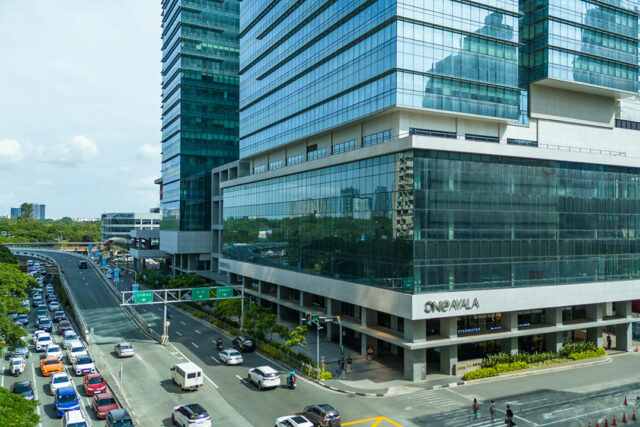
One Ayala East Tower — AREIT.COM.PH

SHARES OF AREIT, Inc. (AREIT) declined slightly last week despite its first-time inclusion in the Philippine Stock Exchange index (PSEi) alongside Chinabank.

Data from the Philippine Stock Exchange showed that the Ayala group’s real estate investment trust (REIT) was the 14th most active stock of the week, with 20.31 million shares worth P801.84 billion changing hands from Feb. 3 to 7.

The company’s shares closed at P39.55 on Friday, 5.8% lower than the P42 closing price on Jan. 31. However, the close was 4.2% higher than the P39.55 closing price on Dec. 27, 2024.

Last Monday, the company entered the PSEi index along with Chinabank, replacing Nickel Asia Corp. and Wilcon Depot, Inc.

As the first and largest publicly traded REIT in the local exchange, AREIT became the first of its kind to join the 30-company index.

“This shows the immense potential REITs have as an investment product and serves as a good example for REIT issuers that aspire to maximize this particular type of listing vehicle,” said PSE President and Chief Executive Officer Ramon S. Monzon in a statement.

“Now that AREIT is part of the PSEi and has gained broader investor attention, we expect it to maintain a steady uptrend,” said Jarrod Leighton M. Tin, equity research analyst at DragonFi Securities, Inc., in a Viber message.

Mr. Tin also said that AREIT’s share price rebounded from weakness following Ayala Land, Inc.’s (ALI) P37-per-share block sale last year, with the stock rallying to P42 on PSEi inclusion expectations after trading below the block sale price.

In December, ALI generated P2.78 billion through a block sale of 75 million AREIT shares priced at P37 each.

ALI holds a 43.33% controlling stake in AREIT.

“Sharp price dips are likely to be short-lived, as investors may accumulate shares when AREIT’s dividend yield becomes more attractive relative to the current risk-free rate,” Mr. Tin added.

Jash Matthew M. Baylon, analyst at First Resources Management and Securities Corp., said that AREIT’s entry “is like placing the company in the stock market spotlight.”

“We believe that this would further strengthen investor interest in the stock, especially vis-à-vis other REITs, as this supports the company’s strong financial performance, which would then translate to consistent dividend payouts moving forward,” Mr. Baylon said in a Viber message.

“Notably, AREIT surged 7.69% to P42 on the final day of the PSEi rebalancing, driven by a mark-on-close rally as fund managers rushed to acquire shares for index-tracking portfolios,” said Mr. Tin.

On Feb. 3, the PSEi plunged by 4.01% or 245.07 points, its lowest finish in 27 months, due to the index rebalancing.

“This significantly contributed to the large sell-off across the board as other index stocks decreased in weight allocation. This means that more funds have flowed into AREIT, making it more attractive,” said Mr. Baylon.

Mr. Baylon also said that the increasing condo oversupply in the real estate industry may negatively affect the stock’s performance.

Vacancy levels for office spaces rose to 19.7% as of the fourth quarter of 2024, driven by move-outs from the business process outsourcing sector, corporate occupiers, and Philippine offshore gaming operators, property services firm JLL Philippines said last Wednesday in a briefing.

AREIT’s portfolio as of the third quarter of 2024 consists primarily of office properties at 76%, complemented by retail (11%), industrial land (7%), and hotels (6%).

Its assets are concentrated in the Makati CBD (61%), other areas in Metro Manila (14%), Cebu (12%), other areas in Luzon (11%), and other areas in the Visayas (1%).

AREIT’s investment properties are composed of 20 stand-alone buildings, five mixed-use properties, nine condominium office units, and land parcels.

For the third quarter, the company’s revenues grew by 42% to P2.89 billion from P2.03 billion last year. AREIT also posted P1.96 billion in net income, 58.9% higher than P1.23 billion in the third quarter of 2023.

For the January-September period, AREIT’s revenues soared by 47.4% to P4.82 billion from P3.27 billion last year. Likewise, the company’s net income grew by 42.3% to P7.12 billion from P5 billion during the same period last year.

“We forecast AREIT’s core net income to grow by 46.83% to P7.2 billion in 2024 (full year) and by 14.98% to P8.3 billion in 2025 (full year), driven by revenue recognition from its 2024 property infusions, which expanded its GLA from 918,710 square meters (sq.m.) in 2023 to 3,892,204 sq.m.,” said Mr. Tin.

“We forecast AREIT’s revenue for the full year 2024 to rise by 40%, amounting to P9.90 billion, higher than the previous year’s revenue of P7.14 billion,” said Mr. Baylon.

Mr. Tin pegged support for the stock at P38 and resistance at P40.45.

“At the P38 level, this implies a 6.14% dividend yield for 2025F, aligning closely with the current 10-year BVAL rate of 6.12%,” said Mr. Tin.

“We consider P38.00 as the support, while the new 52-week high at P42.00 per share is the resistance,” said Mr. Baylon. — Pierce Oel A. Montalvo

Strength in numbers

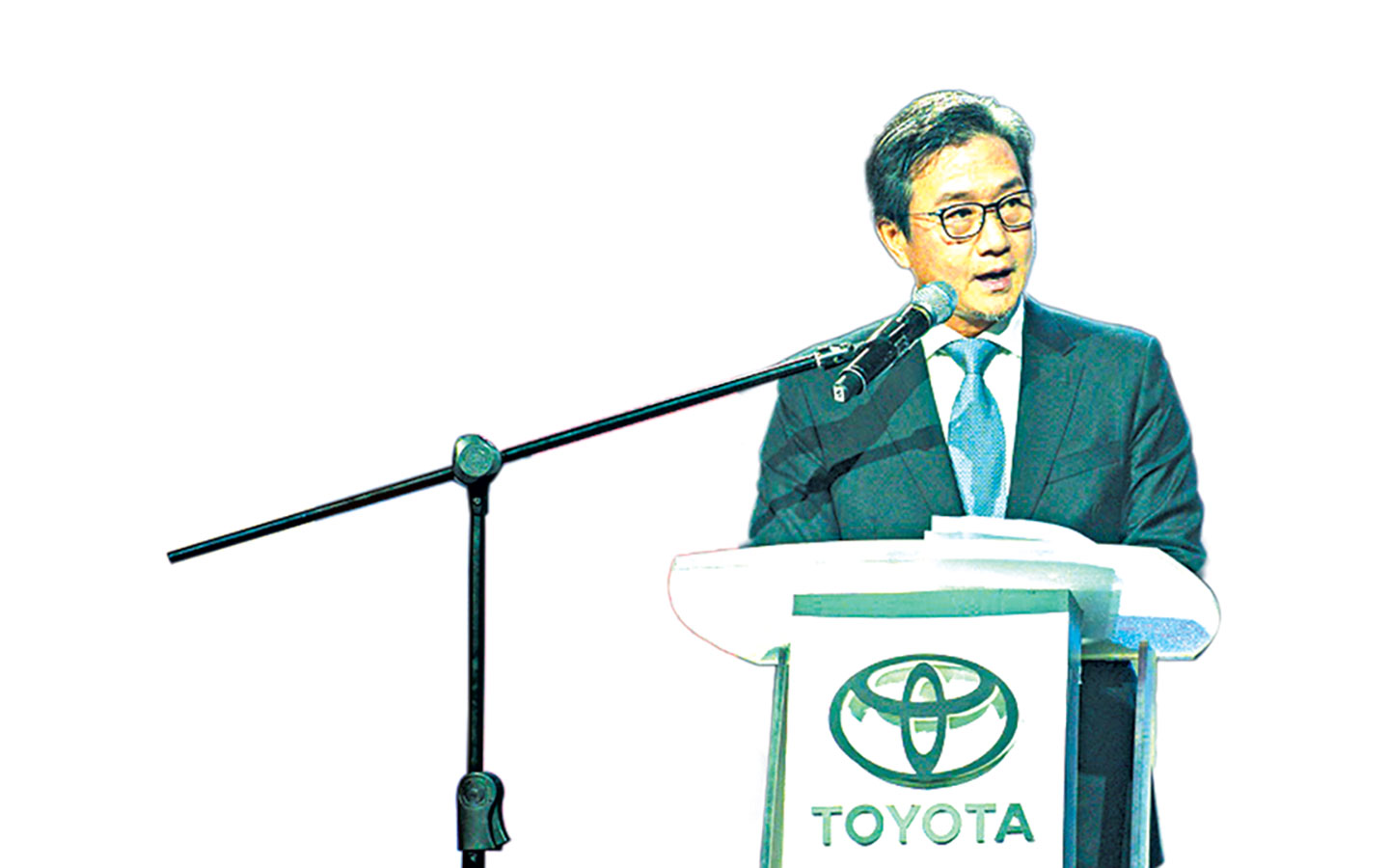
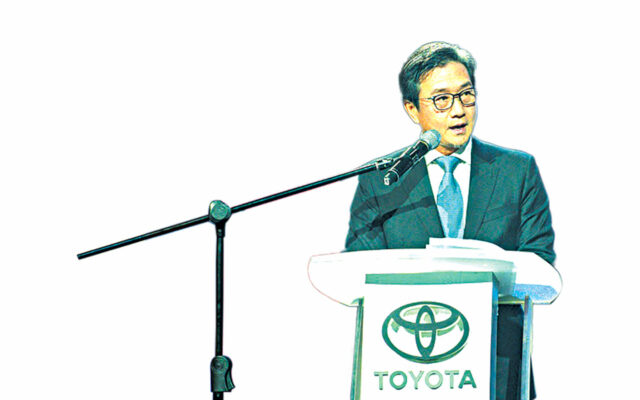
Toyota Motor Philippines Chairman Alfred V. Ty speaks at the recent media thanksgiving party of the company. — PHOTO BY KAP MACEDA AGUILA

AND SO IT GOES: The Philippine auto industry is giddy over the sales results in 2024. Car makers in the country are taking turns hosting thanksgiving events to express appreciation for the gains made. There is much to celebrate, really.

The Chamber of Automotive Manufacturers of the Philippines, Inc. (CAMPI) and Truck Manufacturers Association (TMA) reported sales of 467,252 units, just shy of their projection of 468,000. This represents growth of about 9% versus the 429,807 units sold in 2023 and is the highest-ever mark for both associations.

On the other hand, Toyota Motor Philippines (TMP) leadership reported that the Philippine auto market may have, in fact, achieved a new all-time sales record of 474,000 units in 2024. This beats the previous record of 473,000 units in 2017. In its count, TMP includes sales of both CAMPI and TMA, along with the reckoning of the Automotive Vehicle Importers and Distributors (AVID) and some members of the Electric Vehicle Association of the Philippines (EVAP).

There were a lot of big movers in 2024. Among the Japanese makes, Toyota retained its market leadership, with sales growing by 9% to 218,019 units. Mitsubishi grew faster than the industry average, increasing sales by 13.7% to 89,124 units. Compared to sales of 53,211 units in 2022, its growth is even more remarkable at 67.5%. Honda sales grew by 11.4%, Suzuki by 10.4%.

The Korean auto brands also posted significant growth. Hyundai reported sales of 12,023 units (+31.7%), while Kia recorded an uptick of 33% to 6,692 units.

Of course, Chinese brands also grew significantly in 2024. MG — whose distribution in the Philippines was taken over by parent SAIC Motor — reported sales of 9,016 units, up 59% from the previous year’s 5,679 units. GAC Motor Philippines — distributed by Astara Philippines — recorded even larger growth of 65.1% on sales of 3,207 units. The biggest gain belongs to electric vehicle specialist BYD. BYD Cars Philippines and ACMobility (the official distributor of BYD passenger vehicles in the country) sold 4,780 units reportedly, representing a whopping 8,900% uptick from the 2023 figure.

Indeed, the 2024 sales reports augur very well for the auto industry in the Philippines. It has clearly put the country back on track toward motorization, following the disruption by the COVID-19 pandemic. Given the economic growth targets of government, it is likely that the importance of the auto sector to national development will continue to rise. In fact, the pronouncement of the government of its aim to strengthen the manufacturing sector opens a clear opportunity for automotive manufacturers. As the market continues to expand its scale and more automakers take interest in entering the Philippines, it seems timely for the industry to leverage its collective strength in the pursuit of a unified program that can significantly drive economic development for the country. This was the call made by TMP Chairman Alfred V. Ty at a recent media gathering.

“As the Philippine auto market continues to expand, I am very much encouraged by the added possibilities this growth brings with it. The auto industry is truly transforming into a major pillar of economic development,” he said. “The rapid and significant influx of automakers is a very welcome indicator. The one thing that attracts automakers the most to any market is increasing sales volumes,” he continued. Mr. Ty believes that as motorization progresses, new opportunities open for local manufacturing. “I am a strong advocate of ‘gawa ng Filipino para sa Filipino,’ so this is a very welcome prospect for nation-building. More important than the records set, the expanding market reflects a thriving domestic economy, and a nation and a people on the move,” the executive concluded.

In 2024, the growth in Toyota sales allowed TMP to secure over 69,000 jobs for Filipinos, contribute P35 billion to government revenues, and realize over US$1 billion in auto parts exports for the Toyota group. Given that Toyota accounts for over 40% of the market, Mr. Ty estimates that the whole auto industry could have very well contributed almost twice as much to the Philippine economy, making the automotive sector a very significant contributor to economic development. It is estimated that there are about 12 automotive OEs represented in the country, distributing around 60 different brands and more than 400 models on the road.

In a similar recognition of the growing importance of the Philippine auto market, Mitsubishi Motors (Japan) Executive Vice-President Tatsuo Nakamura announced in April 2024 the new sales record for Mitsubishi in the Philippines in fiscal year 2023. At that time, he mentioned that Mitsubishi Motors “will concentrate management resources to growth drivers,” including the Philippines. He noted that the new car market in the country has been growing rapidly along with the growth rate of the population and economy, and is expected to continuously grow further in the midterm.

Toyota and Mitsubishi are the two largest local producers of motor vehicles in the country. Other makers that maintain production operations in the country are Isuzu, Hino, Foton and some Chinese truck manufacturers.

Looking ahead, TMP projects industry sales of 512,000 units in 2025, up by 8% versus 2024. Main drivers will be GDP growth of over 6%, a sound financial sector with a growing consumer loan portfolio, expanding OFW remittances and BPO earnings, sustained government and private infrastructure spending, and incremental economic demand from election-related spending.

Other auto makers have also expressed similar optimism in the growth prospects for the Philippines. These expressions of confidence are heartening and are, hopefully, harbingers of a more concerted effort among automakers and the government toward nation-building. It is time to harness the combined capabilities and resources of the entire auto sector into a major economic force and manufacturing hub in support of the nation’s long-term development plans.

Ferragamo family seeks to send message of stability after CEO Gobbetti’s exit

FERRAGAMO’S founding family has sought to reassure staff this week that it remains committed to the luxury group after Monday’s surprise news that Chief Executive Officer (CEO) Marco Gobbetti was leaving, a person with knowledge of the matter said.

Italy’s Ferragamo, which has been struggling to revitalize its product offering and sales, has long been seen as a potential merger and acquisition target.

While publicly ruling out the idea of a sale, the Ferragamo family has in the past explored the idea of reducing its stake, sources have previously told Reuters.

For now, the family’s focus is on steadying the group after Mr. Gobbetti’s departure next month barely three years into his tenure, according to the source.

A second source close to the matter confirmed the family was not currently looking at a sale.

During Mr. Gobbetti’s tenure, sales decreased by roughly 10% and shares lost around two-thirds of their value, with the lack of marked improvements stoking tensions between the Ferragamos and the former Burberry chief, the person and another source said.

A lack of communication between the manager and stakeholders compounded problems, with the Ferragamos feeling they had little clarity on the group’s turnaround prospects, the two sources said.

Asked for a comment, Mr. Gobbetti and Ferragamo referred to this week’s press release on the CEO’s departure, which they said was mutually agreed.

In 2022, Mr. Gobbetti had promised a quick turnaround, vowing to increase investments, revamp stores and attract younger customers to double revenue to almost 2.3 billion euros ($2.4 billion) by 2026. Sales dropped 8.2% last year to 1.03 billion euros.

The Florentine group’s market capitalization dwindled to 1.2 billion euros, with Ferragamo’s shares underperforming the broader European luxury sector.

FERRAGAMO’S DECADE-LONG OVERHAUL
Worse hit than others by the COVID-19 pandemic due to its relatively bigger exposure to China, Ferragamo failed to take advantage of the rebound driven by pent-up demand, and is now grappling like the rest of the industry with cooling demand.

“Having only one brand and being focused on a limited number of categories contributed to exacerbating the crisis,” said Carlo Alberto Carnevale Maffe, a Strategy and Entrepreneurship professor at SDA Bocconi School of Management.

Ferragamo has been working on a revamp for almost 10 years during which two other CEOs have left the group.

In 2018 Eraldo Poletto, appointed to succeed long-standing boss Michele Norsa as CEO, stepped down after less than two years in the wake of the company saying that it could not stand by its medium-term targets.

Micaela Le Divelec Lemmi, a former Gucci executive, was appointed as the group’s new CEO a few months later, but lasted only until 2021.

In every crisis, the family has turned back to trusted former CEO Michele Norsa for help with the transition. Mr. Norsa will be part of an advisory committee including James Ferragamo and former general manager Ernesto Greco which will assist Chairman Leonardo Ferragamo until a new CEO is found. — Reuters

KMC Savills expanding services amid optimism

JOE CURRAN

By Revin Mikhael D. Ochave, Reporter

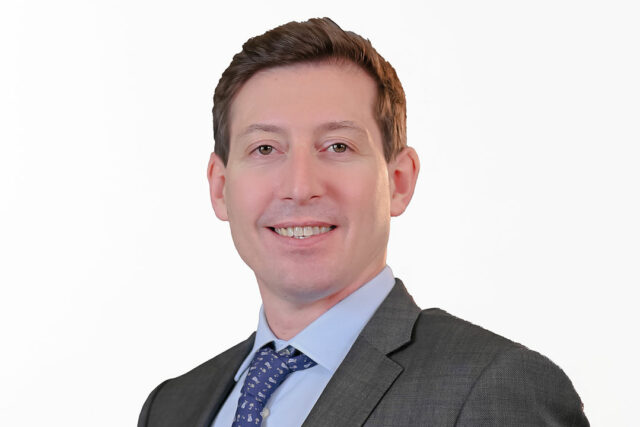
THE PHILIPPINE real estate sector holds significant growth potential and is well-positioned to maintain its competitive edge in the regional property market, according to KMC Savills, Inc. Chief Executive Officer (CEO) Joe Curran.

“The appetite is there. The demand is there. There’s really a bright horizon for property development in the Philippines because there is so much room to improve,” Mr. Curran said in an interview with BusinessWorld.

KMC is a real estate services company headquartered in Bonifacio Global City. It is the exclusive international affiliate of Savills, a global real estate services provider listed on the London Stock Exchange.

“There are some great developers here who have great ambition and who really want to bring world-class products — be they hospitality, office, or residential — to this country,” he added.

Mr. Curran was appointed CEO of KMC Savills in January 2024, bringing with him more than 20 years of experience in the real estate industry.

He previously served as country manager for Cushman & Wakefield in the Philippines and as executive vice president of KMC Savills’ sister company, KMC Solutions, Inc., which operates in the flexible workspace sector. Mr. Curran also held the role of associate director at the commercial real estate services firm CBRE.

“Even though I have the title of CEO, it’s still about client engagement. That’s the highest and best use of my time — working with agents, engaging clients, and driving business growth,” Mr. Curran said.

“We continue to expand our service lines, particularly in facilities management and property management. We’re very bullish on Metro Manila and the regions,” he added. KMC Savills provides services such as tenant and landlord representation, investments, research and consultancy, valuation, project marketing, property management, facilities management, and project management.

Mr. Curran also highlighted the positive impact of ongoing infrastructure projects such as the Metro Manila Subway in enhancing the country’s competitiveness relative to neighbors like Vietnam, Singapore, and Thailand.

“These large infrastructure projects are upgrading ports, roads, and airports — not just in Metro Manila but also across the Visayas and Mindanao. The mass transportation systems underway in Metro Manila can be game-changers by enabling people to live farther north or south, unlocking new economic potential,” he said.

“The Philippines is a fabulous talent pool — English-speaking and with a large population. Some of the key ingredients for growth are already here,” he added.

The infrastructure projects, Mr. Curran said, will also support growth beyond central business districts (CBDs).

“It’s important to decentralize from the core CBDs to areas like Bulacan and the South Luzon Expressway corridor,” he said.

“Cities such as Cagayan de Oro, Puerto Princesa, and Dumaguete also show potential. These regional growth centers are predominantly driven by local talent pools. It’s really labor-driven,” he added.

Mr. Curran noted that decentralization would benefit expanding companies, particularly in the business process outsourcing sector, by reducing attrition rates.

“In regional locations, there’s less poaching and attrition. Being one of only a few choices in town gives companies an edge, unlike in Ortigas, where job opportunities abound,” he explained.

“Another challenge is the quality of office buildings in these areas, but many local developers are prepared to address this,” he added.

KMC Savills also aims to improve the quality of developments and the end-user experience.

“Filipinos, especially the younger generation, are exposed to international cultures and want integrated townships, better public transportation, bike tracks, greenways, and parks here at home,” Mr. Curran said.

“Our role as service providers is to facilitate these improvements, unlock value, and collaborate with both local and international stakeholders,” he said.

KMC Savills and its project management design-and-build arm, T1, employ more than 500 professionals in the Philippines.

T-bill, bond rates may drop as market sees BSP cut this week

BW FILE PHOTO

RATES of the Treasury bills (T-bills) and Treasury bonds (T-bonds) to be auctioned off this week may continue to decline with the Bangko Sentral ng Pilipinas (BSP) expected to deliver its fourth straight rate cut this week.

The Bureau of the Treasury (BTr) will auction off P22 billion in T-bills on Monday, or P7 billion each in 91- and 182-day papers and P8 billion in 364-day debt.

On Tuesday, the government will offer P30 billion in reissued 10-year T-bonds with a remaining life of seven years and seven months.

T-bill and T-bond rates may track the broad decline in secondary market yields amid expectations of another cut by the Monetary Board at their policy meeting on Thursday, Rizal Commercial Banking Corp. Chief Economist Michael L. Ricafort said in a Viber message.

The bonds to be auctioned off on Tuesday could attract strong demand and fetch rates ranging from 5.925% to 5.975%, a trader said in an e-mail.

“The local bond market’s posture leans toward a rate cut [this] week. If US labor data come within expectations, expect more buying action leading up to the Feb. 13 Monetary Board meeting,” the trader said.

At the secondary market on Friday, yields on the 91- and 182-day T-bills went down by 10.89 basis points (bps) and 2.6 bps week on week to 5.1697% and 5.4959%, respectively, based on PHP Bloomberg Valuation Service Reference Rates data as of Feb. 07 published on the Philippine Dealing System’s website. On the other hand, the 364-day T-bill inched up by 0.83 bp week on week to yield 5.7201%.

Meanwhile, the 10-year bond saw its yield go down by 11.1 bps week on week to end at 6.1178% on Friday, while the rate of the seven-year debt, the tenor closest to the remaining life of the T-bonds to be auctioned off on Tuesday, dropped by 8.63 bps to 5.9968%.

A BusinessWorld poll conducted last week showed that 19 out of 20 analysts expect the Monetary Board to reduce the target reverse repurchase rate by 25 bps at its meeting on Thursday.

If realized, this would mark the BSP’s fourth straight 25-bp cut since August and would bring the policy rate to 5.5% from 5.75% currently.

BSP Governor Eli M. Remolona, Jr. has said that a rate cut is “on the table” at this week’s policy meeting.

Mr. Remolona said they may slash benchmark interest rates by 50 bps this year as “policy insurance” against risks, with the cuts likely to be done in 25-bp increments each in the first and second half.

Last week, the BTr raised P27.6 billion at its T-bill auction, higher than the P22-billion plan, as total bids reached P70.649 billion, more than thrice as much as the amount on offer.

Broken down, the Treasury borrowed P9.8 billion via the 91-day T-bills, higher than the programmed P7 billion, as tenders for the tenor reached P27.95 billion. The three-month paper was quoted at an average rate of 5.101%, down by 1.2 bps from the previous auction, with accepted rates ranging from 5.05% to 5.123%.

The government also made a P9.8-billion award of the 182-day securities, above the P7-billion plan, as bids stood at P22.35 billion. The average rate of the six-month T-bill stood at 5.477%, 1.1 bps lower than the previous auction. The tenders accepted by the BTr carried rates of 5.418% to 5.518.

Lastly, the Treasury raised P8 billion as planned via the 364-day debt papers as demand for the tenor totaled P20.349 billion. The average rate of the one-year debt decreased by 5.3 bps to 5.671%, with bids accepted having rates of 5.6% to 5.72%.

Meanwhile, the reissued bonds to be offered on Monday were last offered on Jan. 14, where the Treasury raised P30 billion as planned at an average rate of 6.249%, lower than the 6.75% coupon rate.

The BTr is looking to raise P203 billion from the domestic market this month, or P88 billion from T-bills and P115 billion from T-bonds.

The government borrows from local and foreign sources to help fund its budget deficit, which is capped at P1.54 trillion or 5.3% of gross domestic product this year. — A.M.C. Sy

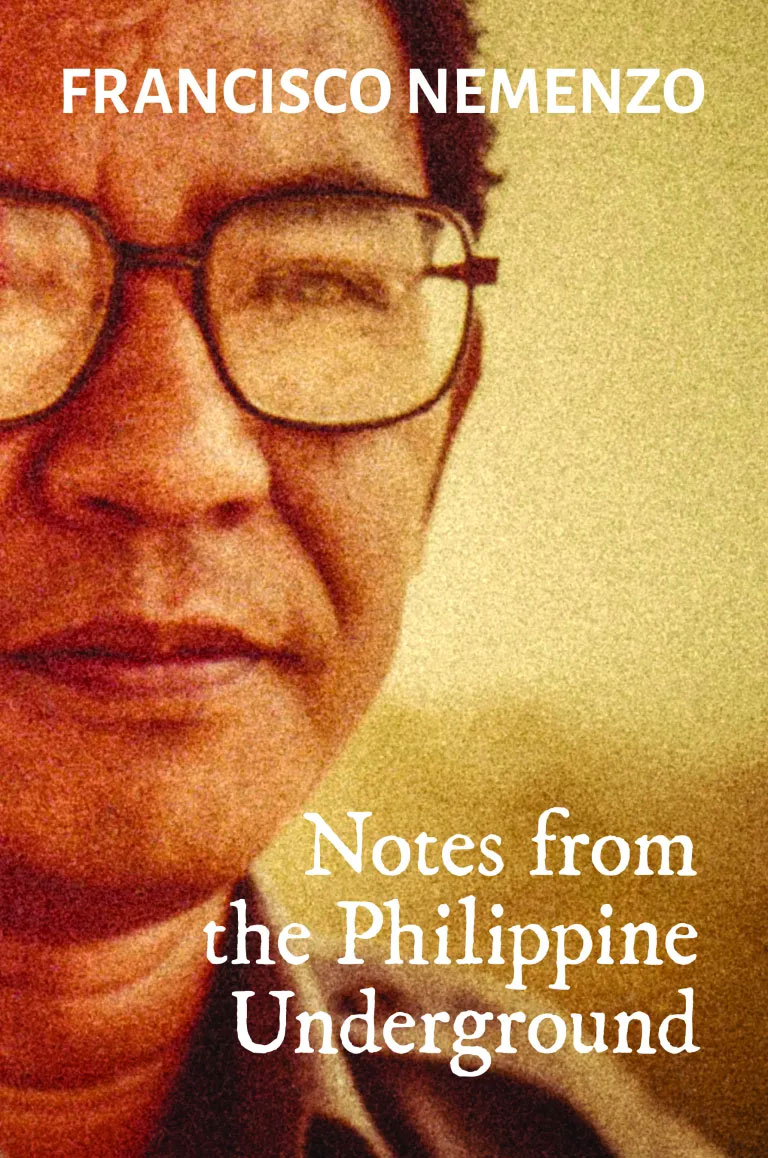
Francisco Nemenzo’s Notes from the Philippine Underground

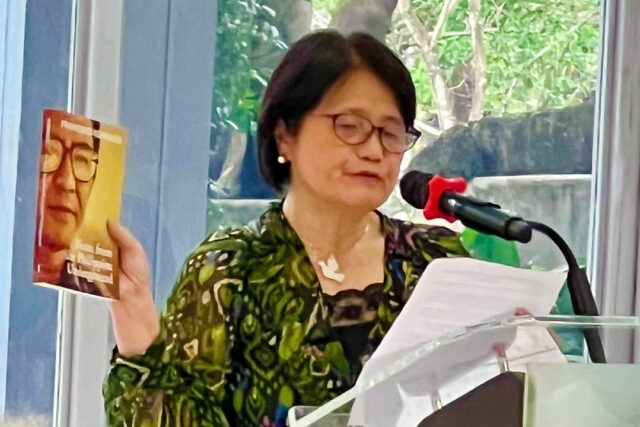
FIDES LIM delivering a message at the launch of Francisco Nemenzo’s Notes from the Philippine Underground at the UP Vargas Museum on Feb. 8.

If there is a chapter in this book of 345 pages that you should read, let it be the first chapter, “Turning Left.”

In 1999, Dodong writes, the University of the Philippines (UP) Board of Regents interviewed him for the UP presidency position, and I quote:

“They asked me point-blank if it was true that I was a Communist. I said, ‘Yes, with a small letter ‘c,’ meaning I remain a Marxist, but I do not belong to the Communist Party of the Philippines or the Partido Komunista ng Pilipinas. I had severed my ties with the PKP. If elected president, I will take no orders from any external group. The university will be my singular concern.”

This statement speaks volumes about an unabashed, unapologetic communist, with a “small c,” who was able to occupy a high national office, the only one to ever do so at that time in this benighted land of McCarthy witch-hunting, while keeping his ideals and integrity intact, pioneering programs to foster a UP renaissance as he continued his own organizational endeavors.

Dodong Nemenzo’s book on his “quest for relevance,” which led him to embrace socialism, is a fascinating read of 13 chapters, each an essay or lecture, split into three main sections — histories, political conjunctures and perspectives. But the book is greater than the sum of its parts as the author himself transcended the limits of the academic world and any single organization.

I was one of Dodong’s students in the general education courses on social and political thought during martial law. And fortunate to have done so as he made us read the classic philosophers and political thinkers from Plato to Machiavelli to Marx, and of course, Mao, whom he less revered and sharply critiqued. Mao Zedong thought was also the greatest divide which, as he admitted, caused him to diverge paths from his best friend Joe, or Joma as Jose Maria Sison is more widely known.

I once thought that Dodong had recruited Joma into the Communist Party. I was surprised to learn from both that it was the other way around. As Dodong writes, in February 1965, Joma extended an invitation to Dodong from the PKP, which elevated him afterward to the Provisional Central Committee. Also, it was Joma’s wife, Julie, who bridged Dodong and Princess with William Pomeroy and Celia Mariano, PKP officials who went into political exile in England during the time that Dodong and Princess studied there.

Let me add: In March 2024, nine months before he died, Dodong told his close comrade, Ed Tadem, that he regretted not joining Joma in the formation of the CPP. (By the way, Feb. 8, 2025, the date of the launching of Notes from the Philippine Underground, would have been Joma’s 86th birthday, and Feb. 9 would have been Dodong’s 90th.)

Indeed, this anthology is more than just a collection of essays on political history. To relate something I read on Cervantes’ Don Quixote, it isn’t just a book. It’s a journey into the heart of what it means to dream, to stand up for what you believe in, no matter the cost, and to see the world not as it is, but what it could be.

Yet Dodong was not simply tilting at windmills or solely fixated on his real-life Princess. Despite the ordeal of political imprisonment during martial law and trumped-up rebellion charges in 2006, he remained forever a teacher and a unifier as he mentored diverse groups, from idealistic students to disillusioned activists to disgruntled officers, and rose above differences to join national democratic forces in a broad united front against the fascist dictatorship and to work with his old friend Joma during peace negotiations.

So, here’s to the dreamers, the activists, the revolutionaries who dare to think differently and never give up to make the world a better place. Before I end, together with my husband Vic Ladlad, I want to say a heartfelt thank you to Dodong and Princess for their unwavering support for political prisoners.


Fides Lim is a writer, editor and spokesperson of Kapatid–Families of Political Prisoners, and a fellow of Action for Economic Reforms.

PHL working to address US fears about coconut oil health impact

By Justine Irish D. Tabile, Reporter

THE Department of Trade and Industry (DTI) said it may propose a joint study with the US to follow up on lingering fears about coconut products even after the withdrawal of US health warnings against coconut oil as a saturated fat.

Export Marketing Bureau Executive Director Bianca Pearl R. Sykimte said issues continue to cast doubts about coconut despite the US Food and Drug Administration’s (FDA) removal of coconut from the list of tree nuts classified as major food allergens.

“For the US (we had) the health warnings against coconut oil as saturated fat, and for the European Union (EU) , we have the forthcoming EU regulation on mineral oil saturated hydrocarbons and mineral oil aromatic hydrocarbons limits on Food,” she said via Viber.

She said the US and the Philippines vary in their approaches to gauging the health effects of coconut oil.

“It seems that American and Philippine doctors are looking at different parameters to gauge the health effects of consuming coconut oil,” she said.

To address this, she said the Philippines proposed a joint study on the health effects of consuming coconut oil.

The US is the largest export destination for Philippine coconut food-based products. It accounted for $556.29 million, or 25.68% of all exports, in the first 11 months of 2024, the Export Marketing Bureau reported.

The first 11 months’ coconut product exports were up 65% from a year earlier.

According to Ms. Sykimte, the DTI is expecting coconut exports to the US to grow further.

The removal of the FDA designation “will give both consumers and producers more confidence in using or consuming coconut or coconut-based products, especially for consumers who have nut allergies,” she said.

“We had an experience where we were promoting coconut in the US. There were a lot of inquiries, especially from producers of gluten-free and allergen-free products, but they didn’t follow through when they learned that the US FDA considers coconut a tree nut. (A joint study) will really have a commercial impact,” she added.

United Coconut Associations of the Philippines (UCAP) Executive Director Yvonne T.V. Agustin said that the US removal of the allergen tag on coconut is a positive development for the industry.

“This will positively impact our coconut food product exports. To consumers, manufacturers, and end users of coconut, this will ensure that including coconut as an ingredient in food formulations is safe and will not cause an allergy,” she said in a Viber message.

Charles R. Avila, president of the Confederation of Coconut Farmers’ Organizations of the Philippines, said that the declaration’s immediate impact on individual consumers should not be underestimated.

“So many of them have habitually assumed that avoiding coconut is another way of avoiding carcinogenic food products. This news, then, is welcome to coconut producers. It’s certainly a case of ‘better late than never,’” he said via Viber.

In the late 1980s, he said that coconut was under attack due to lobbying from vegetable oil producers.

“The truth ultimately triumphed in the US Senate, which rejected the proposed labeling law that would have universally carried the insidious caveat that coconut is bad for the heart,” he said.

“But massive propaganda against coconut, which was the exact opposite of the truth, prevailed in the minds of so many consumers,” he added.

To address this, he said that the coconut industry must find ways to advertise coconut again and to erode the carcinogenic perception of coconut.

“Otherwise, it would be tragic for consumers who otherwise could be helped in their health concerns by medicinal and healthful coconut products, and for the millions of coconut farmers and traders who otherwise would be able to sell more in the global market,” he added.

The coast is clear

Para swimmer Ernie Gawilan pitches in to plant mangrove saplings on Samal Island. — PHOTO FROM TOYOTA MOTOR PHILIPPINES

Paralympic swimmer Ernie Gawilan and Toyota show us how it’s done

I HAVE a special fondness for the first few months of every year. I love how most of us can be generally more relaxed and retrospective about the year that had just passed. In the realm of motoring, it is during this time that I like to look back and recount the efforts automotive brands have made to make a positive difference in the country.

And very fresh in my mind was the time last December that I joined Toyota Philippines and Filipino Paralympic athlete Ernie Gawilan on a trip to Samal Island in Davao, to participate in a community coastal cleanup and mangrove planting project.

As many know, Toyota Motor Philippines (TMP) has long been recognized not only for its automotive excellence, but also for its strong commitment to social responsibility. Through various environmental initiatives, the company continuously seeks to make meaningful impact in the communities it serves. This dedication has clearly been amplified through its ongoing campaign, “Start Your Impossible,” which empowers individuals to overcome personal challenges and start driving change even beyond the world of mobility.

The Japanese-headquartered company’s “Start Your Impossible” campaign is profoundly tied to Toyota’s partnership with the Olympic and Paralympic games, underlining the brand’s commitment to sustainability, innovation, and inclusivity. Hence, it is easy to see why Paralympic swimmer Ernie Gawilan is one of the faces of the Philippine “Start Your Impossible” initiatives.

As the Philippines ranks among the world’s top contributors of plastic waste thrown into the oceans, the detrimental effects on our marine ecosystems are dire — severe enough to harm biodiversity, endanger livelihoods connected to the oceans, and enough to further the impact of climate change. Having said that, Ernie Gawilan tries his best to bring further awareness about the matter to his fellow Filipinos, and TMP has been very happy to assist him in this regard.

In recognition of our country’s bad state of coastal pollution, Toyota Motor Philippines spearheaded a nationwide environmental movement with its “Start Your Impossible National Coastal Cleanup and Mangrove Planting Day” held last Dec. 14. The large-scale initiative simultaneously mobilized thousands of volunteers across 33 locations in the country to collect waste from coastal areas and to plant mangrove seedlings to help rehabilitate marine ecosystems. Ernie Gawilan — being a talented man who, despite being born with congenital limb deficiencies and only one complete arm, continued on to become an amazing swimmer — happily led the contingent that conducted the cleanup on the shores of Samal Island, which is the place where he first learned to swim.

Gawilan has defied the odds to become one of Southeast Asia’s most accomplished Paralympic athletes. He made history by winning the first-ever gold medal for the Philippines at the Asian Para Games and has continued to shine in various international competitions, proving that perseverance and passion can break barriers. He has long been a strong and powerful advocate for cleaner waters in the Philippines.

For Gawilan, this environmental initiative holds a deeply personal significance. The waters of Samal Island played a vital role in shaping his journey as an athlete, and he sees this campaign as an opportunity to give back to the place that nurtured his dreams.

“I hope I have inspired many people. Let us all work together to preserve our environment, especially the ocean… because this is where I started,” he shared during the coastal cleanup event. His presence served as a powerful reminder that protecting our oceans is not just about preserving nature, but also about sustaining the communities that rely on it.

The “Start Your Impossible National Coastal Cleanup and Mangrove Planting Day” was a resounding success, with 1,302 volunteers from Toyota Motor Philippines and its dealer network joining forces with local government units and environmental offices. Together, we collected 789 bags of various kinds of waste and debris from the country’s coastlines and planted 10,354 mangrove seedlings to help restore coastal health. Toyota’s all-new Tamaraw was also there to deliver the mangrove seedlings!

TMP Vice-President for Network Sales and Systems Cluster Elijah Sue Marcial acknowledged Gawilan’s inspiring role, stating that “Ernie is a dual hero — we have also been working alongside him in championing cleaner waters through various cleanup and planting projects. This advocacy was chosen personally by Ernie as a way to give back to the communities that supported him toward his dreams.”

Toyota has once again demonstrated how corporate responsibility can extend beyond business and create meaningful societal change. As the company continues its “Start Your Impossible” campaign, it sets an example for other corporations to step up and take part in the fight against climate change and environmental degradation.

For me, the best part of this is that the success of the “Start Your Impossible National Coastal Cleanup and Mangrove Planting Day” highlighted the power of collective action, inspired by someone truly exceptional. With the help of Toyota’s leadership, the dedication of its volunteers, and the advocacy of Ernie Gawilan, the event not only made a tangible difference in cleaning up the country’s shores, but also strengthened the movement for a cleaner, greener and more sustainable future for the Philippines.

Christian Siriano looks to sleek autos at New York Fashion Week

DESIGNER Christian Siriano looked to the automotive world for his Fall/Winter collection at New York Fashion Week, presenting plenty of metallics for both women and men.

Models dressed in shiny jackets and trousers, sleek dresses and voluminous gowns walked down an all-red catwalk with a parked Toyota nearby. Designs nodded to cars with some details appearing as paint slicks, oil slicks as well as tire tracks. Mr. Siriano used plenty of red as well as blue, black and bronze.

“(The collection) was… inspired by a… connection between sexy… automotive design and clothing. So the red… symbolizes for me that iconic red car, that iconic red dress on a red carpet and how those… go together,” Mr. Siriano said backstage.

Mr. Siriano’s show on Thursday took place on the first day of New York Fashion Week, where some 60 labels, including Michael Kors, Carolina Herrera and LaQuan Smith will present their creations. The event runs until February 11.

New York is the first leg of the autumn-winter 2025/2026 catwalk calendar, with buyers and editors then heading to London, Milan and finally Paris to see designers present their latest lines. — Reuters

Is there still hope?

PHILIPPINE STAR/EDD GUMBAN

• In the sphere of morality, we sense widespread confusion, indifference, apathy and helplessness because of murderous attacks against life, particularly against innocent ones. The culture of impunity, self-entitlement and loss of sense of sin is alarming.

• In ecology, we are constantly traumatized by the effects of disasters and tragedies due to climate emergencies, worsened by substandard and underfunded structures. Private interests are protected over the common good and the welfare of the marginalized, including indigenous peoples and poor communities.

• In the area of economy, increasing poverty, manifested by the rise of unemployment and prices of commodities and services, leads to a situation where the rich become richer, the poor become poorer and the powerful become more powerful.

• In the political realm, the scandalous misuse of public funds and resources; the questionable insertions, cuts, and adjustments in the national budget; and anti-poverty programs that promote a culture of patronage and mendicancy are truly disturbing. As the elections draw near, we see how platforms of popularity, dynasty and patronage are again exploited, making politics into a family business.

• In the area of security and international concerns, we witness how our sovereignty and national security are constantly threatened.

• In the field of communications, falsehood, misinformation and disinformation are weaponized against the truth.

• In the area of governance, we wonder whether there are still checks and balances.

May pag-asa pa nga ba? (Is there still hope?)

It might be the frenzied cacophony of voices of many Filipinos nowadays, some angry, some perplexed and incredulous, some crying out in pain in anxieties for what and where the country seems to be recklessly careening towards in the dark future.

The crescendo of protests peaked in two rallies held on Friday, Jan. 31 at the EDSA People Power Revolution monument, along White Plains Avenue in Quezon City. “Among the groups that participated in the rally were Akbayan, Magdalo, Tindig Pilipinas and the family of victims in the Duterte administration’s bloody drug war. Most of them wore white shirts and carried placards and banners calling to oust the Vice President over alleged misuse of confidential funds — an allegation Duterte previously denied,” ABS-CBN News reported that day.

The morning’s program featured a mass, followed by statements from impeachment complainants, sectoral leaders and cultural presentations. Organizers estimated about 10,000 attending the rally. (But police estimate was lower, at about 4,000 attendees as of 11 a.m.).  Another rally at the same EDSA shrine started at 2 p.m., echoing the same call for the impeachment of Vice-President Sara Duterte, while also criticizing the 2025 national budget. It was led by the Clergy and Citizens for Good Governance, the news networks reported.

Yes, the Catholic clergy is now more openly involved in protests against the government and has made more direct calls to action by the people. Priests and nuns have been participating in rallies.  The litany of sins and omissions of the state and political leaders above, and the confluence of economic and socioeconomic challenges, was recited by Pablo Virgilio “Ambo” S. Cardinal David, bishop of Caloocan and president of the Catholic Bishops Conference of the Philippines (CBCP), in a pastoral letter to the faithful, read by parish priests in homilies at Sunday Mass on Feb. 2, the Feast of the Presentation of the Lord Jesus in the Temple.

Is it “hoping against hope?” (c.f. Romans 4:18), Cardinal Ambo asks. “‘Abandon hope all ye who enter here…’ are the haunting words written at the entrance of the descent into hell in Dante Alighieri’s L’inferno… but what Dante was writing about in the context of his time’s political turmoil and moral decay can mirror today’s Filipino people wrestling with hopelessness, striving to find hope amidst adversities,” Cardinal Ambo laments.

“We, your spiritual leaders, share the pain brought about by these wounds of affliction. We, too, feel the deep disturbance and seeming paralysis that plague many who are dragged into the pit of hopelessness. In this Jubilee Year of Hope, together we hold precious, the gift of hope sparked by the Holy Spirit. This hope is not simply optimism or a positive feeling. These are glimpses of the gift of hope that comes from the Holy Spirit urging us to act,” he adds.

“We call upon all leaders, as we fervently remind ourselves, to breathe the spirit of sincerity of God-directed service, breathe transparency and accountability. We call upon our young people, to share your single feather to become your wings for a better world. Stand up for change and responsible leadership for the present and future of our country. We call upon our dear faithful, in government, in business, in public or religious communities, to harness a tempest of change by a sincere witness to our Christian values and fidelity to conscience. May we safeguard our dignity and our future by not selling them to the highest bidder.”

Cardinal Ambo’s pastoral letter May Pag-asa pa nga ba? (Is there still Hope?) is written in the awareness of the Jubilee Year of Hope, 2025, formally opened on Dec. 29, 2024, as declared by Pope Francis in his bull of indiction, Spes Non Confundit (Hope does not disappoint), issued on May 9, 2024 in Rome.

Spes Non Confundit was written in the raging tempests of May 2024. On Feb. 24, 2022, Russia invaded Ukraine in a major escalation of the Russo-Ukrainian war, which started in 2014. The invasion, the largest and deadliest conflict in Europe since World War II, has caused hundreds of thousands of military casualties on both sides, and tens of thousands of Ukrainian civilian casualties.  The Gaza war has been fought between Israel and Hamas-led Palestinian militant groups in the Gaza Strip and Israel since Oct. 7, 2023. The fifth war since 2008 in the Gaza–Israel conflict, it is the most significant military engagement in the region since the Yom Kippur war in 1973, and sparked an ongoing Middle Eastern crisis. The first day of the war was the deadliest for Israel, and it is the deadliest war for Palestinians in the history of the conflict.

The two major wars are still devastating the warring peoples and threatening world peace. “The first sign of hope should be the desire for peace in our world, which once more finds itself immersed in the tragedy of war. Heedless of the horrors of the past, humanity is confronting yet another ordeal, as many peoples are prey to brutality and violence. What does the future hold for those peoples, who have already endured so much? How is it possible that their desperate plea for help is not motivating world leaders to resolve the numerous regional conflicts in view of their possible consequences at the global level? Is it too much to dream that arms can fall silent and cease to rain down destruction and death? The need for peace challenges us all and demands that concrete steps be taken. May diplomacy be tireless in its commitment to seek, with courage and creativity, every opportunity to undertake negotiations aimed at a lasting peace,” Pope Francis prays.

Pope Francis said “uncertainty about the future may at times give rise to conflicting feelings, ranging from confident trust to apprehensiveness, from serenity to anxiety, from firm conviction to hesitation and doubt… (people) are discouraged, pessimistic and cynical about the future, as if nothing could possibly bring them happiness. For all of us, may the Jubilee be an opportunity to be renewed in hope. God’s word helps us find reasons for that hope.”

“We, too, feel the deep disturbance and seeming paralysis that plague many who are dragged into the pit of hopelessness. In this Jubilee Year of Hope, together we hold precious, the gift of hope sparked by the Holy Spirit. This hope is not simply optimism or a positive feeling. These are glimpses of the gift of hope that comes from the Holy Spirit urging us to act, Cardinal Ambo says of our dire situation in the Philippines:

• We see sparks of hope in principle-driven leaders who champion good governance.

• We see sparks of hope in the idealism of young people and responsible citizens who do not sell their idealism and patriotism.

• We see sparks of hope in the spontaneous collaboration among NGOs, civic and religious organizations with the government in times of disasters and calamities.

• We see sparks of hope in local initiatives and efforts to empower communities for change.

We see sparks of hope in public, religious, uniformed and civic leaders, and ordinary laborers committed to sincere service even without recognition or reward.

• We see sparks of hope in responsible business practices that seek to protect the environment and serve the needy.

• We see sparks of hope in those who stake their reputation, even their lives, to fight corruption and pursue justice.

• We see sparks of hope in the Filipino spirit of resiliency, and in those who dedicate themselves to genuine service despite being overwhelmed by their own need.

We sense a strong surge of hope, above all, in the feeling of uneasiness and disturbance — symptoms of an inner affliction,  prodding us that something is wrong, yet at the same time urging us that something can and must be done within, among ourselves, and our institutions…through the Holy Spirit that has been given to us.” (Romans 5:5)

May pag-asa pa ang Pilipinas (There’s still hope for the Philippines).


Amelia H. C. Ylagan is a Doctor of Business Administration from the University of the Philippines.

ahcylagan@yahoo.com

Kia PHL sees stable car prices via South Korea FTA

PHOTO FROM KIA PHILIPPINES

KIA PHILIPPINES said the free trade agreement (FTA) with South Korea will help car manufacturers stabilize product pricing despite foreign exchange risks.

“There’s still going to be excise [taxes], but the import duties would be at zero,” Kia Philippines Chief Operating Officer Brian James B. Buendia told reporters on the sidelines of the launch of the Kia Sorento Turbo Hybrid last week.

When asked if the FTA could lead to lower prices for Korean cars, he noted that apart from import duties, the automotive industry closely monitors foreign exchange movements.

“There’s another issue, which is the forex. The projected forex, and we deal with the US dollar, will be up to $59. So that’s an issue, because when we were doing our budget, it was only at $57-58. So now we have to recalibrate,” he said.

“One opportunity is, yes, we will not lower the price, but we will not increase the price too even with the forex. So those are the things that are actually being studied,” he added.

Despite this, he said that the company is looking at how it can take advantage of the FTA as Kia Philippines expands its electric vehicle (EV) lineup.

“We are now also scanning for some advantages that we can maximize,” he added.

Aside from the FTA with South Korea, he said that the company hopes for the executive order (EO) for the lowered tariffs for all types of electric vehicles to be retained amid its review.

“I think what’s working for Kia now is the current tariffs. Whatever the adjustments that will be made, then we would have to plan for it again,” he said.

“But I hope they just keep it the way it is for now. Because you can’t really change the rules within the game. They just keep on changing. I hope they… just let it pass through 2028, I think,” he added.

Last year, President Ferdinand R. Marcos, Jr. signed EO 62, which modified the nomenclature and rates of import duty on various products.

A part of which covered the expansion of the reduced Most Favored Nation tariff rates of the products covered under EO 12 to other battery EVs, hybrid EVs, plug-in hybrid EVs, and certain parts and components.

It temporarily reduced tariffs on EVs to zero until 2028. — Justine Irish D. Tabile