For a while there, it appeared as if the Celtics would keep the streak of road victories in their semifinal-round series against the Knicks going. That they needed to prevail yesterday was an understatement, and they certainly played with a sense of urgency for the better part of two and a half quarters. The double-digit lead they put up early on the strength of an outstanding effort spearheaded by six-time All-Star Jayson Tatum remained midway through the third period, and there was little to suggest they would not continue to keep the pace for the rest of the match.
Until, that is, the Knicks finally got things to go their way with unrelenting drive. They put the clamps on defense with their trademark hustle and physicality, daring the Celtics to take long or contested — or, often, both — threes and subsequently getting the percentages to go their way. They knew the green and white could not resist the temptation of haymakers even when shots were not falling, and they made sure to consolidate their excellent coverage by securing the rebounds.
Not coincidentally, the Knicks were likewise actively scouring for offensive boards. And the gamble paid off, as the preferential option provided them with 13 more field goal attempts. It helped, of course, that they translated the extra possessions to 12 more baskets off a higher percentage. This gap negated the additional 10 markers the Celtics got from a whopping 26 free throws. That said, the latter may well have kept the scores close were they in the least bit inclined to modify their strategy given the increasing number of blanks they were shooting as the hosts made a run. Instead, stubbornness ruled the day, resulting in a debilitating setback for them.
The Knicks are now up three and one in the series, an unexpected development in the face of their opponents’ supposed superiority. And, it must be said, they’re on the cusp of upsetting the defending champions because head coach Tom Thibodeau has notably run rings around Celtics counterpart Joe Mazzulla. Granted, Clutch Player of the Year awardee Jalen Brunson delivered the goods anew. Still, he knew well enough to get them to leverage their isolation-heavy predilections with crisp passes, enabling such notables as Mikal Bridges, Karl-Anthony Towns, and OG Anunoby to make timely hits.
Now, the Celtics have a dilemma. True, they’ll be hosting Game Five in front of 19,156 rabid fans. On the other hand, they could well be doing so without Tatum, who suffered a non-contact lower leg injury and had to be helped off the court yesterday. Which means Mazzulla will have to earn his keep. Needless to say, he can’t have his charges do the same things that now have them staring at elimination. Else, he runs the risk of losing yet again, and for good.
POSTSCRIPT: The National University Nazareth School proudly claimed both the boys’ and girls’ championships at the National Basketball Association Rising Stars Invitational Philippines Qualifiers, following impressive wins over De La Salle College Antipolo and the University of Santo Tomas. The finals were held last Saturday at the Smart Araneta Coliseum.
With these victories, the NUNS Bullpups and Lady Bullpups are set to represent the Philippines at the NBA Rising Stars Invitational. The league’s first-ever regional high school basketball tournament will take place in Singapore on June 25 to 29, and will feature top boys’ and girls’ teams from 11 Asia-Pacific countries and territories.
Anthony L. Cuaycong has been writing Courtside since BusinessWorld introduced a Sports section in 1994. He is a consultant on strategic planning, operations and human resources management, corporate communications, and business development.
DUBLIN — The US-China deal to lower the most aggressive import tariffs between the world’s two largest economies could lessen the impact of their trade war, though the levies left in place are still steep and will leave a mark on the economy, Federal Reserve officials said on Monday.
Federal Reserve Governor Adriana Kugler said the 90-day pause on import levies at levels that threatened to shut down bilateral trade reduces chances that the US central bank will need to lower interest rates in response to an economic slowdown.
The outcome of the weekend meetings between Chinese and US officials “obviously… is an improvement as far as trade between the two countries” is concerned, Ms. Kugler said at a Central Bank of Ireland symposium in Dublin.
She said the tariff rates, now 30% on Chinese imports for the next 90 days, were still “pretty high” and she expected “definitely an increase in prices and a slowdown in the economy” as a result.
But Ms. Kugler expects those impacts to be more muted. “My basic outlook, in some sense, may have changed in terms of the extent to which we need to use our tools, and the magnitude,” she said.
In separate comments to the New York Times, Chicago Fed President Austan Goolsbee agreed the weekend deal would lower the impact tariffs have on the economy — for now.
“It is definitely less impactful stagflationarily than the path they were on,” Mr. Goolsbee told the paper. Still, that tariff rate is “three to five times higher than what it was before, so it is going to have a stagflationary impulse on the economy. It’s going to make growth slower and make prices rise.”
Investors decreased their bets on Monday that the Fed would cut rates early this summer, with an initial quarter-percentage-point rate cut now not expected until September and only a half-percentage-point reduction in total anticipated by the end of 2025. Prior to the tariff pause agreed over the weekend, Fed rate cuts were expected to begin in July.
But as the Trump administration has seemed to back off its most aggressive tariff strategies, US stocks and market interest rates have risen, and the threat of a tariff-driven recession has diminished.
REPUTATIONAL HIT The Fed’s policy-setting Federal Open Market Committee (FOMC) last week kept its benchmark interest rate in the 4.25%-4.50% range where it had been since December. Policymakers said they were unlikely to make a change until it was clear whether tariffs would lead to a new inflation problem, or undercut growth and pose risks to the job market that warranted a reduction in borrowing costs.
A third possibility — of a negotiated resolution that leads to a more limited jump in inflation and keeps growth largely on track — was highlighted by the trade war detente announced over the weekend.
“Even with this reprieve, tariffs are much higher than they were, so the outlook still involves tariff raising near-term inflation well above 2%,” offering a reason for the Fed to stay on hold, economists with the consulting firm of former Fed Governor Larry Meyers said.
“What this reprieve does is reduce the likelihood that we’ll see a deterioration in the labor market severe enough for the FOMC to ease despite concerns about elevated inflation.”
Ms. Kugler said the trade conflict still could have deep implications for the US, including a reputational hit that could drive investors elsewhere.
“In the medium term, if this was long-lasting, I think the one issue that I would be looking to is how supply chains get rearranged… if in the rest of the world, some start feeling that they don’t find a reliable partner at the other end,” she said.
It is also posing immediate problems for the Fed in even knowing the pace at which the economy is growing, or not, because recent data have been so distorted by firms and households rushing to beat import tariffs.
Output contracted in the first quarter, but that was largely attributed to a record surge in imports.
“It is currently hard to judge the underlying pace of growth of the US economy,” Ms. Kugler said. — Reuters
HANOI — Vietnam is stepping up its fight against counterfeits and digital piracy after the United States accused the country of being a major hub for these illegal activities and threatened crippling tariffs, documents reviewed by Reuters show.
Among products that are subject to increased inspections at borders to ascertain their authenticity are luxury goods from Prada and Gucci owner Kering, electronic devices made by Google and Samsung, and toys from Mattel and Lego, according to a document dated April 1 from the customs department of the finance ministry.
Consumer goods such as shampoos and razors sold by Procter & Gamble and Johnson and Johnson products are also included in the list, the document showed.
The crackdown focuses on imported counterfeits, not those that could be made in Vietnam, which are also of concern to the administration of US President Donald J. Trump.
A clampdown on the use of counterfeit software is also underway, according to a warning from inspectors at the Ministry of Culture sent on April 14 to a local company, whose name was redacted from the document seen by Reuters.
The letter, it says, followed a complaint from the Business Software Alliance (BSA), the industry’s global trade association, whose members include Microsoft, Oracle and Adobe.
A person familiar with the matter said similar letters have been sent to dozens of companies since the start of April.
Vietnam’s finance and culture ministries and the customs department did not reply to requests for comment, nor did any of the mentioned companies.
A spokesperson for BSA said it has for years urged Vietnam to monitor and take action against the unauthorized use of software.
Vietnam’s recent moves are part of an array of measures taken or pledged by the Southeast Asian export-reliant industrial hub to persuade the Trump administration to reconsider punitive tariffs. Vietnam faces duties of 46% on exports to the US, its largest market, if confirmed in July after a global pause.
Vietnam and the US began informal talks to avoid tariffs well before Mr. Trump announced global “reciprocal” duties on April 2.
Enhanced protection of intellectual property, including the fight against counterfeits and digital piracy, is among the issues being discussed with the US in ongoing tariff talks.
Also under discussion are the reduction of Vietnam’s big trade surplus, the fight against trade fraud such as illegal transshipment, and lowering tariff and non-tariff barriers for US businesses, according to a person briefed on the matter.
Prime Minister Pham Minh Chinh last month instructed officials to strengthen the fight against trade fraud, “especially regarding the origin of goods, counterfeit goods.”
The measures are meant to please Washington but some may irk China, which is the main source of Vietnam’s imports.
‘NOTORIOUS MARKETS’ Despite enhanced controls on imported counterfeits, fake luxury goods targeted by the authorities were on display last week at Saigon Square Shopping Mall in Vietnam’s business hub Ho Chi Minh City.
The mall is on the list of “notorious markets for counterfeiting” published in January by the US Trade Representative (USTR).
“They are not authentic and are made in China,” said an attendant in one of the stalls in the market, referring to Prada wallets and bags she’s selling.
She noted counterfeit Prada belts, also available at her stall, were made in Vietnam. The person declined to be named due to the sensitivity of the subject.
Calls to Saigon Square went unanswered. Its website says the mall offers “imitations of famous brands at low prices.”
The USTR removed a Vietnamese marketplace at the border with China from its latest watchlist published in January after a crackdown by local authorities. It praised Vietnam’s efforts to combat illegal practices, but also expressed concerns over continuing online sales of counterfeit products and Vietnam’s role in producing fakes.
The Vietnamese platform of Singapore-based e-commerce giant Shopee remained a major hub for the sale of counterfeits, the USTR said.
“As more brands have shifted production from China to Vietnam, stakeholders report that Vietnam has become a key manufacturer of counterfeit products,” the USTR said in a separate report published in April.
The USTR and Shopee did not reply to requests for comment.
To improve copyright protection Vietnam is planning to set up specialized courts “to fulfil Vietnam’s commitment… to strictly enforce intellectual property rights” and attract foreign investment, according to a draft law reviewed by Reuters scheduled to be approved by parliament in June. — Reuters
PEOPLE react as Palestinians search for casualties at the site of an Israeli strike on a residential building in Gaza City, Oct. 25, 2023. — REUTERS
BEIRUT — Half a million people in the Gaza Strip face starvation, a global hunger monitor said on Monday, saying the Israeli-blockaded enclave still confronts a critical risk of famine with a high risk of one occurring by the end of September.
The Integrated Food Security Phase Classification (IPC)’s latest report cited a significant deterioration in the situation since its last one in October, reflecting warnings from international agencies of an unfolding catastrophe in the small, densely populated Palestinian territory.
It forecast that 2.1 million people across Gaza — roughly the entire population – would likely experience high levels of acute food insecurity by the end of September, with 469,500 of them projected to likely hit “catastrophic” levels.
Israel has sealed off the Gaza Strip since early March when it resumed its devastating military campaign against militant group Hamas following the collapse of a ceasefire deal, during which thousands of aid trucks entered the enclave.
Israeli government spokesperson David Mencer said on Monday the IPC had “constantly talked about famine; famine has never happened because of Israel’s efforts to get more aid in.”
Mencer reiterated Israel’s accusation that Hamas had caused hunger by stealing aid meant for civilians, and had “engineered the humanitarian crisis.”
Hamas denies these accusations and has in turn accused Israel of using starvation as a weapon of war.
The IPC report said that Israeli plans for large-scale military operations in Gaza, along with aid agencies’ “persistent inability” to deliver essential goods and services, meant that there was a “high risk” of famine in the projection period from May 11 to September 30.
Israeli President Isaac Herzog on Monday called on the international community to help with a new plan to distribute aid directly to the people of Gaza and cut Hamas out of the process.
The IPC report said the Israeli authorities’ plan for delivering aid was “estimated to be highly insufficient to meet the population’s essential needs for food, water, shelter and medicine.”
“Moreover, the proposed distribution mechanisms are likely to create significant access barriers for large segments of the population,” it said.
“Immediate action is essential to prevent further deaths, starvation and acute malnutrition, and a descent into famine.”
For famine to be declared, at least 20% of the population must be suffering extreme food shortages, with one in three children acutely malnourished and two people out of every 10,000 dying daily from starvation or from malnutrition and disease.
The report projected that nearly 71,000 cases of acute malnutrition, including 14,100 severe cases, among children aged 6 to 59 months were expected to occur between April 2025 and March 2026.
IPC reports are produced with contributions from United Nation (UN) agencies, non-governmental organizations and other organizations.
DETERIORATION The report “really demonstrates that the situation in Gaza has deteriorated quite dramatically in recent months,” said Beth Bechdol, deputy director of the UN Food and Agriculture Organization (FAO).
“Since March 2, the comprehensive blockade … has really prevented the delivery of essential humanitarian and even commercial supplies,” she told Reuters.
“We can certainly assume that the types of numbers that we’re seeing in this report… will only continue to escalate,” she said. The report shows that there are “a very large number of people now facing starvation”, she added.
While noting that the two-month-long ceasefire had allowed for a temporary alleviation of acute food shortages and malnutrition, the IPC report said the ongoing blockade had reversed the situation.
The key findings showed that 1.95 million people, or 93% of the population in the coastal enclave, are living through high levels of acute food insecurity, including 244,000 experiencing the most severe, or “catastrophic,” levels.
IPC’s October analysis had said 133,000 people were in the “catastrophic” category.
In Gaza City, Ghada Mohammad, a mother of five, said she had to pay around 1,000 shekels ($281) to buy a 2-kg sack of flour, which would usually have cost 25 shekels before the war and during ceasefire periods in January and February.
Speaking to Reuters via a messaging app, she cited dependence on canned food, unhealthy water, and bread made with insect-infested flour. “Do you know how it feels to be unable to have one meal with some chicken or vegetables or meat for several weeks?” — Reuters
HUNDREDS of veterinarians, support staff and lab workers at the animal health arm of the US Department of Agriculture (USDA) have left under the Trump administration’s push for resignations, according to three sources familiar with the situation, leaving fewer specialists to respond to animal disease outbreaks.
The departures come as the country battles its longest-ever outbreak of bird flu and faces the encroachment of New World screwworm, a flesh-eating pest detected among cattle in Mexico.
“With the decrease in USDA veterinary positions, there is concern that fewer veterinarians will be able to perform ongoing regulatory requirements, disease investigations, and response planning and preparation,” Kansas animal health commissioner Justin Smith said.
“This could result in slower response times and less responsiveness to local veterinary needs,” he added.
Egg prices set records this year after bird flu wiped out millions of laying hens. Cases have slowed in recent weeks, though experts warn outbreaks could flare up again during the spring and fall migratory seasons for wild birds that spread the virus.
More than 15,000 USDA employees have taken President Donald J. Trump’s financial incentive to quit, about 15% of agency staff, as part of administration efforts spearheaded by billionaire Elon Musk to shrink the federal workforce.
In that exodus, the Animal and Plant Health Inspection Service (APHIS), the agency that fights livestock diseases and pests that hurt crops, lost 1,377 staff. That represents about 16% of APHIS employees, according to a Reuters analysis of data from the federal Office of Personnel Management.
About 400 of those leaving worked in the agency’s Veterinary Services arm, representing more than 20% of its 1,850 staff, one source said. That branch works across the US and globally with farmers to test animals for disease and control its spread.
The tally includes 13 of the agency’s 23 area veterinarians who oversee veterinary work across the country, according to a chart of staff departures seen by Reuters and a source familiar with the situation.
Also leaving are 20%-30% of staff at one USDA lab that tests for animal disease like bird flu, a second source said.
Those remaining must have all purchases above $10,000 approved by Mr. Musk’s Department of Government Efficiency, potentially adding up to four weeks of delay, the source said.
The USDA did not respond to a request for comment.
‘A BIG DEAL’ The staff losses threaten APHIS’ ability to respond to bird flu, which continues to infect dairy herds and poultry, said three state veterinarians and three other sources.
Seventy people, mostly farm workers, have contracted the virus since 2024, and further spread raises the risk that bird flu could become more transmissible to humans, experts say. The US Centers for Disease Control and Prevention says the risk to people from bird flu remains low.
Among other responsibilities, area veterinarians can support culling of infected poultry flocks and receiving of payments for their losses, said Beth Thompson, South Dakota’s state veterinarian.
“The federal government, they won’t have the number of people to be able to help out the states,” said Ms. Thompson, who had seen the chart of staff losses. “It’s a big deal.”
Ms. Thompson said USDA’s chief veterinarian, Rosemary Sifford, told her the agency will determine how to organize the remaining area veterinarians after seeing whether there are further departures.
Other APHIS departures include about half of its 69-person legislative and public affairs office, which handles correspondence with members of Congress, external groups and the press, including on issues like bird flu, according to another source.
In New Mexico, state workers are assuming additional duties after USDA support staff resigned, state veterinarian Samantha Holeck said.
“We won’t know the full impacts of these changes immediately,” she said. “The important thing is that we work together as a team through all of these challenges.” — Reuters
WASHINGTON — US House lawmakers laid out plans on Monday to phase out clean energy tax credits, slash spending on electric vehicles and renewable energy, and claw back other climate-related funds as part of the Republicans’ attempt to pass a multi-trillion-dollar budget in line with President Donald J. Trump’s agenda.
The House Committee on Energy and Commerce laid out a proposal, which will be voted on on Tuesday, that would raise $6.5 billion from the repeal of climate-related parts of the Biden administration’s massive Inflation Reduction Act legislation.
The House Ways and Means panel, meanwhile, proposed the phase-out or cancellation of several lucrative tax credits from former President Joseph R. Biden’s signature climate law, including ending a consumer-facing credit for electric vehicle purchases and a tax credit for home energy efficiency improvements, and the phase out of various key clean energy subsidies for expiry by 2031, according to a document it released on Monday.
Groups representing the solar and wind industries said the moves would cost American jobs and were at odds with Mr. Trump’s goal to expand domestic energy sources.
“While American businesses are demanding more energy to compete against our adversaries, and consumers are turning to clean energy to hedge against rising electricity prices, these proposals will undermine our nation’s efforts to achieve President Trump’s American energy dominance agenda,” Abigail Ross Hopper, president of the Solar Energy Industries Association, the top solar trade group, said in a statement.
She noted that the sector has invested billions of dollars into states that elected Mr. Trump.
Mr. Trump had campaigned on a promise to end government support for electric vehicles and unwind Biden’s sweeping efforts to combat global warming, arguing that the measures are unnecessary and harmful to automakers, drillers and miners. He is also hoping that his first budget since reclaiming office will make good on his promises to slash the federal bureaucracy.
The proposed cuts from the House tax panel include a rapid phase-out of the “technology neutral” 45Y tax credits for wind, solar and other clean energy sources that include Republican-favored technologies like nuclear and geothermal.
The credits, which had no expiration previously, would phase down from 80% for a facility placed in service during calendar year 2029, to 60% by 2030, 40% by 2031 and zero after 2031.
Transferability, a provision of the 2022 Inflation Reduction Act that had allowed developers to sell their tax credits and use the funds to finance their projects’ construction, would also be eliminated, according to the proposed draft.
Meanwhile, tax credits for carbon capture and sequestration as well as direct air capture, known as 45Q — favored by the oil and gas industry -— remained mostly in tact, with some limits to foreign ownership of projects. A tax credit for sustainable aviation fuel was also extended in the proposal, in a nod to biofuel producers looking to expand their markets.
Over two dozen Republicans in the House, as well as four Republican senators whose states were beneficiaries of billions in investment due to the individual retirement account (IRA), had urged the committee to preserve several of the tax credits.
Some clean-energy advocates said the proposed phase outs were not as harsh as they could have been but still serve a huge blow to the clean energy industry.
“Dismantling the IRA clean energy tax credits will kill jobs. It will create chaos in the business community, and it will raise energy costs for families already struggling to get by,” said Nevada Democratic Senator Catherine Cortez Masto, who said it would hit her state’s burgeoning solar industry especially hard.
CLAWING BACK CLIMATE SPENDING The House energy panel’s plan, meanwhile, would repeal major Biden administration Environmental Protection Agency rules such as one that would cut allowed emissions for light- and medium-duty vehicles starting with model year 2027.
It also includes measures aimed at speeding up permitting for liquefied natural gas exports and would direct more than $1.5 billion for the Energy Department to refill the Strategic Petroleum Reserve.
“This bill would claw back money headed for green boondoggles through ‘environmental and climate justice block grants’ and other spending mechanisms through the Environmental Protection Agency and Energy Department,” House energy panel chair Brett Guthrie wrote in a Wall Street Journal op-ed that announced the proposal on Sunday.
The bill would also rescind the remaining unspent money from the $27-billion greenhouse gas reduction fund, which has been a key target of EPA Administrator Lee Zeldin, who claimed that the money was being spent fraudulently in subsequent court cases.
It would also take back unspent funding from nine IRA renewable energy and electrification subsidy programs, such as tribal energy loan guarantees and transmission facility financing, and remove unspent IRA funds from the Energy Department’s loan office.
It would rescind unspent funding made available by the IRA for methane reduction at oil and gas facilities and for greenhouse gas reporting, funds to reduce air emissions at ports and manufacturing facilities and schools as well as funds for low-income communities to access clean energy.
“Their proposal guts investments that are cutting energy costs, powering a domestic manufacturing boom, and delivering essential healthcare to the communities that need it most,” said environmental group Evergreen Action Executive Director Lena Moffitt. — Reuters
(This article is a paid content published on Spotlight, BusinessWorld’s sponsored section, and therefore does not reflect BusinessWorld’s views on the matter. BusinessWorld does not endorse any cryptocurrency and does not have any legal liability on any decisions derived from reading cryptocurrency-related advertisements published on its platforms. Readers are advised to thoroughly research and understand potential risks before availing cryptocurrency products or services.)
When analyzing cryptocurrencies, it’s crucial to understand their role within the broader blockchain ecosystem. Each “layer” plays a unique function, from the foundational chains powering the network to the application-specific platforms built on top.
Layer 1 assets like Ethereum (ETH) and Solana (SOL) are popular for their role in lowering transaction costs. Meanwhile, Layer 2 solutions such as Arbitrum (ARB) and Solaxy (SOLX) focus on scalability improvements and protocol governance.
As the industry evolves, Layer 0 (L0) and Layer 3 (L3) networks have also gained attention for their innovative approaches to connectivity and customization.
Let’s break down how each layer contributes to the blockchain stack and the unique benefits they bring.
What Are Blockchain Layers?
Here’s a simplified overview of what each layer does:
Layer 1 (L1): This is the base protocol where blockchain transactions are verified and stored. It provides the core infrastructure and security.
Layer 2 (L2): These protocols sit on top of L1s, designed to boost transaction speed and reduce congestion.
Layer 3 (L3): A newer concept, L3s are built for specific applications, offering highly customizable environments.
Layer 0 (L0): The foundation that connects multiple L1s, L2s, and L3s. It enables communication across blockchains, serving as an interoperability layer.
Layer 1: Comparing Ethereum and Solana
L1 blockchains are responsible for ensuring security and decentralization. Though they share this core responsibility, their methods of scaling differ.
Ethereum, for example, offloads much of its transaction processing to Layer 2 chains. Solana, on the other hand, scales directly on the L1 using a parallel processing technique called Sealevel, which utilizes GPU power to handle multiple smart contracts simultaneously.
There’s ongoing debate about which approach is more sustainable. Critics of Ethereum’s L2-heavy model worry about liquidity fragmentation across separate chains. Supporters argue that interchain protocols will resolve these issues in time. Despite the debate, Ethereum’s influence in the space remains dominant.
Layer 2: Moving Beyond Just Scalability
Originally seen as mere enhancements for L1 networks, L2s have taken on a broader role in enabling blockchain modularity, a design philosophy where core functions (like execution, consensus, and data availability) are handled by specialized components.
In this modular framework, L1 is no longer the centerpiece but just one of several building blocks. Take Eclipse as an example: this L2 uses the Solana Virtual Machine to handle transactions, taps Ethereum for payment settlement, and relies on Celestia for data storage.
This shift allows users to enjoy low gas fees and faster transaction speeds while developers gain the flexibility to build highly efficient systems tailored to specific needs.
Layer 3: Tailored Chains for Specialized Applications
L3s are still a developing concept, and not everyone in the crypto space is sold on their potential. Critics argue that too many L3s could dilute liquidity and worsen the already fragmented blockchain landscape.
However, L3s may find a niche in sectors like gaming or enterprise applications, where performance and customization are more important than decentralization. These chains allow developers to fine-tune network parameters to optimize speed, responsiveness, or cost-efficiency, depending on the use case.
Although L3 solutions are still in their infancy, they offer promising possibilities for highly specific applications that require more than what L1s or L2s can provide alone.
Layer 0: Building the Internet of Blockchains
Layer 0 networks aim to unify the fragmented blockchain landscape. Polkadot (DOT) was an early leader in this space, drawing attention during the 2021 bull run for its unique approach to interoperability through parachains, individual blockchains that plug into Polkadot’s ecosystem.
These parachains can seamlessly exchange data and tokens via the platform’s XCM (Cross-Consensus Messaging) system. Projects like Moonbeam and Acala built on Polkadot’s infrastructure showed early promise, backed by high-profile community auctions.
However, market interest has shifted. DOT has slipped in rankings, and the focus in the broader blockchain space has leaned more toward scalability than interoperability for now. That said, the long-term importance of L0 solutions shouldn’t be underestimated as cross-chain collaboration remains a critical challenge.
What Lies Ahead for Blockchain Architecture?
In just a few years, the blockchain industry has made major strides in solving the scalability puzzle. But each new solution, be it modular chains, app-specific layers, or interoperability protocols has introduced trade-offs, particularly in user experience and liquidity distribution.
At the heart of these developments is the ongoing effort to tackle the blockchain trilemma, the delicate balance between scalability, security, and decentralization. While fragmentation seems like a setback today, it could eventually lead to more refined and resilient systems as the ecosystem matures.
Spotlight is BusinessWorld’s sponsored section that allows advertisers to amplify their brand and connect with BusinessWorld’s audience by publishing their stories on the BusinessWorld Web site. For more information, send an email to online@bworldonline.com.
Join us on Viber at https://bit.ly/3hv6bLA to get more updates and subscribe to BusinessWorld’s titles and get exclusive content through www.bworld-x.com.
From April 20 to 25, JETOUR Auto Global hosted over 200 members of the motoring media and social media influencers, and dealer representatives from across the world to witness first-hand the automaker’s groundbreaking innovations in its vehicles, and the brand’s relevant role in the future of mobility, during the JETOUR International Business Conference and the Auto Shanghai 2025.
The three-day gathering also incorporated the best of JETOUR’s “Travel+” culture together with an international media workshop and test drives of the automaker’s newest vehicles.
Over a thousand discuss the future
JETOUR Auto International Global Delegates
On April 22, the JETOUR international annual business conference 2025 commenced in Shanghai, China. The event, themed “Together for Future,” brought together over 1,000 global partners and user representatives from 70 countries and regions. The conference centered around JETOUR’s global strategic planning, innovative technologies and products, and 2025 marketing initiatives — gathering global momentum to shape the brand’s future. This marks the first time JETOUR’s global conference has exceeded 1,000 attendees.
This record-breaking event underscores the brand’s accelerating global expansion and the strong recognition from its international partners. The number reflects the automaker’s sales performance since it started operations in 2018, as cumulative sales have surpassed 1.68 million units across 67 markets, making JETOUR one of the world’s fastest-growing auto brands.
With the sales growth pushing the brand forward, JETOUR announced that it was now entering its 3.0 era, committing to follow more earnestly its “Travel+” strategy, focusing on off-road, hybrid, and intelligent.
At the conference, JETOUR deepened collaboration through targeted initiatives. The Global Partners Summit fostered direct communication with partners to tackle business challenges, while the Innovative Marketing Seminar equipped partners with actionable strategies for thriving in the digital media era. Flagship store tours offered a practical guide for retail marketing managers. These activities offered comprehensive opportunities for knowledge exchange, not only deepening strategic trust between JETOUR and global partners but also infusing fresh momentum into the brand’s internationalization through shared expertise.
GAIA Architecture and Premium G-Series SUVs showcased
Under the bright lights of Auto Shanghai 2025, JETOUR officially unveiled its GAIA Architecture and showcased the G700 and G900 — both now equipped with the GAIA architecture — marking a significant milestone in the brand’s evolution into the premium and intelligent 3.0 era.
The GAIA architecture represents a next-generation hybrid off-road platform that combines uncompromising power with cutting-edge intelligence to meet the demands of modern exploration.
JETOUR’s entry into a new era comes with an unstoppable momentum, as the company has achieved record-breaking sales of over 560,000 units in 2024 — an 80.3% year-on-year increase. This rapid growth has expanded JETOUR’s footprint to a network of over 2,000 sales and service outlets in 67 countries and regions.
Guided by its “Travel+” strategy, JETOUR has continuously redefined the travel experience — from the family- focused 1.0 era (X70, X90, DASHING series), to the comfortable off-road 2.0 era (T1, T2). The launch of the GAIA architecture now propels JETOUR into its 3.0 era, signaling deeper investment in off-road technology and a clear shift toward hybridization, intelligence, and premium in off-road mobility.
GAIA offers two advanced power systems. The iDM-O Super Hybrid System in the JETOUR G700 premium all-terrain SUV that’s optimized for high-efficiency off-road performance, and the iEM-O Amphibious Range Extender System of the JETOUR G900.
Global media test drive
On the final day of Auto Shanghai 2025, JETOUR hosted a test drive event at the Shanghai Pudong Chuansha Test Drive Center for the global media and influencers from the Middle East, South America, Africa, Asia-Pacific, and the CIS region. The event served as a way for JETOUR to demonstrate its three core technological pillars: Off-road capability, hybrid power, and intelligent innovation. The spotlight was firmly on the T1, T2 i-DM, and a preview of the upcoming G700.
The powertrain of the T1 lite off-road SUV equipped with a 2.0T engine paired with an 8-speed automatic transmission delivered smooth and linear acceleration on city roads, while the XWD intelligent 4-wheel drive system instantaneously redistributed power to the wheels with the most grip.
The T2 i-DM combines rugged design with eco-friendly efficiency, with its 5th-generation 1.5TGDI hybrid engine boasting an industry-leading thermal efficiency of 44.5%. Paired with a 3-speed DHT, seamless power delivery across all driving conditions is assured. Its electric motor provides whisper-quiet starts, and as speed increases, the engine seamlessly kicks in, unleashing a surge of torque that highlights the vehicle’s off-road DNA.
The G700 premium all-terrain SUV stole the show with a stunning demonstration of its autonomous parking capabilities. Equipped with 12 ultrasonic sensors and four 360° cameras, the G700 effortlessly navigated tight parking spaces, executing perfect maneuvers without any driver input. This feature addresses one of the most common pain points for urban drivers, promising to make parking stress-free and effortless.
Glimpses of global travel, emerging off-road trends
JETOUR held its “Travel+” tour of Shanghai, featuring the city’s most renowned landmarks. JETOUR’s media and influencers enjoyed views from the Oriental Pearl Tower, then explored the historic alleys of Town God’s Temple. The group later soaked in the sights of the Bund. The tour concluded at the Grand Halls in Shanghai, just north of the Bund.
That evening, media guests were fully immersed in the “Travel+” lifestyle, surrounded by a JETOUR-branded atmosphere showcasing outdoor gear, cutting-edge technologies, and highlights of the automaker’s Cheetah conservation public welfare initiative. The company also treated guests to a traditional Chinese dance, featuring a live international band. The fusion of performance and tech demonstrated how JETOUR uses travel to inspire shared passions and break new ground.
JETOUR strengthened its global engagement through a media workshop, convening over 40 automotive journalists from core markets. A landmark development also emerged with the official launch of the JETOUR Media Alliance (JMA), the brand’s first international media platform establishing systematic engagement mechanisms through product evaluations and co-created brand initiatives with media members and influencers.
From the JETOUR Global Travel+ Conference in 2024 to this journey at Auto Shanghai 2025, events hosted by JETOUR have provided a delightful combination of surprise and innovation. Through immersive experiences at urban landmarks, hands-on access to cutting-edge technologies, dynamic exchanges at media workshops, and the official launch of the Global JETOUR Media Alliance (JMA), JETOUR has also created an immersive experience of its “Travel+” culture for media members and influencers across the world to enjoy.
JETOUR Auto Philippines, Inc. is the sole and official distributor of JETOUR vehicles and services in the country. JAPI sells the seven-seater JETOUR X70 variants in Journey, Travel, Sport, X70 Plus, and X70 Lightning i-DM, the JETOUR Dashing, Dashing Symphony, Dashing Lightning i-DM, the JETOUR X50, the JETOUR Ice Cream Battery Electric Vehicle (EV), and the 4X4 SUV JETOUR T2, JETOUR T2 Terminator, T2 Panda Edition, T2 Lightning i-DM.
For more details about JETOUR, you may visit JETOUR’s 24 authorized dealerships nationwide.
Spotlight is BusinessWorld’s sponsored section that allows advertisers to amplify their brand and connect with BusinessWorld’s audience by publishing their stories on the BusinessWorld Web site. For more information, send an email to online@bworldonline.com.
Join us on Viber at https://bit.ly/3hv6bLA to get more updates and subscribe to BusinessWorld’s titles and get exclusive content through www.bworld-x.com.
“Policy consistency and regulatory stability are the keys to the Philippines’ economic growth, said Marian Norbert Majer, chairperson of the Policy and Advocacy Committee of the German-Philippine Chamber of Commerce and Industry (GPCCI).
The Philippine Congress, he said, has made “great progress” in advancing pro-business policies, citing tax reform measures such as TRAIN 1 (Tax Reform for Acceleration and Inclusion Act), TRAIN 2 (also known as TRABAHO Bill), CREATE (Corporate Recovery and Tax Incentives for Enterprises Act), and CREATE MORE (Maximize Opportunities for Reinvigorating the Economy Act).
There is room for improvement in the effective implementation and enforcement of the country’s laws, however, Mr. Majer told BusinessWorld.
Interview by Patricia Mirasol Video editing by Jayson Mariñas
SHANGHAI – Chinese e-commerce giants Alibaba and JD.com have opened a new front in the ongoing battle for market share, with both expanding aggressively into so-called instant retail centered around delivery speeds of 30 to 60 minutes this year.
Investors will be dissecting the strategy when JD.com reports its quarterly earnings on Tuesday and Alibaba on Thursday, as finding new avenues for growth has proven challenging for China’s largest online retailers.
Their market penetration is already high and prices for goods are under pressure due to a consumer slowdown driven by concerns about employment and wages as well as a prolonged property market downturn.
The new turf war focused on speed is coming at a high cost in the short term as the e-commerce giants look to entice consumers with hefty discounts.
JD.com’s JD Takeaway and Alibaba’s food delivery app Ele.me last month each pledged 10 billion yuan ($1.38 billion) in subsidies. JD Takeaway said it would invest the sum over a year, while Ele.me did not disclose the timeframe.
“The competition is so intense, there’s not a lot of incremental growth opportunities, so everybody is moving into everybody else’s territories and instant retail is the latest example of that,” said Jason Yu, general manager at CTR Market Research.
China’s food delivery market leader Meituan has moved to grow its business by expanding its instashopping platform, which delivers non-food goods within 30 minutes and JD.com announced its entry into food delivery in February.
“In the past people would go to JD.com to buy a mobile phone and they would deliver to you in the same day, then suddenly they could go to Meituan and have the new Apple iPhone delivered within 30 minutes. That posed a direct threat to JD.com and they moved into food delivery in response,” Yu said.
At the end of April, Alibaba expanded its instant shopping portal on its domestic e-commerce app Taobao. That gave users access to restaurants, coffee shops and bubble tea chains available on Alibaba’s Ele.me – China’s second-largest food delivery player behind Meituan – plus many other categories including pet food and apparel.
Alibaba, JD.com and Meituan did not respond to requests for comment.
Subsidised spending on instant retail from Alibaba and JD.com is being welcomed by cost-conscious consumers.
Users on JD Takeaway currently enjoy discounts of up to 20 yuan, or $2.77, per day for deliveries from restaurants including McDonald’s, Haidilao and Burger King. On Taobao’s instant shopping portal, consumers can receive a discount of 11 yuan on a bill of at least 15 yuan.
Liu Qi, 24, a small business owner in Tianjin, said he was pleased when he recently bought a coconut latte on JD Takeaway for only 5.9 yuan.
“I asked the deliveryman and he said he makes 4 yuan per delivery, so essentially, JD.com bought me a cup of coffee and delivered it to my door,” Liu said.
He was even more surprised days later when he bought a coffee on Taobao’s instant shopping portal for only 3.9 yuan. “It was 2 yuan cheaper than JD.com!” he said.
WAR CHESTS
While subsidizing consumer discounts for instant retail is expensive, China’s e-commerce giants have significant cash reserves. As of December 31, Alibaba, JD.com and Meituan had net cash positions of 400 billion, 144 billion and 110 billion yuan respectively, according to Morningstar analysts.
And despite the low margins inherent in the business, a renewed focus on instant retail made sense for JD.com and Alibaba in part because both firms have armies of couriers already at their disposal, analysts said.
That means there is no need for an expensive build-out of delivery infrastructure as would be required for other potential entrants like Temu-owner PDD Holdings PDD.O.
Beijing-based independent industry analyst Liu Xingliang said Alibaba and JD.com were leveraging high-frequency demand for food, coffee and bubble tea to boost lower-frequency demand for clothing, electronics and other higher-margin purchases – betting that if consumers open their apps more often, they might buy more overall.
For JD.com, the expansion into instant retail was particularly important given its traditional e-commerce business appeared to have hit a ceiling, he said.
“It must try to gain market share in new business areas.” – Reuters
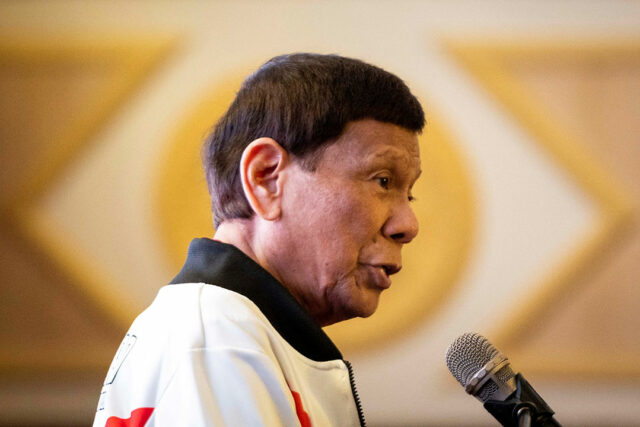
MANILA – Former Philippine President Rodrigo Duterte was almost certain to be elected mayor of his home city by a landslide on Monday, unimpeded by his detention at the International Criminal Court on charges of murder as a crime against humanity.
With 80% of votes counted in an unofficial tally, Mr. Duterte, who was brought to The Hague in March over his bloody “war on drugs” that killed thousands of people, was winning the Davao mayoral contest with eight times more votes than his nearest rival.
The victory during nationwide midterm elections is testament to the 80-year-old’s enduring influence in the southern city, owing to his reputation as a crime-buster that earned him the nicknames “Duterte Harry” and “the Punisher”.
Mr. Duterte’s old Facebook account was flooded with congratulatory messages from supporters, with some calling for his return to serve his people.
“Congratulations, Tatay (father) D! Let’s bring him home,” read one of the comments.
Duterte could become the first Asian former head of state to go on trial at the ICC.
His surprise arrest by Philippine police at the request of the ICC caused outrage among his army of supporters, who called it a kidnapping at the behest of a foreign court.
He has defended the anti-drugs crackdown and his legal team says his arrest was unlawful. The ICC maintains it has jurisdiction to prosecute alleged crimes committed before Mr. Duterte withdrew the Philippines from its founding treaty in 2019.
Despite the ICC’s case also including alleged killings of criminal suspects by a “death squad” in Davao while Mr. Duterte was mayor – which he has denied – analysts have said his arrest has only hardened support for him and his family, in Davao and beyond.
The former president’s two sons were also set to win posts on Monday, one reelected congressman and the other winning the contest for Davao vice mayor and likely to serve in his father’s absence.
The family’s political resilience and dominance in Davao could prove pivotal as Duterte’s popular daughter, Vice President Sara Duterte, faces an impeachment trial that could see her banned from politics for life if convicted, killing off any hopes of a presidential run.
Asked earlier on Monday about her father’s likely victory, she said plans would be made for him to be sworn in as mayor.
“The ICC lawyer said once we get proclamation papers, we will discuss how he can take oath,” she said. – Reuters
Spotlight is BusinessWorld’s sponsored section that allows advertisers to amplify their brand and connect with BusinessWorld’s audience by publishing their stories on the BusinessWorld Web site. For more information, send an email to online@bworldonline.com.
Join us on Viber at https://bit.ly/3hv6bLA to get more updates and subscribe to BusinessWorld’s titles and get exclusive content through www.bworld-x.com.









 In just a few years, the blockchain industry has made major strides in solving the scalability puzzle. But each new solution, be it modular chains, app-specific layers, or interoperability protocols has introduced trade-offs, particularly in user experience and liquidity distribution.

 Under the bright lights of Auto Shanghai 2025, JETOUR officially unveiled its GAIA Architecture and showcased the G700 and G900 — both now equipped with the GAIA architecture — marking a significant milestone in the brand’s evolution into the premium and intelligent 3.0 era.
 Global media test drive
 JETOUR held its “Travel+” tour of Shanghai, featuring the city’s most renowned landmarks. JETOUR’s media and influencers enjoyed views from the Oriental Pearl Tower, then explored the historic alleys of Town God’s Temple. The group later soaked in the sights of the Bund. The tour concluded at the Grand Halls in Shanghai, just north of the Bund.