A German national flag flies atop the illuminated Reichstag building in Berlin, Germany. — REUTERS
BERLIN – Germany’s Chief of Defence, Carsten Breuer, has ordered the German military to be fully equipped with weapons and other material by 2029, a document seen by Reuters on Sunday shows.
By 2029, Russia may have reconstituted its forces sufficiently to attack NATO territory, according to estimates by Breuer and other senior military officials at NATO.
The latest document, entitled “Directive Priorities for the Bolstering of Readiness”, which Breuer signed on May 19, said Germany will meet the goal with the help of funds made available by the loosening of the country’s debt brake in March.
The defence ministry in Berlin did not immediately respond to requests for comment.
In the directive, Breuer sets priorities for the weapons that should be acquired or developed most urgently, reflecting in part priorities NATO has previously laid out.
Among them, Breuer lists the strengthening of Germany’s depleted air defences, in particular with a view to intercepting drones.
Last year, sources told Reuters that NATO will request Berlin to at least quadruple its air defences, ranging from systems with a longer range, such as the Patriot, to short-range systems.
Another priority is a capability to launch deep precision strikes, according to the document, effectively hitting targets at a distance of more than 500 kilometres (310 miles) and far behind enemy lines.
In addition to pushing for Germany’s ammunition stocks to be replenished, Breuer also orders Germany to raise its stockpiling targets for all types of ammunition.
Other priorities listed in the document are the swift expansion of Germany’s capabilities in electronic warfare and the establishment of a resilient system of “offensive and defensive capabilities” in space.
In a speech in mid-May, Army Chief Alfons Mais said a large-scale social and industrial mobilisation meant Russian forces were rapidly gaining firepower.
“From 2029, at the latest, the Russian forces will be capable of a conventional aggression against NATO territory on a large scale,” he said. “But they can start testing us much sooner.” — Reuters
In this photo illustration, the Association of Southeast Asian Nations (ASEAN) emblem is seen on a smartphone screen in front of the ASEAN flag. — PAVLO GONCHAR / SOPA IMAGES/SIPA VIA REUTERS CONNECT
KUALA LUMPUR – Southeast Asia’s leaders will try again when they meet on Monday to bring Myanmar’s military government into talks to end a protracted civil war, and will seek ways to offset global trade uncertainty from US President Donald Trump’s tariff threats.
After weekend ministerial meetings, government leaders of the Association of Southeast Asian Nations are expected to continue to discuss proposals on Myanmar at a summit on Monday and Tuesday in Kuala Lumpur.
Myanmar has been in turmoil since its military overthrew the elected civilian government of Nobel laureate Aung San Suu Kyi in 2021, triggering pro-democracy protests that morphed into a widening rebellion that has taken over swathes of the country.
Malaysia, this year’s ASEAN chair, says it will continue speaking separately to the junta and to Myanmar’s armed opposition groups to try to foster direct talks between the warring sides.
“These negotiations need to be done many times so that an understanding can be built between each side,” Malaysian Foreign Minister Mohamad Hasan told reporters after two meetings on the Myanmar conflict on Saturday, adding that he plans to visit Myanmar next month.
The 10-member bloc’s foreign ministers agreed to discuss a proposal for a permanent ASEAN envoy on Myanmar, Mohamad said. “We want to explore that,” he said. “It’s a matter of who is going to be the permanent special envoy, maybe on a three-year term.”
Myanmar junta chief Min Aung Hlaing has been excluded from the ASEAN summit since 2021 in response to the coup. Thailand’s foreign minister said last week that at the summit his country would propose broader international engagement with Myanmar.
Malaysian Prime Minister Anwar Ibrahim’s closed-door meeting with Min Aung Hlaing in the Thai capital Bangkok last month, followed by online talks with the shadow National Unity Government a day later, has revived hope of dialogues for peace.
The junta is pushing to hold an election later this year, which critics have widely derided as a sham to keep the military in power through proxies.
ASEAN has so far struggled to implement a “Five-Point Consensus” peace plan unveiled months after the coup, and it has yet to discuss a common position on the junta’s election plan.
TARIFF TREMORS
ASEAN leaders are expected to meet Chinese Premier Li Qiang on Tuesday, along with counterparts from Middle East countries.
The talks come amid widespread global market volatility and slowing economic growth sparked by Trump’s threats of U.S. trade tariffs. Six Southeast Asian countries targeted by his administration face much bigger-than-expected tariffs of between 32% and 49% in July, unless negotiations with Washington on reductions succeed.
Philippine President Ferdinand Marcos Jr said ahead of the summit that ASEAN leaders would discuss and compare responses to the tariffs.
“Concerning trade and specifically the tariff schedule imposed by the United States… we must find a way to find consensus amongst the disparate situations that the different member states are operating under,” Marcos said.
Marty Natalegawa, an Indonesian former foreign minister, said ASEAN should identify key principles to rally around to guide each member country’s negotiations with the U.S.
“Otherwise, there could be a risk of a lose-lose cycle in our own region,” he said.
Also up for discussion at the summit are disputes in the South China Sea, a conduit for about $3 trillion of annual ship-borne trade.
China claims sovereignty over most of the waterway and has been involved in heated confrontations with ASEAN member the Philippines.
Vietnam and Malaysia have also protested over the conduct of Chinese vessels in their exclusive economic zones, which Beijing says are operating lawfully in its waters. — Reuters
Vegetables are on display at a market stall in Quezon City. — PHILIPPINE STAR/MIGUEL DE GUZMAN
By Luisa Maria Jacinta C. Jocson, Senior Reporter
THE BANGKO SENTRAL ng Pilipinas (BSP) said it is looking at shifting to a point target for inflation, from the current 2-4% target band, its top official said.
“We’re seriously thinking of just having a point, a target level,” BSP Governor Eli M. Remolona, Jr. told reporters in a press chat on Friday.
“A single number, yes. In the US, it’s just 2%. In many other central banks, it’s just one number,” he added.
In December, the Development Budget Coordination Committee, in consultation with the BSP, set the inflation target at 2-4% from this year until 2028.
A medium-term inflation target helps “strengthen the forward-looking approach to monetary policy formulation with the view of helping anchor inflation expectations to the target,” the central bank earlier said.
Mr. Remolona said the inflation target they are eyeing may be a bit lower than the 3% midpoint of its current target band.
“Maybe 2% is good enough. We don’t know yet. We’re crunching the numbers,” he added.
The target also cannot be too low, Mr. Remolona said, as this has implications on economic output.
“The reason it’s not zero is because in a growing economy, you have to allow relative prices to change. And when you allow relative prices to change, they tend to be sticky downwards.”
“Allowing them to change means some inflation. It constrains the economy if you have too low a target,” he added.
In the past, the central bank had relied on operating targets under a framework for monetary aggregates in its policy decisions, according to a study by the International Monetary Fund (IMF).
The BSP adopted a modified targeting approach in 1995 after inflation spiked to double-digit levels amid a rice supply shortage. This approach focused more on price stability rather than monetary aggregate ceilings.
In 2002, the central bank formally shifted to inflation targeting.
From 2012 to 2014, the target range for inflation was 4% ± 1.0 percentage point. In 2015, the BSP’s inflation target was set at 3% ± 1.0 percentage point and this was applied up until 2022, though the central began using the alternative 2-4% band around this time.
The BSP is currently working with the IMF on studying the shift to a point target for inflation.
“There won’t be an update soon. It was something we asked the IMF to look at. They won’t be able to give us something very soon, they take their time. But I’m comfortable with our band between 2% and 4%.”
The central bank could transition to the point target a year from now at the latest, he added.
RRR CUTS Meanwhile, the BSP chief said reserve requirement ratio (RRR) cuts are unlikely for the rest of the year.
“Maybe (RRR cuts) for next year. Because we’re trying to make the yield curve more reliable, which means managing liquidity in the system better than we have and that the reserve requirement is a factor in that,” Mr. Remolona said.
“So far, we’ve been trying to manage liquidity by issuing our own BSP bills. We’ve been issuing large amounts of BSP bills in an effort to absorb the liquidity in the system.”
As of March, the RRR of universal and commercial banks and nonbank financial institutions with quasi-banking functions was reduced by 200 basis points (bps) to 5% from the current 7%.
The RRR for digital banks was also lowered by 150 bps to 2.5%, while the ratio for thrift lenders was cut by 100 bps to 0%.
Rural and cooperative banks’ RRR has been at zero since October, the last time the BSP cut reserve requirements.
“Reserve requirement (cuts) expand liquidity that’s in the system. So, we’re trying to manage that,” Mr. Remolona said.
“We might start issuing BSP bills. An alternative to that is selling the Treasury securities that we hold. That has the same effect on liquidity.”
Earlier data from the central bank showed that around 50% of its market operations are done through the BSP bills.
‘DE-DOLLARIZATION’ Meanwhile, Mr. Remolona said that veering away from the dollar as the world’s reserve currency would be a long and slow process.
This amid talks of “de-dollarization” or the shift away from the US dollar amid policy uncertainty from President Donald J. Trump’s administration.
“As you know, it’s been a safe-haven currency for a long time. Every time there’s some tension somewhere in the world, the dollar strengthens. Money moves into the dollar.”
“In theory, the safe-haven advantage of the dollar may be reduced over time. But it’s a slow process. It doesn’t happen right away,” he added.
The dollar index, which measures the greenback against a basket of currencies, hit a three-week trough, Reuters reported.
For the week, the dollar was down 1.9%, on track for its biggest weekly percentage decline since early April.
This after Mr. Trump unleashed his latest trade threats, recommending 50% tariffs on European Union imports from June 1 and considering a 25% tariff on any Apple iPhones made outside the US.
Mr. Remolona noted that the United Kingdom’s top invoicing currency used to be the US dollar and their trade was done through dollars as well.
“Then they had Brexit and their invoicing currency moved to the euro. So, this dominance of the dollar is not permanent. It can be eroded,” he said.
Mr. Remolona also noted the failure to produce an “international currency.”
“There was an effort to make international currency. That hasn’t worked out. So, it’s still not very liquid. Those talks come and go,” he said.
“Before the renminbi, it was the Japanese yen. Didn’t work out. I’m not sure there’s a different strategy. It’s still talk. It might be a long while.”
A LARGE Canadian flag hangs on the front of a building in Winnipeg, Manitoba, Canada, March 5, 2025. — REUTERS
By Justine Irish D. Tabile, Reporter
THE PHILIPPINES and Canada are set to conduct exploratory talks for a bilateral free trade agreement (FTA) next month, an official of the Department of Trade and Industry said.
“We have a scheduled joint economic commission meeting in Canada this coming first week of June, and in parallel, I will meet my counterpart to discuss the possible trade agreement,” Trade Undersecretary Allan B. Gepty said on the sidelines of the Businessworld Economic Forum on Thursday.
He said that the exploratory talks will discuss the parties’ levels of ambition, extent of commitment on various chapters, readiness in certain areas, and the FTA’s possible scope or coverage.
Asked which products will benefit from a bilateral FTA with Canada, Mr. Gepty said that it will include electronics and semiconductors and some agricultural products.
“With the fast-paced advancement in technology, all these products or technologies developed are highly dependent on electronics, semiconductors, integrated circuit designs, and others. So that’s why it’s not surprising that exports of these products are also increasing,” he said.
“And we do have some agricultural products in which we have some comparative advantages, like bananas, pineapples, including processed products of these agricultural products, and of course coconut,” he added.
Mr. Gepty said that the Department of Agriculture (DA) is also boosting the production capacity of certain agricultural products like cacao, coffee, and avocado.
Rizal Commercial Banking Corp. Chief Economist Michael L. Ricafort said that an FTA with Canada will allow the Philippines to diversify its markets.
“An FTA would help increase two-way trade between the two countries. This is also one way to diversify the Philippine export markets and reduce reliance on the US, which accounts for 17% of the country’s total exports, the biggest share,” he said in a Viber message.
“The Philippines could also import more pork, poultry, and other meat products and other agricultural products from Canada to also reduce reliance and diversify from the US,” he added.
Canada was the country’s 20th largest trade partner last year, accounting for $1.44 billion, data from the Philippine Statistics Authority showed.
Imports from Canada amounted to $894.14 million, while exports to Canada reached $550.65 million, resulting in a trade deficit of $343.49 million.
Aside from negotiating a bilateral FTA with Canada, the Philippines is also participating in the negotiations for the Association of Southeast Asian Nations (ASEAN)-Canada FTA, which is expected to be substantially concluded this year.
However, progress for the regional FTA was slow, with only 3% of the text agreed upon since negotiations started in 2023, thus the ongoing deliberations whether an extension will be needed in concluding the negotiations.
Sought for comments, Federation of Free Farmers National Director Raul Q. Montemayor said that the group had participated in initial briefings for the ASEAN-Canada FTA but not on a bilateral FTA.
“As with most FTAs, our recurrent concern has been the capacity of our sector to supply quality products at competitive prices to avail of preferential tariffs and other concessions under these FTAs,” Mr. Montemayor said in a Viber message.
“In many cases, we are not able to do so, unlike many of our ASEAN partners. Also, we have flagged the increasing use of nontariff measures that have to be complied with in order for our products to reach the markets of FTA partners,” he added.
Mr. Montemayor also said that the Philippine negotiators should carefully look at the export interests of Canada and ensure that it will not negatively impact local industries, particularly the meat sector.
Citing data from the DA, he said that the country’s top agri-fishery exports to Canada include coconuts, other juice of any other single fruit, nut, or vegetable, other sauces and preparations, sweet biscuits, and other bread, pastry, cakes, biscuits and other bakers’ wares.
Meanwhile, the Philippines mostly imports other wheat and meslin (other than seed), other meat of swine, edible offal of swine, peas, and meat and edible offal of chicken.
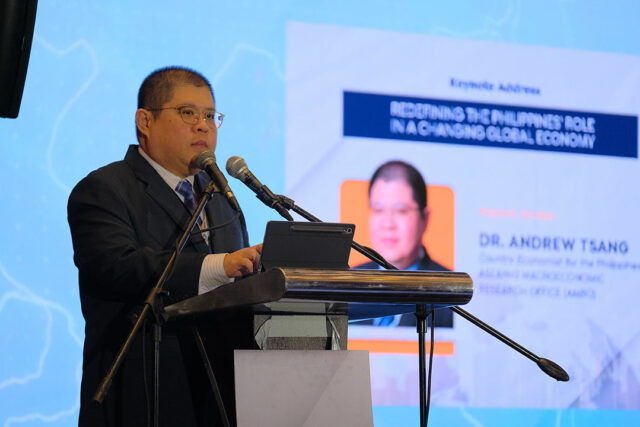
ASEAN+3 Macroeconomic Research Office Country Economist for the Philippines Andrew Tsang speaks at the BusinessWorld Economic Forum on May 22. — PHILIPPINE STAR/RYAN BALDEMOR
By Aubrey Rose A. Inosante, Reporter
PHILIPPINE ECONOMIC GROWTH could pick up this quarter as household consumption likely improved amid easing inflation, and as exporters may have frontloaded production amid the pause in US reciprocal tariffs, an economist said.
ASEAN+3 Macroeconomic Research Office (AMRO) Country Economist Andrew Tsang said private consumption should still be stable in the second quarter amid easing inflation and the low unemployment rate.
However, he said it remains to be seen if private investment would see an increase in the second quarter, after a slowdown in the first quarter.
“Overall, I would expect the second-quarter (growth) to be similar to the first quarter but a bit better,” Mr. Tsang said in an interview on the sidelines of the BusinessWorld Economic Forum on May 22.
In the first quarter, gross domestic product (GDP) grew by a weaker-than-expected 5.4%, reflecting heightened uncertainty arising from the Trump administration’s tariffs. This was sharply slower than the 5.9% expansion in the same quarter last year, and below the government’s 6-8% target for the year.
“We consider both the tariff policy and also consider the Q1 data. Actually, before the tariff policy, we expect 6.3% (GDP growth for the Philippines). And then after the tariff policy and also the sentiment, we already expect there will be a change,” Mr. Tsang said.
“We expect this year, it would not be that bad, but still just below 6%,” he added.
However, Mr. Tsang said household consumption will rebound this year, as the inflation downtrend continues.
“That’s why we expect private consumption would be stronger this year. It’s the main driver of the recovery of the economy,” he said.
In the first quarter, household final consumption expenditure, which accounts for over 70% of the economy, grew by 5.3% annually from the 4.7% print in the fourth quarter.
Headline inflation slowed to 1.4% in April from 1.8% in March amid easing food and transport costs.
In the second quarter, Mr. Tsang said net exports may have gotten a boost as manufacturers likely ramped up production after the US paused the so-called reciprocal tariffs.
The US slapped the Philippines with a 17% reciprocal tariff, but this has been on hold until July. A 10% baseline tariff remains in effect.
“(Because of the 90-day delay in tariffs) they may tend to produce more in the second quarter to avoid any bad effects in the second half of the year,” Mr. Tsang said.
Mr. Tsang noted the external uncertainty has been affecting investor sentiment but expects growth in the second half to be faster compared to last year.
“But in the second half, we expect the number will be better because of the low base effect in the last year. Because last year in the second half, the main issue was the typhoon,” he said, referring to a series of typhoons that battered the country in the last few months of 2025.
The economy expanded by 5.3% in the fourth quarter of 2024, bringing full-year growth to 5.7% amid subdued consumption and lower farm output.
Mr. Tsang said Philippine economic managers are likely to trim the upper end of its 6-8% target for 2025 to make it a “more realistic forecast” considering the current global uncertainty.
The Development Budget Coordination Committee is scheduled to review its targets and macroeconomic assumptions at a meeting on May 26.
“I believe that the government still wants to target 6% or above. And 6%, basically it is the trend growth in our estimation. So, I would expect they will keep 6% but most likely the upper bound will be lowered a bit,” he said.
Earlier, Department of Economic, Planning, and Development Secretary Arsenio M. Balisacan and Budget Secretary Amenah F. Pangandaman have insisted it is too early to abandon the 6-8% target.
The Philippine economy should grow by at least 6.2% in the remaining three quarters to reach at least 6% growth by yearend.
Meanwhile, Rizal Commercial Banking Corp. Chief Economist Michael L. Ricafort said the second-quarter growth may have picked up to 6%, thanks to a boost from election spending, faster consumer spending, more jobs and increased government spending.
Reinielle Matt M. Erece, economist at Oikonomia Advisory and Research, Inc. said GDP is expected to expand by around 6% in the second half of 2025.
“I expect further rate cuts in June and maybe another one in the latter half of the year to further encourage spending and expansion,” he said.
The Bangko Sentral ng Pilipinas (BSP) Governor Eli M. Remolona, Jr. signaled the possibility of two more rate cuts this year, with a 25-basis-point (bp) cut on the table as early as the June 19 meeting.
In April, the Monetary Board reduced benchmark interest rates by 25 bps to bring the policy rate to 5.5%.
US CREDIT RATING Meanwhile, AMRO’s Mr. Tsang said the impact of the latest US credit rating downgrade on the Philippine economy may be minimal but warned it could affect government securities in the long term.
“To our expectation, it would not be making an impact to the Philippines because the credit rating is mainly affecting the US financial market. But given the financial market in the Philippines is a bit isolated from other global markets, the impact should not be that big,” he said.
Moody’s Ratings cut the US’ long-term issuer and senior unsecured ratings to “Aa1” from “Aaa,” revising its outlook to “stable” from “negative.”
“The BSP is mainly focusing on the local inflation dynamics. Given the inflation rate is very low now, I don’t think it would affect too much to the BSP interest rate cut, the pace of interest rate cuts. So, I would expect the impact would be very minimal,” Mr. Tsang said.
By Bjorn Biel M. Beltran, Special Features and Content Assistant Editor
To be a leader in today’s business environment is to face ever-growing, ever-daunting challenges. Even before the COVID-19 pandemic threw the world into disarray, technological disruption, trade wars, and global economic headwinds were already demanding much out of corporate executives.
Popularizing the concept of the Fourth Industrial Revolution in 2016, Klaus Schwab, founder of the World Economic Forum (WEF), had coined the term ‘Leadership 4.0,’ envisioning the leaders of tomorrow: “We need leaders who are emotionally intelligent, and able to model and champion co-operative working. They’ll coach, rather than command; they’ll be driven by empathy, not ego. The digital revolution needs a different, more human kind of leadership.”
Almost a decade later, his ideas continue to resonate.
As different as the world today may seem from that of nine years ago, the demands of the times have stayed, by and large, almost the same. In an interview, Karmeli Love Kintanar, chief operating officer of executive search company KSearch Asia Inc., described what companies today have been looking for when it comes to their leaders — and they bear a striking resemblance to Mr. Schwab’s ideals.
“There was a time when being the ‘ideal candidate’ just meant having deep expertise in a specific industry or role. That’s still important, but today, companies are looking for a lot more than just technical know-how,” Ms. Kintanar said.
She highlighted three main qualities that defined a modern leader: digital fluency, a mindset for sustainability, and empathy. She stressed that more than their technical expertise, leaders today must have the innate ability to establish the relationship between emerging technology and business outcomes.
“It’s knowing how to use digital tools in ways that directly impact business outcomes,” Ms. Kintanar noted. “Then there’s sustainability literacy. Leaders who can explain ESG in simple terms, and show how it affects money, risk, and the future of the business. It’s becoming more than just a reporting exercise. Big-picture thinking matters more than ever. The strongest leaders understand how everything in the business is connected: people, data, operations, even sustainability goals.”
Finally, empathy is needed to be able to bridge the gap between the different teams in an organization and a company’s various stakeholders. Naturally, amid a disruptive environment, leaders who can stay calm under pressure, communicate clearly, and keep people engaged through the chaos hold an edge over those who cannot.
“There’s been a clear shift in what leadership really demands today. Leadership today means navigating constant disruption, whether it’s how quickly tech is evolving, global uncertainty, or the growing demand to balance growing the business while still doing good,” Ms. Kintanar said.
Redefining executive talent
Research from the Business Continuity Institute (BCI), an international network of disaster recovery and business continuity experts, found that in 2024 almost 80% of organizations’ supply chains have been disrupted over the preceding twelve months, with most experiencing between one and ten disruptions.
“This is an increase on the previous year’s disruption levels and that, despite the good practices many organizations are now following, more needs to be done to ensure supply chains are more resilient to shocks,” the BCI wrote in their Supply Chain Resilience Report 2024.
“The report highlights that third-party failures remain the primary cause of these disruptions, followed by cyber-attacks and natural disasters, indicating persistent vulnerabilities in global supply chains.”
A separate study from the WEF found that businesses are increasingly finding more anxious about their global outlook, with a majority of respondents (52%) anticipating an unsettled global outlook over the short term or the next two years. Almost a third (31%) expect turbulence, while 5% are preparing for a “stormy” future.
“As we enter 2025, the global outlook is increasingly fractured across geopolitical, environmental, societal, economic and technological domains,” the WEF Global Risks Report 2025 said.
“Over the last year we have witnessed the expansion and escalation of conflicts, a multitude of extreme weather events amplified by climate change, widespread societal and political polarization, and continued technological advancements accelerating the spread of false or misleading information.”
According to their findings, pessimism among businesses are more prevalent as the time frame increases. Over a ten-year period, 62% of respondents expect stormy or turbulent times, reflecting “skepticism that current societal mechanisms and governing institutions are capable of navigating and mending the fragility generated by the risks we face today.”
In this landscape, leadership today, Ms. Kintanar pointed out, must now shift to a greater role: one that is about guidance and adaptation, more than technical expertise.
“The leaders who stand out today are the ones who can connect big-picture strategy with ground-level execution, all while navigating complexity, uncertainty, and speed. That’s a very different kind of leadership from what was required in the last several years,” she said.
“Today’s leaders don’t need all the answers, but they do need the instincts to ask the right questions and stay focused and decisive through change,” she added. “Hard skills still matter, of course. But what clients want now is proof that a candidate can adapt, grow, and lead through change, especially when the usual playbook no longer applies.”
As an executive search company in the Philippines, KSearch Asia must acquaint themselves intimately with the changing face of leadership as required by the times. Ms. Kintanar pointed out that their approach begins by understanding the businesses of their clients from the inside and out.
“Before we open a single résumé, we spend as much time as possible with the people who actually make the decisions, ask how decisions actually get made, and listen for the unwritten rules that shape culture,” she said.
“Together we decide which skills are non-negotiable, which are nice to have, and which behaviors will click with the culture. Everyone signs off, so we’re all chasing the same target from day one.”
Among the most important values in a leader today, she noted, is the capacity for resilience. Amid headwinds that are only expected to get stronger over the next few years, leaders today, like the story of the bamboo and the oak, must have the ability to bend, not break.
“Companies have to deal with everything from rising costs to talent gaps and changing market demands. So, they’re looking for leaders who’ve been through tough times and know how to keep things moving. People who stay calm under pressure, make good decisions quickly, and can rally a team even when things are uncertain,” she said.
“We’re seeing some clear shifts, both from what leaders are saying in Manila and what global research is showing. The next wave of Filipino executives will need to be very different from the ones who came before.”
Opening of the exhibit and ribbon-cutting ceremony participated in by (L–R): BAIPHIL First Vice President and 33rd BAIPHIL Convention Trustee-in-Charge Shirley G. Felix, Iloilo City Mayor Jerry P. Treñas, BAIPHIL President Iñigo L. Regalado III, Anti-Money Laundering Council Executive Director Atty. Matthew M. David, and BAIPHIL Second Vice President and 33rd BAIPHIL Convention Trustee-in-Charge Ann Marie Y. Alonso.
By Mhicole A. Moral, Special Features and Content Writer, BusinessWorld
Banks have built their reputation on trust, personal service, and community ties. These qualities have helped them stay connected with customers who seek face-to-face interactions and tailored advice.
With more people using online banking apps and digital services, financial institutions are working to uphold their traditional values while keeping pace in the fast-evolving technology race.
“The Philippine banking sector in 2025 is experiencing a dynamic transformation, marked by technological advancements, regulatory reforms, and evolving consumer behaviors,” BAIPHIL President Iñigo “Nitoy” L. Regalado III told BusinessWorld in an email. “While the banking sector remains robust, it is navigating a complex landscape of challenges that require strategic adaptation.”
BAIPHIL President Iñigo L. Regalado III delivered his message.
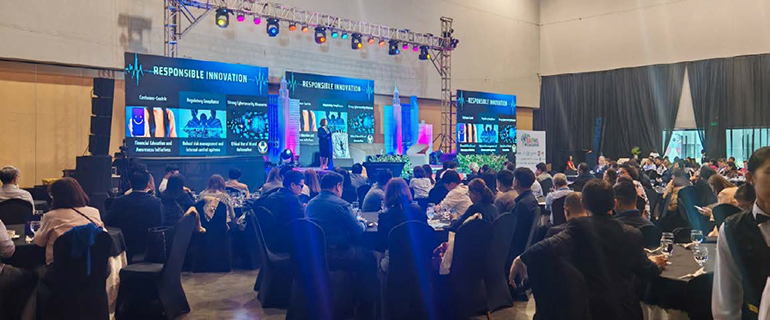
Balancing traditional and modern banking took center stage at the 33rd National Convention of the Bankers Institute of the Philippines, Inc. (BAIPHIL), held at the Iloilo Convention Center from March 6 to 8.
The convention’s theme, “Harmonizing Cultural Tradition and Technological Innovation Towards a Responsible Banking Legacy,” guided three days of presentations, panel discussions, and networking events. The sessions focused on the future of digital banking and the enduring values that define the banking profession.
Several presentations highlighted how banks are updating their digital tools, from mobile apps to AI-driven services, to meet the evolving needs of customers. At the same time, banks discussed ways to preserve personal service, such as training staff to offer quality advice and maintaining access to physical branches.
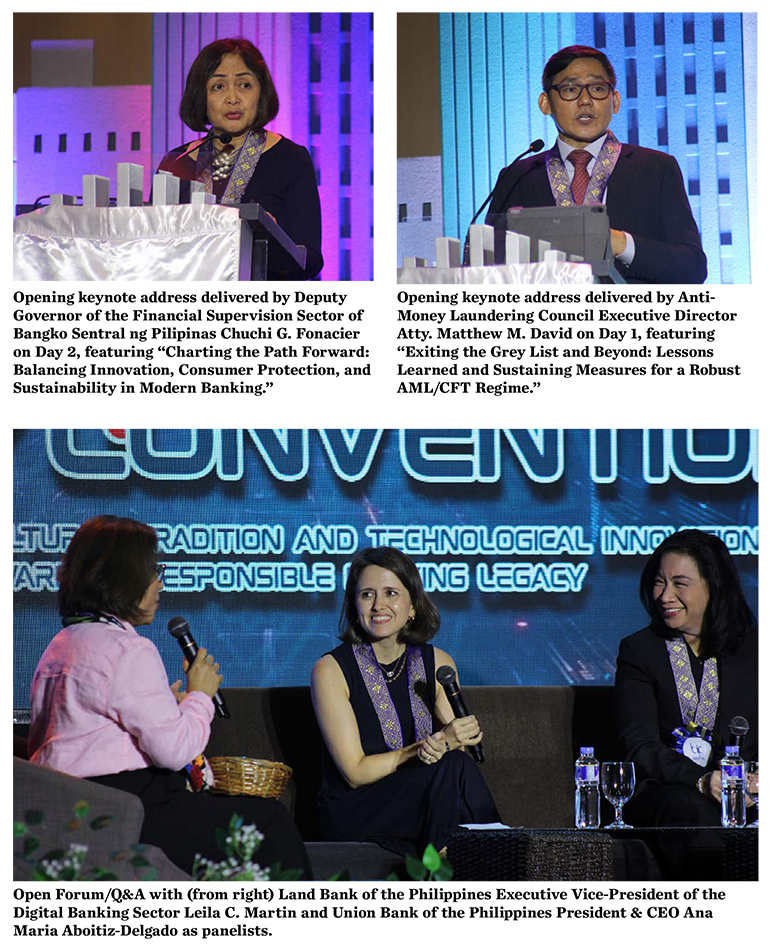
BSP Deputy Governor Chuchi G. Fonacier emphasized the need to combine technology with the values long held by Filipinos. She described this approach as “tech with a heart and soul,” where innovation is guided by responsibility and empathy.
Dr. Felipe M. De Leon Jr., president of the Asian Social Institute and professor of art studies at the University of the Philippines Diliman, discussed the deep cultural foundations that influence Filipino values and national resilience. Atty. Matthew M. David reminded attendees of the importance of honor and integrity in banking, noting that these are essential to building trust and achieving excellence.
The role of artificial intelligence was also discussed with Ana Aboitiz-Delgado, president and chief executive officer of Union Bank of the Philippines, highlighted how AI can personalize banking services while reflecting the country’s relationship-driven culture.
Meanwhile, Leila C. Martin, executive vice-president for the Digital Banking Sector of the Land Bank of the Philippines; Tanya P. Hotchkiss, executive vice-president and chief technology officer of Cantilan Bank; and Rafael Francisco D. Amparo, executive director of the Rural Bankers Association of the Philippines (RBAP), spoke about the power of bayanihan (cooperation), utang na loob (shared responsibility), and malasakit (genuine concern) in advancing financial inclusion, especially in rural and agricultural areas.
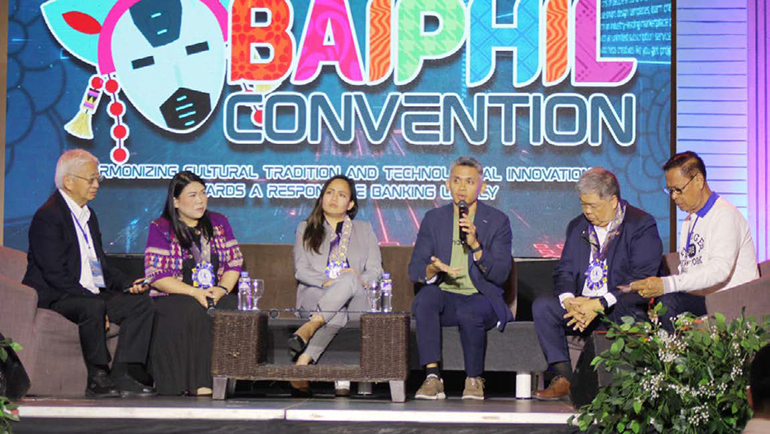
Open Forum/Q&A with (from second from left) Cantilan Bank Executive Vice-President and Chief Technology Officer Tanya P. Hotchkiss and Rural Bankers Association of the Philippines Executive Director Rafael Francisco D. Amparo as panelists.
“Financial institutions, regulators, and the private sector must work together to ensure that innovation serves society, digital finance remains secure, and sustainability drives economic progress. As the financial industry evolves, leadership must be rooted in purpose,” BAIPHIL told BusinessWorld.
Bridging the gap
Banking is shifting rapidly with new technologies that make managing money easier for many Filipinos. Mobile banking apps and digital wallets have become common tools, allowing users to access their accounts anytime and anywhere. Emerging technologies such as blockchain and artificial intelligence (AI) are also beginning to reshape how banks manage operations, detect fraud, and provide more personalized services.
Open Forum/Q&A with (from second from left) BSP Payments Policy and Development Department Director Atty. Bridget Rose M. Mesina-Romero, DTI Center for AI Research Managing Director and Chief AI & Data Officer Erika Fille T. Legara, Maya Bank President Simeon Angelo S. Madrid, and Information Security Officers Group President Luis “Chito” A. Jacinto as panelists.
These advancements are particularly impactful in rural and underserved areas, where access to traditional bank branches remains limited. With more accessible options, more people can now manage their finances without traveling long distances or waiting in lines.
“Furthermore, in order to ensure that banking opportunities are made available for all, the Bangko Sentral ng Pilipinas and the banking sector collaborate in coming up with financial inclusion programs with the overall objective of providing access to some 37 million Filipinos who remain unbanked,” Mr. Regalado added.
Iloilo City Mayor Jerry P. Treñas delivered his welcome address.
However, the absence of human interaction, such as transaction errors or loan inquiries, can quickly turn a minor glitch into a serious customer complaint. In some cases, the frustration caused by impersonal service may even result in violations of consumer protection laws. As technology continue to grow, banks are reminded that building trust remains vital, especially in a culture that places high value on relationships.
“The shift towards digital banking has heightened exposure to cyber threats, including phishing, malware, and data breaches,” Mr. Regalado added. “It is, therefore, important to come up with robust cybersecurity measures and maintain an environment that consumers can trust with their investments and moneys.”
“Understanding Filipino culture is essential because banking is not solely about generating profit or meeting shareholder expectations. It is also about building trust, fostering relationships, and providing services that are genuinely responsive to the needs and values of the Filipino people,” BAIPHIL said.
The solution, they added, lies in bringing Filipino heritage into the boardroom. Financial institutions that align their operations and services with cultural values not only avoid alienating customers but also position themselves for long-term success.
While Filipinos are willing to use technology, they still want someone to talk to when problems arise, according to BAIPHIL. They want a bank that listens, not just responds; a bank that cares, not just calculates.
“Traditional Filipino values and modern banking innovations are not mutually exclusive; they can synergistically enhance the banking experience,” the organization said. “Integrating Filipino heritage and cultural values into banking is not just a social or ethical imperative — it is a strategic business decision. When clients feel seen, heard, and cared for, they stay. And when they stay, the bank thrives.”
Meanwhile, BAIPHIL pointed out that Filipino cultural values such as empathy and compassion should guide financial institutions even as they adopt new tools. To support this, the Bangko Sentral ng Pilipinas has introduced regulations to protect consumers as banking evolves. These include BSP Circular No. 1160, which enforces the Financial Products and Services Consumer Protection Act (Republic Act No. 11765), and BSP Circular No. 1048, which urges banks to integrate consumer protection into their corporate culture and daily operations.
The BSP also holds bank officers accountable when they violate rules or act unethically, as the Manual of Regulations for Banks clearly outlines procedures for handling administrative cases involving directors and officers.
Fireside Chat with Francis J. Kong on “Leading with Purpose: Embracing Inclusivity, Unity, and Responsibility in the Age of Innovation.”
Expanding services and reach
Founded in 1941, BAIPHIL is a non-stock, nonprofit group composed of BSP-supervised financial institutions. Starting out as the National Association of Bank Auditors and Comptrollers, it began with a goal to improve efficiency and standard practices in banking. Over time, as it underwent several name changes until its current name, the organization has evolved into a key institutional partner of the BSP, helping roll out training programs, disseminate regulatory updates, and promote industry standards.
BAIPHIL continues to implement several projects for banking professionals. In addition to its National Convention, the organization expanded its reach through National Regional Outreach activities held in Cebu City and Iloilo City earlier this year. These initiatives focused on delivering industry-standard learning and dialogue to areas often left out of the conversation.
The BAIPHIL Board of Trustees with BSP Deputy Governor Atty. Elmore O. Capule, BSP Monetary Board Member Hon. Jose L. Querubin, and BSP Deputy Governor Chuchi G. Fonacier
Beyond ground-level programs, the organization completed a significant governance change following the approval of its further amended Articles of Incorporation and new bylaws. According to BAIPHIL, this move positions the organization to operate more efficiently and respond more effectively to the fast-changing demands of the industry.
The governance update supports future plans and keeps the organization adaptable. These changes aim to help the group meet its targets, expand operations, and strengthen the delivery of services and training to members and partners.
BAIPHIL also seeks to improve the overall banking experience for Filipinos by helping banks effectively adopt new tools. Its work also aims to keep banks updated on the latest security measures to protect customers and ensure seamless service.
The organization reported record-breaking results from its regular training programs, exceeding both profitability targets and participant numbers. The trainings, which aim to enhance the skills of banking professionals, cover a wide range of topics, from banking regulations to risk management and operational excellence, and continue to attract large audiences due to their relevance and practical value.
BAIPHIL members and other delegates from the banking industry were in attendance.
Through these efforts, BAIPHIL signals its commitment to shaping the future of banking education and engagement in the country. The organization plans to continue hosting conventions, expanding outreach programs, and offering more training opportunities in the coming months.
“By leading with integrity and inclusivity, financial institutions can build a stronger, more resilient future. By striking the right balance between tradition and innovation, the banking industry can shape and create a financial ecosystem that is resilient, ethical, and inclusive for all,” the organization said.
Today, BAIPHIL has grown to include 71 institutional members and 173 associate members, remains steadfast and committed in fostering a resilient, ethical, and forward-looking banking industry in the Philippines.
Spotlight is BusinessWorld’s sponsored section that allows advertisers to amplify their brand and connect with BusinessWorld’s audience by publishing their stories on the BusinessWorld Web site. For more information, send an email to online@bworldonline.com.
Join us on Viber at https://bit.ly/3hv6bLA to get more updates and subscribe to BusinessWorld’s titles and get exclusive content through www.bworld-x.com.
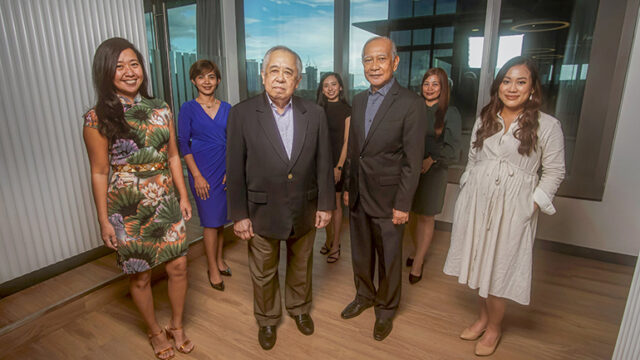
KSearch Asia Consulting, Inc. Executive Board: (front, L-R) Chief Operating Officer Karmeli Love U. Kintanar, Chairman and CEO Mario T. Mananghaya, Chief Finance Officer Antonio G. Pedro, Director and Tribe Lead Ross Suarez-Galura (back, L-R) Director and Tribe Lead Mia Limbo-Golfo, Manager and Tribe Lead Inah Eleazar, and Manager Veron Mendoza-Antonio
KSearch Asia, a top name in executive search in the Philippines, has officially joined the global firm Andersen Consulting. The announcement was made during the New Leaders Meeting held in Las Vegas, where the firm was welcomed as a member in the newly formed global organization.
The development marks a new phase for the Philippine-based firm, which has built its reputation over 25 years through boutique, founder-led operations. Now integrated into Andersen’s organization of consulting professionals, KSearch is preparing to work on larger and cross-border projects while retaining the personalized approach that has earned trust in the local market.
“Joining Andersen preserves our boutique DNA—small, founder-led teams—but it opens up the door to far more strategic possibilities,” KSearch Chief Operating Officer (COO) Karmeli Love U. Kintanar told BusinessWorld in an email.
The deal is designed to give new capabilities while maintaining the identities of members of Andersen Consulting. KSearch may now work alongside other members of Andersen Consulting that are helping large corporations restructure, expand globally, or overhaul their tax operations. If these projects call for leadership and staffing solutions, KSearch steps in as part of their expertise.
KSearch’s inclusion in Andersen Consulting means existing clients, who once relied solely on local support, now have access to expanded capabilities without switching partners.
For example, a company expanding into multiple markets no longer needs to engage separate firms for recruitment, tax advice, and organizational planning. Clients no longer need to coordinate with different service providers for a single project, as the Andersen group can now do it all under one roof.
Accelerating global backing
KSearch said leadership search today is no longer limited by borders, as clients are increasingly asking for candidates and strategies that match a global scale, and they are expanding to meet those expectations.
Ms. Kintanar explained that the collaboration places KSearch alongside six Philippine-based Andersen members and collaborating firms. Together, they form a team that aims to help clients execute their business goals with fewer roadblocks and fewer vendors to manage.
The Manila-based Andersen Consulting member firms can now assist clients with board structuring, shareholder agreements, and urgent regulatory issues involving government agencies like the Philippine Economic Zone Authority (PEZA), the Securities and Exchange Commission (SEC), and the Department of Labor and Employment (DoLE).
They also advise on navigating complex tax environments with changes from the Corporate Recovery and Tax Incentives for Enterprises to Maximize Opportunities for Reinvigorating the Economy (CREATE-MORE) law and policy updates from the Bureau of Internal Revenue (BIR).
Aside from regulatory and tax services, the Andersen team provides support in deal modeling, benchmarking costs for potential sites, and conducting due diligence on potential partners in the Philippines. The group also maps out strategies for business growth by digitizing shared services, improving customer experiences, and making better use of data.
KSearch Asia Consulting, Inc.’s esteemed senior consultants, joined by the executive board
Multinational companies in the Philippines can expect a more hands-on, focused, and results-driven partnership. The team says it combines personalized service with deep local knowledge and international standards.
“[We provide] a personalized, innovative, and results-oriented way of working that turns the traditional consultant relationship into a true business partnership for succeeding in the Philippines,” Ms. Kintanar added.
KSearch said they still remain committed to the same style of working that built trust among clients. They describe the partnership as an opportunity to scale their services while keeping the firm’s identity intact.
“Andersen’s independent and client-focused model is exactly how we were built. Our DNA aligns perfectly with Andersen’s philosophy, so the integration felt natural,” she explained. “We’re still the KSearch, you know, but with a larger engine behind us.”
Humble beginnings, thriving practice
KSearch’s inception dates back to the late 1990s when KPMG Philippines and Andersen Consulting spun off their executive search practice. Three insiders from the Big Four firms stepped forward to build what would become KSearch Asia.
Mario Mananghaya, the then-managing director of KPMG Philippines and a former global partner of Arthur Andersen, brought boardroom credibility and a well-established network of chief financial officers. Manny Guillermo, a former global partner in Andersen Consulting, offered strong international consulting contacts and a methodical approach to operations.
Completing the founding team was Ms. Kintanar, the group’s first professional hire. She joined as a 21-year-old research associate and now serves as the firm’s chief operating officer.
KSearch Asia has long operated from what used to be the KPMG office in Makati. It was there that the founders registered the firm and launched their first successful executive search assignment — a finance director for a Japanese electronics manufacturer in Laguna. They closed the mandate in six weeks, setting the pace for the firm’s steady rise in the headhunting and executive search industry.
25 years later, with KSearch now aligning itself under the Andersen Consulting umbrella, those early connections come full circle. Under Andersen Consulting, the firm continues to operate with its existing leadership and team but aligns more closely with the integrated consulting platform.
Andersen Consulting is part of Andersen’s broader multidimensional service model, which provides end-to-end consulting services to both large multinational firms and upper-middle market businesses. The firm serves companies with complex cross-border needs, including owner-operated enterprises seeking a more hands-on and tailored approach on a global platform spanning more than 170 countries as of date.
Unlike traditional consulting models, Andersen Consulting operates through legally separate but aligned member and collaborating firms. This structure allows local offices like KSearch to maintain autonomy while accessing shared resources and standards across markets.
Spotlight is BusinessWorld’s sponsored section that allows advertisers to amplify their brand and connect with BusinessWorld’s audience by publishing their stories on the BusinessWorld Web site. For more information, send an email to online@bworldonline.com.
Join us on Viber at https://bit.ly/3hv6bLA to get more updates and subscribe to BusinessWorld’s titles and get exclusive content through www.bworld-x.com.
Amidst a volatile global economy and rising geopolitical tensions, the need for leadership skills and organizational capabilities has been more magnified. With problems becoming more complex and even in cyberspace, decision-makers nowadays must be equipped with the leadership qualities necessary to navigate cultural, environmental, digital, and economic shifts.
Disruptions have been numerous since the COVID-19 pandemic, forcing drastic changes in many industries and pushing some of the top companies to rethink their strategies. As a result, the traits corporations seek in a leader have also evolved. Before, technical expertise, experience, and the proper connections were the criteria to land a leadership role. The decision-makers of today will have to move past just technicalities and networks, while maintaining qualities that thrive despite changes and disruptions.
Recently, Harvard Business School Publishing released its “Top 10 In-Demand Leadership Skills for the Future of Work,” saying that leaders must equip themselves with a unique set of skills that go beyond traditional management.
First on their list is digital adaptability, or the ability to quickly understand and leverage new technologies. With innovations seemingly transforming markets on a yearly basis, leaders who can navigate these changes and integrate them to the benefit of their companies will surely help in keeping organizations competitive and resilient.
With growing importance being placed on mental health and well-being in society, the next essential skill is empathetic communication. This empathy fosters trust, strengthens relationships, and creates a supportive environment where employees feel valued and understood, and emphasizes that decision makers must not only convey and command, but also listen and connect with their teams.
Closely related to this attribute are social and emotional intelligence, which are foundational qualities that may be the linchpin that ties all of these skills together. Naturally, leaders who can manage their own emotions while understanding and responding to the feelings of their employees are better equipped to make decisions for the betterment of the company.
Persuasion and influence also remain vital, according to Harvard Business School. In organizations where leadership extends beyond titles and ranks, the most effective leaders are still those who inspire action, build consensus, and motivate others through compelling vision and authentic engagement.
In line with growing societal pressures to be more diverse, inclusive leadership has become almost necessary. Championing equity and creating an environment where diverse voices are heard strengthens organizational culture and generates unique ideas, as it encourages employees to contribute from their unique perspectives.
Another critical skill mentioned is conflict management. Disagreements are inevitable for companies with hundreds or thousands of employees. Instead of looking at disputes as negatives, effective leaders approach them constructively and guide teams toward solutions that respect differing viewpoints.
As industries and markets become more complex, having a leader with strategic ability remains important. Analysis, creativity, and vision are often required to excel in fast-moving environments, even more so nowadays when trends are difficult to anticipate and long-term challenges are gradually becoming immediate.
Along with strategic ability, calculated risk-taking has become especially necessary in industries facing constant disruption, where playing it safe can often mean falling behind. Today’s most successful executives are those who gamble, make bold moves with measured judgment, and recognize when to take leaps that could propel the business forward despite potential downsides.
Engaging and inspiring leadership is also in short supply despite high demand. With many businesses transitioning to work-from-home or hybrid setups, it has become all the more difficult to boost team morale and energize employees. This is why decision-makers who can demonstrate passion, lead by example, and foster a culture where employees feel inspired to innovate and grow are valuable to any company.
Finally, leadership without formal authority that transcends departments, geographies, and reporting structures is quickly becoming a defining trait of the modern executive. Leaders need to influence, collaborate, and drive initiatives through soft power — building trust, aligning interests, and mobilizing people toward common goals even without direct control.
These emerging leadership qualities reflect broader trends shaping the future of executive talent. According to global consulting firm McKinsey and Company, organizations are now rethinking traditional leadership models in favor of approaches and trends that emphasize collaboration, innovation, agility, and trust.
The firm suggests that instead of focusing on value creation, managing revenue, and simple command and control, modern executives must also think about how to convey vision and possibilities noting that “authenticity among leaders isn’t just nice to have; it’s expected by employees, customers, and almost everyone along the value chain.” While companies are still in the early stages of defining modern-day leadership, several best practices and trends have emerged.
Engaging rigorously and relentlessly, through constructive dialogue and debate, is among the trends noted by McKinsey that set the best-performing companies apart from competitors. Therefore, the firm suggests that decision makers clearly, frequently, and memorably give people the information they need when they need it to catalyze discussions that can lead to advancements and innovations within the company.
Aside from engagement, leaders must also enroll their teams in the company’s vision and strategy for them to willingly contribute of their own will. The firm notes that enrolled employees are self-disciplined, self-motivated, and more likely than others to enforce standards that leaders need to continually revisit, and facilitate to enforce deep enrollment and correct course as needed.
McKinsey also recommends that company leaders build and establish an operating model that’s wired for speed and allows for clear decision-making rights, few layers of bureaucracy, and tech-enabled information sharing. In short, modern executives should streamline processes, empower frontline teams, and share best practices and data through digital tools to boost performance, productivity, and speed.
Building a culture of trust is also said to be an essential part of modern leadership. This firm cites American economist and statesman George Shultz, who wrote for his 100th birthday: “‘Trust is the coin of the realm.” McKinsey emphasizes that leaders must identify where their organization’s trust is strong or weak and work to improve reliability, credibility, and openness throughout the company.
In today’s world, leaders who stay flexible, show genuine care, welcome diverse voices, think ahead, and build real trust are the ones who’ll help their teams succeed. As work keeps evolving, great leadership means blending fresh ideas with empathy to meet whatever comes next. — Jomarc Angelo M. Corpuz
Most successful businesses rely on their people — the individuals responsible for creating and delivering products and services, as well as building relationships and interacting with customers. In fact, none of these functions are possible without the right people leading these organizations.
With the workforce always on the verge of transformation, employers are more competitive in attracting top leadership talent and choosing a fitting executive search firm is necessary when doing so.
Talent is crucial to business success. Nowadays, companies are prioritizing not only leadership qualities but also the right talent when taking on senior leadership roles. In the Philippines, talent attrition rate is notably high. According to Sprout Solutions, 68% of employers consider finding qualified candidates as a challenge.
Leadership is paramount in maintaining organizational stability, achieving business objectives, and moving them towards success. Imagine a leader with the right talent, skills, and expertise, and how much they can elevate the company to new heights of transformation.
Yet, hiring the right leader is more difficult than said, especially with senior roles. Having an executive search firm by your side provides a strategic advantage and will benefit the company more than you think.
Similar to choosing the right company to work for, choosing the best executive search firm should be done properly. Start by identifying the company’s needs. Understand how these executive roles will help transform leadership within the company. Then, define the executive roles based on skills, qualifications, and experience. Additionally, state job responsibilities, objectives, and challenges associated with the position.
Once business needs are identified, the next step is to research about executive search firms. Conduct research on the different executive search firms and their services. Know how it will benefit the company, understand their process, look for firms with experience in the company’s field/industry, and evaluate their success rate in recent years. Start researching through online resources, professional networks, industry directories, and so on. Then, organize and make a list of possible executive search firms you have in mind to partner with.
While the primary goal is to find an executive search firm, setting a budget is also important. Make sure to set a realistic budget for the executive search. This budget is crucial as it helps track expenses, avoid overspending, and meet business goals. With the budget in mind, make sure to choose an executive search firm that fits the budget.
When all these are set, it’s time to meet with executive search firms personally. It is important to talk with them in-person through meetings; or if that’s not possible, fix a call with them, when both schedules are aligned. It is necessary to know the team members that the company is working or wants to work with. Afterwards, evaluate their knowledge, communication skills, and their understanding of the business. This way, it ensures that both firms understand each other and make sound decisions in their candidate hiring process.
Nonetheless, don’t forget to maintain confidentiality with firms. Even with hiring, confidentiality is a must. Because data and information are involved, an efficient executive search firm is one that prioritizes the security of the data of the candidates, as well as client information. Make certain that these firms have protocols and data confidentiality agreements that safeguard the employer and the candidates during the hiring process.
Expect quality in service among these executive search firms. Employers need to choose executive search firms based on the quality of service they provide. The process should be conducted thoroughly, ensuring that every step is precise, from the initial job description to the final placement. Emphasizing quality often lead to successful candidate selections and hiring processes, making the investment in executive search firm worth it. — Angela Kiara S. Brillantes
LOPEZ-LED First Gen Corp. is eyeing to build additional liquefied natural gas (LNG) terminals outside Batangas to meet rising power demand, a company official said.
“I think that’s part of the plan, as long as there’s demand,” First Gen Senior Vice-President and Chief Revenue Officer Vincent Martin C. Villegas said on the sidelines of the BusinessWorld Economic Forum last week.
However, Mr. Villegas said there must be sufficient market demand to justify the construction of more LNG terminals.
“You have to create the market to make sure that there’s a market. So, today, we already have two LNG terminals. So, we have to fully utilize that, and then you go to the next terminal,” he said.
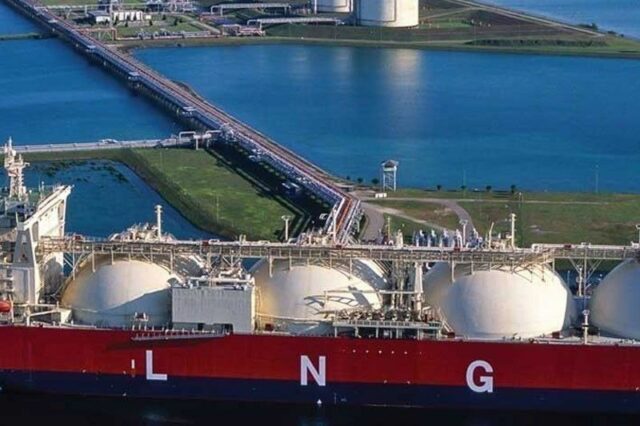
Currently, there are two operating LNG terminals in the country. One is owned and operated by FGEN LNG Corp., a subsidiary of First Gen, while the other is jointly owned by Meralco PowerGen Corp., Therma NatGas Power, Inc., and San Miguel Global Power Holdings Corp.
First Gen’s LNG terminal was developed in partnership with Tokyo Gas, Japan’s largest natural gas utility company.
Under their joint cooperation agreement, Tokyo Gas will hold a 20% participating interest in the interim offshore terminal.
In February, Tokyo Gas completed its acquisition of a 20% equity stake in FGEN LNG.
The transaction marked the Japanese firm’s first investment in a commercially operational overseas LNG terminal project.
“We’re looking at growing with them, either through another LNG terminal or pursuing small-scale business, which is a natural if you already have a terminal,” Mr. Villegas said.
Earlier this year, FGEN LNG secured a permit from the Department of Energy to operate and maintain its interim offshore LNG terminal for 25 years.
Mr. Villegas said he expects LNG prices to further soften over the next two years, primarily due to additional supply from new gas fields.
First Gen uses LNG to fuel its existing gas-fired power plants with a combined capacity of 2,017 megawatts (MW). The company’s portfolio also includes 1,200 MW of installed capacity from geothermal power plants and over 400 MW from hydro, wind, and solar facilities.
At present, First Gen has a total of 3,668 MW of combined capacity across its portfolio of geothermal, wind, hydro, solar, and natural gas-fired plants. — Sheldeen Joy Talavera
The Jetour T2 i-DM and T1 i-DM plug-in hybrid electric vehicles stand side by side at the Shanghai Pudong Chuansha Test Drive Center, China. — PHOTO BY KAP MACEDA AGUILA
1 of 8
The Jetour T2 i-DM and T1 i-DM plug-in hybrid electric vehicles stand side by side at the Shanghai Pudong Chuansha Test Drive Center, China. — PHOTO BY KAP MACEDA AGUILA
A T1 takes a corner at speed. — PHOTO BY KAP MACEDA AGUILA
Waiting for flag-off — PHOTO BY KAP MACEDA AGUILA
Some side-sloping action — PHOTO BY KAP MACEDA AGUILA
Testing the T2’s articulation — PHOTO BY KAP MACEDA AGUILA
An acrophobia-inducing slope tests the T1’s climbing ability and hill descent control. — PHOTO BY KAP MACEDA AGUILA
Flooring the T2 from a standstill — PHOTO BY KAP MACEDA AGUILA
The T2 and the newly launched G700 — PHOTO BY KAP MACEDA AGUILA
Off-road brand crosses the Ts — two of them, actually — in China proving ground
IT WAS a windy November day last year in China when we first got to put the Jetour T2 and the then very new T1 through their paces on a dirt track (for the T2) and on paved ground (for both models) in Pingtan Island just off Fuzhou. Though sharing a common platform, the two vehicles — positioned as off-roaders by Jetour — are markedly different in both size and use cases.
The T2 is a larger, more robustly designed boxy SUV — with its i-DM or plug-in hybrid electric vehicle (PHEV) version being an almost dichotomously rugged/eco-friendly example. Powered by a fifth-generation 1.5TGDI engine that, according to Jetour, boasts an industry-leading thermal efficiency of 44.5%, drivers access the performance via a three-speed DHT for “seamless power delivery across all driving conditions.” It measures 4,785mm in length, 2,006mm in width, and 1,870mm in height — heft that proved to be quite easy to power through off-road conditions. We found the T2 able to deftly dust off road imperfections — no doubt helped along by its 28-degree approach angle, 30-degree departure angle, and ground clearance of 220mm. While we’re at it, the T2 has a claimed wading depth of up to 700mm.
The T1, on the other hand, is a “light off-roader” that derives motivation from either a 2.0-liter turbo or 1.5-liter turbo engine mated with an eight-speed automatic. Compared to the T1, it is a tad smaller, measuring 4,706mm in length, 1,967mm in width, and 1,845mm in height — with a ground clearance of 190mm. Approach and departure angles are the same at 28 degrees; maximum wading depth is reported at 600mm.
It gets a more futuristic-looking interior versus the T2, and boasts agility and fleet-footedness because of its smaller size — performance aspects we noticed after driving it in Pingtan.
When the T1 makes its inevitable arrival here in Q3 or Q4, per Jetour Auto Philippines, we expect a lot of car browsers to take notice — especially in light of its good looks and cache of features. As for the pricing, it would be reasonable to say that it will probably undercut the T2 price tag (at present, the cheapest variant comes in at P2.498 million).
The Jetour T2 certainly earned a following owing to its familiar Defender-esque body — an observation that Jetour brass openly embrace. If you ask me, the T1 deconstructs and softens this persona to great effect, serving to convey a more “urban-oriented” look.
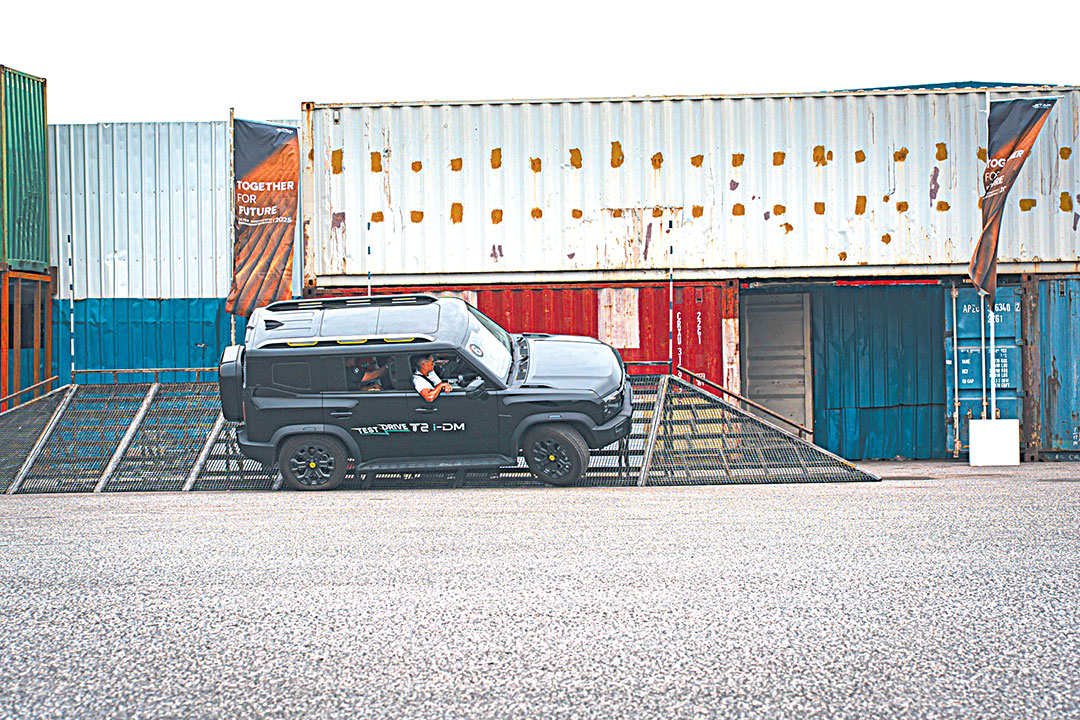
While the Pingtan experience served to highlight the differences between the two T models, a more recent set of exercises at the Shanghai Pudong Chuansha Test Drive Center starring the same two models in effect compared (and contrasted) their qualities and abilities.
Boasting XWD intelligent four-wheel drive, the T1 and T2 took on various exercises, such as the so-called cross-axle test, where they showed off not only articulation prowess, but the ability to redistribute power to the wheels with the most grip. Meanwhile, a steep side slope headlined the models’ reinforced chassis, torsional rigidity, and “advanced suspension system” to minimize body roll.
The centerpiece of the test track was the 10-meter-high seesaw with steep incline (around 30 degrees). Both the T1 and T2 took on the obstacle with aplomb — showcasing the power of the hybrid powertrain (not to mention the benefit of a 360-degree camera system), and advanced hill descent control when coming down the other side.
“The XWD system has been validated by over 200,000 users worldwide,” said a Jetour test drive coach. “Whether you’re a seasoned off-roader or a beginner, the system’s X Mode takes the uncertainty out of driving by automatically adapting to road conditions in milliseconds.”
As a side event, the newly revealed premium all-terrain G700 was also on the premises. We were not able to get behind the wheel though. The featured exercise for the SUV put the spotlight on its autonomous parking capability. Predicated on 12 ultrasonic sensors and four 360-degree cameras, G700 found a spot and, sans driver input, parked itself. When an obstacle was detected, the vehicle stopped, and only resumed when the driver intervened.
The Jetour G700 is expected to make its global debut in the United Arab Emirates this September.








 Dr. Felipe M. De Leon Jr., president of the Asian Social Institute and professor of art studies at the University of the Philippines Diliman, discussed the deep cultural foundations that influence Filipino values and national resilience. Atty. Matthew M. David reminded attendees of the importance of honor and integrity in banking, noting that these are essential to building trust and achieving excellence.
 The solution, they added, lies in bringing Filipino heritage into the boardroom. Financial institutions that align their operations and services with cultural values not only avoid alienating customers but also position themselves for long-term success.