Home Blog Page 1531

Samsung unveils Galaxy A56 5G, A36 5G with AI upgrades

Samsung Electronics Co., Ltd. is set to launch its latest midrange smartphones under the Galaxy A Series—the A56 5G and A36 5G—which feature upgraded artificial intelligence (AI) capabilities.  

The new Galaxy A Series introduces its new trademark, Awesome Intelligence, showcasing advanced AI technologies designed to enhance user productivity.  

The Samsung Galaxy A56 5G comes in three colors: Awesome Graphite, Awesome Light Gray (hero color), and Awesome Pink. Meanwhile, the Galaxy A36 5G is available in Awesome Black, Awesome White (exclusive to online buyers), and Awesome Lavender.  

Pricing for the Galaxy A56 5G starts at P23,990 for the 8GB+128GB variant (exclusive to online buyers) and P25,990 for the 8GB+256GB model. The Galaxy A36 5G is priced at P19,990 for the 8GB+128GB variant (exclusive to online buyers) and P21,990 for the 8GB+256GB model.  

Samsung’s latest smartphones will be available in brand shops and retailers starting March 17, with online availability beginning March 24.  

Both devices include AI Select, which provides intelligent suggestions based on user needs. Through this feature, users can turn videos into GIFs, call phone numbers, and extract and copy text.  

The improved Circle to Search allows users to seamlessly look up images, text, and sounds in videos.  

The Galaxy A56 5G and A36 5G also feature Best Face, which enables users to find and edit their best facial expressions captured using the Motion Photo setting, based on AI recommendations.  

The AI-powered Create Filter feature lets users generate custom filters from existing photos, while the Enhanced Object Eraser helps remove unwanted background objects.  

Both models come with a 6.7-inch Full HD+ Super AMOLED Infinity-O Display with a refresh rate of up to 120Hz and a peak brightness of 1,200 nits.  

Samsung Knox Vault protects users’ sensitive information, such as biometrics, passcodes, and passwords.  

The two smartphones offer six major OS updates and six years of security upgrades. They also have an IP67 rating for dust and water resistance. Other features include an on-screen fingerprint sensor, eSIM support, and stereo speakers.  

The new models feature a slimmer 7.4-millimeter frame compared to their predecessor and have a linear camera layout with housing. The Galaxy A56 5G and A36 5G are also lighter, weighing 198 grams (g) and 195 g, respectively.  

For hardware, the Galaxy A56 5G is powered by the Exynos 1580 (4 nm octa-core) processor, while the Galaxy A36 5G runs on the Snapdragon 6 Gen 3 (4 nm octa-core) processor. A 15% larger vapor chamber ensures improved thermal efficiency.  

Both smartphones are equipped with a 5,000mAh battery, supporting fast charging of up to 45 watts, which allows for a full charge in 68 minutes.  

The Galaxy A56 5G features a 12-megapixel (MP) ultrawide camera, a 50MP optical image stabilization (OIS) main camera that records true-to-life videos with 10-bit high dynamic range (HDR), and a 5MP macro lens.  

The Galaxy A36 5G includes an 8MP ultrawide lens, a 50MP OIS main camera with video HDR, and a 5MP macro lens.  

Both models come with a 12MP selfie camera with video HDR, while the Galaxy A56 5G includes a low-noise feature for clearer selfies in any lighting condition. — Beatriz Marie D. Cruz

Alleged Chinese spies gave Philippine city and police cash and motorbikes

BANGKOK/MANILA – Four Chinese nationals accused by the Philippines of espionage led Chinese Communist Party-affiliated groups that made donations of cash to a Philippine city and vehicles to two police forces, according to photos, videos and online posts seen by Reuters.

Wang Yongyi, Wu Junren, Cai Shaohuang, and Chen Haitao were among five Chinese men detained by Philippine investigators in late January for allegedly gathering images and maps of Philippine naval forces near the South China Sea.

The five men had flown drones to spy on the Philippines’ navy, said the National Bureau of Investigation (NBI), adding that it had found photos and maps of sensitive sites and vessels on their phones. A senior NBI official told Reuters that the men had been charged with espionage, which carries a prison term of up to twenty years.

Reuters could not identify a lawyer for the men or establish how they intend to plead. They have not spoken publicly about their arrests and questions directed to them via the Chinese embassy in Manila went unanswered.

The four men were leaders of civic groups overseen by the Chinese Communist Party’s (CCP) foreign influence network, according to Reuters’ review of articles and multimedia posted by the two groups and in Philippine media.

Wang, Wu and Cai made the donations to the city of Tarlac and to the police forces via the Chinese-backed groups in 2022 and continued to host officials at events through 2024. Reuters could not establish the reason for the donations.

Tarlac is home to major military bases, including one used by the Philippines and the United States for live-fire exercises during annual military drills. Photos of bases in the area were not among the sites that NBI said were found on the men’s devices.

All five detained men also met China’s military attaché in Manila, Senior Col. Li Jianzhong, at least once in the weeks before their arrest, Reuters found. Images and videos additionally show Wang, Wu, and Cai meeting the attaché at least three times in 2024, including in May, when he opened the civic groups’ office in Manila.

Details of the donations made by the men, their interaction with Li, and their association with the CCP have not previously been reported.

The ties revealed by Reuters go beyond public statements made by Philippines investigators, who have said the men disguised themselves as “harmless” members of a legitimate organization.

The NBI said the men were apprehended after “hot-pursuit” operations. It did not specify who the men were suspected of working for. But Beijing has denied the accusations of espionage, which state media has branded the “smear tactics” of a nation whose Chinese policy “is slipping into an impulsive and irrational abyss.”

China’s Ministry of Foreign Affairs and its Manila embassy did not respond to requests for comment.

The office of the mayor of Manila, whose police force took motorbikes from the men, said in response to Reuters’ questions that the “deed of donation and motorcycles… were found to be in order.”

The mayor of Tarlac city and the two police forces did not respond to requests for comment.

The Philippines does not have a specific foreign interference law, but is currently drafting one amid rising tensions with China. Government agencies are permitted to receive donations but contributions from foreign authorities must be approved by the president, according to guidelines.

The practice of donations has been criticized by academics and the Transparency International non-profit, which has noted that Philippine leaders have sometimes used such donations to solicit bribes. Reuters uncovered no evidence of bribe payments in this case.

An academic paper co-written by retired Philippine Rear Adm. Rommel Jude Ong and posted this month on the Social Science Research Network platform said that Chinese businesses and diaspora networks served as “critical intermediaries” in promoting Beijing’s agenda and Philippine local governments were vulnerable to influence via “economic incentives and donations.”

China has said countries including Australia that have tried to fend off foreign interference by passing new laws are damaging bilateral relations.

CHINA’S “MAGIC WEAPON”
The CCP’s United Front Work Department oversees influence operations carried out by the Chinese diaspora and was once described by Chinese leader Xi Jinping as a “magic weapon.” The U.S. State Department says it has penetrated governments worldwide “through propaganda and manipulation of susceptible audiences and individuals.”

The Philippines has arrested at least eight alleged Chinese spies in recent weeks. Their detentions have fueled tensions between the two countries, which share a maritime border and have conflicting claims over territory in the South China Sea.

Manila, a treaty ally of the U.S., has become a site of geopolitical struggle between the two superpowers, especially since President Ferdinand Marcos Jr. brought the country back into Washington’s orbit after a pivot to Beijing under his predecessor.

The recent arrests demonstrate the Philippines’ “need to reconfigure its national security outlook beyond traditional or conventional security threats,” said Don McLain Gill, an international relations expert at Manila’s De La Salle University.
A spokesperson for the Philippine government did not address questions sent via a messaging app.

‘TELL CHINESE STORIES WELL’
Wang, Wu, Cai and Chen lead the Philippine China Association of Promotion of Peace and Friendship, a civic group founded in 2016. The association’s leaders in 2022 formed a second entity, the Qiaoxing Volunteer Group.

The groups share a website that advertises their CCP affiliation. Both are overseen by the All-China Federation of Returned Overseas Chinese (ACFROC), a CCP-led body engaged in united front work, as Beijing terms influence operations.
The website appeared to no longer be accessible as of Feb. 28.

United Front Work Department officials have spoken at the Philippine-based groups’ meetings, according to the website and an ACFROC social media account, with the latest event occurring in May 2024.

Philippine officials have raised concerns about United Front activities. The military chief said in July the United Front was “slowly entering our country and trying to influence various sectors of our society.”

The detained men openly presented themselves as promoting Chinese interests. In an article on the social media account of ACFROC’s Shandong province branch, Cai was quoted as saying Qiaoxing would “follow the brand spirit of the Federation of Returned Overseas Chinese, promote China’s excellent culture, tell Chinese stories well” and “make the future of China-Philippines friendship more glorious”.

The groups offered the men opportunities to rub shoulders with prominent Philippine officials.
A July 2022 article published on Shandong ACFROC’s social media account included a photo of Wang handing a check worth 500,000 Philippine pesos (about US$8,600) and labeled as a municipal “poverty alleviation bursary” to the mayor of Tarlac.

Over the following months, the men continued with the same playbook.

In September, Wang, Wu and Cai donated 10 Chinese-made Sinski motorbikes, worth around $2,500, to the Manila city police. A video broadcast by local media showed the vehicles adorned with red ribbons as a smiling Wang stood alongside the capital’s mayor, Honey Lacuna, and fist-bumped a police chief.

Lacuna’s office told Reuters it was the only time the mayor met with any of the members of the group.

The same month, Qiaoxing gave 10 patrol vehicles to Tarlac police and the city government, according to Shandong ACFROC’s social media account.
The two Chinese groups also publicized regular interactions with the Chinese military attaché in Manila. Photos on their website, for instance, show four of the men dining and drinking with Senior Col. Li and Manuel Mamba, a pro-Beijing provincial governor, at an award ceremony in June 2024.

Mamba told Reuters the men took a picture with him but there was “no conversation as far as I can remember”.

Similarly in May 2024, Li was seen in photos and videos posted on Qiaoxing’s website onstage during a party at an upscale Manila restaurant to mark the anniversary of the group. Nearby, Manila vice mayor John Marvin “Yul Servo” Cruz Nieto cut a five-tiered cake. The vice mayor told Reuters he did not recall the interaction but said he meets many Chinese organizations as part of his job.

While civilian diplomatic officials regularly interact with civil society, Gill said it was unusual for a defense attaché to engage in the way Li did.

One of the last accounts on the group’s website is of a January Lunar New Year event hosted by the Chinese embassy, where all five of the detained men posed on stage with the ambassador and Li.

The next week, the five were arrested after traveling to naval detachment Oyster Bay, next to the South China Sea, where authorities said they had been “conducting aerial surveillance” while “posing as buyers of marine products, roaming around the city.” — Reuters


SM Mall of Asia unveils MOA Sky with spectacular event filled with music, art, and culture

The MOA Sky, a 55,000-sq.m. attraction, is introduced at the SM Mall of Asia through a remarkable launch held on Feb. 25.

The SM Mall of Asia (MOA) recently opened its stunning new attraction, the 55,000-sq.m. MOA Sky, with a launch event that was nothing short of extraordinary. It was a whirlwind of entertainment, celebration, and community spirit, leaving attendees with unforgettable memories.

A grand opening with dance and inspiration

The event began with a captivating performance by the National University (NU) Dance Company, followed by an inspiring speech from SM Supermalls President Steven Tan, who highlighted the MOA Sky’s vision and community significance.

“The MOA Sky isn’t just an expansion; it’s an exciting transformation. SM MOA already was a world-class destination as one of the world’s 10 biggest malls, but today, aside from a host of new brands and world-renowned tenant partners within the mall — we have a larger-than-life playground where every experience is bigger and bolder,” he shared.

A visually stunning MOA Sky video then took viewers on a virtual tour of the breathtaking space, building anticipation for the real experience.

The MOA Sky tour: A journey through themed delights

The heart of the event was the MOA Sky Tour, where attendees were guided through various themed stops. The first stop, the 1,800-seat FIFA-grade MOA Football Pitch, was a highlight, featuring the Filipinas, the Philippines’ women’s national football team, generating immense excitement among sports enthusiasts.

The MOA Sky Sanctuary presents a tranquil escape, inviting visitors to find peace within its gardens.

The tour continued with a photo opportunity at the MOA Sanctuary, debuting its exhibition this March. Nestled within a lush garden, it offers a serene escape for contemplation, with a central oval glass structure serving as both a prayer space and art gallery. The tour then moved to a lively celebration at the North Sky Plaza, featuring Filipino-American artist Jefre’s 12 4-meter-tall Zodiac-themed art installations.

Sustainability and pet-friendly fun

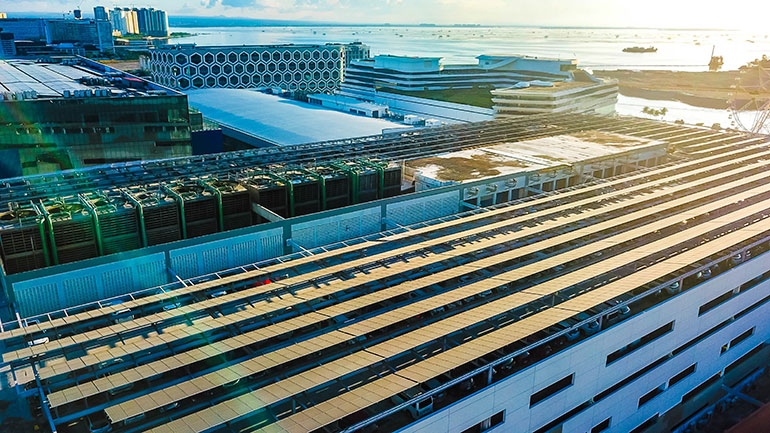
SM Prime powers the MOA Sky with a 3-megawatt solar rooftop, showcasing their ongoing commitment to sustainable energy.

The tour also showcased SM Prime’s commitment to sustainability with a stop at the 3-megawatt solar photovoltaic rooftop that harnesses the sun’s energy for a brighter tomorrow.

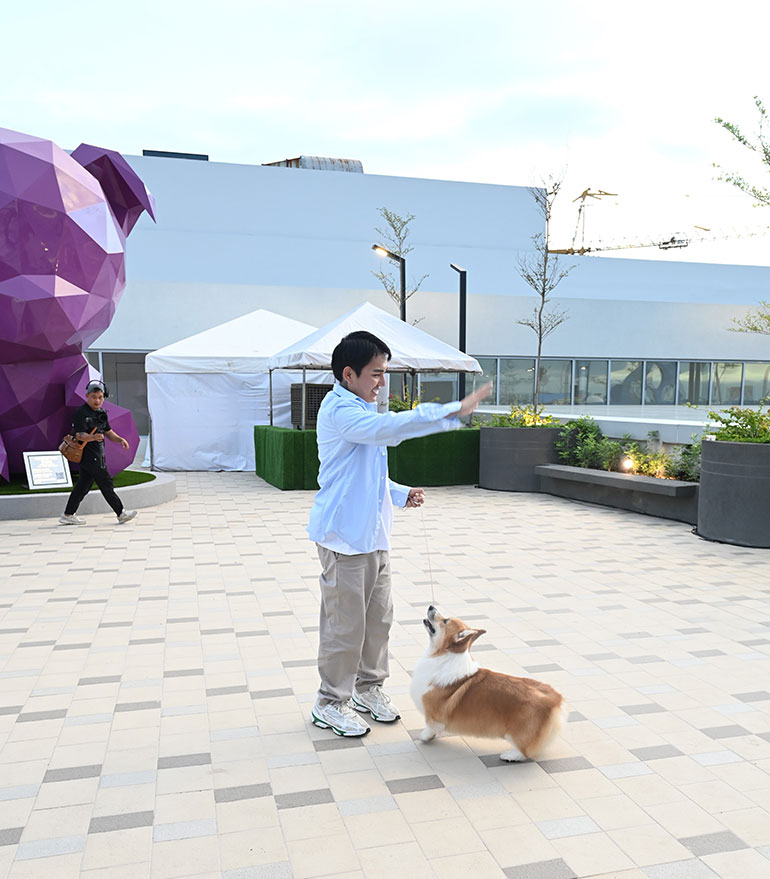
Dalbong, the champion Philippine Corgi, charms visitors at the 577-sq.m. Paw Park within the MOA Sky.

Animal lovers then enjoyed a Dalbong (a Philippine Corgi dog that won a world title at the World Dog Show 2023 held in Switzerland) exhibition at the sprawling 577-sq.m. Paw Park.

The sixth stop, the South Plaza, was a hub of artistic expression with live artists such as Jouache Panaligan, Erwin Grino, Rai Cruz, and AC Bautista.

Music, fireworks, and a mesmerizing drone show

At the MOA Amphitheater, the crowd revels in the live performances of Adie, Hale, and December Avenue.

As the sun began to set, the energy shifted towards the highly anticipated concert featuring Filipino singer-songwriter Adie, alternative rock band Hale, and indie pop band December Avenue at the MOA Amphitheater. The night sky then lit up with a spectacular fireworks display, followed by a mesmerizing drone show that led the crowd toward the MOA Football Pitch.

A thrilling finale: Filipinas exhibition game

The evening culminated in an exhilarating Filipinas Exhibition Football Game, showcasing the talent and passion of the national women’s football team. A second drone show during halftime added to the spectacle, creating a truly unforgettable experience.

A landmark celebration of community and entertainment

The MOA Football Pitch, a FIFA-grade, 1,800-seat field, can stage global tournaments, college games, and high-energy competitions.

The MOA Sky launch was a resounding success, demonstrating SM Supermalls’ commitment to providing world-class entertainment and experiences. The event not only celebrated the opening of a new landmark but also brought the community together for a night of joy and celebration. The MOA Sky is poised to become a must-visit destination, offering breathtaking views and a unique blend of entertainment, culture, and community spirit.


Spotlight is BusinessWorld’s sponsored section that allows advertisers to amplify their brand and connect with BusinessWorld’s audience by publishing their stories on the BusinessWorld Web site. For more information, send an email to online@bworldonline.com.

Join us on Viber at https://bit.ly/3hv6bLA to get more updates and subscribe to BusinessWorld’s titles and get exclusive content through www.bworld-x.com.

Philippines central bank sees February inflation at 2.2% to 3.0%

The Bangko Sentral ng Pilipinas (BSP) said reserve ratios for universal and commercial banks will be reduced to 7% effective October 25. — BLOOMBERG

MANILA – Philippine annual inflation was likely to be within a range of 2.2% to 3.0% in February, the central bank said on Friday.

“Going forward, the Monetary Board will continue to take a measured approach in ensuring price stability,” the Bangko Sentral ng Pilipinas said in a statement.

The Philippines’ statistics agency will release inflation data on March 5. — Reuters

Trade gap widens to $5.09 billion in January

DPWORLD.COM

The Philippines’ trade-in-goods deficit widened to a three-month high in January as both exports and imports picked up, the Philippine Statistics Authority (PSA) reported on Friday.

The trade deficit could further worsen this year as the US trade war escalates, analysts said.

Preliminary data from the PSA showed the country’s trade balance — the difference between the values of exports and imports — ballooned to a $5.09-billion deficit from $4.14-billion deficit in December and the $4.36 billion gap a year earlier.

Philippine Merchandise Trade Performance (January 2025)

The latest figures showed the widest trade deficit in three months since the $5.81-billion deficit in October 2024.

PSA data showed that year on year, merchandise exports in January grew by 6.3% to $6.36 billion, surpassing the 6% growth projection set by the Development Budget and Coordination Committee (DBCC) this year.

Month on month, exports grew by 12.2%. This ended four straight months of export decline.

By value, it was the highest since the $6.75 billion in August 2024.

Imports went up by 10.8% year on year to $11.45 billion in January. Month on month, it grew 16.7%, ending two months of decline.

Imports growth also exceeded the 5% projection set by the DBCC. The value of imports was the highest in three months or since the $12 billion in October last year.

“The fact that it [electronics and semiconductors] has been negative for a number of months implies that the demand for our semiconductor, is not as hot as the newer, more powerful semiconductors in the world which is really used for AI industry,” George N. Manzano, economist from the University of Asia and the Pacific, said in a phone interview.

Electronic products, the country’s main export commodity as these account for more than half of exports in January, saw a 2.6% decline to $3.37 billion in January from the $3.46 billion in the same month in 2024.

Semiconductors, which accounts for almost 40% of total exports and three-fourths of electronic products that month, also contracted by 6.8% year on year to $2.52 billion.

These declines were offset by the double-digit increases seen in other manufactured goods (up by 66.6% to $471.07 million), coconut oil (up 80.3% to $249.05 million), and other mineral products (up by 33.1% to $247.09 million).

“The fact that our exports are also increasing, that’s also a good indicator,” Mr. Manzano said.

The United States remains the top destination of locally made goods in January, with exports valued at $1.13 billion, accounting for 17.7% of total export sales.

This was followed by Japan with $945.80 million (14.9%), Hong Kong with $722.81 million (11.4%), China with $645.57 million (10.1%), and Singapore with $266.48 million (4.2%).

Meanwhile, import of electronic products grew by 14.2% to $2.51 billion in January, while mineral fuels, lubricants and related materials went up by 7.1% to $1.62 billion.

Other import commodities that saw increases were transport equipment (up by 8.5% to $906.22 million), industrial machinery and equipment (up by 20% to $592.90 million), and iron and steel (up by 17.8% to $497.35 million).

China is still the biggest source of imports in January with $3.31 billion worth of goods, making up 28.9% of the total imports.

It was followed by Japan with $912.71 million (8% share), Indonesia with $892.95 million (7.8%), South Korea with $862.27 million (7.5%), and US with $690.81 million (6%).

George T. Barcelon, chairman of the Philippine Chamber of Commerce and Industry, said in a phone interview that the country’s trade deficit has been increasing over the past few years.

“Locally, we are not producing enough competitive products for the local supplier or manufacturer to serve the market. And as such, it’s cheaper to import. We have quite a big deficit with all the world but also with the ASEAN countries. So those are gaps that must be filled,” Mr. Barcelon said.

“Because every time we have a trade deficit, in other words, it translates to giving jobs to countries outside, and the jobs are not here in our country,” he added.

Mr. Barcelon also mentioned the uncertainties brought about by the looming trade war by the US government under the Trump administration.

“One of the issues on the mind of businessmen is how our trade will go, because our biggest market is still primarily North America,” he said.

“When you’re uncertain, people will not really going to be eager to invest…there is not much investment since they’re waiting whether the trade war is going to actually happen,” he added in a mix of Filipino and English.

“So that’s like the biggest thing right now in the world economy, what the US will do. Because the US is such a big buyer of our exports,” he said.

In a research note, Chinabank Research said that outlook for the industry may remain bleak this year as ongoing efforts may materialize in the long run.

Chinabank Research added that a significant risk will arise if Mr. Trump proceeds with his plan to impose 25% tariffs on semiconductors this year.

It also said that the shortfall in trade deficit “could widen further this year, with major risk coming from increased uncertainties on global trade policy, as well as Trump’s plan to impose reciprocal tariffs as the US is the top destination for Philippine exports.”

Markets are preparing for the potential impact of the trade policies by US President Donald J. Trump, such as reciprocal tariffs on all countries that tax US imports.

Mr. Trump on Thursday will impose 25% tariffs on Mexican and Canadian goods starting on March 4, along with an additional 10% duty on Chinese imports of medicines, Reuters reported. Early in February, Mr. Trump imposed 10% levy on Chinese imports. — Kenneth H. Hernandez

[B-SIDE Podcast] How can a brand protect its reputation?

Follow us on Spotify BusinessWorld B-Side

What causes reputational damage? How can one mitigate the effects of it? What are ways companies can protect their reputation?

In this B-Side episode, BusinessWorld talks about these topics with R.G. W. Gabunada, a partner at Louder PH, a full-service agency, and the CMO of Mansmith and Fielders, a training and consultancy company.

Follow us on Spotify BusinessWorld B-Side

Interview by Patricia Mirasol
Audio editing by Jayson Mariñas

DOST eyes potential use of cinnamon, pili-based mosquito repellent

source: DOST-FPRDI

by Edg Adrian A. Eva, Reporter

A mosquito repellent made from forest products is being developed by the Department of Science and Technology (DOST) to support the country’s efforts against dengue. 

Residual byproducts from essential oil production, such as cinnamon bark, almaciga, and pili resin are being repurposed into incense cones and sticks as insect repellents by experts from the DOST-Forest Products Research and Development Institute (DOST-FPRDI).  

These materials naturally possess insect-repelling properties, according to DOST.  

Based on initial tests, including the “test cage method,” the DOST-FPRDI-formulated incense shows high potential for warding off mosquitoes and houseflies.  

They also analyzed the chemical components responsible for repelling insects.  

“May mga nakita at na-detect na chemical components na responsible for repelling these insects like yung creosol and furfural— na common na ginagamit for fungicide, pesticide, (and disinfectant), mga ganon [“We have identified and detected chemical components responsible for repelling these insects, such as creosol and furfural, which are commonly used as fungicides, pesticides, and disinfectants,” Ms. Florena B. Samiano, leader of the Institute’s Flavors and Fragrances from the Forest Technology Program (F3TP) said in an interview.  

Also, initial feedback indicated that the smoke produced by the incense is non-irritating to the eyes and nose and emits a pleasant smell, Ms. Samiano added.  

While initial studies show the DOST-FPRDI-formulated incense to be effective, further testing on sensory acceptability and industry-scale application are still recommended, Ms. Samiano said.  

“Usok pa lang yung tinest namin. It’s still recommended for further laboratory testing. Para mas safety na i-ano (gamitin) ng tao [We have only tested the smoke so far. Further laboratory testing is still recommended to ensure its safety for human use],” she furthered.  

Rico J. Cabangon, DOST-FPRDI Director said that the DOST continues to harness the potential of wood and non-wood products to address the country’s most pressing issues like dengue.  

“The Philippine forests are replete with natural resources that can help combat dengue and other viral diseases,” Mr. Cabangon said in a statement.  

As of February 21, the Department of Health (DOH) recorded 15,134 dengue cases from January 19 to February 15. This brings the total number of cases for the year to 43,732, a 56% increase from the same period last year.


Piloting the technology 

The DOST-FPRDI-formulated incense is set for pilot testing with industry partners in the second to third quarter of the year, Ms. Samiano said.  

They plan to introduce the technology in areas with essential oil extraction facilities, potentially in Zambales, Bacolod, and Bicol.   

Ms. Samiano said that sharing this technology would help partners repurpose a big chunk of raw materials left after the extraction process, which would otherwise go to waste.  

Unleashing Pandora’s Box: DeepSeek, LLMs, and the AI race

DeepSeek is a Chinese AI company that develops large language models, which is a type of AI program that can recognize and generate text, among other tasks. Its new AI model, R1, is said to rival the capabilities of leading AI models, while reportedly costing less to develop.

In this episode, BusinessWorld talks about LLMs, DeepSeek, and the AI arms race with Satnam Narang, a senior staff research engineer at Tenable Inc., a cybersecurity company.

Interview by Patricia Mirasol
Audio editing by Jayson Mariñas

Airline pilots surprised by Chinese live-fire warning near Australia, messages show

MARK OLSEN-UNSPLASH

 – Pilots first heard about a Chinese live-fire naval exercise near Australia last week when already in the air, receiving messages that forced some to change paths through a busy air corridor, satellite text messages to and from pilots seen by Reuters show.

The incident highlights how airlines are increasingly having to react at short notice to geopolitical disruptions and military hazards, such as missile and drone barrages between Israel and Iran last year.

It also shows how China’s military, in its first drills in the Tasman Sea between Australia and New Zealand, is raising tensions by being more assertive across the Indo-Pacific region, according to Western defense analysts, including near Taiwan.

China has said it gave adequate warning to Australian and New Zealand authorities about the exercise.

Planes first heard about a live-fire drill when a Virgin Australia IPO-VIR.AX pilot picked up a Chinese navy broadcast on the 121.5 MHz emergency radio channel pilots use to communicate between planes at 9.58 a.m. Sydney time last Friday (2258 GMT on Thursday), according to Australian officials.

The pilot reported the broadcast to an air traffic controller, who passed the message to Australia’s military, according to Airservices Australia.

“At that stage we didn’t know whether it was a potential hoax or real,” said Peter Curran, deputy CEO of the air traffic control agency, at a parliamentary hearing this week.

Air traffic control started sending hazard alerts to nearby aircraft, including a Singapore Airlines SIAL.SI flight from Christchurch to Singapore and an Air New Zealand AIR.NZ flight from Auckland to Melbourne around 11:30 a.m., according to previously unreported text messages.

Half an hour later, the Air New Zealand pilots told the ground: “Hi, lots of chatter on 121.5 including Chinese navy. Same pos[ition] and ht/radius as you advised. Cheers.”

An airline dispatcher told the Air New Zealand pilots 20 minutes later there was “unannounced live firing in Tasman to the nth of you by Chinese military.”

“Below is all we know. Broadcast on 121.5… just FYI we have been notified of a Chinese live firing exercise as follows. Posn. 37S 15702E. Radius 40nm. SFC-45000. Until 0300Z. No ack required.”

The messages were sent between aircraft and ground stations using an Aircraft Communications Addressing and Reporting System (ACARS) system.


LEGAL BUT ‘IRRESPONSIBLE’

Civil aircraft have been shot down by military assets highlighting the risk of live fire, including Malaysian Airlines flight MH17 over eastern Ukraine in 2014, a Ukrainian flight departing Tehran in 2020 and a suspected incident involving an Azerbaijani jet over Russia in December.

The Chinese warships were beyond Australia’s 200 nautical mile (370 km) exclusive economic zone on the high seas, where countries routinely do live-fire exercises. China has said the warning it provided complied with international law, which Australia has acknowledged.

However, Australia and New Zealand have said the drills fell short of best practice for notifications.

“In that sense, it was irresponsible,” Australia’s defense force chief Admiral David Johnston told a parliamentary committee.

Pilots are typically alerted to military drills, rocket launches and other airspace issues through Notices to Airmen, or NOTAMs, which are usually filed at least 24 hours in advance.

“We/re don/t have a NOTAM in effect for Chinese exercise. Have not seen or heard any of that,” an airline dispatcher told two American Airlines AAL.O flights approaching Sydney and Brisbane from the U.S. at 3:37 a.m. and 3:39 a.m. on Saturday morning.

Steve Cornell, a Qantas QAN.AX captain and a vice president of the Australian and International Pilots Association (AIPA), said the unexpected incident would have increased the workload on pilots and air traffic control.

“The issue with this one was the short notice, or no notice effectively, really,” Cornell told Reuters. “All of a sudden it came to the attention of the pilots and they had to self-manage maneuvering around this zone.”

Routings were changed for 49 flights last Friday, Airservices said.

Eight hours after Airservices first heard of the live-fire warning, air traffic sent a hazard alert to an Emirates flight from Christchurch to Sydney, but said they have “reports that the activity has finished”.

However a second live-fire warning came on Saturday afternoon, New Zealand’s defense ministry reported.

On Sunday, an airline dispatcher told a Virgin Australia flight about to depart Queenstown, New Zealand for Brisbane: “FYI the govt has confirmed Chinese navy now well south in Southern Ocean”.

The ships are now south of Australia and heading west, New Zealand’s military said on Friday. – Reuters

Taiwan tells China World War Two shows aggression will end in failure

CHINESE AND TAIWANESE flags are seen in this illustration, Aug. 6, 2022. — REUTERS

 – Taiwan’s defense ministry said on Friday that the history of World War Two shows aggression and expansion will end in failure, responding to Chinese comments that the island would come into Beijing’s hands sooner or later.

Democratically governed Taiwan, which China views as its own territory, has repeatedly complained of stepped-up Chinese military activity, including drills this week off the island’s southwestern coast that Beijing said were “routine”.

On Thursday, China’s defense ministry, asked about Taiwan’s annual Han Kuang military exercises later this year, said Taiwan was “like a mantis trying to stop a chariot” and “sooner or later we will take you back”.

Taiwan’s defense ministry said in a statement that China has recently been escalating its military threats in the region, destroying the status quo of regional stability, and has become the biggest “troublemaker” in the international community.

“This year marks the 80th anniversary of (the end of) World War Two, and history has proven that any form of aggression and expansion will end in failure,” it said. “The actions of the Communist military in recent years are repeating the mistakes of the invaders and pushing China towards defeat.”

Taiwan’s military is strengthening its forces to safeguard sovereignty, ensure freedom and democracy, and collaborate to maintain security and stability in the region, the ministry added.

Taiwan’s government rejects Beijing’s sovereignty claims, saying only the Taiwanese people can decide their future.

World War Two, and the full-scale Japanese invasion of China in 1937 that preceded the start of the world war in 1939, is a touchy historical subject in both China and Taiwan.

The Chinese government at the time was the Republic of China and its forces did much of the fighting against Japan.

The republican government fled to Taiwan in 1949 after losing a war with Mao Zedong’s Communists, and Beijing today largely downplays the role of the republican forces.

Chinese President Xi Jinping has accepted Russia’s invitation to attend the commemorations of the Soviet victory over Nazi Germany in World War Two, Russian media said this month.

Taiwan was a Japanese colony during the war, and some Taiwanese fought on the side of the Japanese army.

Speaking at a separate event in Taipei to mark a 1947 uprising against Chinese republican troops in Taiwan, known as the “228 Incident“, President Lai Ching-te said China has not given up its attempts to take Taiwan by force.

“The greatest threat to Taiwan’s sovereignty, Taiwan’s democracy and Taiwan’s people being their own master, comes from China,” he said. – Reuters

Shorter tenor Asian bonds can combat tariff-led volatility

BLOOMBERG

Emerging Asian bonds with shorter tenors may be less exposed to any volatility in US rates, relative to their longer-dated peers, due to interest-rate cuts in local markets.

A Bloomberg analysis showed shorter-term emerging Asian debt moved less in tandem with two-year US yields compared with the region’s 10-year bonds. That means front-end bonds of five Asian nations can better withstand any possible tariff-induced resurgence in US yields as local policy makers diverge from the Federal Reserve and cut interest rates.

The relative attractiveness of shorter-dated emerging Asian bonds is coming into view as investors grapple with incremental tariff headlines. US President Donald Trump made contradictory remarks on the timing of Canada and Mexico levies, before a White House official said the deadline remains on March 4. A report on possible reciprocal tariffs is also due in April.

“The probability of US tariff escalation remains high as the trade review on China nears completion and reciprocal tariff policies are evaluated,” said Rajeev De Mello, portfolio manager at Gama Asset Management SA.

He recommends investors to position along shorter-to-mid maturity interest-rate swaps or local-currency bond curves as monetary policy across emerging Asian economies shifts toward easing.

The possibility of US tariffs on Canada and Mexico had pushed up two-year US yields earlier this month as traders bet the move would fuel inflation and prevent further interest-rate cuts from the Federal Reserve. Even though US yields have fallen in recent sessions, Fed officials like Raphael Bostic and Thomas Barkin this week signaled that US rates will need to remain restrictive to tame inflation.

The correlation between the two-year US yield and 10-year Malaysian debt stands at 0.5, while that between 2-year Treasury yields and the three-year ringgit bonds was 0.2, as per Bloomberg analysis. That implies bigger downside for Malaysia’s longer-dated notes should escalation in global trade tensions push up US rates.

“Front-end rates offer somewhat lower exposure” to shifting market pricing around tariff risks, supported by continuation of interest-rate cuts among emerging market central banks this year, Goldman Sachs Group Inc. strategists including Kamakshya Trivedi and Danny Suwanapruti write in a Feb. 12 note.

Bank of Thailand unexpectedly trimmed interest rates by 25 basis points on Wednesday. Bank of Korea also made a similar rate reduction, with BOK Governor Rhee Chang-yong signaling one or two more quarter-point cuts this year.

Bangko Sentral ng Pilipinas stuck to its guidance for a cumulative 50 basis points of rate easing this year, and said it will slash reserve requirement ratio for big banks by 200 basis points next month. Interest rate cuts are favorable for sovereign bonds, particularly notes on the shorter end of the yield curve.

Shorter dated yields in Indonesia, Malaysia, Thailand, the Philippines, India and South Korea have declined by an average 15 basis points, while 10-year yields have slipped by an average of six basis points this year. — Bloomberg

Teleperformance uses AI to ‘neutralize’ Indian accents of agents

The technology is available for Indian and Filipino accents and is being tuned for other regions, including Latin America. Photographer: Taylor Weidman/Bloomberg

Teleperformance SE, the largest call-center operator in the world, is rolling out an artificial intelligence system that softens English-speaking Indian workers’ accents in real time in a move the company claims will make them more understandable.

The technology, called accent translation, coupled with background noise cancellation, is being deployed in call centers in India, where workers provide customer support to some of Teleperformance’s international clients. Teleperformance provides outsourced customer support and content moderation to global companies including Apple Inc., ByteDance Ltd.’s TikTok and Samsung Electronics Co Ltd.

“When you have an Indian agent on the line, sometimes it’s hard to hear, to understand,” Deputy-Chief Executive Officer Thomas Mackenbrock said in an interview with Bloomberg. The technology can “neutralize the accent of the Indian speaker with zero latency,” he said. This “creates more intimacy, increases the customer satisfaction, and reduces the average handling time: it is a win-win for both parties.”

The company declined to disclose which clients are using the technology.

The roll-out of accent translation is part of a bigger push by Teleperformance to invest up to €100 million ($104 million) in AI partnerships this year, the company said in an earnings statement on Thursday. The technology was developed by Palo Alto-based startup Sanas, in which Teleperformance invested $13 million earlier this year. Under the terms of the deal, Teleperformance becomes the exclusive reseller of Sanas’ technology to its clients.

The rise of AI chatbots has led to investor jitters about the sustainability of the human call-center model. Last year, Teleperformance shares fell to their lowest since late 2016 after Swedish fintech company Klarna Bank AB said its AI assistant, powered by OpenAI, was doing the equivalent work of 700 full-time agents. Teleperformance has sought to allay shareholder concerns by using AI to enhance rather than replace employees, which totaled 490,000 as of the end of 2023.

The French company is using AI across the business, including using AI co-pilots to coach new employees and transcribing calls for quality control.

Sanas, the firm that Teleperformance is using to offer this accent-softening service to clients, is one of the AI upstarts blurring the line between where generative AI tech starts and the human ends. The firm’s software also eliminates background noise — like crowing roosters, ambulance sirens and office chatter. That might sound like an aid to agents, rather than a tool that might displace them.

But it carries a risk for customer service bases such as the Philippines that built market-leading positions by cultivating a preponderance of high-quality English speakers. The tools may also be perceived as taking away from workers’ cultural identities and the authenticity of conversations.

Sanas said it developed the technology with a goal of “reducing accent-based discrimination,” according to its website. The technology is available for Indian and Filipino accents and is being tuned for other regions, including Latin America, where Teleperformance has many workers supporting US-based customers, Mackenbrock said.

“AI will be ubiquitous, it is already today,” Mackenbrock said. “But in order to build connections, customer experience, branding awareness, the human element will be incredibly important.”

Teleperformance’s approach appears to be paying off: Teleperformance is forecasting 3% to 5% revenue growth this year, it said in the earnings statement. Fourth-quarter revenue was €2.68 billion, up 12% from last year or 4% on a pro forma basis.

Earlier this month, Klarna’s CEO Sebastian Siemiatkowski posted on X that Klarna “just had an epiphany,” saying that “in a world of AI nothing will be as valuable as humans.” Klarna would continue to invest in its AI support, but use cost savings to make sure that “the human service part of Klarna becomes even better,” he added.

Teleperformance is also making a push to provide services to the tech giants building AI models, Mackenbrock said.

“Whether it is OpenAI, or any AI model in the world, it needs human support for training,” he said. This includes creating, testing and labeling data. — Bloomberg