Home Blog Page 1489

Action on frozen meat ban in Abra pushed

BAGUIO CITY — The League of Municipalities of the Philippines (LMP) is pushing for a decisive action to enforce a ban on frozen meat products within Bangued, Abra.

An early intervention signaling his strong commitment to public health and agricultural products protection in the Cordillera, LMP National President Joseph Sto. Niño B. Bernos called on authorities to be on their toes against the illegal entry of frozen meat products that is detrimental to local production.

Abra province has maintained strict restrictions on the entry of live swine, raw meat, and all forms of frozen or processed pork since 2019.

This measure was implemented as a crucial defense against the spread of African Swine Fever (ASF), a highly contagious and devastating disease for pig populations.

Despite the existing ban, incidents of frozen meat confiscation indicate ongoing challenges in its full enforcement.

Mr. Bernos emphasized that rigorous adherence to the policy is paramount to safeguard the health and well-being of residents not only in Bangued but across the entire province. — Artemio A. Dumlao

Peso sinks to six-week low as US-China deal boosts dollar

BW FILE PHOTO

THE PESO sank to a six-week low on Wednesday as the dollar got a boost after the United States and China reached a deal to extend their tariff truce.

The local unit closed at P55.885 per dollar, weakening by 5.5 centavos from its P55.83 finish on Tuesday, Bankers Association of the Philippines data showed.

This was the peso’s worst close in six weeks or since it finished at P56.145 against the greenback on April 29.

The peso opened Wednesday’s session slightly stronger than Tuesday’s close at P55.80 against the dollar. Its worst showing was at P55.90, while its intraday best was at P55.78 versus the greenback.

Dollars exchanged went down to $1.15 billion on Wednesday from $1.23 billion on Tuesday.

“The dollar-peso ended higher after the US and China agreed to a framework deescalating trade tensions. But the pair was capped on caution ahead of the US CPI (consumer price index) release,” a trader said in a phone interview.

“Talks between the US and China extended into their second day in London, with a Treasury official saying the teams were trying to iron out technical details,” Rizal Commercial Banking Corp. Chief Economist Michael L. Ricafort said in a Viber message.

Philippine financial markets are closed on June 12 (Thursday) for the Independence Day holiday.

Stock markets and the dollar gave a guarded welcome on Wednesday to the latest signs of progress in trade talks between the United States and China, while waiting for more detail of what was decided and whether it would stick for long, Reuters reported.

Bond investors were also hunkered down for a reading on US inflation that could show the early impact of tariffs on prices, and a Treasury auction that will test demand for the country’s debt.

In London, negotiators from Washington and Beijing said they had “agreed a framework on trade” that would be taken back to their leaders.

US Commerce Secretary Howard Lutnick said the implementation plan should result in restrictions on rare earths and magnets being resolved, but again offered no specifics.

Investors in US stocks, who have been badly burned by trade turmoil before, remained cautious, with S&P 500 futures and Nasdaq futures both down 0.2%.

Asian and European shares were slightly more positive, with MSCI’s broadest index of Asia-Pacific shares outside Japan up 0.6% and the STOXX benchmark for major European shares gaining 0.14%.

The reaction in currency markets was equally muted, with the dollar strengthening slightly against the Japanese yen to trade at 145.05. The euro edged down 0.1% to $1.1422, nudging the dollar index up to 99.091.

Data on US consumer prices for May might also show some initial upward pressure from tariffs, though analysts assume it will take a few months to fully show in the series.

Median forecasts are for the headline consumer price index to rise 0.2% and the core 0.3%, which would nudge the annual rates up to 2.5% and 2.9%, respectively.

Anything higher would be a setback to hopes for more rate cuts from the US Federal Reserve and could see bonds sell-off. Markets imply little chance the Fed will ease at its meeting next week or in July, but have priced around a 60% chance of a move in September. — A.M.C. Sy with Reuters

Stocks rebound as US, China agree to extend truce

REUTERS

PHILIPPINE SHARES booked a modest rebound on Wednesday after the United States and China reached a deal to continue their tariff truce.

The main Philippine Stock Exchange index (PSEi) rose by 0.53% or 33.65 points to close at 6,381.32, while the broader all shares index went up by 0.47% or 17.69 points to 3,776.19.

Philippine financial markets are closed on Thursday (June 12) for the Independence Day holiday.

“The local market ended higher following the positive cues from Wall Street. Investors cheered the consensus reached by the US and China in their trade talks in London,” Philstocks Financial Inc. Research Manager Japhet Louis O. Tantiangco said in a Viber message.

“The PSEi corrected higher after the US and China agreed to a preliminary plan to ease trade tensions, and also after US stock markets gained further to near record highs recently,” Rizal Commercial Banking Corp. Chief Economist Michael L. Ricafort likewise said in a Viber message.

US and Chinese officials said on Tuesday they had agreed on a framework to get their trade truce back on track and remove China’s export restrictions on rare earths while offering little sign of a durable resolution to longstanding trade tensions, Reuters reported.

At the end of two days of intense negotiations in London, US Commerce Secretary Howard Lutnick told reporters the framework deal puts “meat on the bones” of an agreement reached last month in Geneva to ease bilateral retaliatory tariffs that had reached crushing triple-digit levels.

Mr. Lutnick said the agreement reached in London would remove restrictions on Chinese exports of rare earth minerals and magnets and some of the recent US export restrictions “in a balanced way,” but did not provide details after the talks concluded around midnight London time.

On Tuesday, the S&P 500 climbed 0.55% to end the session at 6,038.81 points. The Nasdaq gained 0.63% to 19,714.99 points, while the Dow Jones Industrial Average rose 0.25% to 42,866.87 points.

Back home, all sectoral indices closed higher on Wednesday. Industrials climbed by 0.96% or 85.68 points to 8,971.66; holding firms went up by 0.9% or 49.69 points to 5,515.68; property increased by 0.87% or 19.61 points to 2,261.41; services rose by 0.72% or 15.93 points to 2,227.29; mining and oil ascended by 0.53% or 50.06 points to 9,475.57; and financials edged up by 0.03% or 0.75 point to 2,331.54.

“JG Summit Holdings, Inc. was the day’s top index gainer, climbing 4.27% to P19.04. Universal Robina Corp. was at the bottom, falling 3.31% to P83.15,” Mr. Tantiangco said.

Value turnover decreased to P7.14 billion on Wednesday with 897.37 million shares exchanged from the P9.39 billion with 1.45 billion issues traded on Tuesday.

Advancers outnumbered decliners, 104 versus 91, while 44 names were unchanged.

Net foreign selling went down to P30.21 million on Wednesday from P525.73 million. — Revin Mikhael D. Ochave with Reuters

Offshore wind auction to offer capacity of 3,300 MW

REUTERS

By Sheldeen Joy Talavera, Reporter

THE Department of Energy (DoE) said it opened up for stakeholder comment on the rules for fifth round of the green energy auction (GEA-5), which will offer 3,300 megawatts (MW) of capacity.

In a statement on Wednesday, the DoE said this round will focus on fixed-bottom offshore wind technology, with installation targeted for between 2028 and 2030.

“By prioritizing fixed-bottom offshore wind for GEA-5, we are investing in a technology that is ready to deliver,” Energy Secretary Raphael P.M. Lotilla said. “This allows us to set a strong and credible foundation for the country’s offshore wind sector, one that can deliver first power by 2028.”

The DoE said it opted for fixed-bottom as the focus of GEA-5 due to its “established global track record, cost-efficiency, and scalability.”

“This approach positions the DoE to expedite the near-term deployment of offshore wind, supporting large-scale and reliable renewable energy generation aligned with the country’s energy security and climate objectives,” the DoE said.

It said floating offshore wind technology remains in the early stages of development, pending which the Philippines must exploit “a critical window for proactive planning and capacity-building.”

Energy Undersecretary Rowena Cristina L. Guevara said the DoE remains open to floating offshore wind technology.

“As global experience grows and the technology matures, the DoE will reassess its inclusion in future auction rounds. For now, our focus is to build momentum with fixed-bottom projects that can succeed under current technical, regulatory, and infrastructure conditions,” she said.

The DoE is inviting offshore wind developers, port operators, transmission companies, and other parties to review the GEA-5 terms of reference and submit inputs, comments, or clarifications on or before June 18.

GEA-5 is expected to facilitate market access for offshore wind developers, ensuring long-term demand for their generation capacities.

The DoE expects offshore wind to play a key role in achieving the Philippine target of increasing renewable energy’s share in the power mix to 35% by 2030 and 50% by 2040.

PPPs expected to take off after RoW bill becomes law

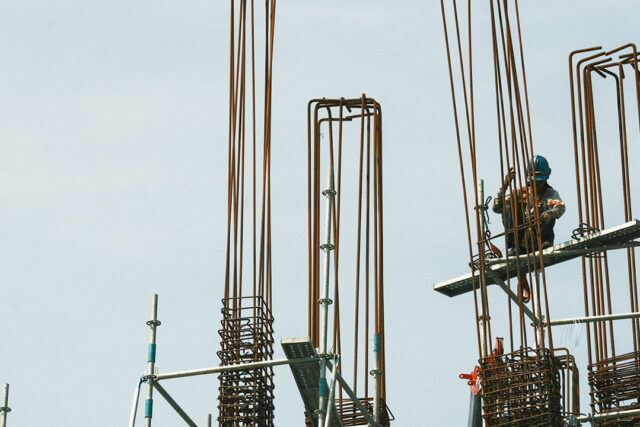
A MAN WORKS at a construction site in Navotas City. — PHILIPPINE STAR/RYAN BALDEMOR

THE new Right-of-Way (RoW) bill, when signed into law, is expected to help fast-track public-private partnerships (PPPs), according to the Federation of Filipino Chinese Chambers of Commerce and Industry, Inc. (FFCCCII). 

“The FFCCCII lauds the historic passage of the Right-of-Way bill, a transformative legislative achievement that will accelerate the Philippines’ infrastructure renaissance,” FFCCCII President Victor Lim said in a statement on Wednesday.

“By dismantling bureaucratic bottlenecks that have stalled critical projects for years, this law empowers our nation to finally bridge its infrastructure gap and fuel equitable progress,” he added.

He said that the bill’s final reading approval at the Senate reflects the government’s priorities of job creation, enhancing logistics, and improving the quality of life.

“The FFCCCII particularly welcomes its potential to fast-track PPPs, enabling timely delivery of airports, seaports, and industrial corridors that will elevate our global competitiveness,” he added.

Senators on Monday approved Senate Bill No. 2821, the Accelerated and Reformed Right-of-Way Act, which aims to facilitate easier acquisition of right-of-way in infrastructure construction.

It seeks to amend the Republic Act No. 10752, also known as the Right-of-Way Act.

The FFCCCII said “costly delays in land acquisition, legal disputes, and procedural gridlock” have hindered the completion of infrastructure projects.

The bill “cuts through these obstacles with clarity, efficiency, and fairness, ensuring public and private projects can advance without sacrificing due process or just compensation,” Mr. Lim said.

“We extend our deepest gratitude to policymakers for their courage in passing this long-stalled measure. As we move forward, we urge vigilant execution to balance swift implementation with transparency, protecting stakeholders’ rights while safeguarding the greater public interest,” he added. — Justine Irish D. Tabile

Immediate return of 35% tariff on rice seen fueling price shocks

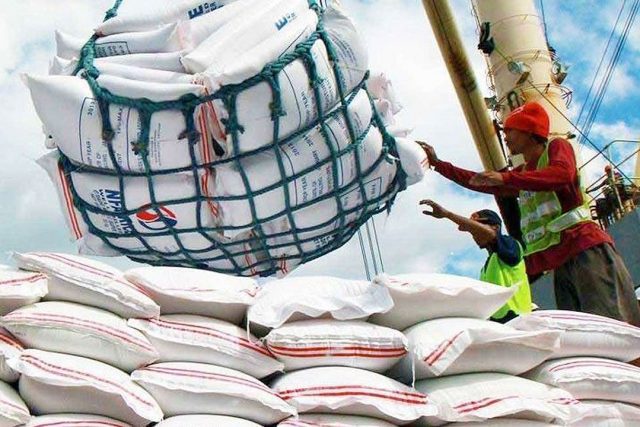
PHILSTAR FILE PHOTO

THE Department of Agriculture (DA) warned legislators that raising rice tariffs to 35% from 15% too quickly could trigger price shocks, and advocated for a gradual increase instead.

At a committee hearing, Nueva Ecija Rep. Rosanna V. Vergara said: “I strongly urge the Secretary of Agriculture to reconsider reverting the tariff rates to the pre-existing rate of 35% and to review Executive Order No. 62, which had lowered the rate to 15%.”

“That might create a big shock in the market, and even to the world market,” Agriculture Secretary Francisco P. Tiu Laurel, Jr. said in response. “A gradual increase has been our suggestion.”

The hearing of the agriculture committee was exploring measures to curb food prices and bolster agriculture development, including restoring the National Food Authority’s (NFA) market regulatory powers.

The government in July 2024 slashed tariffs on rice imports to 15% from 35% until 2028 to tame rice prices. The rate is subject to review every four months.

“The last review, which was two months ago, our position with NEDA (National Economic and Development Authority) is to recommend a gradual increase towards attaining 35%,” Mr. Laurel said.

He said rates could be incrementally increased, by 10% first and then subsequent 5% hikes to slowly prime the rice market.

“It’s difficult if we raise it to that level immediately,” he said. “The price of rice will definitely increase suddenly.”

Meanwhile, the committee also recommended restoring the NFA’s regulatory powers, such as having the ability to intervene in the market to help keep rice affordable.

“(We) support the reinstatement of regulatory trade mandates of the NFA to enable market interventions, thereby stabilizing supply and prices of grains,” Albay Rep. Jose Ma. Clemente S. Salceda told the panel.

NFA Administrator Larry R. Lacson has said that he is seeking the restoration of the power to sell rice directly to the public to influence the market during times of high prices.

The DA is seeking an P18-billion budget to fund next year’s subsidized rice program, Mr. Laurel said.

He said the department has requested about P160 billion in funding for next year, with the bulk to be used to fund rice and livestock programs. — Kenneth Christiane L. Basilio

Egypt targeted for mango, banana exports

PHILSTAR FILE PHOTO

THE Department of Agriculture (DA) said it is targeting Egypt as a new market for high-value produce such as mangoes and bananas.

Agriculture Secretary Francisco Tiu Laurel, Jr. recently met with Egyptian Ambassador Nader Nabil Zaki as part of a larger effort to diversify export markets destinations in North Africa, the DA said in a statement.

The DA noted that Egypt, Africa’s second-largest economy, recently opened its doors to Philippine durian, which could pave the way for similar access for other produce.

“They already granted us access for durian. We are hopeful they will do the same for our mangoes and bananas,” Mr. Laurel was quoted as saying.

Egyptian grapes and potatoes are currently in the final stages of their Pest Risk Assessment and food safety analysis for export to the Philippines, the DA said.

“In addition, the opportunity of sourcing garlic and onions from Egypt was explored and technical assistance and information exchange for the two commodities are planned in the near future,” it added.

Agricultural trade between the two countries is around $7.5 million annually, with Egypt currently running a surplus.

The Philippines primarily exports desiccated coconut and carrageenan to Egypt, while importing broths, soups, and dried kidney beans. — Kyle Aristophere T. Atienza

Agriculture seen providing reduced cushion for exports

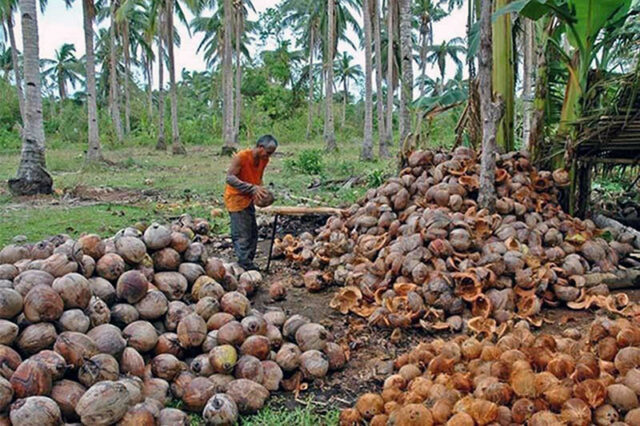
CENTURYPACIFIC.COM.PH

By Justine Irish D. Tabile, Reporter

THE Export Marketing Bureau (EMB) of the Department of Trade and Industry (DTI) said the outlook for agricultural exports is less positive this year because the coconut industry is facing supply challenges.

“We are not as optimistic because of the coconut supply issues,” EMB Director Bianca Pearl R. Sykimte told reporters on the sidelines of the Business Issues Forum.

Growth in agricultural exports had helped mitigate the decline in manufacturing exports last year.

“As you know, coconut has been one of our export winners in the past few years. But unfortunately, we have been facing significant supply constraints,” she added.

In 2024, she said the Philippine agro-based exports of $6 billion offset a $1.5 billion decline in manufactured goods.

“These figures underscore the urgency to innovate and move up the value chain, particularly in our agri-based sectors,” she said.

“By investing in research, sustainable practices, and product development, we can transform basic agricultural outputs into high-value, globally competitive products. This shift is essential, not only to diversify our export base but also to build resilience against external shocks and market volatility,” she added.

She said coconut supply has been a concern for some months.

“But the demand is there. In fact, we have been participating in a couple of shows, and the demand from international markets is high,” she said.

“So the question is, how fast can we supply it? There are challenges like that… coconuts are not only exported but are also being used in local manufacturing,” she added.

She said that the issue is also having an impact on food manufacturers, who are major users of coconut oil.

Asked to comment, Philippine Coconut Authority (PCA) Deputy Administrator Roel M. Rosales said the extended El Niño in previous years has adversely affected output.

“There was a slight reduction in last year’s harvest. During the same time, demand and prices for coconut also increased, for domestic and export, thus the reduced output, though minimal, was felt,” he said via Viber.

“However, it is expected that recovery in production will be seen by the second semester of this year,” he added.

He said that the PCA is currently implementing a salt fertilization program as a “quick turnaround intervention.”

“Effects of fertilization will be seen in terms of increased production a year after application,” he added.

Ms. Sykimte said the EMB has proposed an annual allocation of P200 million under the General Appropriations Act to support exporters in accessing new markets.

“The idea is to help them in terms of getting the certifications they require to access markets because without those certifications, you cannot export,” she said.

She said that both the Philippine Development Plan and the Philippine Export Development Plan (PEDP) are undergoing recalibration, not only for exports but also for other indicators.

For the PEDP, she said that the DTI has been running simulations but is hopeful that the targets will be finalized by the third quarter.

“It’s a whole set of recalibrations. But definitely, (exports) will be aligned, whatever that number is,” she added.


Regulator backs suspension of biodiesel blend hike

PHILSTAR FILE PHOTO

THE National Biofuels Board (NBB) said it supports the suspension of the 1-percentage-point increase in the coco-methyl ester content of biodiesel blend, citing the potential impact on inflation.

Philippine Coconut Authority (PCA) Laboratory Services Division Chief Celia M. Raquepo said at a briefing that the NBB arrived at the recommendation at a recent board meeting, in which it had taken note of the high price of copra, the raw material for coconut oil, and the possibility that these costs may filter into the price of fuel.

The Biofuels Act of 2006 requires all liquid fuel to contain a set proportion of biofuel. The blend rose to 3% in October 2024, from 2% previously. It’s set to further increase to 5% in October this year.

Director Rino Abad of the Oil Industry Management Bureau said the NBB’s recommendation is “not yet official until approved by the Secretary of Energy.”

Secretary Raphael P.M. Lotilla left the Department of Energy in late May after being appointed to head the Department of Environment and Natural Resources.

Ms. Raquepo said the price pressures on copra are not a function of the coconut supply, which she said was “sufficient.”

The per-liter price of diesel rose by 95 centavos on Tuesday, marking the fourth straight week they had increased.

Copra’s monthly average millgate price was P75.34 per kilo in March, surpassing peak levels at the height of the Russia-Ukraine conflict in 2022.

The PCA in March had called for an assessment of the potential impact of the scheduled increase in the biodiesel mandate, in light of the need to “prioritize cooking oil availability for consumers.”

Rosella B. Villaruel of the PCA’s Trade and Marketing department said the global demand for coconut oil has been increasing.
Revenue from exporting coconut oil this year could top the record $2.22 billion generated in 2024, she said.

Coconut production slipped by 0.3% in the first quarter of 2025, nearly reversing the 3.3% decline a year earlier.

The Philippines is the world’s second-largest exporter of coconut products, next to Indonesia. — Kyle Aristophere T. Atienza

Cocolisap pest seen inflicting P280M in production losses

THE coconut scale insect (CSI) infestation across nine regions could result in P280 million in lost production, according to the Philippine Coconut Authority (PCA).

As of May, about 516,000 coconut trees were struck by the pest, also known as cocolisap, PCA Chief Executive Officer and Administrator Dexter R. Buted told reporters.

Calabarzon was the most affected region. Others were Mimaropa, Bicol, the Central Visayas, the Eastern Visayas, the Zamboanga Peninsula, Northern Mindanao, Soccsksargen, and Caraga.

Mr. Buted said 1,000 individual insects can multiply to about 200,000 in 45 days, with each female having the potential to lay 200 eggs.

PCA Deputy Administrator for Operations Roel M. Rosales said the infestation of the 516,000 coconut trees could result in a yield loss of 60%.

“We are looking at a loss of about 14 million nuts and that could be about P280 million,” he said, assuming a valuation of P20 per coconut.

He said 3,600 farmers have been affected by the infestation.

A previous infestation in 2014 took place in Basilan. It was later detected in Calabarzon.

Drought as a result of climate change likely triggered the current spread of the CSI infestation, he said.

The PCA said it expects more such instances due to changing weather patterns.

Mr. Rosales said the transfer of planting materials likely contributed to the cocolisap spread.

Aside from cocolisap, the PCA is also dealing with the coconut spike moth, which was detected in over 20,000 trees in Calabarzon.

The PCA has a P94-million budget for pest mitigation in 2025, P60 million of which is for cocolisap. — Kyle Aristophere T. Atienza

Asurion Cebu expansion to create 500 jobs

THE Department of Trade and Industry (DTI) is expecting the creation of at least 500 jobs with the expansion of US tech support company Asurion in Cebu City.

“The planned facility will support the company’s growing US market, which currently provides smart device insurance, technical support, and repair services to over 100 million customers across one in three US households,” the DTI said in a statement on Wednesday.

The DTI did not disclose investment figures but noted that the expansion includes a new contact center in Cebu City.

“Asurion’s expansion builds on its 16-year presence in the Philippines, where it operates across Manila, Clark, Laguna, and Iloilo,” the DTI said.

“These sites facilitate key functions such as software development, mobile phone remanufacturing, call centers, and technical support — employing skilled Filipino professionals,” it added.

The Philippines is the company’s sole site outside the US for cell phone remanufacturing, which employs around 1,400 technicians focused on repairing iPhones.

“Since launching its operations in 2009, Asurion Philippines has restored and shipped more than 10 million iPhones to the US market,” the DTI said.

“With the addition of the Cebu site, the company’s total workforce is expected to reach approximately 8,000 employees,” it added.

Headquartered in Nashville, Asurion serves over 300 million customers worldwide.

Asked to comment, IT & Business Process Association of the Philippines President and Chief Executive Officer Jonathan R. Madrid said that Asurion’s expansion “is a strong vote of confidence in Filipino talent.”

“These 500 new jobs reflect the Philippines’ global competitiveness and the strength of our tech-driven workforce,” he said in a Viber message.

“We commend Asurion and the DTI for championing investments that drive inclusive growth and regional development,” he added. — Justine Irish D. Tabile

Infra spending up nearly 18% in March

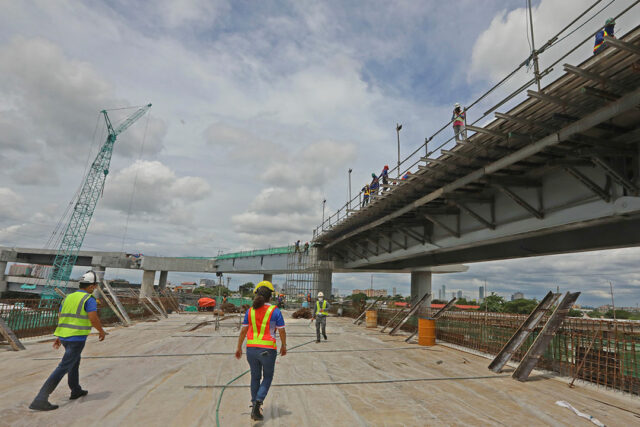
PHILIPPINE STAR/EDD GUMBAN

SPENDING on infrastructure rose 17.9% in March, as disbursements for public works projects ramped up, the Department of Budget and Management (DBM) said.

In a disbursement report, the DBM said spending on infrastructure and other capital outlays rose to P113.5 billion in March, against P96.3 billion a year earlier.

Month on month, infrastructure spending rose 21.1% from February.

The DBM said the Department of Public Works and Highways (DPWH) aggressively implemented its projects, including “payment of progress billing and accounts payable, Right-of Way settlements, and the release of final payments and retention releases for completed projects.”

Its disbursements were applied to payments for the design and construction of bridges, flood management projects, administrative and healthcare facilities, and air passenger terminals.

Other projects include road rehabilitation and the development of access roads and bridges under the Convergence and Special Support Program.

Among big-ticket items, the DPWH disbursed P570.2 billion for “various capital outlays.”

“This latest increase could be attributed to increased midterm election-related infrastructure spending before the election ban, though some infrastructure projects were already exempted from the ban,” Rizal Commercial Banking Corp. Chief Economist Michael L. Ricafort said via Viber.

In the first three months of the year, infrastructure spending totaled P261.8 billion, up 20.8% from a year earlier.

Overall infrastructure disbursements, which include infrastructure components of subsidy/equity to government corporations and transfers to local government units, rose 20.8% to P261.8 billion during the quarter.

Government spending accounted for three percentage points of the 5.4% economic growth posted in the first quarter.

The Department of Economy, Planning, and Development has said that the 18.7% increase in government spending drove 5.4% GDP growth, the strongest reading since the second quarter of 2020.

“For the second quarter, disbursements are seen picking up towards the end of May as the election-related ban on public works and spending ends,” the DBM said.

Budget Secretary Amenah F. Pangandaman has said that a temporary slowdown can be expected in April due to the effect of the election ban.

“The implementation of massive infrastructure projects, governance reforms and investments in human capital are expected to sustain the strong spending performance recorded in the first quarter. This will hopefully help translate to improved economic growth for the rest of the year,” the DBM said.

In 2025, the government budgeted P1.54 trillion in infrastructure spending, equivalent to 5.4% of GDP. — Aubrey Rose A. Inosante