Home Blog Page 1467

World food prices dip in May led by cereals, vegetable oils

REUTERS

PARIS — Global food commodity prices declined in May, driven by marked drops in cereal, sugar, and vegetable oil prices, the UN Food and Agriculture Organization (FAO) said.

The FAO Food Price Index, which tracks monthly changes in a basket of internationally traded food commodities, averaged 127.7 points in May, reflecting a 0.8% decrease from the April figure.

The May reading was up 6% from a year earlier but over 20% below a March 2022 peak following Russia’s full-scale invasion of Ukraine that started a devastating war between two of the world’s leading grains producers.

The FAO cereal price index fell 1.8% month on month, led by a sharp drop in global maize prices. Strong harvests and ample supplies in Argentina and Brazil, along with expectations of a record crop in the US, weighed on prices.

Wheat prices edged lower due to improved crop conditions in the northern hemisphere.

By contrast, rice prices rose 1.4%, supported by firm demand for fragrant varieties and currency movements.

Vegetable oil prices declined 3.7% from April, with declines across all major oils. Palm oil prices fell due to seasonal output increases in Southeast Asia. Soy oil prices dropped on higher South American supplies and weak demand for biofuel.

Rapeseed oil eased on improved European Union supply prospects, while sunflower oil declined amid weak global demand.

The FAO sugar price index decreased 2.6%, reflecting concerns over the global economic outlook, weaker demand from food and beverage industries, and expectations of a production recovery next season.

Meat prices rose 1.3% from April. Beef, pork and sheep meat prices increased, with beef reaching a record high. Poultry prices declined, pressured A surplus in Brazil following import restrictions linked to a bird flu outbreak.

The FAO dairy price index rose 0.8%, supported by strong demand from Asia. Butter prices remained at historic highs, while cheese and whole milk powder prices also increased.

In a separate report, the FAO forecast record global cereal production of 2.911 billion metric tons in 2025, up from 2.848 billion in its previous estimate and 2.1% above 2024.

With production expected to surpass consumption, global cereal stocks are anticipated to grow by 1.0%, partially recovering from last year’s contraction. — Reuters

Toward zero dengue deaths: A call to collective action

STOCK PHOTO | Image from Freepik

Dengue is surging once again in the Philippines — putting thousands at risk and placing renewed pressure on the country’s health system. As of November 2024, the Philippines had recorded 340,860 dengue cases, the highest number in the ASEAN region.

Just two months earlier, Health Secretary Teodoro Herbosa had already sounded the alarm over a looming outbreak. Between Jan. 1 and March 15, the Department of Health (DoH) reported 76,425 cases, a 78% increase compared to the same period in 2024 (42,822 cases).

The number of dengue-related deaths has also risen. From Jan. 1 to Feb. 15, the country recorded 166 fatalities, up from 117 during the same period the previous year — a 42% increase. In 2024 alone, PhilHealth disbursed P3.55 billion for dengue-related claims, making it the second-highest reimbursed illness after pneumonia.

Beyond national trends, Metro Manila has seen a dramatic spike. From Jan. 1 to April 5, the DoH recorded 16,708 dengue cases in the region, which is 242% higher than the same period last year. This alarming surge coincided with the start of Dengue Awareness Month.

Dengue is one of the world’s most common mosquito-borne viral infections. Its incidence has increased 30-fold over the past 50 years, driven by urbanization, travel, and climate change. The World Health Organization (WHO) estimates that dengue causes 390 million infections annually, with the majority of cases occurring in the Asia-Pacific region which accounts for 70% of the global burden.

In response to the growing threat, the DoH launched its “Alas-Kwatro Kontra Mosquito” campaign. Every Monday at 4 p.m., communities are encouraged to join a nationwide clean-up drive, targeting mosquito breeding grounds. This initiative underscores the Filipino spirit of bayanihan, or communal cooperation, as a vital element of disease prevention.

The DoH’s efforts are anchored on an enhanced 4S strategy. First is, “Search and destroy mosquito-breeding sites”; second is Practice Self-protection (e.g., use of repellents, long-sleeved shirts and long pants, insecticidal nets); third is “Seek early consultation”; and fourth, “Support fogging/spraying” in hotspot areas where cases rise for two consecutive weeks.

The health agency also promotes the “Taob, Taktak, Tuyo, at Takip” method which is turning over, emptying, drying, and covering water containers to remove mosquito breeding grounds. These include puddles, roof gutters, flowerpots, old tires, and even bottle caps.

Meanwhile, the WHO’s Global Strategic Preparedness, Readiness and Response Plan, launched in October 2024, calls for strengthened research and innovation to fight dengue and related Aedes-borne diseases like Zika and chikungunya. The goal is to reduce infections and deaths through a coordinated international effort.

According to the WHO, there is currently only one vaccine available for the prevention of dengue in children who have previously had dengue. It has been approved in 40 countries. The WHO recommends the use of the dengue vaccine in children aged six to 16 years in settings with high intensity of dengue transmission.

Another breakthrough is Olyset, the first long-lasting insecticidal net endorsed by the WHO. Woven with slow-release insecticide, Olyset nets are widely used to protect sleeping children and families. Through partnerships with UNICEF and global donors, the nets are now distributed in over 80 countries, including the Philippines.

Effective dengue control demands a multi-sectoral approach, combining the efforts of government agencies, the private sector, non-government organizations, and communities. Rapid mobilization during outbreaks, resource sharing, and sustained vector control can only be achieved through collective action.

In support of these goals, the Pharmaceutical and Healthcare Association of the Philippines (PHAP) launched the “IBA ang BAKUNADO” campaign to raise awareness about life-course immunization. Vaccines help reduce the burden of preventable diseases like dengue as well as protect families and unburden the healthcare system.

PHAP also backs the objectives of the upcoming 8th Asia Dengue Summit, which will convene health experts, policymakers, and researchers under the theme: “Towards Zero Dengue Deaths: Science, Strategy, and Solidarity. The summit aligns with the WHO’s Global Strategy for Dengue Prevention and Control 2021–2030, which targets zero preventable dengue deaths by 2030.

Topics to be tackled include: national and global dengue policy; disease burden and surveillance; innovations in vector control and diagnostics; clinical management and outbreak response; and the role of communication and community engagement.

As dengue continues to threaten lives and livelihoods, the path forward lies in solidarity, science, and sustained action. By combining evidence-based interventions, local leadership, and regional cooperation, the Philippines, and the broader region, can make strides toward a future free from preventable dengue deaths.


Teodoro B. Padilla is the executive director of Pharmaceutical and Healthcare Association of the Philippines which represents the biopharmaceutical medicines and vaccines industry in the country. Its members are in the forefront of research and development efforts for COVID-19 and other diseases that affect Filipinos.

Real-deal racing

Mr. Salapantan’s #11 Toyota Vios sits next to the car of Toyota Motor Philippines President Masando Hashimoto. — PHOTO BY PABLO SALAPANTAN

How Toyota allowed me to realize my track dreams

By Pablo Salapantan

I’VE BEEN a part of the Toyota Gazoo Racing family on and off for about seven years now. I was first an online contest winner who got a chance to participate in the 2019 Autocross Challenge, which was held at the MOA concert grounds in Pasay City.

That very same year, after joining the local motoring journalism beat, I participated again for the whole season of the Autocross Challenge, a role I reprised in 2022, where I won the Autocross overall championship.

Last year, Toyota Gazoo Racing (TGR) Philippines was keen to celebrate the 10th year of the Vios Cup with a bang, and decided to expand media participation in the Novice Class. I, along with former Autocross champions and winners in the beat, joined up and chased our dreams of becoming the racers we always wanted to be.

NOVICE NO MORE
I was lucky enough to be retained for the 2025 season of the TGR Philippine Cup. With one season of circuit racing under my belt, I was expected to carry over all that I’d learned from last year to hopefully further succeed this year.

The thing about racing is that no matter how hard you practice or how deliberate you are about your race craft, you can’t really say with 100% certainty that you’ll walk away the winner after every race.

What I have come to understand about racing is that the best thing a racer can do is to stay focused, be calm and aware. Skill is obviously a huge part of success, but I find that those who possess the aforementioned values are the ones who generally have the best results, and in my own racing journey, I have found that to be true as well.

These traits I mentioned are also things I now practice on the road during everyday driving conditions. I now seldom lose focus while driving in the city, which we of course know, can be very demanding in itself.

LEADERSHIP BY EXAMPLE
Another aspect I think that’s evolved for me is my ability to lead people or even be led in certain cases. Being part of a team of eight drivers who are surrounded by a multitude of coaches, mechanics, and brand people forced me to know how to deal with different people, demands, and situations.

Just because my teammates and I are duking it out on track doesn’t mean that we can’t have close friendships off it. The true camaraderie formed during off-track activities is what strengthens a team and pushes each driver to perform better.

It’s a matter of trust we have in each other as a team that enables us to race so hard on track. While that sounds like a contradictory statement, I have come to realize that because my teammates and I are so close, we know how to push each other for the better on track while minimizing risk and danger.

At the same time, putting our trust in our coaches, mechanics, and team managers allows us racers to focus on the race itself — letting people get on with their jobs as opposed to micromanaging every little detail. I have accepted that those who run the Novice Team are far more knowledgeable and qualified than myself when it comes to managing the team, setting up the car, and see to the needs the team requires.

Lastly, as a team member, I also recognize and give utmost importance to the sheer effort the people behind the scenes put in. Having this mindset humbles me to perform on track properly — not to put myself, the team, or the car in compromising situations. I want to give pride to my team with every result as a thank you for all the hard work.

OUTWARD EFFECTS
Racers are often seen as heroic and are even idolized. I consider that as more of an “occupational hazard” in a good way, but my own personal belief is not to chase wins for my own glory, but to show people what happens when you dream, have determination, and passion.

Growing up, I had opportunities to race, but I was never “on track” to become a pro — a sad reality owing to the fact that racing in the Philippines can prove too costly.

Instead, I found other ways to indulge my passion, to get into the automotive world, work my way up, and get myself the right opportunities. Here I am, a “seasoned” racer with multiple wins and podium finishes — a fact I never thought was possible.

All it took was taking my dream and working to make it a reality. If I can do it, why can’t you?

Yields on gov’t debt move sideways on renewed Trump tariff concerns

YIELDS on government securities (GS) traded at the secondary market ended mixed last week due to fresh trade jitters as the Trump administration’s higher import tariffs on metals took effect.

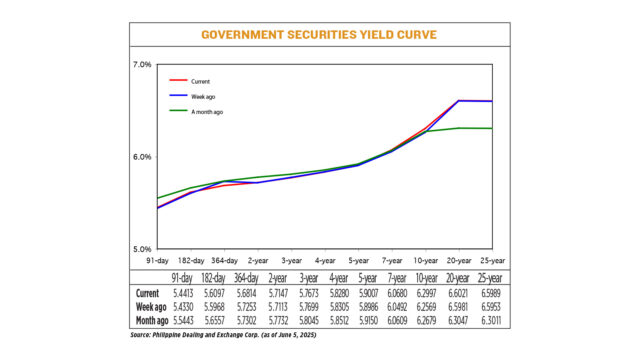
GS yields, which move opposite to prices, edged up by an average of 0.43 basis point (bp) week on week, according to PHP Bloomberg Valuation Service Rates data as of June 5 published on the Philippine Dealing System’s website.

Philippine financial markets were closed on Friday (June 6) for a holiday in observance of Eid al-Adha.

Movements at the short end of the curve were mixed as the 91- and 182-day Treasury bills (T-bills) inched up by 0.83 bp and 1.29 bps week on week to 5.4413% and 5.6097%, respectively, while the 364-day tenor dropped by 4.39 bps to 5.6814%.

The same trend was seen at the belly. The two-, five-, and seven-year Treasury bonds (T-bonds) inched up by 0.34 bp (to 5.7147%), 0.21 bp (5.9007%) and 1.88 bps (6.068%), respectively. On the other hand, the three- and four-year debt slipped by 0.26 bp (to 5.7673%) and 0.25 bp (5.8280%), respectively.

At the long end, yields on the 10-, 20-, 25-year T-bonds went up by 4.28 bps (to 6.2997%), 0.4 bp (6.6012%), and 0.36 bp (6.5989%), respectively.

GS volume traded amounted to P50.43 billion as of June 5 compared with the previous week’s P44.23 billion.

“The US tariff announcement dampened investor confidence, leading yields to rise on the same day,” a bond trader said in a text message on Thursday.

Canada prepared possible reprisals while the European Union (EU) reported progress in trade talks on Wednesday as new US metals tariffs triggered more disruption in the global economy and added urgency to negotiations with Washington, Reuters reported.

President Donald J. Trump’s doubling of tariffs on steel and aluminum imports kicked in on Wednesday, the same day his administration sought “best offers” from trading partners to avoid other punishing import levies from taking effect in July.

The move will hit the closest US trading partners — Canada and Mexico — especially hard. Canada is the top exporter of both steel and aluminum to the United States.

Prime Minister Mark Carney said Canada is prepared to strike back against the United States if talks with Washington to remove Mr. Trump’s tariffs did not succeed.

The US tariff hike on the two metals to 50% from the 25% rate introduced in March took effect at 12:01 a.m. (0401 GMT) on Wednesday. It applies to all trading partners except Britain, the only country so far to strike a preliminary trade agreement with the US during a 90-day pause on a wider array of Trump tariffs that ends on July 8.

The 27-nation EU’s trade negotiator, Maros Sefcovic, and US Trade Representative Jamieson Greer said their meeting in Paris was constructive.

About a quarter of all steel used in the US is imported.

The bond trader added that the slower Philippine May inflation print reported last week has been largely priced in by the market, along with expectations of a Bangko Sentral ng Pilipinas (BSP) cut as early as this month, which was why GS yields barely moved after the data.

“The market was pretty much steady with an upward bias ahead of the inflation data because of the Trump policy announcement,” the trader said.

“With a rate cut already expected, the market will likely be more concerned on hints as to when the next rate cut may be implemented.”

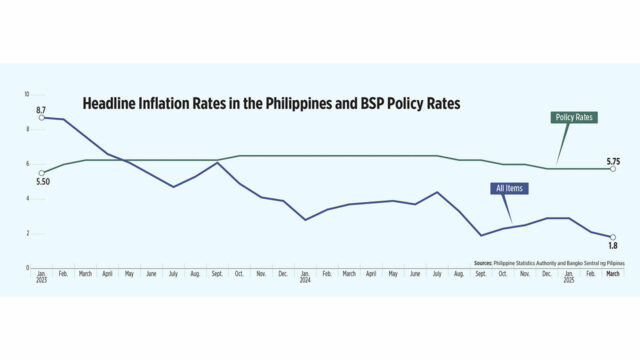
Headline inflation eased to 1.3% in May from 1.4% in April and 3.9% in the same month a year ago, the government reported on Thursday. The May print was the lowest in five-and-a-half years or since the 1.2% posted in November 2019.

For the first five months, inflation averaged 1.9%, a tad below the low end of the BSP’s annual target.

For this week, the trader said the market will likely continue to monitor external developments, particularly trade policy announcements from the Trump administration, as well as US economic data “to give clarity on the direction of yields.”

The trader said GS yields could move sideways with a downward bias.

“The downside may be limited for government securities given ongoing bond issuances of some banks and this week’s seven-year T-bond auction.”

The Bureau of the Treasury is offering P30 billion in reissued 10-year bonds on Tuesday, which have a remaining life of seven years and three months. — M.M.L. Castillo with Reuters

Father’s Day Style

You’ve got about a week to score Father’s Day Gifts before June 15, and we’ve compiled a guide: from luxury watches and perfumes to outdoor equipment.


Marks & Spencer

THIS Father’s Day, Marks & Spencer is celebrating every kind of father figure. Model and father Max Rogers alongside his three children highlight the menswear collection in an ad campaign, including crisp tailored shirts to versatile shorts. For those who love a novelty gift, look no further than a selection of fun and light-hearted gifts, from playful slogan pajamas and socks to smart accessories. Shop in-store through the M&S Philippines Viber Community at bit.ly/MSPH-VC, or shop selected lines online at www.marksandspencer.com.ph.


From pens to luggage at Montblanc

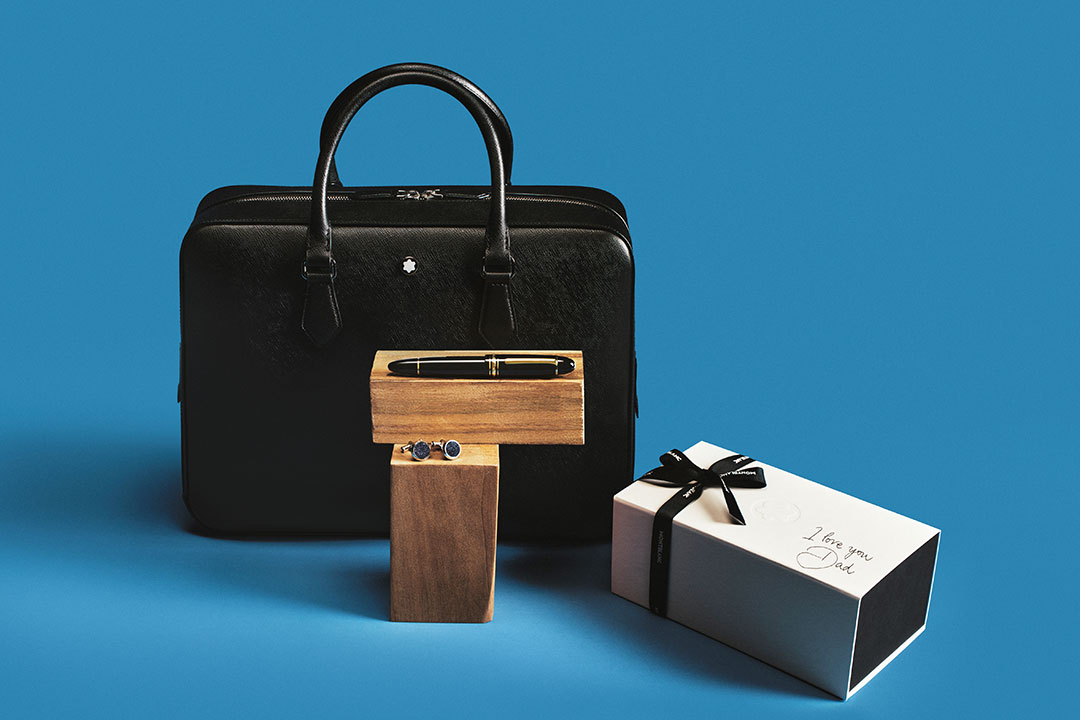
MONTBLANC honors fathers’ unwavering presence with a thoughtful selection of gifts. Each piece comes packaged in a white Montblanc gift box, serving as the ideal blank page on which to leave a special message. Give the gift of a timeless writing experience with the Meisterstück Gold-Coated 149 Fountain Pen, featuring a handcrafted Au 750/18k solid gold nib, a cap and barrel in black precious resin and the white Montblanc emblem inlaid in the cap top. A fitting gift for literary aficionados, the Montblanc Great Characters Homage to The Great Gatsby Limited Edition 1925 Fountain Pen finds inspiration in Jay Gatsby’s elegant world with a pinstriped cap and a clip reminiscent of one for money. Pair these writing instruments with a Montblanc ink in a royal blue color, a Soft Envelope notebook, and an Extreme 3.0 1-Pen Pouch crafted in black embossed leather. The medium-sized Meisterstück Sartorial Document Case is a smart companion with modular functionality. Inspired by the Maison’s writing heritage, its stitching, zip puller, and handles recall the recognizable shape of the Meisterstück fountain pen’s nib.

Montblanc is not all writing instruments and accessories – it offers items from luggage to headphones to watches. There is the #MY4810 Cabin Trolley which ensures smooth travel with its Extreme 3.0 maxi pattern and efficient packing design. Pair it with the Extreme 3.0 leather washbag in a burgundy-hued cassis color. The Montblanc MTB 03 In-Ear Headphones feature active noise cancellation, intuitive touch controls, and comfortable wearing thanks to a sleek, ergonomic design inspired by the Meisterstück. For a lighter look, the headphones are also available in an ivory color.

The Montblanc 1858 Geosphere 0 Oxygen The 8000 Watch pays tribute to the world’s highest peaks and the mountaineers who dare to climb them. The 42mm titanium timepiece features Montblanc’s 0 Oxygen technology, preventing fogging and oxidation inside the watch and thus allowing the movements to last longer. Powered by the MB 29.25 automatic movement, its caseback is adorned by a striking 3D laser engraving of the K2 mountain. The timepiece also comes with a Manufacture World time complication with luminescent 3D globes, dual time display, day and night indications, and a date. A black ceramic bezel, dark grey glacier-patterned dial and an adjustable titanium bracelet complete this watch.

For fragrance, there is the Montblanc Legend Blue Eau de Parfum which evokes memories with fresh spearmint, elegant cedarwood, and warm ambroxan. This balanced fragrance is designed for everyday wear. For the well-dressed man, elevate his look with the Meisterstück Cufflinks in stainless steel featuring a blue-hued glass inlay. Complete the ensemble with a pair of Squared Sunglasses in black acetate, with the temple enriched by carbon fiber and rubber for added lightness and flexibility.


Anko suggests camping gear and more

NO MATTER your budget, Australian home and lifestyle brand Anko offers functional, fun, and affordable picks, from high-tech gadgets to outdoor gear. For example, outdoorsy dads would appreciate a 24-liter cooler (P490), sleek, durable, and designed to keep drinks ice-cold all day. For quick outings, the Titan Expandable Cooler (P490) is the perfect grab-and-go essential. The 960ML drink bottle (P500), made with double-wall insulated stainless steel, keeps drinks colder for longer. The four-person dome tent (P990) fits four and folds away easily. For starry nights, the Trail hooded sleeping bag (P490) offers a snug cocoon, complete with machine-washable convenience. The LED light with fan (P290) is ideal for keeping the tent cool and illuminated, while the bulb tent light (P110) offers compact but powerful brightness.

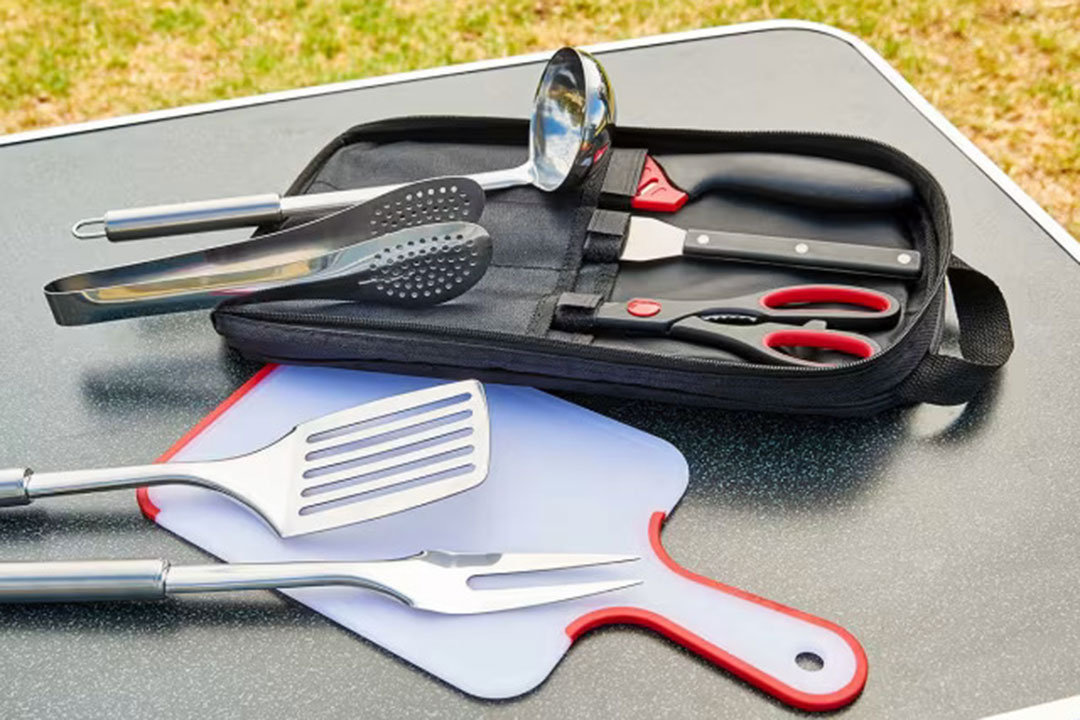
At the end of the day, fathers can kick back in a low camp chair with arms (P290) for ultimate campsite relaxation. Outdoor and at-home cooking tools include a portable charcoal grill (P490), a three-piece pot set (P290), and an eight-piece cooking utensil set (P290). Pair these with a picnic mat (P290) for lounging and the rattan picnic set (P490), a full dinnerware collection tucked inside a woven basket.

For more sporty dads, a badminton set (P440) offers fast-paced fun while the dartboard cabinet set (P1,800) is complete with a sleek cabinet for stylish storage and a professional-grade game setup.  For organizing, the OXX Cosmetics travel bag (P530) keeps essentials in one place, while the 15-liter dry bag (P190) ensures valuables are safe from splashes and spills, perfect for beach trips or hikes. The seven-piece packing cube set (P660) takes the stress out of packing.

If Dad’s idea of a perfect weekend includes belting out classic OPM hits and power ballads, try the Karaoke party speaker (P2,600), complete with lights and booming sound. A portable option is the compact Karaoke speaker (P1,280).

For dads in tech, try the True wireless earphones (P660), the on-ear wired headphones (P440), the gaming headset (P600); designed with an omnidirectional mic and 50mm drivers), the portable charger with solar (P290), and/or the portable Bluetooth speaker (P660).

Anko’s Father’s Day collection is available at its Glorietta and Alabang Town Center stores, with camping items in this guide currently offered exclusively at the Glorietta branch.


Plenty of choice at Rustan’s

RUSTAN’S has a slew of possible gifts for Father’s Day, from perfumes to shoes, to shavers.

For a dad who enjoys making a bold statement, Givenchy Gentleman Society Ambrée Eau de Parfum combines a rich amber facet with notes of Tasuki Vanilla, resulting in a floral woody profile. Also in fragrance, Maison Margiela REPLICA By the Fireplace Eau de Toilette brings the warmth of a crackling fire through a blend of smoky gaiac wood, roasted chestnuts, and sweet vanilla.

For dads with a modern style, Guess Uomo Intenso Eau de Parfum delivers with top notes of Italian bergamot, mint leaf, and airy ozone and a base of tonka bean, Amber Xtreme, and sandalwood. Monotheme Cedar Wood Eau de Toilette is a vibrant and refreshing fragrance with notes of bergamot, pink pepper, cedarwood, patchouli, and tonka bean. Kenzo Homme Indigo Eau de Parfum offers a blend of creamy iris, musky marina accord, and smoky leather, with 95% natural ingredients and eco-friendly packaging. Bond No. 9 Beekman Place Eau de Parfum captures the essence of Manhattan’s exclusive Beekman Place with a mix of pineapple, blackcurrant, and bergamot. The fragrance deepens with notes of driftwood, musk, and patchouli.

For clothes, check out Jack Nicklaus Fracture Print Polo, with Topcool moisture-wicking and UV protection features. The Clarks Whiddon Step delivers a professional finish with its burnished apron toe and slip-on fit. Crafted in full-grain leather with flexible elastic gores, it features an OrthoLite footbed that cushions each step. Classic with a twist, the Dune Stanford Leather Lace Up Brogues stands out with a stacked heel, exposed stitching, and the brand’s signature blue sole, made of smooth leather with timeless brogue detailing.

As for grooming, the BaByliss Performance Endurance Power Clipper delivers pro-level results with ease. Its 45mm stainless steel blades cut through all hair types — including thick textures — while 26 adjustable lengths and eight guide combs offer total control. Corded for consistent power and ergonomically designed, it’s built with washable, self-lubricating blades and a sleek storage pouch to keep things tidy. Shaving becomes effortless with the VS Sassoon Fresh Clean Shaver, a cordless, water-resistant grooming tool featuring 3D smart-touch floating heads, a dual-ring cutter, and a pop-up trimmer, it tackles both beards and sideburns without hassle. Fully washable and USB-rechargeable, it offers up to 30 minutes of use on a single charge — plus a low-battery LED indicator.

Give Dad some skincare with the Nuxe Huile Prodigieuse Neroli, a multi-purpose dry oil for the face, body, and hair. Crafted from organic plum and sesame oils, it nourishes while leaving behind a subtle glow and a calming scent of neroli. Certified organic and antioxidant-rich, it helps protect against pollution, reduces the appearance of stretch marks, and leaves skin and hair soft, radiant, and revitalized.

For more information, visit https://rustanmarketingcorp.com.ph.

Trade spat dragged financial markets in Q1

By Matthew Miguel L. Castillo

TARIFFS imposed by United States President Donald J. Trump, along with uncertain trade and fiscal policies, drove the local financial market’s movement in the first quarter of 2025, analysts said.

These factors are expected to persist in the second quarter as well, the central bank said.

The Philippine Stock Exchange index (PSEi), the barometer for the country’s stock market, closed at 6,180.72 in the first quarter, declining 10.5% from 6,903.53 a year earlier.

Meanwhile, data from the Bankers Association of the Philippines showed the peso closed at P57.21 against the dollar in the January-to-March period, weakening by 1.7% from P56.24 a year earlier.

At the secondary bond market, domestic yields fell by an average of 3.59 basis points (bps) annually based on the PHP Bloomberg Valuation (BVAL) Service Reference Rates posted on the Philippine Dealing System’s website as of end-March.

TRADE WAR WOES
Analysts attributed that US trade policies have been the primary catalyst of the domestic market movements during the period.

Miguel Chanco, chief emerging Asia economist at Pantheon Macroeconomics, said that there was a lot of uncertainty in the global markets due to Mr. Trump’s unclear intentions on global tariffs.

This uncertainty, he added, will likely persist in the second quarter, “as uncertainty of the postponed and more punitive ‘reciprocal’ tariffs continues amid their 90-day pause.”

Metropolitan Bank & Trust Co. (Metrobank) Chief Economist Nicholas Antonio T. Mapa said that Mr. Trump’s stance on “US exceptionalism” was already expected by markets which drove their sentiment in the direction during the period.

For Reinielle Matt M. Erece, an economist at Oikonomia Advisory and Research, Inc., global financial markets were attentive to Mr. Trump’s plans and policies, similar with the fourth quarter.

Additionally, he said that new policies, especially on tariffs and taxes, will impact trade and interest rates. He added that gradual economic growth dragged domestic markets as growth expectations turned pessimistic.

Meanwhile, for Sun Life Investment Management and Trust Corp. economist Patrick M. Ella, Mr. Trump’s moves on trade seen in the last quarter “came worse than expected” from speculations held for his administration last year.

Early in February, Mr. Trump has signaled his plans to announce reciprocal tariffs on many countries, with the intent to reshape global trade relationships in favor of the US.

By April, Mr. Trump implemented a 10% blanket tariffs on all its trading partners. However, the plan to impose higher reciprocal tariffs on certain countries was paused for 90 days or until July.

Mr. Trump slapped a 17% reciprocal tariff in the Philippines, the second lowest among Association of Southeast Asian Nations member countries trailing behind Singapore’s baseline rate of 10%.

The Philippine economy grew by 5.4% in the first quarter, official government data showed, falling short of the 6%-8% target of the government for 2025.

The expansion was driven by government spending climbing to 18.7% and private consumption, which accounts for 70% of the national economy, picking up by 5.3%.

State spending was fueled by the government frontloading infrastructure spending before the 45-day election ban which started on late March while the growth in household spending was due to easing inflation.

For the Bangko Sentral ng Pilipinas (BSP), uncertainty surrounding US trade and fiscal policies, coupled with their perceived impact on the global economy, dragged the prices of local bonds, equities, and foreign exchange (FX) markets during the period.

However, it added that positive investor sentiment fueled by easing domestic inflation and heightened expectations of a policy interest rate reduction tempered the downturn in the domestic market.

Latest government data showed that in March, inflation eased by 1.8%, the slowest in almost five years since the 1.6% posted in May 2020.

This brought inflation to average 2.2% in the first quarter, settling within BSP’s target of 2-4%.

BSP RESUMES EASING CYCLE
On the other hand, the central bank has slashed key rates by a total of 100  bps since it began its easing cycle in August last year.

During its first policy meeting in February, the central bank held interest rates steady at 5.75%. But in its April meeting, the BSP cut borrowing costs by 25 bps, resuming its easing cycle.

Policy rate cuts are implemented by central banks to stimulate productivity and growth as lower rates allow for more spending in the economy when the threat of inflation is low.

For Pantheon’s Mr. Chanco, he said that it is still early to determine what implications the rate cuts have had on financial markets as it takes time for these rate cuts to translate into stronger real economic activity.

“Monetary policy in the Philippines remains very tight despite the cuts pursued to date. This is still very much reflected in business surveys who still see credit access and high interest rates as a material constraint,” Mr. Chanco said.

Meanwhile, Metrobank’s Mr. Mapa, rate cuts are designed to bolster growth through the credit channel, as monetary easing is expected to fire up modest capital formation.

Mr. Erece, on the other hand, expects monetary policy will be further relaxed this year but cautioned that even though there are foreign exchange risks looms with a dovish BSP and a hawkish US Federal Reserve, the underwhelming growth and employment indicators in the country highlight the need for expansionary fiscal and monetary measures.

“Rate cuts can spur growth through higher activity in lending. Furthermore, interest rates set by the central bank and bond yields follow a similar trend,” he explained.

He also noted that monetary policy can serve as benchmark of expectations on the economy as rate cuts signal confidence that inflation is managed and money can be “cheaper” again.

WHAT MARKET TRENDS SHOULD BE MONITORED
“Given a more manageable inflation outlook and emerging risks to growth, the BSP saw scope to further reduce the policy interest rate in April. The continued monetary policy easing cycle will help sustain domestic economic activity amid risks of a global slowdown,” the central bank said.

The BSP recognizes that tariffs and other policies in advanced economies could hinder global growth, which may pose downside risks to the local economy, it added.

It further explained that even though the country is relatively insulated from the tariff wars due to its limited exposure to the US, factors such as potential supply chain disruptions, weak global demand, and subdued investor sentiment could impact domestic growth.

“A more accommodative monetary policy stance should enable banks to allocate additional funds toward more productive uses, such as loans and investments,” the BSP said.

Additionally, it will continue to take a measured approach to monetary easing.

For Mr. Chanco, he believes that there is still a general under-appreciation of how sluggish economic growth is in the country regarding domestic demand.

“Markets may also favor the likes of the Philippines this year because its domestic demand driven economy is much less exposed to further flare-ups in global trade tensions,” he added.

Monetary policy easing may lead to increased capital expenditures by firms as borrowing costs decrease, which could result in higher consumer spending, Mr. Erece said.

“Monetary policy easing is something that the equities market monitor and rate cuts seem to be good news for the market,” he advised, adding that developments that include tariffs, trade conflicts, and political talks, should be monitored as well.

FIXED-INCOME MARKET
Mr. Chanco: Government bond yields probably have further room to fall from our vantage point, as more rate cuts are likely to be priced-in, with the Monetary Board likely to see more space for easing.

Mr. Erece: Bond yields may continue to slip especially on shorter tenors, especially as growth expectations and interest rate cuts continue while longer tenors may see higher yields again.

Mr. Mapa: BSP easing should support with investors also keeping an eye on [Bureau of the Treasury] issuance volume and timing.

EQUITIES
Mr. Erece: Strong earnings for most industries can boost confidence with the growth potential of publicly listed corporations. Rate cuts may be a sign of faster economic activity. Furthermore, rate cuts can also increase market premium, thus making equities more attractive.

Mr. Chanco: Equities will probably continue to recoup some of their [first quarter] losses, as long as the news on US trade talks with a host of countries continues to show forward progress before the end of the 90-day pause.

Mr. Ella: [They may move] sideways for the quarter.

FOREIGN EXCHANGE MARKET
Mr. Erece: A dovish BSP with a hawkish Fed may cause the peso to depreciate this year. Although the peso experienced an appreciation rally last March to April, this was mainly caused by the fall of the USD as seen by the [US Dollar Index].

Mr. Chanco: [The peso’s] recent strong run against the US dollar looks overdone, so I expect to see some downward retracement in the remaining weeks of the [second quarter].


CIC sets sights on airport air-conditioning projects

CONCEPCION.PH

LISTED consumer lifestyle and enterprise solutions provider Concepcion Industrial Corp. (CIC) is targeting participation in bids for large air-conditioning projects at several airports across the Philippines.

“We’re looking at a couple of airports all over. Hopefully, Bacolod, Iloilo, Bohol, and Cagayan de Oro,” CIC Chairman and President Raul Joseph A. Concepcion said in a media briefing last week.

Mr. Concepcion said airports typically conduct bidding processes for the redevelopment and maintenance of their air-conditioning systems.

“Today, the way they do it is they go out, they bid, and they canvas. It’s still a bidding process for them,” he said.

Aside from CIC, Mr. Concepcion noted there are only one or two other industry players capable of handling large air-conditioning projects such as those for airports.

CIC Chief Executive Officer Isaias Ariel P. Fermin said the company offers better value compared to competitors since its product portfolio also includes elevators and escalators.

“Another advantage is that we have elevators in our portfolio. We definitely package a bundle so that there’s value for money,” he said.

CIC subsidiary Concepcion-Carrier Air Conditioning Co. previously installed four new 1,050-TR water-cooled variable frequency drive centrifugal chillers at Ninoy Aquino International Airport (NAIA) Terminal 1, replacing the 20-year-old chillers of the airport’s centralized air-conditioning system.

The move forms part of CIC’s plan to reduce dependence on seasonal demand and sustain market growth by expanding its business-to-business segment.

CIC supplies and manufactures air conditioners, air-conditioning systems, refrigerators, freezers, elevators, escalators, and home appliances. Its brand portfolio includes Carrier, Otis, Condura, Midea, Kelvinator, SharkNinja, and Toshiba.

Shares of CIC last traded on June 5, down 2.77%, or 42 centavos, at P14.72 per share. — Revin Mikhael D. Ochave

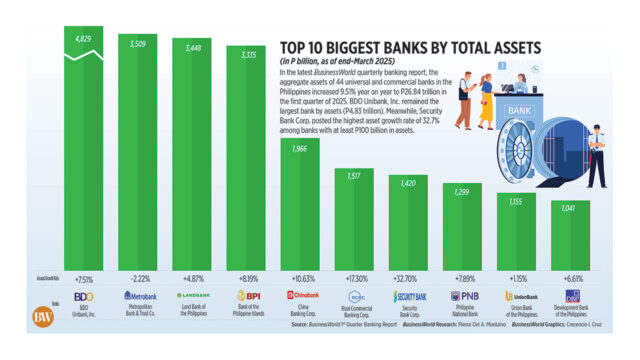
Top 10 Biggest Banks by Total Assets

THE COMBINED ASSETS of the Philippines’ largest banks grew by nearly 10% in the first quarter compared with a year earlier, driven by lower interest rates. Read the full story.

Top 10 Biggest Banks by Total Assets

Cooling inflation, BSP easing bets may boost peso

BW FILE PHOTO

THE PESO could strengthen further against the dollar this week amid low inflation and expectations of further rate cuts by the central bank.

On Thursday, the local unit closed at P55.62 per dollar, climbing by 15.1 centavos from its P55.771 finish on Wednesday, Bankers Association of the Philippines data showed.

Week on week, the peso likewise rose by 12.5 centavos from its P55.745-a-dollar finish on May 30.

Philippine financial markets were closed on Friday (June 6) for the Eid al-Adha holiday.

“The US dollar-peso exchange rate corrected slightly lower after the latest benign inflation data,” Michael L. Ricafort, chief economist at Rizal Commercial Banking Corp., said in a Viber message.

Philippine headline inflation eased to 1.3% in May from 1.4% in April and 3.9% in the same month a year ago, the government reported on Thursday.

The May print was the lowest inflation rate in five-and-a-half years or since the 1.2% posted in November 2019.

This also marked the fourth straight month of deceleration and tenth straight month of inflation settling within the 2-4% target band.

For the first five months, inflation averaged 1.9%, a tad below the low end of the Bangko Sentral ng Pilipinas’ (BSP) annual target.

The peso also rose last week amid broad dollar weakness, even amid the greenback’s slight recovery, Mr. Ricafort added.

The dollar rose against major currencies on Friday after data showed better-than-expected US jobs growth in May despite a slowdown from the previous month, suggesting the Federal Reserve might wait longer to cut interest rates, Reuters reported.

Labor department data showed that employers added 139,000 jobs in May, fewer than the 147,000 jobs added in April, but exceeding the 130,000 gain forecast in a Reuters poll of economists.

The dollar was up 0.95% to 144.87 against the Japanese yen and added 0.26% to 0.822 against the Swiss franc. The greenback extended gains against both safe-haven currencies following the data.

The US currency was headed for a second straight weekly gain against both the yen and franc, but it was still down about 8% year to date and about 9% year to date, respectively, against both currencies.

The dollar has been weighed down by uncertainty from President Donald J. Trump’s tariff policies and the prospects of negotiations with trading partners including China, the deficit spending and tax bill being considered in the US Senate after it passed the House of Representatives, and the trajectory of recent economic data.

The dollar index, which measures the greenback against a basket of currencies including the yen and the euro, rose 0.53% to 99.20 on the session, but it is on track to notch a weekly loss.

Mr. Trump and Chinese leader Xi Jinping held a rare leader-to-leader call on Thursday, as tensions over tit-for-tat tariffs appear to be easing. The dollar strengthened 0.23% to 7.191 versus the offshore Chinese yuan.

For this week, the peso may continue its recovery against the greenback as the benign inflation environment would open the door to further BSP rate cuts, Mr. Ricafort said.

BSP Governor Eli M. Remolona, Jr. has signaled the possibility of two more 25-basis-point (bp) rate cuts this year. He also said a cut is on the table at the Monetary Board’s June 19 meeting.

The central bank has so far slashed borrowing costs by 100 bps since it began easing in August.

The peso will be supported by the seasonal increase in overseas Filipino worker remittances due to the summer holidays this month as well as school-related expenses, Mr. Ricafort added.

“Locally, the peso could find some support from strong gross international reserves (GIR) and the low inflation print for May, which boosts market confidence,” John Paolo R. Rivera, a senior research fellow at the Philippine Institute for Development Studies said.

Latest central bank data showed the country’s dollar reserves rose by 4.6% year on year to a three-month high of $106.65 billion as of end-February.

Mr. Rivera said the peso’s movement will “likely be influenced by external factors, such as market reactions to the latest US economic data on inflation and jobs, and any forward guidance from the Fed ahead of its next policy meeting.”

Federal Reserve policymakers have already signaled they are in no rush to cut interest rates, and a government report on Friday showing the labor market is far from crumbling amid big trade policy changes only cements that stance, Reuters reported.

Financial markets have been betting the Fed will wait until September to cut rates and will deliver a second reduction in borrowing costs by December. After the jobs report, they trimmed their bets on a possible third rate cut by the end of this year.

“However, continued geopolitical risks and uncertainties in global trade including tariff developments could still weigh on investor sentiment and trigger some volatility,” Mr. Rivera added.

Mr. Ricafort expects the peso to trade from P55.40 to P55.90 this week, while Mr. Rivera said it could move at the low P55 range. — Luisa Maria Jacinta C. Jocson with Reuters

Stocks may extend decline as trade jitters linger

BW FILE PHOTO

PHILIPPINE SHARES could decline further this week as market sentiment remains fragile amid lingering global trade uncertainties due to the Trump administration’s changing policies.

On Thursday, the bellwether Philippine Stock Exchange index (PSEi) slipped by 0.02% or 1.77 points to close at 6,376.79, while the broader all shares index rose by 0.28% or 10.64 points to 3,779.22.

Still, week on week, the PSEi rose by 0.56% or 35.26 points from its 6,341.53 close on May 30.

Philippine financial markets were closed on Friday in observance of Eid al-Adha or the Feast of Sacrifice.

“Record-low inflation capped another volatile week for local equities,” online brokerage 2TradeAsia.com said in a market note.

“The local market managed to bounce back in last week’s trading after two consecutive weeks of losses. However, the market failed to make it through the 6,400 resistance line. Trading has also been lethargic, as seen in the thin value turnovers. Overall, market confidence is seen to remain low, which explains the tepid movements,” Philstocks Financial Inc. Research Manager Japhet Louis O. Tantiangco said in a Viber message.

For this week, market sentiment is expected to remain bearish due to jitters over global trade developments, he said.

“On a positive note, our latest inflation print may raise hopes of more aggressive policy easing by the Bangko Sentral ng Pilipinas (BSP), which in turn may give the market a boost. Investors are also expected to digest our labor market data as this would give clues on the strength of our local economy,” Mr. Tantiangco said.

Philippine headline inflation slowed to 1.3% in May from 1.4% in April and 3.9% in the same month last year. This was the lowest inflation rate in five and a half years, or since the 1.2% print posted in November 2019.

Meanwhile, the unemployment rate went up to 4.1% in April from 3.9% in March.

“Chart-wise, the local market is observed to be trading sideways bound within its 50-day and 200-day exponential moving averages (EMA). A break above the 200-day EMA would strengthen the case for a sustainable rally, but a break below the 50-day EMA may lead to a further pull back, possibly near the 6,150 support,” he added, noting that the market remains undervalued.

Rizal Commercial Banking Corp. Chief Economist Michael L. Ricafort said in an e-mail that the PSEi’s next minor support is 6,290 to 6,300, while its immediate resistance is at 6,500.

For its part, 2TradeAsia.com placed the PSEi’s immediate support at 6,300 and resistance at 6,500-6,550.

“As positive fundamentals begin to matter again, factor allocations may tilt towards earnings elasticity and low volatility as markets enter what might be a late-cycle, high-risk-premia regime,” it said. “Agility remains key in the third quarter amid potential regime shifts; favor liquidity and rethink exposure to high duration equity.” — Revin Mikhael D. Ochave

Alas Pilipinas blasts Indonesia in four sets in AVC Nations Cup

ALAS PILIPINAS — ASIANVOLLEYBALL.LIVE

ALAS Pilipinas showed nerves of steel as it turned back Southeast Asian rival Indonesia, 22-25, 25-23, 25-13, 28-26, on Sunday to remain unscathed in Pool B of the AVC Nations Cup in Hanoi, Vietnam.

After a sluggish, error-prone start, the Filipinas came roaring back from an opening-set loss and a 17-19 deficit in the next to knot the count at one apiece and then dominated the third frame to seize a 2-1 set lead.

They then denied the Indonesians their determined bid to extend the duel to a deciding fifth set by taking the fourth set and the match following key hits by Angel Canino and super rookie Shaina Nitura, whose devastating spike the opposing team couldn’t handle that sealed the deal.

The result thus sent the Nationals to the Pool B top spot alongside the tall, fearsome Kazakhs, who earlier smothered the Mogolians, 25-14, 24-26, 25-18, 25-15, with two wins each.

Ms. Canino ended up leading the way with 17 points, the same output of Alyssa Solomon, while Mhicaela “Bella” Belen chipped in 12 hits.

Ms. Nitura, the reigning UAAP rookie of the year who is tipped to become the future of Philippine volleyball, delivered a quality game with five points, including that match-sealing spike.

Alas will next square off with dangerous Iran on Monday, takes a much-needed breather on Tuesday before plunging back into action against New Zealand on Wednesday and Kazakhstan on Thursday. — Joey Villar

Yulo snatches two bronzes at conclusion of Senior Asian Artistic Gymnastics Championships

CARLOS YULO — REUTERS

CARLOS YULO missed out on replicating his three-gold haul from last year’s edition as he settled for a pair of bronze medals at the conclusion of the Senior Asian Artistic Gymnastics Championships in Jecheon, South Korea on Sunday.

These bronzes came from vault where he wound up with an average score of 14.333 and finished behind Iranian Mahdi Olfati (14.5) and Chinese Huang Mingqi (14.4) and in parallel bars where he had a 14.166 to end up trailing Japanese Shinnosuke Oka (14.7) and Tomoharu Tsunoghai (14.466).

The Paris Olympics double-gold medalist tried to add another medal in the horizontal bar but a bad fall sent him scampering to seventh or second to last with a flat 12.

The Filipino spectacle from Leveriza in Manila failed to match his effort in last year’s staging in Tashkent, Uzbekistan where he harvested three golds in floor, vault and parallel bars.

In all, Mr. Yulo will go home with still an impressive haul of one gold he plucked in the floor exercise the day before and three bronzes including one from individual all-around on Thursday.

More importantly, the effort punched Mr. Yulo a ticket to the World Championships set Oct. 19 to 25 in Jakarta, Indonesia.

Also, that floor exercise mint hiked his total in the annual event to a whopping 11.

Another Filipino, John Ivan Cruz, also made the finals in vault and wound up sixth with a 14.15.

Mr. Yulo’s younger brother, Karl Eldrew, went home with a medal himself, thanks to his silver in vault in the juniors’ division where he tallied 13.850.

South Korean Bak Junwoo copped the gold with a 13.933 while another of the host’s bet, Daegeon An, snatched the silver with a 13.783. — Joey Villar

ADVERTISEMENT
ADVERTISEMENT