
How PSEi member stocks performed — June 9, 2025

Here’s a quick glance at how PSEi stocks fared on Monday, June 9, 2025.
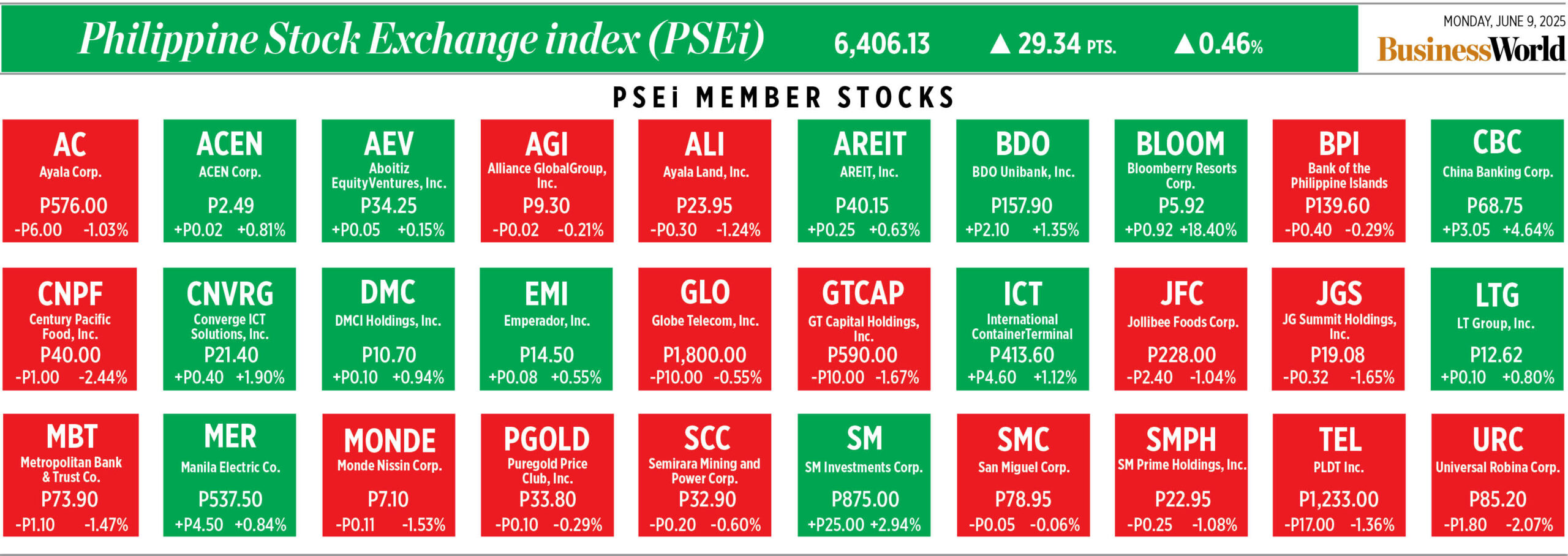

Here’s a quick glance at how PSEi stocks fared on Monday, June 9, 2025.

THE PHILIPPINES should move to make the peso more competitive now that inflation has receded, giving monetary authorities room to maneuver, ANZ Research said.
“We believe the Philippines should consider a more competitive exchange rate. While this carries risks, the country’s improved external position and structurally lower inflation offer a buffer,” it said in a report.
“A weaker peso could boost exports, attract investment, and support a shift toward productivity-led growth,” it said.
The peso has been trading at the P55 level against the dollar since the end of April.
ANZ noted previous periods of peso overvaluation in the 1980s and 1990s, which impacted manufacturing.
“The tradable goods sector has been disproportionately affected — exports relying heavily on imported inputs (for example, the assembly-oriented semiconductors) have fared better than those relying on domestic inputs,” it said.
This caused domestic industries to sharply decline as the real appreciation of the currency made imports cheaper, it added.
“Electronics, which depend on imported inputs, have suffered too but performed better than the traditional manufacturing sectors that typically have deeper local linkages.”
It also cited the Philippines’ widening real effective exchange rate gap relative to its neighbors since 2004, which “signals a sustained loss of relative competitiveness, reinforcing the need for a more balanced exchange rate.”
“Adding to the challenge is an overvalued peso, especially amid weak productivity growth.”
Traditional currency fair-value models indicate that the peso has been overvalued since 2019, hurting export competitiveness — especially for industries relying on domestic inputs, it said.
ANZ said it would benefit the economy to correct the overvaluation or even just “pursue a mildly undervalued exchange rate, whenever possible.”
“A growth model that is reliant on consumption and imports funded by labor exports and remittances inhibits the transition towards higher productivity over time.”
“The two key drawbacks of pursuing a weaker real exchange rate are increased servicing cost of external debt and imported inflation,” it added.
If the Bangko Sentral ng Pilipinas (BSP) opts to undervalue the peso, it will need to accumulate sufficient foreign exchange reserves.
“Nonetheless, a further accumulation may not be necessarily excessive. Higher foreign exchange reserves will make it easier for the BSP to stabilize the exchange rate in case of adverse external events.”
Gross international reserves have been mainly stable, settling above the $100-billion mark.
“It is not uncommon for monetary policy in the emerging markets to be constrained by hawkish developments in the advanced economies,” ANZ said.
“During periods of policy tightening in advanced economies, it has been often difficult for the BSP to sufficiently respond to the domestic business cycle. A higher level of foreign exchange reserves would enhance its ability to focus on the domestic growth-inflation mix more adeptly.” — Luisa Maria Jacinta C. Jocson

THE International Air Transport Association (IATA) expects strong growth in the airline industry, particularly in Asia, driven by falling jet fuel prices and the loosening of visa restrictions.
“Asia-Pacific is the largest market in terms of RPK (revenue passenger kilometers) with China accounting for over 40% of the region’s traffic. Passenger demand is expected to be strong given the relaxation in visa requirements in several Asian countries,” IATA said in a recent report.
For 2025, the airline industry is projected to show improvement despite global economic uncertainty, it said.
IATA, a trade association of airlines, said the aviation industry is expected to post net profit of $36 billion, against $32.4 billion posted in 2024.
“The first half of 2025 has brought significant uncertainties to global markets. Nonetheless, by many measures including net profit, it will still be a better year for airlines than 2024, although slightly below our previous projections,” William M. Walsh, IATA director general, said in a statement.
Mr. Walsh said the main driver for this projection is the falling price of jet fuel, which is now 13% lower compared with 2024.
“Moreover, we anticipate airlines flying more people and more cargo in 2025 than they did in 2024, even if previous demand projections have been dented by trade tensions and falls in consumer confidence,” he said.
IATA anticipates travelers to hit 4.99 billion this year, up 4%; while total air cargo volume may hit 69 million tons.
“Despite some on and off hiccups in our economic progress, the aviation industry will continue to face brighter prospects for the rest of the year,” Nigel Paul C. Villarete, senior advisor at technical advisory group Libra Konsult, Inc. said via Viber on Monday.
According to IATA, jet fuel is expected to average $86 per barrel in 2025, below the $99 average in 2024, which could translate into a total fuel bill of $236 billion, accounting for 25.8% of all operating costs.
In the Philippines, the Civil Aeronautics Board (CAB) has reduced the airline passenger fuel surcharge to Level 3 for June.
Last month, analysts said airlines are projected to generate higher revenue in the second quarter on strong travel demand and higher passenger volumes.
For the first quarter, air passenger volume rose 10.9% to 15.98 million in the first quarter, driven by a surge in domestic traffic, the CAB reported.
“People are looking for better prospects, especially in the economic sector. Most of these would probably be driven by the trade and tourism sectors as both will have stronger growth drivers both in the national and international fronts,” Mr. Villarete said. — Ashley Erika O. Jose

THE Sugar Regulatory Administration (SRA) on Monday said it will control the entry of planting materials into Negros Island in response to an infestation of red-striped soft scale insects (RSSI).
Planting materials, whether for commercial or research purposes, must obtain a certification from the SRA, the regulator said via Viber.
“Research facilities and commercial users will have to seek clearance from SRA to transport materials,” it said.
The spread of RSSI, which could reduce sugar yields by nearly 50%, has hit 841 hectares as of June 6, from 546 hectares on June 2.
Some 42 hectares were classified as severely affected, 99.27 hectares moderately affected, and 667.33 mildly affected.
The SRA on June 2 said it sought emergency powers to fast-track procurement and distribution of pesticide “given the strict regulations of the Commission on Audit regarding procurement.”
An infestation was declared on May 22 in Negros, which accounts for 60% of Philippine sugar production.
The SRA said it will spend P1.5 million to buy pesticide pending assistance from the Department of Agriculture. — Kyle Aristophere T. Atienza

THE PHILIPPINES needs to raise spending on education and build out the infrastructure that will enable broader use of artificial intelligence (AI) if it intends to graduate to upper middle-income status by next year, the United Nations Development Programme (UNDP) said.
“Given the anticipated transition in the near future, we can already sort of start looking at two dimensions where Philippines can further strengthen the capacity,” UNDP Philippines Economist Mohamed Shahudh said in a speech.
“There are two aspects to be included in this context, and this includes greater action on education and design considerations for building artificial intelligence infrastructure specifically,” he added.
He said that as the Philippines needs to adopt the UNESCO Action for Education 2030 standard, which calls on countries to allocate 4-6% of their gross domestic product to education.
“This sort of financing is best implemented at the local level. More decentralization can (improve) education programs at the community level,” he said.
According to the Department of Budget and Management, education was allocated P1.055 trillion in the 2025 General Appropriations Act.
“On the infrastructure side, artificial intelligence is very energy-intensive. Most countries are trying to position themselves as receivers of AI, technology, and foreign direct investment,” Mr. Shahudh said.
“However, the bigger issue to consider is that as nations compete with each other on AI infrastructure… competition for energy should not come at the expense of underserved communities,” he added.
He cited Singapore’s temporary ban on building data centers to ensure that they comply with energy efficiency standards.
The occasion for Mr. Shahudh’s speech was the UNDP’s release of its Human Development Index report, in which the Philippines ranked 117th of 193 countries, up from 120th previously.
At the same event, Science and Technology Secretary Renato U. Solidum, Jr. said the Philippines is ramping up its AI-related investment.
“The Department of Science and Technology (DoST) is looking to invest more than $2.6 billion in the next three years in AI projects spanning industries, healthcare, education, mobility, environment, disaster reduction, emerging technology platforms, among others,” Mr. Solidum said in a speech.
The Philippines is currently classified as a lower middle-income country with a gross national income (GNI) per capita of $4,230 in 2023.
The World Bank typically releases its income classification data every July.
According to the World Bank’s classification, an economy is considered lower middle-income at a GNI per capita of between $1,146 and $4,515. Upper middle-income countries are those with a GNI per capita of between $4,516 and $14,005. — Aubrey Rose A. Inosante

THE Federation of Filipino Chinese Chambers of Commerce and Industry, Inc. (FFCCCII) said amendments to the Right-of-Way (RoW) law are needed to address a “national crisis of competitiveness.”
“The FFCCCII urges the 19th Congress to act with the urgency this crisis demands. Infrastructure is the foundation of economic vitality, and every day of delay widens the gap between the Philippines and its thriving neighbors,” FFCCCII President Victor Lim said in a statement late Sunday.
“The time for debate has passed; the time for decisive action is now. Let us shed the legacy of hesitation, embrace the lessons of global success, and finally secure the future our nation deserves,” he added.
He said that the Philippines lags its neighbors in infrastructure due to “self-imposed paralysis.”
RoW is currently governed by Republic Act 10752, whose provisions diverge with the RoW rules set by foreign donors, leading to confusion on how to proceed with projects funded by development partners like the Japan International Cooperation Agency.
“China’s vast high-speed rail network — the largest in the world — stands as testament to what decisive RoW policies can achieve,” Mr. Lim said.
“The question is no longer whether we can afford to act — it is whether we can afford not to,” he added.
He said that the failures of infrastructure development are not just the result of “bureaucratic inefficiencies.”
“They represent nothing less than a national crisis of competitiveness, one that undermines economic growth, erodes our regional standing, and deprives millions of Filipinos of the modern connectivity they deserve,” he added.
Citing the Metro Manila Subway, North-South Commuter Railway, and Light Rail Transit Line 1 Cavite Extension, he said big infrastructure projects are being delayed due to RoW disputes.
These delays resulted in “lost productivity, stifled investment, and prolonged suffering for commuters trapped in endless congestion.”
“The proposed RoW amendments are not minor adjustments but essential reforms to break this cycle of failure,” he said.
“Standardized valuation based on fair market principles, guaranteed funding for land acquisition, and structured resettlement programs address the root causes of delay: arbitrary pricing, fiscal uncertainty, and inadequate planning,” he added.
He said the law must include interim rental subsidies for affected residents to avoid situations where landowners wait years for compensation.
“The true injustice lies in denying our people the infrastructure that drives opportunity, employment, and prosperity,” he said.
“A modern RoW law ensures both fairness and efficiency — delivering prompt, just compensation while unlocking projects that will benefit generations,” he added. — Justine Irish D. Tabile
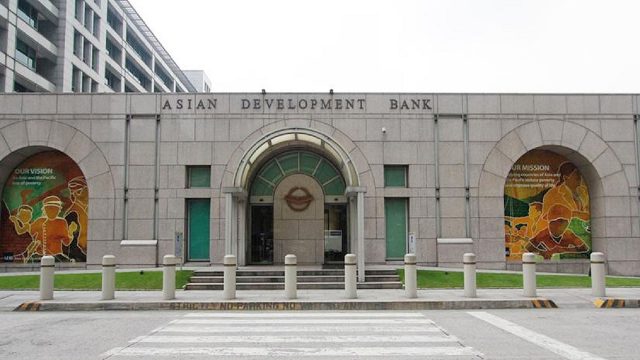
THE Asian Development Bank (ADB) said on Monday that the Philippines will receive $500 million from a $1.5-billion program to improve the climate adaptability of rice farms between 2025 and 2030.
The program is part of ADB’s broader $40-billion commitment to food systems transformation by 2030, according to Qingfeng Zhang, who heads the ADB’s agriculture operations, said at a briefing hosted by the International Rice Research Institute.
The initiative, in partnership with the Consultative Group on International Agricultural Research and the Gates Foundation, seeks to help farmers adapt to the changing climate and reduce their water intensity and carbon footprint.
It promotes the adoption of high-yield and low-emission farming practices; inclusive value chains; and improved nutrients for the Asia-Pacific’s poorest.
In the Philippines, the funds will enhance farming practices and irrigation as well as develop the logistical system for rice, Mr. Zhang said.
It will also help farmers navigate the carbon credits market, he added.
The ADB said in a statement that rice farming faces mounting pressure in the region from declining productivity and receding water supplies. It also contributes significantly to greenhouse gas emissions.
Bangladesh, Cambodia, Pakistan, and China are also among the program’s beneficiaries. — Kyle Aristophere T. Atienza

THE Philippine Crop Insurance Corp. (PCIC) and the International Rice Research Institute (IRRI) launched a satellite-aided crop insurance system for rice farmers, which will facilitate the issuance of insurance policies by doing away with the need for on-site assessments of farmland.
The new system initially targets 1,000 farmers in Isabela and Camarines Sur, according to a memorandum of agreement signed by the PCIC, IRRI, the PAGASA government weather service, and the Alliance of Bioversity International.
Initial beneficiaries are farmers from Isabela and Camarines Sur provinces, with expansion to proceed nationwide following a positive outcome from the pilot.
IRRI noted that traditional crop insurance has not fully addressed farmers’ needs, citing slow claims processing, subjective damage assessments, and limited coverage.
“Crop insurance is seen as one of the mechanisms to cushion the impact of climate shocks on the already vulnerable agriculture sector,” it said.
In 2024, agricultural losses due to natural disasters amounted to P57.8 billion. The Philippines is visited by an average of 20 typhoons every year.
The program will use an area-based yield index insurance developed by IRRI, PCIC, and the Philippine Rice Research Institute “to provide an evidence-based reference for the insurance package,” instead of relying solely on on-site damage assessments.
“This type of crop insurance offers a comprehensive range of risks, including floods, droughts, saltwater intrusion, and pests and diseases,” IRRI said. — Kyle Aristophere T. Atienza
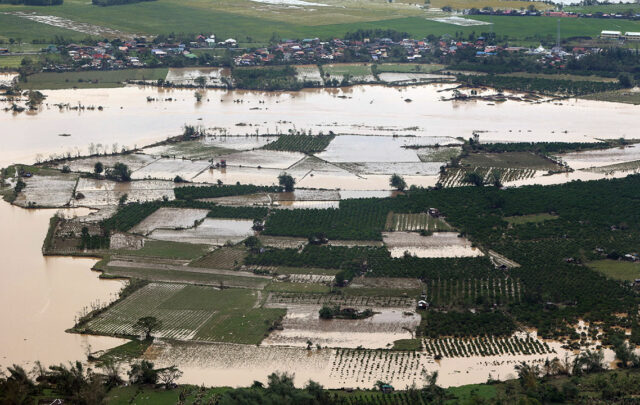
THE Department of Budget and Management (DBM) has released P2.39 billion in calamity funds as of the end of May, mostly to support rehabilitation projects and to top up quick-response funds.
According to the DBM’s National Disaster Risk Reduction and Management Fund (NDRRMF) status update, P18.61 billion remains undisbursed.
The releases included P1.34 billion for the Department of Public Works and Highways (DPWH), P747.70 million for the Department of Social Welfare and Development (DSWD) and P303.20 million for the Department of National Defense (DND).
These were all charged against the NDRRMF fund, with no funds taken from the People’s Survival Fund.
The DBM said the DPWH’s request was to support the reconstruction of infrastructure in Tingloy, Batangas, damaged by Typhoon Carina last year.
The DSWD release replenished its 2025 Quick Response Fund (QRF).
The QRF is a stand-by emergency fund to support aid, relief, reconstruction, and rehabilitation in calamity-affected areas.
The DND release supplemented the Office of Civil Defense’s QRF.
May was the first month in which the calamity fund was tapped.
By May 2024, the releases had been P7.13 billion out of the P22.74 billion total.
The government weather service, known as PAGASA, estimates that between 11 and 19 storms are expected to enter the Philippine Area of Responsibility until November. — Aubrey Rose A. Inosante

THE Bases Conversion and Development Authority (BCDA) said it recovered a Forest Lodge unit within Camp John Hay after a favorable ruling from the Court of Appeals (CA).
In a statement Monday, the BCDA said that the recent CA ruling affirms its “rightful claim and mandate over Camp John Hay.”
“This marks a critical step forward in BCDA’s efforts to transform the area into a vibrant public asset for the benefit of Baguio and its neighboring communities,” it added.
According to the BCDA, the court ruled against claimants Casiano et al., injecting an element of
“legal clarity” which “further strengthens BCDA’s position as it advances long-term development plans aimed at unlocking new opportunities for ecotourism, business, and inclusive growth in the region.” — Sheldeen Joy Talavera

By Sheldeen Joy Talavera, Reporter
THE Energy Regulatory Commission (ERC) will review a budget request by the Independent Electricity Market Operator of the Philippines (IEMOP) for an additional P1.1 billion to cover the cost of a new market management system for the Wholesale Electricity Spot Market (WESM).
“We acknowledge the requirement to update the MMS (market management system) currently used especially with the influx of additional RE (renewable energy) generators and increased participation of suppliers and contestable consumers in the WESM over the last few years,” ERC Chairperson and Chief Executive Officer Monalisa C. Dimalanta told BusinessWorld.
Ms. Dimalanta said that the commission will review the budget request “to ensure that costs for such upgrading are reasonable and prudent.”
In its filing with the ERC, IEMOP proposed that market transaction fees cover the cost of the IEMOP Electricity Market Management System (IEMMS) project from 2025 to 2027, which is “urgently needed” by the WESM.
IEMOP asked the ERC to grant provisional authority to impose additional market fee to be collected over four years on power generators, “according to the volume traded by each in the WESM energy and reserve market.”
The fee will be imposed in addition to the prevailing market fee at the time of the ERC’s approval, IEMOP said.
IEMOP said that the current MMS, which was commissioned in 2015, can no longer be supported with supplier updates and has shown signs of degrading performance.
“Moreover, the current MMS is increasingly constrained by technological obsolescence because its hardware and software components, which form the backbone of market operations, are now approaching or have reached their end-of-support period,” the IEMOP said.
“This includes critical elements such as the database management system, operating system, and middleware, which will no longer receive security patches, technical support, or updates from the third-party software vendors,” it added.
IEMOP said that these issues have resulted in “software instability, performance degradation, escalating maintenance cost, compatibility issues, and security vulnerabilities.”
“Leveraging the use of newer technologies, the IEMMS Project aims to meet the demands, as well as the dynamic and complex requirements of the WESM, including increased transaction volumes, integration of renewable energy sources, energy storage systems and compliance with regulatory standards,” IEMOP said.
Nic Satur, Jr., chief advocate officer for Partners for Affordable and Reliable Energy (PARE), raised concerns about potential pass-through charges.
“There are benefits to improved market infrastructure—like faster clearing times, better data transparency, and potentially fewer imbalances in the spot market. However, these benefits must be clearly demonstrated, quantified, and felt by consumers—not just promised,” he said via Viber.
PARE urged the ERC to require a full cost-benefit analysis and public hearings before granting approval.
The group also proposed exploring alternative funding mechanisms such as using a portion of energy-related taxes to help subsidize the cost of necessary infrastructure upgrades.
“To be clear: PARE supports modernization, but not at the expense of consumer welfare,” Mr. Satur said. “If the goal is a more efficient energy market, then let it also be consumer centered and affordable.”

THE Philippine Economic Zone Authority (PEZA) said investors from China, Taiwan, and Hong Kong are expected to be among the top sources of foreign direct investment (FDI) this year.
“PEZA counts the Chinese investors, including those from Taiwan and Hong Kong, among our best bets for FDI attraction for this year and for succeeding years to come,” PEZA Director General Tereso O. Panga said in a statement Monday.
“With the Philippines as the new ‘plus one’ destination for China-based manufacturers wanting to export to the US and EU, our partners will play a major role in our quest to actively engage Chinese enterprises and to promote the Philippines’ competitive edge as the emerging investment hub in the region,” he added.
PEZA has signed a memorandum of understanding (MoU) with Aoxing Group Chairman Zhao Wenfa for investment promotion.
The MoU is expected to “lay the groundwork for closer collaboration with Chinese enterprises seeking resilient, dual-base production and supply chain models in the region.”
Mr. Wenfa, who is also the president of the International Chamber of Commerce, said that it is important to leverage “localized operations as a foundation for sustainable economic collaboration.”
He also serves as chief executive officer of Dongguan Aoxing Audio Visual Equipment Co., Ltd., an original equipment manufacturer based in Dongguan.
The company manufactures projector equipment, projector screens, and audiovisual products for brands such as HP, Epson, and Skyworth.
“With extensive experience and a strong global market presence, Mr. Zhao has led the company in exporting audiovisual equipment to markets across America, Europe, Asia, and the Middle East,” PEZA said. — Justine Irish D. Tabile
