Home Blog Page 1460

Trump has long speculated about using force against his own people. Now he has the pretext to do so

STOCK PHOTO | Image by Nitish Meena from Unsplash

“You just [expletive] shot the reporter!”

Australian journalist Lauren Tomasi was in the middle of a live cross, covering the protests against the Trump administration’s mass deportation policy in Los Angeles, California. As Tomasi spoke to the camera, microphone in hand, an LAPD officer in the background appeared to target her directly, hitting her in the leg with a rubber bullet.

Earlier, reports emerged that British photojournalist Nick Stern was undergoing emergency surgery after also being hit by the same “non-lethal” ammunition.

The situation in Los Angeles is extremely volatile. After nonviolent protests against raids and arrests by Immigration and Customs Enforcement (ICE) agents began in the suburb of Paramount, US President Donald Trump issued a memo describing them as “a form of rebellion against the authority of the government of the United States.” He then deployed the National Guard.

‘CAN’T YOU JUST SHOOT THEM?’
As much of the coverage has noted, this is not the first time the National Guard has been deployed to quell protests in the US.

In 1970, members of the National Guard shot and killed four students protesting the war in Vietnam at Kent State University. In 1992, the National Guard was deployed during protests in Los Angeles following the acquittal of four police officers (three of whom were white) in the severe beating of a Black man, Rodney King.

Trump has long speculated about violently deploying the National Guard and even the military against his own people.

During his first administration, at the height of the Black Lives Matter protests, former Secretary of Defense Mark Esper alleged that Trump asked him, “Can’t you just shoot them, just shoot them in the legs or something?”

Trump has also long sought to other those opposed to his radical agenda to reshape the United States and its role in the world. He’s classified them as “un-American” and, therefore, deserving of contempt and, when he deems it necessary, violent oppression.

During last year’s election campaign, he promised to “root out the communists, Marxists, fascists, and the radical left thugs that live like vermin within the confines of our country.” Even the Washington Post characterized this description of Trump’s “political enemies” as “echoing Hitler, Mussolini.”

In addition, Trump has long peddled baseless conspiracies about “sanctuary cities,” such as Los Angeles. He has characterized them as lawless havens for his political enemies and places that have been “invaded” by immigrants. As anyone who has ever visited these places knows, that is not true.

It is no surprise that in the same places Trump characterizes as “disgracing our country,” there has been staunch opposition to his agenda and ideology.

That opposition has coalesced in recent weeks around the activities of ICE agents, in particular. These agents, wearing masks to conceal their identities, have been arbitrarily detaining people, including US citizens and children, and disappearing people off the streets. They have also arrested caregivers, leaving children alone.

As Adam Serwer wrote in The Atlantic during the first iteration of Trump in America, “the cruelty is the point.”

The Trump administration’s mass deportation program is deliberately cruel and provocative. It was always only a matter of time before protests broke out.

In a democracy, nonviolent protest by hundreds or perhaps a few thousand people in a city of 10 million is not a crisis. But it has always suited Trump and the movement that supports him to manufacture crises.

White House Deputy Chief of Staff Stephen Miller, a key architect of the mass deportations program and a man described by a former adviser as “Waffen SS,” called the protests “an insurrection against the laws and sovereignty of the United States.” Trump himself also described protesters as “violent, insurrectionist mobs.”

Nowhere does the presidential memo deploying the National Guard name the specific location of the protests. This, and the extreme language coming out of the administration, suggests it is laying the groundwork for further escalation.

The administration could be leaving space to deploy the National Guard in other places and invoke the Insurrection Act.

Incidents involving the deployment of the National Guard are rare, though politically cataclysmic. It is rarer still for the National Guard to be deployed against the wishes of a democratically elected leader of a state, as Trump has done in California.

A BROADER ASSAULT ON DEMOCRACY
This deployment comes at a time of crisis for US democracy more broadly. Trump’s longstanding attacks against independent media — what he describes as “fake news” — are escalating. There is a reason that during the current protests, a law enforcement officer appeared so comfortable targeting a journalist, on camera.

The Trump administration is also actively targeting independent institutions such as Harvard and Columbia universities. It is also targeting and undermining judges and reducing the power of independent courts to enforce the rule of law.

Under Trump, the federal government and its state-based allies are targeting and undermining the rights of minority groups — policing the bodies of trans people, targeting reproductive rights, and beginning the process of undoing the Civil Rights Act.

Trump is, for the moment, unconstrained. Asked overnight what the bar is for deploying the Marines against protesters, Trump responded: “the bar is what I think it is.”

As New York Times columnist Jamelle Bouie recently observed: “We should treat Trump and his openly authoritarian administration as a failure, not just of our party system or our legal system, but of our Constitution and its ability to meaningfully constrain a destructive and system-threatening force in our political life.”

While the situation in Los Angeles is unpredictable, it must be understood in the broader context of the active, violent threat the Trump administration poses to the US. As we watch, American democracy teeters on the brink.

THE CONVERSATION VIA REUTERS CONNECT


Emma Shortis is an adjunct senior fellow at the School of Global, Urban and Social Studies, at RMIT University. She is director of International and Security Affairs at The Australia Institute, an independent think tank.

Sean ‘Diddy’ Combs’ ex testifies he kicked, dragged her in attack last year

Sean “Diddy” Combs on the talk show Late Night with Seth Myers. — IMDB

NEW YORK — An ex-girlfriend of Sean “Diddy” Combs testified on Monday that he kicked, punched, and dragged her last June, about a month after the hip-hop mogul apologized for a video that surfaced of Mr. Combs attacking another girlfriend eight years earlier.

The alleged attack on the woman, testifying under the pseudonym Jane to protect her privacy, occurred three months before Mr. Combs was indicted on racketeering conspiracy and sex trafficking charges. He has pleaded not guilty.

Jane said that after the attack in the backyard of her Los Angeles home on June 18, 2024, Mr. Combs contacted a male entertainer named Anton, gave her an ecstasy pill, and told her to perform oral sex on Anton while Mr. Combs watched — even though she had told him she did not want to.

Jane said Mr. Combs told her, “You’re not going to ruin my fucking night,” and then got close to her face and said, “Is this coercion?”

Jane’s testimony could bolster prosecutors’ contention that Mr. Combs, 55, for two decades coerced women to take part in the sexual performances, sometimes known as “Freak Offs,” against their will. Lawyers for Mr. Combs, founder of Bad Boy Records, have acknowledged he was occasionally abusive in domestic relationships, but say the women who took part in Freak Offs did so consensually.

On May 19, 2024, Mr. Combs apologized on social media after CNN broadcast a hotel surveillance video from 2016 in which Mr. Combs appeared to attack the rhythm and blues singer Casandra Ventura, another ex-girlfriend. The video was shown in court.

In November 2023, Ms. Ventura sued Mr. Combs for allegedly forcing her to take part in Freak Offs over the course of a decade-long relationship that started around 2008. Mr. Combs denied wrongdoing, and he settled with her two days later for $20 million.

Jane said she told Mr. Combs several times that she did not want to have sex with other men anymore. Jurors saw an October 20, 2023, text message in which she told him, “I felt violated and manipulated by you.”

But the encounters continued after that, as did Mr. Combs’ financial support for Jane, according to her testimony.

Jane said the June 2024 altercation occurred after she confronted him about his relationship with another woman.

Jane said she shoved Mr. Combs’ head into a kitchen counter and threw candles and glass at him. He eventually attacked her in the backyard while she was lying on the ground curled into a ball, she said.

Mr. Combs’ defense lawyers are due to begin cross-examining Jane on Tuesday. Testimony is in its fifth week. Mr. Combs could face life in prison if convicted on all counts.

Also known throughout his career as Puff Daddy and P. Diddy, Mr. Combs turned artists like Notorious B.I.G. and Usher into stars, elevating hip-hop in American culture and becoming a billionaire in the process. — Reuters

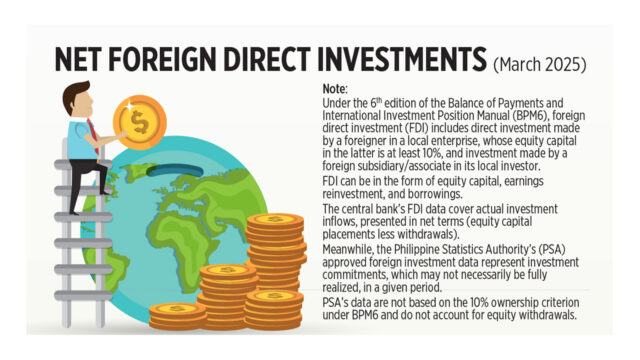
Net Foreign Direct Investment

NET INFLOWS of foreign direct investments (FDI) fell to a three-month low in March, with first-quarter inflows also dropping by more than 40% year on year, amid heightened global uncertainty arising from the US tariff policies. Read the full story.

Net Foreign Direct Investment

How PSEi member stocks performed — June 10, 2025

Here’s a quick glance at how PSEi stocks fared on Tuesday, June 10, 2025.


Senate convenes as impeachment court to try Vice-President Duterte

VICE-PRESIDENT Sara Duterte-Carpio — OFFICE OF THE VICE PRESIDENT

By Adrian H. Halili, Reporter

THE PHILIPPINE Senate on Tuesday convened as an impeachment court after senators took their oath as jurors to try Vice-President Sara Duterte-Carpio, who faces a lifetime political ban if convicted of high crimes and betraying the public trust.

The trial could be a pivotal moment in Philippine politics by not only making or breaking Ms. Duterte, but also carrying big implications for President Ferdinand R. Marcos, Jr. and his agenda for the remaining three years of his presidency and beyond.

A likely contender to be the next president, Ms. Duterte, 47, was impeached in February by the House of Representatives.

She denies all the accusations, from budget anomalies to amassing unusual wealth and threatening the lives of Mr. Marcos, his wife and the Speaker.

“We stand ready to confront the charges and expose the baselessness of the accusations,” her office said in a statement on Tuesday.

The upper chamber convened as an impeachment court after Senator Ronald “Bato” M. Dela Rosa, a Duterte-ally, moved for the Senate to scrap the impeachment trial.

“I respectfully move that in view of its constitutional infirmities and questions on the jurisdiction and authority of the 20th Congress, the verified impeachment complaints against the (Vice President) be dismissed,” he said in a privilege speech.

The impeachment complaint was filed and signed by more than 200 congressmen, meeting the more than one-third vote required by law to start a trial.

Senate President Francis G. Escudero, who will preside over the trial, said the Senate must first convene as an impeachment court before acting on Mr. Dela Rosa’s motion.

Senate Majority Leader Francis N. Tolentino filed a resolution proposing a 19-day impeachment trial for Ms. Duterte starting on June 11 until June 30. The present Congress will be replaced by a new set of lawmakers in July.

“Without compromising the integrity of the Senate and the substance of the impeachment trial, including the rights of the parties, there is a need to adopt an expedited trial calendar,” he said.

A two-thirds majority is required to convict Ms. Duterte, which would kill off her hopes of running for president in 2028.

The trial of the popular daughter of firebrand former President Rodrigo R. Duterte follows an acrimonious falling-out with former ally Mr. Marcos, who ran on a joint ticket that won the 2022 election in a landslide.

Mr. Marcos is limited to a single six-year term in office and is expected to try to retain future influence by grooming a successor who can fend off Ms. Duterte in the next election if she is acquitted.

The President has distanced himself from the impeachment process, even though it was launched by his allies at the House.

The trial comes after a stronger-than-expected showing for Ms. Duterte’s allies in last month’s midterm elections.

That demonstrated her enduring influence, despite the battle with Mr. Marcos and the arrest and handover to the International Criminal Court of her father in March over thousands of killings in a “war on drugs” he waged as President from 2016 to 2022.

‘POLITICAL TOOL’
Ms. Duterte is the fifth top official in the Philippines to be impeached, only one of whom — Renato Corona, a former chief justice — was convicted.

The trial of former President Joseph Estrada was aborted in 2001 after some prosecutors walked out, while the resignation of two officials — an election commission chairman and an ombudsman — followed their impeachment.

The start of her trial comes just three days after the end of the final session of the current Senate, with 12 new members set to join when the chamber next gathers in July.

Ms. Duterte had asked the Supreme Court to nullify the impeachment complaint against her for being politically motivated. The court has ordered Congress to respond.

“The impeachment process must never be weaponized to harass, silence or eliminate political opponents,” her office said on Tuesday. “It is a constitutional mechanism, not a political tool.” — with Reuters

Chinese Coast Guard, Navy keep ‘swarming’ tactics in disputed sea

PHILIPPINE COAST GUARD PHOTO

By Kenneth Christiane L. Basilio, Reporter

CHINESE vessels lingered near contested areas in the South China Sea last month, in line with China’s “swarming” and “gray-zone” strategies amid heightened regional tensions, the Philippine military said on Tuesday.

China sent the biggest number of ships to Scarborough Shoal in May — 15 coast guard vessels and 11 navy ships, military spokeswoman Colonel Francel Margareth Padilla-Taborlupa told a news briefing.

“As part of continued maritime surveillance, Chinese government-affiliated vessels remained persistently present in key areas in the West Philippine Sea,” she said, referring to areas of the South China Sea within the Philippines’ exclusive economic zone (ecozone).

“Chinese vessels were sighted intermittently throughout various features of the Kalayaan Island Group (Spratly Islands) and other Philippine maritime zones, consistent with patterns of maritime swarming and gray-zone activity,” she added.

The Chinese Embassy in Manila did not immediately reply to a Viber message seeking comment.

The Philippines has been irked by the presence of Chinese ships within its ecozone. China claims nearly all of the South China Sea via a U-shaped, 1940s nine-dash line map that overlaps with the exclusive waters of the Philippines and neighbors like Vietnam and Malaysia.

A United Nations-backed tribunal in 2016 voided China’s sweeping claims for being illegal, a ruling that Beijing does not recognize.

Meanwhile, six Chinese coast guard vessels were monitored loitering near Second Thomas Shoal alongside a People’s Liberation Army-Navy ship, Ms. Taborlupa said. Four Chinese Coast Guard and Chinese Navy vessels were also spotted around Thitu Island. Both are occupied by the Philippines.

She said some vessels did not respond when they were challenged by Philippine ships via radio. “Despite the number of nonresponsive vessels, it did not result in… confrontations with friendly forces.”

The presence of Chinese vessels within the country’s ecozone are “disturbing” and “concerning,” Philippine Navy spokesman Rear Admiral Roy Vincent T. Trinidad told the same briefing.

“Their actions, which are coercive and aggressive, are concerning,” he said. “They are disturbing. Their illegal presence, their coercive and aggressive actions and their deceptive messaging have been the cause of all the turmoil in the West Philippine Sea.”

Meanwhile, an advanced mobile anti-ship missile system brought by the US earlier this year for Balikatan (shoulder-to-shoulder) exercises is still in the Philippines and is being used for training, Philippine Navy spokesman Captain John Percie Alcos told reporters at the briefing.

“The NMESIS (Navy-Marine Expeditionary Ship Interdiction System) will remain here in our country for as long as training opportunities are still there for us,” he said.

Familiarizing Filipino troops with the advanced US anti-ship missile battery would train them against sea invasions,” Mr. Alcos said. “This will be extremely helpful if amphibious raids or amphibious landings are planned against our country.”

The Philippine Navy plans on having its own NMESIS unit and has submitted its request to the Defense department, he said.

“The acquisition of long-range missile systems or rocket systems is one of the capabilities that we intend to have,” he said. “We have already submitted the list of capabilities that are critical and crucial for the Philippine Navy to the higher headquarters and the Department of National Defense.”

DEEPER COOPERATION
Meanwhile, Manila and Washington have agreed to bolster cooperation to address Beijing’s aggression in the South China Sea, after a meeting between Philippine Foreign Affairs Secretary Enrique A. Manalo and US State Secretary Marco Rubio.

“Secretary Rubio and Secretary Manalo committed to deepening cooperation on addressing China’s destabilizing actions in the South China Sea and to increasing economic cooperation to mutually benefit American and Philippine citizens,” State department Spokesperson Tammy Bruce said in a statement.

Mr. Manalo and Mr. Rubio met during a working visit by the Philippine envoy to the US on June 9 to 11.

Separately, the Department of Foreign Affairs (DFA) said both secretaries supported continued cooperation in defense and security, including sustaining Manila’s military modernization efforts.

The Philippines seeks to boost its defense capabilities through more foreign partnerships amid worsening ties with China. It has also increased its defense budget, with about P35 billion allotted to modernize its military in the next decade.

The South China Sea has become a boiling point for regional tension as China continues to assert dominance over areas claimed by the Philippines, Vietnam, Malaysia, Brunei and Taiwan.

The Philippines and China have repeatedly clashed in the disputed waterway, with both sides accusing each other of raising tensions.

“The secretaries looked forward to the positive conclusion of high-level talks between Philippine and US economic managers on the US’ reciprocal tariffs,” the DFA said.

Last month, Philippine officials met with the US Trade Representative to negotiate the 17% reciprocal tariff imposed by the US on the Philippines.

“They also underscored the importance of stronger economic relations in building a more enduring Philippines-US alliance and promoting overall security,” the agency said.

The two envoys also committed to explore opportunities for cooperation with regional allies and partners, including trilaterally with Japan through the Luzon Economic Corridor, it added. — with Adrian H. Halili

Marcos assessing performance of undersecretaries

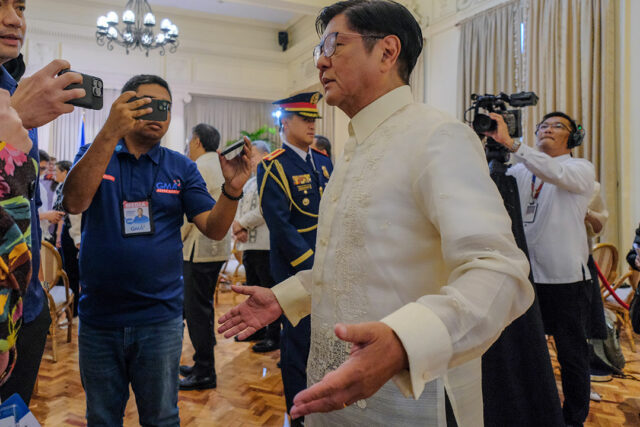
PRESIDENT Ferdinand R. Marcos, Jr. speaks with reporters at the presidential palace.— PHILIPPINE STAR/RYAN BALDEMOR

PRESIDENT Ferdinand R. Marcos, Jr. on Tuesday said he is reviewing the performance of undersecretaries across agencies as part of the Cabinet reshuffle that he ordered last month.

“This time, it looks like the (secretaries) are doing well — the performance is good,” he told reporters at the presidential palace, according to a transcript from his office. “Now, we’re already at [the undersecretaries], we’re already at the agencies.”

The President said the May 22 order for all Cabinet members to quit was meant to ensure that agencies are fulfilling their mandate.

The shuffle was “not a one-shot, one-time, big-time thing,” he said. “It is an ongoing thing.”

He said he wants to evaluate his Cabinet members’ performances every quarter by checking if they are meeting their targets. He added that he would be “much more rigorous” in evaluating all officials, not just the agency heads.

“We are still in the process of examination. Now, we are in the lower positions,” he said in mixed English and Filipino. “What happened really here was that I put everyone on notice that you are all basically on probation.”

He kept his Cabinet mostly unchanged after a “bold reset” call, but his executive secretary, whom he also retained, said “there will be blood” and changes would be made over time.

Meanwhile, Palace Press Officer Clarissa A. Castro told a separate briefing that National Security Adviser Eduardo M. Año would keep his post despite his previous health issues.

Mr. Año has has health issues since the pandemic but agreed to stay at the National Security Council, she said.

“The President agrees that he can continue to do the fine job he has been doing until his health permits,” she added in mixed English and Filipino.

The call for courtesy resignations came in the wake of the disappointing performance of Marcos-backed senatorial candidates in the May 12 midterm elections.

The President earlier kept his core economic team, along with the heads of the Defense, Justice, Agriculture and Education departments.

He accepted the resignation of several officials including Solicitor General Menardo I. Guevarra and Commission on Higher Education (CHEd) Chairman J. Prospero E. de Vera. They were replaced by University of the Philippines College of Law Dean Darlene Marie B. Berberabe and CHEd Commissioner Shirley C. Agrupis, respectively.

Foreign Affairs Secretary Enrique A. Manalo also stepped down and was reappointed as the Philippines’ permanent representative to the United Nations in New York. He will be succeeded by Undersecretary and career diplomat Ma. Theresa P. Lazaro.

Environment Secretary Maria Antonia Yulo-Loyzaga was replaced by Energy Secretary Raphael M. Lotilla, while Housing Secretary Jose Rizalino L. Acuzar was reassigned as presidential adviser for the Pasig River development, with Jose Ramon P. Aliling taking over his post. — Chloe Mari A. Hufana

Congress ratifies Konektadong Pinoy bill

STOCK PHOTO | Image by terimakasih0 from Pixabay

By Kenneth Christiane L. Basilio, Reporter

THE PHILIPPINE Congress on Monday ratified a measure seeking to expand internet access in the country by allowing the seamless entry of new industry players and encouraging investments into digital infrastructure.

Senators and congressmen separately ratified the priority measure via voice vote during their respective plenary sessions. It will now be sent to the Malacañang for President Ferdinand R. Marcos, Jr.’s signature.

“The State shall pursue an open-access policy providing an accessible and competitive environment to all qualified participants in all segments of the data transmission network, and encouraging investments in the digital infrastructure for the development of reliable and affordable data transmission networks, comparable to the best of the world,” according to the version of the bill approved by the bicameral conference committee, a copy of which was obtained by BusinessWorld.

The Philippines is seeking to resolve the country’s digital divide gap, which remains a challenge, especially in remote areas, the Department of Information and Communications Technology (DICT) said last year. About 18.3 million Filipinos are deemed as financially incapable of availing at least one gigabyte worth of internet data per month, according to the 2024 Internet Poverty Index.

The Southeast Asian nation ranked 66th in mobile speeds globally and 52nd for fixed broadband connection rates, based on an April report by connectivity analysis firm Ookla.

The DICT should formulate policies that could help the Philippines foster an “open-access approach” in promoting healthy competition among internet providers, according to the bill.

“[It] should also pursue plans… to incentivize data transmission industry participants to invest, adopt, roll out, implement, establish, own, maintain, operate or utilize new and next-generation technologies, prioritizing unserved or underserved areas,” the measure said.

The National Telecommunications Commission (NTC) would be the internet industry’s regulatory body and should promote “fair and open” competition over the sector, the proposed law said. All industry players should register with the regulatory body.

“If implemented properly, the bill has the potential to bring real improvements to internet access and digital inclusion, particularly for Filipinos in underserved and geographically isolated areas,” Ronald B. Gustilo, national campaigner for Digital Pinoys group, said in a Viber message.

The costs of internet services and their components should also be made transparent, according to the proposal, allowing the agency to ensure fair pricing of data transmission companies.

All internet service providers should also comply with global cybersecurity standards to ensure data safety. The DICT would conduct performance audits of industry players to ensure their compliance.

The DICT and NTC should also formulate a “spectrum management policy framework” to make sure that the internet spectrum is efficiently used by internet service providers within three months of the bill’s approval.

Filipinos are entitled to reliable internet services, having also the rights to receive timely and accurate monthly bills from providers and be provided the timely correction of billing errors, the bill stated.

The NTC would be empowered to impose daily fines of up to P2 million ($35,830) on data service providers failing to meet proposed performance standards, with persistent violators facing a three-year ban from offering transmission services.

“We hope that the government will ensure strong coordination among agencies, transparent use of funds and clear accountability mechanisms for this bill to succeed,” said Mr. Gustilo. “It’s also important to promote competition in the telecom sector to truly drive down costs and improve service quality.”

LPA outside PAR intensifies

Commuters use their umbrellas during a downpour along Taft Avenue, Manila, July 13, 2023. — PHILIPPINE STAR/EDD GUMBAN

A LOW-PRESSURE area outside the Philippine area of responsibility (PAR) has developed into a tropical depression, according to the state weather bureau.

The cyclone was estimated at 610 kilometers (km) west of Iba, Zambales as of 2 p.m., the Philippine Atmospheric, Geophysical, and Astronomical Services Administration (PAGASA) said in a 4 p.m. report.

It was packing maximum sustained winds of 55 kilometers per hour (kph) and gusts of up to 77 kph, moving northwestward at 10 kph, it added.

“No other Low Pressure Areas (LPA) or tropical cyclones are being monitored for Tropical Cyclone Formation.”

Earlier in the day, PAGASA said the tropical depression was unlikely to have any direct impact on the country, even if it entered the PAR.

“We’re also not ruling out the possibility that it might re-enter our Philippine area of responsibility, but even if it does, it won’t have any direct effect on any part of our country,” it said.

The southwest monsoon, which Filipinos call habagat, remained the main weather system seen bringing rain to some parts of the country on Tuesday. — Kyle Aristophere T. Atienza

Marcos names new SC Justice

PRESIDENT Ferdinand R. Marcos, Jr. administered the oath of office to his first Supreme Court appointee, Associate Justice Raul B. Villanueva, during a ceremony in Malacañan Palace on Tuesday. — PHILIPPINE STAR/RYAN BALDEMOR

PRESIDENT Ferdinand R. Marcos, Jr. has named Court Administrator Chief Raul B. Villanueva as the new associate justice, his first appointment in the Supreme Court (SC).

The new high court magistrate took his oath before Mr. Marcos on Tuesday in the presidential palace. He replaced Justice Mario V. Lopez, who mandatorily retired at the age of 70 last June 4.

Mr. Villanueva has been serving as head of the Office of the Court Administrator since 2022, the office tasked to assist the SC in exercising administrative supervision over all courts.

He joined the judiciary in 2002 when he was appointed presiding judge of the Las Piñas City Regional Trial Court (RTC) Branch 255. He later served as the executive judge of the Las Piñas RTC and also held posts as acting presiding judge of the Taguig City RTC Branch 267 and the Manila RTC Branch 4.

In 2010, Mr. Villanueva was appointed deputy court administrator, a position he held until then-Court Administrator Jose Midas P. Marquez was appointed as associate justice.

Like several other appointees of the president, Mr. Villanueva is an Ilocano. A native of Narvacan, Ilocos Sur, he graduated at the top of his class at Narvacan South Central School in 1976 and completed high school with honors at Lourdes School in Quezon City in 1981.

He earned his economics degree from the University of the Philippines in 1985 and his law degree from the same university in 1990. 

Mr. Villanueva is Mr. Marcos’ first appointee to the high court, which remains dominated by justices named by his predecessor, Rodrigo R. Duterte. Of the 15 sitting members of the SC en banc, 12 were appointed by Mr. Duterte, including Chief Justice Alexander G. Gesmundo.

Two justices, Senior Associate Justice Marvic MV.F. Leonen and Associate Justice Alfredo Benjamin S. Caguioa, were appointed by the late former president Benigno Simeon C. Aquino III.

Mr. Marcos’ next opportunity to appoint justices to the top court will be next year, when Mr. Gesmundo and Associate Justice Amy Lazaro-Javier are set to retire. He will then have the chance to name both a new chief justice and an additional associate justice.

During Mr. Villanueva’s oath-taking, Mr. Marcos said he hopes the appointment will help the executive and judiciary have a closer relationship.

“I know that the appointment of our new justice will continue that trend and bring the departments of government even closer than before and so that the function of government is smoother, better, and that we are unified in our goal to making life better for all Filipinos,” the President said. — Chloe Mari A. Hufana

Marcos: BI chief under probe

PHILSTAR FILE PHOTO

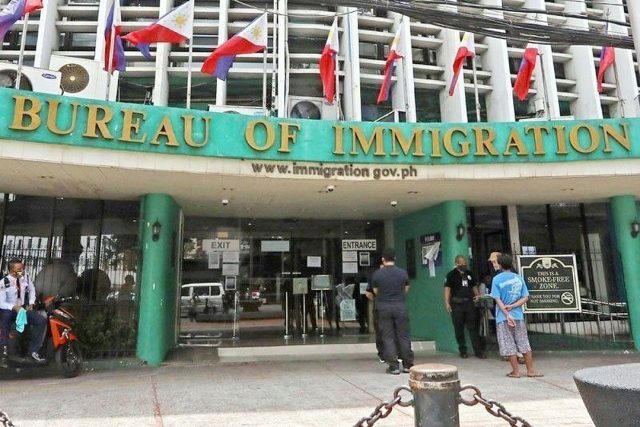
PRESIDENT Ferdinand R. Marcos, Jr. on Tuesday said he is now looking into allegations of misconduct against his Bureau of Immigration (BI) chief after anonymous employees complained over the weekend.

The chief executive said he received reports accusing his immigration chief, Joel Anthony M. Viado, of misconduct and corruption in relation to the now-illegal Philippine offshore gaming operators (POGOs) and the deportation of foreign workers.

“We’re looking at it, but it’s hard to study it thoroughly if it’s just a white paper that’s unsigned and has no specifics,” he told reporters in the Presidential Palace, according to a transcript from the Presidential Communications Office. “But nonetheless, everything like this, we look into it, and we will continue to do that.”

Mr. Viado on the same day said he hoped the issue could be resolved within the agency to spare the public from “needless controversy.”

He noted Justice Secretary Jesus Crispin C. Remulla is kept abreast of the matters.

Meanwhile, Palace Press Officer Clarissa A. Castro, in a separate briefing on the same day, urged aggrieved parties, if they have complaints, to submit evidence to strengthen the investigation.

“It’s difficult if it’s just a white paper without any supporting evidence being submitted, because the Department of Justice’s time would be wasted if they focused solely on white papers,” she said in Filipino.

This followed earlier reports that anonymous BI employees had reportedly approached Mr. Marcos, alleging Mr. Viado had abused his authority by expediting the release of foreign nationals linked to POGOs and negotiating the release of foreign workers from a notorious POGO company.

There were also claims that quota visas were being auctioned off under his leadership, on top of issues raised regarding Mr. Viado’s work ethic and alleged violations related to attending meetings concerning the bureau’s e-gates project.

Mr. Viado on Monday dismissed the claims, saying allegations were “orchestrated” and part of a “well-funded” campaign to discredit reforms in the bureau. — Chloe Mari A. Hufana

House pushes P200 wage hike

PNA FILE PHOTO

THE House of Representatives is pushing for the approval of its proposed P200 wage hike bill as its bicameral conferees ready for negotiations with their counterparts in the Senate, its spokesperson said on Tuesday.

“The House will continue to stand by its version as the one that will best benefit our people,” House spokeswoman Priscilla Marie “Princess” T. Abante said in a statement in Filipino.

The chamber last week approved on third and final reading a measure seeking a P200 across-the-board minimum wage hike for workers in the private sector just a few days before Congress adjourns for the final time on June 13.

This is higher than the P100 wage increase proposed in the Senate version, approved in February last year.

“We respect the discussions and debates that will take place between the two chambers regarding the final version of this measure,” said Ms. Abante. “But what we must ensure is fair compensation that should not be postponed for our people.”

In a separate statement, Rizal Rep. Juan Fidel Felipe F. Nograles said they are prepared to engage constructively with their counterparts to unify the differing wage increase amounts pushed by lawmakers.

“We recognize that our counterparts in the Senate have a different proposal, and we are ready to engage in constructive discussions to craft a unified version that is fair, balanced and responsive to both labor and business sectors,” Mr. Nograles, who heads the House labor committee, said.

“Our goal is to assist the administration in building a resilient and inclusive economy — one where no sector is left behind. The House stands ready to do its part, and we hope the Senate will act with the same urgency,” he said.

Also on Tuesday, the National Wage Coalition pressed both chambers to immediately pass what would be the first legislated wage hike in 26 years.

“The struggle for a legislated wage increase across the nation is not just about numbers — it is about justice, dignity, and the fundamental right of every Filipino worker to earn a living wage and share in the fruits of their labor,” it said in a statement. — Kenneth Christiane L. Basilio

ADVERTISEMENT
ADVERTISEMENT