Home Blog Page 146

UnionBank CEO 1st female BAP head

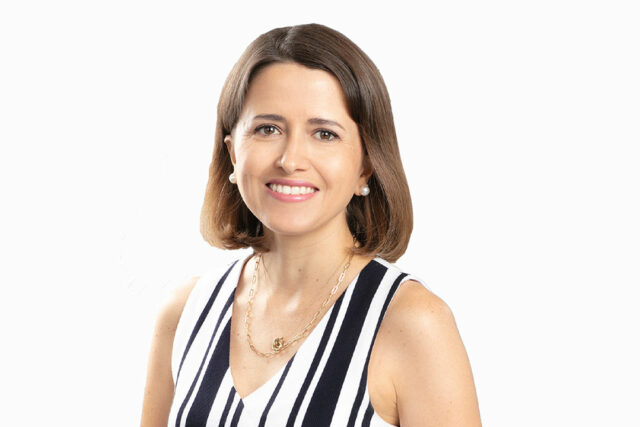
ANA MARIA ABOITIZ-DELGADO — BW FILE PHOTO

ANA MARIA ABOITIZ-DELGADO, president and chief executive officer (CEO) at Union Bank of the Philippines (UnionBank), has been elected president of the Bankers Association of the Philippines (BAP), becoming the first woman to lead the organization in its almost 80-year history. She will serve a one-year term covering 2026-2027, UnionBank said in a statement on Wednesday.

In her inaugural address, Ms. Aboitiz-Delgado cited the industry’s role in driving economic growth and financial inclusion.

“As bankers, we have the ability to uplift lives and fuel economic progress by increasing the efficiency and effectiveness of banking services,” she said. “As we see the acceleration of digitalization and the potential of AI (artificial intelligence), we face a next generation of risks that extend beyond individual institutions and national borders.”

She also cited the importance of collaboration with peers, the central bank and communities to boost trust and confidence in the financial system amid geopolitical uncertainty.

Ms. Aboitiz-Delgado succeeds Jose Teodoro K. Limcaoco, president and CEO at Bank of the Philippine Islands (BPI) who completed a three-year term. Under his leadership, the BAP advanced initiatives against financial scams and cybercrime, supported the Anti-Financial Account Scamming Act and promoted regional cooperation through the ASEAN Bankers Association.

The association also focused on improving the efficiency and connectivity of digital transaction platforms.

Ms. Aboitiz-Delgado became UnionBank president and CEO in January 2025 after more than two decades in leadership roles spanning digital transformation, consumer finance, institutional and small and medium enterprise banking and customer experience design.

In other leadership changes, Elfren Antonio S. Sarte, Jr. has been named BAP managing director, succeeding Benjamin P. Castillo, who served from 2017.

The group also elected Fabian S. Dee, president at Metropolitan Bank & Trust Co., as first vice-president; Lynette V. Ortiz, president and CEO at Land Bank of the Philippines, as second vice-president; Joseph Albert L. Gotuaco, president at BDO Private Bank, as treasurer; and Paul Raymond A. Favila, CEO at Citibank, N.A., as secretary. — Aaron Michael C. Sy

Peter Thiel’s Antichrist tour steps onto the Pope’s turf

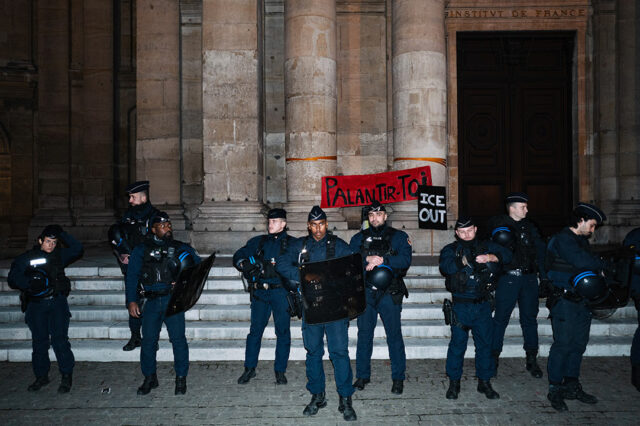
A BANNER reading “Palantir out” and a sign reading “ice out” hang at a rally in front of the Académie des sciences morales et politiques (Academy of Moral and Political Sciences) to protest the visit of Peter Thiel, the libertarian billionaire and Trump supporter, who is invited by Chantal Delsol to speak about the Antichrist before a working group on democracy in Paris, France, on Jan. 26, 2026. — REUTERS/JEROME GILLES/NURPHOTO

By Howard Chua-Eoan

BACK IN SEPTEMBER, I wrote with some amusement about Peter Thiel’s lecture series on the Antichrist — the demonic figure in Christian tradition whose appearance would lead to the end of the world and the Second Coming of Jesus. At that time, the tech titan (funder of Facebook and founder of PayPal Holdings, Inc. and Palantir Technologies, Inc.) was delivering  his talk in San Francisco to a paying audience of 200 or so Silicon Valley futurists, wannabe intellectuals, conservative fanboys, and the industry’s increasing number of Christians. Attendees had to accept non-disclosure rules, which meant there’d be no public details about how Thiel connects the tech world to conceptions of the Antichrist.

This time, he’s taken his message to Rome and the doorstep of the Vatican. This gathering is even more exclusive because attendance is by invitation only. But now I’m finding it less amusing and more alarming. The date of its first lecture — the Ides of March — was ominously apt.

Thiel has a strange perspective. Gleaning from the few clues available, it appears deeply paranoid that the Antichrist could arise with a globe-spanning organization or empire that shuts down individual freedoms in the name of wiping out fear and insecurity. And yet the billionaire himself seems to advocate for some kind of invasive technological superstructure that would restrain the evil of the End Times.

The Holy See — the formidably ancient authority on the Antichrist — has distanced itself from this brazen usurpation of its prerogatives. Pope Leo XIV’s alma mater, the Pontifical University of St. Thomas Aquinas, denied speculation it was the venue for the event or approved of it in the first place.

Theology, of course, is one reason for the antipathy. In a 1988 book, Cardinal Joseph Ratzinger — the future Pope Benedict XVI — cautioned that, while Christians must remain watchful for the Antichrist, the experience is more likely to take place within the soul of each believer, in a personal battle between good and evil. But another reason is worldly: American-born Pope Leo is on the opposite side of the German-born US billionaire in their country’s rancorous battle over immigration. I see the Rome lecture series as Thiel’s latest chess move in that contest.

Palantir, where Thiel is chairman of the board, has for years benefited from multi-million-dollar contracts with the US government, including Immigration and Customs Enforcement (ICE). In the meantime, the rights of immigrants — especially in the face of the often-brutal tactics of ICE — have been the one issue that has helped unify America’s often-fractious bishops under Pope Leo, who will mark his first year as pontiff on May 8. The US hierarchy came together for the first time in a dozen years to denounce the “climate of fear” and “dehumanizing rhetoric” surrounding immigration, as my colleague Mary Ellen Klas noted over the weekend.

The American bishops are saying what the Pope cannot diplomatically utter. His stance, however, is on the record. In January 2025, US Vice-President JD Vance (a Thiel disciple and Catholic convert) said on Fox News that Christians “love your family first, and then you love your neighbor, and then you love your community, and then you love your fellow citizens, and after that prioritize the rest of the world.”  In response, Cardinal Robert Prevost — the future pope — reposted an article on X whose headline read: “JD Vance is Wrong: Jesus doesn’t ask us to rank our love for others.”

Nevertheless, the Catholic church in the US is vulnerable. While the hierarchy has united over immigration, ordinary American Catholics have not. Hispanic Catholics in the US are more pro-immigration than White Catholics, who are twice as likely to support President Donald Trump. It’s the kind of polarization that Thiel may make mischief with by aligning his money and ideas with right-wing Catholic voters and their values.

Why would they heed his counsel? Thiel is not Catholic; he’s more of a mix-and-match, eclectic Christian. But in Rome, he is showing his Catholic tastes by associating with conservative elements of the faith in a country with a complex relationship with the papacy. His host, the Vincenzo Gioberti Cultural Association, is named for a 19th century Italian priest who advocated in 1843 for an Italian federation led by the Pope. That’s not how it played out: Modern Italy was united as a constitutional monarchy in 1861. But history works in mysterious ways. Today, the Pope is more than just Italian. He is the absolute ruler of an enormously influential multinational institution with the nominal fealty of 1.4 billion people. It’s the kind of empire that Thiel might even consider suspect in his vision of apocalypse.

That vision is itself built on the teachings of two modern-day Catholic intellectuals: the Frenchman René Girard and the German Carl Schmitt. At the risk of caricature, here’s a very brief description of their tenets.

Girard explained human desire as motivated by what he called mimesis (Greek for to mimic) — the imitative pursuit of things just because your neighbor possesses or wants them, a kind of grass-is-greener philosophy. For Girard, Christianity was the escape route from that destructive cycle of competitive coveting. He became a committed Catholic in the 1950s after a dramatic recovery from a cancer diagnosis.

Schmitt was an apologist for Adolf Hitler — until he fell out of favor with the Nazis in the mid 1930s. Thiel has admitted that the philosopher’s Nazi entanglement was messy, but Schmitt’s post-war writings about the coming of the Antichrist are at the center of the billionaire’s techno-eschatology. A key concept is the katechon, a Greek word from the New Testament that refers to a person or thing that restrains the much-feared Antichrist. Figuring out who this savior-like figure might be is part of Thiel’s game.

All this is a rabbit hole you probably don’t want to fall into while reading this column. But if that’s a course you’d like to pursue, this excellent piece by Laura Bullard in Wired will get you grounded (https://tinyurl.com/2ae5wuaz).

She spoke to Wolfgang Palaver, a German philosopher of the Girard school (and another Catholic) who remains friendly with Thiel despite disagreeing with him. At one forum a few years ago, Thiel declared that Girard — who died in 2015 — would not have any practical advice for keeping the Antichrist at bay. To which Palaver yelled out that Thiel was wrong and Girard would have told people to go to church.

The trouble is, Thiel looks to be trying to do just that by stepping into the Pope’s backyard.

BLOOMBERG OPINION

A peek at a speakeasy

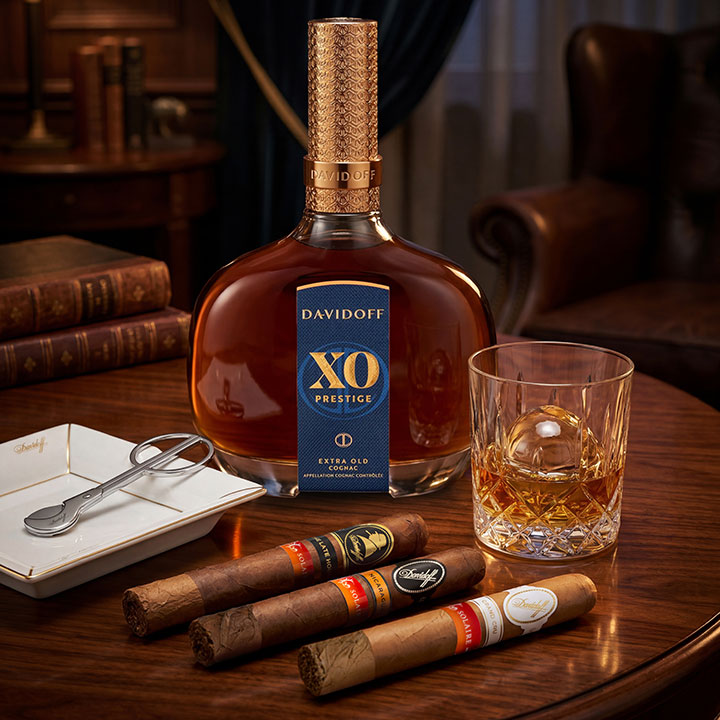
DAVIDOFF’S Solaire Uncut Robusto Colección and Cognac

One night with a ‘secret society’

PREVIOUSLY we had gone on a visit to Solaire Resort Entertainment City’s BRB bar, which proudly features a Prohibition Era-theme, complete with cocktails named ironically for pro-Prohibition figures. On March 12, we leaned into the idea of “vice” for an hour or so with a tasting of a line of cigars named for Solaire, and bourbon whiskeys from Westward; one of the events of the Leaf & Barrel Society.

The line of cigars, the Solaire Uncut Robusto Colección, comes from Davidoff. Davidoff Uncut Cigars stand apart for their distinctive unfinished foot, allowing aficionados to experience the cigar’s filler tobacco in its purest form before the wrapper gradually comes into play. The Solaire Uncut Colección includes the Grand Cru Robusto, Nicaragua Robusto, and Winston Churchill Late Hour.

“It takes six to seven years of aging before the releasing [of the cigars],” said Daniel Blais, director of beverage for Solaire properties, in a speech. “There are only seven places in the world (that) have these cigars.”

We had a go at the Winston Churchill, which costs P3,900 apiece (the Grand Cru is P2,900, the Nicaragua Robusto is P3,300; all of them are offered in boxes of three, six, and 12). We had previously learned not to inhale when enjoying a cigar, but we haven’t quite figured out the complexities of cutting the tip and lighting it yet, so it was a relief that attendants were going around and doing that for us with a special cutting tool and a torch (our attendant also made the cigar choice for us). The Churchill — named after the cigar-chomping British prime minister — had notes of cedarwood, spices, and leather (and a little bit of cocoa; thanks, attendant, for the information).

As for the evening’s whiskey pairing, we were introduced to American distillery Westward Whiskey, its operations centered in Portland, Oregon, in the Pacific Northwest. We had a go through several tasting glasses of whiskey, and here we are listing what impressions we had after that.

The Westward ASM 45% was almost like rum in its sweetness, while the Westward ASM Pinot Noir Cask 45%, arguably the most sophisticated in the bunch, had a note of dark candied fruit (like plums). The Stout Cask 46% had a bit of a rye bread flavor, and a surprising breakfast note that reminded us of Milo. The Cask Strength 63% was sweet and spicy, with some notes of ginger — but boy, what heat! The heat, though, proved necessary, because the sweet notes in this whiskey would have made it seem like I was drinking syrup. Finally, the James E. Pepper 1776 Bourbon Barrel Proof Decanted 53% had a deeply woody scent, a very Southern scent, in fact, almost like I was in Louisiana — it helps define the American whiskey as a genre with sweetness, wood, and heat all in 30 ml.

This is the way of life for the Leaf & Barrel Society, which Solaire created in August last year.

Membership is free, and you can become a member by attending an event. These pairings and tastings are held every two weeks, and an event costs about P3,900, with a tasting selection of five whiskies, and Mr. Blais joking that he’ll light the cigar for you.

It is a way to show off their vast collections: Mr. Blais said that they have the largest selection of whiskies and Cuban cigars in the country (thanks to Cold War-era embargoes, not to mention recent natural disasters that destroyed up to 30% of the plantations, the cigars are now harder to get than ever).

Their whiskies number about 400, with Mr. Blais saying that they have some rare ones, a testament to quality, not just quantity. For example, the Macallan 50 only has 400 bottles in the world (and they have it). Another selection from the same distillery only has 72 bottles in the world — and they have three bottles.

As for their cigars, they have between 120 and 150 varieties.

“It’s about education, so we learn. But it’s also not a masterclass. It is to learn, to drink, to smoke, and have a good time,” said Mr. Blais. — Joseph L. Garcia

FAST urges co-loading to cut logistics costs amid fuel pressures

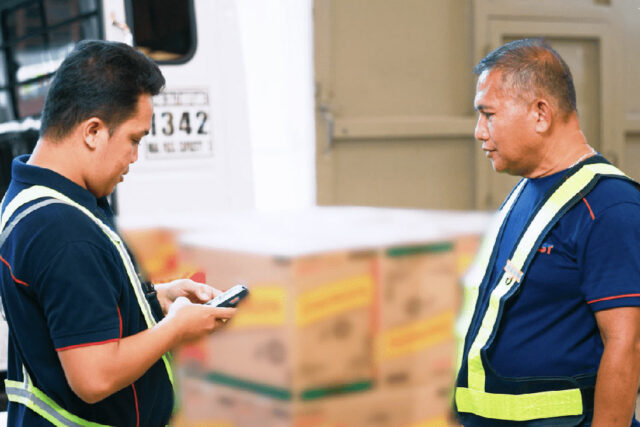
FAST said a co-loading model can increase vehicle utilization, reduce empty miles, and lower fuel consumption. — BLOG.FAST.COM.PH

THE FAST-MOVING consumer goods (FMCG) industry should consider adopting co-loading delivery models to manage transport costs amid fuel price shocks, according to FAST Logistics Group.

In a statement on Wednesday, FAST Chief Executive Officer for Logistics Manuel L. Onrejas, Jr. said companies should look into co-loading as a practical approach amid oil price increases driven by conflicts in the Middle East.

“Every direct-to-store delivery should create value, not waste,” he said.

FAST made the recommendation during a meeting with the Department of Trade and Industry and leading FMCG companies and retailers on March 17.

Co-loading is a logistics strategy that consolidates cargo from multiple shippers into a single vehicle.

“Instead of paying for a dedicated vehicle, FMCG companies pay only for the space occupied by their goods in the co-loading model,” FAST said.

FAST said inefficiencies in transport and direct-to-store deliveries, combined with rising fuel costs, could push up the prices of goods.

“Higher oil prices, driven by global conflict, should push companies to rethink traditional direct-to-store delivery systems, which often result in underutilized trucks, long queuing time, and higher fuel consumption,” it said.

According to the company, a co-loading model can increase vehicle utilization, reduce empty miles, and lower fuel consumption.

FAST also said many FMCG companies deliver goods to retail stores using Asian utility vehicles, which cost 61% more than using larger six-wheeler trucks.

Company data showed that about 56% of trucks delivering FMCG goods to retail distribution units (RDUs), or receiving bays, operate at low utilization rates of 32% to 40%.

This results in long queues at receiving bays, particularly in supermarkets, shopping centers, groceries, and other modern trade outlets.

The company cited its Flow by FAST solution, where products from multiple FMCG companies are sorted and consolidated in its regional facilities before being delivered to retail outlets based on schedule.

“Stronger retailer collaboration would also help reduce congestion at receiving areas and maximize the efficiency gains from co-loading across the supply chain,” FAST said. — Beatriz Marie D. Cruz

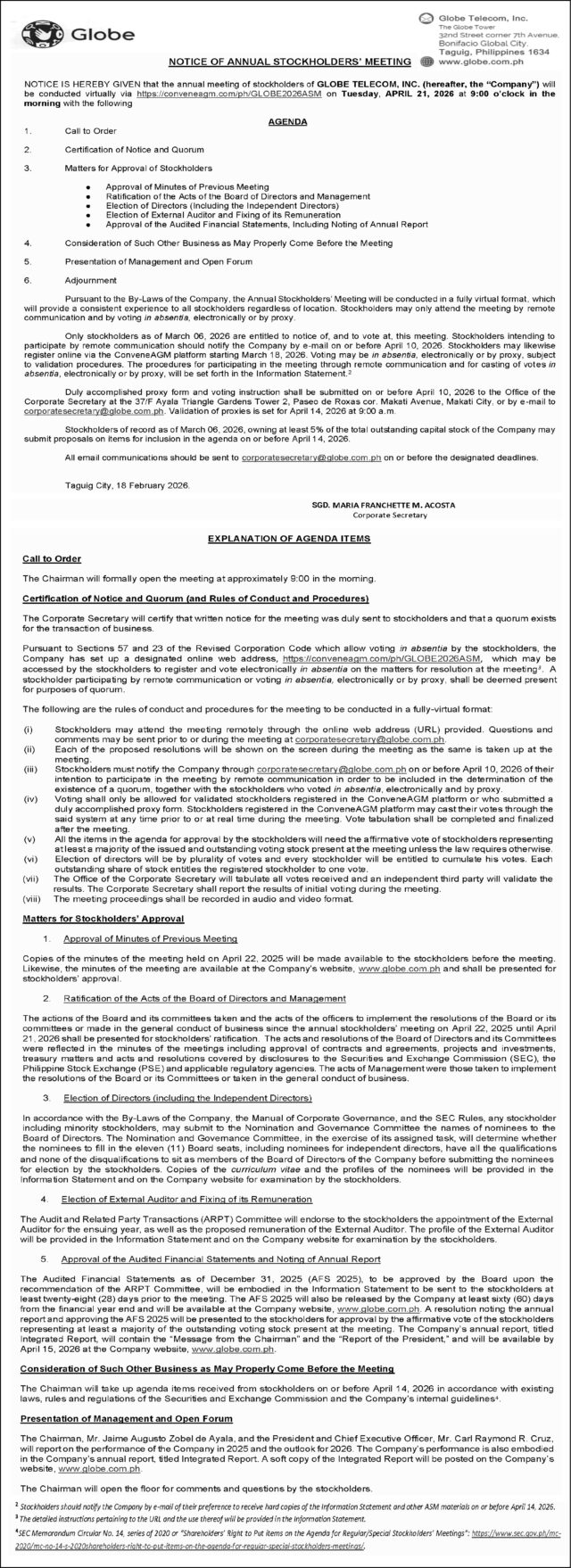
Globe Telecom, Inc. to hold 2025 Annual Meeting of Stockholders virtually on April 21


Spotlight is BusinessWorld’s sponsored section that allows advertisers to amplify their brand and connect with BusinessWorld’s audience by publishing their stories on the BusinessWorld Web site. For more information, send an email to online@bworldonline.com.

Join us on Viber at https://bit.ly/3hv6bLA to get more updates and subscribe to BusinessWorld’s titles and get exclusive content through www.bworld-x.com.

AIA: Filipinos taking charge of finances and health

FREEPIK

AIA PHILIPPINES Life and General Insurance Co., Inc. is seeing a shift in Filipinos toward more proactive financial and health planning, driven largely by family values and a desire to prepare for crises.

A recent survey of 872 Filipino respondents found 83% are more proactive about health after experiencing crises, signaling a move away from the traditional bahala na (come what may) mindset toward a handa na (prepared) approach.

“Filipinos are taking steps to be more proactive about health, to stay healthy and financially independent longer, so that they can be secure and confident through the rest of their lives,” AIA Philippines Chief Marketing Officer Melissa Henson told a news briefing on Wednesday.

She noted that family remains a central influence across generations.

The survey suggests increased awareness could translate into higher insurance demand, with 42% indicating they are likely to buy insurance products within the next 12 months.

More than half of the respondents see the future as tangible and worth preparing for, while 47% remain proactive despite having a safety net such as a health maintenance organization (HMO) plan.

Most respondents reject the bahala na mindset, disagreeing with statements like “I feel fine today, so why plan ahead?” (53%), “It’s hard to invest in benefits I can claim years away” (42%), and “I’ll just wing it when stress hits” (60%).

Filipinos also show growing confidence in managing finances and health. About 56% agree financial planning can be simpler than it seems, 54% find health advice easy to understand, and 53% remain confident even when guidance is complex. Survey results showed 77% prefer customized insurance plans, 56% are setting aside money for the future, 70% are taking charge of physical health, and 71% are planning for mental well-being.

However, some respondents still prioritize the present, with 57% focusing on immediate mental wellness and 59% rewarding themselves with short-term gratification.

Family continues to shape attitudes and behavior. Sixty-two percent said family influences their overall health attitudes and choices, 63% cited family as a motivator for taking care of health, and 59% said spending habits mirror their household.

Seventy-one percent noted family relationships affect mental well-being, and 56% said daily health decisions are guided by family.

The study also found 45% report that supporting their family affects their mental health, while 43% sacrifice personal financial goals for family needs, underscoring the enduring role of family in Filipino financial and health planning decisions. — Aaron Michael C. Sy

The doctor in the box

STOCK PHOTO | Image by Drazen Zigic from Freepik

Imagine a nurse in a rural health unit in some far-flung province. She has a basic X-ray machine, a basic smartphone, no internet access, and a patient in front of her with a cough that has not gone away in three months. The nearest radiologist is four hours away. The nearest specialist is in Manila.

That gap between the patient who needs a diagnosis and the specialist who can give one is a key concern of our public healthcare system. The Universal Health Care Act of 2019 gave us the legal basis to fix it. What we have not yet done is reach for the tools that could actually address the concern.

One of those tools arrived quietly last year as the result of research by the US National Institutes of Health, through its National Institute of Biomedical Imaging and Bioengineering.

The tool is called Merlin, aptly named after the legendary, powerful wizard and prophet in Arthurian mythology.

A doctor can feed Merlin a 3D scan of a patients body and Merlin reads that scan the way an experienced radiologist would, looking for signs of disease across hundreds of conditions at once. This is what makes Merlin unique as an Artificial Intelligence (AI) tool for medical science.

Older medical AI programs were narrow: one program for tuberculosis, a separate one for lung tumors, another for broken bones. If a patient had all three problems, the doctor had to run three separate programs. Merlin looks at everything in a single pass, predicts five-year health risks with 75% accuracy, and flags the most urgent cases first — strokes, tumors, and blocked arteries.

Merlin learned to do this by studying 1.3 million scans alongside the written reports that radiologists made about those scans. Over time, it learned to connect what a scan looks like with what a doctor would say about it. A clinician can now ask it a question in plain language, and it will look, even for things it was never specifically programmed to find.

For a well-equipped hospital in an urban center like Makati City, this is a useful upgrade. But for the rest of the country, where there are not enough specialists and where internet connections outside cities are unreliable, it is something bigger. It is a chance to improve diagnostic capability.

This is already happening in other countries with similar challenges. In India, for instance, a company has deployed AI software on ordinary smartphones and low-cost devices to screen chest X-rays for tuberculosis and other conditions like pneumonia, operating offline without internet.

Available information indicate that the AI runs locally on small devices or phones at clinics, giving rapid imaging analysis without distant servers, and providing specialist-level opinions on medical images regardless of connectivity, like a compact diagnostic expert.

In China, various AI-assisted systems have also been deployed in rural clinics to enhance diagnostics, and provide offline diagnosis recommendations, similar case retrieval, and medical info lookups without internet. Other initiatives include smart village doctor systems with AI for exams like blood pressure and glucose, plus tools using data for prescription references.

And in Nigeria and Uganda, AI tools reportedly enable faster TB and fracture diagnosis in remote areas with minimal prior support, processing images offline on local devices or phones. These act as compact, on-site “diagnostic experts” independent of servers or connectivity.

In all these situations, the AI does not live in a distant server somewhere. It lives in a small box on-site, doing its job whether or not the internet is working. The “doctor” is a “jack in the box,” offering informed opinions on medical imaging data provided by the rural health unit or the patient.

This is the model the Philippines needs to follow. And the law we already have, the Universal Health Care Act, gives us the legal foundation to do it. One section of that law requires hospitals and clinics to use compatible digital health records, the data AI needs to work properly. Another section of the law created a government body responsible for approving new medical tools for public use. The pieces are in place. What is missing is the connection between them.

The approval process for new medical tools is currently designed for physical equipment like an X-ray machine, or a blood pressure monitor. AI is different. It improves as it processes more data. A tool approved today will be more capable in two years. What we need is an approval process that accounts for that.

We should also settle the issue of legal responsibility. If an AI tool clears a scan as healthy, the doctor agrees, and the patient later turns out to be seriously ill, who is at fault? The Department of Health needs to formally recognize AI as a support tool, something that helps the doctor but does not replace the doctor’s judgment. The doctor makes the final call. The law needs to say that clearly. Without that protection, most doctors will simply refuse to use AI tools, and no one can blame them.

Also, a tool like Merlin was trained mostly on scans from patients in Western countries. A 70-year-old Filipino patient has a different medical history from the American patients whose scans shaped Merlin’s training. Different childhood diseases, different diet, different baseline health conditions, etc.

A tool that reads scans accurately in the US may miss things here in the Philippines. So, before any foreign AI tool is used widely here, it must be tested and adjusted using a representative sample of Filipino patients. This is not red tape. This is basic patient safety.

Moreover, clinics will not adopt new technology if it only adds to their costs. PhilHealth can change that by paying clinics more when they use AI to catch tuberculosis and other diseases early. In short, the government should turn a public health goal into a financial incentive.

None of this has to happen all at once. It can start small: AI on smartphones in rural health units, the way India began. It can grow to regional centers with better equipment. It can eventually connect to a national system with full predictive capability. But the groundwork has to be laid now, in law, in regulation, and in budget.

The Universal Health Care Act gave every Filipino the right to health. Merlin, and AI tools like it, give the government the means to deliver on that promise without waiting for enough specialists to be trained and posted to every far-flung clinic in the country. We should start digitizing healthcare and make it real.


Marvin Tort is a former managing editor of BusinessWorld, and a former chairman of the Philippine Press Council.

matort@yahoo.com

Vinexpo Paris overtakes ProWein as world’s largest trade show

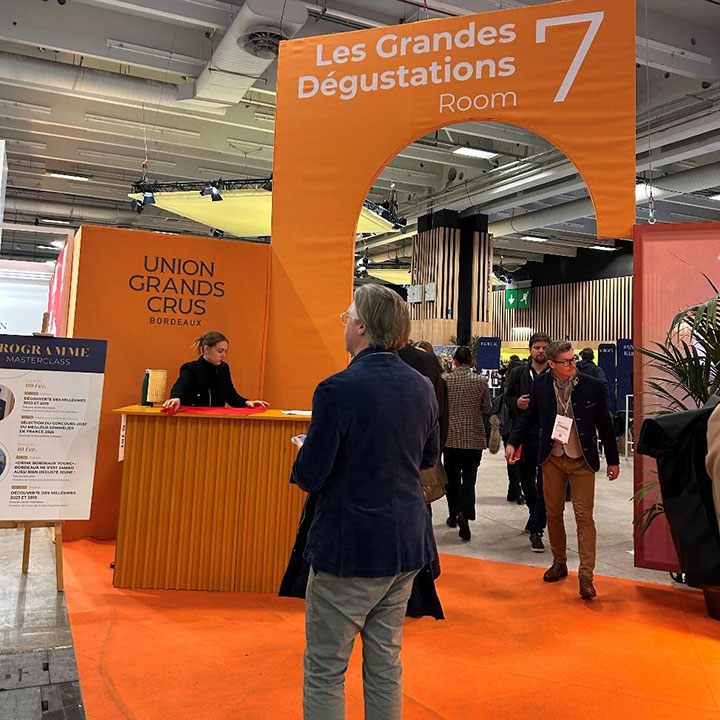
THE Union des Grands Crus de Bordeaux tasting corner, featuring the 2023 vintage. — SHERWIN A. LAO

PARIS, France — For decades, ProWein in Düsseldorf held the uncontested title as the world’s most influential international wine trade fair. But in 2025, a decisive shift occurred — one that industry insiders had been whispering about for years and are now openly acknowledging: Vinexpo Paris has overtaken ProWein as the premier global wine business event. And this recently concluded Vinexpo Paris just cemented this fact decisively.

VINEXPO PARIS 2026’S NUMBERS
The official numbers from Vinexpo Paris: 63,541 trade visitors from 169 countries, 51% of whom were international (up 20.75%), and 6,537 exhibitors from 63 countries (up 20%). I was among the record-breaking number of visitors and part of the 51% who were international or non-French.

Meanwhile, at its peak, ProWein received around 61,500 trade visitors, and that was way back in 2019, before the world experience the COVID-19 pandemic. While the ProWein Düsseldorf 2026 numbers are not out because it was still ongoing as I was writing this column (it ran from March 13 to 15), it is quite safe to assume they will not be higher than those recorded by Vinexpo Paris.

Last year, ProWein welcomed only around 42,000 visitors, a 10.6% decline from their 2024 numbers. That same year, Vinexpo Paris saw over 52,600 visitors.

HISTORY AND ASIAN EXPANSION
The first Vinexpo took place in Bordeaux, France on June 22 to 26, 1981. That fair was considered a success at that time, with 11,000 trade visitors and 500 exhibitors. It was also the first international wine and spirits exhibition of its kind, designed to connect producers, distributors, and buyers on a global scale. Bordeaux was chosen as the host city because of its reputation as the wine capital of the world.

On the other hand, the very first ProWein was held in Düsseldorf, Germany, on Feb. 23 to 24, 1994. It was originally called ProVins and featured 321 exhibitors, and it attracted many visitors from parts of Europe and beyond. By 2019, 25 years after it started, attendance peaked at 61,500 visitors with over 6,800 exhibitors. These 6,800 exhibitors still remain the number to beat to-date, as even this year’s Vinexpo Paris did not exceed this number of exhibitors.

I attended my first ProWein in 2008, and it was before the Vinexpo Paris fair, and it was by far the largest wine event I had been part of back then.

Both event organizations have done well in their expansion, with Vinexpo adding Asia via the launching of Vinexpo Asia-Pacific in Hong Kong in 1998. More recently, in 2023, it was made into an annual event alternating between Hong Kong and Singapore. Just last year, they launched Vinexpo America in Miami, Florida, USA.

ProWein, on the other hand, held their first wine fair outside of Düsseldorf in Asia, in Hong Kong in 2013. In 2014, there was ProWein China, held in Shanghai. This was followed in 2018 by ProWein Southeast Asia, held in Singapore; in 2024, ProWein Japan, held in Tokyo; and this year a ProWein in multiple Asian cities is on its way.

The competition is fierce, and Asia offers the biggest opportunities for wine development and consumption in the world.

I have attended several Vinexpo Asia-Pacific, including the ones held in Tokyo, Hong Kong, and, more recently, Singapore, but I have yet to attend a single ProWein outside of Düsseldorf, Germany.

HOW PROWEIN DEVELOPED
ProWein was most successful in the 2000s and 2010s, partly because many wine producing countries felt it was a more neutral ground for international wine exhibitors. First of all, Germany is not as large of a wine-producing country as France. Germany always ranks in the lower end of the Top 10 producers, either in the 8th or 9th position, and produces only 1/5 of what France does. For wine exhibitors, they feel that trade visitors are traveling to Düsseldorf not so much for German wines, but more for other global wine producers.

Also, controversy struck Vinexpo Bordeaux in 2003, when the majority of the Australian wine producers, including several big names, boycotted that year’s Vinexpo due to what the Australians felt were unfair treatment of exhibitors. This included complaints on poor location and dissatisfaction with service.

Then in 2007, Vinexpo Bordeaux organizers had another major crisis when New Zealand totally withdrew from the fair, the Americans substantially reduced their presence, Wines of South Africa withdrew its sponsorship, and the Italian Trade Agency (the government agency that promotes Italian exports) stopped its support of Vinexpo due to space allocation issues.

The 2003 Australian boycott and the bigger 2007 fallout were often cited as a turning point in Vinexpo’s history. This also marked the beginning of a shift in global wine trade show dominance, with ProWein steadily rising and eventually surpassing Vinexpo in scale (until recently).

WINE PARIS, VINEXPO MERGER
Wine Paris began in 2019 as a merger of two French wine fairs — Vinovision Paris, which showcased cool‑climate wines, and Vinisud, which focused on Mediterranean producers. The idea was to consolidate France’s fragmented wine exhibitions into one major international event in Paris, making it more accessible to global buyers and competitive against ProWein Düsseldorf. The initial edition drew about 26,700 visitors and 2,000 exhibitors, immediately positioning Paris as a serious contender in the trade show landscape.

That same year, Vinexpo Bordeaux held its last fair, from June 13-16. The show had a decent showing, but clearly ProWein was still ahead, and, in fact, ProWein had its best performing year that 2019.

So the next year, in 2020, Wine Paris merged with Vinexpo to create Vinexpo Paris, combining Wine Paris’ domestic strength with Vinexpo’s international prestige. In just six years, Wine Paris evolved from a national consolidation project into the world’s leading wine trade show, surpassing ProWein in both visitor and exhibitor numbers. Its rapid rise reflects not only Paris’ strategic advantages as a preferred international location for trade professionals, but also the industry’s shift toward a more globally connected, dynamic hub for wine commerce. Paris has now firmly established itself as the new epicenter of the wine trade.

But like any competition, I expect ProWein to do something in return. We just must wait and see!


Sherwin A. Lao is the first Filipino wine writer member of both the Bordeaux-based Federation Internationale des Journalists et Ecrivains du Vin et des Spiritueux (FIJEV) and the UK-based Circle of Wine Writers (CWW). For comments, inquiries, wine event coverage, wine consultancy and other wine-related concerns, e-mail the author at wineprotege@gmail.com, or check his wine training website https://thewinetrainingcamp.wordpress.com/services/. Also check out his YouTube channel, www.youtube.com/@winecrazy.


Yuchengco-led BKS energizes P1.8-B solar farm in Isabela

STOCK PHOTO | Image by jcomp from Freepik

YUCHENGCO-LED BKS Green Energy Corp. said it expects to supply electricity to around 33,000 households annually after energizing a 40-megawatt (MW) solar farm in San Pablo, Isabela.

In a statement on Wednesday, BKS Green said it has switched on its first renewable energy project in the Cagayan Valley, which can generate about 59 gigawatt-hours of clean energy per year.

The P1.8-billion solar power plant uses 52,640 solar photovoltaic panels supplied by Chinese manufacturer Trina Solar.

The project was developed in two phases: a 6-MW Phase 1, which is connected to the Isabela Electric Cooperative II system, and a 34-MW Phase 2, which will connect to the National Grid Corp. of the Philippines’ 69-kilovolt Tuguegarao-Cabagan line through a dedicated transmission line.

BKS Green is a subsidiary of Rizal Green Energy Corp., a joint venture between PetroGreen Energy Corp. and Japan’s Taisei Corp. PetroGreen is the renewable energy arm of listed PetroEnergy Resources Corp.

“The current Middle East conflict highlights once more the absolute necessity of securing our country’s energy supply and reducing our dependence on imported energy sources,” PetroGreen President and Chief Executive Officer Francisco G. Delfin, Jr. said.

The Department of Energy has certified the solar power project as an energy project of national significance due to its contribution to economic growth.

PetroGreen currently operates four utility-scale solar projects across Tarlac, Bohol, and Nueva Ecija. — Sheldeen Joy Talavera

SSS rolls out MySSS Card with EastWest Rural Bank

PHILSTAR FILE PHOTO

THE SOCIAL SECURITY SYSTEM (SSS) has partnered with East West Rural Bank, Inc. to expand the MySSS Card to underserved areas.

SSS President Robert Joseph M. de Claro and EastWest Rural Bank President Shiela Marasigan-Bajado signed a memorandum of agreement authorizing the bank to issue the card, which serves as both an official SSS ID and debit card, mainly for rural members while remaining accessible nationwide.

“The MySSS card also allows SSS to provide digital payment facilities for our registrants, members, pensioners and beneficiaries,” Mr. de Claro said in a statement on Wednesday.

The state pension fund uses the national ID database to verify membership and issues cards via partner banks, with benefits disbursed through linked accounts.

Ms. Bajado said the application process would be available at EastWest Rural Bank’s 112 branches and branch-lites nationwide this year, most of which are in Mindanao and the Visayas, and may also be offered digitally at cross-selling desks at EastWest Bank branches.

Cardholders will have waived maintaining balance requirements and can earn interest once balances reach P500, she added.

Launched in October 2025, the MySSS Card replaces the unified multi-purpose identification card and functions as a digital banking tool. — Aaron Michael C. Sy

On rising government bond rates, US public debt and war

Positive economic news is hard to find these days. Nonetheless I consider these reports in BusinessWorld as positive news, all published on March 17: “Slightly positive business sentiment signals ‘cautious optimism’ in the Philippines,” “House approves bill allowing Marcos to suspend or cut excise tax on fuel,” “Senate approves bill authorizing President to temporarily reduce or freeze fuel excise,” and “PHL in talks with China to obtain more fertilizer.”

I believe that the government should cut the various oil taxes under the Tax Reform for Acceleration and Inclusion (TRAIN) Act of 2017 (RA 10963), implemented in 2018-2020, which made the tax on diesel go from zero to P6/liter, gasoline from P4 to P10/liter, LPG from zero to P3/kilo, and so on.

Sure, revenue will decline slightly, but government has windfall revenues from higher VAT collection on oil products — while the VAT on P60/liter diesel will garner it P6.60/liter, VAT on P90/liter diesel will give the government P10.80/liter. That will help compensate for the temporary removal of the diesel excise tax of P6/liter.

Another measure is to have spending cuts on certain sectors and agencies, like climate and war-mongering agencies and departments.

Other sectors in the Philippines oppose an oil tax cut and prefer creating or expanding subsidies for public transportation. I do not support this because it creates sectoral favoritism. Tractors, harvesters, irrigation pumps, trucks, fishing boats, and other agri-fishery machinery also need subsidies and the government will ignore them under the current transportation subsidy scheme. If the government should subsidize, it should subsidize all or none at all. An oil tax cut coupled with a spending and subsidy cut somewhere is still the easiest to administer, and would be most fair to all.

With these moves for either higher spending or cutting taxes, the yields on Philippine 10-year government bonds have spiked, from 5.92% on Feb. 27 (the day before Israel and the US attacked Iran) to 6.73% on March 17 — a 13.7% jump. Thailand has seen a higher expansion of 27% as it plans a huge oil subsidy via its Oil Fuel Fund. In Europe, the largest increase in 10-year bonds was that of Switzerland, from 0.20% to 0.33% yield (see Table 1).

Our outstanding public debt in 2025 was P18.05 trillion. Even if we do not borrow more in 2026, at a 6.7% average interest rate our public debt will rise to P19.26 trillion by end-2026 — the P1.21 trillion increase represents interest payment alone.

Hence, the need to confront the bloated spending problem. Tax revenues keep rising, but any gain or increase is quickly dissipated by increases in public spending. The various agencies, bureaucracies, and legislators have very fertile imaginations when it comes to expanding spending. We also need to do large-scale privatization of some government assets and corporations, like the Agus-Pulangi hydro plants in Mindanao.

We also need to embrace hydrocarbons and fossil fuels, not demonize them. We should encourage more exploration and development of indigenous oil, gas, and coal, and stop these “net zero” and “decarbonization” moves. The global energy transition now is from Middle East fossil fuels to fossil fuels from Russia, North America, Indonesia, etc.

Meanwhile, the US under President Donald Trump has gone crazy, embroiled in various wars, both actual and in preparation for. They have had a proxy war against Russia in Ukraine for more than four years now. They are engaged in a Middle East-wide war against Iran, and they are preparing for war against China over Taiwan and the South China Sea.

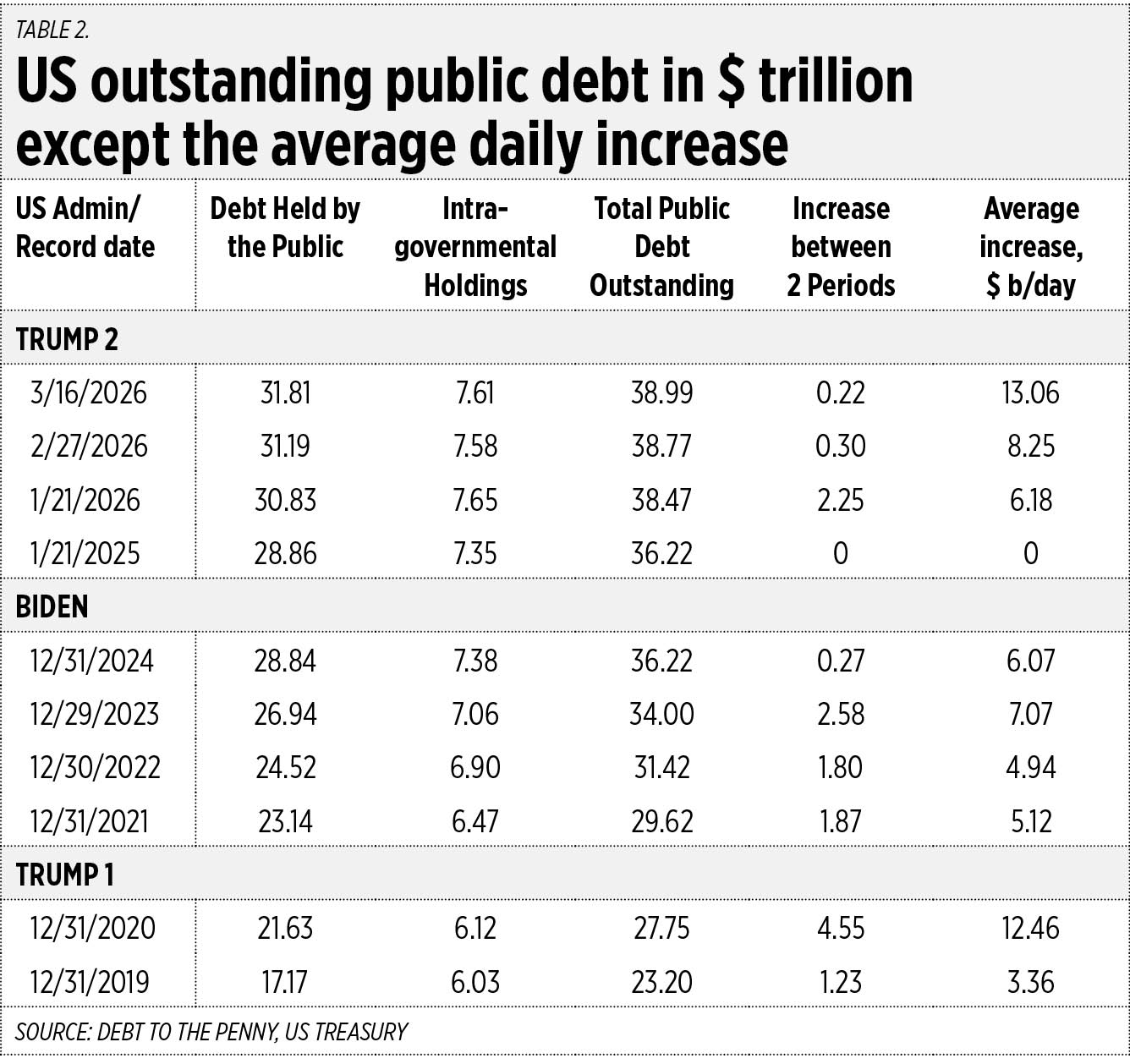
Wars are never cheap, they are costly, both in public finance, people’s lives, and property damage. I checked the numbers of US public debt — it is getting worse.

During the four years of the Biden administration, US public debt was rising by $2.12 trillion/year, or an average of $5.8 billion/day. During Trump’s first year, the debt increased by $2.25 trillion or $6.2 billion/day.

During war preparations against Iran, from Jan. 21 to Feb. 27, US debt was rising by $8.2 billion/day. Since the war started, debt has been rising by $13.1 billion/day. So, estimates of $1 billion/day spent on the Iran war alone may be understated (see Table 2).

Ending the current big war in the Middle East is the logical thing to do. But the US-Israel tandem is already embroiled, and Iran is already heavily damaged and will seek prolonged revenge. Then there has been some damage to seven Middle East countries that host US military bases or facilities.

The Philippines, as Chair of the ASEAN in 2026, should play a major role in pursuing peace and prosperity, at least in East Asia. It should focus more on trade and commerce, investments and tourism, and not war mongering. Peace and prosperity, not war and destruction.


Bienvenido S. Oplas, Jr. is the president of Bienvenido S. Oplas, Jr. Research Consultancy Services, and Minimal Government Thinkers. He is an international fellow of the Tholos Foundation.

minimalgovernment@gmail.com

Using traditional ingredients in modern ways

SCREEN GRAB from Seaweed Harvesters Risk Their Lives in the Philippines (Gamet) from FEATR’s YouTube channel. — YOUTUBE.COM/@FEATRMEDIA

HOW CAN ONE use traditional Filipino ingredients when following a modern lifestyle? That was a topic tackled by James Beard awardee Erwan Heussaff* and the team behind his digital video channel in a talk at the Maya Kitchen on March 14 called “The Not-So-Modern Filipino Pantry.”

In line with FEATR’s work, which features the creation and procurement of obscure Filipino ingredients and how to use them in the kitchen, they told a story using ingredients they had made already documentaries about: gamet, podpod, and pakaskas, among others.

These came in a small market bag thoughtfully provided by Featr so guests at the talk could see, feel, and taste these ingredients — and also featured some of them in a buffet lunch later in the day.

“Filipino food begins with geography,” Mr. Heussaff said, and they conveniently provided a brochure with a map showing how far-flung these ingredients can seem from the capital. Not only do the ingredients show the different flavors one can have on a Filipino plate, but the sheer diversity of ways of living in the Philippines.

For example, there’s gamet from Ilocos Norte and Cagayan Valley. Showing clips from their documentary, Mr. Heussaff explained that it is a local species of seaweed, and quite rare — it costs about P1,000 for one square foot, giving it the name “black gold.” There isn’t much gamet to go around in the country because of the sheer difficulty of collecting it: the seaweed is collected as it is thrown closer to shore by huge waves.

Pakaskas, meanwhile, is a sweetener that comes from the buri palm (the same one whose leaves are used for hats), and typically made in Isla Verde in Batangas. Podpod, meanwhile, is a smoked fish patty made in San Vicente in Eastern Samar. It is a labor-intensive process. The fish is cooked with rice, simmered in vinegar, deboned, skinned, crushed, seasoned, pressed into molds, then smoked over coconut husks.

“If you put the pressure on having to serve Filipino ingredients in traditional ways, the spectrum is too small (in) what you’re allowed and not allowed to do,” said Mr. Heussaff. That is why they used these ingredients in myriad of ways during the lunch: they used a kiping (a thin rice wafer best known for its use in decorations in Lucban, Quezon’s fiesta) as a chip to dip into an aioli that used gamet (coloring it purple), and used the podpod to flavor roasted cabbage.

“Filipino food is not just Filipino recipes. It’s also Filipino ingredients used in international recipes. Representation happens on so many different fronts. It’s really about building that ecosystem of representation,” he said.

“A lot of things can be true at the same time. You can enjoy eating Chickenjoy next to podpod. You don’t have to be one or the other. I think if you become a little too purist with your food and your ingredients, you also run the risk of being elitist, and also the food not moving forward, because it’s so difficult [to make].

“I always tell people: be flexible on how you eat. Be flexible in how you think about Filipino food,” he said. “You don’t want food to become pieces in a museum,” he added. “Food is an artifact of culture: but at the same time, it’s continuously evolving.”

Despite the laxity this philosophy provides, Mr. Heussaff still recommends further exploration. “I recommend everyone to go home today, look in your pantry, and then try to understand the geography of that pantry.

“If it only comes from one area; one supermarket: question it.” — Joseph L. Garcia

*Erwan Heussaff won in the Social Media Category of the James Beard Broadcast Media Awards in 2023.

ADVERTISEMENT
ADVERTISEMENT