Home Blog Page 1453

Extra olive joy

CHEF Robby Goco strikes gold again with more praise for Greek cuisine —  we’d say “paean” but that’s a little bit on the nose — with his new restaurant, Elaia by Cyma.

Opening just last December, the restaurant’s name comes from the Greek for “olive.” The Greeks value the plant a great deal — in a legend, Athens took its name and patronage in a contest between Poseidon, the God of the Sea, and Athena, the Goddess of Knowledge and War. Poseidon gave the city the horse; Athena, the olive. The Greeks valued the olive more, and to this day, the capital bears the name of the contest’s winner, long after the gods lost their significance.

Guests were taken to the restaurant, which is located in Silang, Cavite, just a little bit off tourist hotspot Tagaytay, on Feb. 6. Tables groaned under the sheer amount of food.

We’ll say the pita and the tzatsiki were quite mild, and the Eggplant melitzo (all of these were presented as dips for the pita bread) was smoky and vivid. There was a dish of roasted shrimp, tomatoes, and feta called Garides Saganaki, with a definite taste and feel of something carefully stewed for a long time. Mr. Goco served a panzanella, a Greek bread salad with crisp bread and a very vibrant and forward tomato flavor. We liked the Kreatopita beef pie, so oddly comforting and familiar.

We entered serious territory with an octopus stew, braised for eight hours in red wine. It was so tender it broke apart with a flick of the tongue on the palate. A pompano was hot off the grill, and was very clean-tasting, but a winner from the main courses was the Pork Belly, cooked almost like it was Filipino. Marinated in coriander root, limes, and paprika that penetrated all the way to the center, it was smoky-sweet and tasted like a seaside meal.

The Roasted Lamb also impressed us, with meat so tender it could be sliced with a spoon (to be fair, not a novelty for a Filipino).

While we complained we had no room for dessert, we still managed to finish a slice of Sokolatopita —  Greek chocolate cake with brown butter buttercream and salted caramel.

Mr. Goco professes that he has lost weight despite this amount of feasting. Describing the difference between his previous Greek-style ventures, the popular chains Cyma and Souv, he describes Cyma as someone from the city, Souv as its eccentric sibling, and Elaia as their traditionalist grandmother.

“This one really promotes longevity,” he told BusinessWorld in an interview. “We really made it a point that everybody here will be having their proteins, with very, very healthy vegetables.” He added, “Everything’s cooked in extra virgin olive oil. No more seed oils.”

Some cooking guides are against the practice, singling out extra virgin olive oil’s low smoke point (which means the oil burns out and breaks down, which opens the possibility of the release of harmful compounds; not to mention the taste). He says, “It doesn’t change the oil. Yeah, sure, you’re going to see it’s smoking, but it stays longer, and it doesn’t go bad. Unlike others, wherein after the high smoke point, wala na (it’s gone), it turns rancid. Olive oil, it maintains its integrity.”

To his point, nothing we tasted was off, and we don’t know how he does it, but some dishes even tasted like they had butter in it (zero; we couldn’t believe it wasn’t butter).

Bustling Tagaytay has attracted more than its fair share of tourists and moving further away from the lake (or the Ridge) has become a solution for restaurateurs to take advantage of the location without the hassle. “It’s very calming,” he said about opening in Silang. “Once you get to the Ridge, it’s stressful.”

The location also provides a locus for supplies, thanks to the great agricultural scene: “This can service our restaurants in Manila. This is going to be the drop-off point for all the vegetables,” he said.

À LA GRECQUE (SALAD AND A WAY OF LIFE)
Mr. Goco first opened Cyma in 2000, after studying Greek cuisine in Greece, and noting the dearth of proper Greek restaurants in the Philippines. It’s still standing, and even thriving. He lines out reasons why the two cuisines meld so well — for example, both are archipelagos (the name for island groups comes from the Greeks). “Both rely heavily on the sea for sustenance. Very similar.”

Frequent visits to Greece must have rubbed off on him, and may have changed him à la grecque (“in the Greek manner,” but also a way of dressing food in olive oil and lemon juice), we said. Not so much: there’s very little to modify between Greek and Filipino behaviors, apparently. “It’s very similar to the Filipino,” he said.

“They’re very expressive with their feelings. They talk loud(ly), right? The weather is almost like the Philippines. They’re very proud of their culture.”

Elaia by Cyma is on Buenavista Ave., Bucal, Silang, Cavite. It is open daily, from 11 a.m. to 8 p.m. on Mondays to Thursdays, and 11 a.m. to 9 p.m. on Friday to Sunday.  For reservations, contact 0917-163-7287. — Joseph L. Garcia

Term deposit yields mixed on BSP easing pause

BW FILE PHOTO

YIELDS on the term deposit facility (TDF) ended mixed on Wednesday after the central bank’s surprise decision to keep interest rates steady last week and as the two-week tenor was undersubscribed.

The Bangko Sentral ng Pilipinas’ (BSP) term deposits fetched bids amounting to P203.552 billion on Wednesday, below the P220 billion on the auction block and the P241.191 billion in tenders for the same offer volume a week ago. The central bank awarded P185.038 billion in papers.

Broken down, tenders for the one-week papers reached P119.864 billion, above the P110 billion auctioned off by the central bank and the P111.375 billion in bids for the P120-billion offering seen the previous week. The BSP made a full P110-billion award of the seven-day deposits.

Accepted bid yields ranged from 5.745% to 5.78%, a tad narrower than the 5.74% to 5.785% band seen a week ago. This caused the average rate of the one-week deposits to inch down by 0.16 basis point (bp) to 5.7592% from 5.7608% a week earlier.

Meanwhile, bids for the 14-day term deposits amounted to P83.688 billion, lower than the P110-billion offering and the P129.816 billion in tenders for the P110 billion in papers placed on the auction block a week ago. The BSP awarded just P75.038-billion worth of two-week papers.

Accepted rates for the tenor were from 5.765% to 5.815%, higher than the 5.74% to 5.81% margin seen a week ago. With this, the average rate for the two-week deposits edged up by 0.62 bp to 5.7867% from 5.7805% logged in the prior auction.

The BSP has not auctioned off 28-day term deposits for more than four years to give way to its weekly offerings of securities with the same tenor.

The term deposits and the BSP bills are used by the central bank to mop up excess liquidity in the financial system and to better guide market rates.

TDF yields were mixed following the BSP’s surprise decision to leave benchmark interest rates unchanged at its meeting last week, Rizal Commercial Banking Corp. Chief Economist Michael L. Ricafort said in a Viber message.

The Monetary Board last week unexpectedly held its key interest rates steady in a “prudent” move as global uncertainties cloud the outlook for growth and inflation.

At its first meeting for 2025, the BSP’s policy-setting body left the target reverse repurchase rate unchanged at 5.75%. Rates on the overnight deposit and lending facilities were also kept at 5.25% and 6.25%, respectively.

This was the central bank’s first pause following three consecutive 25-bp cuts since it began its easing cycle in August 2024.

Hints of more reserve requirement ratio (RRR) cuts also affected TDF yield movements, Mr. Ricafort added.

“This could infuse an additional peso liquidity of about P330 billion into the local banking system that could be used by banks to increase loans, investments in bonds, among other assets,” he said.

Mr. Remolona last week said that RRR cuts are still in the pipeline for this year, with the central bank looking to lower big banks’ reserve requirements to 5% from the current 7%.

He said this could be delivered sometime before the Monetary Board’s next policy review on April 3. — Luisa Maria Jacinta C. Jocson

New ways = better outcomes, fingers crossed

IRRI.ORG

(First of two parts)

There is a risk, as one keeps track of the country’s macroeconomic health, of being jaded about agriculture’s consistently dismal performance, a result of decades of policy missteps.

The farm sector’s trajectory has always been sub-par compared to services and industry, even if manufacturing — which makes up about three-fifths of the “industry” sector tracked by the Philippine Statistics Authority — struggles with repercussions of its own past policy blunders. Agriculture, forestry and fisheries (AFF) as a sector contributes an incrementally smaller percentage to national output (as measured by gross domestic product, or GDP) at less than 10% currently — the smallest among the three growth drivers, even as its contribution to overall employment has steadied at around a fourth of the total. “Given the sector’s slow growth and modest share to GDP, and its relatively high contribution to total employment, AFF’s development significantly lagged behind the other sectors as measured by labor productivity (measured by the ratio of the sector’s share to output vis-a-vis employment),” read a paper which Dr. Fermin D. Adriano, formerly Agriculture undersecretary for policy, planning, and research and now columnist for The Manila Times, presented to the Australian National University in October last year.

Hence, agriculture has always been that missing ingredient for faster overall economic expansion — of at least about 8%, according to one of BusinessWorld’s columnists, Dr. Bernardo M. Villegas, compared to the around 6% actually clocked in recent years — that is needed to generate more jobs and economic opportunities that can make a dent on the grinding poverty that has always marred our growth picture. Mr. Villegas has often written on agriculture-related issues for this publication, like the link between farm development and manufacturing (https://tinyurl.com/22u79vpk), the need to upskill agribusiness executives (a three-part series starting with https://tinyurl.com/2bces9ku) and a comprehensive agribusiness situationer (starting with https://tinyurl.com/ynvauzqn), among others.

Which is why farmers always come to mind whenever I hear of technologies’ potential to simplify processes, enhance efficiencies and, thus, increase productivity… and, ultimately, to change lives. Farming communities are also a logical key target for any anti-poverty drive, since much of Philippine poverty is concentrated in rural areas.

One does not need to travel far to realize just how much our farmers have been left behind: just take a trip outside Metro Manila and see if one can spot tractors at work on any farmland. Small farmers, who make up the majority of our agriculture sector, still rely on manual labor and draft animals to get the work done.

And so, any news on new technologies that can help these folks produce more by working more efficiently and, therefore, earn more while hopefully helping to reduce prices of produce, always catches my attention.

Agriculture technology, according to one primer of the US Agriculture department’s National Institute of Food and Agriculture, enables farmers to use just the right amounts of water, fertilizer, and pesticides on specific areas and even individual plants, instead of applying them uniformly across entire fields. This, in turn, increases crop productivity; reduces water, fertilizer, and pesticide use, which in turn keeps a lid on food prices; minimizes impact on natural ecosystems, including chemical runoff into rivers and groundwater; and enhances worker safety.

SEND IN THE DRONES
Take the current initiative to use drones on rice and tobacco fields, for example.

The National Tobacco Administration (NTA) announced in December last year that it had deployed drones at its eight provincial branch offices as well as its Farm Technology and Services Department. The NTA used drones to validate the state of 22,073.09 hectares (ha) in Luzon planted by 36,102 farmers with Virginia, Burley, and Native tobacco types. The office has also begun deploying drones in select areas in Mindanao.

“With the high-resolution aerial imaging and geospatial analysis captured by drones, the area of the tobacco plantations will accurately measure and become the basis for the computation of the volume of production,” the statement quoted NTA Administrator Belinda S. Sanchez as saying.

Meanwhile, Bayer Crop Science demonstrated drone seeding in a rice field in Barangay Sapot in Paniqui, Tarlac in November 2021. The cost of drone seeding was placed at P3,000 per hectare, compared to the labor cost of transplanting rice that ranged from P11,000-P13,000/ha, the company said in a press statement back then. It took just 30 minutes to seed one hectare via drone, compared to half to a whole day if this were done manually. Moreover, this method proved more efficient, with seeding rate averaging 20-25 kilograms of hybrid rice seeds/ha via drone, compared to 40-45 kgs via manual seeding.

Then there is the Drone4Rice project of the International Rice Research Institute (IRRI), done in collaboration with various offices of/attached to the Agriculture department (DA) like the Philippine Rice Research Institute and the Fertilizer and Pesticide Authority (FPA), etc. The project is running for 30 months from April 2024 to September 2026. It will focus on selected organized farms in Cagayan Valley, Calabarzon, and Bicol. Protocols are being drawn up for processes like the accreditation of commercial drone operators that will offer their services. The project aims to cover a total of 150,000 ha per crop season (there are 4.82 million ha planted with palay nationwide). Qualified beneficiaries belonging to irrigators’ associations, small water irrigation system associations, agrarian reform beneficiaries’ organizations, as well as farmers’ cooperatives and associations can tap subsidies amounting to P2,000/ha via vouchers. The National Rice Program has allotted some P300 million for the commercial use of drones for this purpose.

In a press conference in November last year on this project, FPA Officer-in-Charge Glenn DC. Estrada — at that time director for Digitalization and Value Chain Development of the DA’s Masagana Rice Industry Development Program — said that the use of drones is expected to cut farmers’ time, effort, and cost to sow seeds, apply fertilizer, and spray pesticides. “Based on studies, optimal resource allocation leads to better productivity,” he explained.

IRRI said in a statement in April last year that one of the reasons for the huge difference in rice production cost between the Philippines and major rice exporting countries is labor cost, which makes up about a third of the total rice production cost. Noting that mechanization and a shift toward precision agriculture can significantly cut rice production cost, IRRI Senior Scientist Stephen Klassen explained: “Precision agriculture, including the use of drone technology, can optimize input usage like seeds, fertilizers, and pesticides, leading to higher yields and cost efficiency.”

READINESS IN QUESTION
While we eagerly await the results of these initial moves, I should think that the government’s agriculture policy makers and planners have already been exchanging notes with counterparts among the conglomerates that have invested in this field — San Miguel Corp., First Pacific, the Aboitiz Group, and DMCI Holdings, Inc., among others — because I have heard that some of them have their own stories to tell about challenges faced in getting farmers they have contracted to embrace new technologies. That’s a whole cache of valuable empirical knowledge just waiting to be tapped right there.

While the nature of hurdles may be varied, one could be the simple fact that our farmers are among the oldest in Southeast Asia, with an average age of 57 years (although updates to the Agriculture department’s data show this could be declining slightly to about 49-50). This means they may have more difficulty or less willingness (or both) to adopt new technologies, which entail new ways of working.

One paper that was published in the International Journal of Social and Management Studies in 2022 noted works of various scholars saying that farmers’ way of life and traditional practices “exerted a disruptive influence on the modernization process” and that these same factors “have been found to significantly influence [technology] adoption decisions,” even as others noted that “educated farmers tend to be more productive since they are receptive to new technology,” and that “Philippine farmers seem to recognize the many advantages of using farm machines over manual, even if these are costly and will certainly displace laborers,” and that subsistence farmers (who make up bulk of Philippine farmers) who tend to retain labor-intensive practices are “risk-averse due to several constraints such as fears of economic risk, high collateral requirements and social fears… even if, hypothetically, the given costs and benefits are in their favor.”

Other scholars cited in that same paper noted that Filipino farmers, generally do not oppose innovation and actually understand the importance of new technologies in farming. What holds them back is the potential financial risk, especially since farmers are some of the poorest in the country and, hence, have limited options in case new technologies fail them.

(To be concluded on March 6.)


Wilfredo G. Reyes was editor-in-chief of BusinessWorld from 2020 through 2023.

Monde Nissin expects 2024 profit rebound

BW FILE PHOTO

FOOD AND BEVERAGE manufacturer Monde Nissin Corp. said it expects to report a return to profitability for full-year 2024.

“Despite these challenges, both the impairment and the mark-to-market loss, we expect our consolidated reported net income after tax to return to positive territory for the full year (2024),” Monde Nissin said in a statement to the stock exchange on Wednesday.

Monde Nissin said it anticipates record-high revenue for 2024, with a strong fourth quarter led by its Asia-Pacific Branded Food and Beverage (APAC-BFB) business.

The company has yet to disclose its full-year 2024 financial results.

“I am pleased to announce that our preliminary fourth-quarter results reflect sustained momentum from the third quarter, driven by our APAC-BFB business. This has resulted in record-high revenues for both the quarter and the year,” Monde Nissin Chief Executive Officer Henry Soesanto said.

In 2023, the manufacturer posted a P625-million net loss due to a non-cash, non-operating impairment of assets in its meat alternative business amounting to P10.1 billion, partly offset by a P1.3-billion guaranty asset gain. Consolidated revenue rose by 8.4% to P80.17 billion.

Monde Nissin said it expects profitability for 2024 despite a “substantial” impairment charge and an anticipated “material mark-to-market loss on the fair value of its guaranty asset.”

“Our ongoing annual impairment test for the meat alternative business indicates a significant impairment charge this year, estimated between GBP 80 million and GBP 100 million. Although substantial, this figure is notably lower than last year’s impairment,” it said.

Monde Nissin anticipates consolidated sales growth to exceed 3% annually on a comparable basis, driven by strong gross margin growth in the APAC-BFB segment.

Consolidated core net income is projected to increase by over 25%, with consolidated core net margin expected to expand by more than 200 basis points (bps) compared to the same period last year.

Earnings before interest, taxes, depreciation, and amortization (EBITDA) for the meat alternative business are expected to be neutral.

For the fourth quarter, Monde Nissin said it expects to achieve positive EBITDA despite ongoing topline weakness.

It added that the APAC-BFB business saw an 8% revenue growth during the period, driven by volume growth across all categories, with contributions from both domestic and international markets.

However, Monde Nissin said its meat alternative business is expected to post a mid-teens sales decline year-on-year on a constant-currency and comparable basis due to fewer selling weeks compared to last year, as the business continues to operate in a challenging environment.

Monde Nissin will hold its full-year 2024 earnings call next month.

On Wednesday, Monde Nissin shares fell by 0.36% or three centavos to P8.42 apiece. — Revin Mikhael D. Ochave

BankCom raises P18B via bonds

BANKCOM.COM.PH

BANK of Commerce (BankCom) raised P18 billion from its offering of dual-tranche peso-denominated bonds.

The issuance was the bank’s largest to date as the total amount raised was 3.6 times the minimum offer size of P5 billion, BankCom said in a disclosure to the stock exchange on Wednesday.

“We appreciate the strong support of investors and are elated that one of our shortest peso bond offerings has also become the largest in BankCom’s history. Their overwhelming response reflects their confidence in the bank’s strong fundamentals, and their preference for a clear and solid business strategy continues,” BankCom President Michelangelo R. Aguilar said.

“Proceeds from the issuance will be used for management of the bank’s balance sheet, diversification of funding sources, and general corporate purposes,” BankCom said.

The San Miguel Corp.-led bank listed the bonds on the Philippine Dealing & Exchange Corp. on Wednesday.

The papers comprise the third tranche of the bank’s P50-billion peso bond program.

The offer period for the issue ran from Jan. 28-30.

Broken down, P10.00685 billion was raised from the two-year Series C bonds and P7.99315 billion came from the 5.25-year Series D bonds.

The two-year Series C notes carry an interest rate of 6.1942% per annum, while the 5.25-year Series D papers were priced at 6.3494%, both with quarterly interest payouts.

The bonds were sold at minimum investment amounts of P100,000 and increments of P50,000 thereafter.

ING Bank N.V. Manila Branch, Philippine Commercial Capital, Inc., Security Bank Capital Investment Corp., and Standard Chartered Bank were the joint lead arrangers and joint bookrunners for the issuance. They also acted as selling agents along with BankCom.

BankCom last tapped the domestic debt market in 2024, raising P6.57 billion from one-and-a-half-year bonds issued in May 2024. The papers were priced at 6.5635% per annum, payable quarterly.

The bank’s net income jumped by 87.16% to P792.382 million in the third quarter of 2024 amid higher revenues.

This brought its nine-month profit to P2.21 billion, up by 9.98% year on year.

BankCom’s shares went up by six centavos or 0.86% to close at P7.05 apiece on Wednesday. — A.M.C. Sy

Here’s what $500 gets you for sushi in New York City versus Tokyo

FREEPIK

By Kazunori Takada, Akemi Terukina and Kat Odell

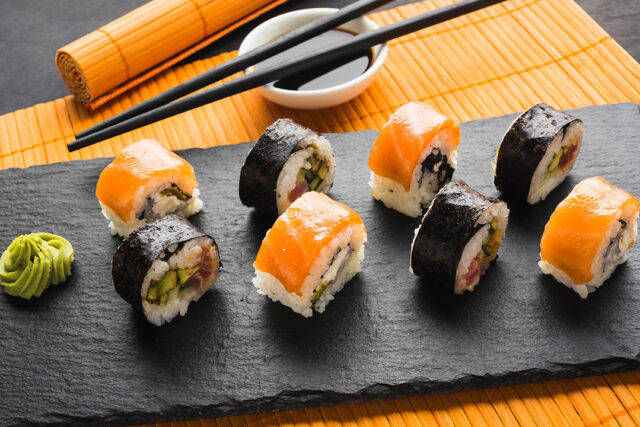
JUST FIVE years ago, a US tourist visiting Japan would have paid a small fortune — close to $500 — for a ¥50,000 omakase meal at a high-end sushi counter in Tokyo. Today, the same meal will cost the visitor just a little over $300.

The notable price drop comes because of the weak yen, which has fallen around 30% against the dollar over the past five years and hit 38-year lows in July. With the lopsided exchange rate, even Tokyo’s most famous sushi restaurants now feel affordable.

At the same time, customers at top-of-the-line sushi counters in New York know it’s routine to spend $500 before they’ve even walked in the door, let alone left a tip.

The relative bargain of ordering sushi in Tokyo has not been lost on international food fans. Sushi restaurants in Tokyo have seen an influx of tourists, turning some of the oldest sushi restaurants into a melting pot. The number of visitors to Japan continues to reach record highs; in October 2024, 3.3 million people arrived in the country, according to the Japan National Tourism Organization. In fact, the stream of travelers spurred some restaurants in tourist-friendly destinations to implement a two-tier pricing system. At Tamatebako, the all-you-can-eat seafood spot in Shibuya, it’s ¥9,328 yen for female residents and ¥10,428 for female tourists. Men pay ¥500 more for their respective categories.

Another plus for sushi-seeking tourists in Tokyo is the plethora of affordable options. In Ginza, a three-minute walk from one of the city’s most renowned (and pricey) sushi restaurants, Sukiyabashi Jiro, there’s an outpost of the solid franchise Kura Sushi, which serves two pieces of sushi for ¥155, or $1 — the preferred price for most Japanese diners.

In New York, the cost of a sushi dinner continues to rise, in part because of pricey real estate, labor (the city’s minimum wage just went up to $16.50), and the increasing cost of shipping pristine seafood from the other side of the world. The price of eating out nationally was 3.6% higher in November 2024 than the previous year, according to the USDA. The tab for eating out at local sushi restaurants has risen more sharply in some spots. At Sushi Noz, the vaunted Upper East Side dining room, a meal is now $550 without tax, tip, or drinks; it’s a 10% increase from a year ago, when it was $500.

Over the past year, Icca in Tribeca has raised its omakase price from $400 to $495. (Gratuity is now included; the actual increase is around $15.) Chef Kazushige Suzuki attributes the rising costs to the global proliferation of high-end sushi counters, which has led to a decline in the availability of certain seafood such as bluefin tuna, which in turn spikes prices.

But there’s a silver lining for New Yorkers: The number of good midrange counters is climbing, too. That’s thanks to local operators including Linda Wang of the Ume Hospitality Group, whose 10 sushi counters typically offer 60-minute meals for around $75. Her model is built around buying seafood in bulk and turning over seats briskly.

Still, it’s hard to ignore the value you can find in Tokyo. For a head-to-head comparison, read on and see what $500 gets you for notably good sushi in both cities.

TOKYO
Sukiyabashi Jiro

$500 gets you: Dinner for one-and-a-half customers

If you didn’t know the name, you wouldn’t guess that Sukiyabashi Jiro is Tokyo’s most famous sushi restaurant. Located on the underground level of a 64-year-old commercial building in the central Ginza district, its shop front is very simple. But Jiro has served countless celebrities, notably former Prime Minister Shinzo Abe, who took Barack Obama there during the former US president’s 2014 visit.

The place adheres to the traditional Edomae style, when sushi was served as street stall fast food, so the menu is simple: just raw fish. Otsumami, or drink-friendly snacks, aren’t served. But it’s so popular that if you call to make a reservation, the automated message will tell you it’s fully booked. If you get seats, the 20-piece sushi dinner starts at ¥58,000.

Ginza Kyubey

$500 gets you: Dinner for two, almost

Opened in 1935, the restaurant has been favored by local power brokers including Shigeru Yoshida, the country’s prime minister following World War II. The ¥40,000 menu includes two appetizers, sashimi, yakimono (grilled fish), nimono (a stewed dish), and 11 pieces of sushi. A multilingual chef, possibly even owner Yosuke Imada, details the selections.

Ginza Kyubey has another claim to fame: The restaurant invented a major form of sushi known as “gunkan” (seafood and rice enclosed in a round nori band), after a customer from Hokkaido asked for his sea urchin to be made into sushi.

Shutoku

$500 gets you: Dinner for at least five

Shutoku roots go back to one of Tokyo’s oldest sushi restaurants, dating back some 400 years. It’s located up a flight of stairs in Tsukiji, which for centuries was home to the city’s main fish market and handled some of the most expensive fish shipped from across the country. (In 2018, the market relocated a few miles south to Toyosu.) A meal will cycle through a series of classics such as hirame (flounder), aji (horse mackerel), and ika (squid) dusted with a few sesame seeds; less common options like gizzard shad might show up, too. The chefs add a generous amount of red vinegar to the rice, a tradition that dates to the Edo period (from 1603 to the 1860s) and turns the rice a funky colored light brown. Omakase meals range from ¥7,000 to ¥15,000.

Kura Sushi Global Flagship Store, Ginza

$500 gets you: A meal for 30 or more

For something casual — and a place to entertain small children — Kura Sushi, a block away from Sukiyabashi Jiro in Ginza, is a super option. Unlike most sushi restaurants, check-in is at a machine at the entrance which allocates a table number. Once seated, pick plates of sushi circulating on a conveyor belt, such as toro or tamago (egg), or order via a tablet or your own smartphone, which gets delivered directly to your table via a separate fast-speed belt. After eating, diners can try their luck at roulette with toys as the prize. A two-piece plate of sushi starts at ¥150.

NEW YORK
Masa

$500 gets you: Half a Hinoki counter experience

Haute sushi pioneer Masa Takayama put luxe omakase dining on the map 20 years ago when his three-Michelin-star counter opened in what’s now known as the Deutsche Bank Center at Columbus Circle. The restaurant has continued to offer the city’s highest-priced sushi. Takayama has only one seasonal menu, with bites such as stone crab with uni aioli and his signature toro tartare crowned with osetra caviar. Those who sit at the roughly nine-seat Hinoki counter will spend $950 (excluding tax and tip); in the dining room, the same meal costs $200 less.

Sushi Noz

$500 gets you: Dinner for one, almost

The six-year-old, two-Michelin-star effort from chef Nozomu Abe and owner Joshua Foulquir is a shoebox-size space that holds two counters with a total of 14 seats. The menu runs $550 (including tip but not tax), punctuated by rare seafood that’s hard to find elsewhere in the city. The 20-course meal typically begins with five seasonal appetizers, followed by nigiri such as live scallop and baby sea bream, and concludes with a daily-changing miso soup, tamago, and two desserts.

Icca

$500 gets you: Dinner for one

Kazushige Suzuki, a veteran of the New York’s now-shuttered Sushi Ginza Onodera, now helms the three-year-old Icca’s subtly Italian-accented eight-seat Edomae-rooted counter. His 21-course omakase leans heavily into appetizers with dishes like Hokkaido hairy crab and uni pasta before moving into nigiri bites, plus tamago, miso soup, and Japanese crown melon mousse for dessert for $495 (including tip). The restaurant is also known for its exceptional sake program rife with rare bottles; pairings are $220 or $280.

Shota Omakase

$500 gets you: Dinner for two

Brooklyn isn’t known as a sushi destination, which is why Cheng Lin opened his spacious 18-seat counter on a residential stretch of South 3rd Street in Williamsburg in August 2023. In fact, Shota is one of the best sushi deals in town; Lin sources premium Japanese ingredients, from sawara (Spanish mackerel) to slippery mozuku seaweed, for his $195 omakase that blends Edomae simplicity with a little innovation. If you have a bigger budget, throw in an order of rare seasonal uni from Hokkaido and black truffles to top a yuzu-miso cod hand roll and other orders.

Omakase Room by Shin

$500 gets you: Dinner for two plus two glasses of sake

As one of the city’s newest sushi entrants, sleek Omakase Room by Shin (sibling to the West Village’s Omakase Room by Mitsu) falls in the modestly priced — by NYC standards — omakase camp. The $195 (exclusive of tax and tip) omakase spans 14 courses solely dedicated to nigiri built from peak seasonal seafood helmed by Blue Ribbon Sushi vet Shin Yamaoka. Expect fish like buttery ora king salmon and a three-bite tuna series — served on rice imbued with red vinegar laced with sake lees. The meal signs out with an uni hand roll, geoduck clam miso soup, and the chef’s signature spongy tamago. Drinks options at the 14-seat counter include smooth, elegant Hoyo Manamusume junmai sakes.

Hōseki

$500 gets you: Lunch for four

Hōseki, the boîte tucked behind a velvet curtain on the lower floor of tony Midtown department store Saks Fifth Avenue, delivers a 12-course menu for $95 in 60 minutes. Morgan Adamson runs the six-seat counter’s minimalist and Edomae-inspired show, which relies on a mix of domestic and Japanese seafood. Her meals begin with a seasonal soup such as kabocha squash and carrot, then move to an appetizer like sesame-dressed Hokkaido scallop with finger limes, nine nigiri bites with Hokkaido uni and local skate, and, finally, a bluefin hand roll with shiso. Adamson works with two distinctly seasoned rices: lighter fish paired with rice imbued with a bright vinegar; fattier fish are served with rice accented with a more complex vinegar.

Thirteen Water

$500 gets you: Dinner for four and a bottle of sake

Thirteen Water proprietor Linda Wang has garnered a following for her string of shockingly affordable omakase spots that scoot diners in and out within an hour. One is Thirteen Water in the East Village, and another is a new Hudson Yards outpost. The $75 omakase is served in a charcoal-hued space anchored by a 16-seat, U-shaped counter. Chef Aaron Liu preps a nontraditional, weekly-changing 13-course menu with global seafood via a quick succession of 12 nigiri — including chutoro (medium-fatty tuna) crowned with chopped chutoro, pickled wasabi, and wasabi soy sauce — and concluding with a maki roll. Because the high-umami meal is so affordable, you can still get a 720-milliliter bottle of Born Gold junmai sake for $78. Bloomberg

Home imprisonment

FREEPIK

On Tuesday, the Philippine Star ran a story from Palawan quoting Bureau of Corrections (BuCor) chief Gregorio Catapang, Jr. as saying that his office was considering home imprisonment for offenders convicted of lesser offenses. He noted that this system was already being implemented in other Asian countries.

“Their (ASEAN countries) set-up is home imprisonment, wherein persons convicted of minor offenses are brought back to their families. It is a way to address prison congestion,” Director-General Catapang was quoted as saying at a regional correctional conference in Puerto Princesa City.

He suggested that home imprisonment could be managed by the Bureau of Jail Management and Penology (BJMP), which oversees local jails for individuals still on trial and not yet convicted. The BuCor takes over custody only after an accused has been convicted and sentenced to imprisonment.

The concept of “house arrest” is nothing new to the Philippines. However, this “accommodation” has typically been extended only to elderly or sickly detainees, as well as high-profile politicians or senior government or military officials in detention.

In other countries, house arrest or home confinement is used to keep detainees within their residences for a specified duration as an alternative to jail time. Ankle monitors are also commonly used. Home imprisonment is primarily considered a strategy to decongest prisons.

In China, house arrest or “Residential Surveillance at a Designated Location” (RSDL) was initially intended for suspects in cases involving national security, terrorism, or major bribery. However, by 2020, approximately 140,000 individuals were reportedly under “house arrest” for various crimes, including lesser offenses.

In Singapore, authorities employ the Home Detention Scheme or Home Detention Order, where eligible non-violent offenders may serve the final portion of their sentences under house arrest. This is subject to strict conditions, such as electronic monitoring and curfews. However, a minimum sentence must first be served, and the inmate must demonstrate good behavior and have strong family support.

Currently, in Myanmar, Indonesia, Thailand, and the Philippines, “house arrest” is primarily used for political figures and high-profile individuals, mainly during investigations rather than as a jail sentence after conviction. In these countries, the use of home detention is discretionary on the part of arresting authorities. In Thailand, house arrest requires court approval.

In Malaysia, only in October 2024 was legislation proposed to allow house arrest for certain offenses. The proposed law aims to reduce recidivism and decongest prisons. It is intended only for minor offenders. However, the proposal is still to be approved by lawmakers.

In general, the main conditions of home imprisonment include movement restrictions, electronic monitoring, and regular check-ins or inspections. I believe that while under house arrest, detainees should be allowed medical and legal appointments only — not political meetings, professional activities, or business management.

More importantly, existing laws must first be amended to include home detention among the penalties not just for detainees but also for convicted individuals. Any proposed law should consider the nature of the offense and limit this “privilege” to those awaiting trial or have been convicted of non-violent crimes.

For convicts, minimum jail time should first be served, and risk of flight, criminal history, and behavior during detention should be carefully evaluated prior to transfer to home detention.

With respect to the home environment, beyond ensuring that it can support the detainee economically, socially, and psychologically, immediate family members should also be held accountable if the detainee attempts escape, commits a new crime, or violates the terms of home detention.

Admittedly, house imprisonment can reduce the government’s financial burden in terms of housing and feeding inmates. Moreover, it can improve the living conditions of detainees.

House arrest also allows offenders to maintain family ties, which can facilitate smoother reintegration into society. Additionally, it eases the strain on correctional facilities by reducing inmate populations.

However, there is no denying that public safety risks increase with the possibility of home detainees committing new crimes. The public may also perceive this “penalty” as unjustifiably lenient compared to jail time. Moreover, monitoring inmates requires government resources and technological infrastructure.

Simply put, home imprisonment is easier said than done. While it offers a viable alternative to traditional incarceration, with benefits such as cost savings and reduced prison populations, it also presents challenges related to public perception and the reallocation of resources from jail management to monitoring.

To ensure effective implementation, it is essential for policymakers to conduct more research, studies, and statistical analyses on home imprisonment. A thorough examination of its economic and social impact, as well as its overall costs, is necessary to determine its feasibility. Understanding how similar programs function in other countries, particularly in ASEAN, can help guide the development of appropriate policies tailored to local conditions.

As an initial step, a pilot program could be introduced, restricting home imprisonment to a specific list of minor offenses. By carefully monitoring and analyzing the results, authorities can assess its effectiveness in reducing recidivism, alleviating prison congestion, and supporting rehabilitation.

The program should track compliance rates, the effectiveness of electronic monitoring, and the overall success of reintegration efforts.

Furthermore, data collection on crime rates before and after implementing home imprisonment will be crucial in determining whether it contributes to maintaining public safety. If successful, the pilot could pave the way for a more extensive implementation, with necessary refinements based on empirical evidence.

Another significant issue is the perception that home imprisonment represents a government abdication of its responsibility to rehabilitate inmates. In short, it may be seen as an attempt by the government to simply pass the burden of correction and rehabilitation onto the very public that incarceration is meant to protect.

Therefore, clear guidelines, transparency, and continuous evaluation will be necessary to ensure that home imprisonment serves its intended purpose without compromising justice and public security.


Marvin Tort is a former managing editor of BusinessWorld, and a former chairman of the Philippine Press Council

matort@yahoo.com

Growing AI adoption may expose PHL companies to more cyberattacks

WANGXINA-FREEPIK

PHILIPPINE BUSINESSES may face more cyberattacks as they continue to adopt artificial intelligence (AI)-powered solutions, with threat actors also using more advanced tools to exploit these technologies, cybersecurity company Trend Micro said.

Trend Micro Philippines Country Manager Ian Felipe said at a briefing on Monday that Philippine enterprises have improved their overall cyber hygiene, boosting investments to address cybersecurity risks and improving their teams’ skill sets.

However, firms must be aware of the risks that come with using AI-driven technologies, he said.

“It’s very important to have visibility in terms of what might and what can happen in the future when you adopt AI,” Mr. Felipe said.

Trend Micro said cyberattacks are now targeting AI agents, with criminals hijacking or misguiding these agents to exploit firms’ systems.

“When you use agentive AI, it’s basically an autonomous AI that can decide on its own, so having this kind of setup provides less visibility in terms of the actions or interactions of this AI to our systems,” Raymond Almanon, senior threat researcher at Trend Micro, said at the same briefing.

Agentive AI deploys a self-governing “agent” that can make decisions without minimal human supervision. It is expected to help automate tasks, reduce costs, and improve productivity.

According to Trend Micro, attackers are also using AI to launch faster and undetectable attacks with less tools.

“Adding to this is the unauthorized or malicious activities carried out by misguided autonomous agents, so we really need to make sure that every time we deploy an agent, there is a way for us to monitor it,” Mr. Almanon said.

He said businesses should have measures to monitor their AI agent operators to spot potential vulnerabilities.

“We have to implement robust security measures that give end-to-end visibility on agent operations and harness AI to ensure protection from vulnerabilities it creates for itself.”

With more companies using AI technologies, hackers are also likely to target AI-driven training environments, access infrastructure, and service subscriptions to steal information, Mr. Almanon added.

Many cyberattacks focus on obtaining companies’ login credentials to help them orchestrate large-scale exploits, he said. “Once info stealers get access to one of your employees’ credentials, that can be the start of a bigger attack on your network.”

AI can also be exploited to craft phishing e-mails, conduct disinformation campaigns and scams like pig butchering or investment fraud, expand the scale of cyberattacks, and target device drivers, he said.

“If you have a vulnerable driver that is installed — meaning these are pre-installed on your machine or came from another software — they can be targeted and used to execute malicious codes without you knowing,” Mr. Almanon said. — Beatriz Marie D. Cruz

Chinese automaker targets 1,000 monthly sales in PHL

FACEBOOK.COM/@OJPHILIPPINES

CHINESE AUTOMAKER Omoda and Jaecoo Motor Philippines, Inc. aims to achieve 1,000 monthly sales and expand its dealership network in the Philippines following its official launch on Tuesday.

“We have the intention to [increase] our dealer network. Currently, we have six, and we are going to have 24 within this year,” Omoda and Jaecoo Global Chief Executive Officer Shawn Xu said.

“With these numbers, definitely within [the first] half of the year, we will reach 500 monthly sales, and then later on, it can be 1,000 units,” he added.

When asked about the company’s optimism in launching in the Philippines, Mr. Xu said the country is one of the largest in Asia.

“The Philippines is a big country among Asian countries. So this is the reason why we established a subsidiary company here. We think that we have big potential,” he said.

“And also, we have good confidence here because other markets have already proved that we get good performance, like Malaysia, Indonesia, Thailand, and Switzerland, so definitely the Philippines will be no exception. So definitely, we have good confidence here,” he added.

On Tuesday, Omoda and Jaecoo announced their official launch in the country with the unveiling of three models: the Omoda C5, Omoda E5, and Jaecoo EJ6.

The Omoda C5 will be priced between P898,000 and P1.18 million, while the Omoda E5 will be sold at P1.5 million.

However, customers who place a deposit for the Omoda C5 and Omoda E5 until June 30 will receive P110,000 and P220,000 discounts, respectively.

“With the warm reception that the Omoda C5 and Omoda E5 received even before our official launch, we were inspired to roll out a promo for our Filipino buyers. This way, more Filipinos can experience premium automotive innovation firsthand,” Mr. Xu said.

Meanwhile, the Jaecoo EJ6, an electric sport utility vehicle, will have a starting price of P1.65 million to P1.8 million.

According to Mr. Xu, Omoda and Jaecoo sold nearly 250,000 units globally last year, driven by new products and market expansions.

“So this year, our target will be for our sales to reach half a million units,” he added.

As of the end of last year, Omoda and Jaecoo were present in 34 markets. This is set to expand to 55 by the end of this year. — Justine Irish D. Tabile

BSP launches cyber resilience council

THE BANGKO SENTRAL ng Pilipinas (BSP) has launched a council to strengthen cooperation on cyber resilience in the financial sector.

The central bank on Feb. 11 launched the Financial Cyber Resilience Governance Council (FCRGC), it said in a statement on Wednesday,

“The FCRGC aims to foster a safe, secure, and resilient financial system by promoting strong cybersecurity practices, governance, and collaboration,” the BSP said.

The council is tasked to implement the 2024-2029 Financial Services Cyber Resilience Plan, which was launched in August 2024. “This plan outlines high-level goals and strategies to maintain the integrity and security of the country’s financial system.”

“This council represents our collective resolve to strengthen our cyber defenses,” BSP Governor Eli M. Remolona, Jr. said.

Central bank data showed that nearly 60% of cyber fraud losses reported by BSP-supervised financial institutions in 2023 were due to account takeovers, identity theft and phishing.

The finance and insurance industry was the top most attacked sector in 2018 and 2020, and ranked second from 2021 to 2022, according to the IBM X-Force Threat Intelligence Index report.

The cyber resilience council will be headed by Monetary Board Member Jose L. Querubin as the group’s advisor.

Meanwhile, BSP Deputy Governor Chuchi G. Fonacier and Bankers Association of the Philippines (BAP) Cyber Committee Head Sandeep Uppal will serve as the FCRGC’s chairperson and vice chairperson, respectively.

“The role of the council is clear: it is to lead the way by overseeing industry initiatives so we are on the right track in ensuring that we remain prepared to any threats that may arise,” Ms. Fonacier said.

“The council is a symbol of our unity, of our shared commitment to protect the financial system, and of our resolve to outpace and outmaneuver those who seek to undermine it,” BAP President Jose Teodoro K. Limcaoco added.

Members of the council will also include representatives from the Chamber of Thrift Banks, Rural Bankers Association of the Philippines, Philippine E-Money Association of the Philippines, BancNet, Inc., and Philippine Clearing House Corp.

“The heads of the BSP’s Policy and Specialized Supervision Sub-Sector, Technology and Digital Innovation Office, and Technology Risk and Innovation Supervision Department will also serve in the council,” the central bank said.

The council will meet quarterly to discuss success metrics and policy recommendations, as well as review cyber threat reports. — Luisa Maria Jacinta C. Jocson

Dining In/Out: Fastfood and then some


Kenny Rogers Roasters offers Corn Muffin Ice Cream

LAST YEAR, fast-casual restaurant Kenny Rogers Roasters and artisanal ice cream brand Merry Moo joined forces to bring Corn Muffin Ice Cream into the retail market. The Corn Muffin Ice Cream is made with a creamy cornbread base, maize bits, and corn muffin chunks, capturing the flavor of Kenny Rogers Roasters classic cornbread recipe. This year, the Corn Muffin Ice Cream is available in even more locations — in select The Marketplace and Landmark branches. The Corn Muffin Ice Cream is one of the many versions of Kenny Rogers Roasters classic creations available in supermarkets around the metro. For more news and a guide to the supermarket locations with the ice cream, follow Kenny Rogers Roasters on Facebook, Instagram, TikTok, and YouTube.


Karayama is now in Makati

POPULAR Japanese chicken chain Karayama opened a branch at One Ayala on Feb. 15. Karayama Philippines opened its first branch in SM North EDSA five years ago. The One Ayala branch is located near the EDSA-Ayala footbridge. The story of Karayama’s famous Japanese-style fried chicken, known as karaage, began in a tiny storefront in Tokyo. Chicken is slowly marinated in a secret recipe, developed to enhance the flavor of the chicken. Each boneless piece is then breaded and fried until crisp. With its ingredients sourced from Japan, Karayama offers authentic Japanese-style Fried Chicken from rice sets to their 15-piece Chicken Mountain. Aside from the rice sets with a one-time refill of rice and miso soup, Karayama also offers Japanese rice bowls; Chicken Paitan Ramen, and Curry Rice sets. Japanese mochi and ice cream for desserts, and drinks like Cherry Blossom Fresh Fizz are also available. Exclusive promos are available when ordering via karayama.pickup.ph or Grabfood.


Panda Express has spicy new chicken

PANDA EXPRESS Philippines has just launched its newest American Chinese sweet and spicy dish — Spicy Bourbon Chicken — available for a limited time. This is a spin on the Southern American classic Bourbon Chicken. The dish contains crispy boneless chicken bites and fresh vegetables, wok-tossed in a spicy and sweet bourbon sauce all topped with sesame seeds. The dish can be paired with a big bowl of steaming white rice, fried rice, or chow mein. Spicy Bourbon Chicken is only available for a limited time at Panda Express branches, or order via takeout, drive-through, or delivery via online store order.pandaexpress.com.ph, Grab or Foodpanda.


McDonald’s gets cheesier

MCDONALD’S brings back the Cheese Dunk, a gooey cheese dip companion to their cheeseburgers. Cheese Dunk is offered in three ways: the Cheese Dunk Solo, the Cheeseburger with Cheese Dunk Meal (a classic cheeseburger and a side of cheese dip), and the Double Cheeseburger with Dunk Meal (double the beef, double the cheese, double the dunk). It is available in all McDonald’s locations nationwide, via dine-in, takeout, McDelivery, or the McDonald’s App. On Feb. 28, they’ll announce “a bold twist” to the cheese dunk limited-time offering. For more information about McDonald’s Cheese Dunk, visit McDonalds.com.ph, or follow @McDo.ph on Facebook, and @McDo_ph on Instagram.

Declining births and urbanized cities of the Philippines

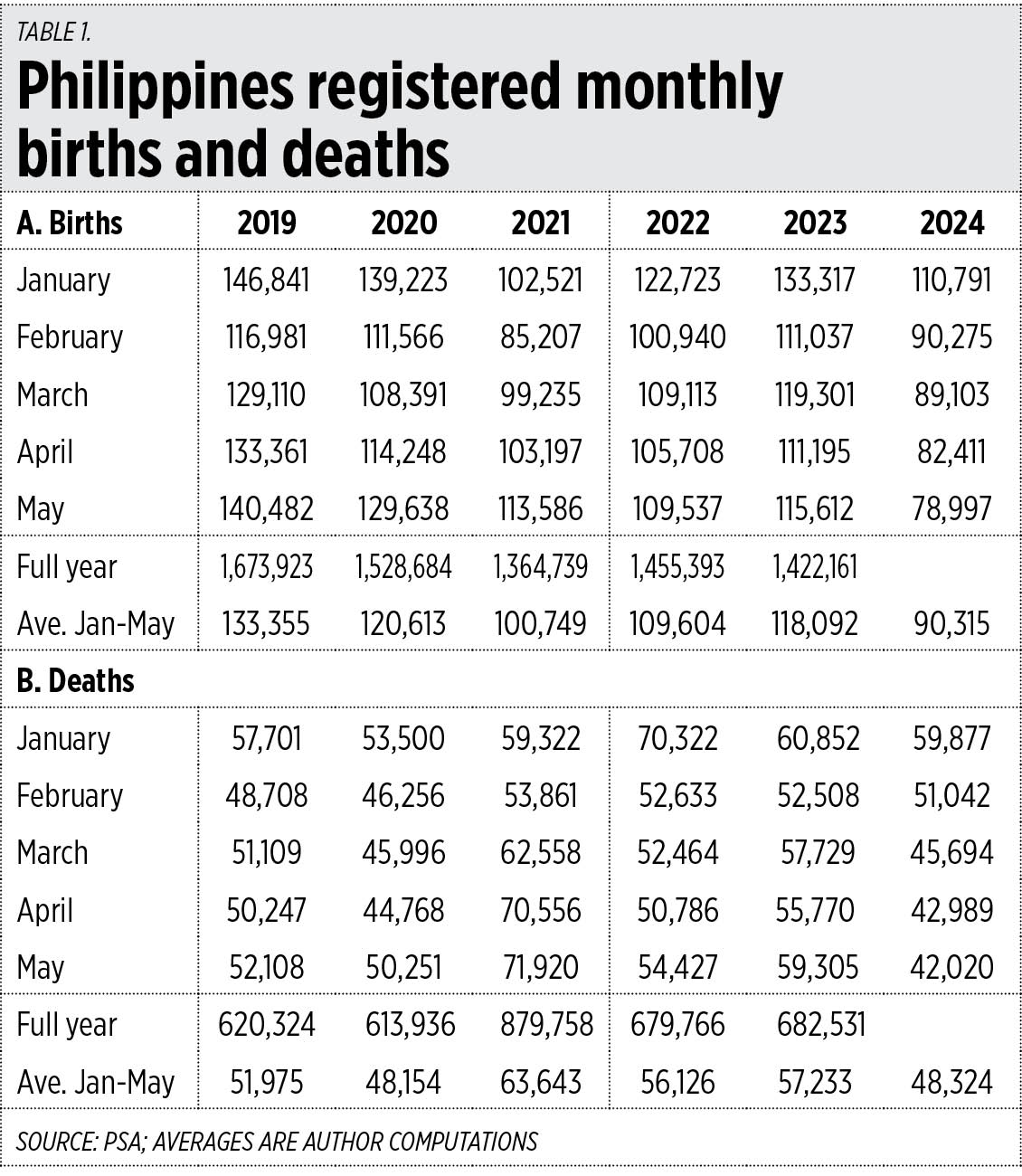
On Jan. 31, the Philippine Statistics Authority (PSA) released the report, “Birth, Marriage, and Death Statistics for 2024 (Provisional, as of 30 November 2024).” I downloaded the Excel file for 2023-2024 and compared the monthly data of previous years, with 2019 serving as the baseline before the lockdowns of 2020 to mid-2022.

The number of births in the Philippines keeps declining. The monthly averages for January-May of each year declined, from 133,355 in 2019 to 100,749 in 2021 and 90,315 in 2024. This is not good. The average number of deaths per month see-sawed from 51,975 in 2019 to 63,643 in 2021, then 48,324 in 2024.

Despite the high number of reported COVID-19 cases in 2020 there were no “excess deaths” that year (an increase in the number of deaths from the previous year). It was in 2021, when COVID vaccination became mandatory, that “excess” deaths were high — there were nearly 880,000 deaths that year, or 259,400 more than in 2019 (see Table 1).

The net increase in population (births minus deaths) for the January-May period has been declining, from 81,380/month in 2019, to 37,100/month in 2021, and 41,990/month in 2024. That is not good. I have always suspected that those experimental vaccines which were made mandatory (otherwise people were not allowed to enter schools, offices, malls, etc.) have short- to long-term adverse effects on people’s health. So far this is slowly being confirmed via adverse demographic trends in the country.

ECONOMIC PERFORMANCE OF CITIES
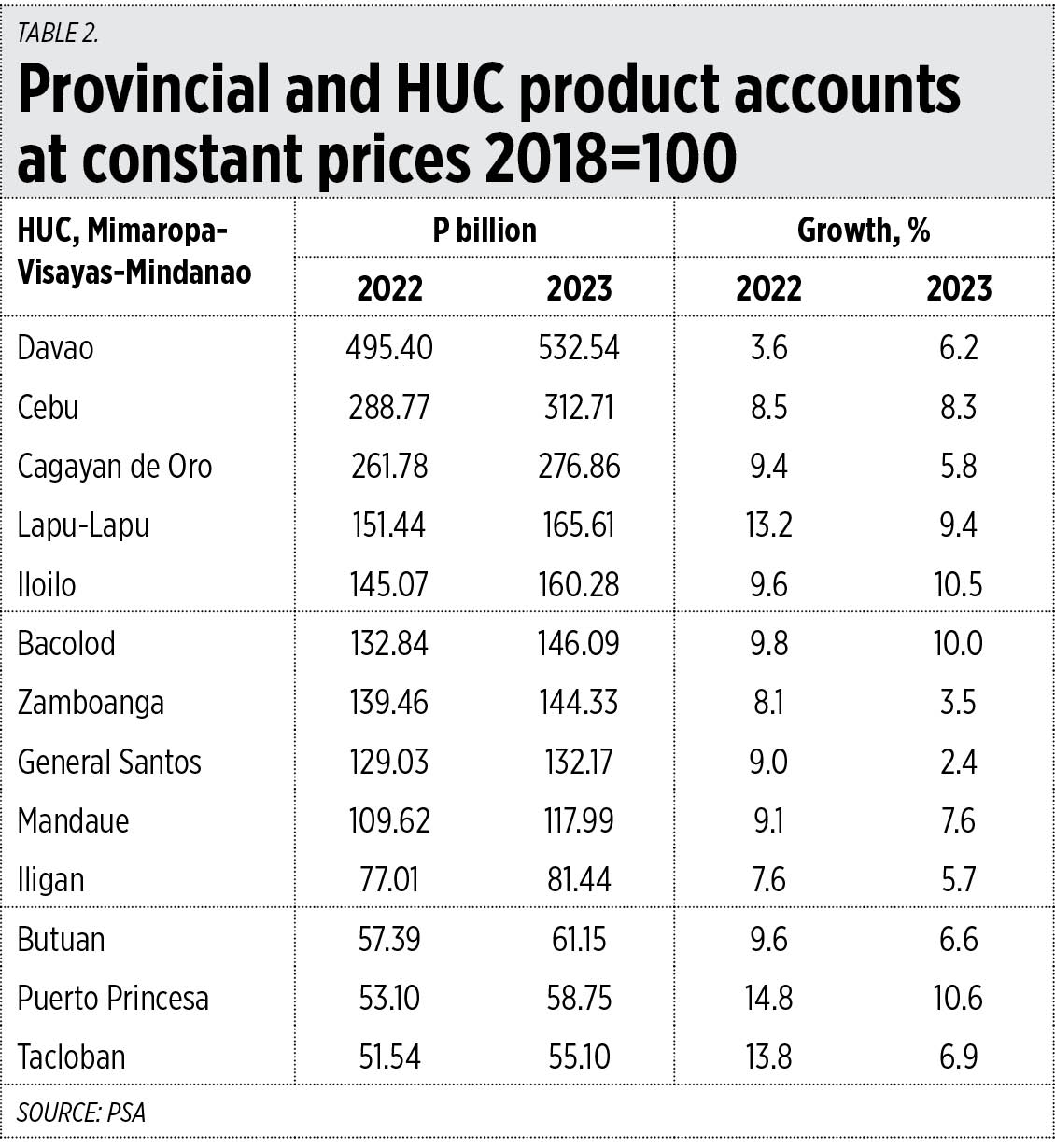
On Feb. 7, the PSA released its report, “2023 Economic Performance of the Highly Urbanized Cities (HUC) in the Philippines.” It showed that Quezon City and Makati City are the only trillionaires, and that Davao City and Cebu City are the only non-Metro Manila cities in the top 10 wealthiest HUCs in the country.

In terms of annual growth, Puerto Princesa City in Palawan was highest with growth of 10.6% in 2023, followed by Iloilo and Bacolod cities with 10.5% and 10.0% growth respectively. I heard that the city government of Puerto Princesa was bragging about its performance — and rightly so. But I also wanted to see just how big or how small the real production in the city is.

So, I checked the PSA’s attached Excel files by region, and I compared the provincial product accounts and HUC accounts of regions in Mimaropa (Mindoro, Marinduque, Romblon, Palawan), Visayas, and Mindanao. It is not a good idea to compare them (except Davao and Cebu) with the HUCs in Metro Manila, Region 3 (Central Luzon), and Region 4 (Calabarzon) which are huge and rich.

It turns out that among the HUCs in Mimaropa-Visayas-Mindanao, Puerto Princesa was the second smallest or second poorest in 2023 after Tacloban City (see Table 2).

The last time I went to Puerto Princesa City was in 2019. The tourist areas of the city are beautiful — the underground river, the white sand beaches, the small exotic islands, a zoo, a crocodile farm, and so on. But the city itself does not look “highly urbanized.”

For one thing, there are frequent blackouts so all the hotels and resorts, malls, and big restaurants have gensets. This immediately raises the cost of business. Thus, food prices, hotel rooms, and tours are not exactly cheap in Puerto Princessa. Tourist arrivals recovered to the 2019 level only in 2023.

Then, many roads are not well-paved. Many streets are dark at night — which is related to the insufficient power supply discussed above. Plus, there are many stray dogs on the road that contribute to more accidents.

Three, I read that the majority of households are not connected to a sewage system. That the water supply is intermittent during the dry or summer months. And that city’s health services are wanting, with patients and their companions having to start queuing as early as 4 a.m.

Four, flooding is frequent in many areas including the north national highway. There must be blocked waterways somewhere, while buildings were given construction permits despite the danger of flooding. There was heavy flooding again early this month, from Feb. 8-10.

I read that the political leadership of Puerto Princesa City has been controlled by one family for three decades. This is not good.

About the blackouts, Palawan does not have big power plants except the oil gensets of Napocor and some private companies.

Years ago, DMCI and other companies proposed putting up a coal plant in Palawan, but this was vehemently opposed by many environmentalists because coal is a fossil fuel. But the same environmentalists are silent about the fact that the diesel and bunker oil that run the big gensets are also fossil fuels.

And then there is the state of the Palawan Electric Cooperative (Paleco). Data from the Energy Regulatory Commission (ERC) showed that Paleco’s System Average Interruption Duration Index (SAIDI) in 2023 for scheduled maintenance shutdown was 1,337 minutes (equivalent to 22 hours) while for some private distribution utilities like Visayan Electric Co. (VECO) it was only 163 minutes (three hours). When it comes to power supply instabilities, Paleco’s SAIDI in 2023 was 3,154 minutes (53 hours) while that of VECO was only eight minutes.

The city and the provincial leadership must make drastic changes in their infrastructure, energy, and other sectoral reforms.


Bienvenido S. Oplas, Jr. is the president of Bienvenido S. Oplas, Jr. Research Consultancy Services, and Minimal Government Thinkers. He is an international fellow of the Tholos Foundation.

minimalgovernment@gmail.com