Home Blog Page 1297

Unsolicited proposals: Driving innovation and growth in public-private partnerships

RAWPIXEL

In the past decades, Public-Private Partnerships (PPPs) have been considered a catalyst for driving and pushing the ends of traditional constraints long plaguing infrastructure development, especially in developing countries.1 In the Philippines, the government has acknowledged that PPPs are a crucial cornerstone for continuing the government’s infrastructure and development strategy. As enshrined in the national policy, the State recognizes the indispensable role of the private sector in bridging infrastructure gaps and accelerating inclusive growth. PPPs enable governments to tap into private sector resources, innovation, and technical expertise to finance, design, construct, operate, and maintain key infrastructure projects and public services, particularly where public funds are limited or unavailable.

In developing economies like the Philippines, insufficient and poorly maintained infrastructure remains a major constraint on economic growth and social equity. The development of infrastructure in the country is hampered by painfully long inefficient bureaucratic systems, lack of coordination, financing, and a relatively low involvement in private sector infrastructure provision.2 To combat these socio-economic difficulties, PPPs serve as a strategic mechanism to address these systemic challenges by enabling efficient, transparent and cost-effective project delivery. They now extend beyond traditional infrastructure to include essential social services like schools and hospitals, contributing directly to public welfare and national development goals.

Under Republic Act No. 11966, enacted on Dec. 5, 2023, otherwise known as the “Public-Private Partnership Code of the Philippines,” one of the most dynamic and potentially transformative mechanisms within the PPP framework is the Unsolicited Proposal (USP). USPs allow private proponents to propose PPP projects outside the formal government pipeline or the traditional request for a proposal from the government but align with national or local development objectives. This mechanism is especially critical and quite revolutionary for a rapidly evolving economic and technological landscape, where the private sector may be better positioned to identify opportunities or introduce innovative solutions directly to the government.

By allowing USPs, the government acknowledges that innovation and initiative often come from the private sector. These proposals can result in new infrastructure ideas that may not yet be captured by existing government plans, and they operate to assist the government in identifying economically valuable projects when it lacks the necessary financial resources to execute such projects through the solicited approach.3

The USP process, however, is not without controls. As public interest is paramount, the USP process is guided by stringent rules to prevent abuse and ensure government accountability. To guarantee that USPs would not become a medium for bypassing government procurement and anti-corruption measures, all USPs must first pass a completeness check by the PPP Center within 10 days from receipt thereof, followed by a detailed evaluation by the implementing agency.4 Guidelines are also in place to regulate the conduct of negotiations for PPP projects.5 The following government undertakings however are prohibited in a USP: Visibility Gap Funding (VGF) and other forms of subsidy; payment of right-of-way related costs; performance undertaking; additional exemptions from any tax other than those provided for by law; guarantee on demand; guarantee on loan repayment; guarantee on private sector return; government equity; and contribution of assets, properties, and rights.6

To promote competition and transparency, all accepted USPs are subject to a comparative challenge process, wherein third parties are invited to match or surpass the original proposal. The implementing agency shall carry out the comparative challenge, either through manual or electronic means, within a certain approved timeline. This period must consider the specific nature and complexity of the PPP project and shall not be shorter than 90 calendar days nor longer than one year. The original proponent retains the right to match any submitted proposal but only after other potential challengers are given a fair and open opportunity to submit competing offers.7 This is a safeguard against sweetheart deals while preserving the incentive for private firms to develop high-quality and well-structured proposals.

A key innovation to the USP process is its time-bound structure. Under the new framework, an Unsolicited Proposal first undergoes a 10-day review by the PPP Center to check for completeness and identify the appropriate approving body. Once endorsed, the implementing agency is given 90 calendar days to conduct a detailed evaluation of the proposal. If the agency fails to act within the 90-day period following the end of this evaluation period, the proposal is automatically deemed approved, subject to any liabilities of responsible officials. If the implementing agency decides to accept the proposal following its detailed evaluation, the head of the implementing agency must issue a Notice of Acceptance to the private proponent within three calendar days from the end of the evaluation period. The implementing agency must also issue a Notice to Commence Negotiations within the same three-day window. Thereafter, the negotiation period officially begins, lasting for 80 calendar days. This period may be extended by mutual agreement between the implementing agency and the private proponent, but in no case shall the total negotiation period exceed 150 calendar days.8

These guidelines address historical bottlenecks in the approval process and enhance investor confidence by providing a clear and enforceable timeline. In fact, failure of the agency to act on a proposal within the prescribed timeframes may result in the proposal being deemed approved, a provision meant to curb bureaucratic obstacles while still holding erring officials accountable under law.

In addition, USPs support the autonomy of local government units by enabling them to receive and process local USPs, helping foster community-level innovation and infrastructure delivery that is tailored to local needs. These projects must still comply with national policies on transparency, risk management, and sustainability, including climate resilience and gender integration, ensuring alignment with broader national objectives.9

Ultimately, for businesses, the USP mechanism represents a powerful avenue to directly propose projects that align with their strategic interests, technologies, and areas of expertise that the government has yet to consider. Unlike traditional procurement, where government agencies dictate the project structure and scope, USPs empower the private sector to take the initiative, identifying infrastructure gaps, and proposing economically feasible solutions to such infirmities. This opens new commercial opportunities while supporting national development priorities, creating a win-win scenario where business innovation can directly drive inclusive and sustainable growth. n

1 “Public-Private Partnerships in Developing Asian Countries: Practical Suggestions for Future Development Assistance,” ADBI Policy Brief No. 2021-5, September 2021

2 “Philippines: Meeting Infrastructure Challenges,” The International Bank for Reconstruction and Development/The World Bank, 2005)

3 “Unsolicited Proposals: An Exception to Public Initiation of Infrastructure PPPs,” Public-Private Infrastructure Advisory Facility, 2014

4 RA 11966, Sec. 10(a)

5 PPP Governing Board Resolution No. 2025-01-02

6 Ibid., Sec. 10(c)

7 Ibid., Sec. 10(e)

8 Ibid., Sec. 10(a)(b); PPP Governing Board Resolution No. 2025-01-02

9 RA 11966, Sec. 2

The views and opinions expressed in this article are those of the author. This article is for general informational and educational purposes only and not offered as and does not constitute legal advice or legal opinion.


Jackie L. Quiñones is an associate of the Angara Abello Concepcion Regala & Cruz Law Offices (ACCRALAW), Davao Branch.

(6382) 224-0996

jlquinones@accralaw.com

Arts & Culture (04/09/25)


ArtistSpace holds Clarence Eduarte solo show

THE exhibit Plantae, by artist Clarence Eduarte, presents images of nature, particularly the intricate beauty of the plant kingdom, at the ArtistSpace in Makati City. His works aim to translate organic rhythms and quiet strength into modern, expressive compositions. His exhibit is on view until April 15. Plantae is an invitation to slow down, to look deeper, and to rediscover our relationship with the environment.


Soloist Andrea Obiso at PPO concert

THE Philippine Philharmonic Orchestra (PPO) will close its 40th concert season, dubbed Forte, with a performance by acclaimed Italian guest violinist Andrea Obiso. The final show of the year, scheduled on April 11, at 7:30 p.m., will feature a new concerto from PPO’s composer-in-residence Jeffrey Ching, at the Samsung Performing Arts Theater in Makati City. PPO Concert VII: Finale will see Mr. Ching’s Concerto for Orchestra performed under the baton of Grzegorz Nowak. Meanwhile, Mr. Obiso will interpret Camille Saint-Saëns’ Violin Concerto No. 3. Tickets, ranging from P1,500 to P3,000, are now available via TicketWorld.


Galerie Stephanie presents trio of solo exhibits

THERE are three solo exhibitions running at Galerie Stephanie, delving into nuances of motion, perception, and equilibrium. Moving Still by Nicole Bitas examines the beauty found in life’s quiet pauses while Shifting Reality by Michael Orlina aims to push the boundaries of glass as a medium. Finally, The Theory of Balance by Jomike Tejido explores balance as a fluid and evolving state using earthy tones and kinetic sculptures crafted from resin, brass, and metal. All three exhibits are open to the public until April 27 at Galerie Stephanie, 6/F East Wing of Shangri-la Plaza, Mandaluyong City.


Virgin Labfest now accepting playwright applications

YOUNG aspiring playwrights can now apply for the Virgin Labfest XX Writing Fellowship Program until April 30. The Cultural Center of the Philippines (CCP), through its Artist Training Division, is opening the program to applicants 18 to 29 years of age. Chosen writing fellows pay a registration fee of P2,500. The announcement of accepted applicants is on May 20. The fellowship will run from June 17 to 29. Visit the Virgin Labfest pages for more information.


Alliance Française puts up Siargao exhibit

THE exhibit Tinted Tides depicts the oceanic soul of Siargao island, especially its fishermen who are overlooked in the face of rising tourism. On view at the Alliance Française de Manille Gallery at Nicanor Garcia Ave., Makati City, the exhibition also serves as a fundraiser, with 10% of the proceeds going to marine education in local communities, in partnership with Oceanus. The exhibit, which features the works of artists Camille Robiou Du Pont and Charlotte Lamy, runs from April 10 to May 3.


Spanish photographer at Instituto Cervantes

RENOWNED Spanish photographer Bernardo Aja is bringing his portrait series, EntreMuros, to Instituto Cervantes de Manila in Intramuros, Manila. Presented by the Embassy of Spain in collaboration with De La Salle College of Saint Benilde and the Intramuros Administration, the show will run from April 10 until July 1. It will feature portraits taken in Cebu, Negros, and Luzon in 2018, offering a profound look into Filipino identity. From April 10 to 11, Mr. Aja will also lead a hands-on photography workshop at Instituto Cervantes, titled “Trades and Chores,” which will guide participants through Intramuros to document the people and professions that shape Manila’s historic district. Admission is free.


ARTablado spotlights Batangas and Baras art group

ARTABLADO turns the spotlight on BAGSIK and BAG, two dynamic art groups, this month. BAGSIK, short for Batangueñong Grupo sa Sining at Kultura, hails from Batangas, while BAG, or the Baras Artist Group, represents artists from the town of Baras in Rizal province. Both groups have found a creative home in ARTablado, the advocacy arm of Robinsons Land Corp. dedicated to providing a platform for visual creators. BAGSIK presents Bahaghari: Mga Kulay ng Sining — a vibrant showcase of 42 artists whose works span various media, including oil, acrylic on canvas, watercolor, mixed media, clay and scrap iron, magazine mosaic, and digital photography — which is on view at ARTablado in Robinsons Galleria until April 15. Meanwhile, BAG’s third collective exhibit, Art Flow, is on view at ARTablado Robinsons Antipolo until April 15.


IPOPHL marks National Intellectual Property Month

THE Philippines is celebrating National Intellectual Property Month this April with programs that highlight the importance of protecting and respecting intellectual property (IP) rights. This year, there is a special focus on the power of music. Its theme is “IP and Music: Bringing the Pinoy Beat to the World,” which connects with the World Intellectual Property Organization. For more details, visit the Intellectual Property Office of the Philippines’ (IPOPHL) site and social media pages.

European Central Bank rates could fall faster as recession risk mounts

REUTERS

FRANKFURT — A global market rout induced by US President Donald J. Trump’s tariffs scheme has solidified the case for another European Central Bank (ECB) rate cut next week and supports arguments for even quicker policy easing from the world’s second-largest central bank.

The expected economic slowdown induced by the tariffs along with the fallout from the market volatility are likely to be such a drag on prices that they will likely outweigh the inflationary impact of any retaliatory measures by the European Union (EU), economists say.

Markets now see almost two rate cuts in the ECB’s next two meetings and see between three and four steps between now and the end of the year. German bond yields, the euro zone’s benchmark, were once again falling on Monday as markets priced in a recession in the bloc and monetary easing to deal with it.

While ECB policy makers are far from a consensus on what it all means in the longer run, the rout makes next week’s rate cut a near certainty and interest rates could fall far deeper this year than earlier thought without jeopardizing the 2% inflation target.

In fact, the market turmoil is so great, a recession is now a real possibility and propping up growth could soon become a bigger concern than inflation, which has run above the ECB’s target for the past four years.

“They have to cut at every meeting, if only because of the uncertainty,” Frederik Ducrozet at Pictet Wealth Management said. “There is no sign of increasing inflationary pressure over the longer term.”

A raft of influential ECB policy makers, including Pierro Cipollone, Francois Villeroy de Galhau and Yannis Stournaras have all called for more policy easing in the current environment and none of the key hawks have pushed back.

Speaking in private, some policy makers even questioned the ECB’s own projection that tariffs plus the EU’s own retaliation would only lower growth by a half a percentage point in the first year and argued that the impact would be larger.

Indeed, oil prices were sharply lower on Monday, yields were down, gold was down and longer-term inflation pricing was falling, a combination of market moves suggesting that a recession is now expected.

The EU is — for now — prioritizing negotiation over retaliation versus the US.

However, more hawkish ECB policy makers, speaking in private, argue that the central bank may be underestimating the inflationary impact of the tariff measures and its prediction of a short-lived price effect may be off.

They argue that tariffs mean less trade, new value chains and higher costs, all pointing to higher underlying inflation in the longer term, much like in the decades before globalization.

MORE THAN RATE CUTS?
The ECB has long said that rate cuts are its primary policy tool but the bank also has a wide range of ready-to-use unconventional instruments in case the market rout morphs into a full meltdown.

The ECB will get nervous if bank lending is impaired, the yield differential between euro zone member states rises to levels that are deemed unjustified and disorderly or if there is a surge in investment grade yields.

The big difference compared with previous crises is that Mr. Trump controls the narrative and could end the turmoil with a stroke of a pen or could even make it far worse.

“We’re in a severe correction territory now, not a meltdown, but there is also a potential for this to turn into a full scale meltdown,” ING economist Carsten Brzeski said.

“Should that be the case, we’re back to the ordinary crisis tools like: liquidity injection via bond buying, TLTROs or LTROs, and perhaps a beefed up dollar swap line.”

TLTROs, or targeted longer term refinancing operations, were used in the last decade to provide banks with cheap, multi-year funding, with incentives to use the cash to keep bank lending to the real economy going.

The ECB also has a standing facility with the US Federal Reserve to access dollars in case banks struggle to find the funding on the market. During the pandemic, the weekly operation ran daily.

There is no sign any of this is happening for now. Commercial banks sit on €2.8 trillion ($3.07 trillion) worth of excess liquidity and there was no demand on Monday in the ECB’s daily liquidity tender.

Rate cuts are the focus for the moment, with the market pricing in a 25 basis point reduction next week and then again in June, and one or two more by the end of the year.

Looking further out, Germany’s 10-year bond yield was down 3 basis points to 2.59% by 1240 GMT on Monday as the market priced in a recession. — Reuters

Monthly Job Gains by Industry (February 2025 vs January 2025, in thousands)

THE JOBLESS RATE slipped to a two-month low in February, as more Filipinos joined the labor force ahead of the summer season and midterm elections, the statistics agency said on Tuesday. Read the full story.

Monthly Job Gains by Industry (February 2025 vs February 2024, in thousands)

PAL eyes up to 20% growth in passenger volume this year

PHILSTAR FILE PHOTO

PHILIPPINE AIRLINES (PAL), operated by PAL Holdings, Inc., expects passenger volume to grow by up to 20% this year.

“Between 10% and 20% increase,” Philippine Airlines President and Chief Operating Officer Stanley K. Ng told reporters on Monday.

“We have recovered some of our grounded aircraft,” he added.

For 2024, PAL Holdings recorded a total comprehensive net income of P10.01 billion, down 51% from P20.48 billion in 2023, due to lower revenues during the period.

In 2024, PAL Holdings posted P178.01 billion in revenue, a 0.62% decrease from P179.12 billion in the previous year.

Despite carrying 15 million passengers in 2024, the flag carrier said the revenue decline was primarily due to a lower load factor of 79.1%, compared to 80.8% in 2023.

This year, PAL has launched new routes and expanded existing services.

The airline is set to begin nonstop Da Nang–Manila flights by July and increase its Manila–Hanoi–Manila service to daily flights as part of its Vietnam expansion.

PAL’s expected passenger growth this year is also attributed to the utilization of its restored aircraft, Mr. Ng said.

“After the pandemic, we were down to 60-plus planes in the air. Now we’re back to 79,” he added.

In 2024, PAL announced plans to acquire at least 22 aircraft, to be delivered between 2025 and 2029.

Mr. Ng said the company hopes to receive the first delivery by yearend.

The new aircraft include nine A350-1000s and 13 A321neo (New Engine Option) jets, intended to serve the airline’s nonstop flights to North America and other overseas destinations, as well as regional routes in Asia and Australia.

Meanwhile, PAL is also planning to resume its Manila–Sapporo service, Mr. Ng said, although supply chain issues remain a constraint.

“[We are looking at] Sapporo, but there’s a challenge with the engine situation — the supply chain,” he said.

At the local bourse on Tuesday, shares in the company closed unchanged at P4.50 apiece. — Ashley Erika O. Jose

Umpisa-Testsigma deal to help firms automate software testing

RADOWAN NAKIF REHAN-UNSPLASH

TECH STARTUP Umpisa, Inc. has teamed up with US-based test automation platform Testsigma to help businesses adopt artificial intelligence (AI)-driven software testing in the Philippines.

“With the growing complexity of modern applications, software teams need testing solutions that are not only fast and reliable but also intelligent and adaptable,” Pamela Isabelle Z. Belen, chief executive officer at Umpisa, said in a statement.

Under the deal, Umpisa will integrate Testsigma’s low-code, AI-driven platform, enabling software teams to create automated tests using plain English, Umpisa said.

The codeless test creation and AI-powered maintenance is expected to reduce automation costs by as much as 70%.

The partnership also seeks to address challenges raised by businesses in maintaining speed and accuracy during rapid release cycles.

“This collaboration is about enabling software teams to focus on delivering quality without being held back by traditional testing processes,” Ms. Belen said.

San Francisco-based Testsigma specializes in cloud-based infrastructure for software testing across web, mobile and application programming interface and sales force applications.

This lets teams easily run tests at any time and integrate seamlessly with DevOps workflows.

Testsigma is used by global companies like Cisco, Samsung, Bosch, Oscar Health and Nagra and is backed by investors including MassMutual, Accel, Strive and Bold Cap.

Only 22% of Philippine companies said they are fully ready to capture AI’s potential, citing gaps in infrastructure readiness, data center network performance and cybersecurity, according to Cisco’s 2024 AI Readiness Index.

“By streamlining testing processes, the partnership seeks to help businesses improve efficiency, accuracy and scalability in their software development efforts,” Umpisa said.

Testsigma CEO Rukmangada Kandyala said its partnership with Umpisa is a major step into their global expansion to help firms adopt digital transformation practices.

“The Philippines is a dynamic technology market,” he said in the statement. “Umpisa’s strong local presence and technical expertise make them an ideal partner to bring our generative AI-powered codeless test automation solutions to the region.” — Beatriz Marie D. Cruz

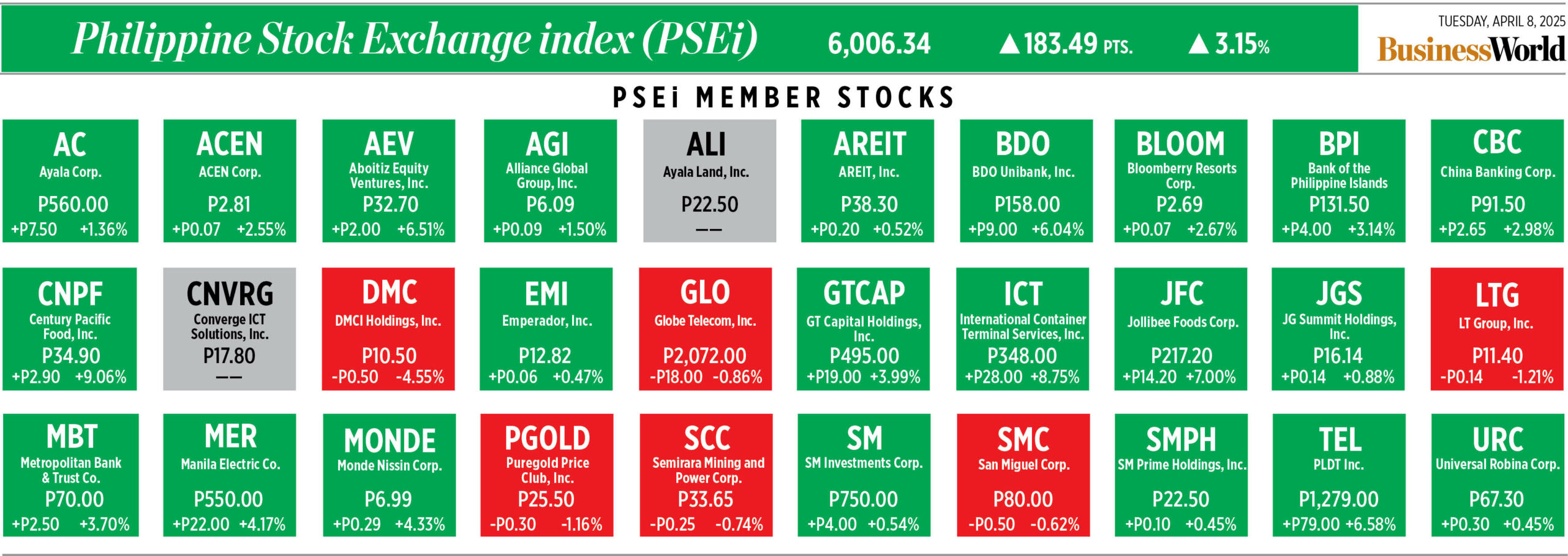
How PSEi member stocks performed — April 8, 2025

Here’s a quick glance at how PSEi stocks fared on Tuesday, April 8, 2025.


PHL stocks rebound as investors pick up bargains

REUTERS

PHILIPPINE SHARES rebounded on Tuesday, with the bellwether returning above the 6,000 mark, as investors bought bargains following the market’s slump and on expectations that the Bangko Sentral ng Pilipinas (BSP) to cut rates on Thursday.

The Philippine Stock Exchange index (PSEi) surged by 3.15% or 183.49 points to close at 6,006.34, while the broader all shares index rose by 2.46% or 86.03 points to end at 3,582.80.

The stock market is closed on April 9 (Wednesday) for a holiday in commemoration of the Day of Valor (Araw ng Kagitingan).

“The local market bounced back as investors hunted for bargains following three straight days of decline,” Philstocks Financial, Inc. Senior Research Analyst Japhet Louis O. Tantiangco said in a Viber message.

“Hopes of a rate cut by the Bangko Sentral ng Pilipinas in their upcoming meeting this week helped in the market’s rise,” he added.

A BusinessWorld poll last week showed that all 17 analysts surveyed expect the Monetary Board to slash its target reverse repurchase rate by 25 basis points to 5.5% from the current 5.75% at its policy meeting on April 10 (Thursday).

“Philippine shares made a furious return after falling to its lowest since October 2022, as many countries came to the negotiating table to resolve the tariff war ignited by US President Donald J. Trump,” Regina Capital Development Corp. Head of Sales Luis A. Limlingan said in a Viber message.

World markets won a reprieve on Tuesday after three days of heavy selling that wiped trillions of dollars off the value of shares, but the mood was cautious with a focus on whether Washington might negotiate on some of its aggressive tariffs, Reuters reported.

Asia stocks bounced off 1-1/2 year lows, European shares opened broadly higher and US stock futures pointed to a positive open for Wall Street where shares fell to their lowest in over a year on Monday, before steadying.

All sectoral indices closed in the green on Tuesday. Services increased by 5.51% or 100.14 points to 1,916.38; financials surged by 4.04% or 92.10 points to 2,370.54; industrials jumped by 3.17% or 259.56 points to 8,438.05; mining and oil went up by 1.80% or 154.18 points to 8,714.54; holding firms rose by 1.10% or 53.51 points to 4,890.07; and property climbed by 0.22% or 4.94 points to 2,158.07.

“Century Pacific Food, Inc. was the top index gainer for the day, surging 9.06% to P34.90. DMCI Holdings, Inc. was the worst index performer, dropping 4.55% to P10.50,” Mr. Tantiangco said.

Value turnover went down to P6.42 billion on Tuesday with 1.22 billion shares exchanged from the P13.23 billion with 1.36 billion issues traded on Monday.

Advancers beat decliners, 127 versus 75, while 60 names closed unchanged.

Net foreign selling went down to P427.75 million on Tuesday from P3.24 billion on Monday. — R.M.D. Ochave with Reuters

Peso climbs on tariff talk hopes

BW FILE PHOTO

THE PESO recovered against the dollar on Tuesday on hopes for negotiations on the Trump administration’s reciprocal tariffs.

The local unit closed at P57.31 per dollar on Tuesday, rising by 12 centavos from its P57.43 finish on Monday, Bankers Association of the Philippines data showed.

The peso opened Tuesday’s trading stronger at P57.35 against the dollar. It traded better than Monday’s close the whole session as its worst showing was at just P57.38, while its intraday best was at P57.145 versus the greenback.

Dollars exchanged went down to $1.97 billion on Tuesday from $2.17 billion on Monday.

The peso rose amid broad dollar weakness amid prospects of tariff talks between the United States and its trading partners, Rizal Commercial Banking Corp. Chief Economist Michael L. Ricafort said in a Viber message.

The US dollar fell on Tuesday on hopes that US President Donald J. Trump will enter negotiations over his sweeping tariffs that have roiled markets for three days, Reuters reported.

The dollar was last down 0.4% against the Japanese yen, traditionally seen as a safe haven at times of market stress, at 147.28 yen to the dollar. The US currency touched a six-month low against the yen on Friday.

Meanwhile, the US dollar index, which measures the currency against six peers, was 0.3% lower at 103.11.

It has fallen around 0.7% since Mr. Trump announced the tariffs on April 2, as investors have weighed up the hit to the US economy against the currency’s typical role as a shield from market slumps.

Investors on Tuesday gleaned some positive signs from the Trump administration about tariff talks. Treasury Secretary Scott Bessent said on Monday he hoped negotiations would bring levies down.

Mr. Trump said Japan was sending a team to start negotiations, helping Japanese equities rally sharply overnight.

However, China dug in and criticized what it called “blackmail” from the United States over Mr. Trump’s threat of additional 50% tariffs in response to China’s initial retaliation. Meanwhile, the European Union floated 25% counter-tariffs on US goods.

“Locally, unemployment data came out lower, strengthening the peso. In the afternoon, there was some demand for the dollar due to uncertainties with tariffs and positioning ahead of US inflation data,” a trader said in a phone interview.

Preliminary data from the Philippine Statistics Authority’s Labor Force Survey showed that the jobless rate was at 3.8% in February, slightly higher than 3.5% a year ago but lower than 4.3% in January.

For Thursday, the trader expects the peso to move between P57.10 and P57.50 per dollar, while Mr. Ricafort said it could range from P57.20 to P57.40. — Aaron Michael C. Sy with Reuters

Farmers warn of tariff disruptions causing dumping of agri products

REUTERS

By Kyle Aristophere T. Atienza, Reporter

FARMERS said the Philippines could be targeted by exporters of agriculture goods if their access to other markets is disrupted by the US tariffs as well as any measures taken in retaliation.

Raul Q. Montemayor of the Federation of Free Farmers said via Viber that the Philippines should be ready to impose anti-dumping duties if the Philippines is flooded by surplus farm goods.

To do so successfully, “We need to set up real-time import monitoring,” he said.

He noted that under World Trade Organization (WTO) rules, a member country can impose additional tariffs on imports if the landed price falls below the price in the source country.

According to the WTO, dumping results when the export price is less than the price charged in the home market.

Mr. Montemayor said the Philippines can also undertake “safeguard” action in the event of a surge in imports that result in harm or potential harm to a local industry.

The US has imposed a 17% tariff on the exports originating in the Philippines.

The US trade deficit with the Philippines was $4.9 billion in 2024, up 21.8%.

One of the potential sources of dumped products is US producers locked out of China, animal feed industry officials said.

In 2024, the Philippines imported about two and a half times more agricultural products than it exported both to the US and the world, according to the Federation of Free Farmers.

The US market accounted for around 17% of total Philippine agricultural trade.

PHL urged to prepare supplier networks as production bases shift

REUTERS

THE PHILIPPINES will need to lay the groundwork for receiving manufacturers exiting China by ensuring that the relocators have adequate supplier networks here, a retail industry official said.

Philippine Retailers Association President Roberto S. Claudio on Tuesday said that the tariffs imposed by US President Donald J. Trump will result in a shift in the production.

“I think the Philippines should be in a good position to take advantage of this mess or the confusion going,” he said on the Money Talks with Cathy Yang program on One News.

He said businesses should take advantage of movement out of China by improving supply and raw material availability.

He said the availability of steel, leather and textiles will be key to attracting manufacturing relocators.

“Some Chinese companies are starting to look at the Philippines and other Asian countries,” he added.

“For retailers, there’s another positive effect… because some goods from China destined for the US (may not end up being shipped there),” he said.

“Asia will be flooded with Chinese products that used to go to the US… the Philippines in particular can take advantage of all these products coming in,” he added.

Separately, the Philippine Chamber of Commerce and Industry (PCCI) said the 17% tariff imposed on the Philippines will ensure continued competitiveness for Philippine goods, though it is wary of the potential impact on some product categories.

“The US has yet to announce the exact coverage, but we remain vigilant as such tariffs typically target specific categories of goods such as food and agri products and electronics, which are our major exports,” the PCCI said in a statement on Tuesday.

The PCCI cited the risk, however, of actions taken by other countries in response to the US tariffs.

“Retaliatory measures can disrupt global supply chains, increase costs, and create uncertainty for businesses and consumers, bringing about a broad negative effect on economic growth. And more so for a remittance- and consumer-driven economy like ours,” it said. 

“The ripple effect of having to absorb extra costs will be hardest on small businesses, particularly those in agriculture and food processing. We note, too, that our neighbors are already preparing to negotiate with the US to offer lower tariffs and better concession arrangements,” it added.

The Department of Trade and Industry on Monday said that it is open to lowering tariffs on US goods in response to the reciprocal tariff.

Trade Secretary Ma. Cristina A. Roque has yet to meet with her US counterparts.

PCCI Chairman George T. Barcelon said that the Philippines should consider lowering tariffs in consultation with the private sector. — Justine Irish D. Tabile

PHL growth forecast maintained at 6.1% by ESCAP; chip boom seen continuing

PHILIPPINE STAR/WALTER BOLLOZOS

THE United Nations Economic and Social Commission for Asia and the Pacific (ESCAP) has maintained its Philippine economic growth forecast for this year, citing Southeast Asia’s sustained electronics boom.

Philippine gross domestic product (GDP) is expected to expand by 6.1% this year, ESCAP said in its Economic and Social Survey of Asia and the Pacific 2025 report, unchanged from its April report last year.

For 2026, the Philippines is expected to grow 6.3%, ESCAP said.

Both projections are within the government’s official 6%-8% target band for the 2025-2028 period.

ESCAP expects the Philippines to be the second-fastest growing economy in Southeast Asia this year, behind Vietnam (6.5%).

In 2026, the Philippines is expected to share the top spot for growth with Vietnam (6.3%).

Last year, growth was a weaker-than-expected 5.7%, as revised, exceeding the 5.5% in 2023. It fell short of the government’s revised 6-6.5% target.

“The (report) highlights how domestic and external pressures, including relatively high interest rates, persisting sovereign debt risks and rising trade tensions and fragmentation, are testing the economic resilience of the region,” Under-Secretary-General of the United Nations and ESCAP Executive Secretary Armida Salsiah Alisjahbana said in the report. 

ESCAP also maintained its 4.7% projection for the region in 2025, and 4.6% next year.

“The strong economic performance of Southeast Asia is expected to continue, benefiting from ongoing manufacturing value chain diversification, a boom in global demand for electronics and semiconductors, and robust domestic consumption,” ESCAP said. 

For the Asia-Pacific, ESCAP raised its forecast to 4.5% from 4.4% previously. It also expects the region to grow by 4.4% in 2026. 

“The macroeconomic outlook for 2025 and 2026 is cautiously optimistic. The region’s GDP growth is likely to remain largely stable at lower inflation rates despite growing external pressures and continuing internal structural challenges,” it said.

However, this projection did not account for the sweeping tariffs imposed by US President Donald J. Trump on April 2.

Philippine goods will be charged a 17% tariff on entering the US.

ASEAN economies were assigned some of the highest tariffs, which will take effect on April 9. Cambodia is facing a 49% tariff, followed by Laos (48%), Vietnam (46%), Myanmar (44%), Thailand (36%), Indonesia (32%), Malaysia (24%), and Brunei (24%).

“These are new projections which were completed a month ago, or more than that in fact, so the latest developments are not reflected here, simply because we simply don’t have the data at the moment to try and quantify the impact of latest developments, which are literally almost less than a week old only,” according to Hamza Malik, director of ESCAP’s Macroeconomic Policy and Financing for the Development Division.

In the report, ESCAP noted three risks to its baseline projections, including the intensification of the tariff hikes in the US and retaliation by other economies.

Other risks include the inflationary impact of trade policy shifts as well as rising economic uncertainty that “could keep global interest rates at a high level for a longer-than-expected period.”

In the same report, ESCAP also lowered its inflation forecast for the Philippines in 2025 to 3.3% from 3.8%. Its 2026 projection is 3.5%. — Aubrey Rose A. Inosante