Home Blog Page 124

Young’s Hawks exit

There are departures in sport that arrive with tiptoeing feet: no slammed doors or scorching statements, but instead a shared recognition that a long-held promise has to finally be let go. Trae Young’s exit from the Hawks is one such instance. Nearly seven seasons after he arrived as their future-altering centerpiece, he leaves as the all-time leader in assists and made threes. He was notably the catalyst of a 2021 playoff run that briefly gave hope of success taking root, and that it never quite did is no indictment to any of those involved. Never mind that it is likewise a reflection of their constant recalibrating around him, and of the ultimate acknowledgment that no further retooling or resetting will lead to lasting progress.

The Hawks’ dilemma was invariably tied to structure. Young’s brilliance was undeniable, his range and audacity redefining what was possible on a given possession. Yet his dominance of the ball and relative lack of size demanded a precise ecosystem: elite defenders, secondary creators comfortable with essentially being exit valves, and a level of continuity they could not sustain for one reason or another. Injuries intervened, roster fits frayed, and patience thinned. Over time, they grew younger and more balanced even as their marquee name remained singular. And when the newer pieces became collectively better without him, the choice, while difficult, became clearer. There was no questioning his impact, but there was likewise no discounting the value of independence from his gravitational pull.

The trade return was, in and of itself, telling in its restraint. The Hawks did not so much seek a replacement star as get some room to breathe. They chose optionality over spectacle, wagering that cohesion and clarity would yield more than just another attempt to force convergence around one transcendent talent. For them, this was a narrowing of focus, an effort to define themselves without constantly orbiting a single point of light.

Meanwhile, the Wizards are embracing precisely that light. They have, for a while now, been suspended between spewing rebuilding rhetoric and acting on the desire to remain visible and relevant. In Young, they acquire a proven offensive engine and, just as importantly, a personality capable of drawing inordinate attention. His comments since the trade underscore reciprocity: a belief that they can rejuvenate him as much as he can revive them. Needless to say, there is both sincerity and risk in the framing. He brings with him injury questions and a net-negative defensive profile that will test them no end. To be sure, they are not chasing immediate contention; they are chasing identity, and in that pursuit, boldness has its uses.

What follows now is a trial period for all involved. The Hawks must demonstrate that balance can compensate for lost brilliance. The Wizards must prove that excitement can coexist with development, and that a franchise player can elevate rather than eclipse a young core. And Young himself, freed from expectations that had grown heavy in red and yellow, must reconcile freedom with responsibility in blue and silver. In a league quick to crown winners and losers, the trade resists easy judgment. It is, instead, a study in timing: of knowing when to let go, when to believe again, and when to accept that advancement can begin with a clean, if uncertain, break.


Anthony L. Cuaycong has been writing Courtside since BusinessWorld introduced a Sports section in 1994. He is a consultant on strategic planning, operations and human resources management, corporate communications, and business development.

Japan PM Takaichi may call early election, coalition partner says

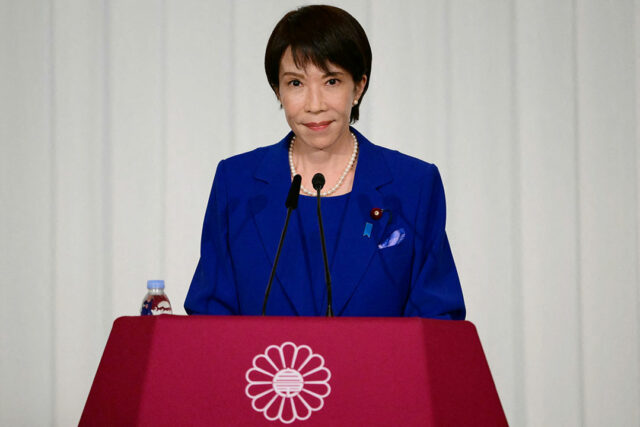
Sanae Takaichi, the newly elected leader of Japan’s ruling party, the Liberal Democratic Party (LDP), attends a press conference after the LDP presidential election in Tokyo on October 4, 2025. — YUICHI YAMAZAKI/POOL VIA REUTERS

TOKYO — Japanese Prime Minister (PM) Sanae Takaichi may call an early general election, the head of her party’s coalition partner said on Sunday, after media reported she was considering a February vote.

It would be the first time for the conservative Ms. Takaichi, Japan’s first female prime minister and a fan of Britain’s Margaret Thatcher, to face the voters, giving her a chance to capitalize on the strong public approval ratings she has enjoyed since taking office in October.

Her tough stance on China has appealed to right-wing voters but has sparked a major diplomatic dispute with Japan’s powerful Asian neighbor.

Hirofumi Yoshimura, leader of the Japan Innovation Party, known as Ishin, told public broadcaster NHK he had met with Ms. Takaichi on Friday and felt her view on the timing of an election had shifted to a “new stage.”

ELECTION WOULD COMPLICATE TAKAICHI’S SPENDING PLANS
“I wouldn’t be surprised if she made the decision as reported by the media,” Mr. Yoshimura said. The Yomiuri newspaper reported on Friday, citing government sources, that Ms. Takaichi was considering holding a snap election on Feb. 8 or 15.

Mr. Yoshimura said he and Ms. Takaichi did not discuss the specific timing of any election.

Ms. Takaichi was mum on when she would call an election during an interview with NHK recorded on Thursday and aired on Sunday.

Ms. Takaichi, an advocate of big spending to boost Asia’s second-biggest economy, said she had just instructed her cabinet ministers to ensure the timely execution of the supplementary budget for the fiscal year through March and parliamentary approval of next fiscal year’s budget.

“At present, I am focusing on the immediate challenge of ensuring that the public feels the benefits of our stimulus policies aimed at cushioning the blow of inflation,” she said.

But Tetsuo Saito, head of the opposition Komeito, said a February election “would make it impossible to pass the budget by the fiscal yearend, at a time Japan’s economy faces a critical phase,” telling NHK he was surprised by the reports that Ms. Takaichi was considering dissolving parliament when it convenes on Jan. 23.

Ms. Takaichi’s $783-billion spending proposal, her first budget as prime minister, includes her flagship spending program. The yen fell against the dollar on Friday after the Yomiuri report on her election plans.

Japan’s economy has weathered the hit from higher US tariffs, but stubborn food inflation has weighed on consumption.

If Ms. Takaichi cannot enact the budget by the end of March, her government would have to compile a stop-gap budget, which could delay execution of spending measures.

ECONOMIC RISK FROM CHINA DISPUTE
Japan’s internal affairs ministry issued a statement on Saturday urging regional election committees to start preparing in case of an early election. While the ministry said it was just responding to media reports, political analyst Shigenobu Tamura said the statement meant the election was a “done deal.”

Yoshihiko Noda, a former prime minister and head of the largest opposition group, the Constitutional Democratic Party of Japan, said he had expected Ms. Takaichi to pass the budget before calling an election but now felt she would dissolve parliament on Jan. 23.

Another economic risk for Japan is its trade tension with China, which could deal a blow to its export-reliant economy if Beijing imposes curbs on vital rare earths.

Ms. Takaichi touched off the dispute in November by saying a Chinese attack on democratically governed Taiwan could be deemed an existential threat to Japan, which could trigger a military response from Tokyo. China regards Taiwan as part of its territory, a claim the island’s government rejects.

Since then, China has urged its citizens not to travel to Japan, canceled meetings and events, and banned exports of dual-use items for Japan’s military, among other measures.

Ms. Takaichi told NHK that Chinese export curbs targeting Japan alone were against international protocols and unacceptable. Japan is negotiating with China through diplomatic channels, while working with its Group of Seven partners to build supply chains that reduce reliance on “a particular country,” she said.

Japan’s next lower house election does not need to be held until October 2028. A strong win in an early election would enhance Ms. Takaichi’s grip on the coalition. Her Liberal Democratic Party (LDP) and Ishin hold a narrow majority in the lower house but are in a minority in the upper house.

Ms. Takaichi became prime minister by winning the LDP presidency after her predecessor, Shigeru Ishiba, oversaw a string of electoral losses. She was approved by parliament but has not run in a national election. — Reuters

Thousands of Australians without power after tropical cyclone hit Queensland

STOCK PHOTO | Image by beasternchen from Pixabay

SYDNEY — Thousands of people in Australia’s northeast state of Queensland were without power on Sunday after a tropical cyclone crossed the coast bringing heavy rain and destructive winds.

Koji, a category one cyclone, made landfall between the towns of Ayr and Bowen, about 500 kilometers (310 miles) north of state capital Brisbane, before weakening to a tropical low, the nation’s weather forecaster said.

The storm, with wind gusts of up to 95 kilometers per hour (59 miles per hour) and heavy rain, hit coastal towns including Mackay, a tourist hub and gateway to the Great Barrier Reef, it said.

Queensland state Premier David Crisafulli said around 15,000 properties had lost power due to Koji, which had also damaged property and boats, and closed roads.

Koji brought rainfall of up to 200 millimeters (7.8 inches) to some areas overnight and was expected to result in heavy downpours over the next 24 to 48 hours, Mr. Crisafulli said.

“There’s the prospect of flooding, Queenslanders will handle that,” he said in televised remarks from Brisbane.

Earlier, Prime Minister Anthony Albanese described flash flooding as a “major risk” across a large stretch of Queensland’s coast.

The weather forecaster said the severe weather would likely persist through Sunday before possibly easing on Monday.

Koji comes after the state was hit in March by Alfred, a downgraded tropical cyclone, bringing damaging winds and heavy rains, cutting power to hundreds of thousands. — Reuters

North Korea’s Kim Yo Jong urges South Korea to investigate drone incidents

A North Korea flag flutters next to concertina wire at the North Korean embassy in Kuala Lumpur, Malaysia March 9, 2017. — REUTERS/EDGAR SU/FILE PHOTO

SEOUL — North Korea’s Kim Yo Jong, the powerful sister of leader Kim Jong Un, urged South Korea to investigate recent drone incidents over North Korean airspace, in a statement carried by state media KCNA on Sunday.

Ms. Kim said she appreciated Seoul for making a wise decision to announce its official stance that it has no intention of provocation, warning that any provocations will result in terrible situations.

Drones were flown from South Korea into North Korea earlier this month, after another intrusion in September, North Korea’s military said on Saturday, which was soon followed by South Korea’s response that they were not operated by the military.

South Korea also said there would be a thorough investigation of a civilian possibly having operated the drones, making clear its stance of having no intention of provocation.

“Clear is just the fact that the drone from the ROK violated the airspace of our country,” Ms. Kim said. ROK stands for the Republic of Korea, South Korea’s official name.

“No matter who is the perpetrator and whether it is a deed by any civilian organization or individual, the authorities responsible for national security can never evade their responsibility for it,” she said.

South Korea’s Office of National Security said on Sunday it would swiftly release results of its investigation into the drone incidents, as it reaffirmed the government’s stance of having no intention to provoke North Korea.

The administration of South Korean President Lee Jae Myung is seeking to improve ties with North Korea and has proposed military talks.

North Korea has not responded to any calls for dialogue with the South since leader Mr. Kim defined the two Koreas as separate, “hostile” nations at the end of 2023. — Reuters

BSP sees inflation rising toward target, rate cut cycle near end

BW FILE PHOTO

The Philippines’ central bank will keep weighing a feeble growth outlook against gradually rising inflation to set monetary policy in a balancing act that could bring an end to its easing cycle soon, Bangko Sentral ng Pilipinas (BSP) Deputy Governor Zeno Abenoja said on Friday.

“Inflation has the greatest weight in the policy discussions at the Monetary Board,” he told the Reuters Global Markets Forum.

“For the next two years, inflation will gradually go up, approaching the midpoint of the target, and that’s one reason why we think … monetary policy easing could be nearing its end,” Mr. Abenoja said, noting that near- and medium-term inflation are manageable.

INFLATION ACCELERATED IN DECEMBER
In December, annual inflation rose at its fastest pace in nine months, while monthly inflation registered the sharpest increase since September 2023. Still, average inflation for 2025 stood at 1.7%, the slowest since 2016.

Bangko Sentral ng Pilipinas (BSP) targets inflation in the range of 2%-4% over the medium term.

Economic momentum, meanwhile, weakened sharply in the third quarter, when growth slowed to 4.0% year-on-year, missing an estimate of 5.2% and down from 5.5% in the second quarter, as a corruption scandal linked to government infrastructure projects dented consumer and investor confidence. Fourth-quarter GDP data is scheduled for release on January 29.

“What is key right now is the uncertainty in the economic momentum that we are seeing,” Mr. Abenoja said, as third-quarter weakness might spill over into the first few months of 2026. He was, however, hopeful for a better growth number for the second-half of 2026, and even greater momentum in 2027.

Growth in 2025 is forecast to ease to 4.6%, below the governmentís 5.5%-6.5% target, compared with 5.7% last year. BSP projects 2026 growth in the 5%-6% range, and at 5.5%-6.5% for 2027.

NEXT MONETARY POLICY SESSION ON FEBRUARY 19
The central bank cut its policy rate for five straight meetings last year, bringing its benchmark rate to a three-year low of 4.5%. Its next monetary policy meeting is scheduled for February 19.

The government’s 2026 budget provides for spending to be kept under control to ensure taxpayer money is used responsibly, even as an earlier BSP forecast sees the country’s 2025 current account deficit at $15.5 billion, or 3.2% of GDP, slightly narrower than October’s forecast.

“The current account is mainly a reflection of still improving investment ratios, to fill in the infrastructure gap, and to increase productivity (and) potential output moving forward,” Mr. Abenoja said, adding that the Philippines needs more investments and external financing.

“Fiscal consolidation continues, but probably not as steep as or as fast as previously envisioned, given all the external developments,” he added.

Mr. Abenoja also reiterated the BSP’s position that it will not defend the currency as the economics don’t warrant it.

The peso has been hovering around its all-time low of 59.362 per dollar, hit in December, underperforming many of its emerging Asian peers in 2025 amid dollar weakness.

“We have to recognize certain periods where you can have big demand for dollars … It’s a healthy environment,” he said. “But we’re looking for those episodes that would have asymmetric effects on inflation.” — Reuters

Classroom observation policies under review, says DepEd

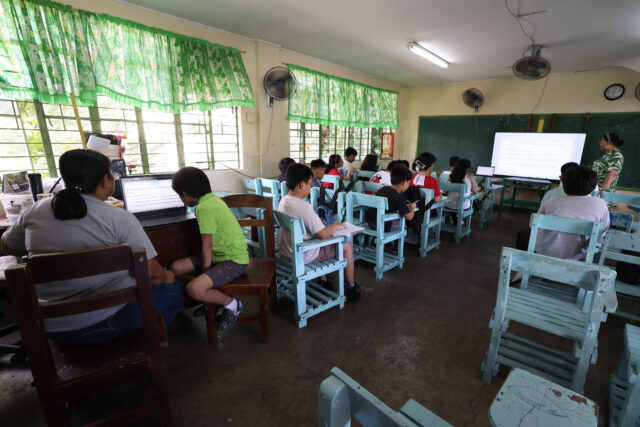
A teacher conducting basic reading comprehension exercises in Kamuning Elementary School in Quezon City, May 21, 2025. — PHILIPPINE STAR/MIGUEL DE GUZMAN

The Department of Education (DepEd) said on Friday that it is currently reviewing classroom observation policies, following the death of a public school teacher during the scheduled evaluation process.

“We’re ordering a review of the policy. Actually, that’s under review because that’s the complaint of the teachers that sometimes the environment has too much pressure,” Education Secretary Juan Edgardo “Sonny” M. Angara told reporters in an interview.

“That’s why we didn’t make it a sole basis. Before, it was the sole basis, and the visits were a surprise. We made it scheduled so the monitor, reviewer, and teacher can discuss their availability,” he added.

Classroom observation is one of the factors considered in teachers’ promotion.

“It’s a long-standing traditional way of reviewing teachers. Before, it was the only thing used in reviewing. We have changed it now, it’s only one of many factors considered,” said Mr. Angara.

“It’s a bit relaxed in the sense that it’s not too pressure-packed,” he added, citing review and feedback from the community as other considerations.

The death of Agnes Buenaflor, a teacher from Pedro E. Diaz High School in Muntinlupa City, on Wednesday has sparked calls for policy review and suspension among several groups.

The Teachers’ Dignity Coalition (TDC) on Friday urged the agency to suspend classroom observations and reinstate the Performance Appraisal System for Teachers (PAST), which the group claims is a “simpler and more developmental alternative.”

“Classroom observations must remain a supportive and formative process aimed at improving pedagogy and professional growth, and should never function as a punitive or judgmental mechanism,” TDC Chairperson Benjo G. Basas said in a statement on Friday.

“Teachers, particularly seasoned ones, are trained professionals who deserve policies that uphold professional trust, well-being, and dignity,” he added.

The Alliance of Concerned Teachers (ACT) echoed the same concern, highlighting the “burdensome” Results-based Performance Management System (RPMS).

Mr. Angara said, however, that the evaluation had no relation to the death of Ms. Buenaflor, linking it to medical concerns. “Based on our investigation, there was no coercion or intimidation. Teacher Agnes had a medical condition that day.” — Almira Louise S. Martinez

DepEd targets AI literacy, training for 1.5 million Filipinos in 2026

President Ferdinand R. Marcos Jr. leads the launch of the Department of Education’s (DepEd) Project AGAP.AI at Quezon City Science High School in Quezon City alongside Education Secretary Juan Edgardo “Sonny” M. Angara, Quezon City Mayor Josefina "Joy" G. Belmonte, and ASEAN Foundation Executive Director Dr. Piti Srisangnam, Jan. 9, 2026. — PHILIPPINE STAR/NOEL PABALATE

The Department of Education (DepEd) said on Friday that 1.5 million learners, teachers, and parents will benefit from its newly launched artificial intelligence (AI) program this year, which aims to educate and train Filipinos on the emerging technology.

“Right now, only 1.5 million are affected,” Education Secretary Juan Edgardo “Sonny” M. Angara told reporters in an interview.

“Once we finish our curriculum, hopefully by the second quarter…it will be released nationwide because it’s a national curriculum everyone will benefit from it,” he added.

The Project Accelerating Governance and Adaptive Pedagogy through Artificial Intelligence (Project AGAP.AI) is a large-scale capacity-building program for AI initiatives in basic education, funded by the ASEAN Foundation and powered by Google.org.

Under the program, a nationwide AI training, branded as AI Ready ASEAN Philippines, is expected to introduce AI in plain language by teaching fundamentals, practical classroom usage, ethics, data privacy, and addressing risks such as misinformation.

The reform to integrate the AI concept into the curriculum and teacher training is also supported by the Massachusetts Institute of Technology’s (MIT) Responsible AI for Social Empowerment & Education (RAISE) initiative and the Day of AI Initiative.

To complement classroom implementation, the AI-focused training modules for teachers will be rolled out in the second quarter of 2026.

“For teachers, [we are going to train them] how they can maximize, how can we make them more efficient and how to teach it,” Mr. Angara said.

“For students, how to research, and then, it’s gamified, as you can see, that’s why it’s attractive to students. It’s like they’re just playing,” he added.

Emerging AI-powered tools developed by the Education Center for AI Research (ECAIR) will also be piloted this year to support teaching, assessment, and school management. The DepEd said utilizing the new platforms will help strengthen data-driven and evidence-based decision-making within the education system.

“AI should not be a replacement for, as the President said in his speech, it’s not a replacement for hard work, for actual studying, for actual reading,” Mr. Angara said.

“Ethical use of AI is part of our training. What does that mean? We need to have rules. It’s not because it’s there that we’re going to use it to replace traditional thinking,” he added.

According to the National AI Strategy (NAIS PH) project of the Department of Science and Technology (DoST), the Philippines has set its goal to become an AI-powered country by 2028. — Almira Louise S. Martinez

US to provide $45 million to help implement Cambodian-Thai accords

STOCK PHOTO | Images by Aranjuezmedina from Freepik

THE UNITED STATES will provide $45 million in assistance to Cambodia and Thailand, the senior US diplomat for East Asia said on Friday during a visit to the region, to help solidify President Donald Trump’s peace-making efforts between the two.

“The United States will continue to support the Cambodian and Thai governments as they implement the Kuala Lumpur Peace Accords and pave the way for a return to peace, prosperity, and stability for their people and the region,” Michael DeSombre, the US assistant secretary for East Asia, said in a statement.

A senior State Department official said Mr. DeSombre would meet senior Thai and Cambodian officials in Bangkok and Phnom Penh on Friday and Saturday to discuss implementation of the peace accords “and broader efforts to promote our shared interests in a safer, stronger and more prosperous Indo-Pacific.”

Mr. DeSombre said the United States, which has slashed its global foreign assistance programs under Mr. Trump, would provide $15 million for border stabilization to help communities recover and to support people displaced by the recent conflict, and $10 million for demining and clearing of unexploded ordnance.

The US would also provide $20 million for initiatives that will help Cambodia and Thailand combat scam operations and drug trafficking, and other programs, Mr. DeSombre said.

The Trump administration has made combating the so-called scam centers based in Southeast Asia a priority, as US citizens have been targeted by their financial fraud operations.

Border clashes between Cambodia and Thailand flared up again last month after the collapse of a previous ceasefire deal brokered in July by Mr. Trump and Malaysian Prime Minister Anwar Ibrahim to end a previous round of conflict.

The Southeast Asian neighbors agreed on another ceasefire at the end of last year, halting 20 days of fighting that killed at least 101 people and displaced more than half a million on both sides. The more recent clashes included fighter-jet sorties, exchanges of rocket fire and artillery barrages.

Thailand is a long-time US ally, while the United States has sought to improve relations with Cambodia to try to woo it away from strategic rival China.— Reuters

DILG warns of petty criminals, thieves during Traslación 2026

Catholic devotees surround the carriage carrying the statue of Jesus Nazareno as it crosses Ayala Bridge during the annual feast-day procession in Manila on Friday, Jan. 9 2026.—PHILIPPINE STAR/RYAN BALDEMOR

Devotees participating in the ongoing procession of the Black Nazarene in Manila, called the Traslación, were reminded to be wary of pickpockets and thieves taking advantage of the event, the Department of the Interior and Local Government (DILG) said on Friday.

In an official statement, the DILG said it received early reports of pickpocketing incidents and snatchers victimizing devotees while they were practicing their faith.

“Wala pong pinipiling panahon ang mga mandarambong kaya po sana ay patuloy po na mag-ingat ang mga deboto na nakikilahok sa Traslación [Looters do not choose a specific time, so devotees participating in the Traslación are urged to remain vigilant],” the DILG said in a Facebook post issued a few hours earlier.

“Nakabantay po ang PNP (Philippine National Police) ngunit importante din po na tayo ay mag-ingat [The PNP is on alert, but it is also important for us to be cautious],” it added.

More than 18,000 police officers from the PNP were deployed along the Traslación route.

The PNP also deployed plainclothes operatives and intelligence units to counter pickpocketing, theft, scams, and other opportunistic offenses, the DILG said.

Organizers said the Traslación 2026 is expected to be completed within 15 hours.

The procession departed from Quirino Grandstand at 4:00 a.m and is set to return to its home at Quiapo Church.

As of this writing, the carriage, locally known as the andas, of the Black Nazarene was traversing Arlegui Street in Quiapo, Manila, according to the city government’s livestream.

The Black Nazarene procession is the annual transfer of the centuries-old image of Jesus Christ, drawing thousands—if not millions—of barefoot devotees as an expression of faith and penance.

Last year’s feast of the Black Nazarene drew an estimated 8.1 million devotees, one of the highest turnouts recorded since the COVID-19 pandemic.— Edg Adrian A. Eva

99% of firms report attacks targeting AI apps, services; agentic-first platform urged, report shows

STOCK PHOTO | Image by Gerd Altmann from Pixabay

Nearly all organizations or 99% reported at least one attack on their artificial intelligence (AI) applications and services last year amid the rapid adoption of enterprise AI, according to the State of Cloud Security Report 2025. The report urges the adoption of an “agentic-first” solution to stay ahead of these escalating threats.

​The study is based on a survey of over 2,800 security executives and practitioners across 10 countries, conducted by Palo Alto Networks, a global AI and cybersecurity firm.

​”As organizations aggressively scale cloud investments to power AI initiatives, they are inadvertently opening the door to sophisticated new attack vectors,” said Elad Koren, vice president of product management for Cortex, Palo Alto Networks’ AI-driven platform for security operations.

“Our research confirms that traditional approaches to cloud security are inadequate, leaving security teams to fight machine-speed threats with fragmented tools and slow, manual fix cycles.”

​She explained that companies need more than just dashboards showing security risks they cannot resolve, urging a shift toward automated AI platforms that link software development to the central Security Operations Center (SOC) to outpace modern cyberattacks.

​A major finding in the report is that GenAI-assisted “vibe coding,” used by 99% of firms, creates security flaws faster than they can be checked. Meanwhile, of the 52% of teams that release code weekly, only 18% can fix security risks at that same speed.

​The report also noted that attackers are increasingly targeting foundational cloud layers like Application Programming Interfaces (APIs), which are tools that allow different software programs to communicate, to overwhelm security teams.

Driven by a heavy reliance on agentic AI, API attacks have jumped by 41%, turning them into a primary entry point for sophisticated threats.

​Identity remains a significant vulnerability, with 53% of firms struggling with weak identity controls, while 28% pointed to unrestricted network access between cloud workloads as a growing threat.

The report emphasized a growing imperative for the unification of cloud security and the SOC, which involves merging the tools and teams that protect cloud data with the central hub that monitors and responds to cyberattacks.

It showed that managing an average of 17 different security tools creates “blind spots” and fragmented data that slow down response times, with 30% of teams taking over a day to resolve a single incident.

But, the consensus now shows that 89% of organizations believe that fully integrating cloud security with the SOC is a strategic necessity to eliminate these gaps and operate at the speed required to stop AI-driven threats.

​To defend against these threats, the report suggests adopting a unified “agentic-first” platform that merges proactive risk reduction with automated response to protect the entire journey from code to cloud.—Edg Adrian A. Eva

Higher power rates, weak peso may stoke inflation this year: BSP

Vendors sell pork inside the Balintawak Coverleaf Market in Quezon City. Photo by Miguel de Guzman, The Philippine Star

HIGHER electricity costs, base effects, and a weakening peso could push Philippine inflation back within the Bangko Sentral ng Pilipinas’ (BSP) 2%-4% target band this year.

“Inflation is projected to settle within the target range in 2026 and 2027 after a subdued inflation environment in 2025,” the BSP said in its Monetary Policy Report for December 2025.

The central bank expects the consumer price index (CPI) to average 3.2% this year and 3% in 2027.

In 2025, inflation averaged 1.7%, the slowest print seen in nine years or since the 1.3% in 2016.

“Higher electricity rates and possible positive base effects could drive inflationary pressures. These base effects follow the decline in food prices, particularly rice prices, in 2025,” the central bank said.

“Inflation is then expected to approach 4% by mid-2026 before easing toward 3% by Q2 2027, as global commodity prices stabilize.”

It added that the lagged impact of its previous rate cuts that may lead to demand-side price pressures, as well as the peso’s depreciation, could also stoke inflation.

The Monetary Board has cut benchmark interest rates by a total of 200 basis points (bps) since its easing cycle began in August 2024, bringing the policy rate to 4.50%.

BSP Governor Eli M. Remolona, Jr. has left the door open to one final cut this year to support the economy if needed. Philippine growth prospects have worsened as a wide-scale corruption scandal has affected both public and private investment.

The Monetary Board will hold its first rate-setting meeting for the year on Feb. 19.

Results of the BSP’s survey of 23 external forecasters (BSEF) for November showed that these governance concerns could continue to affect the economy, which may help temper price pressures.

The analysts see inflation averaging 2.9% for 2026, down from their earlier estimate of 3%. For 2027, their mean inflation forecast was likewise lower at 3% from 3.2%.

“Analysts cited the following upside risks to inflation: adverse weather conditions that could exacerbate food supply issues, upward adjustments in electricity rates, wage hikes, external developments and tariffs, and base effects,” the BSP said.

“The downside risk is seen to emanate from governance issues related to flood control projects, which could dampen the growth and inflation outlook.”

The November 2025 BSEF showed that the respondents assigned an 88.6% probability that inflation would remain within target this year, up from 75.4% in the October survey. The probability of inflation settling within the goal next year also increased to 89.6% from 71.2%.

“Most analysts expect the BSP to further reduce the policy interest rate by another 25–75 bps in 2026 and hold policy settings in 2027,” it added.

DISMAL GROWTH PROSPECTS
Meanwhile, the central bank said fragile business sentiment could continue to dampen economic growth as investment activity may remain weak.

Mr. Remolona earlier said gross domestic product (GDP) growth likely averaged 4.6% in 2025, well below the government’s 5.5%-6.5% full-year goal.

Economic managers have already said the 2025 target could be difficult to reach after the nine-month average was pulled down to 5% by the over four-year low 4% outturn in the third quarter as the graft scandal stalled public spending.

“The growth outlook for 2026 has likewise been lowered, as the investment slowdown is expected to persist through the first half of the year amid less favorable economic sentiment,” the central bank added.

“Growth is projected to be slightly higher in 2027, supported by the lagged impact of the BSP’s policy rate cuts since August 2024. Nonetheless, persistent uncertainty surrounding global economic policies, particularly in trade and investment, continues to pose downside risk to domestic growth.”

The BSP chief earlier said GDP growth could pick up to 5.4% this year, within the government’s revised 5%-6% target, and then to 6.3% in 2027 versus the 5.5%-6.5% goal.

“The output gap has become more negative relative to the previous round, as governance issues have dampened investment prospects… Investment activity is expected to moderate further in 2026, resulting in a negative output gap throughout the year. The output gap is projected to gradually narrow and approach a neutral level by end-2027,” the central bank said.

“At the same time, potential output growth is expected to moderate in the near term, as weak economic sentiment continues to constrain private investment. This is compounded by subdued public infrastructure spending following the proposed removal of flood control projects from the 2026 budget of the Department of Public Works and Highways.”

Still, consumption could be supported by rising real wages and household incomes, the BSP said. “[A] gradual recovery in investment activity and infrastructure spending is expected to underpin overall demand beginning in 2027.” — Katherine K. Chan

Puregold’s ‘Pusong Panalo’ brightens students’ path in remote Rizal village

In an upland village in Tanay, Rizal, children would trek for up to one hour before sunrise just to make it to class. Many from poor and indigenous families, these students have no choice but to walk just to get an education.

To help make their daily trek safer and their school days brighter, leading supermarket chain Puregold Price Club, Inc. recently brought a comprehensive support package for Alas-Asin Elementary school.

The company’s support includes a reliable power source through solar panels, health and dental checkups, and essential goods, including school supplies for students and grocery packs for families. It also built a new playground, giving the community’s children a well-equipped space for play.

To support teachers and learners’ families, Puregold also delivered livelihood packages to provide them with new means to earn a living.

Ang ganda ng lente ng Puregold, nakita kami. Sobrang liwanag, nakita ‘yung pangangailangan ng school,” according to school head Marvie Guinto. “Although green ang kulay niyo, ginintuan ang puso ng mga staff.”

She noted how Puregold’s gift bags were packed with goodies that many of the children had never even seen or tried before.

Sobrang saya po kasi po kami ang napili ng Puregold at nabigyan po kami ng pagkain, drinks, at snacks, mga chocolate po, tsinelas at damit,” said one of the beneficiary students.

“‘Yung mga blessings nila, sobra na. ‘Yung dala nila masyadong madami. Thank you po Puregold sa mga biyaya na binigay niyo sa amin,” another student said.

Alas-Asin was the sixth school to benefit from Puregold’s “Pusong Panalo” program in 2025, as the top retailer sustained its program that aims to bridge the gap between urban and rural areas by providing much needed aid to overlooked communities.

The program, which started in 2024, has reached eight schools across the country so far, with the goal of providing urgent support, including learning technology, essential goods, classroom renovations, and solar panel installations for 30 more schools by 2028.

“Puregold believes that education is the key to a better life. For these children, this school represents their hope for a brighter future. We came here to provide better tools and facilities so these students can achieve their dreams,” said Puregold President Vincent Co.

Puregold believes that every Filipino child with a “gintong pangarap” deserves a fighting chance. Its Pusong Panalo program is looking for more schools to help.

If you know of a school in a remote or underserved area that needs a helping hand, you may reach out to Puregold through the following channels.

Facebook: Message the official Puregold Page

Email: alingpuring@puregold.com.ph

Mail: Puregold Price Club Inc., 900 D. Romualdez St., Paco, Manila, 1007


Spotlight is BusinessWorld’s sponsored section that allows advertisers to amplify their brand and connect with BusinessWorld’s audience by publishing their stories on the BusinessWorld Web site. For more information, send an email to online@bworldonline.com.

Join us on Viber at https://bit.ly/3hv6bLA to get more updates and subscribe to BusinessWorld’s titles and get exclusive content through www.bworld-x.com.