Home Blog Page 1208

New Army Chief hails reservist leader Mikee Romero for Zamboanga efforts

Newly-appointed Philippine Army Commander Lt. Gen. Antonio Nafarrete presents the Western Mindanao Command symbol of appreciation to Lt. Gen. Mikee Romero, PAF Reserve Command, for his valuable efforts in the building of a covered court and assembly area in Barangay Mariki in Zamboanga City.

Lt. Gen. Antonio Nafarrete, who recently assumed command of the Philippine Army on Thursday, led the groundbreaking rites for the Barangay Mariki, Zamboanga City covered court and community assembly area, together with Lt. Col. Mikee Romero of the Philippine Air Force Reserve Command.

Among the first to congratulate Mr. Nafarrete was Mr. Romero, who hailed Mr. Nafarrete’s appointment as a major win for national security and civil-military unity.

Mr. Romero said, “Lt. Gen. Nafarrete’s service as head of the Western Mindanao Command has been marked by both bravery and compassion — qualities that will serve the Army and the nation well.”

Among Mr. Nafarrete’s final official acts as WestMinCom chief was leading the groundbreaking ceremony in Barangay Mariki, a vulnerable coastal barangay in Zamboanga City.

The project is part of WestMinCom’s 19th anniversary celebration and exemplifies the command’s continuing commitment to peacebuilding and community development.

Groundbreaking rites were recently held for the new covered assembly area and basketball court in Barangay Mariki, Zamboanga City, with Philippine Army Commander, Lt. Gen. Antonio Nafarrete, and Lt. Col. Mikee Romero, PAF Reserve Command, at the center in photo.

“This facility will stand as a symbol of unity, hope, and youth development,” Mr. Nafarrete said during the ceremony, held at a site that once bore witness to the challenges of the Marawi conflict.

He credited former congressman and reservist leader Mr. Romero for his significant support in making the project possible. Mr. Romero, also founding chairman of the Association of Reservists and Reservist Administrators of the Philippines, Inc., has long advocated for youth-centered, community-based initiatives across the country.

“This court will be more than just a sports venue,” said Mr. Romero, who is also a top businessman and sportsman.

“It will be a safe haven for our youth, a platform for community dialogue, and a symbol of solidarity and progress. We also plan to bring in more partners from Luzon to help deliver essential services and development support to Barangay Mariki.”

Zamboanga City Mayor Khymer Olaso also expressed gratitude to Mr. Romero and his delegation during a courtesy call, emphasizing the significance of the donation.

“The City Government is grateful for this meaningful gift to our community,” Mayor Olaso posted on social media. “It adds a vital dimension to our vision of a safer, stronger Zamboanga.”

Also present during the visit and ceremony were key members of the reserve force and local officials, including: Capt. Edwin T. Ello (Philippine Navy, GSC), Cmdr. Peter P. Negrido (Philippine Navy, Reserve), Lt. Col. Meliton Agpaoa (Philippine Army, Reserve), Lt. Col. Floreto Solano (Philippine Air Force, Reserve), Lt. Col. Gelacio Bongngat (Philippine Navy – Marines, Reserve), Lt. Col. Maria Josefina San Juan-Torres (Philippine Army, Reserve), Lt. Col. Anthony Villafranca (Philippine Air Force, Reserve), and Celso Lobregat, Secretary to the Mayor and Chief-of-Staff.


Spotlight is BusinessWorld’s sponsored section that allows advertisers to amplify their brand and connect with BusinessWorld’s audience by publishing their stories on the BusinessWorld Web site. For more information, send an email to online@bworldonline.com.

Join us on Viber at https://bit.ly/3hv6bLA to get more updates and subscribe to BusinessWorld’s titles and get exclusive content through www.bworld-x.com.

Southwoods City: The next big business hotspot in the south

Southwoods City’s excellent location just along the South Luzon Expressway enables businesses and people to travel conveniently to and from Metro Manila and other neighboring hubs and provinces.

By RAYMUND IGNACIO

In today’s fast-evolving business landscape, location is more than just geography—it’s strategy.

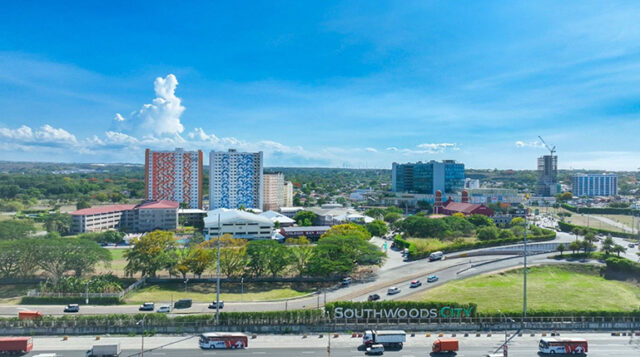
On the boundary between Biñan, Laguna and Carmona, Cavite just along the South Luzon Expressway (SLEX)—an enviable location for investors and businesses—lies Southwoods City, a 561-hectare integrated lifestyle community by property giant Megaworld subsidiary Global-Estate Resorts, Inc. (GERI). In this sprawling development south of Metro Manila, businesses can choose to establish or expand their presence through prime commercial lots that put them right in the center of vibrancy.

With lots ranging in size from 800 square meters to nearly 1,200 square meters, Southwoods City serves as an ideal location for retail shops, dining outlets, service centers, and even corporate headquarters. Backed by strong foot traffic and premium infrastructure, businesses can enjoy a rare opportunity to thrive within a high-growth corridor in Southwoods City.

Aside from unparalleled location accessibility, businesses eyeing commercial lots in Southwoods City also enjoy the convenience of having modern amenities and a lifestyle-centric environment that supports employee well-being and retention.

“Southwoods City’s prime location places businesses within easy reach of Metro Manila, making it ideal for company headquarters, satellite offices, and logistics hubs, just to name a few. Being located directly along SLEX, businesses enjoy convenient access to and from Metro Manila, as well as parts of Cavite, Laguna, and Batangas,” says Rachelle P. Hernandez, first vice president for sales and marketing, Megaworld Global-Estate, Inc.

Southwoods City can be reached within less than hour from Makati and Fort Bonifacio and is fast becoming one of CALABARZON’s most compelling business destinations, allowing businesses to enjoy direct access to and from Skyway and SLEX via the Southwoods Exit.

INSPIRED BY THE PH’S MOST THRIVING URBAN TOWNSHIPS

Unparalleled connectivity and integration have played huge roles in the success of some of the country’s top integrated urban districts, such as Eastwood City in Quezon City, McKinley Hill and Uptown Bonifacio in Taguig, and Newport City in Pasay. These developments have redefined urban living and enterprise by aligning commercial, residential, and lifestyle features with unmatched access to key infrastructure, all part of property giant Megaworld’s celebrated livework-play township concept.

The two office towers are integrated into Southwoods Mall, a proud development that won the ‘Best Commercial Landscape Architectural Design’ award at the Philippines Property Awards by PropertyGuru a few years back.

From proximity to major highways and transport hubs to walkable layouts that connect offices to retail, residences, and civic spaces, Southwoods City and these townships showcase how integration drives vibrancy, productivity, and investor confidence.

A VIBRANT COMMUNITY WITHIN REACH

Surrounding these lots are two PEZA-accredited office towers with almost 60,000 square meters of gross leasable spaces combined and designed for BPOs and multinational firms. There’s also the Southwoods Mall, a sprawling residential village, residential condominiums Holland Park and Tulip Gardens, and the 125-hectare Jack Nicklaus-designed Manila Southwoods Golf and Country Club. Also located nearby are the Sto. Niño de Cebu Parish Church, Colegio San Agustin, and Unihealth Southwoods Hospital.

“Southwoods City’s integrated setup fosters a vibrant ecosystem where business executives and office employees can live, work, and unwind—all within a walkable community. More importantly, its strategic access to business centers, the Ninoy Aquino International Airport (NAIA), and other essential locators offer a unique opportunity for businesses to scale efficiently while enjoying a workplace-community experience that balances productivity with quality of life,” adds Hernandez.

The integrated lifestyle community features a seamless blending of residential, commercial, and leisure spaces, creating a balanced environment that attracts talent and ensuring steady and diverse customer exposure for businesses.

As CALABARZON continues to attract industrial and commercial expansion, Southwoods City stands out as a future-ready platform for growth where entrepreneurs enjoy accessibility, infrastructure, and a vibrant community while scaling their businesses sustainably.

Find out more about these prime commercial lots and other offerings in Southwoods City by visiting www.megaworldglobalestatesouth.com. You may also reach them through 09175253797 or by searching Megaworld GlobalEstate, Inc. on Facebook.


Spotlight is BusinessWorld’s sponsored section that allows advertisers to amplify their brand and connect with BusinessWorld’s audience by publishing their stories on the BusinessWorld Web site. For more information, send an email to online@bworldonline.com.

Join us on Viber at https://bit.ly/3hv6bLA to get more updates and subscribe to BusinessWorld’s titles and get exclusive content through www.bworld-x.com.

Going Dutch: LGBTQ+ Americans find Trump-free life in Netherlands

STOCK PHOTO | Image by Chandlervid85 from Freepik

 – It had been months since Alex and Lucy, a trans couple from Arizona, felt safe enough to hold hands in public. They rediscovered that pleasure after moving to Amsterdam this year.

The couple, who did not want to give their last names because of the sensitivity of the subject, decided to leave the United States soon after Donald Trump was re-elected last year.

They arrived in the Netherlands on Jan. 19, the day before Mr. Trump was inaugurated and swiftly issued an executive order saying the government would only recognize two sexes – male and female.

“We’re both visibly trans and faced growing discrimination. It ramped up right after the election,” said Lucy, sitting alongside Alex in their De Pijp apartment in Amsterdam’s south.

“It felt like people had taken off their masks – waiting for an excuse to finally say what they wanted. We went from being tolerated to openly despised,” she added.

Alex, who is disabled, feared staying put might also mean losing access to their federal health insurance.

“In the end, it became a matter of life and death,” Alex said.

In his first six months in office, Mr. Trump has enacted multiple policies affecting the lives of LGBTQ+ Americans in areas from healthcare to legal recognition and education.

In the face of this rollback of rights, some LGBTQ+ people have voted with their feet.

While there is little official data, LGBTQ+ people and activists told the Thomson Reuters Foundation that many people head to Portugal and Spain, while Costa Rica and Mexico are also popular destinations, alongside France and Thailand.

The Netherlands stands out, though, for its strong legal protections, its record on LGBTQ+ inclusivity, and due to a Dutch–American Friendship Treaty (DAFT) and its affiliated visa.

DAFT – established as a 1956 act of Cold War cooperation – enables U.S. citizens to live and work in the Netherlands if they start a small business investing at least 4,500 euro ($5,200), can secure Dutch housing, and are able to prove they have enough money to live on.

The permit is valid for two years and can be renewed.

“Europe was always on the cards, but the Netherlands had a really high percentage of queer folks, and we knew people here (who) were trans and happy,” said Lucy, who got a DAFT visa.


‘NUMBERS INCREASING’

While the Dutch Immigration and Naturalization Service (IND) does not keep statistics on the sexual orientation or gender identity of DAFT applicants, overall applications have increased since 2016, with January 2025 registering the highest number of any single month on record – 80.

“The numbers are increasing. We don’t know why,” said Gerard Spierenburg, IND spokesperson.

Immigration lawyers also report an increase.

“From the day after the election, my inbox began filling up with requests of U.S. citizens wanting to move to the Netherlands,” said lawyer Jeremy Bierbach, adding that about a fifth came from the LGBTQ+ community.

Three other lawyers in Amsterdam confirmed the trend in interviews with the Thomson Reuters Foundation.

Jack Mercury, a trans adult performer from California, moved to Amsterdam almost a year and a half ago – “literally the moment I knew Trump was going to be re-elected”.

He said the DAFT visa was “one of the few financially accessible visas” for him.

He now lives in west Amsterdam with a partner and two cats.

“The words to describe the U.S. in the last 100 days are uncertainty and fear. For trans people, it’s fear that they’ll lose access to healthcare, rights like housing or the ability to work. And for gay people and lesbians, it’s that they will become the next targets,” Mr. Mercury said.

This year, more than 950 anti-trans bills were introduced in U.S. state legislatures, according to the Trans Legislation Tracker, of which 120 have passed, 647 failed, and 186 are still under consideration.

“I feel very lucky. I know many people who cannot afford to move, because they’re not high earners, they are sick, have family or children,” said Mr. Mercury.

His friend Topher Gross, a trans hair stylist from New York who has been in Amsterdam for four years, offered housing tips and recommended a lawyer.

“Everyone’s exploring any possible way to get out,” said Mr. Gross. “But not everyone can – many trans people of colour can’t afford to leave. It’s terrifying.”

He noted that the climate of fear was exacerbated by deportations under Mr. Trump’s crackdown on illegal immigration.

“Basic rights are being stripped away.”

Jess Drucker, an LGBTQ+ relocation expert with U.S.-based Rainbow Relocation, said many U.S. clients choose to go Dutch.

“People see how quickly rights can erode, with the global rise of right-wing extremism, and want to move somewhere where those rights are more likely to hold,” Drucker said.

“We’ve seen a major increase in requests for consultations. We are absolutely full.”

Because not everyone can afford a DAFT visa, the Dutch NGO LGBT Asylum Support is urging the government to consider asylum options for LGBTQ+ Americans.

Spokesperson Sandro Kortekaas said about 50 trans Americans had contacted the group since Trump’s inauguration.

In June, the group asked the government to reassess the status of the United States as a safe country for queer asylum seekers. However, Bierbach does not expect success as such a shift would be seen “as a provocation towards the U.S.”

Spierenburg from the IND said there had been more asylum applications from the United States this year than last, although the numbers were still low – 33 against 9 in 2024.

Lucy and Alex are grateful for their new life.

“When I came here, I felt more at home than I ever did. I have so much hope,” said Lucy.

But she does worry that a future Dutch administration – a right-wing coalition collapsed in June – could kill off DAFT.

“I’m really concerned that the treaty is going to be damaged by current political agendas. And so I’m doing everything I can to make sure that I stay within the rules. I don’t want to be extradited for any reason.” – Reuters

White House defends firing of labor official as critics warn of trust erosion

STOCK PHOTO | Image from Rawpixel

 – White House economic advisers on Sunday defended President Donald Trump’s firing of the head of the Bureau of Labor Statistics, pushing back against criticism that Trump’s action could undermine confidence in official U.S. economic data.

Later on Sunday, Trump again criticized BLS Commissioner Erika McEntarfer, without providing evidence of wrongdoing, and said he would name a new BLS commissioner in the next three or four days.

U.S. Trade Representative Jamieson Greer told CBS that Trump had “real concerns” about the BLS data, while Kevin Hassett, director of the National Economic Council, said the president “is right to call for new leadership.”

Mr. Hassett said on Fox News Sunday the main concern was Friday’s BLS report of net downward revisions showing 258,000 fewer jobs had been created in May and June than previously reported.

Mr. Trump accused Ms. McEntarfer of faking the jobs numbers, without providing any evidence of data manipulation. The BLS compiles the closely watched employment report as well as consumer and producer price data.

The BLS gave no reason for the revised data but noted “monthly revisions result from additional reports received from businesses and government agencies since the last published estimates and from the recalculation of seasonal factors.”

Ms. McEntarfer responded to her abrupt dismissal on Friday in a post on the Bluesky social media platform, saying it was “the honor of her life” to serve as BLS commissioner and praising the civil servants who work there.

Ms. McEntarfer’s firing added to growing concerns about the quality of U.S. economic data and came on the heels of a raft of new tariffs on dozens of trading partners, sending global stock markets tumbling as Trump presses ahead with plans to reorder the global economy.

Investors also are watching the impact of the surprise resignation of Federal Reserve governor Adriana Kugler, which opened a spot on the central bank’s powerful board and could shake up what was already a fractious succession process for Fed leadership amid difficult relations with Mr. Trump.

Mr. Trump said on Sunday he would announce a candidate to fill the open Fed position within the next couple days.


REVISIONS ARE COMMON

In an interview with CBS’ “Face the Nation,” Greer acknowledged there were always revisions of job numbers, “but sometimes you see these revisions go in really extreme ways.”

Brian Moynihan, CEO of Bank of America, said large revisions of economic data could undermine public confidence and that government officials should develop ways of improving data quality.

“They can get this data, I think, other ways and I think that’s where the focus ought to be: how do we get the data to be more resilient and more predictable and more understandable?” he said on CBS. “Because what bounces around is restatements … that creates doubt about it.”

Critics, including former leaders of the BLS, slammed Trump’s move and called on Congress to investigate Ms. McEntarfer’s removal, saying it would shake trust in a respected agency.

“It undermines credibility,” said William Beach, a former BLS commissioner and co-chair of the group Friends of the BLS.

“There is no way for a commissioner to rig the jobs numbers,” he said. “Every year we’ve revised the numbers. When I was commissioner, we had a 500,000 job revision during President Trump’s first term,” he said on CNN’s “State of the Union.”

Former Treasury Secretary Larry Summers, who worked in both the Clinton and Obama administrations, also criticized Ms. McEntarfer’s firing.

“This is a preposterous charge. These numbers are put together by teams of literally hundreds of people following detailed procedures that are in manuals,” Summers said on ABC’s “This Week.”


LARGE REVISION

The BLS surveys 121,000 employers – businesses and government agencies – each month, seeking their total payroll employment during the week in which the 12th day of the month falls. The response rate has fallen sharply since the COVID pandemic, from 80.3% in October 2020 to about 67.1% in July.

Knowing that, BLS allows late-arriving employer submissions, and revisions to earlier submissions, to be taken into account over the next two months.

That means each month’s initial estimate of employment for the immediately preceding month also contains revisions to the two months before that.

The revisions in Friday’s report were large by historic standards. The downward revision of 125,000 jobs for May was the largest between a second estimate and third estimate since a 492,000 reduction for March 2020. That was the largest ever and was reported in June 2020 for the payrolls report for May 2020. – Reuters

China’s independent oil firms elbow into Iraq’s majors-dominated market

STOCK PHOTO | Image by Ratfink1973 from Pixabay

 – China’s independent oil companies are ramping up operations in Iraq, investing billions of dollars in OPEC’s number two producer even as some global majors have scaled back from a market dominated by Beijing’s big state-run firms.

Drawn by more lucrative contract arrangements, smaller Chinese producers are on track to double their output in Iraq to 500,000 barrels per day by around 2030, according to estimates by executives at four of the firms, a figure not previously reported.

For Baghdad, which is also seeking to lure global giants, the growing presence of the mostly privately run Chinese players marks a shift as Iraq comes under growing pressure to accelerate projects, according to multiple Iraqi energy officials. In recent years, Iraq’s oil ministry had pushed back on rising Chinese control over its oilfields.

For the smaller Chinese firms, managed by veterans of China’s state heavyweights, Iraq is an opportunity to leverage lower costs and faster development of projects that may be too small for Western or Chinese majors.

With meagre prospects in China’s state-dominated oil and gas industry, the overseas push mirrors a pattern by Chinese firms in other heavy industries to find new markets for productive capacity and expertise.

Little-known players including Geo-Jade Petroleum Corp., United Energy Group, Zhongman Petroleum and Natural Gas Group and Anton Oilfield Services Group made a splash last year when they won half of Iraq’s exploration licensing rounds.

Executives at smaller Chinese producers say Iraq’s investment climate has improved as the country becomes more politically stable and Baghdad is keen to attract Chinese as well as Western companies.

Iraq wants to boost output by more than half to over 6 million bpd by 2029. China’s CNPC alone accounts for more than half of Iraq’s current production at massive fields including Haifaya, Rumaila and West Qurna 1.


PROFIT-SHARING, RISK TOLERANCE

Iraq’s shift a year ago to contracts based on profit-sharing from fixed-fee agreements – an attempt to accelerate projects after ExxonMobil and Shell scaled back – helped lure Chinese independents.

These smaller firms are nimbler than the big Chinese companies and more risk-tolerant than many companies that might consider investing in the Gulf economy.

Chinese companies offer competitive financing, cut costs with cheaper Chinese labor and equipment and are willing to accept lower margins to win long-term contracts, said Ali Abdulameer at state-run Basra Oil Co, which finalizes contracts with foreign firms.

“They are known for rapid project execution, strict adherence to timelines and a high tolerance for operating in areas with security challenges,” he said. “Doing business with the Chinese is much easier and less complicated, compared to Western companies.”

Smaller Chinese firms can develop an oilfield in Iraq in two to three years, faster than the five to 10 years for Western firms, Chinese executives said.

“Chinese independents have much lower management costs compared to Western firms and are also more competitive versus Chinese state-run players,” said Dai Xiaoping, CEO of Geo-Jade Petroleum, which has five blocks in Iraq.

The independents have driven down the industry cost to drill a development well in a major Iraqi oilfield by about half from a decade ago to between $4 million and $5 million, Dai said.


TRADE-OFFS

A Geo-Jade-led consortium agreed in May to invest in the South Basra project, which includes ramping up the Tuba field in southern Iraq to 100,000 bpd and building a 200,000-bpd refinery. Geo-Jade, committing $848 million, plans to revive output at the largely mothballed field to 40,000 bpd by around mid-2027, Dai told Reuters.

The project also calls for a petrochemical complex and two power stations, requiring a multi-billion-dollar investment, said Dai, a reserve engineer who previously worked overseas with CNPC and Sinopec.

Zhenhua Oil, a small state-run firm that partnered with CNPC in a $3 billion deal to develop Ahdab oilfield in 2008, the first major foreign-invested project after Saddam Hussein was toppled in 2003, aims to double its production to 250,000 bpd by 2030, a company official said.

Zhongman Petroleum announced in June a plan to spend $481 million on the Middle Euphrates and East Baghdad North blocks won in 2024.

Chinese firms’ cheaper projects can come at the expense of Iraq’s goal to introduce more advanced technologies.

Muwafaq Abbas, former crude operations manager at Basra Oil, expressed concern about transparency and technical standards among Chinese firms, which he said have faced criticism for relying heavily on Chinese staff and relegating Iraqis to lower-paid roles.

To be sure, some Western firms are returning to Iraq: TotalEnergies announced a $27 billion project in 2023, and BP is expected to spend up to $25 billion to redevelop four Kirkuk fields in the semi-autonomous Kurdish region, Reuters reported. – Reuters

Iran sets up new defense council in wake of war with Israel

STOCK PHOTO | Image by jorono from Pixabay

 – Iran’s top security body approved the establishment of a National Defense Council on Sunday, according to state media, following a short air war with Israel in June that was Iran’s most acute military challenge since the 1980s war with Iraq.

“The new defense body will review defense plans and enhance the capabilities of Iran’s armed forces in a centralized manner,” the Supreme National Security Council’s Secretariat was quoted as saying by state media.

The defense council will be chaired by Iranian President Masoud Pezeshkian, and consists of the heads of the three government branches, senior armed forces commanders, and relevant ministries.

On Sunday, the commander-in-chief of Iran’s military, Amir Hatami, warned that threats from Israel persist and should not be underestimated. – Reuters

UK’s FCA proposes 9 billion to 18 billion pound redress scheme for motor finance claims

REUTERS

 – Britain’s Financial Conduct Authority (FCA) on Sunday proposed a redress scheme for consumers with motor finance compensation claims following last week’s Supreme Court ruling, estimating the cost at between 9 billion and 18 billion pounds ($12 billion and $24 billion).

Friday’s court decision had calmed the industry’s worst fears about the size of the bill it would face over improperly disclosed commissions on car loans – a sum analysts had estimated could run to tens of billions of pounds.

However, after considering that ruling, which was largely seen as a win for the banks, the FCA still proposed an industry-wide redress scheme for certain types of compensation claims.

“At this stage, we think it is unlikely that the cost of any scheme, including administrative costs, would be materially lower than 9 billion pounds and it could be materially higher,” the FCA said in a statement.

It said the total cost was hard to estimate. It cautioned that any estimates were indicative and susceptible to change, but it said those in the middle of the 9 billion to 18 billion pounds range were “more plausible.”

Some level of further compensation payout had still been expected by banks after Friday’s ruling, placing investor focus on the FCA’s decision over whether to launch a full redress scheme, what it might look like, and how much it would cost.

Lenders, including Lloyds Banking Group, Close Brothers, Barclays and the UK arms of Santander and Bank of Ireland, have already set aside nearly 2 billion pounds between them to cover potential motor finance compensation claims.

The FCA said firms should now refresh estimates of their liabilities, increase provisions where necessary, and keep markets informed.


CONSUMER FAIRNESS

Prior to the Supreme Court ruling, which overturned a previous court decision, there were fears the cost of redress could rival that of a payment protection insurance mis-selling scandal, which cost lenders over 40 billion pounds between 2011 and 2019.

The proposed motor finance scheme would cover so-called discretionary commission arrangements – those where the broker could adjust the interest rate offered to a customer – if they had not been properly disclosed.

The consultation will also look at which non-discretionary commission arrangements should be included.

The regulator said agreements dating back to 2007 should be considered and it would publish a consultation by early October, with an expectation that people start receiving compensation in 2026.

“Our consultation will cover how firms should assess whether the relationship between the lender and borrower was unfair for the purposes of our scheme,” the statement said.

“Any redress scheme must be fair to consumers who have lost out and ensure the integrity of the motor finance market, so it works well for future consumers.”

The consultation will also look at how interest is calculated on compensation, saying it estimated a simple annual rate of around 3% would be applicable.

The regulator said it had not decided whether the scheme should require customers to opt in, or be automatically involved unless they opt out. – Reuters

A call for smarter tax policy: Why the Philippines must lead bold reforms now

By Mon Abrea

Chief Tax Advisor, Asian Consulting Group

Following the Philippines’ 2025 State of the Nation Address, I offer this perspective, not as a politician or academic observer, but as someone who has worked closely with taxpayers, policymakers, international experts, and MSMEs to push for reforms that promote inclusive growth, responsible investment, and public trust.

After recently completing a tax policy program at Duke University’s Sanford School of Public Policy and building on past work in collaboration with international institutions and business communities, I believe this is the right time and opportunity to act.

If we want a more competitive and equitable Philippines, we must begin with a tax system that rewards productivity, empowers small businesses, and invites responsible foreign investment, without placing unnecessary burdens on those who already comply.

Five Policy Priorities to Transform the Philippine Tax System

As the 20th Congress of the Philippines opens a new legislative session, it presents a critical opportunity to advance genuine tax reform that balances fiscal responsibility, ease of doing business, and inclusive economic growth. Based on global best practices, local realities, and over a decade of field experience, I respectfully propose the following five tax policy priorities:

  1. 10% Minimum Tax for Self-Employed and Professionals (SEPs)

Establish a fair, predictable, and administratively simple baseline tax for self-employed individuals and professionals, who currently contribute disproportionately less to national revenue.

Despite earning substantial incomes, less than 3% of total income tax collections come from professionals, and less than 10% from the self-employed. In contrast, over 85% of individual income tax collections come from withholding taxes on individuals with fixed incomes.

This proposal seeks to:

  • Promote equity and broaden the tax base
  • Minimize tax evasion and underdeclaration
  • Encourage voluntary compliance through a flat, non-punitive rate

It’s a practical and politically viable way to restore fairness without increasing the burden on salaried workers or MSMEs.

  1. Risk-Based and Digital Audit System

    Replace outdated, discretionary audit selection with data-driven, risk-based frameworks supported by digital infrastructure. This will ensure audit resources are focused on high-risk, high-impact cases and reduce abuse and corruption in enforcement.

Current audit-related and deficiency collections account for less than 3% of total revenues, while 97% of tax collections rely on voluntary compliance. This exposes a systemic inefficiency and a need to professionalize tax enforcement.

This reform will:

  • Eliminate arbitrary selection and harassment
  • Improve taxpayer confidence
  • Maximize collection efficiency through targeted enforcement

Countries like Estonia and Chile have already proven how digital audit systems can dramatically increase compliance and transparency.

  1. Strengthen Super IPAs to Streamline Tax and Investment Processes

Empower Super Investment Promotion Agencies (IPAs) with centralized authority over regulatory processes, including national and local taxes, customs, permits, and audit coordination, for all Registered Business Enterprises (RBEs).

This addresses one of the most cited concerns of both foreign and domestic investors: fragmentation, duplicative audits, and inconsistent local policies.

By institutionalizing Super IPAs, we can:

  • Protect legitimate investors from regulatory friction and overlapping audits
  • Lower compliance costs and eliminate bureaucratic redundancies
  • Align incentives with national development goals and ESG priorities

This approach mirrors successful models in Singapore and the UAE, where regulatory streamlining is a cornerstone of global competitiveness.

  1. Full Automation, or Institutional Reform, of Tax Administration

Modernize the tax system through complete end-to-end digital transformation, or if necessary, abolish and replace the current tax authority with an independent, professionally managed institution.

Corruption and inefficiency thrive in manual, discretionary systems. To build credibility and restore public trust, the Bureau of Internal Revenue (BIR) must either:

  • Be fully automated, minimizing human discretion; or
  • Transition into a government-owned but privately managed authority, similar to Singapore’s Inland Revenue Authority (IRAS), operating with less political interference and greater professional accountability.

This bold reform will:

  • Improve taxpayer experience and reduce red tape
  • Prevent leakages and strengthen data-driven decision-making
  • Signal political will for real institutional change
  1. Simplified and Tiered Compliance Framework for MSMEs

Adopt a graduated and proportional compliance system for Micro, Small, and Medium Enterprises (MSMEs) based on turnover, industry, and capacity.

The issue is not just tax rates, but the cost, complexity, and fear of compliance. Many MSMEs and informal enterprises avoid registration not to evade taxes, but to avoid complicated rules, high fees, and frequent inspections.

A simplified framework will:

  • Encourage formalization and improve inclusion
  • Reduce the burden on micro and marginal income earners
  • Create a culture of compliance built on trust, not fear

With more than 99% of businesses in the Philippines classified as MSMEs, empowering them through tax simplicity is vital to inclusive recovery and national resilience.

These five tax policy priorities aim to build a modern, investment-friendly, and citizen-focused tax system; one that collects fairly, administers efficiently, and supports long-term economic transformation.

These reforms are not just policy options; they are economic necessities. Without a smarter, more inclusive tax system, we will continue to burden those who are already compliant, while failing to capture untapped revenues and foreign investment opportunities.

Reimagining the World: Starting with Tax

These priorities align with the core message of my book series, Reimagining the World, which seeks to confront the world’s most urgent challenges through systemic reforms. The first volume, Without Corruption, launched at Harvard. The second, Without Climate Change, will be released this August at Oxford. The final installment, Without Poverty, will be published in 2025 and focuses on eradicating poverty through inclusive economic and tax policies.

Tax policy is not just a matter of collection. It reflects our national values and determines who bears the cost of development and who gets left behind. It can, and must, be a tool for equity, resilience, and empowerment.

A Global Effort with Local Impact

To promote this agenda, I will lead an international tax and investment roadshow across the United States, Europe, Oceania, and Asian Region, including stops in New York, Washington D.C., Los Angeles, San Francisco, London, Paris, Madrid, Milan, South Korea, Dubai, Sydney, and Melbourne.

This roadshow will include:

  • Investment dialogues with foreign business chambers and embassies
  • Tax and policy briefings with global think tanks and Filipino leaders abroad
  • The launch of Reimagining the World: Without Climate Change
  • Engagements with international partners to position the Philippines as an ESG-aligned investment destination

The world is watching how we reform and rebuild. If we want to be seen as a serious investment hub, we must have a tax system that reflects competence, consistency, and a real commitment to inclusive growth.

As the SONA Concluded

To the President’s address, there was no renewed commitment to genuine tax policy reform, not merely as a revenue measure, but as a foundational pillar of good governance, economic justice, and global competitiveness.

Let’s not waste another year debating reforms we already know we need. Let’s act. Let’s lead. 

Let’s reimagine the Philippines and the world through smarter, bolder, and more inclusive tax policies.

Let’s get to work.

About the Author:

Mon Abrea is a global tax policy expert and the Founding Chairman and Chief Tax Advisor of the Asian Consulting Group (ACG), the Philippines’ leading tax advisory firm. A Harvard-educated public servant and Oxford-trained climate policy specialist, he recently completed the Tax Policy Executive Program at Duke University’s Sanford School of Public Policy to strengthen his work in shaping global tax reforms, particularly in developing economies like the Philippines.

Widely recognized as the most prominent advocate of genuine tax reform in the Philippines, Abrea works closely with policymakers, international organizations, and foreign investors to modernize the country’s tax system, attract sustainable investments, and protect micro, small, and medium enterprises (MSMEs). He is also the author of the Reimagining the World book series, which envisions a world without corruption, climate change, and poverty.


Spotlight is BusinessWorld’s sponsored section that allows advertisers to amplify their brand and connect with BusinessWorld’s audience by publishing their stories on the BusinessWorld Web site. For more information, send an email to online@bworldonline.com.

Join us on Viber at https://bit.ly/3hv6bLA to get more updates and subscribe to BusinessWorld’s titles and get exclusive content through www.bworld-x.com.

Poll: Inflation likely slowed in July

People buy goods at the Commonwealth Market in Quezon City. Inflation likely slowed to 1.2% in July, a BusinessWorld poll showed. — PHILIPPINE STAR/EDD GUMBAN

By Luisa Maria Jacinta C. Jocson, Senior Reporter

HEADLINE INFLATION likely fell to a near six-year low in July due to softer prices of food and fuel, analysts said.

A BusinessWorld poll of 17 analysts yielded a median estimate of 1.2% for the July consumer price index, within the central bank’s 0.5%-to-1.3% forecast for the month.

The July print would be slower than the 1.4% in June and 4.4% clip a year ago.

Analysts’ September inflation rate estimates

If realized, this would be the slowest inflation in nearly six years or since the 0.6% print posted in October 2019.

The Philippine Statistics Authority is scheduled to release the July inflation data on Tuesday (Aug. 5).

“For July inflation, my forecast is 1.2% and drivers continue to be soft food prices and muted nonfood prices, especially in energy despite some pump price adjustments of late,” Sun Life Investment Management and Trust Corp. economist Patrick M. Ella said.

In July, pump price adjustments stood at a net decrease of P1.10 a liter for gasoline and P1.10 a liter for kerosene. On the other hand, it stood at a net increase of P1.20 for diesel.

Pantheon Macroeconomics Chief Emerging Asia Economist Miguel Chanco said the headline rate may have slowed in July “thanks to what should be a drop in food inflation into the red, outright.”

“Food and energy prices will likely remain subdued, although the impact of lower rice tariffs, which took effect in late June 2024, will fade from annual comparisons,” Moody’s Analytics economist Denise Cheok said.

Nicholas Antonio T. Mapa, chief economist at Metropolitan Bank & Trust Co. said July will likely mark the fifth straight month of below-target inflation this year as rice deflation persists.

Rice inflation has been on the decline in the last few months as the government has deployed several measures to tame prices of the staple grain. These include slashing tariffs on rice imports, declaring a food security emergency on the commodity, and lowering the maximum suggested retail price (MSRP) for imported rice.

In June, rice inflation decelerated for the sixth straight month to a record 14.3%, the biggest drop since 1995.

“Moreover, the high base effect (given that inflation peaked at 4.4% in July 2024) is expected to help keep the year-on-year figure subdued despite the monthly increase,” Bank of the Philippine Islands Lead Economist Emilio S. Neri, Jr. said.

Rizal Commercial Banking Corp. Chief Economist Michael L. Ricafort also noted the one-year anniversary of the tariff cut on rice imports, which were slashed to 15% from 35% in July 2024.

“Base effects likely played a huge role but retail prices, too, remained manageable month on month,” HSBC economist for ASEAN Aris D. Dacanay said.

“Softer prices of rice, fruits, and LPG may have also contributed to the slowdown, though these may have been tempered by higher costs of fuel, electricity, and other key food items such as vegetables, meat, fish, eggs, and cooking oil,” Chinabank Research said.

Analysts also noted the upside risks to the inflation print for the month.

“The uptick was mainly driven by higher oil prices, electricity rates, and select food items such as vegetables, fish, and meat,” Mr. Neri said.

Manila Electric Co. (Meralco) hiked rates by P0.4883 per kilowatt-hour (kWh) in July, bringing the overall rate for a typical household to P12.6435 per kWh from P12.1552 per kWh a month earlier.

“Upward price pressures were seen, however, in electricity rates and diesel but we don’t think these were enough to offset the deflationary pressures from rice and gas,” Mr. Dacanay said.

BAD WEATHER
Meanwhile, some analysts surveyed expect July inflation to accelerate from a month ago as bad weather disrupted economic activity in key areas.

“The uptick is driven by lagged effects of food and transport costs, weather-related supply disruptions from early monsoon and typhoon activity, and seasonal demand linked to school openings and midyear bonuses,” Ruben Carlo O. Asuncion, chief economist at Union Bank of the Philippines, said.

The latest data from the Department of Agriculture showed damage to the agriculture sector from three successive tropical storms and the southwest monsoon has climbed to P3 billion.

“The recent wave of typhoons and bad weather may have also affected domestic supply chains especially for food, which may have caused the price increases,” Oikonomia Advisory & Research, Inc. economist Reinielle Matt M. Erece added.

Mr. Asuncion also noted exchange rate movements influenced import prices.

The peso fell to P58.32 against the greenback at end-July from its finish of P56.33 at end-June. The peso’s close at end-July was its weakest in almost six months or since its P58.34 finish on Feb. 4.

FURTHER EASING?
With inflation still below the 2-4% target, analysts said the Bangko Sentral ng Pilipinas (BSP) has more than enough room to continue on its rate-cutting cycle.

“Inflation remains below target and is forecast to remain within target over the policy horizon, giving BSP ample space to cut rates and support moderating growth momentum,” Mr. Mapa said.

Chinabank Research expects the central bank to deliver another 25-bp cut at its meeting later this month.

“With inflation possibly falling to its lowest since October 2019 — and average inflation expected to remain below target this year — we think the BSP has room to continue easing monetary policy with a 25-bp rate cut at its August meeting,” it said.

The Monetary Board’s next meeting is on Aug. 28.

“We’re currently looking at a 25-bp rate cut from the BSP this month, as the window for easing could likely narrow starting in the fourth quarter, with headline inflation seen rebounding toward the 3% level, and possibly even higher in 2026,” Mr. Neri said.

BSP Governor Eli M. Remolona, Jr. has said a rate cut is still on the table at their policy review later this month.

“The BSP may continue its policy easing with another 25-bp cut in their next meeting. This is as inflation continues to be below the 2% target and gross domestic product (GDP) growth is still expected to be below the ideal 6% growth or faster,” Mr. Erece said.

Chinabank said a weaker-than-expected second-quarter GDP print would likely further strengthen the case for a cut.

Meanwhile, Security Bank Corp. Vice-President and Research Division Head Angelo B. Taningco said there is a possibility that the BSP could hold rates this month.

“We still expect further monetary easing but may not be immediate for this month of August as the recent and expected peso depreciation could weigh on it,” he said.

The central bank could also remain cautious moving forward, analysts said.

“Subsequent moves following a potential August cut are expected to be more measured, with our in-house view seeing further reductions in the fourth quarter as less likely,” Mr. Neri said.

He cited inflation risks, a prolonged hawkish stance from the Federal Reserve and substantial current account deficit, which could constrain the BSP’s flexibility in adjusting monetary policy.

“A pause in the fourth quarter may be warranted to help manage pressure on the local currency,” Mr. Neri added.

Mr. Ella said a rate cut in the fourth quarter is possible “if growth will surprise on the downside due to trailing impact of global tariffs.”

“The BSP will be closely monitoring potential inflationary pressures stemming from geopolitical tensions and tariff-related supply-chain disruptions,” Ms. Cheok added.

Mr. Chanco expects the Monetary Board to cut at least twice before the year ends.

Mr. Remolona earlier said he is keeping to his outlook for two more rate cuts this year. After August, the Monetary Board has two remaining meetings scheduled for October and December.

“Moving forward, inflation will likely begin its steady climb as the favorable base effects from lower rice prices fade,” Mr. Dacanay said.

“Nonetheless, with inflation staying within the lower-end range of the BSP target band, there is room for the BSP to continue its easing cycle and, perhaps, deepen the cycle further in the last five months of the year.”


PHL loses tariff edge as US also sets 19% rate on 4 ASEAN members

A US FLAG and a “tariffs” label are seen in this illustration taken on April 10, 2025. — REUTERS/DADO RUVIC/ILLUSTRATION

By Aubrey Rose A. Inosante, Reporter

THE PHILIPPINES may have lost its edge in the US market as the US imposed a similar 19% tariff on imports from Indonesia, Cambodia, Malaysia and Thailand, analysts said.

Analysts warned this may undermine the Philippines’ competitiveness as it erodes the margin of preference and limits opportunities for trade diversion.

In an executive order signed on July 31, US President Donald J. Trump imposed a 19% duty on many goods from five members of the Association of Southeast Asian Nations (ASEAN) — the Philippines, Cambodia, Malaysia, Thailand and Indonesia. This will take effect on  Aug. 7.

“What we’ve been saying before is that a 20% or even 19% tariff is acceptable — as long as our competitors have higher rates than us,” Philippine Exporters Confederation, Inc. (Philexport) President Sergio Ortiz-Luis, Jr. said in a phone interview over the weekend.

“The problem now in Asia is that countries like Japan and South Korea have even lower tariffs, and now we’ve been matched by Indonesia, Thailand, and the rest of the ASEAN+5, who are also our direct competitors. That’s where the problem lies for us.”

The Philippines had received the smallest tariff discount among ASEAN members even though Philippine President Ferdinand R. Marcos, Jr. met with Mr. Trump at the White House. The new rate is slightly lower than the 20% the US had threatened to impose, but higher than the 17% tariff announced in April.

Unlike the Philippines, other ASEAN countries received significant tariff discounts from the US, namely, Indonesia (from 32%) Malaysia (from 25%), Thailand (from 36%), Cambodia (from 36%), and Vietnam (from 46%).

At the same time, Mr. Trump set 15% duty on goods from South Korea (from 25%) and Japan (from 25%).

As the new US tariffs are set to take effect on Aug. 7, Trade Secretary Ma. Cristina A. Roque said the talks with the US are still ongoing to come up with a “mutually beneficial deal.”

“While some ASEAN member states got also 19% reciprocal tariff rate, I am not aware what deals or concessions were given for that because every country has its own sensitivities and priorities,” Ms. Roque told BusinessWorld in a Viber message on Saturday.

LOWER EXPORTS
Mr. Ortiz-Luis warned the higher US tariffs will dampen demand for Philippine goods, which will lead to lower exports for the US market. He said this also leaves no room for Philippine exporters to increase prices as regional competitors now have similar or lower tariff rates.

In June, the United States was the top destination for Philippine-made goods amounting to $1.22 billion, 35.2% higher from the same month a year ago.

“[Exporters] will be scared. We look to the government now to come up with mitigating measures to support our exporters. But I don’t know if the government is prepared to do that,” he said.

Mr. Ortiz-Luis also said the exporters group is still in the dark on the comprehensive details of the recent US-Philippines trade deal

Jose Enrique A. Africa, executive director at IBON Foundation, said “the Philippines loses much of the margin of preference and price-based advantage that the government was counting on to offset our underdeveloped manufacturing workforce, infrastructure, and ecosystem.”

He also said the changes in tariff rates in the region further reduce the chances of the Philippines benefiting from trade diversion or US manufacturers looking for supply-chain players.

“The right direction is definitely not to recklessly pursue more free trade agreements, since decades of such openness have already led to our premature deindustrialization and current inability to compete or take advantage of market access, even when it exists on paper,” Mr. Africa said.

Former Tariff Commissioner George N. Manzano said the Philippines is “not disadvantaged” even though it has the same US tariff rates as  Cambodia, Malaysia, Thailand, and Indonesia.

“My only observation is that in relative terms, we paid a steep price in concessions in terms of tariff revenue foregone by agreeing to duty-free imports of US imports in some products compared to our ASEAN neighbors, because we had a reduction of only 1 percentage point from 20%,” Mr. Manzano told BusinessWorld in a Viber message.

Finance Secretary Ralph G. Recto earlier said the government is anticipating between P3 billion and P6 billion in foregone revenues following its decision to grant zero tariffs on selected US products such as automobiles, wheat, soy, and pharmaceuticals.

Meanwhile, Ms. Roque said the Philippines remains competitive as it recently introduced economic reforms such as the Corporate Recovery and Tax Incentives for Enterprises to Maximize Opportunities for Reinvigorating the Economy Act, and free trade agreements with other countries.

BSP to refine economic surveillance tools

High-rise buildings dominate the Manila and Makati skyline. — PHILIPPINE STAR/EDD GUMBAN

THE Bangko Sentral ng Pilipinas (BSP) is working on further refining their economic surveillance tools to better capture data and enhance policymaking, an official said.

The central bank is shifting from mainly traditional data to more soft data in their monitoring, surveillance, and assessment, BSP Deputy Governor Zeno Ronald R. Abenoja said.

“We’re trying to improve a lot of things at the central bank, including our ability to monitor what’s happening on the ground real time and what it means going forward,” he told reporters on Friday.

“As we improve the surveillance, it helps us communicate, hopefully, what we think is happening on the ground and what we think are important developments that could affect policies moving forward.”

For example, the BSP is studying how to mine more data from the Consumer Expectations Survey and Business Expectations Survey.

“We are reviewing the instruments. We want to improve the ease of filling up or getting more information,” he said, adding that they are also reviewing the content of these surveys.

The BSP is also looking at how to streamline the data without sacrificing the information gathered.

“We are trying to improve our ability to mine more information from these different surveys. We are also trying to improve our understanding of what’s happening in the different regions.”

Mr. Abenoja said the BSP is also working to improve the data capture effectiveness of their surveys, and is considering the use of supplementary surveys.

He cited the US Federal Reserve, which uses strategic surveys on consumer sentiment that have more forward-looking aspects of household expectations.

“We’re thinking of doing those types (of survey) that are more forward-looking to have a sense how households are thinking of reacting or their expectations under different circumstances.”

Policy recommendations to the Monetary Board would be based on more solid and current information, he added.

The BSP is also keen on implementing more early warning exercises to better “anticipate possible scenarios that could influence developments and impact our policy stance.”

It is also studying how to leverage developments in the information technology sector and harness computing power.

FX PlAYBOOK
Meanwhile, Mr. Abenoja said they are in the process of developing an “FX (foreign exchange) playbook.”

“There are a lot of studies, analysis being done on the relationship between exchange rate and inflation, exchange rate and inflation expectations,” he said.

BSP Governor Eli M. Remolona, Jr. earlier said they are seeking to develop a “playbook” to guide foreign exchange intervention.

“There are asymmetric effects and threshold effects. The impact of FX movements on inflation is not the same in the sense that the significant, sharp depreciation over a short period of time could have big implications on inflation,” Mr. Abenoja said.

“But we may want to smooth out this impact on inflation because sometimes there are swings, there is a deficit and then it suddenly returns to the previous level. But the impact on inflation is already there,” he said.

Mr. Abenoja said there is room for foreign exchange intervention to smooth out its effects.

“The playbook is being reviewed… to ensure there is a development on our analysis of the dynamics of foreign exchange market. We want to preserve our flexible exchange rate regime,” he said.

“But probably we can improve the inflation dynamics by smoothing out some of these temporary effects of exchange rate on inflation, so we’re doing the playbook.” 

Meanwhile, in a separate memorandum, the BSP is advising banks on the revised the Residential Real Estate Price Index (RREPI), which seeks to provide a more comprehensive overview of the sector.

In a memorandum posted on its website, the BSP reminded universal and commercial banks, thrift banks and digital banks to submit their quarterly reports on residential real estate loans and appraised commercial properties in view of the revised index.

“With the transition to the hedonic methodology, the RREPI has been renamed the Residential Property Price Index (RPPI),” it said.

All references to the RREPI shall now refer to RPPI, it added.

“This change aligns the index’s nomenclature with international standards and more accurately reflects its comprehensive coverage of residential property prices on the banking segment of the market.”

The BSP monitors banks’ exposure to the property sector as part of its mandate to maintain financial stability.

The RREPI tracked the average price changes of residential properties across different housing types and locations.

The BSP in a separate notice said the RREPI relied on “simple averages (and) oversimplified the residential property market by assuming homogeneity within the stratum and failing to address outliers.”

“The use of hedonic regression — widely regarded as the gold standard in property price index generation — allows for the observation of how intrinsic characteristics of the residential real estate market independently influence prices,” it added.

The latest first-quarter data were released with the RPPI format. Latest data showed that the RPPI rose by an annual 7.6% in the January-March period, though slower than the 9.8% expansion logged in the fourth quarter. — Luisa Maria Jacinta C. Jocson

IPO pipeline seen to stay thin for remainder of 2025

BW FILE PHOTO

By Revin Mikhael D. Ochave, Reporter

DOMESTIC initial public offering (IPO) activity is expected to remain limited for the rest of the year amid uncertainties related to tariffs, according to analysts.

Only three initial public offerings are expected to take place this year, which would be half of the Philippine Stock Exchange’s (PSE) target of six, said DragonFi Securities, Inc. Equity Research Analyst Jarrod Leighton M. Tin in a Viber message.

Aside from the lone IPO so far — Cebu-based fuel distributor and retailer Top Line Business Development Corp. in April — Mr. Tin said two more companies could push through with their public listing plans this year, consisting of integrated resort operator Hann Holdings, Inc. and west zone water concessionaire Maynilad Water Services, Inc.

“The tepid IPO pipeline reflects a subdued market environment and lingering uncertainty over the US tariff policies, both of which continue to dampen investor appetite and discourage companies from listing. We believe IPO sentiment will likely remain muted under these conditions,” Mr. Tin said.

United States President Donald J. Trump announced a 19% tariff rate for products from the Philippines following a meeting with President Ferdinand R. Marcos, Jr. in Washington. The tariff rate is marginally lower than the 20% that Mr. Trump threatened to impose, but higher than the 17% announced in April.

“Investor sentiment is being weighed down by global concerns such as the trade tariffs, alongside local worries such as inflation and interest rates,” Unicapital Securities, Inc. Research Head Wendy B. Estacio-Cruz said in a Viber message.

Despite the cautious outlook, Ms. Estacio-Cruz said there is still some room for optimism.

However, she said the planned IPOs of GCash operator Globe Fintech Innovations, Inc. (Mynt) and the real estate investment trust (REIT) of Sy-led property developer SM Prime Holdings, Inc. are unlikely to happen this year.

“There’s some appetite for IPOs, especially for companies with solid fundamentals or exposure to resilient sectors like gaming, tech, and logistics,” she said.

“Big names like GCash or SM Prime’s REIT might be a stretch this year, but if market conditions hold steady, we could see a few more listings, especially from firms that have been waiting for the right timing,” she added.

Jayniel Carl S. Manuel, Seedbox Securities, Inc. sales and trading department assistant manager, said in a Viber message that the local bourse could see three to four IPOs this year depending on market sentiment.

“Realistically, I think we’ll be lucky to see three to four IPOs push through this year, assuming market sentiment remains cautious,” he said.

“While there’s still investor interest, most are becoming more selective, favoring proven names over riskier bets. Unless a major player like GCash or SM Prime REIT surprises us, I don’t see a significant pickup in IPO filings for the rest of the year,” he added.

On July 17, the Securities and Exchange Commission (SEC) approved the IPO of Hann Holdings, which expects to generate up to P11.43 billion in net proceeds. The company is expected to list its IPO on Sept. 23.

Maynilad postponed its IPO to no later than end-October from its initial listing date of July 17 to accommodate interest from cornerstone investors. The water provider aims to raise up to P37.41 billion in net proceeds.

Last month, the PSE raised its target for capital raising this year to over P186 billion, with some P123.7 billion expected in the second half.

The market operator raised about P62.6 billion in the first six months.

Pangilinan-led conglomerate Metro Pacific Investments Corp., which holds a majority stake in Maynilad, is one of three Philippine subsidiaries of First Pacific Co. Ltd., alongside Philex Mining Corp. and PLDT Inc.

Hastings Holdings, Inc., a unit of PLDT Beneficial Trust Fund subsidiary MediaQuest Holdings, Inc., has an interest in BusinessWorld through the Philippine Star Group, which it controls.

ADVERTISEMENT
ADVERTISEMENT