Home Blog Page 1155

US losing out on China soybean sales as Brazil fills key supply period

REUTERS

SINGAPORE/BEIJING – U.S. soybean exporters risk missing out on billions of dollars worth of sales to China this year as trade talks drag on and buyers in the top oilseed importer lock in cargoes from Brazil for shipment during the key U.S. marketing season, according to traders.

Chinese importers have finished booking soybean cargoes for September, taking around 8 million metric tons, all from South America, three traders told Reuters.

For October, Chinese buyers have secured about 4 million tons – half of their expected requirement – also from South America, the traders said.

“China’s heavy Q3 soybean purchases suggest the industry has built up inventories ahead of potential Q4 supply risks,” said Wang Wenshen, an analyst at Sublime China Information.

Last year, Chinese oilseed importers bought around 7 million tons from the U.S. for shipments during the two months.

The risk of a prolonged absence of Chinese purchases for the U.S. crop year starting in September amid unresolved trade tensions could add pressure on Chicago futures Sv1 trading not far from five-year lows, traders said.

Typically, most Chinese purchases of U.S. soybeans are shipped between September and January, before Brazilian supplies take over after South America’s harvest.

Chinese buyers are expected to complete this year’s October bookings by early next month, said a trader at an international firm in Singapore.

There could be some room for U.S. to sell soybeans towards the end of 2025 or early next year, but volumes are likely to be limited if tariffs remain.

“The consensus is that Brazil won’t have enough beans, when all is said and done, to satisfy China’s import requirements,” said Terry Reilly, senior agricultural strategist for Marex.

“So there’s going to be a shortfall late in the season. On a Brazilian crop year basis, they may fall short by about two to five million tons.”

China has been cutting its dependence on U.S. agricultural products since the trade war under President Donald Trump’s first term.

Last year, China imported roughly 105 million metric tons of soybeans. Of that, 22.13 million tons came from the U.S., worth $12 billion.

TRADE TENSIONS CLOUD OUTLOOK
On Sunday, Mr. Trump urged China to quadruple its soybean purchases ahead of a tariff truce deadline, a target that analysts said was unfeasible as it would require China to buy almost exclusively from the U.S.

The next day, the two sides extended their tariff truce by 90 days.

However, three traders told Reuters the extension by itself was unlikely to spur purchases, as Beijing’s tariff on U.S. soybean imports remains at 23% – making them uncompetitive.

China could resume buying U.S. soybeans if an agreement to reduce duties is reached.

“One possible scenario is that if both sides reach a deal in November, China could resume buying U.S. soybeans, potentially extending the U.S. export window and putting pressure on Brazil’s new-crop sales,” said Johnny Xiang, founder of Beijing-based AgRadar Consulting.

Excluding tariffs, U.S. soybeans for October shipment are around $40 per ton cheaper than Brazilian cargoes being bought by China, two traders said.

China has plentiful soybeans on hand after stepping up imports with purchases hitting record highs in recent months. — Reuters

Bitcoin hits fresh record as Fed easing bets add to tailwinds

Representations of cryptocurrency Bitcoin are seen in this illustration picture taken in Paris, France. — REUTERS/BENOIT TESSIER/ILLUSTRATION/FILE PHOTO

TOKYO – Bitcoin hit a record high on Thursday as increasing expectations for easier monetary policy from the Federal Reserve added to tailwinds from recently announced financial reforms.

The world’s largest crypto-asset by market capitalization climbed as much as 0.9% to $124,002.49 in early Asia trading, surpassing its previous peak hit in July. On the day, the second largest crypto-token ether hit $4,780.04, the highest level since late 2021.

Bitcoin’s rally is being powered by increasing certainty of Fed rate cuts, sustained institutional buying and moves by the Trump administration to ease investment in crypto assets, said IG market analyst Tony Sycamore.

“Technically a sustained break above $125k could propel BTC to $150,000,” he wrote in a note.

Bitcoin has risen nearly 32% so far in 2025 on the back of long-sought regulatory wins for the sector following President Donald Trump’s return to the White House. Trump has called himself the “crypto president” and his family has made a series of forays into the sector over the past year.

An executive order last week paved the way to allow crypto assets in 401(k) retirement accounts, highlighting an increasingly favorable regulatory environment in the United States.

Crypto has scored multiple regulatory wins in the U.S. over 2025, including the passage of stablecoin regulations and the U.S. securities regulator’s move to overhaul regulations in order to accommodate the asset class.

Bitcoin’s surge has also sparked a broader rally in the asset class over the past few months, shrugging off the tremors of Trump’s wide-ranging tariff policies.

According to data from CoinMarketCap, the crypto sector’s overall market capitalisation has ballooned to over $4.18 trillion, up from about $2.5 trillion in November 2024, when Trump won the U.S. presidential election.

The latest push for crypto adoption in the United States came via an executive order on Thursday last week, which would ease access to the asset class in 401(k) retirement accounts.

The executive order could also be a boost for asset managers such as BlackRock and Fidelity, which operate crypto exchange-traded funds (ETFs).

Crypto’s push into retirement savings can also be peppered with risks, as the asset class tends to experience much more volatility than stocks and bonds, which asset managers had typically relied on for such accounts. — Reuters

Chinese investors eyeing Indonesia to avoid US tariffs, tap local market

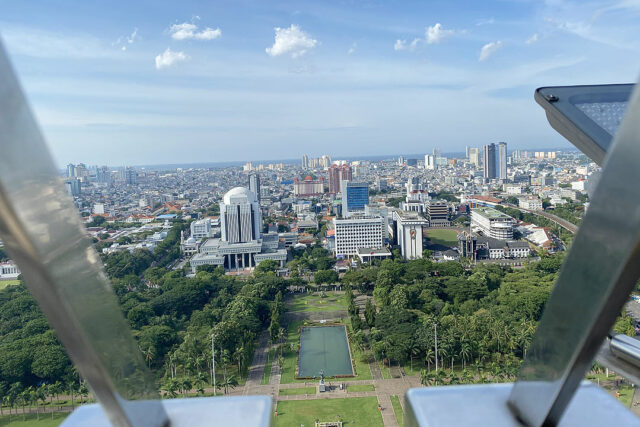
JAKARTA SKYLINE — the view from the top of the National Monument. — JOHN VICTOR D. ORDOÑEZ

JAKARTA – Gao Xiaoyu, the founder of an industrial land consulting firm in Jakarta, has been inundated with calls from Chinese companies eager to expand or set up operations in Indonesia as they try to shield themselves from the United States’ hefty import tariffs.

The 19% U.S. tariff rate for goods from Indonesia is the same as for Malaysia, Philippines and Thailand, and just below Vietnam’s 20%. China’s rates currently exceed 30%.

But Indonesia, Southeast Asia’s biggest economy and the world’s fourth most populous country, has an edge over its neighbors – the potential of its vast consumer market.

“We are quite busy these days. We have meetings from morning till night,” said Gao, who set up her company PT Yard Zeal Indonesia in 2021 with four employees and now has more than 40.

“The industrial parks are also very busy.”

Indonesia’s economy expanded at a better-than-expected 5.12% in the second quarter, the fastest pace in two years, government data showed last week.

“If you can establish a strong business presence in Indonesia, you’ve essentially captured half of the Southeast Asian market,” said Zhang Chao, a Chinese manufacturer who sells motorcycle headlights in Indonesia, the world’s third biggest market for motorbikes.

Vietnam and Thailand were among the major beneficiaries of the first wave of Chinese companies’ overseas diversification, but amid the latest trade turmoil with the United States, other near neighbors are benefiting.

“There has always been a synergy … with Chinese corporates having the confidence to set up shop with ease in Indonesia,” said Mira Arifin, the Indonesia country head at Bank of America. “Indonesia has a huge talent pool with a dynamic young demographic that encourages foreign investors to rapidly build scale in the country.”

Indonesian President Prabowo Subianto has championed China ties, visiting Beijing in November where he held talks with President Xi Jinping and welcoming the Chinese Premier Li Qiang to Jakarta in May.

Investment from China and Hong Kong into Indonesia was up 6.5% year-on-year to $8.2 billion in the first six months of 2025. Total FDI grew 2.58% over the same period to 432.6 trillion rupiah ($26.56 billion), and the government has said it expects more investments in the second half of the year.

MASSIVE CONSUMER MARKET
To be sure, challenges persist across Indonesia, including regulatory hurdles, bureaucratic red tape, ownership restrictions, deficient infrastructure and the lack of a complete industrial supply chain that made China the “workshop of the world” for decades.

Some foreign investors have also raised concerns about the populist Prabowo’s fiscal prudence, as he pushes ahead with his campaign promises, including a flagship programme to deliver free meals to schoolchildren and pregnant women.

After falling in March to its lowest level against the U.S. dollar since June 1998, the rupiah has steadied. It is currently trading about 1% below its level at the end of last year.

At the sprawling, more than 2,700 hectare (6,672 acres) Subang Smartpolitan industrial park in West Java, executives said it had been inundated with enquiries from Chinese investors.

“Our phone, email and WeChat were immediately busy with new customers, agents wanting to introduce clients,” once the U.S.-Indonesia trade deal was announced last month, said Abednego Purnomo, vice-president for sales, marketing and tenant relations of Suryacipta Swadaya, Subang Smartpolitan’s operator.

“Coincidentally, all of them were from China.”

Companies ranging from toy makers and textile firms to electric vehicle makers are scouring for facilities, particularly in West Java, the most populous province in Indonesia, which is home to the Patimban deep sea port.

Chinese demand has pushed up prices of industrial real estate and warehouses by 15% to 25% year-on-year in the first quarter of 2025, the fastest rise in 20 years, according to Gao, from the land consulting firm.

Rivan Munansa, the head of industrial and logistics services at the Indonesian arm of global property consultant Colliers International said that there was an urgency among Chinese firms to move and the company was getting inquiries for industrial land “almost every day” in the run-up to the tariff agreement.

“Most of them (Chinese companies) are looking for immediate opportunities. So, they want land and a temporary building that can be used immediately, it’s like a crash programme,” Rivan said.

Zhang said he signed up for a new four-floor office building in Jakarta in May at an annual rent of 100,000 yuan ($13,936), up 43% from last year, underscoring the pent-up demand.

“The 19% level is lower than my expectation. I thought it would be 30%,” Zhang said, referring to Indonesia’s tariff deal and adding that net profit margins in China could be as little as 3%.

“In Indonesia, it’s relatively easy to achieve net profit margins of 20% to 30%.”

And then there’s the growing pool of consumers with household spending making up more than half of Indonesia’s GDP. The gauge accelerated slightly to 4.97% year-on-year in the second quarter, helped by several public holidays.

“Indonesia has always stood out for a different reason. Beyond supply chain diversification, Indonesia offers what few others in the regions can: a massive domestic market,” said Marco Foster, ASEAN director at Dezan Shira & Associates, an investment consultancy. — Reuters

Trump orders easing of commercial spaceflight regulations, in boon to Musk’s SpaceX

STOCK PHOTO | Image by Arek Socha from Pixabay

WASHINGTON – U.S. President Donald Trump signed an executive order on Wednesday to streamline federal regulation governing commercial rocket launches, a move that would benefit Elon Musk’s SpaceX and other private space ventures.

Mr. Trump’s order, among other things, directs the U.S. transportation secretary to eliminate or expedite environmental reviews for launch licenses administered by the Federal Aviation Administration, the White House said in a statement.

The declaration also calls on the secretary to do away with “outdated, redundant or overly restrictive rules for launch and reentry vehicles.”

“Inefficient permitting processes discourage investment and innovation, limiting the ability of U.S. companies to lead in global space markets,” the executive order states.

It added: “Overly complex environmental and other licensing and permitting regulations slow down commercial space launches and infrastructure development, and benefit entrenched incumbents (who can afford to bear the expense of regulatory compliance) over new market entrants (who cannot).”

Although Mr. Musk and Mr. Trump have remained embroiled in a high-profile feud for months, the billionaire entrepreneur’s SpaceX rocket and satellite venture potentially stands to be the single biggest immediate beneficiary of Mr. Trump’s order on Wednesday.

SpaceX, although not mentioned by name in the executive order, easily leads all other U.S. space industry entities, including NASA, in the sheer number of launches it routinely conducts.

Mr. Musk has complained that environmental impact reviews and post-flight mishap investigations have repeatedly slowed down testing of SpaceX’s ambitious new Starship rocket vehicle, under development at the company’s South Texas launch facility. — Reuters

Trump threatens ‘severe consequences’ if Putin blocks Ukraine peace

Army soldier figurines are displayed in front of the Ukrainian and Russian flag colors background in this illustration taken, Feb. 13, 2022. — REUTERS/DADO RUVIC/ILLUSTRATION

WASHINGTON/BERLIN – U.S. President Donald Trump threatened “severe consequences” if Russia’s Vladimir Putin does not agree to peace in Ukraine but also said on Wednesday that a meeting between them could swiftly be followed by a second that would include the leader of Ukraine.

Mr. Trump did not specify what the consequences could be, but he has warned of economic sanctions if his meeting with Putin in Alaska on Friday proves fruitless.

The comments by Mr. Trump and the outcome of a virtual conference with Trump, European leaders and Ukrainian President Volodymyr Zelenskiy held on Wednesday could provide encouragement for Kyiv after fears the Alaska summit could end up selling out Ukraine by carving up its territory.

However, Russia is likely to resist Ukraine and Europe’s demands strongly and previously has said its stance had not changed since it was first detailed by Mr. Putin in June 2024.

When asked if Russia would face any consequences if Mr. Putin does not agree to stop the war after Friday’s meeting, Mr. Trump responded: “Yes, they will.”

Asked if those consequences would be sanctions or tariffs, Mr. Trump told reporters: “I don’t have to say. There will be very severe consequences.”

But the president also described the aim of the meeting between the two leaders in Alaska as “setting the table” for a quick follow-up that would include Mr. Zelenskiy.

“If the first one goes okay, we’ll have a quick second one,” Mr. Trump said.

“I would like to do it almost immediately, and we’ll have a quick second meeting between President Putin and President Zelenskiy and myself, if they’d like to have me there.”

Mr. Trump did not provide a time frame for a second meeting.

RED LINES
European leaders and Mr. Zelenskiy had earlier spoken with Mr. Trump in a last-ditch call hosted by Germany to lay out red lines ahead of the Alaska meeting.

“We had a very good call. He was on the call. President Zelenskiy was on the call. I would rate it a 10, very friendly,” Mr. Trump said.

French President Emmanuel Macron said Trump agreed Ukraine must be involved in any discussions about ceding land, while Mr. Zelenskiy said Mr. Trump had supported the idea of security guarantees in a post-war settlement.

“President Trump was very clear that the United States wanted to achieve a ceasefire at this meeting in Alaska,” Mr. Macron said.

“The second point on which things were very clear, as expressed by President Trump, is that territories belonging to Ukraine cannot be negotiated and will only be negotiated by the Ukrainian president.”

German Chancellor Friedrich Merz, who hosted the virtual meeting, said the principle that borders could not be changed by force must continue to apply.

“If there is no movement on the Russian side in Alaska, then the United States and we Europeans should … increase the pressure,” he said.

“President Trump knows this position. He shares it very extensively and therefore I can say: We have had a really exceptionally constructive and good conversation with each other.”

Mr. Trump and Mr. Putin are due to discuss how to end the three-and-a-half-year-old conflict, the largest in Europe since World War Two. Mr. Trump has previously said both sides will have to swap land to end fighting that has cost tens of thousands of lives and displaced millions.

RUSSIA MAKES SHARP ADVANCE INTO UKRAINE
On a day of intense diplomacy, Mr. Zelenskiy flew to Berlin for the virtual conferences with European leaders and then with Mr. Trump.

He and the Europeans worry that a land swap could leave Russia with almost a fifth of Ukraine, rewarding it for nearly 11 years of efforts to seize Ukrainian land, the last three in all-out war, and embolden Mr. Putin to expand further west.

Russian forces have made a sharp thrust into eastern Ukraine in recent days in what may be an attempt to increase the pressure on Kyiv to give up territory.

“I told the U.S. president and all our European colleagues that Putin is bluffing (about his stated wish to end the war),” Mr. Zelenskiy said. “He is trying to apply pressure before the meeting in Alaska along all parts of the Ukrainian front. Russia is trying to show that it can occupy all of Ukraine.”

A source familiar with the matter said the call with Mr. Trump discussed possible cities that could host a three-way meeting, depending on the outcome of the talks in Alaska.

Wary of angering Mr. Trump, European leaders have repeatedly said they welcome his efforts, while stressing that there should be no deal without Ukraine’s participation.

Mr. Trump’s agreement last week to the summit was an abrupt shift after weeks of voicing frustration with Mr. Putin for resisting the U.S. peace initiative. Trump said his envoy, Steve Witkoff, had made “great progress” at talks in Moscow.

A Gallup poll released last week found that 69% of Ukrainians favor a negotiated end to the war as soon as possible. But polls also indicate Ukrainians do not want peace at any cost if that means significant concessions.

Russian Foreign Ministry spokesperson Alexei Fadeev earlier said Moscow’s stance had not changed since last year.

As conditions for a ceasefire and the start of talks, Mr. Putin had demanded Ukraine withdraw its forces from four regions that Russia has claimed as its own but does not fully control, and formally renounce plans to join NATO.

Kyiv swiftly rejected the conditions as tantamount to surrender. — Reuters

NG debt to breach P19 trillion in 2026

BW FILE PHOTO

By Aubrey Rose A. Inosante, Reporter

THE NATIONAL Government’s (NG) outstanding debt is projected to balloon to a record P19.06 trillion by the end of 2026, a Department of Budget and Management (DBM) document showed on Wednesday.

This as the government is planning to borrow P2.68 trillion next year to fund the national budget.

The 2026 Budget of Expenditures and Sources of Financing showed the NG’s debt stock is expected to increase by 9.78% from the revised P17.36-trillion estimate for end-2025.

Of the total, domestic debt is expected to rise by 10.27% to P13.28 trillion by end-2026 from the projected P12.04 trillion by end-2025.

Outstanding external debt is also seen to jump by 8.67% to P5.78 trillion by end-2026 from P5.31 trillion by end-2025.

Finance Secretary Ralph G. Recto told BusinessWorld the NG debt is still manageable, noting the economy will be roughly worth P31.8 trillion by 2026.

As of June, the Philippines’ sovereign debt hit a fresh high of P17.27 trillion, up 11.5% from P15.48 trillion in the same month in 2024.

This brought the debt-to-gross domestic product (GDP) ratio to 63.1% at the end of June, the highest ratio since 2005. This is above the 60% debt-to-GDP threshold considered by multilateral lenders to be manageable for developing economies.

“It’s still consistent with our MTFF (Medium Term Fiscal Framework). But we want it at least 60%, that’s the international standard,

Budget Secretary Amenah F. Pangandaman told reporters on the sidelines of the 2026 National Expenditure Program turnover in the House of Representatives.

“Hopefully, we get to that or if possible, even lower around 59% or 58%,” Ms. Pangandaman said.

The DBM said it now expects the debt-to-GDP ratio to settle at 61.3% by end-2025, slightly higher than the previous target of 60.4%.

By end-2026, the debt-to-GDP ratio is seen to pick up to 61.8%.

Budget Assistant Secretary Romeo Matthew T. Balanquit said the higher projections for the debt-to-GDP ratio factored in expectations of slower economic growth.

Economic managers in June narrowed the GDP growth target range to 5.5-6.5% this year from the previous target of 6-8%, “reflecting a more measured and resilient outlook amid global headwinds.”

The growth target was also trimmed to 6-7% for 2026 to 2028 from 6-8% previously.

Mr. Balanquit said the massive debt was accumulated by the government during the coronavirus disease 2019 (COVID-19) pandemic.

“We are paying our debts during the pandemic times. We really need to step up our interest payments. But the good thing here is, interest rates are actually going down,” he said.

“We will also see that the cost of borrowing will be lower over the next few years. Admittedly, our interest payments are increasing,” he added.

BORROWING PROGRAM
Meanwhile, the government’s borrowing program for 2026 was set at P2.68 trillion, up 3.15% from P2.6 trillion this year.

Mr. Balanquit said the borrowing mix remains at a 80:20 ratio in favor of domestic sources to minimize risks from external shocks.

Gross domestic borrowings were set at P2.05 trillion for 2026, 2.7% higher than the P2.11-trillion program in 2025. This includes P1.99 trillion in fixed-rate Treasury bonds and P60 billion in Treasury bills.

On the other hand, gross external borrowings were set at P627.1 billion for next year, 28.46% higher than P488.17 billion this year.

This includes P302.100 billion in bonds and other inflows, P263.29 billion in program loans, P61.71 billion in project loans.

At the same time, the debt service bill is set at P2.01 trillion in 2026, down 2.36% from P2.05 trillion this year.

The government said it will spend P1.06 trillion for principal amortization next year, 12.48% lower than P1.21 trillion in 2025.

For interest payments, the government allocated P950 billion, down by 12% from P848 billion this year.

TAX REVENUES
For 2026, the NG aims to collect P4.98 trillion in revenues, 10.24% higher than the P4.52-trillion projected collection this year.

The government expects to collect P4.63 trillion in tax revenues next year, a 9.96% increase from its P4.21-trillion projection this year.

The Bureau of Internal Revenue is expected to collect P3.58 trillion, while the Bureau of Customs is seen to generate P1.01 trillion.

On the other hand, nontax revenues are expected to fall by 17.38% to P249.1 billion next year from P301.5 billion this year.

Proceeds from the government’s privatization program are expected to surge to P101 billion in 2026 from P5 billion this year.

Double-digit funding boost proposed for education, health in 2026

The Department of Budget and Management on Wednesday submitted the record P6.793-trillion National Expenditure Plan for 2026 to Congress. — COURTESY OF DEPARTMENT OF BUDGET AND MANAGEMENT

By Kenneth Christiane L. Basilio, Reporter

THE DEPARTMENT of Budget and Management (DBM) proposed double-digit increases for the Education, Health and Transportation departments under the 2026 national budget, but reduced the allocation for the Public Works department by 12%.

The DBM on Wednesday submitted the P6.793-trillion National Expenditure Plan for 2026 to the House of Representatives, just over two weeks after President Ferdinand R. Marcos, Jr.’s State of the Nation Address, where he acknowledged public frustration and promised reforms in health, education and transport.

Next year’s budget is equivalent to 22% of the country’s gross domestic product (GDP), and is 7.4% higher than the P6.326-trillion national budget this year.

“The growth of our economy, the biggest contributor is government spending and infrastructure spending,” Budget Secretary Amenah F. Pangandaman told reporters after the turnover ceremonies. “Given what’s happening now, with global uncertainties, we also want to invest more in our people.”

The budget for the Education sector was increased by 16% to P1.224 trillion from P1.055 trillion this year, according to the President’s budget message.

This covers the allocation for the Department of Education (P928.5 billion, up by 18.7%), state universities and colleges (P134.9 billion, up by 6.1%), Commission on Higher Education (P33.9 billion) and Technical Education and Skills Development Authority (P20.2 billion).

“For the first time, the budget for basic and higher education has been increased monumentally to meet UNESCO’s (United Nations Educational, Scientific and Cultural Organization) recommended education spending target of at least 4% of the country’s GDP,” said Ms. Pangandaman.

National Government spending on education for next year would also meet the UNESCO-recommended 15-20% of total public expenditure.

“This is because we are determined to deliver immediate action on child nutrition, address the education crisis and support our youth so they can find jobs,” Ms. Pangandaman said. “If you have a young person who can read, who can study and is healthy, they will contribute to our workforce.”

INFRASTRUCTURE
Next year’s budget for the infrastructure program stood at P1.558 trillion, equivalent to 5.1% of the Philippine GDP, according to the budget document.

“We are fast-tracking infrastructure development to create more livable communities, modernize transportation systems and address long-standing challenges,” the DBM said in the budget document.

The Department of Public Works and Highways (DPWH) was allocated P881.3 billion, 12% lower than this year’s P1.007-trillion budget.

“There are still many ongoing (DPWH) projects,” Ms. Pangandaman said in Filipino. “If you peg it at the same level (as last year), their absorptive capacity, they might struggle.”

On the other hand, the Department of Transportation’s proposed 2026 budget was more than doubled to P197.3 billion from P87.2 billion this year.

The government is prioritizing 54 flagship projects next year such as the Bataan-Cavite Interlink Bridge (P27.9 billion), Laguna Lakeshore Road Network (P22.9 billion) and the fourth phase of the Pasig-Marikina River Channel Improvement Program (P7.4 billion).

The government also earmarked P124.1 billion for rail transport upgrades, including P76.1 billion for the North-South Commuter Railway System and P45.4 billion for the first phase of the Metro Manila Subway Project.

Around P69.7 billion will go to so-called Sustainable Infrastructure Projects Alleviating Gaps  programs that involve the construction of roads, bridges and flood control projects.

The Department of Health was earmarked P320.5 billion under next year’s budget, up by 29% from this year’s P248 billion.

State hospitals in Metro Manila were allotted P27.7 billion, while regional hospitals will receive P99.5 billion to boost healthcare capacity.

The Defense department and its attached agencies, such as the Philippine military, was allotted a P299.3-billion budget, up by 10.3% from P271 billion for this year amid growing tensions with China in the disputed South China Sea.

The Philippine Army, Air Force and Navy will collectively receive P260.6 billion under the proposed budget, while P40 billion will go to the Armed Forces’ modernization efforts, based on the budget document.

The government is proposing a P256.5-billion budget for the agriculture sector next year, 81% higher than this year’s P141.7 billion.

Of this amount, P153.9 billion will go to the Department of Agriculture (DA) and its attached agencies, P45.1 billion for the National Irrigation Administration and P17.4 billion for the Department of Agrarian Reform.

The budget for the DA’s National Rice Program went up by 37.8% to P29.9 billion for next year, while the Rice Competitiveness Enhancement Fund will receive P30 billion.

About P10 billion will go towards funding the Marcos administration’s Rice for All Program to help expand access to cheaper rice, with P11.2 billion allotted for the government’s rice buffer stocking initiative.

NO ‘AKAP’ FUNDS
Next year’s funding for the Department of Social Welfare and Development stood at P223.4 billion, which is 2.7% higher than the P217-billion budget in 2025. The bulk or P113 billion will go to the Pantawid Pamilyang Pilipino Program, while P49.8 billion will go to social pension for indigent senior citizens.

The government did not allot funds for the Ayuda Para sa Kapos ang Kita Program (AKAP) for this year, Ms. Pangandaman said.

AKAP is a social welfare scheme that provides one-time cash assistance worth P3,000 to P5,000 to workers whose income falls below the poverty threshold. It drew criticism last year after concerns that its disbursement could be politicized by lawmakers.

Meanwhile, the government has allotted P10.77 billion for confidential and intelligence funds (CIF), 11% lower than the P12.1-billion budget this year.

Ms. Pangandaman said the Office of the President was allocated P4.5 billion in secret funds, with the Defense department receiving P1.9 billion under the proposed budget. The remaining funds would go to other agencies, like the National Intelligence Coordinating Agency and Anti-Money Laundering Council.

CIFs are meant to finance surveillance and intelligence information gathering activities, according to a 2015 joint circular between the Commission on Audit, Defense, Budget and Interior and Local Government departments.

On the other hand, the government plans to allocate nearly P1 trillion in 2026 for debt servicing, taking up 14.4% of the proposed budget for next year. This is 12% higher than the P876.73 billion allotted this year.

‘LIMITED FISCAL SPACE’
“While (next year’s budget) is 7.4% higher than this year’s P6.326-trillion national budget, the economic team carefully considered the available fiscal space and worked diligently to tighten the budget,” Ms. Pangandaman said.

The government slashed agency budget proposals by 33% to P6.793 trillion for 2026 from an initial P10 trillion, by prioritizing expenditures that could support economic growth, she added.

“Given our limited fiscal space, we carefully evaluated all submissions,” said Ms. Pangandaman.

The government is targeting 5.5-6.5% GDP growth this year, and 6-7% growth from 2026 to 2028. It also aims to bring down the debt-to-GDP ratio to 60.4% by the end of 2025, and to 56.9% by 2028.

Nueva Ecija Rep. Mikaela Angela B. Suansing, who heads the House Appropriations Committee, said budget discussions will start on Aug. 18, giving congressmen nearly two months to scrutinize and approve the budget bill before submitting it to the Senate.

“From Aug. 18 to Oct. 10, we will carefully examine the budget,” she told reporters in Filipino. “We will ensure that deliberations for next year’s budget are thorough.”


USDA cuts Philippine rice import forecast due to two-month ban

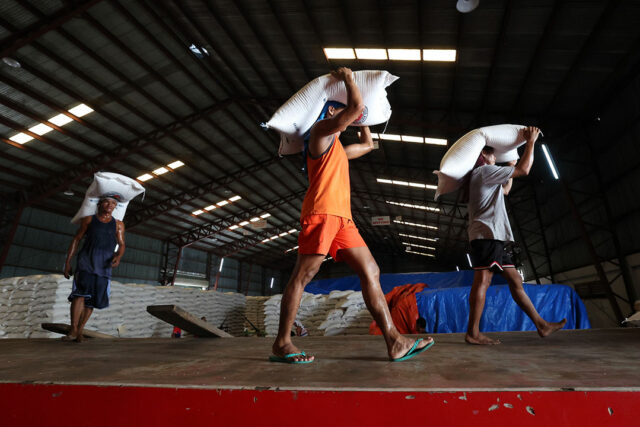
WORKERS load sacks of rice at a National Food Authority (NFA) warehouse in Balagtas, Bulacan, Aug. 13. — PHILIPPINE STAR/MIGUEL DE GUZMAN

By Justine Irish D. Tabile, Reporter

PHILIPPINE RICE IMPORTS are projected to decline by 500,000 metric tons (MT) this year compared to initial projections due to the two-month import ban set to take effect in September, according to the United States Department of Agriculture (USDA).

In its Grain: World Markets and Trade Report issued in August, the USDA’s Foreign Agricultural Service estimated that the country’s rice imports will fall by 9.3% to 4.9 million MT this year, from an earlier projection of 5.4 million MT.

The US agency attributed the lower projections to President Ferdinand R. Marcos, Jr.’s order to suspend rice imports for two months beginning Sept. 1 to protect local farmers.

He made the decision after the Department of Agriculture recommended the two-month ban amid declining farmgate prices.

Despite the lower projections, the USDA report showed the Philippines will remain the world’s largest rice importer this year.

The Bureau of Plant Industry reported that 2.58 million MT of rice had arrived in the country as of Aug. 7. Last year, the country imported 4.81 million MT of rice.

Meanwhile, the USDA projected for the Philippines’ milled rice production to reach 12.37 million MT in the marketing year 2024 to 2025, while it anticipates an output of 12.3 million MT for the marketing year 2025 to 2026.

The marketing year for rice starts in July and ends in June of the following year.

Earlier this year, the DA said that it expects the country to achieve a record rice harvest of 20.46 million MT or even surpass it.

Data from the Philippine Statistics Authority showed that the first six months of palay production reached 9.08 million MT, up 6.41% from 8.53 million MT in the same period last year.

In 2024, the country’s palay production reached 20.06 million MT, the highest-ever harvest of the Philippines’ national staple.

Sought for comment, Federation of Free Farmers National Director Raul Q. Montemayor said that the original projection of over 5 million MT in rice imports “was excessive in the first place.”

“Removing the supply glut through the import ban, and hopefully reverting the tariff to 35%, will bode well for farmers in terms of palay prices,” he said in a Viber message.

“In any case, the original USDA projection of rice imports of more than 5 million tons was excessive in the first place,” he added.

Mr. Montemayor also noted that rice prices should not increase “given current international prices and ample supply in the market.”

However, he warned that the mere suspension of rice imports will only lead to the rescheduling of rice imports, and not necessarily reduce it.

“The import ban will temporarily halt further decline in palay prices but will also raise prices at the retail level. While import volume will be lower than last year, imports will remain substantial at around 4 million MT,” former DA Undersecretary Fermin D. Adriano said.

Samahang Industriya ng Agrikultura Executive Director Jayson H. Cainglet said that the impact of the import ban is negligible.

“The prevailing 15% tariff on imported rice remains unchanged. This low rate makes rice importation still highly profitable,” he said.

“While we welcome the import ban, the agriculture sector is steadfast in its appeal to restore rice tariffs to their original levels to discourage excessive importation and protect local producers,” he added.

For the marketing year 2024-2025, the USDA projects world rice imports to reach 62.04 million MT and reach 61.71 million MT in the following year.

Meanwhile, the USDA also projected a 4.2% decline in Philippine wheat imports for marketing year 2025-2026 to 6.9 million MT due to lower feed consumption.

It was initially expected to reach 7.2 million MT.

VIETNAM TO CHALLENGE PHILIPPINES’ RICE IMPORT BAN
Meanwhile, the Vietnam Food Association has asked the country’s Trade ministry to challenge a move by the Philippines to suspend rice imports for two months, two sources told Reuters, with traders saying it will harm local production.

The Philippines, Vietnam’s biggest rice buyer, said last week that it would suspend rice imports for 60 days starting from Sept. 1 in an effort to protect local farmers impacted by falling prices during the harvest season.

“The Philippines is Vietnam’s largest rice export market and the suspension would have significant impacts on rice production in Vietnam,” said one of the sources, a trader with knowledge of the matter.

The association and the Ministry of Industry and Trade didn’t immediately respond to Reuters’ requests for comments.

Vietnam exported 2.44 million metric tons of rice to the Philippines in the first seven months of this year, accounting for 44.3% of its total rice shipments over the period, according to official customs data.

Last year, the Philippine market accounted for 46.7% of Vietnam’s total rice exports, with shipments in September and October higher than monthly average.

Vietnam early this year signed a memorandum of understanding on rice trade with the Philippines, where rice production is often prone to flooding and typhoon risks. “They are suspending rice imports this year to protect their farmers ahead of an expected bumper harvest,” said a second trader based in Ho Chi Minh City.

Traders said the Philippines’ move to suspend rice imports will put pressure on export prices of Vietnamese rice.

Vietnam’s 5% broken rice was offered at $395 on Tuesday, down by nearly 30% from a year earlier, according to data from the association.

“We fear that prices will fall further if there’s the suspension,” the second trader said. — with Reuters

ADB approves $400-M loan for Philippines’ food stamp program

People line up to purchase food items with food stamps under the Department of Social Welfare and Development’s “No Hunger 2027” program in Moriones, Tondo, Manila. — PHILIPPINE STAR/JOHN RYAN BALDEMOR

THE ASIAN Development Bank (ADB) has greenlit a $400-million loan to expand the Philippine government’s food stamp program aimed at reducing involuntary hunger among low-income households.

In a statement on Wednesday, the multilateral lender said it approved the financing for the Reducing Food Insecurity and Undernutrition with Electronic Vouchers Project.

The $400-million loan will fund the government’s flagship social assistance initiative, Walang Gutom (Zero Hunger) Food Stamp Program.

Under the project, the Department of Social Welfare and Development (DWSD) will provide monthly electronic food vouchers to around 750,000 “food-insecure” households.

“With nearly half the Philippine population unable to afford a healthy and nutritious diet, food vouchers are essential to help poor and vulnerable households meet their nutritional needs,” ADB Deputy Director General for Southeast Asia and concurrent Country Director for the Philippines Pavit Ramachandran said in a statement.

The project is being co-financed by the Agence Française de Développement with a loan of 200 million euros ($220 million) and the OPEC Fund for International Development with a $150-million loan.

The DSWD said the Walang Gutom program currently covers 300,000 of the poorest Filipino families. It aims to cover 750,000 families by 2026.

Beneficiaries receive an Electronic Benefit Transfer (EBT) card with a food credits worth P3,000 per month. The card can be used to buy selected food commodities from accredited partner-stores.

However, beneficiaries have to attend monthly sessions to learn about “positive nutrition-related behaviors” and how to combat malnutrition and poverty.

“This project reflects ADB’s commitment to improving food security and nutrition so that all Filipinos can thrive,” Mr. Ramachandran said.

The ADB noted that poverty and food insecurity contribute to undernutrition, as nearly 30% of children in the country under the age of five are stunted.

“Childhood undernutrition is estimated to cost the economy $8.5 billion annually, underscoring the urgent need for targeted multisector solutions,” it said.

The Philippines’ vulnerability to disasters has also raised the risk of food insecurity and malnutrition. The country remained the most disaster-prone country for a 16th year, according to the World Risk Index. It experiences about 20 tropical cyclones each year.

The government has allocated P1.9 billion for the program, which will provide 50,000 qualified households with EBTs, under next year’s proposed national budget.

The ADB had provided technical assistance to the DSWD to pilot the delivery of electronic vouchers in five locations from December 2023 to July 2024 in partnership with the World Food Programme. — Aubrey Rose A. Inosante

Ayala Q2 profit rises 17% to P10.8B on banking, property

CEZAR P. CONSING — GLOBE.COM.PH

AYALA CORP. reported a 17% increase in second-quarter (Q2) attributable net income to P10.76 billion from P9.21 billion a year ago, supported by higher contributions from its banking and real estate businesses.

Revenue for the quarter fell slightly by 2.3% to P90.52 billion from P92.67 billion a year earlier, while operating expenses declined 8.3% to P68.09 billion from P74.24 billion, the company said in a regulatory filing on Wednesday.

For the first half, Ayala Corp. reported a 5% increase in attributable net income to P23.36 billion from P22.29 billion last year due to higher impairments recorded in 2024.

Core net income, which excludes one-off items, dropped by 2% to P23.7 billion.

The conglomerate saw higher contributions from banking subsidiary Bank of the Philippines Islands (BPI), Ayala Land, Inc. (ALI), and its portfolio businesses, which partly offset softer earnings from telecommunications unit Globe Telecom, Inc. and energy and infrastructure unit AC Energy & Infrastructure Corp. (ACEIC).

“While our telco and energy businesses have some catching up to do, our full year targets remain achievable. We are also encouraged to see our portfolio businesses showing better numbers,” Ayala President and Chief Executive Officer Cezar P. Consing said.

The banking segment, led by BPI, posted an 8% increase in net income to P33 billion. Total revenue increased by 14% to P92.6 billion on higher net interest income.

Operating expenses rose by 12% to P42.7 billion due to higher manpower, technology, and volume-related costs.

In the real estate business, ALI reported an 8% growth in net income to P14.2 billion, led by its property development, leasing, and hospitality segments. Revenue fell by 1% to P83.1 billion amid mall reinvention works and lower service revenues.

ALI launched five residential projects worth P40.5 billion in the first half, largely in the premium segment, headlined by Ayala Land Premier’s Laurean Residences in Makati last June.

The telecommunications business, led by Globe, saw a 14% drop in net income to P12.4 billion, as higher equity earnings from affiliates and a dilution gain in Mynt were offset by higher depreciation, interest expenses, and non-operating charges.

Gross service revenue fell by 2% to P80.2 billion on lower revenues across telco and non-telco segments.

In the power segment, ACEN posted an 88% drop in net income to P763 million due to a P2.7-billion impairment for the Lac Hoa and Hoa Dong wind projects in Vietnam.

Core net income fell by 24% to P3.5 billion due to weaker irradiance in the Philippines and Australia, damaged wind farms in Ilocos Norte, depressed local spot market prices, and depreciation expenses from newly operationalized plants.

ACEN’s parent company, ACEIC, recorded a 39% drop in core net income to P4.1 billion because of reduced contributions from ACEN and thermal plants, lower parent net interest income, and foreign exchange losses.

Meanwhile, Ayala Corp. said its portfolio investments recorded strong performances in the first half.

The conglomerate’s healthcare arm, Ayala Healthcare Holdings, Inc. (AC Health), trimmed its core net loss to P100 million from P327 million last year as stronger results from the provider group more than offset muted results from the pharmaceutical segment.

On Aug. 8, Singapore-based investor ABC Impact acquired about a 16% stake in AC Health. The investment aims to support AC Health’s expansion across hospitals, clinics, and pharmacies.

“The recently announced investment in AC Health by Singapore’s ABC Impact demonstrates our ability to bring in strategic partners to help scale our businesses,” Mr. Consing said.

ACMobility grew its net income to P122 million from P24 million, led by higher dividends from Isuzu, equity earnings from Honda, and the sustained positive contribution of BYD.

Chip manufacturer Integrated Micro-Electronics, Inc. posted a net income of $7.6 million, a turnaround from the $8.8-million net loss last year, as greater operational efficiencies supported profitability.

AC Logistics narrowed its net loss to P631 million from P773 million due to the closure of its last-mile business and ongoing rationalization efforts.

Ayala Corp. shares climbed by 1.69%, or P10, to P600 per share on Wednesday. — Revin Mikhael D. Ochave

GT Capital Q2 profit surges 39% to P9.28B on banking, auto gains

BW FILE PHOTO

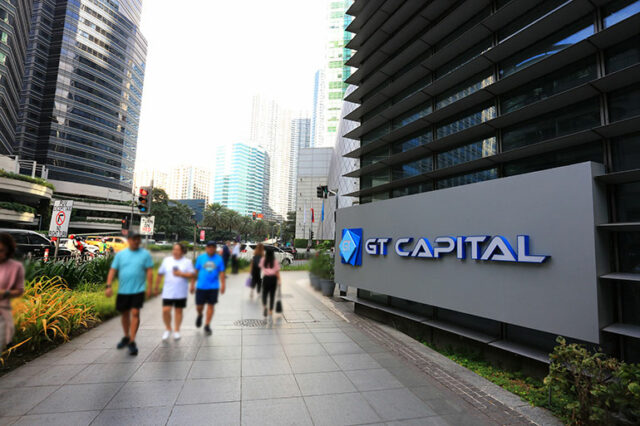
TY-LED conglomerate GT Capital Holdings, Inc. saw a 39% increase in its second-quarter (Q2) attributable net income to P9.28 billion from P6.67 billion last year driven by its financial services and automotive businesses.

Consolidated revenue for the April-to-June period increased by 13% to P86.66 billion from P76.65 billion a year ago, GT Capital said in a regulatory filing on Wednesday.

First-half attributable net income rose by 34% to P18.42 billion from P13.78 billion a year ago. Revenue likewise climbed by 17% to P176.44 billion from P150.75 billion in 2024.

GT Capital attributed the growth to the performance of its key operating businesses led by banking subsidiary Metropolitan Bank & Trust Co. (Metrobank), automotive company Toyota Motor Philippines Corp. (TMP), and associate Metro Pacific Investments Corp. (MPIC).

“GT Capital delivered strong financial results in the first half of 2025, fueled by record performance of our automotive and financial services businesses. These achievements lay a strong foundation for meeting our full-year objectives,” GT Capital President Carmelo Maria Luza Bautista said.

“We enter the second half with guarded confidence — aware of ongoing uncertainties in both domestic and global markets, yet encouraged by the strength and resilience of our core businesses. With this momentum and a sharp focus on execution, we are well-positioned to sustain our growth trajectory,” he added.

Metrobank booked P24.8 billion in first-half net income due to healthy loan growth, recovering margins, robust trading income, and improving cost efficiency.

Net interest income reached P60 billion driven by a sequential rebound in net interest margin while gross loans grew by 13.2%.

“Our first half performance reflects the continuing strength of our core businesses. As we enter the second half of the year, we remain focused on building on our fundamentals and implementing prudent strategies, which will allow us to continue helping our clients grow further as well as achieve our medium-term goals,” Metrobank President Fabian S. Dee said.

TMP posted a record 66% growth in first-half net income to P12.5 billion while consolidated revenue went up by 19% to P135.6 billion on strong retail sales volume, healthy models mix, and favorable foreign exchange movement.

As of end-June, TMP had a 46.1% market share as retail sales volume rose by 6.6% to 111,276 units.

“We will continue to maintain our guarded optimism in our outlook for the remainder of the year, against the backdrop of a dynamic global and local economic environment,” TMP President Masando Hashimoto said.

Real estate subsidiary Federal Land Inc. saw a 15% increase in reservation sales driven by demand for its commercial lots and horizontal developments in Cavite and Laguna, as well as its ready-for-occupancy vertical residences in Bonifacio Global City and the Manila Bay area.

Federal Land continued to leverage its expansion of horizontal developments outside Metro Manila and renewed its focus on ready-for-occupancy properties across its key locations.

Federal Land NRE Global, Inc., the property company’s joint venture with Nomura Real Estate of Japan, is expected to complete the first Uniqlo logistics facility in the country by the first quarter of 2026.

MPIC posted a 36% increase in first-half reported net income to P17 billion on the back of the gain from the sale of its oil storage company, Philippine Coastal Storage and Pipeline Corp.

Among its core businesses, power contributed the largest share of net operating income at 64% or P11.2 billion. The water and toll roads segments contributed P3.8 billion and P3.3 billion, respectively, representing 41%.

AXA Philippines Life and General Insurance Corp. saw a 14% increase in first-half gross premium to P16.7 billion.

In the life insurance segment, AXA Philippines’ annual premium equivalent increased by 18% to P2.5 billion due to higher single premium and group premium contributions.

MPIC is one of the three key Philippine units of Hong Kong-based First Pacific Co. Ltd., alongside Philex Mining Corp. and PLDT Inc.

Hastings Holdings, Inc., a unit of PLDT Beneficial Trust Fund subsidiary MediaQuest Holdings, Inc., holds a majority stake in BusinessWorld through the Philippine Star Group, which it controls.

GT Capital stocks rose by 4.52% or P30 to P694 apiece on Wednesday. — Revin Mikhael D. Ochave

Yuchengco-led HI sets P22-B capex for 2025-2026 expansion

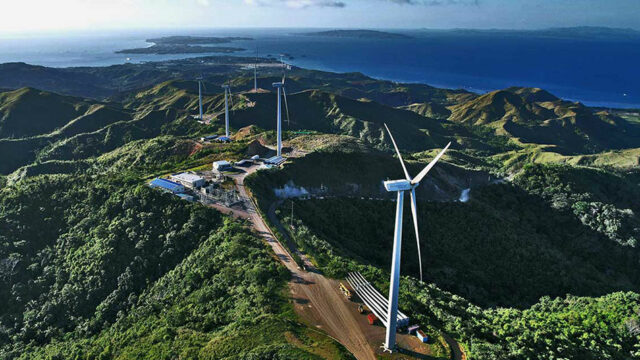
PETROENERGY.COM.PH

YUCHENGCO-LED holding company House of Investments, Inc. (HI) has allocated P22 billion in capital expenditures (capex) for 2025 and 2026 to fund expansion across its education, energy, and property segments.

“Our investment roadmap is more than just a capex plan that channels resources for strategic and long-term value creation. We are strengthening our portfolio to align with the Yuchengco Group’s commitment to future-proof our stakeholders and remain catalysts for nation-building and sustainable growth,” HI President and Chief Executive Officer Lorenzo V. Tan said in an e-mailed statement on Wednesday.

The energy business led by listed PetroEnergy Resources Corp. allotted P9.3 billion for the expansion projects of renewable energy subsidiary PetroGreen Energy Corp., of which P4.5 billion will be spent in 2025 and P4.8 billion in 2026.

The education segment through iPeople, Inc. has allocated P5.3 billion in capex over the two-year period. The company will use 82% for campus expansion to support enrollment growth and expansion of program offerings, while the remaining capex will be for continuing technology investments across the schools.

HI earmarked P4.2 billion to expand its property portfolio. The bulk of the budget will be for the completion of The Yuchengco Centre into a mixed-use office-commercial development. The project will feature a network of open spaces, public art facilities, green architecture, sophisticated technology and eco-friendly materials.

The recently announced prospective joint venture with Lima Land Inc. into HI’s subsidiary Tarlac Terra Ventures, Inc. for the expansion of the TARI Estate in Tarlac is not expected to require a large capex yet pending several regulatory approvals.

Meanwhile, HI has allotted P2 billion for information technology (IT) improvements to remain competitive, adapt to evolving business needs, enhance operational efficiency, and address security concerns, among others.

“HI recognizes that investing in IT is crucial for innovation and automation, as well as in maintaining a strong market position,” the company said.

Aside from energy, education, and property, HI also has presence in financial services, automotive, healthcare, and deathcare.

HI shares rose by 0.75% or three centavos to P4.03 per share on Wednesday. — Revin Mikhael D. Ochave

ADVERTISEMENT
ADVERTISEMENT