Home Blog Page 1142

Raslag inks deal to supply 15-MW solar power to Pampanga

RASLAG.COM.PH

LISTED renewable energy developer Raslag Corp. has entered into a power supply agreement (PSA) with Pampanga I Electric Cooperative, Inc. (PELCO I) to provide 15 megawatts (MW) of electricity for 10 years.

Under the agreement, Raslag will deliver electricity to PELCO I from a portion of the renewable energy generated by its 36.65-MW Raslag-4, the company said in a stock exchange disclosure on Wednesday.

“This partnership aims not only to strengthen the local energy supply but also to reinforce both parties’ commitment to promoting energy security and sustainability in the region,” the company said.

The parties will jointly file an application to seek approval from the Energy Regulatory Commission for the PSA.

In October last year, Raslag energized the solar farm located in the municipality of Magalang in Pampanga. It is designed to produce 53 gigawatt-hours of electricity and power 24,000 homes annually.

Raslag develops, owns, and operates solar power plants to provide utility-scale renewable energy to on-grid customers.

To date, the company has a total installed capacity of 77.84 MW from four facilities in Pampanga. It is currently developing the Raslag 7 and 8 solar projects, with a combined capacity of 140 MW.

Raslag has estimated an investment of up to P37 billion to achieve its goal of expanding its portfolio to 1,000 MW by 2035. — Sheldeen Joy Talavera

‘A good cocktail reflects a good life’

Tiziano Tasso turns philosophical at The Pen’s bar takeover

APRIL was just one hot day after another, so we were thankful to meet the Pirata Group’s Beverage Director Tiziano Tasso in The Peninsula Manila’s refreshingly cool and elegant The Bar. Mr. Tasso had flown in from Hong Kong for a bar takeover at the hotel on April 25.

Mr. Tasso was a bartender for over 30 years, and his father, a bartender himself, got him started. “I do this for fun,” he said since he now works with one of Hong Kong’s trendiest restaurant groups.

For his takeover at The Bar — sponsored by Volcan Tequila and Hennessy Cognac — Mr. Tasso made four drinks: the Tropical (Hennessy VS, tropical tea cordial, lime juice, palm sugar, and guava foam), Blossoming (Vanilla, Hennessy VS, chocolate-infused Volcan Blanco, white port, lemon juice, and egg), Hennessy Garden (Hennessy VSOP, Timur pepper cordial, eucalyptus essence, and bitters), and The Eruption (Thai rhubarb-infused Volcan Blanco, orange Curacao, pear and peach cordial, lime juice, and bitters).

In keeping with the mixologist’s heritage, the bar chow was decidedly Italian.

The Blossoming, served in a tall glass, proved to be filling and tasted almost nutritious, like a spiked breakfast smoothie. The Tropical was pleasantly fruity, with a taste that reminded one of berries, and felt like a nice poolside cocktail.

The Hennessy Garden was served with some ceremony inside a glass box on a bed of leaves with a bite of chocolate on the side — it was refreshing and mild, but still with a kick, the pepper cordial leaving its trail on all the ingredients. The eucalyptus essence gave it a cooling and slightly medicinal taste, like a nice cup of cool herbal tea.

Finally, the Eruption was a real show: it was served in a little clay pot with basil, but atop it was a bowl of steel wool, lit aflame resulting in an eruption of glowing embers. The drink itself (once the smoking steel wool was removed) proved to be very refreshing; the tickle on your nose from the basil was a pleasant bonus.

THE PHILOSOPHY OF COCKTAILS
Mr. Tasso has a few principles when it comes to making drinks: “I think a good cocktail needs to reflect what is a good life — and a good life is a balance of life. If you have too much of anything, even positive things, it’s no good.”

As an Italian in Hong Kong, he gave us an impression of the place and how it influences how he makes his drinks. “Hong Kong, it’s a place of contradictions. It’s beautiful in a way that you have access to nature. It’s very multicultural, but on the other side, it’s quite closed. Local people are very into their own thing. It’s very fast-paced in a way, and very slow in another way,” he explained.

“They don’t drink too much alcohol. There’s an incredible up(take) on zero-alcohol,” he says about his customers. “They really like the idea to have innovation,” he says, adding, “They don’t drink much, but when they do, they want something different; something unique.”

Of the drinks he made for The Pen’s bar takeover that evening he said: “Cognac is very strong and rich. Not many people drink it. So I wanted to have three drinks that are completely different from one another, and give you access to a spirit that is strong.

“You always try to create a story. It’s not just a list of drinks on a piece of paper,” he said.

The first bar takeover this year featured Awarzed Awarra, an Ulan Bator-based mixologist from the Nomad Bar whose drinks for the night of April 9 featured Mongolian vodka and absinthe.

Upcoming bar takeovers at The Pen seem to be hush-hush surprises: the next one will be on June 13, and will feature a female bartender from Japan. The next one will be in August and a final one in October. — Joseph L. Garcia

Canada just got the crisis manager it desperately needed

MARK J. CARNEY, a former central banker and the leader of the Liberal Party. — FLICKR-WORLD ECONOMIC FORUM

By Robert Burgess

CANADA’S Liberal Party is projected to win a fourth consecutive national election in a race that largely came down to which party would better stand up to US President Donald Trump. “We are over the shock of American betrayal,” Mark Carney, a former central banker and the leader of the Liberal Party, said in a victory speech early Tuesday morning. “But we should never forget the lessons.”

Indeed, there were many lessons, not the least of which is that Trump’s provocations on tariffs and musings about making Canada the 51st US state probably would have been easier to laugh off if the country’s leaders had taken steps to shore up its woeful productivity. Generally defined as the amount of output per hours worked, productivity is a bedrock of any strong economy, boosting competitiveness, helping to restrain inflation and raising living standards.

Productivity is Canada’s Achilles heel. It’s so bad that the 1.8% drop in labor productivity in 2023 was the worst among the 38 members of the Organization for Economic Co-operation and Development (OECD), according to an October presentation by Jonathan Barr, senior director at Innovation, Science and Economic Development Canada. The poor performance, which carried into 2024, erased all productivity growth since 2017. The Deutsche Bank Trade Weighted Canada Dollar Index, a measure of the nation’s economic performance compared with trading partners, has plunged 9.44% over the past four years. A similar measure for the US dollar surged 11%.

No wonder the OECD predicts that growth in Canada’s gross domestic product per capita will rank last among its member countries over the next 40 years. “A positive change in productivity could be the most significant factor in lifting economic growth, and the prosperity that goes with it,” RBC Capital Markets noted in a recent report.

Luckily for Canada, Carney is more economist than politician. Bloomberg News describes him as “a consummate crisis manager,” having steered the Bank of Canada through the global financial crisis of 2008 and the Bank of England through the UK’s highly disruptive decoupling from the European Union in 2016. (Carney was the chair of Bloomberg, Inc. until January, when he resigned that post to enter politics.)

Comments by Carney on the campaign trail suggest he understands the challenge, promising a capital spending budget that would allocate tens of billions of dollars to investments in productivity-boosting infrastructure. “It’s said there are no atheists in foxholes. There should be no libertarians in a crisis,” Carney said at a news conference in Whitby, Ontario, earlier this month.

More spending is a start, but more is needed. Canada needs to reduce its notorious bureaucracy and the stiff internal trade barriers between provinces that impede the flow of goods, services, and people. It also needs a system to match education and skills with jobs to accommodate its immigrant-fueled population boom. Here, a little could go a long way. RBC notes that businesses in Canada invest about half as much per worker as those in the US, a trend that has only become worse since the 2008-09 global financial crisis. Lower taxes, especially for businesses that embrace worker training, should be an immediate priority.

Carney can also help the cause by adopting a policy championed by Pierre Poilievre, head of the defeated Conservatives, to boost housing in a nation that doesn’t have enough supply by tying municipal grants to a requirement that cities increase home construction by 15% a year. Carney may have no choice given that his party had about 43% of the national vote, falling short of the 172 seats needed for a majority in the House of Commons. This means the government will be forced to work with other parties to pass budgets and other legislation, according to Bloomberg News. Carney is already talking about “working constructively with all parties across parliament.”

Although Canada’s tax burden isn’t bad relative to other advanced economies — with tax revenue amounting to 34.8% of GDP in 2023 as measured by the OECD — it’s meaningfully higher than the US’s 25.2% of GDP. Bringing the tax burden down would go a long way to spurring growth and productivity. It’s not like Canada doesn’t have the fiscal space to accommodate lower taxes, with a budget deficit of around 2% of GDP versus 7% in the US. In its 2025 outlook, the OECD recommended that Canada could make its tax system more growth friendly by switching the burden from direct taxation to indirect and environmental taxes. Canada could also incentivize research and development, which the OECD notes is “a key driver of a country’s innovation capacity.” Carney has already promised to run deeper budget deficits to cut income taxes and grow spending on infrastructure.

Fixing what ails Canada’s economy won’t be easy or quick. But Carney’s credentials and comments about never forgetting “the lessons” suggest he understands the root of the problem.

BLOOMBERG OPINION

Trump officials eye changes to Biden’s AI chip export rule, sources say

NEW YORK — The Trump administration is working on changes to a Biden-era rule that would limit global access to artificial intelligence (AI) chips, including possibly doing away with its splitting the world into tiers that help determine how many advanced semiconductors a country can obtain, three sources familiar with the matter said.

The sources said the plans were still under discussion and warned they could change. But if enacted, removing the tiers could open the door to using US chips as an even more powerful negotiating tool in trade talks.

The regulation, which was issued in January, is aimed at dividing up access to the most advanced AI chips and controlling certain model weights in order to keep the most sophisticated computing power in the United States and among its allies, and away from China and other countries of concern.

The Framework for Artificial Intelligence Diffusion, as the rule is called, was issued by the US Department of Commerce in January, a week before the end of the administration of former President Joseph R. Biden. Companies must comply with its restrictions starting on May 15.

Currently, the rule has the world divided into three tiers. Seventeen countries and Taiwan in the first tier can receive unlimited chips. Some 120 other countries are in the second tier, which leaves them subject to caps on how many AI chips they can get. And countries of concern like China, Russia, Iran and North Korea in the third tier are blocked from the chips.

But Trump administration officials are weighing discarding the tiered approach to access in the rule and replacing it with a global licensing regime with government-to-government agreements, the sources said.

“There are some voices pushing for elimination of the tiers,” Wilbur Ross, who served as Commerce secretary during the first Trump administration, said in an interview on Tuesday. “I think it’s still a work in progress.” He said government-to-government agreements were one alternative.

Such a structure would likely tie in to President Donald J. Trump’s broader trade strategy of making deals with individual countries, one of the sources said. That would make it easier for the US to use access to American-designed chips as leverage in other negotiations.

US Commerce Secretary Howard Lutnick said at a conference in March that he wants to include export controls in trade talks.

Other possible changes include a lower threshold for an exception to licensing. Under the current rule, orders under the equivalent of about 1,700 of Nvidia’s powerful H100 chips do not count toward country caps and only require the government be notified about the order. No license is necessary.

The Trump administration is considering making the cutoff orders under the equivalent of 500 H100 chips, one source said.

A spokesperson for the Commerce Department declined comment. A spokesperson for the White House did not immediately respond to a request for comment.

For months, Trump administration officials have suggested they want to make the rule “stronger but simpler,” but at least some experts believe removing the tiers will make the rule more complicated.

Ken Glueck, executive vice president at Oracle, a critic of the current rule, said that the tiers did not make sense, noting that Israel and Yemen were both in the second tier.

“Wouldn’t surprise me they’re going to take a new look at this,” said Mr. Glueck, who said he did not know the Trump administration’s plan but expects the rule to be modified in a significant way.

Oracle and Nvidia were both outspoken in their criticism of the new rule when it was issued in January.

Industry has argued that by limiting access to the chips, countries will buy the technology from China. Some US lawmakers have agreed. Seven Republican senators sent a letter to Mr. Lutnick in mid-April asking for the rule to be withdrawn.

The restrictions would incentivize buyers, especially in Tier 2 countries, to turn to China’s “unregulated cheap substitutes,” the letter said. — Reuters

Emirates, PAL plan codeshare to boost market reach

EMIRATES.COM

DUBAI-BASED carrier Emirates said it is exploring further expansion of its partnership with Philippine Airlines (PAL) to serve more passengers and enhance cargo operations.

In a media release on Wednesday, Emirates said PAL has agreed to consider the potential of a reciprocal codeshare agreement for flights between the Philippines and Dubai, as well as on select routes beyond the gateways of the two carriers.

Codeshare agreements are arrangements between airlines to sell seats on each other’s flights, allowing them to reach a wider network.

The two airlines are also exploring the possibility of enhancing their cargo interline cooperation, Emirates said, adding that it will also exchange best practices with PAL in ground handling, maintenance, and technical training.

In 2023, Emirates and PAL signed an enhanced interline agreement to connect travelers to at least ten domestic points via Cebu and Clark, as well as nine international routes via Dubai.

Currently, Emirates serves the Philippines with 28 weekly flights, offering up to 22,700 weekly seats to and from Dubai.

Currently, PAL operates a global network of nonstop flights out of hubs in Manila, Cebu, Clark, and Davao to 31 destinations in the Philippines and 37 destinations across Asia, North America, Australia, and the Middle East.

Last week, PAL said it is anticipating a wider international footprint with the appointment of British aviation executive Richard Nutall as the company’s new president, effective May 29. — Ashley Erika O. Jose

Dining In/Out (05/01/25)


2 Gordon Ramsay restaurants opening in Cebu

FOLLOWING the success of Gordon Ramsay Bar & Grill Philippines at Newport World Resorts, two more Gordon Ramsay restaurant concepts — Gordon Ramsay Fish & Chips and Street Burger by Gordon Ramsay — are set to open in Lapu-Lapu City, Cebu. The two new dining concepts will offer casual, quality-driven menus that reflect Ramsay’s signature flair. Gordon Ramsay Fish & Chips is a fast-casual and over-the-counter style restaurant serving variations of its signature take on the British classic, alongside its Lobster & Shrimp, Dirty Chips, and handcrafted milkshakes. Right next door, Street Burger by Gordon Ramsay will offer a bold lineup including the Idiot Burger, the G.F.C. (Gordon’s Fried Chicken) Burger, and the O.G.R. Burger, along with other fan favorites. The restaurants will be located at Mactan Newtown, a 30-hectare beachfront township by Megaworld that blends business, leisure, and residential living. For more information visit www.gordonramsay.com.ph and follow @gordonramsayfishandchips and @gordonramsaystreetburger on Facebook and Instagram.


Celebrate Mother’s Day at Okada Manila

FOR dining out on Mother’s Day, Okada Manila is serving up an Italian feast at La Piazza — a seven-course meal for P10,000 net which includes fresh tuna, Iberico ham, barramundi, and more. At Yu Lei, there will be a limited-time menu featuring tender duck breast, Kurobuta pork, seafood, and more, for P6,000. Plus, a complimentary signature Machang to take home. At Enbu, Japanese culinary traditions are on full display including Seabream, Chawanmushi, US Beef Ribeye, and more for P5,088 net. There will be a special Mother’s Day offering at the Medley Buffet exclusively on May 11 with Boston lobster, lechon, Oysters Rockefeller, and more alongside free-flowing wines and drinks, as well as local and international desserts. The buffet costs P4,500 for adults and P2,250 for kids. For dining inquiries and reservations, e-mail RestaurantReservation@okadamanila.com or contact 8555-5799.


Solaire Resort North offers Mother’s Day treats

AT Solaire Resort North, enjoy a bountiful selection of dishes at FRESH for lunch or dinner with their exclusive Mother’s Day promo offering a free feast for each mother with five paying guests, and a photobooth as a souvenir. The spread includes unlimited lobster and drinks, a selection of fine meats, seafood, and vegetarian options with decadent desserts. For an elevated buffet experience, celebrate Mother’s Day with Finestra’s Festa della Mamma special, featuring their semi-buffet selection for Sunday brunch. Continue the celebration with a casual feast at Lucky Noodles, Red Lantern, Pool Café, or Yakumi for a unique set menu for each restaurant, or Manyaman Filipino flavors boasting both savory and sweet items for the whole family this May 11. For more details, reservations, and inquiries, contact 8888-8888 or e-mail sn.reservations@solaireresort.com.


Gringo serves up seafood for Mother’s Day

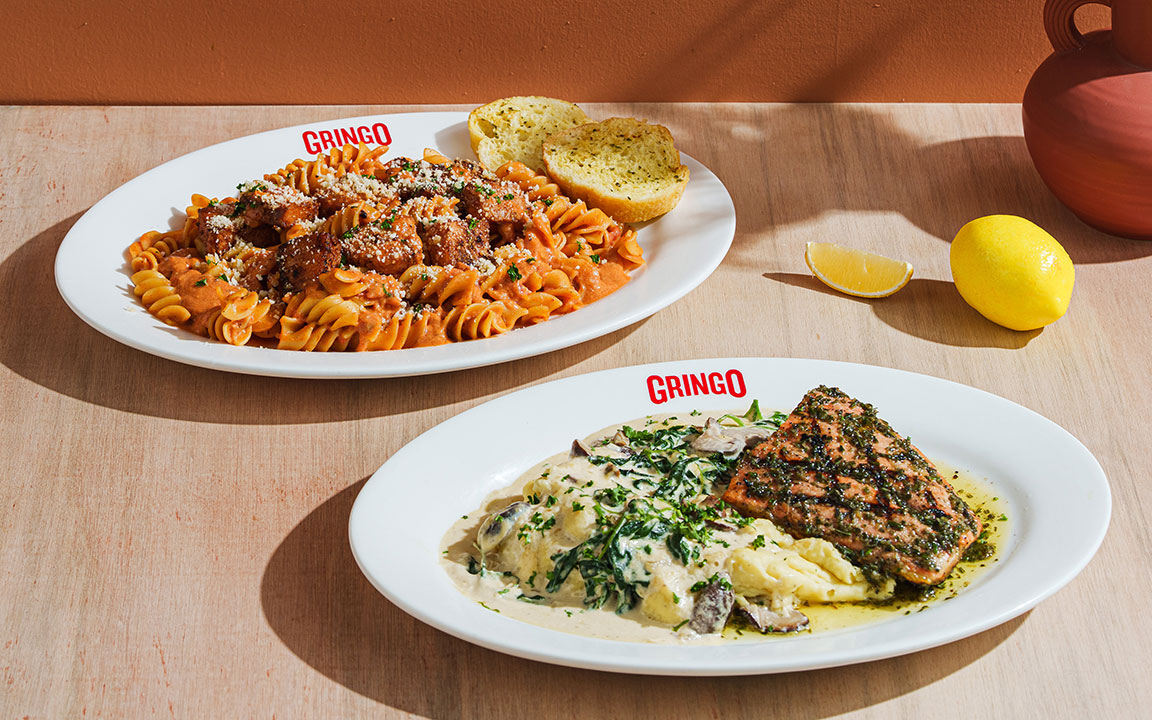
GRINGO launches new Mother’s Day dishes that bring a refreshing new flavor to the table, light yet indulgent. These are: Salmon Cajun cream fusilli, Lemon-marinated grilled salmon with creamy mashed potatoes, and Crispy battered lapu-lapu with smashed potatoes. These new dishes join Gringo’s seafood lineup that’s perfect for sharing with the whole family: Onion glazed camaron, Shrimp bisque pasta, and Crispy catfish. Find these dishes at Gringo branches nationwide, including SM North EDSA, SM Dasmarinas, Ayala Malls Feliz, and SM Baguio. Gringo also offers catering, bulk orders, and delivery via Gringo.ph, GrabFood, and Foodpanda. Meanwhile, the McWilson Food Group, the company behind Gringo, Gringonito, Tatatito, Kaokee, Tokyo Bubble Tea, Honeybon, and Super Pollo, has officially launched the MCW Eats Loyalty Club, a loyalty program to reward diners with exclusive perks every time they visit any McWilson restaurant. Registration is free and new members receive a P100 voucher upon signing up. Members earn one point for every P50 spent at any McWilson Food Group restaurant. These points can be accumulated and redeemed for gift certificates, discounts, and other exclusive rewards across all participating brands. To join the MCW Eats Loyalty Club, customers who dine at any participating McWilson Food Group restaurant can sign up using their mobile number. They may also register online (https://eats.mcwgroup.ph/.).


Honeybon launches Mango Brazo de Mercedes

JUST IN TIME for Mother’s Day, Honeybon unveils its newest mango dessert: the Mango Brazo de Mercedes made with delicate meringue, filled with a rich custard and ripe mangoes. This special dessert adds a golden touch to Honeybon’s growing Mango Collection, which also features the Mango Royale with layers of buttercream, meringue, and chopped nuts, and the Mango Cheesecake, topped with mangoes and finished with a creamy mousse that balances its smooth cheesecake base. The Mango Brazo de Mercedes is available for a limited time at Honeybon stores in SM North EDSA, SM Megamall, and Festival Mall. It is also available online for delivery through www.honeybon.ph.


Tatatito celebrates Mother’s Day with special menu

THIS Mother’s Day, Tatatito presents a special menu entitled Ilaw ng Tahanan, featuring familiar Filipino flavors, Crab claw in ginataang kalabasa, and BanoffeeQ Pie, a fusion of the classic banana cue and banoffee pie. Tatatito is located at the OPL Bldg. on Dela Rosa Street corner Carlos Palanca in Makati. The restaurant is open from 7 a.m. to 10 p.m. on Mondays through Thursdays, Saturdays, and Sundays, and until 11 p.m. on Fridays. Reservations can be made online at book.bistrochat.com/tatatito or by calling 0917-862-4000 or 8809-8055.


Newport World Resorts’ hotels, restaurants offer Mother’s Day specials

NEWPORT WORLD RESORTS’ hotel, mall, and signature restaurants present a collection of offerings for Mother’s Day. At Gordon Ramsay Bar & Grill Philippines, thanks to a partnership with Las Filipinas, a collective of Filipina artists, guests may have their portraits drawn live as lasting mementos for families and loved ones (contact 0917-147-6576 or e-mail info@gordonramsayrestaurants.com.ph). Over at the Marriott Hotel Manila’s Marriott Café Bakery, a Honey Glazed Bone-in Ham Package. Priced at P4,500 net, will be available from May 9 to 11, with early bird privileges for advance purchases until May 5. Sweet indulgences await with Mother’s Day Treats including mini cakes, fondant cakes, artisanal chocolates, and more, with prices starting at P350 net, available until May 12. A grand Mother’s Day Buffet will be offered on May 11 at the Marriott Café, priced at P3,800 net, featuring selections such as Australian beef rump and Legris oysters (0917-584-9560). Sheraton Manila Hotel’s Oori will be holding a Banchan and Kimbap Making Class on May 11 from 2-4 p.m. for P2,500 net per person, complete with a demonstration kit, snacks, finished dishes for takeaway, and certificates of participation. Meanwhile, S Kitchen commemorates the special day with a Flower Embroidery Workshop guided by Bella Joy Bardollas. The class, from 1-3 p.m., is priced at P3,000 net, inclusive of workshop materials, food, and a keepsake final artwork (0917-859-7496). Hotel Okura Manila’s Yawaragi will present a Mother’s Day Buffet priced at P3,950++, available on May 11, featuring Australian Wagyu chuck eye roll pot roast, herbed Dijon Omaha steamship, Japanese oyster thermidor, and more, accompanied by a complimentary mocktail and a special token for mothers. Yamazato offers an intimate Japanese fine dining experience with its Mother’s Day Omakase Sushi, priced at P15,000++, highlighting seasonal items such as purple sea urchin, bigfin squid and firefly squid, horse mackerel and Isaki. The Omakase Sushi is available from May 7 to 11 (contact fb@hotelokuramanila.com or 0917-842-9067). Hilton Manila’s Kusina Sea Kitchens will have a Mother’s Day Lunch Buffet priced at P2,800++ per person. The celebration features Filipino favorites and international classics alongside flowing sodas and juices. Mothers will receive a Laura Mercier beauty gift and a 15-minute massage at The Cabana (7239-7788 or e-mail MNLPH_F&Binquiries@hilton.com).


Foodpanda’s summer deals

THIS summer, foodpanda is helping Filipinos chill out without splashing out, thanks to exclusive discounts on both food and essentials. These include 20% off on meals from popular restaurants like Tim Hortons. Meanwhile, pandapro members can enjoy even greater savings on their favorite summer chillers, whether they crave fruity refreshers or caffeinated drinks, with up to 30% off on selected summer coolers like Jamba Juice, CoCo, and Zus coffee. Beyond mealtime cravings, foodpanda makes sure homes are summer-ready with deep discounts on grocery must-haves. From summer snacks from URC and chilled drinks from Pepsi to necessities like sunscreen, foodpanda’s summer sale offers up to 50% off on a wide range of summer must-haves from pandamart, Robinsons Supermarket, The Marketplace, Puregold, Watsons, Southstar Drug, and many more.

Maya Bank launches premium card powered by AI-driven credit scoring

MAYA BANK, Inc. has launched a premium credit card powered by its artificial intelligence (AI)-driven credit scoring model.

The Maya Black credit card uses Maya’s tech-driven platform to allow consumers — even those with no traditional banking histories — to get access to credit, the digital bank said in a statement on Wednesday.

“Leveraging Maya’s proprietary transactional data and other alternative data sources, Maya’s AI-driven credit scoring model can assess and approve users whom traditional banks often overlook. Applicants without credit history can also opt into a secured card pathway — fully integrated into the app, with no paperwork or reapplication,” Maya Bank said.

The card is available via the Maya app with instant issuance of a virtual card and the physical, numberless card delivered afterwards.

“All card details are stored securely in-app, where users can also freeze or replace their card in real time,” Maya Bank said.

The application, approval, and issuance process for the card is fully digital. Users will also be able to access support, track their spending, and access billing statements in-app.

“Credit cards have long symbolized financial freedom and status — but for most Filipinos, they’ve remained out of reach. With Maya Black, we’re making the most desirable card in the market — and democratizing access to it,” Maya Group President and Maya Bank Co-Founder Shailesh Baidwan said.

“We designed Maya Black for a generation that expects instant, mobile-first banking. This isn’t the usual credit card — it’s a re-engineered experience,” Maya Bank President Angelo S. Madrid said.

Benefits of the Maya Black card, powered by Visa, include earning Maya Miles from transactions, which can be tracked real-time and can be spent via Maya’s merchant network, converted into airline miles and redeemed for other travel rewards. 

New cardholders will receive 3,000 bonus Maya Miles upon activation of their physical cards and a P5,000 spend within 60 days.

The credit card also provides access to airport lounges via DragonPass.

Maya Bank is one of the six Bangko Sentral ng Pilipinas-licensed digital banks in the country. It is part of the Maya Group.

Maya Innovations Holdings, Pte. Ltd., formerly Voyager Innovations Holdings, Pte. Ltd., is the parent holding company of Maya Bank and Maya Philippines, Inc.

Maya Group in April said it continued to achieve net income profitability last quarter, which it first reached at end-2024.

PLDT Inc., Maya Innovations’ main shareholder, said in February that Maya Bank has been in the black starting September 2024. The digital bank posted a net loss of P826.83 million in 2023, widening from the P729.77-million loss in 2022, its annual report showed.

Hastings Holdings, Inc., a unit of PLDT Beneficial Trust Fund subsidiary MediaQuest Holdings, Inc., has a majority stake in BusinessWorld through the Philippine Star Group, which it controls. — A.M.C. Sy

Not-so-common tax still

PHILIPPINE STAR/RYAN BALDEMOR

I believe motor vehicle use in Metro Manila and other major cities has now reached an all-time high. Constant traffic congestion, despite the development of new roads and tollways, provides strong evidence of this trend. The current vehicle mix visibly includes more public buses, jeepneys, taxis, transport network vehicles, and motorcycle taxis.

It also appears that since the pandemic years (2020-2022), we’ve experienced a significant surge in public utility vehicular activity. With higher fares being charged, there should logically have been an increase in the government’s collection of the Common Carrier’s Tax (CCT).

Under Section 117 of the National Internal Revenue Code (NIRC), the CCT imposes a 3% tax on the gross receipts of domestic carriers. Operators of public utility vehicles (PUVs) such as jeepneys, buses, and taxis fall under this category. However, I am uncertain about the applicability of this tax to motorcycle taxis, and I understand tricycles are currently exempt.

For transport operators whose annual gross receipts exceed P3 million, a 12% Value-Added Tax (VAT) applies instead. Gross receipts include all fares collected by the operators, regardless of expenses for drivers, fuel, and maintenance.

Data from the Land Transportation Office (LTO) confirms a consistent increase in registered motor vehicles over recent years. In 2023, Metro Manila alone had over four million registered vehicles, suggesting a significant rise in the number of PUVs as well.

Furthermore, fare adjustments approved by the Land Transportation Franchising and Regulatory Board (LTFRB) should also have driven higher gross receipts. The minimum fare for jeepneys in Metro Manila, for instance, increased from P11 to P13. This fare hike, coupled with greater ridership, logically implies higher revenues and, thus, increased CCT collections.

However, I suspect Bureau of Internal Revenue (BIR) reports might reveal a different reality. Despite the evident growth in the land transport sector, I doubt CCT collections have seen a corresponding increase. Reliable CCT data is challenging to obtain, but the potential tax revenue can still be approximated.

Considering jeepneys alone, about 50,000 units operate in Metro Manila. Nationwide, a conservative estimate would be at least 200,000 units, each potentially generating gross receipts of P1,500 daily over approximately 22-26 days per month.

Even if we reduce this estimate to P1,000 daily over 20 days monthly, each jeepney would still earn about P20,000 monthly or P240,000 annually. With 200,000 jeepneys nationwide, gross receipts would total about P48 billion annually. Yet, it’s doubtful operators report even half this amount.

Applying the 3% CCT rate yields potential annual tax revenues of about P1.4 billion from jeepneys alone. If jeepneys alone have this tax potential, significantly more should be collectible from city and provincial buses, taxis, and transport network vehicles. Motorcycle taxis may also contribute if they fall under this taxation.

Expanding the jeepney estimate reveals the vast untapped potential of CCT to generate substantial tax revenues. These funds could be instrumental in financing improvements to public transportation, infrastructure development, and social services.

Given that total percentage tax collections for 2023 amounted to about P50 billion — including franchise taxes and others — it seems clear that land transport operators pay far less than their potential. I suspect the bulk of CCT currently collected likely comes from air and sea transport operators.

This chronic under-collection of CCT is a longstanding issue. Many PUV operators operate informally without proper BIR registration, making tax monitoring and collection challenging. Even registered operators often underreport receipts to minimize their tax liabilities.

The cash-based nature of fare collection facilitates this underreporting. Since jeepneys and city buses typically do not issue receipts and lack ridership tracking, the BIR must rely on operators’ self-reported data.

Additionally, the BIR faces limited enforcement capabilities. Auditing and enforcing compliance across numerous small-scale operators would require substantial resources and staffing. Some operators might also remain unaware of their exact tax obligations.

Addressing these challenges is critical. The government should intensify efforts to formalize PUV operations through simplified registration processes and compliance incentives, particularly under jeepney modernization programs.

Adopting digital fare collection systems can significantly enhance transparency and accuracy in gross receipt reporting, thereby improving tax compliance. Digital systems can also alleviate issues related to coin shortages and making correct change.

The BIR could further invest in building its capacity to monitor and enforce tax compliance through additional staffing, enhanced training, and advanced technological tools. Establishing robust data-sharing systems and coordinated enforcement efforts with agencies such as the LTO and LTFRB would also be beneficial.

Persistent traffic congestion in the Philippines clearly indicates a growing land transportation sector. The sector’s growth and associated fare hikes should naturally lead to increased CCT collections. However, multiple factors hinder effective tax compliance.

To address this, targeted measures could be beneficial. One such measure would involve earmarking CCT collections from jeepney operators specifically for jeepney modernization programs. This approach ensures that jeepney operators directly benefit from their taxes, effectively subsidizing their industry’s modernization.

Another viable option is imposing a presumptive tax — using a standard, predetermined formula or fixed rate — to estimate taxable income or liability. For example, a presumptive gross receipt of P1,000 daily for 20 days monthly equates to annual receipts of P240,000. Applying a 3% CCT yields an annual presumptive tax of P7,200 per jeepney.

Alternatively, a presumptive tax based on seating capacity or average passenger load could standardize revenue per seat annually, ensuring larger vehicles pay proportionately more. This system could apply to jeepneys, taxis, and buses alike.

Another approach is to base the presumptive tax on the “boundary” or rental fees drivers pay their operators, which represents operators’ minimum guaranteed gross receipts.

A presumptive tax simplifies administration in an otherwise difficult-to-audit industry dominated by cash transactions. It can substantially minimize tax evasion, particularly if proof of tax payment is required annually for public utility vehicle registration and franchise renewal.

While presumptive taxes might create fairness issues, with some taxpayers paying more or less than their actual income warrants, and might not fully reflect income variability, the overall benefits may outweigh these concerns.

Given the evident challenges in achieving tax compliance among public transportation operators, particularly jeepneys and possibly tricycles, a carefully designed presumptive taxation system could be a beneficial alternative to the present CCT.


Marvin Tort is a former managing editor of BusinessWorld, and a former chairman of the Philippine Press Council

matort@yahoo.com

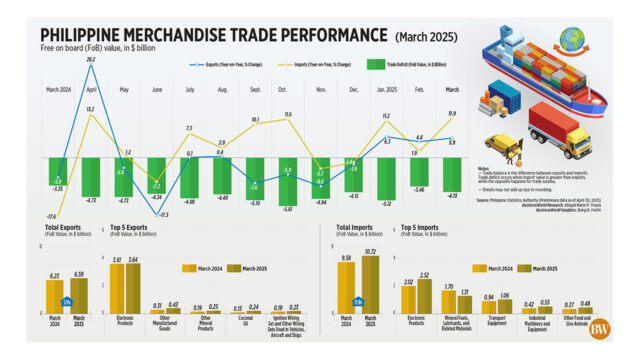
Philippine Merchandise Trade Performance (March 2025)

THE PHILIPPINES’ trade-in-goods deficit widened to a two-month high in March as both exports and imports picked up, the Philippine Statistics Authority (PSA) reported on Wednesday. Read the full story.

Philippine Merchandise Trade Performance (March 2025)

Nonbanks’ domestic claims rise in Q4

DOMESTIC CLAIMS of nonbank financial firms rose by 12.6% year on year in the fourth quarter, preliminary data from the Bangko Sentral ng Pilipinas (BSP) showed.

The BSP’s Other Financial Corporations Survey (OFCS) showed domestic claims of nonbanks increased to P10.1 trillion in the October-December period from P8.94 trillion a year prior.

Quarter on quarter, domestic claims also went up by 2% from P9.87 trillion.

The OFCS is an analytical survey of the assets and liabilities of the OFC sector. It uses standardized report forms as required by the International Monetary Fund like individual financial statements from nonbank companies — which include insurance firms, holding companies, government financial institutions, investment companies, and other financial intermediaries — as well as consolidated financial statements from trust institutions.

The central bank said domestic claims grew at a faster annual pace in the period versus the third quarter’s 11.9% amid “higher claims on depository corporations, other sectors, and the central government.”

Claims on other sectors accounted for the bulk (46.9%) of domestic claims in the fourth quarter, followed by claims on depository corporations (28.7%) and net claims on the central government (24.4%).

Other sectors include the state and local government, public nonfinancial firms, and the private sector.

OFCs’ claims on other sectors amounted to P4.73 trillion in the quarter ending December, up by 7.8% from P4.39 trillion a year ago.

Nonbanks’ claims on the private sector likewise rose by 7.8% to P4.71 trillion from P4.37 trillion year on year.

“Claims on other sectors also expanded due to higher holdings of equity shares issued by other nonfinancial corporations and more loans extended to households. Moreover, claims on the central government rose due to higher investments in government-issued debt securities.”

In the fourth quarter, net claims on the central government rose by 8.1% year on year to P2.46 trillion from P2.27 trillion.

Claims on depository corporations surged by 26.4% to P2.89 trillion in the last quarter of the year from P2.28 trillion a year prior.

“The increase in claims on depository corporations was due to higher deposits with the banks,” it added.

Meanwhile, net foreign assets of OFCs jumped by 20.6% to P465.95 billion in the fourth quarter from P386.32 billion a year earlier.

“Moreover, the sector’s other liabilities rose by 13% year on year, driven mainly by higher shares and other equity issuances,” the central bank said.

Claims of OFCs on nonresidents climbed by 11.8% to P629.61 billion from P562.23 billion.

“Since its inception, the OFCS has recorded significant growth in the assets of other financial corporations,” the BSP said. “The sector’s domestic claims expanded by 100.2% in the fourth quarter of 2024 from the initial recorded amount of P5.03 trillion in the first quarter of 2017, reflecting its growing importance to the economy.” — Luisa Maria Jacinta C. Jocson

Garmin announces vívoactive 6 smartwatch

GARMIN INTERNATIONAL, INC.

GARMIN last week announced its latest health and fitness smartwatch vívoactive 6, which is now available in the Philippines.

The vívoactive 6 has a suggested retail price of P19,490 and can be purchased via Garmin PH’s official website or at Kinetic, Lazada, or Shopee. It has an aluminum bezel and silicone band and comes in the colors Black/Slate, Bone/Lunar Gold, Jasper Green and Pink Dawn.

“No matter your fitness goals, vívoactive 6 is designed to help you understand your body better than ever before. From your morning routine to your mid-day workout session to your nighttime wind down and everything in between, this smartwatch will be with you every step of the way,” said Susan Lyman, Garmin Vice President of Consumer Sales and Marketing.

The smartwatch has an AMOLED display and up to 11 days of battery life, and comes with various features like Body Battery energy monitoring, sleep coach, preloaded sports apps, and new mobility workouts, among others.

The vívoactive 6 also has a brand-new feature, Garmin’s “smart wake alarm,” which monitors users’ lighter sleep stages during a pre-selected window of time and gently wakes them up with a light vibration.

“Once awake, the morning report provides an overview of last night’s sleep, recovery insights, Body Battery, daily calendar and more,” it said. “It also includes heart rate variability (HRV) status, an early indicator of overall wellness and how prepared the body is for the day ahead.”

Other features include stress tracking, meditation and mindful breathing, Pulse Ox for track blood oxygen saturation while awake or asleep, as well as women’s health functions like tracking menstrual cycles or pregnancy.

It also has more than 80 preloaded sports apps, including walking, running, cycling and pool swimming, and new daily suggested walking workouts.

“Users can also download a robust selection of step-by-step workouts for strength, HIIT, yoga, Pilates, mobility and more through Garmin Connect. They can also access Garmin Coach running and strength training plans — several of which adapt daily based on performance, recovery and health metrics to help users prepare for their next race, train for a milestone or improve overall fitness,” it said.

“While out for a run, keep track of crucial running dynamics like cadence, stride length and ground contact time. PacePro provides runners with grade-adjusted pacing guidance based on course elevation and personal pacing preferences. Following a workout, the workout benefit and recovery time tools can help users understand how their workout benefits their body and see how much time is needed to recover before taking on their next fitness challenge,” Garmin added.

Users can see their health and fitness information via the Garmin Connect app and also download other apps and watch faces via the Connect IQ Store.

They can also receive text messages, emails and alerts via the smartwatch when paired with a compatible iPhone or Android smartphone, and those with Android phones can respond to messages via the on-watch keyboard.

“Safety and tracking features help provide peace of mind by sending a message with the user’s live location (when available) to chosen emergency contacts if they feel unsafe or if an incident is detected,” Garmin said. — B.V. Roc

Meralco says P683.74-M spent in Q1 for substation upgrades

MANILA ELECTRIC COMPANY (Meralco) said it recently expanded its Fort Bonifacio Global City-2 Gas-Insulated Switchgear Substation to meet the growing power requirements of commercial establishments and residential customers in Taguig City and Makati City.

MANILA ELECTRIC CO. (Meralco) spent a total of P683.74 million in the first quarter (Q1) for the upgrade and development of three substations to help meet growing power requirements in its service areas, the power distributor said on Wednesday.

Meralco allocated P268.84 million for the development of the Mesaland 115-34.5 kilovolt (kV) substation, which was energized in March, based on the company’s presentation.

The development, which involves the installation of a new power transformer and gas-insulated switchgear, provides additional capacity to serve load growth in parts of the provinces of Laguna and Cavite, it added.

With a budget of P188.41 million, the company expanded its Malinta Substation to accommodate increasing demand in the cities of Valenzuela and Malabon.

Meralco also said it commissioned a new power transformer and gas-insulated switchgear for the switchgear substation located in Bonifacio Global City at a total cost of P226.49 million.

The improvement aims to accommodate additional demand and enhance flexibility and reliability in Bonifacio Global City and parts of Makati, it said.

“With these three projects, we are effectively providing additional capacity to support local and rural areas,” Meralco First Vice-President and Head of Networks Froilan J. Savet said in a recent briefing.

The company said that it “continuously invests heavily on projects aimed to improve its electricity distribution system and ensure safe, stable and reliable electricity service to its customers.”

Meralco’s controlling stakeholder, Beacon Electric Asset Holdings, Inc., is partly owned by PLDT Inc.

Hastings Holdings, Inc., a unit of PLDT Beneficial Trust Fund subsidiary MediaQuest Holdings, Inc., has an interest in BusinessWorld through the Philippine Star Group, which it controls. — Sheldeen Joy Talavera