Home Blog Page 1133

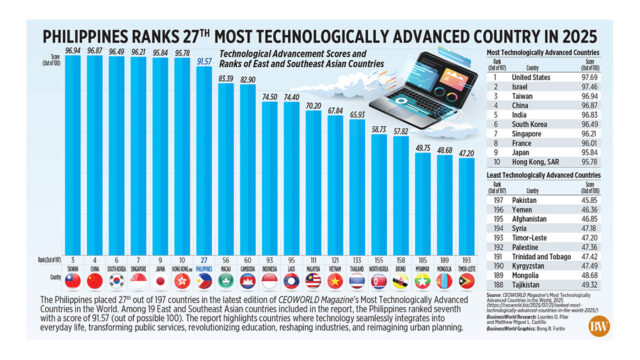
Philippines ranks 27th most technologically advanced country in 2025

The Philippines placed 27th out of 197 countries in the latest edition of CEOWORLD Magazine’s Most Technologically Advanced Countries in the World. Among 19 East and Southeast Asian countries included in the report, the Philippines ranked seventh with a score of 91.57 (out of possible 100). The report highlights countries where technology seamlessly integrates into everyday life, transforming public services, revolutionizing education, reshaping industries, and reimagining urban planning.

Philippines ranks 27<sup>th</sup> most technologically advanced country in 2025

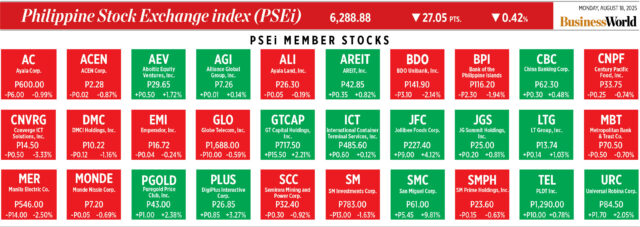
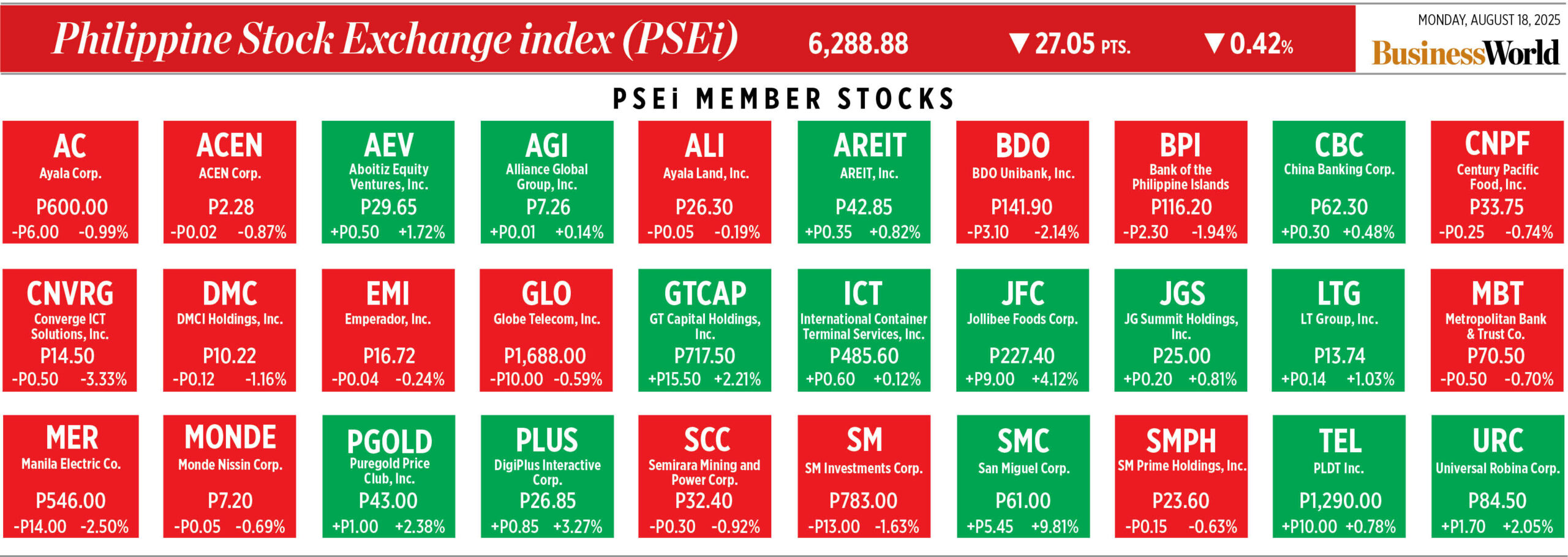
How PSEi member stocks performed — August 18, 2025

Here’s a quick glance at how PSEi stocks fared on Monday, August 18, 2025.


PSEi drops to 6,200 level amid lack of catalysts

BW FILE PHOTO

PHILIPPINE SHARES dropped on Monday, pulling the main index back to the 6,200 level, as the market mostly moved sideways due to the absence of new trading drivers. 

The benchmark Philippine Stock Exchange index (PSEi) dropped by 0.42% or 27.05 points to close at 6,288.88, while the broader all shares index fell by 0.27% or 10.12 points to 3,741.11.

“The local market’s sideways movement closed in the negative territory as investors sold off shares amid the lack of fresh leads,” Philstocks Financial Inc. Research Manager Japhet Louis O. Tantiangco said in a Viber message. “Trading was anemic… reflecting poor investors’ confidence towards the market amid the lack of a catalyst.”

“The PSEi closed at 6,288.88, down by 0.42%, as the market appears to be experiencing some profit taking from names that increased last week. Moreover, on a broader scale, the market seems to be in a consolidation phase, with investors likely waiting for more news before taking clearer directions,” Regina Capital Development Corp. Head of Sales Luis A. Limlingan said in a Viber message.

Rizal Commercial Banking Corp. Chief Economist Michael L. Ricafort said in a Viber message that the local bourse dropped to track the decline seen on Wall Street on Friday.

US shares were down as investors assessed mixed data to gauge the US Federal Reserve’s monetary policy path this year, Reuters reported.

The central bank last lowered borrowing costs in December and said US tariffs could add to price pressures. However, recent labor market weakness and signs that tariff-induced inflation was yet to reflect in headline consumer prices have made investors confident of a potential dovish move next month.

On Aug. 15, the S&P 500 dropped by 0.29% or 18.74 points to 6,449.80; and the Nasdaq Composite index retreated by 0.4% or 87.69 points to 21,622.98; while the Dow Jones Industrial Average index rose by 0.08% or 34.86 points to 44,946.12.

Sectoral indices closed mixed on Monday. Financials sank by 1.45% or 31.40 points to 2,122.36; holding firms decreased by 0.31% or 16.90 points to 5,285.59; and property went down by 0.18% or 4.50 points to 2,412.32.

Meanwhile, mining and oil rose by 3.39% or 314.86 points to 9,587.25; industrials climbed by 0.15% or 14.41 points to 9,066.32; and services went up by 0.15% or 3.47 points to 2,274.83.

“San Miguel Corp. was the day’s index leader, jumping 9.81% to P61. Converge ICT Solutions, Inc. was the main index laggard, falling 3.33% to P14.50,” Mr. Tantiangco said.

Value turnover went down to P6.18 billion on Monday with 746.65 million shares traded from the P10.35 billion with 1.55 billion shares exchanged on Friday.

Decliners bested advancers, 105 versus 85, while 63 names were unchanged.

Net foreign buying was at P252.17 million on Monday, a turnaround from P514.88 million in net selling recorded on Friday. — Revin Mikhael D. Ochave with Reuters


Rice import freeze not expected to affect inflation; stocks ample

REUTERS

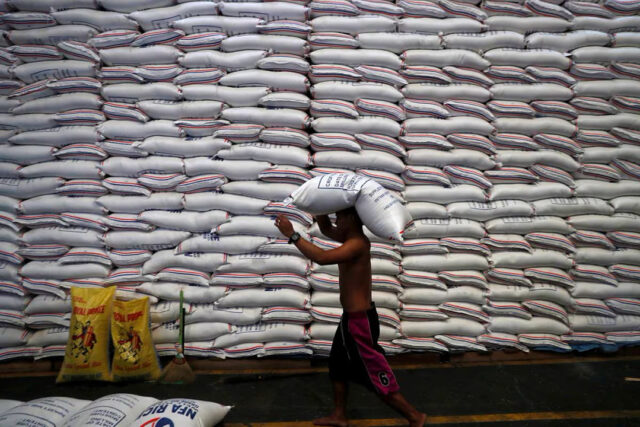
THE temporary ban on rice imports is not expected to stoke inflation as rice stocks remain substantial, according to the Department of Agriculture (DA).

“We had a record harvest in the first half, plus we are expecting a record harvest for the wet season,” DA spokesman Arnel V. De Mesa told reporters.

“This means that we have lots of rice and palay (unmilled rice) in circulation. (We do not expect) sudden surges in rice prices,” he added.

President Ferdinand R. Marcos, Jr. suspended rice imports between September and October to provide relief to farmers, who have had to sell their grain to traders for as little as P8 per kilo in some places, well below production costs.

Mr. De Mesa noted that due to the upcoming import ban, the international price of Vietnamese rice declined.

He noted that the Philippines accounts for 45% of Vietnam’s rice shipments.

Palay production in the first half of 2025 rose 6.4% year on year to 9.08 million metric tons (MMT), of which 4.38 MMT came in during the three months to June, the highest second-quarter output since 1987.

The Philippine Statistics Authority reported that the national rice inventory as of July 1 rose 27% year on year to 2.8 MMT.

Rice carries a 9% weighting in the basket of goods used to estimate inflation.

The Department of Economy, Planning, and Development (DEPDev) has said that the sustained drop in rice prices has significantly eased the cost of living for low-income households.

Mr. De Mesa said rice tariff collections, which go towards supporting the Rice Competitiveness Enhancement Fund (RCEF), were substantial during the earlier months of the year, adding that the import suspension will not affect the RCEF’s funding.

The Bureau of Plant Industry (BPI) reported that imported rice landed between January and July totaled 2.44 MMT.

Mr. De Mesa urged legislators to give equal attention to water impounding and irrigation projects after flood control projects came under scrutiny following their failure to prevent floods during the spate of July rains.

He noted that floods result in the loss of 500,000-600,000 metric tons of palay annually.

Central Luzon, the leading rice-producing region, was heavily affected by flooding in July.

Irrigation systems, which have separate drainage systems, are “long-term” investments, Mr. De Mesa noted. — Kyle Aristophere T. Atienza

BoI sticks to P1.75-T goal for approved investments

THE Board of Investments (BoI) said it maintained its target for approved investment applications this year at P1.75 trillion.

“We will stick to that. And next year we’re hosting ASEAN 2026, so that will open the Philippines to our counterparts,” BoI Chairman and Trade Secretary Ma. Cristina A. Roque said on the sidelines of the media launch of the 51st Philippine Business Conference and Expo.

“We will show our best. We are preparing for that,” she added.

The P1.75-trillion approvals target, if achieved, would represent an 8% rise from the P1.62 trillion worth of approvals in 2024.

The Philippine Statistics Authority reported that BoI-approved investments hit P382.24 billion in the first half, about 60% behind the year-earlier approval pace.

Ms. Roque said approvals have been affected by the uncertainty surrounding US reciprocal tariffs.

When the tariff situation for Southeast Asia clears up, “then, businesspeople can already choose to really stay here,” she said.

“But I think we’ll still have an edge because 19% is not that big compared to others,” she added.

On Aug. 7, the US started collecting a reciprocal tariff of 19% on Philippine goods entering the US market.

To attract more foreign investment, she said that the government will be sending more trade missions throughout the year.

“We are scheduled to go to Cambodia, Osaka, Japan, and New York. We are hoping for France plus other countries,” she said.

“Despite the tariffs, I think it’s business as usual. If you’re a businessperson, you don’t stop your business because of all of these tariffs … We still have to go on and maneuver using (every opportunity) offered to us,” she added. — Justine Irish D. Tabile

5-month foreign debt service bill creeping up to $5.9 billion

REUTERS

THE debt service bill on foreign borrowing was nearly $5.9 billion in the five months to May, according to preliminary data from the Bangko Sentral ng Pilipinas (BSP).

Debt service rose 0.51% to $5.869 billion in the first five months, from $5.839 billion a year earlier.

Principal payments rose 2.68% in the first five months to $2.645 billion. Interest payments declined 1.23% to $3.224 billion.

The debt service burden represents principal and interest payments after rescheduling, according to the BSP.

These totals include principal and interest payments on fixed medium- and long-term credits, including International Monetary Fund credits, loans covered by the Paris Club and commercial bank rescheduling, and New Money Facilities.

They also cover interest payments on fixed and revolving short-term liabilities of banks and nonbanks.

The debt service data exclude prepayments on future years’ maturities of foreign loans and principal payments on fixed and revolving short-term liabilities of banks and nonbanks.

“The external debt service burden is largely a function of matured foreign debt versus year-ago levels, in view of the fact that the NG (national government) borrowings increased since the COVID-19 pandemic started in March 2020,” Rizal Commercial Banking Corp. Chief Economist Michael L. Ricafort said via Viber.

Mr. Ricafort noted, however, that most of the NG’s foreign debt is long-term, “some of which have started to mature and have increased since the pandemic.”

The Bureau of the Treasury reported that gross borrowing rose 78.16% to P263.99 billion in June, driven by both domestic and foreign debt.

Mr. Ricafort added that the net increase in US interest rates since the pandemic were a factor, “offset by the total Fed rate cuts of minus 1 percentage point since September 2024 and the possible half percentage point Fed rate cuts for the balance of 2025,” he said.

The Federal Reserve is expected to deliver its first interest rate cut this year in September, followed by another before year’s end, Reuters reported.

As of May, the debt service burden as a share of gross domestic product (GDP) fell to 2.8% from 3.1% a year earlier.

Outstanding external debt grew 14.02% to $146.737 billion at the end of March, consisting of  $91.535 billion in public-sector debt and $55.202 billion in private-sector debt.

This brought the external debt-to-GDP ratio to 31.5%, up from 29% a year earlier.

The BSP’s external debt data cover borrowings of Philippine residents from nonresident creditors, regardless of sector, maturity, creditor type, debt instruments or currency denomination.

The central bank gathers data on external debt through reports submitted by borrowers, banks, and major foreign creditors. — Katherine K. Chan

Fisherfolk set to join P20 rice beneficiary list

BW FILE PHOTO

THE Department of Agriculture (DA) said the beneficiary list of P20-per-kilo rice program will be expanded this month to include fisherfolk.

The DA said the rice will start to go on sale at fishports by the end of the month.

“Weekly provincial rollouts will also continue in areas with active NFA (National Food Authority) depots through the end of the year,” it said in a statement on Monday.

Agriculture Secretary Francisco P. Tiu Laurel, Jr. said the rice program is the DA’s “biggest challenge” that still needs “full support” from the government. The subsidized-rice program currently benefits nearly 400,000 families.

“We have the stocks. We have the budget. What we need now is urgency and unity,” he said, referring to the P10-billion increase in rice program funding under the 2026 national budget.

The program was originally limited to senior citizens, persons with disabilities, solo parents and indigents. It was recently expanded to minimum wage earners, beneficiaries of the Department of Social Welfare and Development’s Walang Gutom program, and farmers and farm workers enrolled in the Registry System for Basic Sectors in Agriculture. — Kyle Aristophere T. Atienza

PEZA sees 20-30 economic zone proclamations as best-case scenario 

THE Philippine Economic Zone Authority (PEZA) said economic zone (ecozone) proclamations are likely to number 20-30 this year, based on the agency’s best-case target.

“We might be able to achieve that. Because if you notice lately, there are a lot of proclamations coming out,” PEZA Director General Tereso O. Panga told reporters last week.

“So maybe 20 to 30 proclamations. That is our ambitious target,” he added.

The Palawan Mega Ecozone is among the ecozones it is counting for endorsement to PEZA this month.

“They’re ready to endorse it to us if not this month, next month. So once they endorse it to us, we will now apply it with the Office of the President for proclamation,” he said.

The endorsement will initially cover 4,000 hectares and eventually cover 28,000 hectares, Mr. Panga said.

The Palawan Mega Ecozone is a result of a memorandum of agreement signed between PEZA and the Bureau of Corrections (BuCor) to redevelop portions of the Iwahig Prison and Penal Farm in Puerto Princesa, Palawan.

He also added that BuCor Director General Gregorio Pio P. Catapang, Jr., has announced plans to develop another BuCor property in Sablayan, Mindoro Occidental, into an ecozone.

“That is far bigger than Palawan. They want to develop it into a township ecozone. I think that is a total of 200,000 hectares,” he said.

He said that the plan is to develop the mega ecozones through public-private partnerships and distribute the property to the private sector to develop their own facilities.

“We will offer the land as our equity and bring in the developers to put in money for all the amenities and facilities,” he said.

“It might be a big ecozone, but we are willing to split it into packets of development. What we are anticipating are probably huge agro-processing companies that will need, other than processing plants, their own plantations,” he added.

He also said the pharma ecozone that is set to rise in Luisita, Tarlac, will be developed by Lloyd Laboratories.

“They’re now complying with the requirements for presidential proclamation. So that one will be massive too because they have an American partner to do drug manufacturing,” he said.

“We are looking at three months for proclamations, so if we can submit by September, maybe towards the end of December it can be proclaimed,” he added.

Meanwhile, he said the PEZA board is set to approve billions worth of investments at the Victoria Industrial Park.

The PEZA board is scheduled to meet in Davao City between Aug. 14 and 16. — Justine Irish D. Tabile

PPP project pipeline hits P2.86 trillion

PPP.GOV.PH

THE public-private partnership (PPP) projects in the pipeline now number 230, valued at P2.86 trillion, the Department of Economy, Planning, and Development (DEPDev) said.

Speaking at a House Committee on Appropriations briefing on Monday, Economy Secretary Arsenio M. Balisacan said the government is currently in the process of maximizing the PPP Code to mobilize greater private-sector participation in infrastructure.

“We will continue to collaborate with Congress to prioritize transformative reforms identified in the updated PPP (law), reforms that will accelerate the realization of our shared development objectives,” Mr. Balisacan said.

The PPP Center reported that the PPP pipeline totaled 230 projects as of Aug. 18.

Some 166 of these were national projects worth P2.70 trillion, while 95 were local projects valued at P154.74 billion.

The PPP Center said two new projects were added to the pipeline since the July 28 update.

These are the P29.62-billion Metro Manila Waste to Energy project of the Metropolitan Manila Development Authority, and phase 4 of the School Infrastructure Project of the Department of Education.

The PPP Center said it delisted the P29.39-billion 3,000-tons-per-day Manila Waste-to-Energy Facility Project and the P320-million digitalization project of the Philippine Retirement Authority.

The PPP Center noted that the projects were delisted due to “failure of negotiations.”

Meanwhile, PPP projects under implementation totaled 261 and were valued at P3.79 trillion. — Aubrey Rose A. Inosante

Any SC order to return GOCC funds will be complied with in 2027 budget — Recto

BW FILE PHOTO

FINANCE Secretary Ralph G. Recto said a prospective Supreme Court (SC) order to return funds taken from the Philippine Health Insurance Corp. (PhilHealth) and Philippine Deposit Insurance Corp. (PDIC) will be complied with in the next budget cycle.

“Assuming that the decision is made in the middle of the budget (preparation process), then that will increase the deficit,” Mr. Recto said at a House Committee on Appropriations briefing on Monday.

“If we are to comply, we will do it in the succeeding year’s budget,” he added.

Akbayan Party-list Rep. Jose Manuel I. Diokno had queried him on the possibility of an adverse Supreme Court ruling. Mr. Diokno had participated in the legal challenge to the government’s decision to raid PhilHealth’s reserves.

Bayan Muna had asked the Supreme Court to order the return of P60 billion to PhilHealth and P104 billion to the PDIC.

The deficit remains manageable at 5.7% of gross domestic product (GDP) in the first half, Mr. Recto said, with a target to bring down the ratio to 5.5% this year.

The deficit-to-GDP ratio is expected to fall to 5.3% next year and to 4.3% in 2028.

“It may affect our credit ratings (also),” he said.

In April, Fitch Ratings reaffirmed the Philippines’ BBB credit rating with a stable outlook.

The Department of Finance (DoF) said government-owned or -controlled corporations (GOCCs) remitted P105 billion to the Bureau of the Treasury as of July.

At the same briefing, Mr. Recto said the government is open to cutting taxes if the deficit falls to 3% of GDP.

“My advice is that when the deficit gets down to 3%, then we can start talking about cutting taxes,” he said.

Asked if he is open to lowering the value-added tax (VAT) to 10% from 12%, Mr. Recto said: “For as long as the deficit is roughly 3% and the debt-to-GDP maybe below 50%, I would not object to lower taxes.”

At the end of June, sovereign debt hit a record P17.27 trillion, up 11.5% from a year earlier. This brought the debt to GDP ratio to 63.1% at the end of June, the highest ratio since 2005.

The debt-to-GDP ratio is expected to end the year at 61.3%, picking up to 61.8% by the end of 2026 and then falling to 58% by 2030. — Aubrey Rose A. Inosante

Emerging Asia outlook ‘structurally bullish’ due to favorable demographics — Pantheon

TOM BOOTH/FLICKR

THE PHILIPPINES is among the countries in Emerging Asia expected to benefit from favorable demographics, Pantheon Macroeconomics said.

“One of the reasons we remain structurally bullish about the prospects for Emerging Asia ex-China economically, let alone as a burgeoning export manufacturing hub, is the region’s favorable demographic outlook,” Pantheon Chief Emerging Asia Economist Miguel Chanco said in a report.

Pantheon said the 15-to-64 working-age population in the region — excluding Taiwan, Thailand, and Singapore — will continue to grow over the next two decades, citing the United Nations’ (UN) latest population projections.

“This represents a continued boon for both the supply side story, via a naturally growing labor force, and the demand side, as this enlarging workforce spends more and more on goods and services,” Mr. Chanco added.

The Philippine Statistics Authority (PSA) estimates that the Philippine working population (aged at least 15 years) hit a record in May at 52.32 million, up 2.65% from a year earlier.

The UN projects the Philippines’ working-age population to hit its peak in 2054, much sooner than its 2077 projection made in 2010.

However, Pantheon noted that some members of the ‘ASEAN four’ — Indonesia, Malaysia, the Philippines and Vietnam — are “greying more rapidly than previously expected.”

Pantheon said fertility rates in the region, which are below the 2.1 replacement level, and brain drain could sidetrack their expected economic growth path.

“The latter is a particularly acute problem in the Philippines, Taiwan and Vietnam,” Mr. Chanco said.

Replacement level refers to the fertility rate required to maintain a stable population.

As of 2022, the Philippines has a total fertility rate of 1.9 children per woman, the PSA reported. — Katherine K. Chan

DENR supports hiring of informal waste collectors

DENR PHOTO

THE Department of Environment and Natural Resources (DENR) said it supports the absorption of waste collectors by the formal waste management industry.

The DENR said in a statement that informal collectors can thereby access welfare benefits, boosting their economic opportunities.

It said while Republic Act 9003 provides the legal framework for solid waste management, it does not yet establish clear protections or governance structures for the informal waste sector.

“The informal waste workers remain excluded from the solid waste management value chain, yet their work is indispensable and forms the very backbone of a supply chain that advances environmental sustainability,” Environment Secretary Raphael P. M. Lotilla said.

“Faced with the growing weight of plastic pollution, we must build stronger partnerships that turn our environmental goals into tangible results that benefit all sectors, protect all ecosystems, and uplift all communities,” he added.

Informal waste workers include waste reclaimers, itinerant waste buyers, and small junk shop operators who recover and recycle significant amounts of waste materials, which help reduce the dependency on landfills.

According to the DENR’s Environmental Management Bureau (EMB), informal waste workers operate without workplace safety protections, stable incomes, or access to social services.

“Exposure to hazardous materials puts them at risk of respiratory illnesses, infections, and injuries,” it added.

The National Solid Waste Management Commission requires local government units to integrate programs supporting informal waste workers into their 10-year solid waste management plans to ensure institutional recognition and access to essential services.

In 2024, the EMB briefed about 200 informal waste workers in the National Capital Region, Region III, and Region IV-A on their role in the Extended Producer Responsibility (EPR) Act of 2022 and the Ecological Solid Waste Management  Act of 2000, particularly in helping producers achieve recycling targets under the EPR system.

This year, the EMB will provide grants for weighing scales to 50 junk shops in Quezon City to support waste recovery and recycling, and connect workers to larger markets and enterprises where they can support producers seeking to comply with the EPR Act. — Kyle Aristophere T. Atienza

ADVERTISEMENT
ADVERTISEMENT