Home Blog Page 113

Investors in ‘very risk-off mode’ as oil prices stay elevated — PSE chief
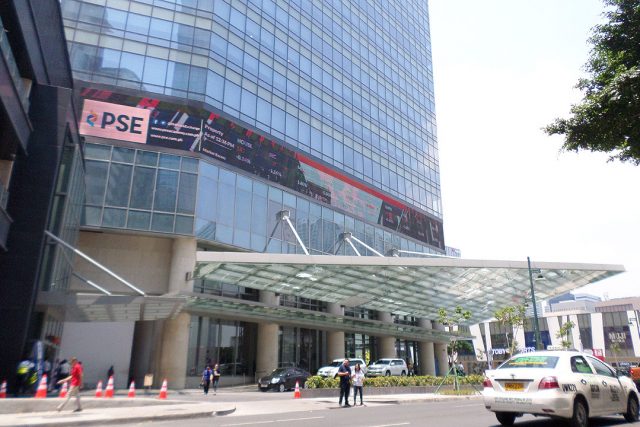
BW FILE PHOTO

PHILIPPINE STOCK EXCHANGE (PSE) President Ramon S. Monzon said investors are in a “very risk-off mode” amid the Middle East conflict, adding that oil prices, currently at $131.97 per barrel, would need to fall to around $80 to signal a return to market stability.

“I think we need to see oil back at the $80 level… When the oil starts going down from $100 to $80, I think it will deliver a strong message to the market that the conflict has somewhat subsided and there will be stability in oil prices,” he said on the Money Talks with Cathy Yang program on One News on Tuesday.

Fuel prices in Metro Manila are set to increase starting March 24, with gasoline rising by P8 to P12 per liter, diesel by P15 to P18 per liter, and kerosene by P12 to P22 per liter. These adjustments will bring diesel prices to as high as P144.20 per liter and gasoline to P102.50 per liter. Kerosene is expected to reach up to P165.79 per liter.

“I think it’s a very risk-off mode,” Mr. Monzon said.

“I hope yesterday (Monday) was an exaggerated fear or anxiety by investors. But as we all know, [US President Donald J.] Trump has come out with a statement that he and Iran leaders are talking about halting hostilities. If that is true, or that really holds, I think the damage to our market would be transitory, not permanent,” he added.

On Monday, the PSE index (PSEi) slid by 1.98% or 119.44 points to close at 5,899.18, while the broader all-shares index declined by 2.04% or 68.28 points to end at 3,276.59.

This marked the PSEi’s worst close so far this year and its lowest finish in nearly four months, or since it ended at 5,887.58 on Dec. 4.

Despite ongoing challenges, the PSE chief cited strong aggregate corporate earnings growth among index companies last year, highlighting potential upside for the market.

He also expressed cautious optimism on the PSEi, noting that while the flood control corruption scandal has eroded investor trust, resilient initial public offering (IPO) performances suggest the impact has not peaked.

“In spite of the market being down 2.5% from last year, the price of Maynilad is still way above their IPO price… So I don’t — I think it’s peaked in that sense. But now we have to get over this new challenge, this new headwind, which is the Iran crisis,” he said.

Mr. Monzon also said the recent corruption scandal has been overshadowed by the Iran crisis, stressing that strong governance is essential across markets, particularly at the government level rather than only in the corporate sector.

“I think Filipinos are still waiting for really concrete action on the results of the investigation. They need to see more criminal cases filed. That’s what everybody’s hoping for,” he added.

The flood control issue has weighed on the stock market, which declined in 2025. The PSEi ended lower on the final trading day of 2025 at 6,052.92, down by 7.29% or 475.87 points from its end-2024 finish of 6,528.79.

On Tuesday, the PSEi rose by 0.62% or 37.02 points to close at 5,936.20, while the broader all-shares index gained by 0.56% or 18.64 points to end at 3,295.23. — A.G.C. Magno with inputs from Sheldeen Joy Talavera

DMCI to keep capex plans despite higher oil costs

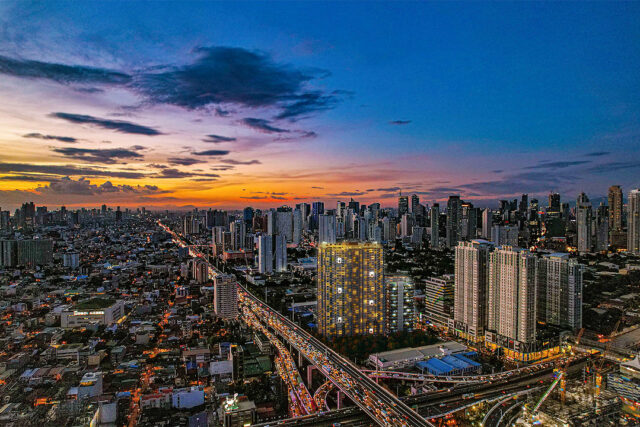
FORTIS Residences is a project of DMCI Homes’ premium brand, DMCI Homes Exclusive. — COMPANY HANDOUT

DMCI HOLDINGS, Inc. executives said capital expenditures (capex) will remain unchanged despite higher oil prices linked to the Middle East conflict, although the company may review operating costs and project timelines.

“I think the committed capex will just keep going, no change in plans,” Isidro Consunji, DMCI Holdings chairman and chief executive officer, said during a briefing on Tuesday.

DMCI earlier said it would increase its capex budget for its subsidiaries to P24.6 billion this year, up 11% from P22.2 billion in 2025, to support residential construction, expand off-grid power capacity, and upgrade cement operations.

DMCI Holdings Executive Vice-President and Chief Financial Officer Herbert Consunji, who also serves as president and chief executive officer of Concreat Holdings Philippines, said the capex budget has already been finalized and will be implemented as planned.

“[But] of course, the operating costs will now be revisited because the price is different now,” he said, speaking for Concreat Holdings.

“It’s not just a matter of price, it’s a matter of availability. You may have money to buy it, but it’s not available because other suppliers have downgraded,” Mr. Consunji added.

He said that as costs are reviewed, funding plans will also be reassessed. “Everything will be reset — parang ganon. But we’ll never know what’s going to happen.”

DMCI allocated P2.9 billion for Concreat Holdings Philippines this year for plant capacity improvements, operational upgrades, and preventive maintenance.

In 2025, Concreat Holdings Philippines posted a net loss of P1.9 billion due to higher financing expenses and lower average selling prices, although the company has implemented operational improvements to support recovery.

Meanwhile, DMCI Homes President Alfredo R. Austria said some project launches may be delayed if current challenges persist.

“There will be a possible delay on the launches. Only the launch of the new projects might be delayed. But for existing projects, we have to push through because it’s already committed,” he said.

For 2026, DMCI Holdings will allocate P15.5 billion, or 65% of its capex, to its property arm DMCI Project Developers, Inc. (DMCI Homes).

DMCI Homes’ capex budget this year will fund ongoing and new project construction for four residential developments in Baguio, Laguna, Quezon City, and Taguig, covering premium, leisure, and mid-market segments, as well as land banking, depending on market conditions.

Cristina Gotianun, DMCI Holdings vice-chairman and Semirara Mining and Power Corp. president, said the company has implemented fuel-saving programs at the Semirara power plant, particularly during startup.

“So we are positioned very well to reduce our fuel, as well as at the mine site. We’ve always had this, because fuel is the single biggest cost of our operations. So we’ve always been very cautious and diligently putting all the programs in place to conserve fuel,” she said.

DMCI allocated P1.9 billion for Semirara Mining and Power Corp. this year, mainly for power plant maintenance. Last year, Semirara Mining and Power Corp. remained the group’s largest contributor with P7.3 billion, down 33% from P11.1 billion, due to softer energy prices, reduced shipments, and higher production costs.

Record coal production, power generation, and energy sales helped offset the impact of price normalization.

For 2026, DMCI has also earmarked about P3.3 billion for DMCI Power to fund 44 megawatts (MW) of new capacity in Palawan, Occidental Mindoro, and Calapan; P675 million for DMCI to re-fleet construction equipment and meet project requirements; and P300 million for DMCI Mining Corp.’s mine development initiatives.

On Tuesday, DMC shares rose by 1.05% to close at P9.60 each. — Alexandria Grace C. Magno

Aviation regulator issues demand letter to PHL AirAsia over unpaid fees

NEWSROOM.AIRASIA.COM

THE Civil Aviation Authority of the Philippines (CAAP) has directed low-cost carrier Philippines AirAsia, Inc. to settle unpaid obligations, including airport fees and unremitted passenger charges totaling P833.66 million.

“The Civil Aviation Authority of the Philippines confirms that it has issued a collection letter to AirAsia Philippines regarding its outstanding account, as part of its regular business processes,” CAAP said in an advisory on Tuesday.

In a final demand letter addressed to AirAsia Philippines President and General Manager Suresh Bangah, through Chief Financial Officer Lee Chue Yee, CAAP ordered the airline to settle its outstanding financial obligations.

CAAP said AirAsia Philippines’ obligations stem from unpaid navigation charges, aircraft landing and parking fees, passenger service charges (PSCs), and other airport-related fees.

AirAsia Philippines’ obligations include unremitted domestic PSCs, or terminal fees, CAAP said in its letter. It noted that this also includes amounts collected for expired and unutilized tickets, which are held in trust for CAAP’s benefit.

“As reflected in our official records, AirAsia’s unsettled accounts receivable reached P833.656 million as of Dec. 31, 2025, net of all payments made up to Feb. 13, 2026, and exclusive of applicable penalties and interest for delayed remittances,” it said.

BusinessWorld sought comment from AirAsia Philippines, but the company declined to comment.

CAAP added in its letter that AirAsia has failed to fully remit domestic PSC collections despite prior correspondence and subsequent follow-ups.

“AirAsia has failed to fully remit DSPC collections, including those derived from expired and unutilized tickets. It is emphasized that such collections constitute a trust fund held for the benefit of CAAP,” it said. — Ashley Erika O. Jose

PXP unit to convert P561 million in debt into new shares for FEPCO

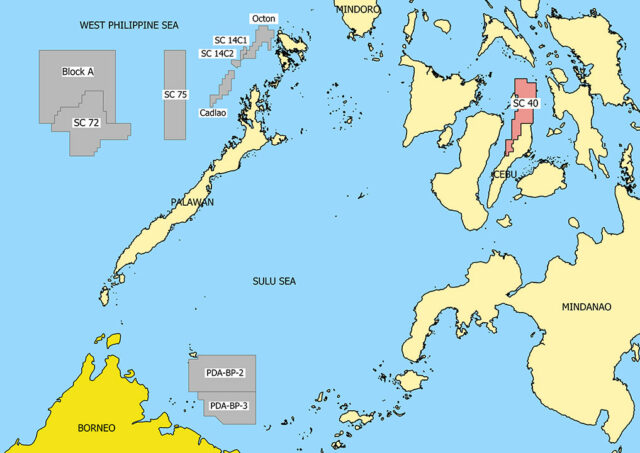
FEI holds a 100% operating interest in Service Contract (SC) No. 40 in Northern Cebu, a key asset within PXP’s portfolio. — PXPENERGY.COM.PH

FORUM EXPLORATION, INC. (FEI), an indirect subsidiary of Pangilinan-led upstream oil and gas exploration firm PXP Energy Corp., will convert P561 million of its debt into new common shares to be issued to Forum Energy Philippines Corp. (FEPCO).

In a regulatory filing on Tuesday, PXP said FEI will issue 561 million new common shares at P1 each to FEPCO as part of the conversion.

“The conversion is intended to strengthen FEI’s balance sheet and improve its capital position by reducing outstanding obligations,” PXP said.

FEI is an indirect subsidiary of PXP through its 98.08% effective interest in Forum Energy Ltd., which holds a 100% interest in FEPCO.

Once completed, FEPCO will increase its ownership in FEI to approximately 91.65% of the total issued and outstanding shares, from 66.67%.

FEI holds a 100% operating interest in Service Contract (SC) No. 40 in Northern Cebu, a key asset within PXP’s portfolio.

SC 40, or the North Cebu Block, is located in the Visayan Basin, covering the northern part of Cebu Island and adjacent offshore areas in the Central Tañon Strait and the Visayan Sea.

Earlier this year, PXP said it continues to evaluate options to advance the block, including potential farm-in arrangements, subject to the finalization of commercial terms and funding considerations.

In 2025, PXP reported a wider core net loss of P50.2 million, from P33.3 million in the previous year, due to lower output from the Galoc Field, softer crude prices, and higher financing and foreign exchange-related charges.

Consolidated petroleum revenues fell by 16.9% to P49.8 million from P67 million, amid weaker crude prices.

At the local bourse on Tuesday, shares in the company rose by 3.81% to close at P3 each. — Sheldeen Joy Talavera

Former PLDT chief Napoleon Nazareno passes away at 77

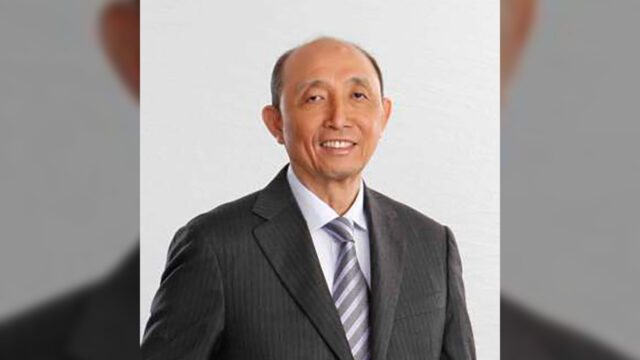
NAPOLEON L. NAZARENO — COMPANY.MERALCO.COM.PH

NAPOLEON L. NAZARENO, who served as president of PLDT Inc. and its unit Smart Communications, Inc., has died at 77.

Mr. Nazareno’s family announced his passing on Tuesday following a spontaneous intracranial hemorrhage, according to a Facebook post by his daughter, Apple Nazareno.

“Polly will be remembered for his kind heart, quiet strength, and remarkable vision. He devoted much of his life to helping shape the future of Philippine telecommunications and believed deeply in innovation, excellence, and making technology serve more people. He led with wisdom, integrity, and a strong sense of purpose, leaving behind a legacy that touched both family and country,” the post said.

His cremated remains will lie at Santuario de San Antonio Parish in Forbes Park, Makati, from March 25 to 27.

Mr. Nazareno retired as president and chief executive officer of PLDT and Smart in 2015. — Ashley Erika O. Jose

BTr partially awards T-bonds as Mideast war pushes up yields

BW FILE PHOTO

THE GOVERNMENT made a partial award of the dual-tranche Treasury bonds (T-bonds) it offered on Tuesday, even rejecting all bids for the shorter tenor, as global markets remained volatile due to the worsening war in the Middle East.

The Bureau of the Treasury (BTr) raised just P5.565 billion via its dual-tenor T-bond offer, below its goal to raise up to P40 billion through the auction, with total bids for both tenors reaching only P27.118 billion.

Broken down, the Treasury rejected all bids for the reissued seven-year bonds it placed on the auction block despite total bids reaching P13.358 billion, within the P10-billion to P20-billion target.

Had the government made a full award, the papers, which have a remaining life of three years and one month, would have fetched an average rate of 6.819%, with bids ranging from 6.65% to 6.895%.

This would have been 86.5 basis points (bps) higher than the 5.954% fetched for the series’ last award on Nov. 28 2024 and also 31.9 bps above the 6.5% coupon for the issue.

The average yield would also be up by 20.7 bps from the 6.612% fetched for the same bond series and 37.3 bps higher than the 6.446% quoted for the three-year bond, the benchmark tenor closest to the remaining life of the issue, at the secondary market before Tuesday’s auction, based on PHP Bloomberg Valuation Service (BVAL) Reference Rates data provided by the BTr.

Meanwhile, for the reissued 25-year T-bonds, the government borrowed just P5.565 billion via the tenor, below the P10 billion to P20 billion goal, even as tenders reached P13.76 billion.

The notes, which have a remaining life of 23 years and 10 months, were awarded at an average rate of 7.4%, with the BTr only accepting bids carrying this yield.

The average rate of the issue jumped by 70 bps from the 6.577% fetched for the series’ last award on Feb. 24 and was also 102.5 bps above its 6.375% coupon.

This was likewise 13 bps higher than the 7.27% fetched for the same bond series and 15.3 bps above the 7.247% quoted for the 25-year bond at the secondary market before Tuesday’s auction, PHP BVAL Reference Rates data showed.

“The back-and-forth headlines on the Middle East conflict continue to dampen investor appetite. As a result, there is a lack of liquidity in the market. Oil prices continue to drive upward movement in yields,” a trader said in a text message.

Expectations of second-round inflationary pressures due to the war also led to weaker demand for the T-bonds, Rizal Commercial Banking Corp. Chief Economist Michael L. Ricafort said in a Viber message.

US President Donald J. Trump’s postponement of the bombing of Iran’s power grid proved no panacea for investors worried about the ramifications of the Middle East war, Reuters reported.

US Treasury yields pushed higher and the dollar regained lost ground, in a retracement of the relief rally that swept markets overnight after Mr. Trump added five days to his Saturday ultimatum for Iran to reopen the Strait of Hormuz within 48 hours, citing “productive” talks Tehran. 

US Treasury yields rose on Tuesday after a sharp fall overnight, as little clarity over an end to the conflict left traders pricing in a more hawkish global interest rate outlook.

The two-year yield jumped 7 basis points to 3.9015% in Asia, while the benchmark 10-year yield was up more than 4 bps to 4.3797%.

The inflationary pulse from energy has seen investors abandon hope for further monetary easing globally and swing to pricing in rate hikes across most developed nations.

Tuesday’s T-bond auction was the last offering of government securities for this month. The government raised P142.358 billion from the domestic market in March, below the P248-billion plan, as the escalating Middle East war spooked investors, causing weaker demand and pushing bond yields higher.

The government borrows from local and foreign sources to help fund its budget deficit, which is capped at P1.647 trillion or 5.3% of gross domestic product this year. — Aaron Michael C. Sy with Reuters

Firms, policymakers urged to rethink strategy as ‘Global 2.0’ takes hold

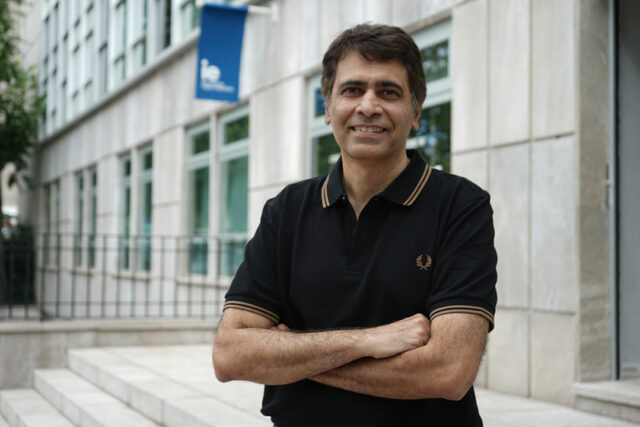
IKHLAQ SIDHU, dean of IE School of Science and Technology in Madrid, Spain.

BUSINESSES and policymakers must rethink how they operate to stay competitive in “Global 2.0,” a new era where resilience matters more than cost efficiency and artificial intelligence (AI) becomes part of everyday infrastructure.

According to Navigating Technological and Geopolitical Transformation, a report from the inaugural IEX Berkeley Collider Summit co-organized by the IE School of Science & Technology and UC Berkeley’s International Co-Lab, the traditional playbook of globalization is being fundamentally “rewired.”

While the previous era prioritized efficiency and cost optimization, the report said the current landscape is increasingly shaped by differing regulations, national priorities, and tighter control over key resources and technology.

For businesses, this means resilience is no longer just a buzzword but a practical requirement in a world where capital, data, and talent move through channels shaped by regional politics rather than fully open markets.

In response to queries on practical execution, Ikhlaq Sidhu, dean of IE School of Science and Technology, said globalization is not retreating but being redesigned.

“The shift from efficiency to resilience means companies must continuously adapt to changes in AI, supply chains, and geopolitics, rather than optimize for a fixed model. For companies in Asia-Pacific, resilience means diversifying supply chains, understanding multiple regulatory systems, and building the ability to reconfigure operations quickly as conditions change,” he told BusinessWorld via e-mail.

AI AS PHYSICAL INFRASTRUCTURE
A key takeaway for the Philippines, particularly its information technology and business process management (IT-BPM) and manufacturing sectors, is the shift of AI from cloud-based software into embedded, real-world infrastructure.

The report said AI is becoming an integral part of logistics, healthcare, robotics, and energy systems.

Mr. Sidhu said this shift will change how technology is valued and delivered.

“AI is no longer something you buy as software — it’s becoming embedded into products, infrastructure, and operations. That makes standalone software harder to sell. In sectors like IT-BPM and manufacturing, value will shift to integrating AI into real-world systems — combining software, hardware, and human expertise to deliver outcomes at scale. The competitive advantage will come not just from using AI, but from embedding it deeply into workflows and going beyond what AI alone can do,” he said.

The report added that the next wave of innovation will come from the convergence of semiconductors, autonomous systems, and digital twins — areas that may require companies to rethink investments toward hardware-software integration and sensor-based systems.

CLOSING THE ‘AGENCY’ GAP
The report also pointed to a widening talent gap between “pedigree” (credentials) and “agency” (the ability to lead and act in uncertain conditions). As AI spreads across industries, traditional credentials alone are no longer enough.

Mr. Sidhu said talent must focus on human judgment and real-world impact to become more valuable in the job market.

“The bar for talent is rising. It’s no longer enough to have credentials — people need the ability to do what AI cannot. Companies need to move learning out of the classroom and into real projects — working with AI, but going beyond it with judgment, creativity, and context. Scale is the new innovation,” he said.

Trond Petersen, associate dean at UC Berkeley, said that institutions must shift toward building “interdisciplinary capability and navigability.”

To address these challenges, the report identified five strategic priorities: promoting adaptable, skills-based education; managing data across different regulatory systems; strengthening cross-border collaboration; improving energy efficiency in computing; and designing systems that can work seamlessly across global markets.

The report also noted that success in innovation is no longer measured by invention alone, but by real-world impact at scale.

“The challenge is not just to innovate, but to ensure systems can work together across boundaries,” said Leticia Cabral Calvillo, executive director of the IEX Research Xcelerator at IE University. — Arjay L. Balinbin

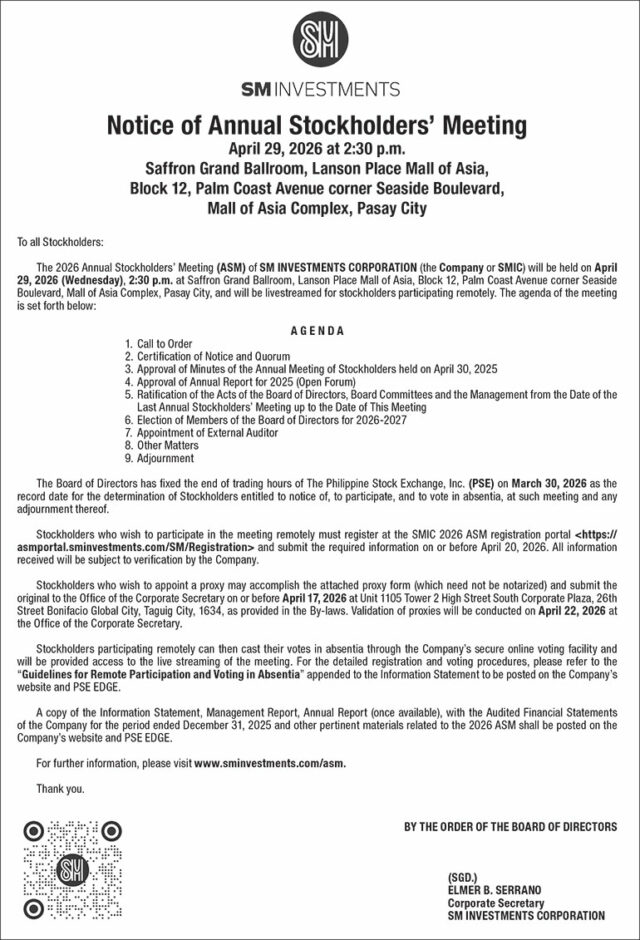
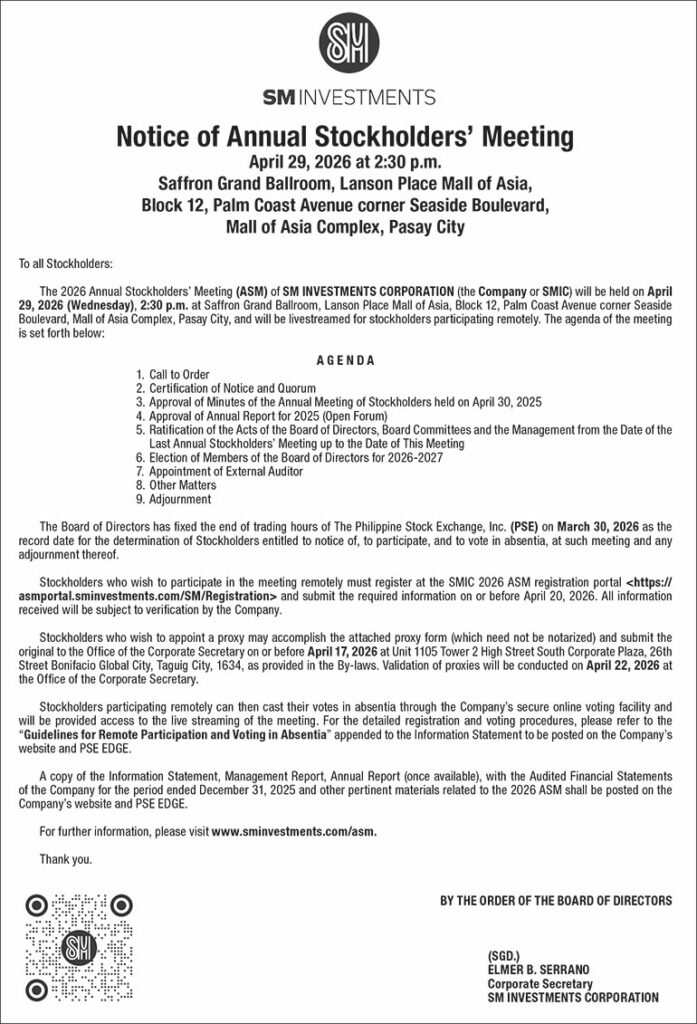
SM Investments Corp. to hold Annual Stockholders’ Meeting on April 29


Spotlight is BusinessWorld’s sponsored section that allows advertisers to amplify their brand and connect with BusinessWorld’s audience by publishing their stories on the BusinessWorld Web site. For more information, send an email to online@bworldonline.com.

Join us on Viber at https://bit.ly/3hv6bLA to get more updates and subscribe to BusinessWorld’s titles and get exclusive content through www.bworld-x.com.

Metrobank closes sustainability bond offer early on strong demand

METROBANK.COM.PH

METROPOLITAN Bank & Trust Co. (Metrobank) on Monday ended the public offer period for its sustainability bonds, a week earlier than scheduled amid robust appetite from the market.

“Metrobank has closed the public offer for its Series F ASEAN Sustainability Peso-denominated bonds on March 23, earlier than the March 30 date previously set, due to strong demand from both institutional and retail investors,” the Ty-led bank said in a disclosure to the stock exchange on Tuesday.

The bank is looking to raise at least P5 billion from the 1.5-year bonds, which have been priced at 5.4727% per annum.

“Proceeds from the bonds will help diversify Metrobank’s funding sources while supporting the bank’s lending operations. In line with Metrobank’s Sustainable Finance Framework, the bank intends to allocate the proceeds to finance or refinance eligible green and social assets, supporting projects that deliver positive environmental and social impact,” it said.

The notes are scheduled to be issued and listed on the Philippine Dealing & Exchange Corp. on April 14.

Metrobank sold the securities at a minimum investment of P500,000 and additional increments of P100,000 thereafter.

The papers will be issued out of the bank’s P200-billion bond and commercial paper program approved in December 2021.

Metrobank tapped First Metro Investment Corp., ING Bank N.V. Manila Branch, and Standard Chartered Bank as joint lead managers and bookrunners for the issuance.

These three institutions and Metrobank also served as selling agents, while ING Bank was also the sustainability coordinator.

The bank last tapped the domestic bond market in October 2022, raising P23.7 billion from 1.5-year notes at a 5% coupon. The final issue size was more than double the initial P10-billion plan amid strong demand, likewise prompting an early close of the offer period.

Proceeds from that issuance were used mainly for general capital requirements, including refinancing maturing obligations.

Metrobank reported a record net income of P49.7 billion in 2025, supported by steady loan growth and strong trading gains.

Its shares jumped by P2.55 or 3.99% to close at P66.40 each on Tuesday. — Aaron Michael C. Sy

Ballet Philippines takes on the journey of the sea people

BRONTË H. LACSAMANA

THIS APRIL, Ballet Philippines (BP) is focusing on the landscape, wind, and memory of Batanes through its brand-new ballet, Paglalakbay: The Journey of the Sea People. Helmed by artistic director Mikhail Martynyuk, the ballet company will finally bring this story to stage after fruitful research expeditions to the northernmost point of the Philippines.

Centered on a deep connection between two people, the full-length ballet will reflect BP’s take on the landscape, materials, and environmental forces that shape life in Batanes, according to Mr. Martynyuk.

“Hopefully, something in it will speak to your heart. It’s really a story about connection and about journey,” he said at a press launch on March 10. The event included a preview, where dancers performed sweeping, graceful, yet grounded movements amid a detailed Ivatan-style set designed by Leeroy New.

BP’s 2024 expedition to Batanes, made possible through their Ballet Brigade outreach program, was not intended to result in “a literal reconstruction of place, but an immersive study of atmosphere.”

There, they gathered with over 200 locals to exchange cultures, perform dances, and share each other’s heritages.

Mr. Martynyuk explained some of the differences. “There’s different movement in Batanes because it is mountainous, so they don’t move like we do on flat land,” he said. “There are also cultural differences, like how crossed arms don’t mean disrespect.”

For librettist Sheree Chua, the interaction of land, weather, and human habitation informed the story just as much as it did the visual design of the piece.

“Migration is often framed as displacement, but movement can also be expansion, a widening of self without losing origin,” she said, noting that “resilience, adaptability, and a sense of identity” are qualities that underpin the Austronesian migration story.

She added that the ballet is historical and intimate, as “a large-scale narrative of seafaring peoples” and a personal tribute to her mother, the woman who first taught her how to move through the world.

“Ballet is definitely relevant up to now,” said Kathleen Liechtenstein, BP president, at the press launch. “With cheaper ticket prices, we can increase accessibility to the younger generation, because they are the future of the country.”

Aside from performances in The Theatre at Solaire in Parañaque this April, Paglalakbay will be brought on a national tour across different provinces, the details of which are still to be announced, as well as a world tour to countries like Hungary and Cyprus.

Ms. Liechtenstein explained that the music — composed by a Gen Z fresh graduate, Ronald Vincenzo Khaw De Leon, who is known for electronic video game music — combines both modern and classical sensibilities.

Despite this, BP took great care to treat the Ivatan culture with respect, even submitting requirements to the National Commission on Indigenous Peoples, to approve their piece about indigenous culture.

“We were very careful about getting the Ivatans’ trust and confidence. It takes a lot of effort,” she said. “Also, we’ll have a chanter to start the program. Ivatan chanters from Batanes will go onstage and start off the ballet.”

She also explained how part of the research journey led Mr. New’s design team to Itbayat, where they searched for traces of early Ivatan structures that predate colonial architecture. During one such exploration, the group ventured deep into the island’s forested terrain and unexpectedly lost their way, spending nearly four hours navigating dense vegetation.

“We wanted the stage design to emulate the key visuals and movement of the Batanes landscape — waves crashing on the shore, jagged rock beaches, wild winds hitting the grass, eroding soil from cliffs,” Mr. New said of the experience.

Both the set and costumes will emphasize elemental textures and materials associated with the islands, including cogon, reed, sawdust, and raffia, all of which “easily respond to the dancers’ motions.”

On a personal note, Mr. Martynyuk also spoke about his resonance with the Ballet Brigade program, which they continue to roll out in various regions of the Philippines.

“We found a promising ballet student in Batanes. I was also from a remote province, in Siberia, many hours from Moscow,” he said. “In Russia, we really market our dancers. I used to dance in Italy and then Turkey and then fly back to Russia, all in the same day. Here, there are many talented dancers. They just need to find a way to be better.”

Ms. Chua concluded by saying that “movement is very universal.”

Paglalakbay is actually every man’s journey,” she said. “This is about our future, our past, and our present.”

Paglalakbay: The Journey of the Sea People runs from April 10 to 12 at The Theatre at Solaire, Parañaque City. Tickets, ranging in price from about P800 to P4,000, are available via www.ticketworld.com.ph, www.ballet.ph, and the Solaire Box Office. — Brontë H. Lacsamana

Belle Corp. to convene on April 27 for its Annual Stockholders’ Meeting via hybrid format


Spotlight is BusinessWorld’s sponsored section that allows advertisers to amplify their brand and connect with BusinessWorld’s audience by publishing their stories on the BusinessWorld Web site. For more information, send an email to online@bworldonline.com.

Join us on Viber at https://bit.ly/3hv6bLA to get more updates and subscribe to BusinessWorld’s titles and get exclusive content through www.bworld-x.com.

Safer environments for women to contribute

Pressfoto | FREEPIK

Across industries and countries, women’s participation in the workforce has expanded significantly over the past few decades. Yet, women’s presence in workplaces does not automatically translate into safety, fairness, or equal opportunity.

While excelling in economic participation, many women still encounter gender-based discrimination, harassment, and barriers to career advancement. Creating safer and fairer workplaces, therefore, requires more than hiring women. It demands structural change, strong institutional policies, and cultural shifts within organizations.

In World Economic Forum’s (WEF) 2025 Global Gender Gap Report, the Philippines ranked 20th out of 148 countries. With an overall gender parity score of 78.1%, the country reaffirms its leadership in Asia as one of the most gender-equal countries.

Despite these high rankings, the daily reality for many Filipino women remains complex. Statistical success often masks the persistent gender-based discrimination, harassment, and invisible barriers that hinder career advancement.

The crisis of workplace harassment

One of the most pressing issues women face at work is gender-based harassment and violence. Studies show that harassment — ranging from inappropriate remarks to coercion and intimidation — remains a widespread concern in many workplaces.

In a study by International Labour Organization (ILO), 22.8% of employees globally have experienced violence and harassment at work.

The local statistics attests to this. Research from the Philippine Business Coalition for Women Empowerment indicates that one in seven women experience sexual harassment in the workplace at least once every week. These occurrences remain largely underreported.

Fear of reprisal or professional retaliation often keeps victims silent, allowing toxic environments to persist.

Such environments not only harm individual well-being but also discourage women from fully participating in the workplace. This requires clear reporting mechanisms, confidential complaint systems, and strict enforcement of anti-harassment policies.

Economic inequality

Fairness in the workplace is also inextricably linked to economic equality. While employment rates for women have improved, the gender wage gap remains a stubborn fixture in many sectors.

Data from WEF Global Gender Gap Report 2024 shows that women continue to earn significantly less than men for similar work. Globally, this gap sits at approximately 20%.

In the Philippines, the disparity is even more pronounced in specific contexts. According to a 2023 LinkedIn report, women in the Philippines earn only 78% of what their male counterparts earn.

This gap widens drastically in rural areas, where women’s earnings plummet to just 43% of men’s wages.

As United Nations Philippines points out, this discrepancy is not a reflection of ability, but rather “a symptom of a system that allows such inequality to exist.”

The UN emphasizes that achieving equality is “not a favor” granted to women, but a fundamental right that must be addressed.

These disparities are often tied to structural barriers such as occupational segregation (funneling women into lower-paid roles), the care gap (unequal distribution of unpaid domestic work, which falls disproportionately on women), and promotional biases.

Redefining work-life balance and leadership

For many women, the professional climb is hindered by the double burden of unpaid caregiving responsibilities. Without supportive policies like parental leave for both parents and accessible childcare, women are forced to limit their professional opportunities to meet domestic demands.

When companies recognize caregiving as a shared social responsibility, they can create a culture where employees can thrive without sacrificing their family commitments.

Furthermore, leadership representation remains a critical area for growth. Despite making up 41.9% of the global workforce, women only hold 32% of leadership positions in tech and media, while making up 14% of the overall science, technology, engineering, and mathematics (STEM) workforce.

This occupational segregation keeps women overrepresented in lower-value, less-skilled, and lower-paid positions, keeping them from advancing.

While over 100 legal reforms were passed from 2019 to 2024 to reduce discrimination, the global workforce participation has stagnated below 50%.

Increasing women’s representation in leadership not only promotes equity but also improves organizational decision-making.

Culture and commitment

Education and organizational culture are equally important. Workplace training programs on gender sensitivity, unconscious bias, and diversity can help reshape how employees interact with one another. However, training alone is not sufficient if leadership does not actively reinforce inclusive values.

Managers and executives must model respectful behavior and demonstrate that discrimination and harassment will not be tolerated. Cultural change occurs when fairness becomes embedded in everyday practices — from hiring and performance evaluations to information interactions among colleagues.

In countries like the Philippines, where women make up a significant portion of sectors, creating safer workplaces is intimately tied to broader economic development. When women feel secure and respected in their jobs, they are more likely to remain in the workforce, invest in their skills, and contribute to innovation and productivity.

Progress towards gender equality in the workplace is neither automatic nor inevitable. It is the result of deliberate choices: policies that protect workers, leadership that values diversity, and cultures that treat dignity as non-negotiable.

By committing to these principles, organizations can create environments where women not only participate in the workforce but succeed, lead, and shape the future of work. — Krystal Anjela H. Gamboa

ADVERTISEMENT
ADVERTISEMENT