Home Blog Page 113

AI washing is masking an insidious labor crisis

STOCK PHOTO | Image by Drazen Zigic from Freepik

By Catherine Thorbecke

SINGAPORE-BASED CRYPTO.COM said last week that it was cutting 12% of its workforce, the latest company among a growing cohort from Atlassian Corp. to Block, Inc. to cite artificial intelligence (AI) adoption for job losses.

But what’s lacking in these pronouncements is the evidence of how, exactly, AI is replacing workers. Comprehensive data on whether the technology is destroying jobs, lifting productivity, or reshuffling routine tasks remain patchy at best. And that vacuum is being filled with fearmongering and market-friendly spin. It is undoubtedly reshaping how people work, but for governments and business leaders to effectively react, far more data and transparency is needed.

In a world where engagement algorithms shape public speech, the loudest voices are rarely the most nuanced. Stories of white-collar bloodbaths have gone mega-viral in recent weeks — and even moved markets — despite offering little hard evidence. The narrative is potent. But the bigger danger may not be that AI is already causing a “jobpocalypse,” but that these headlines obscure how the technology is being used to quietly erode the entry level roles that train tomorrow’s workforce. Combined, so-called AI washing becomes a distraction from the harder policy work required during periods of rapid technological change.

Investors are rewarding AI washing, but they shouldn’t be fooled so easily. Recasting pandemic over-hiring and cyclical belt-tightening as innovation and efficiency may help send share prices higher in the near term, but they don’t vouch for sound fundamentals or wise management.

The layoffs narrative does not neatly fit in Asia. In Japan, one survey found that nearly 30% of 246 listed companies were increasing their workforce after adopting AI. An OECD report published last October argued AI-induced job losses may be less common in Japan than elsewhere due to chronic labor shortages driven by demographic decline and people’s tendency to stay at one company for extended periods. Japanese workers, it found, are more likely to see AI as a source of new jobs than a destroyer of them. A similar tension is emerging in South Korea. IMF researchers say that while about half of jobs are “exposed to AI,” the negative effects of an aging population could be mitigated through the technology’s adoption.

That is not an argument for complacency. Older workers, non-regular employees, and entry-level staff are less likely to benefit from the shift, which makes targeted training and workplace adoption programs all the more important. The real balancing act is how to use AI to ease labor shortages without allowing it to widen inequality or disrupt livelihoods. This is where Asia can show leadership.

The gap between what is known and what is being claimed is already too wide. Breathless predictions from industry leaders about how all white-collar work will be automated within 18 months aren’t analysis, they’re marketing. And they’re also bad for the technology itself. Public trust in AI is already fragile. Tech leaders who want it widely adopted should stop selling every restructuring as proof that humans are becoming obsolete and machines more powerful.

Even if the overall scale of layoffs is being overstated, early signals suggest the pain may fall hardest on entry-level workers. It may make short-term business sense to use a model for tasks once handed to an intern or junior employee. But it’s a shortsighted bargain.

One of AI’s biggest limitations is still hallucinations. Human oversight remains essential for its use in businesses, hospitals, and broader society. But people cannot check a machine’s output if they’ve never developed the expertise themselves. Companies risk hollowing out the apprenticeship layer where knowledge workers learn by doing, badly and repeatedly at first, and under supervision.

In my line of work, for example, an experienced editor can immediately spot the cliches, repetitive phrases, or dramatic but inconsistent metaphors that AI tools love to sprinkle into prose. An engineer who has reviewed hundreds of design drawings can spot when an overconfident computer system’s elegant solution will fail in the real world.

That should worry governments as much as employers — especially in China and across Southeast Asia where a Gen Z job crisis was already brewing. Failing to invest in the next generation of talent will backfire. Large numbers of unemployed, educated young people do not make for a stable society. Companies, universities, and policymakers need to do more to protect these training paths and junior roles.

Lawmakers trying to tackle AI’s impact on jobs should start by requiring companies that publicly cite AI as a reason for layoffs to disclose what that actually means: where the technology was utilized, what work changed, what productivity gains were measured, and how many jobs were truly eliminated as a result. Only then can governments build sensible responses, from stronger social safety nets to targeted training and reskilling programs.

AI is already reshaping the labor market. But the bigger danger may not be today’s headline-hogging layoffs, it’s the slow hollowing out of the career ladder itself.

BLOOMBERG OPINION

Dining In/Out for Lent and Easter

EGGCITING KIT by Benilde Culinary Arts alumna and Pastry Chef Lovely Jiao

Paint sugar cookies, smash chocolate eggs

THIS EASTER, dessert chef Lovely Jiao of Sugarplum Pastries invites kids and adults to elevate the celebrations with interactive season-inspired confections. Veering away from the iconic Easter bunnies, her latest collection, titled “Chicks & Cheers,” introduces a blend of pastel colors and dainty elements such as bows, laces, and cheeky hatchlings to symbolize rebirth and encapsulate the essence of sweetness. Headlining the selection is Hatch Me, a big chocolate-shaped egg adorned with white fondant details to decorate. It comes in a “nest” bag with an edible sugar cookie palette, a paintbrush, and a wooden mallet. Her tip: Once painted, let the egg sit for a bit to dry. And then smash for more surprises. Inspired by pinball maze puzzles which come in party goodie bags, the bestselling sugar cookie makes a return this season. The edible and playable Speggtacular Maze takes an egg form adorned with flowers and bows. Also included in the set are Binge Oatmeal Cookie. Also available is the all-time favorite season-inspired cookie-do set, which this year is called the Eggciting Kit. It contains three Easter-themed sugar cookies with line guides and three piping bags of icing in yellow, pink, and blue, and three chocolate-coated eggs, which, when smashed, will reveal sprinkles and trinkets to adorn the cookies with. Ms. Jiao has a culinary degree from the De La Salle-College of Saint Benilde School of Hotel, Restaurant, and Institution Management and is equipped with experiences from Makati Shangri-La and F1 Hotel Taguig. For more information, visit facebook.com/sugarplumpastriesph.


The Pen marks Easter with a giant egg and more

THIS EASTER, The Peninsula Manila marks a season of renewal during a year of celebration, as the hotel commemorates 50 years at the heart of the city. Throughout Holy Week and on Easter Sunday, thoughtful experiences unfold across the hotel. Young guests can hop into Egglandia’s “Bunny’s Playground” an Easter Egg Hunt at the Rigodon Ballroom on Easter Sunday, April 5, from 2-5 p.m. (P5,500 for one child and one adult; P3,000 for each additional guest). Children ages one to 10 can enjoy the Easter Egg Hunt alongside face painting, trace-and-color stations, balloon domes, magic shows, claw machine games, and a lively bunny play area. The Easter Bunny will also make a special appearance to help children fill their baskets with hidden eggs. A festive merienda buffet will be served in the Garcia Villa Room, with prizes awarded for the best bunny and egg costumes. Meanwhile, at The Peninsula Boutique, Head Pastry Chef Annalyn Solano presents a spectacular limited-edition Golden Anniversary Chocolate Easter Egg, weighing four kilograms and hiding prizes inside. Only five eggs are available at P8,888 each, with lucky winners discovering rewards such as an overnight stay in a Premier Suite, a Champagne dinner at Old Manila, and Peninsula Afternoon Tea vouchers. At The Lobby, the beloved Afternoon Tea receives a festive Easter twist with seasonal pastries and sweets. Each set includes a limited-edition Peninsula plush toy. The special afternoon tea is served daily until April 5, 2:30 to 5 p.m., for P3,800 with tea, or go extra special with Champagne for P5,800. For a truly memorable holiday escape, the Golden Easter Stay room package invites families to celebrate with festive surprises, breakfast at Escolta, and joyful Easter activities including access to the Egglandia Easter Egg Hunt and Merienda Buffet. Rates begin at P17,050 for a Deluxe Room and P22,450 for a Premier Suite. Gather the family for a lavish Easter Sunday Brunch at Escolta, from noon to 3 p.m., featuring seasonal specialties, classic favorites, and indulgent desserts (P5,500 for adults, and P2,750 for children).


Sheraton Manila Bay unveils Easter feast

SHERATON MANILA BAY presents “The Tale of Peter & Friends,” a magical Easter island adventure. Taking place on April 5 (Easter Sunday) from 10 a.m. to 2 p.m., the hotel’s 7th floor will transform into a vibrant island world where pirates, fairies, and Lost Boys come together for an unforgettable Easter celebration. Inspired by the spirit of childhood adventure, the event invites children to dress as pirates, fairies, or lost girls and boys as they set off on a treasure-filled journey through a series of themed activity zones. Young guests can explore a variety of interactive experiences including pirate shipwreck games, fairy obstacle courses, and egg decorating, coloring activities, and face painting. The afternoon also includes a festive lunch buffet prepared by the culinary team of Manila Bay Kitchen, along with themed beverages such as Fairy Dust Punch and Treasure Chest Cooler, specially crafted for the celebration. Families can join the adventure through a Family Bundle at P5,888 net (two adults and two kids, 11 years old and below). Additional tickets from the bundle cost P1,000 net for kids and P1,500 for adults. Individual tickets cost P1,500 net for kids and P2,000 net for adults. Special prizes will be awarded for Best Costume and Pirate-Inspired Egg Treasure Hunt Champion. Reservations are required and full pre-payment is needed to secure slots. For bookings and inquiries, guests may contact Sheraton Manila Bay at 5318-0788.


Seafood at Newport World Resorts for Lent

NEWPORT WORLD RESORTS invites guests to mark the Lenten occasions with them. Six restaurants across the property — Happy 8, Ginzadon, Victoria Harbour Café, Silk Road, the Greatroom at Holiday Inn Express Manila Newport World Resorts, and Gordon Ramsay Bar & Grill Philippines — present seafood offerings. Across the first five, Lenten selections are available until April 30, while Gordon Ramsay Bar & Grill Philippines extends the experience through seafood dishes featured in its 48-Minute Lunch Express Menu. Located on the third floor of the Garden Wing at Newport World Resorts, Happy 8, known for its Cantonese cuisine, serves Black Truffle & Seafood Noodles, where glass noodles and assorted seafood are wok-fried in a rich black truffle sauce. The dish is available for P913 net. Nearby, Ginzadon presents Tendon, a bowl of shrimp and squid tempura, served over warm rice and finished with a glossy tare, all for P1,400 net. Victoria Harbour Café, located on the ground floor, introduces the XO Clam Udon, where thick udon noodles and fresh clams are tossed in an XO sauce. The bowl is priced at P480 net. Silk Road, the property’s Southeast Asian restaurant, presents Thai-Style Fried Pompano for P1,350 net. Rounding out the selection, Holiday Inn Express Manila Newport World Resorts presents Pan-Fried Barramundi in Creamy Garlic Sauce, a seared fillet paired with garlic cream and fresh vegetables for P800 net. For guests looking to mark the season with something distinctly refined, Gordon Ramsay Bar & Grill Philippines presents its 48-Minute Lunch Express Menu, a selection of modern British cuisine available Mondays to Fridays from noon to 5 p.m. Among the highlights are the Seared Tasmanian Salmon, served with braised lentils, kale, ikura, and herb oil, and Mushroom Risotto, finished with truffles, mushroom, and crispy parsley. The broader menu also features light starters such as Crispy Crab Cake & Caviar and Watermelon Salad, alongside a selection of hearty mains and desserts. Guests may choose any two dishes for P1,488, or any three dishes with a complimentary drink for P2,488.


Newport hotels celebrate Easter

AS HOLY WEEK gives way to Easter Sunday on April 5, Newport World Resorts’ international hotel brands offer a range of festive celebrations. The Garden Wing Café’s Easter treats include signature cakes, festive pastries, and artisanal chocolates. Available until April 5, celebrate the season with Large Chocolate Easter Egg (P4,400), Easter Carrot Cake (P2,200), Portuguese Easter Bread (P700), and more. Hotel Okura Manila invites guests to an Easter celebration featuring an exclusive spread at Yawaragi Kisetsu Buffet, complete with hands-on activities such as cupcake-making, roving cake pops, magicians, and surprises to entertain the whole family. Celebrate a fun Easter for P4,000++ for adults (ages 13 and above) and P2,000++ for kids (ages six to 12). Sheraton Manila Hotel presents the Bunny’s Spring Garden Easter as S Kitchen transforms into a Spring Garden for the occasion. From noon to 3 p.m., guests can enjoy an Easter Lunch, an Easter Egg Hunt, family activities, a costume contest, and special treats, priced at P3,600 net per person. The BunnyVerse Wonder Race at the Manila Marriott Hotel brings a high-octane twist to Easter Sunday. A Special Easter Sunday Buffet Lunch celebration at Marriott Café from noon to 3 p.m. features premium seafood alongside The Big Chef Meat Overload station, a kids’ corner, an Easter egg hunt, a magic show, cocktails and family-friendly drinks. Young racers are encouraged to come dressed in their best racing costume for a chance to win a prize. The buffet is priced at P3,888 net. Hilton Manila invites families to a lively Easter celebration with Dinoland Easter Sunday: Hop, Hunt, Roar — a day of themed activities, entertainment, and dining where dinosaurs and Easter traditions meet. Young guests step will into a prehistoric setting with a dino-themed inflatable play area, booth games, face painting, balloon twisting, a magic show, line dancing, and an Easter egg hunt, alongside meet-and-greet moments with a baby triceratops and baby raptor from Dino Crew. Packages are designed to suit families of all sizes: the Family Package (two adults and two children aged two to 12) is priced at P6,500 net, inclusive of a buffet lunch or dinner at Kusina Sea Kitchens and full access to activities. Individual Adult Packages are available at P3,500 net, and Kid Packages at P1,800 net. An Easter Activity Package for one adult and one child is also offered at P2,200 net. Holiday Inn Express Manila rounds out the resort’s Easter lineup with the Eggspress Adventure, a family event on April 5, from 3 to 5 p.m. at The Greatroom on the ground floor of the hotel. There will be an egg hunt and other festive activities. The event is available via an Overnight Stay with free breakfast and access pass for P6,899 (one adult and one child), or an access pass for one adult and one child for P1,899. For more information on Newport World Resorts, visit www.newportworldresorts.com and follow @newportworldresorts on Facebook, Instagram, and TikTok.

BSP eyes transfer pricing, pool rate reports to track policy transmission

THE BANGKO SENTRAL ng Pilipinas (BSP) is planning to establish a mandatory reporting framework on fund transfer pricing and transfer pool rates (FTP/TPR) for large banks.

In a draft circular, the central bank said the reporting requirement will allow them to track how universal and commercial banks react to interest rate adjustments and manage their liquidity.

“The BSP seeks to institutionalize the submission by U/KBs (universal and commercial banks) of the FTP/TPR Report,” the BSP said in a note. “This report will support the BSP’s fulfillment of its price and financial stability mandates through the closer monitoring of how banks respond to changes in the interest rate environment and implement good governance in the management of their interest rate and liquidity exposures.”

Under the proposal, universal and commercial banks will be required to disclose their pricing methodologies, benchmark rates, and any strategic adjustments made to their fund transfer pricing or transfer pool rate mechanism.

The BSP said the reporting requirement will be launched for a pilot implementation phase a month after the circular takes effect.

All big banks must submit the reports monthly five days after the end of every reference month via the BSP’s Prime Reporting Innovation and Monitoring Engine or PRIME system.

BSP Governor Eli M. Remolona, Jr. has said that interest rate adjustments usually take about one-and-a-half to two years before they are fully transmitted in the financial market.

According to the central bank’s latest Monetary Policy Report, interest rates for the overnight reverse repurchase and the term deposit facilities have fully reflected a total of 200 basis points (bps) in rate cuts.

The BSP has delivered a cumulative 225 bps in reductions since it began easing in August 2024, bringing the policy rate to 4.25%. — Katherine K. Chan

DigiPlus sees recovery by late 2026 amid regulatory impact

DIGIPLUS.COM.PH

LISTED digital gaming company DigiPlus Interactive Corp. said it expects a full recovery by the third or fourth quarter of 2026, following the impact of last year’s central bank move to delink e-wallets from online gaming platforms.

“Delinking actually happened in mid-August. We have seen a steady recovery over the last six months. What we have done is we increased our engagement with our long-term high-value users. Because we follow the same business logic, the substantial amount of revenue coming from a group of these high-value long-term users,” President Andy Tsui said during a briefing on Wednesday.

“So again, we’re still in the recovery stage. We probably see, I would say, full recovery more towards maybe third or fourth quarter of this year,” he added.

Mr. Tsui said more than 50% of users have migrated to the company’s proprietary platform, with the share expected to rise.

“So we’re just providing more options to the players. Besides that, the online payment. So we added a Bayad Center last year, to make it more convenient for the player to deposit the money. So there’s no change even after delinking,” he said.

DigiPlus reported mixed results for 2025. Net income was steady at P12.6 billion, while revenue rose 12% to P84.2 billion from P75.2 billion in 2024, as strong first-half performance offset slower activity after the third-quarter delinking of e-wallet in-app access to licensed online gaming platforms.

Earnings before interest, taxes, depreciation, and amortization (EBITDA) increased 2% to P14.2 billion in 2025.

In the fourth quarter, net income fell 36% to P2.5 billion, while revenue declined 27% to P17.3 billion, reflecting partial regulatory effects. EBITDA rose 52% from P2 billion, supported by improved cost controls and operational efficiencies.

The company also said it is participating in a technical working group with the Senate and the Philippine Amusement and Gaming Corp. (PAGCOR) to help develop a regulatory framework for the digital entertainment sector.

The proposed framework seeks to tighten controls on payment channels and marketing practices, with an emphasis on consumer protection and transparency. PAGCOR and Senate officials have increased oversight as discussions continue.

“As a licensed and leading online gaming operator, we continue to welcome collaboration and active participation in discussions with the Philippine government to achieve our shared goal of raising the standards of the industry,” Chairman Eusebio H. Tanco said in a statement.

“By reinforcing a market where only those who adhere to the highest standards of compliance operate, we ensure that the benefits of our industry — from job creation to essential tax revenues — are preserved for the Filipino people,” he added.

Shares in DigiPlus rose 3% to close at P17.84 each on Wednesday. — Alexandria Grace C. Magno

Picking a substitute

STOCK PHOTO | Image by Kues1 from Freepik<

IN THEATER, there are always designated understudies for the lead roles in case a star is suddenly unavailable or in a prickly mood. The substitute can also perform in the weekend matinee shows to give the diva some rest for her regular evening schedule. The casting change is announced just before the curtain rises.

In other situations, substitutes are picked at the last minute, even without rehearsals.

Inviting a high-profile CEO or recognized expert for a seminar, product launch, ribbon cutting, or a ground-breaking ceremony for a new building (we will provide the shovels) is quite a tradition.

The limited supply of celebrities (even counting has-beens) tilts the situation against event organizers who feature them for their high social profile and marketing appeal. What if they suddenly become unavailable? (He was abducted by aliens over the weekend.)

A designated proxy (from the Latin word, procurare — to attend to) can make an appearance on behalf of the VIP promised in the original program. Organizers are too polite to show disappointment at the absence of their original guest featured in the online brochure. (They don’t bother to change his name card on the VIP table.)

The alter ego shows up properly attired. Even substitutes must still be of a high enough standing to be acceptable for their role. Modesty is expected. There is no pretense of being equal to the one he is substituting.

The surrogate proceeds to the rostrum and reads the speech, confidently using the first person as if he were himself the absent one. He may insert his own warm-up jokes at the start. (I see all of you expected to see someone more important addressing you this afternoon. I’ll be quick.) Those in the audience, who feel deprived of the previously announced guest speaker, are not in a laughing mood.

Can a video greeting, more easily planned and scripted, provide an alternative for a possible absence? Perhaps online meetings which were in vogue during the pandemic shutdown, would make such an approach acceptable.

Still, the physical presence of a well-known personality expounding on his area of expertise is what propels the marketing effort for a seminar. He doubles up as a keynote speaker and panelist in a subsequent discussion group on stage.

Some substitutions can be even more bizarre.

Can an internationally recognized award be afterwards handed over to a substitute who has publicly expressed his worthiness for the honor?

Can an already designated winner subsequently turn over her prize to a vociferous self-anointed “winner”? She can even publicly hand over the plaque and medal (maybe not the cash prize) hoping to get in exchange some support for something else she feels entitled to. The original awarding body may even assert publicly that its award is final and not subject to transfer.

There are more traditional substitutes who are accepted as proxies for others. Their roles are defined as they are part of the accepted social practice.

The spokesman of a company or political figure is one such acknowledged proxy. The opinions he expresses are intended to reflect those of the person or company he represents. There is no effort to dissemble and read a script meant for someone else. Opinions that a spokesperson publicly spouts may even be at odds with those he privately holds. In another time and place, this spokesman may even have expressed an opposite view from what he seems to now be embracing.

The proxy approach is also routinely used in meetings to elect the board of a homeowners’ association or a listed company. A valid vote is assigned to a proxy to represent one who cannot attend.

Isn’t an election a voter’s way of designating someone who represents his advocacies and principles of governance? Doesn’t the organization called the “House of Representatives” embody this principle of being a substitute for the voters who cast their ballots for a particular candidate? Along the way, the substitute can forget whose interests he represents.

Substitution is a regular process in team sports. One advantage of a high-caliber team is a deep bench. In this case there are many substitutes to choose from… to represent the team.


Tony Samson is chairman and CEO of TOUCH xda.

ar.samson@yahoo.com

Midrange smartphone HONOR X8d now available in the Philippines

HONOR PHILIPPINES

HONOR PHILIPPINES last week launched the latest addition to its X Series lineup of smartphones, the HONOR X8d, which it said is primarily designed for students.

The phone launched on March 19 is priced at P15,999, has three colorways — Light Blue, Velvet Black, Velvet Grey — and is now available for pre-order. Customers who will pre-order at any HONOR Experience and Partner Stores until March 27 can get free HONOR Camping Light Speakers. Those pre-ordering via online channels get a free HONOR Earbuds II.

“Today’s students are creative, expressive, and always on the move. We offer HONOR X8d to match that energy — sleek, capable, and budget-friendly. It proves that you don’t have to spend more to stand out and stay connected,” HONOR Philippines Vice-President Stephen Cheng said in a statement.

The HONOR X8d features a 7.5mm ultra-thin and lightweight design and has an SGS Premium Performance Certification of Drop & Crush Resistance, ensuring it can withstand drops from heights of up to two meters. It also has an IP65 water resistance rating and wet-hand touch enhancement.

The phone has a 6.77-inch OLED display with a refresh rate of 120Hz and peak HDR brightness of 3000 nits.

“The device also boasts 6 eye-care technologies, including 3840Hz PWM Risk-free Dimming, Circadian Night Display, Dynamic Dimming, Comfortable Dim-light Adjustment, Low Blue Light and E-Book Mode.”

It is powered by the Snapdragon 6s 4G Gen 2 chip, complemented by HONOR’s RAM Turbo Technology that provides a 16GB RAM equivalent (8GB physical + 8GB virtual) experience.

The HONOR X8d also sports a 7,000mAh battery, providing up to 52 hours of battery life. It also supports fast charging via 45-watt wired HONOR SuperCharge.

“The test data shows that the device can stand up to 31 hours of video playback on a single charge. With multi-point temperature monitoring, the battery shows great performance in temperatures from -20°C to 45°C, which allows it to work perfectly in various harsh condition.”

The phone comes with various AI features, headlined by an Instant AI Button at the side. It runs on the latest MagicOS 10 based on Android 16.

The HONOR X8d also has a 108-megapixel Ultra-Clear AI Camera, with integrated AI photography features including AI Eraser, AI Upscale, AI Cutout and AI Outpainting.

“With 3x Lossless Zoom, users can create stunning shots with diverse focal lengths, effortlessly creating different street vibes. With HONOR Connection, the HONOR X8d breaks the long-standing ‘drop-barrier’ between different systems, enabling the device to share moving photo to iOS seamlessly,” the brand said. — BVR

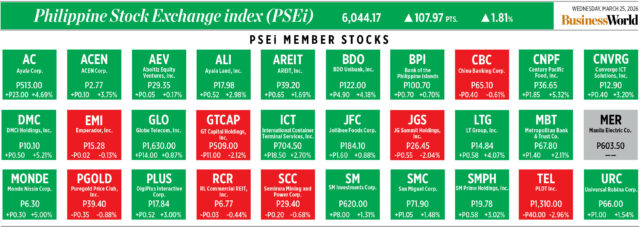
How PSEi member stocks performed — March 25, 2026

Here’s a quick glance at how PSEi stocks fared on Wednesday, March 25, 2026.


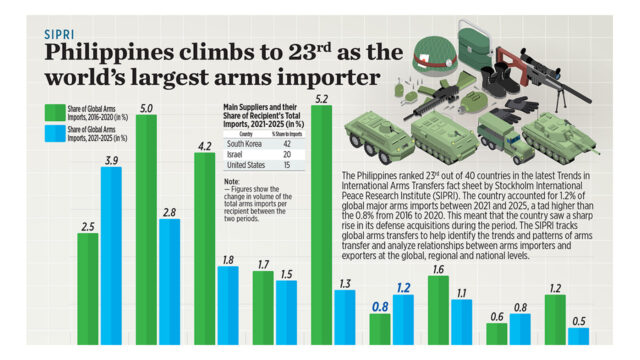
SIPRI: Philippines climbs to 23rd as the world’s largest arms importer

The Philippines ranked 23rd out of 40 countries in the latest Trends in International Arms Transfers fact sheet by Stockholm International Peace Research Institute (SIPRI). The country accounted for 1.2% of global major arms imports between 2021 and 2025, a tad higher than the 0.8% from 2016 to 2020. This meant that the country saw a sharp rise in its defense acquisitions during the period. The SIPRI tracks global arms transfers to help identify the trends and patterns of arms transfer and analyze relationships between arms importers and exporters at the global, regional and national levels.

Philippines may revive China oil talks as Middle East war threatens supply

BW FILE PHOTO

By Adrian H. Halili, Reporter

A POTENTIAL joint oil exploration between the Philippines and China might be revived, Manila’s top diplomat said on Wednesday, as the conflict involving Iran threatens global oil supplies and prompts the Southeast Asian nation to widen its energy options.

Foreign Affairs Secretary Maria Theresa P. Lazaro said discussions with Beijing have not yet begun, but could follow as the government reassesses supply risks stemming from the Middle East.

“Not at this point in time, but I think it may be forthcoming,” she told reporters when asked whether talks have started.

President Ferdinand R. Marcos, Jr. said earlier that he is open to resuming negotiations with China on a possible joint oil and gas exploration at Reed Bank, a resource-rich area in the South China Sea also claimed by Beijing.

In an interview with Bloomberg, Mr. Marcos said the war in the Middle East could provide “impetus” for renewed talks.

He and Chinese President Xi Jinping agreed in 2023 to restart discussions on joint energy development in the disputed waters after previous attempts collapsed over legal and sovereignty concerns.

“It is not new,” Ms. Lazaro said. “There have been discussions on oil and gas exploration many times in the past. However, there were misunderstandings on the finer points.”

In 2005, the Philippine Supreme Court voided a joint seismic survey deal involving China and Vietnam, ruling it unconstitutional for allowing foreign entities access to the country’s natural resources.

Talks resurfaced again in 2018 under the Duterte administration through a memorandum of understanding with China, but the agreement was later terminated due to constitutional and sovereignty issues.

“If ever it comes to the point that there will be discussions, we will see how it unravels,” Ms. Lazaro said, adding that negotiators are aware of the flaws that derailed past talks.

Relations between Manila and Beijing have deteriorated in recent years amid repeated confrontations in the South China Sea, where China continues to assert expansive maritime claims.

The Philippines has consistently rejected those claims, citing a 2016 ruling by the Permanent Court of Arbitration in The Hague that voided China’s position under international law.

Beyond China, Ms. Lazaro said Manila is also exploring other avenues to secure fuel supply, including efforts to ease restrictions on Russian oil.

The Philippine Embassy in Washington has been coordinating with the US State Department to seek relief from sanctions imposed on Russian energy exports, she said.

“We are asking the US State Department to lift the sanctions against Russia so that we can buy oil and meet our other energy needs,” Ms. Lazaro said, adding that no response has yet been conveyed.

The Department of Foreign Affairs is helping other agencies, particularly the Department of Energy, in identifying alternative sources of oil and relaying requests through diplomatic channels.

The Philippines has been scrambling to ensure fuel supply as the war involving Iran disrupts global oil trade. The country has about 45 days’ worth of oil inventory, according to the Energy department.

The Strait of Hormuz, which carries roughly a fifth of the world’s oil shipments, has been shut due to an Iranian blockade, compounding supply pressures.

Ms. Lazaro said the Iran war is expected to dominate discussions at the upcoming Association of Southeast Asian Nations (ASEAN) Summit, even as the bloc pushes to finalize a long-delayed code of conduct in the South China Sea.

“The war will be a dominant issue, but the South China Sea will always be part of the agenda,” she said. Meetings are scheduled later this year in Cebu and Manila.

She added that ASEAN remains hopeful the conflict would not derail progress on the code of conduct, which aims to manage disputes in the strategically vital waterway that handles trillions of dollars in annual trade.

“The bright side is that the code of conduct is being worked on, hopefully to be completed by the end of the year,” Ms. Lazaro said.

‘DWINDLING’ AID
Meanwhile, Senator Maria Imelda “Imee” R. Marcos urged the government to broaden talks with other countries to secure alternative sources of petroleum, following the declaration of a state of national energy emergency.

She called on the administration to engage more aggressively with both regional and global partners to ensure stable fuel imports.

“The Philippines should be negotiating with ASEAN neighbors such as Malaysia, Brunei, Vietnam and Thailand to secure crude oil imports,” she said in a statement.

She added that the government should also reach out to Indonesia, Australia, China and India to bolster domestic petroleum supply.

Ms. Marcos urged authorities to mobilize the Philippine National Oil Co. to pursue longer-term strategies that could cushion the impact of future energy shocks. She also called on the administration to disclose the country’s actual fuel inventory levels.

The President earlier declared a state of national energy emergency, citing the threat posed by the conflict in the Middle East to the Philippines’ oil supply.

Ms. Marcos cited measures taken by other countries, saying Myanmar has implemented fuel rationing, vehicle coding and expanded work from home arrangements, while Vietnam has reinstated its Oil Price Stabilization Fund.

“Does the government actually have a plan, or will it simply carry on distributing dwindling amounts of [aid] to select sectors?” Ms. Marcos asked, warning that subsidies might not be enough as fuel prices rise.

Marcos signs law allowing fuel tax cuts

MOTORISTS queue at a gasoline station along Norzagaray Road in San Jose del Monte on March 8, 2026. — PHILIPPINE STAR/RYAN BALDEMOR

PRESIDENT Ferdinand R. Marcos, Jr. signed into law on Wednesday a measure granting the Executive branch temporary authority to suspend or reduce excise taxes on petroleum products when global oil prices hit critical levels, as the government seeks to cushion consumers and the economy from volatility in crude markets.

Republic Act No. 12316 amends Section 148 of the National Internal Revenue Code of 1997, which governs excise taxes on manufactured oils and other fuels.

The measure was approved with the concurrence of Senate President Vicente C. Sotto III and Speaker Faustino “Bojie” G. Dy III, and will take effect 15 days after its publication in the Official Gazette.

Under the law, the President may suspend or reduce fuel excise taxes upon the recommendation of the Development Budget Coordination Committee, in coordination with the Energy secretary, when the average Dubai crude oil price — based on the Mean of Platts Singapore benchmark — reaches or exceeds $80 per barrel for one month.

The authority allows flexibility, enabling tax relief to be applied selectively to certain petroleum products and either fully or partially. Any suspension or reduction may last for up to three months, with total relief capped at one year within any given period. — Erika Mae P. Sinaking

House subpoenas records in Duterte impeachment

VICE PRESIDENT SARA DUTERTE — PHILIPINE STAR/RYAN BALDEMOR

By Kenneth Christiane L. Basilio, Reporter

A HOUSE of Representatives committee on Wednesday moved to compel government agencies to submit documents and ordered several witnesses to appear as impeachment proceedings against Vice-President Sara Duterte-Carpio entered the evidence-gathering stage.

The House Justice Committee issued subpoenas for Ms. Duterte’s statements of assets, liabilities and net worth (SALN) from 2007 to the present, as well as her tax records, corporate documents related to her business interests and a video recording in which she allegedly threatened President Ferdinand R. Marcos, Jr.

The panel said the materials were needed to determine whether accusations against the Vice-President have sufficient basis to be elevated to the Senate.

Lawmakers also ordered the appearance of several witnesses, including a person alleged to have distributed cash for corrupt activities on Ms. Duterte’s behalf and an official from the Commission on Audit responsible for overseeing the use of confidential and intelligence funds.

Ms. Duterte did not attend the opening day of the proceedings. In a letter submitted to the committee and shared with reporters, her legal team argued that the House lacks jurisdiction to conduct what it described as “any form of trial” on impeachment complaints, insisting that such authority rests solely with the Senate.

Committee Chairman and Batangas Rep. Gerville R. Luistro rejected that argument, saying the process is a preliminary investigation meant to help lawmakers determine probable cause.

The impeachment proceedings come amid mounting political tension between Ms. Duterte and Mr. Marcos, her running mate in the 2022 elections.

The Vice-President, widely viewed as a potential contender for the 2028 presidential election, has been locked in a bitter feud with the President, raising the political stakes for both camps.

An earlier attempt by lawmakers allied with Mr. Marcos to impeach Ms. Duterte last year failed. With Mr. Marcos constitutionally barred from seeking reelection and yet to designate a successor, the renewed push against the Vice-President underscores intensifying maneuvering ahead of the next election cycle.

Ms. Duterte faces allegations consolidated in two impeachment complaints. If endorsed by at least 106 members of the House, the cases would move to the Senate for trial, where a conviction could remove her from office and permanently bar her from public service.

The charges advanced by the Justice committee last week include accusations that Ms. Duterte misused hundreds of millions of pesos in confidential and intelligence funds during her tenure as head of the Office of the Vice-President and earlier as secretary of Education.

She has also been accused of plotting to destabilize the Marcos administration and conspiring to assassinate the President, First Lady Liza Araneta-Marcos and a former Speaker — claims that Ms. Duterte has flatly denied.

Additional allegations include amassing wealth disproportionate to her declared income over more than a decade in public service.

“These are not trivial matters,” Ms. Luistro said at the hearing. “They go to the very heart of public trust.”

Ahead of the proceedings, Ms. Duterte called on the committee to dismiss the complaints, labeling them a “fishing expedition” aimed at politicizing the impeachment process.

“The committee has nothing left to do but dismiss the complaints due to the obvious lack of evidence,” she said in a statement in Filipino.

Party-list Rep. Terry L. Ridon pushed back against that characterization, arguing that the complaints were supported by documentary evidence, including discrepancies in Ms. Duterte’s SALNs.

“This would just be a fishing expedition if we don’t start the proceedings with any documents,” he told the same briefing with Ms. Luistro in Filipino, alleging Ms. Duterte’s total net worth in 2024 did not match her income since 2007.

Ms. Duterte’s legal team reiterated that they would not participate in proceedings they consider unconstitutional. Lawyer Sheila C. Sison said the Vice President would not appear before the committee, arguing that impeachment trials are the Senate’s exclusive domain.

Ms. Luistro said the panel has clear constitutional authority to conduct the inquiry, adding that lawmakers would examine allegations individually and allow evidence and witnesses to be tested in the coming hearings.

The justice committee is set to resume proceedings on April 14, when it expects subpoenaed documents and witnesses to be presented.

Supreme Court asked to halt fee increases at Manila’s int’l airport

NINOY AQUINO INTERNATIONAL AIRPORT (NAIA) Terminal 3 — PHILIPPINE STAR/MIGUEL DE GUZMAN

By Erika Mae P. Sinaking, Reporter

TWO TAXPAYERS have asked the Supreme Court to stop higher fees at the country’s main gateway, arguing that the privatization of the Ninoy Aquino International Airport (NAIA) is worsening the economic burden on travelers amid global instability.

In a second reiterative motion filed on Wednesday, Rico V. Domingo and Caesar G. Oracion urged the high court to stop both the concession agreement for NAIA and the fee increases imposed by management.

The plaintiffs said war in the Middle East and its knock-on effects on fuel prices make the suspension of the higher fees a matter of urgent public necessity.

“The petitioners are constrained to submit this second motion reiterating the prayer for the issuance of a temporary restraining order or other injunctive remedies by reason of the ongoing war in the Middle East,” according to a copy of the filing, arguing that continued implementation of the agreement would deepen the financial strain on Filipinos.

The petitioners said the revised administrative order has sharply raised operating costs at NAIA, citing a more than threefold increase in landing and takeoff fees. Aircraft parking fees for the first 30 minutes for planes weighing up to 50,000 kilos rose by more than 15 times for both domestic and international operations.

They also pointed to soaring fuel prices, noting that diesel prices climbed by about P40 per liter within two weeks and that the Civil Aeronautics Board has approved level 8 fuel surcharges, which could raise international airfares by as much as P6,208.98.

The motion alleged that the airport’s privatization was marred by legal irregularities and asked the court to immediately restrain the Department of Transportation, Manila International Airport Authority and New NAIA Infra Corp. from enforcing the higher charges.

In a statement, New NAIA Infra Corp. maintained that exemptions and discounts already provide relief to travelers, noting that overseas Filipino workers are exempt from travel tax and international terminal fees while airlines get a 65% discount on domestic charges.

“For many years, NAIA’s fees remained unchanged even as the airport grew busier and more strained,” it said. “This contributed to congestion, aging facilities and service limitations that travelers experienced firsthand.”

“Improving NAIA and making it safer, more modern and more efficient requires sustained investment. That, in turn, requires a stable and fair funding structure,” it added.

ADVERTISEMENT
ADVERTISEMENT