Photo of Hong Kong tycoon Jimmy Lai by Studio Incendo/CC BY 2.0/Wikimedia Commons
HONG KONG — Hong Kong police arrested a bookstore owner and three shopkeepers on Tuesday for allegedly selling “seditious” publications including a biography of jailed media tycoon Jimmy Lai, broadcaster TVB reported.
The owner of the Book Punch store Pong Yat-ming and three staff were accused of selling copies of “The Troublemaker”, a biography of Mr. Lai by one of his former business directors, Mark Clifford, TVB reported.
Mr. Lai, founder of the now-shuttered pro-democracy Apple Daily newspaper, was sentenced to a 20-year jail term in February for collusion with foreign forces and sedition in the city’s biggest national security case.
A police spokesperson, asked about the reported arrests, did not comment directly but said in a statement that police “will take actions according to actual circumstances and in accordance with the law”.
Hong Kong’s Secretary for Security Chris Tang did not respond to reporters’ questions. Secretary for Culture, Sports and Tourism Rosanna Law said it was inappropriate for her to comment as someone has already been arrested.
Asked whether the arrests could impact public reading habits, Ms. Law said “reading will continue to be promoted in Hong Kong”.
A notice outside the door of the bookstore read: “Resting for a day due to emergency, sorry for the inconvenience.”
Reuters could not immediately reach Mr. Pong for comment and could not determine whether Mr. Pong or any of the staff had been charged with any offense.
Mr. Clifford, now based in New York, was a former director of media group Next Digital owned by Mr. Lai. In response to questions from Reuters, Mr. Clifford said he was not aware of the arrests, but “if true, it’s a sad and ironic commentary that selling a book on a man who is in jail for his activities as a journalist, for promoting free expression, would be subject to sedition”.
Under a local national security law, known as Article 23, sedition is punishable up to seven years in jail and a maximum of 10 years if the act involves collusion with an “external force”.
Beijing imposed broader and more sweeping national security legislation on the city in 2020.
Facing criticism by some Western governments and international rights groups, Hong Kong and Chinese officials said new laws were needed to bring stability after months of pro-democracy protests rocked the city in 2019.
Two other independent stores announced temporary closures on Wednesday as word spread of the arrests among readers and supporters who said the booksellers have become vital outlets for civil society by hosting book talks and workshops.
A loose network of stores seeks to offer a broader range of political and social titles than those found in mainstream stores, some of which are controlled by Chinese state-owned Sino United Publishing.
In January, Mr. Pong pleaded not guilty to three charges of operating an unregistered school after he held a Spanish class at the bookstore last year. The case is ongoing.
On Instagram last year, Book Punch said it had canceled several activities due to anonymous complaints.
Another independent shop, Hunter Bookstore, said earlier that it faced regular visits and checks by various government departments as well as tax probes.
Mount Zero, an independent bookstore in Sheung Wan on Hong Kong Island, closed in 2024, citing visits by authorities after a string of anonymous complaints on its social media.
In a further crackdown on dissent, the city’s government on Monday gazetted new amendments to the implementation rules to the Beijing-imposed law, which would allow customs officers to seize items that are deemed to have “seditious intention”.
The moves also mean police with warrants from a magistrate can now demand that people suspected of breaching the national security law provide phone or computer passwords or face jail and a fine.
Hunter Bookstore on Instagram said it would remain open but it urged the government to maintain an updated public list of publications that are deemed to be seditious.
“Books and publishing are not just independent businesses, it is the cultural foundation of the entire society,” it said. — Reuters
ON MONDAY evening, Walt Disney Co. and OpenAI teams were working together on a project linked to Sora, OpenAI’s artificial intelligence (AI) video tool. Just 30 minutes after that meeting, the Disney team was blindsided with word that OpenAI was dropping the tool altogether, a person familiar with the matter said.
OpenAI announced the move publicly on Tuesday.
“It was a big rug-pull,” according to the person, who requested anonymity to discuss the matter.
The move is the first big step by the ChatGPT maker to focus its business on potentially more lucrative areas such as coding tools and corporate customers.
But the abrupt cancellation of Sora illustrates how messy the streamlining process may become as OpenAI prepares for a stock market debut that could come as early as later this year.
The Sora decision means the end of a blockbuster $1-billion deal between Disney and the ChatGPT maker that was announced a little more than three months ago. As part of the three-year deal, Disney said it would invest $1 billion in OpenAI and lend more than 200 of its iconic characters to be used in short, AI-generated videos.
But the transaction between the companies never closed, two other people familiar with the matter said, and no money changed hands.
OpenAI executives have been debating Sora’s fate for some time. Running the AI video app required significant computational resources, a fourth person with knowledge of the matter said, and left other teams with less firepower.
Even so, some OpenAI staffers on the Sora team were surprised when they were informed of the changes on Tuesday morning, one of the people and another source said. The announcement was made just a day after OpenAI published a blog post about Sora safety standards.
“We’re saying goodbye to Sora … we know this news is disappointing,” the Sora team said in a post on X, adding that timelines for the app and API, as well as details on preserving user work, would be shared later.
OPENAI FOCUSES ON A SUPER-APP OpenAI executives are now focusing on other research areas, including robotics and building artificial general intelligence. The company is rolling more of its capabilities into a single super-app. To reflect that shift, Fidji Simo’s title was changed from CEO of applications to CEO of AGI deployment.
Separately, CEO Sam Altman said OpenAI’s security and safety teams would no longer report directly to him.
A spokesperson for Disney said that the media giant respects “OpenAI’s decision to exit the video generation business and to shift its priorities elsewhere.”
The two sides are discussing if there is another way they can partner or invest with one another, one of the people familiar with the matter said.
OpenAI first introduced Sora in early 2024, stunning the tech world with software that could generate high-quality, feature film-like videos based on text prompts. The launch prompted AI companies across the US as well as China to ramp up releases of their own AI video-generation models.
The company launched the standalone Sora app in September 2025, letting users create and share AI videos that can be spun from copyrighted content and shared to social media-like streams.
Sora’s cancellation comes as OpenAI faces intensifying pressure to ramp up its enterprise and coding products, as competition from rival AI startups and tech giants heats up.
Anthropic’s focus on training its models on coding has helped its Claude Code product gain strong traction among developers, giving the company an edge over OpenAI and other competitors in the enterprise AI market. — Reuters
SAN FRANCISCO — Arm Holdings announced a new artificial intelligence (AI) data center chip on Tuesday which it said will add billions of dollars of revenue and represent a significant shift in the company’s strategy.
The new chip, called the AGI CPU, will address data-crunching needed for a specific type of AI that is able to act on behalf of users with minimal oversight, instead of responding to queries as part of a chatbot.
So-called agentic AI has jump-started demand for the central processing units (CPUs) produced by the likes of Intel and Advanced Micro Devices.
Arm shares jumped 6.5% in the extended session after the company issued its financial projections. Arm stock closed down 1.4% on Tuesday and have advanced 22% this year.
For years, Arm, majority-owned by Japan’s SoftBank Group, has relied only on intellectual property for revenue, licensing its designs to companies such as Qualcomm and Nvidia and then collecting a royalty payment based on the number of units sold.
Last year, Arm signaled to investors it was investing in making its own chip, a process that can cost hundreds of millions of dollars, and that the company had hired key executives to assist with the effort. The AGI CPU will be the first chip under that new strategy.
“It’s a very pivotal moment for the company,” CEO Rene Haas said in an interview with Reuters.
Arm, is forecasting the new chip will generate roughly $15 billion in annual revenue in about five years, Mr. Haas said.
Overall, Arm expects to generate annual earnings per share of $9 and revenue of $25 billion, also in five years, he said.
Mr. Haas said the company expects the intellectual property business to double over roughly five years.
The new chip will be overseen by Mohamed Awad, head of the company’s cloud AI business, and Arm has additional designs in the works that it plans to release at 12- to 18-month intervals.
Meta Platforms will be the company’s lead partner for the AGI CPU and the two companies worked together on the design. Arm’s customers for the new chip include ChatGPT maker OpenAI, Cloudflare, SAP and SK Telecom.
Taiwan Semiconductor Manufacturing Co. is fabricating the device on its 3-nanometer technology and is made from two distinct pieces of silicon that operate as a single chip. Arm plans to put it into volume production in the second half of this year but has received test chips that function as expected.
“It’s back, and it works, and it’s doing everything we thought it would,” Mr. Haas said, referring to the new chip.
In addition to the chip itself, Arm is working with server makers such as Lenovo and Quanta Computer to offer complete systems.
For its current fiscal year, Wall Street expects Arm to generate a net profit of $1.75 per share on revenue of $4.91 billion, according to LSEG estimates. — Reuters
EPIC GAMES will cut more than 1,000 jobs following a drop in engagement for “Fortnite,” the latest layoffs in the video game industry where growth has stalled due to economic uncertainty.
The company also expects to save $500 million by reducing contracting and marketing spend and eliminating some open roles, CEO Tim Sweeney said in a note to employees on Tuesday.
“We’re spending significantly more than we’re making, and we have to make major cuts to keep the company funded,” he said.
Blockbuster titles such as the first-person shooter game “Fortnite” had proven resilient after the pandemic, holding up as a slowdown eroded demand beyond the biggest franchises.
But engagement is now declining even for those, particularly live-service games that rely on a constant flow of costly new content to retain players.
“We’ve had challenges delivering consistent Fortnite magic,” Mr. Sweeney said, adding “market conditions today are the most extreme” since the early days of the company founded in 1991.
“The layoffs aren’t related to AI,” Mr. Sweeney noted amid industry fears that the technology could replace developers.
Epic had earlier this month raised prices of Fortnite’s in-game currency, citing higher costs to run the game.
The move marks Epic’s second major round of layoffs in three years. In September 2023, the company cut about 830 jobs, or roughly 16% of its workforce, to boost profitability.
It was not immediately clear what percentage of staff would be impacted by Tuesday’s announcement.
Last month, Fortnite topped US monthly active players across PlayStation and Xbox, yet the average playtime fell sharply, according to Mat Piscatella, senior director at Circana.
Other gaming companies have also cut jobs.
In September, Electronic Arts laid off hundreds of workers and canceled a Titanfall game that was in development, according to media reports. Amazon’s broader job cuts late last year also affected its gaming division.
Rising memory chip prices have added to the industry’s difficulties, as surging demand from artificial intelligence data centers absorbs supply, pushing up semiconductor costs and forcing console makers to raise prices. — Reuters
BLACKROCK CEO Larry Fink said oil prices could reach $150 a barrel and cause a “global recession” if Iran “remains a threat” even after the war ends.
“If there is a cessation of war, and yet Iran remains a threat, a threat to trade, a threat to the Strait of Hormuz, a threat to this peaceful coexistence of the GCC region, then I would argue that we could have years of above $100 closer to $150 oil which has profound implications in the economy,” Mr. Fink told BBC’s Big Boss Interview podcast published on Wednesday.
“We will have global recession,” he said, when asked if oil stays at $150 a barrel.
Oil prices have remained volatile and risen sharply since the US-Israeli war on Iran began. However, prices sank about 4% on Wednesday after reports the US had sent Iran a 15-point proposal aimed at ending the war, raising prospects of a ceasefire.
The war has all but halted shipments of oil and liquefied natural gas through the Strait of Hormuz, which typically carries about one-fifth of the world’s gas and crude supply, causing what the International Energy Agency has called the biggest-ever oil supply disruption. — Reuters
Honor guards raise a Taiwanese flag at the Presidential Palace in Taipei, Taiwan Oct. 10, 2023. — REUTERS
TAIPEI — Taiwan fears China will exploit the distraction of the United States by its war in the Middle East, with state media citing examples from the conflict to cast doubt on the efficiency of US weapons the island would use to repel any invasion.
One of the world’s biggest potential flashpoints, democratically governed Taiwan faces growing military pressure from China, which views the island as its own territory, around which Beijing held its latest war games in December.
Taiwan officials say Beijing’s resumption, since March 14 and 15, of large-scale air force incursions near Taiwan after an unusual drop-off, show China wants to take advantage of US forces redeploying from East Asia to bolster the war effort.
“This is a moment for China to exercise influence,” said a senior Taiwan security official, speaking on condition of anonymity to discuss sensitive intelligence matters.
“What China is trying to create is a sense that when the US shifts forces away and Indo-Pacific strength is redirected to the Middle East, tension and instability should be manufactured.”
Neither China’s Taiwan Affairs Office nor its defenSe ministry responded to Reuters requests for comment.
Taiwan’s defense ministry cited comments this month by DefenSe Minister Wellington Koo that China’s “intention to annex us by force has always existed”.
BALANCED US MILITARY DEPLOYMENT ACROSS REGIONS Deployment of US military resources across regions has always been balanced, so the move was unlikely to create a gap for China to attack, the Taiwan source added.
In Washington, a State Department spokesperson told Reuters the US military’s capacity to handle simultaneous global threats remains “formidable”, adding that the US is committed to preserving peace and stability across the Taiwan Strait.
A long war would deplete US stocks of weapons, divert attention from the Asia-Pacific and fuel domestic anti-war sentiment, said Chang Kuo-cheng, a professor of international relations at Taipei Medical University.
“All these factors may lead Xi Jinping to believe that, in exerting greater pressure on Taiwan or even using force against Taiwan, his position would be stronger than before this war began.”
The longer the war lasts, the more lessons it offers for China on US military thinking and response scenarios for a possible Chinese move on Taiwan, he added.
US allies in Asia have also warned the Iran war could sap defenSes against China.
‘COGNITIVE WARFARE’ Taipei is wary of Beijing using the Middle East war in its “cognitive warfare” propaganda against Taiwan, such as AI-generated online videos after the conflict that claimed it faced a “devastating” energy supply crisis, the government said this month in an internal memo reviewed by Reuters.
“They want people to think that one day, when Taiwan is again encircled by the Chinese military, the public will lose confidence in energy issues,” another Taiwan security official said.
On Wednesday, China’s Taiwan Affairs Office touted improved infrastructure as a benefit of “reunification”, with an offer of a “rapid transit link” including a Beijing-Taipei expressway.
That followed a Chinese offer of energy security if the island agreed to be ruled by Beijing, dismissed last week by Deputy Economy Minister Ho Chin-tsang as more cognitive warfare.
Chinese state media view the Iran war as having implications for future conflict with Taiwan, its weapons mainly supplied by the United States, despite a lack of formal diplomatic ties.
Taiwan’s radar stations could share the fate of similar US equipment reported destroyed in Iranian attacks, said Liu Kuangyu, a researcher at the Institute of Taiwan Studies of government think-tank the Chinese Academy of Social Sciences.
Taiwan’s radars would be “instantly reduced to scrap metal” in “saturation attacks” by the People’s Liberation Army, Liu said in remarks last week to the Riyue Tantian website run by the China Media Group parent of state television.
But the United States has not confirmed such attacks by Iran.
The military channel of China’s state broadcaster has played up the supposed poor performance of some US weaponry, citing a fire on the Gerald R. Ford aircraft carrier as an example.
“From the outbreak of the war up to now, the real combat performance of US weapons and equipment has differed markedly from the image widely perceived by the outside world,” it said on its WeChat account on March 16.
‘GREAT OPPORTUNITY TO OBSERVE US MILITARY OPERATIONS’ The war affords China a great opportunity to observe US military operations, especially high-end military assets such as the F-35 fighter jet, said Todd Harrison, a defense analyst at the American Enterprise Institute in Washington.
“They’re also going to be collecting (data) on how well our air and missile defense systems work and how we employ them,” Mr. Harrison said.
Taiwan, which has proposed extra defense spending of $40 billion, is also keenly watching the prospects for a summit of US and Chinese leaders in Beijing, now postponed from early April.
The government expected the talks would cover Taiwan, but had no way to influence them, said Shen Yu-chung, a deputy minister at Taiwan’s Mainland Affairs Council, responsible for policy towards China.
“However, we must … present a clear and consistent message to the outside world, that we are determined to rely on our own national defense to safeguard our sovereignty,” he said. — Reuters
WIN ZAW is among five of a Myanmar family who fan out on motorcycles most nights from their small village in the rice-growing Irrawaddy delta to queue at fuel depots that might yield a few jerry cans of diesel for his tractor.
“Some even sleep there overnight,” said the farmer, adding that lines of buyers on motorcycles and tractors formed as early as 3 a.m. “This is a total waste of manpower and time.”
Myanmar’s economy, battered by five years of civil war since a military coup in 2021, is reeling under a fresh blow from the Iran conflict, which has driven up global oil prices and made domestic supplies scarce.
The pump price of diesel in Myanmar stood at 3,800 kyat ($1.80) per liter by mid-March, up from 2,450 kyat ($1.16) in February.
Scarcity has forced farmers such as Moe Win to turn to the black market, despite an exorbitant rate of about 12,000 kyat ($5.71) a liter. But one that he is willing to pay to save his paddy crop.
“Occasionally, after queuing in town for two days, we’ve had instances where we could only buy five or six liters,” said the delta farmer.
“But if we don’t harvest the paddy in time, the crops will be destroyed, so we have to bear any cost.”
A spokesman for Myanmar’s ruling junta did not respond to telephone calls to seek comment, although its chief Min Aung Hlaing told a meeting this week it was working to resolve the fuel shortage problems, state media said on Wednesday.
WORLD’S FIFTH HUNGRIEST COUNTRY Myanmar is the world’s fifth hungriest country, where 12.4 million, or a quarter of the population, struggle to find food, the United Nations’ World Food Programme says.
“Rising fertilizer costs and restricted fuel access for machinery threaten the upcoming cultivation season,” Michael Dunford, its Myanmar director, told Reuters. “Production costs are expected to double if instability continues.”
Farmers are preparing for the major monsoon paddy season after harvesting dry-season crops, he added.
Over the last three years, Iran has become Myanmar’s primary supplier of the urea used in fertilizer, with annual imports ranging between 400,000 tons and 600,000 tons, some of which the junta also uses to make explosives, Reuters has reported.
This month the WFP warned that global hunger levels could surge to an all-time record, pushing a further 45 million people into acute hunger, as US-Israeli attacks on Iran since February 28 drive up costs of food, fuel and shipping.
In Myanmar, an immediate intervention is necessary to avert the almost certain risk of a drop in output and significant post-harvest losses, said Maximo Torero, the chief economist of the United Nations’ Food and Agriculture Organization.
“A poor harvest would reduce supply, driving prices even higher and putting basic staples out of reach for millions who have lost their jobs and livelihoods.”
‘WAGING A WAR FOR FUEL’ Anticipating a fuel shortage soon after the war broke out, Myanmar’s junta launched a sweeping rationing system for private vehicles early in March, featuring QR codes to deter multiple daily refills.
But the measure has led to massive congestion at gas stations, so that, despite hours of queuing, some get only a fraction of their needs.
Domestic airlines running low on jet fuel, large quantities of which Myanmar imported from Iran, have suspended routes and adopted strict limits on baggage, with ticket prices tripling on sectors still operational.
Myanmar depends on regional processing hubs of Middle East crude, such as Singapore and Malaysia, for the diesel imports crucial for its struggling economy and farm sector.
To reduce consumption, the junta has ordered state employees to work from home every Wednesday, while saying on Monday that a stockpile sufficient for 50 days of supply remains.
Still, three farmers in towns and villages across the nation said they were struggling to buy fuel ahead of a critical harvest window.
After relying on machinery for so long, it was impossible to immediately turn back to farm animals, they told Reuters.
“Nowadays, we are practically waging a war just to get some fuel,” added the Irrawaddy delta’s Win Zaw. — Reuters
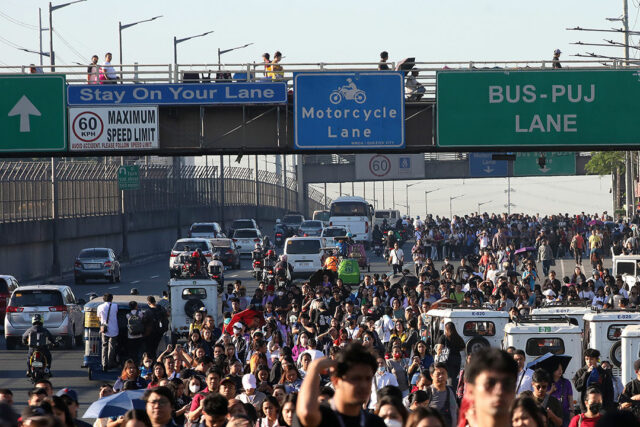
Commuters wait for buses and jeepneys along Commonwealth Avenue in Quezon City, March 25, 2026. — PHILIPPINE STAR/MIGUEL DE GUZMAN
Countries across Asia are weighing up work-from-home policies and stimulus measures enforced during the COVID pandemic, as they scramble to respond to global fuel shortages triggered by the Iran war.
Asia is at the frontline of the fuel crisis, buying more than 80% of the crude that transits the Strait of Hormuz, which has been almost totally blocked by Iran since the war broke out on February 28.
No country in the region has enforced work-from-home measures yet, but some have said they are on the table.
“I think it is a good idea,” South Korean Energy Minister Kim Sung-whan said on Tuesday when asked about an International Energy Agency (IEA) recommendation for people to work from home.
The IEA, which agreed a record release of around 400 million barrels of oil from strategic stockpiles to deal with the crisis, has outlined proposals to ease oil price pressures such as working from home and avoiding air travel.
IEA Executive Director Fatih Birol repeated those calls at a conference in Sydney this week.
“There were real-life tests, such as after the Russian invasion of Ukraine, European countries adopted these measures, and it was announced by the European governments. It helped them a lot to go through these difficult times without Russian energy … but keeping the lights on,” Birol said.
Industrial powerhouse South Korea on Tuesday launched a public campaign asking people to cut shower time, charge phones during the day and run vacuums on weekends.
“We will consult with relevant ministries and actively consider measures for work-from-home,” Energy Minister Kim told a briefing.
The Philippines, which relies heavily on Middle Eastern oil for its energy needs, shortened the work week in some government offices earlier this month. President Ferdinand Marcos declared a state of national energy emergency saying the conflict poses an “imminent danger” to the country’s energy supply.
Pakistan closed schools for two weeks and said office workers would work more from home. The island nation of Sri Lanka declared a public holiday every Wednesday to help make its fuel supplies go further.
Singapore, an Asian financial hub, urged people and businesses to switch to energy-efficient appliances, use electric vehicles and set the temperature higher on their air conditioners.
Thai Prime Minister Anutin Charnvirakul ordered bureaucrats to suspend overseas trips, set air conditioning temperatures above 25 degrees Celsius (77 degrees Fahrenheit), avoid suits and ties, use stairs instead of elevators, and work from home.
COST-OF-LIVING RELIEF Some countries have turned to stimulus measures as rising fuel costs bite into household budgets.
The Japanese government said on Tuesday it plans to tap 800 billion yen ($5 billion) in reserve funds to finance subsidies aimed at keeping gasoline prices at about 170 yen per litre on average. The measure would cost as much as 300 billion yen per month.
New Zealand said on Tuesday that it would provide temporary financial support of NZ$50 ($29.30) every week from April for low-income families.
“We know these families will be hit particularly hard by the global fuel-price shock. We are delivering them timely relief,” New Zealand Finance Minister Nicola Willis said.
In neighbouring Australia hundreds of petrol stations are running dry from panic buying and shortages, which are acutely hitting the remote regional areas of the vast continent.
The center-left government introduced legislation in the parliament to double penalties for fuel price gouging.
Several Asian countries have also released petrol and diesel from domestic reserves and temporarily loosened gasoline and diesel quality standards to increase supply.
POLICY DILEMMA The glaring contrast with the pandemic, however, is that central banks are not rushing to cut interest rates. In fact, they are considering hikes.
During the pandemic, demand collapsed as many economies were essentially shuttered for health reasons, so policymakers responded with massive stimulus.
Now, the Reserve Bank of Australia has already hiked rates twice this year. It cited energy risks as a material risk to inflation and a reason for raising rates to a 10-month high last week.
Investors expect Japan, Britain and Europe will all raise rates in coming months, and pressure on Asian economies may be even more acute as their currencies slip against the dollar.
“Central banks face a classic policy dilemma when oil prices surge – inflation rises but growth might weaken,” Jennifer McKeown, chief global economist at Capital Economics, said in a note last week.
“The right response depends crucially on why oil prices are rising, how persistent the shock is, and whether inflation expectations are at risk,” she added. — Reuters
SINGAPORE-BASED regulatory technology (regtech) firm Tookitaki has opened a satellite office in the Philippines amid growing demand for anti-money laundering (AML) compliance solutions among local players.
In a statement on Tuesday, the company said its new office at Ayala Triangle Tower One in Makati City aligns with its plan to expand its presence in Southeast Asia.
Tookitaki’s satellite office is expected to help grow its local team, boost engagement with financial institutions, and offer more on-the-ground support.
This comes amid the increased demand for advanced technologies as financial crimes grow more complex, said Tookitaki Founder and Chief Executive Officer Abhishek Chatterjee.
“Our presence in Manila allows us to bring these capabilities closer to Philippine financial institutions and support their continued growth,” he was quoted as saying.
He noted that Tookitaki’s artificial intelligence-driven solutions and federated approach to fighting financial crime would help financial firms detect complex fraud patterns, uncover hidden risks, and strengthen AML compliance.
“By strengthening our local presence, we can collaborate more effectively, respond more quickly to client needs, and continue providing exceptional service as institutions navigate an increasingly complex financial crime landscape,” Tookitaki Co-founder and Chief Operating Officer Jeeta Bandopadhyay said.
Tookitaki launched its Philippine operations in 2022.
The company supports key financial technology (fintech) players in the country, including electronic wallets GCash, Maya, and payment gateway platform PayMongo.
With the Philippines growing into a key fintech player in the region, Tookitaki’s local expansion helps utilize the country’s local talent amid evolving financial crimes, Tookitaki President Isabel Ridad said.
“We see tremendous potential in the country’s talent pool, and we are proud to invest in Filipino professionals who will help drive innovation and strengthen the global fight against financial crime,” she added.
In February last year, the Philippines was officially removed from the Financial Action Task Force’s “grey list” of jurisdictions under increased monitoring for money laundering and terrorism financing. — Beatriz Marie D. Cruz
A woman smiles between the early flowering cherry blossoms in Kyoto, Japan March 13, 2020. — REUTERS
TOKYO — Global inflation is taking a bite out of Japan’s iconic “hanami” cherry blossom picnics, with an index tracking food and drink costs up 25% since 2020, private think tank Dai-ichi Life Research Institute said on Tuesday.
Around late March to early April of each year, the Japanese fill parks and riverbanks with blue tarps, lunch boxes, snacks and drinks to picnic under blooming cherry trees with family and friends in a custom called “hanami.”
The event, a must-do for many Japanese, is not immune to the hit from rising raw material costs that has prodded companies to charge more for a wide range of food and beverages.
To gauge the degree of pain, Hideo Kumano, chief economist at Dai-ichi Life Research, updated an index he created in 2020, using the latest data to track the weighted average price of 14 popular “hanami” items including rice balls, bento boxes, fried chicken, potato chips and beer.
The findings showed the cost of “hanami” was up 4.2% in February from year-before levels, and rose 25.0% from the base year of 2020.
Japanese sweet buns recorded the biggest price rise, up 46.1% from 2020 levels, followed by carbonated drinks at 45.7% and rice balls at 45.0%, the index showed.
“A weak yen and rising global commodity prices are causing cost-push inflation in Japan,” Kumano said. “Hanami is clearly facing the negative effect of the global inflationary trend.”
After being mired in decades of deflation, Japan has seen inflation creep up since the Ukraine war as a falling yen and rising commodity prices boosted the cost of raw material imports.
Core consumer inflation stayed above the Bank of Japan’s 2% target for nearly four years before slowing to 1.6% in February due largely to generous government fuel subsidies. — Reuters
Robinsons Retail Holdings, Inc. (RRHI), the retail arm of the Gokongwei group, will close its 11 No Brand standalone stores across the Philippines by the end of June.
“The decision reflects evolving consumer preferences and how customers are choosing to shop across our retail formats,” RRHI President and Chief Executive Officer Stanley C. Co said in a disclosure on Wednesday.
“Our focus remains on meeting customer needs by providing relevant assortments in the most appropriate formats. We thank Emart for the partnership over the past several years,” he added.
RRHI said it does not expect the closures to have a material impact on its financial performance. No Brand accounts for about 0.2% of annual net sales and a minimal share of total assets.
“No Brand’s 11 stores are immaterial relative to RRHI’s network of more than 2,700 company-owned stores—including 157 Robinsons Supermarket, 159 Robinsons Easymart, 38 The Marketplace, 16 Shopwise, and 415 Uncle John’s under its food segment—and over 2,100 franchised TGP branches, as of Dec. 31, 2025,” RRHI said.
No Brand entered the Philippine market in 2019 through a master franchise agreement between RRHI and South Korea’s Emart, which owns the No Brand label and authorized RRHI to operate standalone stores nationwide. — Alexandria Grace C. Magno
By Jomarc Angelo M. Corpuz, Special Features and Content Writer, BusinessWorld
All roads lead to retirement. After graduating from college, working for decades, and climbing the career ladder, most Filipinos eventually retire to rest and reap the fruits of their labor. While that phase of life may seem distant, it is actually one of the most important stages to prepare for as early as possible.
According to a survey by World Finance, Filipinos believe that savings equivalent to 2.1 years’ worth of personal income is enough for their retirement, a few months below the regional average of 2.9 years and a few years off for those who opt to retire early. In the Philippines, the optional retirement age currently stands at 60 years, with the mandatory age set at 65. While the numbers are still impacted by deaths during the pandemic, the latest data from the World Health Organization shows the country’s life expectancy to be at 66.4. This means that Filipinos would have to fund between 1.4 and 6.4 years of retirement after leaving their main source of income.
“Many Filipinos are still underprepared for retirement. A large number rely on family support, limited savings, or mandatory benefits alone. The challenge is not just income, but also delayed planning and low awareness of how much preparation retirement really requires,” Raymund Benedict C. Zalamea, President and CEO of leading retirement consulting firm E.M. Zalamea Actuarial Services, said in an e-mail.
“In general, Filipinos are ill-prepared for retirement, and there are many factors contributing to this. Among other factors, first and foremost, we are a spending economy; we spend most of what we earn and even money that we have not earned yet,” Rafael G. Ayuste, Independent Director of the Bank of Commerce, added.
Wirestock | FREEPIK
The realities that Mr. Zalamea and Mr. Ayuste mentioned go to show the urgency of financial preparation and reinforce the need to begin planning for retirement as early as one starts earning to ensure long-term security and stability during retirement.
“Ideally, people should begin as soon as they start earning. Starting early gives savings more time to grow and makes the discipline easier to build. In retirement planning, time is one of the biggest advantages a person can have,” he explained.
Meanwhile, despite the clear advantages of starting early, Mr. Ayuste explained that financial realities and competing responsibilities often delay retirement planning for many Filipinos until later in life.
“We have to be realistic; that is not likely to happen in the Philippine setting. In addition to the reasons cited above, the Philippine salary base is low compared to the rest of Southeast Asia. Realistically, if one is looking to retire at age 60, then the earliest one can start saving for retirement is at age 40, after most of the family obligations are settled or partially settled and income has grown to a comfortable level,” he said.
Expounding on starting retirement planning early, Mr. Zalamea notes that the foundation of effective retirement planning lies in developing sound financial habits early on that allow young and retirement planning Filipinos to save for their later years.
“The first steps are financial awareness, discipline, and consistency. That means learning to budget, avoiding unnecessary debt, building an emergency fund, and setting aside savings regularly, even if the amount is still small. Retirement planning starts with good habits,” he said.
Building on this emphasis on early habits, Mr. Ayuste shared that the next crucial step is to translate financial discipline into a clear and purposeful retirement plan.
“Time is the greatest advantage of the young, because compounding works best when given many years. Retirement planning is not something that begins in your 40s or 50s. The earlier you start thinking about it, the more choices and freedom you will have later in life,” he said.
Similarly, Mr. Zalamea also highlighted that the principle of retirement planning is a continuous process that requires discipline and awareness rather than a single endeavor. He stated how, over time, consistent financial habits and informed decisions will eventually lead to building long-term security.
“Starting early, staying disciplined, and building financial awareness are very important. Budgeting, debt management, emergency savings, and continuous financial education all play a role. In many cases, retirement security is built not by one big decision, but by consistently practicing good habits over time,” he added.
Alongside building strong financial habits, Mr. Zalamea also pointed to the need to consider the social and cultural factors that influence retirement planning. With the Philippines being a family-oriented society, he emphasized the importance of balancing personal financial security with the Filipino tradition of supporting one’s family.
“Supporting family is part of Filipino culture, but people also need to prepare for their own future. The goal is balance. People should help where they can, but also maintain boundaries, follow a budget, and continue building their own retirement fund. Preparing for one’s own retirement is also a way of protecting the next generation from future financial burden,” he said.
Reinforcing this balance between personal responsibility and family obligations, Mr. Ayuste emphasized the importance of discipline in navigating the financial pressures faced by many Filipinos, particularly those supporting both older and younger generations.
“Being part of the sandwich generation is a very real and personal situation for many Filipinos. If there is one piece of advice, it is discipline. Discipline means learning to distinguish between needs and wants, and having the courage to say no to wants… The goal is balance: caring for loved ones while still setting aside resources for retirement. Because in the end, preparing for our own retirement is also a way of protecting our family from financial burden in the future,” he said.
These considerations become even more pressing when viewed against the country’s shifting demographic landscape. At present, the Philippines has around 7.6 million Filipinos aged 60 and above. In 2032, this number is expected to rise to nearly 9 million or 7% of the populace, making the country an aging population. This only means that more people would have to rely on their savings and other institutions to fund their retirement.
The Philippines’ Social Security System (SSS) provides a monthly pension ranging from P2,200 to nearly P30,000 to retirees, depending on reforms.
“The SSS and the Government Service Insurance System (GSIS) are important because they provide a foundational layer of retirement support. For private sector employees, retirement benefits under RA 7641 add another layer,” Mr. Zalamea said.
Despite the presence of these institutional support systems, gaps in retirement funding remain a significant concern for many Filipinos. Mr. Zalamea said this backs the importance of strengthening personal savings and investment strategies alongside existing benefits.
“However, even taken together, these are often still not enough to sustain the kind of retirement most people would want. That is why personal savings and investments remain very important, especially when started early and allowed to grow through compounding,” he explained.
“For most, the private sector SSS pension alone will not sustain a comfortable life at retirement. Reduction in expenses at retirement does not take effect immediately, it happens gradually. By the time expenses are substantially reduced, the heathcare expenses kick in. Filipinos, without a doubt, should prepare additional savings or investments as part of their retirement planning,” Mr. Ayuste mirrored.
Given these limitations, Mr. Zalamea emphasized the importance of turning financial awareness into concrete action. He noted that starting early, even with small and consistent steps, can significantly improve one’s chances of achieving a secure and sustainable retirement.
“Retirement planning should not be postponed. You do not need to start big, but you do need to start. Small and consistent steps taken early can make a meaningful difference later in life. The important thing is to move from awareness to action,” Mr. Zalamea said.
Spotlight is BusinessWorld’s sponsored section that allows advertisers to amplify their brand and connect with BusinessWorld’s audience by publishing their stories on the BusinessWorld Web site. For more information, send an email to online@bworldonline.com.
Join us on Viber at https://bit.ly/3hv6bLA to get more updates and subscribe to BusinessWorld’s titles and get exclusive content through www.bworld-x.com.