Home Blog Page 1067

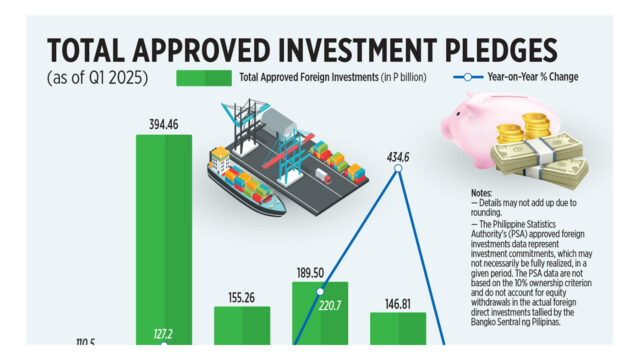
Total Approved Investment Pledges

APPROVED foreign investments in the Philippines slumped further by 82% in the first quarter to the lowest in one-and-a-half years, according to the local statistics agency, as US President Donald J. Trump tries to undo decades of global economic integration through his sweeping tariff increases. Read the full story.

Total Approved Investment Pledges

Sean ‘Diddy’ Combs’ ex-girlfriend says he raped her, paid $20 million in settlement

Sean “Diddy” Combs on the talk show Late Night with Seth Myers. — IMDB

NEW YORK — Sean “Diddy” Combs’ ex-girlfriend Casandra Ventura testified on Wednesday that the hip-hop mogul raped her in 2018 after they ended their more than decade-long relationship.

Ms. Ventura, a rhythm and blues singer known as Cassie, also said Mr. Combs agreed to a $20-million settlement to end her November 2023 civil lawsuit against him over their relationship, with the deal coming 24 hours after she filed the case.

The disclosures came on the third day of Mr. Combs’ criminal trial, where the 55-year-old rapper has pleaded not guilty to five felony counts of racketeering conspiracy, sex trafficking and transportation to engage in prostitution.

If convicted on all counts, Mr. Combs would face a minimum of 15 years in prison and could face life behind bars.

Ms. Ventura, 38, fought back tears as she described Mr. Combs’ allegedly raping her in her living room.

“I just remember crying and saying no but it was very fast,” she said, as her voice trailed off.

Ms. Ventura said that she sued Mr. Combs nine months after undergoing rehabilitation and trauma therapy prompted by “horrible flashbacks,” and that she “didn’t want to be alive” by the time she sought help.

Asked why she decided to testify against Mr. Combs, Ms. Ventura said she could no longer bear the emotional burden of years of his physical and emotional abuse.

“I can’t carry this anymore,” Ms. Ventura said. “I can’t carry the shame, the guilt, the way he treated people like they were disposable. What’s right is right, what’s wrong is wrong. I came here to do the right thing.”

Lawyers for Mr. Combs will begin their cross-examination of Ms. Ventura on Thursday, and it may last two days.

The lawyers have signaled they will ask Ms. Ventura about what they have called her own history of domestic violence.

Mr. Combs’ trial could take up to two months.

FREAK OFFS
Ms. Ventura is the prosecution’s star witness against Mr. Combs, and wore a turtleneck dress and dark jacket for her second day of testimony.

Mr. Combs wore a cream-colored sweater and white-collared shirt, with his mother and at least two children looking on.

Ms. Ventura testified that Mr. Combs beat her during drug-fueled sex parties known as “Freak Offs,” and that he threatened to release videos of her taking part and warned he would ruin her career.

“He would grab me up, push me down, hit me in the side of the head, kick me,” Ms. Ventura recalled.

Ms. Ventura said Mr. Combs was dismissive after she showed him a photo of a gash on her eyebrow that she said he gave her in 2013 by throwing her against a bed frame.

“You. Don’t know. When to. Stop,” Ms. Ventura said Mr. Combs told her. “You have pushed it too far and continue to push. Sad.”

Prosecutors showed jurors seven still photos of Ms. Ventura and various escorts that were taken from videos of “Freak Offs.”

One juror swallowed hard upon seeing one image, and another jerked his head back.

The photos were not shown to spectators or the press. US District Judge Arun Subramanian, who oversees the trial, denied Reuters and other media limited access to the photos and videos.

‘NOBODY SHOULD DO THAT’
Jurors were shown photos that Ms. Ventura’s mother once took of Ms. Ventura, where she sported bruises on the back and leg from having been kicked by Mr. Combs.

Ms. Ventura told jurors that fighting back against Mr. Combs sometimes slowed him down, but usually made the abuse worse.

“It would just make him more violent, make him stronger, make him want to push me harder,” Ms. Ventura said.

“He said that it would ruin everything that I had worked for, that it would make me look like a slut. That I would be shamed,” Ms. Ventura added. “Nobody should do that to anyone.”

Ms. Ventura acknowledged having herself initiated physical violence against Mr. Combs, but said she didn’t see any injuries.

She said she was heavily dependent on opiates during her relationship with Mr. Combs.

By the time they broke up, she said she experienced episodes of post-traumatic stress disorder, sleepwalking and blackouts.

Ms. Ventura said she stopped doing drugs in 2022. She is pregnant with her third child.

Mr. Combs is being jailed in Brooklyn when not in court.

Also known during his career as Puff Daddy and P. Diddy, Mr. Combs founded Bad Boy Records and is credited with helping turn artists like Mary J. Blige, Faith Evans, Notorious B.I.G., and Usher into stars in the 1990s and 2000s.

Mr. Combs also faces dozens of civil lawsuits by women and men who accuse him of sexual abuse. He has denied wrongdoing, and said his relationships were consensual. — Reuters


Transforming labor-management relations

It is essential to incorporate the perspectives of global thought leaders to enrich our understanding of labor-management dynamics in the Philippines. In this article, we explore key insights from Dr. Manuel Muñiz, Provost of IE University in Madrid, one of Europe’s premier institutions for business and public policy education.

With this in mind, allow me to deviate from our format of answering reader questions so we can compare notes with Dr. Muñiz, a former Spanish Secretary of State. But first, a disclaimer.

IE made me the first Filipino to win the Prize for Asian Economic Journalism in 2022, in recognition for more than 1,600 articles that I’ve written in this space since 1993. This includes the article “What’s the Best Employee Feedback Mechanism?” which was cited by IE during the award.

IE (formerly Instituto de Empresa) consistently ranks among the top business schools for its MBA and special master’s programs. In 2024, the Financial Times ranked IE’s MBA in the top 30 globally, while the QS Global MBA Rankings put it in the top 10 to 15 programs in Europe and top 40 globally.

IE’s point of view allows for critical reflection on entrenched practices, fresh theoretical insights, and innovative policy recommendations that are grounded in global standards while adaptable to local realities.

CRITICAL REFLECTION
With experience in analyzing management systems across diverse contexts, Dr. Muñiz can identify patterns, best practices, and pitfalls that may not be visible from within the local framework. Here are the key insights of Dr. Muñiz on five major issues:

​One, improving labor-management relations. The key “lies in fostering a culture of empowerment and participatory decision-making, ensuring the inclusion of all workers while promoting open communication, skills development, and merit-based leadership, leading to better collaboration and higher productivity.

​“A possible policy recommendation would be to implement leadership training programs focused on emotional intelligence, ethical decision-making, and collaborative management.”   

​Two, sharing of productivity gains. Any cost savings achieved (done through kaizen or any continuous improvement efforts) can serve as a reward that all employees may benefit from in one way or another. A win-win solution requires the creation of an incentive-based system, where employees feel that their contributions to productivity improvement are recognized and rewarded for enhancing decision-making processes.

“Employers who make better decisions based on these ideas can also receive bonuses for their productivity gains. This would increase trust in the system and encourage everyone to collaborate. From a public policy perspective, tax incentives could be offered to companies that adopt profit-sharing models, thus promoting a more equitable distribution of earnings.”

​Three, ideas for minimum wage-fixing. One of the most divisive and pressing issues in labor relations is minimum wage fixing. One “sustainable solution could be to shift from a fixed minimum wage model to a dynamic living wage system, where salaries adjust automatically based on inflation, economic growth, and cost-of-living indices.

“This could be facilitated by AI-driven economic models, enabling wage boards to make real-time, data-based decisions that better reflect current economic conditions. Additionally, the government could experiment with pilot programs for universal basic income or tax credits for low-income workers, providing a safety net that complements wage adjustments.”

Four, harnessing Artificial Intelligence (AI). “Both AI and data analysis can assist in collective bargaining negotiations by processing large volumes of historical data on wage trends, economic conditions, and political developments to accurately predict potential worker demands and management counterproposals.”

“Additionally, machine learning models can simulate various economic scenarios, allowing both unions and management to negotiate based on data-driven insights rather than assumptions. However, AI should be used as a decision-support tool, not a substitute for human judgment, as negotiations involve complex social and emotional factors that technology cannot fully capture.”

Five, ending the endo and related 5-5-5 schemes. “A win-win solution involves transitioning from short-term subcontracting to flexible yet secure employment models. One effective strategy could be the adoption of portable benefits systems, allowing workers to accumulate entitlements such as healthcare and retirement funds regardless of employer changes.

“Another possible approach is to incentivize long-term employment by offering tax reductions to companies that convert a higher percentage of temporary workers into regular employees. Moreover, sector-wide agreements, in which entire industries establish common labor standards, could help reduce reliance on the endo system while maintaining global competitiveness.”

TRIPARTISM
These ideas require the collaboration of all stakeholders under the age-old principle of tripartism, which is deeply rooted in the Labor Code (Presidential Decree No. 442), and reinforced by the Labor and Employment Tripartism Act (Republic Act No. 10395) that created the National Tripartite Industrial Peace Council and Tripartite Industrial Peace Councils.

Tripartism is a key tool for social dialogue and labor governance, aligning the interests of the state, employers, and workers to achieve equitable and sustainable development. Tripartism is not unique to the Philippines; it is an internationally recognized labor governance model led by the International Labor Organization.

Unlike other versions, the Philippine tripartism model is exceptionally notable for being constitutionally enshrined and relatively well-institutionalized. Let’s not waste that vision. It may not be easy. But that should not mean we must not try. It’s better than rehashing the old zero-sum arguments of the stakeholders.


Bring Rey Elbo’s popular leadership program Superior Subordinate Supervision to your organization. For details, e-mail elbonomics@gmail.com or via https://reyelbo.com.

PCC approves GCash acquisition of ECPay

GLOBE Telecom, Inc. has secured the approval of the Philippine Competition Commission (PCC) for the sale of its stake in Electronic Commerce Payments, Inc. (ECPay) to the parent company of the electronic wallet platform GCash.

“We received a certification from the Philippine Competition Commission allowing the transaction to proceed, subject to strict compliance by ECPay and Mynt of their respective voluntary commitments,” Globe told the stock exchange on Thursday.

The Ayala-led telecommunications company said it expects to complete the transaction upon receipt of approval from the regulatory bodies and once closing conditions are also completed.

In 2023, Globe said that it had entered into an agreement with Globe Fintech Innovations, Inc. (Mynt), the holding company of the e-wallet platform GCash, for the sale of its 77% stake in ECPay for P2.31 billion.

Payment One, Inc., which holds a 23% stake in ECPay, had also agreed to the transaction, allowing Mynt to fully acquire ECPay.

ECPay is an electronic payment service provider established in 2001. Its platform allows its partners to process bill payments, online shopping, and credit card payments, as well as e-wallet and cash card reloading. ECPay was acquired by Globe in 2019. — Ashley Erika O. Jose

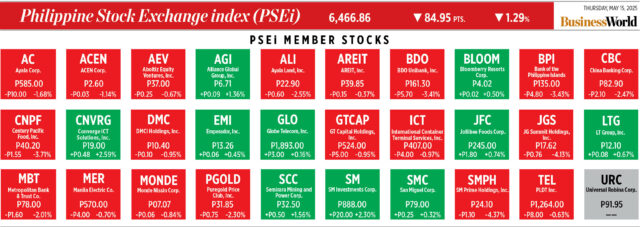
How PSEi member stocks performed — May 15, 2025

Here’s a quick glance at how PSEi stocks fared on Thursday, May 15, 2025.


Samsung investment decision awaiting talks on power rates

REUTERS

THE GOVERNMENT is currently negotiating power rates with Samsung Electronics that will help determine whether the South Korean multinational pursues an over $1-billion investment in the Philippines, the Philippine Economic Zone Authority (PEZA) said.

“What they want to assure is the power rates; that is what is being fixed. But the fiscal incentives have already been ironed out,” PEZA Director General Tereso O. Panga told reporters.

“They have presented prevailing rates in Vietnam, China, and South Korea, and those are going to be used as a benchmark. We can approximate the rates we can give them based on those,” he added.

Asked how much lower Samsung wants power rates to be, he said, “They are being reasonable; that is all I can say, and we have the capacity to provide it.”

He said another government agency is involved in the rate negotiations.

“Their other asks can be addressed through administrative interventions, like water; that one we are doing it from our end,” he added.

According to Mr. Panga, the new investment would expand Samsung’s operation in Calamba Premiere Industrial Parkway in Laguna.

“They have been with PEZA ever since. They will still manufacture multi-layer ceramic capacitors (MLCCs),” he said.

He added that the expansion involves a multi-story facility.

Incentives for investments under P50 billion are governed the Corporate Recovery and Tax Incentives for Enterprises to Maximize Opportunities for Reinvigorating the Economy (CREATE MORE) Act, while incentives can be tailored for investments amounting to P50 billion and above.

Under the law, President Ferdinand R. Marcos, Jr. can grant customized fiscal and non-fiscal incentives for projects at the P50 billion threshold in the “interest of national economic development.”

According to Mr. Panga, due to geopolitical events, many investments from the US, South Korea, and China are entering the country.

Mr. Panga noted that Chinese investor activity outpaced Japanese activity in the first four months.

In the four months to April, PEZA approved P63.523 billion worth of investment approvals, up 112.06% from a year earlier.

South Korea was the top source of investment in the first four months, accounting for P10.45 billion, followed by the US (P2.53 billion), China (P2.17 billion), Japan (P1.66 billion), Hong Kong (P1.14 billion), and Singapore (P1.1 billion).

“We are already seeing this momentum early on this year, we are hoping to sustain it,” he said. — Justine Irish D. Tabile

PHL, S. Korea sign deals on critical minerals, EVs

NICKELASIA.COM

TRADE Secretary Ma. Cristina A. Roque signed a strategic partnership agreement involving critical minerals and electric vehicles (EVs) with South Korean Minister for Trade, Industry, and Energy Cheong In-Kyo, the Department of Trade and Industry (DTI) said.

In a statement on Thursday, the DTI said the memorandum of understanding (MoU) signed in South Korea on Wednesday is expected to accelerate trade, drive industrial transformation, and support the transition to green energy.

“This MoU is the embodiment of President Ferdinand R. Marcos, Jr.’s mission to build a nation propelled by strategic global partnerships, environmentally responsible development, and a dynamic industrial sector,” Ms. Roque said.

The MoU covers renewable energy, electric vehicles, and the value-added processing of critical minerals for battery production in the interest of advancing both countries’ green industrial revolution.

Also on Thursday, Ms. Roque inaugurated the DTI SME Showroom at the President Hotel, offering a showcase for export-ready Philippine products.

“This launch is a concrete step towards bringing small and medium enterprises (SMEs) closer to the global market,” Ms. Roque said.

“By providing this physical presence overseas, we break through geographical barriers for our SMEs and build the trust that international buyers seek,” she said. — Justine Irish D. Tabile

Hog industry lobbied for pork MSRP removal — DA

PHILIPPINE STAR/ MICHAEL VARCAS

THE Department of Agriculture (DA) said on Thursday its decision to discontinue the maximum suggested retail price (MSRP) scheme for pork was the result of lobbying by the hog industry, which argued that production remains constrained by African Swine Fever (ASF).

Agriculture Secretary Francisco Tiu Laurel, Jr. clarified that the DA is withdrawing the pork MSRP “at the request of industry players.”

“While the industry tried to comply with the MSRP, the severe shortage in swine due to ASF, combined with strong consumer demand, has made it increasingly difficult to keep pork prices down,” he said.

The MSRP had been set at P300 per kilo for a whole slaughtered pig, P350 for pork shoulder and hind leg and P380 for pork belly.

Agriculture Undersecretary for Livestock Constante J. Palabrica said on Wednesday that vendors were not complying with the MSRP likely due to high farmgate prices, reportedly as high as P290 per kilo.

Mr. Laurel said pork retail prices remain high, “with industry groups pointing to the ASF resurgence as a key factor disrupting supply and dampening production.”

Since the first outbreak in 2019, the national hog inventory has declined from about 13 million head to just 8 million, according to the DA.

DA spokesman Arnel V. de Mesa told reporters on Thursday that the hog industry cited the need for a “recovery period” from ASF.

The MSRP will be revised, he said.

Compliance with the pork MSRP was below 5% as of May 2, against 30% on April 1.

Alfred Ng, National Federation of Hog Farmers, Inc. vice-chairman said the MSRP “failed” because “less than 15% of retailers followed the MSRP, claiming higher transfer prices from middlemen who in turn blame farmers,” he told BusinessWorld.

He said the DA’s failure to control the viajeros — the consolidators who link farms with dealers — was “the actual cause of the failed MSRP scheme.”

Mr. Ng said producers have to “sacrifice P2,000 per pig to cooperate with the DA.”

“How else will farms recover from the millions of losses the past year?”

“DA always says farmers have a 30% profit compared to viajeros with 10% and retailers 5%. In reality, farmers need a minimum of four to six months before they can convert their pigs to cash,” he said.

He said the actual profit of pig producers is only between 5% and 7.5% because they have to deal with animal diseases.

Mr. Laurel, meanwhile, said the lifting of the pork MSRP will not lead to a sudden spike in prices as markets also deal in cheaper imported pork.

Pork imports hit 53.598 million kilos in February, up from 38.994 million kilos a year earlier.

The DA said it will focus on buying hogs from farmers for P230 per kilo and distribute these to key slaughterhouses.

The DA is piloting a direct-sourcing scheme involving Food Terminal, Inc. (FTI) and Charoen Pokphand Foods PLC (CP Foods).

State-owned FTI has been supplying a Caloocan slaughterhouse with 100 live hogs daily from CP Foods since April.

The DA is hoping to pursue similar arrangements with other farm companies like Pilmico Foods Corp.

Mr. Ng welcomed the direct-sourcing strategy but noted that “many farms” refuse to sell to the DA because of its 30-days-to-pay terms.

Mr. Palabrica on Wednesday described the mode of payment for the direct-sourcing program as a “credit on delivery” scheme.

He said about P5-7 billion is earmarked for the program, adding that the FTI sells the hogs at no markup, while the cost of delivery to slaughterhouses is absorbed by the partner company.

Meanwhile, Mr. Laurel said the DA has hit the minimum access volume (MAV) quota for meat imports.

“Same breakdown as last year,” he said, noting that the allocation remains the same pending tariff negotiations with the US.

“Whatever changes we will make to the MAV allocation, it will be in 2026,” he said.

Meat Importers and Traders Association (MITA) President Jess C. Cham told BusinessWorld he supports an increase in the MAV.

“After all the current volumes were set 30 years ago when our population was 50% less, with lower per capita consumption,” he said.

“In addition, we are facing production shortfalls due to animal diseases such as ASF,” he added.

He noted that the delayed release of MAV allocations has “affected greatly the purchasing decisions of the licensees.”

The DA in April said it was hoping to overhaul the MAV system, which it said was being “exploited by a small number of accredited importers.” — Kyle Aristophere T. Atienza

Visitor arrivals of 6 million seen possible in 2025 — leisure analyst

REUTERS

THE PHILIPPINES can hit visitor arrivals of 6 million this year, even with its key source markets roiled by currency volatility, Leechiu Property Consultants said.

“I think the Philippines can still book 6 million visitors by year’s end, but of course there are risks,” Alfred Lay, director for hotels, tourism, and leisure at Leechiu, told BusinessWorld.

“Risks for this year are all mainly external, namely the uncertainty in the global economy, airline disruptions, and exchange rate volatility in our top source markets, which can both have positive and adverse effects,” he added.

The Department of Tourism reported that the Philippines booked 5.95 million visitor arrivals last year, well off its target of 7.7 million.

Mastercard Chief Economist for Asia-Pacific David Mann said that inbound tourism to the Philippines is recovering slowly compared to the outbound segment of the business.

“We have seen outbound spending rise 6% versus 2019, with the majority traveling to Japan, Korea, and Vietnam,” Mr. Mann said in a virtual briefing on Thursday.

“The inbound recovery has been a bit slower, at less than three-quarters (72%) recovered to 2019 levels, likely due to some of the slower recovery in the air capacity and reliance on long-haul markets,” he added.

He noted the slowdown in arrivals from Northeast Asia but added that visitors from Singapore, the US, and Australia, as well as overseas Filipinos, have been helping support the recovery.

The Philippines recorded 2.1 million visitor arrivals as of May 1, down 0.82% year on year.

South Korea, the top source market, accounted for 22.25% of arrivals, or 468,337, down 18% from a year earlier.

The other top source markets were the US, Japan, Australia, and Canada.

“While the dip in South Korean arrivals is notable, it’s too early to call it a lasting trend,” Mr. Lay said.

“Encouragingly, we’re seeing steady growth from the US, Australia, Japan, and parts of Europe — markets showing healthy demand that can help offset the shortfall,” he said.

However, he said the decline in arrivals “highlights the ongoing need for both the private and public sectors to continue improving our infrastructure and services.”

“The regional market is very competitive, and we need to keep adding more focus, resources, and funding to our tourism sector to ensure we stay relevant,” he added.

He said the opportunities in Philippine tourism still lie mainly in the domestic market. — Justine Irish D. Tabile

Puregold sees Vis-Min expansion helping more small businesses

PLANS to expand in the Visayas and Mindanao will help encourage the growth of small businesses, supermarket chain Puregold Price Club, Inc. said.

Puregold Vice-President for Operations Antonio G. Delos Santos II said that the company, whose core market is sari-sari store owners buying inventory to sell to consumers, has a new-store target of 25 locations.

“What we want is to put up stores in places that do not yet have Puregold,” Mr. Delos Santos told reporters on the sidelines of Puregold’s Tindahan ni Aling Puring (TNAP) Convention on Thursday.

“Very soon we will be opening in Pantukan, Davao de Oro and in Sindangan, Zamboanga del Norte,” he added.

He said there are also plans to open stores in the north, Metro Manila, and Bicol.

“We want Aling Puring’s footprint (to be nationwide) because we believe that it is not only the National Capital Region that needs the help of Aling Puring,” he said.

“We want Aling Puring to reach all places in the Philippines, especially Visayas and Mindanao, to help entrepreneurs in these regions,” he added.

He said that the company’s goal is to help businesses succeed by selling the right products.

“If more Puregold stores open, more jobs will be created,” he added.

Puregold President Ferdinand Vincent P. Co said the company’s business impact is not limited to the number of locations.

“When a sari-sari store thrives, a family moves forward, a community strengthens, and the economy grows from the ground up. By enabling our ‘Ka-Asensos’ (sharers in prosperity) to succeed, we are paving the road to thriving communities,” he added.

It said the TNAP program has become a “nationwide platform for micro-entrepreneurship.”

Puregold currently has a 512-store network. — Justine Irish D. Tabile

SC ruling nullifying LGU mining bans sets bad precedent — environmentalists

STOCK PHOTO | Image by David Hellmann from Unsplash

By Kyle Aristophere T. Atienza, Reporter

A SUPREME COURT (SC) ruling striking down local-government mining bans sets a bad precedent for conservation, according to environmental groups.

The ruling also exposes the flaws of a 1995 mining law, they added.

Alyansa Tigil Mina (ATM) said the ruling has “clear repercussions for efforts to stop destructive and irresponsible mining.”

It called for a balanced interpretation of laws on local autonomy and minerals management.

“In the real world where mining corporations and political dynasties rule economic decision and management of our natural resources, this is not a just interpretation, in our view.”

The ruling nullified a 25-year moratorium on large-scale mining by the province of Occidental Mindoro and the municipality of Abra de Ilog in that province, with the SC saying it violated Republic Act (RA) No. 7942 or the Philippine Mining Act of 1995.

It stemmed from a case filed by Agusan Petroleum and Mineral Corp., which argued that the ban violated its exclusive rights to mine in Mamburao and Abra de llog under a government-approved Financial or Technical Assistance Agreement (FTAA).

ATM said the ruling constrains the police powers of LGUs, though it notes that instead of blanket bans, it found that LGUs can decide to approve or disapprove of specific mining applications.

“We are asking public interest law organizations to review and give a briefing to environmental and climate justice networks and affected communities as soon as possible, so we may be able to draft our responses with concerned LGUs,” it said.

Occidental Mindoro elevated the case filed by Agusan to the SC after a regional trial court voided the ordinances imposing the ban.

The province argued that the ordinances were a valid exercise of its police power since their purpose was to protect the environment and the lives and safety of residents.

The SC said large-scale mining and exploration of mineral resources are legal under the Constitution and the Philippine Mining Act of 1995, adding that it is the State’s duty to promote these activities “to support national development, while also ensuring environmental protection and safeguarding the rights of affected communities.”

Local ordinances are not considered “laws” that can prohibit mining under Section 19 of RA 7942, according to the ruling.

The power of LGUs to issue ordinances comes from Congress, and interpreting “laws” to include local ordinances would, in effect, allow LGUs to override Congressional authority to regulate mining, it said.

The ruling noted that RA 7942 gives LGUs the power to approve or deny individual mining applications based on their effects on the environment, livelihoods, and land rights.

“However, the law does not authorize them to impose a blanket ban on all large-scale mining in their area,” the court said.

Kalikasan People’s Network called the ruling a “dangerous move.”

“This ruling… is a direct assault on the autonomy of local governments and the collective right of the people to a balanced and healthful ecology, as enshrined in the Constitution,” it said.

The group called on the 20th Congress to repeal RA 7942 and pass the people’s mining bill.

The bill seeks the creation of multi-sectoral mineral councils, expanding the decision-making process to affected communities,stakeholders, and LGUs.

The bill “affirms the role of the MGB as a scientific research institution under the DENR.”

Meanwhile, the Philippine Nickel Industry Association (PNIA) said the court ruling “holds profound significance not just for the mining sector, but also for maintaining the delicate balance between local government authority and national laws.”

It called the ruling a “pivotal step in enhancing the competitiveness of the mining industry while fostering its sustainable development.”

“This ruling not only clarifies legal ambiguities in mining governance but also sets a crucial precedent for future policy discussions.”

The SC issued the ruling months after the province of Palawan, backed by local communities, issued a 50-year moratorium on new mineral agreements.

Finance dep’t, UNDP launch $4.5-million accelerator for nature-based enterprises

THE Department of Finance (DoF) said it tied up with the United Nations Development Programme (UNDP) to launch a $4.5-million “accelerator” which will help enterprises scale up sustainable and inclusive businesses.

“It aims to identify and support 10 high-potential nature-based enterprises that deliver direct, measurable environmental benefits while driving sustainable and inclusive economic growth,” the DoF said in a statement on Thursday.

NatureNest, which was launched on May 5, is a six-month accelerator program under Accelerating Green and Climate Finance in the Philippines: Nature-based Solutions (AGCF) Project.

Also providing funding were the Government of Canada. The UNDP tapped Villgro Philippines to implement the program.

The DoF said the enterprises participating in the program will be supported with capacity-building, coaching, and specialized technical assistance to help them scale immediately.

The project will fund the creation of a climate finance lab; climate data platforms for research in Nature-Based Solutions finance; as well as the design and incorporation of gender-responsive and green and climate-related policies in lending programs.

The AGCF program will also support the establishment of a system to report Sustainable Development Goals impact of green and climate investments made by the private sector and financial institutions. — Aubrey Rose A. Inosante