Home Blog Page 1034

More than 25,000 sign up for socialized housing units under Expanded 4PH

Over 25,000 Filipino workers have signed up to express interest in purchasing socialized housing units through the Pag-IBIG Housing Loan under the Expanded Pambansang Pabahay para sa Pilipino (4PH) Program, just three months after Pag-IBIG Fund rolled out its 4PH Online Registration system in June 2025, officials announced Friday, Sept. 5.

This early success reflects strong demand and high interest among Filipino workers in securing affordable homeownership through the Marcos administration’s flagship housing initiative.

The Expanded 4PH Program, which now includes house-and-lot units in subdivision developments in addition to previously available vertical condominium projects, currently features socialized housing developments in key areas such as Caloocan City, Cavite, Bulacan, Nueva Ecija, Rizal, Pampanga, Ilocos Norte, Bacolod, Zamboanga, and Davao. With more projects under way, even more Filipino workers are expected to benefit in the coming months.

“The high number of registrants in such a short span of time clearly reflects the need of Filipino workers and their families for affordable homeownership,” said Department of Human Settlements and Urban Development Secretary Jose Ramon P. Aliling, who also chairs the Pag-IBIG Fund Board of Trustees.

“This user-friendly, transparent, and corruption-free digital solution under the Expanded 4PH Program allows us to bring homeownership within reach. The tool also helps us match the growing demand with the available housing inventory, and eventually with the more than 251,000 socialized housing units committed by the private sector. This forms part of our many efforts to move us closer in fulfilling President Marcos’ vision of providing Filipino families with safe, decent, and secure homes under a Bagong Pilipinas,” Mr. Aliling said.

Pag-IBIG Fund’s Expanded 4PH Online Sign-Up Facility is a mobile-optimized platform that allows members to browse available socialized housing projects, view unit photos, compute estimated monthly payments, and monitor their registration status in real time. Once a member registers through the system, Pag-IBIG Fund conducts a preliminary assessment based on membership status, income, and other eligibility criteria. The registrant’s information is then transmitted to the National Housing Authority (NHA) and the Social Housing Finance Corporation (SHFC) for further validation. After completing eligibility checks, the potential homebuyer’s details are endorsed to the partner developer of the selected project to facilitate the housing loan and home purchase process.

“We developed this online registration system with our members’ convenience in mind. It now allows them to easily explore housing options and indicate their interest, so we can reach out and assist them in completing their application. This further supports Secretary Aliling’s push for full digitalization in the housing sector, a key component of his 8-Point Agenda,” said Pag-IBIG Fund Chief Executive Officer Marilene C. Acosta. “At Pag-IBIG Fund, we have always embraced digital transformation as a means of making our services better and more responsive to our members’ needs. Through this facility, first-time homebuyers can now begin their journey to homeownership with just a few clicks.”

Ms. Acosta also urged eligible members to take advantage of Pag-IBIG Fund’s ongoing Early Bird Promo, which offers a special 3% subsidized housing loan rate fixed for 10 years for the first 30,000 qualified borrowers under the Pag-IBIG Housing Loan for the Expanded 4PH.

Under the Pag-IBIG Housing Loan for the Expanded 4PH, qualified members may avail of loans with a subsidized interest rate to finance the purchase of house-and-lot units priced up to P850,000, or condominium units up to P1.8 million. Pag-IBIG Acquired Assets that fall within the same price ceilings may also be purchased through the loan.

Interested members may register through the Expanded 4PH Online Sign-Up Facility at https://www.pagibigfundservices.com/MagpalistaSa4PH/.


Spotlight is BusinessWorld’s sponsored section that allows advertisers to amplify their brand and connect with BusinessWorld’s audience by publishing their stories on the BusinessWorld Web site. For more information, send an email to online@bworldonline.com.

Join us on Viber at https://bit.ly/3hv6bLA to get more updates and subscribe to BusinessWorld’s titles and get exclusive content through www.bworld-x.com.

Japan revises Q2 GDP higher on upbeat consumer spending

A MAN takes photo of cherry blossoms on the first day of the Japanese government’s relaxation of official guidance on masks as it emerges from the COVID-19 pandemic, in Tokyo, Japan, March 13, 2023. — REUTERS

TOKYO – Japan’s economy expanded much faster than initially estimated in the second quarter, driven by upward revisions in private consumption and inventories, giving policymakers some assurance as they navigate political and trade uncertainty.

Gross domestic product grew an annualised 2.2% from the previous quarter in the three months through June 30, revised data from the Cabinet Office showed on Monday, up from the 1.0% announced on August 15 and economists’ median forecast.

While the figures show brisk growth in the world’s fourth-largest economy, US tariffs and growing political uncertainty could complicate policymaking in the months ahead after Prime Minister Shigeru Ishiba resigned on Sunday.

On a quarter-on-quarter basis, GDP grew 0.5%, compared with a median forecast and the initial estimate of a 0.3% rise.

The Cabinet Office said the upgraded estimates reflected restaurant, game sales and corporate spending, which was not available at the time of the initial reading’s release.

Private consumption, which accounts for more than half of the Japanese economy, inched up 0.4%, versus a 0.2% uptick in the preliminary reading.

However, analysts warn US President Donald Trump’s tariffs could trigger a sharp slowdown in exports in the current quarter and undermine the economy’s current momentum.

“It’s difficult to expect consumer spending to be sufficiently robust in the July-September quarter to offset the decline in exports,” said Shinichiro Kobayashi, principal economist at Mitsubishi UFJ Research and Consulting.

While Monday’s data is unlikely to influence the Bank of Japan’s immediate policy deliberations, tariff concerns and political uncertainty could delay any imminent interest rate hikes, said economist Uichiro Nozaki at Nomura Securities.

The focus will now turn to July-September GDP figures to gauge how far U.S. tariffs have weighed on the economy.

Tokyo and Washington last week formalised a trade deal, implementing lower tariffs on Japanese automobile imports and other products that were announced in July, providing some relief for the export-heavy economy.

The capital expenditure component of GDP, a barometer of private demand, rose 0.6% in the second quarter, revised down from 1.3% in the initial estimate. Economists had estimated a 1.2% rise.

External demand, or exports minus imports, contributed 0.3 percentage point to growth, in line with the preliminary reading. Domestic demand contributed 0.2 percentage point, reversing a 0.1 percentage point drag in the initial figure. — Reuters

EastWest Ageas launches protection and payout insurance

What is the “Filipino Dream”? In a place that is the 13th most populous in the world, the Filipino Dream cannot be defined under a singular lens. Instead, it is shared from generation to generation, shaped by the environment, and ultimately, chosen by the self. From ensuring they live comfortably with a sure income, living a healthy life with their loved ones, or simply preparing their kids’ future or for their golden years, these are the dreams that Filipinos share.

Securing safety and source of income

A common dream Filipinos share is achieving a stable source of income, which also feeds into their sense of security. This aspiration and prioritization is reflected in a recent study commissioned by EastWest Ageas Insurance where 82% of Filipinos chose income security as a top focus. Whether its income that can cover for their daily needs or funds for emergencies, when Filipinos are secure about how to fund their tomorrows, they can make more confident choices about their future.

Honing into health and wellness

In a post-pandemic world, the importance of health and wellness has climbed higher in the public consciousness. In fact, 81% of Filipinos say that making sure they are healthy so they are free of the worries health-based concerns bring them is a personal goal. This focus on the commitment to a healthy lifestyle is a sign that most Filipinos truly believe in the saying that prevention is indeed better than the cure.

Empowering through education

Though there has been a shift to preparing for retirement, 33% of Filipinos are focused on ensuring their children get the education they deserve. This long-standing belief in education as an untouchable legacy for their children that ultimately decides their future remains strong.

Designing solutions for the Filipino Dream

With a myriad of variants for the Filipino Dream, how does one come up with a solution that can encompass these needs? And for fast-rising insurance provider, EastWest Ageas the answer is simple.

“Filipinos deserve a solution that empowers them to pursue their life goals while still staying protected,” shares Sjoerd Smeets, President and CEO of EastWest Ageas.

“We designed an insurance solution that gives you the confidence to plan ahead. Whether you’re preparation for retirement, saving for your children’s college education, or you’re the breadwinner seeking for financial security, we created a product that provides the protection and guaranteed benefits you need to confidently pursue your dreams, worry-free.”

All of this is in Dream Builder.

Dream Builder is the newest addition to EastWest Ageas’ growing roster of PURPLE Solutions insurance offerings that can help Filipinos pursue their purpose for their people their PURPLE. It is designed to help Filipinos enjoy the present with guaranteed cash payouts at the end of the 6th policy year, plan for their next chapter with the maturity benefit at end of the 20th year, and be ready for whatever life brings, with protection coverage for 20 pivotal years.

Best of all, it has a simplified issue offer which makes the application process convenient and faster with minimal health requirements.

“We are proud to add Dream Builder into our suite of products,” shares Greg Martin, Chief Distribution and Marketing Officer. “With it, we hope to help more Filipinos build their dreams with the knowledge that they are secured as they pursue it. Life may be uncertain, but Dream Builder offers the security and peace of mind that every Filipino deserves.”

Dream Builder is now available through EastWest Ageas’ financial consultants and financial advisors in all EastWest Bank stores nationwide.

Visit www.ewageas.com.ph to help build your dreams today!


Spotlight is BusinessWorld’s sponsored section that allows advertisers to amplify their brand and connect with BusinessWorld’s audience by publishing their stories on the BusinessWorld Web site. For more information, send an email to online@bworldonline.com.

Join us on Viber at https://bit.ly/3hv6bLA to get more updates and subscribe to BusinessWorld’s titles and get exclusive content through www.bworld-x.com.

US to target more businesses after Hyundai raid, top official says

Masked law enforcement officers, including Immigration and Customs Enforcement agents, walk into an immigration court in Phoenix, Arizona, US, May 21, 2025. — REUTERS/CAITLIN O’HARA

WASHINGTON – President Donald Trump’s administration plans to target more businesses for immigration enforcement after a raid on a Hyundai facility in Georgia led to hundreds of arrests, a top White House official said on Sunday.

Speaking on CNN’s ‘State of the Union,’ White House border czar Tom Homan said the administration would intensify the focus on workplaces.

“We’re going to do more worksite enforcement operations,” Homan said. “No one hires an illegal alien out of the goodness of their heart. They hire them because they can work them harder, pay them less, undercut the competition that hires US citizen employees.”

Opponents of Trump’s crackdown and some business groups say major US industries – including agriculture, hospitality and meatpacking – depend on immigrants without legal status.

US immigration authorities arrested 475 people on immigration violations during the raid of the Hyundai facility on Thursday, most of whom were South Korean nationals. The South Korean government said on Sunday that the workers would be returned once administrative procedures were completed.

The US Department of Homeland Security did not immediately respond to a request for comment.

A US Immigration and Customs Enforcement official said during a press conference on Friday that some of the people arrested at the facility had crossed the border illegally and overstayed visas. A separate ICE official told Reuters that many had visas for tourists and business travelers that do not include a work permit.

The arrests in Georgia followed tougher rhetoric by Trump on illegal immigration. For weeks, Trump and his top officials have suggested the administration could send National Guard troops and federal officers to Chicago to target crime and immigration.

In a Truth Social post on Saturday, Trump posted a meme based on the 1979 Vietnam war movie “Apocalypse Now” that showed an image of the Chicago skyline with flames and helicopters, reminiscent of the deadly helicopter attack on a Vietnamese village in the film.

On CNN, Homan defended the meme, which has been heavily criticized by Chicago residents and others for its warlike imagery and suggestion that the city is a military target. He said it was being taken out of context and that the Trump administration was only going to war with criminals and those violating immigration laws. — Reuters

US probes malware email targeting trade talks with China, WSJ reports

STOCK PHOTO | Image by geralt from Pixabay

WASHINGTON – US authorities are investigating a bogus email purportedly from a Republican lawmaker that contained malware apparently aimed at giving China insights into the Trump administration’s trade talks with Beijing, the Wall Street Journal reported on Sunday.

The malware in the email that appeared to be sent by Representative John Moolenaar in July to US trade groups, law firms and government agencies was traced by cyber analysts to a hacker group – APT41 – believed to be working for Chinese intelligence, the newspaper said.

Moolenaar, a harsh critic of Beijing, is the chairman of a congressional committee focused on strategic competition between China and the United States, including threats to US national security.
The email was the latest alleged Beijing-linked hacking operation aimed at giving China insight into recommendations to the White House for contentious trade talks with China, said the Journal, quoting people familiar with the matter.

The Chinese embassy in Washington said it was not familiar with the details of the reported attack and that all countries face cyberattacks that are difficult to trace.

“China firmly opposes and combats all forms of cyber attacks and cyber crime,” it said in an emailed statement. “We also firmly oppose smearing others without solid evidence.”

The Journal said the first malware email was sent just before US-China trade talks in Sweden that led to an extension of a truce on tariffs until early November, when US President Donald Trump and Chinese leader Xi Jinping could meet at an Asian economic summit.

“Your insights are essential,” said the email that asked recipients to review proposed legislation attached to it.

Opening the draft legislation would have allowed the malware to give the hackers extensive access to the targeted groups, the newspaper said, adding that it could not be determined if the attacks had succeeded.

The newspaper said that the FBI and the US Capitol Police were investigating the email.

It quoted an FBI spokeswoman as saying that the bureau was aware of the email and was “working with our partners to identify and pursue those responsible.” The Capitol Police declined to comment, it said.

In a statement to the Journal, Moolenaar called the attack another example of Chinese cyber operations aimed at stealing US strategy. “We will not be intimidated,” he said.

The fake email came to light when staffers of Moolenaar’s committee started receiving puzzling inquiries about it, said the Journal, quoting people familiar with the matter. — Reuters

Aboitiz Equity Ventures strengthens role in driving Philippine economy

Aboitiz Foods, one of the leading food and agribusiness players in Asia, made significant strides in enhancing its operations this year, further reinforcing its contribution to Aboitiz Equity Ventures’ growth journey.

Aboitiz Equity Ventures, Inc. (AEV), the public holding company of the Aboitiz Group, continues to demonstrate resilience and adaptability as it strengthens its role in supporting the country’s economic progress. As the Philippines’ first techglomerate, AEV manages a diversified portfolio of businesses in power, banking, food and beverage, infrastructure, land development and cement—essential sectors that power communities, enable industries, and create opportunities. This diversity not only allows the group to withstand challenges but also reinforces its commitment to innovation and sustainability as drivers of long-term growth and national development.

“Our performance reflects the strength of a well-diversified portfolio,” said Sabin M. Aboitiz, AEV President and CEO. “We are managing our businesses with discipline, resilience, and innovation—not only to deliver value to our shareholders, but also to help drive the Philippine economy forward.”

AboitizPower continues to ensure reliable energy supply to households and industries nationwide, supporting inclusive growth and competitiveness. In food and agribusiness, Aboitiz Foods delivered stronger performance, while Coca-Cola Europacific Aboitiz Philippines, Inc. (CCEAP) added further diversity to the group’s consumer market portfolio.

UnionBank sustained its leadership in digital banking, expanding financial access through innovative solutions and a healthier funding mix. Its role in advancing financial inclusion aligns with AEV’s purpose of uplifting communities. Aboitiz InfraCapital pushed forward with projects in airports, water, and economic estates, laying foundations for long-term development. Aboitiz Land reaffirmed its mission to provide affordable housing for Filipino families, while Republic Cement worked with stakeholders to strengthen the domestic cement industry, critical to infrastructure growth.

The group is also deep into its Great Transformation journey, reimagining itself as the country’s first techglomerate. By embedding data science, artificial intelligence, and emerging technologies into traditional industries, AEV is creating smarter, more efficient, and future-ready businesses. UnionBank’s pioneering digital banking initiatives, AboitizPower’s renewable and smart energy systems, and InfraCapital’s smart city and airport solutions are just some examples of how technology is reshaping its operations. The Aboitiz Foundation is likewise harnessing innovation to uplift communities through programs like AuroraPH, which energizes last-mile schools and upskills teachers in remote areas by equipping them with digital tools and training to enhance education delivery.

Despite headwinds, AEV remains steadfast in its mission to uplift lives and advance business and communities. Its diversified portfolio allows it to balance risks while seizing opportunities for inclusive growth across multiple sectors. “There will always be challenges, so we try to keep our businesses in a position to capture opportunities and sustain growth,” Aboitiz emphasized.

From powering homes and industries, to building sustainable communities, to enhancing access to financial services, AEV’s role in nation-building is deeply embedded in its operations. Strategic investments and forward-looking transformation ensure that it remains a key driver of Philippine economic growth in the years ahead.

With more than a century of business history, AEV is recognized as one of the Philippines’ most respected conglomerates. Guided by strong corporate governance and sustainability principles, it continues its purpose of advancing business and communities. As it transforms into a techglomerate, AEV is shaping the future by integrating innovation and sustainability into every aspect of its operations—helping build a stronger, more inclusive, and more resilient economy.


Spotlight is BusinessWorld’s sponsored section that allows advertisers to amplify their brand and connect with BusinessWorld’s audience by publishing their stories on the BusinessWorld Web site. For more information, send an email to online@bworldonline.com.

Join us on Viber at https://bit.ly/3hv6bLA to get more updates and subscribe to BusinessWorld’s titles and get exclusive content through www.bworld-x.com.

From metro to the provinces: Meralco powers growth with reliable service

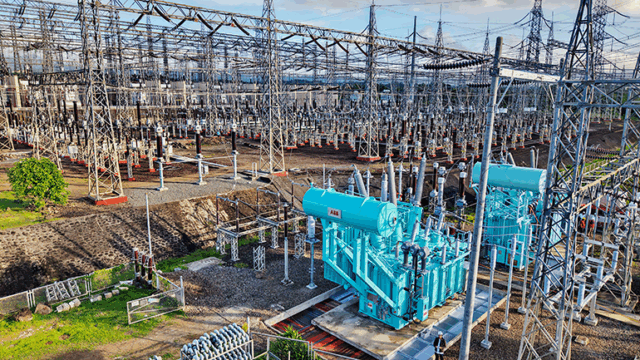
ENHANCING CAPACITY FOR GROWTH. Manila Electric Company (Meralco) is committed to delivering reliable, resilient, and future-ready electricity service to its growing customer base through continuous infrastructure upgrades. In photo is the Tayabas Power Transformer, whose capacity was increased to 300 megavolt-amperes (MVA) from 100 MVA to support load growth in portions of Quezon and Laguna provinces.

As the country continues to evolve into a more connected and energy-intensive economy, Manila Electric Company’s (Meralco) smart substations, upgraded transmission lines, and expanded capacity are no longer just support mechanisms — they serve as critical infrastructure investments that promise of reliability, innovation, and progress. These projects reflect the power distributor’s proactive approach in anticipating customer needs and adapting to the challenges of climate change and urbanization.

With a clear vision for the future, the Manuel V. Pangilinan-led power distribution utility remains committed to powering communities and enabling growth through sustainable and resilient energy solutions. Whether it’s supporting critical facilities, commercial hubs, or everyday households, Meralco’s network enhancements ensure that the lights stay on — and the future stays bright.

In the second quarter of this year, Meralco energized nine major capital expenditure (capex) projects — spanning key urban centers in Metro Manila and high-growth areas in Bulacan, Laguna and Quezon.

“These projects are part of Meralco’s broader network enhancement strategy, ensuring that our infrastructure is future-ready to meet growing energy demand while improving operational flexibility and service reliability,” Meralco First Vice-President and Head of Networks Froilan J. Savet said.

CAPACITY ADDITIONS

SUPPORTING ECONOMIC HUBS. Meralco’s recently commissioned the ASEANA 115 kV-34.5 kV GIS Substation in Parañaque City ensures a more reliable and stable power supply to serve the booming ASEANA City and nearby developments.

From April to June of this year alone, Meralco commissioned projects contributing a total of 450 megavolt-amperes (MVA) in additional capacity to support the load growth and improve service reliability in the cities of Makati, Pasig, Parañaque and Quezon in Metro Manila, as well as several municipalities in Laguna and Quezon.

The power distributor completed the ASEANA 115 kilovolt (kV) – 34.5 kV Gas Insulated Switchgear (GIS) Substation in Parañaque City to support key economic hubs in the southern part of Metro Manila.

The new smart substation now serves the power requirements of business and commercial establishments including ASEANA 3, Ayala Malls Manila Bay, Bayprime Hotel, Seda Manila Bay, Bayprime Hotel, and Uni-Asia International Prime Holdings, Inc.

To enhance power supply reliability in central business districts in Metro Manila, the power distributor also expanded the Bridgetowne 115 kV – 34.5 kV GIS and Makati 115 kV – 34.5 kV GIS Substations.

The Bridgetowne Substation will serve the growing demand of customers in Pasig City and Quezon City, including Exxa and Zetta Towers, Giga Tower, Tera Tower, Opus Mall and GBF Center; while the Makati Substation caters to key customers such as Cash & Carry Mall, St. Clare’s Medical Center, St. Mary of the Woods School, SMDC Red Residences and residents in nearby areas.

In Southern Luzon, Meralco increased the capacity of the Tayabas Power Transformer to 300 MVA from 100 MVA to support load growth in portions of Quezon and Laguna provinces.

IMPROVING NETWORK RELIABILITY

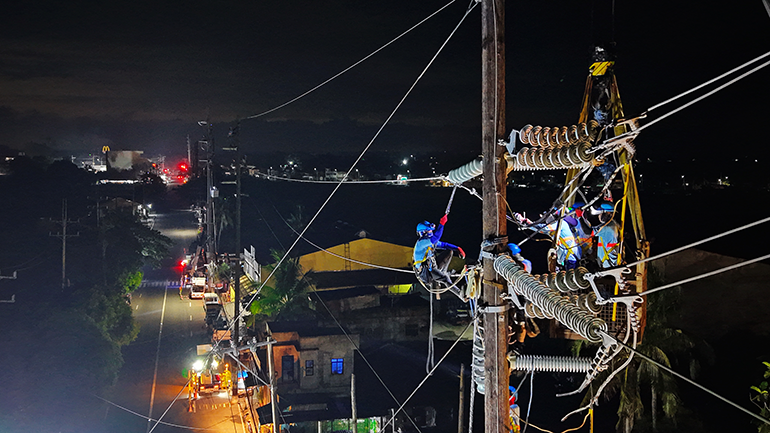
BOOSTING POWER RELIABILITY IN LAGUNA. The uprating of a portion of the Dila-Real 115-kV line features the installation of high-capacity HTLS STACIR conductors, enhancing the reliability of Meralco’s sub-transmission system and ensures stable electricity supply for key areas in Laguna, including Calamba, Los Baños, Bay, Pila, and Calauan.

Meralco also energized five major projects intended to improve its sub-transmission system backbone, Mr. Savet said.

The power distributor increased the capacity of the Dila-Real 115 kV line, bolstering power reliability for customers in Laguna, including Calamba, Los Baños, Bay, Pila and Calauan.

In the northern part of its franchise area, Meralco energized key transmission lines in Bulacan, namely the Malolos-Tabang and Malolos-Calumpit 69-kV lines, to meet the increasing demand and support the Department of Transportation’s flagship North-South Commuter Railway project.

The company also launched its first fully indoor GIS switching station in Regalado, Quezon City. The project improves operational switching flexibility in portions of Quezon City and Caloocan City, and boosts service reliability for critical facilities such as ST Telemedia Global Data Centers.

In Cavite, Meralco upgraded the Abubot Substation by installing three 115-kV circuit breakers and other associated equipment to support commercial and healthcare customers in Dasmariñas, General Trias and Imus. The project will also benefit large customers including De La Salle University Medical Center, Emilio Aguinaldo College, National College of Science and Technology, and San Miguel Yamamura.

All these projects are aligned with Meralco’s ongoing efforts to modernize its infrastructure and support the country’s socioeconomic growth by ensuring continuous, adequate, and high-quality electricity supply for households, industries, and key public services.

“These infrastructure investments reflect our unwavering commitment to power progress and ensure that our customers have access to reliable, sufficient, and high-quality electricity. As demand continues to grow, we will continue to upgrade and expand our facilities and strengthen our distribution network which serves as the backbone of our efforts to support the country’s economic development,” Mr. Savet said.

As the country continues to evolve into a more connected and energy-dependent economy, Meralco’s investments in smart substations, upgraded transmission lines, and expanded capacity are more than just infrastructure — they’re a promise of reliability, innovation, and progress. These projects reflect Meralco’s proactive approach to anticipating customer needs and adapting to the challenges of climate change and urbanization.

With a clear vision for the future, Meralco stands true to its commitment to powering communities and enabling growth through sustainable and resilient energy solutions. Whether it’s supporting critical facilities, commercial hubs, or everyday households, Meralco’s network enhancements ensure that the lights stay on — and the future stays bright.


Spotlight is BusinessWorld’s sponsored section that allows advertisers to amplify their brand and connect with BusinessWorld’s audience by publishing their stories on the BusinessWorld Web site. For more information, send an email to online@bworldonline.com.

Join us on Viber at https://bit.ly/3hv6bLA to get more updates and subscribe to BusinessWorld’s titles and get exclusive content through www.bworld-x.com.

UN says time is short to stop famine spreading as Israel bombards Gaza City

PALESTINIANS wait to receive food cooked by a charity kitchen amid shortages of food supplies in Rafah in the southern Gaza Strip, Jan. 16, 2024. — REUTERS

JERUSALEM/CAIRO/NEW YORKUS – There is a “narrow window” to prevent famine from spreading further in Gaza, a top UN official said on Sunday, calling on Israel to allow unimpeded aid delivery in the territory, where it is fighting Palestinian militant group Hamas.

According to a global hunger monitor, hundreds of thousands of Palestinians are already experiencing or at risk of famine in areas including Gaza City, the enclave’s largest urban centre, where Israel has launched a new offensive against Hamas.

Israel, which stopped all aid for 11 weeks from March until mid-May, says it is doing more to let aid enter and be distributed in the enclave to prevent food shortages, though international agencies say far more is needed.

“There is a narrow window – until the end of September – to prevent famine from spreading to Deir al Balah (in central Gaza) and Khan Younis (southern Gaza). That window is now closing fast,” said United Nations aid chief Tom Fletcher.

COGAT, the Israeli defence agency that deals with humanitarian issues, said on Sunday that over the past week aid from more than 1,900 trucks, most supplying food, was distributed in Gaza.

“We will continue facilitating humanitarian aid into Gaza for the civilian population – not Hamas,” COGAT said in a statement.

Israel last month launched an assault on the outskirts of Gaza City and its forces are now just a few kilometers from the city centre, where it issued warnings over the weekend to civilians to evacuate high rise buildings it says are being used by Hamas, before bombing them.

Israel did not provide evidence to show Hamas was using the buildings, an accusation the militant group denied.

Overnight, strikes killed 14 people across the city, local health officials said, including a strike on a school in southern Gaza City sheltering displaced Palestinians.

The Israeli military said it had struck a Hamas militant and that civilians had been warned before the strike was carried out.

The military on Saturday also warned Gaza City’s civilians to leave for the south, including Khan Younis, where hundreds of thousands of Palestinians are already sheltering in cramped tent encampments along the coast.

‘ENOUGH IS ENOUGH’
With hundreds of thousands of people remaining in Gaza City, pressure is growing to end the war.

“We say to Hamas, we want a ceasefire, end this war before Gaza City is turned into ruins like Rafah,” said Gaza City resident Emad, referring to a southern Gaza City that Israel destroyed earlier in the war.

“We want an end to this war. How long is this going to go on? How many lives are going to be wasted? Enough is enough,” he said by phone, asking for his surname not to be published.

The war has grown increasingly unpopular among Israelis too. On Saturday night, tens of thousands of protesters joined families of hostages at rallies, calling for an end to the war and demanding the release of the hostages.

Twenty of the 48 hostages still in Gaza are believed to still be alive.

Israeli Foreign Minister Gideon Saar said that the war could end immediately if Hamas released the hostages and laid down its weapons.

“We will be more than happy to reach this objective with political means,” he told a press conference in Jerusalem.

In response, senior Hamas official Basem Naim said the group would not disarm but would release all hostages if Israel ended the war and withdrew all its forces from Gaza, reiterating Hamas’ long-standing position.

More than 64,000 Palestinians have been killed by Israel’s military assault, launched after Hamas-led militants carried out the surprise October 7, 2023 attack that killed 1,200 people and saw another 251 abducted and taken into Gaza.

Danish Foreign Minister Lars Lokke Rasmussen, speaking to reporters in Jerusalem alongside his Israeli counterpart, called on Israel to “change course” and stop its military campaign.

“We are extremely concerned about the humanitarian (situation),” he said, also calling for the hostages to be freed. — Reuters

MBC Media Group: Notice 2025 Annual Stockholders Meeting


Spotlight is BusinessWorld’s sponsored section that allows advertisers to amplify their brand and connect with BusinessWorld’s audience by publishing their stories on the BusinessWorld Web site. For more information, send an email to online@bworldonline.com.

Join us on Viber at https://bit.ly/3hv6bLA to get more updates and subscribe to BusinessWorld’s titles and get exclusive content through www.bworld-x.com.
Dollar reserves inch up to $105.9B

Five-dollar bills are inspected at the Bureau of Engraving and Printing in Washington, D.C., March 26, 2015. — REUTERS

THE PHILIPPINES’ gross international reserves (GIR) inched up in August as the value of the central bank’s gold holdings hit a record high.

Preliminary data from the Bangko Sentral ng Pilipinas (BSP) showed that dollar reserves went up by 0.46% to $105.9 billion as of end-August from $105.4 billion at end-July.

Year on year, dollar reserves dipped by 1.8% from $107.857 billion in August 2024.

“The Philippines’ gross international reserves rose in August 2025 due to higher global gold prices and income from Bangko Sentral ng Pilipinas’ investments,” the central bank said in a statement.

Ample foreign exchange buffers protect the country from market volatility and ensure that it is capable of paying its debts in the event of an economic downturn.

BSP data showed the level of dollar reserves as of end-August is enough to cover about 3.4 times the country’s short-term external debt based on residual maturity.

It is also equivalent to 7.2 months’ worth of imports of goods and payments of services and primary income, more than double the three-month standard.

“The latest GIR level provides a robust external liquidity buffer,” the central bank said.

International reserves are the central bank’s foreign assets held mostly as investments in foreign-issued securities, foreign exchange and monetary gold, among others.

These are supplemented by claims to the International Monetary Fund (IMF) in the form of reserve position in the fund and special drawing rights (SDRs).

Central bank data showed the BSP’s foreign investments stood at $85.852 billion as of end-August, down 0.4% from $86.187 billion at end-July. Year on year, it fell by 7%.

The value of the central bank’s gold holdings climbed by 5.4% to a record $14.523 billion at end-August from $13.783 billion at end-July. It jumped by 42.1% from $10.221 billion as of August last year. Gold tends to perform well during economic uncertainty.

Foreign exchange holdings rose by 8.3% to $897.8 million as of August from $828.9 million in the previous month. Year on year, it went up by 13.7%.

The country’s reserve position in the IMF likewise edged up by 1% to $736.4 million as of end-August from $729 million in the previous month. Year on year, it rose by 1.4%.

SDRs — or the amount which the Philippines can tap from the IMF’s reserve currency basket — inched up by 0.2% month on month to $3.895 billion as of August from $3.889 billion. Year on year, it went up by 1.3% from $3.847 billion.

Meanwhile, net international reserves grew by 0.46% to $105.9 billion from $105.4 billion as of end-July. These refer to the difference between the BSP’s reserve assets and reserve liabilities, including short-term foreign debt, and credit and loans from the IMF.

Rizal Commercial Banking Corp. Chief Economist Michael L. Ricafort said the month-on-month increase in gold holdings was due to rising gold prices in the world market.

“(This was) largely due to the latest month-on-month increase in gold holdings by $740 million or 5.4% to a new record high of $14.5 billion as world gold prices gained by 4.8% month on month in August 2025 to new record highs to $3,600 per ounce on Sept. 5, 2025,” he said.

However, Mr. Ricafort noted this was offset by the $335-million month-on-month decline in foreign investments amid market volatility and the higher US tariffs that took effect on Aug. 7.

“For the coming months, the country’s GIR could still be supported by the continued growth in the country’s structural inflows from OFW (overseas Filipino worker) remittances, BPO (business process outsourcing) revenues, and exports (though offset by imports),” he said.

Mr. Ricafort said the government’s plan to reduce foreign borrowings may also affect the GIR level in the coming months.

“Still relatively high GIR at $105.9 billion… among three-year highs [and] could still strengthen the country’s external position,” he said.

The BSP expects dollar reserves to reach $104 billion this year and $105 billion in 2026. — K.K.Chan

Gen Z workers embrace ‘polyworking’ amid low wages, rising costs

JOBSEEKERS attend a job fair at a mall in Antipolo, Rizal — PHILIPPINE STAR/MIGUEL DE GUZMAN

By Almira Louise S. Martinez, Reporter

TRISTAN C. SOLINAP, 23, juggles three jobs to keep up with his financial needs.

The young professional works as a program manager for public engagement in a local nongovernmental organization (NGO), a creative strategist for an Australian ad agency and a contractual documentation specialist for an international NGO.

Relying on a single paycheck, he said, was never enough.

“Before I got my side jobs, I was living paycheck to paycheck, budgeting every week just to get by,” he told BusinessWorld in a Zoom interview. “After paying the bills, I would have to think twice about whether I could even afford a simple fastfood meal.”

Now, with three jobs, his monthly income has jumped to P70,000 from P20,000, letting him put away savings and make small investments.

“Polyworking,” the practice of holding multiple jobs at once, has become more visible in recent years, especially among younger workers.

Forbes describes it as a “growing trend” in which employees manage several careers instead of sticking to one. Labor Secretary Bienvenido E. Laguesma in a Viber message said the concept might sound new but is essentially the same as what used to be called multiple job holding.

As a polyworker, Mr. Solinap carefully divides his time between his overlapping roles.

His day begins at 9 in the morning, when he tackles tasks for the ad agency. “Since my ad agency job is a production, it’s more time-bound. I have to meet deadlines everyday,” he said.

The local NGO job, which follows an output-based schedule, gets most of his attention in the afternoons and evenings. “Not much happens in the morning. Our meetings usually start in the afternoon, and if we need to report to the office, it’s typically around lunch or later,” he said.

Balancing two demanding jobs is possible, he said, because one requires more fieldwork while the other is purely online. Meanwhile, his project-based part-time job only needs him to submit reports every few months.

The Philippines’ underemployment rate — employees wanting longer working hours or more jobs — eased to 11.4% in June from 13.1% in May and 12.1% a year earlier, according to the local statistics agency. This translated to 5.76 million Filipinos looking for more jobs or longer working hours in June.

SIDE HUSTLES ON THE RISE
Polyworking has gained traction worldwide as workers seek flexibility and supplemental income.

The 2024 Gen Z and Millennial Survey Report by business consulting firm Deloitte Touche Tohmatsu Ltd. found that 45% of Gen Zs have at least one part-time or full-time side job. These range from selling products and offering online services to gig work, retail jobs, consulting and even running small businesses.

The report noted that financial stability is the key driver for multiple job holding, though other factors such as monetizing hobbies, developing skills and contributing to communities also play a role.

In the Philippines, there is still little data on polywork, though part-time work is legally recognized. “Generally, the contract of employment or work arrangement governs the rights and obligations of the employee and the employer,” Mr. Laguesma told BusinessWorld.

Complaints, he added, could be addressed through administrative proceedings or the courts if violations arise.

For many young workers, financial need is the strongest motivator for juggling jobs.

Twenty-four-year-old Pola C. Basaya balances two full-time roles: one as a global solution coordinator for an international company and another as a web development coordinator for a local firm.

“With the economy in the Philippines, prices are just too high,” she said. “It’s hard to keep up if you don’t have a high-paying job.”

Her combined income of about P50,000 a month now supports the lifestyle she wants. “Of course, I have needs. I need to buy things, I need to go out — I have to sustain that as well.”

Labor group Bukluran ng Manggagawang Pilipino (BMP) blames low wages and contractualization for the rise of polyworking among the youth.

Young workers are more vulnerable to becoming polyworkers due to low wages and contractualization, BMP National President Renecio S. Espiritu, Jr. said in a Viber message.

“Obviously, the young generation will suffer from polywork because centuries of traditional politics and dynastic rule pauperized workers and institutionalized starvation wages and contractualization,” he added.

He cited the surge in app-based gigs like Grab, Lalamove and Angkas as proof that many are forced to take on multiple jobs just to get by.

Data from the Philippine Statistics Authority’s 2022 Occupational Wages Survey showed that the average monthly salary in the country stood at P18,423. Meanwhile, global consulting firm Mercer projected a 5.5% rise in average salaries for 2025 — an increase that labor groups say will still fall short of addressing workers’ needs amid inflation.

Not all polyworkers are motivated purely by financial concerns. Some seek personal fulfillment or more career opportunities.

“A worker may want diverse types of work to avoid monotony, or maybe for personal satisfaction if the other job relates to a hobby or matter of personal interest,” Mr. Laguesma said.

The Deloitte survey found that 86% of Gen Z workers think having a sense of purpose is crucial to job satisfaction and well-being.

For Mr. Solinap, his side jobs provide a creative outlet. “I studied communications in college,” he said. “With my second job, I now have an avenue to express my passion for writing and producing content.”

THE HIDDEN COSTS
But polyworking comes at a price. Long work hours often take a toll on physical and mental health. “The downside will be prolonged work hours resulting in negative health effects and the quality of family life might also be affected,” Mr. Laguesma said.

Ms. Basaya’s biggest challenge is lack of sleep. “Sometimes, I know my body needs more rest, but I just can’t do it because I’m required to report to work or deliver outputs,” she said.

She admits becoming irritable from fatigue. Spending more than 10 hours a day in front of a laptop has also affected her body, prompting her to take short breaks to get sunlight or run errands.

“I’m lucky because both of my companies are not strict with work hours,” she said. “Whenever I need to run errands or exercise, I just inform my teammates that I’ll be logging off at a certain hour.”

Mr. Solinap, meanwhile, experiences burnout from time to time. “A lot of things are happening every day and sometimes I just want to be isolated and be away from people even just for a while,” he said.

Although he works to support himself, he admits that having several jobs compromises his self-care. “The most glaring impact is on my mental health. Most of the time I just want to lie in bed, lock my door and shut my windows.”

Labor groups warn that the normalization of polyworking reflects systemic neglect of workers’ welfare.

Polywork itself is unhealthy, and its proliferation in the Philippines is a sign that the government doesn’t care about the welfare of workers, Mr. Espiritu said. “What workers demand is a living wage and security of tenure, not multiple jobs to cope with inflation.”

He added that many companies in the country operate under “backward and feudal” practices, preferring to keep wages low to maximize profits rather than sharing productivity gains with employees.

For him, the real solution is investing in agriculture and manufacturing while institutionalizing living wages and job security. That will ensure full and dignified employment, he added.

Despite the drawbacks, young Filipinos like Mr. Solinap and Ms. Basaya continue to embrace polyworking as a practical way to survive — and even thrive — in today’s economy.

For them, multiple jobs mean freedom from financial anxiety, but also new challenges in health and work-life balance.

“I can now have my own savings and small investments,” Mr. Solinap said. “But the tradeoff is steep.”

Most days, he finds himself exhausted, burned out and struggling to take care of his mental health.

For Ms. Basaya, the challenge is more physical — managing long hours and sleepless nights. Yet both remain committed to polyworking, at least for now.

Their stories reflect a larger reality: for many young workers in the Philippines, one job simply isn’t enough.

Gov’t debt service bill jumps by 33% in July

BW FILE PHOTO

THE National Government’s (NG) debt service bill increased by 33% in July as the government ramped up interest payments, the Bureau of the Treasury (BTr) reported.

The latest data from the BTr showed that the debt service bill went up to P108.06 billion in July from P81.17 billion in the same month last year.

Month on month, the debt service bill surged by 65.88% from P65.14 billion in June.

Debt service refers to the payments made by the government on domestic and foreign borrowings.

The bulk or 98.3% of debt payments was made up of interest payments, BTr data showed.

Interest payments stood at P106.22 billion in July, up 33.72% from P79.43 billion in the same month in 2024.

Domestic interest payments increased by 49.88% to P82.92 billion in July from P55.32 billion in the same month last year.

Broken down, P73.61 billion was for fixed-rate Treasury bonds, P3.89 billion for Treasury bills (T-bills), and P3.58 billion for retail Treasury bonds.

Interest payments for foreign borrowings went down by 3.36% to P23.3 billion in July from P24.11 billion in the same month in 2024.

Meanwhile, amortization payments rose by 5.4% to P1.84 billion in July from P1.74 billion in July 2024.

Principal payments on foreign debt went up by 6.49% to P1.66 billion in July from P1.56 billion last year.

However, amortization paid on domestic debt slid by 3.78% to P178 million in July from P185 million a year ago.

“(The) higher debt servicing bill is largely a function of larger outstanding debt since the pandemic that entailed higher interest payments and also principal payment,” Rizal Commercial Banking Corp. Chief Economist Michael L. Ricafort said in a Viber message over the weekend.

Last week, the NG debt stock ballooned to a fresh high of P17.56 trillion as of the end-July, exceeding its projected P17.36-trillion ceiling by end-2025.

Mr. Ricafort also attributed the higher debt service bill to borrowings that financed the wider budget deficit in recent months.

As of end-July, the fiscal gap widened by 22.04% to P784.4 billion. This was on track to hit the revised P1.56-trillion full-year deficit ceiling, the BTr said.

SEVEN-MONTH PERIOD
In the seven-month period of 2025, the NG debt service bill stood at P876.16 billion, down by 35.76% from P1.36 trillion in the same period last year.

The seven-month tally was 42.65% of the P2.05-trillion debt service program this year.

Amortization payments slumped by 60.86% to P355.12 billion in the January-to-July period from P907.3 billion. This was 29.44% of the P1.21-trillion full-year amortization program.

Principal payments on domestic debt plunged by 77.48% to P170.06 billion, while external payments increased by 23.25% to P184.49 billion.

On the other hand, interest payments on external debt went up by 14.1% to P521.04 billion in the January-to-July period from P456.66 billion a year ago. This was 61.44% of the P848.03-billion programmed interest payments for 2025.

Interest payments on domestic debt stood at P382.74 billion, up by 18.36% from P323.36 billion in 2024.

This was composed of P267.29 billion in fixed-rate Treasury bonds, P82.84 billion in retail Treasury bonds, and P25.74 billion in T-bills.

On the other hand, external debt inched up by 3.75% to P138.3 billion as of end-July from P133.3 billion a year ago.

Mr. Ricafort said the government is still on track to meet its P2.05-trillion debt service program, with around P800 billion in maturing securities due in August and September.

“Wider budget deficits could also increase short-term NG borrowings and debt servicing for the rest of the year. However, the preference remains to use long-term borrowings to finance the budget deficit and to undertake new borrowings to hedge and manage maturing debts,” Mr. Ricafort said. — Aubrey Rose A. Inosante

ADVERTISEMENT
ADVERTISEMENT