Home Blog Page 1011

China tieups eyed in high-growth industries, PHL ambassador says

PHOTO CREDIT| Image from dfa.gov.ph

THE PHILIPPINES will pursue opportunities to work with China in high-growth industries, particularly related to its strengths in services, the Philippine ambassador in Beijing said.

“The Philippines is a highly resilient, globally competitive hub for services in Asia,” Ambassador Jaime A. FlorCruz said in a statement.

“We are open for business, and we welcome China, our largest trading partner, to partner with us in high-growth services and industries,” he added.

The Philippines participated in the China International Fair for Trade in Services in Beijing and the China International Fair for Investment and Trade (CIFIT) in Xiamen.

During the events, the Philippines promoted its tourism and hospitality industries, digital services, health and wellness services, creative industries, and education and professional services.

The embassy’s Commercial Counsellor Glenn G. Peñaranda noted opportunities to further expand trade and investment relations in services and digital infrastructure.

“The Philippines offers a young, creative, and tech-savvy workforce — an invaluable asset for driving growth in services, particularly in the information technology sector,” he said in a statement.

Tourism Attaché Ireneo Reyes said that the country’s leading destinations provide opportunities for resorts, leisure facilities, and sustainable tourism ventures.

The Philippines is “the perfect setting for deeper cultural exchange, ESL (English as a Second Language) development, and showcasing world-class English proficiency to Chinese friends,” he added.

The Philippines also highlighted its economic zones at CIFIT.

Matchmaking meetings were also held between Philippine and Chinese enterprises to explore investment partnerships. — Justine Irish D. Tabile

Fair incomes, safety nets, career progression urged for PHL workers

PHILSTAR FILE PHOTO/ THE FREEMAN

THE GOVERNMENT needs to ensure that gig workers receive fair and transparent earnings to unlock the full potential of the gig economy, market research company Ipsos said.

“The Philippine gig economy provides workers with a flexible and empowering source of income, presenting a dynamic avenue for economic growth,” Ipsos Strategy3 Principal Christine P. Dugay said at a briefing.

She said the government and gig platforms need to support such workers by ensuring fair and transparent earnings, investing in data systems, protecting workers, and offering skills development and career progression.

“(Workers) have to be provided breakdowns of earnings, bonuses, and deductions,” she added.

“There is really a need to standardize what we would call gig work principles,” she said, including defining base pay for gig workers.

“The government has to actually work with the gig platforms because they should see the pay structure … The government has to understand how they are defining base rates and what would be considered base pay,” she added.

She said that gig platforms can help by providing a detailed breakdown of earnings, bonuses, and deductions and adopting standardized definitions for base pay, search rates, and incentive schemes.

The Ipsos Gig Life PH study found that 64% of gig workers are actively planning for retirement, while 58% value access to healthcare.

“Given their preferences, we recommend there should actually be an improvement of social protection and retirement security for gig workers,” she said.

“We also are recommending that the government create benefits schemes. Gig workers want to be in control of their social protection; this is why you should allow them flexible app-based enrollments and contributions to enhance their social security,” she added. — Justine Irish D. Tabile

AI essential for competitiveness — AIM

FREEPIK

BUSINESSES need to embrace artificial intelligence (AI) to remain competitive and provide more value to their customers, the Asian Institute of Management (AIM) said.

On the sidelines of an AI Advantage Workshop, Christopher P. Monterola, head of AIM’s Aboitiz School of Innovation, Technology, and Entrepreneurship, said AI must be allowed to enhance returns in sales and marketing, process improvement, or innovation.

“There are many dimensions that result from that return. But I guess the most important component will be agility, given limited information, that you will be able to make the best possible decision for whatever you’d like to do,” he told BusinessWorld on Friday. 

“If you do not embrace AI, then you will have a problem with your competitors and the market itself,” he added. “It really brings value to the customer, assuming that businesses know how to use it.”

He said that almost all industries today require AI adoption, noting however that mom-and-pop stores may not require it now for the time being.

“It’s a must for almost all businesses right now, I would say. But of course, again, it goes back to Return on Investment. If your goal is not to scale up and simply to sustain what you’re earning, then the risk there is that there will be a competitor that is more efficient than you,” he said.

Sari-sari stores don’t need automation. But if your goal is scaling up, making your product more competitive globally, then the only way to go is to use data science and AI and work with competent partners who understand the risk,” he added.

However, he said AI adoption remains a challenge, especially for smaller businesses, as it is capital intensive.

“The smaller ones, there are many issues to be resolved, including, among others, the cost of doing this… because data scientists are expensive and the infrastructure to do it is also somehow expensive,” he added.

He said that the government needs to help micro, small, and medium enterprises (MSMEs) by providing them access to public data.

“There is a lot of public data, and I hope the government can be a caretaker of many of these that can be shared with all MSMEs,” he said, noting that such data can help forecast the movement of people and wealth.

“One of the most important things in many businesses will be, of course, (data on) customers and foot traffic and the demography of the people that you want to target for your products are actually available,” he added. — Justine Irish D. Tabile

Driving digital transformation and AI in finance and government

IN BRIEF:

• When secure data practices meet agile collaboration, public services can evolve in months instead of years, as was experienced during COVID.

• The future of finance and government will be shaped by the integration of digital transformation, regulatory technology automation, and AI, unlocking broader financial inclusion and smarter public services.

The intersection of technology and governance has become increasingly vital in recent years, particularly in the context of Southeast Asia’s evolving landscape. In 2018, a select group of Southeast Asian startups, each pioneering solutions for urban resilience, agricultural optimization, and smart city applications, participated in a bootcamp hosted by the UK’s Open Data Institute. The program featured a tailored curriculum designed to help these startups understand how secure, standardized data sharing could drive inclusive economic transformation. What began as an introduction to Open Data soon expanded to encompass Open Banking, which can be defined as a collaborative model where banking data is shared through application programming interfaces (APIs) between different parties to offer enhanced capabilities to the market. An API is a set of rules and protocols that allows different software applications to communicate with each other.

This dual focus revealed two complementary themes. Regulators and financial institutions harness data — safely, transparently, and with consumer consent — while Filipino startups relentlessly pursue digital transformation across fintech and governance. The bootcamp bridged public sector operations and financial technology, demonstrating that responsibly collected, standardized, and securely shared data empowers communities far beyond siloed institutions.

The event illustrated the transformative potential of digital technologies in the realms of finance and governance, particularly within the Philippines. It emphasizes the strategic importance of secure and standardized data sharing, positioning it as a catalyst for economic transformation.

DIGITAL TRANSFORMATION UNDER PRESSURE
In early 2020, the COVID-19 pandemic swept away timeframes, elevating digital transformation from a strategic priority to an urgent necessity. Multidisciplinary teams across government units and public-private agencies rallied around two critical, data-driven initiatives:

1. Vaccine data pipelines: Clean, automated workflows for case counts, test results, and resource availability ensured decision-makers received real-time, accurate insights.

2. Credential verification platform: Under extreme time constraints, a tamper-proof portal integrated vaccination records from barangays to national systems — supporting overseas deployment and secure testing.

These efforts illustrated a crucial truth: when secure data practices meet agile collaboration, public services can evolve in months instead of years. Moreover, they laid bare a broader opportunity in the financial sector, applying the same rigor and speed to regulatory and compliance workflows.

AI AND AUTOMATION: FROM RULES TO INTELLIGENCE
Building on this momentum, the next AI frontier is automating regulatory and compliance work within banks. Traditionally, compliance teams wrestle with voluminous policy updates, manual checklists, and fragmented audit trails. Automation can streamline:

•Policy ingestion & classification: Scraping regulatory websites, tagging new circulars, and routing them to relevant stakeholders in real-time.

•Audit-ready reporting: Generating end-to-end logs and exception reports, reducing human error and accelerating internal review cycles.

Once these automation foundations are in place, AI agents can catapult efficiency further. By infusing machine learning and natural language understanding on top of rule-based systems, these agents can anticipate compliance risks through pattern analysis, flagging anomalies before they escalate, and engage in proactive regulator dialogue via conversational interfaces, drafting queries and summarizing answers. AI agents can also continuously refine their own models by ingesting audit feedback loops, becoming both more accurate and transparent over time.

PRACTICAL AI AGENTS: FROM CONCEPT TO ACTION
By 2025, AI had stepped out of labs and into live deployments across finance and public services. Practical AI agents — autonomous systems that perceive, reason, and act — are now integral.

1. Conversational interfaces: Hybrid chat and voice bots fluent in Tagalog and regional dialects deliver ultra-low latency support at frontline desks.

2. Automated regulation monitoring: Advanced pipelines ingest policy updates, distill them into concise digests, and distribute actionable insights to compliance teams — lifting the manual burden.

3. Geospatial risk analysis: Dashboards fuse environmental, geological, and infrastructure data; AI agents pinpoint high-risk zones and recommend mitigation strategies.

Retrieval-Augmented Generation ensures every output cites structured, near-real-time sources, keeping recommendations current, traceable, and auditable.

THE FUTURE OF AI AGENTS
According to the AI 2027 forecast, mid-2025 marks the “Stumbling Agents” era, where agents function as reliable digital employees — writing and debugging code, drafting reports, and triaging tasks. By September 2027, “Agent 4” will emerge as a superhuman AI researcher, running 290,000 local instances at 43 times the speed of human thinking. Such power will prompt calls to pause Agent 4 until robust transparency, governance, and trust mechanisms are in place, a reminder that capability must be balanced by integrity.

In finance and government, domains anchored in policies, procedures, and public trust, these future AI agents promise to reduce turnaround times, improve accuracy, and free experts to focus on strategic challenges.

FOR EMERGING BUILDERS
Emerging builders can invest in technologies that not only address current needs but also prepare their organizations for future challenges. This vision of the future is not just about efficiency; it’s about future-proofing organizations in an ever-changing landscape.

1. Start with high-impact use cases: Map existing data silos — whether municipal records, banking ledgers, or sensor feeds — and digitize one end-to-end workflow. Measure, iterate, repeat.

2. Design for interoperability: Choose APIs and modular services over monoliths. Encrypt every data channel and enforce tokenized access.

3. Embed responsible practices: Build consent flows, privacy checks, and immutable audit trails from day one.

Today, three orbiting pillars — Digital Transformation, RegTech Automation, and AI — frame the future of finance and government. In the Philippine context, their integration will unlock broader financial inclusion, more transparent governance, and smarter public services. This journey proves a simple truth that when shaped responsibly, technology can uplift entire communities and propel a nation forward.

The integration of digital transformation, regulatory technology automation, and AI will redefine finance and governance in the Philippines. As startups and institutions adopt innovative solutions, secure data sharing will foster economic growth and enhance public services.

Moving forward, responsible AI and automation will streamline compliance and empower communities, promoting financial inclusion and transparency. By leveraging these technologies, the Philippines can advance toward a more resilient and equitable future.

This article is for general information only and is not a substitute for professional advice where the facts and circumstances warrant. The views and opinions expressed above are those of the author and do not necessarily represent the views of SGV & Co.


Christian G. Lauron is the ecosystems and knowledge head, and financial services leader of SGV & Co. Anderson Bondoc is a senior director of SGV’s Technology Consulting, covering both the Financial Services and Government and Infrastructure sectors.


Philippines, Japan and US hold drills near Scarborough Shoal, iring China

THE PHILIPPINE frigate BRP Jose Rizal, US destroyer USS John Finn and Japanese landing ship JS Osumi. — ARMED FORCES OF THE PHILIPPINES

By Kenneth Christiane L. Basilio, Reporter

THE Philippines held joint naval drills with Japan and the US in the South China Sea on Sept. 12 and 13, signaling a growing trilateral partnership in response to increasing maritime tensions in the South China Sea.

In a statement on Sunday, the Armed Forces of the Philippines (AFP) said the Philippine frigate BRP Jose Rizal, US destroyer USS John Finn and Japanese landing ship JS Osumi held anti-submarine warfare drills off the coast of Zambales province, which faces Scarborough Shoal, one of the most volatile flashpoints in the sea dispute between Manila and Beijing.

The joint activity took place in the waters off Magalawa Island, Palauig to Silanguin Island in San Antonio, Zambales.

Four Philippine Air Force FA-50 jets, a US maritime patrol and surveillance aircraft and several helicopters also joined in the exercises that also involved surface warfare maneuver drills, it added.

“The successful conduct of the multilateral maritime cooperative activity not only enhances the interoperability of the participating forces but also reaffirms the Philippines’ steadfast commitment to safeguard its maritime interests and upholding peace and security in the region,” the AFP said.

Manila’s sea drills with its close allies Tokyo and Washington came on the heels of China’s plan to build a nature reserve in the Scarborough Shoal, which is within the Philippines’ exclusive economic zone and is located about 120 nautical miles (222 kilometers) off Zambales.

China’s military held routine patrols in the South China Sea on Sunday, Reuters reported, in a seeming response to the trilateral sea drills by the Philippines and its allies. It also warned the Philippines of raising tensions in the disputed waters.

“We sternly warn the Philippine side to immediately stop provoking incidents and escalating tensions in the South China Sea, as well as bringing in external forces for backing such efforts that are destined to be futile,” a spokesperson for the Chinese military’s Southern Theater Command said. “Any attempt to stir up trouble or disrupt the situation will not succeed.”

The two countries have been engaged in a long-running maritime standoff in the strategic waterway that has included regular clashes between coast guard ships and massive naval exercises.

The South China Sea has become a regional flashpoint as Beijing continues to assert sovereignty over almost the entire sea, a vital global trade route that is believed to be rich in undersea and oil deposits.

In a separate statement, the US Indo-Pacific Command said Japan, the drills were meant to strengthen regional cooperation and support a free and open Indo-Pacific region.

The Philippines has increasingly leaned on multinational cooperation to shore up its maritime capabilities and boost interoperability with its allies in the waters fraught with tension.

Rear Admiral Roy Vincent T. Trinidad, Philippine Navy spokesman for the South China Sea, said in August that Chinese activity typically dials back in the presence of foreign navies during joint maritime drills.

“Maritime cooperative activities are conducted in a manner consistent with international law and with due regard to the safety, navigational and freedoms of all nations,” the US Indo-Pacific Command said.

“The US, along with our allies and partners, upholds the right to freedom of navigation and overflight and other lawful uses of the sea and international airspace, as well as the respect to the maritime rights under international law,” it added.

Manila and Washington are close allies, and their security ties are anchored on a 1951 Mutual Defense Treaty that obligates both nations to come into the aid of each other in case of an attack in the Pacific region, including the South China Sea.

Security cooperation with allies have been boosted under President Ferdinand R. Marcos, Jr., who has taken a firmer stance against Beijing’s sweeping maritime claims compared with his predecessor.

A Hague-based arbitral tribunal voided China’s sweeping South China Sea claims in 2016, but Beijing has ignored the ruling.

Manila urged to revisit 2016 ruling as China pushes ‘nature reserve’

PHILSTAR FILE PHOTO

ANALYSTS are calling on the Philippine government to seek a review of the 2016 Hague arbitral ruling on the South China Sea, amid China’s plans to set up a “marine nature reserve” at Scarborough Shoal — one of the most volatile flashpoints in the maritime dispute between the two nations.

While the landmark 2016 ruling by the United Nations-backed tribunal voided China’s expansive “nine-dash line” claim, it stopped short of deciding ownership of specific maritime features such as Scarborough Shoal, which lies just 222 kilometers off the coast of Luzon but almost 900 kilometers from China’s Hainan Island.

Last week, Beijing approved the creation of a reserve covering more than 3,500 hectares at the shoal, with its coral reef ecosystem cited as the primary focus of conservation. However, Manila quickly filed a diplomatic protest, warning that the move is a thinly veiled effort to consolidate Chinese control over the atoll.

“The Chinese encroachment of Scarborough Shoal is a clear obstruction of justice and endangers our country’s resource control,” said Chester B. Cabalza, founding president of the International Development and Security Cooperation, a Manila-based think tank said in a Facebook Messenger chat. “The Philippines must engage with the tribunal court to review evolving interpretations of the 2016 ruling. International law is not static and so is the 2016 ruling.”

China seized de facto control of the shoal in 2012 after a standoff with Philippine forces, and has since limited access to Filipino fishermen. Beijing has not responded to recent requests for comment on the controversy.

Security analysts argue that Manila must continue asserting the tribunal ruling and explore all diplomatic and legal avenues to prevent further erosion of its maritime rights.

“[The Philippines] has to continue to contest China’s dominion over the shoal while avoiding open conflict,” Raymond M. Powell, a fellow at Stanford University’s Gordian Knot Center, said via Messenger chat. “Its hope for victory cannot be realized by military means in 2025.”

Given limited naval capabilities, Philippine authorities have so far opted to deploy its coast guard, rather than warships, to disputed areas like Scarborough Shoal. Mr. Powell described this approach as pragmatic, likening it to a “resistance force” facing a superior occupation.

Other experts say the Philippines must not only defend its claims legally, but also strengthen its national defense posture.

“The only way to deter the Chinese from crossing a ‘red line’ is to show them we are ready to fight back,” Michael Henry Ll. Yusingco, a fellow of the Ateneo Policy Center, said in a Messenger chat. “This requires implementing a genuine self-reliance defense strategy.” — Kenneth Christiane L. Basilio

Stricter flood project oversight may shield rural workers

Portions of the revetment wall along the Tullahan River collapsed in North Fairview, Quezon City, Aug. 29, 2025. — PHILIPPINE STAR/MIGUEL DE GUZMAN

By Chloe Mari A. Hufana, Reporter

THE Philippine government should tighten oversight of flood control projects to protect farm workers and secure food production, Labor Secretary Bienvenido E. Laguesma said, after a surge in unemployment tied to damage from recent typhoons and substandard infrastructure.

“If the supposed anomalous or substandard projects caused or contributed considerably to massive flooding, landslides and damage to infrastructure resulting in crop losses or halted activities, then the failure can be blamed for the loss of work or employment,” he told BusinessWorld in a Viber message.

His comments follow the Philippine Statistics Authority’s July 2025 labor force survey, which recorded 2.59 million unemployed Filipinos, the highest in three years. The agricultural sector bore the brunt of these losses, shedding 974,000 jobs year on year, while agriculture and forestry combined lost 1.38 million jobs across major industries.

Mr. Laguesma argued that failed or anomalous flood mitigation projects might have directly affected employment and livelihood in rural areas. “Had these projects been done properly, the agricultural sectors would not have suffered such employment losses or crop destruction,” he added.

Experts also warn of deeper, long-term effects. Former Agriculture Secretary William D. Dar described a “very strong” link between the rise in rural underemployment and flawed flood control infrastructure, which worsens the impact of typhoons and persistent rain.

“There are opportunities lost as a result of the continuous flooding of communities,” he said via Viber. “Because of flooding, these people are disturbed in their various jobs as they need to protect and bring their families to evacuation centers.”

The country’s underemployment rate quickened to 14.8% in July from 12.1% a year ago and 11.4% in June. This translated to 6.8 million underemployed Filipinos, many of whom are in rural areas dependent on farming and fishing.

With flooded fields and destroyed crops, many farmers have sought temporary work in construction — a sector now under scrutiny itself due to ongoing corruption investigations.

President Ferdinand R. Marcos, Jr. recently announced that flood control projects would get no funding in the 2026 national budget, raising further concerns about employment and disaster resilience.

“The long-term implications of these project failures for food security are enormous,” Mr. Dar said. “Food production is badly affected during flooding, much more so if extreme weather conditions come one after the other.”

“The risk of having to lose one production cycle will greatly reduce our food supply and can even increase food prices as a result,” he added.

A March 2025 study by the Social Weather Stations found that 27.2% of Filipino families experienced involuntary hunger, the highest since September 2020. Repeated crop failures, Mr. Dar said, might deepen poverty in farming communities.

Small farmers don’t have the capital to absorb repeated losses, he added.

The Philippines is the world’s most typhoon-exposed nation, averaging 20 tropical cyclones per year, with the peak season spanning July to October. Despite decades of flood control initiatives, many rural communities continue to suffer devastating inundation every storm season.

Last week, President Marcos created an Independent Commission for Infrastructure to investigate irregularities within the Department of Public Works and Highways (DPWH), after visiting areas with complaints about unfinished or nonexistent infrastructure.

Commission eyed for infra probe

PHILIPPINE STAR/JOHN RYAN BALDEMOR

SENATE PRESIDENT Vicente “Tito” C. Sotto III is calling for the urgent passage of a bill that seeks to institutionalize an independent commission tasked to investigate corruption in the government, involving flood control and other infrastructure project.

“The IPC (Independent Peoples Commission) will not just be a stop-gap measure, it will institutionalize oversight and prevent instances like this from happening again in the future,” Mr. Sotto said in a statement on Sunday.

Last week, President Ferdinand R. Marcos, Jr. signed Executive Order No. 94 creating an Independent Commission for Infrastructure, amid an investigation of irregularities in flood control and other public works projects.

“While the President’s Executive Order is immediate, my bill ensures permanence,” the Senate chief said.

Senate Bill No. 1215, the Infrastructure Anomalies Investigation bill, proposes the creation of an independent commission that investigates anomalies in all government infrastructure projects.

Mr. Sotto said that the independent body will also investigate the infrastructure projects of other agencies like the Departments of Agriculture, Health, Education, among others.

“Corruption in projects does not only happen on roads and bridges. It also affects farm-to-market roads, hospitals, and schools,” he added. “That’s why this bill is important because it protects taxpayers’ money and makes sure projects truly serve the people.”

Congress is investigating corruption in the Public Works department’s budget following the discovery of anomalous flood control projects. — Adrian H. Halili

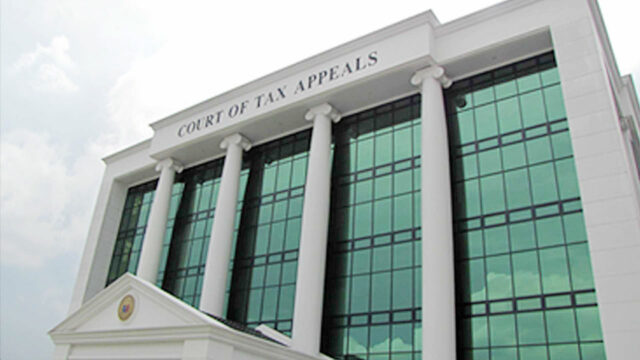
JBC interviews for CTA chief set

CTA.JUDICIARY.GOV.PH

THE Judicial and Bar Council (JBC) will hold public interviews with nominees to the top post of the Court of Tax Appeals (CTA) on Sept. 22-23, the Supreme Court said.

The interviews come in anticipation of the compulsory retirement of CTA Presiding Justice Roman G. Del Rosario, who has served with the court since 2013 and will step down on Oct. 6, upon reaching the mandatory age of 70.

In a notice issued on Thursday, the JBC said the interviews will take place at the Supreme Court Session Hall, pursuant to Section 2, Rule 7 of the 2020-01 Revised Rules of the JBC, as amended.

The interviews on Sept. 22 will cover applicants Marion M. Agaceta, Cresencio V. Aspiras, Jr., Rosauro Angelito S. David, and Vicky C. Fernandez.

On Sept. 23, the Council will hear from Mare Joseph A. Quirante, Marian Ivy F. Reyes-Fajardo, Ma. Belen M. Ringpis-Liban, and Maria Rowena M. San Pedro.

The high court noted that the public may submit sworn complaints, reports, or oppositions against any of the eight applicants until Sept. 22.

Meanwhile, Chief Justice Alexander G. Gesmundo, in his capacity as ex officio chairperson of the JBC, led the signing of a Memorandum of Agreement (MoA) between the JBC and the Integrated Bar of the Philippines (IBP) on Sept. 11.

The MoA formalizes the deputization of IBP representatives to conduct independent background checks on applicants for judicial and other key legal posts, including those in the Office of the Ombudsman, the CTA, and the Legal Education Board.

According to the Supreme Court, the agreement seeks to bolster the credibility of the judicial selection process by ensuring only candidates of proven competence, integrity, and independence are nominated.

“[The partnership] fortifies our shared mission to ensure that the selection process is guided by integrity, transparency, and excellence,” JBC regular member retired CTA Associate Justice Erlinda Piñera Uy said.

“To recommend only the most qualified, competent, and morally upright individuals to positions of public trust,” she added.

IBP National President Allan G. Panolong, for his part, emphasized that the partnership reinforces the “gateway through which our public entrusts the awesome power of judgment to men and women who will decide actual cases and controversies, safeguard rights, and vindicate the rule of law.”

In line with the agreement, the parties also approved guidelines detailing the role of IBP representatives, outlining eligibility, duties, and ethical standards, with emphasis on confidentiality, impartiality, and data privacy. — Erika Mae P. Sinaking

PHL acting on corruption, Recto says

FINANCE SECRETARY RALPH G. RECTO — PCO

FINANCE Secretary Ralph G. Recto assured Japanese investors of the Philippine government’s commitment to address corruption even as the country grapples with over P118 billion lost to anomalous flood control projects annually since 2023.

“[Y]ou will be welcomed by a government that is not only transparent and guided by good governance but is decisive and unafraid to act and address corruption. We will continuously earn your trust and confidence by protecting your investments and delivering on our promises,” he said in a statement on Friday.

Mr. Recto said this during the Philippine Economic Briefings held in Osaka, Japan, which was gathered more than 280 Japanese investors and guests.

The Philippine government has launched a corruption probe in public works, particularly in anomalous flood control projects.

Last week, President Ferdinand R. Marcos, Jr. has issued Executive Order No. 94 to form the Independent Commission for Infrastructure to probe the public works covering past 10 years ago.

“Our goal is simple: to dramatically increase the footprint of the 3,018 Japanese-owned projects already thriving in the Philippines, most of which are in the manufacturing sector,” Mr. Recto said.

In a separate statement, the Department of Finance (DoF) said the Philippine delegation met with senior executives of top Japanese companies, namely Sojitz Corp., Mitsui & Co, Koshidaka Holdings Co., Ltd., and Marubeni Corporation.

“In February 2025, Koshidaka’s Board approved the establishment of a 100%-owned Philippine subsidiary that will spearhead the group’s ASEAN (Association of Southeast Asian Nations) expansion, leveraging the Philippines’ deep cultural affinity for karaoke, its strong youth demographic, and its growing middle-class leisure spend,” the DoF said.

The DoF said the initial rollout will be in Metro Manila, with the first Karaoke Manekineko outlet scheduled to open by 2026, and an expansion plan of up to 100 outlets nationwide over the long term. — Aubrey Rose A. Inosante

Livelihood aid for street dwellers sought

PHILIPPINE STAR/ BOY SANTOS

THE Department of Social Welfare and Development (DSWD) should consider broadening a livelihood assistance program for street dwellers, House Speaker Ferdinand Martin G. Romualdez said on Sunday, describing it as a key measure to help reduce poverty.

He said the DSWD’s Pag-Abot program fills a “critical social safety net… in our poverty alleviation measures,” and the House of Representatives is committed to helping the agency expand its aid program.

“We will ensure that sufficient resources are provided for these programs,” he said in a statement.

The DSWD’s Pag-Abot program started in 2023 and has provided assistance to about 1,245 individuals, including 751 street dwellers, according to the agency’s website. — Kenneth Christiane L. Basilio

UAAP unveils full schedule of Season 88 basketball games

UNIVERSITY OF THE PHILIPPINES FIGHTING MAROONS — FACEBOOK.COM/UAAPVARSITYCHANNEL

REIGNING champion University of the Philippines (UP) takes on host University of Santo Tomas (UST) in the UAAP Season 88 opener next Sunday but has its sights locked on modern day rival De La Salle University in the penultimate game day of the first round on Oct. 19, both at the UST Quadricentennial Pavilion.

The UP Fighting Maroons will parade former UAAP Mythical Five member Rey Remogat from the University of the East (UE) Red Warriors after completing his residency to reinforce their core, looming as the team to beat anew after four straight finals appearances.

Winner of two titles in the past four seasons including a three-peat in the Filoil Preseason, the wards of coach Goldwin Monteverde will also have a key Battle of Katipunan against neighbor Ateneo de Manila University on Oct. 8 at the Mall of Asia Arena, as per the full first-round schedule released by the league.

Prior to that, Mr. Remogat and UP will face his former squad UE on Sept. 28 at the Smart Araneta Coliseum.

Starring in the famed Blue-Green rivalry is the vengeful La Salle without Kevin Quiambao, who’s already in Korea, against the erstwhile multi-titled but now in rebuilding phase Ateneo under the watch of Tab Baldwin.

Mr. Quiambao won back-to-back MVPs for La Salle, which he also towed to back-to-back finals including a championship in Season 86 but fell prey to UP’s redemption in Season 87 before jumping to pros in the Korean Basketball League.

WOMEN’S BASKETBALL
In women’s basketball, reigning champion National University (NU) and Santo Tomas figure in a rematch on Oct. 1 with the Growling Tigresses enjoying homecourt advantage at the UST Q Pavilion.

Serving as the opening weekend on Sept. 20 and 21 are all eight schools at the same venue, which serves as the main hub for Santo Tomas’ hosting with the unavailability of most venues at least in the first month due to the ongoing FIVB Volleyball Men’s World Championship at the MOA Arena and Big Dome.

UP and Santo Tomas take centerstage at 4:30 p.m. on Sept. 21 after the duel between NU and UE at 2 p.m. The first salvo of the back-to-back opening weekend features Far Eastern University against Ateneo at 2 p.m. then La Salle against Adamson University at 4:30 p.m. on Sept. 20.

All squads led by their head coaches and team captains will meet in a press conference Monday in Greenhills for a calm before the storm to be kickstarted by a grand opening ceremony on Sept. 19 at UST Grandstand and Open Field with an expected attendance of up to 30,000 fans.

Santo Tomas will extend its tradition of “Welcome Walk” for all student-athletes from member schools in the grand opener marked by a mass in celebration of the Jubilee Hope Year, ceremony proper and a finale concert like its annual Paskuhan.

In the finale concert, Santo Tomas will launch the season’s theme and official song named “Strength in Motion, Hope in Action” written by assistant professor Louell Baldoza of UST Institute of Religion and interpreted by Santo Tomas alumnus, OPM singer-songwriter and Callalily band frontman Kean Cipriano.

Topping off the ceremony is lighting of the cauldron then a drone and fireworks display to officially declare the games open. — John Bryan Ulanday